Showing posts with label capcom. Show all posts

Friday, October 2, 2026

Bookmark This Page; Street Fighter 6 is a master class in game design

Street Fighter 6 was a revelation when it was released in 2023. My deep dive on the game almost sent me to the hospital. If you want to find out why I called it a master class in game design then Bookmark This Page.

The Street Fighter 6 master class index

Street Fighter 6: A master class in game design, part 1

Street Fighter 6: A master class in game design, part 2

Street Fighter 6: A master class in game design, part 3

Street Fighter 6: A master class in game design, part 4

Street Fighter 6: A master class in game design, part 5

Street Fighter 6: A master class in game design, part 6

Street Fighter 6: A master class in game design, part 7

Street Fighter 6: A master class in game design, part 8

Street Fighter 6: A master class in game design, part 9

Street Fighter 6: A master class in game design, part 10

Street Fighter 6: A master class in game design, part 11

Street Fighter 6: A master class in game design, part 12

Street Fighter 6: A master class in game design, part 13

Street Fighter 6: A master class in game design, part 14

Street Fighter 6: A master class in game design, part 15

Street Fighter 6: A master class in game design, part 16

Street Fighter 6: A master class in game design, part 17

Street Fighter 6: A master class in game design, part 18

Street Fighter 6: A master class in game design, part 19

Street Fighter 6: A master class in game design, part 20

Street Fighter 6: A master class in game design, part 21

Street Fighter 6: A master class in game design, part 22

Street Fighter 6: A master class in game design, part 23

Street Fighter 6: A master class in game design, part 24

Street Fighter 6: A master class in game design, part 25

Street Fighter 6: A master class in game design, part 26

Street Fighter 6: A master class in game design, part 27

Street Fighter 6: A master class in game design, part 28

Street Fighter 6: A master class in game design, part 29

Street Fighter 6: A master class in game design, part 30

Street Fighter 6: A master class in game design, part 31

Street Fighter 6: A master class in game design, final part

What was your impression of Street Fighter 6, was it the best game in the series or not? Tell me about it in the comments section. As always if you enjoyed this blog, and would like to sponsor me please visit my Patreon page and consider donating each month, even as little as $1 would help make better blogs and even podcasts!

follow the Street Writer on Patreon!

Friday, September 18, 2026

Bookmark This Page; Looking at the character designs in Street Fighter V, and Street Fighter 6

I am probably best known for my deep dives on fighting game character designs. If you want to see what I did not like about Street Fighter V’s character designs, or my initial reactions to the SF6 designs then Bookmark This Page.

The return of Charlie Nash, or how zombies make the best fighters...

Necalli, a first look and second take on the new Street Fighter V character...

A look at Ed from Street Fighter V, design meets legacy...

How age and gender helped make the Street Fighter cast unique...

Zeku, the ninja spirit from the '70s finally returns!

From Strider to Zeku, where did the lighting-quick ninja come from?

G, or the evolution of power-hungry characters in fighting games

The new Evil Ryu, a look at Kage

A quick take on Luke, the new Street Fighter.

Capcom Fighting All Stars, the fighting game that never was. A reprint from 1UP / Capcom-Unity.

A first take on Jamie, the new Street Fighter 6 character

Luke in Street Fighter 6, what's different?

A look at Marisa, the Street Fighter 6 gladiator...

Ken Masters, from champ to chump in Street Fighter 6

A new look for Guile, or correcting a mistake? His update in Street Fighter 6.

A look at Lili, the new native Mexican fighter in Street Fighter 6

E. Honda, the return of a sumo legend in Street Fighter 6

Ed, and Rashid. A look at two Street Fighter V stars in Street Fighter 6

Juri in Street Fighter 6, how her design got better with time

Manon in Street Fighter 6, representing a style over 200 years in the making

Dee Jay is back in Street Fighter 6, is he better than we remember?

A look at JP in Street Fighter 6, is this old money personified?

Dhalsim, and Blanka, the return of the strange characters in Street Fighter 6

The Red Tornado returns in Street Fighter 6, a look at Zangief.

Cammy gets an entirely new look for Street Fighter 6, let's see how

The greatest fighting game boss returns to Street Fighter 6, a look at Gouki

Let's talk about A.K.I., the Dragon Lady of Street Fighter 6

Meet Kimberly, is she the Urban ninja of Street Fighter 6?

Ryu becoming the master in Street Fighter 6, a look at his new path

Chun-Li's new look in Street Fighter 6. Is it a step backwards?

Some details in the Street Fighter 6 trailer I wanted to talk about

Figuring out the changing Street Fighter style, part 1…

Figuring out the changing Street Fighter style, part 2…

Figuring out the changing Street Fighter style, part 3…

Figuring out the changing Street Fighter style, final part

Style Wars, looking at Kimberly in Street Fighter 6, and Isla from King of Fighters XIV.

The Street Fighter 6 pre-order trailer, a love letter to the series, and a look at JP

The Street Fighter 6 pre-order trailer, a look at Manon, the graceful judo practitioner

The Street Fighter 6 pre-order trailer, a look at Marisa, the modern gladiator

Lili gets a makeover, just in time for Street Fighter 6!

Gouki in Street Fighter 6, the greatest fighting game villain has returned

Did you enjoy the character deisgns from Street Fighter V or 6 more? Tell me about it in the comments section. As always if you enjoyed this blog, and would like to sponsor me please visit my Patreon page and consider donating each month, even as little as $1 would help make better blogs and even podcasts!

follow the Street Writer on Patreon!

Wednesday, May 20, 2026

Bookmark This Page; 30 years of Street Fighter, 30 Days of Characters

Street Fighter is my favorite fighting game series by a mile. If you want to learn about my favorite characters from the SF universe over the past 30+ years then Bookmark This Page.

30 Years of Street Fighter, 30 Days of Characters; #30

30 Years of Street Fighter, 30 Days of Characters; #29

30 Years of Street Fighter, 30 Days of Characters; #28

30 Years of Street Fighter, 30 Days of Characters; #27

30 Years of Street Fighter, 30 Days of Characters; #26

30 Years of Street Fighter, 30 Days of Characters; #25

30 Years of Street Fighter, 30 Days of Characters; #24

30 Years of Street Fighter, 30 Days of Characters; #23

30 Years of Street Fighter, 30 Days of Characters; #22

30 Years of Street Fighter, 30 Days of Characters; #21

30 Years of Street Fighter, 30 Days of Characters; #20

30 Years of Street Fighter, 30 Days of Characters; #19

30 Years of Street Fighter, 30 Days of Characters; #18

30 Years of Street Fighter, 30 Days of Characters; #17

30 Years of Street Fighter, 30 Days of Characters; #16

30 Years of Street Fighter, 30 Days of Characters; #15

30 Years of Street Fighter, 30 Days of Characters; #14

30 Years of Street Fighter, 30 Days of Characters; #13

30 Years of Street Fighter, 30 Days of Characters; #12

30 Years of Street Fighter, 30 Days of Characters; #11

30 Years of Street Fighter, 30 Days of Characters; #10

30 Years of Street Fighter, 30 Days of Characters; #9

30 Years of Street Fighter, 30 Days of Characters; #8

30 Years of Street Fighter, 30 Days of Characters; #7

30 Years of Street Fighter, 30 Days of Characters; #6

30 Years of Street Fighter, 30 Days of Characters; #5

30 Years of Street Fighter, 30 Days of Characters; #4

30 Years of Street Fighter, 30 Days of Characters; #3

30 Years of Street Fighter, 30 Days of Characters; #2

30 Years of Street Fighter, 30 Days of Characters; #1

Who is your favorite Street Fighter universe character? Tell me about it in the comments section. As always if you enjoyed this blog, and would like to sponsor me please visit my Patreon page and consider donating each month, even as little as $1 would help make better blogs and even podcasts!

follow the Street Writer on Patreon!

Monday, May 4, 2026

Bookmark This Page; Art, graphics, and aesthetics in fighting games

Video game players sometimes use the word graphics, when instead they mean the aesthetics, or art style of the game. If you want to learn about some of the most unique looking fighters then Bookmark This Page.

The aesthetic versus graphics debate, part 1…

The aesthetic versus graphics debate, part 2…

The aesthetic versus graphics debate, part 3…

The Style Files, Voltage Fighter Gowcaizer & Goketsuji Ichizoku aka Power Instinct

The Style Files, Psikyo and the aesthetic copies

The Style Files, Daraku Tenshi: The Fallen Angels, part 1

The Style Files: Daraku Tenshi The Fallen Angels, part 2...

Did you get a chance to play any of these fighting games? Let me know about it in the comments section. As always if you enjoyed this blog, and would like to sponsor me please visit my Patreon page and consider donating each month, even as little as $1 would help make better blogs and even podcasts!

follow the Street Writer on Patreon!

Monday, April 27, 2026

Wednesday, April 1, 2026

Bookmark This Page; How fight culture became fighting game history

One of the first series I created for this blog was a look at the martial arts legends that inspired many of our favorite characters, and games. If you want to learn the ancient history of modern games then Bookmark This Page.

How fight culture became fighting game history, part 1…

How fight culture became fighting game history, part 2…

How fight culture became fighting game history, part 3…

How fight culture became fighting game history, part 4…

How fight culture became fighting game history, part 5…

How fight culture became fighting game history, part 6…

How fight culture became fighting game history, part 7…

How fight culture became fighting game history, part 8…

How fight culture became fighting game history, part 9…

How fight culture became fighting game history, part 10…

How fight culture became fighting game history, part 11…

How fight culture became fighting game history, part 12…

How fight culture became fighting game history, part 13…

How fight culture became fighting game history, part 14…

How fight culture became fighting game history, part 15…

How fight culture became fighting game history, part 16…

How fight culture became fighting game history, part 17…

How fight culture became fighting game history, part 18…

How fight culture became fighting game history, part 19…

How fight culture became fighting game history, part 20…

How fight culture became fighting game history, part 21…

How fight culture became fighting game history, part 22…

How fight culture became fighting game history, part 23…

How fight culture became fighting game history, part 24…

How fight culture became fighting game history, part 25…

How fight culture became fighting game history, part 26…

How fight culture became fighting game history, part 27…

How fight culture became fighting game history, part 28…

How fight culture became fighting game history, part 29…

How fight culture became fighting game history, part 30…

How fight culture became fighting game history, part 31…

How fight culture became fighting game history, part 32…

How fight culture became fighting game history, part 33…

How fight culture became fighting game history, part 34…

How fight culture became fighting game history, part 35…

How fight culture became fighting game history, part 36…

How fight culture became fighting game history, part 37…

How fight culture became fighting game history, part 38…

How fight culture became fighting game history, part 39…

How fight culture became fighting game history, part 40…

How fight culture became fighting game history, part 41…

How fight culture became fighting game history, part 42…

How fight culture became fighting game history, part 43…

How fight culture became fighting game history, part 44…

How fight culture became fighting game history, part 45…

How fight culture became fighting game history, part 46…

How fight culture became fighting game history, part 47…

How fight culture became fighting game history, final part…

Did you have a favorite legend, or real world fighter that you were inspired by? Let me know about it in the comments section. As always if you enjoyed this blog, and would like to sponsor me please visit my Patreon page and consider donating each month, even as little as $1 would help make better blogs and even podcasts!

follow the Street Writer on Patreon!

Saturday, December 28, 2024

The Return of Virtua Fighter, part 2...

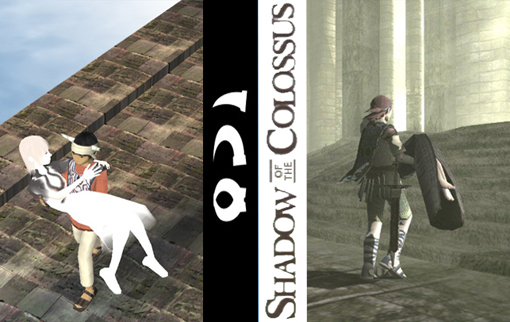
The announcement of a new Virtua Fighter at the 2024 Game Awards was a pleasant surprise. The only reveal I was more excited about was a new game from Fumito Ueda, and his team at gen DESIGN. These were the people formerly on Team Ico at Sony Studios Japan. Both ICO, and Shadow of the Colossus were a revelation for me. The game reveals were also a little melancholy for me. A long time had indeed passed between titles. I’m talking about major life changes; new jobs, getting married, raising a kid before I saw another sequel. I began thinking of how much history I had with the games. I began thinking of how much the industry had changed throughout the decades. I especially began to focus on how my love of Sega games went back a few generations.
There was another reason why the game reveals made me reflect. You see in November of 2024 I celebrated my 50th birthday. It was a bittersweet time. A relative came down with a medical emergency in the fall of 2024. My wife sprung into action, and moved in to help take care of this person. The original plan was for a few days, maybe a week. That had turned into almost 4 months and counting. We were apart for our wedding anniversary, Halloween, my birthday, Thanksgiving, Christmas, and the New Year. The time, and distance had been heavy for us, especially with no reunion in sight. This health issue made me think of my own life, and mortality as well.
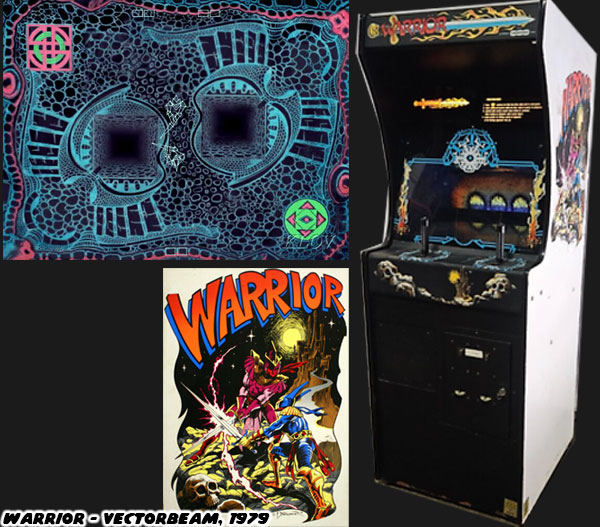
I realized that I’d been a fan of video games, and specifically fighting genre for almost as long as I’d been alive. Yet at no point did I ever think that it was time wasted. My first fighting game memory went back years before the creation of Street Fighter. It was the extremely rare Warrior by Vectorbeam. I was five-years-old when it came out. The innovative top-down view, sword combat, and painted background of the arcade cabinet sparked my imagination. It also made me realize that fighting games could be more than a boxing sim. They could be about knights, karate masters, and even dinosaurs! I would argue that 1984 was the most important year for the development of the fighting genre. This was two years before the original Street Fighter, and the template of the brawler was revealed through Renegade.
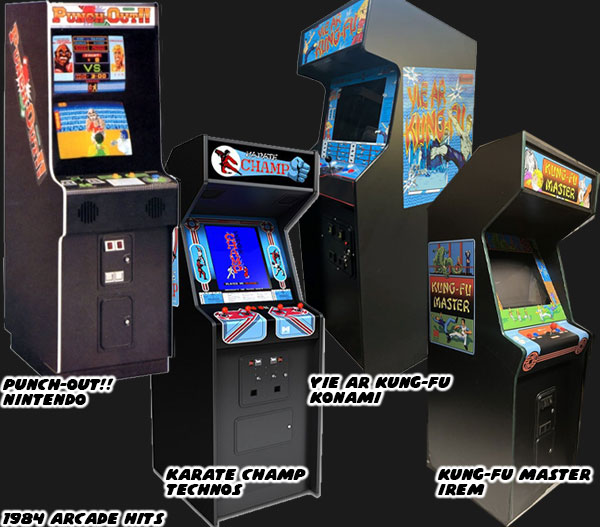
Punch-Out!!, Karate Champ, Yie Ar Kung-Fu, and Kung-Fu Master all came out in ’84. Each influenced the studios, and developers that would create the modern fighting game. I was grateful that I had a chance to play through them when they debuted. In fact I was born at the perfect time to experience the peak years of the arcade revolution. The memories I had of the dozens of arcades I frequented, and hundreds of games that I’d played were irreplaceable to me. I would not have changed one thing about the time I spent playing video games. Especially not after I discovered fighting games. I was grateful for each, and every title that I enjoyed over my time on Earth. Knowing that Virtua Fighter was getting a reboot, and celebrating 30 years made me realize that I first played the game when I was 20-years-old. This also meant that the architects of the genre were getting old too.
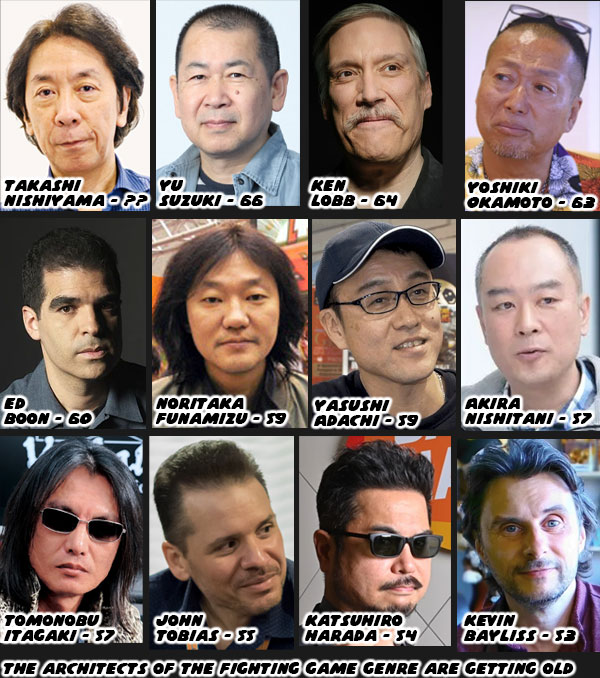
The masterminds behind Street Fighter, Fatal Fury, the King of Fighters, Mortal Kombat, Killer Instinct, Tekken, Samurai Shodown, Virtua Fighter, and more were now in their 50’s, and 60’s. A few of them were retired, if not considering retirement. This meant that some games, and entire genres could potentially die off. It was important for the publishers to have younger talent take over the projects. New directors, and producers to be just as passionate about the genre as their mentors. This ensured that the games would continue to grow, evolve, and remain fresh. I wasn’t a fan of Yoshinori Ono as the producer of Street Fighter IV, and V. I did appreciate his enthusiasm, and how he pushed Capcom to bring the franchise back after almost a decade after SFIII had been released. I believe that his eye would have worked better on a series like Vampire / Darkstalkers.
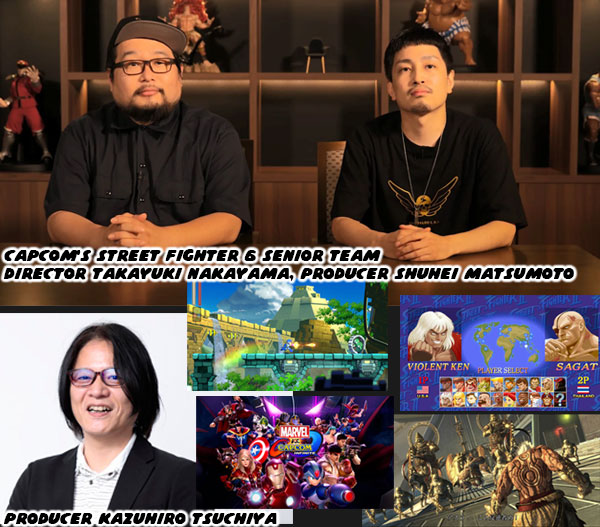
I was much happier with the team putting together Street Fighter 6. Mr. Nakayma, Mr. Matsumoto, and Mr. Tsuchiya had been with Capcom for years. They were ready to slide into their new roles, and take over the franchise. They managed to honor the legacy of Street Fighter, Final Fight, and bring in elements from 40 years of Capcom games without breaking the continuity of the series. They were able to update the game play, the elements that modern audiences expected from a video game, and even help bring new players up to speed. Most important they were also young. They would be able to carry their passion, and insight to SF for years to come. Not every classic series had these types of directors. Many of those games faded away from relevancy once their creators left the studio.
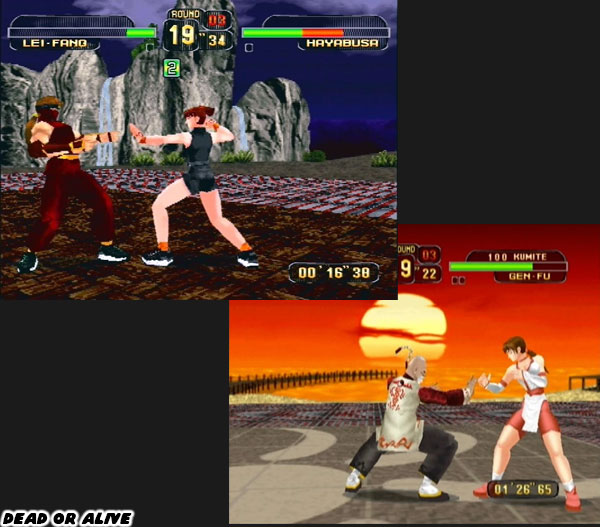
It may seem hard to believe but Virtua Fighter was such an important game that it changed the direction of the industry. In 1991 Capcom already created a global phenomenon with Street Fighter II. This made every studio in Japan, and the US start developing their own fighting games. A few years later Sega demonstrated that 3D would be the next step in the process. Companies that weren’t already developing their own 3D engines were at a loss. They could however license the work from Sega for their own titles. Some gamers may not know this but the original Dead or Alive arcade game was built on the Model 2 engine, the same one that powered Virtua Fighter 2. The game’s creator Tomonobu Itagaki had been described as a creep. It was no surprise that the girls in his fighting game had very bouncy breast physics applied to their models. He left Tecmo with many of his Team Ninja developers to strike out on his own. He eventually closed his studio in 2024. Dead or Alive managed to make it to DOA 6 which was released in 2019, with no word on another sequel.
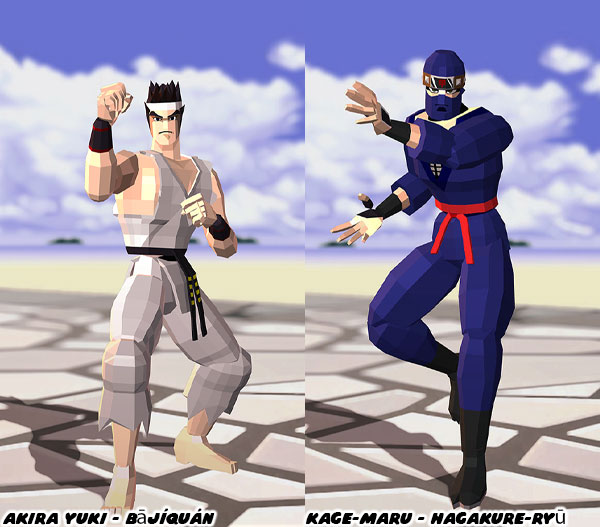
That was not to say that Virtua Fighter was a superior experience to Street Fighter II, or many other sprite-based fighting games from the early ‘90s. The game play was not as quick, or as intuitive as audiences were used to from 2D fighters. Visually however Sega was offering something that was unlike anything else in the arcade. When you saw a Sega 3D engine in a racing game, air combat, or Star Wars title then you immediately took notice. The visuals were so unlike anything else in the arcade that players were instantly drawn to them. In the early 1990’s 3D human models were still in their infancy. People were so blocky that the team at Sega referred to them as robots. They looked embarrassingly like somebody wearing cardboard boxes. To my knowledge the only fictional style in the original game was given to the ninja Kage-Maru. Yet it was still inspired my elements of actual ninjitsu.
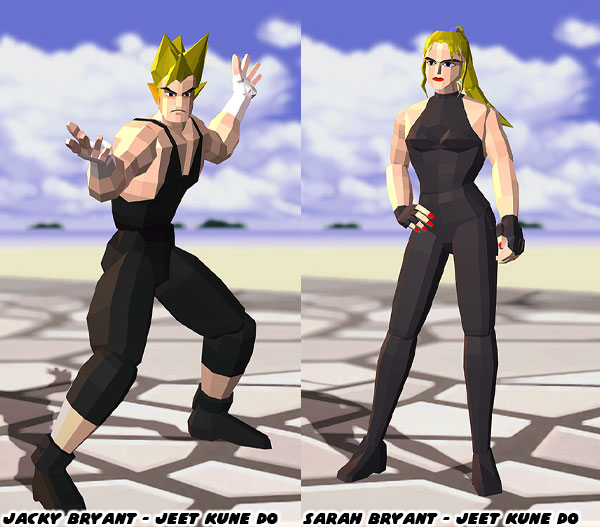
Series creator Yu Suzuki knew what he was doing. Smooth, perfect 3D characters were not his goal. The team at AM2 were using every trick at their disposal to create a solid engine that they could improve upon. Knowing that people would look more realistic in every future iteration. The team also focused on creating a library of characters that represented a broad spectrum of fighting arts. Each sequel would introduce another fighting style. The brother, and sister team of Jacky, and Sarah Bryant used Bruce Lee’s very own Jeet Kun Do aka the Way of the Intercepting Fist. They were fast, flashy, and designed to appeal to western audiences. They were not the only relatives in the game.
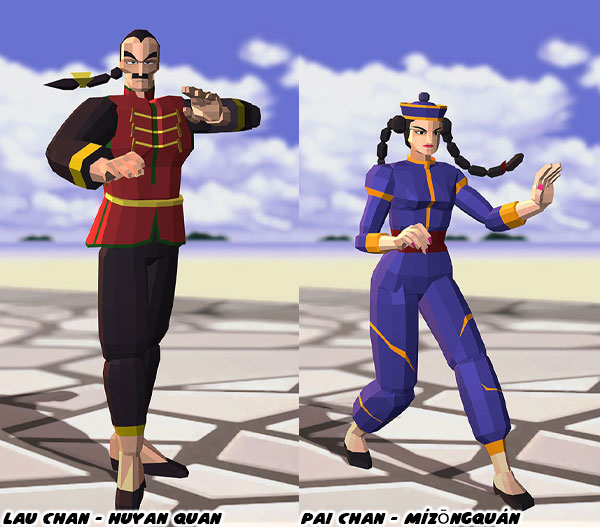
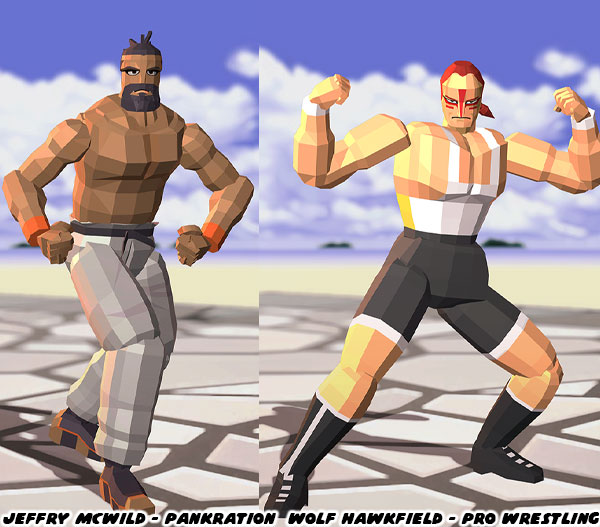
The Chinese father, and daughter pair of Lau, and Pai Chan were central to the story as well. They were a sort of classic martial arts cinema archetype that was universally understood. Anyone that approached the game could tell that they used some form of kung-fu. Then there were the two heavy hitters in the game, the ones that I favored. The Native character Wolf Hawkfield, and the Caribbean Jeffry McWild. Although Wolf was light skinned it was nice to see some form of Native representation in a game. The same applied to Jeffry. The duo were so popular that they would appear in future pro wrestling games as well.
With a cast, and engine in place it was only a matter of time before the rival studios would have an answer to VF. The first would be Tekken. Namco had been going back-and-forth with Sega on everything they released. Just because they went from 2D sprites to 3D polygons didn’t mean the rivalry would end. There was not one genre where the two publishers did not have direct competition. Tekken floored audiences with their textured polygons. These stood apart from Sega's flat shaded polygons. Visually Tekken looked like the superior game, even if the frame rate or other elements weren’t as well done as VF. Each sequel from the two companies felt like a call, and answer.
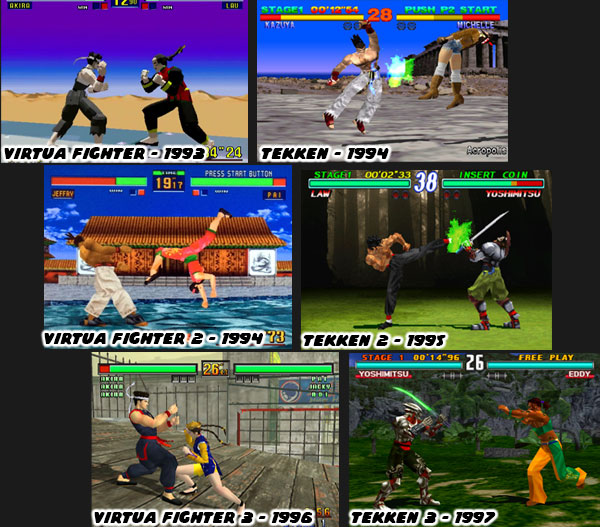
The differences between the two games were tiny, but their impact to the community was tremendous. The four years from the release of the first VF in 1993 to Tekken 3 in 1997 was a technological leap. The improvement on textures, engine, animation, and frame-rate was apparent in the Virtua Fighter 2 arcade intro. Virtua Fighter was focused on realism rather than the more fantastic Tekken. By the time Sega released VF 3 the characters could not only turn their heads to follow opponents, but even turn their eyes as well. Not to mention when they stepped in sand, or snow they left tracks. Doing tiny things like having head tracking, showing damage, and even breathing was an unheard detail in any other game. Suddenly Capcom’s reputation as the best fighting game developer was in doubt.
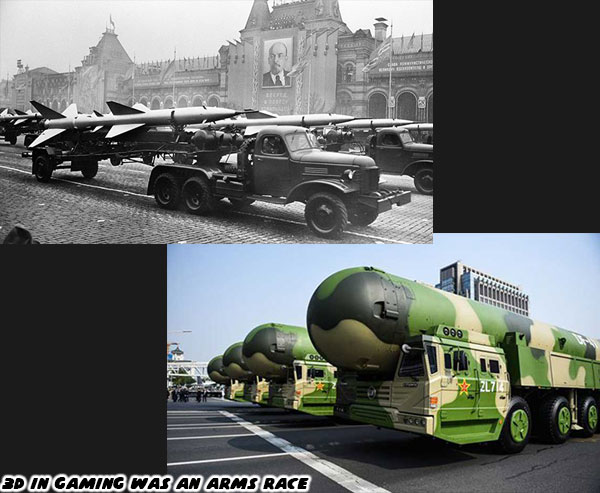
Sega, and Namco had turned the fighting game community upside down in the mid-‘90s. This made every major publisher increase funding into 3D R&D, helping push the entire entertainment industry forward. What many people didn’t realize was that Sega, and Namco relied on outside contractors to help create next generation 3D graphics. Namco built their System-22 engine on simulator tech from Evans & Sutherland. Sega developed the Model 3 board with military-level technology from General Electric Aerospace Simulation & Control Systems. The two publishers created an arms race. This applied equally to arcade, and console developers. Whichever company could bring 3D graphics home for a reasonable price would win the war.
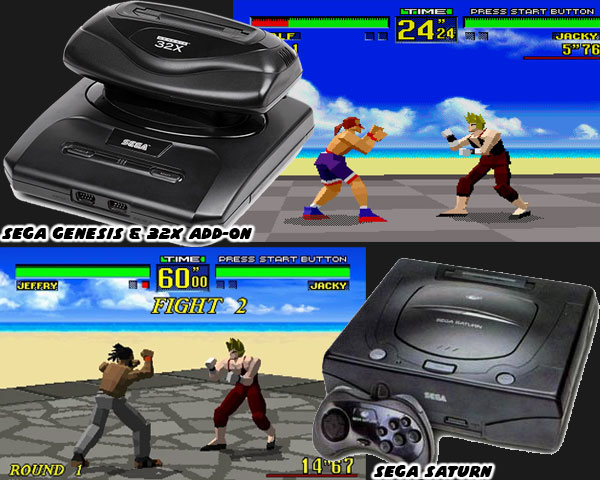
Sega was able to bring some 3D games home. They made a decent 16-bit adaptation of VF using the 32-X add-on for the Sega Genesis. A closer arcade-quality version would appear on the 32-bit Sega Saturn as well. Not to be outdone Namco partnered with Sony to create an arcade-perfect version of Tekken for the new Playstation console. Fighting games were not the only titles to help move consoles, but they certainly helped. The shift from 2D to 3D was pushed along thanks to Sega and Namco. More than 30 years had now passed. Mr. Harada, and his team were still keeping Tekken alive. Sega had drifted away from many of their biggest hits through the 2000's and 2010’s. How would Virtua Fighter become relevant once more, and especially with Mr. Suzuki talking about retirement? We’ll talk about it in the next blog. Were you a fan of 2D fighters, 3D fighters? How long had you been playing video games? I’d like to hear about it in the comments section. As always if you would like to sponsor me please visit my Patreon page and consider donating each month, even as little as $1 would help make better blogs and even podcasts!
follow the Street Writer on Patreon!

Friday, December 20, 2024

Freeze frame, my poster collection part 23...

I had so many posters in my Capcom collection that I had to break them over several separate blogs. Here's a reminder for any Street Fighter, or fighting game fans in general. If you want to get into collecting the posters then try to track down the game guides from Japan. The gems in my collection came from Gamest. It was the premier arcade magazine through the '90s. When they published guides, which they called MOOKS after Magazine-Book they often included a poster.

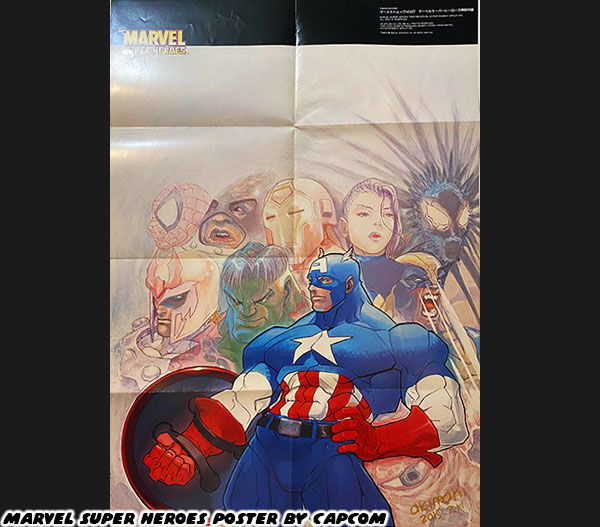
My Marvel Super Heroes poster was actually autographed by AKIMAN, the father of Chun-Li. It was at the San Diego Comic Con at the UDON Booth. The booth did not want to honor their commitment to one autograph per person who purchased one of the Capcom hardcovers. I said I didn't want the autograph on the book, but instead the poster. They pushed back until I talked to the managers, then they told the staff that it was okay, in fact that I could get the autograph on my book too for the hassle.

There are two Muscle Bomber posters that I know of. The first is the same as the main art that most people are familiar with. This version I had no idea existed until I saw it pop up in a Japanese auction site. I was super happy with it, and was one of the official drawings by Tetsuo Hara where I could see the details on the CWA belt that I used as reference for the actual belt I commissioned.

I don't believe in wall scrolls since they usually steal licensed art. I bought this Marvel vs Capcom 3 poster under false pretenses, I was told it was an official poster, and was sent a scroll instead. You just can't trust people online.

The Pocket Fighter is too cute, as is this classic illustration of Sakura.

Do you have a favorite game, or character that you wish you had a poster of? I’d like to read about them in the comments section. As always if you would like to sponsor me please visit my Patreon page and consider donating each month, even as little as $1 would help make better blogs and even podcasts!

follow the Street Writer on Patreon!

Wednesday, December 18, 2024

Freeze frame, my poster collection, part 22…

I had so many posters in my Capcom collection that I had to break them over several separate blogs. Here's a reminder for any Street Fighter, or fighting game fans in general. If you want to get into collecting the posters then try to track down the game guides from Japan. The gems in my collection came from Gamest. It was the premier arcade magazine through the '90s. When they published guides, which they called MOOKS after Magazine-Book they often included a poster.

I thought the 3D remake of Bionic Commando absolutely failed to capture the magic of the original NES hit. I called it one of my favorite games of all time. If you can track down a copy of the 2.5D "Rearmed" remake I implore you to check it out. Sadly the 3D remake failed in every regard, and pretty much buried the franchise.

My friend was actually in Japan for work, and he asked me if he could pick anything up for me. I said anything from Capcom would be great. He got me a Capcom Girls Calendar that featured some art that I do not think was published in any other artbook. It's certainly one of my treasures.

I also have a collection of Capcom Secret Files. These were previews that were only available for arcade operators in Japan. I don't have all of them (yet) but I do have some gems in my collection.

Are there any rare items from a favorite game studio that you're proud of? I’d like to read about them in the comments section. As always if you would like to sponsor me please visit my Patreon page and consider donating each month, even as little as $1 would help make better blogs and even podcasts!
follow the Street Writer on Patreon!

Saturday, December 14, 2024

The Street Fighter 6 master class index

I am grateful for all the new readers to the blog at the end of 2024. I noticed that a number of different entries into my Street Fighter 6 master class were getting shares. For those that do not know I did a 30-part series in 2023. It took a lot out of me, in fact I got super sick because I was spending so much time working on it. I’m pacing myself better now. For those that are interested here are all the links. I discuss the history of Capcom, Street Fighter, Final Fight, and the arcade legacy. We look at the mechanics of fighting games. We dissect the origins of the cast, and how they were improved over time. Plus how the new developers were making everyone a better fighting game player. Please share this if your friends love fighting games. 


As always if you would like to sponsor me please visit my Patreon page and consider donating each month, even as little as $1 would help make better blogs and even podcasts!
follow the Street Writer on Patreon!

Saturday, August 24, 2024

Mai Shiranui returns in Fatal Fury the City of the Wolves...

I don’t know why but I had a massive spike in views the other day. I’m betting it had something to do with the character reveal trailer for Mai Shiranui in Fatal Fury / Garou City of the Wolves. This was a long running series and I had blogged a much earlier this year I even did some character breakdowns for the game for both new, and returning faces. Takashi Nishiyama was the Godfather of the fighting game genre, while he may not have designed Mai Shiranui, he certainly deserved respect from the entire community for the direction of the SNK titles.

I’ve never talked at length about Mai, or most of the characters in the Fatal Fury / King of Fighters franchise by SNK. I played through most of the games, but enjoyed the titles by Capcom just a little bit more. I still loved the characters, and canon they created for audiences. Mai was unique among all the early fighting game girls. The Capcom titles tended to make caricatures of the fighting arts with their cast. The difference for the SNK universe was in their costuming. Very often the Fatal Fury characters were also masters of the fighting arts, but they didn’t always dress the part. That was the genius of the SNK school of art. They hid the masters in plain sight. A world champion level boxer for example could show up in a dress suit, an assassin might sport a fur coat.

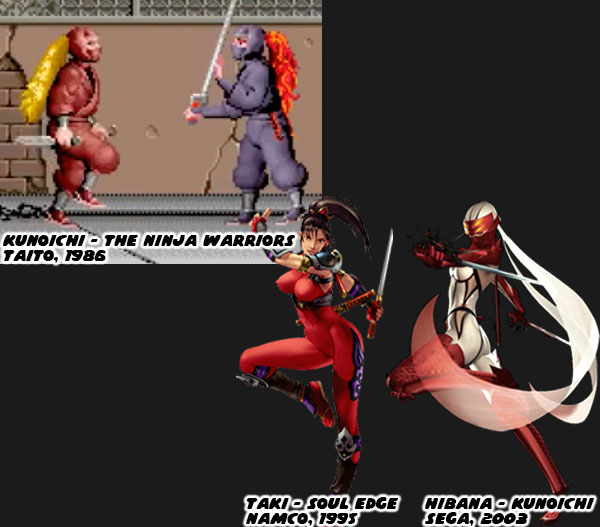
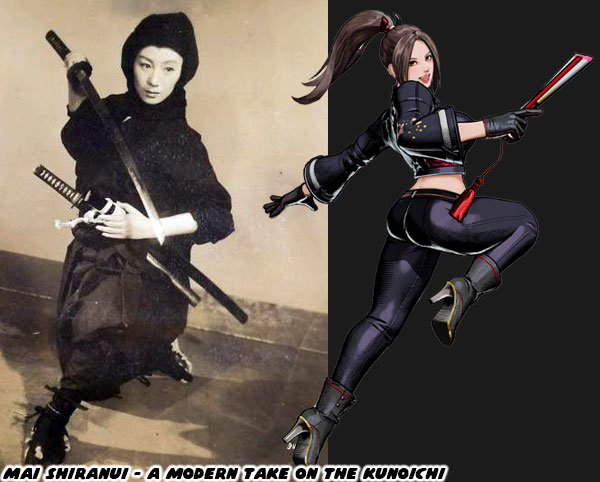
Female ninjas were referred to as kunoichi. They were normally presented with a dark outfit, and a mask. The very first kunoichi in gaming that I remember was in the game The Ninja Warriors. The Taito game used multiple screens, and featured rotoscoped animation. It was an important contribution to the genre with a shocking ending. From there on kunoichi weren’t featured very often in fighting games. I could remember Taki from the Soul Edge series by Namco. To be fair Kunimitsu was a hidden character in Tekken from 1994, she was a boss for Michelle Chang. The last new lady ninja that I could remember was Hibana from the action game Kunoichi (Nightshade) by Sega. She was the successor to the Shinobi franchise. In essence it seemed that a new lead female ninja character would appear once a decade in gaming. 

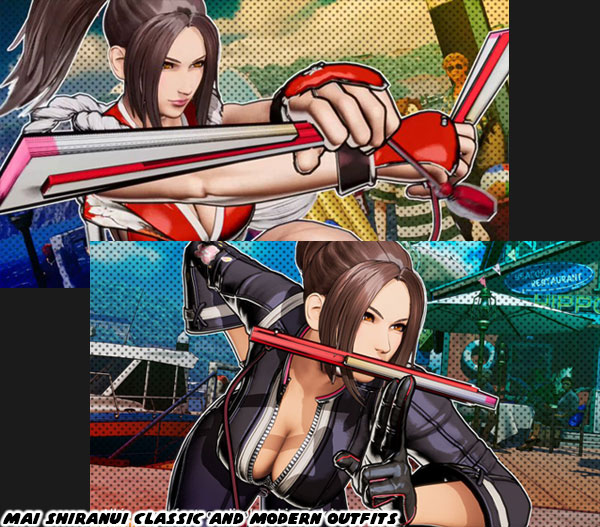
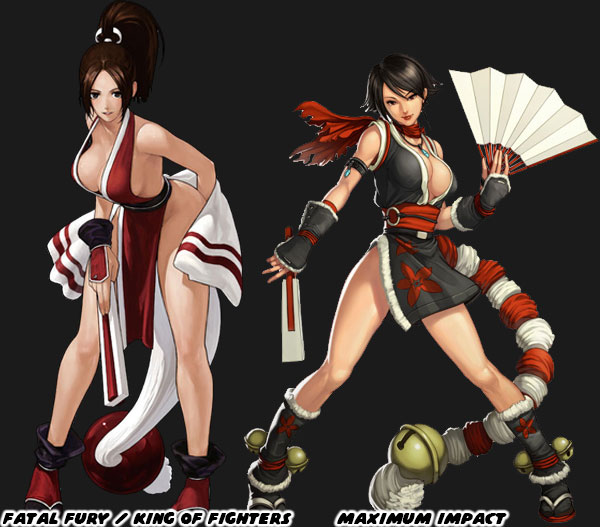
Mai looked nothing like any of the classic lady ninja characters in pop culture. She wore a bright red outfit, that revealed her bosom, and backside. Mai was anything but shy or demure. She was the heiress of the Shiranui clan. Her form of ninjitsu went back centuries, and was closely guarded. Despite protecting her form of fighting the team at SNK made sure she stood out from her contemporaries. This tradition continued into 2024 with an updated form-fitting leather outfit.

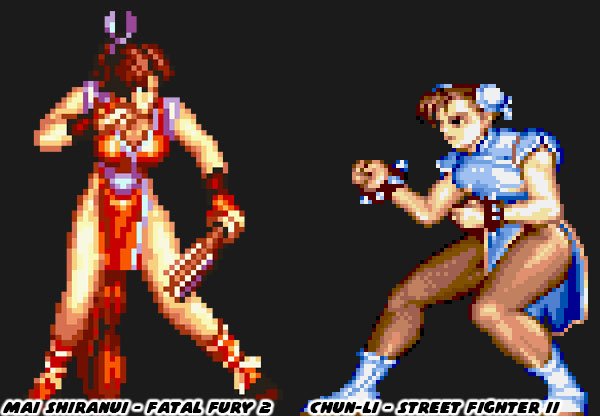
Mai was meant to be a response to Chun-Li. Street Fighter II was more than a fighting game. When it came out in 1991 it became a global phenomenon. A few months after it came out SNK released Fatal Fury, which helped keep the momentum going. Fatal Fury was more than a lucky break, it was more than a studio trying to capitalize on the moment. The game was designed by Mr. Nishiyama. He had created the original Street Fighter back in 1986. He was planning new ideas for a Street Fighter sequel, some of which would inspire Street Fighter ’89, which would later become the arcade hit Final Fight. Mr. Nishiyama changed companies and wanted to try out entirely new play mechanics through Fatal Fury.

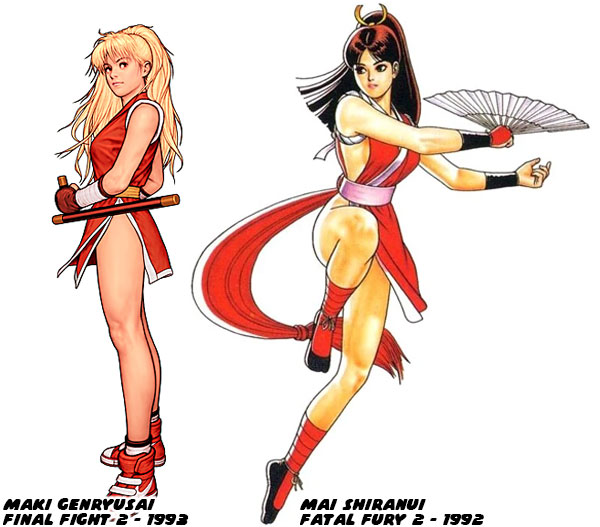
Mai was not in the original Fatal Fury, she debuted in 1992 with the release of Fatal Fury 2. During this time Capcom was developing a Super Famicom / Super Nintendo follow up to Final Fight. The game from 1993 would introduce some new faces, among them a female ninja wearing red, and white. The blonde Maki Genryusai debuted in Final Fight 2. Despite outward appearances she was not a clone of Shiranui. Maki had a completely different move set, her costume, and sneakers were designed to parallel Guy. It was simply coincidence that Mai, and Maki had similar looks. Not only that but Mai was meant with a fighting game in mind, rather than a brawler.

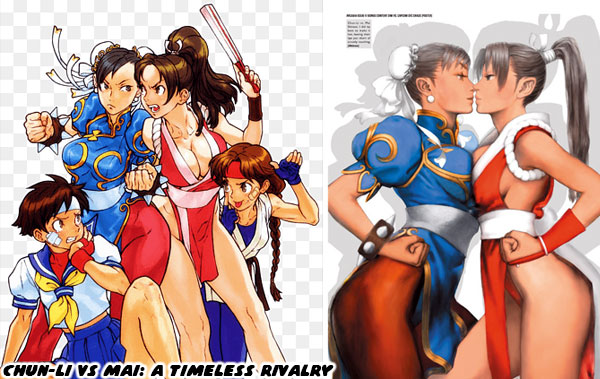
Terry Bogard, and Ryo Sakazaki (Art of Fighting) were a sort of male equivalent to Ken, and Ryu, but the studio needed a strong female lead as well. From the very first day audiences knew that Shiranui was a scene stealer. There was no doubt in our minds that she was going to be the face for the franchise, similar to how Chun-Li was embraced by the global community. When it came to fan art the two female leads were in a category all their own. Capcom and SNK would play up the friendly rivalry in official art, and often present Chun-Li and Mai Shiranui as opponents. Sakura was considered a little sister clone, a jab at Yuri Sakazaki from the Art of Fighting 2. In fact Dan Hibiki was also a parody of Ryo, and Robert Garcia from the Art of Fighting. This is why they sometimes turned up in the Mai vs Chun-Li art as well.With her leather outfit the most recent version of Mai was one of the better contemporary remakes for the character. It was not the first time she was presented with a mostly black costume.

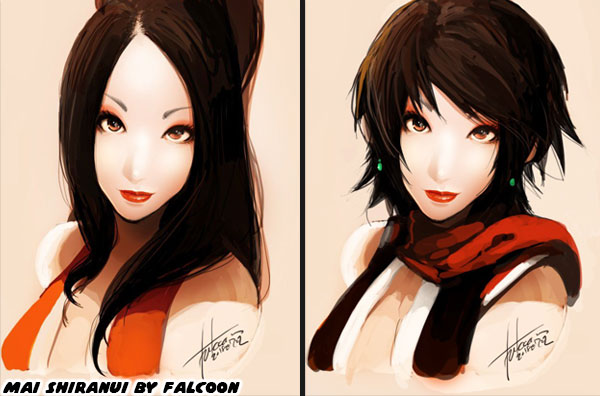
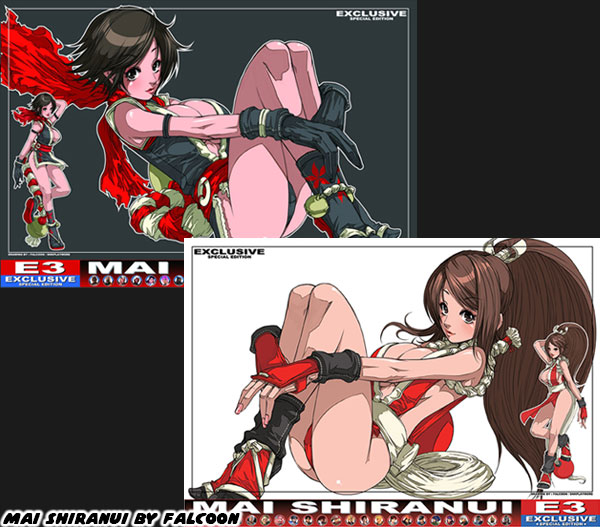
When the Fatal Fury games went to 3D many of the main characters got makeovers in the form of alternate costumes. Noise Factory developed the King of Fighters Maximum Impact in 2004. The updated looks of all the returning characters were well done, and Mai specifically had a bold new design. Her long hair had been cropped short. Her trademark red outfit was swapped to black. The occasional redraws by Tatsuhiko Kanaoka aka Falcoon were memorable.

I am a big fan of Falcoon’s art. I consider his bold style to be the BENGUS equivalent of the SNK art team. Back in 2005 the studio released two limited edition posters at the E3 in Los Angeles. I was able to get the black version of Mai for my little brother. I wish I had known about the signings both days so I could have scored the two prints.

It was great to see the Fatal Fury series continue into the 2020’s. I was glad that there were teams still passionate about the classic fighters. They were keeping the genre alive, and sharing them to an entirely new generation of fans. I’m certain that Mai would reclaim her spot on the fighting ladies Mount Rushmore. What did you think of Mai, and her new look? Were you a fan of any of her redesigns, or did you prefer her classic look? Tell me about it in the comments section. As always if you would like to sponsor me please visit my Patreon page and consider donating each month, even as little as $1 would help make better blogs and even podcasts!
follow the Street Writer on Patreon!

Wednesday, August 14, 2024

Daigo owns Arcadia Magazine! - A 1UP classic from October 11, 2010

Hello friends, I trust you had a good weekend. I picked up the November 2010 issue of Arcadia this weekend. The cover story was a feature on the upcoming Kidou Senshi Gundam: Extreme Vs. an arcade update of the popular Gundam series. It is very much in the vein of the classic Sega title Virtua On.

Despite the big reveal on the Gundam game, this issue was packed with tons of info on Super Street Fighter IV. In particular the official announcement of Yun and Yang in the arcade as well as an interview with Producer Yoshinori Ono.

Joining Ono to talk about the game is the SF phenom Daigo Umehara.

This issue of Arcadia totally belonged to Daigo.

Daigo already had a running column in the magazine but the November issue turned out page after page of interviews and his take on the various fighting games as well as his competition on the international level, including the USA's own Justin Wong.

As if all that weren't enough there was even a manga in the back about a couple of inept bounty hunters trying to track down Daigo.

They never do find Daigo as they spend most of the time springing traps on themselves and getting into trouble.

It's really nice to see how Daigo has come up in popularity in Japan and how Capcom is making sure that the press remembers what games he is famous for. Fame can only take a player so far, skills are what will keep Daigo from being forgotten by the masses. Let's just hope that Capcom might get around to tapping another community member the next time they go about designing a new Street Fighter game...

I'm just saying.

As always if you would like to sponsor me please visit my Patreon page and consider donating each month, even as little as $1 would help make better blogs and even podcasts!
follow the Street Writer on Patreon!