Showing posts with label karate. Show all posts

Wednesday, April 1, 2026

Bookmark This Page; How fight culture became fighting game history

One of the first series I created for this blog was a look at the martial arts legends that inspired many of our favorite characters, and games. If you want to learn the ancient history of modern games then Bookmark This Page.

How fight culture became fighting game history, part 1…

How fight culture became fighting game history, part 2…

How fight culture became fighting game history, part 3…

How fight culture became fighting game history, part 4…

How fight culture became fighting game history, part 5…

How fight culture became fighting game history, part 6…

How fight culture became fighting game history, part 7…

How fight culture became fighting game history, part 8…

How fight culture became fighting game history, part 9…

How fight culture became fighting game history, part 10…

How fight culture became fighting game history, part 11…

How fight culture became fighting game history, part 12…

How fight culture became fighting game history, part 13…

How fight culture became fighting game history, part 14…

How fight culture became fighting game history, part 15…

How fight culture became fighting game history, part 16…

How fight culture became fighting game history, part 17…

How fight culture became fighting game history, part 18…

How fight culture became fighting game history, part 19…

How fight culture became fighting game history, part 20…

How fight culture became fighting game history, part 21…

How fight culture became fighting game history, part 22…

How fight culture became fighting game history, part 23…

How fight culture became fighting game history, part 24…

How fight culture became fighting game history, part 25…

How fight culture became fighting game history, part 26…

How fight culture became fighting game history, part 27…

How fight culture became fighting game history, part 28…

How fight culture became fighting game history, part 29…

How fight culture became fighting game history, part 30…

How fight culture became fighting game history, part 31…

How fight culture became fighting game history, part 32…

How fight culture became fighting game history, part 33…

How fight culture became fighting game history, part 34…

How fight culture became fighting game history, part 35…

How fight culture became fighting game history, part 36…

How fight culture became fighting game history, part 37…

How fight culture became fighting game history, part 38…

How fight culture became fighting game history, part 39…

How fight culture became fighting game history, part 40…

How fight culture became fighting game history, part 41…

How fight culture became fighting game history, part 42…

How fight culture became fighting game history, part 43…

How fight culture became fighting game history, part 44…

How fight culture became fighting game history, part 45…

How fight culture became fighting game history, part 46…

How fight culture became fighting game history, part 47…

How fight culture became fighting game history, final part…

Did you have a favorite legend, or real world fighter that you were inspired by? Let me know about it in the comments section. As always if you enjoyed this blog, and would like to sponsor me please visit my Patreon page and consider donating each month, even as little as $1 would help make better blogs and even podcasts!

follow the Street Writer on Patreon!

Wednesday, July 6, 2022

Figuring out the changing Street Fighter style, part 1...

Over the last month I had talked a lot about the new, and returning faces in Street Fighter 6. I studied their outfits, the colors assigned to them, their nationality, and physical build. I did my best to try to figure out their roots, and fighting method, and share it with the visitors to my blog. In the end it reminded me that there was a style of character design that could be considered uniquely “Street Fighter.” By that same token there was a style of design that worked for Mortal Kombat, Tekken, King of Fighters, and Killer Instinct. The aesthetic of Capcom was distinct. This was thanks to the legacy of artists that had worked there. Akiman, Shoei, Bengus, Daigo Ikeno, Edayan, Kinu Nishimura were brilliant artists that had a hand in developing the style, and direction of the SF series.
The newest designer Yusuke Hashimoto, was now putting his own unique stamp on the lineup. Yusuke had produced Bayonetta, so he was comfortable designing all manner of characters with different outfits, skin colors, builds, and body types. In short, he was the perfect person to shape the direction of this generation of fighters. With that said let’s try to figure out what made the “SF Style” distinct. The most obvious thing would be the costumes the characters wore. Could you really put a SF character in just any outfit, and would it work within the context of the game? I’m not saying that every character had to be wearing an authentic martial arts costume. That type of visual storytelling did not work great in SF. Instead there was a mix of pseudo-authentic costumes, and casual uniforms to break up the monotony. Consider for a moment what it would look like if everyone in the lineup wore casual clothing. Concept artist Xin Wang came up with fashionable makeovers for the SF cast in the Chinese mobile game Street Fighter: Duel. I would argue that Mr. Hashimoto’s designs were sort of a counter to that. He wanted to bring back the classics, but not go overboard with their costumes.
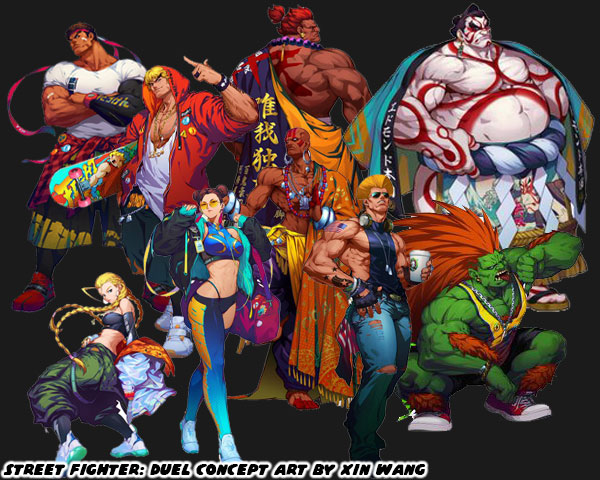
Long time fans would enjoy seeing their favorite characters in new outfits. However what did this do to new players? How did the game change by shifting just one element? Were new players able to make out the style of fighting that a character represented based on casual wear? Were they able to figure out what they could do based on the color of their skin, or their physical size? Now consider what costumes affected from a game play perspective. Was it easy to read the action on the screen if a character was covered up with long sleeves, or pants? What about vivid patterns, or clashing color choices on an outfit? Did these things make it easier to play the game, or were they distracting? I could argue similar points for excessive splashes of color, lightning, fire, smoke, etc. while the characters performed special attacks. There were many individual elements that made up the main costume choices for the SF cast. In the early days arcade cabinets, and game consoles lacked the memory, and processing power to render anything too detailed. The developers were limited to a simple outfit, and a primary color. This set the standard that was copied the world over. Now that consoles, and even mobile devices were more powerful then it became easier to create characters with highly detailed outfits, and millions of color choices. Was is then critical to take advantage of all this processing power? Or did putting too much into a costume’s detail take away from the overall presentation of the character?
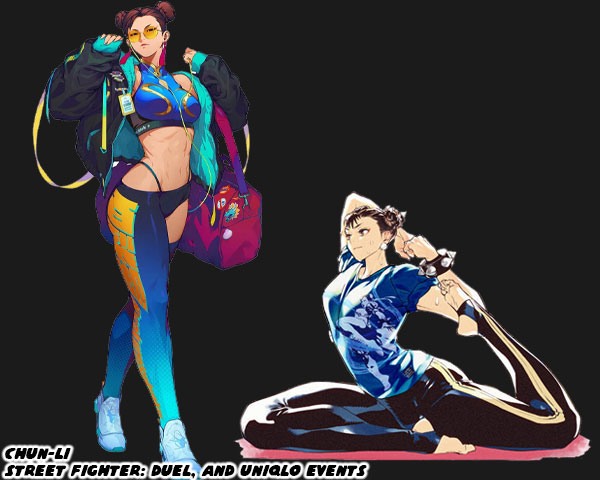
I welcomed the addition of Story, Arcade, and Battle costumes that were put into the library in SFV. I was not against a character getting an updated main costume in the series, as long as it didn’t stray too far from the original design. The importance of a primary costume still remained. This was why I had no objections to the new designs for Dhalsim or Blanka in SF6. There was even a chance for the studio to take a good idea, and make it even better. I thought this was the case for Juri’s update. I saw the studio taking a step backwards when they revealed the new look of Chun-Li. They took away the small details that added up to make her costume truly stand out not only in the lineup, but across the spectrum of fighting games. Chun-Li perfectly encapsulated the Street Fighter school of design. It didn’t matter if you were from the Middle East, South America, or Europe. It didn’t matter if you had played a million fighting games, or if this was your first. When you looked at Chun-Li for the first time you almost instantly thought “Chinese Fighter.” Why was this? 
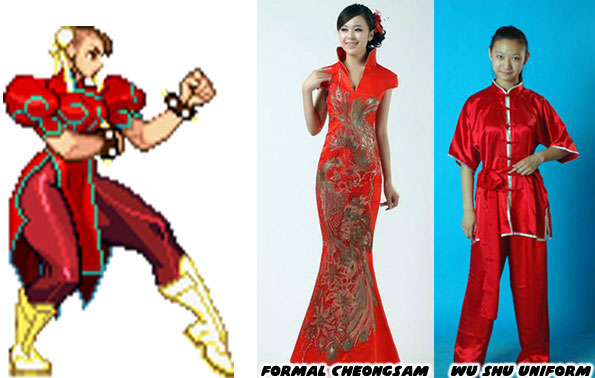
Audiences had seen Chun-Li’s prototype appear in pop culture generations before the game came out. Whether in story, film, photo, television, cartoon, or comics. The artists working at Capcom were pulling from various influences. People saw the repetition of heroic Chinese fighters, especially in Taiwanese, and Hong Kong cinema. They had seen physical Chinese representations in the form of certain hairstyles, makeup, and fashions. The cut of a dress, the use of ribbons, belts, sashes, and how they were assembled could be considered Chinese, or Mexican, or French, or American. Audiences had seen some combination of a wu shu uniform, or a traditional cheongsam at some point in the past. These were actual, traditional outfits from China. The genius of Capcom was how Akira “Akiman” Yasuda arranged certain elements when designing Chun-Li. The puffy shoulders, the pantyhose, wrestling boots, wide belt, and weighted bracelets had never been used in an actual martial arts costume, let alone any traditional Chinese dress. Audiences filled in the blanks with what they knew. They saw elements that they had seen before, and they assumed the rest was traditional Chinese. It was an absolutely brilliant trick, and set a standard that few studios could match. Yusuke Hashimoto showed that he was aware of what Akiman had done. Jaime in Street Fighter 6 followed the exact same design path of Chun-Li.
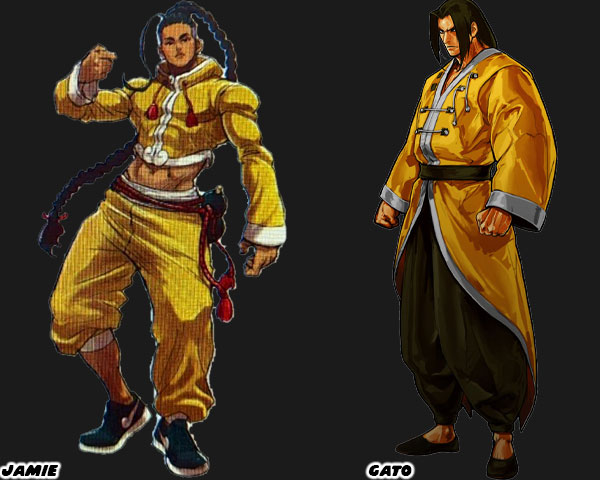
I want you to compare Jamie, and Gato who was a fighter from SNK’s Garou Mark of the Wolves. I had already highlighted Jamie’s various elements on my blog, but let me point them out again. Street Fighter 6 Director Takayuki Nakayama, Producers Kazuhiro Tsuchiya, and Shuhei Matsumoto, along with Yusuke Hashimoto spoke about the influence that Hip Hop had on SF6 in several interviews. Jamie was from Hong Kong, and at first glance it looked like he was wearing a traditional kung-fu outfit, but his costume had a decidedly urban flair to it. Just like Chun-Li it wasn’t apparent until you looked closer. The crop top, long sleeves, and wide collar were tailored to his frame, they were not baggy at all. This fit hadn’t really been worn in any traditional form of Chinese kempo, or kung-fu. The pants with one leg rolled up was a style from USA Hip Hop circles. The color of the fabric looked authentic, until you looked closer, and saw that it had a Louis Vuitton-inspired pattern on it.
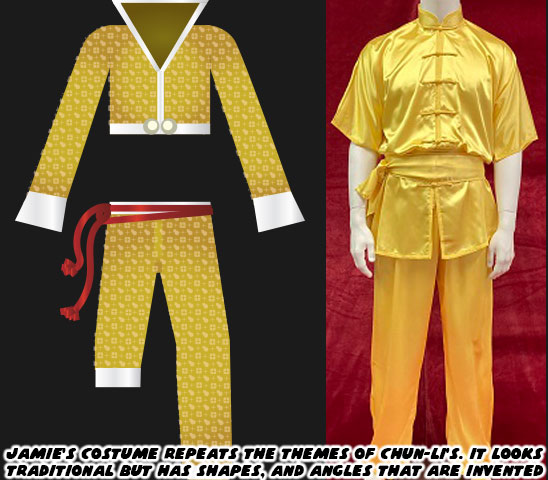
Jamie also wore sneakers with a cloud pattern at the front of what looked like the Nike swoosh design. Even his haircut wasn’t quite traditional. The long braid was supposed to make audiences think of the queue worn by men during the Qing Dynasty. Yet that hair style required the men to shave the front part of their scalp. Jamie instead had a modern fade on the sides, and back of his head. Jamie had a red rope belt with a wine gourd strapped to his hip. Many classical heroes in Chinese mythology such as Lu Zhishen, Ji Gong, and Li Tieguai carried a wine gourd as well. Capcom swore that Jamie was drinking a special juice, and not booze from the gourd. Jamie’s design really captured the SF Style, but it did not reflect the quality of the designs placed on some of the returning characters.
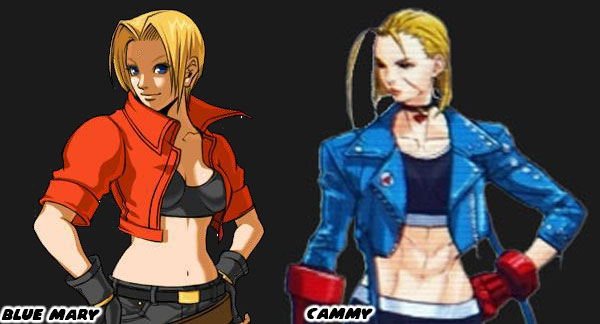
Cammy for example had an entirely new look that was much more casual than earlier looks. I felt that her short jacket, and leggings outfit betrayed the spirit of her original military-inspired uniform. My old friend DarthEnderX mentioned that she looked like a knock-off Blue Mary. That was a valid comparison. I had done a three part series on Blue Mary from the Fatal Fury series by SNK. Mary was essentially a female version of the protagonist Terry Bogard. She wasn’t a Sakura in terms to counterpart either, but more of a super cop like Chun-Li. Her look of jeans, and jacket was warranted as she was supposed to be very Western character. The casual costumes featured on the majority of SNK characters helped distinguish their lineup from Capcom’s. The Street Fighter-Style of character design relied on putting fighters in pseudo-traditional outfits. They had to be instantly recognizable to represent a certain country, school, or style. Like Ken, Ryu, Chun-Li, and Jamie. SNK had an entirely different approach. The genius of SNK’s design was that they hid the martial arts master in plain sight. They might be wearing a three-piece suit, a tuxedo, or a Hawaiian shirt, and flip flops. In every case they were unstoppable brawlers.
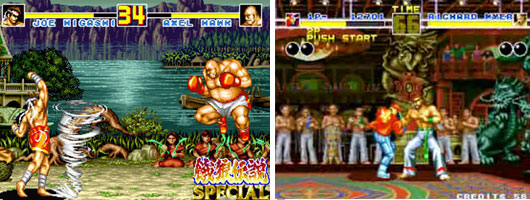
A good chunk of the Fatal Fury, Art of Fighting, and King of Fighters lineup were trained martial artists in street clothes. There were some with classical outfits sprinkled through the series, like Gato, Joe Higashi, and Kim Kaphwan. These traditional designs helped connect the audience to the well-dressed modern archetypes. If you are a budding designer, and are trying to figure out if your style works for SNK, Capcom, or other studios then practice creating fighters of common martial arts. See if you can put a karate fighter in a pseudo traditional gi. Or what that fighter would look like in a suit. How would audiences be able to tell that this person was a fighter? It’s a difficult exercise for sure. Capcom, and SNK had actually been broadcasting who their designs were targeted for in the past decade. We will explore these things in the next blog. I hope to see you back for that. If you have any thoughts on the blog please let me know in the comments section. As always if you would like to sponsor me please visit my Patreon page and consider donating each month, even as little as $1 would help make better blogs and even podcasts!
follow the Street Writer on Patreon!

Monday, June 27, 2022

The greatest fighting game boss returns to Street Fighter 6, a look at Gouki

Gouki / Akuma is slated to return in Street Fighter 6. Of the countless fighting games that have come out over the past 40+ years there is one boss character that I consider the greatest of all time. I’m certain that many would agree that Gouki is the bar by which all fighting game bosses are measured. There have been many great boss characters throughout history. Revenge against Geese Howard drove the plot in the Fatal Fury series. Then there was the villainous Heihachi Mishima, and his attempts to kill his own son in the Tekken tournament. Plus Bilstein set the galaxy on fire in Star Gladiator, and his ghost came back to continue his path of destruction in Plasma Sword. Despite all those great titles Gouki was still head, and shoulders above the competition.

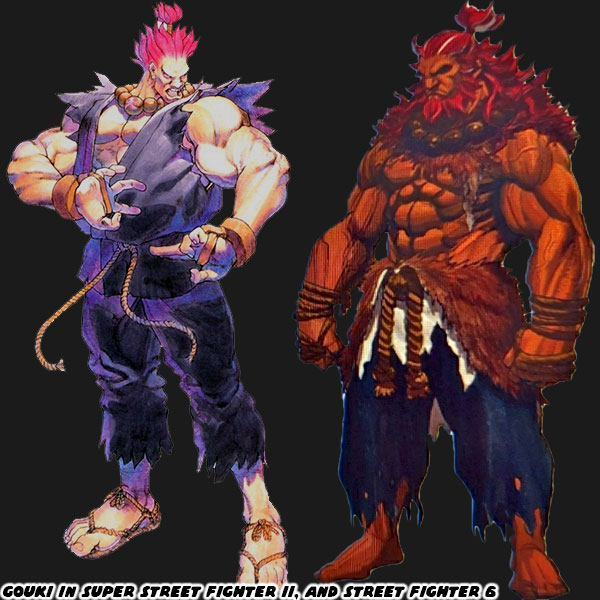
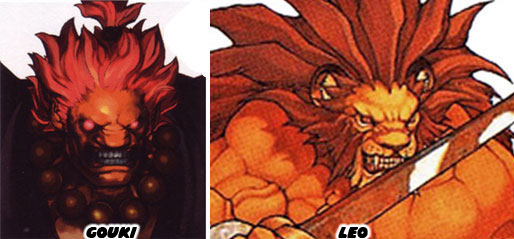
I’ve written a lot about the origins of this character, and his impact in the series. I considered Gouki the third most important character in the franchise. If you are new to the Street Fighter franchise Gouki is a master of Ansatsuken a fictional fighting art known as “Murder Fist.” He killed his brother Gouken, and their master Goutetsu to claim the title as the best in the world. Ken, and Ryu, the stars of the game, were trained by Gouken. So you can guess that his appearance helped motivate the lead characters. Gouki’s look was based on the mythological Nio, the guardians of heaven, and hell. Their statues can be seen at entrances to Buddhist temples. Not only that but he was created using the features of a lion. The flat nose, the sharp teeth, and red clay skin was all done to make him look like a supernatural being, while still being a plausible real person.

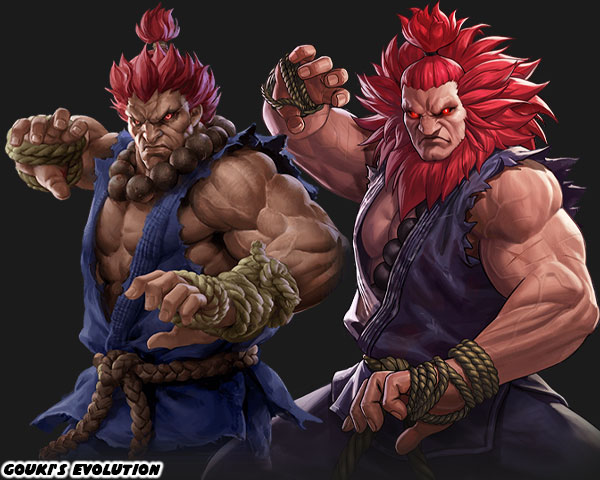
This animal look was expanded in Street Fighter V. The studio went ahead and grew out his hair, and gave him a beard in order to make it look like a full fledged lion’s mane. He was still wearing a rope belt, rather than a traditional black belt. His hands were wrapped in cord, rather than punching gloves. Plus he wore the beads of his master around his neck. Every design element placed on the character meant something, including the type of knot used on the belt. These were all very important details whether the audience knew it or not. For Street Fighter 6 the designers at Capcom decided to remove his top, and give him a cape of animal fur instead. I can almost imagine him training in the mountains of Japan, surviving in the harshest of conditions with this new getup. He looks less like a spiritual being, and more like a caveman now. Not that this was necessarily a bad thing. He is still has a physically imposing presence, and looks like he could break any returning character in half.

The latest version of Gouki looks amazing, but diffuses all of the design elements that made him iconic in the first place. If the newest version of Gouki were the one that first appeared in Super Street Fighter II Turbo, then I don’t think his impact would have been as big as it originally was. Gouki’s black gi was the opposite of Ryu’s white gi. His hair was red, and fiery. He wore a rope belt, and oversized prayer beads. This was a karate master that was as close to demon as we could get. Once the character was established the studio could adjust his appearance. Previously it was simple things, like streaks of white hair in Street Fighter III. Then it became a beard, and longer hair. Now it’s the mane, and streaks of white hair. I think by moving away from the karate uniform it breaks the best elements of his original design. Not to mention that the animal fur was almost the same shade as his skin. Thus muddying his primary colors. I’m not completely on board with the new design team at Capcom steering all the original World Warriors away from their original costume designs, and colors. Some appear better, like Zangief, Dhalsim, and Blanka. But changes to Ken, and Gouki seem to diffuse the impact that they used to have. That’s what I think anyhow, what are your thoughts on the newest look of Gouki? Do you care how the characters appear at all? Or are you more concerned with the game play? Let me know in the comments section please. If you would like to sponsor me please visit my Patreon page and consider donating each month, even as little as $1 would help make better blogs and even podcasts!
follow the Street Writer on Patreon!

Thursday, August 17, 2017

Speculation on ARIKA's unnamed Street Fighter EX successor, final part

I have said a lot about the poor design choices made at Capcom over the past few years. I haven’t found much greatness in characters like Rufus, Hakan or F.A.N.G. introduced in Street Fighter IV and V. Nor have I enjoyed watching classic characters like Birdie, Hugo and Abigail get turned into jokes. Of course I had a dilemma. Capcom Producer Yoshinori Ono was beloved in the community. He traveled the globe promoting the brand, promoting the games and meeting with fans. His energy was infectious, his enthusiasm was genuine and his passion just about single-handedly brought back the franchise. Without him the Street Fighter series would have stayed dead and fighting game scene would not have been as big as it was today. Without him other developers would not have pushed to bring back long-extinct titles like Killer Instinct, or even ARIKA’s updated EX title. With all that said I’m not on board with his creative input. I don’t agree with the addition of silly characters, silly mechanics, silly animations or silly game play. I will continue to call his team out on the poor choices that I think they made with regards to character design. I will remind them of the standards that they used to have. Let’s talk about one of the worst characters Capcom ever put into the series.


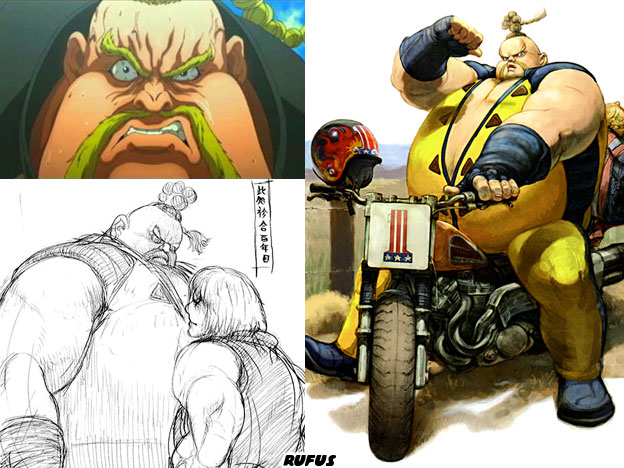
Rufus captured everything that was wrong with the direction of the Street Fighter cast starting with Street Fighter IV. He was big, fat, dumb and obnoxious. He was written as Ken’s great American rival, the only thing was he was too stupid to even know what Ken looked like. How can you be a rival when you can’t recognize your nemesis? What’s worse is that in the early stages Rufus was a powerful black character, nicknamed the King Cobra / Black Cobra. Capcom wanted to give Ken his very own Sagat-type rival, a literal giant. The inspiration was Kareem Abdul-Jabbar from Bruce Lee’s last film Game of Death. This character evolved and became a unique karateka in his own right. Then Yoshinori Ono decided that it would be funny if he put a fatty in the game instead. This new character was rushed into the game and both Ono and the artist Ikeno said it was a bad choice later on. Ono saw that the fat gimmick worked for Bob in the Tekken series. Bob was a much better developed character and was never presented as an idiot. The subtext was obvious to international audiences, fat was funny, and Americans were fat and dumb. There was a different path that could have been used to create the self-obsessed American. ARIKA showed us that more than 20 years ago.


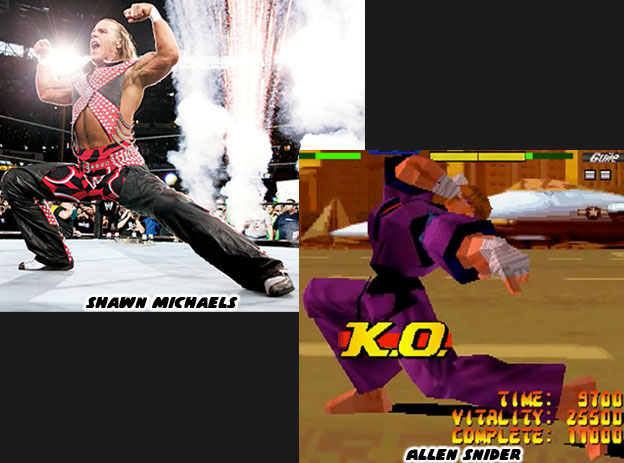
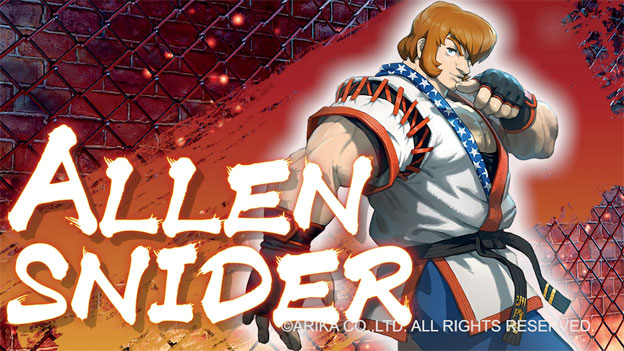
I said in the previous blog that Allen Snider was a second chance for the Street Fighter II and Street Fighter EX developers to create the Ken archetype. They wanted this character to be way more “American” than Ken. Somebody that would be easy to identify in a lineup. He didn’t need to wear camouflage pants or have USA flag tattoos on his shoulders. They gave him a very non-traditional karate gi and made him brash. As over the top as Allen was he was still a good fighter. He couldn’t be confused with Dan Hibiki as being a joke character. Allen was also as far removed from the personality of Kairi as possible. I think they accomplished their goal. Snider was loud in the EX and Fighting Layer titles. He captured the arrogant showmanship of television superstars. His victory poses reminded me of the characters from US pro wrestling. Clearly the team at ARIKA had picked up the personality traits of the most famous superstars of the late ‘80s and early ‘90s. When he was revealed for the new EX game he looked better than ever.


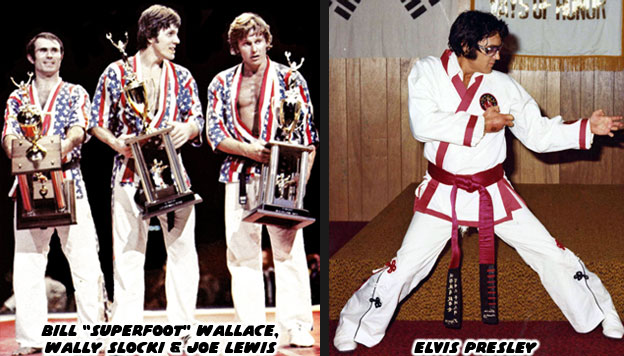
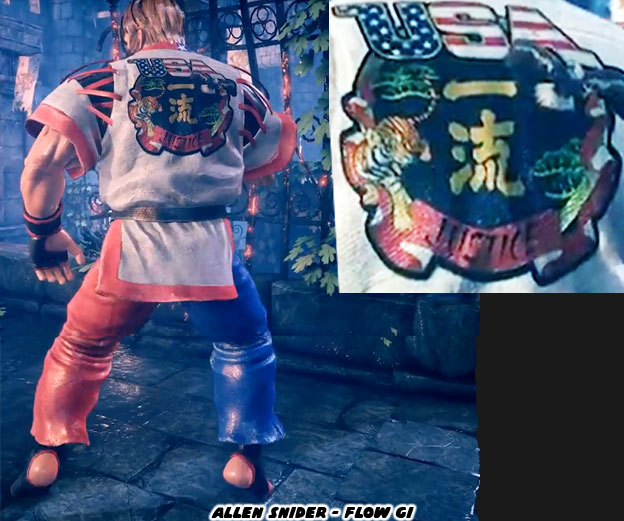
There was no mistaking that Snider had returned in all his patriotic glory. His star-spangled uniform was amazing. It was layered in details that helped tell a story. Even if you had never heard of the character you could tell a lot just by looking at him. He was definitely American and he was definitely not Ken. The updated look also harkened back to the era that inspired the original Street Fighter. Ken was based on actual fighters like Bill Wallace and Joe Lewis. While his hair and facial features were inspired by Chuck Norris and Bruce Lee, the whole persona of Snider being the great American hero were based on multiple real-world sources. Kung-fu and karate enjoyed a popularity boom in the ’60s and ‘70s thanks to cinema. American fighters appeared almost overnight on television competing against Japanese champions. Imagine how absurd it looked to the rest of the world. Karate had evolved in Japan from Chinese immigrants that had introduced them to kung-fu. The Asian countries had centuries perfecting the “empty hand” techniques. It was a part of their culture. It was a part of their national identity. It was sacred and revered. All of a sudden a bunch of Americans showed up in colorful uniforms treating the martial art like a team sport.


Karate tournaments popped up all over the country and trophies were handed out at a feverish pace. People wondered if it was easy to earn a black belt and pick up a bunch of medals in the process. After all, if the guys on TV could do it then anybody could, right? Even the famous singer Elvis Presley was smitten with the fighting arts. He studied under a number of different teachers, having various belts bestowed upon him. Traditionalists didn’t appreciate karate being treated like an organized sport. It had cultural relevance, it was more like a lifestyle, with the discipline of a serious religion rolled into one. It was certainly not a points-based game that anyone could “play.” Thanks to people like Wallace, Norris and Lewis, who were legit athletes, and the coverage provided by ABC’s Wide World of Sports it gained momentum through the ‘70s and ‘80s. For better or worse they laid the foundation for mixed martial arts schools gaining a foothold in the states. The team at ARIKA didn’t forget the culture shock of seeing how the US represented the martial arts in those early days. It made the costume choice placed on Snider that much sweeter.


In the EX series Snider’s first professional defeat was at the hands of Ken Masters. Akira Nishitani didn’t want to disrespect the template he was working from after all. Snider decided to become the understudy of masters and unlock his true potential. This was before Sean was created as his pupil in Street Fighter III. When I looked at Rufus I didn’t see half the forethought that went into making Snider. I didn’t see the nods to history, to the legacy characters or the real world legends that inspired them. I could see it in Black Cobra for certain but not in Rufus. I wondered if Yoshinori Ono and his team could really be so blind to their design choices when other studios didn’t seem to fall into the same traps. There were many days when I wished that Akira Nishitani and his team were still at Capcom, but sadly that ship sailed 21 years ago. Now that Snider was back I hoped that his library of moves had been expanded. Every character revealed so far seems to have matured, I expected no less for the champ. What do you think of the character? Do you think I was too hard on Rufus or Mr. Ono? I’d like to read about your favorite characters it in the comments section. As always if you enjoyed this blog and would like to sponsor me please visit my Patreon page and consider donating each month, even as little as $1 would help make better blogs and even podcasts!

 follow the Street Writer on Patreon!

Wednesday, July 1, 2015

How fight culture became fighting game history, part 1

If you've been reading my blogs for a minute then you know that I love fighting games. The genre is sorely underrated for its contribution to the game industry. It means more to the community of gamers than most genres and despite its combative nature it actually unites audiences all around the world. The success of many franchises is due to the influences from hundreds of real life and fictional sources. There is a reason that some of the best fighting myths have withstood the test of time. They speak to the collective human experience. The most storied fighting game heroes are a reflection of us, our hopes, desires and aspirations. They are playable fables where good and evil are pitted against each other and the outcome depends on how well the player can rise to the challenge. The ability to assume the role of the main character is really the biggest selling point behind the greatest adventures. Players are not passively watching the action but are instead engaged on multiple levels. What they see, what they hear and what they learn are all internalized. Very few forms of media allow audiences that luxury. But before I become too long winded let me try to explain the purpose of this series. I was going to repost some of my best fighting game blogs from 1UP and Capcom-Unity but thought twice about it. Rather than just copy and paste those entries I decided to edit them together and come up with a sort of comprehensive history of the martial arts and fighters that inspired some of the greatest characters introduced into the genre. We will explore the origins of the martial arts, the mythology behind them and how they were represented in pop culture. I'll try to go chronologically but will have to jump forward and back in time because I will try to explore the Eastern and Western myths that inspired the earliest games.

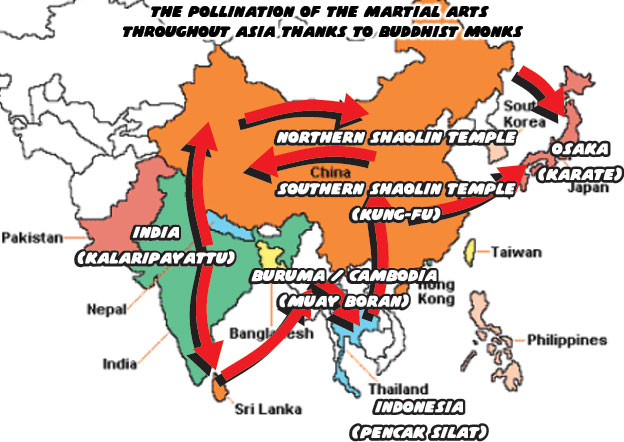
Normally I start a fighting game series in the early 20th century but this time around we are going back more than a millennia. It is understood that the roots of the Asian martial arts stem from China. Even the popular forms of karate and tae kwon do from japan and Korea respectively have roots in Chinese martial arts. Yet how did those styles get introduced to different nations? How did they evolve? What differences did they carry? Is there any sort of common ancestry? The answer to that is actually rooted in the spiritual beliefs from India.


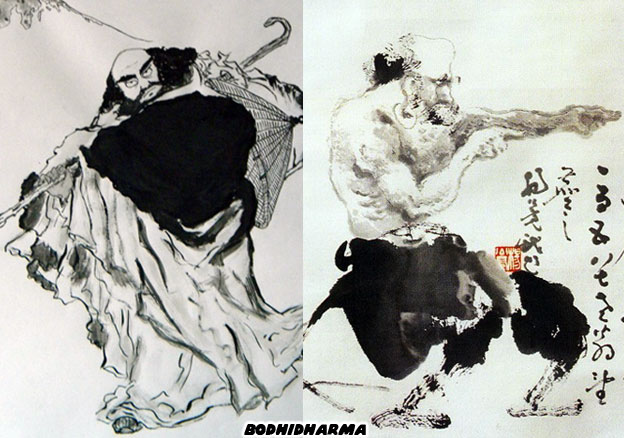
Buddhism, as a path towards finding enlightenment began in the heart of India over 1500 years ago. The system spread throughout Asia over the next 1000 years. It travelled north and south via monks and disciples. It crossed boundaries and nationalities and became ingrained with the art, language and culture of every place it visited. The symbols of Buddha were adapted and refined to fit the customs of local tribes. Whether they lived in the Himalayan mountains or in the monsoon belt of the Southeast Asian peninsula the followers of Buddha tried to reflect the lessons and remain ever vigilant against worldly corruptions. This meant that many practitioners had to learn how to strengthen their mind, body and resolve as to not give into temptation. A series of exercises was developed to help monks maintain focus and protect themselves and their communities wherever they travelled. These early forms of fighting were rooted in the Indian fighting art Kalaripayattu. It was the predecessor to Kung-Fu and Karate. The person that was most influential to the spread of the martial arts and Buddhism throughout China was a man named Bodhidharma. He was described as a dark skinned man that was treated rather unkindly by Chinese villagers. They were suspicious of foreigners, even if they professed to be spiritual men. Little by little he won over their trust and eventually respect by sharing his insight and instructing the early Shaolin Buddhists in the arts of self-defense.

In Mainland China kung-fu is more commonly known as kempo or whushu. It is well known and understood as one of the oldest forms of fighting on the face of the Earth. Take the description of one of the oldest forms, Shorinji Kempo, into account. According to this webpage highlighting the various forms of martial arts.

"Shorinji Kempo traces its origins back almost 5000 years to India. From India, Buddhism spread to many countries, including China. Bodhidharma, the sixth century founder of Zen Buddhism, introduced kempo to the legendary Shaolin Temple ('Shorin-Ji' in Japanese), located in Honan prefecture. Here kempo became the main form of spiritual training for the buddhist monks and the monastery became famous for its fighting arts. Wall paintings can still be seen today in the Shaolin Temple of dark-skinned (Indian) monks practicing and teaching kempo to light-skinned (Chinese) monks. The Imperial Chinese Government, feeling threatened, destroyed the temple and persecuted the monks. The techniques however continued to be taught and practiced by various secret societies as a means of protection against bandits and corrupt officials. Many different forms of kempo were developed and kept alive by these secret societies."


Bodhidharma had introduced physical exercises to the Shaolin monks to strengthen their bodies and minds. He wrote the manuscripts which established the physical regiments that the monks were expected to adhere to and even a book on dieting to achieve the maximum results from exercise. His manuscript Included a diet of teas which would help the monks focus and concentrate during long meditation sessions. It was said that Bodhidharma became enraged with himself when he fell asleep during his meditation and created the manuscripts so that his physical body would no longer fail him. The manuscripts disappeared over the centuries but many of the fighting techniques that he taught, including the use of the staff, survived to this day. Bodhidharma became synonymous with the martial arts and became a symbol for its lineage.

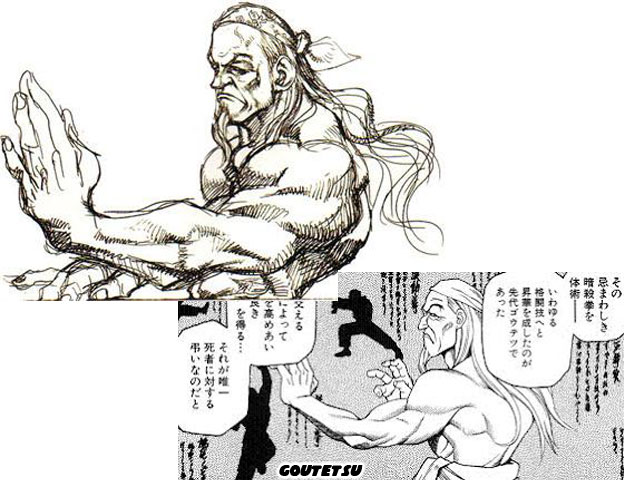
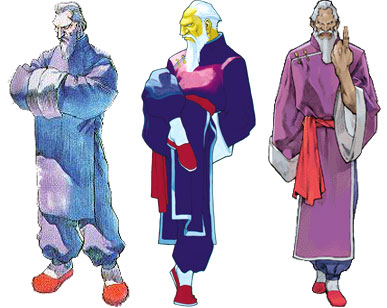
When Buddhism arrived in Japan and mixed with Shinto traditions the personification of Bodhidharma became almost subversive. He was dark and brooding, the polar opposite of the white and chaste symbols of divinity and purity in ancient Japan. His influence, especially in the martial arts seemed primitive, almost backwoods. There was no denying its effectiveness however, the early practitioners of the martial arts in Japan were immigrants that had arrived from China. Before Karate became synonymous with the "Empty Hand" techniques it was instead known as "China Hand" in Japanese. The original martial arts masters in Japan had brought with them the techniques that Bodhidharma coveted. In Japanese pop culture this lineage would be celebrated again and again in the manga, or comic books, that told the stories of turn-of-the century masters. The character Goutsetsu, the master of Gouki and Gouken from Street Fighter mythology was Chinese. He had brought with him the secret techniques of an "Assassins Fist" or Ansatsuken from China and trusted his students with them.


The influence that Buddhism had throughout Asia was immeasurable. It went well beyond what Bodhidharma did for the martial arts. Systems of fighting had been around since recorded history. The bigger the civilization was the more likely it had several forms of fighting taught in each provence. Some styles were created for military conquest and some for sport. What Buddhism did was cross pollenate spirituality, culture and the martial arts throughout Asia. As the Buddhist monks went from village to village they adapted the customs and art of the locals. They traded symbology and philosophy with many spiritual leaders and traded blows with bandits that attacked them on their travels. If you were to study the history of the martial arts you would actually see how certain systems predated others and how some forms were based on older schools. The oldest forms began in India and progressed east. It was no accident that the rise in martial arts ran parallel with the spread of Buddhism.

In a thousand years the fighting forms that would withstand the test of time had developed along the roads taken by merchants and travelers but especially by monks. By the time the monks reached the Sea of Japan they had brought with them countless lessons from their travels. The closest point between the Asian mainland and the main island of Japan was from a peninsula of what was now known as South Korea. Early immigrants from China and Korea, some monks and some merchants crossed the channel and settled in the center of Japan. The largest town being Osaka, where the seeds of what would become Karate were planted. Before we cross the channel ourselves this blog will take its time and see how various fighting arts were created and how they were represented in pop culture, but specifically in video games. As always if you enjoyed this blog and would like to sponsor me please visit my Patreon page and consider donating each month, even as little as $1 would help make better blogs and even podcasts!