Showing posts with label buddhism. Show all posts

Friday, May 5, 2017

Teasing the next Street Fighter EX and Fighting Layer, part 2

The previous blog celebrated the teaser that ARIKA gave us of Fighting EX Layer. If it was an April Fools joke then it was a very well produced one, it raised the hopes of thousands of players around the world. Even if the studio had no plans on releasing the game we could still learn a lot about storytelling through the character designs. I was discussing the Mizukami family; Kairi, Hokuto and Nanase in the previous blog. I had also mentioned that the Street Fighter EX and Fighting Layer were built on a universe filled with mystical characters and spiritual arts. In the genre it was not the only game to feature these types of figures.


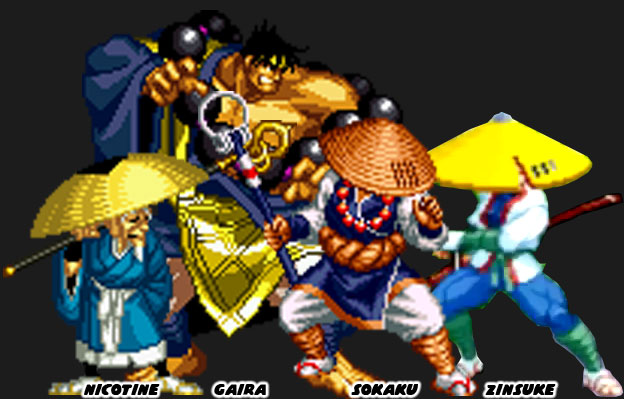
Buddhist and Shinto monks had been featured in pop culture for decades. These mysterious robed men were popular in action cinema and animé. Their identity was hid under a large bamboo straw hat, called a takuhatsugasa, and they were often experienced in the martial arts. Usually it was some form of Shaolin Kung-Fu. When the Chinese settled in parts of Japan they brought with them their religions too. Before karate was synonymous with the “empty hand” techniques it was actually associated with “Chinese fist.” That is to say the oldest schools of karate in Japan were founded on Zen Buddhist principles. The lion's share of fighting monks appeared in the SNK universe. Nicotine Caffeine debuted in the 1994 smash hit Samurai Shodown II. It was a game set a few centuries ago in feudal Japan. He would have been a period appropriate character. His massive grandson Gaira Caffeine appeared the following year in Samurai Shodown 3. Both Nicotine and Gaira wore variations of traditional monk clothing. Nicotine could summon powerful spirits to fight on his behalf whereas Gaira used bowling ball-sized prayers beads to flatten opponents. Zinsuke was a samurai-like-monk that appeared in the game Asura Buster: Eternal Warriors by Fuuki Co. Ltd. Monks were not permitted to carry weapons, and especially not swords as part of their code. Asura Buster was set in a fantasy world so that different designs elements worked for the character. In 1995 SNK also debuted another fighting monk, Sokaku Mochizuki. This character had all the trappings of a classical monk and would have fit into the Samurai Shodown universe. Yet he appeared in Fatal Fury 3, which was based in the modern era. It turned out that the uniform actually hadn't changed much in centuries.
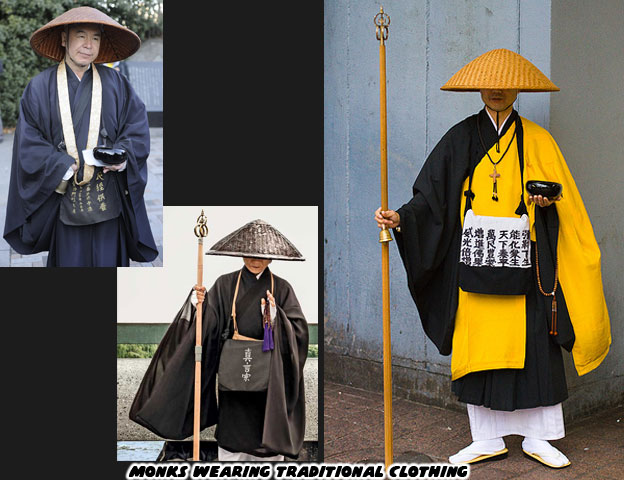
 

To this day Buddhist monks still traveled through Asia and served in temples both ancient and modern. If they were on a pilgrimage they would wear a motsuke or robe. Their takuhatsugasa was wide for a reason, it protected the monk from the elements, but it also shielded their face to protect their identity. In many regions practicing and outside religion was against the law. Secrecy was for the safety of the practitioner or followers. The large hat also shielded the monk from distractions and noise so that they could mediate. Monks sometimes traveled with a khakkhara. This was a ringed "sounding staff" that had originated in India. The number of rings, 4, 6 or 12 was more than an ornament. They symbolized the Four Truths, the Six Perfections or the 12 chains of cause and effect. Only the Buddha would wield a 12-ring staff. When the monk walked with the staff it would ring. The sound would warn small animals to stay out of the path or alert people that there was a monk nearby. Although not widely practiced anymore by Buddhist monks there was an actual form of fighting associated with the khakkhara. It differed slightly from the forms used with a staff or spade, which monks were also allowed to fight with. Having Nicotine use it as a weapon in game was actually authentic.
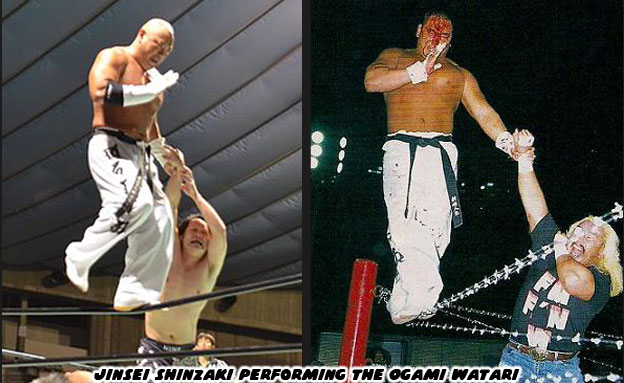
   

The legend of the fighting monk grew in pop culture until it was even associated with pro wrestling. Jinsei Shinzaki, aka Hakushi in the WWF/E, was an exceptional Japanese performer. Having studied under the “lucharesu” school which combined the high flying acrobatics of Mexico’s lucha libra with the hard striking of Japan’s puroresu (pro wrestling). He was a well-rounded fighter. If his opponent came at him with strikes and grapples then he had a counter attack ready. If his opponent was a fast worker and wanted to perform death defying moves then he too could launch himself off the top rope. Mr. Shinzaki could always be counted on to perform well in a match. He was very serious in and out of the ring and never broke character. He was portrayed as a fighting monk and would power bomb and slam his opponents and then follow up with a prayer. One of his trademark moves, the ogami watari, was an arm twist rope walk that ended in a flying chop. As he walked along the top rope he would pray aloud. He did this move in just about every type of ring set up, including hardcore “death” matches where the ropes would be replaced with razor wire. He was doing this move in Japan at about the same time the Undertaker was using it in the USA. The two actually had a rivalry which worked because they were both using a similar persona. In many Asian countries people only wore white at religious ceremonies if there was a funeral. Jinsei was like a monk praying for those about to die, usually his opponents. By the same token the Undertaker was a sort of ghostly monster in the USA. You could expect him to bury his opponents as well. In real life Mr. Shinzaki was as generous as you could expect a monk to be. After the 2011 Tohoku earthquake and tsunami he actually spend weeks delivering food and water to those displaced by the disaster, most of it coming from his savings.
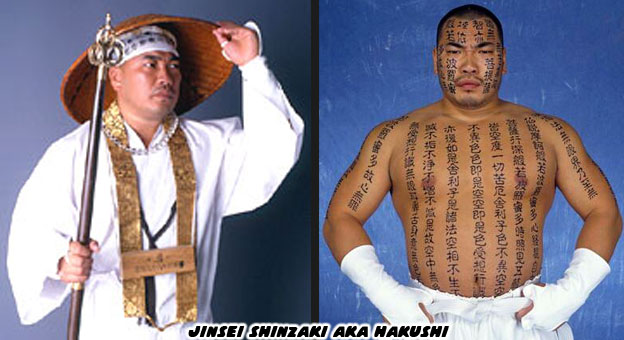
   

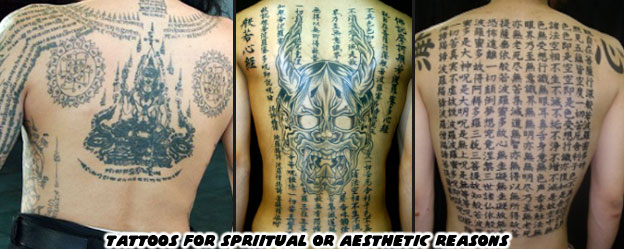
Sometimes Jinsei would go all-out for his character. He would wear the full monk costume and walk with a khakkhara to the ring. Sometimes his face and body were covered in shakyo or calligraphic characters. The messages written on his body were sutras or scripture. These showed humility and piety for his belief. In Buddhism practitioners would write down shakyo as a form of reverence. Families could commission monks and nuns to write down scripture to honor their family or loved ones. Although not practiced widely there have been many examples of tattooed shakyo written on people over the centuries. In Japan the practice of carved tattoos, called horimono, extended back to the Jomon era. These tattoos were thought to have spiritual connotations and had appeared more than 10,000 years ago. Some people did indeed tattoo their faces as well as bodies with elaborate designs. About 2000 years ago Chinese travelers to Japan had recorded these tattoos on the native Japanese and saw that they were associated with status. Only later on did tattoos start to have a negative association in society. This was because criminals were tattooed for various offenses. Regular people wouldn’t hire these people however the criminal underworld, better known as the yakuza would. To this day you can still find examples of irezumi, Japanese tattoos, that incorporate shakyo for decoration, or devotion. A mantra and symbol of Buddha or even Hindu Dharmas could be found tattooed on people all over the world.
   

There is a reason why I bring up all of this history. As the EX series progressed the spiritual themes became more relevant to the development of the game. Only the Samurai Showdown series had invested more mysticism into their canon. Garuda had some very distinct Buddhist symbolism associated with him. His sitting lotus position, that he teleported around the stage with, and even the actual lotus flower, a symbol of purity were seen in his animations and endings. I had described the origins of Kairi and his spiritual powers as well on previous blogs. Kairi and Hokuto had a unique bond. They were both monk-like in their training. Yet their relationship was more profound than anyone in Street Fighter. Ken and Ryu might consider themselves brothers but the Mizukami characters were actual (cursed) blood relatives. Imagine how different the Street Fighter series would have been if Ryu and Chun-Li were brother and sister. Imagine the heartbreak of Chun-Li if her brother had become a murderer. If she remained loyal to her job as an officer then she would have to arrest him, or worse, kill him in the line of duty. This was the type of character development that made the EX series so unique. This was something that the former Street Fighter II developers were thinking out lout. The lead characters were related, and they were both the heroes and villains of the universe. The drama that pulled audiences in was built because of this bond. The curse was something that would destroy the family or unite it. I think the latter was entirely possible. Kairi was headed for self-destruction at the end of the first EX game. Unless Hokuto could intervene there wouldn’t be much left of him to save.
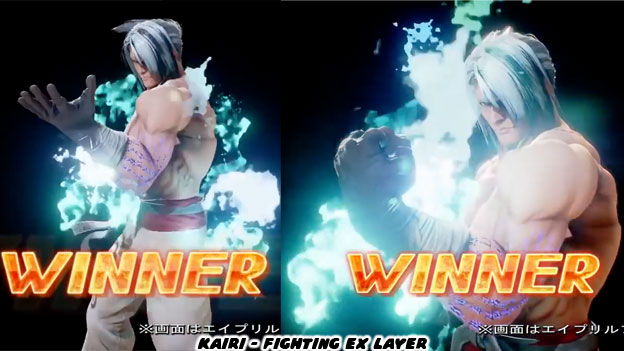
 

Between Street Fighter EX 3 and Fighting EX Layer something did change. Kairi had defeated Gouki, and had elevated his powers in the process. Kairi no longer performed like a tortured soul. It was obvious in his new animations and the moves that ARIKA demonstrated on April 1. I believe the secret to his evolution lay in the marks on his arms. He now had shakyo tattoos on his wrists when previously he had none. These markings must have placed the evil energy driving him mad under his command. The spiritual forces were confined to his hands and not in his mind. He was fully in control of his abilities yet unlike Garuda these strikes were not centered around maiming an opponent. In a previous blog I mentioned how spirits could be bound to objects and people. Kairi was a "yorimashi" or a possessed person. The shakyo tattoos bent the spirits to his will. In shinto tradition it could have been a rope belt or blessed paper streamers to do that as well. Gouki by contrast used prayer beads to keep control of the evil spirits within him.

Kairi had achieved a strength of boss character and established an entirely new template. He was not bent on global domination, that was Gill and the Dictator’s hang up. He had become a master, a sort of anti-Gouki. He had little interest in tracking down the most powerful Street Fighters. If they wanted a challenge then they would have to seek him out. How this would effect the relationship between himself and his sisters would have to be explored in the actual games. The Fighting EX Layer reveal also introduced something else to the fighting game conversation. We will look at this in the next entry. As always if you enjoyed this blog and would like to sponsor me please visit my Patreon page and consider donating each month, even as little as $1 would help make better blogs and even podcasts!
 follow the Street Writer on Patreon!

Monday, July 27, 2015

How fight culture became fighting game history, part 12

In every culture and in every story tradition a myth would sometimes be rooted in reality. It helped our ancestors cope with the unknown, the mysterious and bizarre. When it came to the martial arts the tradition of myth was supremely important. It helped turn local fighters into legends and military warlords into god-kings. Imagine how word of mouth helped create the fables of men that were able to break stones with a punch, were able to kick down trees and even run over water. The impossible was possible to a handful of people. It's secrets became highly sought after. As the martial arts spread throughout Asia the mythologies of each culture helped shape its evolution. The Buddhist monks of India and China were some of the strongest forces that helped shape the history of the martial arts. In the previous blogs I had mentioned how Kung-Fu travelled through China and reach the shores of Japan where it was adapted and transformed into Karate. But what happened to the art form as it went through South Asia? How did it differ from the other fighting arts? How did its founders become legend?


Something that contributed greatly to the development of the fighting arts in South and South East Asia was actually the terrain and weather. The further south in Asia had a much higher level of precipitation. During the monsoon season rainfall could be measured in meters rather than inches. Portions of Japan and China were well within the monsoon belt as well but the majority of the rainfall was concentrated over areas closer to the ocean, such as Thailand, Cambodia and Myanmar (Burma). Of course the surrounding islands and peninsulas of Malaysia, Indonesia and the Philippines were no strangers to wet climates. This heavy rainfall translated into lush vegetation, thick jungles and heavy forest canopies. Travelers had to be wary not only of wild animals but also of bandits that could be hiding at every step of a journey. This terrain also changed the way wars were fought and won. Larger armies from the North used to controlling massive areas of space with the aid of advanced long-range weaponry such as catapults and crossbows were at a loss in jungle settings. Due to the dense vegetation the wars in the South were fought in close quarters, man-to-man. The armies that combined practical close-range weapons with deadly martial arts training were all but guaranteed victory. The way men fought and trained in the martial arts in the South was much different than what Bodhidharma took with him into China. Heavy armor favored by Chinese, Mongolian and Japanese forces were too cumbersome to use or even wear in the hot tropics. Fighters had to be free to move, use the terrain to their advantage, and strike whenever and wherever an opportunity presented itself. As Budhhism traveled through Bangladesh, into Myanmar and Thailand the fighting forms of the monks were dissected and portions were combined with native techniques. The hybrid of systems worked extremely well with stick, sword and shield fighting. Even without weapons the forms that grew from the tropic regions was deadly in its efficiency.


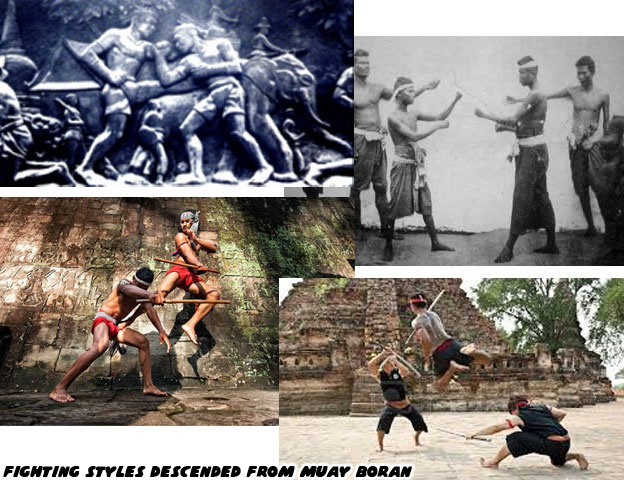
The art of "Eight Limbs" had a lineage that went back thousands of years. The bare hand fighting forms which made liberal use of elbows, knees and clutches were brutal. They were dangerous in the arena as they were in the battlefield. The form known as Muay Boran in ancient times was practiced by the personal bodyguards of the kings. It eventually went beyond the walls of the imperial palaces and changed into what the modern world now knows as Muay Thai. There were countless regional iterations of the striking arts, called Mai Mae, Luk Mai Muay Thai, Bokator, Kun Khmer and Pradal Serey. Each one could be identified for its many victories on the battlefields as well as in the fighting arenas.

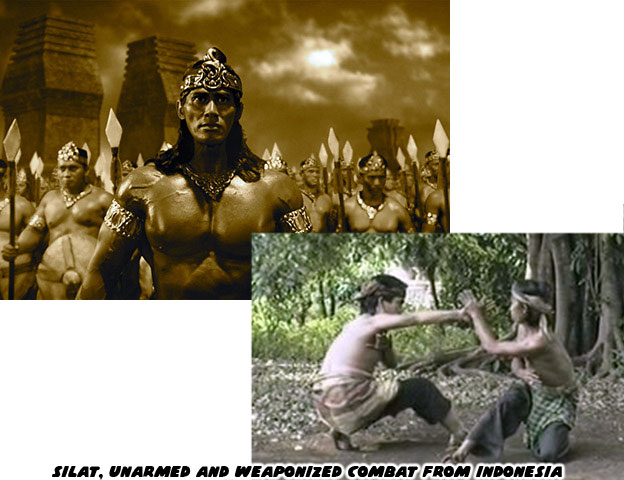
Yet that was not the only offshoot fighting art that evolved in Asia. In Indonesia Pencak Silat, sometimes called Silat was a word used to represent the indigenous martial arts of over 800 styles from the thousands of islands that make up Indonesia. Betawi for example is an aggressive striking form whereas Cimande is focused on flowing combinations. The main forms originated in Sumatra and Java. Silat was used to defend the natives from Northern aggressors as well as from foreign invaders. It incorporated many unique stances, tight sweeping strikes and rapidly changing angles. These kept opponents off guard, baffled invaders and made sure that the Indonesians enjoyed their independence for centuries. The style, like those from the other coastal countries in Asia would not have worked while wearing armor or yielding heavy weapons. It was about being light and fast so swords were more like daggers and shields were light and portable. When the British, Dutch, French and other imperial armies began to colonize the port towns the Indonesians did their best to preserve the art form. The would-be conquerers from the West did their best to supplant the languages, temples and cultural icons of the Asians but this did nothing more than make them dig in deeper to preserve their heritage. As a result Silat not only survived into the modern era, its practitioners were still considered some of the most lethal fighters in the world. Pencak Silat, like Muay Thai was descended from combat, it was not a form for sport, exercise or self-improvement. It was meant to kill and thus retained its dangerous overtones.


Silat could not necessarily be considered one of martial arts directly influenced by the Buddhist monks traveling through Asia. Indonesia is the largest Muslim nation on Earth and has been for some time. The evolution of Silat was nonetheless influenced by traders and settlers from Northern regions. Kung-Fu developed striking arts that were inspired by the grace and beauty of nature however the fighting arts in South East Asia were inspired by centuries of bloody conflict. As such the fighters from South Asia gained a reputation for being dangerous combatants. The masters of kung-fu and karate could find a way of having a friendly sparring match, perhaps the first to drop an opponent or even the first to land a solid strike could be declared the winner. By contrast those that fought in Muay Thai tournaments were looking to break opponents. Blood was the measure of success, fighters would wrap their knuckles in cord and sometimes crushed glass so that they would be able to tear the flesh off opponents. Even modern matches have lost little of the lethality of ancient rules. Some strikes have been outlawed in organized competition but even without these strikes only the most dedicated fighters could hope to achieve a level of champion. For those that want to see what sort of brutal punishment the top fighters could unleash against each other take a look at the infamous "Elbow Fight" between Sakmongkol and Jongsanan at Lumpinee Stadium in Bangkok. It was the fifth time that the two had fought each other. Round after round the two ate elbows like a kid eating candies at Halloween. Fans of this level of fighting could be considered sadistic while the fighters were clearly masochists. No amount of punishment could satiate either group. The spectacle of professional competitions and the legend of underground Muay Thai tournaments spread far and wide throughout Asia. Only the most foolhardy martial arts master would dare seek out these men in a fight. More "refined" cultures like those in China and Japan looked down on the barbaric combat from the South. This repulsion for the hyper-violent Southern eventually turned into legend. The only way that a master of the "modern" arts could prove their skill was to seek out new challengers, especially those from Thailand.

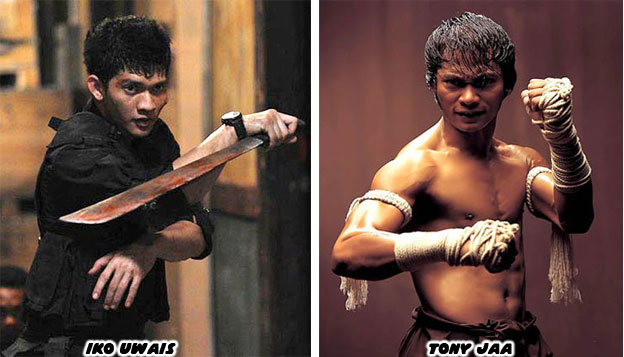
In cinema kung-fu had become a mainstay of fighting forms. Action films the world over relied on the classic Asian arts to make heroes appear unstoppable. Yet every decade there seemed to be an artist to come out of nowhere, using a different art and redefine how movie fight should look. Muay Thai rose to prominence on the heels of the film Ong Bak in 2003. In it director Prachya Pinkaw made a moderate-budget film that highlighted the fighting and stunt abilities of Tony Jaa. Tony became an overnight sensation in action film circles and created a buzz that was comparable to the early days of Jackie Chan and even Bruce Lee. Almost a decade later director Gareth Evans featured Silat through the skilled hands and feet of Iko Uwais, The Raid which was released in 2011 demonstrated how an art form at least a millennia old could amaze audiences that had grown up on expensive special effects.


The films of Tony and Iko were two examples of how the fighting arts were still integral to pop culture. This was not a new trend. In the late 19th and early 20th century pop culture would take the regional biases against different fighting forms and the stereotypes about their practitioners and turn them into fodder for stories, comics, movies and eventually video games.

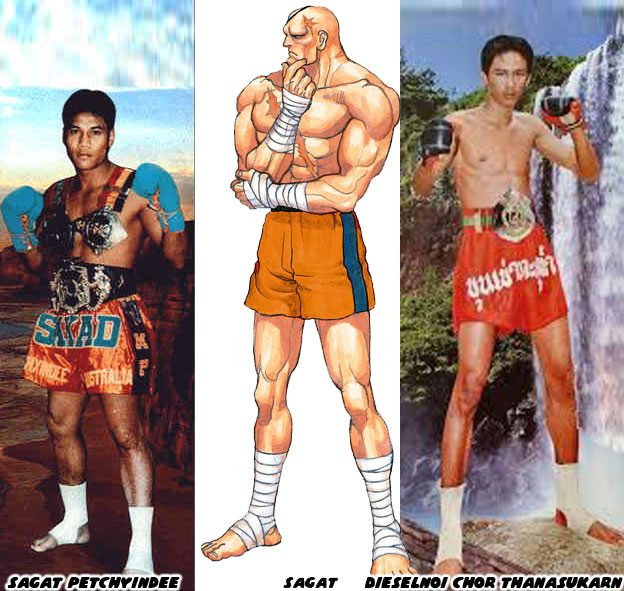
It was not enough for a video game that the Muay Thai master was just an average person. As the final opponent in Street Fighter he had to become much more imposing figure and present a genuine challenge to audiences. The designers at Capcom made the one-eyed fighter into a seven-foot giant. He had a reach advantage, a strength advantage and used a fighting form that was considered more dangerous than karate. The name Sagat was based on Sagat Petchyindee, a Muay Thai fighter that dominated tournaments in the early '80s and undoubtedly made its way into the psyche of the Japanese developers. Although Sagat has always been illustrated as an incredibly muscular man in Street Fighter II he was much lankier. There was another Muay Thai legend that likely inspired this design. Dieselnoi Chor. Thanasukarn was 6' 2", possibly 6' 3" tall, and had a considerable reach and size advantage over most of his opponents. Although he was thin he packed a powerful knee, a "Sky Piercing Knee" according to legend. The character of Sagat was known for his knee strikes as well so it is entirely possible that Dieselnoi had a hand in influencing the developers on Street Fighter. Dieselnoi was such a formidable champion that after several years at the top he was forced into retirement when he could not find an opponent in his same class. Although to be fair Sagat Petchyindee was one of the few to ever defeat Dieselnoi.


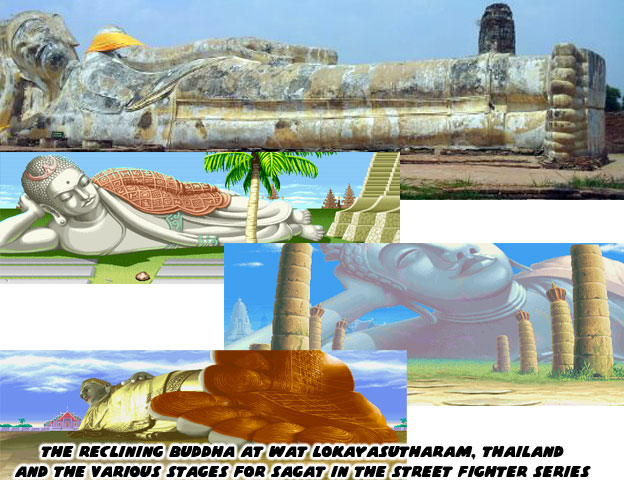
There was something about Thailand that kept designers returning to the region. It was romanticized in comics, its location considered exotic and mysterious to the more industrialized nations in Asia. The inclusion of Hindu temples and Buddhist shrines presented the perfect backdrop for the Street Fighter game series and even the animated films and television shows. Adon, the cocky understudy of Sagat had stages built on the Chaopraya River. The temples of Angkor Wat and Angkor Thom were also used in the backgrounds for Adon's stages as well as the secretive location of the dictatorship Shadowlaw. The reclining Buddha of Wat Lokayasutharam, whose weathered features were awe-inspiring in real life looked fantastic when adapted to the game series.


Ryu was the star of Street Fighter and karate was presented as the ultimate fighting art but the genre would never have been the same without the inclusion of Muay Thai. This survey of the real world fighting forms will take a closer look at the Muay Thai heroes and villains from gaming in the next blog. As always if you enjoyed this blog and would like to sponsor me please visit my Patreon page and consider donating each month, even as little as $1 would help make better blogs and even podcasts!
Monday, July 13, 2015

How fight culture became fighting game history, part 6

In the era of high technology there were still many places in the world that were heavily influenced by the tenants of old religions. Politicians extolled the virtues of ancient scriptures as the sway to get society back on the right track. These politicians could not see how science and reason might also be beneficial to a nation. The use of religion or scripture as a learning tool was not necessarily a bad thing. A proud culture preserved many classic traditions, many of these traditions did not fly in the face of science or common wisdom but were instead celebrations of cultural foundations. The heroes of ancient religions were the templates that people were supposed to emulate. In many cases peace was the desired outcome but in order to achieve that peace sometimes blood had to be spilled fighting against the forces of evil.

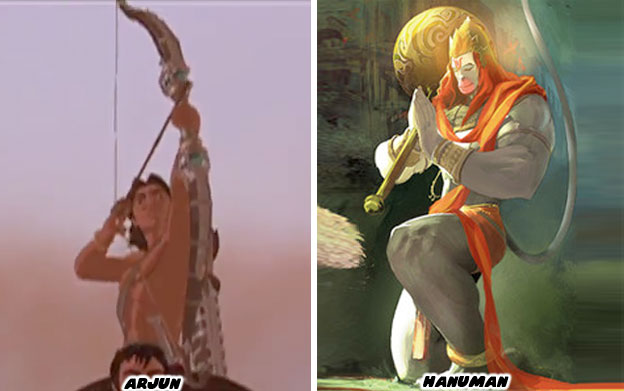
In Asian traditions two of the oldest icons were symbols of purity, strength and nobility. Arjun (also written Arjuna) and Hanuman were figures central in Hindu traditions. The gods favored Arjuna and blessed him with weapons and training. He was challenged at every opportunity and tempted to go astray many times. His name could be translated literally as shining or bright. Arjun was a figure whose martial prowess and especially the use of a bow were inspirational. If he had one failing, as most classic heroes tended to do, it was that he was extremely prideful in his abilities. He was so proud that he would squander his gifts from the gods just to prove he was as mighty a warrior as he claimed to be. More often than not these parables were a way to humble the man and remind him that the needed to be humble and honor the gods that favored him. That pattern of pride coming before the fall turned up in both Western and Eastern storytelling traditions. The legend of King Arthur and Beowulf from classic tradition also featured stories of how pride was a dangerous thing.


A contemporary of Arjun was Hanuman. The god creature was actually a vanara, or ape-like man. Hanuman was also blessed with powers and gifts from the gods. He was insanely strong, capable of carrying mountains with one arm, he also had the ability to change his size at will. His favored weapon was a war hammer, sometimes referred to as a mace. Despite his appearance Hanuman was extremely intelligent and well spoken, having memorized all of the holy scriptures and a scholar of nine different languages. Arjun and Hanuman crossed paths and you can imagine that two prideful characters did not get along well. After they had a quarrel they were reminded that they should know better than to waste their talents just to satisfy the foolish notion of pride. A wonderful graphic novel Sundarkaand Triumph of Hanuman explores the myths of the character and shows why even to this day Hanuman is still revered around the world.


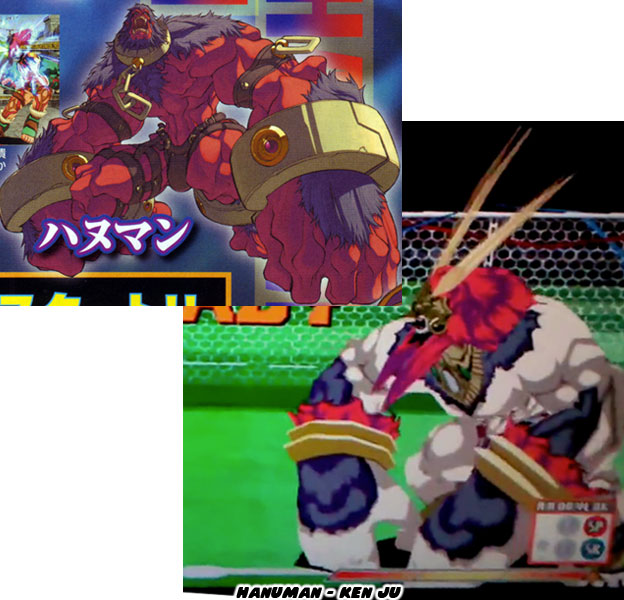
There was a fighting game in the works called Ken Ju that actually featured a beast man called Hanuman. He was a large hairy, red-skinned character. He wore chains and shackles and was sort of like Blanka but on steroids. The arcade game was a rare 3D title developed for the Sega Atomiswave cabinet. Sammy designed the title and few copies of the game are known to exist. Above is a look at the alternate costume for Hanuman, in it his skin was white and he wore golden armor and a mask. The alternate look was more in line with the traditional representations of the figure. The adventures of Arjun and Hanuman helped spread the tenants of Hinduism. What was interesting was how the use of mythological characters spread from India to China. Animal gods were celebrated in almost every culture around the world. There were creatures who could think and act like a person while retaining the appearance of an animal. Some of these creatures even had supernatural powers as well. 

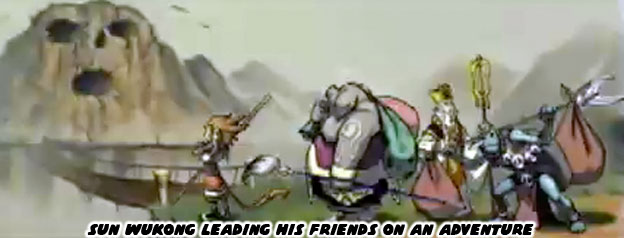
In Chinese tradition no animal character was better known than Sun Wukong, the Monkey King. He was one of many figures that existed in classic storytelling traditions. As Buddhism spread from India through China a new parable was created. The mischievous Wukong was humbled by Lord Buddha and made to serve as a guide to the Buddhist monk Xuanzang (Tang Sanzang) as penance. The story that featured his adventures would become known as "Journey to the West." Wukong was a mighty figure, he was impossibly strong, could change shape, a master martial artists and could leap countless miles in a single jump when he wasn't riding around on a cloud. He was also a trickster and notorious troublemaker. Yet even with all of his powers he was nothing in comparison to Buddha. This format of humbling mythological characters helped demonstrate that the new religions were the true faiths. I would contend that Sun Wukong was actually a variation of the legend of Hanuman that had reached China before Buddhism. The war hammer of Hanuman was replaced by a magical staff that could also grow impossibly long. As Buddhism spread Journey of the West helped bring in older figures into the fold and keep them relevant to the culture.


The legends of Hanuman and Wukong would persevere and last well into the 21st century. In pop culture the characters would be celebrated in comics, cartoons and even video games like IGS' Oriental Legend series. The long-running Japanese series Dragon Ball was inspired in equal parts by Superman and Journey to the West. The main character Son Goku was mistaken as his reincarnation of Sun Wukong early on in the series. He even had a magical staff and could ride around on a cloud like the classic figure. The manga inspired a generation to read up on the older stories and see what Akira "Dr. Slump" Toriyama used as the basis of his series. Live-action features based on ancient gods were still being produced and the relevancy of these figures was still an important part of society. The legends were still heroic and virtuous and could teach modern audiences a thing or two about doing the right thing. An excellent analysis of the symbolism used in action games can be found on A Buddhists Guide to Asura's Wrath by Art-Eater. The author goes to great lengths to chronicle all of the nuances and details that Capcom had placed in their game.There were also other ways in which classic traditions were observed in modern culture.

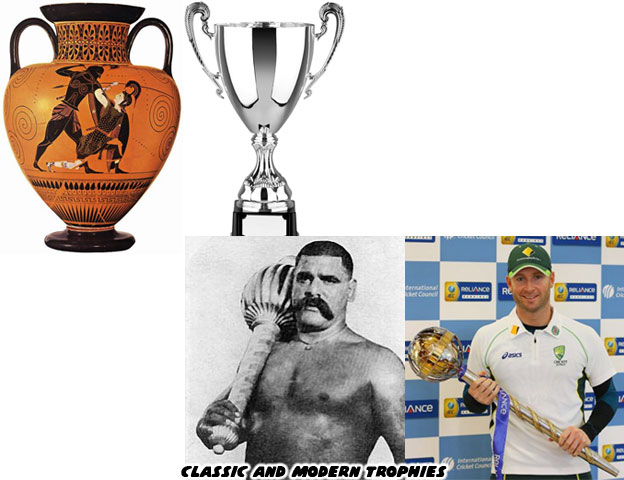
In combat sports like boxing, wrestling and mixed martial arts there were rewards given to the victors that resembled ancient artifacts. The belt awarded to prize fighters could be traced back to ancient times, more than two thousand years ago. In different parts of the world combatants, sometimes soldiers on a battlefield, sometimes gladiators would be rewarded the banner or sash of a rival opponent as a victory trophy. In modern times boxers would show that they were champions by wearing a colorful belt with a large buckle at social events. Over time the belts became larger, more ornate and more colorful. The belt signified that they were the absolute best in the world, the literal peacock feathers for the fighting community. There were also trophies that went even further back in time. The Greeks would reward the victors of early sports competitions with jars filled with olive oil. The victor would be crowned with a wreath of olive leaves as well. The wreath was lost to tradition but the cup remained. It would become synonymous with victory and would take many forms and materials over the years but retain its basic shape.


In South Asia the trophy used for wrestling competitions was shaped like a mace. It symbolized the war hammer of Hanuman. The victor of a competition was said to have had the same qualities of the ancient god. Chief among them were honor and strength. Just like the title belts and victory cups the hammers could be made of polished gold or silver and be decorated with precious stones. To this day the belt, cup and mace were still used as symbols for sporting champions. In many fighting games there were characters that were shown with belts or trophies that they had won as well. Symbols became very important to the development of fighting games. The oldest figures from Asian tradition would become the backbone of the most powerful characters in the fighting games developed by both SNK and Capcom. The next blog will look at the most fearsome characters ever created. As always if you enjoyed this blog and would like to sponsor me please visit my Patreon page and consider donating each month, even as little as $1 would help make better blogs and even podcasts!
Wednesday, July 1, 2015

How fight culture became fighting game history, part 1

If you've been reading my blogs for a minute then you know that I love fighting games. The genre is sorely underrated for its contribution to the game industry. It means more to the community of gamers than most genres and despite its combative nature it actually unites audiences all around the world. The success of many franchises is due to the influences from hundreds of real life and fictional sources. There is a reason that some of the best fighting myths have withstood the test of time. They speak to the collective human experience. The most storied fighting game heroes are a reflection of us, our hopes, desires and aspirations. They are playable fables where good and evil are pitted against each other and the outcome depends on how well the player can rise to the challenge. The ability to assume the role of the main character is really the biggest selling point behind the greatest adventures. Players are not passively watching the action but are instead engaged on multiple levels. What they see, what they hear and what they learn are all internalized. Very few forms of media allow audiences that luxury. But before I become too long winded let me try to explain the purpose of this series. I was going to repost some of my best fighting game blogs from 1UP and Capcom-Unity but thought twice about it. Rather than just copy and paste those entries I decided to edit them together and come up with a sort of comprehensive history of the martial arts and fighters that inspired some of the greatest characters introduced into the genre. We will explore the origins of the martial arts, the mythology behind them and how they were represented in pop culture. I'll try to go chronologically but will have to jump forward and back in time because I will try to explore the Eastern and Western myths that inspired the earliest games.

Normally I start a fighting game series in the early 20th century but this time around we are going back more than a millennia. It is understood that the roots of the Asian martial arts stem from China. Even the popular forms of karate and tae kwon do from japan and Korea respectively have roots in Chinese martial arts. Yet how did those styles get introduced to different nations? How did they evolve? What differences did they carry? Is there any sort of common ancestry? The answer to that is actually rooted in the spiritual beliefs from India.


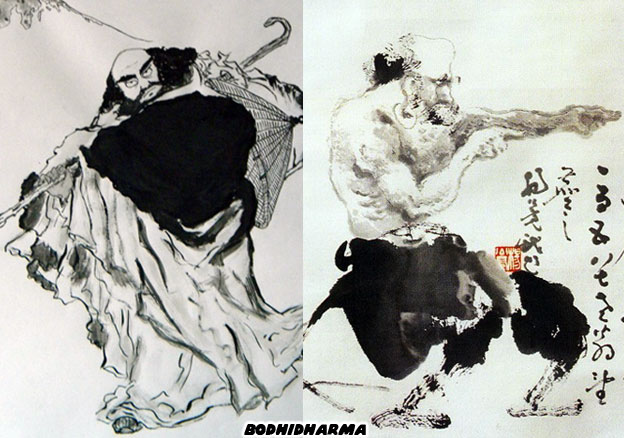
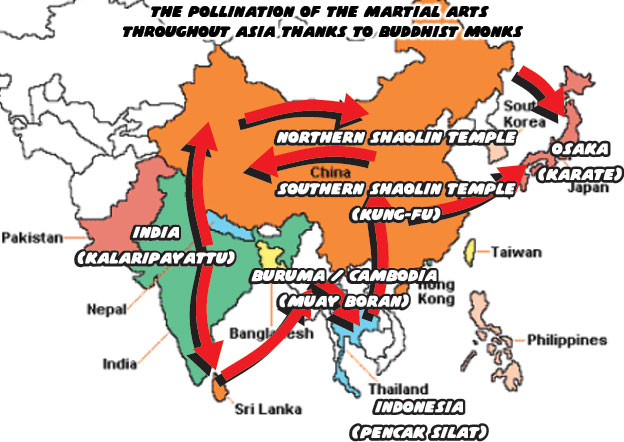
Buddhism, as a path towards finding enlightenment began in the heart of India over 1500 years ago. The system spread throughout Asia over the next 1000 years. It travelled north and south via monks and disciples. It crossed boundaries and nationalities and became ingrained with the art, language and culture of every place it visited. The symbols of Buddha were adapted and refined to fit the customs of local tribes. Whether they lived in the Himalayan mountains or in the monsoon belt of the Southeast Asian peninsula the followers of Buddha tried to reflect the lessons and remain ever vigilant against worldly corruptions. This meant that many practitioners had to learn how to strengthen their mind, body and resolve as to not give into temptation. A series of exercises was developed to help monks maintain focus and protect themselves and their communities wherever they travelled. These early forms of fighting were rooted in the Indian fighting art Kalaripayattu. It was the predecessor to Kung-Fu and Karate. The person that was most influential to the spread of the martial arts and Buddhism throughout China was a man named Bodhidharma. He was described as a dark skinned man that was treated rather unkindly by Chinese villagers. They were suspicious of foreigners, even if they professed to be spiritual men. Little by little he won over their trust and eventually respect by sharing his insight and instructing the early Shaolin Buddhists in the arts of self-defense.

In Mainland China kung-fu is more commonly known as kempo or whushu. It is well known and understood as one of the oldest forms of fighting on the face of the Earth. Take the description of one of the oldest forms, Shorinji Kempo, into account. According to this webpage highlighting the various forms of martial arts.

"Shorinji Kempo traces its origins back almost 5000 years to India. From India, Buddhism spread to many countries, including China. Bodhidharma, the sixth century founder of Zen Buddhism, introduced kempo to the legendary Shaolin Temple ('Shorin-Ji' in Japanese), located in Honan prefecture. Here kempo became the main form of spiritual training for the buddhist monks and the monastery became famous for its fighting arts. Wall paintings can still be seen today in the Shaolin Temple of dark-skinned (Indian) monks practicing and teaching kempo to light-skinned (Chinese) monks. The Imperial Chinese Government, feeling threatened, destroyed the temple and persecuted the monks. The techniques however continued to be taught and practiced by various secret societies as a means of protection against bandits and corrupt officials. Many different forms of kempo were developed and kept alive by these secret societies."


Bodhidharma had introduced physical exercises to the Shaolin monks to strengthen their bodies and minds. He wrote the manuscripts which established the physical regiments that the monks were expected to adhere to and even a book on dieting to achieve the maximum results from exercise. His manuscript Included a diet of teas which would help the monks focus and concentrate during long meditation sessions. It was said that Bodhidharma became enraged with himself when he fell asleep during his meditation and created the manuscripts so that his physical body would no longer fail him. The manuscripts disappeared over the centuries but many of the fighting techniques that he taught, including the use of the staff, survived to this day. Bodhidharma became synonymous with the martial arts and became a symbol for its lineage.

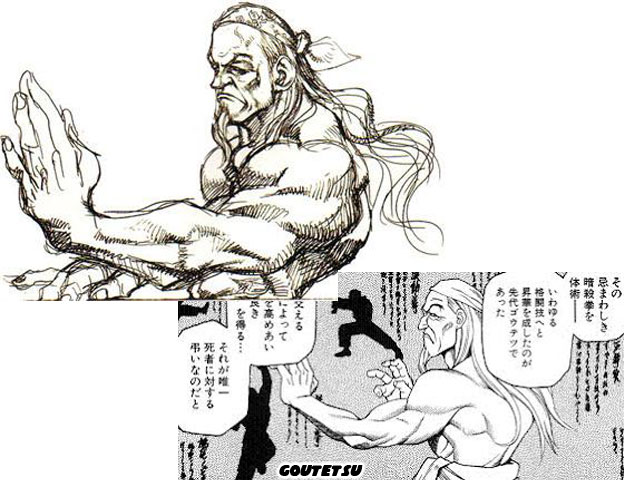
When Buddhism arrived in Japan and mixed with Shinto traditions the personification of Bodhidharma became almost subversive. He was dark and brooding, the polar opposite of the white and chaste symbols of divinity and purity in ancient Japan. His influence, especially in the martial arts seemed primitive, almost backwoods. There was no denying its effectiveness however, the early practitioners of the martial arts in Japan were immigrants that had arrived from China. Before Karate became synonymous with the "Empty Hand" techniques it was instead known as "China Hand" in Japanese. The original martial arts masters in Japan had brought with them the techniques that Bodhidharma coveted. In Japanese pop culture this lineage would be celebrated again and again in the manga, or comic books, that told the stories of turn-of-the century masters. The character Goutsetsu, the master of Gouki and Gouken from Street Fighter mythology was Chinese. He had brought with him the secret techniques of an "Assassins Fist" or Ansatsuken from China and trusted his students with them.


The influence that Buddhism had throughout Asia was immeasurable. It went well beyond what Bodhidharma did for the martial arts. Systems of fighting had been around since recorded history. The bigger the civilization was the more likely it had several forms of fighting taught in each provence. Some styles were created for military conquest and some for sport. What Buddhism did was cross pollenate spirituality, culture and the martial arts throughout Asia. As the Buddhist monks went from village to village they adapted the customs and art of the locals. They traded symbology and philosophy with many spiritual leaders and traded blows with bandits that attacked them on their travels. If you were to study the history of the martial arts you would actually see how certain systems predated others and how some forms were based on older schools. The oldest forms began in India and progressed east. It was no accident that the rise in martial arts ran parallel with the spread of Buddhism.

In a thousand years the fighting forms that would withstand the test of time had developed along the roads taken by merchants and travelers but especially by monks. By the time the monks reached the Sea of Japan they had brought with them countless lessons from their travels. The closest point between the Asian mainland and the main island of Japan was from a peninsula of what was now known as South Korea. Early immigrants from China and Korea, some monks and some merchants crossed the channel and settled in the center of Japan. The largest town being Osaka, where the seeds of what would become Karate were planted. Before we cross the channel ourselves this blog will take its time and see how various fighting arts were created and how they were represented in pop culture, but specifically in video games. As always if you enjoyed this blog and would like to sponsor me please visit my Patreon page and consider donating each month, even as little as $1 would help make better blogs and even podcasts!