Showing posts with label monk. Show all posts

Thursday, June 30, 2022

Ryu becoming the master in Street Fighter 6, a look at his new path

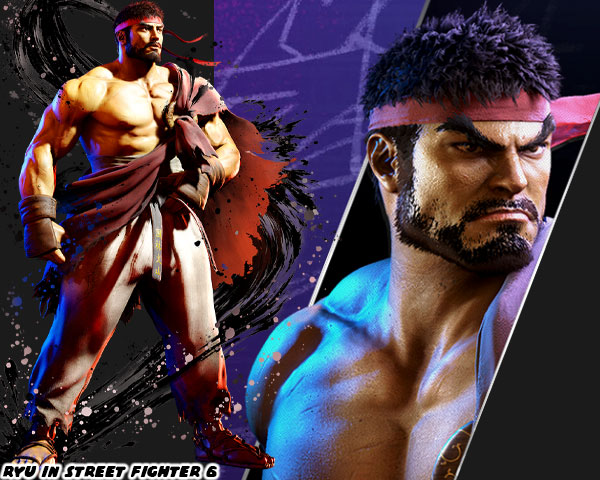
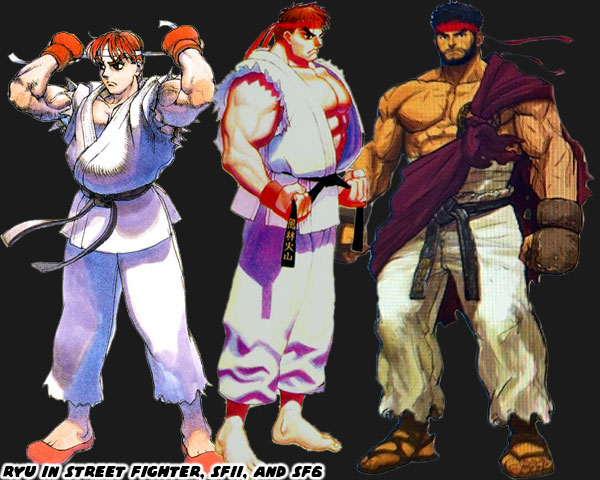
Today we are going to look at the evolution of Ryu in Street Fighter 6. In case you didn’t see him recently, he was presented a little older than any other appearance, plus he had a beard now. The biggest change for the character came with the look of his uniform. For the longest time Ryu wore a traditional, albeit torn, karate gi. Now he was without his top. In SF6 Designer Yusuke Hashimoto now had him wearing a kasaya or Buddhist robe over his shoulder. The design was very interesting. I’m not quite sure it worked in its current form, but let’s take a look at where the tradition came from.
The custom of having marital arts masters wearing classical costumes went back to the birth of the genre. Karate Champ by Data East in 1984 gave us the white, versus red uniform karate guys. A year later Yie Ar Kung Fu by Taito gave audiences multiple opponents, representing different styles. Aside from the way they fought, these characters had costumes that players would have seen in kung-fu cinema. You didn’t have to be an expert on the various styles, and their histories, as long as you had seen at least a few movies. The seeds for Street Fighter were planted then.
The martial arts spread thanks to Buddhist monks. I had documented it previously in the blogs. The monks traveled all throughout Asia, bringing with them the fighting arts. They didn’t learn to fight as a way to seek out opponents, but rather as a way to defend themselves from bandits. The Shaolin developed in China was a form of Buddhism known as Chan, or meditative Buddhism. The school fostered a Northern, and Southern version of their martial arts studies. These various forms would be influential in shaping kung-fu, and karate as well. The interesting thing was while there were many classically styled Chinese fighters throughout game history there were actually few Shaolin characters in the genre. The look was rare, but had been seen in Street Fighter.
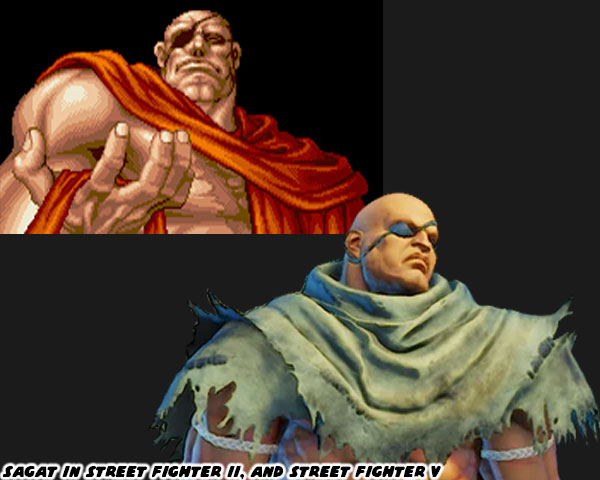
Ryu’s main rival in the original Street Fighter was actually the first in the series to be presented with a kasaya. Sagat was satisfied that he had indeed beaten the best in the world. He had achieved a level of peace with the victory that seemed transformative. He appeared in the ending of Street Fighter II with the robe while meditating on Ryu. That look made sense for Sagat. Years later the alternate costumes of Sagat in Street Fighter IV worked incredibly well. Especially the ones where he wore a tattered wrap. Part of the reason for this was because in pop culture we had seen people from Asia, and South Asia wearing the robes. In my home town of Long Beach we had a large Cambodian, and Vietnamese community, and I had grown up seeing lots of people wearing the robes. Japanese martial artists were rarely, if ever shown in the same way. Instead of the familiar orange robes we would see the elder Japanese master wearing a uniform with one bare arm.
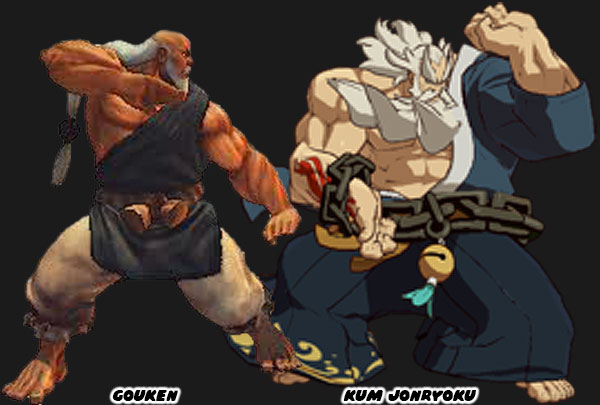
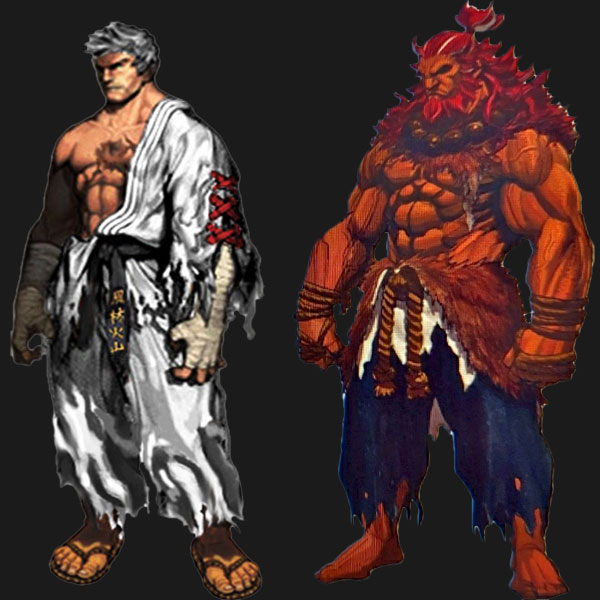
Gouken in the earliest concept art actually wore a gi like Ken, and Ryu. The only difference was that he had a rope belt, instead of a black belt. It was only in later revisions, and his playable debut in Street Fighter IV, when he was given a robe. A similar character appeared in the Guilty Gear series. Kum Jonryoku was a robot made to look like an elder master. He was created, and piloted by Kum Haehyun,a young, and talented scientist. Both fighters represented the peak of the martial arts. They had been studying a specific technique all their lives, if they didn’t invent their own style. These types of people were physically, and mentally stronger than any other person on the planet. Very rarely were they ever seen in mid-life. Gouken was seen in middle-age in Street Fighter manga, and comics books when he took on a young Ken, and Ryu as students. At that time he was not at the peak of his abilities. He was still studying under his master, the elderly Goutetsu. Prior to Ryu’s makeover in Street Fighter 6 there had been at least one young master with a similar look.
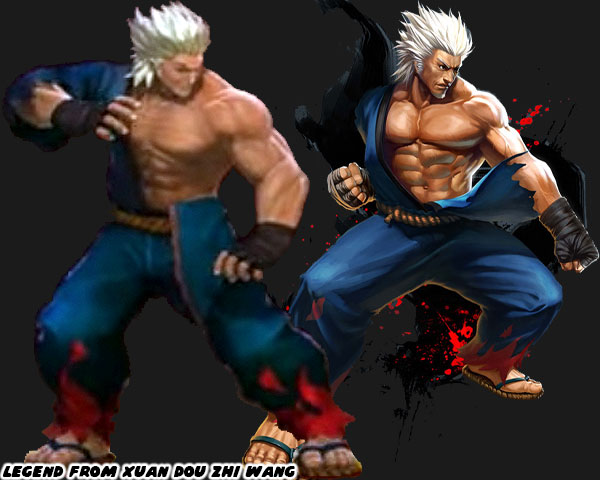
Xuan Dou Zhi Wang aka King of Combat was a Chinese-developed game first published in 2011. It had updates over the following years that patched the control, added levels, and characters. It had characters whose looks, and styles were sampled from various other fighting games. The title already had a Ken / Ryu clone named King. What they lacked was a Gouki / Akuma. That was until they updated the roster, and added a guy called Legend. This person was not much older than King, but more advanced in power, and ability. This person had white hair, no beard, but didn’t look elderly at all. The white hair might have been an aesthetic choice, or to signify that he had some sort of divine revelation. In any case there had been precedent for a young master in fighting games. Not only that, but many artists had been creating their own concept art for Ryu if the series ever did a time jump.
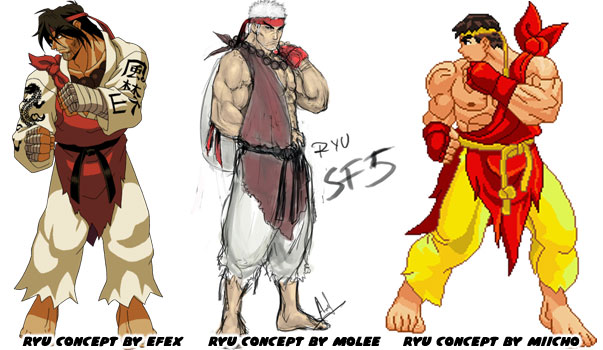
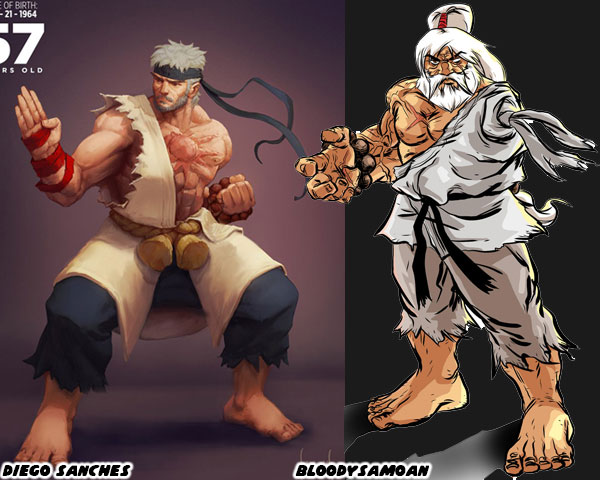
A few designers had a variation of the robe over one shoulder as a nod to Oro becoming his new master. A couple of artists pushed the idea of having the robe be made of Ken’s old gi. This idea had been circulating in the SF community for a long time. One of the older one-armed Ryu illustrations was by the artist BloodySamoan in 2010. In it he also gave Ryu one eye, his red headband now held up a ponytail, and he wore the beads of his master around his wrist. It was a unique take on the fighter for certain. In 2020 the Brazilian illustrator Diego Sanches did a series on older SF characters. He put Ryu in the colors, and costume of Gouken. He also gave him a beard, and gray hair. It also worked well.  
It is highly possible that the creative team working on SF6 was aware of all of the fan art that had come out pre, and post SFIV. They must have been especially aware of the tastes of Western artists as the game had historically sold very will in North, and South America. I’m almost certain that Designer Yusuke Hashimoto, and Director Takayuki Nakayama were aware of these illustrations, and it had a hand in influencing the new look of Ryu. The reason I can say this was because the official concept art for Street Fighter IV, and V coming out of Capcom did not have Ryu wearing a Buddhist robe. Instead they had him with long hair, or with a tattered gi, or in MMA gear. They even had several versions of Evil Ryu, and the stronger Kage variation. But none of Ryu as a Buddhist. Sure it could have been because SF IV, and V were set before he studied under Oro, but even then Oro was added as a DLC character as well.
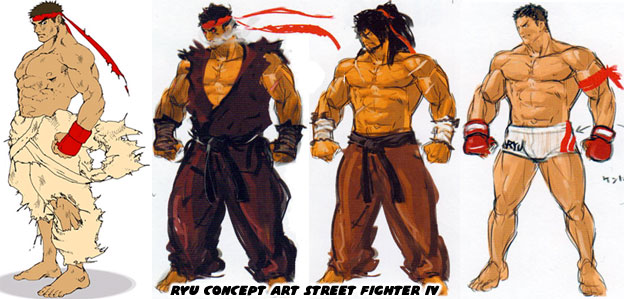
Mr. Nakayama said the new look was to honor his mentor Gouken, but I’m not sold on that idea. From SFII to today it had been established in the game endings that Ryu was not interested in trophies, or accolades. He was the opposite of Ken in this regard. The only thing that pushed Ryu forward was finding the next challenge. To continue developing as fighters both Ken, and Ryu had to prove that their form of Ansatsuken was the best. Why Ryu would suddenly decide to dress up like his mentor didn’t make much sense. He was walking his own path, and not his master’s path. Visually I don’t think the look works. Wearing a brown kasaya across his torso contrasted with the solid white of his original costume. Perhaps if Ryu wore all brown it might work better, but then his colors would be too close to Ken’s.
I’m interested in seeing Ryu continue his path. I want to see what the studio has planned for him. But I’m also interested in seeing a classic uniform DLC because right now I don’t think his new look works. The costume changes for several of the returning characters aren’t as strong as their original look. That’s what I think anyhow. I’m sure Capcom will continue tweaking the look right until the games release date. They did many visual changes to previous games when they were first previewed versus when they were published. Street Fighter 6 should be no different. Maybe Ryu’s outfit would still get updated. I’d like to read your takes in the comments section. Do you like Ryu's updated look? Would you have done anything different? Tell me about it! As always if you would like to sponsor me please visit my Patreon page and consider donating each month, even as little as $1 would help make better blogs and even podcasts!
follow the Street Writer on Patreon!

Friday, May 5, 2017

Teasing the next Street Fighter EX and Fighting Layer, part 2

The previous blog celebrated the teaser that ARIKA gave us of Fighting EX Layer. If it was an April Fools joke then it was a very well produced one, it raised the hopes of thousands of players around the world. Even if the studio had no plans on releasing the game we could still learn a lot about storytelling through the character designs. I was discussing the Mizukami family; Kairi, Hokuto and Nanase in the previous blog. I had also mentioned that the Street Fighter EX and Fighting Layer were built on a universe filled with mystical characters and spiritual arts. In the genre it was not the only game to feature these types of figures.


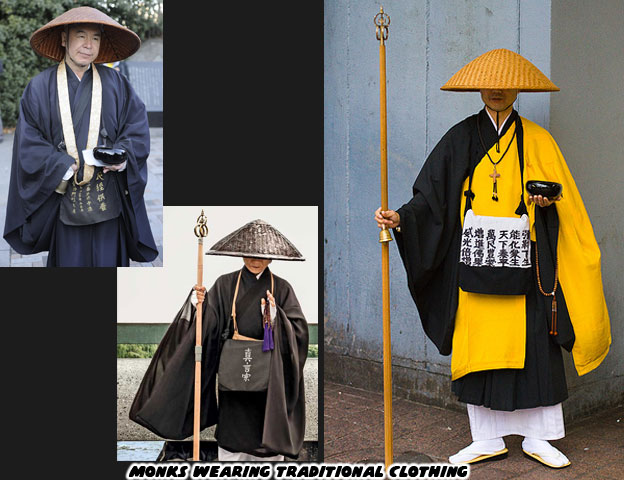
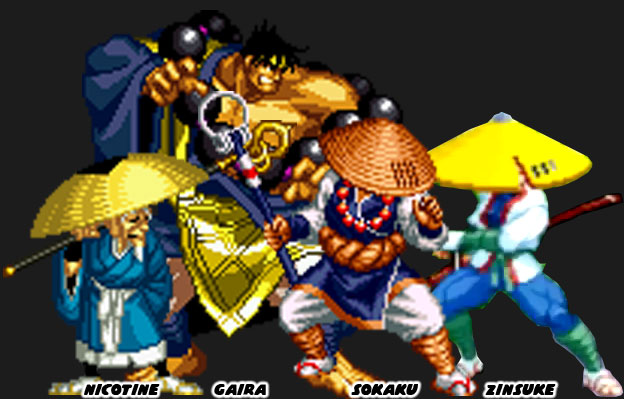
Buddhist and Shinto monks had been featured in pop culture for decades. These mysterious robed men were popular in action cinema and animé. Their identity was hid under a large bamboo straw hat, called a takuhatsugasa, and they were often experienced in the martial arts. Usually it was some form of Shaolin Kung-Fu. When the Chinese settled in parts of Japan they brought with them their religions too. Before karate was synonymous with the “empty hand” techniques it was actually associated with “Chinese fist.” That is to say the oldest schools of karate in Japan were founded on Zen Buddhist principles. The lion's share of fighting monks appeared in the SNK universe. Nicotine Caffeine debuted in the 1994 smash hit Samurai Shodown II. It was a game set a few centuries ago in feudal Japan. He would have been a period appropriate character. His massive grandson Gaira Caffeine appeared the following year in Samurai Shodown 3. Both Nicotine and Gaira wore variations of traditional monk clothing. Nicotine could summon powerful spirits to fight on his behalf whereas Gaira used bowling ball-sized prayers beads to flatten opponents. Zinsuke was a samurai-like-monk that appeared in the game Asura Buster: Eternal Warriors by Fuuki Co. Ltd. Monks were not permitted to carry weapons, and especially not swords as part of their code. Asura Buster was set in a fantasy world so that different designs elements worked for the character. In 1995 SNK also debuted another fighting monk, Sokaku Mochizuki. This character had all the trappings of a classical monk and would have fit into the Samurai Shodown universe. Yet he appeared in Fatal Fury 3, which was based in the modern era. It turned out that the uniform actually hadn't changed much in centuries.


To this day Buddhist monks still traveled through Asia and served in temples both ancient and modern. If they were on a pilgrimage they would wear a motsuke or robe. Their takuhatsugasa was wide for a reason, it protected the monk from the elements, but it also shielded their face to protect their identity. In many regions practicing and outside religion was against the law. Secrecy was for the safety of the practitioner or followers. The large hat also shielded the monk from distractions and noise so that they could mediate. Monks sometimes traveled with a khakkhara. This was a ringed "sounding staff" that had originated in India. The number of rings, 4, 6 or 12 was more than an ornament. They symbolized the Four Truths, the Six Perfections or the 12 chains of cause and effect. Only the Buddha would wield a 12-ring staff. When the monk walked with the staff it would ring. The sound would warn small animals to stay out of the path or alert people that there was a monk nearby. Although not widely practiced anymore by Buddhist monks there was an actual form of fighting associated with the khakkhara. It differed slightly from the forms used with a staff or spade, which monks were also allowed to fight with. Having Nicotine use it as a weapon in game was actually authentic.


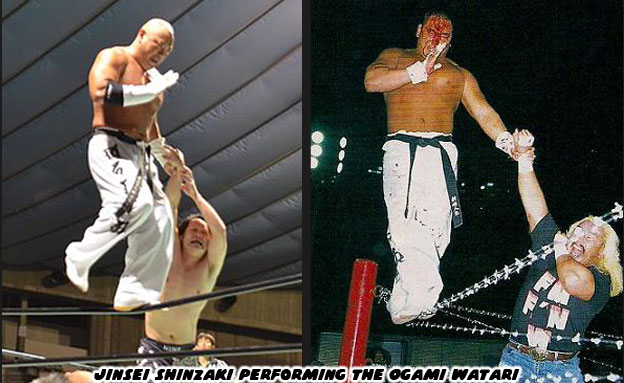
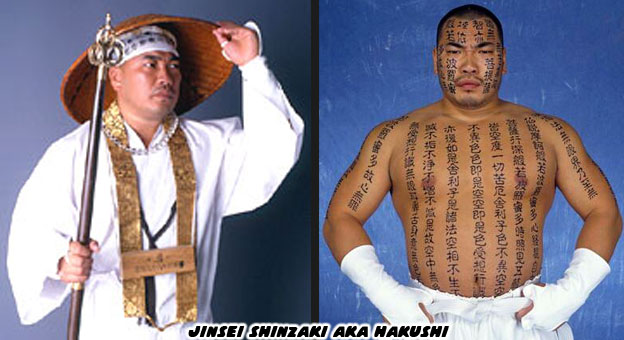
The legend of the fighting monk grew in pop culture until it was even associated with pro wrestling. Jinsei Shinzaki, aka Hakushi in the WWF/E, was an exceptional Japanese performer. Having studied under the “lucharesu” school which combined the high flying acrobatics of Mexico’s lucha libra with the hard striking of Japan’s puroresu (pro wrestling). He was a well-rounded fighter. If his opponent came at him with strikes and grapples then he had a counter attack ready. If his opponent was a fast worker and wanted to perform death defying moves then he too could launch himself off the top rope. Mr. Shinzaki could always be counted on to perform well in a match. He was very serious in and out of the ring and never broke character. He was portrayed as a fighting monk and would power bomb and slam his opponents and then follow up with a prayer. One of his trademark moves, the ogami watari, was an arm twist rope walk that ended in a flying chop. As he walked along the top rope he would pray aloud. He did this move in just about every type of ring set up, including hardcore “death” matches where the ropes would be replaced with razor wire. He was doing this move in Japan at about the same time the Undertaker was using it in the USA. The two actually had a rivalry which worked because they were both using a similar persona. In many Asian countries people only wore white at religious ceremonies if there was a funeral. Jinsei was like a monk praying for those about to die, usually his opponents. By the same token the Undertaker was a sort of ghostly monster in the USA. You could expect him to bury his opponents as well. In real life Mr. Shinzaki was as generous as you could expect a monk to be. After the 2011 Tohoku earthquake and tsunami he actually spend weeks delivering food and water to those displaced by the disaster, most of it coming from his savings.


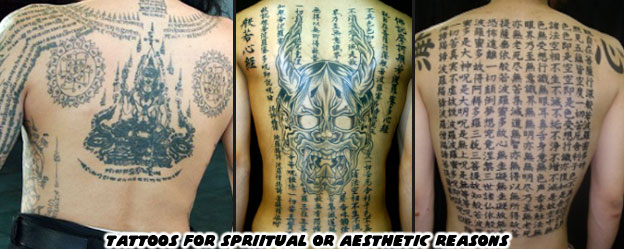
Sometimes Jinsei would go all-out for his character. He would wear the full monk costume and walk with a khakkhara to the ring. Sometimes his face and body were covered in shakyo or calligraphic characters. The messages written on his body were sutras or scripture. These showed humility and piety for his belief. In Buddhism practitioners would write down shakyo as a form of reverence. Families could commission monks and nuns to write down scripture to honor their family or loved ones. Although not practiced widely there have been many examples of tattooed shakyo written on people over the centuries. In Japan the practice of carved tattoos, called horimono, extended back to the Jomon era. These tattoos were thought to have spiritual connotations and had appeared more than 10,000 years ago. Some people did indeed tattoo their faces as well as bodies with elaborate designs. About 2000 years ago Chinese travelers to Japan had recorded these tattoos on the native Japanese and saw that they were associated with status. Only later on did tattoos start to have a negative association in society. This was because criminals were tattooed for various offenses. Regular people wouldn’t hire these people however the criminal underworld, better known as the yakuza would. To this day you can still find examples of irezumi, Japanese tattoos, that incorporate shakyo for decoration, or devotion. A mantra and symbol of Buddha or even Hindu Dharmas could be found tattooed on people all over the world.


There is a reason why I bring up all of this history. As the EX series progressed the spiritual themes became more relevant to the development of the game. Only the Samurai Showdown series had invested more mysticism into their canon. Garuda had some very distinct Buddhist symbolism associated with him. His sitting lotus position, that he teleported around the stage with, and even the actual lotus flower, a symbol of purity were seen in his animations and endings. I had described the origins of Kairi and his spiritual powers as well on previous blogs. Kairi and Hokuto had a unique bond. They were both monk-like in their training. Yet their relationship was more profound than anyone in Street Fighter. Ken and Ryu might consider themselves brothers but the Mizukami characters were actual (cursed) blood relatives. Imagine how different the Street Fighter series would have been if Ryu and Chun-Li were brother and sister. Imagine the heartbreak of Chun-Li if her brother had become a murderer. If she remained loyal to her job as an officer then she would have to arrest him, or worse, kill him in the line of duty. This was the type of character development that made the EX series so unique. This was something that the former Street Fighter II developers were thinking out lout. The lead characters were related, and they were both the heroes and villains of the universe. The drama that pulled audiences in was built because of this bond. The curse was something that would destroy the family or unite it. I think the latter was entirely possible. Kairi was headed for self-destruction at the end of the first EX game. Unless Hokuto could intervene there wouldn’t be much left of him to save.


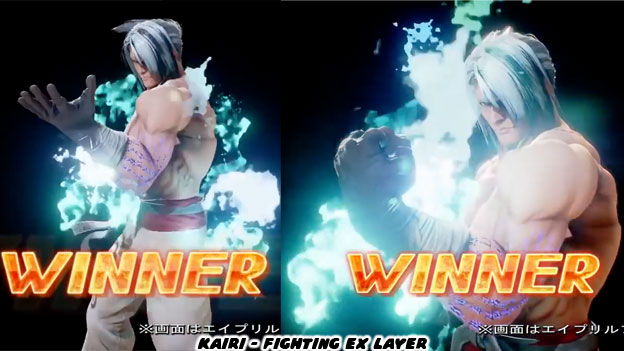
Between Street Fighter EX 3 and Fighting EX Layer something did change. Kairi had defeated Gouki, and had elevated his powers in the process. Kairi no longer performed like a tortured soul. It was obvious in his new animations and the moves that ARIKA demonstrated on April 1. I believe the secret to his evolution lay in the marks on his arms. He now had shakyo tattoos on his wrists when previously he had none. These markings must have placed the evil energy driving him mad under his command. The spiritual forces were confined to his hands and not in his mind. He was fully in control of his abilities yet unlike Garuda these strikes were not centered around maiming an opponent. In a previous blog I mentioned how spirits could be bound to objects and people. Kairi was a "yorimashi" or a possessed person. The shakyo tattoos bent the spirits to his will. In shinto tradition it could have been a rope belt or blessed paper streamers to do that as well. Gouki by contrast used prayer beads to keep control of the evil spirits within him.

Kairi had achieved a strength of boss character and established an entirely new template. He was not bent on global domination, that was Gill and the Dictator’s hang up. He had become a master, a sort of anti-Gouki. He had little interest in tracking down the most powerful Street Fighters. If they wanted a challenge then they would have to seek him out. How this would effect the relationship between himself and his sisters would have to be explored in the actual games. The Fighting EX Layer reveal also introduced something else to the fighting game conversation. We will look at this in the next entry. As always if you enjoyed this blog and would like to sponsor me please visit my Patreon page and consider donating each month, even as little as $1 would help make better blogs and even podcasts!

 follow the Street Writer on Patreon!