Showing posts with label sagat. Show all posts

Wednesday, August 21, 2024

Ryu Final, the real Street Fighter III and IV, part 2 - A 1UP classic from January 31, 2008

Good morning friends, there's not much news to report today. Some family issues that I will see about later in the day, plus lawn mowing of course. Things are holding steady but right now I have to get back to work, one of the projectors blew a bulb so that's going to cost somebody money. Let's get back to the second (and final) book of Ryu Final. WARNING: if you would rather wait for the translated issue next month then skip today and tomorrow's blog. I will be talking about everything that happens in great detail.

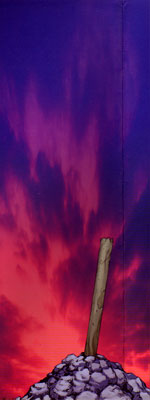
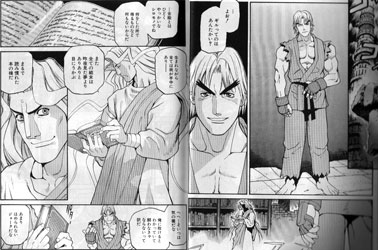
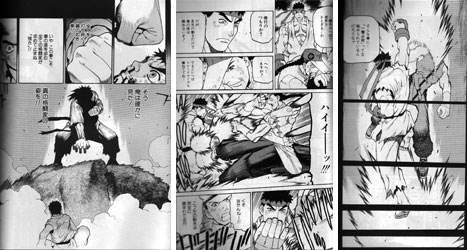
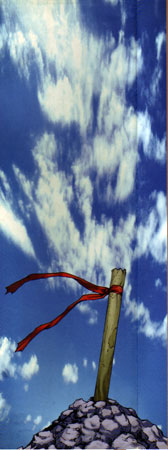
This comic begins with a rock pile and a stick. It is a grave marker. The red headband of Ryu is tied onto it.

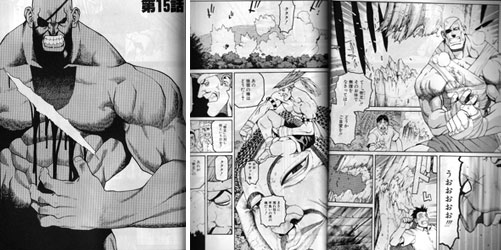
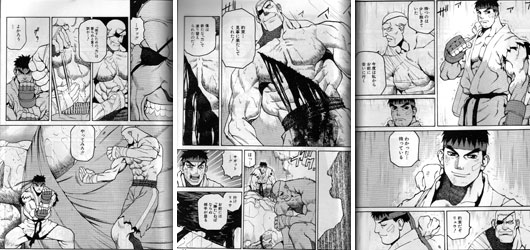
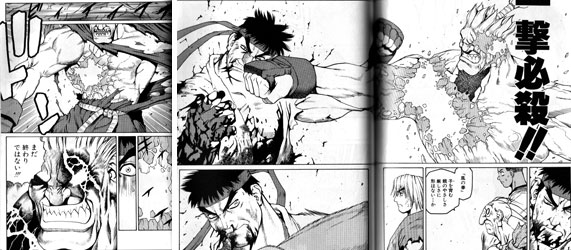
This story does not begin with Ryu but the lessons learned are just as important as everything we saw in the first book. This is the story of Sagat, rather the lessons of Sagat. As the story starts we see Hugo's diesel truck parked outside of a temple in the heart of Thailand. Hugo is taking swings at Sagat. Although he towers over the mighty Thai, he is unable to land a solid hit on him. Sagat is motionless and allows Hugo to throw punches that don't seem to faze him. In a fit of anger Hugo lifts the stone head of a Buddha and throws it down on Sagat. It shatters into a million pieces and this gets a reaction. Sagat takes down the mighty giant with one kick. He then remembers his life of fighting.

We are taken back to a period in time when Sagat was at his most dangerous. He had survived the dragon punch from Ryu and was recovering in Thailand. Furious with himself he takes his aggression out in the jungle. Knocking down trees and trying to make his techniques stronger. Adon watches from a distance, ashamed that the tiny Ryu could have done this to his master. Although bandaged up Sagat has a would that will not heal. He doesn't stop long enough to think about the consequences of his actions until he accidentally knocks a tree down onto a child. He takes the child to a temple where the monks take him in and try to help. The monks warn Sagat of what he is becoming.

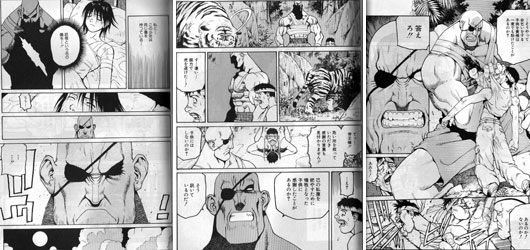
Although he survived a potentially fatal blow he survived. Whether is was his size, his determination or his will that kept him alive is unknown. What worries the monks is the scar has been left in the Shoryuken's wake. It is not the physical scar but the emotional one. They warn Sagat that revenge and hatred is what is fueling him now. That hatred is going to eat him up from the inside, that scar will never heal if Sagat remains possessed with a desire to kill. Sagat lived for a reason, there is tremendous potential for him but he seems to miss his purpose. It extends beyond the fight. The monks say that poachers are killing and trapping tiger nearby. Sagat should be defending his homeland. So he leaves the child behind and goes into the jungle.

We see poachers stalking a tiger who instead kills one of them. Before the tiger can pounce on the other Sagat kicks it in the head and scares it off. The poacher thanks Sagat profusely for which he rejects. Sagat has found a new target for his aggression. He begins slapping the poacher all over the jungle. As he does so the scar on his chest opens up and he starts bleeding. While Sagat pauses to clutch his chest the poacher grabs a young villager from a nearby tent. It is the child that Sagat accidentally hurt. The poacher holds him hostage. Sagat throws his hand in between the gun and the child. The poacher fires a round into his hand. Sagat grabs the poacher with his free hand and lifts him into the air. The poacher fires a few more rounds into the torso of Sagat.

Sagat can easily kill the poacher but he chooses not to. He had just cause and unlike Ryu, this person was a criminal willing to murder Sagat in cold blood. At that point Sagat has chosen his path, he will not let rage consume him, he will not use muay thai as a means to have his revenge. He will not stain the name of his beloved country. The bandages fall away from his chest as he holds the poacher aloft. The massive scar on his chest has stopped bleeding. Sagat has matured as much as Ryu in the universe. He has learned many lessons and he perseveres. He is proof that even a mortal wound can be overcome.

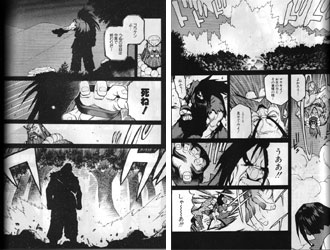
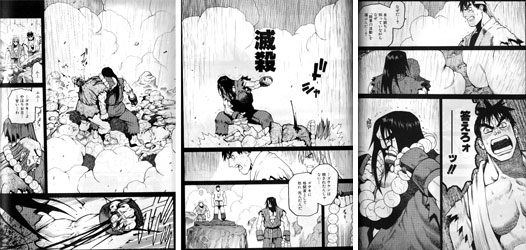
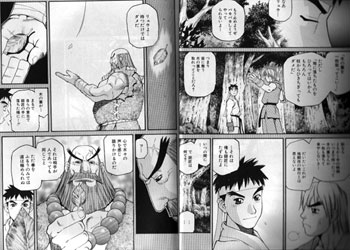
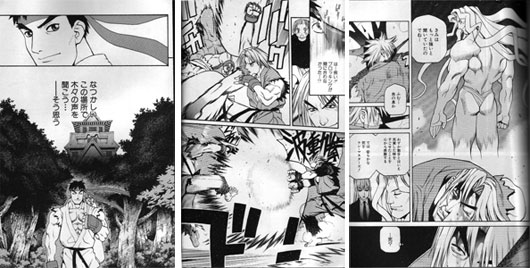
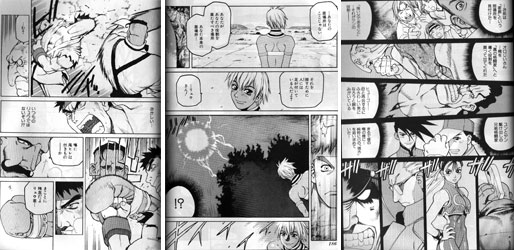
Ryu and Oro know where their path will lead. In Ryu's memory the reader is taken to the past again to witness an important moment in SF continuity. Nakahira shows us the fight between Gouken and Gouki in all its violent glory. Ryu and Ken are young, about the age they were in Zero if not a little younger. One day Gouki just begins shooting fireballs at his brother from high atop a ridge in the woods. Gouken senses these strikes and jumps out of the way. They begin battling all over the woods in a very cinematic fashion. They hurl special moves at each other but Gouken is eventually overtaken by his brother. He is beaten and killed when Gouki punches his hand through his chest. Gouki takes the string of giant beads from the body of his brother and places them around his own neck. Ken and Ryu call out for their master but it is no good. They can barely hold themselves back but they know neither of them is remotely a match for Gouki. He warns them and then walks off. The memory remains with Ryu for a long time and now is the time to do something about it.

It is now the present and Ryu returns to Thailand for a rematch. Ryu and Oro pass a couple of teens farming near the temple. The villagers that Sagat saved many years ago are growing up. Sagat waits for Ryu, the battle between the tiger and dragon has been a long time coming. Sagat is stronger than he's ever been, Ryu has been training harder than ever. Of all the rivalries in Street Fighter this is the oldest. Nakahira tells us what happened between them during the SF III continuity. This is important because the beef was not settled in canonical terms or in the videogame, Sagat was not in III. Both Ryu and Sagat prepare for the fight with Oro and the teens acting as spectators. There is a storm brewing but neither Sagat nor Ryu will let the rain stop them. They square off and begin fighting when the lightning strikes nearby.

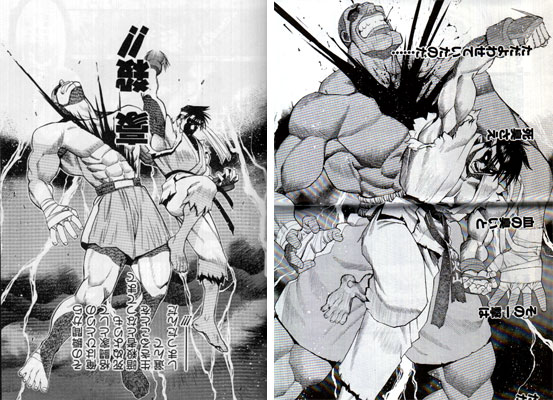
The battle is over in a few hits.

Both strike each other quickly, over and over, but Sagat manages to land a devistating knee. He sends Ryu crashing through a sleeping Buddha statue. Oro was the only one that was able to perceive the blows and know when each struck the other. Ryu looks beaten but Sagat takes a knee and concedes defeat. Ryu does not understand. Both men were capable of taking the fight much further. Sagat has taken a knee because his old wound has reopened. He knows now that the path of the warrior is not validated if he must fight to the death. Ryu learns that every battle does not have to end with him crippling or knocking out his opponent. He must take the fight as far as it has to go and no further. Ryu must not becomes that which he despises. Ryu and Sagat come to an understanding after that. Ryu and Oro leave Thailand. Sagat bandaged up again, the teens holding an umbrella over his head and watching an old adversary walking away. This might very well be the last time Sagat is supposed to be seen in continuity, the end of an amazing chapter in the history of fighting games.

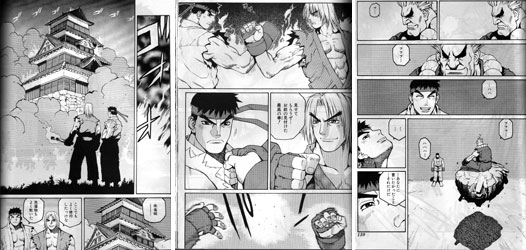
Ryu and Oro make it to Japan where they reunite with Ken and Sean. Ken and Ryu prepare to end another chapter in the series. They set fire to their masters temple. It is a majestic castle that has been in the background of every Street Fighter game. Sadly this is the last time we shall see it standing. Ryu and Ken square off to determine who must challenge Gouki as their dojo burns in the distance. Ryu connects with one well placed strike. Suddenly the temple explodes and collapses. Gouki descends on a pile of rubble. The two great warriors pause to study each other.

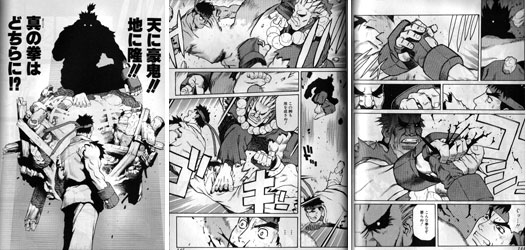
In a way it is funny that the path Ryu has wandered on for years takes him back home. Gouki finds irony in the little boy he saved has grown into a capable warrior. They both laugh a little. It is the only time you will ever see a smile on Gouki, it is slightly unnerving. Ryu tries to catch Gouki with a dragon punch. Gouki grabs Ryu's hand and crushes it.

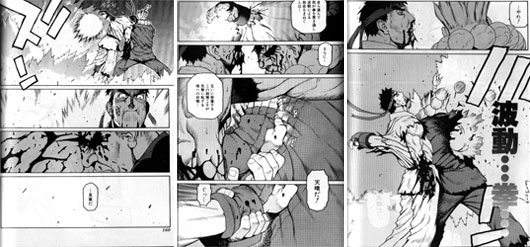
The fight is brutal and although Ryu has grown and learned a lot in the past few years he is still no match for Gouki. Gouki beats Ryu and hits him with the legendary Shun Goku Satsu or Instant Hell Murder. The finishing strike is a punch through the chest, just like he gave his brother and master. To make sure that Ryu is done for he drops a fireball from the hand that went through him. This explains the flash of light that you see at the end of the videogame version. Ryu spits up blood in the face of Gouki. He is wiling to return the favor in kind and do something that his master was not willing to. Ryu places his palm on the side of Gouki and shoots a fireball right through him. Gouki pulls his arm out and both men stagger back.

Ryu is bleeding profusely and wonders how Gouki can remain standing. Gouki tears off his gi and we can see the gaping hole in his torso. Gouki is hollow inside, he has been completely consumed by the Dark Hadou. All that remains is a rage-filled shell of his former self. Ryu curses the monster for killing his master and killing himself.

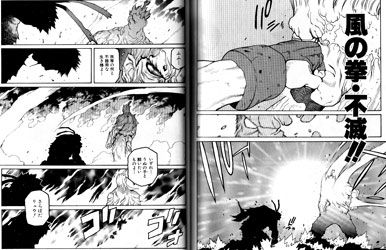
They strike each other once more. Gouki connects first. As soon as Ryu hits the face of Gouki he becomes consumed by fire. Gouki turns away from Ryu and staggers into the flames of the burning temple. The demon is defeated but at the ultimate price. Ryu collapses and Ken runs to his side. He is unresponsive as Ken yells his name. Ryu is dying.

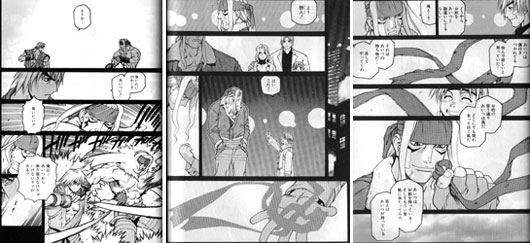
The epilogue. We see Alex sitting in an alley, distraught. Earlier that day he had a match with Ken at Madison Square Garden. Alex was a big up-and-coming fighter in the MMA circuit. In SF canon he even knocked out M. Bison in a MMA fight. He gives Ken a good battle in the final but is ultimately defeated. Alex is disappointed in himself, not for losing to Ken but because he realizes that he is still not strong enough to fight Gill, whom he really wishes to battle and avenge his family. Alex's adopted family finds him sulking in the alley and helps him. A few days later Alex seems to be doing better when he runs into Ken and his family. Ken advises that the only way to get better is to go around the world and learn from the best. Little Mel reaches out and gives Alex the red headband of Ryu, knowing that Alex respects the legendary fighter greatly. Ken and Alex part ways.

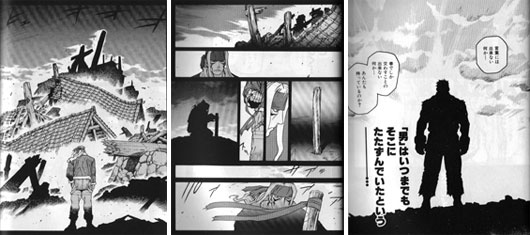
We see Alex months later in the hills of Japan. We assume that he has already done extensive traveling. Learning from Birdie, Zangief and Adon as per the canon. He stops at the ruins that was formerly the temple where Ken and Ryu trained. It is a sad scene now, nothing but rubble remains. There is a pile of rocks marking a grave and a post. Alex kneels and ties the red headband to it. He wishes that he could have learned from the best, to have sparred with Ryu once.

We see a silhouette appear on the horizon. We don't know if it's a memory or Alex's imagination. He turns around.

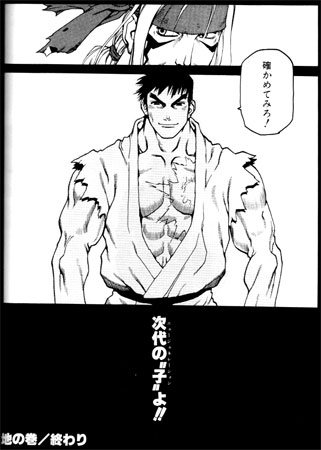
Ryu is standing there, smiling. His hair unkempt. A large circular scar on his chest.

THE END.

Now do you know why I am so critical of the Udon books? Why can they not write or draw anything as epic as Ryu Final? So what can we make from the end of this book? Well aside from the near-impossible surviving from a punch through the chest we can take many things for the future of the series in canonical and videogame terms. His surviving a death blow was foreshadowed by Sagat at the beginning of the book. Ryu returns not as a messiah but as a true martial artist. Ryu has learned to harness the power of a killing strike in his Fist of the Wind and seems to have finally completed his journey. From this point on he should hold a place of great importance in the universe, the transition from fighter to master. From this point on Ryu is no longer the intro into the world, or should not be. I am speaking in manga and videogame terms. From this point on Ryu should be something more... What should we expect if Capcom creates a true Street Fighter IV and not a II.5? 

As always if you would like to sponsor me please visit my Patreon page and consider donating each month, even as little as $1 would help make better blogs and even podcasts!
follow the Street Writer on Patreon!

Monday, August 19, 2024

Ryu Final, the real Street Fighter III and IV - A 1UP classic from January 30, 2008

Welcome back friends. We're here to talk about Ryu Final, the last book Masahiko Nakahira created for Street Fighter. The book was set in the SF III continuity, to be precise it is set during 2nd Impact: Giant Attack. Nakahira never did a SF II book for Capcom, those were covered by Masaomi Kanzaki and Mami Itoh. So how does Nakahira's story go? How does it progress? If you read it once then go back through you'll notice that everything that went into this story was done so deliberately. Every character, location, fight and moral was done with forethought. Nakahira is a genius when it comes to plotting the events of his book. He doesn't just plot out a linear story but carefully intersects flashbacks which keeping you turning the pages. The weakest part of his story is better than anything I've seen with Udon. Overall it is perfect storytelling and great art combined. Let's touch on the events of the first collected book.

This comic begins with a rock pile and a stick. It is a grave marker, but for whom?

Ken and Ryu are much older, stronger and wiser than when we last saw them. They are possibly at the peak of their abilities. Ryu begins the tale, he is training in the shadow of his old dojo. He remembers the lessons learned from his master Gouken. Nakahira presents Ken and Ryu younger than they appeared in the Zero books, as young as they appear in some Udon flashbacks. The sage advice is not lost on Ryu as he remembers, in Jedi style, that he and Ken are part of the living, breathing world, not apart from it. It is up to Ken and Ryu to catch a falling leaf, the task sounds simple but has profound meanings. In almost all the Nakahira books you see a big oak tree and leaves come up time and again. The leaves and lessons of Gouken also return in the ending credits of SF III: 3rd Strike. The cycle of growth and change, the eternal strength with roots deepening as they grow. The hard training of Ryu and the trees that shake with his blows are inspired by actual accounts of Mas Oyama's tremendous power.

Ryu is fully confident in his abilities and decides it is time for him to return to the circuit and prove himself. His first stop is San Francisco where the understudy of Ken, Sean, taxis Ryu to a yacht. Young Mel, the son of Ken and Eliza is crying because he's afraid that Ryu is going to beat his father. After a few formalities the classic rivalry gets underway. The outcome isn't even close. Ryu is soundly beaten by Ken and can't even manage to get a hit in. Somehow his best friend and rival has surpassed him. Ken has worked harder than Ryu and has become a true martial artist. The reason is told in flashback.

Ken had challenged the man-god Gill and was beaten within an inch of his life. He came to the realization of his purpose as he was lying in a pool of his own blood. He could not allow this defeat to happen, he would never allow himself to be defeated in combat by anyone. His life was not forfeit as he remembered his wife and son. They were his foundation and Gill be damned for trying to sever those ties. The fight became a stepping stone for Ken. From that point on Ken realized he was not only fighting for himself, but for his family and with that conviction he would never fail them. With his remaining strength he leveled Gill with a dragon punch and did the same to Ryu. A clear-cut victory.

The scenes and plot with Gill were covered in the shortest span of time. Nakahira knew the important part of the story was not in trying to explain the plot of SF III but instead allowing the reader to discover how much the cast had grown. Ryu walked away from the encounter a little humbled but grateful. He knew now that he had room to grow. So he said farewell to his friends and set out again. While sleeping in a park he was awoken by Oro, who was trying to walk away with his duffel bag. Ryu tries to teach the old man a lesson but is instead beaten by the aged master. To make things fair Oro even puts one hand behind his back and still manages to beat up Ryu. FYI: remember that Capcom has been trying to use a one-armed boxer in their series because their template for SF II, the Master of the Flying Guillotine sparked the idea. Ryu becomes progressively angry with his aged opponent and finally decides he's had enough. Ryu tries to counter with a fireball but he is instead knocked silly when Oro unleashes a massive Yagyou Dama, or two handed fireball the size of a Volkswagen Beetle. It turns out that Oro was testing him. Hoping to find a student worthy to train. Ryu is the one and from then on he is under the hard tutelage of the 140-year-old master. He begins by making Ryu carry a massive boulder on his back with Oro riding atop.

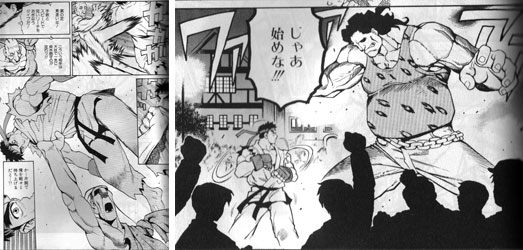
At this point of the story Ryu has pretty much hit rock bottom. This is important because he must be rebuilt as a person and as a fighter. The battles he has had in the past, against opponents like Sagat and Vega should have made more of him. Instead he is still locked in the rigid system taught to him by his master and unwilling to progress. It is up to Oro to show Ryu his true potential or kill him in the process. Somewhere in Germany Ryu's first battle turns out to be against the giant Hugo. The battle is brutal on Ryu as Hugo dominates him for most of the match. Pounding him into the ground and throwing him like a ragdoll, Hugo is a force of nature against Ryu. Nakahira uses exaggerated perspective to make Hugo appear 20 feet tall rather than the 7'8" he is. This is in the same dramatic technique that Tetsuo Hara would do to make gigantic opponents for his Kenshiro to battle. After losing for most of the match Ryu is able to defeat Hugo with a well placed dragon punch to his stomach.

It is not easy for Ryu to win battles. Unlike the Udon books where fan-favorites can knock out opponents in one hit, nothing comes easy in the Nakahira books. This importance of this fight is to show him, and the reader, that there will always be bigger and stronger opponents waiting for the challenge. Ryu will always bring out the best in his opponents and he can't always out-muscle them. The moral of the Hugo battle is that strength is tempered by technique. Ryu continues his training with Oro from there, having earned the respect of Hugo and Poison. He travels south and eventually encounters Yun and Yang. The brothers are brash and inexperienced fighters. The determination of the young kung-fu masters is a parallel between Ryu and Ken's legacy. Even though Yun and Yang are beaten by Ryu they will not quit. Ryu is reminded of how stubborn he was in his youth as well. Yun and Yang establish the core of the Ryu story.

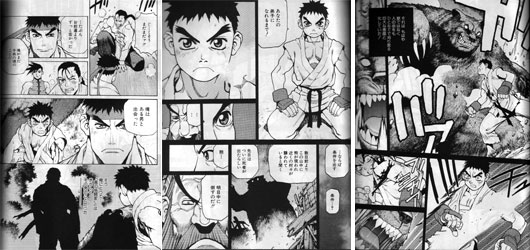
In flashback we see a young Ryu, much younger than he's ever been presented. His build is skinny, his hair unkempt, but he has a determination that impresses Gouken. He wants to prove that he is worthy to learn under the master so he says he will strike out to chase away a bear terrorizing the local villages. Gouken discovers his bloody duffel bag a few days later. Gouken fears that the bear has killed Ryu. This adventure, like much in the life of Ryu is inspired by the fictional retelling of the life of Mas Oyama, better known as the Karate Baka Ichidai anime. In particular the battle here is between Ryu and a dangerous bear, the same thing that happened to Yoshiji Soeno in the cartoon. We catch up to Ryu in the woods and see that a bear is indeed slashing at him ferociously.

The bear pounces on Ryu and is about to finish him when he is struck from behind. The force of the punch travels through the head of the bear and stops inches from the face of Ryu. It is a wild-haired Gouki that has saved Ryu and killed the bear. Gouken arrives to take Ryu away. Gouki cares not for man or beast, saving Ryu was an afterthought. It was that day where Ryu saw the face of evil. He saw that the techniques he wanted to learn was lethal in the wrong hands. These were techniques that could easily be used to kill if left unchecked. In present time Ryu thanks Yun and Yang for the fight and hopes to see them again someday. Like they Ryu has room to grow and many more battles to come.

The next battle Ryu faces is nowhere near as easy as the battle with Yun and Yang. Dudley the boxer, the undisputed heavyweight world champion, wishes to challenge Ryu. You would think that with Oro as his new master he would have become a better fighter by now. Dudley beats the tar out of Ryu and has a counter for every move. Ryu is simply not fast enough to catch the champ with his guard down. Even his dragon punch is caught and countered. Round 1 goes to Dudley but Ryu will not stay down.

This is the abstract part of the book, the weakest reason for a character to be introduced. Elena is brought in an aside and doesn't fight in any way. She is in Africa, a continent away from where Ryu is. Yet she, like every other fighter in the world is connected. It all goes back to the lessons that Gouken planted into the young Ken and Ryu. They are part of this living world, their roots have grown deep and they have more potential than they realize. It is up to them to wake up to that and release their true potential. With that Ryu comes to his senses and catches his second wind. The leaves in the mighty oak tree in the background shake. Ryu plants his feet and prepares a new fighting stance. Oro and Dudley are intrigued at this newfound intensity in Ryu.

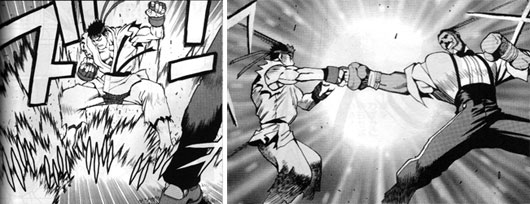
Oro wonders how Ryu will face his opponent now. Dudley is the culmination of the boxing arts, possibly the oldest fighting arts in the world, dating back thousands of years. Boxing is a refined sport, called the sweetest science by practitioners. Embracing the culmination of the art Dudley represents a fighter in the purest sense of the word. He is taller than Ryu and has a longer reach than Ryu, there is no way he can get caught by Ryu's blows. A pure fighter cannot be defeated by traditional strategies and technique. Ryu has learned that he is not fast enough for a special move, he has also learned that he can't always out-muscle his opponents. In order to evolve he must be willing to change his strategy. He decides to use the force of a killing strike but use it in a new way. In one strike they go at each other with everything they have.

Dudley was aiming for the head of Ryu and failed to notice that Ryu's punch was headed for his hand. Ryu has learned to harness the power of a killing strike but not in the way that was used against Sagat. The force of the blow destroys Dudley's boxing glove and breaks the bones in his arm. The force of the blow also travels through Ryu's arm and tears part of his gi off. Ryu remained grounded and the remaining energy returned to the Earth. Dudley concedes defeat. Ryu has learned the fist of the wind, a technique unique to him. He is now ready for an even greater challenge.

End of book 1.

As always if you would like to sponsor me please visit my Patreon page and consider donating each month, even as little as $1 would help make better blogs and even podcasts!
follow the Street Writer on Patreon!

Thursday, June 30, 2022

Ryu becoming the master in Street Fighter 6, a look at his new path

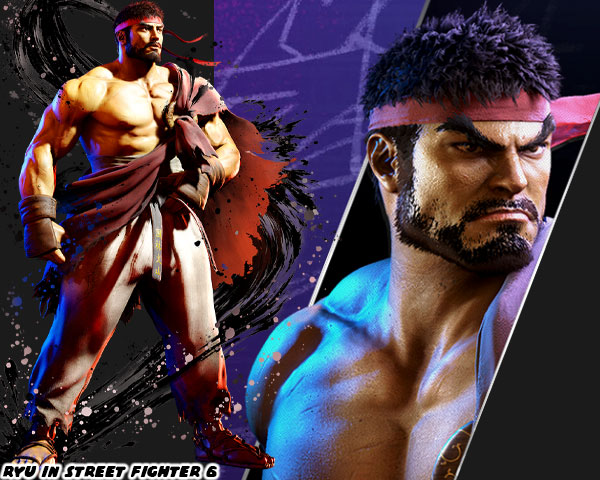
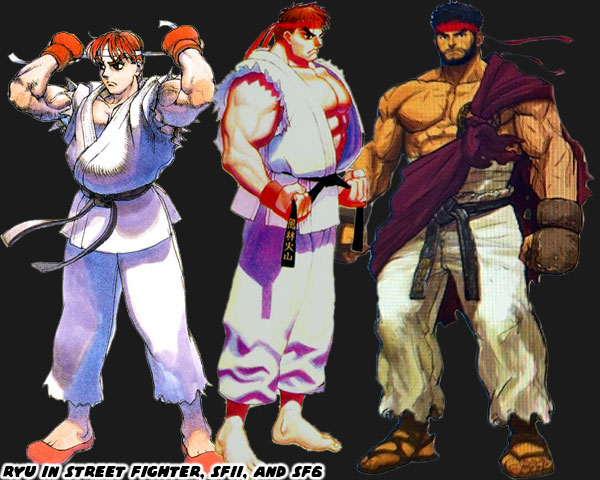
Today we are going to look at the evolution of Ryu in Street Fighter 6. In case you didn’t see him recently, he was presented a little older than any other appearance, plus he had a beard now. The biggest change for the character came with the look of his uniform. For the longest time Ryu wore a traditional, albeit torn, karate gi. Now he was without his top. In SF6 Designer Yusuke Hashimoto now had him wearing a kasaya or Buddhist robe over his shoulder. The design was very interesting. I’m not quite sure it worked in its current form, but let’s take a look at where the tradition came from.

The custom of having marital arts masters wearing classical costumes went back to the birth of the genre. Karate Champ by Data East in 1984 gave us the white, versus red uniform karate guys. A year later Yie Ar Kung Fu by Taito gave audiences multiple opponents, representing different styles. Aside from the way they fought, these characters had costumes that players would have seen in kung-fu cinema. You didn’t have to be an expert on the various styles, and their histories, as long as you had seen at least a few movies. The seeds for Street Fighter were planted then.

The martial arts spread thanks to Buddhist monks. I had documented it previously in the blogs. The monks traveled all throughout Asia, bringing with them the fighting arts. They didn’t learn to fight as a way to seek out opponents, but rather as a way to defend themselves from bandits. The Shaolin developed in China was a form of Buddhism known as Chan, or meditative Buddhism. The school fostered a Northern, and Southern version of their martial arts studies. These various forms would be influential in shaping kung-fu, and karate as well. The interesting thing was while there were many classically styled Chinese fighters throughout game history there were actually few Shaolin characters in the genre. The look was rare, but had been seen in Street Fighter.

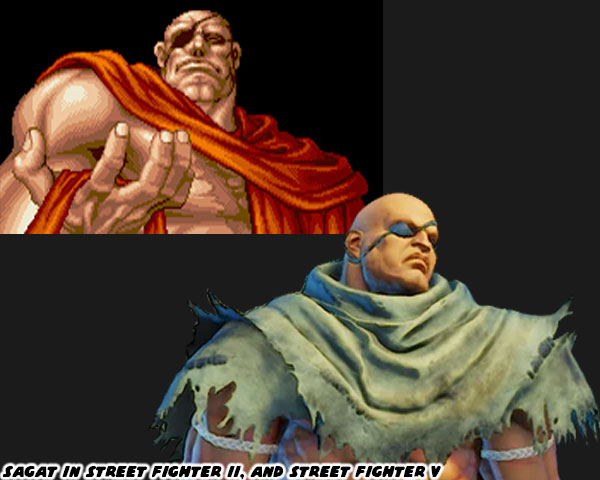
Ryu’s main rival in the original Street Fighter was actually the first in the series to be presented with a kasaya. Sagat was satisfied that he had indeed beaten the best in the world. He had achieved a level of peace with the victory that seemed transformative. He appeared in the ending of Street Fighter II with the robe while meditating on Ryu. That look made sense for Sagat. Years later the alternate costumes of Sagat in Street Fighter IV worked incredibly well. Especially the ones where he wore a tattered wrap. Part of the reason for this was because in pop culture we had seen people from Asia, and South Asia wearing the robes. In my home town of Long Beach we had a large Cambodian, and Vietnamese community, and I had grown up seeing lots of people wearing the robes. Japanese martial artists were rarely, if ever shown in the same way. Instead of the familiar orange robes we would see the elder Japanese master wearing a uniform with one bare arm.

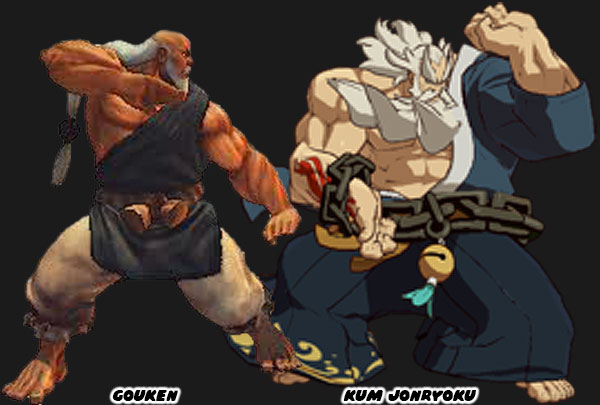
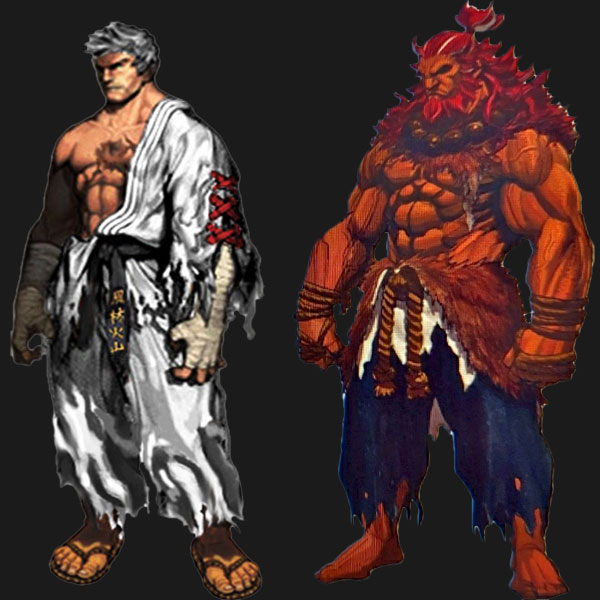
Gouken in the earliest concept art actually wore a gi like Ken, and Ryu. The only difference was that he had a rope belt, instead of a black belt. It was only in later revisions, and his playable debut in Street Fighter IV, when he was given a robe. A similar character appeared in the Guilty Gear series. Kum Jonryoku was a robot made to look like an elder master. He was created, and piloted by Kum Haehyun,a young, and talented scientist. Both fighters represented the peak of the martial arts. They had been studying a specific technique all their lives, if they didn’t invent their own style. These types of people were physically, and mentally stronger than any other person on the planet. Very rarely were they ever seen in mid-life. Gouken was seen in middle-age in Street Fighter manga, and comics books when he took on a young Ken, and Ryu as students. At that time he was not at the peak of his abilities. He was still studying under his master, the elderly Goutetsu. Prior to Ryu’s makeover in Street Fighter 6 there had been at least one young master with a similar look.

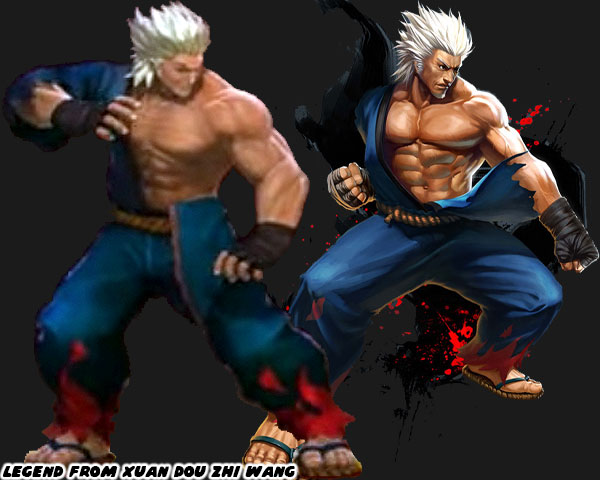
Xuan Dou Zhi Wang aka King of Combat was a Chinese-developed game first published in 2011. It had updates over the following years that patched the control, added levels, and characters. It had characters whose looks, and styles were sampled from various other fighting games. The title already had a Ken / Ryu clone named King. What they lacked was a Gouki / Akuma. That was until they updated the roster, and added a guy called Legend. This person was not much older than King, but more advanced in power, and ability. This person had white hair, no beard, but didn’t look elderly at all. The white hair might have been an aesthetic choice, or to signify that he had some sort of divine revelation. In any case there had been precedent for a young master in fighting games. Not only that, but many artists had been creating their own concept art for Ryu if the series ever did a time jump.

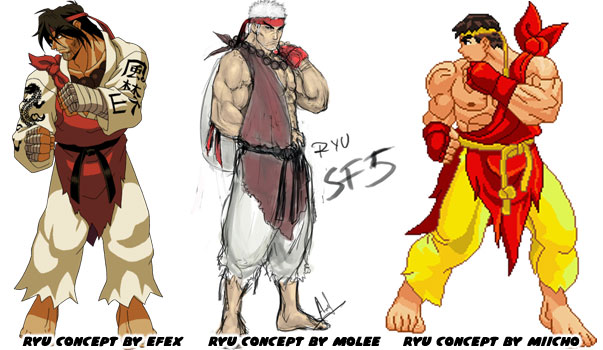
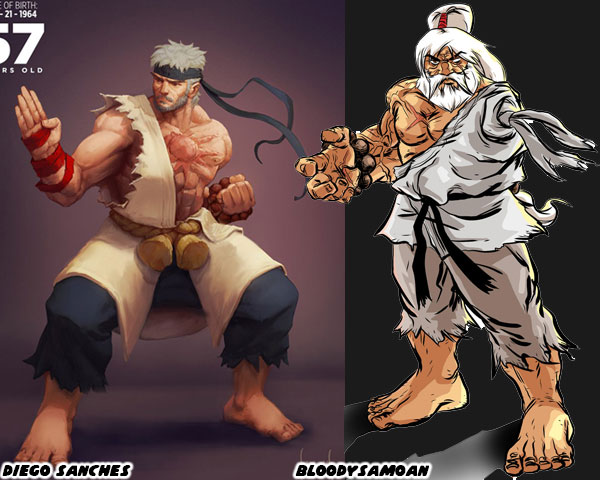
A few designers had a variation of the robe over one shoulder as a nod to Oro becoming his new master. A couple of artists pushed the idea of having the robe be made of Ken’s old gi. This idea had been circulating in the SF community for a long time. One of the older one-armed Ryu illustrations was by the artist BloodySamoan in 2010. In it he also gave Ryu one eye, his red headband now held up a ponytail, and he wore the beads of his master around his wrist. It was a unique take on the fighter for certain. In 2020 the Brazilian illustrator Diego Sanches did a series on older SF characters. He put Ryu in the colors, and costume of Gouken. He also gave him a beard, and gray hair. It also worked well.  

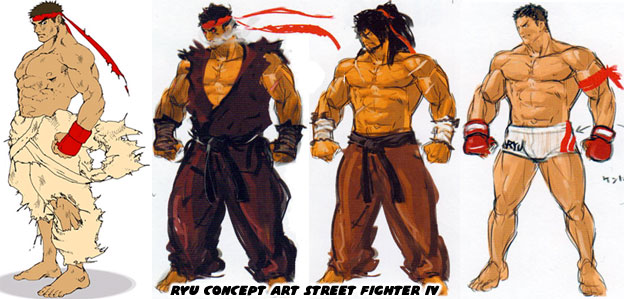
It is highly possible that the creative team working on SF6 was aware of all of the fan art that had come out pre, and post SFIV. They must have been especially aware of the tastes of Western artists as the game had historically sold very will in North, and South America. I’m almost certain that Designer Yusuke Hashimoto, and Director Takayuki Nakayama were aware of these illustrations, and it had a hand in influencing the new look of Ryu. The reason I can say this was because the official concept art for Street Fighter IV, and V coming out of Capcom did not have Ryu wearing a Buddhist robe. Instead they had him with long hair, or with a tattered gi, or in MMA gear. They even had several versions of Evil Ryu, and the stronger Kage variation. But none of Ryu as a Buddhist. Sure it could have been because SF IV, and V were set before he studied under Oro, but even then Oro was added as a DLC character as well.

Mr. Nakayama said the new look was to honor his mentor Gouken, but I’m not sold on that idea. From SFII to today it had been established in the game endings that Ryu was not interested in trophies, or accolades. He was the opposite of Ken in this regard. The only thing that pushed Ryu forward was finding the next challenge. To continue developing as fighters both Ken, and Ryu had to prove that their form of Ansatsuken was the best. Why Ryu would suddenly decide to dress up like his mentor didn’t make much sense. He was walking his own path, and not his master’s path. Visually I don’t think the look works. Wearing a brown kasaya across his torso contrasted with the solid white of his original costume. Perhaps if Ryu wore all brown it might work better, but then his colors would be too close to Ken’s.

I’m interested in seeing Ryu continue his path. I want to see what the studio has planned for him. But I’m also interested in seeing a classic uniform DLC because right now I don’t think his new look works. The costume changes for several of the returning characters aren’t as strong as their original look. That’s what I think anyhow. I’m sure Capcom will continue tweaking the look right until the games release date. They did many visual changes to previous games when they were first previewed versus when they were published. Street Fighter 6 should be no different. Maybe Ryu’s outfit would still get updated. I’d like to read your takes in the comments section. Do you like Ryu's updated look? Would you have done anything different? Tell me about it! As always if you would like to sponsor me please visit my Patreon page and consider donating each month, even as little as $1 would help make better blogs and even podcasts!
follow the Street Writer on Patreon!

Monday, June 25, 2018

30 years of Street Fighter: 30 years of Characters #6


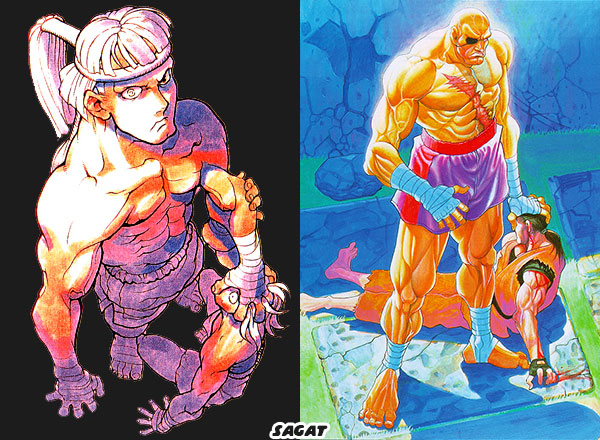
At one point in time, 30 years ago to be precise, the world's strongest fighter was named Sagat. That title didn't come with a trophy or a belt. It wasn't celebrated on television or reported in the newspapers. It was only by word of mouth that his reputation traveled. People around the globe eventually learned of the man. Those that knew their history, were familiar with underground fighting scene knew who the real world champ was. It was understood that the seven-footer was the most dangerous man on the planet. How long did he hold the reputation? Perhaps years, but more likely decades. He lost his left eye in a fight. He killed the man that took his eye in that fight. He was never the same after that, not physically and not mentally. One day a young kid from Japan beat Sagat in a fight. His reputation exploded. Sagat disappeared after his defeat. Some thought he died. He was actually recovering and training. He had become more dangerous than ever before when he returned. 


When it comes to fighting game design there may never be a better template to work from than Sagat. The bald, eyepatch-wearing giant was a master of Muay Thai. It was one of the longest-lived and certainly most lethal of the South Asian fighting arts still being practiced today. Fighters can not only punch and kick but can also grapple their opponents and use knee and elbow strikes. In some versions of the sport the punching gloves are replaced by braided cord which causes massive cuts to their opponents. Matches are often very violent and very bloody. It's actually amazing that Sagat didn't kill more men in the ring based on his style. From a design standpoint there was a problem with the character. Somebody so monstrous could only be used as the final boss one time. It was shocking to see someone that big and fast in the original game. It would have however been anticlimactic if he were the final boss two times in a row. The new final villain in the game, Vega / The Dicatator was so unique that he rewrote the book on final boss design. Sagat remained in the series as the eternal rival to Ryu. He returned in Street Fighter II as a sub-boss. He had changed considerably. He had a massive scar across his torso and a new move, the Tiger Punch that he created to destroy Ryu. 


By all accounts Sagat should have died after the events of the original Street Fighter. The Shoryuken or Dragon Punch that Ryu used against him was supposed to be a lethal strike. The punch was powerful enough to split boulders. It was a sacred technique known only to Ryu, Ken, and their seniors Gouken and Gouki. Sagat was almost cut in half but he survived and somehow became a more powerful in the process. It was a profound bit of storytelling and character evolution. Sagat was inspired by real world fighters and comic book characters, but somehow he rose above them to become his own legend. On the anniversary of Street Fighter I want to remind you all about the original champ. As always if you enjoyed this blog and would like to sponsor me please visit my Patreon page and consider donating each month, even as little as $1 would help make better blogs and even podcasts!
 follow the Street Writer on Patreon!

Tuesday, August 1, 2017

A look at the big man, where did the Capcom giants come from? Part 2...

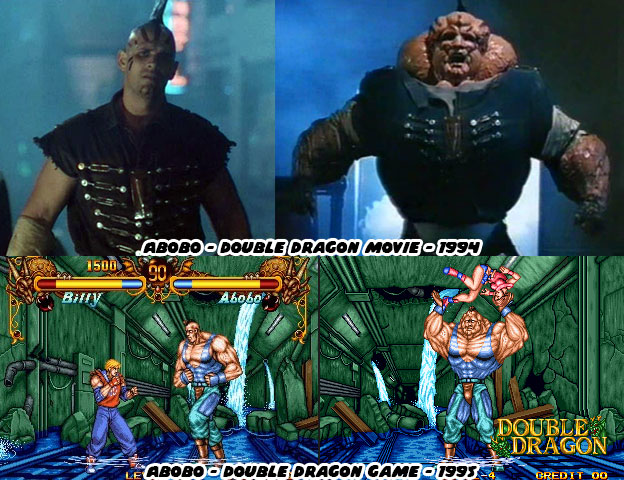
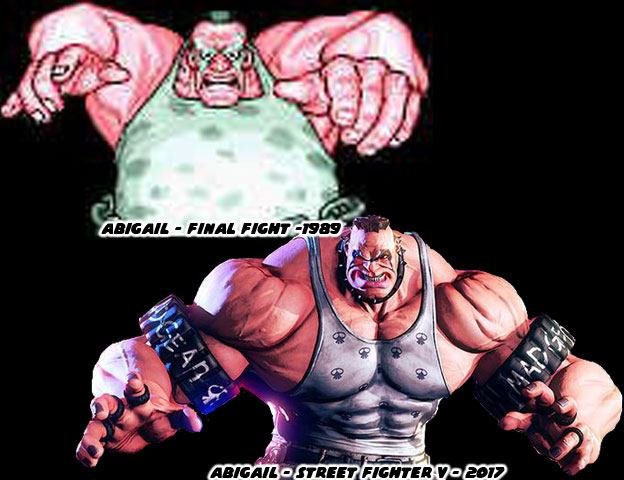
Abigail, a character introduced in Season 2 of Street Fighter V had originally appeared in Final Fight, an arcade hit from 1989. The character was a boss in Mad Gear gang, a group made up of the biggest, meanest criminals from Metro City. Abigail was gigantic, even by Final Fight standards which had many characters above 6 and 7-feet in height. In the Street Fighter universe, where the Final Fight story took place in, he was listed at 8' tall and 584 lbs. He was the largest figure in the series and among the largest human character in any fighting game. The tradition of over-sized, muscular characters in fighting games went back to the start of the genre. The third boss in the 1984 Irem classic Kung Fu Master was a dark skinned character named Giant, he was a full head and shoulders taller than Thomas the hero. The trope of gigantic villains in a fighting game really took off however with the cast featured in the Technos series Double Dragon. There were massive villains in the original and sequel; named Burnov, Bolo, Oharra and Abore. They were capable of lifting players up with one hand and even punching down walls with their bare fists. The bad guy that audiences remember most was a bodybuilder-type character called Abobo.


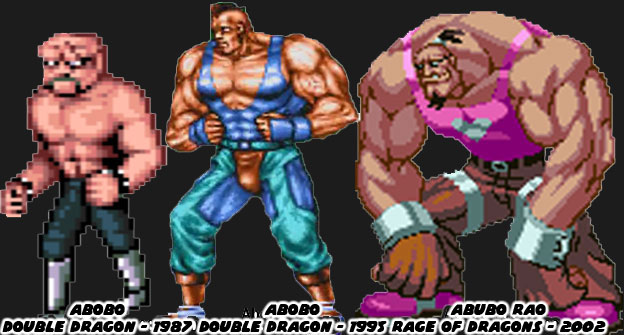
Abobo actually changed during the various sequels and remakes of the series. He was a generic bruiser in the original 1987 game. His face paint and spiked wrist guards made him appear like a heel or bad guy wrestler. Abobo was far more fleshed out when the studio created a 2D fighting game in 1995. This newer version of Abobo was more proportional to the rest of the cast and was officially listed at 7' 2" and 336 lbs. He was still huge but nowhere near as big as the character's final appearance. In 2002 the Mexican developer EVOGA created an unlicensed Double Dragon game, which they called Rage of the Dragons, an homage to the series. They avoided legal issues by slightly changing the names of the main characters. The bruiser in this game was called Abubo instead of Abobo. This character was on the absolute extreme end of character designs. He was now 8-feet tall, actually 8.03, and 640 lbs. making him a fraction bigger than Abigail. His arms were so huge that they hung to the ground. This type of large upper half / small lower half character designs had actually evolved through the '90s and were almost commonplace post 2000. I had written a history of these "top heavy" designs when Gigas was introduced in Tekken 7. Abubo and Abobo had set a standard, or rather limit, on what worked when it came to fighting character designs. Believe it or not in the '95 version of Double Dragon the character could grow even larger and more muscular.


The "transforming" version of Abobo and the updated cast were based on the 1994 Double Dragon film. In the movie Abobo was a typical punk bad guy. He was already big and dumb but Koga Shuko, the main villain in the film, turned him into a mutated freak for failing to recover an artifact. This weirdly swollen character had muscles where muscles didn't exist. He was literally swollen where his glands, bones, cartridge and neck should have been. The absurdity of his updated look was incorporated into the game where he could temporarily "buff up" while performing certain moves. The movie was absolutely horrid and had nothing in common with the game, except for the names of the characters. It was the first and hopefully last film directed by James Yukich, whom had probably never even played the title. Interestingly enough the story was co-written by Paul Dini (The Batman Animated Series and co-creator of Harley Quinn) who has been one of the greatest comic and cartoon writers of a generation. I guess something was lost in translation when the screenwriters adapted his story. But I digress, character transformations were not a new idea in games, cartoons or comics. The Incredible Hulk for example turned from a small scientist into a thousand-pound green skinned monster. A more contemporary version of the transforming villain was seen with the character Bane.


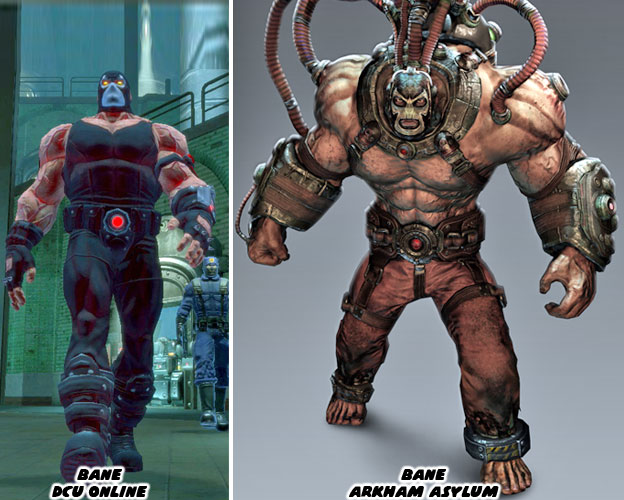
Bane debuted as a Batman villain in 1993. He was an assassin that was trained in the fighting arts and was a perfect rival to Batman. The thing that made him a superior opponent was a synthetic drug, similar to adrenaline, called Venom. It increased his speed, reflexes, strength and durability. He could turn on a pump filled with Venom whenever he wanted to boost his fighting prowess. When the character originally appeared he was muscular but realistic. He had a bodybuilder physique and was not as deformed as Abobo. A really good 3D representation of his original design appeared in DCU Online, the DC Comics online multiplayer game (MMO). However as comic book aesthetics changed, and as different writers and artists took over, the look and purpose of Bane changed as well. In less than 20 years he went from a realistic physique to a grossly disproportionate one. To see how far the character had changed look at the version that was featured in the Batman Arkham games. This new Bane had a gross physique. Not only that but every iteration of Bane seemed to become dumber and dumber. It wasn't long until he was nothing more than a typical brute that used his muscles rather than technique to beat people. Abigail was sliding into modern Bane territory but for over 30 years the designers at Capcom managed to avoid this trope. How did they do it?


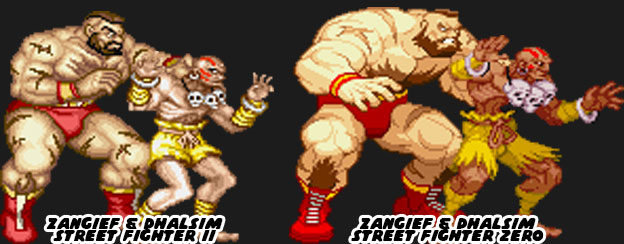
Capcom developed a template copied hundreds of times over. The idea for Street Fighter was simple, different martial arts masters fighting against each other to prove who was the best. The designers created a library of characters that reflected different nationalities and by default the different fighting arts. One of the reasons the series stood out was because of how unique the character designs looked compared to other games. The artists at Capcom, people like AKIMAN, Shoei and SENSEI created figures that were not quite manga, not quite anime, and not even comic book in appearance. They were instead something in between the Japanese and USA aesthetics. These archetypes worked incredibly well and they helped launch a franchise. The characters were diverse in size, color and body type. Their appearance helped reinforce a particular fighting style. These basic concepts were used and expanded upon by other studios as well. Look at a character like Dhalsim, a slender Yoga practitioner that stood 5' 9" and weighed about 100 lbs. Compare him to the burly Zangief, a 7-foot 400 lbs wrestler. In Street Fighter II the characters had good contrast. When the studio created a new sequel they went with a different designer. Bengus wanted to keep the scale of the characters similar but he used artistic license to exaggerate their proportions. Zangief and Dhalsim had the same height difference in Street Fighter Zero, but Bengus made Zangief much wider, especially on his shoulders, arms and back. He also cut Dhalsim's waist in half, making him even more gaunt. This contrast was more profound. It looked fantastic on screen but did not break the scale of the franchise. The exaggerated proportions ended up influencing a generation of game designers in Japan and even comic book artists in the USA.


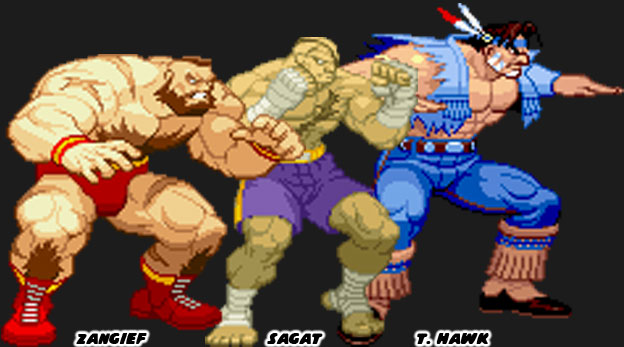
The proportions developed by Bengus were used by Edayan, Kinu and Ikeno in the other Capcom games from that era. In doing so the giant characters appeared far more menacing when compared to the rest of the lineup. The Street Fighter library had always worked within a certain range of body types. Every character had to be muscular, the sumo wrestler E. Honda had an enormous belly but his arms and chest were well defined. Dhalsim was thin but his muscles had definition as well. As the characters got taller they preserved those same basic rules. Zangief was considered a standard for giant characters in the series but that concept was flexible. Sagat was 7' 4", a few inches taller and slightly leaner than Zangief. Sagat was the original boss in Street Fighter and was a character of distinction in both Street Fighter II and Street Fighter Zero. He stood a head above every other character and did a great job of capturing the boss feel. Yet even Sagat would be replaced as the biggest fighter. T. Hawk was a native character, at 7' 7" he was on the edge of the character sizes that worked within the continuity of the series. Moreover his height was about the limit for any giant character in a fighter. There was actually some real world precedence for this.


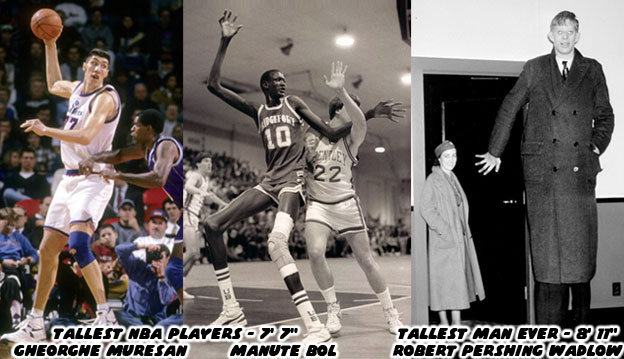
Professional NBA basketball players were 6' 7" on average with centers being around 6' 10" to 6' 11". Teams were constantly on the hunt for athletic 7-footers. These people represented less than .00004% of the population, and an even smaller fraction of those were healthy and coordinated enough to play at a professional level. The tallest of these men were Shawn Bradley standing 7' 6", Manute Bol at 7' 7" and Gheorghe Muresan also at 7' 7". Think about how imposing it was for T. Hawk to be created at the same height as the biggest NBA players. When you saw these players on TV the height differences between someone 6' 6" and 6' 10" looked much greater. Keep height to weight ratio in mind. A bulky tall person did not appear as tall as a lean person at the same height. Most basketball players were lean because it allowed them greater flexibility and speed. On television thinner people looked much taller than their opponents even though the actual height difference was only an inch or two. In a sport like American football tall players were very muscular. Because of this it was harder to spot the height differences on television.

Most fighting games have characters with a similar height to weight ratio. When you look at the height differences between Zangief, Sagat and T. Hawk it doesn't seem like much. Now think about Abigail. At 8 feet his height was very rare but not impossible. There had been taller people in history. The tallest that ever lived, Robert Pershing Wadlow was 8' 11". He would have broken the 9-foot barrier if an infection and compromised immune system didn't end his life at the age of 22. What made Abigail so awkward in appearance was his weight. The character was extremely muscular, almost to the inflated Bane or Abobo proportions. In the original Final Fight Abigail was shaped more like a professional strongman, with a wide gut, rather than a trim bodybuilder physique. This was actually very believable as there were many strongmen and wrestlers throughout history that were tall with that same body type.


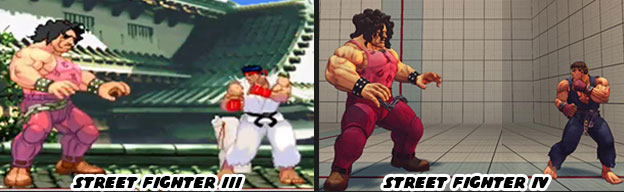
The designers at Capcom went overboard with the muscular physiques in Street Fighter IV. I believe it was because the artists were reacting to the trends in Western character designs which favored overly-muscular characters. Look at how big comic book characters were today. When presented as 3D models rather than 2D sprites the extra bulk made the height seem less dramatic. In order to make the differences more noticeable the model heights were exaggerated ever so slightly. Many players did not pick up on the new sizes. When the characters were far apart on the screen most people couldn't tell that the scale was different. But as they got closer it became obvious. Take the character Hugo for example. The original version featured in Street Fighter III Giant Attack was an updated version of the classic Final Fight character. His height was astounding but proportional to the rest of the cast. Fans of the Final Fight series, and those that remember his cameos in the Street Fighter Zero / Alpha series remember how massive he was and therefor his sprite worked. When the character was created in 3D for Street Fighter IV and also for Street Fighter X Tekken he became bulkier and taller. Players really noticed this change when the character model was close to an opponent.


Abigail was absurdly huge. He looked as wide as he was tall, dwarfing Zangief and the other large characters in the process. He didn't seem to have the same proportions as Hugo or the other giants. That is to say he was missing his neck and shoulders. This made him look cartoonish in appearance. None of the other characters had the same type of physiology. The addition of car tires around his biceps and belt made little to no sense. I understand they were part of his new personae as a scrap yard owner but they were not part of his original costume. The most jarring thing about Abigail's appearance in Street Fighter V was his personality. Abigail went from high-ranking Mad Gear boss, with a genuine fighting ability to an idiot. He retained his temper from Final Fight but everything else was made up. It was embarrassing watching him putting around and making car noises in his introduction and story mode. Both Street Fighter IV and V had played up the silliness of certain characters while making others seem terrifying. Rufus, Hakan, Birdie and F.A.N.G were some of the other goofy / awkward characters added to the series. The director and producer of the series were certainly playing favorites with the cast. I wondered if the studio created a moronic Abigail to make fun of USA fighting game designs. They had given us a mindless Bane because apparently that's what we thought all strong characters should be like. The studio hadn't always treated their giant characters so poorly. In fact they used to treat their legacy characters with a lot more consideration. We'll look at the ways they used to present giants in the next blog. As always if you enjoyed this blog and would like to sponsor me please visit my Patreon page and consider donating each month, even as little as $1 would help make better blogs and even podcasts!

 follow the Street Writer on Patreon!