Showing posts with label elena. Show all posts

Monday, August 19, 2024

Ryu Final, the real Street Fighter III and IV - A 1UP classic from January 30, 2008

Welcome back friends. We're here to talk about Ryu Final, the last book Masahiko Nakahira created for Street Fighter. The book was set in the SF III continuity, to be precise it is set during 2nd Impact: Giant Attack. Nakahira never did a SF II book for Capcom, those were covered by Masaomi Kanzaki and Mami Itoh. So how does Nakahira's story go? How does it progress? If you read it once then go back through you'll notice that everything that went into this story was done so deliberately. Every character, location, fight and moral was done with forethought. Nakahira is a genius when it comes to plotting the events of his book. He doesn't just plot out a linear story but carefully intersects flashbacks which keeping you turning the pages. The weakest part of his story is better than anything I've seen with Udon. Overall it is perfect storytelling and great art combined. Let's touch on the events of the first collected book.
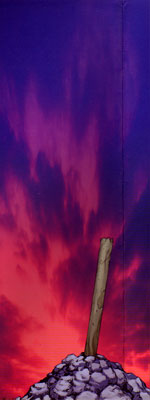
This comic begins with a rock pile and a stick. It is a grave marker, but for whom?

Ken and Ryu are much older, stronger and wiser than when we last saw them. They are possibly at the peak of their abilities. Ryu begins the tale, he is training in the shadow of his old dojo. He remembers the lessons learned from his master Gouken. Nakahira presents Ken and Ryu younger than they appeared in the Zero books, as young as they appear in some Udon flashbacks. The sage advice is not lost on Ryu as he remembers, in Jedi style, that he and Ken are part of the living, breathing world, not apart from it. It is up to Ken and Ryu to catch a falling leaf, the task sounds simple but has profound meanings. In almost all the Nakahira books you see a big oak tree and leaves come up time and again. The leaves and lessons of Gouken also return in the ending credits of SF III: 3rd Strike. The cycle of growth and change, the eternal strength with roots deepening as they grow. The hard training of Ryu and the trees that shake with his blows are inspired by actual accounts of Mas Oyama's tremendous power.
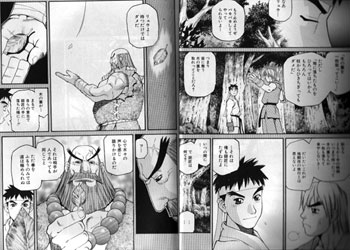
Ryu is fully confident in his abilities and decides it is time for him to return to the circuit and prove himself. His first stop is San Francisco where the understudy of Ken, Sean, taxis Ryu to a yacht. Young Mel, the son of Ken and Eliza is crying because he's afraid that Ryu is going to beat his father. After a few formalities the classic rivalry gets underway. The outcome isn't even close. Ryu is soundly beaten by Ken and can't even manage to get a hit in. Somehow his best friend and rival has surpassed him. Ken has worked harder than Ryu and has become a true martial artist. The reason is told in flashback.
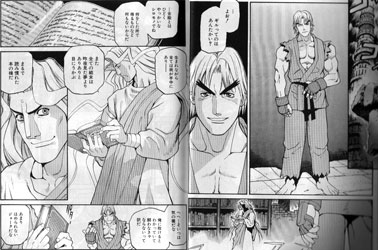
Ken had challenged the man-god Gill and was beaten within an inch of his life. He came to the realization of his purpose as he was lying in a pool of his own blood. He could not allow this defeat to happen, he would never allow himself to be defeated in combat by anyone. His life was not forfeit as he remembered his wife and son. They were his foundation and Gill be damned for trying to sever those ties. The fight became a stepping stone for Ken. From that point on Ken realized he was not only fighting for himself, but for his family and with that conviction he would never fail them. With his remaining strength he leveled Gill with a dragon punch and did the same to Ryu. A clear-cut victory.
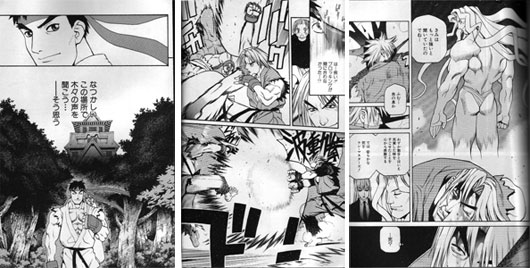
The scenes and plot with Gill were covered in the shortest span of time. Nakahira knew the important part of the story was not in trying to explain the plot of SF III but instead allowing the reader to discover how much the cast had grown. Ryu walked away from the encounter a little humbled but grateful. He knew now that he had room to grow. So he said farewell to his friends and set out again. While sleeping in a park he was awoken by Oro, who was trying to walk away with his duffel bag. Ryu tries to teach the old man a lesson but is instead beaten by the aged master. To make things fair Oro even puts one hand behind his back and still manages to beat up Ryu. FYI: remember that Capcom has been trying to use a one-armed boxer in their series because their template for SF II, the Master of the Flying Guillotine sparked the idea. Ryu becomes progressively angry with his aged opponent and finally decides he's had enough. Ryu tries to counter with a fireball but he is instead knocked silly when Oro unleashes a massive Yagyou Dama, or two handed fireball the size of a Volkswagen Beetle. It turns out that Oro was testing him. Hoping to find a student worthy to train. Ryu is the one and from then on he is under the hard tutelage of the 140-year-old master. He begins by making Ryu carry a massive boulder on his back with Oro riding atop.

At this point of the story Ryu has pretty much hit rock bottom. This is important because he must be rebuilt as a person and as a fighter. The battles he has had in the past, against opponents like Sagat and Vega should have made more of him. Instead he is still locked in the rigid system taught to him by his master and unwilling to progress. It is up to Oro to show Ryu his true potential or kill him in the process. Somewhere in Germany Ryu's first battle turns out to be against the giant Hugo. The battle is brutal on Ryu as Hugo dominates him for most of the match. Pounding him into the ground and throwing him like a ragdoll, Hugo is a force of nature against Ryu. Nakahira uses exaggerated perspective to make Hugo appear 20 feet tall rather than the 7'8" he is. This is in the same dramatic technique that Tetsuo Hara would do to make gigantic opponents for his Kenshiro to battle. After losing for most of the match Ryu is able to defeat Hugo with a well placed dragon punch to his stomach.
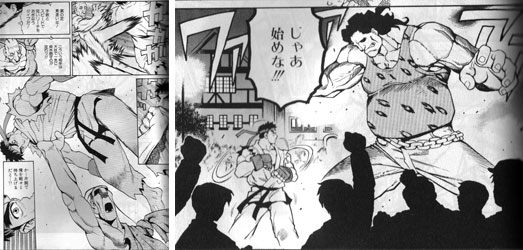
It is not easy for Ryu to win battles. Unlike the Udon books where fan-favorites can knock out opponents in one hit, nothing comes easy in the Nakahira books. This importance of this fight is to show him, and the reader, that there will always be bigger and stronger opponents waiting for the challenge. Ryu will always bring out the best in his opponents and he can't always out-muscle them. The moral of the Hugo battle is that strength is tempered by technique. Ryu continues his training with Oro from there, having earned the respect of Hugo and Poison. He travels south and eventually encounters Yun and Yang. The brothers are brash and inexperienced fighters. The determination of the young kung-fu masters is a parallel between Ryu and Ken's legacy. Even though Yun and Yang are beaten by Ryu they will not quit. Ryu is reminded of how stubborn he was in his youth as well. Yun and Yang establish the core of the Ryu story.
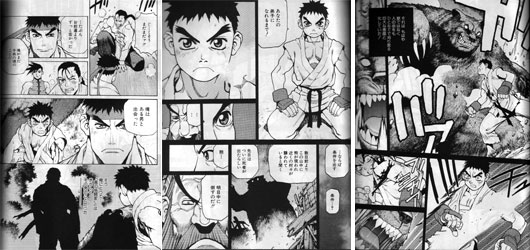
In flashback we see a young Ryu, much younger than he's ever been presented. His build is skinny, his hair unkempt, but he has a determination that impresses Gouken. He wants to prove that he is worthy to learn under the master so he says he will strike out to chase away a bear terrorizing the local villages. Gouken discovers his bloody duffel bag a few days later. Gouken fears that the bear has killed Ryu. This adventure, like much in the life of Ryu is inspired by the fictional retelling of the life of Mas Oyama, better known as the Karate Baka Ichidai anime. In particular the battle here is between Ryu and a dangerous bear, the same thing that happened to Yoshiji Soeno in the cartoon. We catch up to Ryu in the woods and see that a bear is indeed slashing at him ferociously.
The bear pounces on Ryu and is about to finish him when he is struck from behind. The force of the punch travels through the head of the bear and stops inches from the face of Ryu. It is a wild-haired Gouki that has saved Ryu and killed the bear. Gouken arrives to take Ryu away. Gouki cares not for man or beast, saving Ryu was an afterthought. It was that day where Ryu saw the face of evil. He saw that the techniques he wanted to learn was lethal in the wrong hands. These were techniques that could easily be used to kill if left unchecked. In present time Ryu thanks Yun and Yang for the fight and hopes to see them again someday. Like they Ryu has room to grow and many more battles to come.

The next battle Ryu faces is nowhere near as easy as the battle with Yun and Yang. Dudley the boxer, the undisputed heavyweight world champion, wishes to challenge Ryu. You would think that with Oro as his new master he would have become a better fighter by now. Dudley beats the tar out of Ryu and has a counter for every move. Ryu is simply not fast enough to catch the champ with his guard down. Even his dragon punch is caught and countered. Round 1 goes to Dudley but Ryu will not stay down.
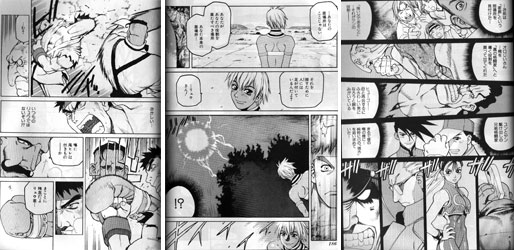
This is the abstract part of the book, the weakest reason for a character to be introduced. Elena is brought in an aside and doesn't fight in any way. She is in Africa, a continent away from where Ryu is. Yet she, like every other fighter in the world is connected. It all goes back to the lessons that Gouken planted into the young Ken and Ryu. They are part of this living world, their roots have grown deep and they have more potential than they realize. It is up to them to wake up to that and release their true potential. With that Ryu comes to his senses and catches his second wind. The leaves in the mighty oak tree in the background shake. Ryu plants his feet and prepares a new fighting stance. Oro and Dudley are intrigued at this newfound intensity in Ryu.

Oro wonders how Ryu will face his opponent now. Dudley is the culmination of the boxing arts, possibly the oldest fighting arts in the world, dating back thousands of years. Boxing is a refined sport, called the sweetest science by practitioners. Embracing the culmination of the art Dudley represents a fighter in the purest sense of the word. He is taller than Ryu and has a longer reach than Ryu, there is no way he can get caught by Ryu's blows. A pure fighter cannot be defeated by traditional strategies and technique. Ryu has learned that he is not fast enough for a special move, he has also learned that he can't always out-muscle his opponents. In order to evolve he must be willing to change his strategy. He decides to use the force of a killing strike but use it in a new way. In one strike they go at each other with everything they have.
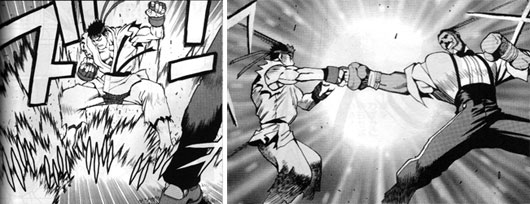
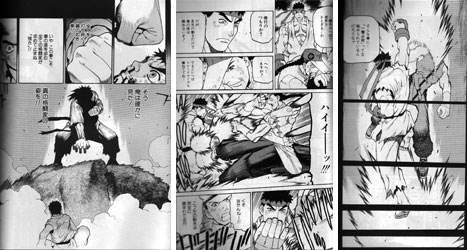
Dudley was aiming for the head of Ryu and failed to notice that Ryu's punch was headed for his hand. Ryu has learned to harness the power of a killing strike but not in the way that was used against Sagat. The force of the blow destroys Dudley's boxing glove and breaks the bones in his arm. The force of the blow also travels through Ryu's arm and tears part of his gi off. Ryu remained grounded and the remaining energy returned to the Earth. Dudley concedes defeat. Ryu has learned the fist of the wind, a technique unique to him. He is now ready for an even greater challenge.

End of book 1.

As always if you would like to sponsor me please visit my Patreon page and consider donating each month, even as little as $1 would help make better blogs and even podcasts!
follow the Street Writer on Patreon!

Friday, September 25, 2015

How fight culture became fighting game history, part 38

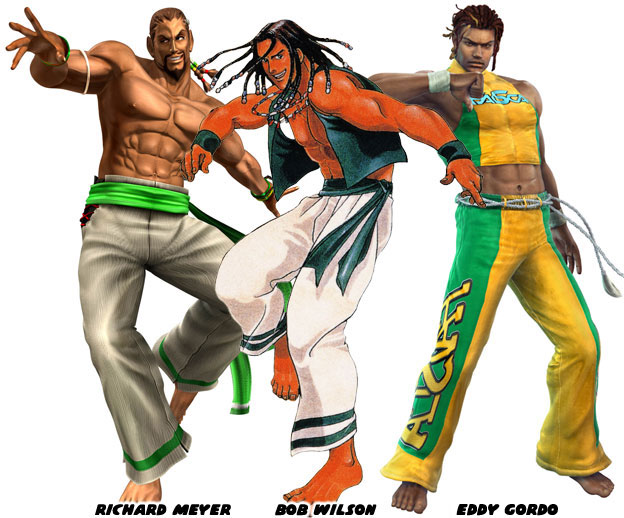
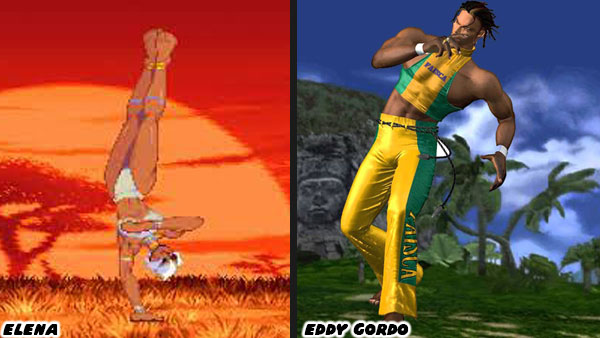
Street Fighter III was the long-awaited hit from 1997. Thanks in part to the dazzling animation featured on Elena and her contemporaries. Unfortunately advances in 3D technology were putting the squeeze on Capcom. Namco had fired a shot across the bow of their rival with a new character named Eddy Gordo in the game Tekken 3. The animations for Eddy were created by motion capture. Mestre (master) Marcelo "Caverinha" Pereira lent his talents to the game. The end result was a character that had genuine personality and moved unlike anybody else in fighting game history. Eddy became an overnight sensation. Arcade players were eager to find what combos worked best for the character and even what hidden moves Namco had included. Unlike every other martial art featured in the game Eddy seemed capable of flowing from move to move without having to reset to a standing position. This distinction set Tekken apart from even Street Fighter.

For example Elena reset to her standing animation after every attack but Eddy could make an attack into a handstand and still be able to turn and move while upside down. Gordo was such as easy character to control and play as that he became appealing to many novices. They could almost blindly mash the four control buttons and put together a fluid combo string. The term "dial a combo" used by fighting game fans to describe a simple control interface was coined with Eddy in mind. Beginning players looked like pros while Eddy spun, jumped and kicked in all three dimensions. The ease of use upset many players. They felt as if the balance between the various fighting styles had been upset. At no other time had this game or any other inserted a character whose attacks came in rapid succession through simple button sequences. Even Elena required timing and practice just like the other characters in SFIII.

The afro-sporting, bellbottom wearing Tiger Jackson was the alternate character created from Eddy's motion capture data and moves. Jackson never developed the following that Gordo had. He looked like a joke character and was treated as such by most Western gamers. Despite having the same moves as Eddy he was less frequently played in arcades, even by most in the black community. Eddy and Elena introduced something original to the genre. Most fighting games featured either a white person from the US or a Japanese person in the leading roles. It was almost assumed by the developers that people from other countries could never play an important role in the game. Elena and Eddy dispelled that myth. Capcom and Namco won over minority and non-minority players by treating them all with respect. These two were not basketball players, boxers or break dancers. The developers did not rely on trope for the new minority characters but instead grounded them in a real system. This exposed people around the world to capoeira and made two new stars in the process.


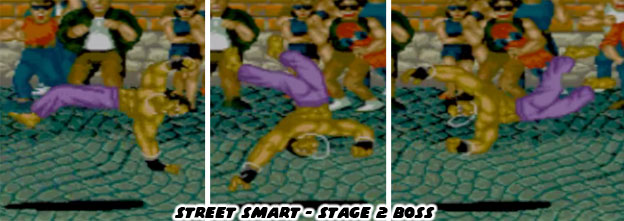
It turned out that neither Eddie Gordo or Elena were even the first capoeiristas featured in a game. They weren't even the second ones for that matter. At the dawn of the genre, around 1989, there was a villain named "Slippery" Sam Santana, the 38-year-old character was featured in an SNK fighting game called Street Smart. The characters did not have names in the original arcade release. It would only be revealed once the game was translated to the Sega Mega Drive a year later. The tanned brawler with the long pants and sunglasses was simply known as the Stage 2 boss. His use of tumbling attacks as well as the ability to flip and spin away from opponents had a very distinct capoeira appearance. The designers at SNK were very fond of the unique fighting arts from around the world. They would continue to learn from the fighting community and refine the characters until they were ready for the genre.


The first capoeira character worth highlighting in an arcade fighting game was Richard Meyer. He appeared in Fatal Fury, a 1991 title that was also published by SNK. The game was designed by Takashi Nishiyama and Hiroshi Matsumoto. They were planners on the original Street Fighter for Capcom but then moved to the rival studio shortly after it was released. Some of the Japanese developers had been aware of capoeira and had experimented with the form in Street Smart. It didn't really take off prior to 1991 due to the limitations of the hardware and software. Nishiyama and Matsumoto took a chance with the "exotic" style in Fatal Fury. Meyer's kick based moves were revolutionary. He would perform handstand kicks and tumble through the air with wide sweeping motions. He could even hold onto the rafters on his stage and kick at the player. Despite the limitations of the game engine he had a sort of shuffle to indicate the ginga or dancing stance of the art. The immigrant to the fictional Southtown carried with him the music and atmosphere of Brazil. His club, the Pao Pao Café, became well recognized in the series.

In game canon Meyer retired from fighting to run his club. Bob Wilson, introduced in Real Bout Fatal Fury 3, became the second Capoeira practitioner in fighting game history. Although when the game was originally translated in the USA it was called "Cooperia." The sleeper from 1995 actually influenced SNK canon. As a bouncer Wilson accidentally burned down the Pao Pao Café 2. It would be rebuilt and multiple sister clubs would be featured in other SNK games including the King of Fighters. By 1997 gamers had become somewhat acquainted with the art form. It wasn't until the brilliant animations from Capcom and the motion capture sessions from Namco that players really took notice. Capoeira had arrived and would become part of gaming landscape forever.


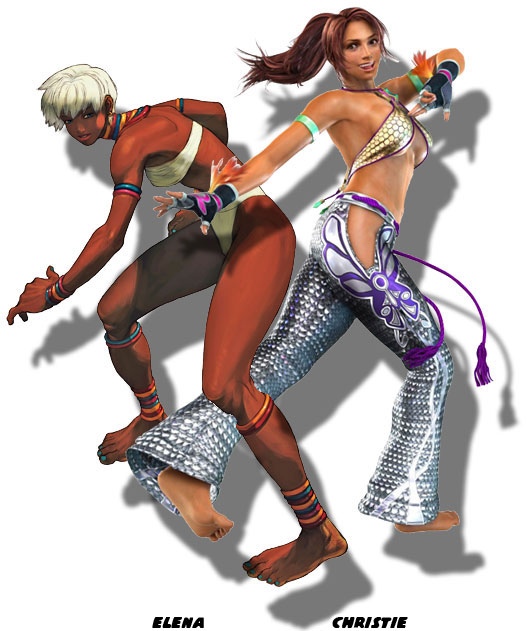
The next Capoeira star would be Christie Monteiro. She was the daughter of Eddy Gordo's teacher and one of the new faces in Tekken 4, a game from 2001. The character was created using the same motion capture data as Eddy and Tiger Jackson along with some new moves thrown in. The graphics had been improved considerably on the new Namco System 246 hardware. Despite the bump in graphics, lighting, effects and level design, Namco was keenly aware that sex was a major selling point for many characters. Eddy would appear down the road as an secret character but Christie was designed to get the attention of players. This skin show was obvious pandering to the mostly male fans of the genre. The objectification of women in fighting games is a topic for another day. For Elena and Christie the looks got the attention of the players but the Capoeira moves were the icing on the cake. Not that many gamers complained about the sexy designs as the Tekken series stood on its own merit. It was a well designed and well balanced game. It had more things going for it than Killer Instinct and thus saw far more sequels. Tekken, along with Sega's Virtua Fighter, would continue to be the standard by which all other 3D fighting games would be measured.

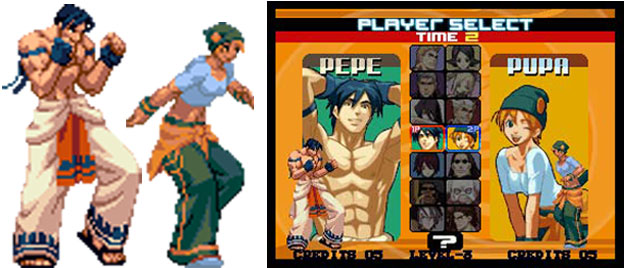
Even Evoga, the developers of the Rage of Dragons, were not immune to the appeal of capoeira. They had created the insipid Mr. Jones but followed up with some more original ideas. Brazilian Pupa Salgueiro and Mexican Pepe Rodriguez were a tag team pair that added color to the lineup. Pepe had a fictional fighting form given to him while Pupa had a variation of capoeira. Pupa made for an interesting choice because she was young and undersized compared to the other characters in the game. There was another young girl in the game named Alice Carroll but she had awe-inspiring psychic powers that allowed her to throw players around the screen using her mind. There was an eight-foot-tall 600-pound brute in the game named Abobo. He had arms twice the size of Pupa and Alice and enjoyed menacing the other fighters. Pupa kept a rather large pipe wrench in her back pocket for just such an encounter. Whether Pupa was a master of Capoeira or not the wrench was the great equalizer.


Rage of Dragons had capped a decade of Capoeira in the arcade and positive minorities in fighting games. The downside for people from other nations was that the roles were often fixed to the country of origin. Most karate experts were Japanese, most boxers were black Americans, most kung-fu artists were Chinese, most wrestlers were white Americans and most capoeiristas were Brazilian. However as Ron Van Clief, Dennis Brown, Willie Williams and other African-Americans had shown, the black community could excel at kung-fu, karate and wrestling in the home countries of the art. Foreigners had contributed greatly to the fighting arts from other nations. Asians could be great boxers, Europeans could be great at judo and anyone could practice capoeira. When a small team of developers got together to see if they could make an all-capoeira fighter they set a standard yet to be topped. The next blog will look at this series. As always if you enjoyed this blog and would like to sponsor me please visit my Patreon page and consider donating each month, even as little as $1 would help make better blogs and even podcasts!

Wednesday, September 23, 2015

How fight culture became fighting game history, part 37

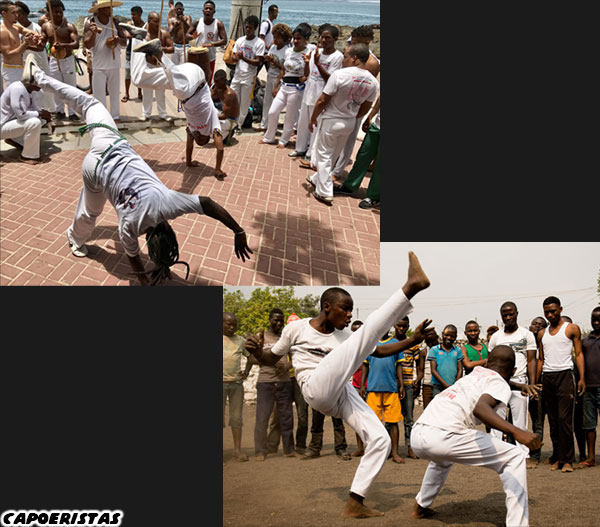
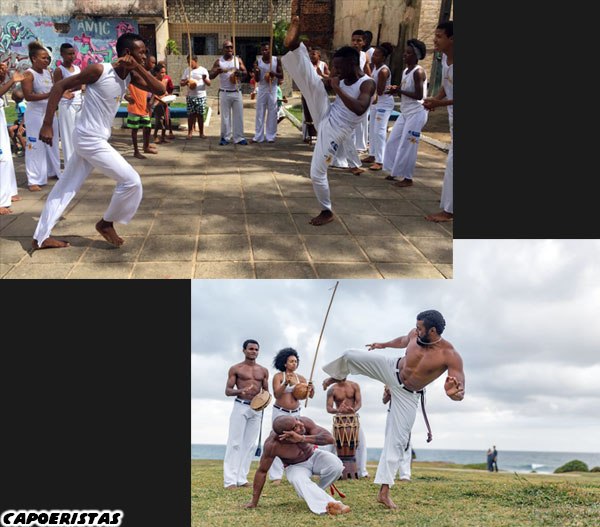
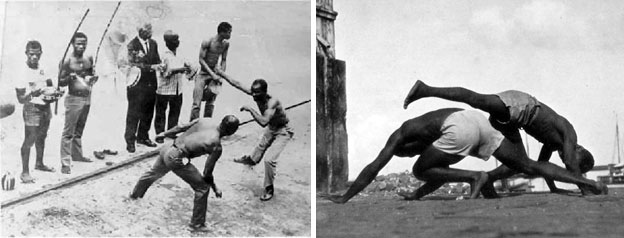
Many readers that were fans of the fighting genre could probably guess that this blog would be highlighting the martial art of Capoeira. In the previous blog I had mentioned that the fighting art of Kupigana Ngumi incorporated rhythmic dances to help teach the style. Slave owners had made an off-hand comment about how the Africans were born with rhythm and the ability to dance. What they failed to realize was that the slaves had brought their Kupigana Ngumi traditions with them and these things could not be thrown overboard, destroyed or erased by violence. Nowhere else was this cultural tradition more apparent than in South America. The Portuguese, French and Spanish traders had taken slaves through the islands of the Caribbean en route to the new continent. Along the way they cross-pollinated spiritual, musical and religious ideas with island natives. When the slaves had arrived in Brazil they maintained a good portion of their cultural heritage but also brought with them many new lessons. The fighting art they developed came to be called Capoeira.


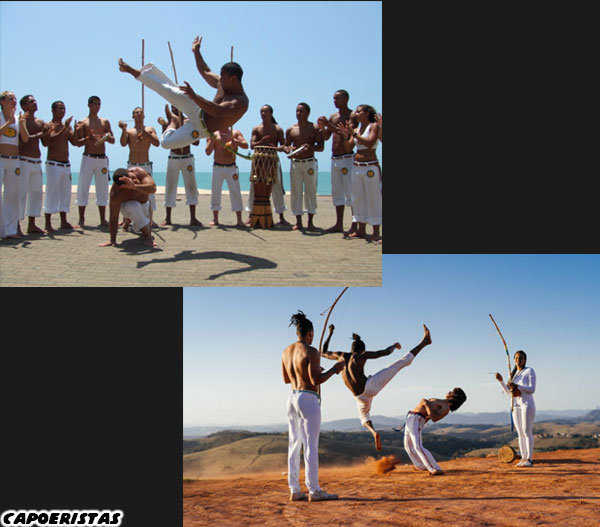
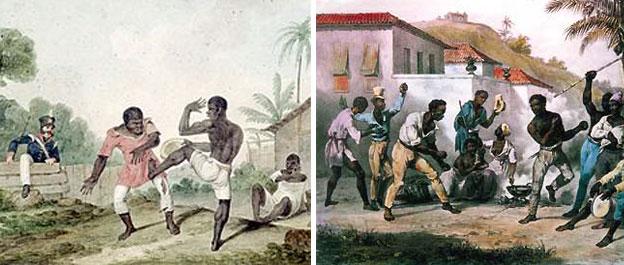
The slaves and natives kept authorities from discovering the true origins of the fighting art by making it look like a dance and a even a game. African drums were replaced by the native panderio (tambourines) and the berimbau (a stringed bow). The rhythms or toques played by the musicians, usually made up of other capoeiristas, determined what style the session would be in. Some songs emphasized leaping and tumbling moves, others focused on quick moves or trapping and still others forced participants to lay low and focus on upper body strength exclusively. The most dangerous form "Cavalaria" had knives, razors or machetes used by participants. In demonstrations two sticks replaced the machetes. The songs could also be used to signal the community of approaching authorities or soldiers. Practitioners would trade moves in a circle or roda. The constant movement of the dance would help make the practitioners hard to hit in a real fight. It would also teach timing, feinting and counter defense, which were all important elements in a battle. Capoeira became known as the Dance of War. It didn't take authorities long to figure out what the practitioners were really up to. The form was outlawed but many capoeiristas, not all African-slaves but also natives, ex-soldiers and immigrants kept the system alive. It became the secret fighting art of the New World. It was practiced in the back alleys and outskirts of town far from questioning eyes. Practitioners would call each other only by their nicknames or apelidos as to not tip off authorities to a real name or hideout even if they were to be captured.

Slavery was abolished in Brazil in 1888, decades after the Civil War in the US had ended. It lasted longer in South America because of the higher demand for slaves. The tropical climate was very good for year-round growing of crops and traders demanded a massive workforce. The indigenous people could not leverage enough support to end the trade with smaller nations or European partners. Those in authority did not want their economy or power structure to collapse so they did whatever it took to keep it running. When slavery ended capoeira finally came out of the shadows and became ingrained into Brazilian culture. Practitioners acknowledged the African roots of the art but also understood that it had changed considerably in the 300 years since the first generation of slaves had arrived. Brazilian natives, European immigrants and Caribbean islanders had all helped shape the fighting art and keep it alive.


Capoeira would look great in a video game but there was one major problem. The system was much more fluid and rhythmical than the other arts. Karate looked absolutely stiff by comparison. In order to be accurately represented in a game it required hardware capable of displaying hundreds of complex animations on the fly. The early fighting game engines were woefully underpowered. They could only show a handful of frames of animation and had relatively small sprites. By 1997 both Capcom and Namco had developed powerful game engines that were up to the task. The CPS-III engine by Capcom was sprite-optimized hardware. It allowed developers to work with a more robust palette of colors, larger pixels and characters whose animation frames had gone up exponentially. Namco by comparison was working on 3D hardware. The System-12 unit they had developed created stunning animations on complex models with detailed textures and lighting effects. The characters both studios introduced set the gold standard for capoeira characters in a game.

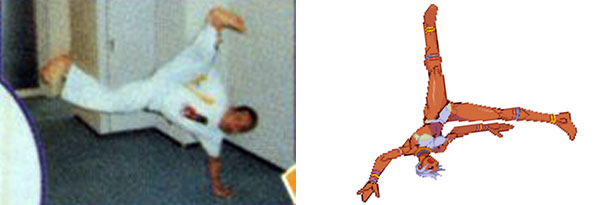
Elena was the playful long-legged African girl created by Capcom. The developer had rotoscoped one of their designers, Daigo Ikeno, who actually practiced capoeira in order to make the animations look as fluid as possible. Players could tell that the CPS-III hardware was leagues ahead of any other studio as they watched the hundreds of frames of animation given to Elena flow from one move into another.


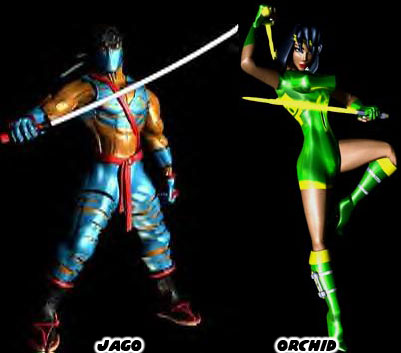
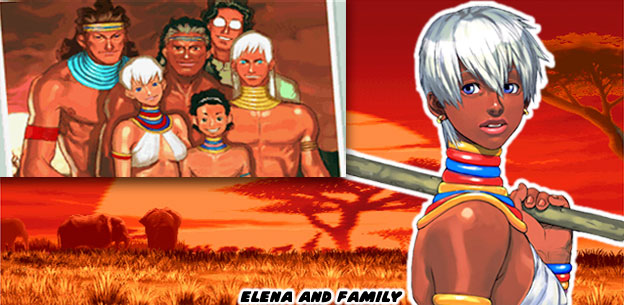
Elena was designed with a combination of different native elements and animé influences. She had white hair and blue eyes, which was rare for a native African but seemed to run in her family. It was an interesting visual contrast, similar to the Aboriginal tribes of Australia. It hinted that Elena was actually of mixed descent. This made her one of the first mixed ancestry videogame characters. Black Orchid and her brother Jago from the 1995 game Killer Instinct were actually the first mixed ethnic fighters. They were from black and Asian parents but presented with Western comic book design cues rather than animé ones. The developers at Rare were keenly aware of their audience in the US. North, Central and South America had become ethnically diverse thanks to centuries of emigration. Asians, Europeans, Africans and Natives were not always mutually exclusive communities in the New World. Gamers that came from two different cultures sometimes felt that they could not identify with the main characters in their favorite titles. Even the strong minority characters only represented half of their heritage. Killer Instinct changed the perception of what was possible not just to gamers but to the industry as well.

Granted, Rare exploited many of the same trends when creating their cast that the other studios did. Orchid was a highly sexualized character. She was very busty and fought in heels while wearing a tight rubber dress. Her brother had huge muscles, like the other males in the cast, yet was still incredibly fast and flexible. The characters and gameplay was completely over-the-top and audiences understood that and appreciated the game for what it was. Killer Instinct was not meant to be a copycat of the games from Japan. It did not use hand drawn sprites but instead pre-rendered CGI sprites so that its graphics appeared years ahead of the curve. It did not limit the number of strikes that players could pull off and instead celebrated the 20-hit, 30-hit or even 90+ hit combo strings that savvy players could put together. Killer Instinct featured violent, gory or even comedic "Fatality" moves for the characters. Orchid for example would open her top, flash opponents and give them a heart attack. The game had become a reflection of what the audience desired in a fighting game. Players from Generation-X made up the majority of arcade visitors in the US. By '95 they had become older teenagers and wanted to see sex and violence in equal measure. Killer Instinct was a bold contrast to the sanitized experiences from Japan and offered more "mature" themes for these teenagers.


Jago and Orchid did not have an actual fighting style associated with them but instead had fictionalized martial arts moves. This was fine among players considering the duo were battling lizardmen, werewolves, cyborgs and aliens. None of those fantastic characters had realistic combat styles either. Gamers enjoyed the clash of styles and characters and for a few months Killer Instinct was the hottest title in the arcade. Once players had figured out all of the possible combinations and fatality moves the game tapered off in popularity. The characters and premise were fun and the uniqueness of the experience had built a strong following. Unfortunately the game lacked depth. The sequel failed to gain as much interest as the original. Within the community it became another challenge to figure out all of the combos, fatalities and secrets as fast as possible. Once that was done players went to other fighting games, and in some cases back to older fighting games.

The staying power of the best franchises was due to more than shock value, fancy graphics or massive combo strings. Great game engines and characters went hand in hand. Fantastic character designs that relied too much on spectacle rather than substance eventually sank the KI experience. Street Fighter tended to have a bit more forethought in their character designs and game engine. The developers had created a balanced game that would be easy for beginning players to pick up and yet gave advanced players a challenge to master. Killer Instinct had a steep learning curve by comparison. Beginning players could be brutally punished by opponents or the computer AI. This reduced the chance of repeat plays from those still learning the intricacies of Western fighters. The characters for KI were interesting but also lacked staying power. Gamers did enjoy the diversity of the cast but perhaps they were a little too generic. A black boxer, an alien made of ice and one made of fire… it was as if they were pulled from comic books and rival fighting games. Capcom on the other hand was crafting fighters that had more substance. In some cases they were inspired by real fighters, rooted in real systems and bore cultural cues when they could. It was easier for gamers to identify with these characters when it seemed that the studio respected their audience. The jewelry that Elena wore for example was similar to the layered necklaces of the Samburu tribe from Kenya. Her costume was anything but traditional though as it consisted of a very short bikini. The appeal of sexualized characters was not lost on the Japanese developers! Elena's stages in Street Fighter III featured the beautiful landscape of her home country. Wild animals, sweeping valleys and amazing sunsets framed the postcard-worthy Africa. Perhaps she wasn't meant to be a capoeirista but instead was supposed to represent Kupigana Ngumi.


Elena had set the bar for traditionally animated fighting game characters. Moreover she was a strong minority character of mixed ancestry. These design choices spoke to the community of players from different backgrounds. It was however a rival character that made the biggest impression with audiences. The next blog will look at the whirlwind character introduced by Namco and the style that inspired millions of gamers. As always if you enjoyed this blog and would like to sponsor me please visit my Patreon page and consider donating each month, even as little as $1 would help make better blogs and even podcasts!
Tuesday, July 21, 2015

Representation Matters! Or, what happened to Birdie, part 8...


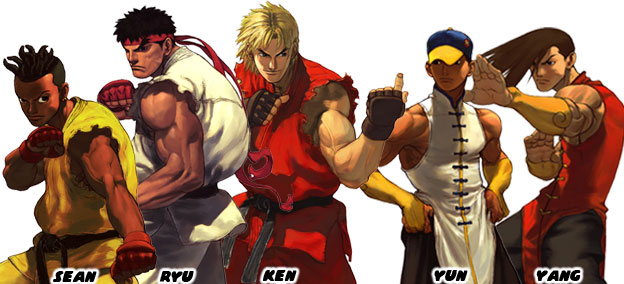
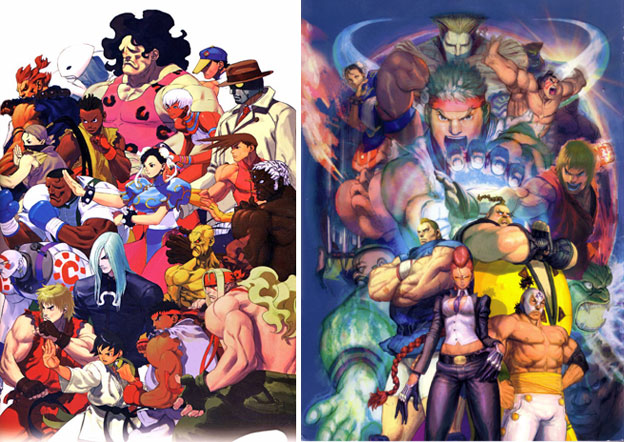
Past the mid '90s Capcom was a completely different studio. The rise of 3D and the 32-bit consoles had changed the gaming landscape. Successfully publishers could no longer ignore home systems market. The arcade market had yet to decline but the writing was on the wall. Studios had to branch out or they would fail. Capcom found success with new franchises such as Breath of Fire and Resident Evil. The fighting game genre was starting to peak and the studio wondered if they had one more great title left in them. Street Fighter III tried to use the elements that made Street Fighter II work. The project began by starting off by deciding who should return. Ken and Ryu were selected to be the only familiar faces and an entirely new cast would fill out the roster. I would argue that there was a lot of redundancy in the new faces. There were a pair of Chinese twins named Yun and Yang that played similarly to each other. They were meant to be a sort of younger Chinese equivalent to Ken and Ryu. Their red and white uniforms were reminiscent of Ken and Ryu's. There was also understudy of Ken called Sean that had similar moves to the stars of the game. I think the team was having too much fun with the names of the new faces. There was the obvious Yin and Yang jab but also the more subtle Sean-Ryu-Ken which was a play on the fireball attack or Shoryuken.


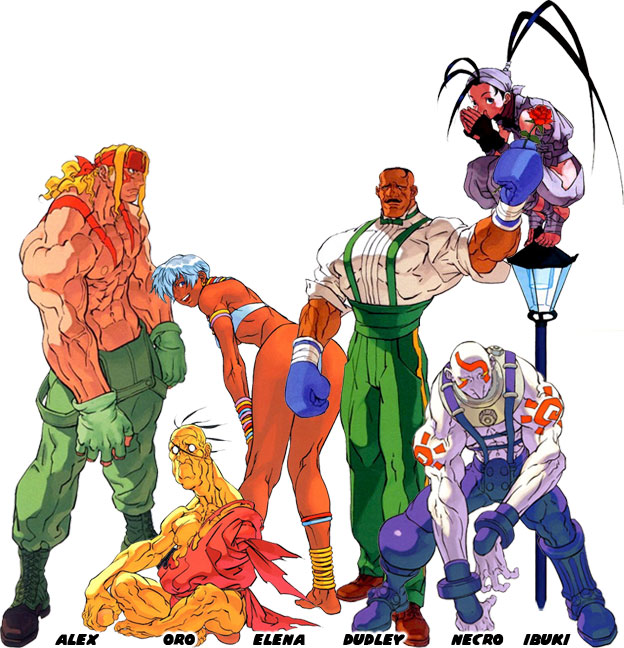
The three karate fighters in all and two kung-fu fighters ate up a lot of the space in the roster. The only duplicates in the original Street Fighter II lineup were pro wrestlers and those were dropped early on so that the team could fit in different styles. Sean was well received, especially as a black minority character. Unfortunately he lacked the impact of Sakura when she debuted. The rest of the cast was more unique. Alex was the star of the new game. He represented an entirely new style of fighting, MMA actually, and was somewhere in between a striking character and a grappler. He actually had elbow attacks similar to Adon, headbutt attacks similar to Birdie and suplex throws similar to Zangief. His size, speed and strength were unique in the genre. The rest of the cast took some chances with the character designs and forms represented. A heroic boxer had finally made it into the series. Moreover Dudley was a very positive black role model. He was not the only minority in the game. Elena was an African that had studied abroad, in Paris first and then Japan. Her dark skin was contrasted by bright blue eyes and white hair. Her costume left little to the imagination. She didn't have the same forethought into her design as Chun-Li. Instead Elena was very much like the characters in anime, pandering heavily to fan service, which was a trend that Akiman was trying to break when he finalized Chun-Li. This was odd considering that the lead artist on this project was Kinu Nishimura, she was heavily influenced by Akiman. Elena did have a unique form of fighting. She used capoeira and there had been some rotoscoping work by the animators to make sure that the moves looked as fluid as possible. Capcom designer Daigo Ikeno was a capoeira practitioner and helped with the reference work.

The game also introduced a female ninja practitioner named Ibuki. Her look was unique and not as grounded in history or anime making her a fantastic addition to the title. The game was not without its own Blanka and Dhalsim, or two extreme characters. An elderly one-armed Brazilian (he actually kept his other arm tucked inside his gi) was a master of a unique fighting art, it was a mix of psychic attacks and judo throws. He was very strong and fast despite his age. Oro was based on Helio Gracie, the co-founder of the Gracie school of Brazilian ju-jisu. The character design was unique because he was the oldest character in Street Fighter mythology, almost twice as old as Gen, the previous elderly character. He demonstrated that age did not make some fighters less dangerous. The other unique character was Necro. The young Russian teen had been experimented on by a mysterious group of religious and scientific zealots. The various experiments they did to him left his muscles, skin and bones like rubber and gave him the ability to shock opponents like an electric eel. Meaning he had some of the best qualities of both Dhalsim and Blanka,


The game did well with audiences. The upgraded arcade engine allowed for larger sprites, a broader color palette and more frames of animation. Having three black characters, including a woman of color was a tremendous credit to Capcom. They were showing an active interest in inclusion and diversity with their lineup. Unfortunately for many audiences and arcade owners this was not the game they had expected. The lack of returning characters and redundant new characters gave the game an unfinished feel. Capcom had established a president in Street Fighter Zero that was tough to beat. They could bring back classic characters and make them work again and again. Upgrade kits were in the planning stages. Each one could introduce a new character if not classic character. Before long Chun-Li and the giant Hugo were put in the game. Hugo was actually meant to be in the first release but the team didn't finish his animations in time. There was no doubt that the time spent creating the redundant Yun, Yang as well as Sean may have been better spent on entirely new figures. Hugo was representing the Final Fight cast as Chun-Li was a return to the SF II lineup. Gouki / Akuma had returned as well but was a hidden character in the first few builds.

The new characters Urien, Q, 12, Remy and Makoto were a mixed bag. Urien was a pallet and head swap for the new final boss Gill. Meaning that another redundant character was also featured in the title. Q was a nonsensical masked secret agent that moved and fought like a robot. Remy had many of the attacks from Guile and Nash but with a look that was pulled from the rival King of Fighters series. 12 was a shape-shifter that was reminiscent of Necro but was also heavily anime-influenced. Of the final new characters added Makoto had the most traditional design elements applied to her. She was a karate fighter, yet her form was completely different than Ken, Ryu, Sean and Gouki. This meant that for audiences she also controlled differently and required some new strategies to use.


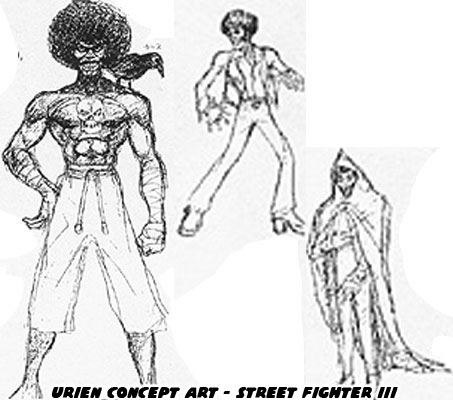
With the exception of Makoto, the last new faces added to SF III were lacking. They didn't have enough time to be evaluated or redesigned. In fact the original plan for Urien had once again fallen on old stereotypes. Had the studio not gone with the pallet swap of Gill who knows how audiences would have reacted to the afro-sporting, disco pants wearing antagonist. I don't think it would have been a warm reception. When development began on Street Fighter IV the approach for new fighters was completely the opposite of SF III. The studio started with Ken, Ryu and the original World Warriors from SF II as all returning members. Then they had a small group of new faces that they would introduce to fans. The characters were designed mainly to appeal to the West, where Capcom had hoped to gain a lion's share of the games profits. The sexy spy Crimson Viper was meant to appeal exclusively to US players. Despite the pandering most gamers in the US ignored the character. Of course the fatty Rufus was forced onto audiences because he was funny. The final two spots would be taken by a judo-ex-military fighter and a masked Mexican wrestler.


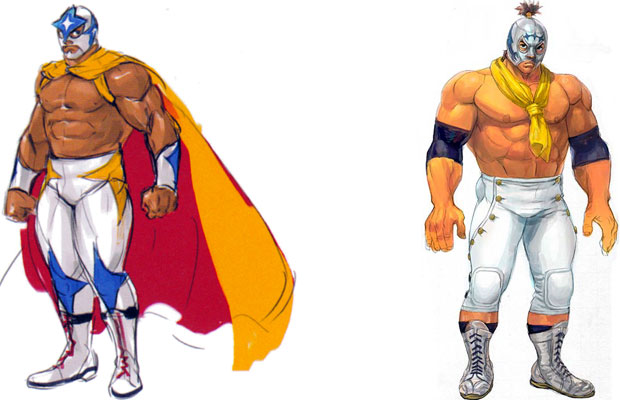
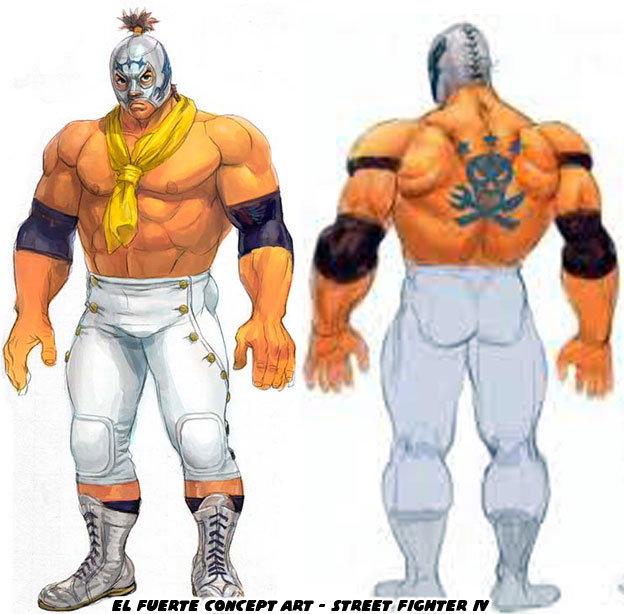
The lead designer on this game was Daigo Ikeno. He could not seem to find designs that worked as well with audiences as the SF II cast had. I think that the choices pushed by producer Yoshinori Ono had something to do with why the characters were lacking. A few blogs back I mentioned how there was a strong black character planned for the game that was eventually turned into Rufus. Something similar happened with El Fuerte the enmascarado, or masked luchador. In the early planning stages El Fuerte had a unique costume that was inspired by actual lucha libre livery. He had the mask, the tights and even a cape. Which was something that performers had worn to the ring since the earliest days of pro wrestling in Mexico, which would be over 80 years ago! In the earliest stages the design was every bit as good as something that Tetsuo Hara could have come up with for the Muscle Bomber series. In fact I would say that the original El Fuerte was a better design than El Stinger, the Mexican wrestler created by Hara. El Fuerte did not necessarily poach and designs from a masked wrestler living or dead. The star on his mask was even a nod to the masked wrestler that had been planned for SF II. But then something happened…


It was decided that El Fuerte was not unique enough. At least not unique enough to be ranked against the World Warriors. So his costume was redone, his mask was redone and even his purpose for fighting was redone. The team decided that it would be great if he was a masked wrestler that was obsessed with cooking. In this way they could name his attacks after food. The Habanero Dash, Tostada Press, Fajita Buster, Gordita Sobat, Calamari Slide Propeller Tortilla, Picadillo Jump, Quesadilla Bomb and Guacamole Leg Throw. The names were an insult to the fantastic and dangerous moves that Mexican pro wrestlers performed on a weekly basis. To add insult to injury, the mask, which is sacred to the performers was even stripped of its origin to reflect the silly obsession with cooking. There were forks coming out of lighting bolts in the early redesigns. The tights were turned to chef pants, at one point El Fuerte even had tattoos or a fork and knife on his back. The three stars that adorned his mask was meant to mimic the Three Star Michelin rating given to the top restaurants around the world. Each decision that the team made took away from the character, it did not add to him. It was as if the designers were bypassing the lessons from previous generations and were focused on the punchline.


It was up to the team to decide how the tone of the game was supposed to be. The new graphics engine allowed for some realistic 3D models. When the majority of the cast fought each strike looked like it had weight and power behind it, giving the game a serious tone. But then all of the models had silly expressions applied to them when certain characters performed super moves. It was a mix of cartoon and realism that was sending a mixed message to audiences. Either the game was a return to the classic challenging Street Fighter II, or it was more anime influenced like SF Zero and SF III. Being caught somewhere in between did little to improve the game itself. The only signal that was not missed was how minorities and their fighting arts were being presented. Mexican and later on Turkish wrestling was seen and shown as an absurd form of fighting not to mention that Americans were stupid, morbidly obese participants.

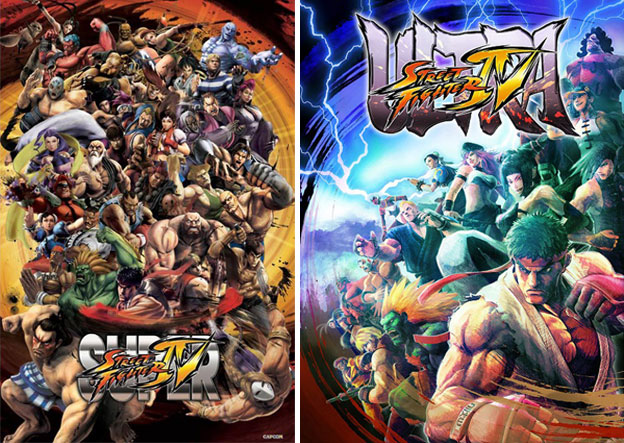
 As the reception to the new characters were met with a lack of interest the team went back in time and started putting in as many classic characters as they could with each update. The majority of characters from SF III and SF Zero had returned by the time Ultra Street Fighter IV. In the rush to return to fan favorites the designers missed a number of important details. The characters from Zero had not matured. Remember that in continuity Zero happened shortly after the events in the first game. Ryu, Ken and Chun-Li were still young adults and Cammy and Sakura were girls. In Street Fighter III Ryu, Ken and Chun-Li were adults. During this timeline Sakura and Cammy would have been adults as well. Instead Street Fighter IV was pitched like the Zero series. It would tie together the events of SF II and SF III. Only this time Daigo Ikeno would not go out of his way to redesign the cast so that they were all unique to this continuity. Instead the team picked and chose the various incarnations that would appear in the game even if their designs were from two or three different games.


It had been almost 10 years since the last Street Fighter III and the first Street Fighter IV had appeared. In that time audiences never forgot what the series meant to them while growing up. Seeing a diversity of male and female characters in SF IV was fantastic. It was also nice to see different nations represented, mainly because they were the original World Warriors. Audiences from around the world would be able to identify with a character or two, including the new ones. It would go a long way in making kids feel validated, especially when they were being underrepresented on television and movies. I only wish that Capcom had done a better job at presenting minorities. They were never as disrespected in any previous version, why did the team start now? Street Fighter IV had missed the boat with new faces and after seeing what was done to Birdie in Street Fighter V I shudder to think what else the studio had planned for non-Asian and non-White British characters. As always if you enjoyed this blog and would like to sponsor me please visit my Patreon page and consider donating each month, even as little as $1 would help make better blogs and even podcasts!