Showing posts with label capoeira. Show all posts

Wednesday, October 21, 2015

How fight culture became fighting game history, final part

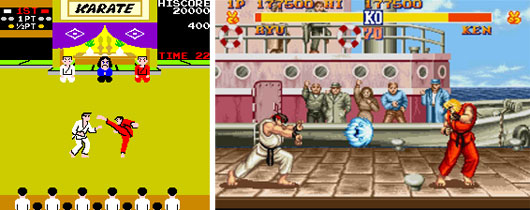
The seeds for the fighting game genre were planted in 1984. That year saw the introduction of three important arcade games which would profoundly change the industry. Irem released Kung-Fu Master, which predated Double Dragon and could actually be considered the forefather of the brawler. It had stage after stage of different villains approaching from the left and right and had a boss waiting at the end of each stage. Technos developed Karate Champ which was the original two-player fighting game featuring a red and white karateka. This was years before Ken and Ryu had appeared in the first Street Fighter. The only thing that the previously mentioned games lacked was diversity, in terms of different ethnicities. Although to be fair there was a dark-skinned giant, possibly of Indian or even Arabian descent in Kung-Fu Master. Minority characters were not playable characters however. The first prominent black character in a fighting game was Mr. Sandman.


The original WVBA (World Video Boxing Association) Champion from the Nintendo game Punch Out!! Boxing would be pinned on many black characters from the earliest point in Japanese games. Some of the characters developed during the late '80s and early '90s were done as an homage to Mike Tyson. He was going through opponents at a feverish pace when he turned professional. Near the end of his reign other black athletes began to replace him. Axel Hawk was written as the mentor of Michael Max (another Tyson clone) from the Fatal Fury series. Axel was a nod to George Forman who made a comeback at the age of 46 and recaptured the heavyweight championship of the world 21 years after he had originally won it.
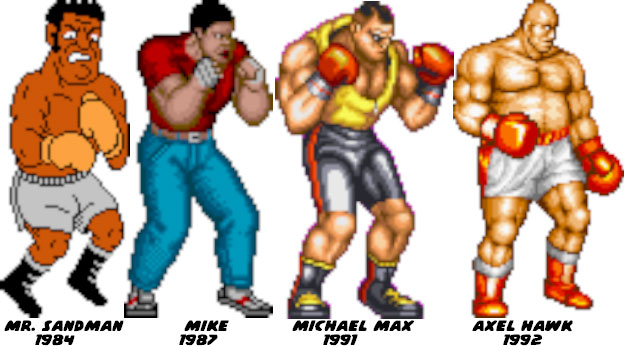

The game was also released in 1984 but had a reputation for its ethnically stereotypical characters including the Cuban Piston Hurricane and Italian Pizza Pasta. These were meant to be taken as a joke by the Japanese developers. Many game fans did not find too much offense in those characters however that changed with the introduction of the Vodka Drunkenski in Punch Out 2. The Russian was renamed when the game was translated to the home consoles. His bottle of vodka had been replaced by a soda bottle. Mr. Sandman was different though. He did not have any gimmick or racially biased name. There had been professional black fighters that also went by aliases like "Sugar," "Hitman" and "Dynamite," so the Sandman seemed to be a good fit. The character was deadpan serious, as one would expect a World Champion to be. He required perfect timing to beat and most arcade gamers never did. The character still managed to intimidate opponents 25 years later when a new Punch-Out!! was released for the Nintendo Wii.


Shigeru Miyamaoto, creator of the Mario Bros, the Legend of Zelda, Metroid and a slew of other franchises had actually designed the cast and started a tradition in for developers. He demonstrated through Mr. Sandman that a character designed with respect rather than trope would reflect back to gamers. In the very first blog of this series I mentioned that the developers that respected their subject matter often did better with audiences. Even if a fighting game pitted skeletons against cyborgs or revolved around dinosaurs the players could pick up whether or not the developer was simply trying to cash in on a trend or if they had really invested their efforts into the game and the universe they created. Kung-Fu master and Karate Champ were ported to multiple consoles yet neither received a proper sequel. By comparison the Punch-Out!! series was a hit in the arcade, on the 8-bit NES with an added plot, on the 16-bit Super Nintendo with new villains and years later on the Wii. The extra time, energy, diversity and attention to detail that Miyamoto and his team had put into their game clearly came across to audiences every time.
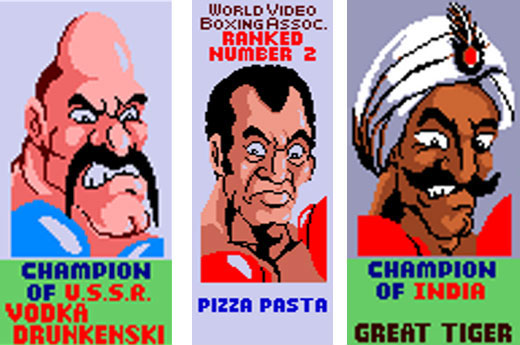

The Japanese did not think that creating caricatures of ethnic stereotypes or names would have caused a big fuss. Through the '80s not many people took notice. However when the Politically Correct / Ethnic Sensitivity movements took off in popularity the Westerners expected those in the business world to follow the trends. In Japan that was not the case. Again there was cultural relativism to consider. Of the two nations only the US had a major civil rights movement.
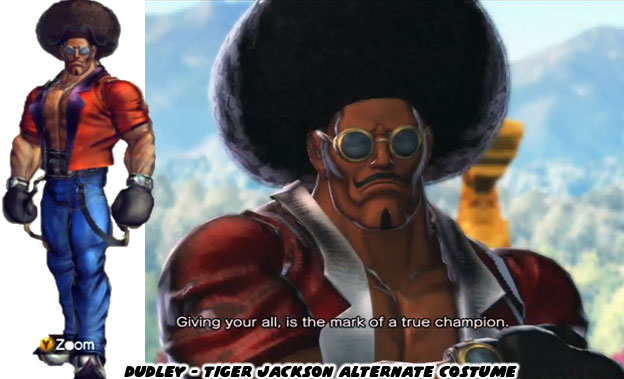

Capcom had created a great legacy of black boxers through the Street Fighter series, one of which played up the strengths and abilities of the sweet science rather than perpetuate stereotypical tropes. The bar that had been raised by the Street Fighter III team when they created Dudley was unfortunately lowered by the Street Fighter IV. More than a decade between games didn't make the Capcom artists any wiser. Dudley would receive an alternate costume of an afro and sunglasses modeled after the look of Tiger Jackson in Street Fighter X Tekken. He certainly didn't look very much like a world champ any more.

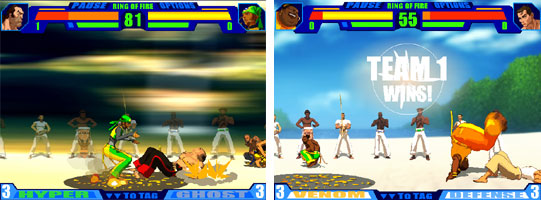
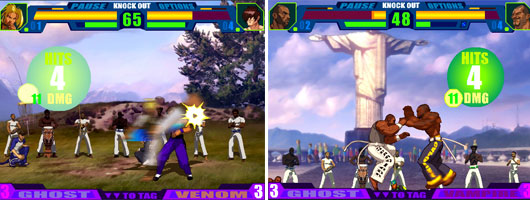
Developers in Japan and the US were stuck in a rut. Aside from professional boxers there wasn't much in terms of styles that they felt comfortable assigning black athletes. Basketball and breakdancing had become the new fad and by the mid-90s it was becoming tired to audiences. Thankfully Capcom and Namco wizened up and pointed to new fighting styles. Capoeira came into focus in 1997 thanks to Eddy Gordo and Elena. Even Sean was allowed to learn the assassin's fist that had been previously reserved for Ken and Ryu. Minority fighters suddenly no longer seemed locked into one role. A few years later Spiritonin expanded on that concept and began flipping conventions in their Capoeira Fighter series. Blacks, Whites, Latinos, men and women from different nations were all presented as exceptional capoeiristas. When those characters went on a wold tour they faced many new styles. These fighters from different nations also broke convention.
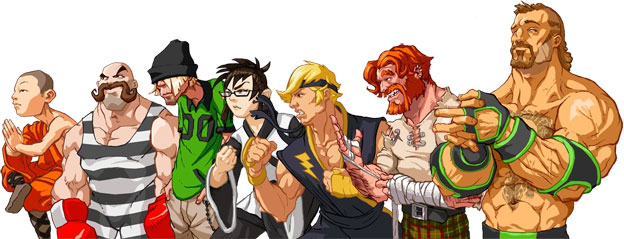

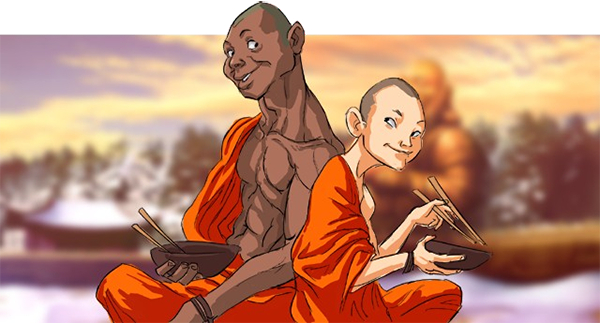
The boxing champion was a short British person with a Napoleon Complex. There was also a young Shaolin Monk, a German breakdancer, a female Tae KwonDo practitioner, a karateka based on the villain from the film the Karate Kid, a Scottish barroom fighter and a large Southern grappler. Rarely had any fighting game featured such diversity with regards to ethnicity, age and technique. Spiritonin had put the same level of detail on all the new fighters that they had with the capoeiristas. The moves each had, the special attacks, costumes, voices, names and even stages were built with forethought. The studio made sure to incorporate actual or appropriate details from each nation or culture to place on their cast. The name of the Shaolin Monk Kuan Yin Shen was based on a Buddhist deity. The young man spoke in wise passages during cut scenes, beguiling his age. Other characters had their own personalities on display while fighting or in their own cinemas.

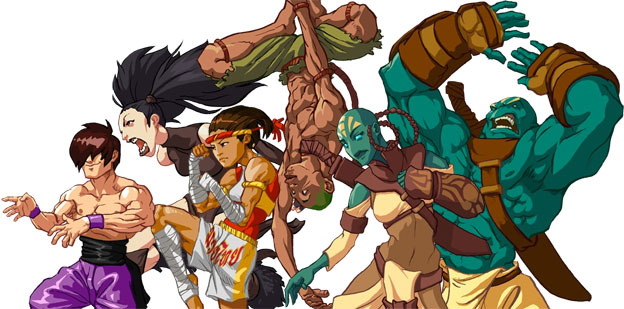
The capoeiristas were joined by some other traditional and non-traditional faces. A Bruce Lee clone which all fighting games needed to have, a wild jungle girl, a female Muay Thai master (the first one ever featured in a fighting game!), a monkey kung-fu master (that I designed) and a couple of alien beings from the Guardians of Altarris (a different Spiritonin game) made a cameo appearance as well.

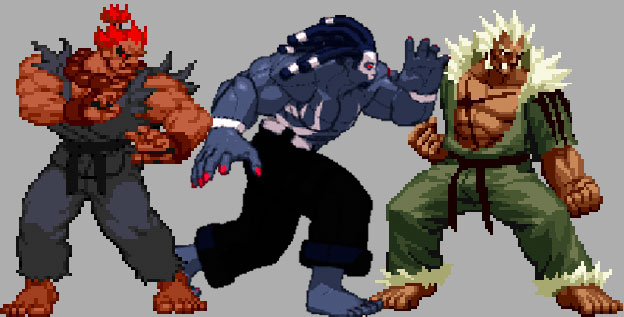
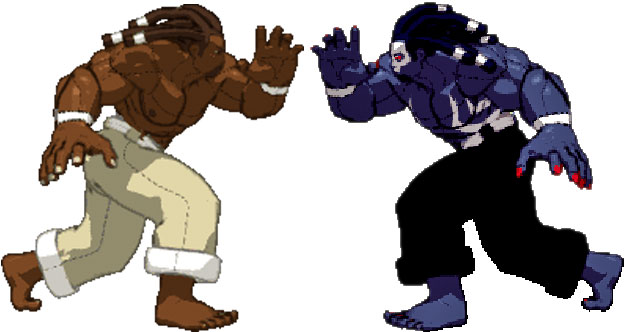
Spiritonin knew that a colorful cast was important but not as important as good control, great animations and a balanced fighting engine. They delivered on all those things while at the same time deconstructing the ideas of minority characters in fighting games. Women and blacks could not only make good supporting characters but they could also be important leading ones as well. The game had no set main characters although Meste Loka and Mestre Rochedo had been in the series the longest followed by their students. In order to make sure the game went beyond all expectations Spiritonin also wrote a new chapter in the book on villains. Zumbi Azul was so well done that I would rank him among the best villains ever created for a fighter. Zumbi was already an impressive bad guy but his dark alter-ego raised the bar. In all honesty I would rank Zumbi Azul in the top-5 bosses of all-time. He would even be in my personal top-3, second only to Gouki and ahead of Silber.

Spiritonin was able to insert powerful minorities and females into the genre as if they had always been there. They did not play the race card because they did not have to. They simply decided that it was finally time to bring fighting games into the 21st century. The biggest publishers in Japan and the US were taking too long to catch up with society. Spiritonin learned from Miyamoto and the other industry leaders. They treated their audience with respect. They placed men and women of color into a game without any pandering or gimmicks. The cast was balanced from a gameplay perspective but almost as important the members of both sexes had equal weight on the plot and outcome of the game. When Spiritonin wanted locations that meant something to Western players then they used actual landmarks. Even the fictional locations were still inspired by reality. The plantation mansions, the secluded beaches, the rain-forests and the colorful hotels featured in CF3 could be found sprinkled throughout South America. When Spiritonin wanted to create a convincing villain they used elements from ancient Afro-Caribbean and African-American spiritual customs that modern players could still identify. They did not put a costumed European in a corner and have him wave his hand to call down a meteor strike. In short the studio delivered something that audiences were not expecting.

An important chapter in the history of the fighting genre was written but for the web browsers instead of the arcade or home consoles. Capoeira Fighter 3 was a great game but did not get wide exposure. Because of this many "hardcore" and even casual players missed out. The biggest loser would be the entire industry. The big publishers on both sides of the Pacific would not learn how a fighting game should treat members of every ethnic group and culture. Nor would they learn that they could present attractive females that were also strong and athletic instead of just big boobs in skimpy costumes. Without a popular and successful template to work from most developers would rely on trope to design the next fighter. A generation that grew up seeing minorities and women portrayed in one way would never expect to see them in any other light. It was important that the developers get these impressions right the first time or else they would perpetuate stereotypes. It was simply not enough to live up to player expectations, the studios had to exceed them and redefine what the expectations should be. A great game and a terrible game could equally color their perception of gamers. The industry should always remember that the color of their audience should always be respected more than the color of their money.


Capoeira found its way into the world of mixed martial arts in the latter half of the 20th century. Almost a century ago the Japanese Count Kouma had demonstrated that jujitsu could be used to defeat the best capoeira striker. Suddenly the Brazilians felt inclined to begin studying this new form from the East. Yet as Kazushi Sakuraba demonstrated time and time again not even the Gracie jujitsu system was perfect. Many mixed martial arts fighters, not solely the Brazilians, took another look at the Dance of War and began adapting the sweeping kicks and unpredictable strikes into their technique. Now modern fighters are well rounded in the various fighting forms and are able to put on demonstrations that are as exciting to watch as any fighting videogame. Marcus Aurelio for example has an incredible sense of balance and makes capoeira look easy to do in a professional match as he takes out opponents with dizzying speed. While he may never achieve the legend of Mas Oyama we can see that the lessons of knowing multiple forms does indeed make one a better fighter.

I hope that you enjoyed this survey on the various fighting arts and how they migrated around the world. From the roots of grappling and kung fu that Indian monks took with them to China. To the merchants that crossed the Sea of Japan and introduced a continent to the Empty Hand techniques. there were the indigenous tribes in Indonesia and the isles in the South Pacific that kept their form alive as Dutch, Spanish and French imperialists sought to destroy them. When the fluid striking of the African arts crossed the Atlantic it mirrored the journey of millions of slaves. It would become wrapped up in ancient animism beliefs of the Old World and the crown of thorns from the New World. Its legacy would become the mix of Japanese blood in the form of judo and ju-jitsu. It would bear the illegitimate offspring of English catch-as-catch-can and US wrestling. These children would grow up on a steady diet of fighting. Their children and great grandchildren would continue to fight and shape the arts.
When fighting games became popular almost 30 years ago the developers celebrated the colorful world that gave birth to the genre. Little by little they turned their backs on the real men and women that shaped history and began inventing fighters and forms. By doing so the games suffered just a little bit and the popularity of the titles declined. I still think that the best days of the genre were still ahead of us. If the new generation of designers learned where fight culture came from and worked as hard trying to evolve as much as the current crop of real world fighters then I think they could capture the spirit once more. Thank you for following this series, thank you for the questions and comments throughout and I wish you all the best. As always if you enjoyed this blog and would like to sponsor me please visit my Patreon page and consider donating each month, even as little as $1 would help make better blogs and even podcasts!

Wednesday, September 23, 2015

How fight culture became fighting game history, part 37

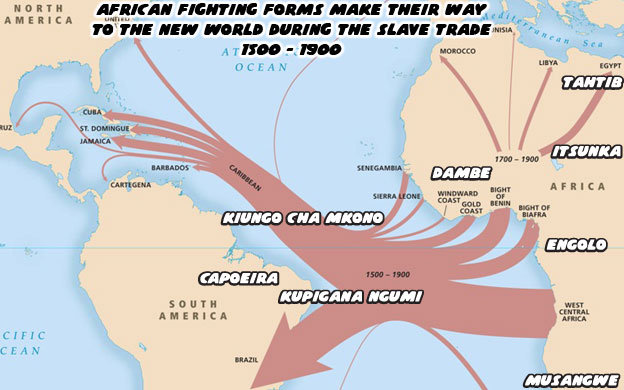
Many readers that were fans of the fighting genre could probably guess that this blog would be highlighting the martial art of Capoeira. In the previous blog I had mentioned that the fighting art of Kupigana Ngumi incorporated rhythmic dances to help teach the style. Slave owners had made an off-hand comment about how the Africans were born with rhythm and the ability to dance. What they failed to realize was that the slaves had brought their Kupigana Ngumi traditions with them and these things could not be thrown overboard, destroyed or erased by violence. Nowhere else was this cultural tradition more apparent than in South America. The Portuguese, French and Spanish traders had taken slaves through the islands of the Caribbean en route to the new continent. Along the way they cross-pollinated spiritual, musical and religious ideas with island natives. When the slaves had arrived in Brazil they maintained a good portion of their cultural heritage but also brought with them many new lessons. The fighting art they developed came to be called Capoeira.


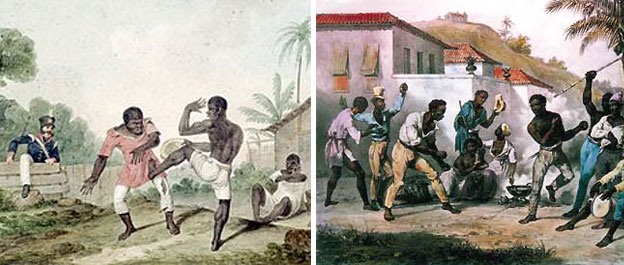
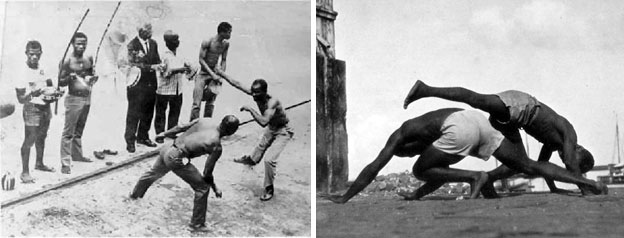
The slaves and natives kept authorities from discovering the true origins of the fighting art by making it look like a dance and a even a game. African drums were replaced by the native panderio (tambourines) and the berimbau (a stringed bow). The rhythms or toques played by the musicians, usually made up of other capoeiristas, determined what style the session would be in. Some songs emphasized leaping and tumbling moves, others focused on quick moves or trapping and still others forced participants to lay low and focus on upper body strength exclusively. The most dangerous form "Cavalaria" had knives, razors or machetes used by participants. In demonstrations two sticks replaced the machetes. The songs could also be used to signal the community of approaching authorities or soldiers. Practitioners would trade moves in a circle or roda. The constant movement of the dance would help make the practitioners hard to hit in a real fight. It would also teach timing, feinting and counter defense, which were all important elements in a battle. Capoeira became known as the Dance of War. It didn't take authorities long to figure out what the practitioners were really up to. The form was outlawed but many capoeiristas, not all African-slaves but also natives, ex-soldiers and immigrants kept the system alive. It became the secret fighting art of the New World. It was practiced in the back alleys and outskirts of town far from questioning eyes. Practitioners would call each other only by their nicknames or apelidos as to not tip off authorities to a real name or hideout even if they were to be captured.

Slavery was abolished in Brazil in 1888, decades after the Civil War in the US had ended. It lasted longer in South America because of the higher demand for slaves. The tropical climate was very good for year-round growing of crops and traders demanded a massive workforce. The indigenous people could not leverage enough support to end the trade with smaller nations or European partners. Those in authority did not want their economy or power structure to collapse so they did whatever it took to keep it running. When slavery ended capoeira finally came out of the shadows and became ingrained into Brazilian culture. Practitioners acknowledged the African roots of the art but also understood that it had changed considerably in the 300 years since the first generation of slaves had arrived. Brazilian natives, European immigrants and Caribbean islanders had all helped shape the fighting art and keep it alive.


Capoeira would look great in a video game but there was one major problem. The system was much more fluid and rhythmical than the other arts. Karate looked absolutely stiff by comparison. In order to be accurately represented in a game it required hardware capable of displaying hundreds of complex animations on the fly. The early fighting game engines were woefully underpowered. They could only show a handful of frames of animation and had relatively small sprites. By 1997 both Capcom and Namco had developed powerful game engines that were up to the task. The CPS-III engine by Capcom was sprite-optimized hardware. It allowed developers to work with a more robust palette of colors, larger pixels and characters whose animation frames had gone up exponentially. Namco by comparison was working on 3D hardware. The System-12 unit they had developed created stunning animations on complex models with detailed textures and lighting effects. The characters both studios introduced set the gold standard for capoeira characters in a game.

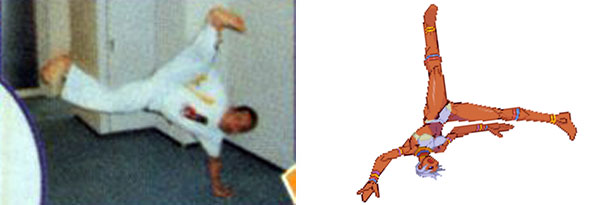
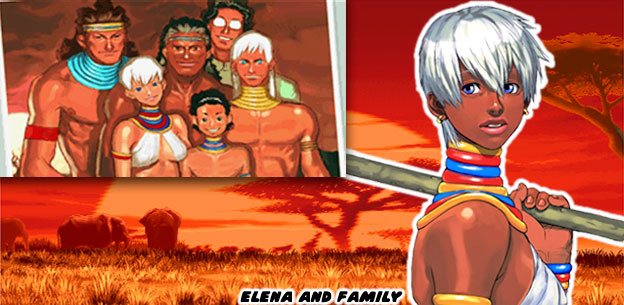
Elena was the playful long-legged African girl created by Capcom. The developer had rotoscoped one of their designers, Daigo Ikeno, who actually practiced capoeira in order to make the animations look as fluid as possible. Players could tell that the CPS-III hardware was leagues ahead of any other studio as they watched the hundreds of frames of animation given to Elena flow from one move into another.


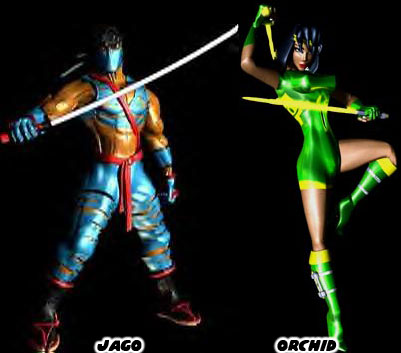
Elena was designed with a combination of different native elements and animé influences. She had white hair and blue eyes, which was rare for a native African but seemed to run in her family. It was an interesting visual contrast, similar to the Aboriginal tribes of Australia. It hinted that Elena was actually of mixed descent. This made her one of the first mixed ancestry videogame characters. Black Orchid and her brother Jago from the 1995 game Killer Instinct were actually the first mixed ethnic fighters. They were from black and Asian parents but presented with Western comic book design cues rather than animé ones. The developers at Rare were keenly aware of their audience in the US. North, Central and South America had become ethnically diverse thanks to centuries of emigration. Asians, Europeans, Africans and Natives were not always mutually exclusive communities in the New World. Gamers that came from two different cultures sometimes felt that they could not identify with the main characters in their favorite titles. Even the strong minority characters only represented half of their heritage. Killer Instinct changed the perception of what was possible not just to gamers but to the industry as well.

Granted, Rare exploited many of the same trends when creating their cast that the other studios did. Orchid was a highly sexualized character. She was very busty and fought in heels while wearing a tight rubber dress. Her brother had huge muscles, like the other males in the cast, yet was still incredibly fast and flexible. The characters and gameplay was completely over-the-top and audiences understood that and appreciated the game for what it was. Killer Instinct was not meant to be a copycat of the games from Japan. It did not use hand drawn sprites but instead pre-rendered CGI sprites so that its graphics appeared years ahead of the curve. It did not limit the number of strikes that players could pull off and instead celebrated the 20-hit, 30-hit or even 90+ hit combo strings that savvy players could put together. Killer Instinct featured violent, gory or even comedic "Fatality" moves for the characters. Orchid for example would open her top, flash opponents and give them a heart attack. The game had become a reflection of what the audience desired in a fighting game. Players from Generation-X made up the majority of arcade visitors in the US. By '95 they had become older teenagers and wanted to see sex and violence in equal measure. Killer Instinct was a bold contrast to the sanitized experiences from Japan and offered more "mature" themes for these teenagers.


Jago and Orchid did not have an actual fighting style associated with them but instead had fictionalized martial arts moves. This was fine among players considering the duo were battling lizardmen, werewolves, cyborgs and aliens. None of those fantastic characters had realistic combat styles either. Gamers enjoyed the clash of styles and characters and for a few months Killer Instinct was the hottest title in the arcade. Once players had figured out all of the possible combinations and fatality moves the game tapered off in popularity. The characters and premise were fun and the uniqueness of the experience had built a strong following. Unfortunately the game lacked depth. The sequel failed to gain as much interest as the original. Within the community it became another challenge to figure out all of the combos, fatalities and secrets as fast as possible. Once that was done players went to other fighting games, and in some cases back to older fighting games.

The staying power of the best franchises was due to more than shock value, fancy graphics or massive combo strings. Great game engines and characters went hand in hand. Fantastic character designs that relied too much on spectacle rather than substance eventually sank the KI experience. Street Fighter tended to have a bit more forethought in their character designs and game engine. The developers had created a balanced game that would be easy for beginning players to pick up and yet gave advanced players a challenge to master. Killer Instinct had a steep learning curve by comparison. Beginning players could be brutally punished by opponents or the computer AI. This reduced the chance of repeat plays from those still learning the intricacies of Western fighters. The characters for KI were interesting but also lacked staying power. Gamers did enjoy the diversity of the cast but perhaps they were a little too generic. A black boxer, an alien made of ice and one made of fire… it was as if they were pulled from comic books and rival fighting games. Capcom on the other hand was crafting fighters that had more substance. In some cases they were inspired by real fighters, rooted in real systems and bore cultural cues when they could. It was easier for gamers to identify with these characters when it seemed that the studio respected their audience. The jewelry that Elena wore for example was similar to the layered necklaces of the Samburu tribe from Kenya. Her costume was anything but traditional though as it consisted of a very short bikini. The appeal of sexualized characters was not lost on the Japanese developers! Elena's stages in Street Fighter III featured the beautiful landscape of her home country. Wild animals, sweeping valleys and amazing sunsets framed the postcard-worthy Africa. Perhaps she wasn't meant to be a capoeirista but instead was supposed to represent Kupigana Ngumi.


Elena had set the bar for traditionally animated fighting game characters. Moreover she was a strong minority character of mixed ancestry. These design choices spoke to the community of players from different backgrounds. It was however a rival character that made the biggest impression with audiences. The next blog will look at the whirlwind character introduced by Namco and the style that inspired millions of gamers. As always if you enjoyed this blog and would like to sponsor me please visit my Patreon page and consider donating each month, even as little as $1 would help make better blogs and even podcasts!

Monday, September 21, 2015

How fight culture became fighting game history, part 36

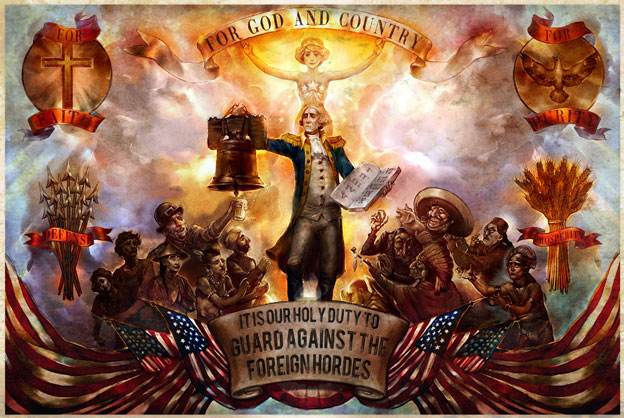
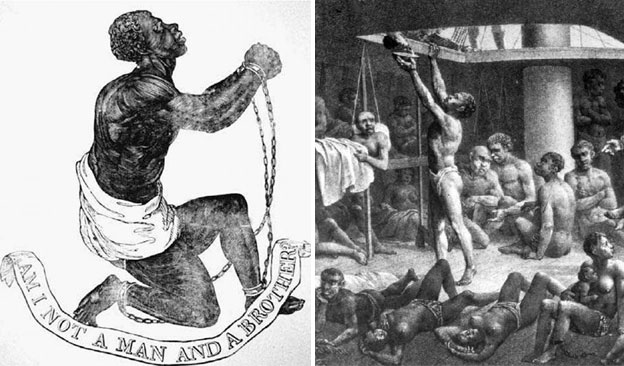
The subjugation and oppression of minority groups was the backbone of Bioshock Infinite. The game actually compared the grotesque caricatures of minority groups with illustrations from historical abolitionists. It was a well crafted way of rewriting history and exploring themes which still affected modern society. Developers had opened a dialogue of sorts with their audience. They cast a complex issue in a new light by creating a virtual world for players to explore. Gamers could see and hear the differences between how the privileged class and minority characters were treated in the floating city of Columbia. Many of the elements featured in the game were pulled from actual US history. It gave the game a sense of depth and substance that few titles had ever achieved.


One of the most horrific acts in the building of the US was the workforce acquired. Slaves from Africa and Europe were brought over by the shipload in inhumane conditions. Those that survived the crossing were separated from their families, sold as property and beaten into submission. For centuries these unnamed and unknown servants helped shape America. The world they left behind, the veritable cradle of civilization had been encroached upon by colonists. In their assimilation to "the New World" a good portion of their culture, their history and their traditions were lost. The ancestors that knew the languages, belief systems and wisdom of the homeland died off from work or disease. Slaves learned that the American continent was their new home, only that they would never be allowed to call it such.

Columbia in Bioshock was a microcosm of post-industrial American society. It summed up multiple periods in history, the ugliness of hate speech, propaganda and showed how difficult it was for migrants to integrate into society. The spiritual and religious themes were also very important considering that the tenants of the Christian faith extolled forgiveness and acceptance. These teachings seemed only to apply to the leaders of Columbia and not the servants. The contrast and hypocrisy of this utopian society were the undertones that carried the game. Yet outside of the dialogue started by the developers at Take-Two Interactive the game still revolved around white protagonists. The studio seemed unsure how to write for minority leads, if they were even considered to be stars of the game to begin with. Take-Two seemed as out of the loop as Japanese developers when it came to creating strong black characters. To be fair though the lack of high-profile black characters was the status quo for most AAA titles. Following the trend did not make it right.


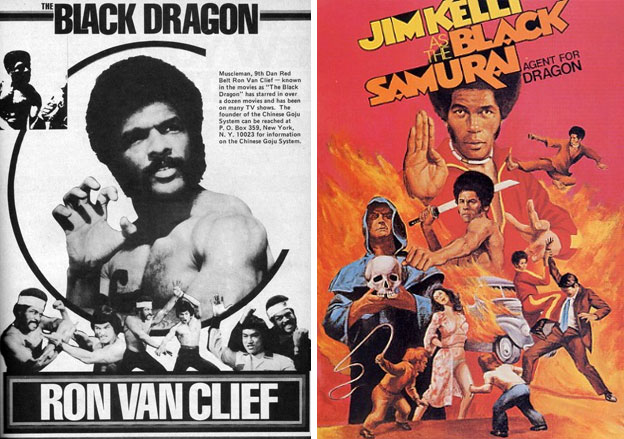
One of the biggest mistakes made by modern game designers were the roots of black fighters and traditional combat systems. The previous blogs showed how black characters in games were given a gimmick. Boxing, basketball or breakdancing were the most common "forms" applied to them. It demonstrated how hopelessly out of touch most developers were with regards to the martial arts of Africa or what arts had been studied by African-Americans outside of boxing and wrestling. African-American martial artists had been making tremendous strides through the 20th century, especially during the Civil-Rights Era. For example Kung-Fu practitioner Ron Van Cief survived a lynching from his own unit after joining the Army. He also survived a tour of duty in Vietnam against very adverse conditions from his fellow soldiers as well as the enemy forces. When he got out he auditioned for a movie role and became a star. He would appear in more than three dozen martial arts films overseas. In the US he and fellow blacks that practiced martial arts were still heavily discriminated against but in Hong Kong they were treated with respect. Van Clief and other black karate, judo and kung fu fighters had mostly been ignored by game developers in Japan and the US for their contributions to the martial arts. Only the stylish characters like Jim Kelley would make a lasting impression to designers.


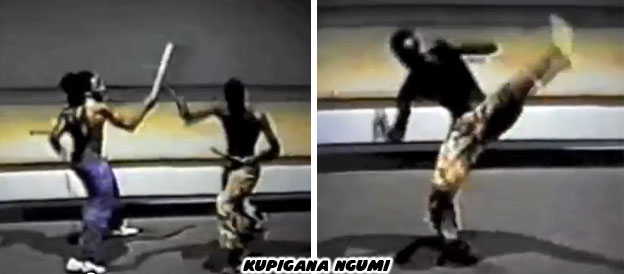
Some of the oldest combat systems the world had ever known were born in Africa. They went back thousands of years, back to the days of the pharaohs. Ancient carvings depicting hand to hand and weapon based combat were on the Beni Hassan Temple in Egypt. The did not record a war or ceremony but appeared to depict a system of grapples and strikes dating back to 3000 B.C. The system was known as Montu Ngumi or Kupigana Ngumi in Swahili. The martial art combined many elements from various tribal cultures into its development including music and dance. These things were not all strikes but included meditation, breathing exercises, religious and spiritual beliefs as well. In these ways Kupigana Ngumi was very similar to the martial arts of Asia. Many systems in China and Japan also relied on mediation and other exercises to help mentally condition their practitioners.


Mental discipline was just as important to most defensive arts as learning how to properly block, throw a punch or kick. People concerned with only learning how to fight often missed the most important lesson the arts had to offer. Self control and character development were paramount to physical training. The difference between learning to fight and learning a system was in the "kata" or forms. In karate practitioners learned a routine that used punches, kicks, blocks and stances. These were called kata. As new moves were learned they were incorporated into the kata. Variations of these kata were long and complex, taking thousands of hours to learn and a lifetime to master. What Kupigana Ngumi did was use music and dance to help practitioners memorize the techniques. Moves flowed from one into the other like steps in a dance. This made for a very fluid system which allowed for individual interpretation. Asian systems were usually fixed forms, having zero room for deviation. Practitioners for Kupigana Ngumi were free to build on their strengths while switching from standing to crouching movements in a nonstop, rhythmical string.


This was a technique that was taught to both men and women starting at a young age. The form was good for core strength development and building arm and leg strength as well. The broad swings of the appendages allowed for even the smallest fighter to learn powerful attacks. Momentum, speed and torsional mechanics replaced the need for big muscles while striking. The constant shift from foot to foot and crouching moves meant that some practitioners were were extremely good at evasion. Pacifists or those that could not generate the right "snap" for a kick could still make it out of a tight spot thanks to the system. The low stances were also useful for those that had fallen or were tackled. The majority of real world fights ended up on the ground and people that knew how to strike and evade from a low position had the advantage.

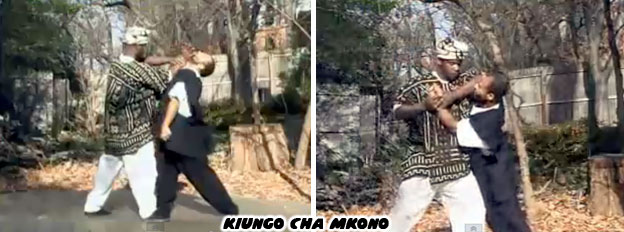
The form followed slave practitioners to the West Indies, the Caribbean and eventually the Americas. Consider the blasphemous stereotype that slaves were born with natural rhythm and the ability to dance. Could it be possible that what those early slave owners had witnessed were some of the first Kupigana Ngumi moves in the New World? Any accurate report of what customs and traditions the Africans had brought over were lost in time and simply never recorded. The settlers considered them savage and sub-human after all. The slave owners would have destroyed any artifacts the Africans brought and would have worked tirelessly to suppress any spiritual beliefs they had. The history books would have made no mention of what African culture was like before the slave trade started. The brutality of the slave owners had twisted the generations born on the new continent. During the centuries of slavery and apartheid the African fighting arts had evolved into a new form. The large sweeping motions of Kupigana Ngumi had all but disappeared. In its place was a system that was far more brutal and to the point. Kiungo Cha Mkono or "Shackle Hands" was a form of trapping and striking that was very similar to the Chinese Wing Chun school of boxing. It could be practiced by any person regardless of gender or age. It was born from the necessity of slaves and prisoners to defend themselves while handcuffed and chained together. The strikes used in the system were meant for maximum soft tissue damage. Exposed ears, eyes and throats were prime targets. Jabbing with fingers and scratching out eyes were fair attacks considering what sort of life the Africans were being sold into.

Kupigana Ngumi and Kiungo Cha Mkono survived a long and ugly history and were still being taught thousands of years later. More than any boxer, basketball player or breakdancer it would have been amazing to have seen a fighting game character use the systems. Those that played arcade games in the '90s had actually been exposed to parts of the African fighting culture. It turned out that the genre was not solely not about stereotypical gimmicks being placed on minority characters. Some of the greatest game characters introduced almost 20 years ago were rooted in reality. The next blog will look at the proud characters that highlighted the beautiful fighting art. As always if you enjoyed this blog and would like to sponsor me please visit my Patreon page and consider donating each month, even as little as $1 would help make better blogs and even podcasts!