Showing posts with label gill. Show all posts

Wednesday, August 21, 2024

Ryu Final, the real Street Fighter III and IV, part 2 - A 1UP classic from January 31, 2008

Good morning friends, there's not much news to report today. Some family issues that I will see about later in the day, plus lawn mowing of course. Things are holding steady but right now I have to get back to work, one of the projectors blew a bulb so that's going to cost somebody money. Let's get back to the second (and final) book of Ryu Final. WARNING: if you would rather wait for the translated issue next month then skip today and tomorrow's blog. I will be talking about everything that happens in great detail.

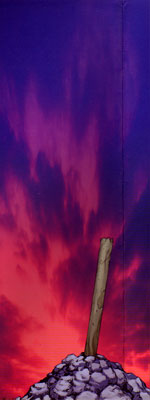
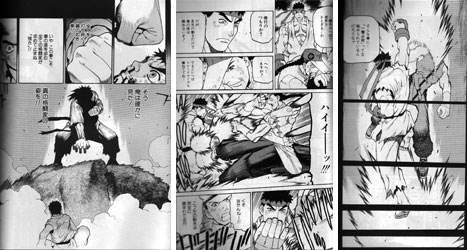
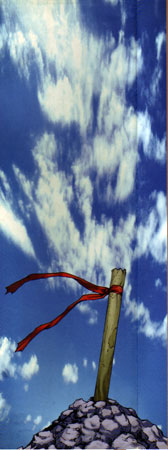
This comic begins with a rock pile and a stick. It is a grave marker. The red headband of Ryu is tied onto it.

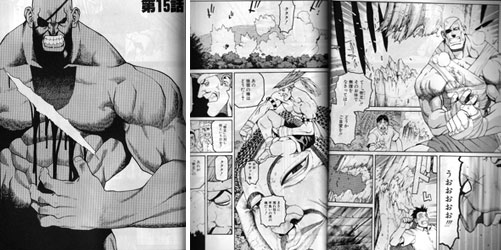
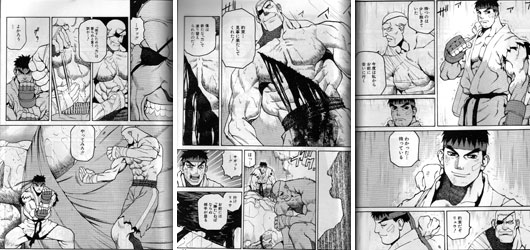
This story does not begin with Ryu but the lessons learned are just as important as everything we saw in the first book. This is the story of Sagat, rather the lessons of Sagat. As the story starts we see Hugo's diesel truck parked outside of a temple in the heart of Thailand. Hugo is taking swings at Sagat. Although he towers over the mighty Thai, he is unable to land a solid hit on him. Sagat is motionless and allows Hugo to throw punches that don't seem to faze him. In a fit of anger Hugo lifts the stone head of a Buddha and throws it down on Sagat. It shatters into a million pieces and this gets a reaction. Sagat takes down the mighty giant with one kick. He then remembers his life of fighting.

We are taken back to a period in time when Sagat was at his most dangerous. He had survived the dragon punch from Ryu and was recovering in Thailand. Furious with himself he takes his aggression out in the jungle. Knocking down trees and trying to make his techniques stronger. Adon watches from a distance, ashamed that the tiny Ryu could have done this to his master. Although bandaged up Sagat has a would that will not heal. He doesn't stop long enough to think about the consequences of his actions until he accidentally knocks a tree down onto a child. He takes the child to a temple where the monks take him in and try to help. The monks warn Sagat of what he is becoming.

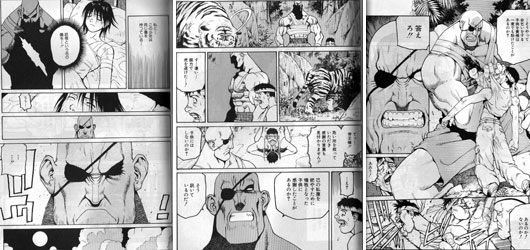
Although he survived a potentially fatal blow he survived. Whether is was his size, his determination or his will that kept him alive is unknown. What worries the monks is the scar has been left in the Shoryuken's wake. It is not the physical scar but the emotional one. They warn Sagat that revenge and hatred is what is fueling him now. That hatred is going to eat him up from the inside, that scar will never heal if Sagat remains possessed with a desire to kill. Sagat lived for a reason, there is tremendous potential for him but he seems to miss his purpose. It extends beyond the fight. The monks say that poachers are killing and trapping tiger nearby. Sagat should be defending his homeland. So he leaves the child behind and goes into the jungle.

We see poachers stalking a tiger who instead kills one of them. Before the tiger can pounce on the other Sagat kicks it in the head and scares it off. The poacher thanks Sagat profusely for which he rejects. Sagat has found a new target for his aggression. He begins slapping the poacher all over the jungle. As he does so the scar on his chest opens up and he starts bleeding. While Sagat pauses to clutch his chest the poacher grabs a young villager from a nearby tent. It is the child that Sagat accidentally hurt. The poacher holds him hostage. Sagat throws his hand in between the gun and the child. The poacher fires a round into his hand. Sagat grabs the poacher with his free hand and lifts him into the air. The poacher fires a few more rounds into the torso of Sagat.

Sagat can easily kill the poacher but he chooses not to. He had just cause and unlike Ryu, this person was a criminal willing to murder Sagat in cold blood. At that point Sagat has chosen his path, he will not let rage consume him, he will not use muay thai as a means to have his revenge. He will not stain the name of his beloved country. The bandages fall away from his chest as he holds the poacher aloft. The massive scar on his chest has stopped bleeding. Sagat has matured as much as Ryu in the universe. He has learned many lessons and he perseveres. He is proof that even a mortal wound can be overcome.

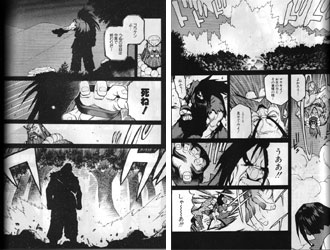
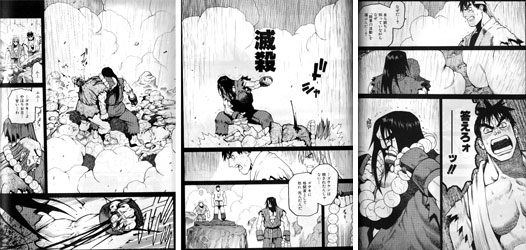
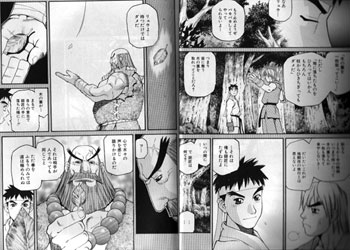
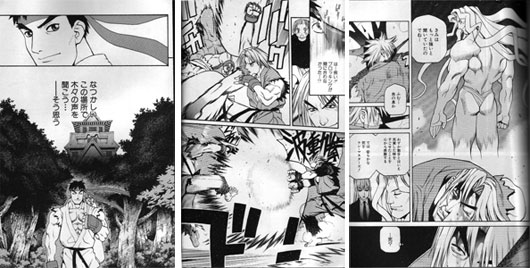
Ryu and Oro know where their path will lead. In Ryu's memory the reader is taken to the past again to witness an important moment in SF continuity. Nakahira shows us the fight between Gouken and Gouki in all its violent glory. Ryu and Ken are young, about the age they were in Zero if not a little younger. One day Gouki just begins shooting fireballs at his brother from high atop a ridge in the woods. Gouken senses these strikes and jumps out of the way. They begin battling all over the woods in a very cinematic fashion. They hurl special moves at each other but Gouken is eventually overtaken by his brother. He is beaten and killed when Gouki punches his hand through his chest. Gouki takes the string of giant beads from the body of his brother and places them around his own neck. Ken and Ryu call out for their master but it is no good. They can barely hold themselves back but they know neither of them is remotely a match for Gouki. He warns them and then walks off. The memory remains with Ryu for a long time and now is the time to do something about it.

It is now the present and Ryu returns to Thailand for a rematch. Ryu and Oro pass a couple of teens farming near the temple. The villagers that Sagat saved many years ago are growing up. Sagat waits for Ryu, the battle between the tiger and dragon has been a long time coming. Sagat is stronger than he's ever been, Ryu has been training harder than ever. Of all the rivalries in Street Fighter this is the oldest. Nakahira tells us what happened between them during the SF III continuity. This is important because the beef was not settled in canonical terms or in the videogame, Sagat was not in III. Both Ryu and Sagat prepare for the fight with Oro and the teens acting as spectators. There is a storm brewing but neither Sagat nor Ryu will let the rain stop them. They square off and begin fighting when the lightning strikes nearby.

The battle is over in a few hits.

Both strike each other quickly, over and over, but Sagat manages to land a devistating knee. He sends Ryu crashing through a sleeping Buddha statue. Oro was the only one that was able to perceive the blows and know when each struck the other. Ryu looks beaten but Sagat takes a knee and concedes defeat. Ryu does not understand. Both men were capable of taking the fight much further. Sagat has taken a knee because his old wound has reopened. He knows now that the path of the warrior is not validated if he must fight to the death. Ryu learns that every battle does not have to end with him crippling or knocking out his opponent. He must take the fight as far as it has to go and no further. Ryu must not becomes that which he despises. Ryu and Sagat come to an understanding after that. Ryu and Oro leave Thailand. Sagat bandaged up again, the teens holding an umbrella over his head and watching an old adversary walking away. This might very well be the last time Sagat is supposed to be seen in continuity, the end of an amazing chapter in the history of fighting games.

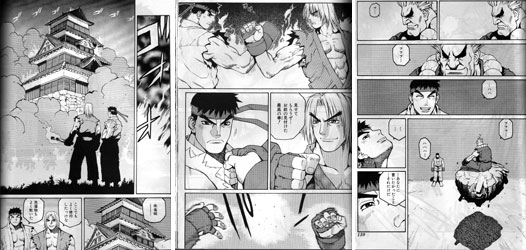
Ryu and Oro make it to Japan where they reunite with Ken and Sean. Ken and Ryu prepare to end another chapter in the series. They set fire to their masters temple. It is a majestic castle that has been in the background of every Street Fighter game. Sadly this is the last time we shall see it standing. Ryu and Ken square off to determine who must challenge Gouki as their dojo burns in the distance. Ryu connects with one well placed strike. Suddenly the temple explodes and collapses. Gouki descends on a pile of rubble. The two great warriors pause to study each other.

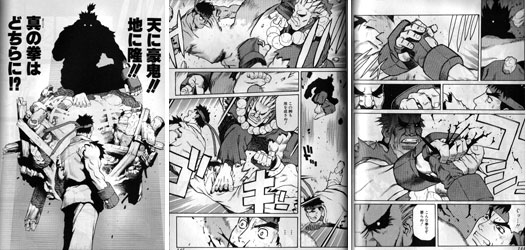
In a way it is funny that the path Ryu has wandered on for years takes him back home. Gouki finds irony in the little boy he saved has grown into a capable warrior. They both laugh a little. It is the only time you will ever see a smile on Gouki, it is slightly unnerving. Ryu tries to catch Gouki with a dragon punch. Gouki grabs Ryu's hand and crushes it.

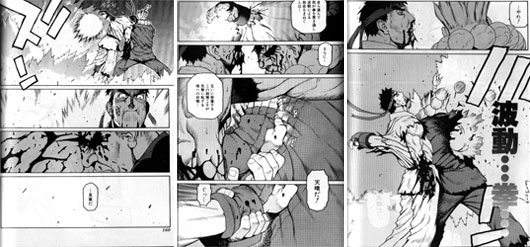
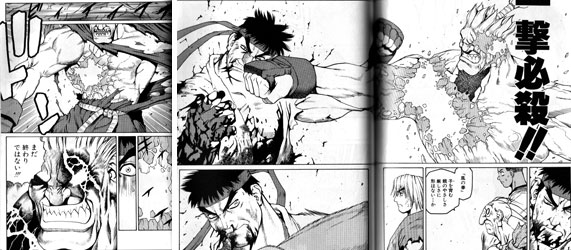
The fight is brutal and although Ryu has grown and learned a lot in the past few years he is still no match for Gouki. Gouki beats Ryu and hits him with the legendary Shun Goku Satsu or Instant Hell Murder. The finishing strike is a punch through the chest, just like he gave his brother and master. To make sure that Ryu is done for he drops a fireball from the hand that went through him. This explains the flash of light that you see at the end of the videogame version. Ryu spits up blood in the face of Gouki. He is wiling to return the favor in kind and do something that his master was not willing to. Ryu places his palm on the side of Gouki and shoots a fireball right through him. Gouki pulls his arm out and both men stagger back.

Ryu is bleeding profusely and wonders how Gouki can remain standing. Gouki tears off his gi and we can see the gaping hole in his torso. Gouki is hollow inside, he has been completely consumed by the Dark Hadou. All that remains is a rage-filled shell of his former self. Ryu curses the monster for killing his master and killing himself.

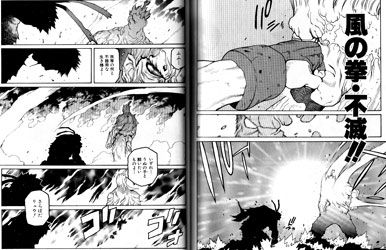
They strike each other once more. Gouki connects first. As soon as Ryu hits the face of Gouki he becomes consumed by fire. Gouki turns away from Ryu and staggers into the flames of the burning temple. The demon is defeated but at the ultimate price. Ryu collapses and Ken runs to his side. He is unresponsive as Ken yells his name. Ryu is dying.

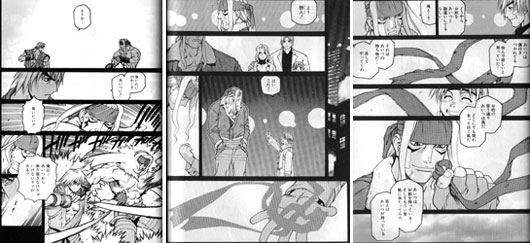
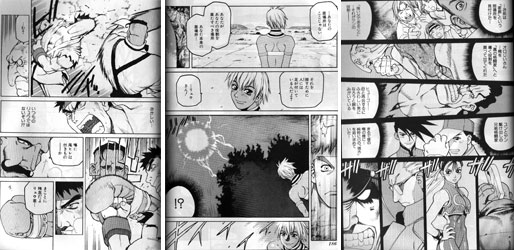
The epilogue. We see Alex sitting in an alley, distraught. Earlier that day he had a match with Ken at Madison Square Garden. Alex was a big up-and-coming fighter in the MMA circuit. In SF canon he even knocked out M. Bison in a MMA fight. He gives Ken a good battle in the final but is ultimately defeated. Alex is disappointed in himself, not for losing to Ken but because he realizes that he is still not strong enough to fight Gill, whom he really wishes to battle and avenge his family. Alex's adopted family finds him sulking in the alley and helps him. A few days later Alex seems to be doing better when he runs into Ken and his family. Ken advises that the only way to get better is to go around the world and learn from the best. Little Mel reaches out and gives Alex the red headband of Ryu, knowing that Alex respects the legendary fighter greatly. Ken and Alex part ways.

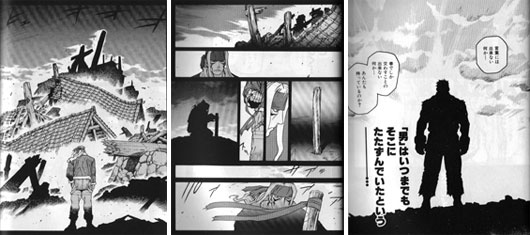
We see Alex months later in the hills of Japan. We assume that he has already done extensive traveling. Learning from Birdie, Zangief and Adon as per the canon. He stops at the ruins that was formerly the temple where Ken and Ryu trained. It is a sad scene now, nothing but rubble remains. There is a pile of rocks marking a grave and a post. Alex kneels and ties the red headband to it. He wishes that he could have learned from the best, to have sparred with Ryu once.

We see a silhouette appear on the horizon. We don't know if it's a memory or Alex's imagination. He turns around.

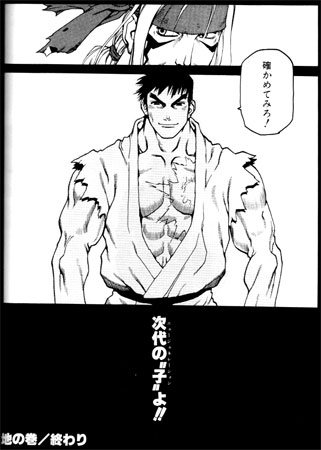
Ryu is standing there, smiling. His hair unkempt. A large circular scar on his chest.

THE END.

Now do you know why I am so critical of the Udon books? Why can they not write or draw anything as epic as Ryu Final? So what can we make from the end of this book? Well aside from the near-impossible surviving from a punch through the chest we can take many things for the future of the series in canonical and videogame terms. His surviving a death blow was foreshadowed by Sagat at the beginning of the book. Ryu returns not as a messiah but as a true martial artist. Ryu has learned to harness the power of a killing strike in his Fist of the Wind and seems to have finally completed his journey. From this point on he should hold a place of great importance in the universe, the transition from fighter to master. From this point on Ryu is no longer the intro into the world, or should not be. I am speaking in manga and videogame terms. From this point on Ryu should be something more... What should we expect if Capcom creates a true Street Fighter IV and not a II.5? 

As always if you would like to sponsor me please visit my Patreon page and consider donating each month, even as little as $1 would help make better blogs and even podcasts!
follow the Street Writer on Patreon!

Monday, August 19, 2024

Ryu Final, the real Street Fighter III and IV - A 1UP classic from January 30, 2008

Welcome back friends. We're here to talk about Ryu Final, the last book Masahiko Nakahira created for Street Fighter. The book was set in the SF III continuity, to be precise it is set during 2nd Impact: Giant Attack. Nakahira never did a SF II book for Capcom, those were covered by Masaomi Kanzaki and Mami Itoh. So how does Nakahira's story go? How does it progress? If you read it once then go back through you'll notice that everything that went into this story was done so deliberately. Every character, location, fight and moral was done with forethought. Nakahira is a genius when it comes to plotting the events of his book. He doesn't just plot out a linear story but carefully intersects flashbacks which keeping you turning the pages. The weakest part of his story is better than anything I've seen with Udon. Overall it is perfect storytelling and great art combined. Let's touch on the events of the first collected book.

This comic begins with a rock pile and a stick. It is a grave marker, but for whom?

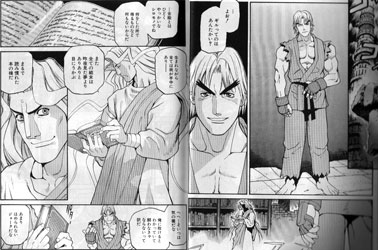
Ken and Ryu are much older, stronger and wiser than when we last saw them. They are possibly at the peak of their abilities. Ryu begins the tale, he is training in the shadow of his old dojo. He remembers the lessons learned from his master Gouken. Nakahira presents Ken and Ryu younger than they appeared in the Zero books, as young as they appear in some Udon flashbacks. The sage advice is not lost on Ryu as he remembers, in Jedi style, that he and Ken are part of the living, breathing world, not apart from it. It is up to Ken and Ryu to catch a falling leaf, the task sounds simple but has profound meanings. In almost all the Nakahira books you see a big oak tree and leaves come up time and again. The leaves and lessons of Gouken also return in the ending credits of SF III: 3rd Strike. The cycle of growth and change, the eternal strength with roots deepening as they grow. The hard training of Ryu and the trees that shake with his blows are inspired by actual accounts of Mas Oyama's tremendous power.

Ryu is fully confident in his abilities and decides it is time for him to return to the circuit and prove himself. His first stop is San Francisco where the understudy of Ken, Sean, taxis Ryu to a yacht. Young Mel, the son of Ken and Eliza is crying because he's afraid that Ryu is going to beat his father. After a few formalities the classic rivalry gets underway. The outcome isn't even close. Ryu is soundly beaten by Ken and can't even manage to get a hit in. Somehow his best friend and rival has surpassed him. Ken has worked harder than Ryu and has become a true martial artist. The reason is told in flashback.

Ken had challenged the man-god Gill and was beaten within an inch of his life. He came to the realization of his purpose as he was lying in a pool of his own blood. He could not allow this defeat to happen, he would never allow himself to be defeated in combat by anyone. His life was not forfeit as he remembered his wife and son. They were his foundation and Gill be damned for trying to sever those ties. The fight became a stepping stone for Ken. From that point on Ken realized he was not only fighting for himself, but for his family and with that conviction he would never fail them. With his remaining strength he leveled Gill with a dragon punch and did the same to Ryu. A clear-cut victory.

The scenes and plot with Gill were covered in the shortest span of time. Nakahira knew the important part of the story was not in trying to explain the plot of SF III but instead allowing the reader to discover how much the cast had grown. Ryu walked away from the encounter a little humbled but grateful. He knew now that he had room to grow. So he said farewell to his friends and set out again. While sleeping in a park he was awoken by Oro, who was trying to walk away with his duffel bag. Ryu tries to teach the old man a lesson but is instead beaten by the aged master. To make things fair Oro even puts one hand behind his back and still manages to beat up Ryu. FYI: remember that Capcom has been trying to use a one-armed boxer in their series because their template for SF II, the Master of the Flying Guillotine sparked the idea. Ryu becomes progressively angry with his aged opponent and finally decides he's had enough. Ryu tries to counter with a fireball but he is instead knocked silly when Oro unleashes a massive Yagyou Dama, or two handed fireball the size of a Volkswagen Beetle. It turns out that Oro was testing him. Hoping to find a student worthy to train. Ryu is the one and from then on he is under the hard tutelage of the 140-year-old master. He begins by making Ryu carry a massive boulder on his back with Oro riding atop.

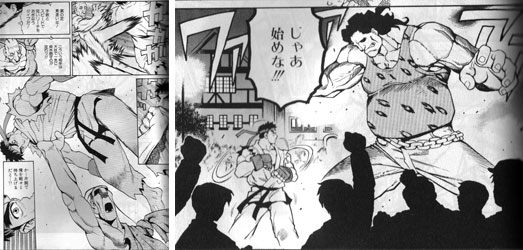
At this point of the story Ryu has pretty much hit rock bottom. This is important because he must be rebuilt as a person and as a fighter. The battles he has had in the past, against opponents like Sagat and Vega should have made more of him. Instead he is still locked in the rigid system taught to him by his master and unwilling to progress. It is up to Oro to show Ryu his true potential or kill him in the process. Somewhere in Germany Ryu's first battle turns out to be against the giant Hugo. The battle is brutal on Ryu as Hugo dominates him for most of the match. Pounding him into the ground and throwing him like a ragdoll, Hugo is a force of nature against Ryu. Nakahira uses exaggerated perspective to make Hugo appear 20 feet tall rather than the 7'8" he is. This is in the same dramatic technique that Tetsuo Hara would do to make gigantic opponents for his Kenshiro to battle. After losing for most of the match Ryu is able to defeat Hugo with a well placed dragon punch to his stomach.

It is not easy for Ryu to win battles. Unlike the Udon books where fan-favorites can knock out opponents in one hit, nothing comes easy in the Nakahira books. This importance of this fight is to show him, and the reader, that there will always be bigger and stronger opponents waiting for the challenge. Ryu will always bring out the best in his opponents and he can't always out-muscle them. The moral of the Hugo battle is that strength is tempered by technique. Ryu continues his training with Oro from there, having earned the respect of Hugo and Poison. He travels south and eventually encounters Yun and Yang. The brothers are brash and inexperienced fighters. The determination of the young kung-fu masters is a parallel between Ryu and Ken's legacy. Even though Yun and Yang are beaten by Ryu they will not quit. Ryu is reminded of how stubborn he was in his youth as well. Yun and Yang establish the core of the Ryu story.

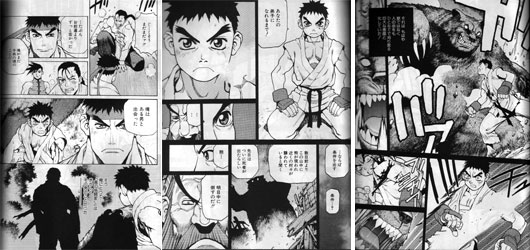
In flashback we see a young Ryu, much younger than he's ever been presented. His build is skinny, his hair unkempt, but he has a determination that impresses Gouken. He wants to prove that he is worthy to learn under the master so he says he will strike out to chase away a bear terrorizing the local villages. Gouken discovers his bloody duffel bag a few days later. Gouken fears that the bear has killed Ryu. This adventure, like much in the life of Ryu is inspired by the fictional retelling of the life of Mas Oyama, better known as the Karate Baka Ichidai anime. In particular the battle here is between Ryu and a dangerous bear, the same thing that happened to Yoshiji Soeno in the cartoon. We catch up to Ryu in the woods and see that a bear is indeed slashing at him ferociously.

The bear pounces on Ryu and is about to finish him when he is struck from behind. The force of the punch travels through the head of the bear and stops inches from the face of Ryu. It is a wild-haired Gouki that has saved Ryu and killed the bear. Gouken arrives to take Ryu away. Gouki cares not for man or beast, saving Ryu was an afterthought. It was that day where Ryu saw the face of evil. He saw that the techniques he wanted to learn was lethal in the wrong hands. These were techniques that could easily be used to kill if left unchecked. In present time Ryu thanks Yun and Yang for the fight and hopes to see them again someday. Like they Ryu has room to grow and many more battles to come.

The next battle Ryu faces is nowhere near as easy as the battle with Yun and Yang. Dudley the boxer, the undisputed heavyweight world champion, wishes to challenge Ryu. You would think that with Oro as his new master he would have become a better fighter by now. Dudley beats the tar out of Ryu and has a counter for every move. Ryu is simply not fast enough to catch the champ with his guard down. Even his dragon punch is caught and countered. Round 1 goes to Dudley but Ryu will not stay down.

This is the abstract part of the book, the weakest reason for a character to be introduced. Elena is brought in an aside and doesn't fight in any way. She is in Africa, a continent away from where Ryu is. Yet she, like every other fighter in the world is connected. It all goes back to the lessons that Gouken planted into the young Ken and Ryu. They are part of this living world, their roots have grown deep and they have more potential than they realize. It is up to them to wake up to that and release their true potential. With that Ryu comes to his senses and catches his second wind. The leaves in the mighty oak tree in the background shake. Ryu plants his feet and prepares a new fighting stance. Oro and Dudley are intrigued at this newfound intensity in Ryu.

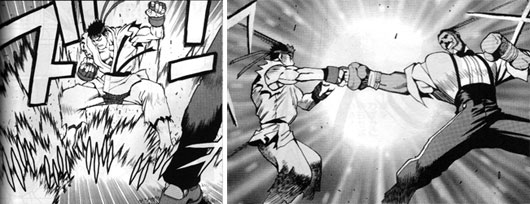
Oro wonders how Ryu will face his opponent now. Dudley is the culmination of the boxing arts, possibly the oldest fighting arts in the world, dating back thousands of years. Boxing is a refined sport, called the sweetest science by practitioners. Embracing the culmination of the art Dudley represents a fighter in the purest sense of the word. He is taller than Ryu and has a longer reach than Ryu, there is no way he can get caught by Ryu's blows. A pure fighter cannot be defeated by traditional strategies and technique. Ryu has learned that he is not fast enough for a special move, he has also learned that he can't always out-muscle his opponents. In order to evolve he must be willing to change his strategy. He decides to use the force of a killing strike but use it in a new way. In one strike they go at each other with everything they have.

Dudley was aiming for the head of Ryu and failed to notice that Ryu's punch was headed for his hand. Ryu has learned to harness the power of a killing strike but not in the way that was used against Sagat. The force of the blow destroys Dudley's boxing glove and breaks the bones in his arm. The force of the blow also travels through Ryu's arm and tears part of his gi off. Ryu remained grounded and the remaining energy returned to the Earth. Dudley concedes defeat. Ryu has learned the fist of the wind, a technique unique to him. He is now ready for an even greater challenge.

End of book 1.

As always if you would like to sponsor me please visit my Patreon page and consider donating each month, even as little as $1 would help make better blogs and even podcasts!
follow the Street Writer on Patreon!

Monday, August 21, 2017

A look at Ed from Street Fighter V, design meets legacy...

It’s been a while since I’ve talked about a new Street Fighter character, I haven’t been happy with most of them. I’m not going to talk about Kolin, probably ever, sorry about that. Instead I’m going to look at one of the new guys. Ed, revealed at the end of Street Fighter V Season 1 as the understudy of M. Bison / Boxer, was now a playable character. As a whole I think his design and assignment of moves and powers was done very well. There were the things that seemed off, like his animations which seemed to lack polish. Then there was the ability to perform special attacks with simple button combinations instead of traditional joystick+button inputs. Long time fans of Street Fighter thought this was pandering to Nintendo’s Smash Bros. community. But speaking from a visual design standpoint I would say Ed was probably the best new character in the past few years. The reasons for this were subtle but well done.

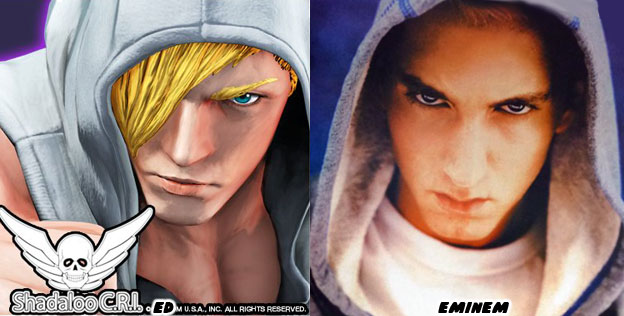
The first thing we should look at was his age. Ed was a young character. Most people in the series were adults. Young characters in a fighting game had mostly been girls, rarely men. In the Season 1 cut scenes he looked like a skinny kid, someone that you might see in real life. The use of a sleeveless hoodie was a good costume choice as it was not too modern. It made sense given that he was learning the art of boxing. Fighters had been wearing training sweatsuits for over half a century. It worked in any era the game was taking place in. This look was also used in pop culture. Rappers like Eminem used street fashion to build an identity. He dressed the part because he was genuine. He was from the streets and not created by a marketing wing of a record label. It was Ed’s updated costumes that worked even better.

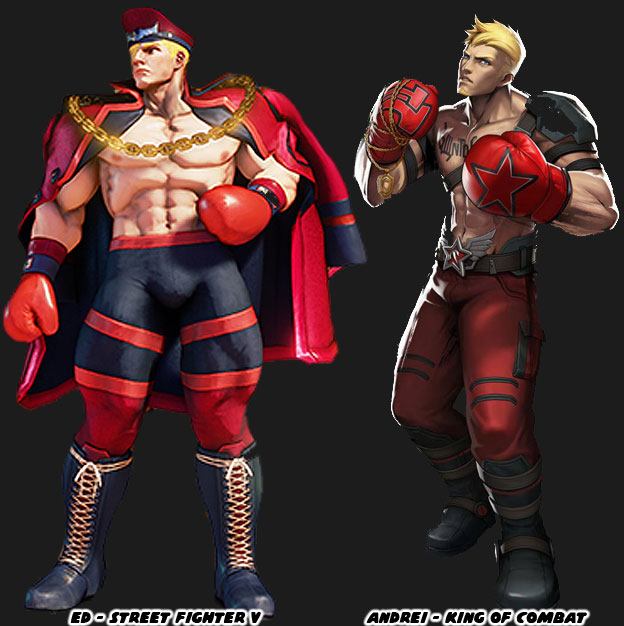
The black and red motif of Ed’s Battle Costume worked extremely well, especially against the light skin and blonde hair the character. The three colors, red, black and yellow were considered a triad of colors. The main color red, contrasting color black and accent color gold worked well visually. Go back through your fighting game history and look at the other characters that had similar color choices. Ken or course had a red gi for most of the games but in SFV he was paired with a black rash guard as well. The other blonde characters with similar color schemes were Paul Phoenix from Tekken, Jacky Bryant from Virtua Fighter, Rugal from the King of Fighters and Andrei the boxer from King of Combat. Having a strong color pallet was something that had made previous characters so memorable. Of course the use of the colors, jacket and military cap was also a callback to the organization that made Ed unique.

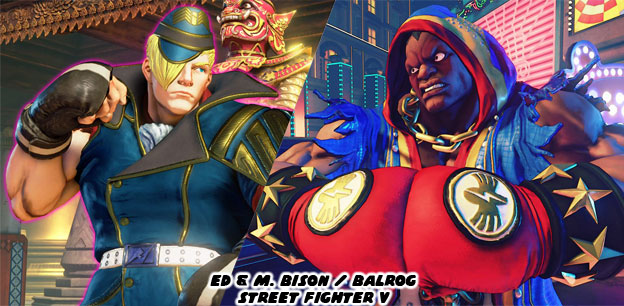
Ed had matured some, had gotten bigger and stronger, from the last time he appeared. Season 2 saw the addition of multiple costumes, the Default, Story and Battle uniforms. Each one of the costume choices complimented the character very well. In his Default costume Ed now looked like a full-fledged Shadowlaw officer. In the story he was aging quickly because of the experiments that S.I.N., the Shadowlaw weapons group, had performed on him. When I saw his militaristic costume and fingerless gloves it worked on multiple levels. He was now using the striking techniques taught to him by the former world boxing champ. Yet he was also his own unique fighter. He wouldn’t be riding the coattails of M. Bison for long. When I saw the character going toe-to-toe with his mentor I wasn’t put off. In fact seeing him in action reminded me of another young fighter taking on a veteran.

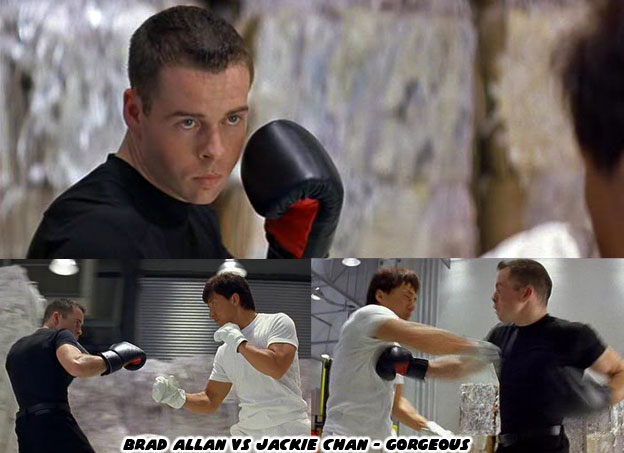
Brad Allan, a martial artist, stuntman and fight choreographer was a villain in the 1999 Jackie Chan film Gorgeous. Allan was a cocky young fighter that gave Jackie a run for his money. In the movie Allan didn’t want the fight to be over too quickly so he allowed Chan to wear light sparring gloves while he wore heavily padded boxing gloves. At that time Chan was a well-established movie star. Fans had seen him beat up all sorts of different martial artists over the years. Most of the people he fought were about the same age and the same size, yet every now and then he took on much larger opponents. Chan had lightning fast punches and was a master at improvisation, he could adapt to his opponents and overcome them quickly. People expected more of the same in this film. Imagine their surprise when they saw the kid trading punches and kicks as fast if not faster than Chan. For the first time in a long time it appeared as if the veteran had been outclassed. The stakes had suddenly become much higher because of this villain. When I saw Ed’s assortment of boxing moves I got flashbacks to how Allan was portrayed in the film. It got me excited for his potential in the Street Fighter series.

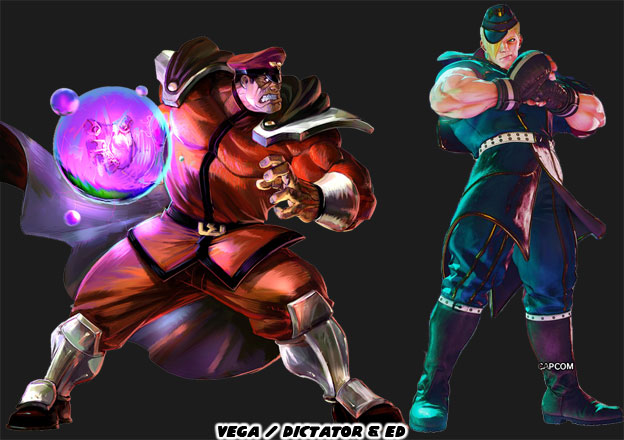
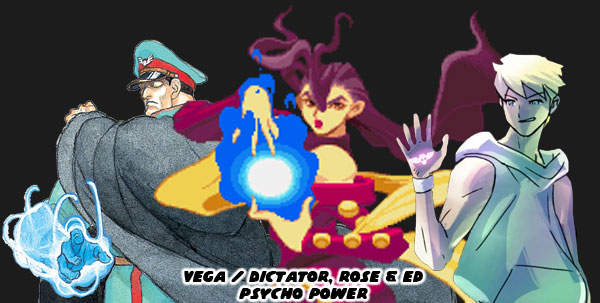
It wasn’t enough that Ed was a striker. His costume revealed a lot more about his true purpose and the extend of his powers. He was being groomed by the Dictator himself to become an important member of Shadowlaw. Would he perhaps become a general in the organization? Would he replace Sagat, F.A.N.G. or even the Boxer on the roster? Or would he assume total leadership of the organization some day? In order to accomplish this goal it meant that Ed would be given powers that went above those of normal people. This was where the fictional “Psycho Power” was reintroduced into the series. It had first appeared in Street Fighter II and was used to explain the awesome powers of Vega / the Dictator. The origins of Psycho Power were touched upon in the Street Fighter Zero series in 1995. The character Rose was a fortune teller whose powers were harnessed by Vega. This form of psychic energy allowed people to float, throw balls of energy and strike with burning force.

Psycho Power faded into history as Street Fighter III changed the main villain in 1997. Gill represented a secretive group known as the Illuminati. He had some sort of elemental powers, fire and ice specifically, at his disposal. This was never full explained in the series making him more fantastic in origin. In 2008 Street Fighter IV returned back to the SF II timeline. The head of S.I.N. was developing a new form of energy that could be weaponized. The character Seth had a Tanden Engine, installed into his abdomen, which allowed him to generate fields of energy and attract or repel opponents. A miniature version of the Tanden Engine was placed behind Juri’s eyepatch, which gave her superhuman strength. The Tanden Engine was combining the spiritual studies of Yin and Yang with science. It was the spiritual energy that allowed Ken and Ryu to throw fireballs but for the first time had been recreated mechanically. This technology took a back seat when Ed showed up and brought Psycho Power back to the forefront.

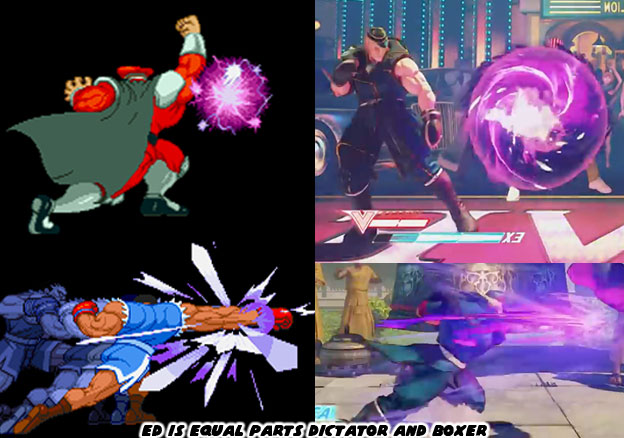
Psycho Power was a great explanation for why Ed was more than just another martial arts master in a tournament. It allowed the artists at Capcom to pull design elements that went into both the Boxer and Dictator and create something new. For the artists and budding designers reading this it was an important lesson in creativity. Take a look at your favorite character and try to pinpoint the best features. Look at the colors used, look at the cut of the costume. Look at the moves they had. Then take a look at a another one of your favorite characters and do the same thing. Now imagine how you could combine their features. For bonus points try making a good guy or bad guy version of the character. Or try changing the sex of the character or ethnicity. But Ed was more than just a distilled mix of the Dictator and Boxer. He had a unique special attack all his own.

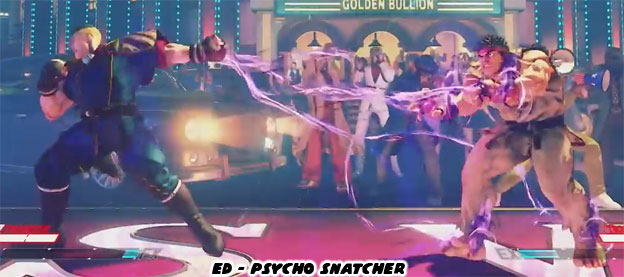
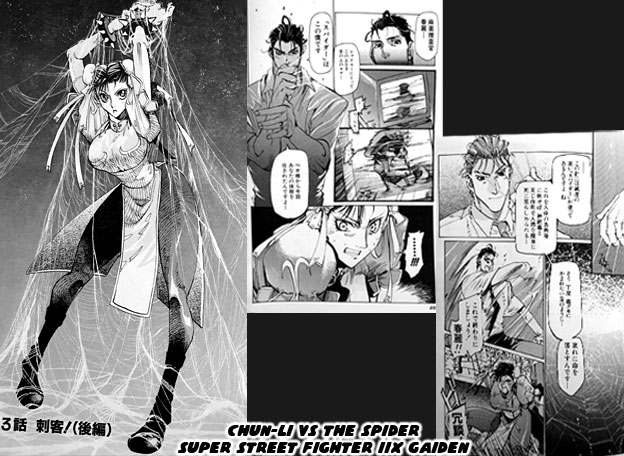
Ed could use his Psycho Power to create a web of energy and pull his opponents to him, it was called the Psycho Snatcher. It looked like the sort of move Spider-Man might use. This attack opened up the potential from a game play standpoint. The web of energy could cut off projectile attacks mid-air. It could also snatch opponents right out of the air. At a close range it could stun opponents and ensnare them even if they were blocking. From a design standpoint this also meant that Psycho Power was malleable. It didn’t have to be used as concentrated bursts of energy, and it didn’t have to be used to engulf the player in a psychic flame. Psycho Power could be used like a whip or net as well. Its other uses were limited only by the imagination of the designer. This special attack actually had its roots in the manga series Super Street Fighter II X Gaiden by Mami Itoh.

In the manga Chun-Li, acting as an INTERPOL agent was investigating a dangerous new drug that had hit the streets. It lead her to Los Angeles and eventually San Francisco where she ran into Ken’s wife Eliza. A handsome young investigator was assigned to the case as well. The two were tracking down the drug trafficker and assassin known by the alias the Spider. Chun-Li’s partner turned out to be the Spider and he was working on behalf of Shadowlaw. He tried to kill Chun-Li before she bring down the operation. The Spider had developed a deadly neurotoxin which he coated spikes with. He would use these poison barbs to kill his enemies. The trap that he set, the web symbolism used in the comics especially, made him a unique opponent. If he could have been presented in a fighting game with monofilament wires (like the kind Rolento uses) and his poison spikes then he could have made for a very unique Street Fighter villain. Seeing the Psycho Snatcher reminded me of the the Spider. I wondered if this double agent was not an inspiration for Ed. Even if he wasn't I think Ed’s design was well done. It worked in the lineup better than most of the new heroes and villains introduced up until now. What did you think about this character? Were you a fan or not? Why was that? Please let me know in the comments section. As always if you enjoyed this blog and would like to sponsor me please visit my Patreon page and consider donating each month, even as little as $1 would help make better blogs and even podcasts!

follow the Street Writer on Patreon!

Monday, August 22, 2016

Fighting with a disability, final part.

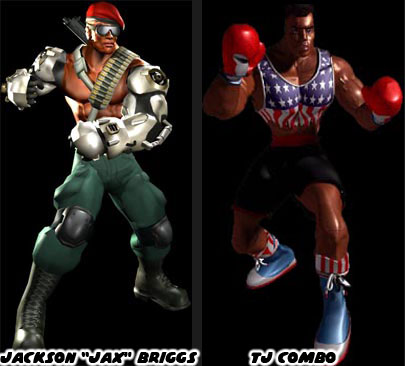
In the previous blog I had mentioned some fighting game characters with visual impairments and even blindness. But what about characters with other disabilities, how were they represented over the years? There have actually been a few characters that fought despite amputations. Two of the most memorable were doing the representation act quite well. The fighters were actually Black and featured an assortment of boxing moves. Major Jackson "Jax" Briggs was a new player in Mortal Kombat II. He debuted in 1993, like his co-stars he was originally an actor that was rotoscoped and turned into a sprite for the game graphics. He wore spandex pants and silver sleeves on his arm that made them look cybernetic. His look changed over the years when the game engine went to 3D. His arms were now clearly robotic. Like many fighters in the series he had to be very strong in order to survive the onslaught of the warriors from the Netherrealm. A similar character appeared in 1994. TJ Combo debuted as the deadly boxer in Killer Instinct. He was a great boxer but his arms were cybernetic implants, making him punch much harder than a regular human. He had to fight demons and aliens in his respective title so his exaggerated strength made sense.


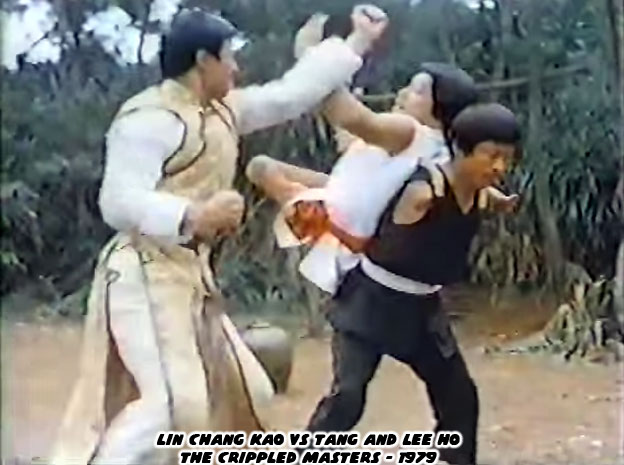
Actual paraplegic fighters had very rarely been done in gaming. In cinema there had been plenty of drunken and blind masters but those with real or imaginary physical deformities were rare. Possibly the most famous of the real-life kung-fu exploitation films was the Crippled Masters. The film from 1979 featured Chen Mu Chuan, Jackie Conn and Frankie Shum, two of the actors were actually born with deformities. The film told the story of a Shaolin monk that teaches a person born with no arms, and a person with deformed legs, how to use kung-fu in order to beat a local crime boss. It so happened that the crime boss was a "hunchback" with deep facial scars. The villain actually had a metal plate covering his deformity. It was a unique premise but with an absurd "team up" ability. The duo has a backpack that allows them to fight back-to-back.


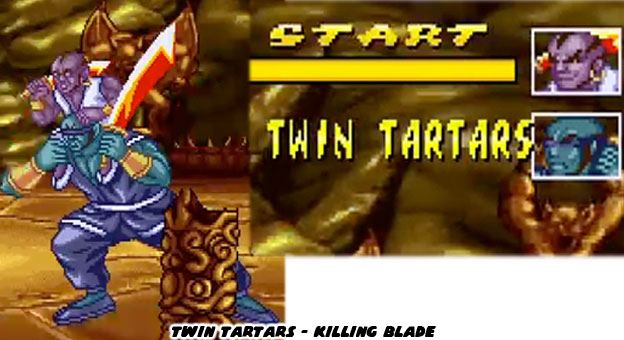
In fighting game history there was actually a character that was similar to the Crippled Masters. The villain Twin Tartars appeared in the game the Killing Blade. The 1998 title by IGS appeared on their PGM arcade system. Both fighters had flaming swords that they used in combat. The larger of the fighters was blind and the smaller had achrondoplasia. He was a little person, someone that may be mislabeled a dwarf. The smaller brother rode on the shoulders of the larger and helped direct the attacks. There was a more recent character that was in a similar vein. Ferra and Torr appeared in Mortal Kombat X. The game came out in 2015 yet the idea of a smaller character controlling a larger fighter was at least 30 years old. The design could be traced back to the film Mad Max Beyond Thunderdome. Released in 1985 it was the third film in George Miller's Mad Max series. In the film the warlord that controlled Bartertown was called Master Blaster. Master was a little person that rode on the shoulders of an enormous warrior "Blaster" who was actually a young man with down syndrome. People with cognitive disorders or impaired development were even less likely to be featured in any form of popular entertainment. It was one of many bold ideas that Miller brought to cinema and it helped color the design of other films as well as fighting games.


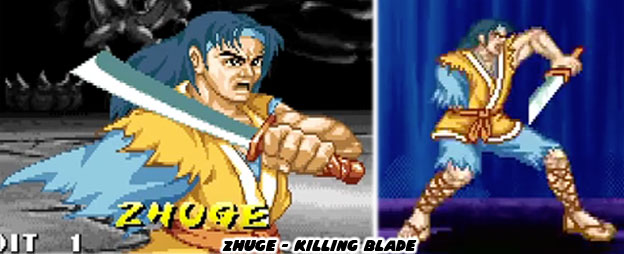
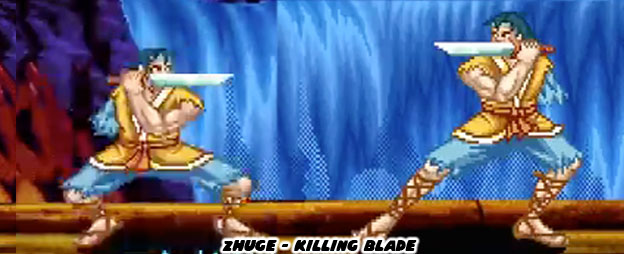
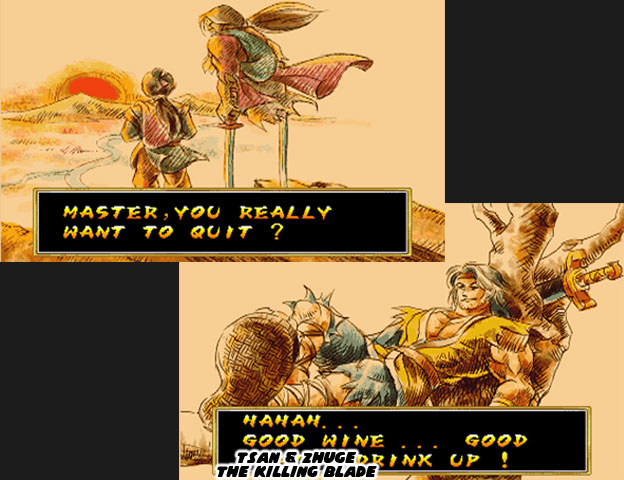
Killing Blade was notable because it had more characters with physical challenges than any other fighting game ever made. The Twin Tartars were non-playable boss characters in the story mode. One of the main characters that players could use was just as unique as the bosses. Zhuge was a one-armed swordsman. He was driven for revenge but by the end of the game he realizes that no amount of bloodshed would bring back his loved ones or his arm for that matter. He accepted this and became a wandering sword for hire, content with his jug of wine. If anything he had the temperament of Haohmaru, the star of the Samurai Shodown series.


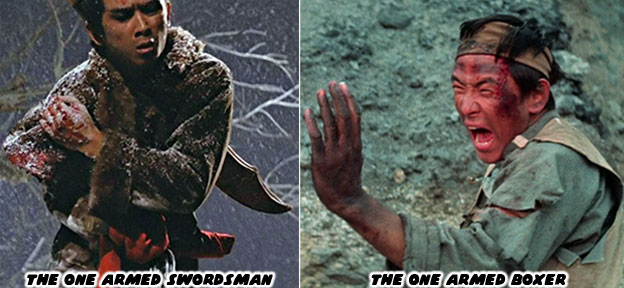
The one -armed swordsman was a character that was made popular more than a generation ago. Jimmy Wang Yu was a young writer / action film star that appeared in a movie called the One Armed Swordsman. The title from 1967 introduced us to a melancholy fighter. It became a big hit in Asian markets and a sequel soon followed. The films gave Wang Yu the traction to leave the famous Shaw Bros. Studio and strike out on his own. In 1971 he released a variation of the movie titled the One Armed Boxer. I had written about this influential person in a previous blog. The movies featuring Jimmy not only influenced other action films but they also planted the design seeds of fighting games, not the least of which was the Street Fighter series. His one armed characters were very well done. They were interesting and sympathetic characters.


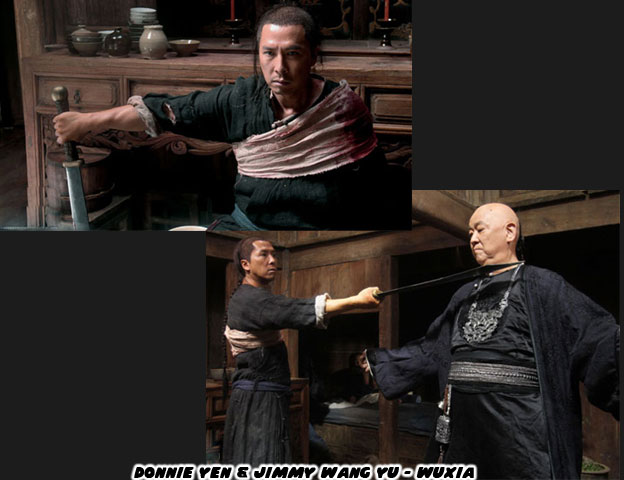
One of the action film stars influenced by Jimmy was Donnie Yen. Donnie like many of his contemporaries had grown up watching the movies and learning the legends of the various martial arts heroes. Donnie decided to write, direct and produce a love letter to the classic films. He called his 2011 movie WuXia, which was the Chinese word for martial arts myth. In the film Donnie played Tang Long, an assassin that was wanted to escape his brutal past. He married and had a child and moved to a village in the country. A botched robbery brought him out of hiding and made it so his old gang was able to track him down. In a last ditch effort to leave the gang he tries faking his own death and even cuts off his own arm in a symbolic gesture that he has quit the gang. I don't want to bore you with the details but I will mention that Donnie managed to get Jimmy Wang Yu out of retirement to play the leader of the 72 Dragons and father of Tang Long. The fight choreography was superb and it really demonstrated what was capable by using only one arm in battle.


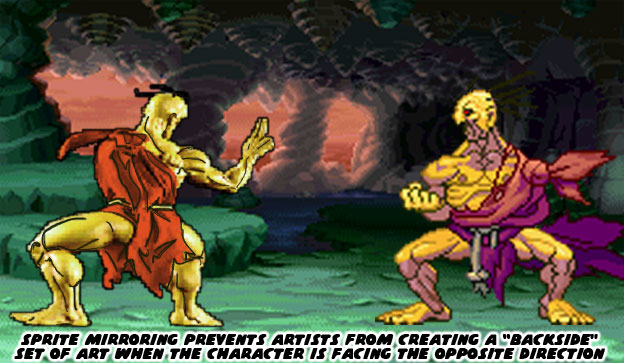
Zhuge was a variation of the One Armed Swordsman, combined with elements from other films. As great as it was having an amputee represented in a fighting game, it also pointed out one glaring issue with sprite-based technology. Namely the issue of sprite mirroring. Animators working on sprite-based titles only had to create character art facing one direction. The programmers would simply mirror or flip the image so that they could face the opposite direction in game. This was perfectly fine for the vast majority of fighting games because players had full use of both arms and legs. When The Killing Blade came out this limitation was obvious. Zhuge would have the wrong arm missing when he faced the opposite direction. It was a minor detail and most audiences didn't seem to mind this.


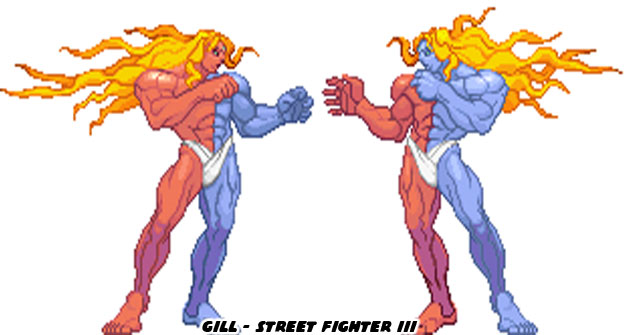
The limitations in technology throughout the '80s, specifically with memory, were responsible for sprite mirroring. Designers had to carefully plan out costumes for their main characters that required few colors and little detail. They tried to limit the details that would give away the mirroring effect, such as patches or words that would end up backwards. When the game came out many Street Fighter II fans noticed that Guile's USA flag tattoo was reversed when he faced the opposite side. Not every studio took the time to review these details, a few got past Capcom but not enough to be noticeable. When sprite-based engines improved in the '90s then the ability to create larger, more colorful and more detailed sprites took over. Capcom showed off their CPS-3 hardware with the games Warzard (Red Earth) and Street Fighter III. To show how much the engine had advanced they decided to create a boss that would take advantage of this new technology. The final boss of Street Fighter III, Gill, was not a mirrored sprite. He had a left and right side, the right side was made of fire and the left made of ice. That little detail remained correct regardless of what side of the screen he was on. His attacks even showed off this detail, he could burn or freeze opponents depending on which arm or leg he struck with.


In the planning stages Gill was not the only character that was supposed to have a left and right side. One of the early concept characters for the "New Generation" was a one-armed fighter. Somebody that could be likened to the one-armed boxer from the Jimmy Wang Yu movies. The artists, specifically Akiman and Kinu Nishimura looked at Helio Gracie, the co-founder of the Gracie Ju-Jitsu system as the root of this new character. The figure would evolve and become Oro. The developers realized that while they could create a left and a right-side version of this fighter that in order to be accurate he would actually have to have his back to the player. This was an aesthetic challenge. The ability to "read" the character was very important to players. The competitive game players would have their rhythm thrown off if they could not see a leading hand or foot, Casual players would not be able to appreciate the design of the character if all they saw was a back. Capcom had to figure out a way to present the "crippled" boxer while also using sprite mirroring. It was decided that Oro would simply tuck his arm behind his back depending on which side he was facing. It made sense and was accepted by audiences. Just remember that for a brief moment the designers at Capcom were considering including an amputee in the lineup. How interesting would that have been?


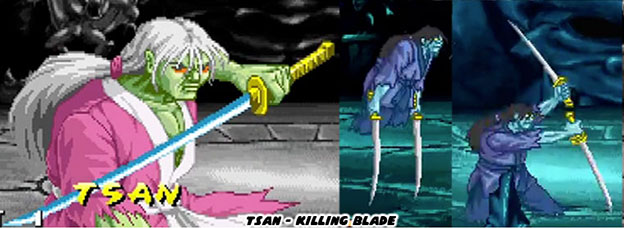
The Taiwanese designers at PGM didn't think twice, they actually put a swordsman with only one arm in their game. More important they had another playable character that had an even greater physical disability. The character Tsan was legless. His long white hair and green skin made him appear like a demon. Many game players assumed that he was indeed some sort of supernatural creature. The game was poaching many of the ideas and themes explored in SNK's Samurai Shodown series, including the mystical elements. Yet instead of feudal-era Japan this game was set in ancient China. Tsan wielded two swords and actually "walked" around on the tip of his blades. He could hurl himself at players, leap across the screen and pretty much moved like a ghost.


As the plot was revealed it turned out that Tsan was a living sword master and not some sort of ghoul. He had overcome his disability and learned various two sword techniques. The fact that he was lighter without his legs allowed him to move much faster than a normal person. When this was combined with his looks it was easy to see why people thought he was some sort of monster. Tsan was actually a positive character. He was such an accomplished fighter that he had actually taken on pupils. When the evil of the Twin Tartars and a corrupt emperor were defeated he decided to go into retirement. The Taiwanese developer had done a great job at creating heroes and villains with different backgrounds. The fact that they included disabled fighters was one of their more unique contributions to the genre.


What are your thought on fighting game characters with different backgrounds and abilities? Who were some of your favorite non-traditional fighters? I'd like to hear about it in the comments. As always if you would like to sponsor me please visit my Patreon page and consider donating each month, even as little as $1 would help make better blogs and even podcasts!

follow the Street Writer on Patreon!