Showing posts with label boxer. Show all posts

Friday, June 17, 2022

Ed, and Rashid. A look at two Street Fighter V stars in Street Fighter 6

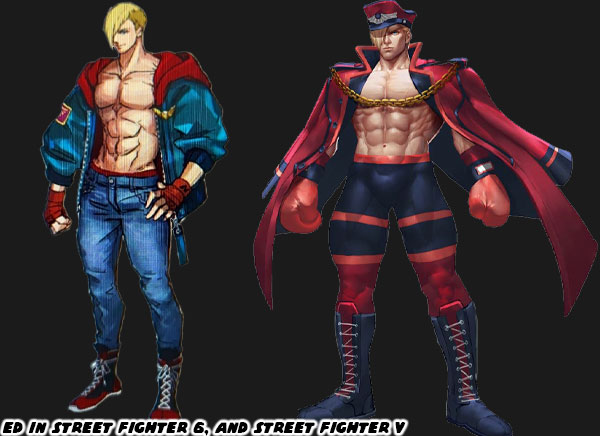
Today is going to be a two-for-one special. We are going to look at Ed, and Rashid’s redesign in Street Fighter 6. The reason for this is because the two characters are relatively new. I’ve already done a deep dive on the origins of their look, especially in the case of Rashid. I covered Ed when he made his debut in Street Fighter V. In case you missed it, Ed is a punch-based fighter. Not quite a pure boxer as his mentor M. Bison/Boxer. He also has some psychic / psycho powers like Vega / Dictator from Shadowlaw. He was designed, and literally programmed to be a high-ranking Shadowlaw officer, but broke away from command with the help of Falke. His appearance in SF6 is similar to a few other characters. His look is more casual than before. His tights, and boxing gloves have given way to pants, and a jacket. Ed represents the new direction of how the fighting arts show up in the franchise. In one sense it’s much more realistic, but in another it steers us away from the things that make Street Fighter, well, look like a Street Fighter game. 

The series was never one about making the most realistic fighting game. Instead it took archetypes of the martial arts, caricatures essentially, and put them in different settings. This meant that karate guys walked around in karate gis, soldiers in their camouflage fatigues, boxers with punching gloves, and trunks. You get the idea. You could almost instantly tell two things just by looking at the character, what their nationality was, and what fighting style they represented. If you look at E. Honda you could probably figure out he was a Japanese sumo wrestler. If you look at Chun-Li you can guess she's a Chinese kung-fu practitioner. Most of the characters in SF6 wear costumes that make a little more sense in a casual setting. The trade off means they are more conservative in some regards. I think part of the appeal of the earlier fighters was their ability to reflect a country of origin, and legendary fighting arts. Ed is a shirtless pretty-boy with his hands wrapped in red athletic tape. Would you care to guess what country he is supposed to represent? If you didn't know he was German, you might have guessed a dozen other countries. I mean he has almost the same colors, and outfit as Ken. Maybe he was going to be Mel in the planning stages? We get he’s ready to fight, but with the blonde-haired Luke already the new punching star of the game what purpose does Ed serve? Or is he a redundant character?

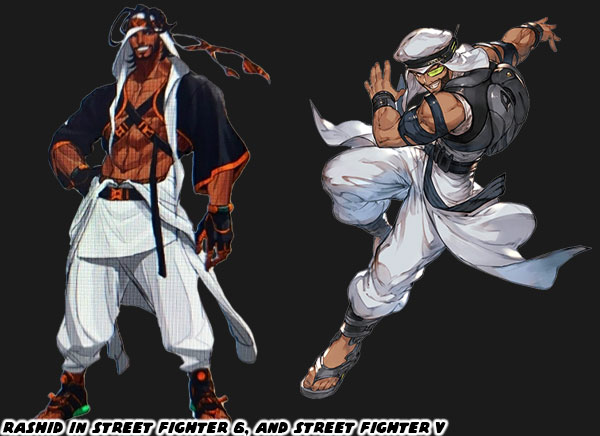
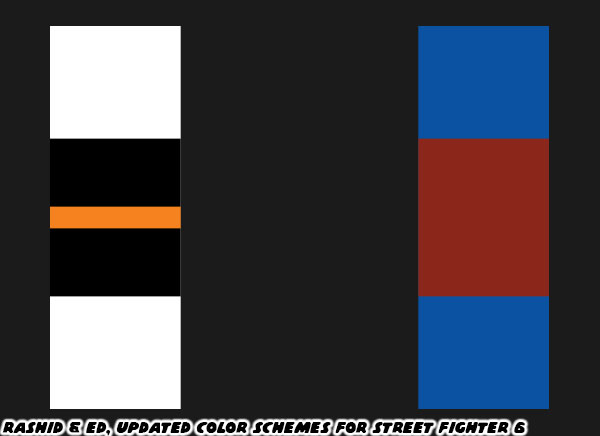
Rashid's design was a lot more classic. It was easy to figure out that he was from the Middle East. He was Saudi Arabian, but it would be understandable if you thought he was from the United Arab Emirates, Jordan, or Quatar. He was previously covered in a four-part series. I was glad to see his return. I always applaud any character of color returning to the franchise. The changes made to his costume are subtle, but help him stand out from the lineup even more. Rashid’s original design in SFV was a little bit lacking. His all-white outfit, with parts of black for contrast was kind of bland. Not to mention that Ryu pretty much had that color scheme for the previous 30 years. The studio realized that the he was lacking a third contrasting color. Ryu had red in his headband, and gloves. Rashid was given splashes of orange on his sandals, belt, backpack, sleeves, and bands of his keffiyeh. Now his look is much more distinct thanks to the use of an accent color. If there is one thing that makes both Ed, and Rashid’s updates work are the colors assigned to their costumes. They are solid colors that are well balanced, and help them stand out from the colors assigned to the other characters. With Ed having a burgundy, and deep blue combination that were not the shades of blue featured on characters like Guile, or Chun-Li. They were actually complimentary to the colors, and outfit of Ken.

What do you think about the return of Ed, and Rashid? Did you enjoy the two in Street Fighter V? Would you have rather seen another returning character, or a new character instead? I’d like to hear about it in the comments section. In case you missed it here are the other entries related to Rashid. Middle Eastern series, Part 1. Middle Eastern series, Part 2. Middle Eastern series, Part 3. If you would like to sponsor me please visit my Patreon page and consider donating each month, even as little as $1 would help make better blogs and even podcasts!
follow the Street Writer on Patreon!

Thursday, August 5, 2021

A quick take on Luke, the new Street Fighter.

Another year goes by, and another new Street Fighter character is introduced to a lukewarm reception. This new character is named Luke, he was the mystery character added for the Summer 2021 Street Fighter V reveal. Takayuki Nakayama Director of Street Fighter V, and Shuhei Matsumoto the Producer of Street Fighter V showed off the inclusion or Oro. The elderly fighter that had originally appeared in Street Fighter III way back in 1997. Luke was a new face, and presented as the future of the series. I am thankful for Twitter because the hot takes on this character were very spot-on.

Many fans were unimpressed with the reveal. One of the first reactions came from @adam_rsfv who compared the new character to YouTube personality-turned-pro fighter Logan Paul. Logan, and his brother Jake have grated many people with their online antics. These include allegations of sexual assault, filming a dead body in a park, insulting the Japanese while on vacation, and acting like general nuisances. In a way they do reflect the culture of fame, and notoriety from the USA. You don’t have to be the best at what you do, you just have to be the best at promoting what you do. But those were far from being the only takes on the character reveal.

The fish-mash of design elements for the hair, tattoos, and costume of Luke were pointed out right away. @ryo_redcyclone said the character was piecemeal from other Street Fighters. It was easy to point out these influences. Like a villain in a daikaiju, or giant monster tv show.

Many lamented that there was another white boxer in the series. Luke follows on the heels of Ed, a white striker that had been introduced not long ago. The Street Fighter series was known for having a string of powerful Black fighters including Mike, M. Bison, and Dudley. Now in one game two white boxers had turned up. Some compared his look, and introduction to Steve Fox, the British boxer from the Tekken series. Katsuhiro Harada, producer, and director behind the Tekken series agreed with a fan reaction that this might be Steve’s younger brother.

All jokes aside the news of another white character designed to be the face of Street Fighter, the future of the franchise, was met with groans from many fans. Those that had been with the series a long while remember that Alex was supposed to be the face of a New Generation, starting with Street Fighter III. Then almost 15 years later the grappler Abel was designed to appeal to the west in Street Fighter IV. He was supposed to be the go-to character for Americans. Yet in each instance players passed him over to try other other new faces.

With one word to Capcom @KAINONAUT calls out the pattern, and like many minorities, is exhausted with the trend. With each legacy character returning to Street Fighter V players could see that the franchise was favoring the return, and the introduction of white, mostly blonde characters. It was hardly representative of the USA, and given the past four plus years of politics, and civil unrest, you would think Capcom could read the writing on the wall. This is why I am grateful for the internet, for Twitter, and players that are able to dig deep into the history of the series, and call out the company for making missteps when they have a chance to rise up, and produce something exceptional.

In a reply to Kai @mossy_dahlia reminds us of the greatness that could have been. King Cobra was a marvelous design, and the final design known as Rufus was the opposite. On the 30th Anniversary of Street Fighter I highlighted the 30 most important characters to me. Although he never appeared in a game I named King Cobra #1 When that character was turned into an obese white guy for the sake of being funny I knew the series, and director had lost their way. It didn’t make me boycott the series, but constantly call the studio out because I knew they could do better. Most people that read my blogs want to get to the heart of the character, what works, what doesn’t work with Luke? What should Capcom do?

First-off white boxers are nothing new in Street Fighter, or fighting games. Joe was featured in the original Street Fighter. What is concerning is that many of the newer boxers that end up in fighting games tend to be white, and blonde. Even if they come from Hong Kong like Shen Woo in the King of Fighters series. SNK, and Capcom have had their share of Black boxers in the KOF, and SF series. If I were to ask most of my friends to name champion boxers in any weight division I’m sure they could come up with many Black, Latino, and Asian-Pacific names. The white champions (especially blondes) would be few, and far between. Why then should fighting games go out of their way to cater to a certain demographic?

Capcom has demonstrated time, and time again that they are unwilling to take a risk. They want their lead character designs to be accepted by the west. This goes into the use of colors, tattoos, body markings, costumes, etc. If you look at several of the new characters, you’ll start to spot certain trends. Blonde female characters for example tend to get military alternate costumes, with goggles. For the new men the use of solid color tattoos, and patterns, turns up. It was on Necalli, Ed, and now prominent on Luke. The USA is a huge market for the studio. So if they look at pop culture, fight culture, wrestling, MMA, and the like they want to create a fighter that appeals to those fans. The Logan / Jake Paul comparisons for Luke are warranted. What Takayuki Nakayama, and Shuhei Matsumoto may not realize is that this type of fighting "personality" may be popular, but they are often reviled. They aren’t necessarily what the Street Fighter audience either wants, or what the game needs. In many cases fans are eager to try more unique characters.

I mentioned that Abel was designed to be the new face of the series in SF IV, but he was originally an androgynous little boy. The studio thought it would be too risky to have the skinny character in pigtails be able to judo flip larger opponents, so they turned him into a huge bruiser. To cover their bases the studio also created a female spy for the west. C. Viper took her inspiration from the western ideal of beauty, skinny with big lips, a bit like actress Angelina Jolie. When Capcom started trying out the SF IV cabinet in the US they were surprised that players were skipping over Abel, and C. Viper. The characters they designed for the market were failing. Yes they found some fans, but were largely not missed in SFV. There were many reasons why they didn’t work. I think Japanese interpretations of western trends was simply lost in translation. It turned out that when the studio created a character that more closely reflected a classic design, say Juri Han compared to Chun-Li, then the character was more widely accepted. I’m willing to bet that the little kid Abel would have been better remembered by audiences because he was out of the ordinary. Or then again, because he reflected smaller fighters like Ibuki, Makoto, and Sakura.

There is something that concerns me with Luke’s design. Again, it circles back to Japanese creators trying to interpret western tastes. We can tell he is supposed to be a patriotic character, somebody akin to Guile. Guile was a soldier that literally carried his nation on his sleeve. For Luke the stars, and stripes, in the form of tattoos, and even a haircut sends a similar, but not equal message. The use of solid color tattoos is something that I don’t think the people at Capcom considered. These types of tattoos have been more closely aligned with Far Right ideology in recent years. We saw police covered in patriotic tattoos, notably those of the Three Percent, a group identified by the Anti Defamation League as a far right militia movement. These officers have intimidated, and killed in the past. Many were fired, or forced to retire when they were outed as members of the group. The tattoos even turned up Patriots kicker Justin Rohrwasser.

In every instance people with Three Percent tattoos, and the like, all claim to be patriots. They claim not to subscribe to any racist ideology, but want to defend their country. It turns out that they want to defend their country from people that are not like them. Usually white, usually well off. Those that are minorities, gays, trans, Black Lives Matter supporters, Muslims, Liberals, Socialists, or immigrants are the enemy. They even go so far as to claim Anti-Fascists are the biggest threat to the American way of life. The irony in that logic cannot be understated. Guile had a design that could never be lumped into a hate group. He was intentionally designed to be over-the-top, like a GI Joe character that happened to be in a fighting game. He was fighting not for fame, but to get revenge for his fallen comrade, the soldier Charlie Nash. Luke seems to be in the game for himself, to be big, and famous. Sure it could be seen as being distinctly American, but there was more to this nation than a clone of the Paul brothers. I believe Luke doesn’t work because he has conflicting design elements. The sorts of elements that went into Ken for Street Fighter V.

More important I think Luke doesn’t work because Capcom does not know how to take a creative risk. When the studio says they are doing a deep dive, they often miss the elements that made their early generation characters work so well. They fall back on tropes, and stereotypes. Look at how Turkish oil wrestling was presented, or Mexican lucha libre with Hakan, and El Fuerte in SF IV. Fat people became used as joke characters in the series. Starting with Rufus, but spilling over into Birdie as well. The studio forgot that giant characters weren’t always stupid. Luke is designed to be modern, and edgy. He’s probably going to be as well remembered as Necalli in a few years. This is what drives me crazy about Capcom. Greatness is right in front of them, in many concept pieces for a character never used. For a throw-away design given to an existing character, as a costume. If only they would take a moment to listen, to trust their idea, and not what they think we really want. Lord knows I’ve tried to get through to them. I’ve applied to work at that company a half-dozen times. Even asked the producers to please read the blog. I’ll keep on pushing them to do better. I hope the community does too. If you would like to sponsor me please visit my Patreon page and consider donating each month, even as little as $1 would help make better blogs and even podcasts!

follow the Street Writer on Patreon!

Saturday, June 9, 2018

30 years of Street Fighter, 30 Days of Characters; #22


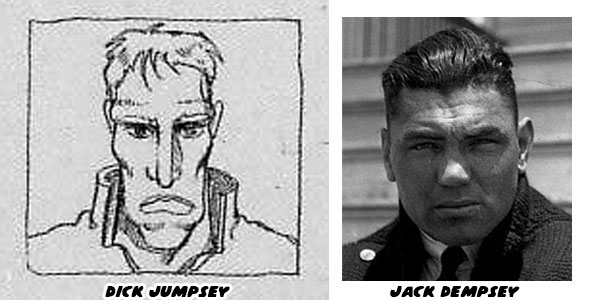
Boxing characters are as old as the fighting game genre itself. Every generation of the Street Fighter series has featured at least one boxer. In the original Street Fighter (1987) it was a scrappy young man named Mike. No doubt influenced by Mike Tyson, the young heavyweight champion. In Street Fighter II (1991) the boxer had grown up and went by the name M. Bison, as in Mike Bison. At least that was his name in Japan. As you already know the Shadowlaw boss names were swapped around when the game came to the USA. Did you know that Mike was not the original choice for a boxer in the Street Fighter II? In the planning stages the designers were looking at a classic boxer named Jack Dempsey. Jack was active from 1914-1927, he was notable for winning and defending a championship, being the first fighter to break a million dollars at the gate and ranked among the best of all time. Dempsey influenced the character Makounochi Ippo in the manga and anime Hajime no Ippo. He uses the "Dempsey Roll" a nonstop barrage of punches and dodges to take down opponents.


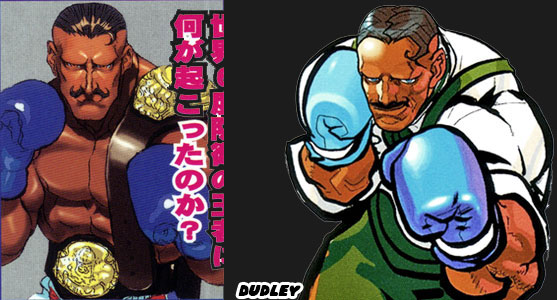
The boxer for Street Fighter II was called Dick Jumpsey but he seemed a little bit antiquated. That was why a more contemporary Mike Tyson served as the template for Bison. The seeds for a classic boxer had been planted at the Capcom offices. It would take a while for that archetype to return. Many studios had their own variation of a boxer. Most wore shorts or training clothes. They looked exactly like a pro fighter should have in the current era. That was until 1997 when Street Fighter III debuted. The gentlemanly boxer Dudley was literally cut from a different cloth. He was an aristocrat that happened to be a boxer. He traveled in luxury automobiles, with butler Ortho K. Gotch at his side. He fought while wearing fine suits, he simply rolled up his sleeves when it was time to teach an opponent some manners. There were no fighters before or after that had as much personality.  


Dudley was a change of pace from the thuggish boxers that had taken over the world of pro fighting. Loud braggarts like Mike Tyson and Floyd Mayweather Jr. that flashed their money and acted questionably seemed to hold the title forever. When classy fighters Evander Holyfield and Lennox Lewis captured heavyweight gold in the '90s it was a refreshing change of pace. Dudley was created as a reflection of this new reality. Of course he was a way over-the-top in his mannerisms and ability. There has never been a character as eccentric as him and there probably never will be again. Because of this we want to celebrate Dudley on Street Fighter's 30th anniversary. As always if you enjoyed this blog and would like to sponsor me please visit my Patreon page and consider donating each month, even as little as $1 would help make better blogs and even podcasts!
 follow the Street Writer on Patreon!

Thursday, October 5, 2017

Hiding the master in plain sight, the genius of SNK's character design... part 4

SNK was working hard to stay a step ahead of the competition. Their one-two punch of Fatal Fury and the Art of Fighting were unique entries to the genre. Each game provided a different experience and both expanded on the themes found in Street Fighter II. Not every character in both games worked or were even memorable. SNK had to learn and adapt to the trends quickly. The studio had to focus on multiple fighting games, each with their own aesthetic, while Capcom had to focus on patching and upgrading Street Fighter II. With the focus spread out over several games some of the fighters in the Fatal Fury (FF) and Art of Fighting (AoF) lacked the impact of Capcom's "World Warriors." In one particular field SNK started off slowly but then quickly caught up.


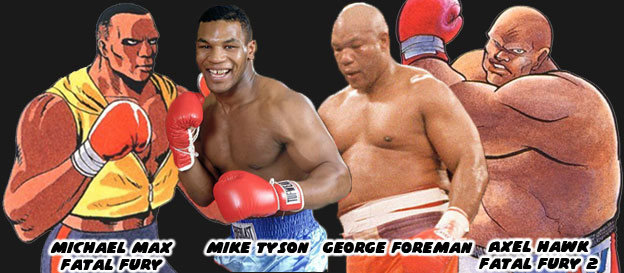
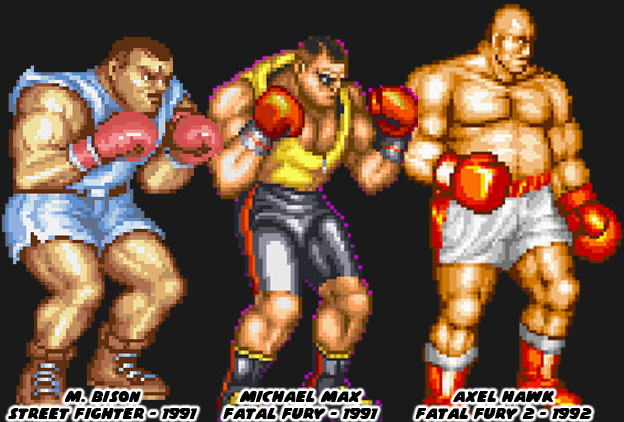
It was no coincidence that Street Fighter II's boxer M. Bison (Balrog in the USA) looked like pro boxer Mike Tyson. Capcom used the heavyweight champ as the template for their ring general earlier. Tyson had launched his professional career in 1985 and was featured in a version of Nintendo's Punch-Out!! He helped inspire the character Mike in the original Street Fighter as well. Tyson dominated the squared circle, at the age of 20 he became the youngest ever to win a heavyweight title. He earned a reputation for being destructive, and often knocked out opponents shortly after the opening bell. His supernatural fighting ability made him the perfect candidate for a fighting game. Of course Capcom didn't want to pay the boxer any royalties for using his likeness so they made a few changes, swapping out his name with another Shadowlaw general, and presented him in warmup gear. He was an easy fit into Street Fighter II and would even inspire a Fatal Fury boxer. Michael Max was literally cut from the same cloth as Bison, both having roughly the same size, shape, similar warmup gear and even haircut. Audiences felt this character was lacking, even if he had a unique tornado uppercut.


SNK's follow-up boxer had a more unique look. The bald and pudgy Axel Hawk was a friend and trainer for Michael Max. This fighter, featured in Fatal Fury 2, was taller and heavier than his protege. From a design standpoint it was strange to have a character that was older and fatter than the previous star. From a real-world influence however it made sense. George Foreman was a legendary heavyweight fighter that started his career in 1969 and stopped fighting at the end of the '70s. He became a preacher but returned to the ring in the late '80s. He got a title shot against Bernard Hopkins, a fighter 16 years younger than he was. Foreman recaptured the heavyweight championship at the age of 45, making him the oldest person ever to win the title. It was an underdog story that inspired long-time boxing fans. Chances were that SNK boss and boxing aficionado Eikichi Kawasaki suggested a version of Foreman for the sequel. Axel was a bit more rotund, especially in the official character art, than Foreman but they both had amazing power behind their strikes. Pop culture tended to color the SNK character designs more than any other studio. Aside from real-world fighters there were also decisions based on popular aesthetics. This was seen on another boxer in the SNK universe.


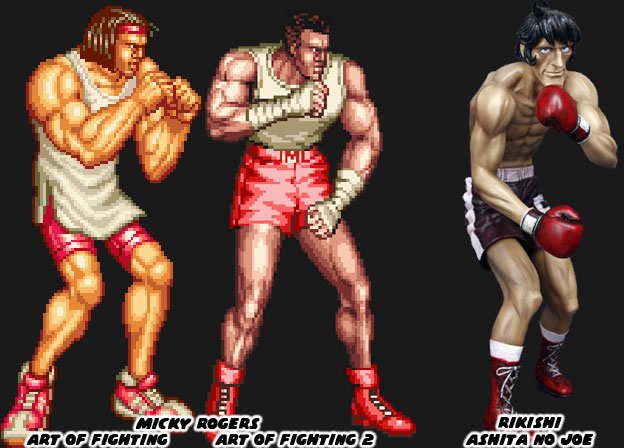
Micky Rogers was the boxing archetype introduced in the AoF series. The character sported braids in his first appearance and the look was changed slightly when he appeared again in a sequel. Visually the fighters in the AoF series were much different than the figures in FF. The artists working on the characters tried to make them more proportional to actual people. The reason for this was because of the larger sprites that AoF featured. If the character were drawn too muscular it would have looked awkward when they were scaled up. The fighters would have looked like cartoon characters in an otherwise realistic setting. Micky looked anemic compared to some of the other characters. He was lanky but well defined. It made sense given he was a boxer where speed was often more prized than power. The manga Ashita No Joe was a wildly popular boxing manga from Japan. The artist Tetsuya Chiba would draw his character with long, lean muscles. The action was easy to follow on the page because of his slender lines. This style of art that he popularized in 1968 would end up influencing countless other manga and anime shows about boxing. I believe that this design also found its way to SNK, given the Mr. Kawasaki was a boxing fan. Micky had almost the same build as characters like Joe or Rikishi, the champion fighters from the book.


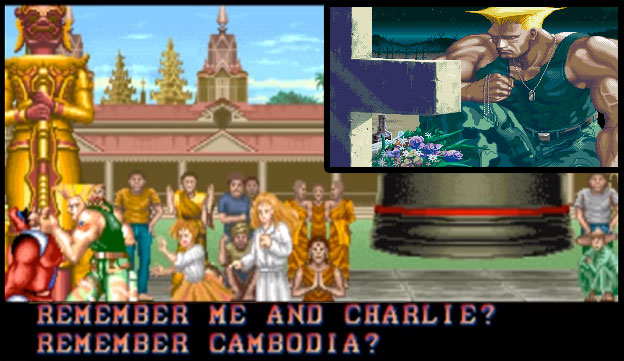
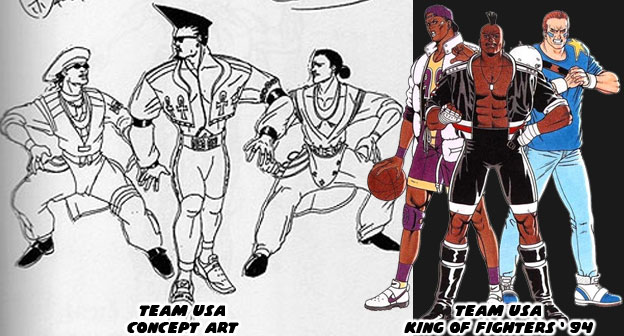
SNK, like most major arcade publishers realized that in order to succeed they had to become global players. This meant that they had to include fighters from other countries, especially the USA. Capcom and a few other studios included fighters from the USA in their games but gave them the slightest connection to real western culture. Joe and Mike in the original Street Fighter looked very plain, wearing street clothes, they were somewhat forgettable. The studio punched up their efforts with Guile in SF II. If anything they were pandering quite heavily to each nation, easily to the point of parody. Look at Zangief and Dhalsim’s original endings. Even the American was over-the-top. He was a military fighter wearing camouflage pants, with an absurd haircut, that was all muscles, and sported USA flag tattoos. As a Mexican-American I can confess that I must run into people that look like Guile at least twice a day! SNK did a slightly better job with their US characters and realistic street fashion in both the FF and AoF games. They decided to really crank it up with each sequel. They payed close attention to the trends happening in tv and in movies. When the studio began work on the King of Fighters, which would bridge all of their fighting games together they began pandering heavily to the USA. They did this by making the US team captain a boxer, and by looking at pop culture for his design cues.


Decades ago fashion trends travelled much slower than they did today. The artists at SNK wanted international audiences to visually identify the US team because of how they looked, rather than what school of fighting they were representing. In order to do this they had to create archetypes that were wearing the most “Western” costumes. The people at SNK were using fashion cues from pop culture as the basis. The only problem was that street culture evolved rapidly. The look of the US fighters were reminiscent of dancers from the films Beat Street and music videos from Salt-N-Pepa and Queen Latifah. The spandex and leather outfits of the late ‘80s were quite outdated for a game dropping in 1994. Thankfully the studio revised the outfits and based the fighters more on sports icons. A hint of the street fashion remained but for the most part it worked given the character. Heavy D, the captain of the team (and a name pulled from a popular rapper) was a breath of fresh air. He was a boxer that completely rewrote the book on character design. In the next entry we’ll look at how SNK’s designs evolved post 1994. As always if you enjoyed this blog and would like to sponsor me please visit my Patreon page and consider donating each month, even as little as $1 would help make better blogs and even podcasts!
 follow the Street Writer on Patreon!

Monday, August 21, 2017

A look at Ed from Street Fighter V, design meets legacy...

It’s been a while since I’ve talked about a new Street Fighter character, I haven’t been happy with most of them. I’m not going to talk about Kolin, probably ever, sorry about that. Instead I’m going to look at one of the new guys. Ed, revealed at the end of Street Fighter V Season 1 as the understudy of M. Bison / Boxer, was now a playable character. As a whole I think his design and assignment of moves and powers was done very well. There were the things that seemed off, like his animations which seemed to lack polish. Then there was the ability to perform special attacks with simple button combinations instead of traditional joystick+button inputs. Long time fans of Street Fighter thought this was pandering to Nintendo’s Smash Bros. community. But speaking from a visual design standpoint I would say Ed was probably the best new character in the past few years. The reasons for this were subtle but well done.

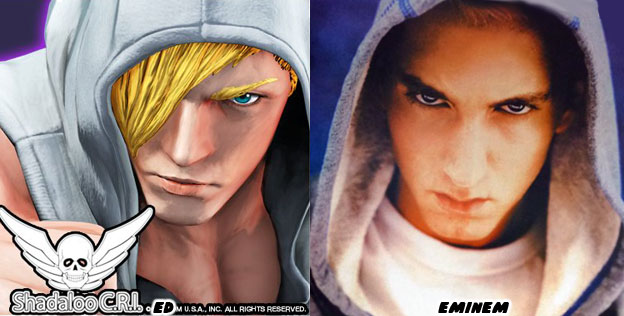
The first thing we should look at was his age. Ed was a young character. Most people in the series were adults. Young characters in a fighting game had mostly been girls, rarely men. In the Season 1 cut scenes he looked like a skinny kid, someone that you might see in real life. The use of a sleeveless hoodie was a good costume choice as it was not too modern. It made sense given that he was learning the art of boxing. Fighters had been wearing training sweatsuits for over half a century. It worked in any era the game was taking place in. This look was also used in pop culture. Rappers like Eminem used street fashion to build an identity. He dressed the part because he was genuine. He was from the streets and not created by a marketing wing of a record label. It was Ed’s updated costumes that worked even better.

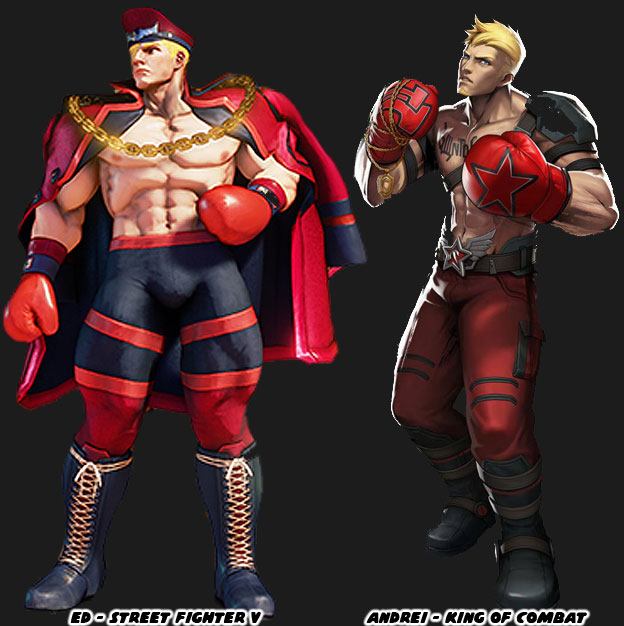
The black and red motif of Ed’s Battle Costume worked extremely well, especially against the light skin and blonde hair the character. The three colors, red, black and yellow were considered a triad of colors. The main color red, contrasting color black and accent color gold worked well visually. Go back through your fighting game history and look at the other characters that had similar color choices. Ken or course had a red gi for most of the games but in SFV he was paired with a black rash guard as well. The other blonde characters with similar color schemes were Paul Phoenix from Tekken, Jacky Bryant from Virtua Fighter, Rugal from the King of Fighters and Andrei the boxer from King of Combat. Having a strong color pallet was something that had made previous characters so memorable. Of course the use of the colors, jacket and military cap was also a callback to the organization that made Ed unique.

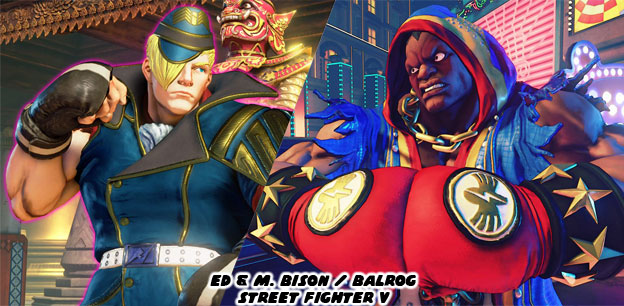
Ed had matured some, had gotten bigger and stronger, from the last time he appeared. Season 2 saw the addition of multiple costumes, the Default, Story and Battle uniforms. Each one of the costume choices complimented the character very well. In his Default costume Ed now looked like a full-fledged Shadowlaw officer. In the story he was aging quickly because of the experiments that S.I.N., the Shadowlaw weapons group, had performed on him. When I saw his militaristic costume and fingerless gloves it worked on multiple levels. He was now using the striking techniques taught to him by the former world boxing champ. Yet he was also his own unique fighter. He wouldn’t be riding the coattails of M. Bison for long. When I saw the character going toe-to-toe with his mentor I wasn’t put off. In fact seeing him in action reminded me of another young fighter taking on a veteran.

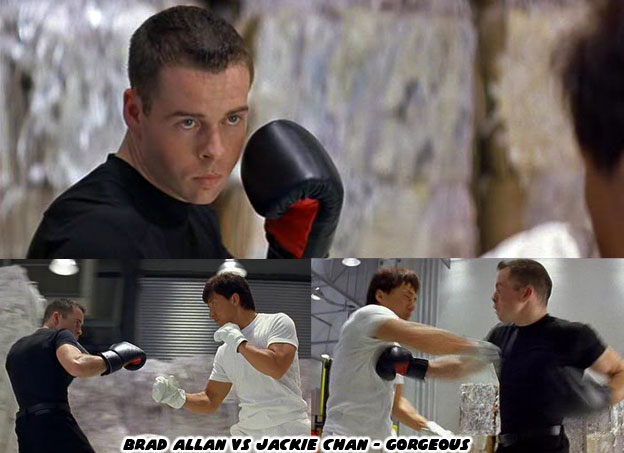
Brad Allan, a martial artist, stuntman and fight choreographer was a villain in the 1999 Jackie Chan film Gorgeous. Allan was a cocky young fighter that gave Jackie a run for his money. In the movie Allan didn’t want the fight to be over too quickly so he allowed Chan to wear light sparring gloves while he wore heavily padded boxing gloves. At that time Chan was a well-established movie star. Fans had seen him beat up all sorts of different martial artists over the years. Most of the people he fought were about the same age and the same size, yet every now and then he took on much larger opponents. Chan had lightning fast punches and was a master at improvisation, he could adapt to his opponents and overcome them quickly. People expected more of the same in this film. Imagine their surprise when they saw the kid trading punches and kicks as fast if not faster than Chan. For the first time in a long time it appeared as if the veteran had been outclassed. The stakes had suddenly become much higher because of this villain. When I saw Ed’s assortment of boxing moves I got flashbacks to how Allan was portrayed in the film. It got me excited for his potential in the Street Fighter series.

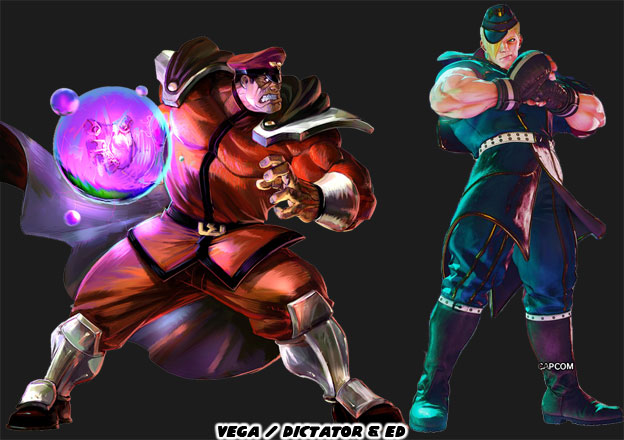
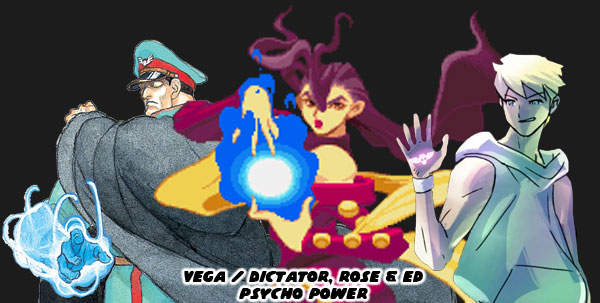
It wasn’t enough that Ed was a striker. His costume revealed a lot more about his true purpose and the extend of his powers. He was being groomed by the Dictator himself to become an important member of Shadowlaw. Would he perhaps become a general in the organization? Would he replace Sagat, F.A.N.G. or even the Boxer on the roster? Or would he assume total leadership of the organization some day? In order to accomplish this goal it meant that Ed would be given powers that went above those of normal people. This was where the fictional “Psycho Power” was reintroduced into the series. It had first appeared in Street Fighter II and was used to explain the awesome powers of Vega / the Dictator. The origins of Psycho Power were touched upon in the Street Fighter Zero series in 1995. The character Rose was a fortune teller whose powers were harnessed by Vega. This form of psychic energy allowed people to float, throw balls of energy and strike with burning force.

Psycho Power faded into history as Street Fighter III changed the main villain in 1997. Gill represented a secretive group known as the Illuminati. He had some sort of elemental powers, fire and ice specifically, at his disposal. This was never full explained in the series making him more fantastic in origin. In 2008 Street Fighter IV returned back to the SF II timeline. The head of S.I.N. was developing a new form of energy that could be weaponized. The character Seth had a Tanden Engine, installed into his abdomen, which allowed him to generate fields of energy and attract or repel opponents. A miniature version of the Tanden Engine was placed behind Juri’s eyepatch, which gave her superhuman strength. The Tanden Engine was combining the spiritual studies of Yin and Yang with science. It was the spiritual energy that allowed Ken and Ryu to throw fireballs but for the first time had been recreated mechanically. This technology took a back seat when Ed showed up and brought Psycho Power back to the forefront.

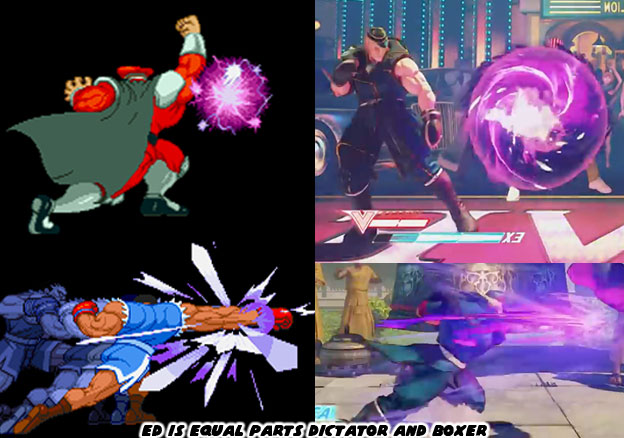
Psycho Power was a great explanation for why Ed was more than just another martial arts master in a tournament. It allowed the artists at Capcom to pull design elements that went into both the Boxer and Dictator and create something new. For the artists and budding designers reading this it was an important lesson in creativity. Take a look at your favorite character and try to pinpoint the best features. Look at the colors used, look at the cut of the costume. Look at the moves they had. Then take a look at a another one of your favorite characters and do the same thing. Now imagine how you could combine their features. For bonus points try making a good guy or bad guy version of the character. Or try changing the sex of the character or ethnicity. But Ed was more than just a distilled mix of the Dictator and Boxer. He had a unique special attack all his own.

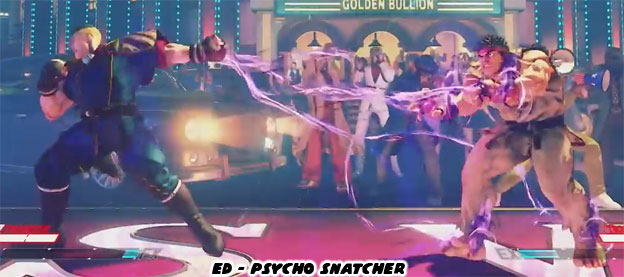
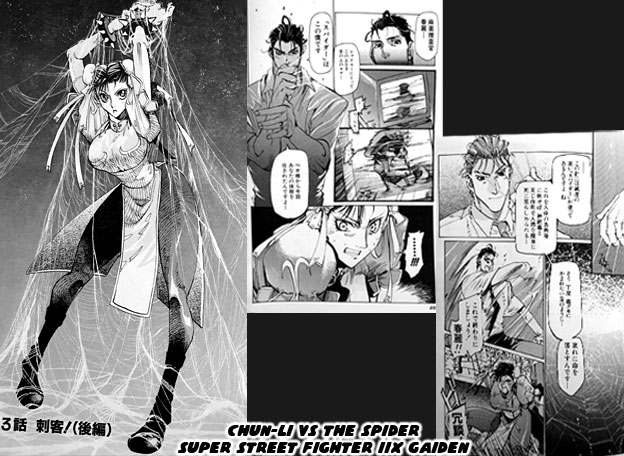
Ed could use his Psycho Power to create a web of energy and pull his opponents to him, it was called the Psycho Snatcher. It looked like the sort of move Spider-Man might use. This attack opened up the potential from a game play standpoint. The web of energy could cut off projectile attacks mid-air. It could also snatch opponents right out of the air. At a close range it could stun opponents and ensnare them even if they were blocking. From a design standpoint this also meant that Psycho Power was malleable. It didn’t have to be used as concentrated bursts of energy, and it didn’t have to be used to engulf the player in a psychic flame. Psycho Power could be used like a whip or net as well. Its other uses were limited only by the imagination of the designer. This special attack actually had its roots in the manga series Super Street Fighter II X Gaiden by Mami Itoh.

In the manga Chun-Li, acting as an INTERPOL agent was investigating a dangerous new drug that had hit the streets. It lead her to Los Angeles and eventually San Francisco where she ran into Ken’s wife Eliza. A handsome young investigator was assigned to the case as well. The two were tracking down the drug trafficker and assassin known by the alias the Spider. Chun-Li’s partner turned out to be the Spider and he was working on behalf of Shadowlaw. He tried to kill Chun-Li before she bring down the operation. The Spider had developed a deadly neurotoxin which he coated spikes with. He would use these poison barbs to kill his enemies. The trap that he set, the web symbolism used in the comics especially, made him a unique opponent. If he could have been presented in a fighting game with monofilament wires (like the kind Rolento uses) and his poison spikes then he could have made for a very unique Street Fighter villain. Seeing the Psycho Snatcher reminded me of the the Spider. I wondered if this double agent was not an inspiration for Ed. Even if he wasn't I think Ed’s design was well done. It worked in the lineup better than most of the new heroes and villains introduced up until now. What did you think about this character? Were you a fan or not? Why was that? Please let me know in the comments section. As always if you enjoyed this blog and would like to sponsor me please visit my Patreon page and consider donating each month, even as little as $1 would help make better blogs and even podcasts!
follow the Street Writer on Patreon!