Showing posts with label tattoo. Show all posts

Friday, August 25, 2023

Street Fighter 6: A master class in game design, part 12

Many Japanese studios set their games in the west, particularly in major cities like New York. No genre had featured this more than the brawlers. The loudest, most colorful gangs would take on all sorts of tough guys on the most dangerous streets on the planet. I had mentioned in the previous blog that the designs for these worlds were pulled from cult Hollywood films. Some of my absolute favorite games were developed by Capcom’s perennial rival Konami. The two studios essentially took the genre over after Tatio’s Double Dragon II: The Revenge failed to recreate the success of the previous game. Final Fight of course was everything that Double Dragon II failed to be. The only title that I would even argue topped some things in Final Fight was Vendetta. Konami’s previous game Crime Wave was sorely lacking by comparison.

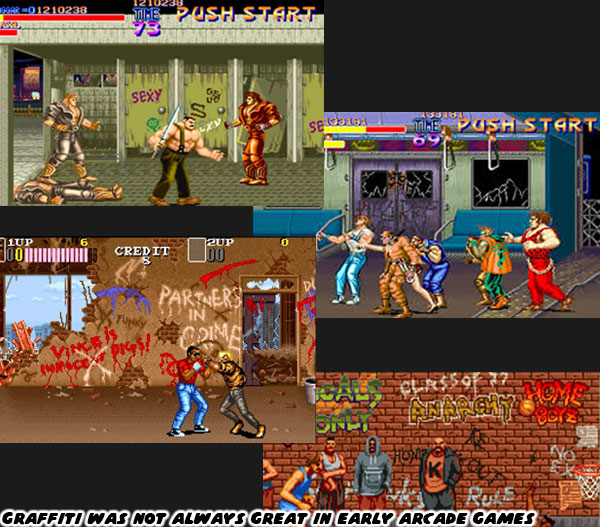
The thing that all of the Japanese studios would do in order to create the look, and feel of the west was the use of graffiti. It instantly transported arcade visitors into the world that the designers were creating. This extended beyond brawlers, it included fighting games, sports games, action shooters, and adventure games. Graffiti in pop culture was a sort of shorthand for gang territory, for dangerous neighborhoods. The thing was that if you had grown up in a big city, if you were familiar with actual graffiti art, with actual gang neighborhoods you would notice how amateur the graffiti was in gaming. It actually looked convincing, so long as you didn’t take too close of a look at the art. Capcom was aware of how to use graffiti going back to the original Street Fighter.

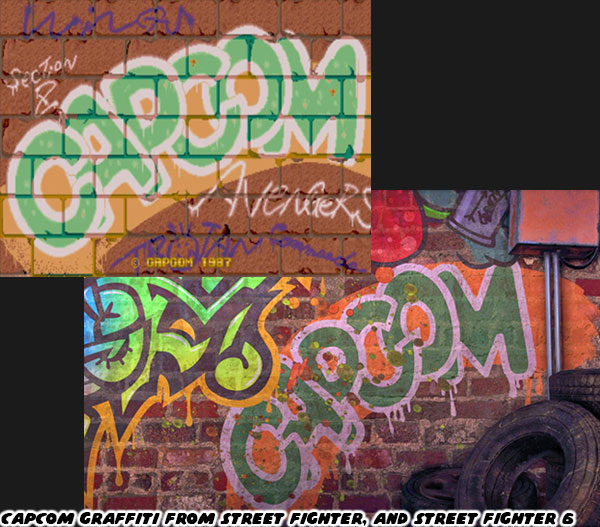
I don’t think modern audiences understand what a groundbreaking visual language Capcom was pushing with the first SF title screen. A brick wall was covered in tags of their previous hits; Section Z, Avengers, Trojan, and Commando. The massive company logo was right in the center. It oozed style, and attitude. Suddenly a fist punched through the wall, the unknown character turned his back, and we could see Street Fighter was embroidered on his jacket. It instantly grabbed your attention, and made you think that this would be the hardest title ever. Well at least I thought so. As I mentioned previously I played the original SF with the giant foam buttons. The intro screen was burned deeply into my memories. When I saw Capcom had recreated, and hidden the logo in SF6 I lost my mind. Every callout in Metro City was making me freak out. Capcom had learned to do something with graffiti culture that many other Japanese studios missed. Let’s talk about something that ran parallel with graffiti art.

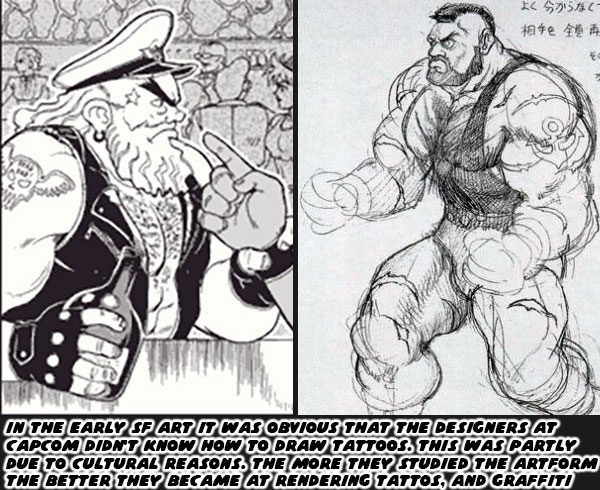
Drawing a character with a tattoo was another form of shorthand. In comics, cartoons, and manga people with tattoos were instantly seen as criminals, gangsters, or tough guys. The thing was that tattoos in Japan had a completely different connotation, and style from tattoos in the west. Intricate tattoo work in Japan was mostly associated with the yakuza. Not only that but the majority of the markings were covered up. They were only seen if a gangster visited a bath house for example. This was opposed to tattoos from the west where they could be seen out in the open. Perhaps on a shoulder, bicep, or forearm. When Capcom artists would create concept art for SF, and FF, they would try to draw a character with tattoos, but you could tell they didn’t know how, or what to draw. I remembered one biker/captain looking guy arguing with M. Bison (Boxer) he had a skull with wings, and a star on his temple. Or the early Zangief had a tattoo on his shoulder. Even the finished art had some yikes designs, like Birdie having a bright heart tattoo on the side of his head. It certainly wasn’t a very punk look.

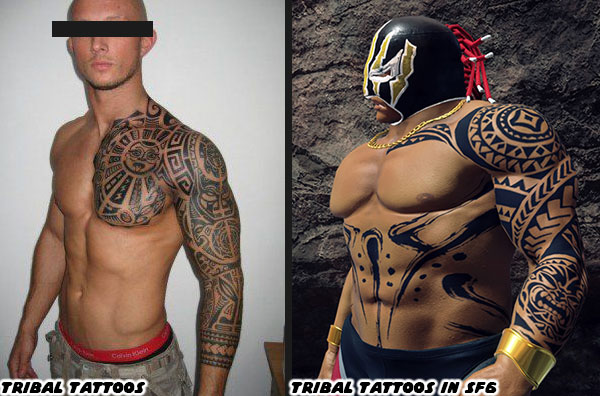
The thing was that the artists working at Capcom, and other Japanese studios, started studying up on tattoos. They saw the rich tapestry of styles from artists all over the world. They saw how classic Western Norman “Sailor Jerry” Collins helped shape a timeless aesthetic. It turned out that he was actually inspired by what he saw in Japanese tattoo art. This meant that the art form was cross pollinating across the Pacific pre, and post WWII. Society’s attitudes towards tattoo art had changed tremendously in the past few generations. It was the responsibility for the designers working at game studios to understand how to create authentic looking tattoos for their game characters. More than 30 years after the debut of SF Capcom was capable of creating passable tattoo designs that could be seen on gang members, and even used for avatar characters.

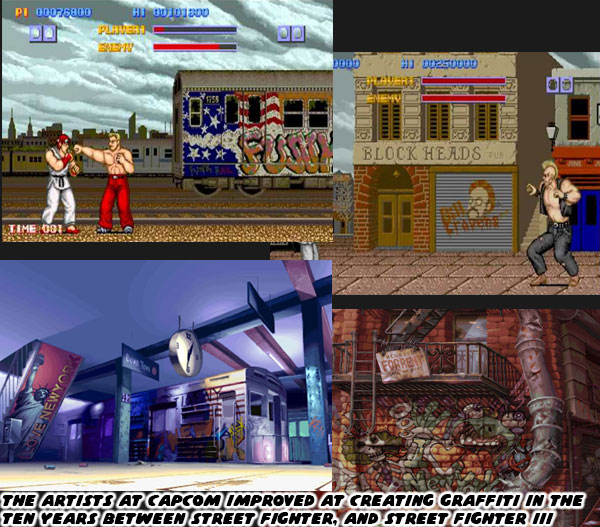
It was obvious that the more the artists studied a school of art the better they became at it. The graffiti used in the first SF was sometimes passable, and sometimes primitive. There were a lot of basic tags in Final Fight, but not really any good pieces. There was no graffiti art in SFII, and the only tattoo was Guile’s USA Flag. A decade after the first SF several stages in SFIII showed that the Capcom staff had grown by leaps, and bounds. The quality of the art, and animation, had grown as quickly as the skills of the programmers. There were several realistic tags, big productions, murals, and throw ups. Essentially the studio was showing that they knew not only the language of graffiti, but how, and where to present it on the stages. Some of these designs were recreated in SF6 for Metro City.

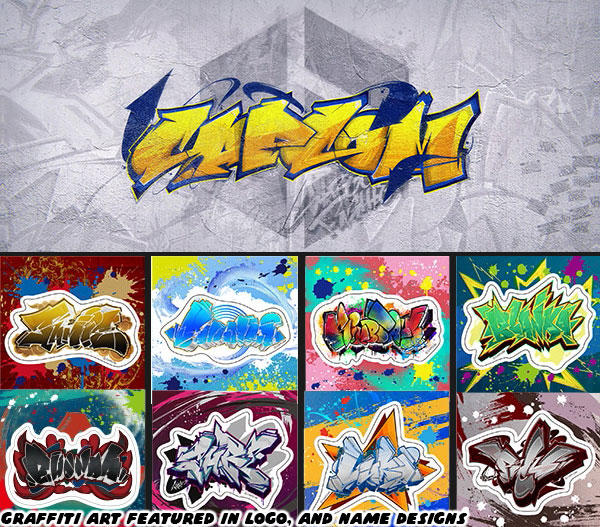
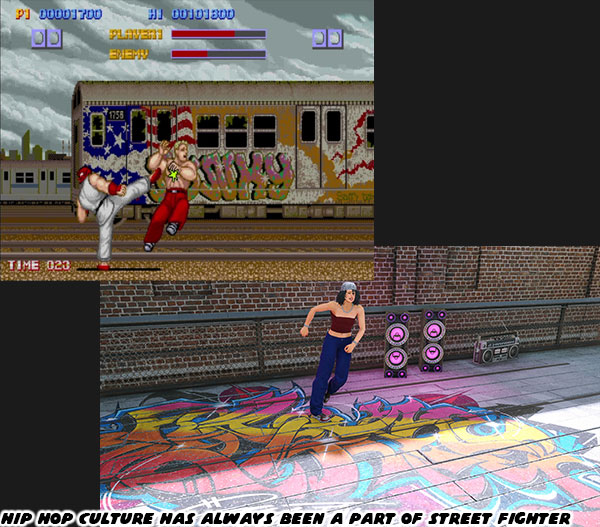
Fast forward almost 25 years after SFIII and Capcom was producing some peak graffiti art. It was displayed proudly on the SF6 intro screen, character logos, and all over the stages. It was apparent that Street Fighter 6 Director Takayuki Nakayama, and Producer Shuhei Matsumoto were not only fans of Hip Hop culture, but wanted to remind audiences that it had always been a part of the history of SF. In the early days the studio didn’t really know what they were doing. They were sort of emulating what they saw in movies, and on TV. Sometimes they missed the mark, but more often than not they got it right. Mr. Nakayama, and Mr. Matsumoto connected that history through the visuals, stage designs, NPCs, animations, and new characters. They also shared with audiences that graffiti was only one element of Hip Hop culture.

For decades game developers used only parts of the culture, rather than the whole. They might use graffiti, or rap music, or the dance in their game. These things were often disjointed, and poorly presented without context. The SF6 developers eased new players into how to play Street Fighter through the World Tour. They taught them the hundreds of little lessons through the pedestrian fights, gangs, and side missions. Something similar happened with Hip Hop in SF6. Metro City had some brilliant graffiti scattered throughout. They weren’t all freshly painted masterpieces, in rougher parts of town they were tagged up, and aged accordingly. There was a sense of realism with the use of the art. There were also b-boys (breakdancers) performing in the street, battling each other with their footwork. In the Battle Hub you could even put together some music on a turntable. Hip Hop had four major elements. Graffiti was the visual language, the dance was b-boying, and the music had two components, the dee jay, and the emcee. Rap was just one tiny part of a bigger cultural movement. In the ‘80s the Japanese developers were trying to emulate a culture they didn’t understand, or practice in their video games. By 2023 Hip Hop was understood universally as street culture.

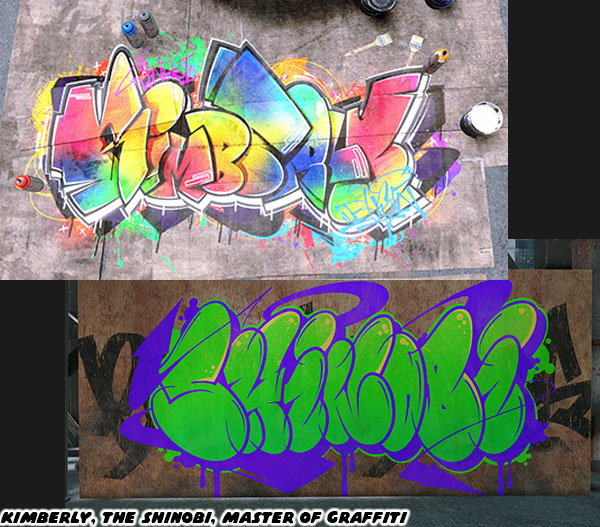
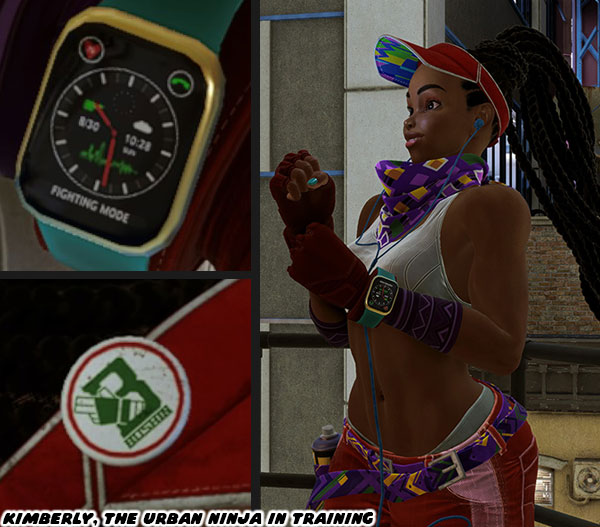
Mr. Nakayama, and Mr. Matsumoto were not only aware of the four elements of Hip Hop, but they wanted to make sure it felt authentic in SF6. One of the ways they did this was through who was representing the culture in the game. Kimberly had embraced ninjitsu, her goal was to be a shinobi, the understudy of Guy. At the same time she wanted to infuse the secretive Bushin art with her own style as a graffiti artist. She had a sketchbook, she carried paint cans with her, and fought with them. Her hangout on top of the Metro City Police Department was covered in some amazing pieces. Every detail in her design told a story, and was supported by her environment. Just as I had mentioned that Luke’s stage design reflected his personality. Every SF character featured in the game received the same treatment. Capcom wanted to make sure that Kimberly’s representation mattered. She was not a washed up womanizing boxer, a struggling protégée for Ken, or an African tribal princess. She was a multi talented black teen. A student, artist and ninja star that would be influencing a whole new generation that looked just like her.

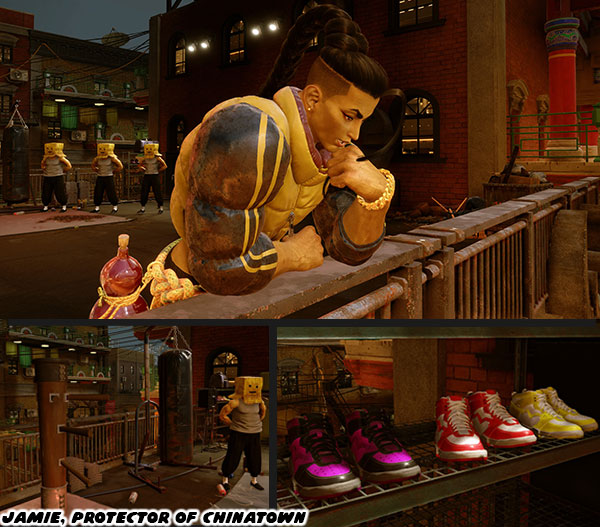
Hip Hop culture started in NYC back in the ‘70s. In one generation it became a global phenomenon. It did not belong to one race, or people, or country. With that said it was girls that looked just like Kimberly had been there since day one. They didn’t get any representation in fighting games until now. A similar thing could be applied to Jamie. The protector of Chinatown was a b-boy. Some of the best dancers in recent years had come from Korea, Japan, and China. Seeing the Asian community represent, if not win in high level competitions demonstrated how powerful the culture was in attracting new audiences. Jamie had a foot in two cultures, the classic kung-fu practitioner, and the Hip Hop dancer. He was exceeding in both. It was the same amount of understanding, and respect that the developers used when creating Kimberly.

Jamie had the smoothest blend of martial art, and Hip Hop dance the world had ever seen. I had done a deep dive on his design, and origins back in June 2022. There was not really too much to add to his look, and personality that I didn’t pull from his teaser video. The game did frame his personality in his stage design. He hung out on a Chinatown rooftop at night. Up there he had everything a young man would need; a weight set, punching bag, wing chun dummy, tiles for breaking, boombox, and collection of sneakers. The cultures, and representation that went into SF6 were handled much better than in the previous two games. It wasn’t the only progress the studio had made in this game. I’ll dig deeper in the next entry. Before I wrap up this blog if you want to find out more about the roots of Hip Hop culture here are three documentaries I would highly recommend. For graffiti art check out the classic Style Wars. As far as dee jay music went I couldn’t think of a better film than Scratch. One of the finest b-boy documentaries was called The Freshest Kids. Thankfully they were all available for free on YouTube. I hope to see you back for the next entry. If you are a long time fan of Final Fight, or Street Fighter then I would like to hear your impressions of SF6. If you have never played any game previously then tell me your experiences in the comments section please. As always if you would like to sponsor me please visit my Patreon page and consider donating each month, even as little as $1 would help make better blogs and even podcasts!
follow the Street Writer on Patreon!

Monday, June 6, 2022

Luke in Street Fighter 6, what's different?

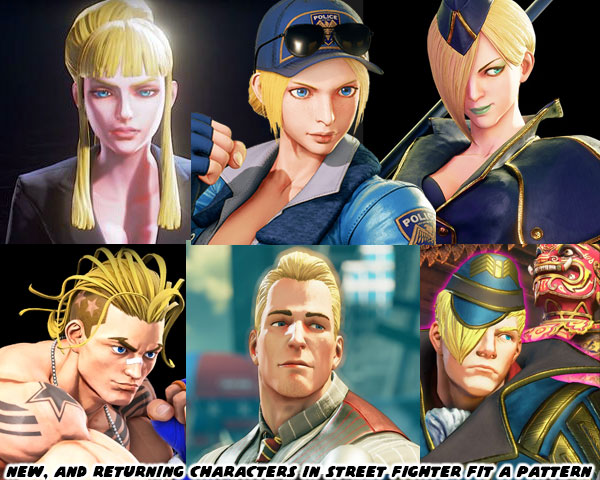
I think it’s fair to say that the team working on Street Fighter 6 has been paying attention to feedback from the community more than previous teams. Street Fighter 6 Director: Takayuki Nakayama, Producer: Kazuhiro Tsuchiya, and Designer: Yusuke Hashimoto have talked about the game, features, and community briefly. Despite everything revealed in the trailer, the team itself is still playing their cards close to their chest. The reason for this secrecy was foreshadowed following the release of Street Fighter V: Arcade Edition. Yoshinori Ono who, to be honest, I never cared much for his direction of the series, was said to have been rubbing the team the wrong way with his ideas, and development of SF6. He was let go in 2020 to join another company. One of the inescapable things that the studio had done, aside from the silly fat joke characters, and fourth-wall breaking gags, was the insistence of adding blonde haired, blue-eyed characters across Street Fighter IV, and V. 

The global community saw every slot taken by mostly white characters as a missed opportunity. Could there have been a native, Black, brown, Asian, or female character in that spot instead? When Luke was unveiled as the new star of the franchise, Capcom got a lot of heat online. I mention some of the responses on my original take on Luke in Street Fighter V. There was nothing I could have said better  about the disappointment of seeing another blonde-haired, blue-eyed, white character get set to carry the franchise. It had been tried before with Alex in Street Fighter III, and Abel in Street Fighter IV. By the time Luke was announced it was 21 consecutive years of not letting any other minority sit in the driver’s seat. Just for the record Street Fighter V: Arcade Edition had 12 blonde, and light-skinned characters (13 if you count Rainbow Mika).

The amount of native, Black, brown, and minority Street Fighter fans the world over had never been bigger. They were gaining momentum in cartoons, and comics, in the pop culture convention circuit, in the cosplay community, as well as in gaming tournaments. People had followed the series since the original was released. I remember playing with oversized foam buttons in the arcade way back in 1987. Some of these Gen-X players raised their own children on the franchise, and a few had even become grandparents. That’s right! There were third-generation Street Fighter fans being introduced to the series, and many had never even seen an arcade cabinet to begin with! It’s not hard to imagine that the millions of fans around the world were feeling left out of the conversation. Following the pushback on Luke, the leaked lineup for Street Fighter 6 was like night, and day. The new game seems to have five returning blonde, and light skinned characters. More important; it adds zero new ones. There are eight women from around the world, and five of which are brand new characters.

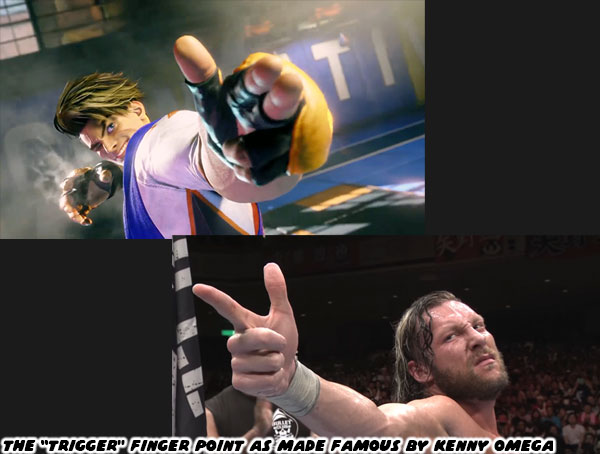
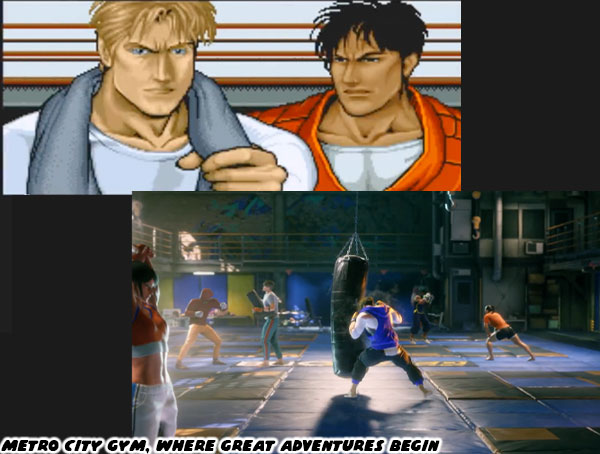
Luke is still central to the plot, but his appearance has been altered somewhat. We get an entirely new take on the young striker in the SF6 trailer. We see Luke punching a heavy bag in the Metro City Gym. He strikes a familiar pose before he smashes the bag with his hardest strike. Wrestling fans would note his pose appears like Kenny Omega's "V-Trigger." Omega is a huge gaming fan, and pro wrestler. He played Cody in the Street Fighter V: Arcade Edition trailer. They gym itself appears to be the very same one that Cody, and Guy were training in at the start of Final Fight more than 30 years ago.

Final Fight was originally dubbed Street Fighter '89. Some of the team that created the original SF had left Capcom to join SNK. They would go on to develop the Fatal Fury, Art of Fighting, and King of Fighters franchises. The remaining members at Capcom decided to capitalize on the popularity of Double Dragon, and replace Ken, and Ryu with Cody, and Guy respectively. The new game would still feature lots of fighting, but a bigger narrative to go along with it. Arcade owners, and studio heads asked to change the title, and work on a proper SF sequel. Thankfully they did, but many long-time fans were left wondering what if the SF series had gone down the path of an open world brawler. Street Fighter 6 actually seems to be a return to that idea. At least parts of it do. The new leads are Luke, and Jamie, recreating the partnership of a white guy brawler, and lightning quick Asian martial artist. For the most part Luke seems much more approachable in his SF6 makeover. Let’s take a look at how he changed.

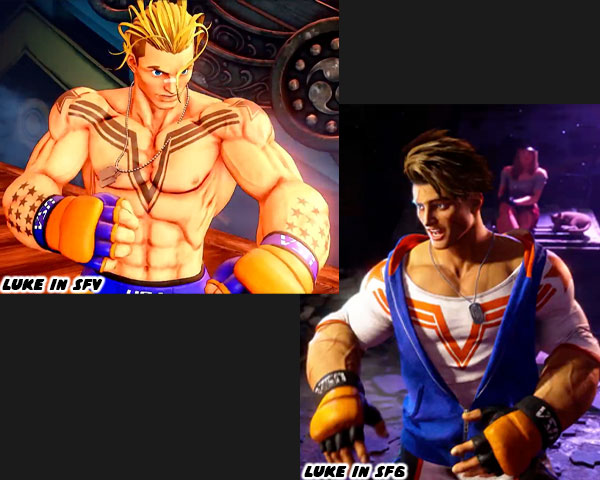
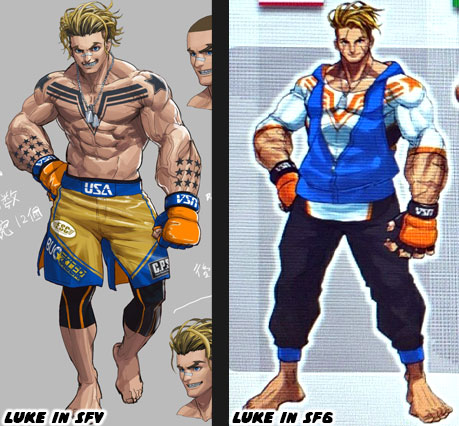
Luke’s frame, and build have changed considerably. I always believed that the 3D models featured in SF IV, and V looked too bulky. When every character was hyper-muscular, then none of them really stood out. It was one of the directions that Mr. Ono had supposedly insisted on. If you look at Luke you will notice that his shoulders are not as protruded as before. His hair is not as stringy, and the stars shaved into the sides of his head have been removed. The star tattoos on his forearms have been replaced with scars. The wing tattoo across his chest, and back, are gone, and now represented by a tee shirt instead. I had commented previously that solid black tattoos like these were being appropriated by white nationalists in the USA. It would have been possible for far-right groups to hold up this character as an example of true patriotism. I’m glad that Capcom had the sense to eliminate most of the markings.

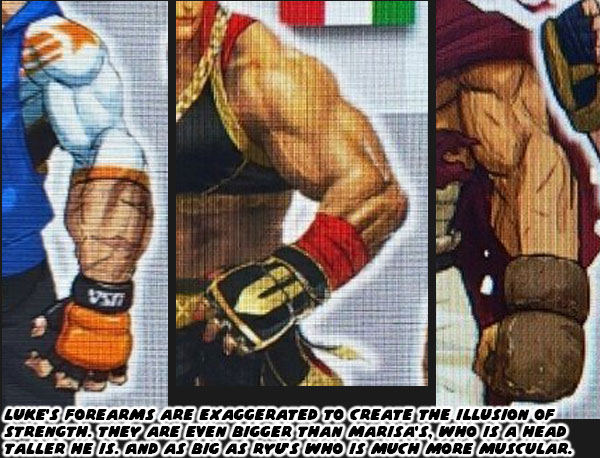
Luke had a bandage across his nose previously. This was removed, and replaced with a long scar running over the right side of his face, from the forehead, down to his cheek. You could say that he's not a pretty boy any more. His boxing trunks have given way to training pants. He still looks like an MMA practitioner, but no longer a poster boy for white nationalism. The one thing that didn’t change, and I think is his stand-out feature are his massive forearms, and fists. Exaggerated muscles, oversized hands, and feet had been used in Street Fighter Zero / Alpha in 1995 to convey the adolescent cast. Luke’s forearms are obscenely huge by comparison! He has the biggest forearms in the game, proportionally to his height. They are in fact bigger than his biceps.

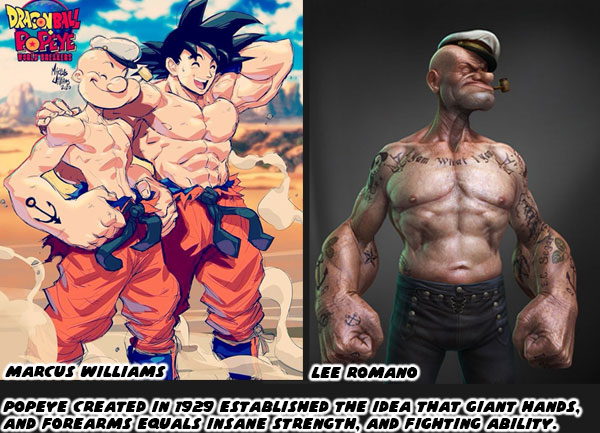
This is a cartoon quality that I think works well in the lineup. Characters are not as hyper-muscled as before. They still appear strong, but are nowhere near as bulky as they had been in the past decade. There are more pronounced differences in height, weight, and build. Their bodies were closer to the proportions used in Street Fighter III. In fact I did not see any comedic “fatties” or odd-colored characters in the leaked lineup. I’m willing to bet that the team working on Luke gave him intentionally big forearms, and fists as a nod to Popeye. This would help make him appear as one of the most powerful punchers in the game, even if he wasn’t the tallest.

In case you don’t know Popeye was first seen in the Thimble Theater comic strip in 1929. He was the original cartoon brawler, and capable of superhuman feats almost a decade before the creation of Superman. Most comic, and cartoon fans would agree that Popeye was technically the first superhero. If indeed this influenced the changes to Luke then I appreciate the effort. Much more seems to be going into the development of the SF6 lineup, than the previous two games. Although the rest of the cast has not been finalized, let alone announced, I will be discussing them over the next few weeks. I hope to see you back for those entries. For now I’d like to know your take on Luke. What do you think about this character as the face of SF6? Would you like to see more representation in the game? Is this a bad idea? Let me know your takes in the comments section. If you would like to sponsor me please visit my Patreon page and consider donating each month, even as little as $1 would help make better blogs and even podcasts!
follow the Street Writer on Patreon!

Thursday, August 5, 2021

A quick take on Luke, the new Street Fighter.

Another year goes by, and another new Street Fighter character is introduced to a lukewarm reception. This new character is named Luke, he was the mystery character added for the Summer 2021 Street Fighter V reveal. Takayuki Nakayama Director of Street Fighter V, and Shuhei Matsumoto the Producer of Street Fighter V showed off the inclusion or Oro. The elderly fighter that had originally appeared in Street Fighter III way back in 1997. Luke was a new face, and presented as the future of the series. I am thankful for Twitter because the hot takes on this character were very spot-on.

Many fans were unimpressed with the reveal. One of the first reactions came from @adam_rsfv who compared the new character to YouTube personality-turned-pro fighter Logan Paul. Logan, and his brother Jake have grated many people with their online antics. These include allegations of sexual assault, filming a dead body in a park, insulting the Japanese while on vacation, and acting like general nuisances. In a way they do reflect the culture of fame, and notoriety from the USA. You don’t have to be the best at what you do, you just have to be the best at promoting what you do. But those were far from being the only takes on the character reveal.

The fish-mash of design elements for the hair, tattoos, and costume of Luke were pointed out right away. @ryo_redcyclone said the character was piecemeal from other Street Fighters. It was easy to point out these influences. Like a villain in a daikaiju, or giant monster tv show.

Many lamented that there was another white boxer in the series. Luke follows on the heels of Ed, a white striker that had been introduced not long ago. The Street Fighter series was known for having a string of powerful Black fighters including Mike, M. Bison, and Dudley. Now in one game two white boxers had turned up. Some compared his look, and introduction to Steve Fox, the British boxer from the Tekken series. Katsuhiro Harada, producer, and director behind the Tekken series agreed with a fan reaction that this might be Steve’s younger brother.

All jokes aside the news of another white character designed to be the face of Street Fighter, the future of the franchise, was met with groans from many fans. Those that had been with the series a long while remember that Alex was supposed to be the face of a New Generation, starting with Street Fighter III. Then almost 15 years later the grappler Abel was designed to appeal to the west in Street Fighter IV. He was supposed to be the go-to character for Americans. Yet in each instance players passed him over to try other other new faces.

With one word to Capcom @KAINONAUT calls out the pattern, and like many minorities, is exhausted with the trend. With each legacy character returning to Street Fighter V players could see that the franchise was favoring the return, and the introduction of white, mostly blonde characters. It was hardly representative of the USA, and given the past four plus years of politics, and civil unrest, you would think Capcom could read the writing on the wall. This is why I am grateful for the internet, for Twitter, and players that are able to dig deep into the history of the series, and call out the company for making missteps when they have a chance to rise up, and produce something exceptional.

In a reply to Kai @mossy_dahlia reminds us of the greatness that could have been. King Cobra was a marvelous design, and the final design known as Rufus was the opposite. On the 30th Anniversary of Street Fighter I highlighted the 30 most important characters to me. Although he never appeared in a game I named King Cobra #1 When that character was turned into an obese white guy for the sake of being funny I knew the series, and director had lost their way. It didn’t make me boycott the series, but constantly call the studio out because I knew they could do better. Most people that read my blogs want to get to the heart of the character, what works, what doesn’t work with Luke? What should Capcom do?

First-off white boxers are nothing new in Street Fighter, or fighting games. Joe was featured in the original Street Fighter. What is concerning is that many of the newer boxers that end up in fighting games tend to be white, and blonde. Even if they come from Hong Kong like Shen Woo in the King of Fighters series. SNK, and Capcom have had their share of Black boxers in the KOF, and SF series. If I were to ask most of my friends to name champion boxers in any weight division I’m sure they could come up with many Black, Latino, and Asian-Pacific names. The white champions (especially blondes) would be few, and far between. Why then should fighting games go out of their way to cater to a certain demographic?

Capcom has demonstrated time, and time again that they are unwilling to take a risk. They want their lead character designs to be accepted by the west. This goes into the use of colors, tattoos, body markings, costumes, etc. If you look at several of the new characters, you’ll start to spot certain trends. Blonde female characters for example tend to get military alternate costumes, with goggles. For the new men the use of solid color tattoos, and patterns, turns up. It was on Necalli, Ed, and now prominent on Luke. The USA is a huge market for the studio. So if they look at pop culture, fight culture, wrestling, MMA, and the like they want to create a fighter that appeals to those fans. The Logan / Jake Paul comparisons for Luke are warranted. What Takayuki Nakayama, and Shuhei Matsumoto may not realize is that this type of fighting "personality" may be popular, but they are often reviled. They aren’t necessarily what the Street Fighter audience either wants, or what the game needs. In many cases fans are eager to try more unique characters.

I mentioned that Abel was designed to be the new face of the series in SF IV, but he was originally an androgynous little boy. The studio thought it would be too risky to have the skinny character in pigtails be able to judo flip larger opponents, so they turned him into a huge bruiser. To cover their bases the studio also created a female spy for the west. C. Viper took her inspiration from the western ideal of beauty, skinny with big lips, a bit like actress Angelina Jolie. When Capcom started trying out the SF IV cabinet in the US they were surprised that players were skipping over Abel, and C. Viper. The characters they designed for the market were failing. Yes they found some fans, but were largely not missed in SFV. There were many reasons why they didn’t work. I think Japanese interpretations of western trends was simply lost in translation. It turned out that when the studio created a character that more closely reflected a classic design, say Juri Han compared to Chun-Li, then the character was more widely accepted. I’m willing to bet that the little kid Abel would have been better remembered by audiences because he was out of the ordinary. Or then again, because he reflected smaller fighters like Ibuki, Makoto, and Sakura.

There is something that concerns me with Luke’s design. Again, it circles back to Japanese creators trying to interpret western tastes. We can tell he is supposed to be a patriotic character, somebody akin to Guile. Guile was a soldier that literally carried his nation on his sleeve. For Luke the stars, and stripes, in the form of tattoos, and even a haircut sends a similar, but not equal message. The use of solid color tattoos is something that I don’t think the people at Capcom considered. These types of tattoos have been more closely aligned with Far Right ideology in recent years. We saw police covered in patriotic tattoos, notably those of the Three Percent, a group identified by the Anti Defamation League as a far right militia movement. These officers have intimidated, and killed in the past. Many were fired, or forced to retire when they were outed as members of the group. The tattoos even turned up Patriots kicker Justin Rohrwasser.

In every instance people with Three Percent tattoos, and the like, all claim to be patriots. They claim not to subscribe to any racist ideology, but want to defend their country. It turns out that they want to defend their country from people that are not like them. Usually white, usually well off. Those that are minorities, gays, trans, Black Lives Matter supporters, Muslims, Liberals, Socialists, or immigrants are the enemy. They even go so far as to claim Anti-Fascists are the biggest threat to the American way of life. The irony in that logic cannot be understated. Guile had a design that could never be lumped into a hate group. He was intentionally designed to be over-the-top, like a GI Joe character that happened to be in a fighting game. He was fighting not for fame, but to get revenge for his fallen comrade, the soldier Charlie Nash. Luke seems to be in the game for himself, to be big, and famous. Sure it could be seen as being distinctly American, but there was more to this nation than a clone of the Paul brothers. I believe Luke doesn’t work because he has conflicting design elements. The sorts of elements that went into Ken for Street Fighter V.

More important I think Luke doesn’t work because Capcom does not know how to take a creative risk. When the studio says they are doing a deep dive, they often miss the elements that made their early generation characters work so well. They fall back on tropes, and stereotypes. Look at how Turkish oil wrestling was presented, or Mexican lucha libre with Hakan, and El Fuerte in SF IV. Fat people became used as joke characters in the series. Starting with Rufus, but spilling over into Birdie as well. The studio forgot that giant characters weren’t always stupid. Luke is designed to be modern, and edgy. He’s probably going to be as well remembered as Necalli in a few years. This is what drives me crazy about Capcom. Greatness is right in front of them, in many concept pieces for a character never used. For a throw-away design given to an existing character, as a costume. If only they would take a moment to listen, to trust their idea, and not what they think we really want. Lord knows I’ve tried to get through to them. I’ve applied to work at that company a half-dozen times. Even asked the producers to please read the blog. I’ll keep on pushing them to do better. I hope the community does too. If you would like to sponsor me please visit my Patreon page and consider donating each month, even as little as $1 would help make better blogs and even podcasts!

follow the Street Writer on Patreon!

Friday, May 5, 2017

Teasing the next Street Fighter EX and Fighting Layer, part 2

The previous blog celebrated the teaser that ARIKA gave us of Fighting EX Layer. If it was an April Fools joke then it was a very well produced one, it raised the hopes of thousands of players around the world. Even if the studio had no plans on releasing the game we could still learn a lot about storytelling through the character designs. I was discussing the Mizukami family; Kairi, Hokuto and Nanase in the previous blog. I had also mentioned that the Street Fighter EX and Fighting Layer were built on a universe filled with mystical characters and spiritual arts. In the genre it was not the only game to feature these types of figures.


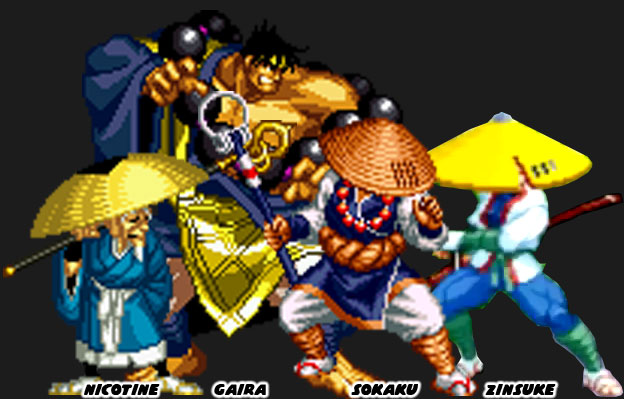
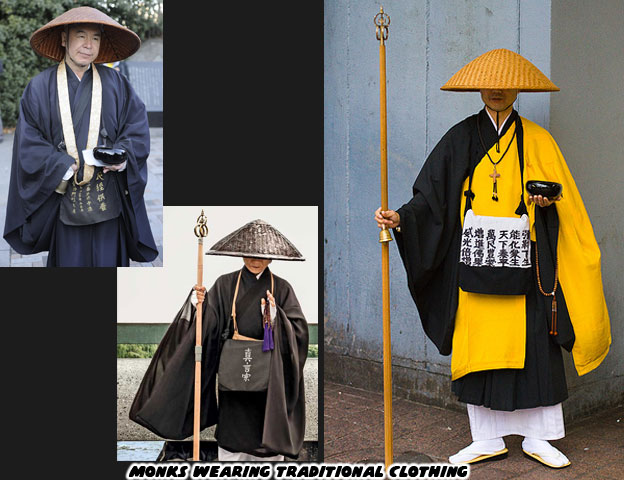
Buddhist and Shinto monks had been featured in pop culture for decades. These mysterious robed men were popular in action cinema and animé. Their identity was hid under a large bamboo straw hat, called a takuhatsugasa, and they were often experienced in the martial arts. Usually it was some form of Shaolin Kung-Fu. When the Chinese settled in parts of Japan they brought with them their religions too. Before karate was synonymous with the “empty hand” techniques it was actually associated with “Chinese fist.” That is to say the oldest schools of karate in Japan were founded on Zen Buddhist principles. The lion's share of fighting monks appeared in the SNK universe. Nicotine Caffeine debuted in the 1994 smash hit Samurai Shodown II. It was a game set a few centuries ago in feudal Japan. He would have been a period appropriate character. His massive grandson Gaira Caffeine appeared the following year in Samurai Shodown 3. Both Nicotine and Gaira wore variations of traditional monk clothing. Nicotine could summon powerful spirits to fight on his behalf whereas Gaira used bowling ball-sized prayers beads to flatten opponents. Zinsuke was a samurai-like-monk that appeared in the game Asura Buster: Eternal Warriors by Fuuki Co. Ltd. Monks were not permitted to carry weapons, and especially not swords as part of their code. Asura Buster was set in a fantasy world so that different designs elements worked for the character. In 1995 SNK also debuted another fighting monk, Sokaku Mochizuki. This character had all the trappings of a classical monk and would have fit into the Samurai Shodown universe. Yet he appeared in Fatal Fury 3, which was based in the modern era. It turned out that the uniform actually hadn't changed much in centuries.


To this day Buddhist monks still traveled through Asia and served in temples both ancient and modern. If they were on a pilgrimage they would wear a motsuke or robe. Their takuhatsugasa was wide for a reason, it protected the monk from the elements, but it also shielded their face to protect their identity. In many regions practicing and outside religion was against the law. Secrecy was for the safety of the practitioner or followers. The large hat also shielded the monk from distractions and noise so that they could mediate. Monks sometimes traveled with a khakkhara. This was a ringed "sounding staff" that had originated in India. The number of rings, 4, 6 or 12 was more than an ornament. They symbolized the Four Truths, the Six Perfections or the 12 chains of cause and effect. Only the Buddha would wield a 12-ring staff. When the monk walked with the staff it would ring. The sound would warn small animals to stay out of the path or alert people that there was a monk nearby. Although not widely practiced anymore by Buddhist monks there was an actual form of fighting associated with the khakkhara. It differed slightly from the forms used with a staff or spade, which monks were also allowed to fight with. Having Nicotine use it as a weapon in game was actually authentic.


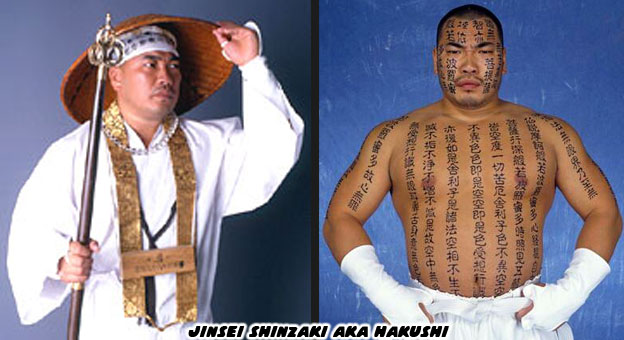
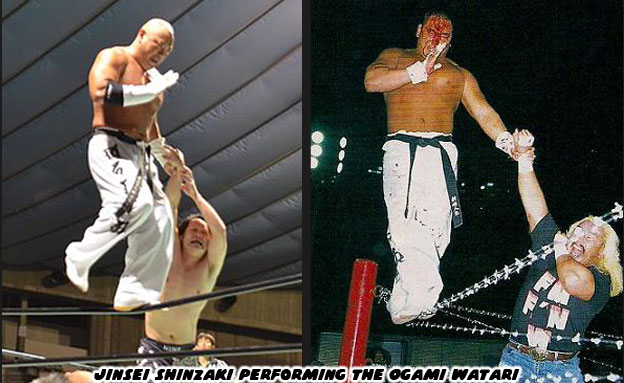
The legend of the fighting monk grew in pop culture until it was even associated with pro wrestling. Jinsei Shinzaki, aka Hakushi in the WWF/E, was an exceptional Japanese performer. Having studied under the “lucharesu” school which combined the high flying acrobatics of Mexico’s lucha libra with the hard striking of Japan’s puroresu (pro wrestling). He was a well-rounded fighter. If his opponent came at him with strikes and grapples then he had a counter attack ready. If his opponent was a fast worker and wanted to perform death defying moves then he too could launch himself off the top rope. Mr. Shinzaki could always be counted on to perform well in a match. He was very serious in and out of the ring and never broke character. He was portrayed as a fighting monk and would power bomb and slam his opponents and then follow up with a prayer. One of his trademark moves, the ogami watari, was an arm twist rope walk that ended in a flying chop. As he walked along the top rope he would pray aloud. He did this move in just about every type of ring set up, including hardcore “death” matches where the ropes would be replaced with razor wire. He was doing this move in Japan at about the same time the Undertaker was using it in the USA. The two actually had a rivalry which worked because they were both using a similar persona. In many Asian countries people only wore white at religious ceremonies if there was a funeral. Jinsei was like a monk praying for those about to die, usually his opponents. By the same token the Undertaker was a sort of ghostly monster in the USA. You could expect him to bury his opponents as well. In real life Mr. Shinzaki was as generous as you could expect a monk to be. After the 2011 Tohoku earthquake and tsunami he actually spend weeks delivering food and water to those displaced by the disaster, most of it coming from his savings.


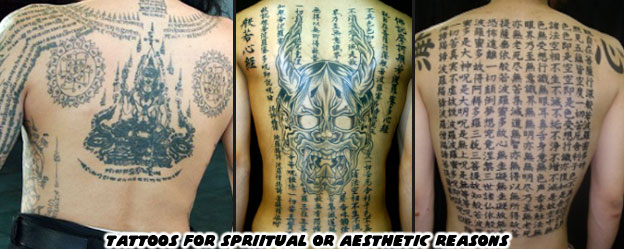
Sometimes Jinsei would go all-out for his character. He would wear the full monk costume and walk with a khakkhara to the ring. Sometimes his face and body were covered in shakyo or calligraphic characters. The messages written on his body were sutras or scripture. These showed humility and piety for his belief. In Buddhism practitioners would write down shakyo as a form of reverence. Families could commission monks and nuns to write down scripture to honor their family or loved ones. Although not practiced widely there have been many examples of tattooed shakyo written on people over the centuries. In Japan the practice of carved tattoos, called horimono, extended back to the Jomon era. These tattoos were thought to have spiritual connotations and had appeared more than 10,000 years ago. Some people did indeed tattoo their faces as well as bodies with elaborate designs. About 2000 years ago Chinese travelers to Japan had recorded these tattoos on the native Japanese and saw that they were associated with status. Only later on did tattoos start to have a negative association in society. This was because criminals were tattooed for various offenses. Regular people wouldn’t hire these people however the criminal underworld, better known as the yakuza would. To this day you can still find examples of irezumi, Japanese tattoos, that incorporate shakyo for decoration, or devotion. A mantra and symbol of Buddha or even Hindu Dharmas could be found tattooed on people all over the world.


There is a reason why I bring up all of this history. As the EX series progressed the spiritual themes became more relevant to the development of the game. Only the Samurai Showdown series had invested more mysticism into their canon. Garuda had some very distinct Buddhist symbolism associated with him. His sitting lotus position, that he teleported around the stage with, and even the actual lotus flower, a symbol of purity were seen in his animations and endings. I had described the origins of Kairi and his spiritual powers as well on previous blogs. Kairi and Hokuto had a unique bond. They were both monk-like in their training. Yet their relationship was more profound than anyone in Street Fighter. Ken and Ryu might consider themselves brothers but the Mizukami characters were actual (cursed) blood relatives. Imagine how different the Street Fighter series would have been if Ryu and Chun-Li were brother and sister. Imagine the heartbreak of Chun-Li if her brother had become a murderer. If she remained loyal to her job as an officer then she would have to arrest him, or worse, kill him in the line of duty. This was the type of character development that made the EX series so unique. This was something that the former Street Fighter II developers were thinking out lout. The lead characters were related, and they were both the heroes and villains of the universe. The drama that pulled audiences in was built because of this bond. The curse was something that would destroy the family or unite it. I think the latter was entirely possible. Kairi was headed for self-destruction at the end of the first EX game. Unless Hokuto could intervene there wouldn’t be much left of him to save.


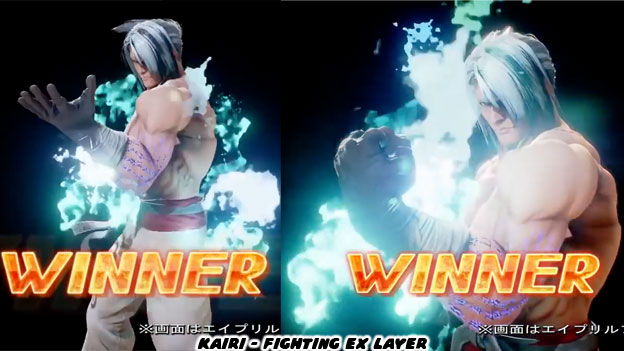
Between Street Fighter EX 3 and Fighting EX Layer something did change. Kairi had defeated Gouki, and had elevated his powers in the process. Kairi no longer performed like a tortured soul. It was obvious in his new animations and the moves that ARIKA demonstrated on April 1. I believe the secret to his evolution lay in the marks on his arms. He now had shakyo tattoos on his wrists when previously he had none. These markings must have placed the evil energy driving him mad under his command. The spiritual forces were confined to his hands and not in his mind. He was fully in control of his abilities yet unlike Garuda these strikes were not centered around maiming an opponent. In a previous blog I mentioned how spirits could be bound to objects and people. Kairi was a "yorimashi" or a possessed person. The shakyo tattoos bent the spirits to his will. In shinto tradition it could have been a rope belt or blessed paper streamers to do that as well. Gouki by contrast used prayer beads to keep control of the evil spirits within him.

Kairi had achieved a strength of boss character and established an entirely new template. He was not bent on global domination, that was Gill and the Dictator’s hang up. He had become a master, a sort of anti-Gouki. He had little interest in tracking down the most powerful Street Fighters. If they wanted a challenge then they would have to seek him out. How this would effect the relationship between himself and his sisters would have to be explored in the actual games. The Fighting EX Layer reveal also introduced something else to the fighting game conversation. We will look at this in the next entry. As always if you enjoyed this blog and would like to sponsor me please visit my Patreon page and consider donating each month, even as little as $1 would help make better blogs and even podcasts!
 follow the Street Writer on Patreon!