Hello friends, welcome back to the blog. This entry is a follow up to the one I posted on Arjun. This has to do with the new character reveals for Season 4 of Street Fighter 6. I said that the design behind Arjun was poorly executed. His appearance, and costume was essentially a copy of the concept art for Ryu in SF6. It was bland, and lackluster, and made me think that the team’s Senior Designer Yusuke Hashimoto had nothing to do with his look. I could almost argue the same thing with the other new character introduced for the game. Yasmine was the first new female added to the game since its launch. The other women introduced in the seasonal updates were pulled from older games.

Before Capcom said anything about the origin of the character, or her move set I knew where she was from, and what she represented. She appeared to be a Filipino. Making her the first Asian-Pacific islander represented in the series. The colors of her uniform were rooted in the flag of the Philippines. It was white, blue, red, and yellow. The sun icon on her shoulder was modeled very much on the sun logo on the flag. As many national flags
there is tremendous meaning behind the colors, shape, and symbols featured on it. Not the least of which are the eight rays emerging from the sun, which represents the eight provinces that rebelled against the Spanish in 1898. Her top was based on the
Barong Tagalog, a traditional shirt strongly rooted in national identity. It wasn’t just worn by residents in casual, or formal settings, but also by politicians in the Senate.

In her hands she had an ornamental karambit. This knife was used in the traditional fighting art Eskrima, sometimes referred to as Kali or Arnis. For many people in the USA their first exposure to this martial art was
in the 2003 film The Hunted featuring Tommy Lee Jones, and Benicio Del Toro. It highlighted the lethality of the fighting art. It was made popular in recent years from The Raid movies. The Raid 2 specifically from 2014 featured Iko Uwalis as the undercover cop Rama, and Cecep Arif Rahman as the Assassin.
Their karambit battle was one of the best sequences in martial arts cinema. Yasmine could have used sticks as a weapon. Most people were familiar with stick fighting with the Filipino martial arts. The
staff, and sticks were already featured by Eagle, Rolento, and Falke in the series. The advantage of the karambit was a stronger national theme.

Since Yasmine’s karambit was not a blade in the traditional sense it was still a weapon that could be used for trapping, as well as striking. I think this tool was inspired by the wooden fishing hooks carved by Pacific Islanders. There was
a lot of cultural influence between Malaysia, Indonesia, and the Philippines. The karambit was only part of a strong ethnic identity that united the three nations. Her martial arts belt was also accurate to her region. Karate practitioners tied their belt in the front, in the Philippines the belt was knotted at the right hip.
Her name, and school were written on the belt. It was worn is very specific way for the Filipino martial arts. In some schools a sash could be used in place of a belt.

Everything that Capcom did with the new character seemed to be the polar opposite of the last time a Filipina was used in a fighting game. If you were familiar with fighting games then you realized that Yasmine was not the first Filipino fighting game character. She wasn’t even the second. Josie Rizal debuted in Tekken 7, back in 2015. She was a time-release character that came out in April of that year. Series producer
Katsuhiro Harada said that he had wanted t include a Filipino character going back to Tekken 5 in 2005. He didn’t get a chance to do so until much later. Unfortunately for him this character would be very divisive. Fighting games were big the world over, Tekken was especially popular in the Philippines. The downside was that even though Josie was proposed as an eskrima fighter, without any weapon it was hard to tell. She was voiced by Ananda Jacobs, and had no detectable Filipino accent. The other was she had the name of a national hero, and the attitude of a crybaby.

José Rizal was a writer, nationalist, and doctor whose work helped inspire the country to rise up against Spain. He was executed in Barcelona for rebellion after a brief exile in Cuba. He had no direct involvement with the resistance, but his death helped spark a revolution. The fact that Bandai Namco used the name of an icon,
but put it on a crybaby girl was read as a direct insult to millions of Filipinos. The Japanese had committed many war crimes against
the Philippines,
China, and
Korea during regional conflicts. It was not hard to imagine that they still looked down on other cultures even if this was not the intention from the developers.

To add fuel to the fire Namco put a Filipina in a fighting game much earlier, and was more culturally sensitive about it. They did this with Talim in Soulcalibur II. The game came out in 2002. It was directed by Jin Okubo, and Yoshitaka Tezuka. It was produced by Hiroaki Yotoriyama. The Soulcalibur, and Tekken teams had a friendly rivalry inside of Namco. They traded jabs with each other at gaming events, but deeply respected each other at the same time. The Soulcalibur series was a sword fighting game which pulled elements from ancient history. It was much closer to fantasy than historical to be honest. In the case of island representation Talim was a sort of amalgamation of Indonesia, Malaysia, and Philippines. Her costume was pseudo-traditional, as was her weapon. It was a hybrid karambit, and tonfa. She demonstrated that the studio was capable of better representation if they tried. Yasmine was a better design compared to Josie, but I think that Capcom was trying too hard to swing in the other direction.
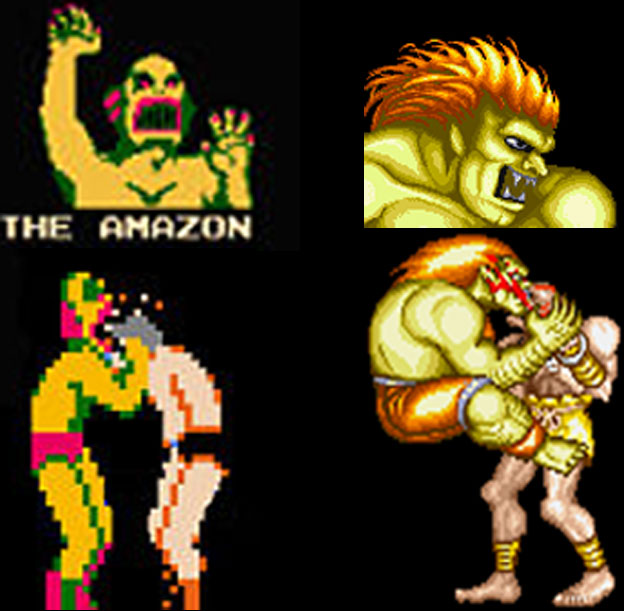
The taped shins, and hands signaled to audiences that Yasmine was clearly a fighter. The use of the Filipino national flag as primary colors on her costume, with the sun, and stars as accents let us know what region she was from. Her hair color was purple, a mix of the red, and blue from the flag as well. You would think this made her a fantastic design, and a prime example of inclusion done well. I would argue that it was sloppily done at worst, and ham-fisted at best. For starters I want you to think about which characters in the game wore their national flag as the primary colors on their uniforms. Zangief did indeed wear the old USSR colors on his shorts. Ryu was a happy accident in that his gi was white, with a splash of red on his headband. Contrary to popular belief Blanka was not green because of the Brazilian flag, but because he was modeled after the Amazon from Nintendo’s Pro Wrestling. Past that none of the World Warriors from SFII or New Generation from SFIII used their national colors as their costume.
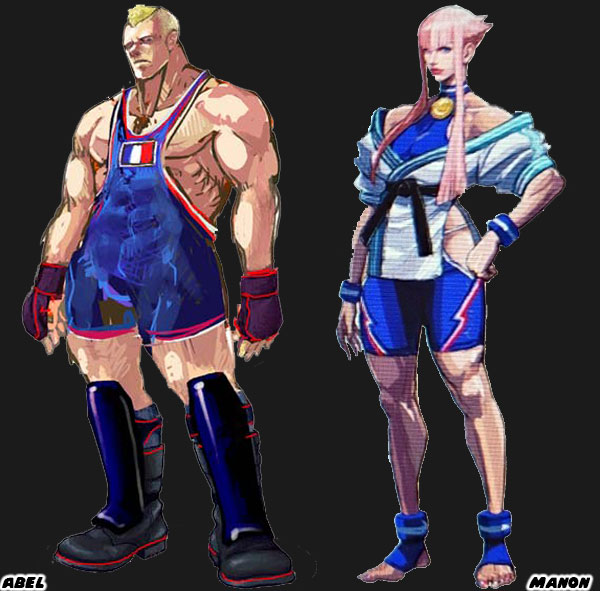
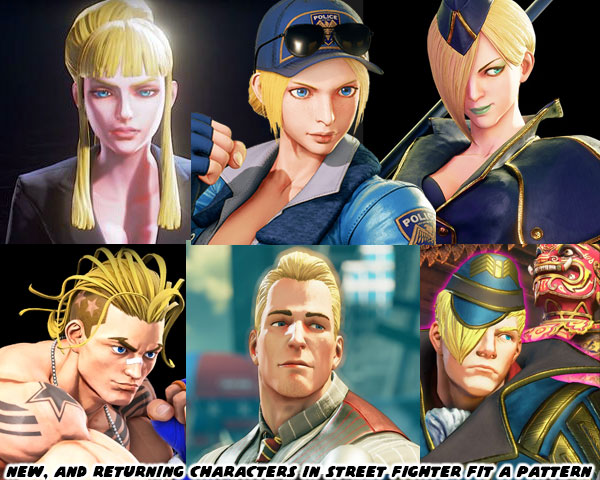
Street Fighter IV, and V started the trend of turning the colors of a national flag into costumes. We could see it with
Abel from Street Fighter IV, Manon from SF6, and
Laura from Street Fighter V. I argued that of all the new characters introduced into the franchise Juri Han was the best because
she poached the most from Chun-Li’s design roots. I mentioned that the purple in her hair, and uniform were created by mixing the red, and blue from the South Korean flag. I would argue that the purple hair featured on Yasmine was a result of the same logic. I thought it was a cheap, and unnecessary design choice.

Any other color hair would have clashed Juri, and Yasmine’s costume. At the same time we had to address
the Asian colored hair phenomenon. For decades Asian characters were coded with attitude thanks to colored hair streaks.
Teen Vogue covered this issue, and
Glamour said it was time to retire this trope. I was aware of it when
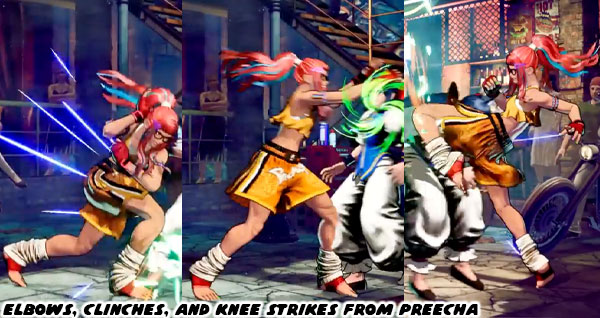
I talked about how Juri Han’s design got better with time. It might seem insignificant to you, but I think that turning a flag into a costume was cheap. I think that giving colored hair to an Asian, or Pacific-Islander was sloppy. This pandering to tropes was not limited to Capcom. Even Preecha, the new female Muay-Thai fighter from SNK
had colored hair with contrasting streaks.
Going with popular generalizations was not a substitute for actual research. You cannot achieve great design by pandering to the lowest common denominator. With some effort you can have a great national figure, and undo years of ugly caricatures. This was why I respected Designer Yusuke Hashimoto, and the team working on SF6. They managed to take Dhalsim, and Blanka which were the two ugliest caricatures in the franchise,
and make them significantly better by changing just a few details. Not only that. I would argue that
Rudra was an even better design, and a sort of way for Capcom to quietly retire Dhalsim. It seemed like an impossible task for Capcom, or any Japanese developer to do better. I knew it wasn’t impossible. A generation ago we had T. Hawk. He was originally going to be the new Zangief for Street Fighter III. Along with Cammy, Dee Jay, and Fei Long. However they were pushed into the Super SF II update before his design was refined.

I wanted to see Mexican representation in the SF franchise, but this was not it. T. Hawk was a member of the fictional Thunderfoot Tribe from Mexico. He was about as authentic a native as Iron Eyes Cody. For those that didn’t know Iron Eyes was born Espera Oscar De Corti. He was an Italian-American that was cast for Native-American movie roles going back to the 1920’s. He spent the next 70 years convincing the USA that he was the real deal when in actuality he was perpetuating stereotypes. With his face paint, moccasins, jean vest, and feathered headband T. Hawk was doing the same thing for the fighting game crowd. I was saddened to see how little Capcom cared to present a Mexican fighter correctly, and even more disappointed with what was done with El Fuerte.
When Lili / Lily was announced for SF6 she was pulled from the same tribe, and had essentially the same design elements. In any other timeline her look would have remained the same from concept to publication. Yet the SF6 team did a lot more homework, and revised her appearance several times before her debut.

The changes to Lily were subtle, but made for a much better overall design. Her physical appearance was mostly the same. But the color choices, costume, and fashion worked much better without the pandering. Capcom got rid of the face paint, and feather. Her clothes did not have to be a poncho of red, white, and green. The colors of the national flag. An oversized jaripeo shirt did just fine. Even the change in her boots from Central to Northern American worked better. I had a similar thought on Yasmine (and Arjun). It was good to see the Philippines get representation, especially with a strong female warrior. But she was version 1.0 of the character. I knew that version 2.0 was going to be much better, just as it was for Juri, and Lily. That was my belief anyhow. What did you think of this character reveal? Who were you most interested in using in the next season of Street Fighter 6? Tell me about it in the comments section. As always if you enjoyed this blog, and would like to sponsor me
please visit my Patreon page and consider donating each month, even as little as $1 would help make better blogs and even podcasts!