
Showing posts with label luke. Show all posts

Friday, September 18, 2026

Bookmark This Page; Looking at the character designs in Street Fighter V, and Street Fighter 6

I am probably best known for my deep dives on fighting game character designs. If you want to see what I did not like about Street Fighter V’s character designs, or my initial reactions to the SF6 designs then Bookmark This Page.

The return of Charlie Nash, or how zombies make the best fighters...

Necalli, a first look and second take on the new Street Fighter V character...

A look at Ed from Street Fighter V, design meets legacy...

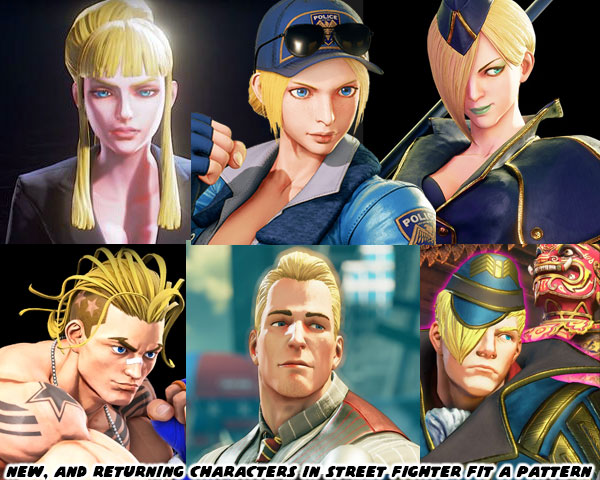
How age and gender helped make the Street Fighter cast unique...

Zeku, the ninja spirit from the '70s finally returns!

From Strider to Zeku, where did the lighting-quick ninja come from?

G, or the evolution of power-hungry characters in fighting games

The new Evil Ryu, a look at Kage

A quick take on Luke, the new Street Fighter.

Capcom Fighting All Stars, the fighting game that never was. A reprint from 1UP / Capcom-Unity.

A first take on Jamie, the new Street Fighter 6 character

Luke in Street Fighter 6, what's different?

A look at Marisa, the Street Fighter 6 gladiator...

Ken Masters, from champ to chump in Street Fighter 6

A new look for Guile, or correcting a mistake? His update in Street Fighter 6.

A look at Lili, the new native Mexican fighter in Street Fighter 6

E. Honda, the return of a sumo legend in Street Fighter 6

Ed, and Rashid. A look at two Street Fighter V stars in Street Fighter 6

Juri in Street Fighter 6, how her design got better with time

Manon in Street Fighter 6, representing a style over 200 years in the making

Dee Jay is back in Street Fighter 6, is he better than we remember?

A look at JP in Street Fighter 6, is this old money personified?

Dhalsim, and Blanka, the return of the strange characters in Street Fighter 6

The Red Tornado returns in Street Fighter 6, a look at Zangief.

Cammy gets an entirely new look for Street Fighter 6, let's see how

The greatest fighting game boss returns to Street Fighter 6, a look at Gouki

Let's talk about A.K.I., the Dragon Lady of Street Fighter 6

Meet Kimberly, is she the Urban ninja of Street Fighter 6?

Ryu becoming the master in Street Fighter 6, a look at his new path

Chun-Li's new look in Street Fighter 6. Is it a step backwards?

Some details in the Street Fighter 6 trailer I wanted to talk about

Figuring out the changing Street Fighter style, part 1…

Figuring out the changing Street Fighter style, part 2…

Figuring out the changing Street Fighter style, part 3…

Figuring out the changing Street Fighter style, final part

Style Wars, looking at Kimberly in Street Fighter 6, and Isla from King of Fighters XIV.

The Street Fighter 6 pre-order trailer, a love letter to the series, and a look at JP

The Street Fighter 6 pre-order trailer, a look at Manon, the graceful judo practitioner

The Street Fighter 6 pre-order trailer, a look at Marisa, the modern gladiator

Lili gets a makeover, just in time for Street Fighter 6!

Gouki in Street Fighter 6, the greatest fighting game villain has returned

Did you enjoy the character deisgns from Street Fighter V or 6 more? Tell me about it in the comments section. As always if you enjoyed this blog, and would like to sponsor me please visit my Patreon page and consider donating each month, even as little as $1 would help make better blogs and even podcasts!

follow the Street Writer on Patreon!

Wednesday, July 13, 2022

Figuring out the changing Street Fighter Style, final part

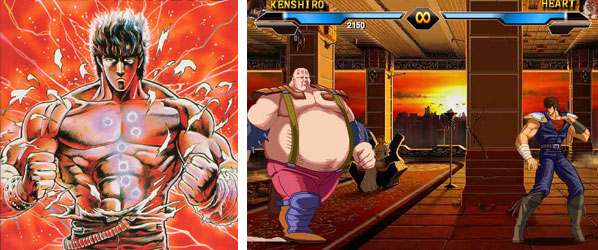
In the previous blog I mentioned that the characters in the King of Fighters, and King of Combat series tended to go over well with the broader Asian market, especially the Chinese. If you wondered why Asian-style leads were younger, or less muscular than the archetypes that Americans tended to favor I want you to think about pop culture. Think about every anime, and manga you had ever seen. There were some very muscular stars throughout history. Hokuto No Ken / Fist of the North Star, Dragon Ball Z, and Baki featured swollen leads. However those titles were the exception, and not the rule. The vast majority of manga, and anime featured characters with skinny-to-average builds. More often than not the stars were high school, or middle school kids. It wouldn’t make any sense for them to be huge, or vascular.

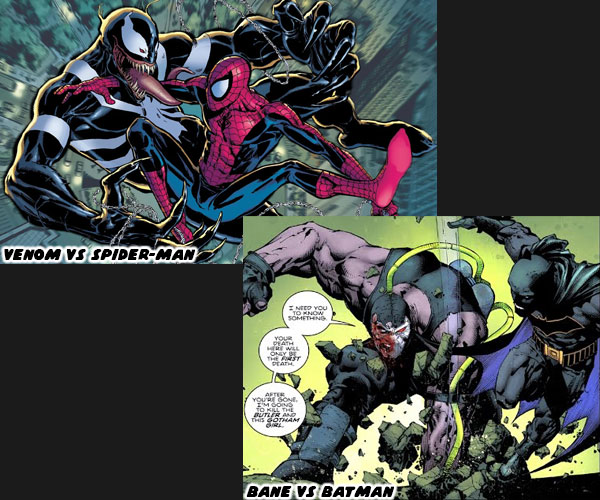
By comparison comic book, and animation heroes in the US were fully grown adults. They almost all had bodybuilder physiques. The villains were sometimes even more physically imposing than the heroes. Think of the difference between Batman, and Bane, Spider-Man, and Venom, the Hulk, and the Abomination. There was a distinct size advantage to the rivals. Even relatively young characters like Robin, or Kid Flash were often drawn more muscular than the average child. It stood to reason that Japanese studios would try to create equally buff characters when trying to appeal to the west. 

I think that the market had a bigger influence on the design changes happening at SNK, and Capcom than they had discussed publicly. Money talked, and if a studio wasn't hitting their goals then they had to find a new direction. In the previous blog I mentioned that DIMPS had co-developed Street Fighter IV. It was something that not everybody in the fighting game community was aware of. I believe that they had a hand in influencing the look of C. Viper, and Rufus. Even studios outside of Japan got a chance to shape the direction of the series. The Malaysian company Streamline Studios helped in pre-planning and development of Street Fighter V It wasn't the only time that an outside studio had shaped the direction of a flagship title. Most publishers outsourced some work to smaller developers. They might have built assets from the game, painted backgrounds, or created the title, and ending credits. The bigger the budget the more work a studio had to build from, and possibly outsource. If a game didn't perform then the publisher had a reason to cut down the team size, or try something different.

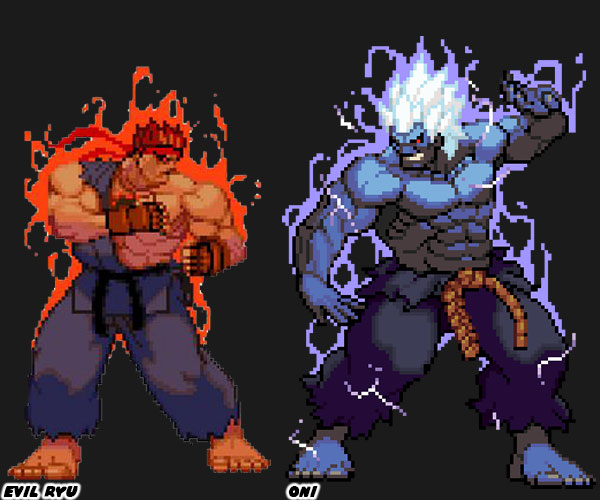
Street Fighter IV sold over 9 million units, across all versions, and platforms. It was credited with relaunching the fighting game craze. Street Fighter V sold over 6 million units, across all versions, and platforms. Both were hits, but they did not outsell Mortal Kombat X, which was just shy of 11 million units, and Mortal Kombat 11 which sold 12 million. The lack of numbers compared to MK, plus the drop off in sales from SF IV to V probably had a hand in seeing Yoshinori Ono leave Capcom. It wasn't the only reason that a change was warranted. Mr. Ono had lead the company to some interesting places during his tenure. He brought back a number of classic characters, but also introduced a number of odd ones as well. Rufus, Hakan, and F.A.N.G. stretched the idea of what worked in the series. They looked, and played like he was trolling audiences. He brought Gouken back from the dead. His murder was integral to Ryu, and Ken's story. All of a sudden he was alive without explanation. Then he introduced Kage, and Oni which were evolved versions of Evil Ryu, and Gouki respectively. These characters were already well designed, they didn't need an upgrade. To many in the community he was pushing the series very far from its roots. 

A new team made up of internal members had to step in. Director Takayuki Nakayama was joined by Producer Kazuhiro Tsuchiya, who had been with Capcom since 1992, Produced Asura’s Wrath, and was the lead Producer on the Mega Man series since 2018. Producer Shuhei Matsumoto had worked on Street Fighter: 30th Anniversary Collection, Marvel vs. Capcom: Infinite, Ultra Street Fighter II: The Final Challengers. Designer: Yusuke Hashimoto had Produced Bayonetta, and Directed Bayonetta 2. It was up to them to steer the ship in a new direction, without losing the Street Fighter Style. They had mentioned in interviews how they wanted the game to feel like a worthy successor to SFII. That meant they wouldn't have as many fantastic elements, and over-the-top characters as audiences had seen previously. The game would be focused on fantastic, but plausible fighters. Closer to the World Warriors, rather than Rufus, and other joke designs. So let’s have a thought exercise. If you were Japanese employee, working at Capcom, and tasked with creating a character that would appeal to American audiences, who would you come up with? It might be a pro wrestler, as wrestling was still popular, or it could be a more contemporary mixed martial arts (MMA) star.

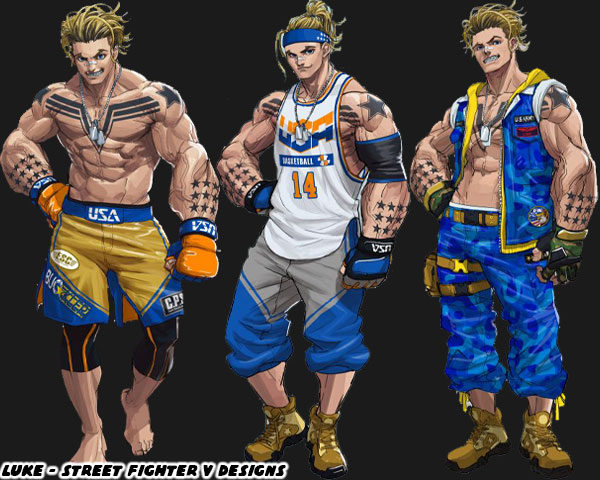
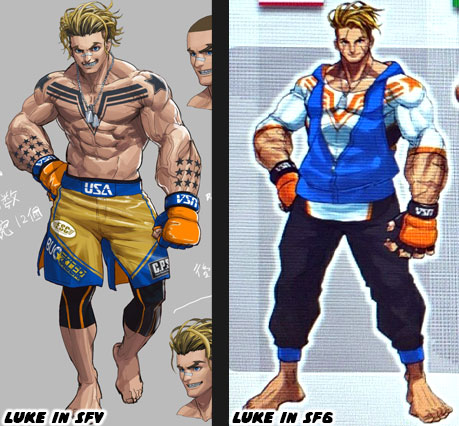
Luke appeared like an up-and-coming MMA star. The new designers followed the rules that Capcom had established in 1987. He was a muscular, blond haired white guy. He could certainly never be mistaken for the skinny Kyo, or Shun’ei. The difference for Capcom this time was that the character was much younger than the other leads in the series. He was younger than Ken, Alex, and Abel when they made their debuts in SF, SFIII, and SFIV respectively. He was roughly the same age of Ryu in Street Fighter Zero / Alpha. Using the SF style of character design they tried to give him a pseudo-traditional martial arts outfit. MMA fighters often wore shorts, sometimes a rash guard. Luke was given both. He also had striking gloves instead of larger boxing gloves. His color scheme was distinct, he wore gold, and blue, the colors of the Capcom logo. The pride in his nation was displayed on his main, and alternate costumes. The USA logo, the dog tags, the US Army fatigues, and Team USA basketball jersey to name a few.

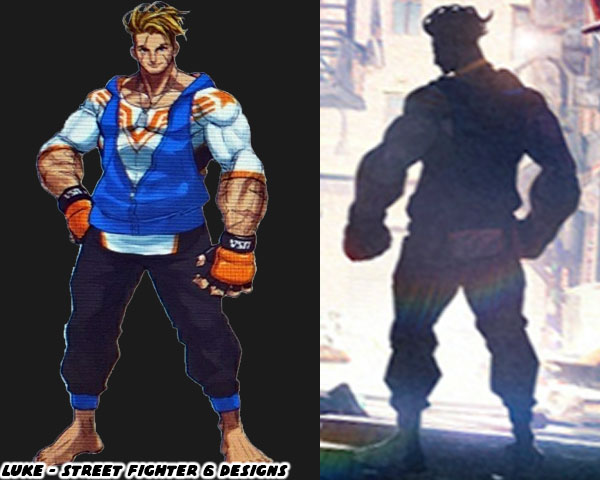
Despite his age he was a special forces op. He was a skilled fighter with a patriotic duty, somewhere in between Cammy, and Guile. The thing about his main costume was that it didn’t allow much material to establish his color, and identity. By comparison think about how much the colors, and costumes on Ryu, Ken, Chun-Li helped frame them. The designers at Capcom made up for it by covering his arms, and chest is solid black tattoos. It wasn’t the only thing the studio did to give him a distinct look. They gave him cartoonishly large forearms, this completely changed his profile. It made it so that despite his height, it looked as if he could hold his own with larger characters. They were design choices that wouldn’t have necessarily been used in a newer KOF game. The differences between Luke, and Shun’ei reflected both the aesthetic of Capcom, and SNK, as well as the target audience that they were going after. Capcom wanted to push the series forward in SF6, age the cast slightly, and give them new costumes. Luke’s uniform was changed to cover him up. Not only that but he lost the logo colors, going now to black, blue, white, and orange. His forearm tattoos were replaced with scars, and the chest tattoo was put on his rash guard. I think it was a good choice to leave the tattoos behind because patriotic symbols had been co-opted by the far right in recent years. 

Despite these changes you could still identify him even with just his outline because of his cartoonish proportions, and wavy haircut. I’m not sold on the colors selected for the fighter. I think that blue, and gold worked better for him. That’s my opinion anyhow. I think he would still be popular among new players. With character costumes becoming more casual, and more conservative in SF6 do you think that Capcom was moving closer to the SNK style? That's how it seemed with designs like Cammy, and DeeJay. Was this a good idea to attract new players? Do you think this was a business decision? I’d like to hear your take in the comments section. Let me know what you think defines the Capcom, SNK, or any other publisher style. As always if you would like to sponsor me please visit my Patreon page and consider donating each month, even as little as $1 would help make better blogs and even podcasts!
follow the Street Writer on Patreon!

Monday, July 11, 2022

Figuring out the changing Street Fighter style, part 3

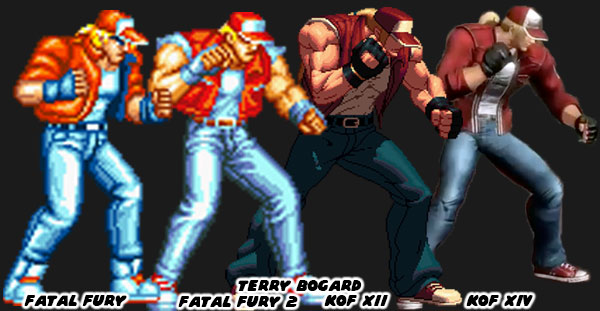
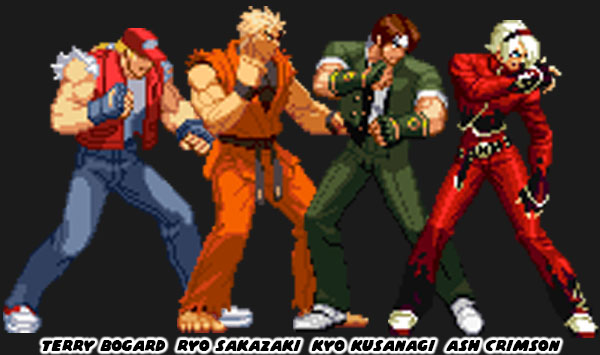
In the previous blog I talked about how different studios tried to create fighting game characters by using Capcom’s template from Street Fighter II. One of the missteps that some studios made was in overtly pandering to the western audience. The examples I used were Max Eagle, and Magic Dunker who wore costumes made up the stars, and stripes of the USA flag. There was no mistaking who these characters were, and what they represented when they literally wore the nation’s colors on their shorts. Yet great character design was more often subtle. It was subtle in the sense of how people thought Chun-Li’s costume was traditionally Chinese even if there wasn’t’t really anything classical about it. There was another way this subtlety was accomplished. SNK would not always use traditional outfits on their fighters. Instead they would put their martial arts masters in street clothes. But they weren’t just any outfits from the mall. They were on the leading edge of fashion, if not predicting it by a few years. These outfits were more than just flashy, they were carefully assembled to tell a story. The star of Fatal Fury, and poster boy for a lot of SNK’s greatest hits was Terry Bogard. Take a look at the evolution of his costume over 30 years, and see what you could identify. For the sake of this blog I am going to leave out the updated look that he received in Garou Mark of the Wolves. Since that involved a time jump.

Terry was the “Wild Wolf” of the King of Fighters universe. He didn’t represent any traditional form, like his brother Andy, instead Terry learned how to fight on the streets. He was a western character, the typical blonde-haired protagonist, however SNK didn’t play up those features. They covered him up with a trucker cap. His colors were red, white, and blue, but they weren’t the shades that you would find on the US flag. The blue on his jeans was a very faded light blue. This signaled to players that he spent a lot of time living, and working outdoors. He wore a white tee shirt, something classic, and humble. He wore a leather jacket, tough, and durable. It had a single star on the back, but it was saturated with more orange than crimson. He wore white sneakers, casual, but sporty. These would be swapped out for red ones which contrasted better with his outfit in later revisions. The tweaks that SNK gave his outfit only further reinforced the story elements from his costume. The sleeves on his jacket would be torn off to reveal huge muscles. By King of Fighters XII he was at his most muscular form. A few years later he was slimmed down, and the sleeves put back on his jacket. His jacket turned from leather to jean material, lighter, and more flexible. The majority of characters got similar makeovers post KOF XIII. Why was this?

With the exception of Ryo Sakazaki, SNK had mainly pushed leading characters in very fashionable street costumes. The character that carried the torch in the KOF series was Kyo Kusanagi, he wore a very hip take of a gakuran, or school uniform. Not unlike the way Jamie wore his kung-fu outfit with a Hip Hop vibe in SF6. The young Kyo’s powers were cloned for the even more fashionable Ash Crimson. There were many characters introduced in the KOF series who wore flashy outfits. This was one of the things that distinguished their lineup from Street Fighter’s. SNK changed the look, feel, and overall aesthetic of KOF with XIV. They saw that the swollen characters in XII, and XIII weren’t necessarily going over well with audiences. The studio then put former Capcom developer, and SFIV team member Yatsuyuki Oda in charge of KOF. He focused more on making cool-looking characters that would appeal to their target audience. In this case they wouldn’t try to guess western tastes, but instead try to create archetypes that would be more popular in Asia.

Fighting games enjoyed popularity all around the world. North, and South America, the Middle East, Europe, and England had millions of fans, all eager to get the next game, and hopefully see a little representation in the lineup. In Asia there were countless fans, more so than just Japan. People in Malaysia, Singapore, Hong Kong, Taiwan, Korea, and Thailand loved the game. There were a number of changes happening between developers, and publishers all throughout Asia, some of which directly influenced the franchises. 37Games from China bought a majority stake of SNK in 2015. The studio created, and distributed browser, and mobile games in North America, and Europe, as well as China. The owners were fairly large company with a market cap of $7.14 billion. By comparison Capcom headquartered in Japan had a market cap of $5.18 billion. Both companies were of course mindful of the new media juggernaut. The biggest publisher in China was Tencent. That company had a market cap of $446 billion, by comparison Disney had a market cap of $175 billion. It would make sense to try and get Tencent’s attention, and become partners on a game somewhere down the road.

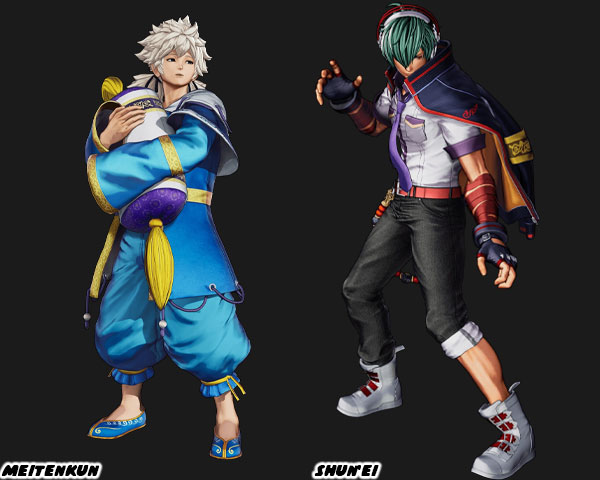
Since China was becoming the biggest gaming market. It only made sense for SNK to make a title that could win over Chinese fans. This was why the two new leads in KOF were added to Team China. Meitenkun, and Shun’ei made more sense in that role than the “Psycho Soldier” team of Athena, and Sie Kensou. The team also had the elderly master trope of Tung Fu Ru, who was a mentor to Terry, and Andy Bogard. Meitenkun, and Shun’ei were decidedly unlike the super-strong brawlers that Americans were used to seeing. They weren’t tall, weren’t buff, and weren’t “manly” by western standards. The sleepy Meitenkun was a decidedly soft boy with incredible internal power. He was a sort of pretty boy that could be appealing to female fans. His name actually sounded like the Mandarin saying “mei tian kun” which meant “sleepy everyday". The other character Shun’ei was meant to be the star character. He was an updated take on the cool guy, the new Kyo essentially. His school uniform was just as fashionable, and he even wore it with one pant leg rolled up, take that Jamie! The designers behind Rock Howard, the young star of Garou Mark of the Wolves, had a hand in creating Shun’ei.

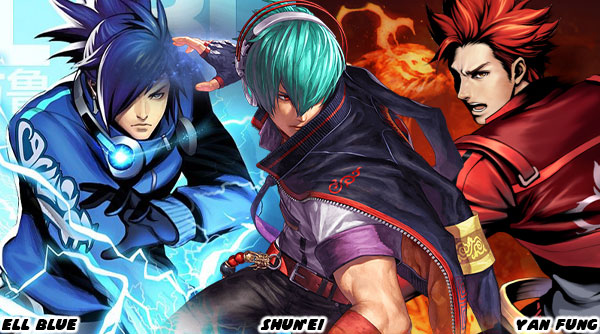
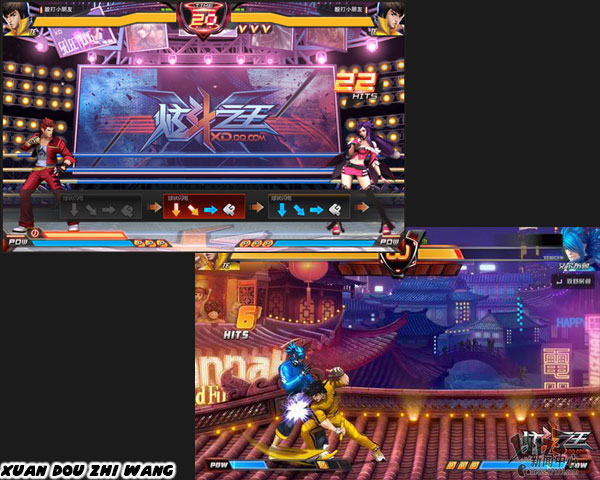
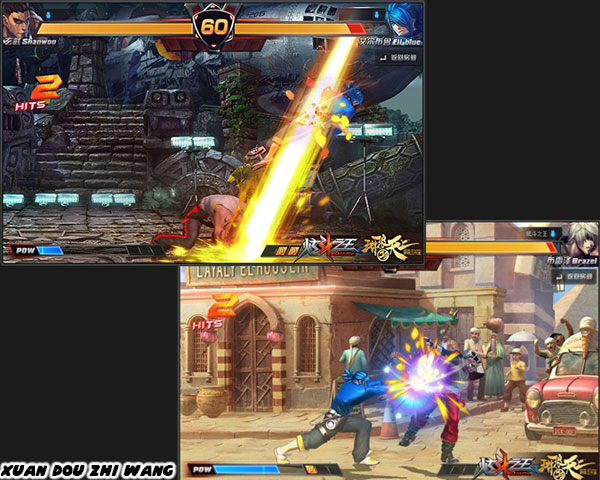
Many of the KOF star characters did not represent a traditional martial arts style, they were given awesome powers instead. Very much like comic book heroes. Kyo had flame powers, as did Ash. Shun’ei had both flame, and water powers. These were reflected in the red, and blue psychic hands that he attacked with. The design, and choice of colors I think was done in response to the popular home-grown Chinese game Xuan Dou Zhi Wang aka King of Combat. Jade Studio developed the game for publisher Tencent Games in 2011. It would receive new characters, and stages over the next eight years. This was well before 37Games acquired SNK. Those that had seen King of Combat, and had played it could say that it was a clone of the KOF series. The character selection, and even stage design seemed lifted from SNK’s best work. I had already talked about this connection with Shun’ei, but essentially his look was an amalgamation of Ell Blue, and Yan Fung, the stars of that game. 

Two years before SNK was sold Tencent announced a crossover where KOF characters would appear in King of Combat. This raised the status of the game, and made the copycat title appear more legit to the Chinese fighting game community. It also helped make sure that the aesthetic that SNK used would remain more Asian influenced. These things helped explain the shift in changes from slim-to-buff, back-to-slim characters in KOF. There was something happening in Capcom as well. I'm going to talk about it on the next blog. I hope to see you back for that. I’d like to hear your take in the comments section. Let me know what you think defines the Capcom, SNK, or the style of any publisher. As always if you would like to sponsor me please visit my Patreon page and consider donating each month, even as little as $1 would help make better blogs and even podcasts!
follow the Street Writer on Patreon!

Monday, June 6, 2022

Luke in Street Fighter 6, what's different?

I think it’s fair to say that the team working on Street Fighter 6 has been paying attention to feedback from the community more than previous teams. Street Fighter 6 Director: Takayuki Nakayama, Producer: Kazuhiro Tsuchiya, and Designer: Yusuke Hashimoto have talked about the game, features, and community briefly. Despite everything revealed in the trailer, the team itself is still playing their cards close to their chest. The reason for this secrecy was foreshadowed following the release of Street Fighter V: Arcade Edition. Yoshinori Ono who, to be honest, I never cared much for his direction of the series, was said to have been rubbing the team the wrong way with his ideas, and development of SF6. He was let go in 2020 to join another company. One of the inescapable things that the studio had done, aside from the silly fat joke characters, and fourth-wall breaking gags, was the insistence of adding blonde haired, blue-eyed characters across Street Fighter IV, and V. 

The global community saw every slot taken by mostly white characters as a missed opportunity. Could there have been a native, Black, brown, Asian, or female character in that spot instead? When Luke was unveiled as the new star of the franchise, Capcom got a lot of heat online. I mention some of the responses on my original take on Luke in Street Fighter V. There was nothing I could have said better  about the disappointment of seeing another blonde-haired, blue-eyed, white character get set to carry the franchise. It had been tried before with Alex in Street Fighter III, and Abel in Street Fighter IV. By the time Luke was announced it was 21 consecutive years of not letting any other minority sit in the driver’s seat. Just for the record Street Fighter V: Arcade Edition had 12 blonde, and light-skinned characters (13 if you count Rainbow Mika).

The amount of native, Black, brown, and minority Street Fighter fans the world over had never been bigger. They were gaining momentum in cartoons, and comics, in the pop culture convention circuit, in the cosplay community, as well as in gaming tournaments. People had followed the series since the original was released. I remember playing with oversized foam buttons in the arcade way back in 1987. Some of these Gen-X players raised their own children on the franchise, and a few had even become grandparents. That’s right! There were third-generation Street Fighter fans being introduced to the series, and many had never even seen an arcade cabinet to begin with! It’s not hard to imagine that the millions of fans around the world were feeling left out of the conversation. Following the pushback on Luke, the leaked lineup for Street Fighter 6 was like night, and day. The new game seems to have five returning blonde, and light skinned characters. More important; it adds zero new ones. There are eight women from around the world, and five of which are brand new characters.

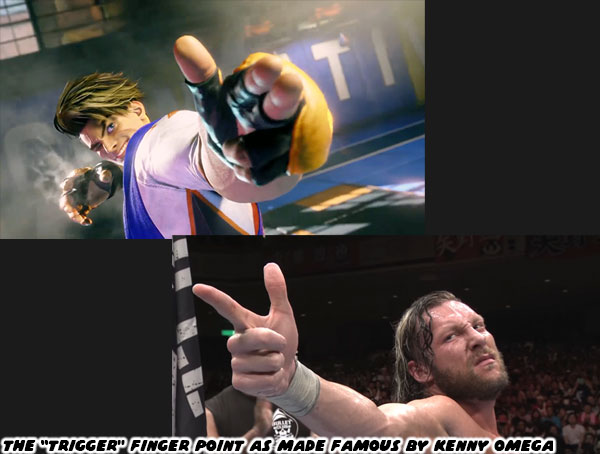
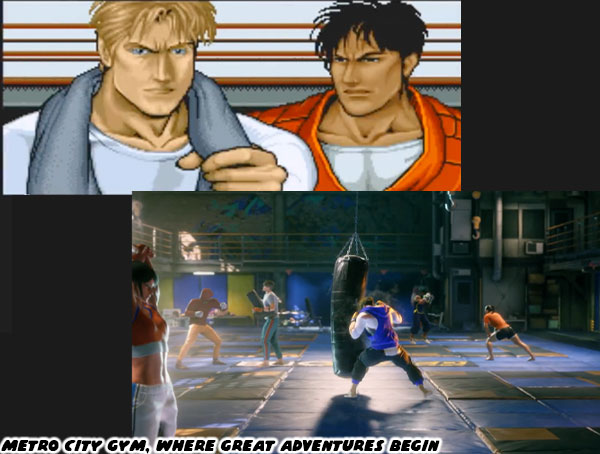
Luke is still central to the plot, but his appearance has been altered somewhat. We get an entirely new take on the young striker in the SF6 trailer. We see Luke punching a heavy bag in the Metro City Gym. He strikes a familiar pose before he smashes the bag with his hardest strike. Wrestling fans would note his pose appears like Kenny Omega's "V-Trigger." Omega is a huge gaming fan, and pro wrestler. He played Cody in the Street Fighter V: Arcade Edition trailer. They gym itself appears to be the very same one that Cody, and Guy were training in at the start of Final Fight more than 30 years ago.

Final Fight was originally dubbed Street Fighter '89. Some of the team that created the original SF had left Capcom to join SNK. They would go on to develop the Fatal Fury, Art of Fighting, and King of Fighters franchises. The remaining members at Capcom decided to capitalize on the popularity of Double Dragon, and replace Ken, and Ryu with Cody, and Guy respectively. The new game would still feature lots of fighting, but a bigger narrative to go along with it. Arcade owners, and studio heads asked to change the title, and work on a proper SF sequel. Thankfully they did, but many long-time fans were left wondering what if the SF series had gone down the path of an open world brawler. Street Fighter 6 actually seems to be a return to that idea. At least parts of it do. The new leads are Luke, and Jamie, recreating the partnership of a white guy brawler, and lightning quick Asian martial artist. For the most part Luke seems much more approachable in his SF6 makeover. Let’s take a look at how he changed.

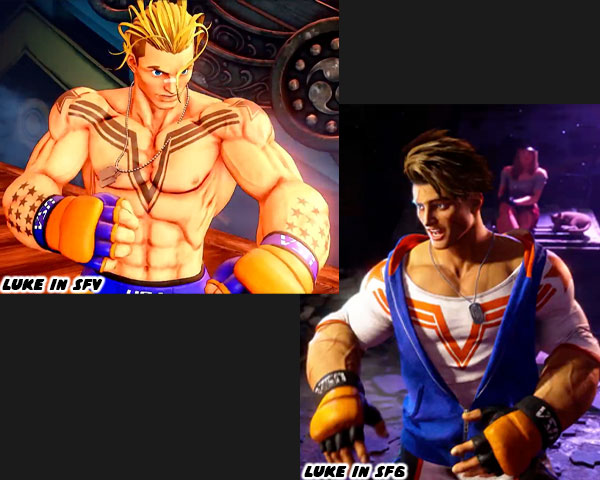
Luke’s frame, and build have changed considerably. I always believed that the 3D models featured in SF IV, and V looked too bulky. When every character was hyper-muscular, then none of them really stood out. It was one of the directions that Mr. Ono had supposedly insisted on. If you look at Luke you will notice that his shoulders are not as protruded as before. His hair is not as stringy, and the stars shaved into the sides of his head have been removed. The star tattoos on his forearms have been replaced with scars. The wing tattoo across his chest, and back, are gone, and now represented by a tee shirt instead. I had commented previously that solid black tattoos like these were being appropriated by white nationalists in the USA. It would have been possible for far-right groups to hold up this character as an example of true patriotism. I’m glad that Capcom had the sense to eliminate most of the markings.

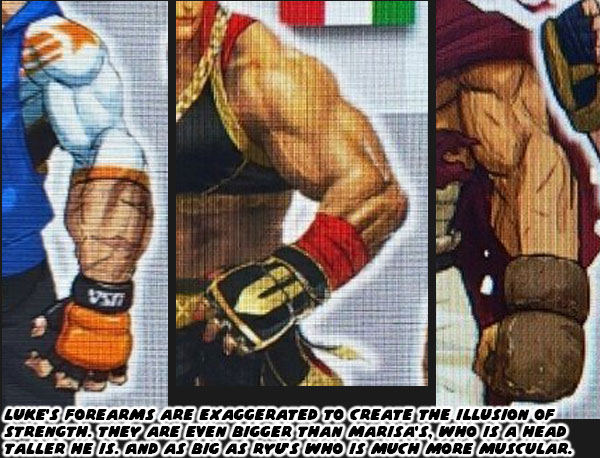
Luke had a bandage across his nose previously. This was removed, and replaced with a long scar running over the right side of his face, from the forehead, down to his cheek. You could say that he's not a pretty boy any more. His boxing trunks have given way to training pants. He still looks like an MMA practitioner, but no longer a poster boy for white nationalism. The one thing that didn’t change, and I think is his stand-out feature are his massive forearms, and fists. Exaggerated muscles, oversized hands, and feet had been used in Street Fighter Zero / Alpha in 1995 to convey the adolescent cast. Luke’s forearms are obscenely huge by comparison! He has the biggest forearms in the game, proportionally to his height. They are in fact bigger than his biceps.

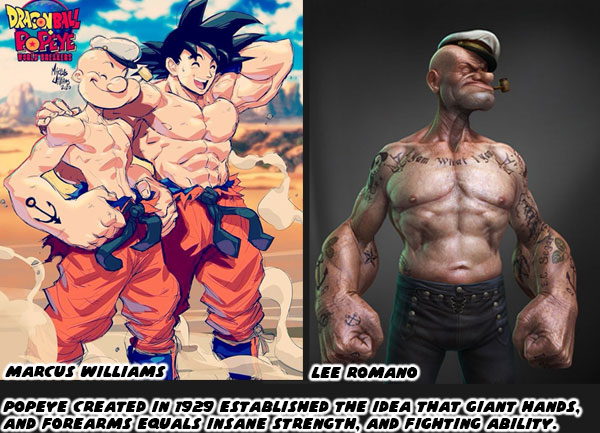
This is a cartoon quality that I think works well in the lineup. Characters are not as hyper-muscled as before. They still appear strong, but are nowhere near as bulky as they had been in the past decade. There are more pronounced differences in height, weight, and build. Their bodies were closer to the proportions used in Street Fighter III. In fact I did not see any comedic “fatties” or odd-colored characters in the leaked lineup. I’m willing to bet that the team working on Luke gave him intentionally big forearms, and fists as a nod to Popeye. This would help make him appear as one of the most powerful punchers in the game, even if he wasn’t the tallest.

In case you don’t know Popeye was first seen in the Thimble Theater comic strip in 1929. He was the original cartoon brawler, and capable of superhuman feats almost a decade before the creation of Superman. Most comic, and cartoon fans would agree that Popeye was technically the first superhero. If indeed this influenced the changes to Luke then I appreciate the effort. Much more seems to be going into the development of the SF6 lineup, than the previous two games. Although the rest of the cast has not been finalized, let alone announced, I will be discussing them over the next few weeks. I hope to see you back for those entries. For now I’d like to know your take on Luke. What do you think about this character as the face of SF6? Would you like to see more representation in the game? Is this a bad idea? Let me know your takes in the comments section. If you would like to sponsor me please visit my Patreon page and consider donating each month, even as little as $1 would help make better blogs and even podcasts!
follow the Street Writer on Patreon!

Sunday, June 5, 2022

A first take on Jamie, the new Street Fighter 6 character

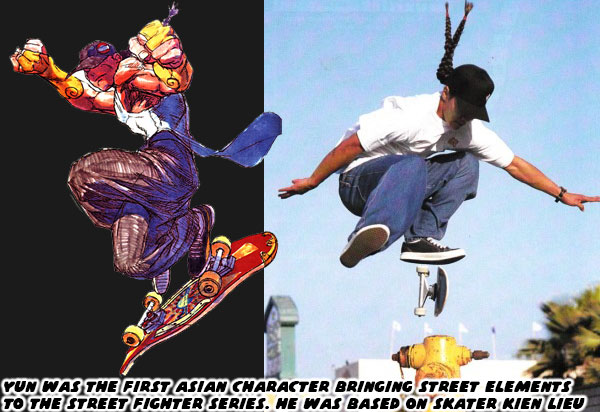
The full Street Fighter 6 trailer dropped recently. Make sure to check it out before continuing. Today we are going to focus on Jamie, the young kung-fu fighter. He is one of the new characters introduced in the footage, and apparently the friendly rival to Luke. I will be going through every character announced so far, the changes made to those returning, as well as those that were leaked in more depth. But for now let’s focus on Jamie. The character is listed as from Hong Kong. As you may know it was previously under British colonial rule before being handed over to China. Culturally they people from Hong Kong had more western influences, and freedoms, thus the transfer to a more authoritarian government was met with resistance. Jamie is similar to other young Street Fighter (SF) characters in that he wears what appears to be traditional martial arts gear, with a hint of modern touches. This trend for the series started in 1997 with Street Fighter III. Yun, and Yang were twin brothers that wore what appeared to be traditional outfits, but skateboarded, and inline skated respectively.

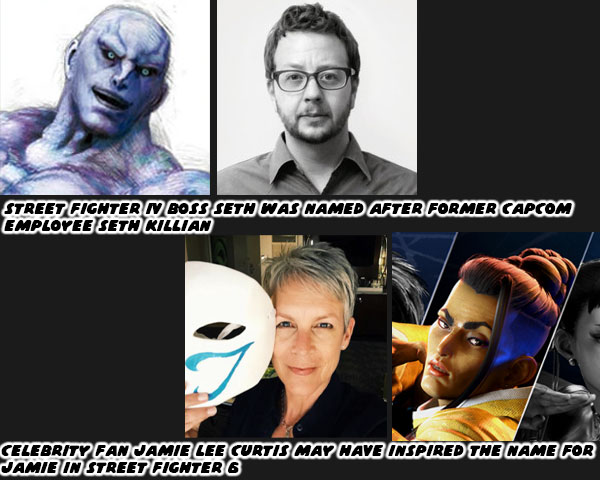
The other thing that stood out for the character was the name. Jamie is not a name that we might consider traditionally Chinese. To be fair, a number of Asians have both traditional names, and adopted western names. For example Lee Jun-fan was the birth name of Bruce Lee, and Fang Shilong is the birth name of Jackie Chan. Capcom often gives the staff leeway on the names they select. James Goddard named his Black kickboxer DeeJay in Super Street Fighter II. It is well known that pro fighting game player, and Seth the boss in Street Fighter IV was named after former Capcom Community Manager Seth Killian. If I were to guess where the name Jamie came from it would be from actress Jamie Lee Curtis. She famously attended the EVO tournament in a full Balrog / Claw costume. She has been known to dress up as various pop culture icons in order to attend conventions incognito with her family.

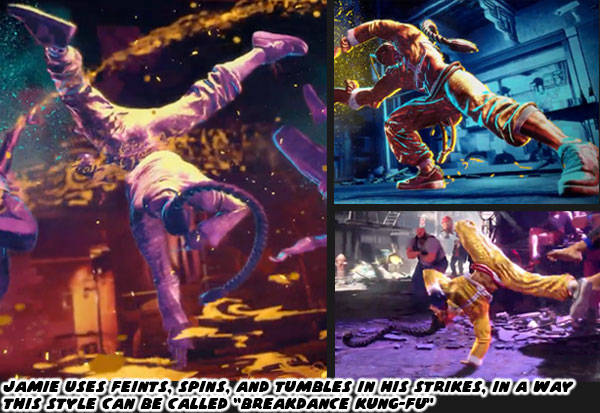
Jamie moves unlike almost any other character in the series, or in fighting games in general. In the trailer we see footage of him spinning, flipping, and tumbling with a ton of dexterity. He has quick strikes which are a mix of kung-fu punches, but with the footwork that appears like an uprock, the foundation of competitive breakdance. His stance, and movement is dance-like, it stands out like a “ginga” does for capoeira practitioners. Given his design, it stands to reason that the young fighter is having fun with his natural abilities, as well as his training.

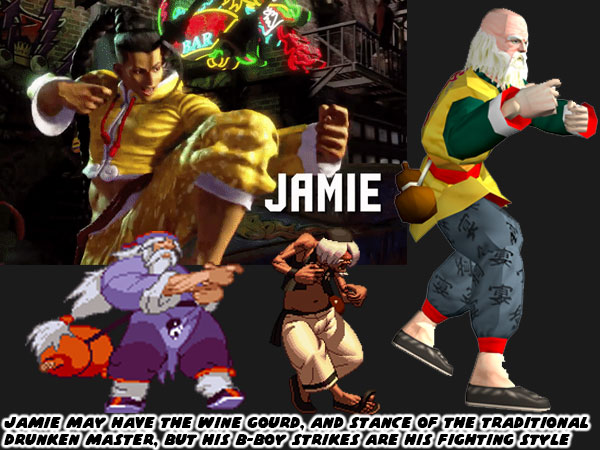
At first glance the character appears to be a master of Drunk Fist kung-fu. He carries a gourd, which is often filled with wine, according to popular media. Although his stance, and fist positions seem to be those of a traditional kung-fu master, very few of his strikes appear to be based on any traditional form of kung-fu.

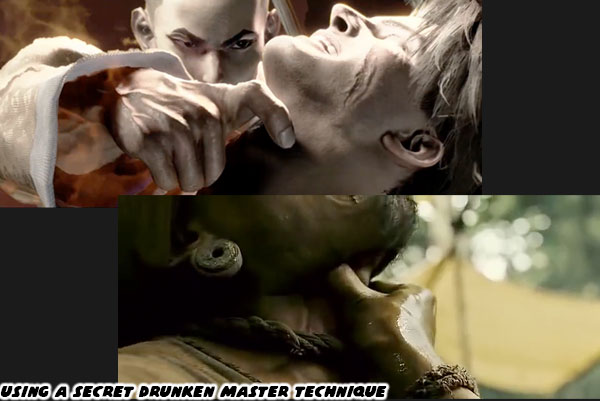
There is a part in the trailer where Jamie says “my secret art” then goes for Luke’s throat. This was similar to a move used by Tony Jaa in Ong Bak 2. Jaa was playing the mythical fighter Tien in the film. Tien was a young prince that got kidnapped by pirates, and trained in multiple forms of combat. The character makes his way to some bandits that had brutalized him, and his friends earlier in the film, and fights off a slave trader using Drunken Fist. He grabs the villain by his Adam’s apple before throwing him through a stand via fishhook to the mouth. I sincerely hope that Jamie doesn't have the full attack in SF6.

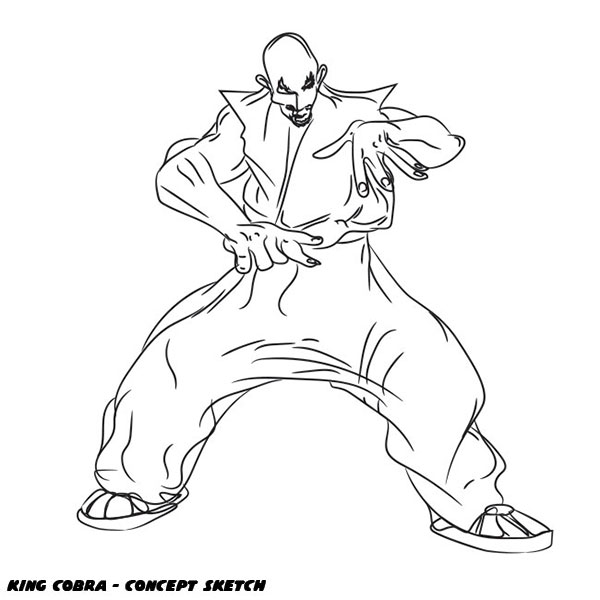
Jamie’s style can be best described as “Breakdance Kung-Fu.” If you remember your SF history you will know that before Rufus there was a young Black fighter in the planning stages called King Cobra. Although he wore what appeared to be a traditional karate gi, his method of fighting was said to be a form of breakdance kung-fu. He sported sneakers, and a gold chain, showing just hints of an urban background. Sadly there was never a 3D model, or sprite built for this character, let alone the actual animated moves. All we have to go on are concept sketches.

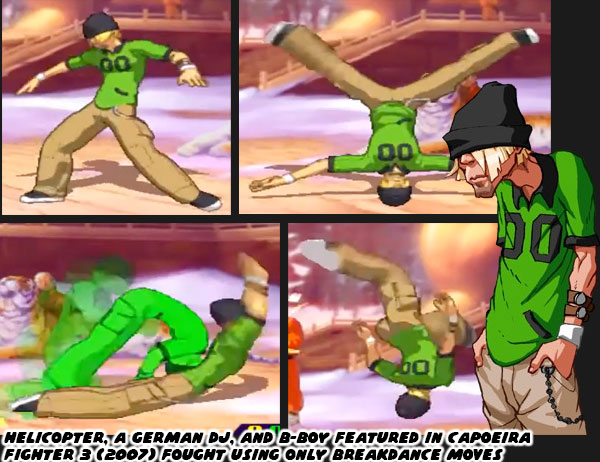
To be completely fair, there was a fighting game character whose entire arsenal was based on breakdancing. Helicopter from Capoeira Fighter 3 used nothing but b-boy moves. Even his stance, and movement saw him performing the wave as he danced through the stages some 15-years-ago.

Many people feel that no great idea goes to waste. Elements of King Cobra eventually found their way into the series. Ken was given an alternate costume in SF IV that looked just like King Cobra’s. Also the fictional form of striking eventually found its way to Jamie. Which makes more sense than to give it to the Black kid from the US. Since Jamie is from Hong Kong, and blends eastern, and western cultures. So what exactly are the origins of dancing as a form of fighting? The roots are based on tropes, and racial undertones. The Black athlete, and Black entertainer are stereotypes known the world over. In many of the early fighting games Black characters were presented often as basketball players. At least one was presented as a dancer.

Mind you, before the internet, it was tough for Japan to get a finger on the pulse of US culture. All the gaming studios had to go by was pop culture references. The way Blacks were portrayed in movies, music videos, and TV shows did a lot to color their perception. Hip Hop was, and continues to be a major part of that perception. The cultural revolution moved into every corner of the world. The four elements of Hip Hop; rap, breakdance, DJ, and graffiti influenced everything from advertising, to fashion, language, and music of course. The trailer for Street Fighter 6 even begins with a graffiti styled version of the Capcom logo. 30+ years ago the Japanese studios were not as in tune as to the proper ways to reflect, let alone incorporate that culture.

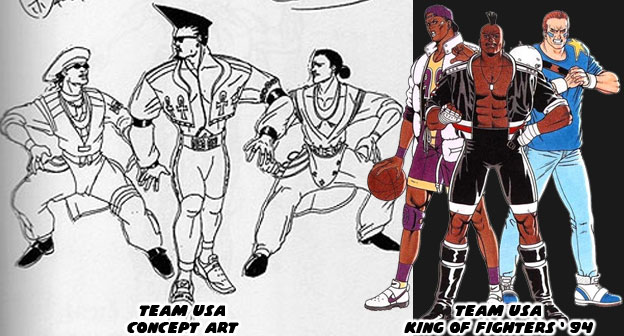
The concept for Team USA in SNK’s iconic King of Fighters series was laughable. The trio of men in costumes that were reminiscent of back-up dancers for Salt n Pepa, or Janet Jackson made little to no sense in a fighting tournament. Yet the Japanese designers persisted. They continued putting in elements of Hip Hop into the games. Jamie may yet be the most in tune the studio has ever been to the elements.

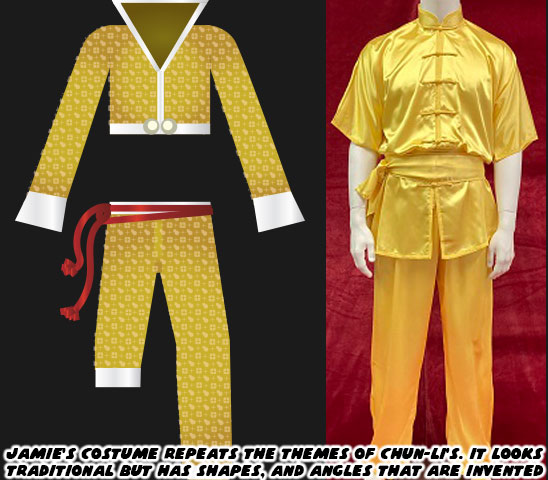
Pay very close attention to the cut, color, and design of Jamie’s costume. It looks traditional, but is far from an actual outfit worn in classic China. The illusion of a certain form, and fit is a long-standing design legacy of Street Fighter. I spoke about it at length with Chun-Li’s costume. Most wushu, or tai chi uniforms are made of soft, silk material, but the shirts usually hang long, and the pants are baggy. Jamie’s has a cut top, exposed midriff, and the the shirt, and pants fit more snugly. Also instead of a sash belt, Jamie wears a red cord belt, to hold his gourd. Also note that in all of the footage revealed of the character he wears one pant leg rolled up. Sure enough the Hip Hop elements are not lost on this kid.

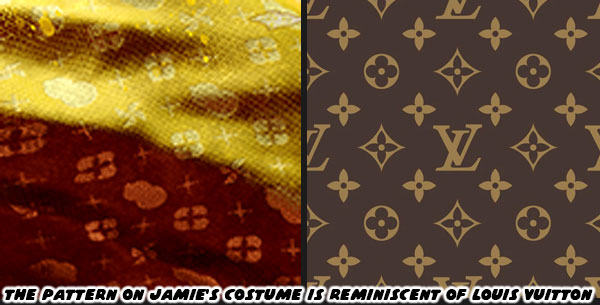
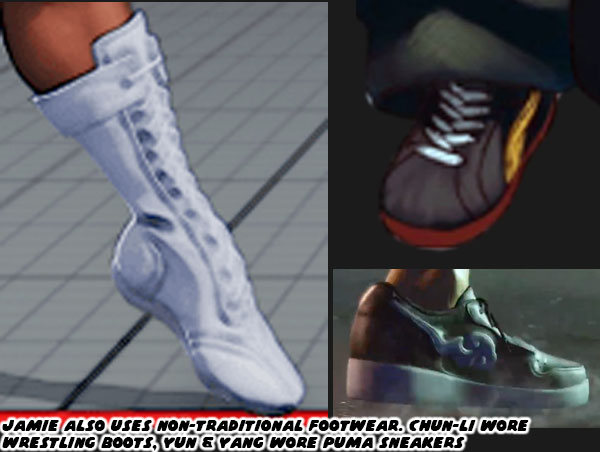
If you look carefully at his costume there is a repeated pattern over it. Some competition uniforms may feature an embroidered phoenix, lion, or dragon on them. However Jamie has a pattern reminiscent of the Louis Vuitton brand. As you may know a lot of rappers promote material displays of wealth. In videos, and photo shoots they are often showing off, or “flossing” diamonds, gold, and rocking brands like Louis Vuitton, Gucci, Prada, Dolce and Gabanna, etc. Jamie’s version of the pattern uses the stars, and gourd motif, as a clever nod to the designer. Also Jamie is rocking some Cloud-label sneakers, instead of the flat-soled shoes that most practitioners wear. The cloud motif shows up on other parts of his outfit. Perhaps to denote his light, and airy fighting style. The use of non-traditional footwear again goes back to Chun-Li, who wore white wrestling boots instead of dainty slippers. Yun, and Yang sported Puma brand sneakers. As a nod to Keen Lieu, who was sponsored by the brand when Street Fighter III was developed.

These were the things that I was able to pick out about Jamie after seeing the footage of the character. I will be digging in to the rest of the cast over the next several weeks. I hope to see you back for that. Is there a character you would like me to look at sooner, rather than later please let me know. Also any feedback would be appreciated. What details did you notice about Jamie? What do you think of the SF6 announcement so far? Are you interested in playing this game when it’s released? Let me know in the comments section please. If you would like to sponsor me please visit my Patreon page and consider donating each month, even as little as $1 would help make better blogs and even podcasts!
follow the Street Writer on Patreon!

Thursday, August 5, 2021

A quick take on Luke, the new Street Fighter.

Another year goes by, and another new Street Fighter character is introduced to a lukewarm reception. This new character is named Luke, he was the mystery character added for the Summer 2021 Street Fighter V reveal. Takayuki Nakayama Director of Street Fighter V, and Shuhei Matsumoto the Producer of Street Fighter V showed off the inclusion or Oro. The elderly fighter that had originally appeared in Street Fighter III way back in 1997. Luke was a new face, and presented as the future of the series. I am thankful for Twitter because the hot takes on this character were very spot-on.

Many fans were unimpressed with the reveal. One of the first reactions came from @adam_rsfv who compared the new character to YouTube personality-turned-pro fighter Logan Paul. Logan, and his brother Jake have grated many people with their online antics. These include allegations of sexual assault, filming a dead body in a park, insulting the Japanese while on vacation, and acting like general nuisances. In a way they do reflect the culture of fame, and notoriety from the USA. You don’t have to be the best at what you do, you just have to be the best at promoting what you do. But those were far from being the only takes on the character reveal.

The fish-mash of design elements for the hair, tattoos, and costume of Luke were pointed out right away. @ryo_redcyclone said the character was piecemeal from other Street Fighters. It was easy to point out these influences. Like a villain in a daikaiju, or giant monster tv show.

Many lamented that there was another white boxer in the series. Luke follows on the heels of Ed, a white striker that had been introduced not long ago. The Street Fighter series was known for having a string of powerful Black fighters including Mike, M. Bison, and Dudley. Now in one game two white boxers had turned up. Some compared his look, and introduction to Steve Fox, the British boxer from the Tekken series. Katsuhiro Harada, producer, and director behind the Tekken series agreed with a fan reaction that this might be Steve’s younger brother.

All jokes aside the news of another white character designed to be the face of Street Fighter, the future of the franchise, was met with groans from many fans. Those that had been with the series a long while remember that Alex was supposed to be the face of a New Generation, starting with Street Fighter III. Then almost 15 years later the grappler Abel was designed to appeal to the west in Street Fighter IV. He was supposed to be the go-to character for Americans. Yet in each instance players passed him over to try other other new faces.

With one word to Capcom @KAINONAUT calls out the pattern, and like many minorities, is exhausted with the trend. With each legacy character returning to Street Fighter V players could see that the franchise was favoring the return, and the introduction of white, mostly blonde characters. It was hardly representative of the USA, and given the past four plus years of politics, and civil unrest, you would think Capcom could read the writing on the wall. This is why I am grateful for the internet, for Twitter, and players that are able to dig deep into the history of the series, and call out the company for making missteps when they have a chance to rise up, and produce something exceptional.

In a reply to Kai @mossy_dahlia reminds us of the greatness that could have been. King Cobra was a marvelous design, and the final design known as Rufus was the opposite. On the 30th Anniversary of Street Fighter I highlighted the 30 most important characters to me. Although he never appeared in a game I named King Cobra #1 When that character was turned into an obese white guy for the sake of being funny I knew the series, and director had lost their way. It didn’t make me boycott the series, but constantly call the studio out because I knew they could do better. Most people that read my blogs want to get to the heart of the character, what works, what doesn’t work with Luke? What should Capcom do?

First-off white boxers are nothing new in Street Fighter, or fighting games. Joe was featured in the original Street Fighter. What is concerning is that many of the newer boxers that end up in fighting games tend to be white, and blonde. Even if they come from Hong Kong like Shen Woo in the King of Fighters series. SNK, and Capcom have had their share of Black boxers in the KOF, and SF series. If I were to ask most of my friends to name champion boxers in any weight division I’m sure they could come up with many Black, Latino, and Asian-Pacific names. The white champions (especially blondes) would be few, and far between. Why then should fighting games go out of their way to cater to a certain demographic?

Capcom has demonstrated time, and time again that they are unwilling to take a risk. They want their lead character designs to be accepted by the west. This goes into the use of colors, tattoos, body markings, costumes, etc. If you look at several of the new characters, you’ll start to spot certain trends. Blonde female characters for example tend to get military alternate costumes, with goggles. For the new men the use of solid color tattoos, and patterns, turns up. It was on Necalli, Ed, and now prominent on Luke. The USA is a huge market for the studio. So if they look at pop culture, fight culture, wrestling, MMA, and the like they want to create a fighter that appeals to those fans. The Logan / Jake Paul comparisons for Luke are warranted. What Takayuki Nakayama, and Shuhei Matsumoto may not realize is that this type of fighting "personality" may be popular, but they are often reviled. They aren’t necessarily what the Street Fighter audience either wants, or what the game needs. In many cases fans are eager to try more unique characters.

I mentioned that Abel was designed to be the new face of the series in SF IV, but he was originally an androgynous little boy. The studio thought it would be too risky to have the skinny character in pigtails be able to judo flip larger opponents, so they turned him into a huge bruiser. To cover their bases the studio also created a female spy for the west. C. Viper took her inspiration from the western ideal of beauty, skinny with big lips, a bit like actress Angelina Jolie. When Capcom started trying out the SF IV cabinet in the US they were surprised that players were skipping over Abel, and C. Viper. The characters they designed for the market were failing. Yes they found some fans, but were largely not missed in SFV. There were many reasons why they didn’t work. I think Japanese interpretations of western trends was simply lost in translation. It turned out that when the studio created a character that more closely reflected a classic design, say Juri Han compared to Chun-Li, then the character was more widely accepted. I’m willing to bet that the little kid Abel would have been better remembered by audiences because he was out of the ordinary. Or then again, because he reflected smaller fighters like Ibuki, Makoto, and Sakura.

There is something that concerns me with Luke’s design. Again, it circles back to Japanese creators trying to interpret western tastes. We can tell he is supposed to be a patriotic character, somebody akin to Guile. Guile was a soldier that literally carried his nation on his sleeve. For Luke the stars, and stripes, in the form of tattoos, and even a haircut sends a similar, but not equal message. The use of solid color tattoos is something that I don’t think the people at Capcom considered. These types of tattoos have been more closely aligned with Far Right ideology in recent years. We saw police covered in patriotic tattoos, notably those of the Three Percent, a group identified by the Anti Defamation League as a far right militia movement. These officers have intimidated, and killed in the past. Many were fired, or forced to retire when they were outed as members of the group. The tattoos even turned up Patriots kicker Justin Rohrwasser.

In every instance people with Three Percent tattoos, and the like, all claim to be patriots. They claim not to subscribe to any racist ideology, but want to defend their country. It turns out that they want to defend their country from people that are not like them. Usually white, usually well off. Those that are minorities, gays, trans, Black Lives Matter supporters, Muslims, Liberals, Socialists, or immigrants are the enemy. They even go so far as to claim Anti-Fascists are the biggest threat to the American way of life. The irony in that logic cannot be understated. Guile had a design that could never be lumped into a hate group. He was intentionally designed to be over-the-top, like a GI Joe character that happened to be in a fighting game. He was fighting not for fame, but to get revenge for his fallen comrade, the soldier Charlie Nash. Luke seems to be in the game for himself, to be big, and famous. Sure it could be seen as being distinctly American, but there was more to this nation than a clone of the Paul brothers. I believe Luke doesn’t work because he has conflicting design elements. The sorts of elements that went into Ken for Street Fighter V.

More important I think Luke doesn’t work because Capcom does not know how to take a creative risk. When the studio says they are doing a deep dive, they often miss the elements that made their early generation characters work so well. They fall back on tropes, and stereotypes. Look at how Turkish oil wrestling was presented, or Mexican lucha libre with Hakan, and El Fuerte in SF IV. Fat people became used as joke characters in the series. Starting with Rufus, but spilling over into Birdie as well. The studio forgot that giant characters weren’t always stupid. Luke is designed to be modern, and edgy. He’s probably going to be as well remembered as Necalli in a few years. This is what drives me crazy about Capcom. Greatness is right in front of them, in many concept pieces for a character never used. For a throw-away design given to an existing character, as a costume. If only they would take a moment to listen, to trust their idea, and not what they think we really want. Lord knows I’ve tried to get through to them. I’ve applied to work at that company a half-dozen times. Even asked the producers to please read the blog. I’ll keep on pushing them to do better. I hope the community does too. If you would like to sponsor me please visit my Patreon page and consider donating each month, even as little as $1 would help make better blogs and even podcasts!

follow the Street Writer on Patreon!