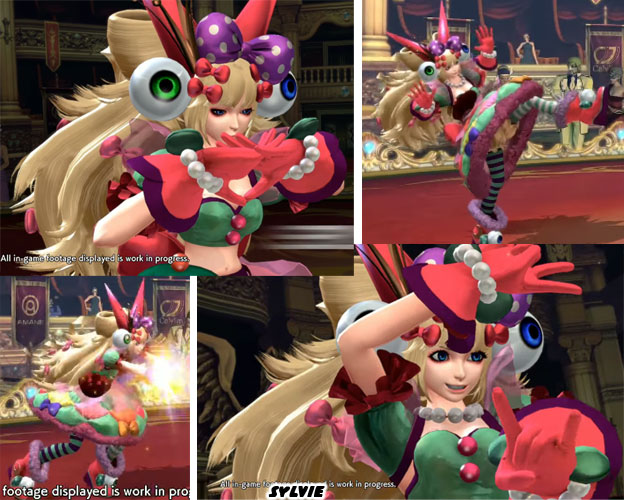
Did you know that the King of Fighters franchise is celebrating 25 years? It began with the original Fatal Fury back in 1991 when Geese Howard sponsored the first tournament. Now with the debut of King of Fighter XIV there are 50 playable reasons to celebrate. Yet one was revealed recently that sort of came out of left field. The franchise has had many odd characters, don't get me wrong, but this new character is really pushing the envelope for what works for the franchise. In case you hadn't heard or seen of this character let me introduce you to Sylvie.
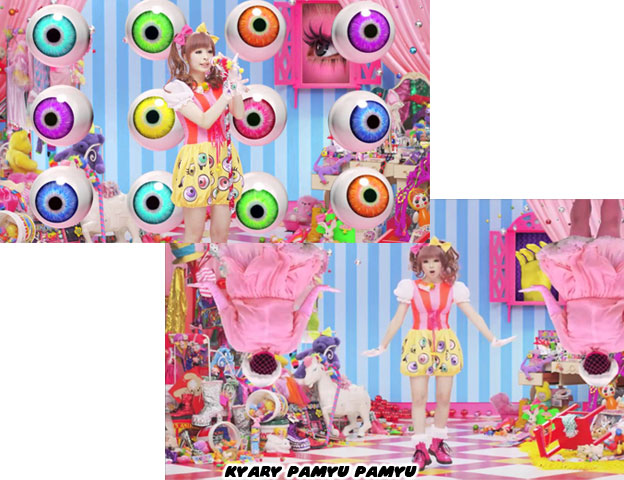
Her look is very over-the-top. Oversized bangles, pearls, gloves and the puffiest of vinyl skirts covered in star-shaped pillows. She looks like a cross between a pop idol and a fashion stylist from Harajuku. To be fair a lot of people online have called SNK out on poaching Sylvie's design from pop star Kyary Pamyu Pamyu
specifically the Pon Pon Pon music video from a few years back. I'd be hard pressed to defend SNK on this one.
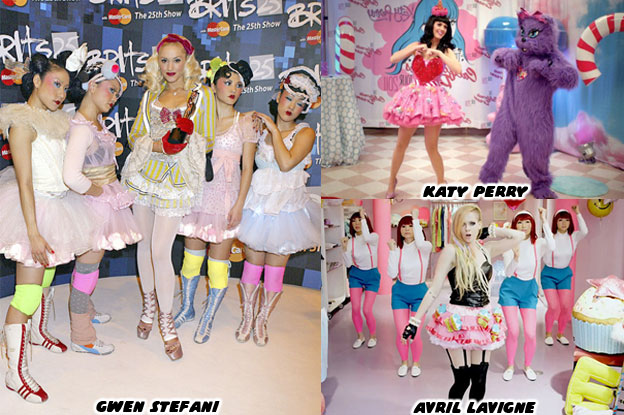
Companies, ad agencies, producers and other musicians have been poaching elements from street culture for decades. Thanks to how quickly trends spread on the internet the companies or artists that want to be ahead of the curve have to do this more often. They want to keep a sharp eye on what is happening in the West, in Europe and especially in Japan. Harajuku is an area between Shibuya (home of Jet Set Radio's famous GG's) and Shinjuku where youth culture converges to create the fashion trends of tomorrow. This area is so well known that artists have been going to it to be "inspired" for costume ideas, so much so that even western performers have been poaching ideas from it for years. Singer Gwen Stefani has made it no secret that she worships Harajuku girls and created an album, perfume and fashion line around them. Also pop stars like Katy Perry and Avril Lavigne have been swiping ideas from them for videos and concert tours. It can be a little more than insulting when Japanese girls are mainly used as ornaments for Western acts. As if they exist only to be props in a music video or backup dancers on a tour. Sure their culture and fashion are good enough to steal but heaven forbid that a Japanese singer tries to cross over to the West. Suddenly the roads for exposure, for distribution and contracts dry up faster than the California reservoirs. But I digress…
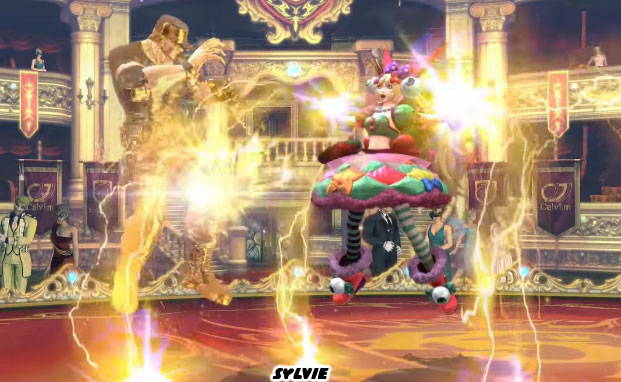
Sylvie has a very strong Harajuku idol look. But if you dig a little bit deeper there is a reason why she is in the KOF lineup. She seems to possess some sort of electrical power that emits from her hands. It may be because of some sort of power source hidden in her costume, sort of like Rashid in Street Fighter V, which would explain why her clothes seems to be made out of vinyl. However she probably generates the power naturally. There are other characters in the universe that can emit fire, ice and other forms of energy from their hands. Of course it isn't enough that she can shoot bolts of lightning but she generates enough power to fly. Which is amazing in and of itself. She can also generate force fields, like electrical cages and throw her opponents around. Sylvie is small and doesn't seem to be very muscular so power moves were probably not going to be her forté. There were other women in the series that were amazingly strong but usually that was due to genetic modification. Sylvie's electrical powers are a good equalizer especially when going up against the power players. As odd as she appears she actually is a good fit for the King of Fighters universe.
With that said not every character design works in every fighting game. Sylvie would be very much out of place in a western-produced game like Killer Instinct or Mortal Kombat. Those games have mature women which are ruthless killers, some are monsters in disguise or even sorceresses. Not to mention that they wear skimpy clothing and are usually designed to be sexually appealing. The design of Sylvie is grounded in reality, well, the reality of youth culture in a very specific part of the world. The reality presented in Mortal Kombat or Killer Instinct is more on the western fantasy, or horror side. When Sylvie debuted it got me wondering where the precedence was set for someone like her to be included in traditional fighting games. Over the past three decades there have been women, both adults and girls in fighting games representing a wide range of styles and different schools of martial arts. There have even been all-female fighting games in different formats created as well. A character like Sylvie however is a female fighter that has no discernible style or technique, an "outsider" character for lack of a better word. Where did those archetypes come from and what did they represent in the genre?
While there had been women in brawlers, including some of the first female and trans villains in games like Double Dragon and Final Fight, from 1987 and 1989 respectively I want to say that the first "outsider" girl character that stood out was Kurara Hananokoji. The 13-year-old magical girl appeared in the game Power Instinct 2. The game from 1994 was developed by Atlus. It was a sequel to the 1993 arcade original. It was one of the first fighting franchises that was presented with a strong sense of humor. The characters in the title were typical archetypes from other fighting games, a Shaolin Monk, a ninja and a Native American. Then there were geriatric twins Otane and Oume Goketsuji that were excellent fighters and could even shape shift into their younger former selves. I wouldn't say that the game was meant to be a parody of the genre but instead it was as if a silly comic book were turned into a fighting game. One of the stars of the game was Kurara. She had elements from manga and anime shows about magical girls. To make her inspiration more obvious she was voiced by Kotono Mitsuishi the voice actress of Usagi Tsukino, the star of Sailor Moon,
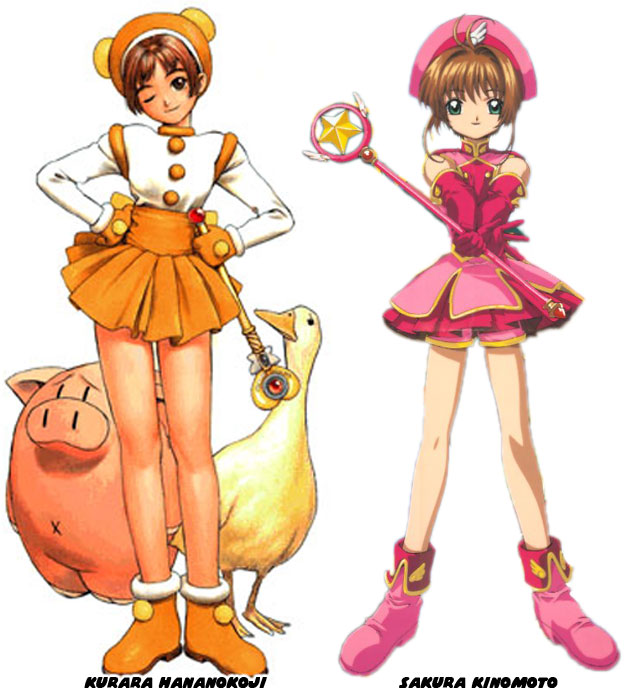
Here is where things get interesting about Kurara. Her designer was Range Murata. He was a popular artist that had worked for Atlus and Psikyo. He was known for his cheesecake paintings so it was interesting to see him develop a bunch of fighting game archetypes that weren't all topless female models. Kurara was a cute design by herself. For years I simply assumed that Range had poached the look of Cardcaptor Sakura from the popular manga and animé series by female artist collective CLAMP. It turned out the opposite was true. The CLAMP book wouldn't debut for another 2 years. In that time Atlus developed two games featuring Kurara. Sure the bangs, magical wand, skirt, boots and puffy hat might be coincidence then again they might not be. Of course Range wouldn't be able to get very far in the franchise unless he did some fan service. In this case he turned Kurara into a cheesecake character as well. In order to avoid doing this to a 13-year-old he created an alternate version of her in the 1995 release of Power Instinct Legends. Since she had magical powers she could turn herself into an adult, this version was called Super Kurara. Her moves and costume changed completely.
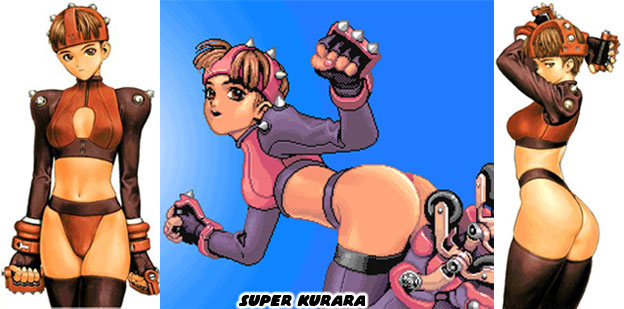
Her updated look left little to the imagination. Super Kurara's attacks were more physical than magical. From a design standpoint Kurara represented several important elementsthat could be applied to other female archetypes in fighting games. Women and girls could appear in fighting games but their design could be pooled into one of two camps. There were female characters that were practitioners of a traditional fighting art; karate, judo, kung-fu, capoeira, ninjitsu, etc. They dressed conservatively and were mostly serious figures. Then there were female characters where style didn't matter as much as sex appeal, a revealing costume was one way of helping spot these fighters. Kurara, at least the original version, created a third camp of female characters. These were female fighters that didn't fit the mold. They were not dressed in any traditional costume, not even a school sailor uniform. They were in essence the outsider characters, to make a Street Fighter comparison she represented a female equivalent to Blanka, Dhalsim or Skullomania. Except that women in pop culture were rarely seen as beast men, stretchy yoga masters or costumed weirdoes.
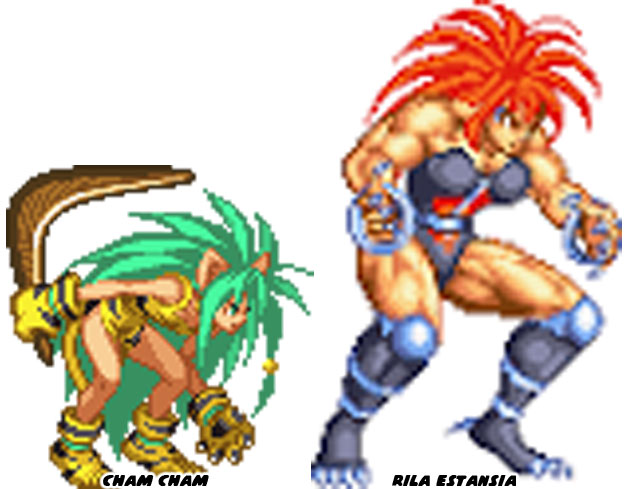
Although to be fair the genre had tried to replace the beast man concept with the wild girl / Amazonian archetype. I don't mean the traditional Greek amazon either but rather someone from the Amazon jungle. Cham Cham from Samurai Showdown II an SNK title from 1994 was one such character. Covered in animal skins she slashed at opponents with her gloved paws. Then there was an adult version that was a similar character, Rila Estansia from Breakers, a Visco title from 1996. She didn't wear a costume with built-in claws but instead sharpened her actual fingernails and toenails into claws. She was very much the Blanka equivalent from a rival studio. These female characters reflected a part of that outsider category of designs. They weren't the only ones, not by far. In the middle of the '90s almost every major developer had released a fighting game. They were all experimenting with female characters in the various franchise and offshoots. Another comic book artist came in and introduced a female that would again fall outside of the sexy or traditional archetypes. Masahiko Nakahira created a rival for Street Fighter Zero / Alpha's Sakura. He introduced Karin Kanzuki in the pages of Sakura Ganbaru!, a spin-off of the Street Fighter Zero manga he had also created. The fan reaction to the character was great and Capcom put her in Street Fighter Alpha 3 in 1998.
Karin represented another break from tradition. She did not wear revealing costumes, her design was very reserved. She was presented as refined and elegant young lady but retained a strength and ferocity that intimidated all of her male counterparts. There had been petit and
dainty moe-type characters in fighting games but Karin was not one of them. This was a princess that enjoyed fighting. This archetype would be revisited by Capcom as well as by rival studios. Depending on how extreme the designer wanted to go with the idea the character could go from gym clothes under a school uniform (which also applied to Sakura!) all the way to the frilliest Gothic Lolita dress. The power and techniques of a kung-fu master remained with these girls despite their frilly costuming.
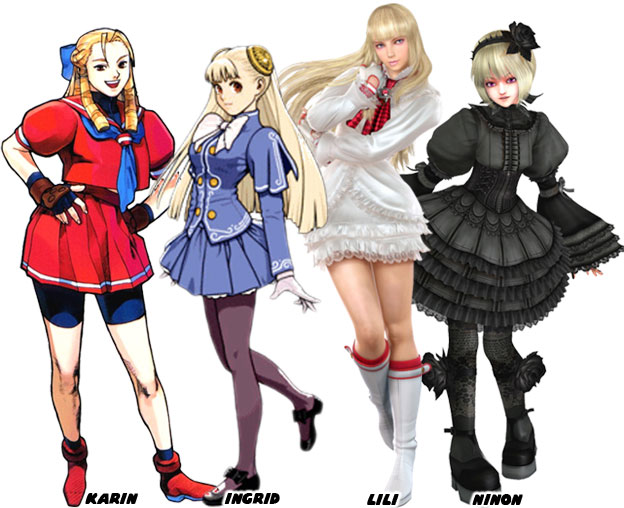
Just look at the chronology of characters that were the fighting princesses. In early 2003 Capcom created Ingrid, who was planned for the 3D Capcom Fighting All-Stars. That title was cancelled but Ingrid returned in 2D form for Capcom Fighting Evolution a year later. In 2005 the world was introduced to Emilie de Rochefort or Lili for short. She debuted in Tekken 5: Dark Resurrection. The Namco character was coquettish and enjoyed torturing her friends as much as her rivals. On the extreme end of the princess design was Ninon Beart. The character appeared in the 2006 SNK title King of Fighters: Maximum Impact 2. Unlike the previous three Ninon had average physical attacks but extremely powerful psychic attacks. Of these types of characters the gaming audience, especially in Japan seemed to enjoy Karin and Lili most. Yet when Tekken producer, Katsuhiro Harada wanted to introduce another outsider female character into the franchise he was met with a harsh response online, at least from the West.
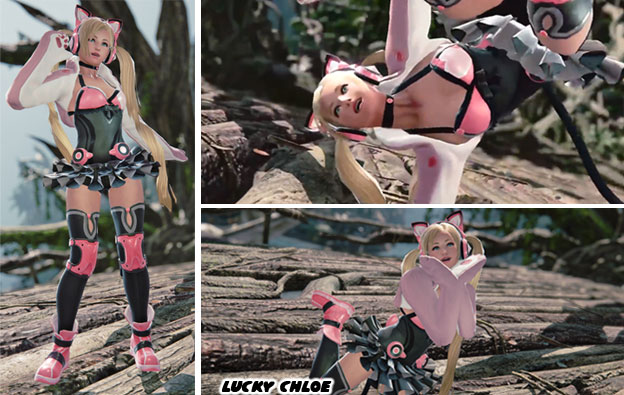
In 2015 Mr. Harada unveiled a Japanese trope character, an energetic
genki-girl named Lucky Chloe. This character wore a silly cat costume and seemed absolutely spastic about fighting. The Japanese seemed to be "in" on the joke and didn't seem to mind her inclusion into the franchise. After all there had been cyborgs, demons, dinosaurs and even kangaroos all accepted as canon fighters. Yet for some reason some people in the US
had an absolute fit that the game would include her. Harada had no intention of pulling the character simply because some people didn't get the joke. He shot back sarcastically online saying that he would essentially put a musclebound skinhead in the series, possibly with a gun, because that's all that the US was interested in. Lucky Chloe did not appear out of thin air. Her design had been building for some time. She was a definite outsider character even if audiences got it or not.
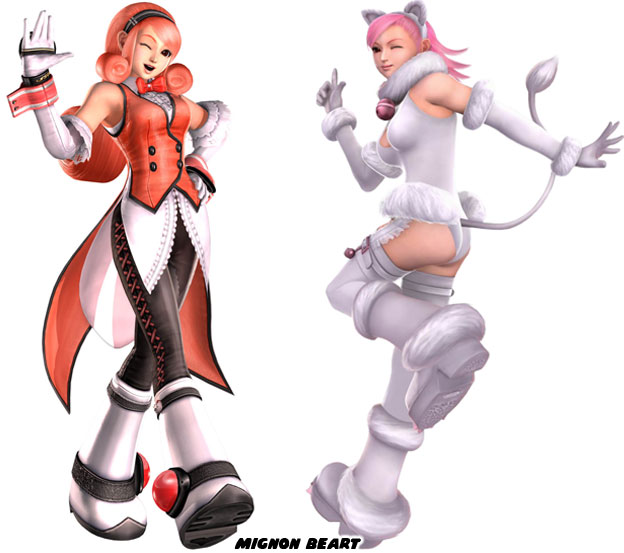
To be more precise, Harada was calling out some questionable designs from his contemporaries. Almost a decade earlier the SNK producer Falcoon had created a new girl character for the 3D version of the King of Fighters series. In 2004 Maximum Impact debuted and with it came a girl with psychic powers known as Mignon Beart. She was the big sister of Ninon. Anyhow every character in the game had an alternate costume that was much more than the typical pallet swap. These alternate costumes were instead completely new skins on the models that either showed off more of their personality or had been featured in classic KOF games. Mignon's alternate was a cat costume, complete with tail and ears. It made little to no sense but it made it into the game and became part of KOF canon. Years later Harada was taking a jab at these silly characters and put his own over-the-top fangirl into the franchise. Unfortunately not everyone got the joke.
When Sylvie was unveiled for King of Fighters XIV I thought back to what the reaction was for Chloe. Instead of saying WTF or promising that I would never buy another SNK product I thought there was better use for the blog. Why not ask where did this character come from and why was she in the series? I began thinking about Chloe, then Mignon and then started working backwards from there until I hit Kurara. I realized these were the odd characters that never fit the bill. Again, like Dhalsim, Blanka and Skullomania, they would never be the stars of the game but they had every right to be in the franchise. They reflected something far from the norm and that was what made them so unique. For female characters there was not much leeway, you were the sexy one or the one in the traditional uniform. Or now you were Sylvie or Lucky Chloe or Karin or Kurara. The road to this unique design wasn't all magic and princesses, it also included the self-made female fighters.
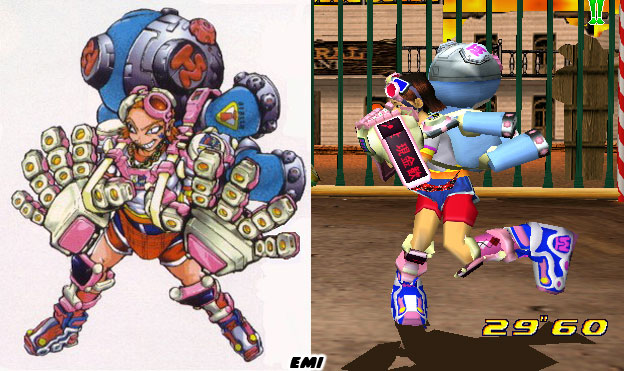
In 1998 Sega released a sequel to the game Fighting Vipers. The title was a sort of teen version of Virtua Fighter. The control and combo system was a little easier to pick up than VF. The cast was made up of mostly teenagers in armor representing some sort of youth culture, such as rock music, skateboarding, inline skating or bmx. In Fighting Vipers 2 there was a talented computer programmer named Emi that wore unique power armor in the tournament. Emi wore her school gym clothes, armored boots, power gloves and then on her back was a robotic teddy bear that doubled as a jet pack. Other fighters wore armor made out of safety gear and even motorcycle parts. While Emi gets the credit for doing the fighting it was her grandfather, a robotics expert that put together her gadgets. When the grandfather was kidnapped Emi put together the elements of her costume so that she could rescue him.
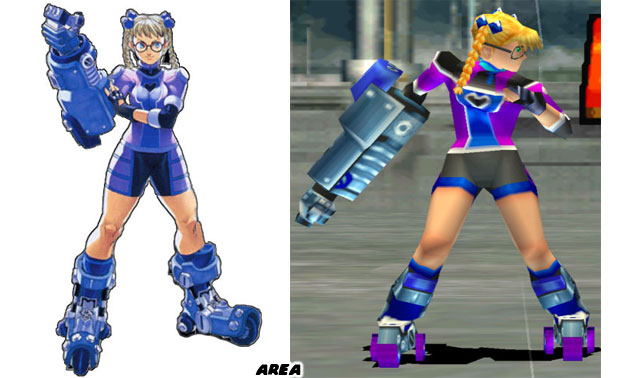
Would you believe that a month later Capcom published a game that had pretty much the same character? Well this one was a French girl in pigtails named Area. Her costume was made up of robotic parts as well. A mechanized arm that granted her strength, defense and a rocket punch and jet-powered roller skates that allowed her to zip across the screen. With this armor she was able to enter the Street Fighter EX 2 tournament. Her father was the robotics expert and he knew his daughter had her heart set on fighting. and there was nothing he could say to convince her otherwise. He wanted to make sure she would stay safe so he set her up with the gadgets that made up for her lack of raw strength and technique. She had smarts of her own and eagle-eyed players could see that she had over-sized molecule bangles holding her pigtails in place. They weren't as big or as glaring as the eyeball bangles worn by Sylvie but they told a story about the character. Through the course of history there were other female fighters that didn't quite fit the mold.
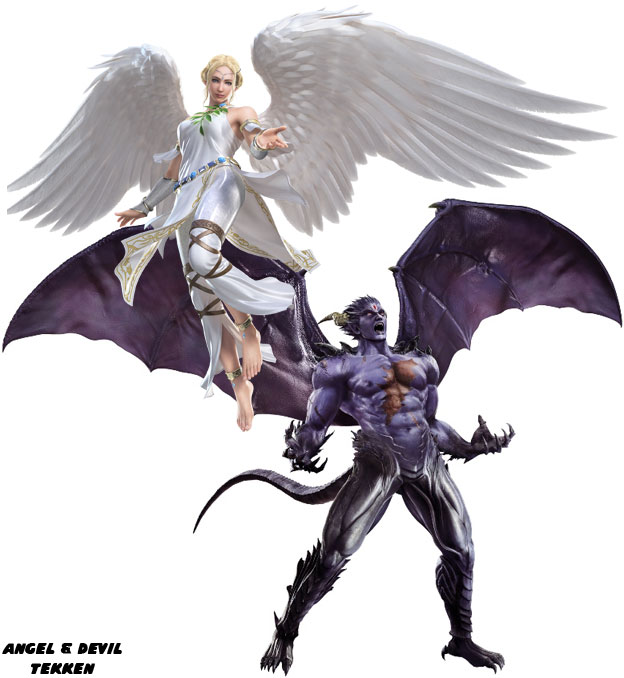
Women were sometimes presented as spiritual creatures in fighting games, perhaps demon or even angel. This allowed the designers to assign all sorts of amazing powers and abilities to these characters. These mystical creatures could be used to balance out the most powerful boss-type characters in canon. This was the case for the Angel in the Tekken series. She was a counter to "Devil" form of Kazuya Mishima. Kazuya was born with a "Devil gene" which allowed him to turn into a monster when enraged. While Kazuya had a long history of performing evil deeds, including trying to kill his own father, the Angel believed there was still a shred of good left in him. She appeared in the series to fight the Devil from time to time and try to redeem Kazuya. In 2015, with the release of Tekken 7 a mystery had finally been explained. Kazumi Mishima was presented as the mother of Kazuya and it was revealed that she was the one that had passed along the gene. She had tremendous power that she had to keep in check or else she would turn into a monster as well. She was murdered by her own husband, Heihachi Mishima many years earlier. He tried to kill Kazuya too when he suspected he might be carrying the gene as well. Her spirit returned in physical form to avenge her death.
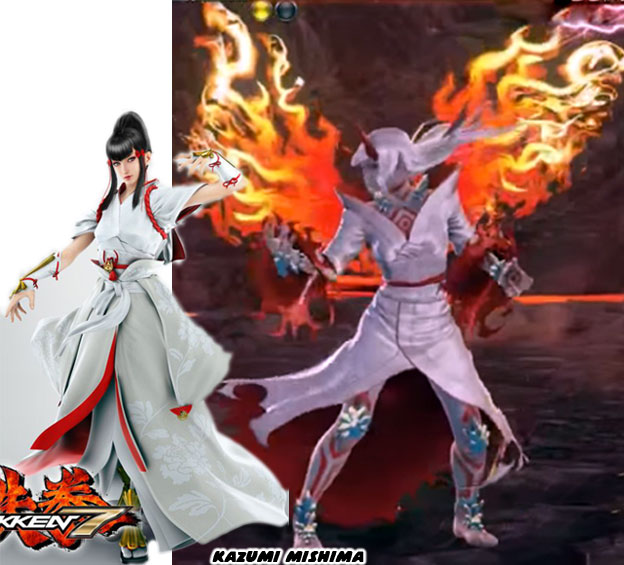
It turned out to be too little too late for Heihachi, or Kazumi to end the cursed bloodline. Kazuya had a son named Jin that he also passed the devil gene to. Jin was a sort of half demon, half angel. His mother was a noble woman named Jun Kazama. She loved, and tried her best to cure Kazuya. In a way she managed to alter the path of Jun. When he changes into a demon instead of leathery bat wings he has bird-like wings, which were more associated with an angel. As for the demon masquerading as a human female was a myth explored in various Japanese folk legends. Some of these legends were the basis of fighting game characters, especially for a franchise like Samurai Shodown / Spirits. The series by SNK created a number of heroes based on real word sword masters and kept them in feudal-era Japan. There was a lot of mythology pulled into the franchise which made it all the more unique. In 1994 SNK released Samurai Shodown II, the original title was a smash hit and there was a lot riding on the sequel. The main villain in this game was a character named Mizuki Rashojin.
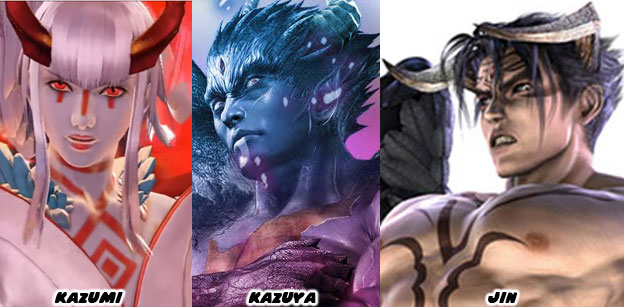
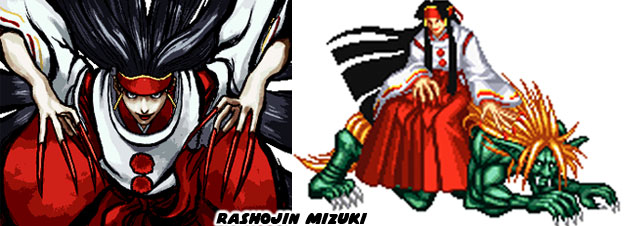
Mizuki dressed in a red and white costume, it mirrored the robes worn by "miku" or Shinto Priestess. She looked like a plain character until she began using her powers, then players understood why she was also referred to as the Marauding Deity. She fought with a gohei, a wand used by Shinto priests for blessings, the wand was decorated with shide, the zig zag paper streamers seen on many temples. What was unique was that her gohei was more dangerous than the swords used by the main cast. If players dodged one attack they had to contend with her elongated fingers and dagger-length nails. In ancient Japan she was a priestess for an evil demon called Ambrosia. She hated humanity with a passion. She was born during a famine a thousand years before the events in the original Samurai Spirits. She was cast into the sea by her parents and left to die. She survived thanks to the intervention of Ambrosia. She washed up on shore and was adopted by a new family. Because of her supernatural intuition it was decided she should become a priestess, unfortunately for villagers she was serving a spiteful demon. Mizuki looked like a normal person but she was several centuries old, her evil spirit jumped from body to body. She would sometimes hibernate for centuries at a time and rebuild her powers.
Not every spirit in the Samurai Spirits franchise was malevolent. The forest tribes watched out for the forest spirits and lived in harmony with nature. The girls Nakoruru and Rimururu were protectors of the tribes and nature helped them by sending a giant falcon and wolf to fight alongside them. At least one natural spirit from Japanese mythology was turned into a playable character. Iroha appeared in Samurai Shodown VI. The 2005 title from SNK continued to expand on the universe and put in a unique character. On the surface she looked like a "sexy maid." She did of course happen to debut at the peak of maid mania in Japan. Where everyone was going to a maid cafe and there were comics and cartoons about maids seemingly everywhere. Yet there was much more to this character. The maid costume, a simple black and white motif also reflected the colors of the crane. Iroha was actually a crane-turned-human. The myth was better known as
tsuru no ongaeshi the crane returns a favor. In the stories a crane was rescued, usually from a trap or removing the arrow from a hunter. The crane gets released but then returns as a beautiful young girl that acts as a servant to return the favor. The stories were often melancholy but they helped establish a tradition of animals turning into people and vice-versa. This form of animism was seen in cultures all over the world.
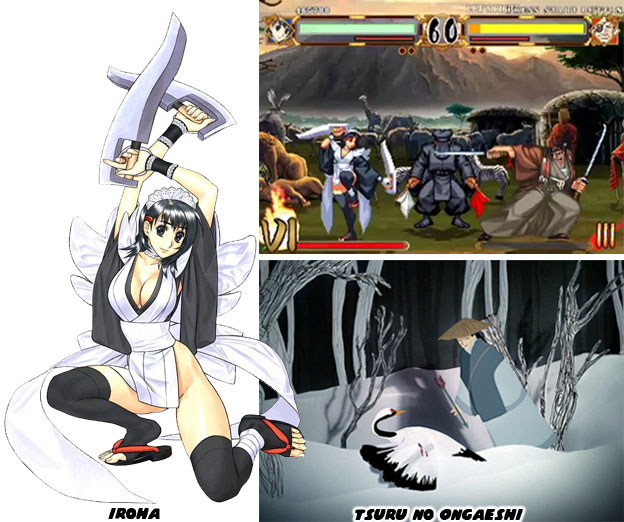
Iroha had perfect balance and fought on one leg, her stance was very crane like. In the game she used two oversized knives but could also throw white feathers like darts. One of her special moves had her take an opponent behind a screen door where she disrobed and beat them up, the silhouette turned into a crane for just a split second. She was actually a servant in the game that was fighting to try and cure the illness of her master. It turned out that he was lonely and when she returned to him he was once again healthy and happy. Another animal spirit-turned-human from Asian myth was not as kindly as Iroha. In the Chinese developed Xuan Dou Zhi Wang / King of Combat game there was a female fighter named Ameth. Like Iroha she appeared like the typical sexy character with some oddly powerful attacks.
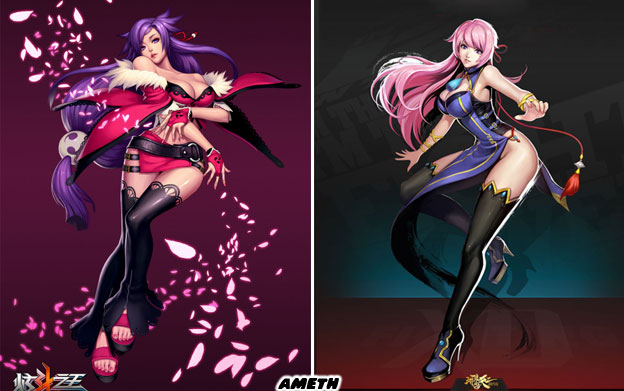
Ameth aka the Purple Pupil was a 998-year-old shape changer that was actually a fox. The divine or demonic fox creature appeared in many Asian mythologies. In Chinese stories Huli Jing was a divine fox mischievous but also ill-tempered. In Japanese tradition Kitsune was also a divine fox but with nine tails. The fox mask of Kitsune had been used on female ninja characters in manga, animé and video games for decades. In Korea there was Kumiho, possibly the creepiest of all the fox legends. She was an evil spirit that seduced and killed men. The version featured in the Tencent produced game from 2011 was was on the evil side. Ameth had actually been feeding on souls of powerful people for hundreds of years and was trying to achieve immortality. In order to guarantee that she would live forever she had to achieve a certain amount of power before she turned 1000. She learned about the King of Combat tournament and entered it to steal the souls of the other powerful competitors. I wouldn't say that Ameth or Iroha were typical of the other outsider that I had been talking about. The focus on their design was in making them the token sexy girls for each franchise. I will say that their origins, their powers were decidedly non-traditional and that was why they earned a spot on this presentation. I hope you enjoyed this brief post on female fighting game designs. Be sure to tell us who your favorite outsider female character was from any title. Until next time take care! As always if you enjoyed this blog and would like to sponsor me
please visit my Patreon page and consider donating each month, even as little as $1 would help make better blogs and even podcasts!