Showing posts with label boxing. Show all posts

Thursday, October 5, 2017

Hiding the master in plain sight, the genius of SNK's character design... part 4

SNK was working hard to stay a step ahead of the competition. Their one-two punch of Fatal Fury and the Art of Fighting were unique entries to the genre. Each game provided a different experience and both expanded on the themes found in Street Fighter II. Not every character in both games worked or were even memorable. SNK had to learn and adapt to the trends quickly. The studio had to focus on multiple fighting games, each with their own aesthetic, while Capcom had to focus on patching and upgrading Street Fighter II. With the focus spread out over several games some of the fighters in the Fatal Fury (FF) and Art of Fighting (AoF) lacked the impact of Capcom's "World Warriors." In one particular field SNK started off slowly but then quickly caught up.


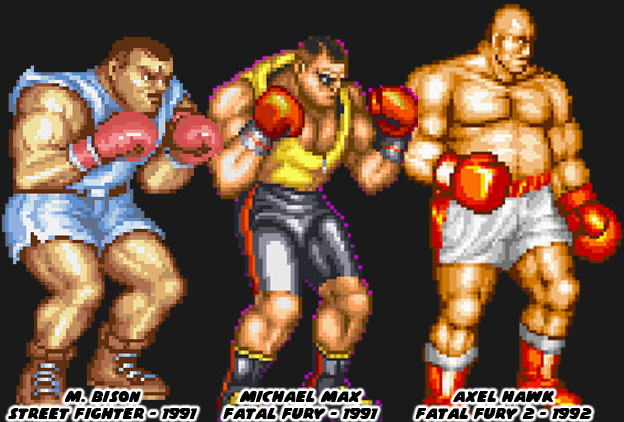
It was no coincidence that Street Fighter II's boxer M. Bison (Balrog in the USA) looked like pro boxer Mike Tyson. Capcom used the heavyweight champ as the template for their ring general earlier. Tyson had launched his professional career in 1985 and was featured in a version of Nintendo's Punch-Out!! He helped inspire the character Mike in the original Street Fighter as well. Tyson dominated the squared circle, at the age of 20 he became the youngest ever to win a heavyweight title. He earned a reputation for being destructive, and often knocked out opponents shortly after the opening bell. His supernatural fighting ability made him the perfect candidate for a fighting game. Of course Capcom didn't want to pay the boxer any royalties for using his likeness so they made a few changes, swapping out his name with another Shadowlaw general, and presented him in warmup gear. He was an easy fit into Street Fighter II and would even inspire a Fatal Fury boxer. Michael Max was literally cut from the same cloth as Bison, both having roughly the same size, shape, similar warmup gear and even haircut. Audiences felt this character was lacking, even if he had a unique tornado uppercut.
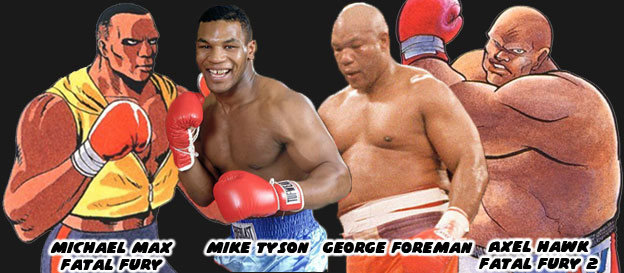
 

SNK's follow-up boxer had a more unique look. The bald and pudgy Axel Hawk was a friend and trainer for Michael Max. This fighter, featured in Fatal Fury 2, was taller and heavier than his protege. From a design standpoint it was strange to have a character that was older and fatter than the previous star. From a real-world influence however it made sense. George Foreman was a legendary heavyweight fighter that started his career in 1969 and stopped fighting at the end of the '70s. He became a preacher but returned to the ring in the late '80s. He got a title shot against Bernard Hopkins, a fighter 16 years younger than he was. Foreman recaptured the heavyweight championship at the age of 45, making him the oldest person ever to win the title. It was an underdog story that inspired long-time boxing fans. Chances were that SNK boss and boxing aficionado Eikichi Kawasaki suggested a version of Foreman for the sequel. Axel was a bit more rotund, especially in the official character art, than Foreman but they both had amazing power behind their strikes. Pop culture tended to color the SNK character designs more than any other studio. Aside from real-world fighters there were also decisions based on popular aesthetics. This was seen on another boxer in the SNK universe.
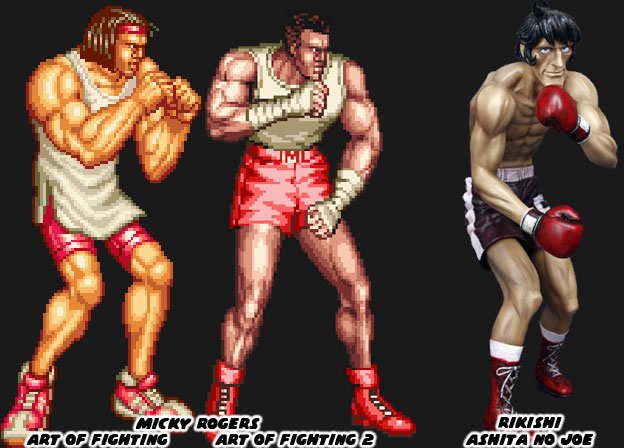
 

Micky Rogers was the boxing archetype introduced in the AoF series. The character sported braids in his first appearance and the look was changed slightly when he appeared again in a sequel. Visually the fighters in the AoF series were much different than the figures in FF. The artists working on the characters tried to make them more proportional to actual people. The reason for this was because of the larger sprites that AoF featured. If the character were drawn too muscular it would have looked awkward when they were scaled up. The fighters would have looked like cartoon characters in an otherwise realistic setting. Micky looked anemic compared to some of the other characters. He was lanky but well defined. It made sense given he was a boxer where speed was often more prized than power. The manga Ashita No Joe was a wildly popular boxing manga from Japan. The artist Tetsuya Chiba would draw his character with long, lean muscles. The action was easy to follow on the page because of his slender lines. This style of art that he popularized in 1968 would end up influencing countless other manga and anime shows about boxing. I believe that this design also found its way to SNK, given the Mr. Kawasaki was a boxing fan. Micky had almost the same build as characters like Joe or Rikishi, the champion fighters from the book.
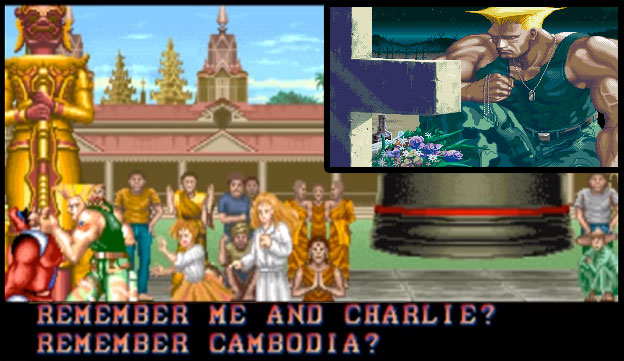
 

SNK, like most major arcade publishers realized that in order to succeed they had to become global players. This meant that they had to include fighters from other countries, especially the USA. Capcom and a few other studios included fighters from the USA in their games but gave them the slightest connection to real western culture. Joe and Mike in the original Street Fighter looked very plain, wearing street clothes, they were somewhat forgettable. The studio punched up their efforts with Guile in SF II. If anything they were pandering quite heavily to each nation, easily to the point of parody. Look at Zangief and Dhalsim’s original endings. Even the American was over-the-top. He was a military fighter wearing camouflage pants, with an absurd haircut, that was all muscles, and sported USA flag tattoos. As a Mexican-American I can confess that I must run into people that look like Guile at least twice a day! SNK did a slightly better job with their US characters and realistic street fashion in both the FF and AoF games. They decided to really crank it up with each sequel. They payed close attention to the trends happening in tv and in movies. When the studio began work on the King of Fighters, which would bridge all of their fighting games together they began pandering heavily to the USA. They did this by making the US team captain a boxer, and by looking at pop culture for his design cues.
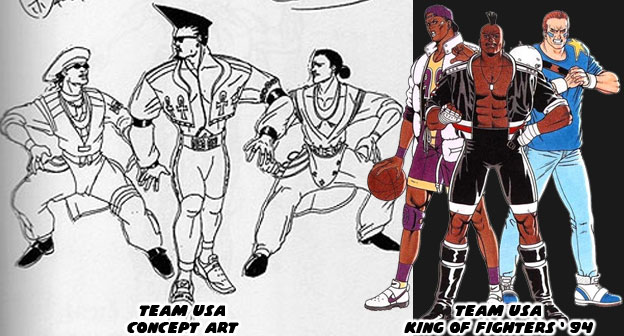
 

Decades ago fashion trends travelled much slower than they did today. The artists at SNK wanted international audiences to visually identify the US team because of how they looked, rather than what school of fighting they were representing. In order to do this they had to create archetypes that were wearing the most “Western” costumes. The people at SNK were using fashion cues from pop culture as the basis. The only problem was that street culture evolved rapidly. The look of the US fighters were reminiscent of dancers from the films Beat Street and music videos from Salt-N-Pepa and Queen Latifah. The spandex and leather outfits of the late ‘80s were quite outdated for a game dropping in 1994. Thankfully the studio revised the outfits and based the fighters more on sports icons. A hint of the street fashion remained but for the most part it worked given the character. Heavy D, the captain of the team (and a name pulled from a popular rapper) was a breath of fresh air. He was a boxer that completely rewrote the book on character design. In the next entry we’ll look at how SNK’s designs evolved post 1994. As always if you enjoyed this blog and would like to sponsor me please visit my Patreon page and consider donating each month, even as little as $1 would help make better blogs and even podcasts!

 follow the Street Writer on Patreon!

Wednesday, October 26, 2016

The best championships in fighting games, part 1

If you are a fan of fighting games then you're probably familiar with the different fighting styles represented. Kung-fu, karate, judo, muay thai and boxing are among some of the more common forms featured in the genre. One of the stand out forms is pro wrestling. In video games the pro wrestlers are often the characters wearing the brightest costumes and using the flashiest, most impractical moves. These days they are thought of less as fighters and more as "sports entertainers" thanks to the WWE. If you have been following this blog then you know that pro wrestling is among the oldest of the fighting arts. There are some legitimately tough fighters that know actual grappling moves. Many consider themselves true professional wrestlers.

In the fighting game genre the most memorable characters often represent the best fighters in a particular form. Ken and Ryu for example are not simply practitioners of karate or ansatsuken, they are the absolute best in the world. Chun-Li is not a very good kung-fu practitioner, she is the best living kung-fu artist. She represents a legacy that includes the earlier Street Fighter masters Gen and Lee. Sagat is not a muay thai expert, he was formerly the greatest fighter in the world. Zangief is not simply a massive wrestler, he is a Russian hero. Fighting games are designed to answer the question of who was the best fighter and what is the best style. What would happen if the best boxer that ever lived squared off against the best karate master?


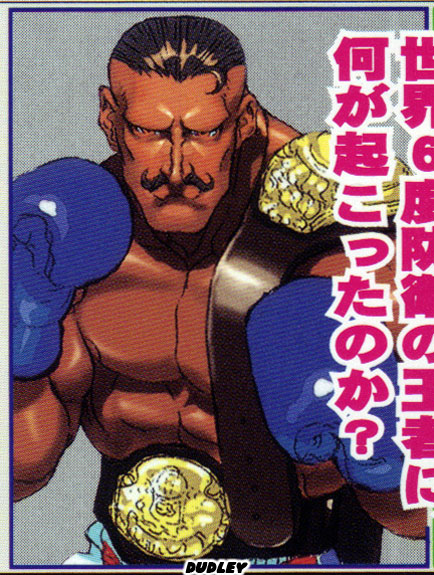
A small detail that you may or may not have noticed is how few characters in fighting games are presented wearing a championship belt. After all, real pro fighters don't wear their titles while fighting. But this is something that makes some game characters visually appealing. Dudley has a great design but he doesn't go around with his belts. The aesthetic choice of having him dressed in civilian clothing worked well in the lineup. Street Fighter III was a chance to introduce a new generation of fighters, one that wasn't as campy as the original cast. Yun and Yang for example had classic Chinese shirts and pants but also paired that with modern sneakers. Alex was an MMA star but wore overalls and heavy combat boots instead of trunks. As long as Dudley wore his boxing gloves it was painfully obvious what type of fighter he was. In canon Dudley had at least two, of what can be assumed, world championship belts. Here's a short list of some memorable champions in the genre, if not their fancy belts.


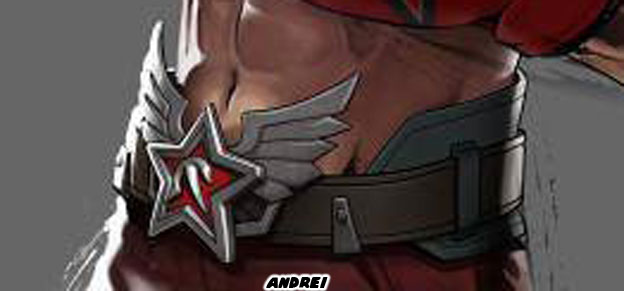
Not many boxers flashed their belts in game, one of those that did was Andrei. The Russian boxer was featured in King of Combat. The young boxer had a great belt design. The star, sickle and hammer were supposed to conjure up images of the old Soviet Union. It was perfect for the upstart. He was proud of his country. It showed in his Cryllic tattoos, amulet he wrapped around his boxing glove and militaristic haircut. In the best designs from the various studios every detail of a costume has to reinforce the personality of the fighter. The details should each tell a story. Whether it's a torn sleeve, a spiked bracelet or even an eye patch. They all have to mean something and not simply be a superfluous detail. There were other fighters in the various games that were as accomplished as Dudley and Andrei.


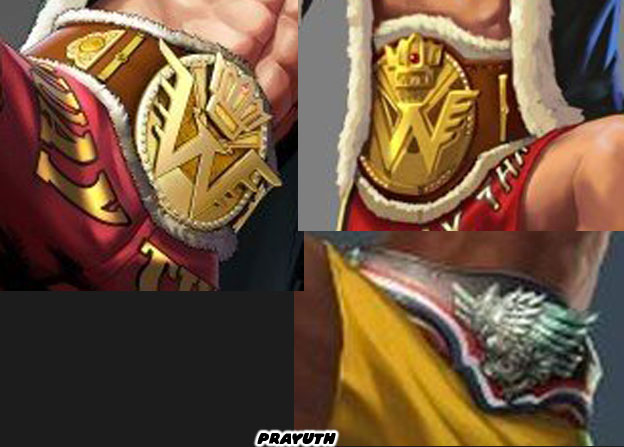
Muay Thai master Prayuth had a hefty belt that he wore in the King of Combat. The large circular fur-lined plate was reminiscent of modern championship belts. Flamboyant champions are nothing new in professional fighting. The best in the world wanted to show off from time to time. Over the past century and a half many different champions would add their own flare to the titles. They would encrust their belts with ribbons, fur and eventually gold plating and jewels. Some belts were even made of leather that had been dyed to a brilliant red or bright green. Prayuth's belt was representative of modern belts but its fur-lining also served a practical purpose. It could be worn while fighting. It wouldn't scrape or irritate his skin even with sweat. The developers on King of Combat even had an alternate color scheme and with it an alternate belt for Prayuth. The alternate title was more in tune with a classic championship belt. Instead of the sponsor logo there was a head of the mythical Garuda. It celebrated the spiritual origins of South Asian, specifically behind Indonesian and Thai culture. If Prayuth was the best Muay Thai fighter in the world then his belt should reflect the culture that created that form of fighting.


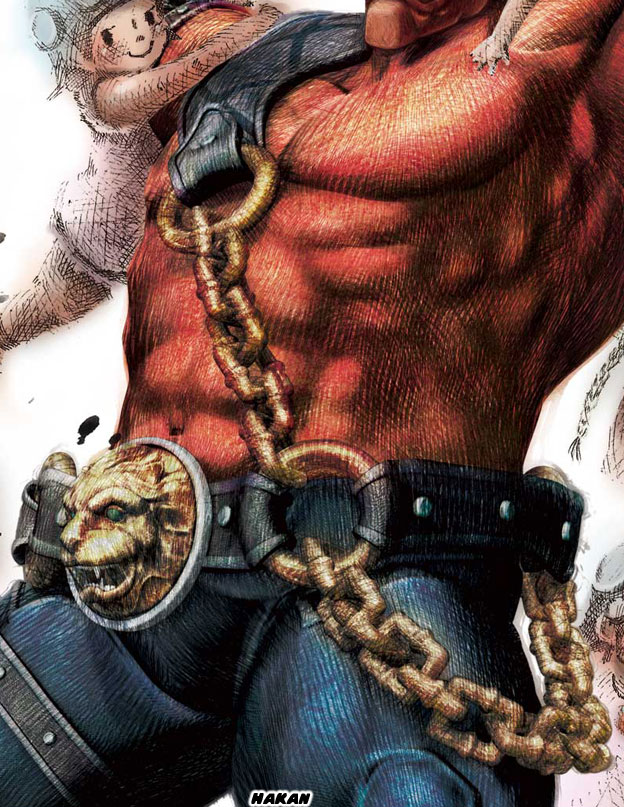
A belt that celebrated a culture and also looked intimidating belonged to Hakan from the Street Fighter IV. I was not a fan of his design, how he misrepresented yağlı güreş or Turkish oil wrestling. I was not a fan of the color of his skin and absurd blue hair. One thing that I cannot deny is the costume he wore. The chain and strap symbolized strength but it was the roaring lion that really caught my eye. I cannot say with any certainty that this was a championship belt. Modern oil wrestling championships are sometimes a trophy and sometimes a belt that looks like a modern wrestling title. Hakan's belt might have simply been a family crest or his business logo. In all regards it was a fine belt, accessorized by large metal chains and rings. Anyone could tell that only the absolute strongest could wear this ensemble.


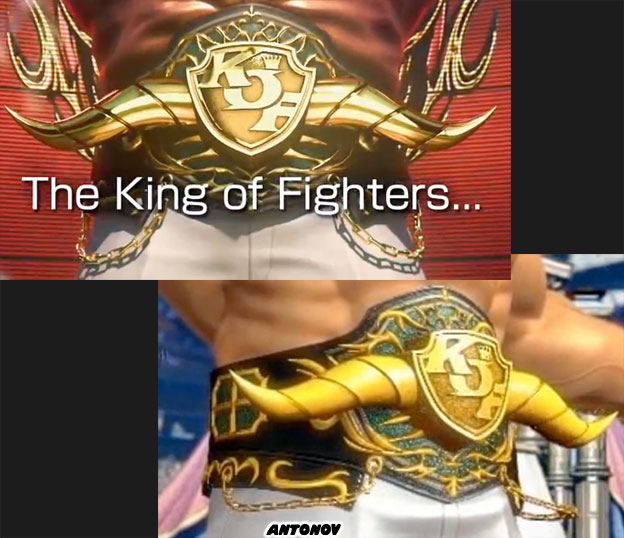
One of the biggest and possibly gaudiest championship belts belongs to Antonov. The self proclaimed original King of Fighters champion wears the belt in KOF XIV. Although I would argue the legitimacy of his claim with the iconic Geese Howard and Terry Bogard who had been there since the first tournament. Anyhow the belt is plated in gold, with thorn tribal patterns, gold chains and enormous bull horns. Aside from being bulky it would not be sensible to wear in a fight. The horns would limit the range of motion for the wearer. I can only imagine the number of times Antonov split his forearms open each time he threw a punch. The reason that Antonov wore it was two-fold. It showed off that he was the champion obviously but less known was that he was hooked on smoking and he kept his trademark cigars hidden in the front plate. If it were reproduced I can only imagine that a combination title and humidor would make it among the most expensive belts ever built. Antonov's belt was meant to be over-the-top, bigger and gaudier than any other title in any fighting game. It was not supposed to look like a traditional belt as with Dudley, nor was it supposed to have elements of a particular culture like Hakan or Prayuth. If I could find an example of a belt that balances culture and gaudiness it would have to be Darun Mister's Indian elephant title.


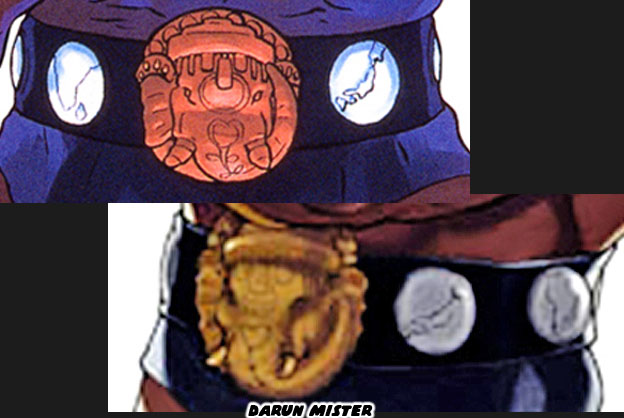
The main plate, in gold or bronze, is a sculpture of an elephant wearing a ceremonial headdress. The side plates are silver and have the outlines of the global continents. It symbolized that this belt had been defended or recognized by promotions around the world. The elephant has a number of details. The flower pattern on the trunk and filigree on the ears mirrors the long standing custom of painting the elephants as a sign of reverence. The elephant has powerful cultural context, especially when considering the relationship that the Hindus have with the god Ganesha. This belt is not representative of Ganesha but it is supposed to make Indians feel proud. There was more forethought to this championship title than say the stages created for Dhalsim in Street Fighter II and Zero / Alpha which pandered heavily the symbol of Ganesha. Unlike Antonov's belt there is nothing that would interfere with the wearer. The elephant trunks are short and stubby, they wouldn't catch a person like bull horns could.


Darun was a unique character, inspired by various legendary Indian wrestlers including the Great Gama. In Street Fighter canon I would argue that he was a greater wrestler and champion than Zangief. I could back up this claim by pointing out that Darun not only held the elephant title, his alternate costumes featured two other belts. The gold and silver titles had a flat cut to them, they seemed to be from other, possibly Western promotions. Darun was a multi-promotion heavyweight champion and possibly the best pure wrestler in Street Fighter canon. Darun however was not the most decorated fighting game champion. In the next blog we will look at the character that had more belts than any other Street Fighter icon combined! As always if you enjoyed this blog and would like to sponsor me please visit my Patreon page and consider donating each month, even as little as $1 would help make better blogs and even podcasts!
 follow the Street Writer on Patreon!

Monday, September 8, 2014

Copycat Culture, part 1...

Thanks to my long-time readers for putting up with my long tangent on cars and space shooters. I think I got it out of my system, at least for another week. Right now the pendulum is swinging back to fighting games, I know, big surprise! I wanted to preface the news on the fighting game front with a bigger theme. Every form of entertainment is synthesized from the human experience. The collective culture, interests and life lessons that every creator had was part of the creative cycle. You might remember hearing that there were Seven Basic Plots to every great or even not-so-great story. The ways in which that story were presented were also remixed in infinite ways. Perhaps the story was told in a poem or through a song. Perhaps the story was on a stage, a television set or a movie screen. For our generation the video game was the biggest medium for exploration in each of those seven basic plots. For the first time in the history the audience got a chance to take an active role in the plot. They no longer had to imagine what it would be like to be a part of the story when they were instead the central figure. A well assembled team of designers, programmers and artists could point audiences in the right direction, give them tools to succeed and provide just enough challenge to make the players think that they did everything themselves. It was the invisible hand of a producer that made sure all of the pieces worked well together so that audiences never felt disconnected from the action on screen. These game creators could not separate their own influences from seeping into the games they designed. The stories, comics, cartoons, music and movies that they grew up with and continued to enjoy colored the games they produced. In turn the games they released influenced their peers and the next generation of artists, designers, programmers and composers as well. It was a circle of storytelling dating back to the dawn of civilization. The only thing that changed was the format in which it was consumed.

Several of the most successful franchises were influenced by many sources. Some of these influences were subtle and others were very overt. The earliest video games mirrored the content of popular movies, comics and cartoons. Back in the early days the developers sometimes did not try hard to cover up these influences, especially where the Japanese designers were concerned. International copyright law was a different beast in the '70s and '80s. Characters, levels, in-game art and even box art in early arcade, console and PC titles were often poached. The developers and publishers knew they could often get away with it because they changed enough elements as to define an entirely new work of art. Of course for sharp-eyed audiences could pick out what the developers took from other sources. Hardcore Gaming 101's big writeup on gaming "influences" was a perfect site to see these game comparisons. The site displayed a bunch of art that was pretty much stolen and featured in Japanese, US and European games. Audiences tended to overlook the poached content so long as the game itself was well done. Many of the small companies that relied on outside inspiration for their first console hits eventually turned into publishing giants. Konami, Namco, Capcom and Sega were just a few of the companies that managed to grow exponentially during the '80s and '90s despite some poached art and designs. The entire library that each company produced was still very original and completely surpassed the few instances of stolen art that they got away with. The only reason that I bring this up is because poached art and design was at the heart of the Chinese gaming boom. The fastest growing economy in the world would soon be telling the developers and publishers from Japan and the US what they wanted to see in mainstream media. Since the entertainment companies seemed more focused on a profit rather than original content they would probably acquiesce to the Chinese demands. Yet what the Chinese gaming consumer wanted was at the core not much different than what the Japanese, US, UK or Europeans wanted. They longed for a great experience that was original and memorable. What they got instead were often rehashes of a popular genre.


Valve's Team Fortress 2 was a runaway hit with PC gamers. It was only a matter of time before imitators came out of the woodwork to poach the art style, character classes and gameplay of the first person shooter. None were as blatant as Final Combat. The Chinese title did very little to distinguish itself from its US inspiration. The studio went so far as to release trailers for each class of character as Valve had been doing over the past few years. Certainly the Chinese PC gaming market was starved for a quality FPS but was this really the way to go? The country had put a ban on console systems and arcade games in 2000 and did not lift that ban until 2014. This meant that a generation missed out on the formative years for both the Playstation 2, Playstation 3 and Xbox and Xbox 360. Audiences could still purchase modified consoles sold as home computers rather than gaming consoles. These hybrid PS2/3 and Xbox systems often came with Linux and a few dozen games pre-installed on the internal hard drive. Of course these modifications were done without the approval of Sony or Microsoft, the respective manufacturers of the consoles. Those that played PC titles could find a way to download the hottest games from the West but were always eager to play comparable experiences created at home. Games that reflected Chinese culture and tastes instead of being force-fed a diet of what was hot according to the west. Rather than invest in new technology, experiment with new formats or trust the designers to come up with an original idea the publishers often chose to copy what worked. The developers did an exceptional job of copying and running with it. It was good for a quick profit. It explained Final Combat and a number of other copycat titles that China developed. To be fair the idea of poaching popular games was something that the neighboring nations of Taiwan and Korea also had a hand in. Those other countries mixed and matched popular western culture to suit their needs.

The fighting game genre was no different than any other. As one of the more popular formats of gaming the Chinese were starved for an original fighting game that spoke to the community. What they got was a game that was as innovative as any fighting game released in the US or Japan in the past decade. The reason for that was because it also took tremendous influences from the characters, mechanics and balance from numerous different franchises. I had talked about Xuan Dou Zhi Wang aka the King of Combat on my 1UP and Capcom-Unity blogs previously. The game was worth revisiting because it continued to grow and evolve. It certainly was not the same game now as it was a year ago and would be a different experience next year. Every few months the publisher Tencent would roll out a patch that fixed the online gameplay, balanced the roster and introduced entirely new characters into the mix. One of the more recent was a Movin' In Circles from Ridge Racer Type 4. I sincerely doubt that Namco was paid for the use of the song.


Players would have a relatively short learning curve with Andrei because they could use many of the earlier set-ups and tactics from Street Fighter. Yet Andrei and the other fighters in the game were unique because they did not only borrow attacks from the Street Fighter series, they also borrowed elements from the King of Fighters, Tekken, Virtua Fighter and Guilty Gear. To be completely honest there were even elements of Blaze Blue, Capoeira Fighter 3, Sengoku Basara X and JoJo's Bizarre Adventure in the series as well. The addition of moves and attacks that were previously only seen in 3D fighting games and sword-fighting games was a welcome change of pace. Although King of Combat was rendered in 3D it followed the mechanics of 2D fighting games very closely. This blending of formats was handled very well, although some in the community could not get behind the game because of how blatantly it had copied the characters from other titles.

It wasn't enough to dissect the way that Andrei played. Audiences were looking for some originality in his design. A light-skinned playable boxer hadn't been seen in a 2D fighting game for some time. Most had been black characters, which was only fair since they reflected the legacy of actual boxing champions. Yet to say all of the great heavyweight champs were only black would be a slap in the face to some of the more recent champs. Ukranian brothers Vitali and Wladimir Klitscho were light skinned as well. Between the two they held every heavyweight title through most of the turn of the millennium.


In 3D fighting games the black boxer was not the trend. Steve Fox from Namco's Tekken series was a fair skinned British boxing champ. He had some devastating attacks but what really set him apart from his contemporaries was his lighting-fast defense. He was designed to take advantage of some unique dodges that left opponents wide open for a counter-attack. Andrei did have a touch of Steve in his design but also the other British boxing champ Aleron from Capoeira Fighter 3. Even the non-playable Joe from the original Street Fighter could have been an inspiration to Andrei. The original arcade boxing hero was Little Mac from Nintendo's Punch-Out series was the one that started it all. There was a hint of the baby face and haircut of Little Mac in Andrei's appearance as well.

The studio has actually gotten a lot better about masking the influences from other fighting games with the debut of Andrei. The previous character that Tencent had introduced was so blatantly stolen from another IP that many in the community were wondering if the company had any shame at all. The next blog would look at this character and what he meant for the series. If you would like to sponsor me please visit my Patreon page and consider donating each month, even as little as $1 would help make better blogs and even podcasts!
follow the Street Writer on Patreon!