Showing posts with label dictator. Show all posts

Friday, June 22, 2018

30 years of Street Fighter: 30 years of Characters #9


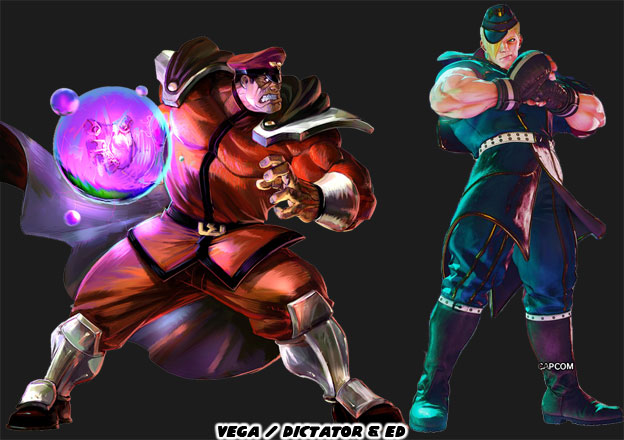
Vega / The Dictator, maniacal tyrant, master of the mysterious Psycho Power and leader of the military nation Shadowlaw might just about be the perfect fighting game villain. Think about it for a moment. When Street Fighter came out in 1987 it made sense that just about every opponent the main characters came across were martial arts masters. This was a straight-forward story of Ken and Ryu trying to prove their worth by traveling the globe and fighting the best of the best. It could have been the plot for a comic book, or a movie. It was just a traditional story. The sequel worked because it was more or less the same exact setup. Only now we could play as a bunch of other fighters with their own unique styles. The constant was different masters. The thing was in canon Ryu had already become the strongest fighter in the world. Who could he possibly fight that was more imposing than Sagat? It turned out that the series had someone very unique in mind.


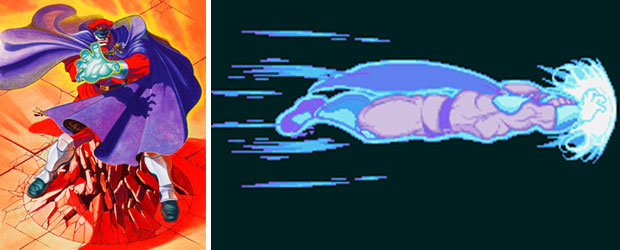
Go back in time and imagine what it was like for audiences the very first time they got to the final boss in Street Fighter II. After beating all of the World Warriors, then fighting a massive boxer, a Spanish assassin and the previous world champ Sagat there was one person left. This character was standing in front of a Thai temple, wearing a cape that he tossed aside in dramatic fashion. What was he all about? He was more than a foot shorter than Sagat. Actually Vega wasn't even 6-foot-tall in canon. He also didn't dress like a martial artist, but instead like a militaristic cartoon villain. This look was interesting. The things he did as soon as round started made him unforgettable. He didn't fight like any other character and his style didn't fit any school of martial art. He could leap across the screen, stomp on the head of players or slide along the ground and trip his opponents. His special ability, the Psycho Crusher, allowed him to fly across the screen while engulfed in a weird blue flame. It was obvious that players were now dealing with a super villain. There was a reason why even Sagat was now a subordinate.


If you were trying to figure out how Street Fighter II became a smash hit just look at Vega. He demonstrated the dramatic change that had to happen between the first and second games. It wasn't enough to expand the library of playable characters and bosses. The final villain had to be more powerful than any other character, and not by a little bit but instead by a wide margin. He had to be so powerful that he could have easily served as the boss in other fighting games. You were never going to forget the Dictator, his glowing eyes, or armored costume. He was a villain that you could celebrate, like Darth Vader. His inclusion meant that Street Fighter was now a game with a deeper plot. Characters could grow and change. They could build relationships and evolve. Vega was the measuring stick that all following bosses would try to beat. I'm happy to bring him up on the 30th anniversary of Street Fighter and I look forward to seeing if his final days are upon us. As always if you enjoyed this blog and would like to sponsor me please visit my Patreon page and consider donating each month, even as little as $1 would help make better blogs and even podcasts!
 follow the Street Writer on Patreon!

Wednesday, August 30, 2017

Meet Street Fighter V's Menat, an old soul in a young body?

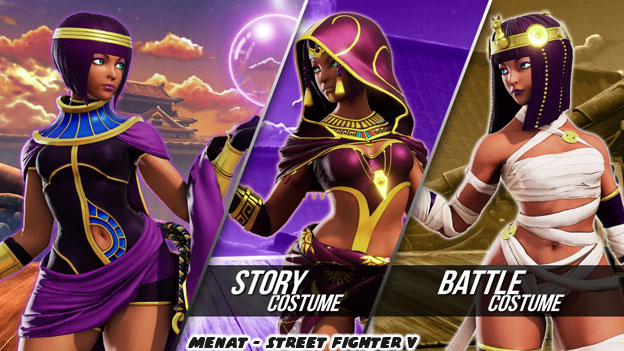
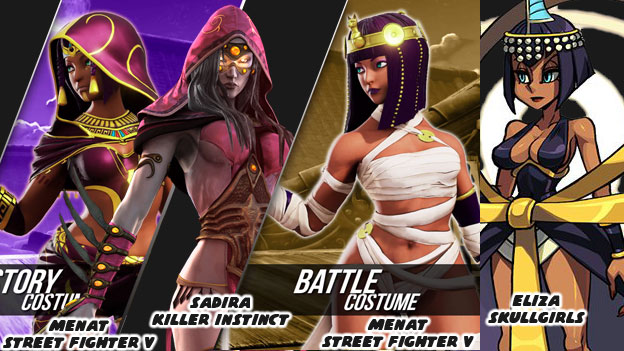
More news from the people at Capcom. The latest fighter for Street Fighter V; Season 2 has been revealed. This time it is a young female by the name of Menat. Harrison at Capcom-Unity gave the fighting game crowd a full preview of the character. In case you haven't seen her here she is along with her alternate costumes.


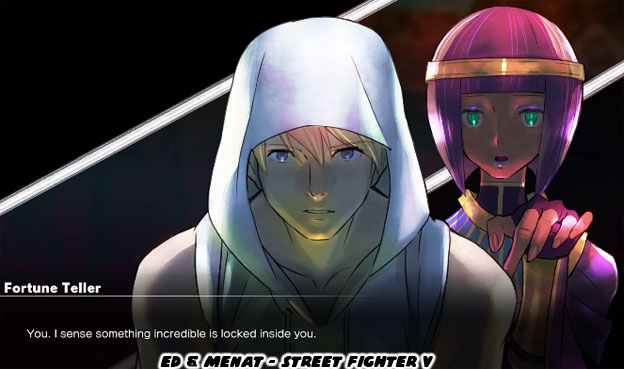
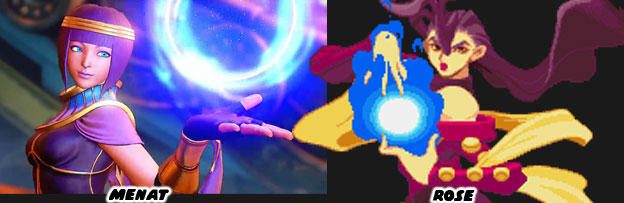
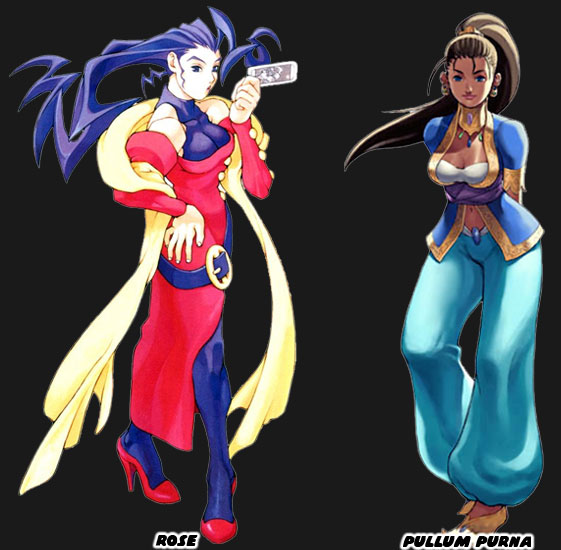
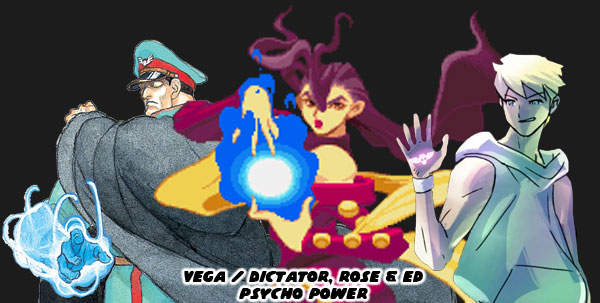
The character was actually teaser earlier, appearing in the visions of Ed. In her earlier debut she was listed only as a Fortune Teller. The connection between her and Ed was instant. I had mentioned previously that Ed was a return to Psycho Power. This was the mysterious psychic energy that powered Vega / the Dictator and allowed him to do things like fly, teleport and glowing orbs of psychic energy. The origins of this power were connected by a mystical person named Rose. She debuted in Street Fighter Zero / Alpha, which tied together the events that happened between Street Fighter, Final Fight and Street Fighter II. It looks like Menat is filling in that same role. Harrison said that Menat was the understudy of Rose. It made sense that Menat and Ed were connected. Rose and Vega also shared a psychic bond. This was explored in the various endings.


The moves and special abilities of Menat had a few things in common with Rose. She could reflect fireball attacks and even add energy to them to make them more powerful. Yet like Ed, she was her own unique character. Menat fought with a crystal ball, which she named Ankh. The Capcom designers called it a soul sphere, the name was based on the ancient Egyptian symbol which symbolized life. I didn't know if the crystal ball actually contained her soul, or was a conduit for her psychic powers. I suppose we'll find out shortly. There had been a few characters from the Middle East in the history of fighting games. Egyptian characters were not unique but they sometimes wore costumes that were more classical than contemporary.


I wouldn't say that Menat's default costume was daily wear for an Egyptian but her alternate costumes did seem eerily familiar. At worst the costumes could be considered culturally insensitive. I mean did Egyptians in the 21st century really wear mummy wraps? But more important than that, a lot of people have noticed that the alternate costumes looked like costumes worn by characters in other fighting games. Sadira for example was an assassin introduced in Killer Instinct. The fighting game from 2013 was a relaunch of a cult-classic Rare franchise. Sadira was inferred to be from the Middle East. The colors of her hood and patterns on her costume looked like traditional dress. Something inspired loosely by the bedleh, the light clothing worn by dancers. Sadira's uniform looked very much like the basis for Menat's costume. Then there was Eliza. This Pharaoh-themed character was introduced in Skullgirls Encore. The indy fighting game from 2014 pulled inspiration from dozens of different sources, including classic American cartoons and Japanese anime. Eliza was actually a design that was voted on by fans. The studio used Kickstarter to raise funds for new characters and Eliza was extremely popular in the voting. She really stood out when she was finally added. It was as if Cleopatra had become a fighter, her dress, Ankh symbol and crown were pulled from ancient history. And then apparently it looked like these things were poached by Capcom to be used for Menat as well. The similarities I think were too close for this to be more than coincidence.


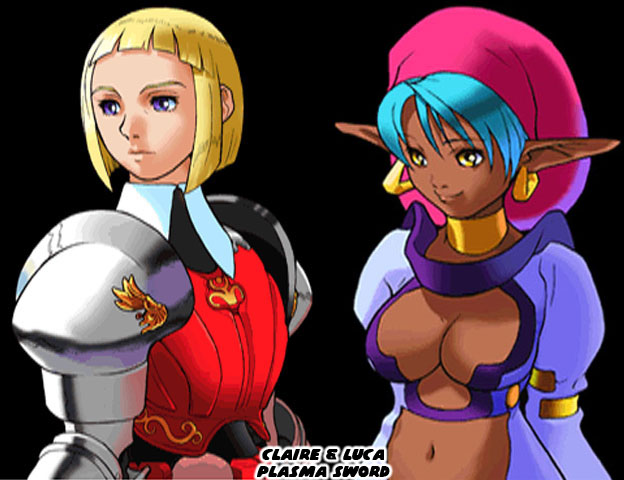
Poaching costumes from a rival studio was pretty low in my book. But then it might all be coincidence. The first time I saw the Fortune Teller / Menat the very first thing that stood out to me was the cut of her hair. Her look, her costume didn't immediately strike me as something that was featured in any contemporary game. Instead the hair, the colors and overall look actually reminded me of a few characters that Capcom had designed previously. The hair specifically reminded me of Claire, an officer in the Fourth Empire. She had a look that was inspired by medieval Spanish knights. She even fought with a plasma rapier. Plasma Sword: Nightmare of Bilstein came out in 1998. It was the sequel to Star Gladiator, a 1996 3D game, that was essentially Capcom's version of Star Wars as a fighting game. The sequel also introduced us to Luca, an alien fighter that was the fiance' of the alien Gore.


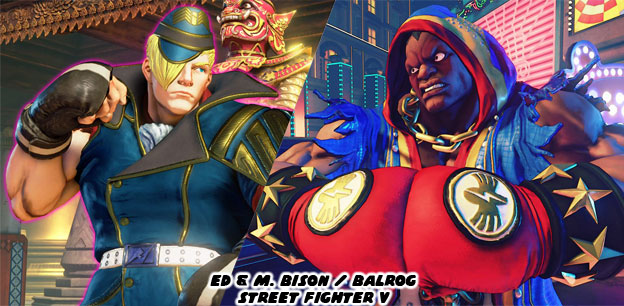
When I first saw Menat I thought that she was a sort of combination design of Claire and Luca. As if the designers revisited the notes on other fighters and tried to create something new. Also, seeing her bubbly personality reminded me of ARIKA's Pullum Purna. The youthful and energetic girl from the Arabian peninsula predated Menat by 20 years. It was hard to deny that Sadira and and Eliza also predated if not outright influenced Menat's design. What Capcom did right was in approaching her move set, her special abilities and connection to the past. Menat worked in part because she was reminiscent of Rose. Just as Ed reminded us of M. Bison and Vega, the Boxer and Dictator. But Menat was her own character, with her own special attacks, strategies and techniques. She would bridge the legacy designs and make a unique spot in the lineup.


If you are an artist trying to crack the code of the Street Fighter designs just look at three of the newer characters introduced into the series. Juri, Ed and Menat were all inspired by previous characters, they were in essence mirroring legacy designs. Juri was like an evil version of Chun-Li. Ed was a hybrid of Vega and Bison. Menat was the fresh face. She was to Rose as Cammy was to Chun-Li. It was not a coincidence that audiences gravitated towards these characters. Whether they realized it or not Capcom was using the same design elements that brought people into the fold 30 years ago. You can't really say the same about Rufus, Hakan, F.A.N.G. or Necali could you? I'd like to hear your take on Menat. Do you like the character? Why do you think she does or doesn't work in the series. As always if you enjoyed this blog and would like to sponsor me please visit my Patreon page and consider donating each month, even as little as $1 would help make better blogs and even podcasts!

 follow the Street Writer on Patreon!

Monday, August 21, 2017

A look at Ed from Street Fighter V, design meets legacy...

It’s been a while since I’ve talked about a new Street Fighter character, I haven’t been happy with most of them. I’m not going to talk about Kolin, probably ever, sorry about that. Instead I’m going to look at one of the new guys. Ed, revealed at the end of Street Fighter V Season 1 as the understudy of M. Bison / Boxer, was now a playable character. As a whole I think his design and assignment of moves and powers was done very well. There were the things that seemed off, like his animations which seemed to lack polish. Then there was the ability to perform special attacks with simple button combinations instead of traditional joystick+button inputs. Long time fans of Street Fighter thought this was pandering to Nintendo’s Smash Bros. community. But speaking from a visual design standpoint I would say Ed was probably the best new character in the past few years. The reasons for this were subtle but well done.

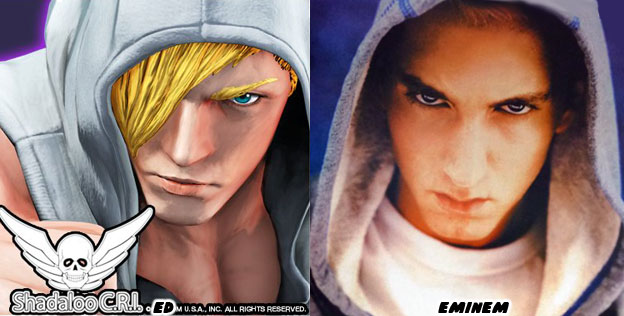
The first thing we should look at was his age. Ed was a young character. Most people in the series were adults. Young characters in a fighting game had mostly been girls, rarely men. In the Season 1 cut scenes he looked like a skinny kid, someone that you might see in real life. The use of a sleeveless hoodie was a good costume choice as it was not too modern. It made sense given that he was learning the art of boxing. Fighters had been wearing training sweatsuits for over half a century. It worked in any era the game was taking place in. This look was also used in pop culture. Rappers like Eminem used street fashion to build an identity. He dressed the part because he was genuine. He was from the streets and not created by a marketing wing of a record label. It was Ed’s updated costumes that worked even better.

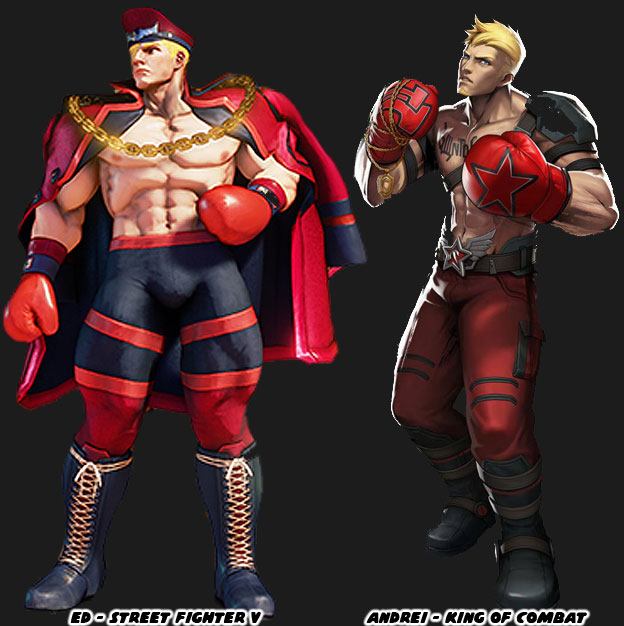
The black and red motif of Ed’s Battle Costume worked extremely well, especially against the light skin and blonde hair the character. The three colors, red, black and yellow were considered a triad of colors. The main color red, contrasting color black and accent color gold worked well visually. Go back through your fighting game history and look at the other characters that had similar color choices. Ken or course had a red gi for most of the games but in SFV he was paired with a black rash guard as well. The other blonde characters with similar color schemes were Paul Phoenix from Tekken, Jacky Bryant from Virtua Fighter, Rugal from the King of Fighters and Andrei the boxer from King of Combat. Having a strong color pallet was something that had made previous characters so memorable. Of course the use of the colors, jacket and military cap was also a callback to the organization that made Ed unique.

Ed had matured some, had gotten bigger and stronger, from the last time he appeared. Season 2 saw the addition of multiple costumes, the Default, Story and Battle uniforms. Each one of the costume choices complimented the character very well. In his Default costume Ed now looked like a full-fledged Shadowlaw officer. In the story he was aging quickly because of the experiments that S.I.N., the Shadowlaw weapons group, had performed on him. When I saw his militaristic costume and fingerless gloves it worked on multiple levels. He was now using the striking techniques taught to him by the former world boxing champ. Yet he was also his own unique fighter. He wouldn’t be riding the coattails of M. Bison for long. When I saw the character going toe-to-toe with his mentor I wasn’t put off. In fact seeing him in action reminded me of another young fighter taking on a veteran.

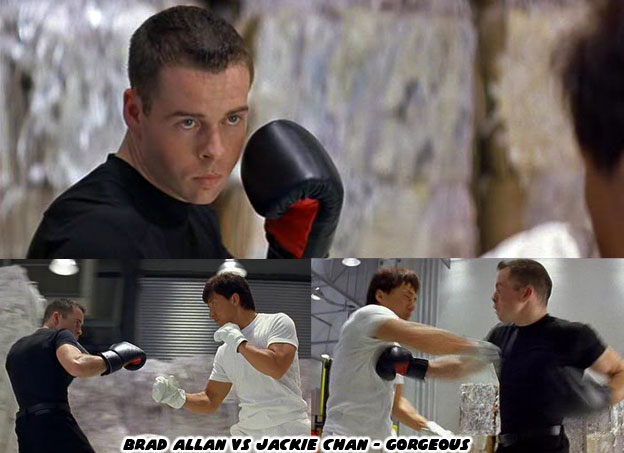
Brad Allan, a martial artist, stuntman and fight choreographer was a villain in the 1999 Jackie Chan film Gorgeous. Allan was a cocky young fighter that gave Jackie a run for his money. In the movie Allan didn’t want the fight to be over too quickly so he allowed Chan to wear light sparring gloves while he wore heavily padded boxing gloves. At that time Chan was a well-established movie star. Fans had seen him beat up all sorts of different martial artists over the years. Most of the people he fought were about the same age and the same size, yet every now and then he took on much larger opponents. Chan had lightning fast punches and was a master at improvisation, he could adapt to his opponents and overcome them quickly. People expected more of the same in this film. Imagine their surprise when they saw the kid trading punches and kicks as fast if not faster than Chan. For the first time in a long time it appeared as if the veteran had been outclassed. The stakes had suddenly become much higher because of this villain. When I saw Ed’s assortment of boxing moves I got flashbacks to how Allan was portrayed in the film. It got me excited for his potential in the Street Fighter series.

It wasn’t enough that Ed was a striker. His costume revealed a lot more about his true purpose and the extend of his powers. He was being groomed by the Dictator himself to become an important member of Shadowlaw. Would he perhaps become a general in the organization? Would he replace Sagat, F.A.N.G. or even the Boxer on the roster? Or would he assume total leadership of the organization some day? In order to accomplish this goal it meant that Ed would be given powers that went above those of normal people. This was where the fictional “Psycho Power” was reintroduced into the series. It had first appeared in Street Fighter II and was used to explain the awesome powers of Vega / the Dictator. The origins of Psycho Power were touched upon in the Street Fighter Zero series in 1995. The character Rose was a fortune teller whose powers were harnessed by Vega. This form of psychic energy allowed people to float, throw balls of energy and strike with burning force.

Psycho Power faded into history as Street Fighter III changed the main villain in 1997. Gill represented a secretive group known as the Illuminati. He had some sort of elemental powers, fire and ice specifically, at his disposal. This was never full explained in the series making him more fantastic in origin. In 2008 Street Fighter IV returned back to the SF II timeline. The head of S.I.N. was developing a new form of energy that could be weaponized. The character Seth had a Tanden Engine, installed into his abdomen, which allowed him to generate fields of energy and attract or repel opponents. A miniature version of the Tanden Engine was placed behind Juri’s eyepatch, which gave her superhuman strength. The Tanden Engine was combining the spiritual studies of Yin and Yang with science. It was the spiritual energy that allowed Ken and Ryu to throw fireballs but for the first time had been recreated mechanically. This technology took a back seat when Ed showed up and brought Psycho Power back to the forefront.

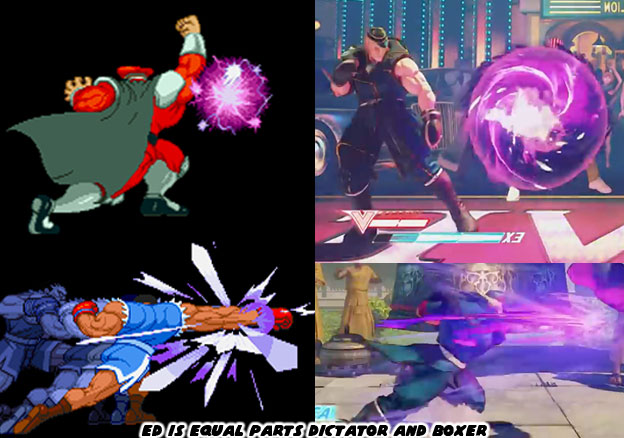
Psycho Power was a great explanation for why Ed was more than just another martial arts master in a tournament. It allowed the artists at Capcom to pull design elements that went into both the Boxer and Dictator and create something new. For the artists and budding designers reading this it was an important lesson in creativity. Take a look at your favorite character and try to pinpoint the best features. Look at the colors used, look at the cut of the costume. Look at the moves they had. Then take a look at a another one of your favorite characters and do the same thing. Now imagine how you could combine their features. For bonus points try making a good guy or bad guy version of the character. Or try changing the sex of the character or ethnicity. But Ed was more than just a distilled mix of the Dictator and Boxer. He had a unique special attack all his own.

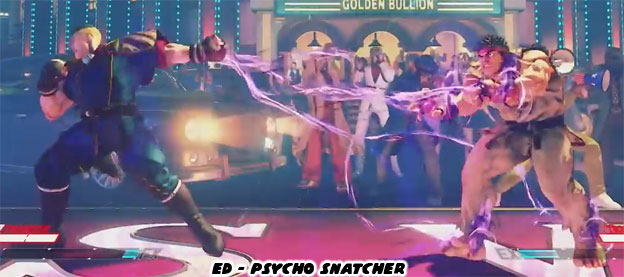
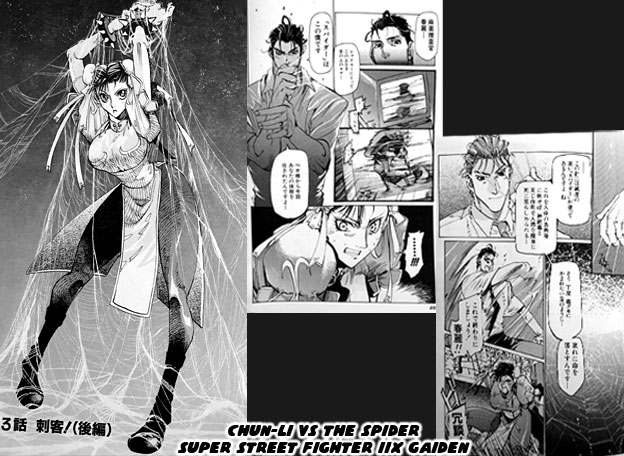
Ed could use his Psycho Power to create a web of energy and pull his opponents to him, it was called the Psycho Snatcher. It looked like the sort of move Spider-Man might use. This attack opened up the potential from a game play standpoint. The web of energy could cut off projectile attacks mid-air. It could also snatch opponents right out of the air. At a close range it could stun opponents and ensnare them even if they were blocking. From a design standpoint this also meant that Psycho Power was malleable. It didn’t have to be used as concentrated bursts of energy, and it didn’t have to be used to engulf the player in a psychic flame. Psycho Power could be used like a whip or net as well. Its other uses were limited only by the imagination of the designer. This special attack actually had its roots in the manga series Super Street Fighter II X Gaiden by Mami Itoh.

In the manga Chun-Li, acting as an INTERPOL agent was investigating a dangerous new drug that had hit the streets. It lead her to Los Angeles and eventually San Francisco where she ran into Ken’s wife Eliza. A handsome young investigator was assigned to the case as well. The two were tracking down the drug trafficker and assassin known by the alias the Spider. Chun-Li’s partner turned out to be the Spider and he was working on behalf of Shadowlaw. He tried to kill Chun-Li before she bring down the operation. The Spider had developed a deadly neurotoxin which he coated spikes with. He would use these poison barbs to kill his enemies. The trap that he set, the web symbolism used in the comics especially, made him a unique opponent. If he could have been presented in a fighting game with monofilament wires (like the kind Rolento uses) and his poison spikes then he could have made for a very unique Street Fighter villain. Seeing the Psycho Snatcher reminded me of the the Spider. I wondered if this double agent was not an inspiration for Ed. Even if he wasn't I think Ed’s design was well done. It worked in the lineup better than most of the new heroes and villains introduced up until now. What did you think about this character? Were you a fan or not? Why was that? Please let me know in the comments section. As always if you enjoyed this blog and would like to sponsor me please visit my Patreon page and consider donating each month, even as little as $1 would help make better blogs and even podcasts!

follow the Street Writer on Patreon!

Wednesday, December 9, 2015

What is going on with the Street Fighter V character designs? Part 1, who is F.A.N.G?

I've been pretty quiet these past few months on the characters unveiled for Street Fighter V. However seeing as the majority have been announced I think we can start talking about them. Let's start with the newest character F.A.N.G. Let's put down the initial impressions of him. The character is dumb, he is ugly, he is insincere and has no redeeming factors.
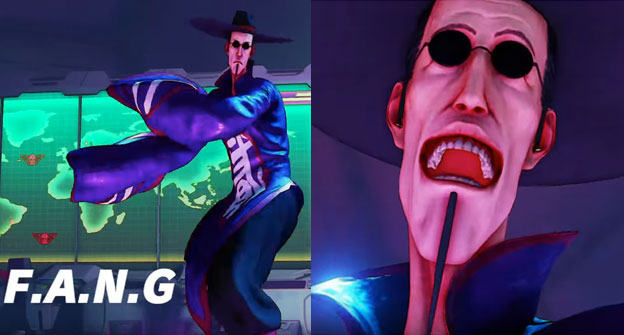
 

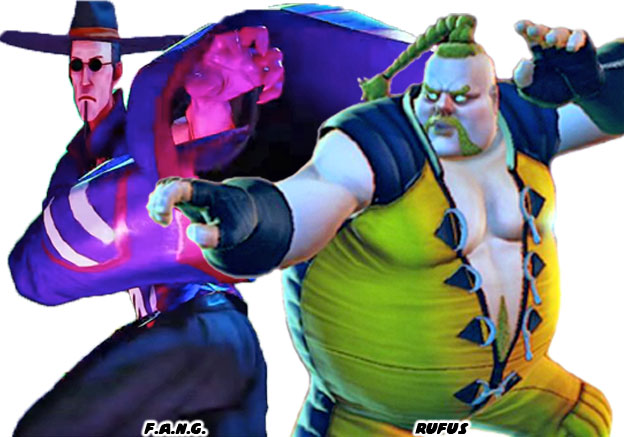
I think it would be safe for me to say that F.A.N.G. is the new Rufus. He is a character that is so over-the-top, that is so beyond the conventions of the other Street Fighter characters that he simply doesn't belong in the game. This is really saying something considering that a rubber-limbed Indian and a green-skinned Brazilian wild man are considered some of the great all-time characters. So what is it about F.A.N.G. that doesn't work? Well his design is a sort of polar opposite of Rufus. Instead of a big, fat and dumb US character we have a tall, skinny and sneaky Chinese character. In either case we have extremes in stereotype, extremes in caricature that say a lot more about the producer and director of the game than of what Street Fighter has become.

Yoshinori Ono should be taken to task for every character, every design that makes in into the game. He was the one that pulled the Black Cobra and made a strong black character into a fat white character. The excuse was that he thought it would be funny to put a fatty into the game. He was the one that made sure that the Turkish character was beet red and obsessed with oil, he was the one that made sure that the masked Mexican wrestler named every move after a Mexican dish. He made sure that the returning black character in Street Fighter V was turned into a fat slob. And now the joke is that a tall skinny Chinese character is flying around the screen like a pelican. Stop and think about how he has presented the British, Japanese, white and female characters that are returning to the series. Is there any bias, whether intended or not, in his decisions?
 

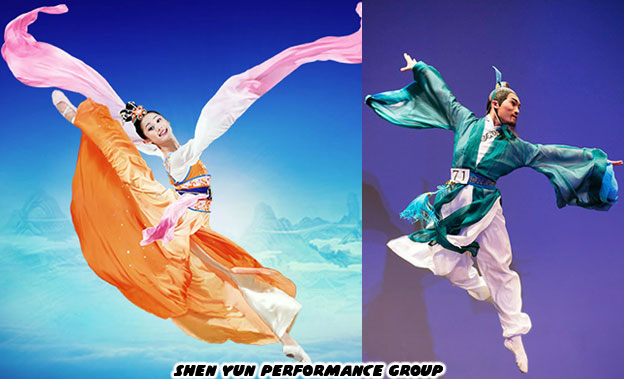
As the producer Mr. Ono has the final say as to how the game is going to present itself. He has a reputation for being a funny guy, always kind to his fans, but very silly at the same time. This silly humor has found its way into the game in how the characters act, how their special moves appear and even with the constant use of breaking the fourth wall. The Street Fighter games that came before Mr. Ono were considered templates for great design. The ones that came after certainly looked nice and were well balanced but they did not contribute as much to the genre as the earlier titles. This is especially true with the appearance of F.A.N.G. I know some people read my blogs because I try and understand the roots of a character's design. The long sleeves given to his costume are more akin to Chinese opera than a traditional kung-fu uniform or even classic Mandarin robe.

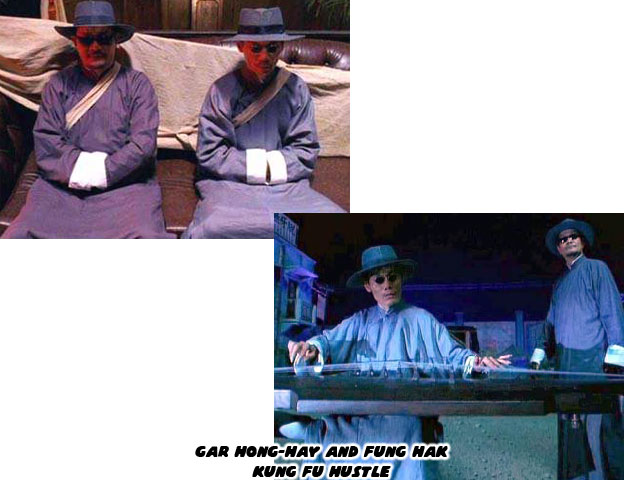
The combination of sunglasses and robes has been seen many times before in film and television. Sometimes detectives set in pre-cultural revolution China wear fedoras and sunglasses while tracking down criminals. However in film the majority of those wearing the sunglasses and robes are villains. They are often mob bosses if not mob enforcers. A good example of these dangerous characters can be seen in the film Kung-Fu Hustle. The harpist assassins as played by Gar Hong-hay and Fung Hak were mysterious agents sent to kill some kung-fu masters. Their traditional costumes were nondescript. They seemed harmless until they unveiled their secret techniques. Of course there was nothing subdued about F.A.N.G.'s costume. The colors and cut on his robe were as flamboyant as his personality. Instead of a modest hat he wore the widest brim possible.

There was a reason why F.A.N.G.'s design had to be super exaggerated. Every character in the Street Fighter universe had been presented in a costume that looked traditional on a superficial level. Karate masters after all did not walk around with torn sleeves, and female masters of wushu did not really wear wrestling boots and spiked bracelets. F.A.N.G. had a costume that at first glance looked like a traditional robe and hat. But the more you looked at his costume the more you realized that they were as exaggerated as his proportions. F.A.N.G. wasn't just skinny, his head appeared as if it had been squeezed by a vice grip. His costume shared the same qualities, he didn't just have long sleeves, they could double as wings if he flapped his arms fast enough. It was absurd of course but also par the course for Street Fighter character designs.
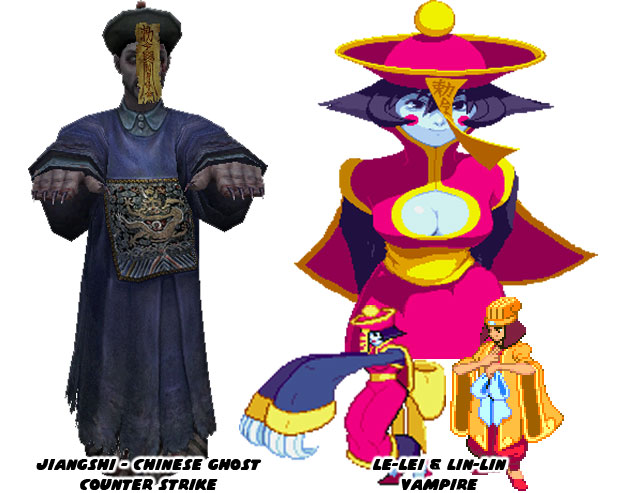
 

Traditional Chinese costumes had been used for generations in pop culture. Whether they were in a movie, comic book or cartoon, the classic Chinese tunic had been seen many times by audiences and not solely on Chinese people either! These costumes were even finding their way into game designs. The Jiangshi for example were zombie-like Chinese ghosts. They could be summoned to life with a special talisman placed on their head. Since they were dead and rigor mortis had set in they had limited use of their limbs. Rather than shuffle around like a zombie these monsters had to hop around like rabbits. Read about it on the Chinese Ghost Primer. The jiangshi turned up in a number of modern games, for example you could fight them in Sleeping Dogs, specifically the DLC called Nightmare in North Point. The costumes and designs of the undead were stylized in the fighting game Vampire / Darkstalkers by Capcom. The sisters Lei-Lei & Lin-Lin aka Hsien-Ko and Mei-Ling wore very bright (and revealing) versions of the classic robes. The costume given to F.A.N.G. was no more different than what Capcom had done previously. At first glance it had the appearance of a traditional costume however upon further inspection it was something else entirely. Yet the costume, weird moves and silly personality were only part of the reason why F.A.N.G. didn't really inspire me.
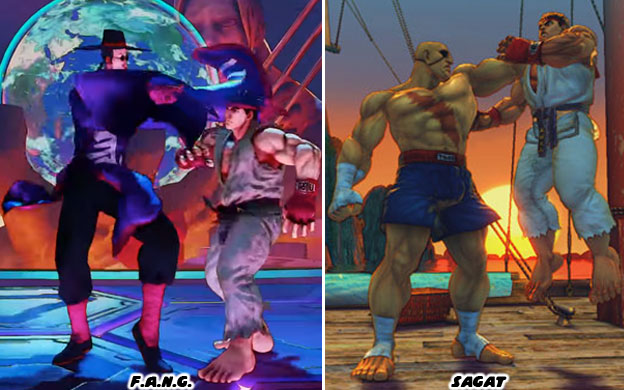
 

In the reveal trailer we could see several things about the character. He was goofy and lanky of course but he was also quite tall. In fact he appeared to be as tall as Sagat, the once world champion. And like Sagat this new character was marking a place for himself in the pantheon of Shadowlaw / Shadaloo villains. In the reveal trailer there was a level that was set inside of a secret base. In the background there was a statue celebrating the leader and "generals" of Shadowlaw. Sagat was previously the second-in-command to Vega "the Dictator." Yet during Street Fighter V there is no sign of Sagat, not only that but his visage would not be in the background details either. Instead the bust of F.A.N.G. had been carved out of a mini Mt. Rushmore.
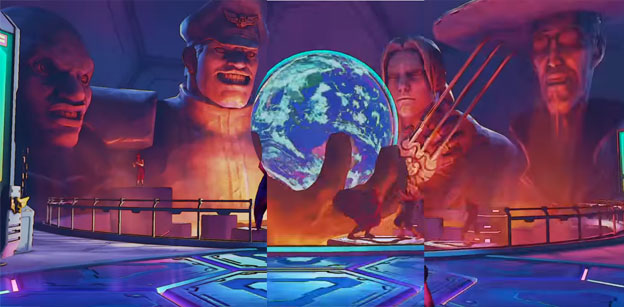

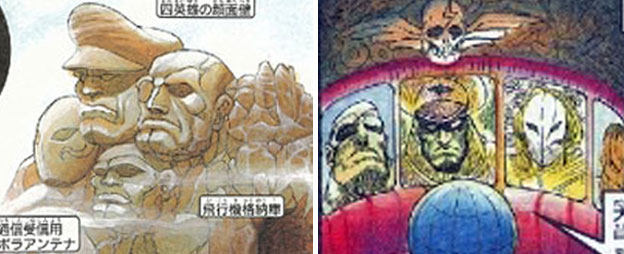
This flew in the face of everything that had been established about Shadowlaw from many years earlier. Whether it was mentioned in the game, in the comics or supplemental material The other generals were dangerous fighters in their own right. In propaganda posters, in Shadowlaw art the four figures were placed side-by-side in a show of solidarity. The generals looked intimidating but there was something about F.A.N.G. that did not match the gravitas of the earlier bosses. A one-eyed, seven-foot, muay thai fighter was a sight to behold. A seven-foot, flamboyant Chinese kung-fu master was also a sight to behold, but not for the same reasons. Why the designers working on Street Fighter V would replace the legacy character Sagat with F.A.N.G. didn't make much sense. Why they would go out of their way to erase any hint of Sagat was frankly insulting.

What were the roots of F.A.N.G. and why was he so bad? Was there anything about the character that might work? These are things that we can explore in the next blog. Right now I'd like to read your thoughts on the character. As always if you enjoyed this blog and would like to sponsor me please visit my Patreon page and consider donating each month, even as little as $1 would help make better blogs and even podcasts!
Wednesday, September 30, 2015

How fight culture became fighting game history, part 40

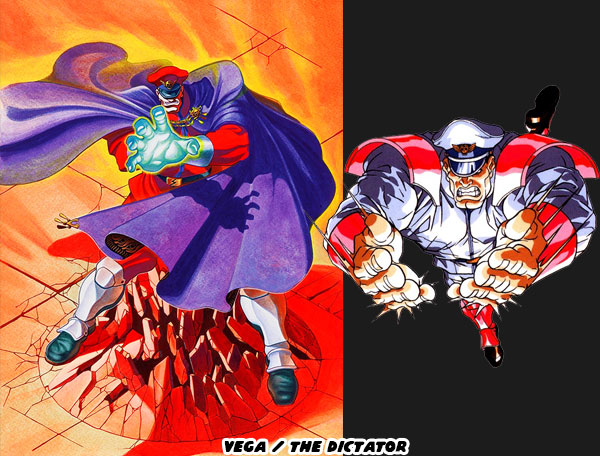
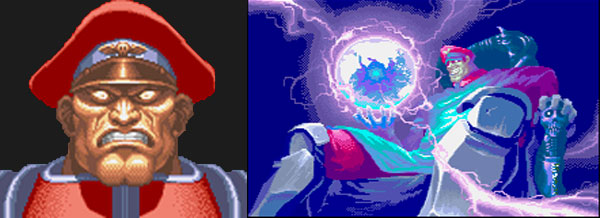
In the three decades since the fighting game genre had been established there were dozens of forgettable bosses and only a handful that withstood the test of time. The best of these villains had achieved a mythical status. Some were as well regarded as classic movie, comic book or animation villains. For a generation growing up on videogames the boss characters were revered as much, if not more, than most of the heroes. Undoubtedly it was Capcom that set the bar for what defined a great villain was in Street Fighter II (SF II). The game already had an exceptional boss with M.Bison in the USA aka Vega in Japan. He was known commonly around the world as the Dictator. The Dictator was completely unlike the martial arts characters featured in the regular cast. Instead of a traditional fighting costume he wore a red military uniform. He had large metal wrist guards and heavy boots covered in armor. His assortment of moves had no definable style. He could leap well over players, come stomping down on their heads and even fly across the screen with an awe-inspiring psychic attack known as the Psycho-Crusher. The character did not seem cheap or overpowered. His moves were slightly superior than most characters but not to the point where it felt impossible for players to defeat him. He had elevated the standard set by the Muay Thai giant Sagat, who was the boss from the original game.


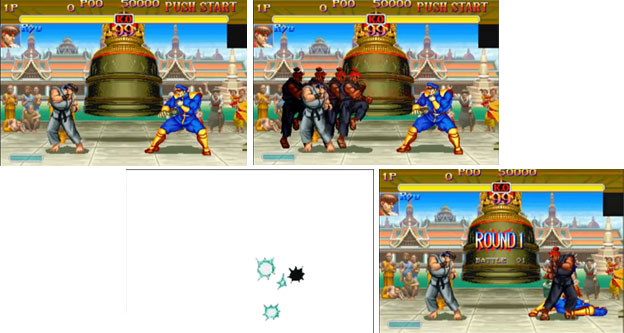
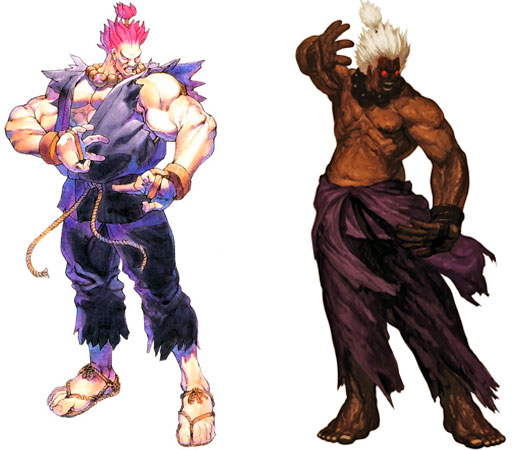
The Dictator seemed the perfect template for fighting game bosses. That was until one day Street Fighter II got an upgrade and introduced the world to the monster known as Gouki aka Akuma. The character was hidden in the game, he could only be fought after certain criteria were met by the player. The gamer could not lose any rounds and had to defeat most of their opponents with a Super Attack. It seemed like only the best players could meet these requirements. In most arcades whenever a player was about to face Gouki all of the other patrons would stop what they were doing to see the man in action. Just before the fight against the Dictator a new opponent appeared. Gouki had a move that allowed him to slide by his opponents, the Ashura Senkuu. In this case he would slide right past the player and pummel the Dictator with a flurry of strikes. Players didn't know it at the time but the attack was known as the Shun Goku Satsu, literally the Instant Hell Murder. He would then drop the defeated Dictator and turn his attention to the player and issue a challenge. It was one of the earliest cinematic experiences for the genre. This display of raw power was unnerving for the first players that reached him. Gouki had an assortment of moves that none of the other characters had. He could throw fireballs from the air, dive kick and throw opponent while leaping as well. He was absolutely relentless in battle. Unfortunate players would be dispatched by a Shun Goku Satsu. The legend of Gouki would only grow from there.


Players had no back story on the character so rumors began to circulate as to his origins. Why were some of his moves similar to Ken and Ryu? Was he the father of Ryu or was he some long-lost rival? Was he their former master? Why was he so powerful? Most important; where did he come from? The answers to these things would be revealed over time in many more Street Fighter sequels. The actual origins of Gouki were less inspiring. Capcom was asked to release upgrade after upgrade for the arcade hit. Bootleg CPS-II boards allowed cabinet owners to set up all sorts of special things that deviated from the regular gameplay. They could speed up attacks, allow players to switch characters on the fly and increase the combo system so that battles could take place mid-air. These variations of Street Fighter II often turned up in liquor stores and laundromats rather than arcades. Capcom released the Turbo and Championship Edition upgrades to arcade owners that wanted legitimate copies and not bootlegs. At the same time titles from SNK including the Art of Fighting and Fatal Fury as well as competition from the US in the form of Mortal Kombat had begun putting additional pressure on Capcom. The studio was at a crossroads. They could continue working on Street Fighter III or take some of those characters and make one final push for a SF II upgrade. Management pushed for the latter and Super Street Fighter II Turbo was born.


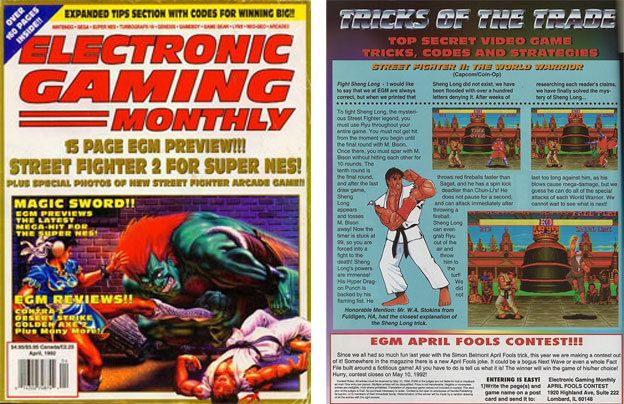
It was not enough to simply add some new moves, characters and animations to the original SF II lineup. The game needed a new boss character to go with it. Electronic Gaming Monthly had a hand in creating the Gouki myth. During one of their more elaborate April Fools jokes they created a hidden character called Sheng Long, named after the dragon punch used by Ryu. They included screenshots to help sell the character. They said that the only way to reach the true master of the game was not to lose any rounds and avoid getting hit by the Dictator until time ran out. At which point the master of Ken and Ryu would show up and beat up the Dictator. Those that didn't get the joke spent the better part of a summer trying to unlock the character. Rumors that the friend of a cousin in some unnamed arcade had seen Sheng Long in action. The myth stayed alive for years. The internet was not widespread in the early '90s so there was no way of proving if it was true or not until EGM had said something. Capcom learned about the prank and decided to put Gouki in the game using similar criteria. Unlike EGM the people at Capcom did much more than put a ponytail on Ken when they created him. They wanted players to remember this boss. In order to do that they had to make him absolutely terrifying and unlike any boss ever seen before.


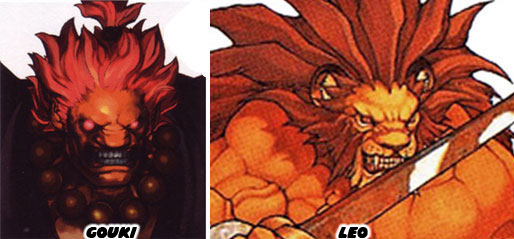
The designers at Capcom in Japan put together the definitive style guide for fighting game bosses. Actually they had done such a good job that Gouki could be considered as one of the great villains in all of game history. They started by making Gouki appear less human and more animalistic. They flattened and broadened his nose. Instead of a normal skin tone they gave him dark red, almost clay-colored skin. He wore all black and had a rope belt. His hair was crimson, spiky and tied up in the back like a crown or horns. The artists actually looked at a lion for inspiration. The king of the animals was a great template to work from. Years later the studio would revisit the design when they created Leo, the warrior featured in Red Earth / Warzard fighting game. The dark eyes, with a red glint, the sharp teeth… Gouki could hardly be considered human. This was an important trait from both a design and a gamer perspective. The physical traits were used to intimidate players. Although there were bigger characters in the game none of them had the presence of Gouki. Players were not staring down a man as much as they were staring down a beast.

This was a fine line that Capcom was walking. The use of physical traits to make a person seem more animal than man was used in racist propaganda less than a century ago. By dehumanizing minority groups it was easier for the public to side against them and for segregational laws to be passed. In order to make players fear Gouki he also had to be dehumanized. The Dictator was an impressive boss but Gouki was the peak as far as villains went. Capcom was able to dehumanize Gouki without offending players or their sensibilities. Part of that was through the animal cues but part of it was also through spiritual and metaphysical traits. Gouki wore large wooden prayer beads around his neck. This did not make him a spiritual man but instead was a sign to demonstrate that he was a martial arts master. While most Westerners were familiar with the colored belt system used in karate Gouki had evolved well beyond that. He wore a rope instead of a colored belt. The beads were an older symbol, they were something that he had taken from his old master, a Chinese martial artist named Goutetsu. The poses and art featuring the character were pulled from ancient Chinese and Japanese mythology. The demonic protectors of the gates of Heaven and Hell were mighty warriors. They were muscular, crimson skinned, had fearsome scowls and spiky hair. The connections between Gouki and the ancient Nio were certainly more identifiable for the Asian community than the Western one.


This relationship between man and demon was not lost on westerners however. His design was believable but clearly supernatural. It was the way in which the industry reinforced the myth of the supernatural karate fighter that kept audiences coming back for more. The next blog will explore a similar villain created by SNK. As always if you enjoyed this blog and would like to sponsor me please visit my Patreon page and consider donating each month, even as little as $1 would help make better blogs and even podcasts!
Tuesday, June 30, 2015

Representation Matters! Or, what happened to Birdie, part 2...


In the previous blog I talked briefly about the influence of Street Fighter around the world. There were many reasons why the franchise was so successful. From a move selection, balance and control standpoint Capcom had done a superb job. The controls were experimental, many developers thought that anything more than two buttons might confuse players, six was going to be overkill! Despite the fears of the industry (and the extra expense to Capcom to put in all those extra buttons) players seemed to quickly pick up on the nuances of multiple buttons and joystick combinations. From week to week gamers were becoming exponentially better at the title and were uncovering secrets and techniques over months. The studio had a hit on their hands with Street Fighter II and decided to refine the game. Unlike other companies that would publish a title and move to something else Capcom was looking to fine tune Street Fighter II and offer arcade owners more repeat business. They would release upgrades to the game, known as the Hyper, Turbo and Super versions. The changed the way certain characters played and modified the balance accordingly based on location tests and feedback from player. Each upgrade to the arcades was met with great success.

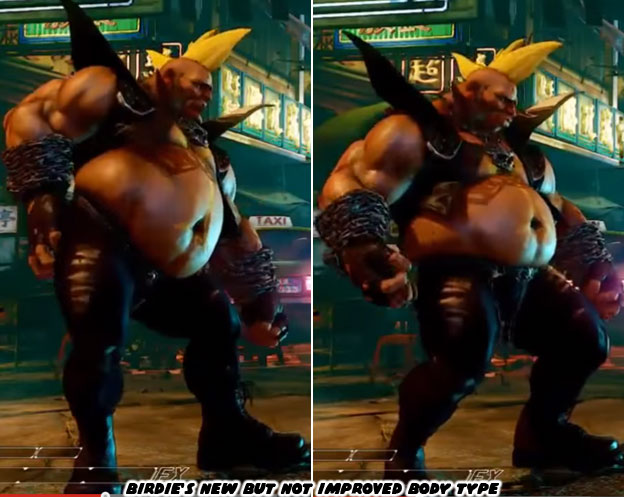
From a technical standpoint the developers at Capcom were unparalleled. Yet with certain updates and sequels the characters introduced into canon did not have the staying power of the original Street Fighter II "World Warriors." The designs of the subsequent characters did not evolve as greatly as the game engine had. In some cases the characters were ill informed, if not crude and stereotypical. Birdie had started out as a typical punk character in the original Street Fighter but turned into an icon in Street Fighter Zero. It had been 17 years since Birdie was last featured in a Capcom game. In Street Fighter V the years had not been kind to him.


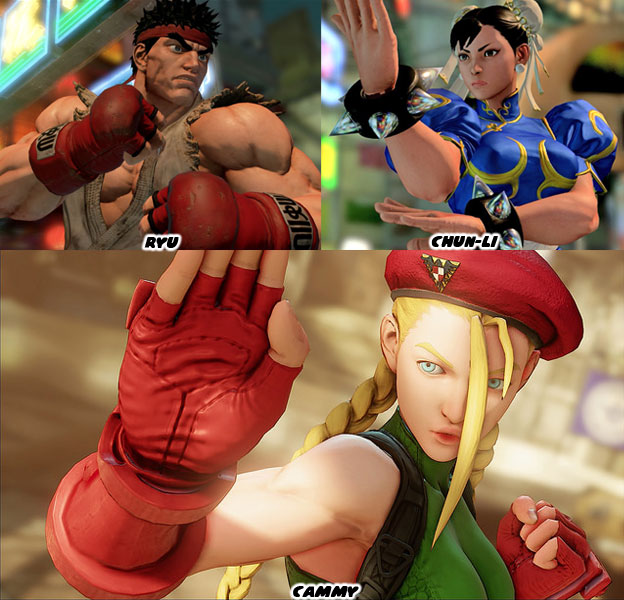
Actually it was the designers that were not kind to Birdie. They turned the character into a slob. A fat, junk food craving shadow of his former self. I wondered why Capcom would do such a thing. The other characters announced thus far had not changed at all. Ryu (who happens to be friends with Birdie in canon) was still muscular, Chun-Li was as beautiful as her previous incarnation, and Cammy seemed a minute older than her previous appearance but was still beautiful. None of the characters were fat or out of shape.


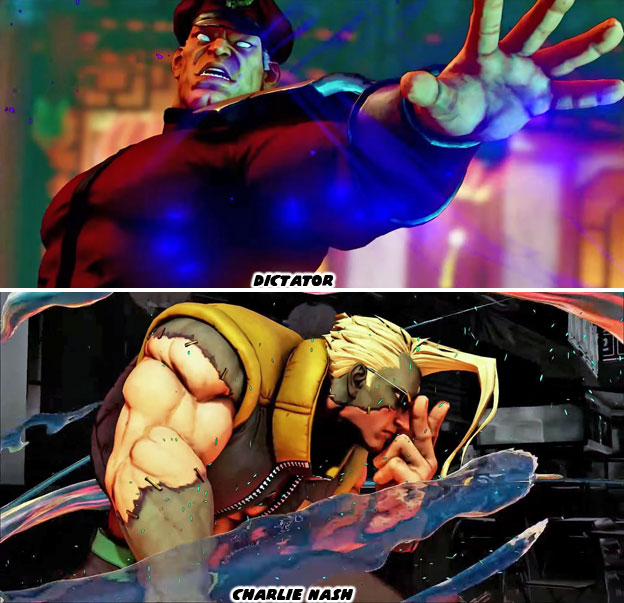
The Dictator, known as Vega in Japan and M. Bison in the USA, leader of the terrorist organization Shadowlaw was the main villain in Street Fighter II. He had also returned for Street Fighter V. He appeared very much the same as he did in Street Fighter IV only that now his hair was white. It didn't seem to go white due to his age but instead due to his mysterious "Psycho Power." The surprise announcement was that of Charlie Nash asa  returning character. Charlie had last been seen in Street Fighter Zero. Like Birdie it had also been 17 years since his last major role. Nash had changed somewhat as well. The character was presumed dead following the events of SF Zero, he had been shot in the back by Shadowlaw soldiers and thrown off a cliff. Revenge spurred his military friend Guile to enter the SF II tournament and track down the Dictator. In canon Nash was brought back from the dead, brainwashed and turned into an assassin. His discoloration and Frankenstein's monster-like appearance were done deliberately. Of course neither the Dictator or Charlie had returned fat and out of shape.


I wondered why Birdie had been turned into a slob. What did the character do to deserve such a disservice from the  new developers? Did the team of artists and animators not like him? Was it because they did not like punk culture? Was it because they did not like minority characters? Perhaps they simply didn't understand the appeal of the character in the first place. Unlike the radical redesign of Birdie from the original game to Street Fighter Zero the designers used the Zero version and tore him down. They did not even bother to use the cues that were placed on him in his previous incarnation. For example he didn't wear chains on his wrists because it was his primary weapon but because they were attached to a pair of handcuffs that he had broken. The newest version is missing the handcuffs as well as some other details that I will let you figure out.

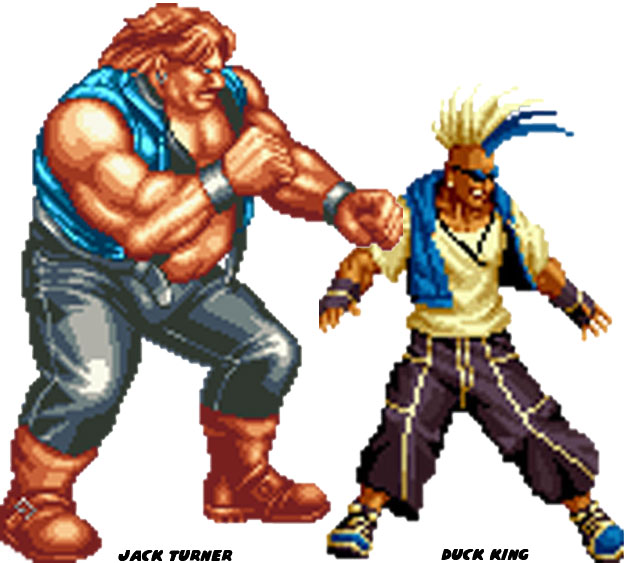
So what exactly did Birdie's new point of reference come from if it was not from previous games? I would say that the new Birdie is now a mash up of SNK's Jack Turner and Duck King. Both characters appeared in 1991. Jack appeared in the Art of Fighting. He was a mob enforcer in South Town. The character was modeled after the stereotypical fat bikers from the West. He hung out in bars and seedy back alleys looking for trouble. His costume and fat belly had a lot in common with the Birdie redesign.


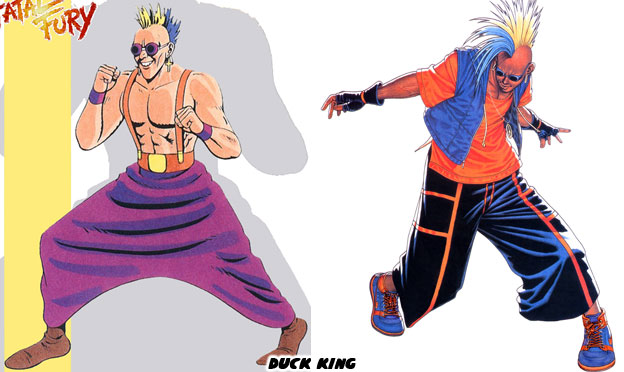
Duck King appeared in Fatal Fury. Despite the Mohawk haircut he was not supposed to be seen as a punk character. He was instead based on party kids, ravers and b-boys (break dancers) from the USA. His bright colors and costumes were pulled from trends in the West. There was a difference between how he was put together versus J and Two-P. In the early character art we could see that his costume, especially sunglasses and fat pants was inspired heavily by MC Hammer. He was never meant to be seen as any sort of gang member. As dance trends and pop culture changed the look of Duck King evolved. He was still a colorful character but now dressed in more street appropriate costumes. I would argue that neither Duck King nor Jack Turner were ever as popular as Birdie. In fact I remember the first time that I saw Duck King in the game I thought to myself that SNK was trying to create their own Birdie. I mean even the name was similar.


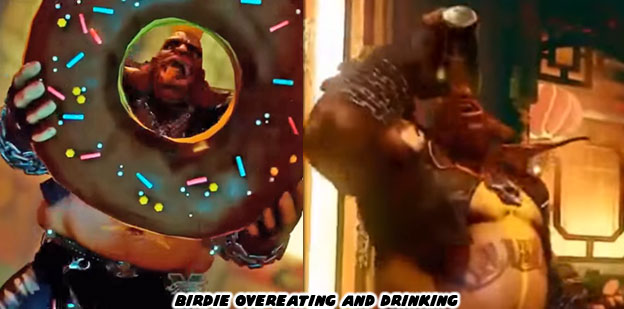
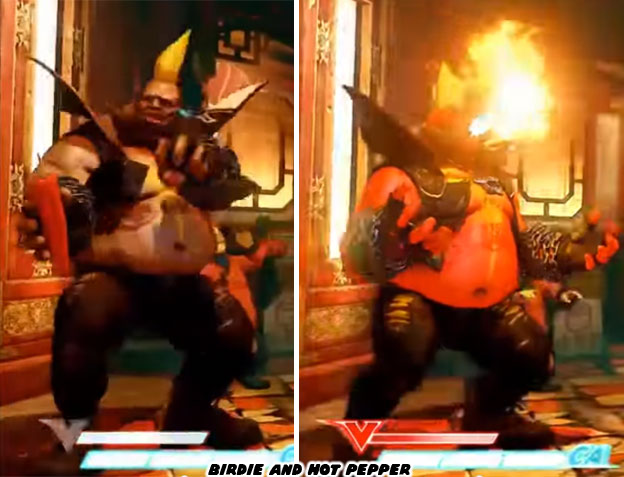
Yet anything that SNK did was nothing compared to what Capcom would do to their legacy character. Everything the designers did to Birdie in Street Fighter V reinforced what a slob he had become. For example some of his "attacks" consisted of him sneaking a donut from his back pocket or guzzling an energy drink. In fact in his character animation after winning a match he would pull a gigantic donut out of thin air and bite into it. It was an odd visual that nothing but demean him. Not only that but unlike previous representations of punks in the series the team did not seem to have the insight as to what Birdie would have eaten to gain so much weight. Donuts were considered more of a USA treat than a British one. Perhaps fish and chips and a warm beer would have made more sense.


Having Birdie drink and eat and throw his garbage at opponents would hardly be considered "punk." He was just being crude and nasty. The most absurd of his mid-match snacks was a hot pepper. It would cause Birdie to breath fire, have his skin glow red hot and do more damage to his opponents with each hit. Birdie had never had any moves in previous versions of the game that were similar to these new food-based attacks. I could not figure out what made the developers think that this radical direction was appropriate for the character.


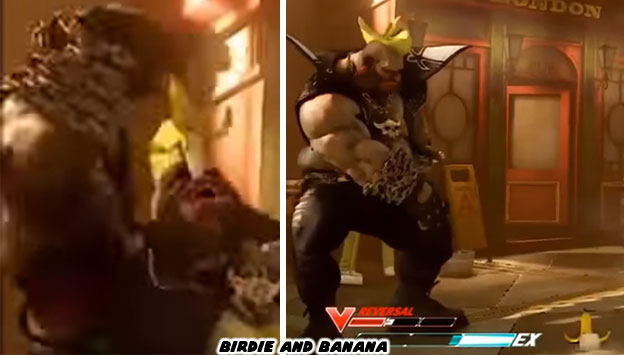
When I saw his last food-based attack it raised a red flag in my mind. Birdie would eat a banana and throw the peel on the ground. Opponents could slip on this banana. It was supposed to be a funny attack that also helped keep aggressive opponents at a safe distance. It was an ill-informed choice to make a black character enthusiastically eat a banana, There were heavy racial overtones that Capcom could have done without. In many parts of the world black professional athletes are often called monkeys and bananas are thrown at them from the stands. Seeing as how Street Fighter V is going to become an international title then I would strongly suggest avoiding anything that could even remotely be taken in the wrong context.


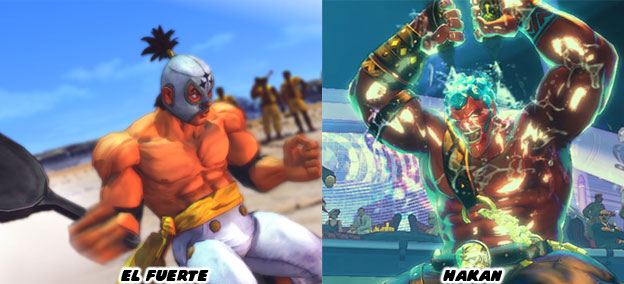
Since Birdie had never had these types of silly attacks before I wondered why the studio would start adding them now. If they are giving Birdie absurd attacks why not do the same for Ryu, Chun-Li, Cammy, Dictator or Charlie? If Birdie is now fat and sloppy but none of the other characters are why is that? All of the other characters seem to be played very straight. The way they were in previous games is the way they are now. I would hate to think that Capcom is doing this because of the color of his skin or the minority status of the character but it just might be true. Consider for a moment the previous nationalities represented in Street Fighter IV. There was a lot of diversity in the lineup but the new characters created for the game were very odd as well. The Mexican wrestler El Fuerte for example was obsessed with cooking and named several of his moves after plates. There was also a Turkish wrestler with beet red skin and bright blue hair named Hakan that practiced the art of Yagli Gures, or Turkish oil wrestling. That character was obsessed with finding the perfect oil recipe to help him dominate in his matches. Players could splash themselves with oil in the game and slide across the floor. The gimmicks placed on El Fuerte and Hakan were done to give the characters a personality and make them more interesting. Yet gimmicks and throw away attacks were not something that was used with the original Street Fighter II cast. Those characters were far more interesting without being silly or sloppy.


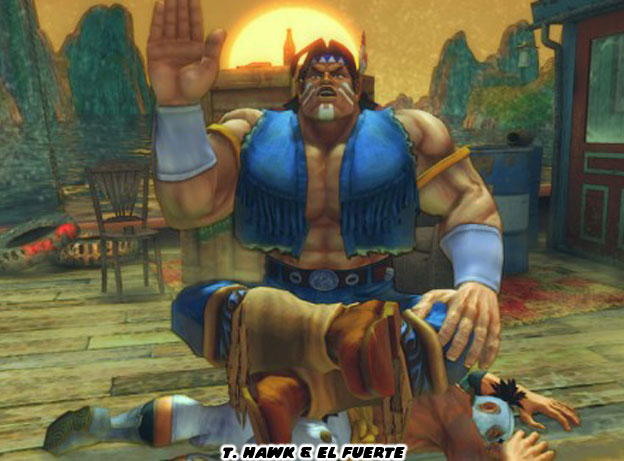
The trend was becoming apparent in the more recent Capcom fighting games. El Fuerte, Hakan and Birdie had something in common. They were all minority characters. The designers had no point of reference for the characters, their cultures or their specific fighting arts. So instead they gave each of them a gimmick and made them silly. I sincerely doubt that the developers would have done the same to a Japanese character or one of the female characters. Before Birdie had the silly food attacks applied to him the developers had done something similar in Street Fighter IV. The Native Mexican character T. Hawk  was given an update to his "Raging Typhoon" special attack. In Super Street Fighter II the character would grab an opponent by the head, spin them in the air and slam them into the ground. In Street Fighter IV an extra animation was added where T. Hawk would then sit cross-legged on top of the opponent making a stereotypical "how" pose for Native Americans. This was a trope used by television to depict the ways that Native North Americans would greet each other.


I would hate to think that the developers at Capcom were being racist with the characters. I like to think that these choices were made out of ignorance (which is a root cause of racism) rather than racial bias. Unfortunately the silly makeover was a trend that was becoming more and more apparent for the series. Something that could be measured over the past few years were how odd the character selection had become. What was done to Birdie was part of a pattern. The next blog will question the choices from the developers. As always if you enjoyed this blog and would like to sponsor me please visit my Patreon page and consider donating each month, even as little as $1 would help make better blogs and even podcasts!