Showing posts with label rufus. Show all posts

Tuesday, May 7, 2024

Another Rufus blog... A 1UP classic from May 15, 2008

Hello friends, it looks like I'm on a bit of a Street Fighter IV kick again. We might as well keep the train going with some more random observations. Today's rant takes us back to look at the place and purpose of nobodies favorite SF fat man Rufus. It's funny timing that I bring him up as Capcom in Japan and the US has made no official mention of this guy. Even better, Cap USA wants to make 3 figurines of the new lineup and are letting fans vote. Rufus is nowhere to be found. Is it possible that the fan reaction was so strong that they buried him or are they holding him plus other characters as a surprise for when the game is launched? It might turn out to be like Tekken in which some characters appear after a certain amount of time has passed. Let's hope that some other SF-universe characters appear in the lineup.

Now I have nothing against fat people, I'm a fat guy. I also don't have a problem with fat fighting game characters. In fact, I'd like to see more of them, provided that they are consistent with what has already been established in the series. Just the other day a new character was introduced for the boxing game Ready2Rumbe 3 Facebreaker. He's a fat boxing master named Steve Talking Head. The game is supposed to be cartoonish and over-the-top, so he makes sense in that lineup... Make of him what you will.
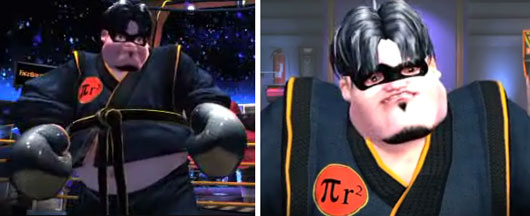
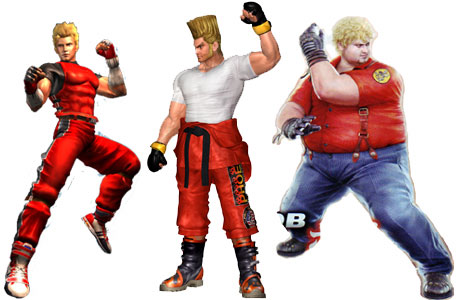
I've already spoken at length about the subject with my origins of Rufus blog. In case you don't want to read old news I'll sum up some of my gripes. A character like Bob from Tekken moves too quickly for a man of his girth. It's as if they did some motion capture moves and thought it would be funny if the animations were stuck on a fat character. It seems that Rufus is even larger than Bob yet seems to move faster. Maybe Rufus was inspired by strongman Gene Rychlak. He's also a big guy with wild hair and a trucker mustache that bench pressed a thousand pounds. Sure he's strong, but can he move fast? Is he flexible? I doubt it.
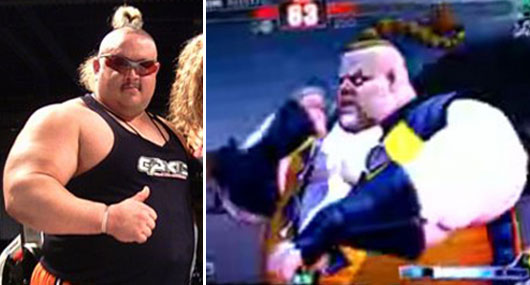
While thinking about this character I began wondering what it is that I don't like about Rufus. 1UP member Smashbro mentioned that it could be the way obese people are demonized in US culture. But my issues are more about his speed, lack of muscle definition and seemingly weightless mass, not any bias against fat people. 1UP member Marc lamented that he seems to be the only one on 1UP willing to try this game. I never said that I wouldn't play SF IV or that I wouldn't try out this character. In fact if there is a location test anywhere in the southland then I'll be there, getting in line and trying each character at least once. I'm also thinking about which console to pick up based on which will have a better joystick for the game. To think that I'll pass on a SF IV after waiting so long after III is absurd. Remember that I got the Wii for NiGHTS? Or the Xbox for Jet Set Radio Future?

I've said that large characters tend to move slower in SF games, Rufus is contrary to that. Smashbro mentioned that the Japanese tradition of sumo might explain why they created him and seem to be more accepting of this large character than the US is. The US demonizes obesity yet has a large population that is overweight. My biases might be based from a cultural P.O.V. I began thinking about who Rufus reminded me of, aside from Gene Rychlak and where his place could be in the Street Fighter universe. I began thinking about large characters from cartoons, movies and even real life. Who were the ones that worked and why? As far as fighting games go, the fat guys in Final Fight worked, King Heart in Fist of the North Star worked and Karnov from Fighter's History Dynamite worked as well.
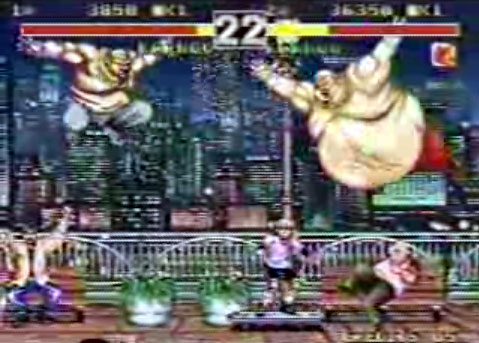
Heck, Karnov could even inflate himself and become even more massive than Rufus, yet he worked in the game because he also had an assortment of mystical properties. Karnov could breath fire, teleport and float, he was a fat doppleganger of Dhalsim. In the context of his game these things worked, but this is a different game. The issues that I have with Rufus and the other new characters are because I feel that Capcom is betraying their own design legacy. Actually part of the problem is that DIMPS is developing this game and their approach to character design is different than the classic Capcom formula. I'll talk about it more tomorrow but I strongly feel that Rufus is just a more complete vision of the character Boyd that DIMPS had put in their 2.5D fighter Rumble Fish.
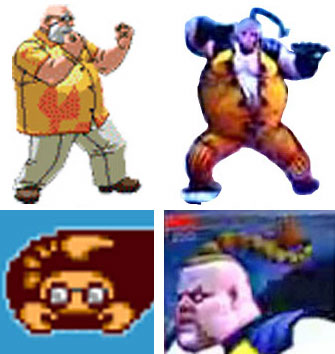
I couldn't just leave it at that. Like a scab I have to keep picking at the design until it starts bleeding. Where did Rufus come from? What was it about his costume that works or doesn't? Yellow jumpsuit, unzipped to his belly with built-in pads? What about that ponytail and facial hair? Looking at Rufus' trucker mustache I was reminded of the larger-than-life character of Bull Hurley from the movie Over the Top.
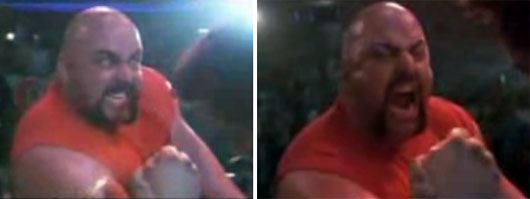
I noticed that even though Bull, as played by the late character actor Rick Zumwalt was massive, he wasn't obese. I began wondering how "fat" a character could get and still be valid in the SF universe. I began wondering how big a person could be and still remain a valid fighter. Here is where the distinction between what "fits" in the real world and what "fits" in SF has to be made. We are willing to suspend our disbelief up to a point. If the point is crossed then that character becomes redundant, broken or laughable. At some point something has to be done with the character and design to make him or her fit into the game. This is the part that I think Capcom and DIMPS is missing with Rufus. They are not separating his purpose from his moves. The reason for my thinking of that actually goes back to the character of Bull and the movie he was in. The real arm wrestling legend at the time, Cleve Dean, makes a few cameos but isn't the last person that Stallone faces. According to the Wiki page the filmmakers didn't think that audiences would believe that Stallone could beat Dean.

Wait a minute. We could believe that Stallone could beat Bull but not Dean? How much more massive and imposing was Dean over Hurley?

At his peak in the late 70's / early 80's Cleve Dean was a multiple time world champion. He simply dominated his opponents. The reason for this was because of his tremendous size and strength. He was about 6' 7" and over 450 lbs. easily dwarfing Stallone and even some of his competition. His girth beguiled his opponents, he wasn't just a mountain of a man but rather a mountain of a man with lots of muscle. Like a modern-day Paul Bunyan, Cleve became synonymous with power.
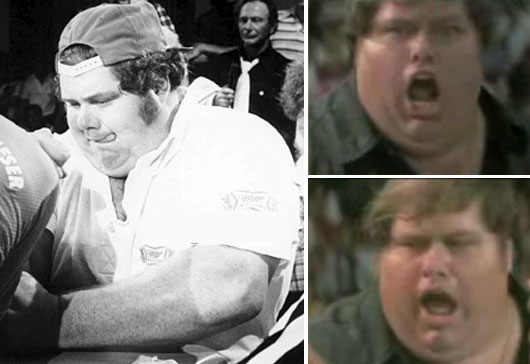
Cleve represents a certain athletic aesthetic that is older than most people realize. Throughout history some of the strongest men in the world haven't always looked like bodybuilders. Some of the most powerful figures in myth have been on the heavy side. The giants and titans of ancient Greek and Norse mythology were usually heavy-set. The legendary Olympic weightlifter Vasili Alexeyev was another mountain of a man but he also did the unthinkable. Before his time many thought it would be impossible to lift more than 500 lbs. in the clean and jerk. Even though there were many strong weightlifters in that era, part of the reason for not being able to break the mark was psychological. Before his record-setting lift his coaches told him that he would be lifting 497 lbs. something that he had done in the past. As he lifted it he thought it felt heavier than normal but pushed himself to complete the cycle. Once he broke the barrier many in the sport realized that the human body had even more strength potential.

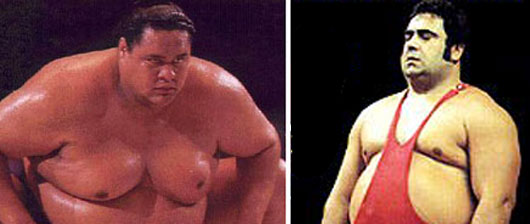
But the incredible strength of Cleve or Vasili doesn't mean much in the fighting arena. Grappler Royce Gracie once said a person with an average build that is experienced with judo would be able to beat a person with a bodybuilder physique and no fighting experience. There seems to be a lot to his reasoning. Big, tough guys that know a little fighting are usually taken out by smaller, experienced MMA fighters. The only large people that knowingly have fighting ability are sumo wrestlers. I've already mentioned that sumo wrestlers have a lot of muscle underneath their mass. More than that they have technique. Being absurdly strong is one thing but most sumos are evenly matched, they need technique to counter the strength. They need technique to decide a winner. A champion like Akebono made for a great sumo wrestler because he had the raw size and strength of Cleve or Vasili but combined it with impeccable fighting technique and strategies.
This is where I don't understand the purpose of Rufus. Street Fighter is already filled with archetypical strongmen. Zangief is a giant, bearded version, of Alexander Karelin. Like Alexander, Zangief is capable of superhuman feats of strength with his wrestling ability. E. Honda is a champion-class sumo wrestler, a kabuki-painted yokozuna. Where does Rufus fit between those other big men? He doesn't seem to have the design or purpose of the legendary strongmen I've mentioned. Instead he is a fat guy that knows kung-fu and moves really, really fast. He jumps fast, punches and kicks fast and has fast super attacks. Zangief and Honda are slower by comparison.

It just doesn't make sense to me. I'd love to see Rufus as massive as his is now, playing sickly powerful but also slow. A middleman between Zangief and Honda. Or a "slimmer" version, one that is still chubby but also fast and more reminiscent of Sammo Hung. But a Rufus that is both absurdly fat and fast? That, like Bob from Tekken, is a stretch and I don't think I'm the only one that thinks so. At some point character design stopped being great. It stopped evolving logically and just became absurd. I'm not going to lie and say that 2D fighters all had great designs, there were some awful designs back in the day. However the third dimension really brought the worst designs to life. Advances is animation and 3D modeling allowed a character of any shape or size to move as lightly as an olympic gymnast or as fast as a professional boxer.
When did the gatekeeper to great fighting character design go on holiday? Wish I could have been there in his stead, some characters would have never gotten the greenlight. All I can do now is point out the tragedies and lament the days gone bye. What do you think. Do fat characters have a place in fighting games? Is it about time or just a gimmick so far? Am I making too much about nothing? Does Rufus work in SF IV? Let me know what you think in the comments!

Saturday, June 30, 2018

30 years of Street Fighter: 30 years of Characters #1

I'm proud to say that I was there for the first Street Fighter and was a fan of Capcom since 1984 with the debut of a shooter called 1942. It's hard to believe that I've been following Street Fighter for 30 years. I've met many great people thanks to the series. I made an awesome friend during many heated Street Fighter II battles at the local arcade. I even became the best man at his wedding. I know I'm not alone when it comes to Street Fighter building long-term friendships. I have always believed in the greatness of the fighting game community. Street Fighter is one of the reasons I've been writing online for more than a decade. It will always have a special place in my heart. I've loved the various Capcom fighting games since they debuted, Final Fight, Darkstalkers, Rival Schools, Saturday Night Slam Masters, Power Stone, and on and on. I've followed the developers and their careers once they left Capcom. The Street Fighter team assembled the roster of the greatest fighting game icons we'll ever know. When the majority of the team left Capcom they forever changed the genre. They went to other studios, notably SNK, and they created their own studios like DIMPS and ARIKA. These people built a library of characters, control systems, and game play elements still used to this day. They inspired an entirely new generation of programmers, writers, artists, animators and designers. Street Fighter literally changed the world. With all the praise I give them I know the studio can always do better.


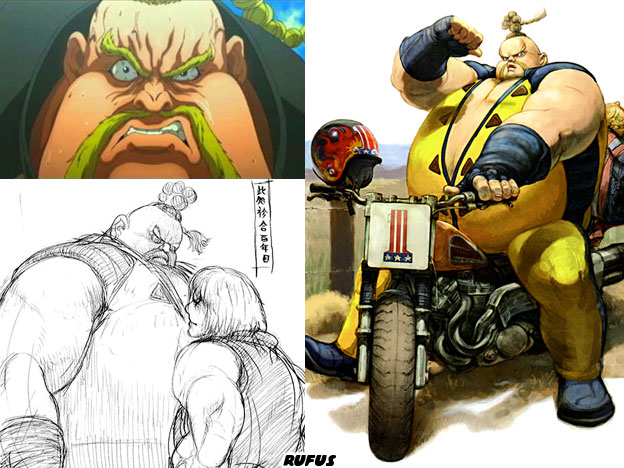
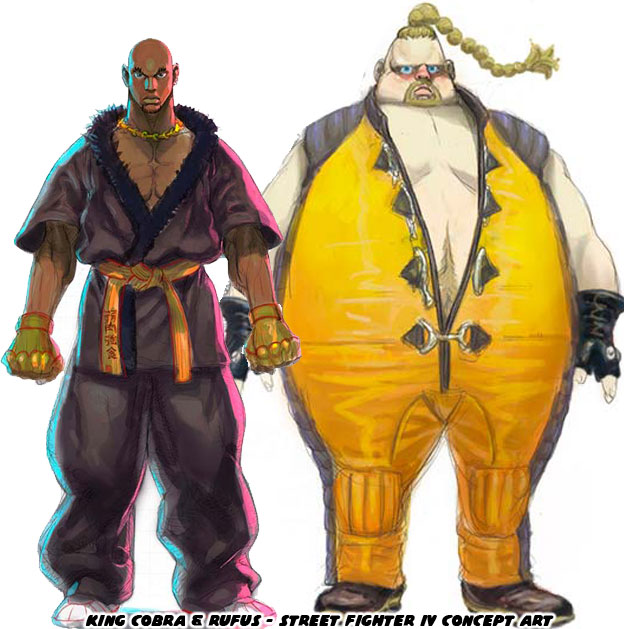
For my final day of the Street Fighter celebration we're going to honor the one that got away. Or thinking more positively, the one that might still find his spot in the lineup. The game series has done a good job at representation. There have been fighters from every corner of the globe, male and female, of every skin color and age featured in the Street Fighter universe. Some were good guys, some were bad guys, and some were victims of circumstance. Many were fantastic but a few were not well done. To be honest every now and then Capcom fell flat on their face. It broke my heart to look at the concept art for Street Fighter IV and see a strong, young, black character in the final stages of design.This character was supposed to be an arch rival to Ken. Only we got Rufus, the joke character instead. The young black man, nicknamed King Cobra took all the elements that made Ken and Ryu unique and incorporated them into his design. He wouldn't have been the only new rival in the game. Juri took a lot of cues from Chun-Li and for some reason that worked with audiences. I have a feeling that King Cobra would have gotten the same amount of love from audiences. It hurts to look at this character this character and wonder what if?


In the planning stages of every Street Fighter not every design was a hit, some were ugly, boring, borderline racist or just horrible. Some of these characters made it into the series but many more were left out of the game. This wasn't exclusive to Capcom. Every lineup had their own growing pains. Many figures were left on the cutting room floor for a reason. At worst the designers were culturally insensitive, at best they were being lazy. Every now and then you could find discarded characters that hit all the right notes. If you saw them in the sketchbook you might wonder why they were left out the game. It's a sad realization that these fighters would most likely never appear in the series. You should always have hope. Street Fighter has made it to 30 years because the most passionate people at Capcom wouldn't let it die. It will continue growing and evolving as long as those energetic voices keep hope alive. Maybe one day we'll see King Cobra in the game. He could be the face that carries the series for another 30 years. You never really know. As always if you enjoyed this blog. Street Fighter is a series worth exploring and explaining. I hope you've revisited some memories during this lengthy series. If you would like to sponsor me please visit my Patreon page and consider donating each month, even as little as $1 would help make better blogs and even podcasts!
follow the Street Writer on Patreon!

Thursday, August 17, 2017

Speculation on ARIKA's unnamed Street Fighter EX successor, final part

I have said a lot about the poor design choices made at Capcom over the past few years. I haven’t found much greatness in characters like Rufus, Hakan or F.A.N.G. introduced in Street Fighter IV and V. Nor have I enjoyed watching classic characters like Birdie, Hugo and Abigail get turned into jokes. Of course I had a dilemma. Capcom Producer Yoshinori Ono was beloved in the community. He traveled the globe promoting the brand, promoting the games and meeting with fans. His energy was infectious, his enthusiasm was genuine and his passion just about single-handedly brought back the franchise. Without him the Street Fighter series would have stayed dead and fighting game scene would not have been as big as it was today. Without him other developers would not have pushed to bring back long-extinct titles like Killer Instinct, or even ARIKA’s updated EX title. With all that said I’m not on board with his creative input. I don’t agree with the addition of silly characters, silly mechanics, silly animations or silly game play. I will continue to call his team out on the poor choices that I think they made with regards to character design. I will remind them of the standards that they used to have. Let’s talk about one of the worst characters Capcom ever put into the series.


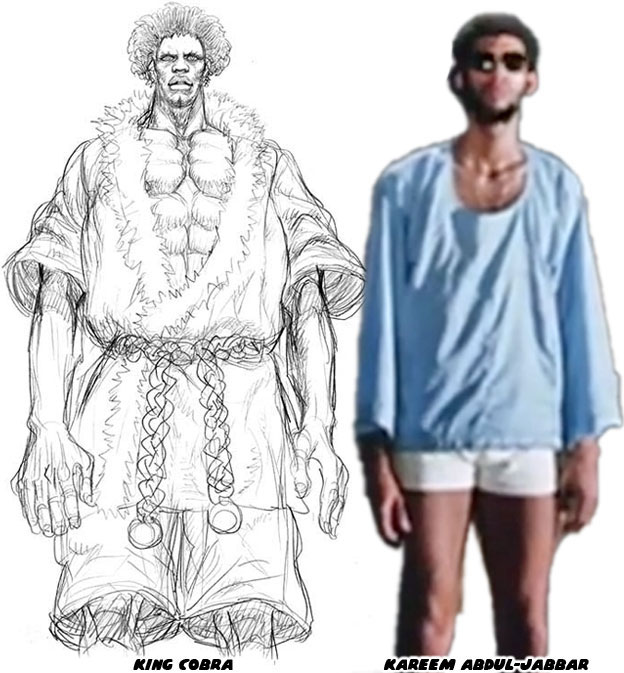
Rufus captured everything that was wrong with the direction of the Street Fighter cast starting with Street Fighter IV. He was big, fat, dumb and obnoxious. He was written as Ken’s great American rival, the only thing was he was too stupid to even know what Ken looked like. How can you be a rival when you can’t recognize your nemesis? What’s worse is that in the early stages Rufus was a powerful black character, nicknamed the King Cobra / Black Cobra. Capcom wanted to give Ken his very own Sagat-type rival, a literal giant. The inspiration was Kareem Abdul-Jabbar from Bruce Lee’s last film Game of Death. This character evolved and became a unique karateka in his own right. Then Yoshinori Ono decided that it would be funny if he put a fatty in the game instead. This new character was rushed into the game and both Ono and the artist Ikeno said it was a bad choice later on. Ono saw that the fat gimmick worked for Bob in the Tekken series. Bob was a much better developed character and was never presented as an idiot. The subtext was obvious to international audiences, fat was funny, and Americans were fat and dumb. There was a different path that could have been used to create the self-obsessed American. ARIKA showed us that more than 20 years ago.


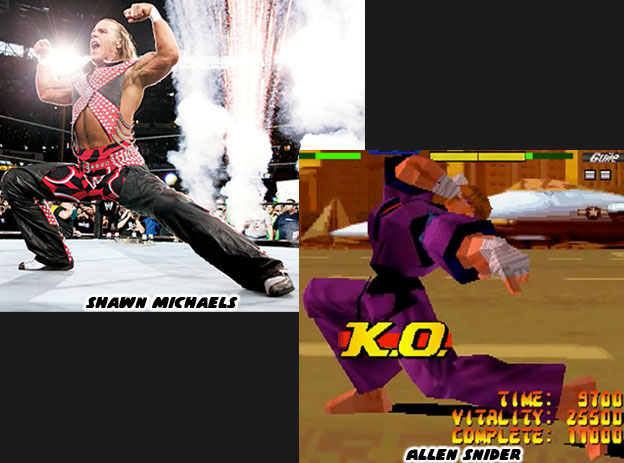
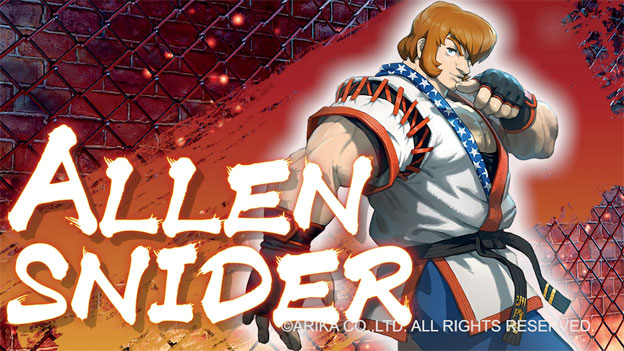
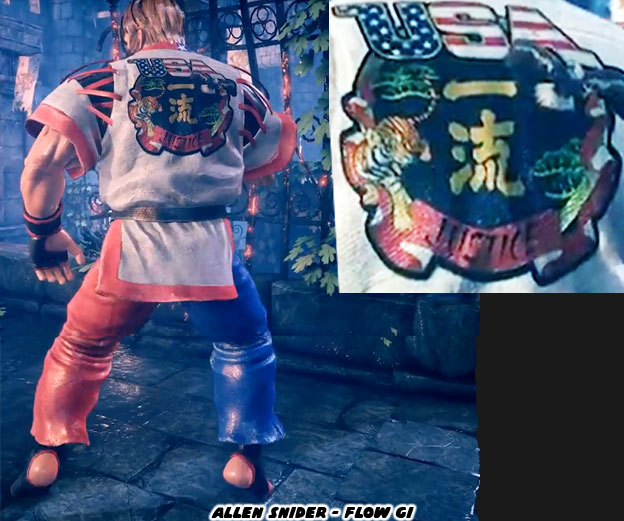
I said in the previous blog that Allen Snider was a second chance for the Street Fighter II and Street Fighter EX developers to create the Ken archetype. They wanted this character to be way more “American” than Ken. Somebody that would be easy to identify in a lineup. He didn’t need to wear camouflage pants or have USA flag tattoos on his shoulders. They gave him a very non-traditional karate gi and made him brash. As over the top as Allen was he was still a good fighter. He couldn’t be confused with Dan Hibiki as being a joke character. Allen was also as far removed from the personality of Kairi as possible. I think they accomplished their goal. Snider was loud in the EX and Fighting Layer titles. He captured the arrogant showmanship of television superstars. His victory poses reminded me of the characters from US pro wrestling. Clearly the team at ARIKA had picked up the personality traits of the most famous superstars of the late ‘80s and early ‘90s. When he was revealed for the new EX game he looked better than ever.


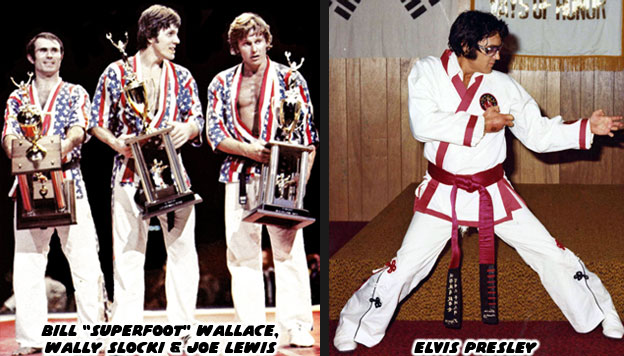
There was no mistaking that Snider had returned in all his patriotic glory. His star-spangled uniform was amazing. It was layered in details that helped tell a story. Even if you had never heard of the character you could tell a lot just by looking at him. He was definitely American and he was definitely not Ken. The updated look also harkened back to the era that inspired the original Street Fighter. Ken was based on actual fighters like Bill Wallace and Joe Lewis. While his hair and facial features were inspired by Chuck Norris and Bruce Lee, the whole persona of Snider being the great American hero were based on multiple real-world sources. Kung-fu and karate enjoyed a popularity boom in the ’60s and ‘70s thanks to cinema. American fighters appeared almost overnight on television competing against Japanese champions. Imagine how absurd it looked to the rest of the world. Karate had evolved in Japan from Chinese immigrants that had introduced them to kung-fu. The Asian countries had centuries perfecting the “empty hand” techniques. It was a part of their culture. It was a part of their national identity. It was sacred and revered. All of a sudden a bunch of Americans showed up in colorful uniforms treating the martial art like a team sport.


Karate tournaments popped up all over the country and trophies were handed out at a feverish pace. People wondered if it was easy to earn a black belt and pick up a bunch of medals in the process. After all, if the guys on TV could do it then anybody could, right? Even the famous singer Elvis Presley was smitten with the fighting arts. He studied under a number of different teachers, having various belts bestowed upon him. Traditionalists didn’t appreciate karate being treated like an organized sport. It had cultural relevance, it was more like a lifestyle, with the discipline of a serious religion rolled into one. It was certainly not a points-based game that anyone could “play.” Thanks to people like Wallace, Norris and Lewis, who were legit athletes, and the coverage provided by ABC’s Wide World of Sports it gained momentum through the ‘70s and ‘80s. For better or worse they laid the foundation for mixed martial arts schools gaining a foothold in the states. The team at ARIKA didn’t forget the culture shock of seeing how the US represented the martial arts in those early days. It made the costume choice placed on Snider that much sweeter.


In the EX series Snider’s first professional defeat was at the hands of Ken Masters. Akira Nishitani didn’t want to disrespect the template he was working from after all. Snider decided to become the understudy of masters and unlock his true potential. This was before Sean was created as his pupil in Street Fighter III. When I looked at Rufus I didn’t see half the forethought that went into making Snider. I didn’t see the nods to history, to the legacy characters or the real world legends that inspired them. I could see it in Black Cobra for certain but not in Rufus. I wondered if Yoshinori Ono and his team could really be so blind to their design choices when other studios didn’t seem to fall into the same traps. There were many days when I wished that Akira Nishitani and his team were still at Capcom, but sadly that ship sailed 21 years ago. Now that Snider was back I hoped that his library of moves had been expanded. Every character revealed so far seems to have matured, I expected no less for the champ. What do you think of the character? Do you think I was too hard on Rufus or Mr. Ono? I’d like to read about your favorite characters it in the comments section. As always if you enjoyed this blog and would like to sponsor me please visit my Patreon page and consider donating each month, even as little as $1 would help make better blogs and even podcasts!

 follow the Street Writer on Patreon!

Wednesday, December 9, 2015

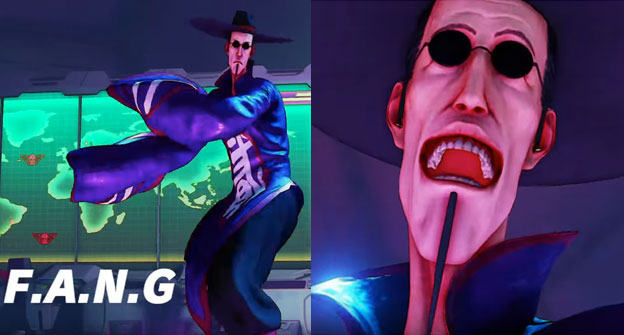
What is going on with the Street Fighter V character designs? Part 1, who is F.A.N.G?

I've been pretty quiet these past few months on the characters unveiled for Street Fighter V. However seeing as the majority have been announced I think we can start talking about them. Let's start with the newest character F.A.N.G. Let's put down the initial impressions of him. The character is dumb, he is ugly, he is insincere and has no redeeming factors.


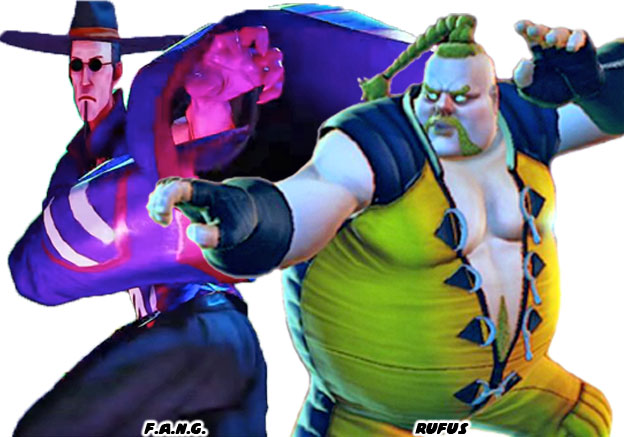
I think it would be safe for me to say that F.A.N.G. is the new Rufus. He is a character that is so over-the-top, that is so beyond the conventions of the other Street Fighter characters that he simply doesn't belong in the game. This is really saying something considering that a rubber-limbed Indian and a green-skinned Brazilian wild man are considered some of the great all-time characters. So what is it about F.A.N.G. that doesn't work? Well his design is a sort of polar opposite of Rufus. Instead of a big, fat and dumb US character we have a tall, skinny and sneaky Chinese character. In either case we have extremes in stereotype, extremes in caricature that say a lot more about the producer and director of the game than of what Street Fighter has become.

Yoshinori Ono should be taken to task for every character, every design that makes in into the game. He was the one that pulled the Black Cobra and made a strong black character into a fat white character. The excuse was that he thought it would be funny to put a fatty into the game. He was the one that made sure that the Turkish character was beet red and obsessed with oil, he was the one that made sure that the masked Mexican wrestler named every move after a Mexican dish. He made sure that the returning black character in Street Fighter V was turned into a fat slob. And now the joke is that a tall skinny Chinese character is flying around the screen like a pelican. Stop and think about how he has presented the British, Japanese, white and female characters that are returning to the series. Is there any bias, whether intended or not, in his decisions?


As the producer Mr. Ono has the final say as to how the game is going to present itself. He has a reputation for being a funny guy, always kind to his fans, but very silly at the same time. This silly humor has found its way into the game in how the characters act, how their special moves appear and even with the constant use of breaking the fourth wall. The Street Fighter games that came before Mr. Ono were considered templates for great design. The ones that came after certainly looked nice and were well balanced but they did not contribute as much to the genre as the earlier titles. This is especially true with the appearance of F.A.N.G. I know some people read my blogs because I try and understand the roots of a character's design. The long sleeves given to his costume are more akin to Chinese opera than a traditional kung-fu uniform or even classic Mandarin robe.


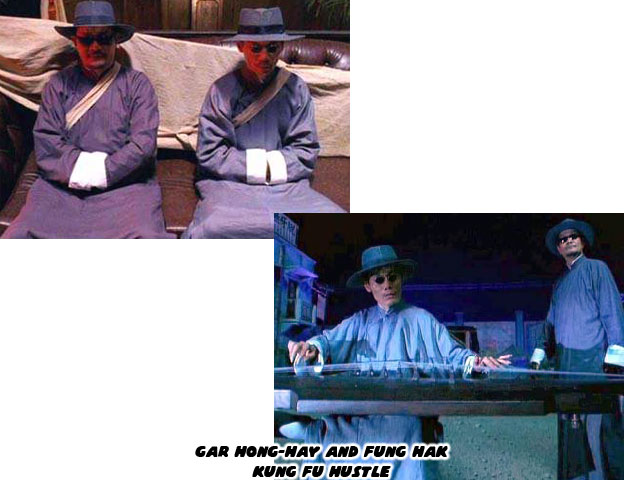
The combination of sunglasses and robes has been seen many times before in film and television. Sometimes detectives set in pre-cultural revolution China wear fedoras and sunglasses while tracking down criminals. However in film the majority of those wearing the sunglasses and robes are villains. They are often mob bosses if not mob enforcers. A good example of these dangerous characters can be seen in the film Kung-Fu Hustle. The harpist assassins as played by Gar Hong-hay and Fung Hak were mysterious agents sent to kill some kung-fu masters. Their traditional costumes were nondescript. They seemed harmless until they unveiled their secret techniques. Of course there was nothing subdued about F.A.N.G.'s costume. The colors and cut on his robe were as flamboyant as his personality. Instead of a modest hat he wore the widest brim possible.


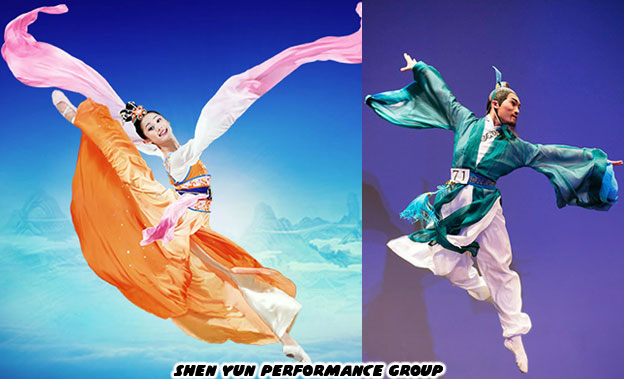
There was a reason why F.A.N.G.'s design had to be super exaggerated. Every character in the Street Fighter universe had been presented in a costume that looked traditional on a superficial level. Karate masters after all did not walk around with torn sleeves, and female masters of wushu did not really wear wrestling boots and spiked bracelets. F.A.N.G. had a costume that at first glance looked like a traditional robe and hat. But the more you looked at his costume the more you realized that they were as exaggerated as his proportions. F.A.N.G. wasn't just skinny, his head appeared as if it had been squeezed by a vice grip. His costume shared the same qualities, he didn't just have long sleeves, they could double as wings if he flapped his arms fast enough. It was absurd of course but also par the course for Street Fighter character designs.


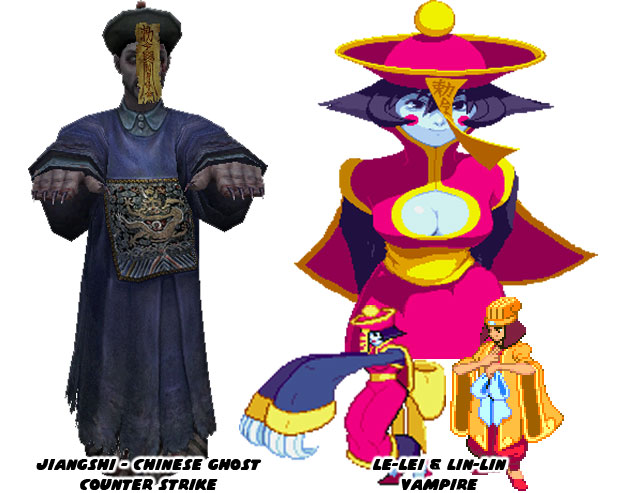
Traditional Chinese costumes had been used for generations in pop culture. Whether they were in a movie, comic book or cartoon, the classic Chinese tunic had been seen many times by audiences and not solely on Chinese people either! These costumes were even finding their way into game designs. The Jiangshi for example were zombie-like Chinese ghosts. They could be summoned to life with a special talisman placed on their head. Since they were dead and rigor mortis had set in they had limited use of their limbs. Rather than shuffle around like a zombie these monsters had to hop around like rabbits. Read about it on the Chinese Ghost Primer. The jiangshi turned up in a number of modern games, for example you could fight them in Sleeping Dogs, specifically the DLC called Nightmare in North Point. The costumes and designs of the undead were stylized in the fighting game Vampire / Darkstalkers by Capcom. The sisters Lei-Lei & Lin-Lin aka Hsien-Ko and Mei-Ling wore very bright (and revealing) versions of the classic robes. The costume given to F.A.N.G. was no more different than what Capcom had done previously. At first glance it had the appearance of a traditional costume however upon further inspection it was something else entirely. Yet the costume, weird moves and silly personality were only part of the reason why F.A.N.G. didn't really inspire me.


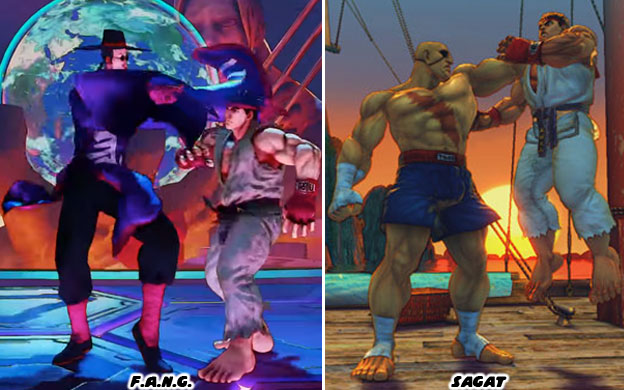
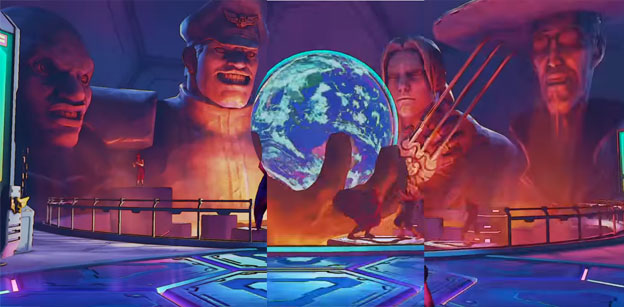
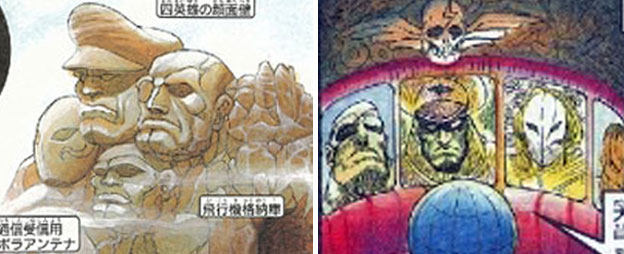
In the reveal trailer we could see several things about the character. He was goofy and lanky of course but he was also quite tall. In fact he appeared to be as tall as Sagat, the once world champion. And like Sagat this new character was marking a place for himself in the pantheon of Shadowlaw / Shadaloo villains. In the reveal trailer there was a level that was set inside of a secret base. In the background there was a statue celebrating the leader and "generals" of Shadowlaw. Sagat was previously the second-in-command to Vega "the Dictator." Yet during Street Fighter V there is no sign of Sagat, not only that but his visage would not be in the background details either. Instead the bust of F.A.N.G. had been carved out of a mini Mt. Rushmore.


This flew in the face of everything that had been established about Shadowlaw from many years earlier. Whether it was mentioned in the game, in the comics or supplemental material The other generals were dangerous fighters in their own right. In propaganda posters, in Shadowlaw art the four figures were placed side-by-side in a show of solidarity. The generals looked intimidating but there was something about F.A.N.G. that did not match the gravitas of the earlier bosses. A one-eyed, seven-foot, muay thai fighter was a sight to behold. A seven-foot, flamboyant Chinese kung-fu master was also a sight to behold, but not for the same reasons. Why the designers working on Street Fighter V would replace the legacy character Sagat with F.A.N.G. didn't make much sense. Why they would go out of their way to erase any hint of Sagat was frankly insulting.


What were the roots of F.A.N.G. and why was he so bad? Was there anything about the character that might work? These are things that we can explore in the next blog. Right now I'd like to read your thoughts on the character. As always if you enjoyed this blog and would like to sponsor me please visit my Patreon page and consider donating each month, even as little as $1 would help make better blogs and even podcasts!

Tuesday, July 7, 2015

Representation Matters! Or, what happened to Birdie, part 4...


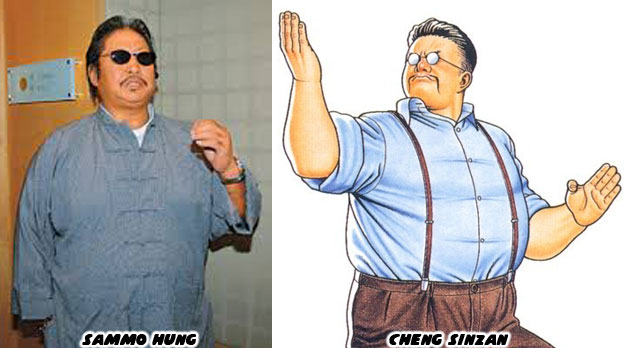
The characters in fighting games are rarely based on mythological figures. Instead they are based on real fighters, comic book characters or actors. Fat martial artists are few and far between. The most popular and longest-lived template for fat fighters is Sammo Hung. The writer, director and actor from Hong Kong broke into cinema at a young age. His talents behind the camera are nothing compared to his knowledge and experience in the martial arts. He was trained as a child in the Chinese Drama Academy, where performers learned what it took to appear in the Chinese Opera. He learned various forms of kung-fu as well as tumbling and working with weapons. The lessons were brutally difficult, children were made to do handstands and splits for hours on end, they would be disciplined with caning for being disobedient. Many would consider the training to be nothing short of child abuse. Sammo made it through and became an exceptional performer and choreographer. He was developed alongside people like Jackie Chan and Yuen Biao, whom also became martial arts superstars. There was a dramatized retelling of what they had gone through in the film Painted Faces. Sammo actually played an instructor in the film and said many things that happened to him growing up were much harsher than what the film depicted.


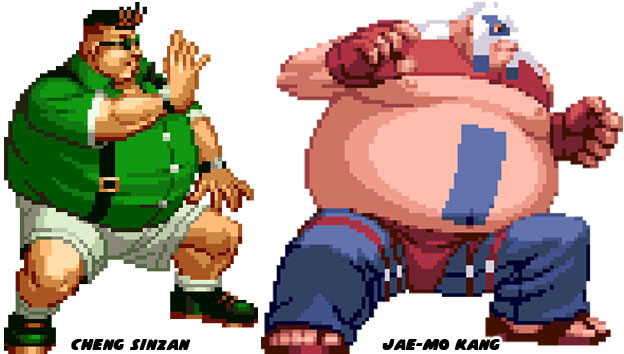
The first fighting game to feature a character modeled after Sammo was Fatal Fury 2 in 1992. Cheng Sinzan was a businessman and expert martial artist. He was fast, as Sammo was, had an assortment of great kung-fu attacks but was always played up to be slightly funny. Sammo was known for his comedic timing. As great as he was in a fighting scene he always found a way to get in a visual gag, usually at the expense of his weight. It was no different for Cheng. He sweated profusely and could be seen wiping his forehead with a handkerchief in between rounds. Cheng got fatter when he turned up again as a non-playable cameo in Fatal Fury 3 and then as a playable character in Real Bout Special. Each time he came back he was fatter than the last time.

The same trend happened to other fat characters in fighting games. They became extraordinarily large, more so than average people. Sammo was always what we would consider "chubby" but he was nowhere near as fat as the in game versions of Cheng were. This was something that character designers and animators learned to do as the genre evolved. It did not matter what form of fighting that a character practiced. They had to have very exaggerated proportions. This was something that worked well in comic books and manga. Gamers would be less likely to watch two average-looking people in a fight, on television or in the comics. If instead the karate guy had torn sleeves to show off bodybuilder-like biceps and the female kung-fu expert had a short dress to show off her long shapely legs then it would be much more appealing.


By the same process the fat characters could not be slightly overweight in games or comics, the had to be morbidly obese. Cheng was only the tip of the iceberg. As other studios got into the genre they began pushing the envelope on what was possible. Those with muscles became extraordinarily swollen, female characters became bustier, and fat characters became almost perfectly round. Such was the case with Jae-Mo Kang, the Korean pro wrestler from the 2002 game Rage of Dragons. The game was set in an anime-like version of the Double Dragon universe. The developers at Evoga avoided the continuity from the previous Double Dragon fighting game. Kang was strong but not meant to be taken as seriously as Burnov.

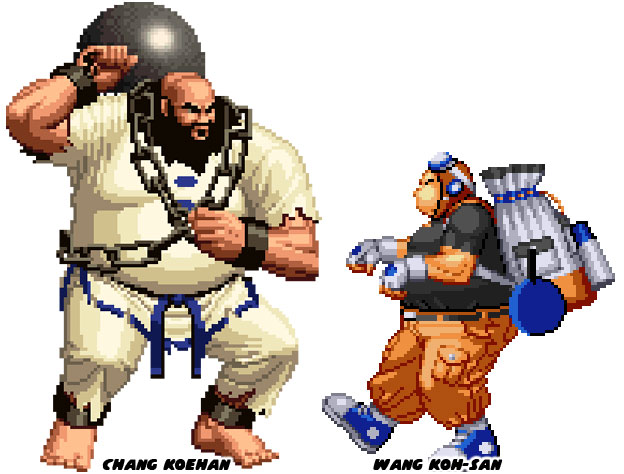
Fat characters were beginning to find their stride through the late '90s and into the '00s and they were supposed to be funny. Any great elements that Sammo had given his roles, anything he meant to the martial arts was completely lost. Heaven help the player if they actually liked or even identified with the fat characters. They were not meant to be seen as stars of the games. In 1994 SNK launched the King of Fighters series. It would become the longest-lived and most popular tag team fighting franchise. The Taekwondo star of the game, Kim Kaphwan needed two partners to round out the Korean team. The designs given to his partners were lackluster. One was a short criminal, Choi Bounge, with claw gloves and a fedora. He looked like a tiny Freddy Krueger from the Nightmare on Elm Street movies. The other was a tall but obese criminal named Chang Koehan. Kim was trying to rehabilitate the pair. Chang was oafish, swinging and enormous ball and chain at his opponents. He lacked appeal and would appear on and off with the team.


Taking a page from the Cheng Sinzan school of funny fatties was Wang Koh-San. The chubby character was introduced in the Art of Fighting 3. The character was a cartoonist that was in the tournament. He seemed outfitted for a long time on the road with all sorts of camping gear attached to his backpack. In the sack there was a pelican that would pop up from time to time. Not only was the character fat and funny but he even had a wacky bird sidekick. If this was a Hanna Barbera cartoon from the '70s then it would have been a hit. In fighting games players were just left scratching their heads.

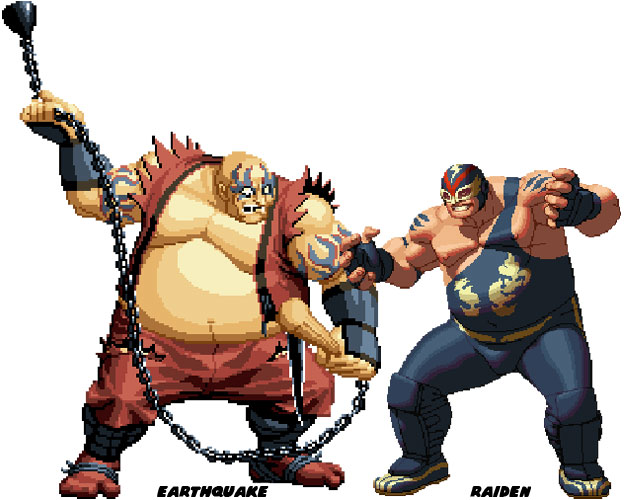
SNK had started a tradition of having morbidly obese people serve as comic relief as far back as 1993. Earthquake in the game Samurai Spirits / Showdown was an American ninja. He was massive, at the time being one of the largest sprites ever created for a fighting game. The character took up almost a third of the screen. He was fat and gross too. Farting on opponents and eating turkey legs that he kept stashed away in his belt. Yet despite these things he was a very fresh design. He had tattoos, and face paint, he was colorful and brought attention to himself. This was the opposite of what most people thought of when they heard that he was a ninja. Despite his size he was able to move quickly, disappear in a puff of smoke and fight with some unique attacks. Earthquake was meant to represent greed, he wanted everything in excess and was looking for the fastest way to get rich, which was why he was so big and fat. He was actually balanced out by another American ninja named Galford. Galford had stayed on the true path set by his masters and was therefor young and handsome. Despite his gross aspects there was not another obese character that was as memorable as Earthquake.


In 1991 Fatal Fury debuted. Created by the planner behind the original Street Fighter it was a new take on the genre. Players could jump between the foreground and background and even team up against opponents. One of the villains (that later became a hero) was a pro wrestler called Raiden. This character was large and heavy-set. But he also had some high flying maneuvers despite his size. He was never as fat as any other character in the SNK universe but always carried around a gut. He was actually modeled after pro wrestler Leon "Big Van Vader" White. Tetsuo Hara used Vader as the basis for Sheep the Royal in Muscle Bomber. Vader came on the heels of Abdullah the Butcher but because he was a bit more athletic he suck around for some more high profile rivalries in promotions. Vader was a huge American wrestler that found a great deal of fame in Japan. He had crazy matches against the biggest bruisers of the era including one against Stan Hansen where he had his eye poked out of its socket. Vader also carried around a belly but was backed up by some big muscles as well. Huge wrestlers like Vader, Abdullah and host of others greatly influenced the development of characters in wrestling games, brawlers and fighting titles. SNK did a good job of experimenting with fat body types in many of their games but tended to side as the fat as funny stereotype. 

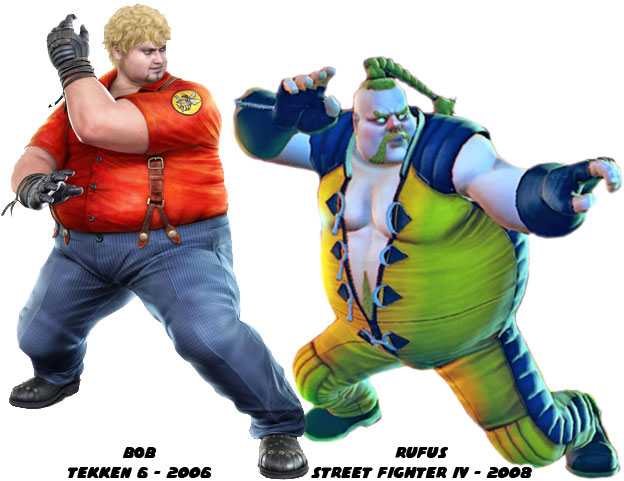
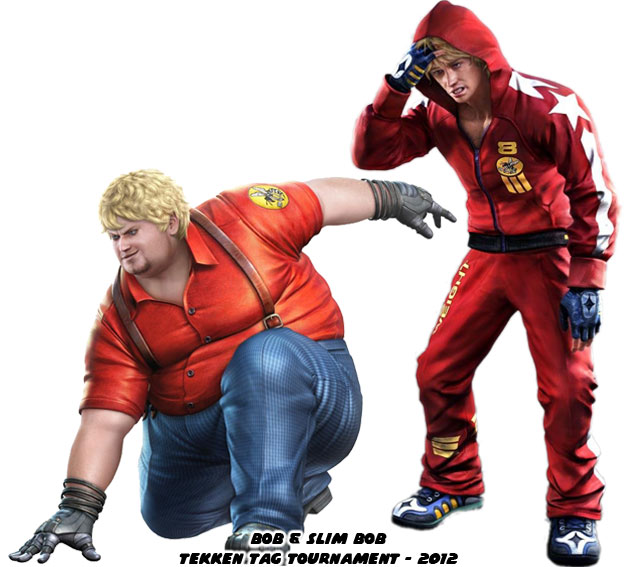
Other studios followed the trend and would only pull out the fat character if they could get a joke out of it. This reality came to a head in 2006 with the release of Tekken 6. The Tekken series was one of the fighting games that actually kept pace with the Street Fighter in terms of sales and popularity. It set itself apart from the other titles because it was one of the first 3D fighting games. The designers of that series and head producer Katsuhiro Harada had introduced dozens of characters into continuity. Many were from around the world and there was even a diverse mix of female characters as well. The game had always combined the fantastic as well as science fiction, cyborgs, mutants angels and demons were all within canon. The reality it was based in was only loosely grounded and this was the understanding that audiences were expected to accept when Bob was put in the game. Bob was a great fighter but he felt that it took too much effort to defeat opponents. He decided that he could do better in tournaments if he had some extra weight behind his punches and kicks. He bulked up and became about three times as heavy as he used to be.


It was strange watching Bob in the game, not because of his size but because how fast he moved. Despite his girth the character was blindingly fast. But that speed also made him look weightless. The graphics engine was very powerful. It was capable of rendering flowing hair, accurate shadows and reflections as well as clothes that bunched and folded realistically. It even put a little bit of jiggle in Bob's belly fat. The illusion of a three-dimensional figure was broken each time he attacked. Bob was so fast that he simply appeared unrealistic.

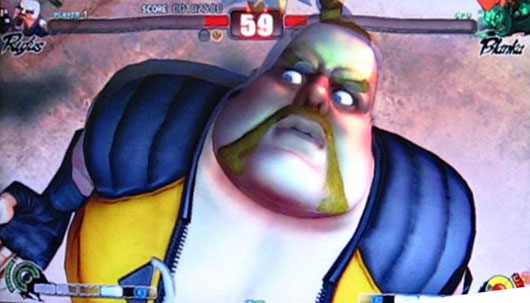
Yoshinori Ono must have had a strong reaction to Bob because a few years later he announced a new character to debut in Street Fighter IV. Many game players were hoping for something as unique and memorable as the figures in Street Fighter EX, Street Fighter Zero and Street Fighter III. The new character was memorable but for all the wrong reasons. Rufus took a page from Bob and the developers went even faster with his moves and attacks. His gigantic belly would sway underneath his jumpsuit. Both Harada and Ono had put a fat character in the game because it was funny. They did not mean to be more inclusive of different body types. I mean could you imagine how absurd it would be to see a serious fat person in a game? Fat people were not heroes, they were social outcasts. It was obvious in public and reinforced in media.


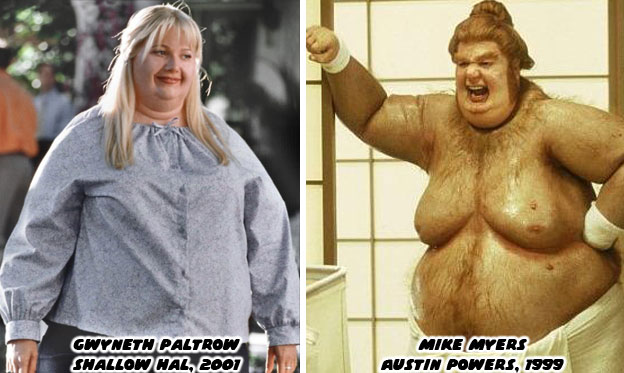
Makeup artists had been making people appear fat since the days of black and white movies. But when newer techniques allowed them to create lightweight "fat suits" then Hollywood began looking for ways to exploit the technology. Comedians Eddie Murphy and Martin Lawrence used fat suits in films to lampoon fat stereotypes respectively in the Nutty Professor and in Big Mama's House. Mike Meyers had a recurring character called Fat Bastard from the 1999 film Austin Powers: the Spy Who Shagged Me. The hit man had an unmistakable presence and was meant to be gross and disgusting. But as audiences discovered there was an underlying sadness to the character this gave him much more dimension than simply writing gag after gag on how fat he was. In his final appearance Fat Bastard had lost his weight and had become much happier with himself.

A similar lesson lesson on sympathy and understanding was learned in the Farrelly Bros. Comedy Shallow Hal from 2001. Gwyneth Paltrow played Rosemary Shanahan and she couldn't find a person to accept her for who she was. Jack Black played Hal Larson, a womanizer who gets hypnotized by life coach Tony Robbins into seeing the inner beauty of people instead of the physical ideals of beauty. Hal realizes that Rosemary is the person he'd been looking for all his life. Both films were comedies and both relied on fat as the punchline to many jokes. Characters like Bob and Rufus appeared later and were simply reinforcing that stereotype.


Bob actually had a physical transformation over the years. He lost his weight and by 2012 was back down to his original size. Of course the Tekken team could not allow the character to be quite happy with whatever size he was. Since he had lost the weight it required more effort for him to win battles. He was left tired more often and wondered if his weight loss was worth it. Fat people couldn't catch a break even when they were no longer fat.

What really irks me about the direction of Street Fighter IV and V were how fat was being used as a punchline as well. It was cheap, it was demeaning and it took away from the elements that made all of the other characters great. I've mentioned it before but it bears repeating now more than ever. The designers on Street Fighter IV and V are putting a priority of visual gimmicks and pandering to stereotype rather than great character designs. We could start with Rufus and work backwards. In doing so we could spot a trend. That trend sadly leans towards racial bias and I would even say racial exclusion from Street Fighter.


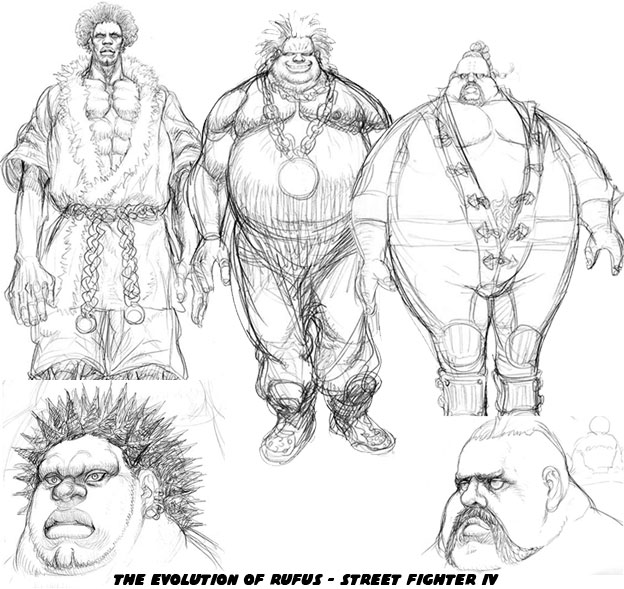
Many people that read my blogs know that the fat white Rufus was not the original choice as a new character in Street Fighter IV. Instead he was going to be a young black man named King Cobra / Black Cobra. The character was in pretty much the final stages when Yoshinori Ono went in a radically different direction and pushed the team to put a "fatty" in the game. All of the great elements of Cobra were gone and in his place there was a tub of jelly that was insanely fast and had moves perfect to counter most every other character in the series. We can actually work backwards and see who Rufus was based on and how radically different he was in the early stages.


Rufus was meant to be the ultimate rival to Ken. The team realized that Ryu had a great rival with Sagat but after 20 years there was not somebody for Ken. The designers wanted players to see a character that was both physically imposing and could be a genuine threat to Ken. They knew this character had to be bigger-than-life, just like Sagat. They also considered making him a minority similar to Sagat. In the planning stages Rufus was a tall, heavy set black man with subtle gangster features. He had high top sneakers, a thick gold chain and pointy dreads. The fat gimmick got more and more pronounced the closer he came to Yoshinori's vision of a fatty. But if you go back far enough you can actually find a character that met the original plan and wasn't fat or silly at all.

The first thing that made rivalry between Ryu and Sagat important was the size difference between the two characters. Ryu was almost six-feet tall but Sagat was about a foot and a half taller. King Cobra would have been at least as tall if not taller. The earliest version of this figure was tall and lanky. He actually looked like Kareem Abdul Jabbar, the basketball player and friend of Bruce Lee. Kareem played the final opponent in Lee's last film the Game of Death. The second thing that made the classic rivalry important was the techniques that each fighter possessed. Ryu studied karate which was considered a very refined form of self defense and required tremendous self discipline to master. Sagat studied Muay That which was an older system that was designed to hurt, maim and kill opponents. It was an art that required people to be very aggressive and tough. The two styles clashed against each other perfectly. Ken's opponent would have been a tall black man that was a master of a certain form of karate. Perhaps having two forms of karate was a bad choice and the designers began looking elsewhere.


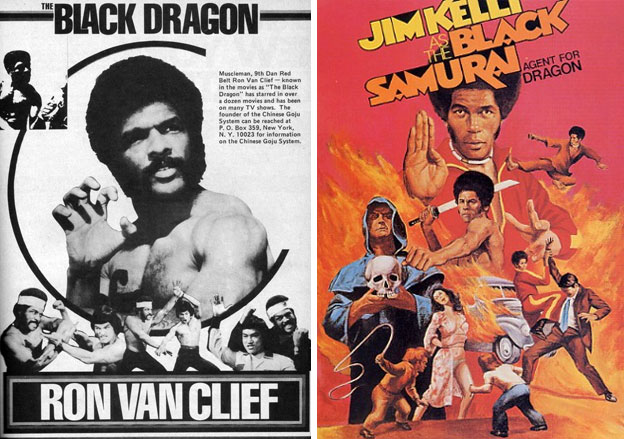
A few of the early US martial arts stars and tournament champions were black. Ron Van Clief, master of karate and several forms of kung-fu was nicknamed "The Black Dragon" and karate champion Jim Kelly starred as the Black Samurai. They were both martial arts pioneers and friends of Bruce Lee. They were well versed in various forms of fighting and this was apparent when they performed on film. What was terrible for the duo was that they could find work in Hong Kong cinema yet be denied many opportunities in the USA. If they performed in a US film they were usually the "Blacksploitation" kind. The two overcame many hardships because of the color of their skin. Things were especially hard for Van Clief. When he joined the Army and was sent to the South to train he was lynched by his fellow enlistees. He barely survived the attack and had to deal with racism both in and out of uniform. Racism was very strong in many parts of the country and that animosity exists to this day.

When I think of a missed opportunity to put in a powerful black karate fighter I think about how blacks had become caricatured in the genre. Just as everything great about Sammo Hung had been stripped away when creating fat characters in the genre. The only thing that Japanese studios seemed to remember from the early black martial arts appearances were the afro and sideburns worn by Clief and Kelly. The developers had reduced black fighters to a trope. It was seen with Tiger Jackson from Tekken, and Mr. Jones from Rage of Dragons. The black fighters in modern games still wore afros, sunglasses and bell bottom pants as if they were perpetually locked in the '70s.


Another questionable approach to the design and purpose of Rufus was how stupid he was. In canon Rufus was incredibly dumb, taking an obvious jab at the Fat Dumb American stereotype. He was so dumb that he could not even identify Ken if they crossed paths, which they did several times. I mean how great it is to have an arch-rival for Ken that is too stupid to spot him in the same room? It's genius planning I tell you! I doubt and sincerely hope that the black rival would not have been presented as stupid.

Imagine what would have happened to Sagat if he couldn't remember what Ryu looked like. His purpose in the series and reputation would have been greatly diminished. Karate could have very well been assigned to Cobra and it could have been a form unique to the Street Fighter universe. But seeing as how the Japanese developers didn't really know much about black fighters then they made things up. In the design notes Cobra actually used "Breakdance Kung-Fu." It seemed as if the Japanese developers could never take blacks seriously as being masters of karate.


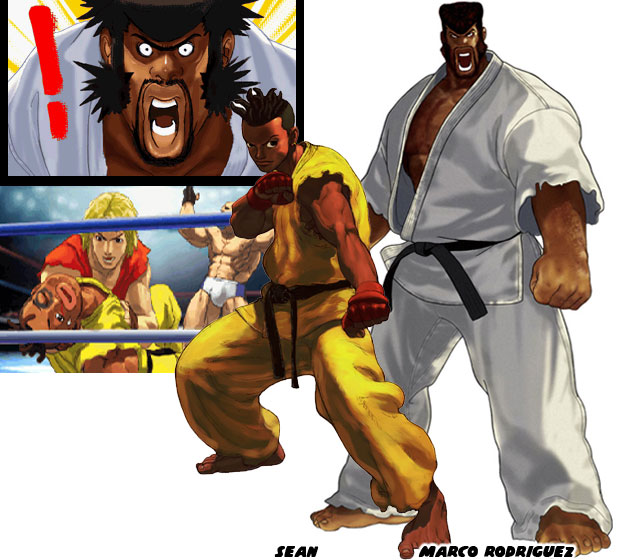
Miscasting a minority was nothing new to Japanese developers. Characters like Sean from Street Fighter III and Marco Rodriqguez from Garou: Mark of the Wolves, while popular, were not meant to be taken seriously. They were not supposed to be stars of the games. Instead they were supposed to be overzealous proponents of the fighting art. They were too enthusiastic for their own good and that lesson was seen in their respective endings. Sean would never become as great as Ken. Marco would never become as great as Ryo Sakazaki. Their roles were subservient, it's quite possible that the designers never thought about the statement they were making through these characters.

The thing about history was that blacks were an important part of the evolution of karate. Karate champions Willie Williams, Jamie Oliver and Charles Martin were the subject of the documentary The Fighting Black Kings, set during the 1st Kyokushin (the form founded by Mas Oyama) World Karate Championship. They were the basis for Marco but they were not the only black fighters that influenced the Japanese designers. But I am getting a bit off of the subject. Fat characters were put into fighting games because they were funny to look at. When presented with a choice as to put a strong black character in Street Fighter or put a fatty in Street Fighter the director chose the latter. This is what drives me insane about the people that worked on Street Fighter IV and the people working on Street Fighter V. Each time they make a design choice for a new character it always seems to be the wrong one. It always seems to degrade the character if not devalue the art being depicted. This was a problem that went all the way back to Street Fighter II, however Capcom was able to overcome some potentially disastrous choices. We will look at these things in the next blog. As always if you enjoyed this blog and would like to sponsor me please visit my Patreon page and consider donating each month, even as little as $1 would help make better blogs and even podcasts!