Showing posts with label sumo. Show all posts

Tuesday, May 7, 2024

Another Rufus blog... A 1UP classic from May 15, 2008

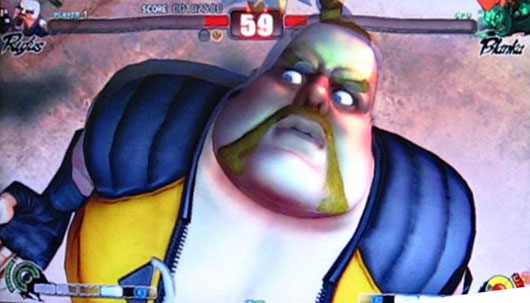
Hello friends, it looks like I'm on a bit of a Street Fighter IV kick again. We might as well keep the train going with some more random observations. Today's rant takes us back to look at the place and purpose of nobodies favorite SF fat man Rufus. It's funny timing that I bring him up as Capcom in Japan and the US has made no official mention of this guy. Even better, Cap USA wants to make 3 figurines of the new lineup and are letting fans vote. Rufus is nowhere to be found. Is it possible that the fan reaction was so strong that they buried him or are they holding him plus other characters as a surprise for when the game is launched? It might turn out to be like Tekken in which some characters appear after a certain amount of time has passed. Let's hope that some other SF-universe characters appear in the lineup.

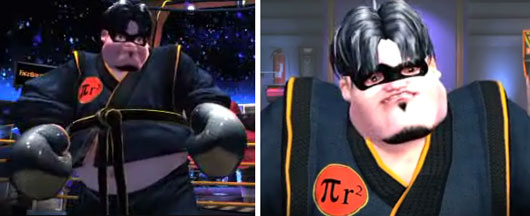
Now I have nothing against fat people, I'm a fat guy. I also don't have a problem with fat fighting game characters. In fact, I'd like to see more of them, provided that they are consistent with what has already been established in the series. Just the other day a new character was introduced for the boxing game Ready2Rumbe 3 Facebreaker. He's a fat boxing master named Steve Talking Head. The game is supposed to be cartoonish and over-the-top, so he makes sense in that lineup... Make of him what you will.
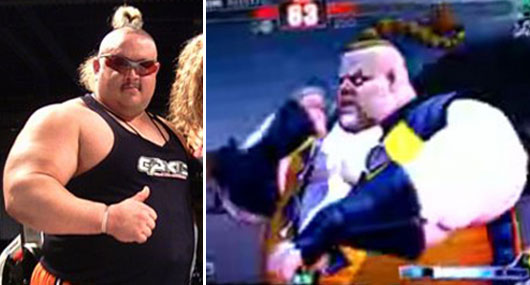
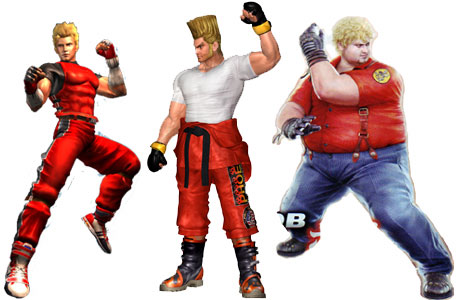
I've already spoken at length about the subject with my origins of Rufus blog. In case you don't want to read old news I'll sum up some of my gripes. A character like Bob from Tekken moves too quickly for a man of his girth. It's as if they did some motion capture moves and thought it would be funny if the animations were stuck on a fat character. It seems that Rufus is even larger than Bob yet seems to move faster. Maybe Rufus was inspired by strongman Gene Rychlak. He's also a big guy with wild hair and a trucker mustache that bench pressed a thousand pounds. Sure he's strong, but can he move fast? Is he flexible? I doubt it.
While thinking about this character I began wondering what it is that I don't like about Rufus. 1UP member Smashbro mentioned that it could be the way obese people are demonized in US culture. But my issues are more about his speed, lack of muscle definition and seemingly weightless mass, not any bias against fat people. 1UP member Marc lamented that he seems to be the only one on 1UP willing to try this game. I never said that I wouldn't play SF IV or that I wouldn't try out this character. In fact if there is a location test anywhere in the southland then I'll be there, getting in line and trying each character at least once. I'm also thinking about which console to pick up based on which will have a better joystick for the game. To think that I'll pass on a SF IV after waiting so long after III is absurd. Remember that I got the Wii for NiGHTS? Or the Xbox for Jet Set Radio Future?

I've said that large characters tend to move slower in SF games, Rufus is contrary to that. Smashbro mentioned that the Japanese tradition of sumo might explain why they created him and seem to be more accepting of this large character than the US is. The US demonizes obesity yet has a large population that is overweight. My biases might be based from a cultural P.O.V. I began thinking about who Rufus reminded me of, aside from Gene Rychlak and where his place could be in the Street Fighter universe. I began thinking about large characters from cartoons, movies and even real life. Who were the ones that worked and why? As far as fighting games go, the fat guys in Final Fight worked, King Heart in Fist of the North Star worked and Karnov from Fighter's History Dynamite worked as well.
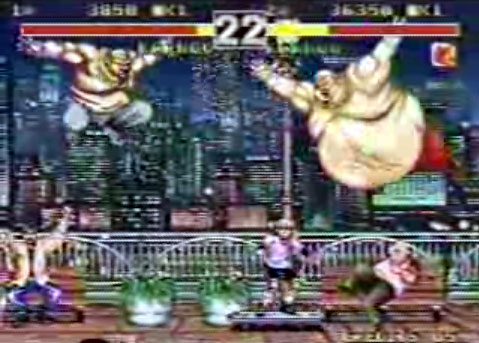
Heck, Karnov could even inflate himself and become even more massive than Rufus, yet he worked in the game because he also had an assortment of mystical properties. Karnov could breath fire, teleport and float, he was a fat doppleganger of Dhalsim. In the context of his game these things worked, but this is a different game. The issues that I have with Rufus and the other new characters are because I feel that Capcom is betraying their own design legacy. Actually part of the problem is that DIMPS is developing this game and their approach to character design is different than the classic Capcom formula. I'll talk about it more tomorrow but I strongly feel that Rufus is just a more complete vision of the character Boyd that DIMPS had put in their 2.5D fighter Rumble Fish.
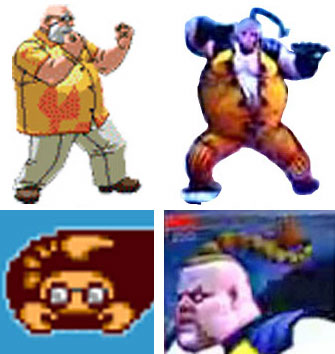
I couldn't just leave it at that. Like a scab I have to keep picking at the design until it starts bleeding. Where did Rufus come from? What was it about his costume that works or doesn't? Yellow jumpsuit, unzipped to his belly with built-in pads? What about that ponytail and facial hair? Looking at Rufus' trucker mustache I was reminded of the larger-than-life character of Bull Hurley from the movie Over the Top.
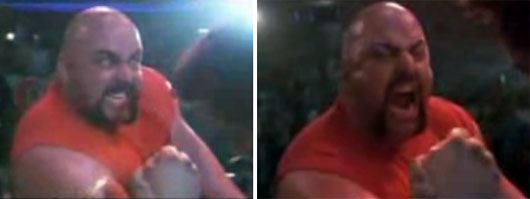
I noticed that even though Bull, as played by the late character actor Rick Zumwalt was massive, he wasn't obese. I began wondering how "fat" a character could get and still be valid in the SF universe. I began wondering how big a person could be and still remain a valid fighter. Here is where the distinction between what "fits" in the real world and what "fits" in SF has to be made. We are willing to suspend our disbelief up to a point. If the point is crossed then that character becomes redundant, broken or laughable. At some point something has to be done with the character and design to make him or her fit into the game. This is the part that I think Capcom and DIMPS is missing with Rufus. They are not separating his purpose from his moves. The reason for my thinking of that actually goes back to the character of Bull and the movie he was in. The real arm wrestling legend at the time, Cleve Dean, makes a few cameos but isn't the last person that Stallone faces. According to the Wiki page the filmmakers didn't think that audiences would believe that Stallone could beat Dean.

Wait a minute. We could believe that Stallone could beat Bull but not Dean? How much more massive and imposing was Dean over Hurley?

At his peak in the late 70's / early 80's Cleve Dean was a multiple time world champion. He simply dominated his opponents. The reason for this was because of his tremendous size and strength. He was about 6' 7" and over 450 lbs. easily dwarfing Stallone and even some of his competition. His girth beguiled his opponents, he wasn't just a mountain of a man but rather a mountain of a man with lots of muscle. Like a modern-day Paul Bunyan, Cleve became synonymous with power.
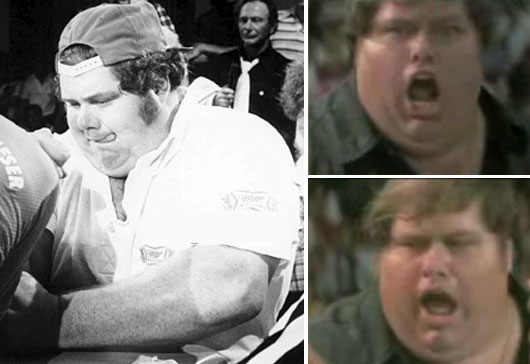
Cleve represents a certain athletic aesthetic that is older than most people realize. Throughout history some of the strongest men in the world haven't always looked like bodybuilders. Some of the most powerful figures in myth have been on the heavy side. The giants and titans of ancient Greek and Norse mythology were usually heavy-set. The legendary Olympic weightlifter Vasili Alexeyev was another mountain of a man but he also did the unthinkable. Before his time many thought it would be impossible to lift more than 500 lbs. in the clean and jerk. Even though there were many strong weightlifters in that era, part of the reason for not being able to break the mark was psychological. Before his record-setting lift his coaches told him that he would be lifting 497 lbs. something that he had done in the past. As he lifted it he thought it felt heavier than normal but pushed himself to complete the cycle. Once he broke the barrier many in the sport realized that the human body had even more strength potential.

But the incredible strength of Cleve or Vasili doesn't mean much in the fighting arena. Grappler Royce Gracie once said a person with an average build that is experienced with judo would be able to beat a person with a bodybuilder physique and no fighting experience. There seems to be a lot to his reasoning. Big, tough guys that know a little fighting are usually taken out by smaller, experienced MMA fighters. The only large people that knowingly have fighting ability are sumo wrestlers. I've already mentioned that sumo wrestlers have a lot of muscle underneath their mass. More than that they have technique. Being absurdly strong is one thing but most sumos are evenly matched, they need technique to counter the strength. They need technique to decide a winner. A champion like Akebono made for a great sumo wrestler because he had the raw size and strength of Cleve or Vasili but combined it with impeccable fighting technique and strategies.
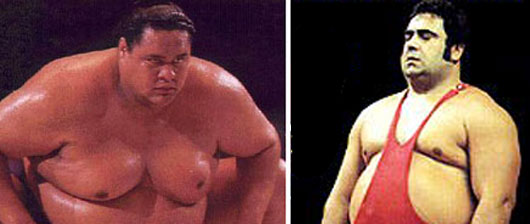
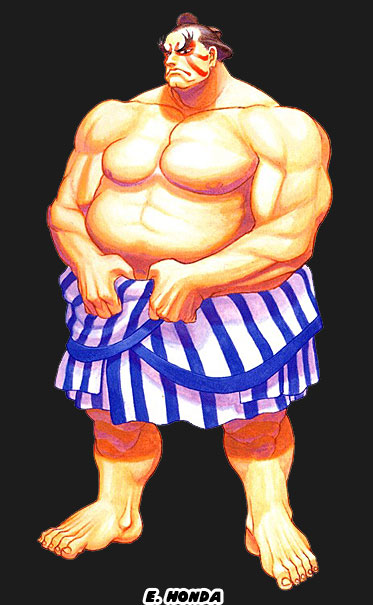
This is where I don't understand the purpose of Rufus. Street Fighter is already filled with archetypical strongmen. Zangief is a giant, bearded version, of Alexander Karelin. Like Alexander, Zangief is capable of superhuman feats of strength with his wrestling ability. E. Honda is a champion-class sumo wrestler, a kabuki-painted yokozuna. Where does Rufus fit between those other big men? He doesn't seem to have the design or purpose of the legendary strongmen I've mentioned. Instead he is a fat guy that knows kung-fu and moves really, really fast. He jumps fast, punches and kicks fast and has fast super attacks. Zangief and Honda are slower by comparison.

It just doesn't make sense to me. I'd love to see Rufus as massive as his is now, playing sickly powerful but also slow. A middleman between Zangief and Honda. Or a "slimmer" version, one that is still chubby but also fast and more reminiscent of Sammo Hung. But a Rufus that is both absurdly fat and fast? That, like Bob from Tekken, is a stretch and I don't think I'm the only one that thinks so. At some point character design stopped being great. It stopped evolving logically and just became absurd. I'm not going to lie and say that 2D fighters all had great designs, there were some awful designs back in the day. However the third dimension really brought the worst designs to life. Advances is animation and 3D modeling allowed a character of any shape or size to move as lightly as an olympic gymnast or as fast as a professional boxer.
When did the gatekeeper to great fighting character design go on holiday? Wish I could have been there in his stead, some characters would have never gotten the greenlight. All I can do now is point out the tragedies and lament the days gone bye. What do you think. Do fat characters have a place in fighting games? Is it about time or just a gimmick so far? Am I making too much about nothing? Does Rufus work in SF IV? Let me know what you think in the comments!

Monday, September 11, 2023

Street Fighter 6: A master class in game design, part 19

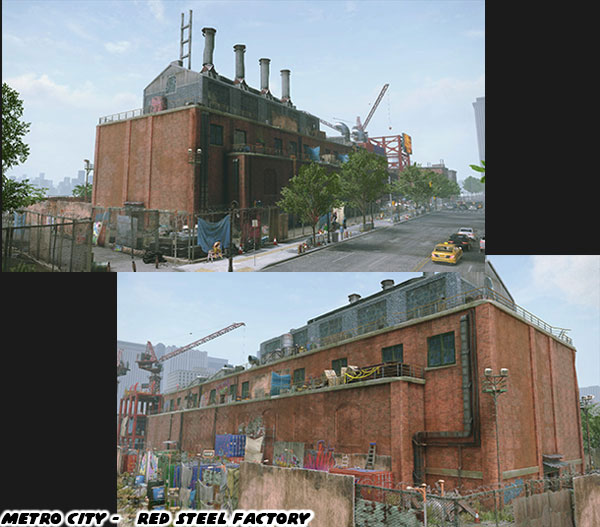
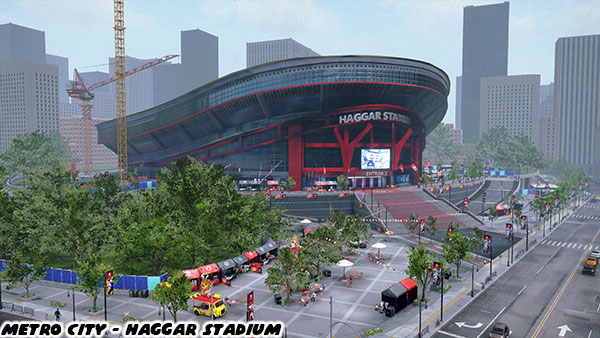
You would complete the side missions of the various masters, build a friendship with them, and challenge them in order learn new techniques. Past a certain point Luke recommended entering the amateur fighting tournament in the Haggar Stadium. It seemed like a logical conclusion to the World Tour. You would be competing against other fighters in this contest. I assumed that the game would end after this point. I mean up until that point I was blown away with how everything had turned out. As a fan since the original title I couldn't ask for anything more. Once you had signed up for the tournament you were allowed to continue exploring, but once the tournament began you wouldn't be allowed to leave the stadium. I had a lot of butterflies about competing so I decided to wander around that side of Metro City, and do more exploration. There was a massive industrial building next to the Chanko House. I decided to check it out.

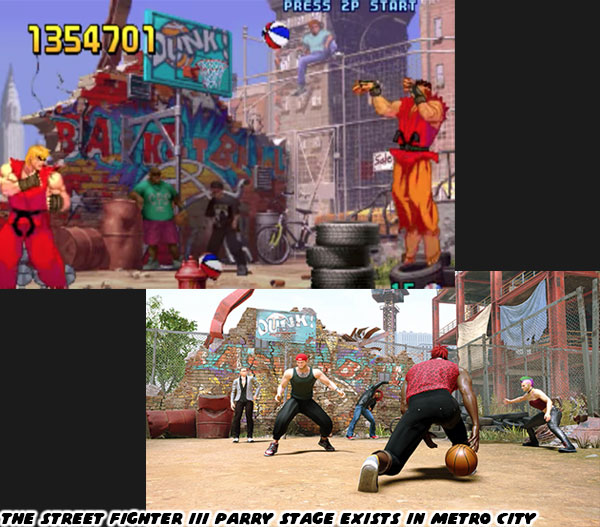
I had the eeriest feeling of deja-vu as I explored the building. I felt that I had been here before, but couldn't quite place the context. As I wandered behind the building I saw some people playing basketball. This was where one of the part time jobs was, the Ball Breaker Blitz, with Baller Mando. People that remember SFIII could recall the bonus stage where Sean was teaching how to parry. He would throw basketballs at you, and had you block them. Capcom had recreated that stage, including the color correct backboard, and graffiti on the wall but in 3D. Again the detail in this game was absolutely insane by any standard.

I still couldn't shake the feeling of deja-vu. It wasn't just the basketball court that reminded me of something. As I poked around the factory I kept thinking to myself there was no way a building this massive would just be taking up space in Metro City. That the developers must have placed something inside. Yet all the doors, and gates were closed. I thought that maybe it would open up at night. As I circled the building I found a ladder. As I climbed it I didn't expect to find much. Thankfully a side door was open near the top. That was when the SF6 team again showed why they were the best team for this project.

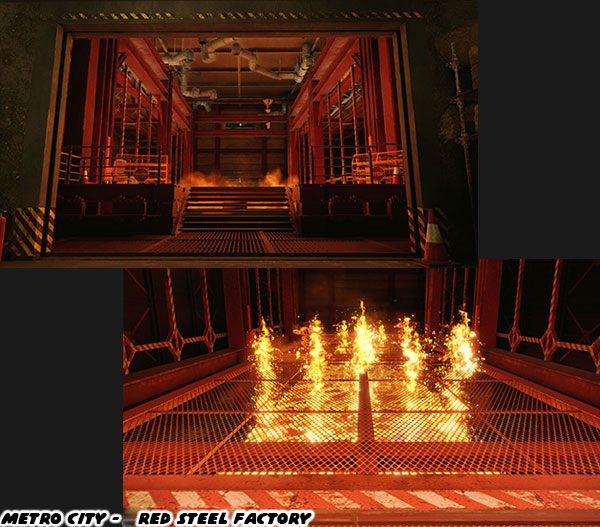
The factory may have looked abandoned, but it was very much still in use. The furnace was burning away, but the workers were nowhere to be seen. Capcom was letting you figure out what had happened inside. As you explored the massive complex you discovered there were Rampaging Drones, and Rampaging Hyoombas hiding in the corners. The robots that were already causing trouble elsewhere in the city had gone completely haywire inside the building. The rampaging models were overheating, they were sparking, smoking, and much more aggressive than any of the other AI robots in the game. They could be found exclusively inside the factory. I could imagine that the workers were too scared to enter the building once the robots had taken over.

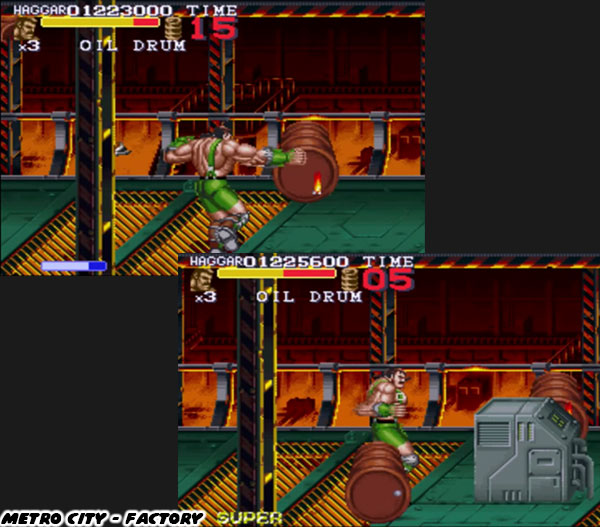
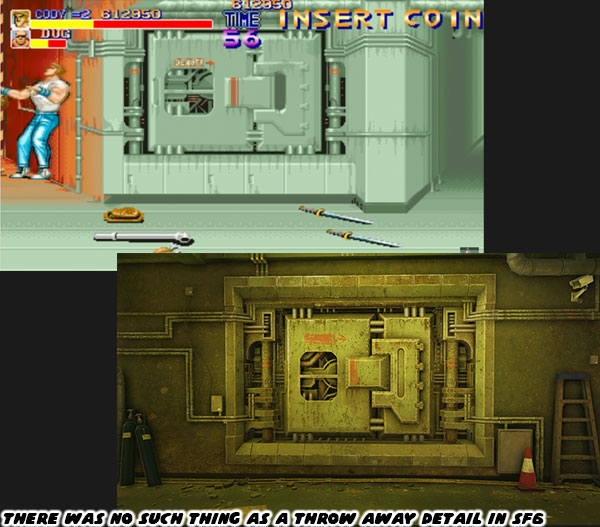
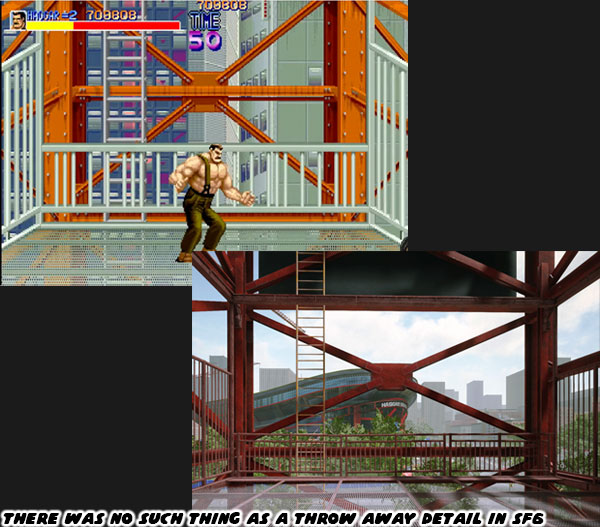
As I made my way through the steel grates, and battled the whirling machines of death I was instantly transported back to 1991. Capcom had recreated the Industrial Area from the original FF as a stand-alone adventure in SF6. This was the exact same Factory that was featured in Final Fight 3 a few years later. As I went floor-by-floor beating up the various robots, and occasional construction gang members waiting outside I was astounded by how much I recalled from the earlier games. Even though I played through the series once or twice I year, many of the details were burned into my memories decades ago.

Seeing the massive machine door at the end of a corridor filled me with delight. I recognized all of the features of the building. I was calling them out to my daughter. She wasn't even born when FF came out, and was barely one-year-old when FF3 debuted. She wouldn't have any context or emotional connection to these things, but was happy that I was happy. I had been explaining to her that the game was very much a love letter to the genre. There was no feature that the studio overlooked. As I climbed up each floor, and fought robots, and workers it captured the spirit of FF just as well as the subway had. When I finally reached the control room for the factory I saw that it was packed with all sorts of robots. They must have easily overrun the workers, and forced them out. Upon defeating them you were able to lower the metal grate over the furnace, and unlock the front doors to the building.

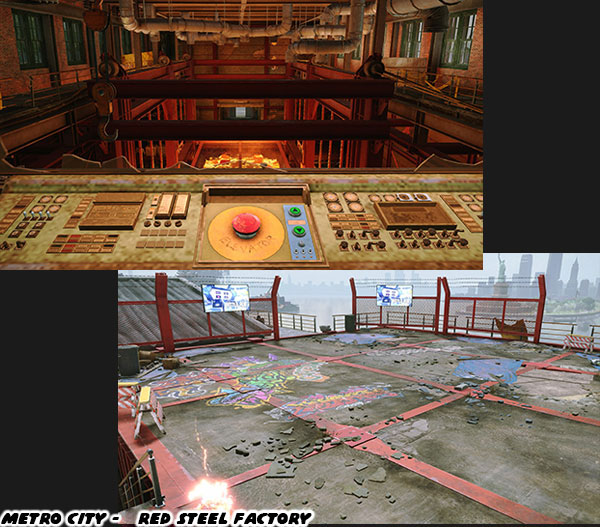
As I walked out of the room, and onto a metal grate industrial elevator I started freaking out. I knew instantly that it was the same elevator that you rode, and fought Rolento on some 35 years prior. There was even a ladder right next to it, the same one that he climbed while throwing grenades at you. As the elevator descended my heart started racing. For just a moment I thought that the Mad Gear general was going to appear. I was disappointed that he didn’t show up given how many cameos the developers were pouring into the game. Instead it was the one place in the city where you were guaranteed to get two android Copy Fighters to appear. After opening up the Red Steel Factory my adrenaline was pumping. The game had me prepped for the tournament now. I reported back to the Mike Haggar stadium, and told the host that I was ready to begin.

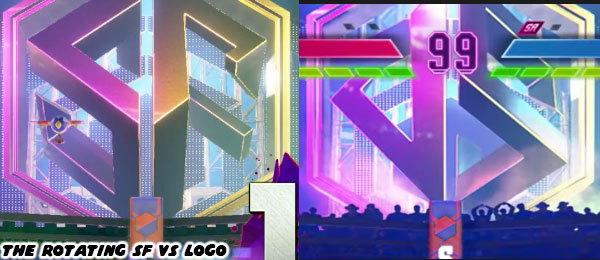
There were a handful of unique characters created for the amateur tournament. Sort of like “light” versions of Street Fighters. They looked like the generic characters that would turn up in an Udon comic book to fill out an encounter with the stars. You were expected to battle a few of them in order to reach the finals. Eternity, the host of the Battle Hub was also on hand to interview the participants before each match. Something that stuck out to me, other than the great arena design, were the floating 3D logos in the background. They rotated to show both the letters SF, and VS, in between matches. Again this was something that could be considered a throw away detail, but was something the team had planned with some forethought.

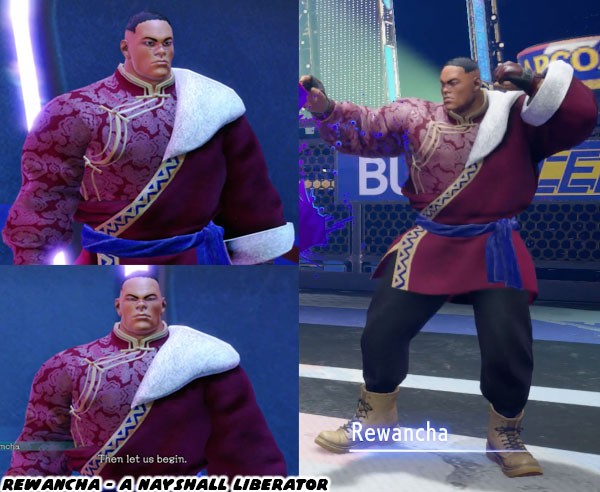
The final match in the tournament featured you versus a large brawler named Rewancha from a country called Nayshall. It was the same place that Bosch was from. This fighter was dressed in traditional clothing, and was determined to win it all. I figured he must be related to Bosch, perhaps a big brother. Maybe he would be able to tell me what happened with my sparring partner. He was as tight lipped, and intimidating as a mob enforcer. You weren’t getting any information out of him, aside from he was planning on destroying you in the fight.

As I said at the start of this blog. I honestly expected the World Tour mode to wrap up after this tournament. After all the SF6 developers had already done a tremendous amount of world building, storytelling, and cameos from the various games. What else could they have hidden up their sleeves? It turned out that I had barely scratched the surface of the game. The next half of the adventure was going to be even deeper. I’ll talk a little bit about the road that brought us here in the next blog. I hope to see you back for that. If you are a long time fan of Final Fight, or Street Fighter then I would like to hear your impressions of SF6. If you have never played any game previously then tell me your experiences in the comments section please. As always if you would like to sponsor me please visit my Patreon page and consider donating each month, even as little as $1 would help make better blogs and even podcasts!
follow the Street Writer on Patreon!

Friday, September 8, 2023

Street Fighter 6: A master class in game design, part 18

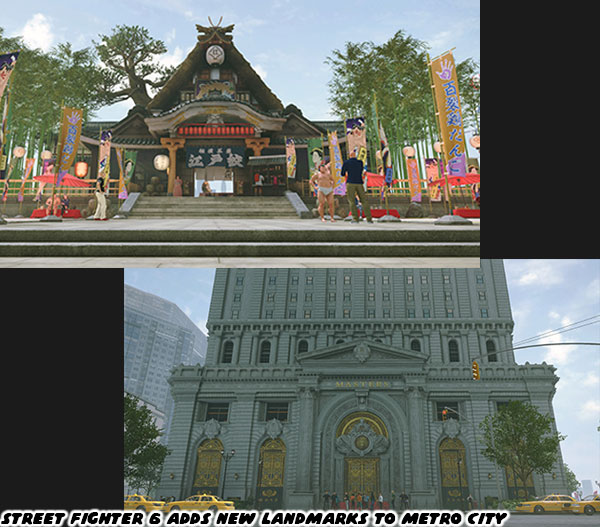
The World Tour in Street Fighter 6 was not only designed to ease players into the genre of fighting games, but it also wanted to tell a good story. The challenge, and pace of the game was perfect for new players, and surprisingly fun for seasoned players. Luke from Street Fighter V had returned, a little bit wiser than before as your trainer. He advised you to visit every corner of Metro City, and then travel the globe looking for new masters. The iconic World Warriors would teach you the basics, and help your avatar become a stronger fighter. Chun-Li was the first star that you met along the way, but she was not the only one that was teaching in Metro City. The thing that I could not have predicted was seeing E. Honda appear on the other side of town. The game had already retconned the Masters Building into the Metro City skyline. It was not the only new landmark being added.

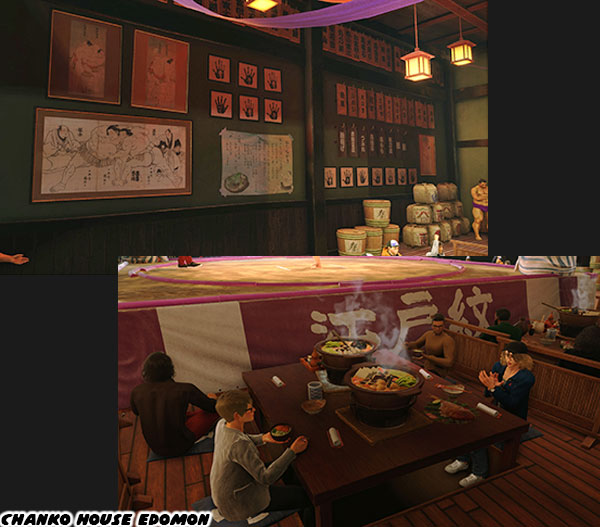
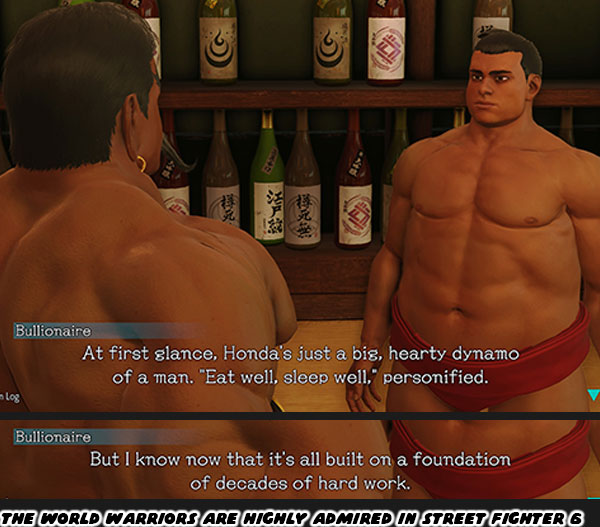
E. Honda had actually been traveling the world looking for the perfect place to set up a restaurant. Well, not just any restaurant, but a chanko house, the food that sumo wrestlers would traditionally eat. He wanted to share the culture of Japan, the tradition of sumo wrestling, and of course the delicious food in an entirely new community. The building he created was similar to a classic Japanese hall. Tiled roof, hardwood floor, and all of the trimmings. The level of detail in the house was absurd. An actual sumo ring was surrounded by booths for guests. They could be seen enjoying bubbling pots of chanko stew, and watching other patrons fight against Honda's stable of wrestlers.

It was easy to get lost in the details placed inside the restaurant. Enormous saké barrels were stacked next to modern refrigerators. There were paintings, and prints of ancient sumo wrestlers adorning the wall. The names of previous yokozuna, ozeki, the ranked sumo wrestlers, and the banzuke or list of current wrestlers were were pinned on the rafters. Sumo autographs were very unique, they would often sign a handprint. Fans could see how massive their palms were compared to regular people. The restaurant had an entire wall dedicated to the other legends in the sport. Honda himself was no different, his hands were as thick as his belly. It was apparent in his dialogue, and the other NPCs that he was beloved in the sport.

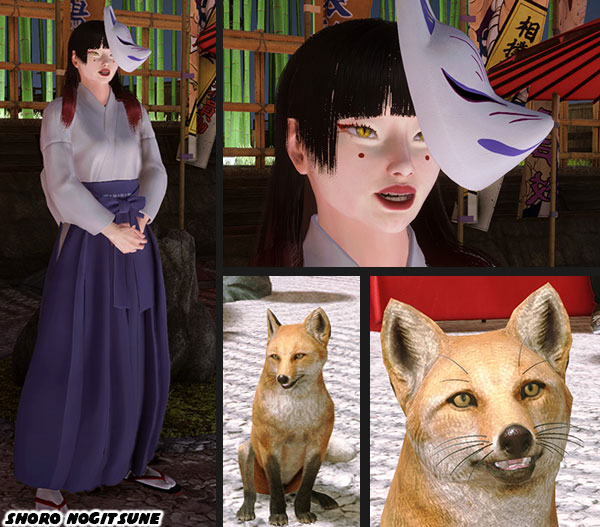
What the game never could have prepared me for was the wholesome writing throughout. You were not only learning how to fight using the styles of the various masters, but you were also building a friendship with them. They were sharing their history, cultures, and traditions with you. Even the more reserved, and introverted characters like Cammy could be won over in time. She would open up a little, and build a bond with you as long as you put in the effort. When it came to Honda he was not doing a surface level overview about sumo culture. He was giving you a deep dive on Japan itself. In fact, Capcom was making sure that he would be bringing a part of Japanese mythology with him. As I was exploring the Chanko House I noticed a young woman named Shoro Nogitsune wearing a fox mask, and standing outside. She had unique yellow eyes. I talked to her to see what she had to say. In one dialogue tree she said that she had no relation with E. Honda. In fact she said “As if I’d give the time of day to young folk like Honda or K-er… did I say young? I meant older than the hills. Why, I’m simply an innocent shrine maiden, lured in by the wafting aroma of fried tofu.” When I returned during the daytime the woman was gone, and instead there was a fox sitting in the rock garden, about the same spot that Shoro was at.

A kitsune was a fox, and had a long history in Japanese mythology, a nogitsune was a fox without a divine spirit this meant they could change shape, and take the appearance of a young woman. Previously we had seen a playable character from the fox myth named Ameth. The 998-year-old fox spirit appeared in the game Xuan Dou Zhi Wang / King of Combat. E. Honda oozed so much Japanese spirit that the spirits followed him to the USA. He explained what the shikona, or ring names meant for the wrestlers themselves. He explained that he never made yokozuna, the top rank in the sport because he was too busy competing outside of the standard tournaments. The sumo schedule was demanding, you had to compete even while injured or else you would lose rankings. He certainly had the skills to be the greatest ever, but his passion extended beyond the ring. In a way it was bittersweet but this self awareness gave the character more dimension than anything else had in the past 30 years.

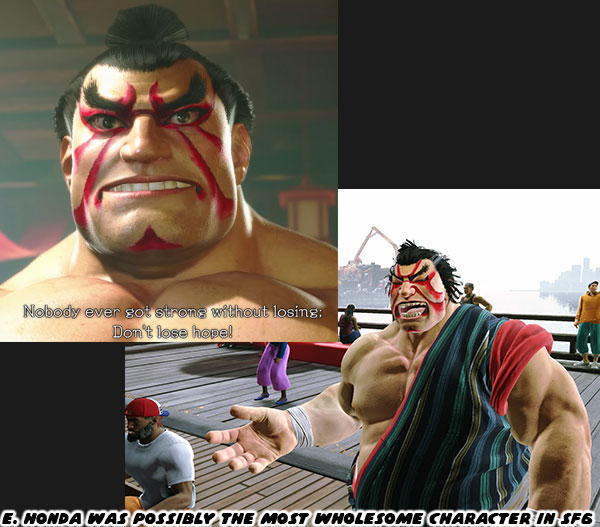
E. Honda was introduced in SFII as the dramatic sumo. His kabuki face-paint flew in the tradition of the sport. Sumo was closely aligned with Shinto spiritual beliefs. Every tournament was layered with religious ceremonies. Then Honda turned up one day and was turning it into theater. That silliness was supposed to appeal to American players more than Japanese audiences. For the majority of his existence he was presented with a comedic tone. This time however he had some actual dimension. The way he acted, the wisdom he spoke, the way he presented himself was deliberate. He was filled with joy, and it was palpable. He would ask you to help find new disciples to work at his restaurant. His passion would rub off on them too. I ended up having much more love, and respect for this character than ever before.

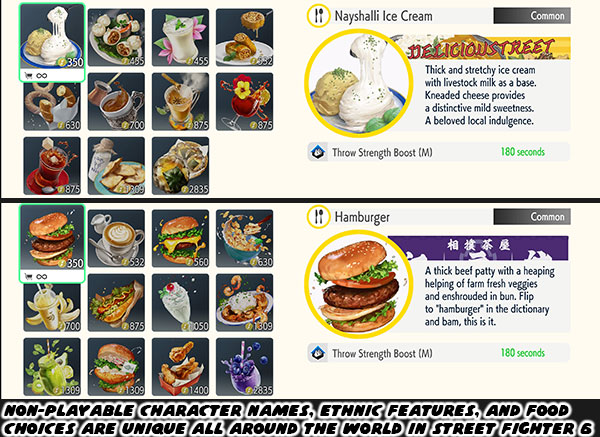
I never expected the SF6 team to go out of their way to give us realistic portraits of the World Warriors. They showed us how they thought, and let us hear in their own words what they were fighting for. The World Tour did much more for all the characters than any arcade story could have ever done. Even the smallest details were explained in the game. For example your avatar would take damage, and lose energy during the fights. You would have to buy something to eat, or drink from the local vendors to recover energy. The food at each business was unique. At the Chanko House you could get udon, tempura, or any other type of traditional meal. Every food item had its own history, and benefit. Some allowed you to earn more experience points, others allowed you to deal more damage for a limited time. There were even unique items that you could order while you were traveling. A drone would deliver your food to you. 

It seemed absurd to me that the SF6 developers would go out of their way to explain every dish in the game, and its benefits, but this was a tiny detail that was important for world building. It would set the standard for the company moving forward. It was an example of the work that Capcom was putting into Street Fighter 6. You weren't expected to just run from fight to fight, but to experience the world that they had created in between all of those battles. We will dig even deeper into this side of Metro City in the next blog. I hope to see you back for that. If you are a long time fan of Final Fight, or Street Fighter then I would like to hear your impressions of SF6. If you have never played any game previously then tell me your experiences in the comments section please. As always if you would like to sponsor me please visit my Patreon page and consider donating each month, even as little as $1 would help make better blogs and even podcasts!
follow the Street Writer on Patreon!

Sunday, June 3, 2018

30 Years of Street Fighter, 30 Days of Characters; #28


E. Honda has easily earned a spot in my list of 30 memorable characters. His look is so bold and his moves so imaginative that it would be a shame to ignore him this anniversary season. The origins for the character are more cartoon than reality. There was actually a sumo wrestler with a painted face that appeared much earlier in the arcade. The look of E. Honda was meant to grab your attention. He was supposed to be an over-the-top character, borderline parody. He was on the extreme end of designs like the wild man Blanka or the skinny yogi Dhalsim.


E. Honda was unique for a number of reasons. Sumo wrestling had not really been covered in early fighting games. This was a chance for Capcom to write a new page in history. In order to work in Street Fighter it had to be an exaggerated version of the real art, just like the other forms represented. We could tell Honda was strong just by looking at him. His muscles could still be made out under a layer of fat. What audiences never expected was for him to be quick and agile as well. Sumo wrestlers could be surprisingly quick despite their size but E. Honda was on a whole new level. 


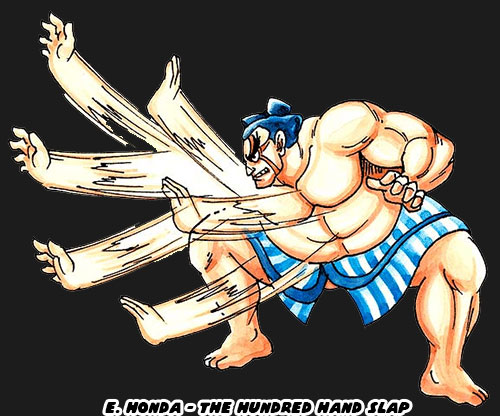
Sumo wrestling was known for being a contest of strength and force. There was a lot of technique involved but moves such as kicks were off limits. Since Honda was competing in an underground tournament his arsenal was expanded. He could jump and kick, trip opponents, sweep the leg and even throw himself head first into a rival. Sumo wrestlers often fought for position by slapping their opponent's head, neck, chest and shoulders. E. Honda was so good at this he could do it with one hand, thus earning the legend of the Hundred Hand Slap. While it wasn't as flashy as a fireball it was still an impressive move. E. Honda's appearance combined with his library of moves made him one of the best heavyweight characters ever created. I'm glad that the character has been a part of the Street Fighter universe for almost three decades. What do you think about him? I'd like your take in the comments section. As always if you enjoyed this blog and would like to sponsor me please visit my Patreon page and consider donating each month, even as little as $1 would help make better blogs and even podcasts!

 follow the Street Writer on Patreon!