Showing posts with label rumble fish. Show all posts

Tuesday, May 7, 2024

Another Rufus blog... A 1UP classic from May 15, 2008

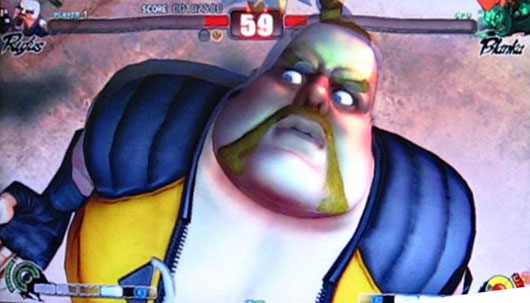
Hello friends, it looks like I'm on a bit of a Street Fighter IV kick again. We might as well keep the train going with some more random observations. Today's rant takes us back to look at the place and purpose of nobodies favorite SF fat man Rufus. It's funny timing that I bring him up as Capcom in Japan and the US has made no official mention of this guy. Even better, Cap USA wants to make 3 figurines of the new lineup and are letting fans vote. Rufus is nowhere to be found. Is it possible that the fan reaction was so strong that they buried him or are they holding him plus other characters as a surprise for when the game is launched? It might turn out to be like Tekken in which some characters appear after a certain amount of time has passed. Let's hope that some other SF-universe characters appear in the lineup.

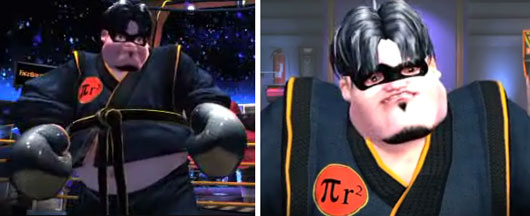
Now I have nothing against fat people, I'm a fat guy. I also don't have a problem with fat fighting game characters. In fact, I'd like to see more of them, provided that they are consistent with what has already been established in the series. Just the other day a new character was introduced for the boxing game Ready2Rumbe 3 Facebreaker. He's a fat boxing master named Steve Talking Head. The game is supposed to be cartoonish and over-the-top, so he makes sense in that lineup... Make of him what you will.
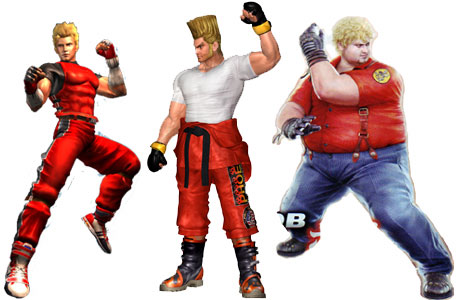
I've already spoken at length about the subject with my origins of Rufus blog. In case you don't want to read old news I'll sum up some of my gripes. A character like Bob from Tekken moves too quickly for a man of his girth. It's as if they did some motion capture moves and thought it would be funny if the animations were stuck on a fat character. It seems that Rufus is even larger than Bob yet seems to move faster. Maybe Rufus was inspired by strongman Gene Rychlak. He's also a big guy with wild hair and a trucker mustache that bench pressed a thousand pounds. Sure he's strong, but can he move fast? Is he flexible? I doubt it.
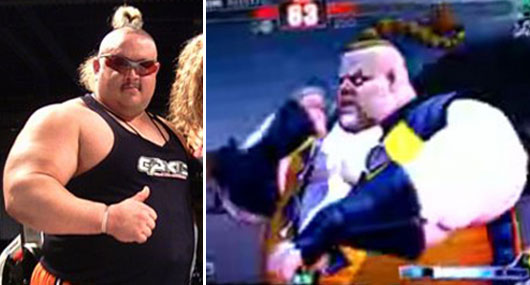
While thinking about this character I began wondering what it is that I don't like about Rufus. 1UP member Smashbro mentioned that it could be the way obese people are demonized in US culture. But my issues are more about his speed, lack of muscle definition and seemingly weightless mass, not any bias against fat people. 1UP member Marc lamented that he seems to be the only one on 1UP willing to try this game. I never said that I wouldn't play SF IV or that I wouldn't try out this character. In fact if there is a location test anywhere in the southland then I'll be there, getting in line and trying each character at least once. I'm also thinking about which console to pick up based on which will have a better joystick for the game. To think that I'll pass on a SF IV after waiting so long after III is absurd. Remember that I got the Wii for NiGHTS? Or the Xbox for Jet Set Radio Future?

I've said that large characters tend to move slower in SF games, Rufus is contrary to that. Smashbro mentioned that the Japanese tradition of sumo might explain why they created him and seem to be more accepting of this large character than the US is. The US demonizes obesity yet has a large population that is overweight. My biases might be based from a cultural P.O.V. I began thinking about who Rufus reminded me of, aside from Gene Rychlak and where his place could be in the Street Fighter universe. I began thinking about large characters from cartoons, movies and even real life. Who were the ones that worked and why? As far as fighting games go, the fat guys in Final Fight worked, King Heart in Fist of the North Star worked and Karnov from Fighter's History Dynamite worked as well.
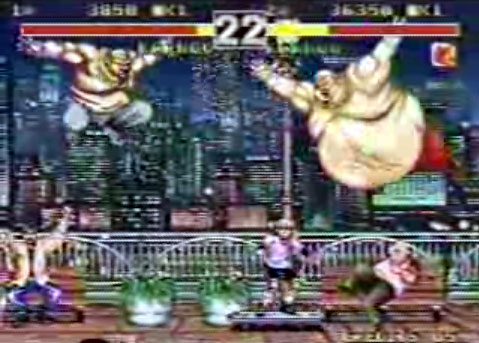
Heck, Karnov could even inflate himself and become even more massive than Rufus, yet he worked in the game because he also had an assortment of mystical properties. Karnov could breath fire, teleport and float, he was a fat doppleganger of Dhalsim. In the context of his game these things worked, but this is a different game. The issues that I have with Rufus and the other new characters are because I feel that Capcom is betraying their own design legacy. Actually part of the problem is that DIMPS is developing this game and their approach to character design is different than the classic Capcom formula. I'll talk about it more tomorrow but I strongly feel that Rufus is just a more complete vision of the character Boyd that DIMPS had put in their 2.5D fighter Rumble Fish.
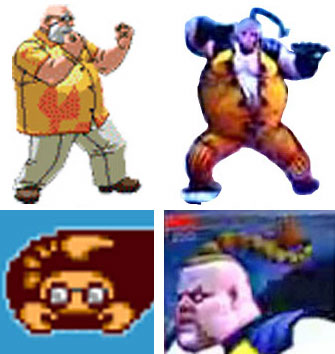
I couldn't just leave it at that. Like a scab I have to keep picking at the design until it starts bleeding. Where did Rufus come from? What was it about his costume that works or doesn't? Yellow jumpsuit, unzipped to his belly with built-in pads? What about that ponytail and facial hair? Looking at Rufus' trucker mustache I was reminded of the larger-than-life character of Bull Hurley from the movie Over the Top.
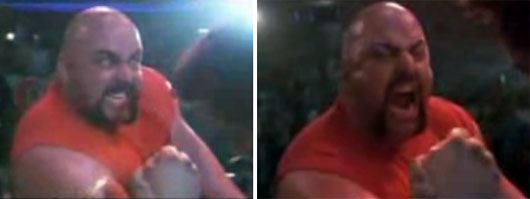
I noticed that even though Bull, as played by the late character actor Rick Zumwalt was massive, he wasn't obese. I began wondering how "fat" a character could get and still be valid in the SF universe. I began wondering how big a person could be and still remain a valid fighter. Here is where the distinction between what "fits" in the real world and what "fits" in SF has to be made. We are willing to suspend our disbelief up to a point. If the point is crossed then that character becomes redundant, broken or laughable. At some point something has to be done with the character and design to make him or her fit into the game. This is the part that I think Capcom and DIMPS is missing with Rufus. They are not separating his purpose from his moves. The reason for my thinking of that actually goes back to the character of Bull and the movie he was in. The real arm wrestling legend at the time, Cleve Dean, makes a few cameos but isn't the last person that Stallone faces. According to the Wiki page the filmmakers didn't think that audiences would believe that Stallone could beat Dean.

Wait a minute. We could believe that Stallone could beat Bull but not Dean? How much more massive and imposing was Dean over Hurley?

At his peak in the late 70's / early 80's Cleve Dean was a multiple time world champion. He simply dominated his opponents. The reason for this was because of his tremendous size and strength. He was about 6' 7" and over 450 lbs. easily dwarfing Stallone and even some of his competition. His girth beguiled his opponents, he wasn't just a mountain of a man but rather a mountain of a man with lots of muscle. Like a modern-day Paul Bunyan, Cleve became synonymous with power.
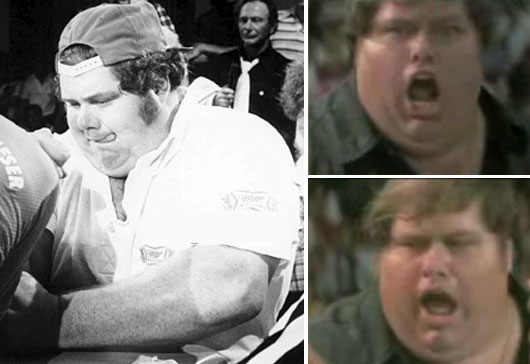
Cleve represents a certain athletic aesthetic that is older than most people realize. Throughout history some of the strongest men in the world haven't always looked like bodybuilders. Some of the most powerful figures in myth have been on the heavy side. The giants and titans of ancient Greek and Norse mythology were usually heavy-set. The legendary Olympic weightlifter Vasili Alexeyev was another mountain of a man but he also did the unthinkable. Before his time many thought it would be impossible to lift more than 500 lbs. in the clean and jerk. Even though there were many strong weightlifters in that era, part of the reason for not being able to break the mark was psychological. Before his record-setting lift his coaches told him that he would be lifting 497 lbs. something that he had done in the past. As he lifted it he thought it felt heavier than normal but pushed himself to complete the cycle. Once he broke the barrier many in the sport realized that the human body had even more strength potential.

But the incredible strength of Cleve or Vasili doesn't mean much in the fighting arena. Grappler Royce Gracie once said a person with an average build that is experienced with judo would be able to beat a person with a bodybuilder physique and no fighting experience. There seems to be a lot to his reasoning. Big, tough guys that know a little fighting are usually taken out by smaller, experienced MMA fighters. The only large people that knowingly have fighting ability are sumo wrestlers. I've already mentioned that sumo wrestlers have a lot of muscle underneath their mass. More than that they have technique. Being absurdly strong is one thing but most sumos are evenly matched, they need technique to counter the strength. They need technique to decide a winner. A champion like Akebono made for a great sumo wrestler because he had the raw size and strength of Cleve or Vasili but combined it with impeccable fighting technique and strategies.
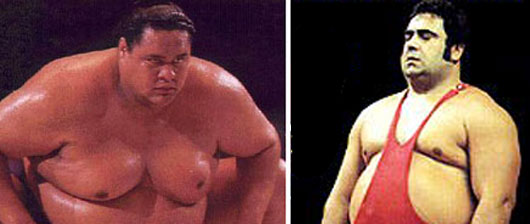
This is where I don't understand the purpose of Rufus. Street Fighter is already filled with archetypical strongmen. Zangief is a giant, bearded version, of Alexander Karelin. Like Alexander, Zangief is capable of superhuman feats of strength with his wrestling ability. E. Honda is a champion-class sumo wrestler, a kabuki-painted yokozuna. Where does Rufus fit between those other big men? He doesn't seem to have the design or purpose of the legendary strongmen I've mentioned. Instead he is a fat guy that knows kung-fu and moves really, really fast. He jumps fast, punches and kicks fast and has fast super attacks. Zangief and Honda are slower by comparison.

It just doesn't make sense to me. I'd love to see Rufus as massive as his is now, playing sickly powerful but also slow. A middleman between Zangief and Honda. Or a "slimmer" version, one that is still chubby but also fast and more reminiscent of Sammo Hung. But a Rufus that is both absurdly fat and fast? That, like Bob from Tekken, is a stretch and I don't think I'm the only one that thinks so. At some point character design stopped being great. It stopped evolving logically and just became absurd. I'm not going to lie and say that 2D fighters all had great designs, there were some awful designs back in the day. However the third dimension really brought the worst designs to life. Advances is animation and 3D modeling allowed a character of any shape or size to move as lightly as an olympic gymnast or as fast as a professional boxer.
When did the gatekeeper to great fighting character design go on holiday? Wish I could have been there in his stead, some characters would have never gotten the greenlight. All I can do now is point out the tragedies and lament the days gone bye. What do you think. Do fat characters have a place in fighting games? Is it about time or just a gimmick so far? Am I making too much about nothing? Does Rufus work in SF IV? Let me know what you think in the comments!


Friday, March 29, 2024

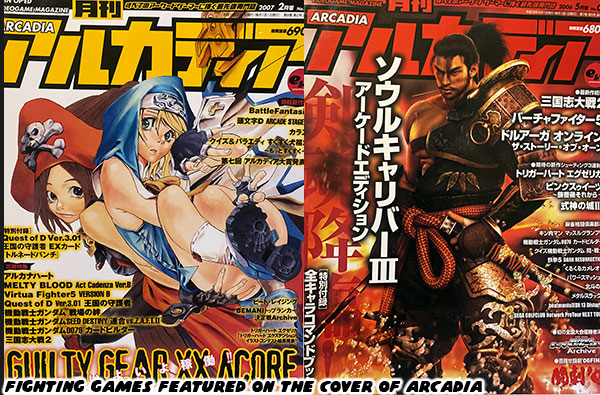
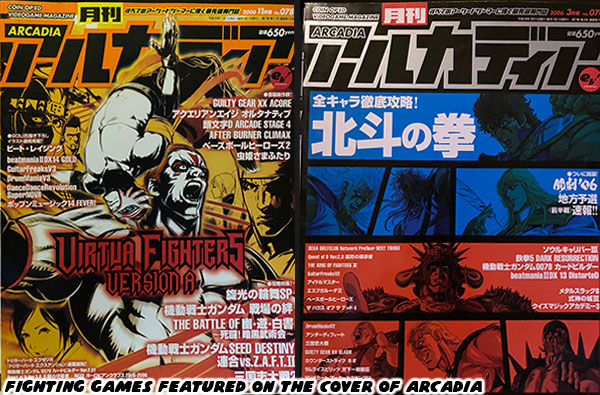
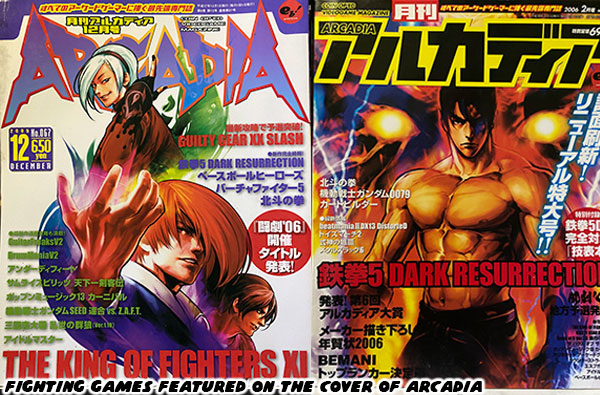
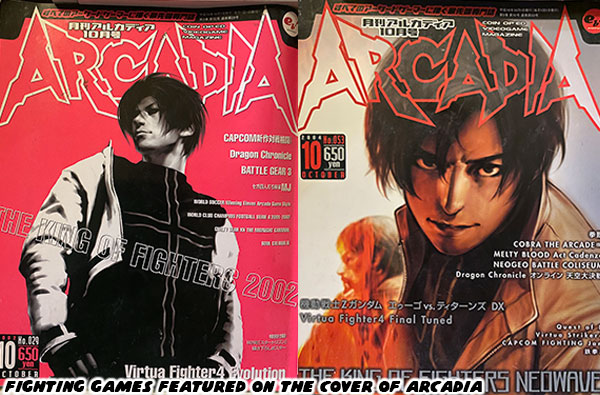
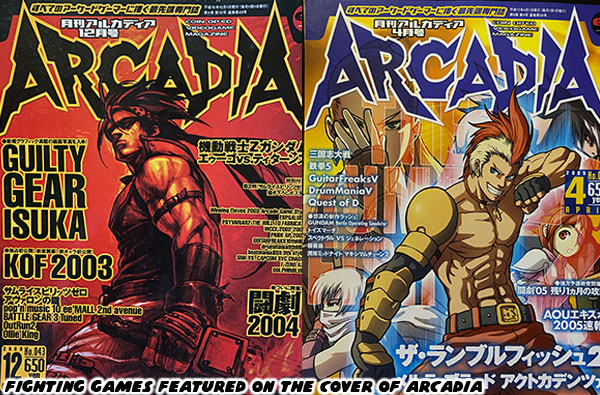
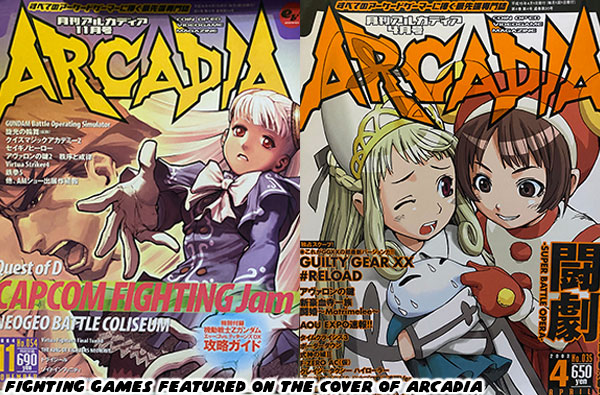
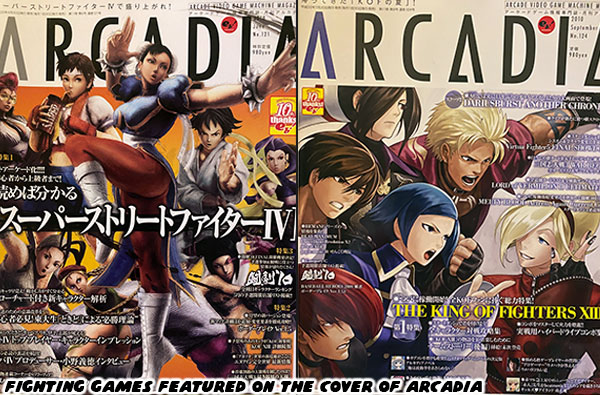
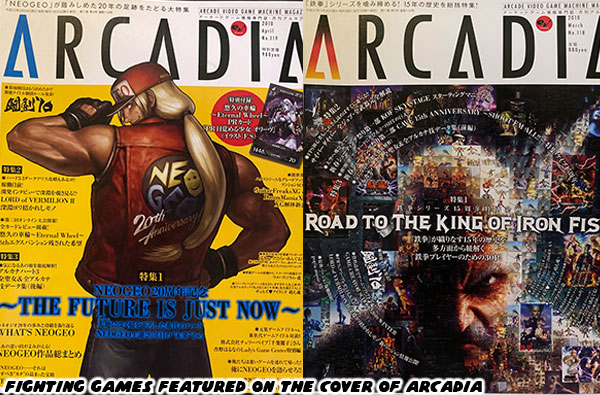
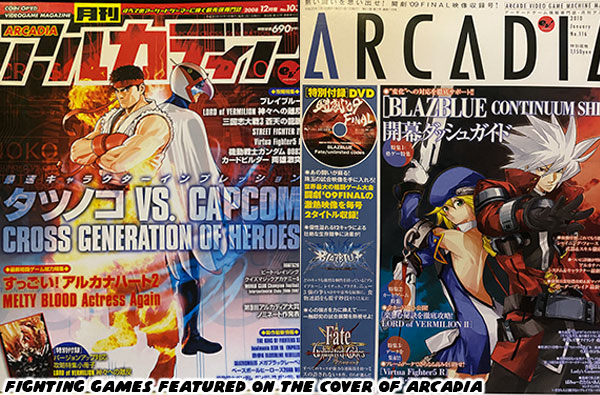
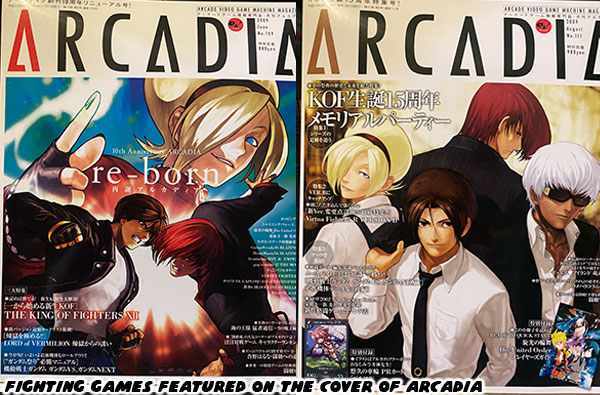
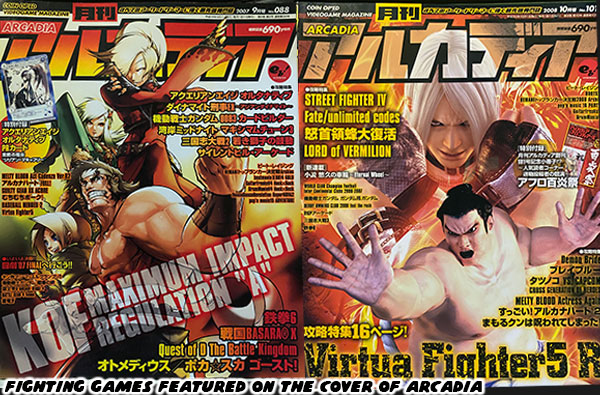
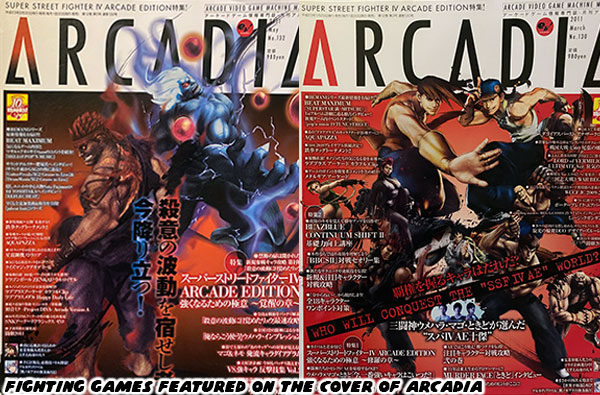
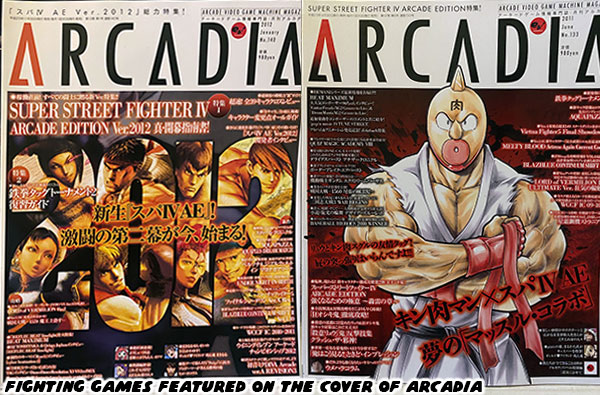
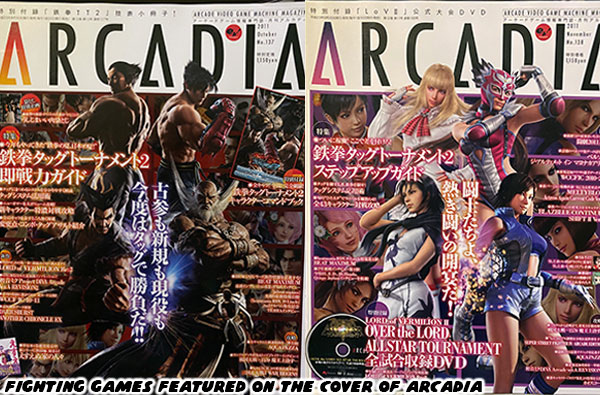
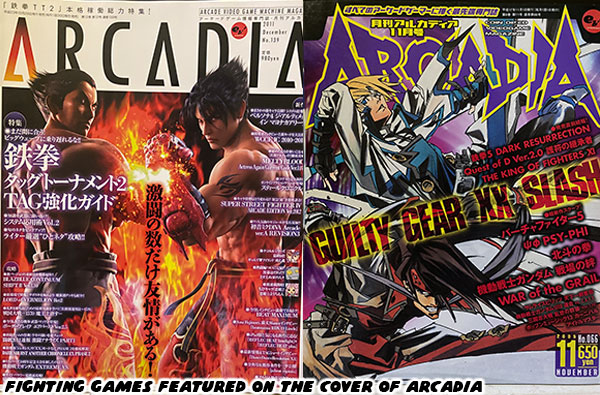
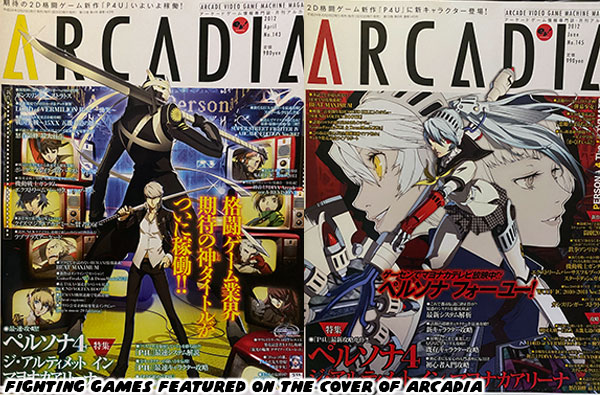
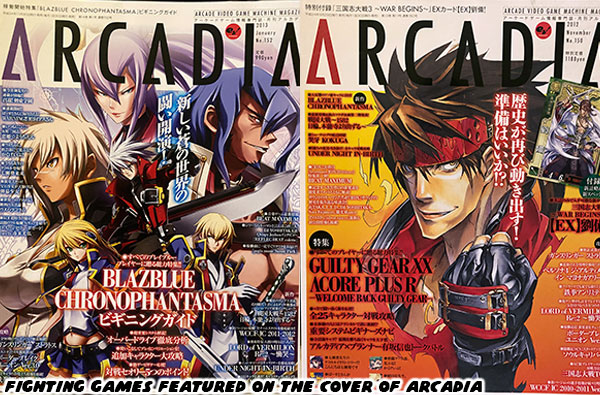
The last great fighting game covers of Arcadia.

The past few Friday’s I’ve talked a bit about bringing my Arcadia magazine collection out of the garage, and into my home library. In the fall of 2023 I had brought over my Gamest magazines, game books, and mooks (magazine books from Japan), manga, as well as my fighting game manhua, or Chinese comics.

As I continue to sort through the collection I wanted to share a quick glance of some of the covers featuring the stars from the fighting games of the generation.

Did you have a favorite fighting game, arcade game, or console game that came out between 2003, and 2013? I’d like to hear about it in the comments section. As always if you would like to sponsor me please visit my Patreon page and consider donating each month, even as little as $1 would help make better blogs and even podcasts!
follow the Street Writer on Patreon!

Wednesday, August 4, 2021

The Chun-Li template, don't follow it too closely! A 1UP classic...

NOTE: This blog entry was originally published on 1UP on April 18, 2012.

In the previous blog I had highlighted how Chun Li was the template from which Capcom drew its great female character designs. I wanted to make a special mention of how the context of the character design was important as well. The studio could have and did try to introduce two new female characters in Street Fighter IV. The audience reaction was lukewarm to one and somewhat better for the other. Crimson Viper, the spy in a tight fitting pantsuit was actually a character design based on marketing data. Capcom learned that western audiences were drawn to women that looked like Angelina Jolie. They decided to make a Jolie-like character and put her in the game. Unfortunately most players skipped out on playing her during the first public showings of the game. This was a surprise to everyone working internally. The studio had made the mistake of trying to predict their audience based on trends from outside of the community. Jolie was a popular actress and she might have made for a fun character in a game like Tomb Raider, where running and gunning were the objective, however she had absolutely zero credibility as a martial artist. She was no Angela Mao or or Michelle Yeoh, those were actresses that had made a living by playing fighters on the big screen.

Capcom could not convince audiences that a fighting game character in tight-fitting street clothes with the same features of a size zero Hollywood actress belonged in the Street Fighter universe. The other character, Juri Han, went much further with audiences.

Capcom learned that SF fans were interested more in fighting designs than pop culture caricatures. You would think that they had learned that with the Bruce Lee clone called Fei Long… but I digress. Players were used to seeing multiple layers of detail that supported the character as a fighter. With Juri the details were more apparent. The costumes for the SF cast were story elements that explained who the character was in fighting style and personality to gamers. Juri was like Chun-Li, a variation of a traditional design. However it took Capcom senior designer Daigo Ikeno multiple revisions to find a character that worked.

Like Chun-Li before her the character started off in a more traditional costume. The new character was to be of Korean descent and Capcom wanted audiences to identify her easily as such. She was placed her in a Hanbok or traditional Korean clothing. The oversized dress was an interesting design choice however might have proved nonfunctional in a fight. Juri was to have a majority of kicking attacks to balance out her rival, Chun-Li. Her kicks would have been impossible to make out in the dress. Ikeno went back to the drawing board and kept on revising the character.

There were many revisions made Juri. Some of the design choices were bold while others were nonsensical. In this way Mr. Ikeno was able to demonstrate that during the development process every idea was considered, not solely the traditional choices but the outlandish ones as well. The countless revisions would not end up influencing the final design as much as Chun-Li did.

Visually Juri was almost point-for-point a repeat of the elements featured with Chun-Li. Savvy viewers might notice that some of the clothing options were reversed for the character. Chun-Li had bare arms and legs and Juri had covered arms and legs. Chun-Li wore a wide belt and Juri had a bare midriff.

Both characters had unique elements on their heads. Chun-Li had her hair in buns with long flowing ribbons while Juri sported two outlandish pigtails. Both characters featured a contrasting color on their uniforms, a filigree pattern that outlined their breasts.

Both characters also sported spiked bracelets. Juri's were a little harder to make out and seemed more decorative than functional in a fight.

Both characters relied on kicking moves that were supposedly inspired by their home countries. Chun-Li used a fictional form of kung-fu while Juri relied on fantastic Tae-Kwon Do attacks. Both characters also sported uniforms that were pseudo-authentic. Chun-Li's was a little more believable but it was still completely fabricated. These things were not noticeable until her uniform was compared to actual Chinese martial arts clothing. The cut of Juri's costume was extremely odd. Her top and sleeves were not based on any known martial art or fashion. Her leggings were a take-off of the traditional dobok or tae kwon do uniform. The dobok sported loose fitting pants so practitioners could perform a wide range of kicks. Juri's pants actually hung from her belt and were open on the hips and inner thigh, they were more like chaps that people wore while riding horses. Even her belt was unlike the traditional "dhee" worn on a dobok. Tae Kwon Do belts were styled similar to karate belts and were also colored to show what level of proficiency the fighter had. Instead of a short black belt Juri had an extremely long belt with purple striping which hung low across her waist.

Juri made a bigger impression on players of Street Fighter IV than almost any other character introduced in the series. A big reason for that was because she borrowed tremendously from the design of Chun-Li. Gamers that didn't pay attention to Juri's design influences but enjoyed the character nonetheless were possibly drawn to her at a subconscious level. Daigo Ikeno did a good job at introducing a new female into the SF universe that covered many of the elements that made the other characters memorable. Juri certainly stood apart from the more "traditional" designs explored in the SNK games. SNK had created an entire library of Korean characters starting with Kim Kaphwan, a TKD practitioner from Fatal Fury 2, released in 1992 a year after SF II had come out. The Fatal Fury and King of Fighters series had a unique cross sampling of Korean characters and styles. Capcom was barely exploring this part of Asia some 16 years after SNK.

SNK had at least two female Korean leads in the KOF series. The first was Mae Lee, a character dressed in modern street clothing sporting a strange belt and large scarf. Her design was rooted more in henshin, the Japanese superhero shows than on a classic fighting art. The other was Chae Lim. She was the first female wearing a traditional dobok featured in a videogame. She predated Juri by six years. The bold cut of Juri's uniform and use of contrasting colors black, white and purple made her stand out from the crowd however. Juri was designed to be a non-conformist or a non-traditionalist. It could explain why the character took extreme liberties with the uniform of TKD practitioners. Everything from the hair and colors associated with her were bold. She had shock value going in her favor, more so than even Crimson Viper and her electrified gloves. However was shock value enough to make her fit within the Street Fighter universe?

I would argue that Juri was lacking the elements to make her as timeless as Chun-Li. The character was instantly liked because she borrowed a large number of elements from Chun-Li. However this new character lacked inspiration and originality. Chun-Li went through several revisions before a character emerged that audiences could identify with. The influences from martial arts cinema and Chinese culture were tangible with Chun-Li. With Juri audiences could not readily see or identify any inspirations behind the character other than those of Chun-Li. Juri was a copy of a caricature. She suffered from the same inconsistencies of the other characters placed into SFIV, namely that the designers were not looking to the outside world for inspiration but looking at their own series to fill a slot on the roster.

Juri was a bit too formulaic. Capcom saw the reaction that western audiences had with the new characters and went back to the drawing board for Super SFIV. They went back to basics and tried applying a traditional fighting style on a national representative. Juri represented Korea and TKD and Hakan represented Turkey and their native wrestling. The the decision to reverse the clothing elements featured on Chun-Li helped make sure that Juri was better received than the oily red-colored man. Juri was a better design than C. Viper and certainly leagues ahead of Rufus, however even those two seemed pulled from characters featured in an older DIMPS fighting game.

Perhaps Mr. Ikeno played the design a little too safe. By following the template of Chun-Li so closely he created a character that lacked personality. All of the moves attached to the character were over-the-top, not to mention that she acted out sadistically in her animations. She was like an animé character placed into a fighting game. If the character was indeed a non-traditionalist then Capcom should have ignored trying to give her dobok leggings. The character in only her tights looked more like a cross-between Cammy and Chun-Li and possibly would have been more believable as the super fighter capable of taking on both icons at once. But that's just me speaking as an armchair designer.

I don't believe that Juri was as well designed as she could have been. Capcom wanted to push the envelope but they were not sure how. They had tried to make a dramatic change and failed with C. Viper. They returned to basics and succeeded somewhat with Juri. The differences between the two characters was obvious. One had more fighting elements while the other looked like she was wearing street clothes. Yet the nuances for a memorable female fighting lead were harder to pin down. Cammy was not a reversal of the costume elements of Chun-Li, she was her own person that complimented the designs of the earlier character. Cammy did not move or fight like Chun-Li but had her own special attacks. In Street Fighter EX Blair Dame was also nothing like Chun-Li yet she represented a strong female archetype with her own original style. Juri's pseudo-traditional costume and kick-based attacks were a little too similar to Chun-Li's to be considered completely original. That was my interpretation of the character, what do you think?