Showing posts with label guilty gear. Show all posts

Friday, March 29, 2024

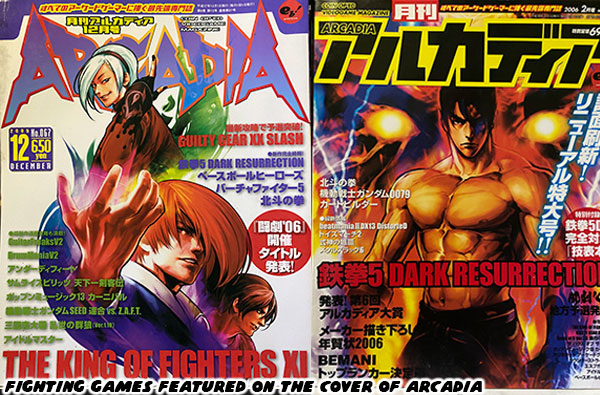
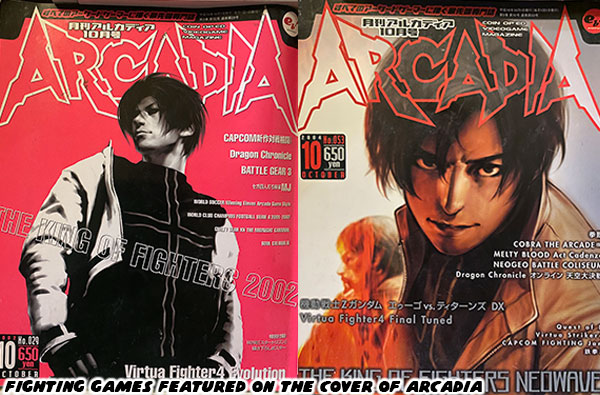
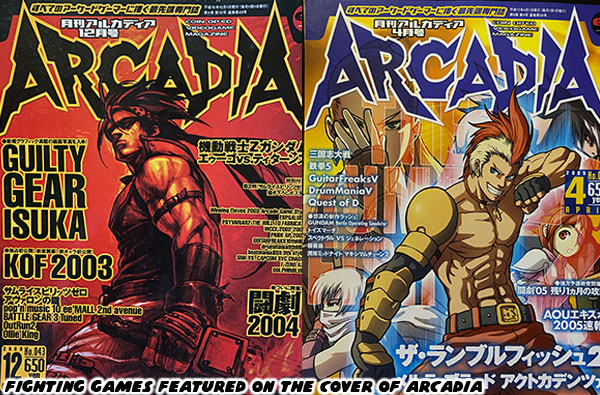
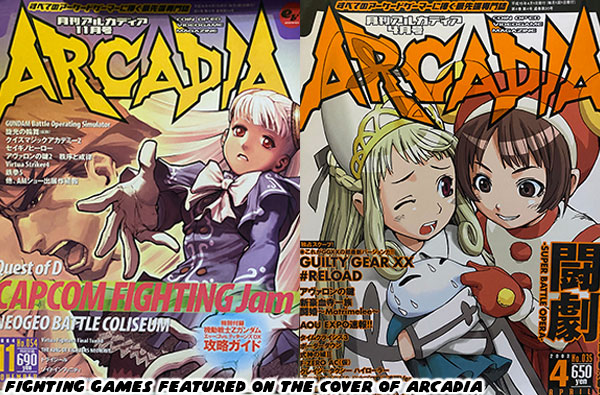
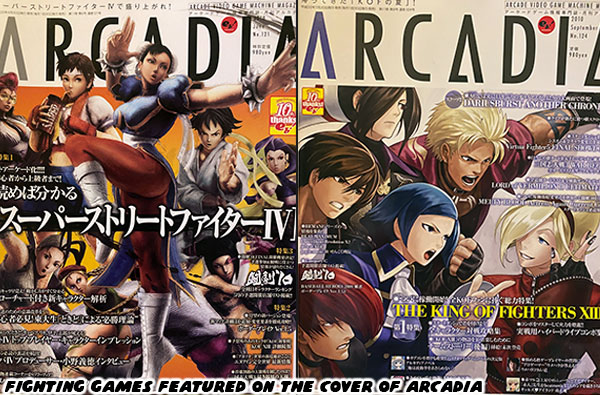
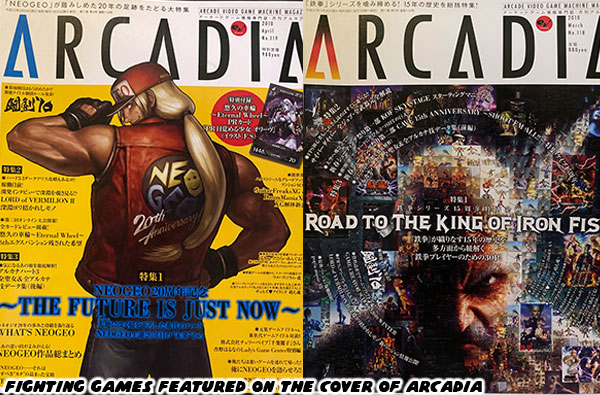
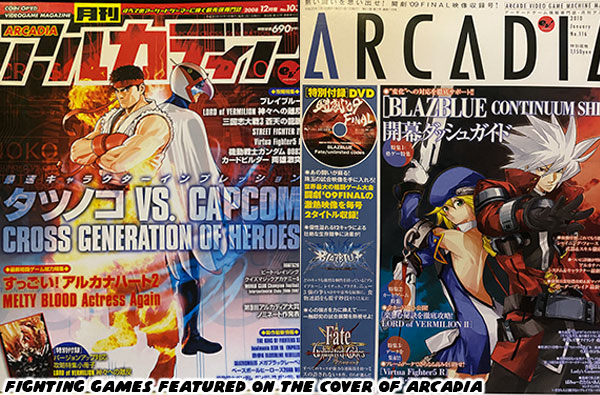
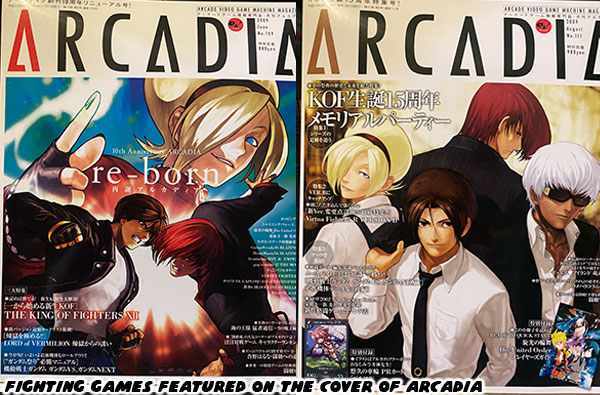
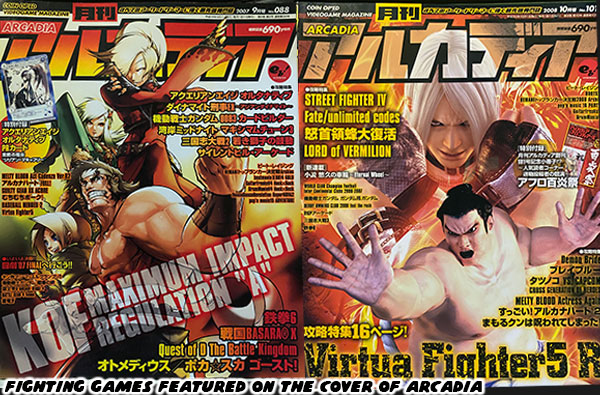
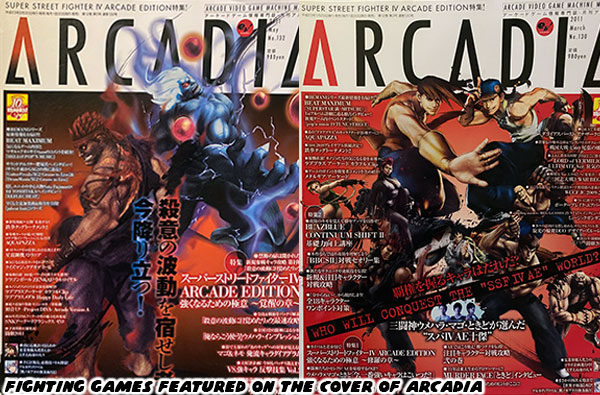
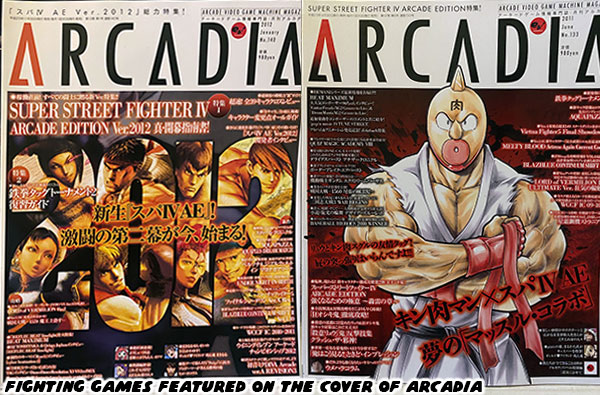
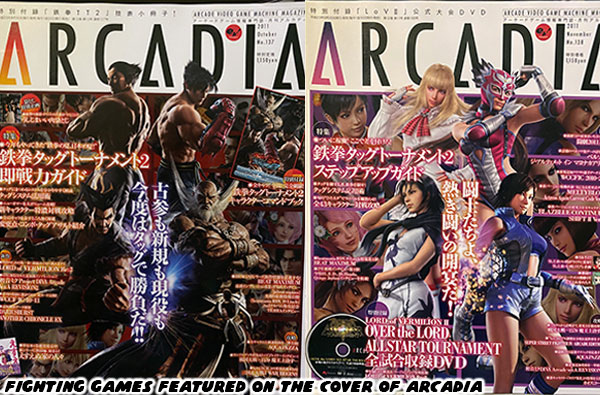
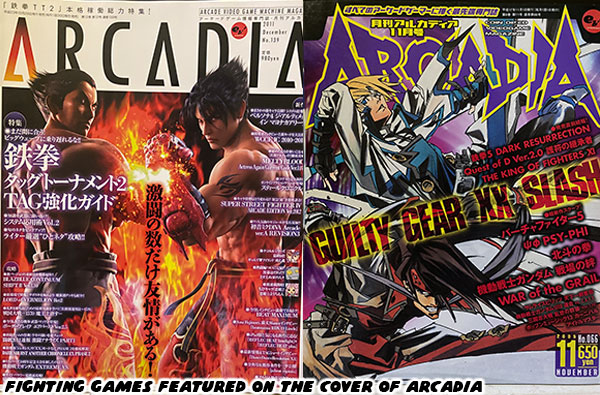
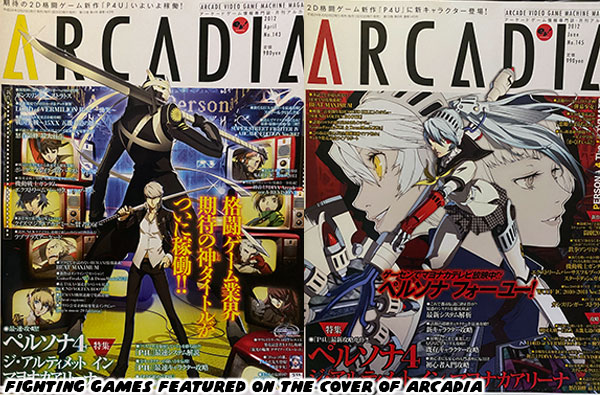
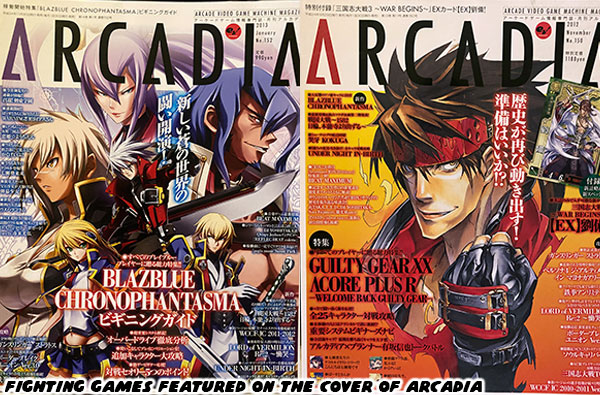
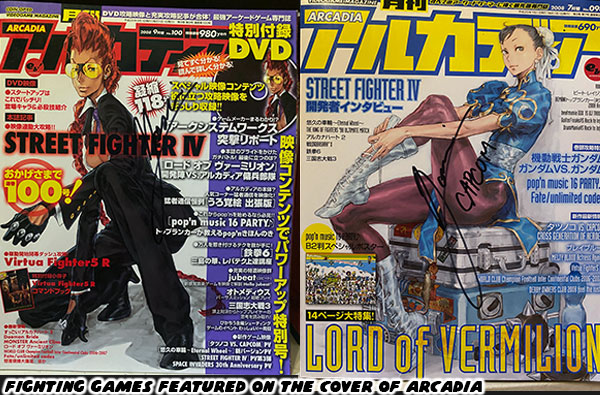
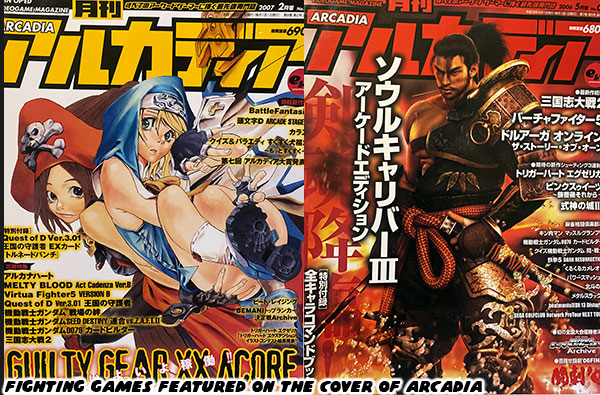
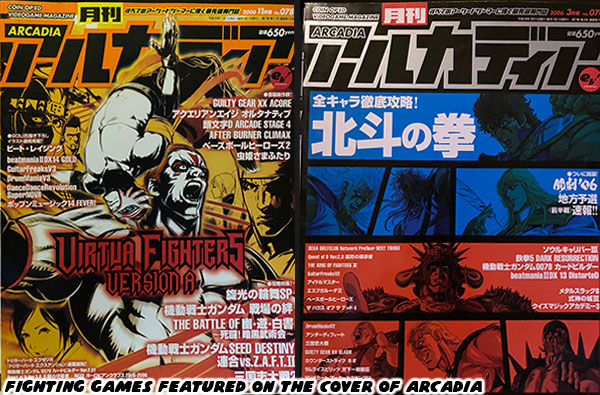
The last great fighting game covers of Arcadia.

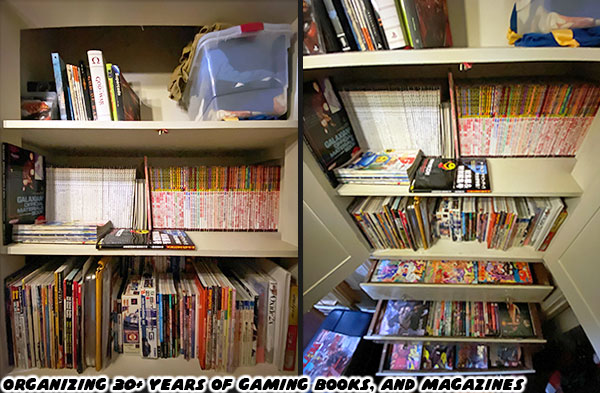
The past few Friday’s I’ve talked a bit about bringing my Arcadia magazine collection out of the garage, and into my home library. In the fall of 2023 I had brought over my Gamest magazines, game books, and mooks (magazine books from Japan), manga, as well as my fighting game manhua, or Chinese comics.

As I continue to sort through the collection I wanted to share a quick glance of some of the covers featuring the stars from the fighting games of the generation.

Did you have a favorite fighting game, arcade game, or console game that came out between 2003, and 2013? I’d like to hear about it in the comments section. As always if you would like to sponsor me please visit my Patreon page and consider donating each month, even as little as $1 would help make better blogs and even podcasts!
follow the Street Writer on Patreon!

Friday, March 8, 2024

Remembering some rare fighting game news in Arcadia

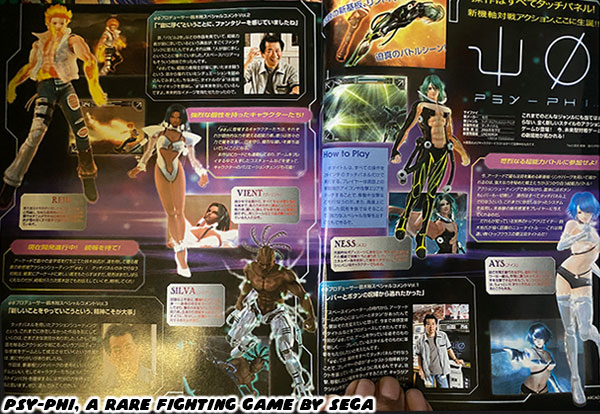
A couple of weeks ago I talked about bringing my Arcadia magazines out of the garage, and into the house. I’ve been flipping through them, and remembered that many of the games featured within never came to the USA. Not only that, but even Japanese audiences didn’t always get a chance to play some of these games, as they were only in location tests, or never saw a wider release. If you follow this blog you’ll remember that I talked about Psy-Phi that last two Fridays. It was a touch screen arcade game made by Sega.

In addition to being a touch screen game, it was also notable because the mechanic was an evolved version of Psychic Force. Psychic Force was a Taito fighter from 1995. Its sequel Psychic Force 2012 came out in 1998, and was published on multiple consoles including the Sega Dreamcast. Those games featured a cast of psychic powered characters that could float, and battled in the sky using their mental powers. I could imagine that arcade visitors didn’t like the touch mechanic, despite the buzz it generated at the AOU trade show. After 2005 nothing came from it.

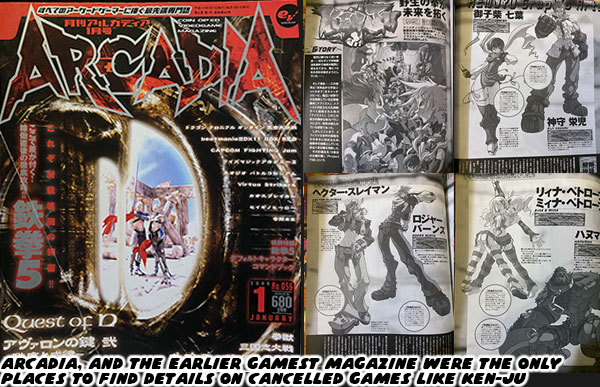
It wasn’t the only rare fighting game immortalized in the pages of Arcadia. There was also Ken-Ju. The 3D fighting game had a lot of unique things going for it, including online matchmaking, and character customization when these things weren’t even available in the biggest titles of the time. I was able to do a deep dive on Ken-Ju on the blog. I was thankful that I held onto these issues, and share them here.

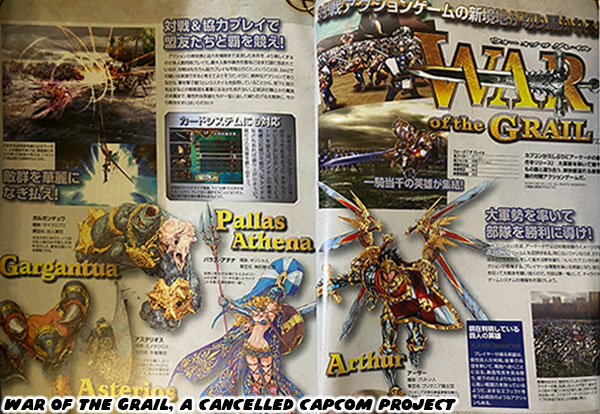
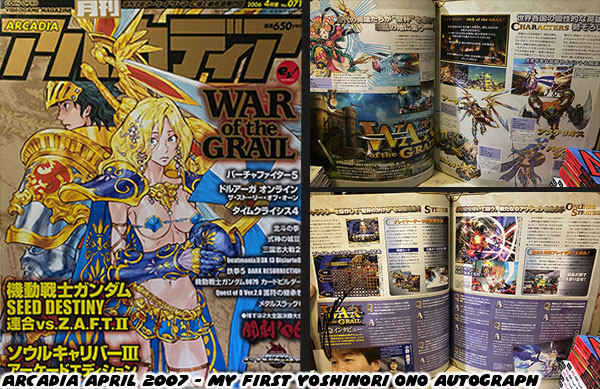
Possibly the most important cancelled fighting game that was covered was War of the Grail. It was a fantasy-strategy-fighting game from Capcom. Kinu Nishimura created some fantastic designs for the game, and it would get a limited location test in a few arcades. Sadly the project was scrapped, and very little on the game was released after this issue came out.

It would be the first game directed by Yoshinori Ono, who had moved up from sound production in the studio. When he was appearing in his first San Diego Comic Con in 2008 I brought my issue with me for him to autograph. He was blown away that there were people in the US had been following his career. It wouldn’t be the only time I surprised him with these rare issues. When he did another signing to celebrate the release of Super Street Fighter IV I brought out two more Arcadia issues to autograph. I remember him asking his translator where I was getting these issues, and telling him that I had a subscription to the magazine.

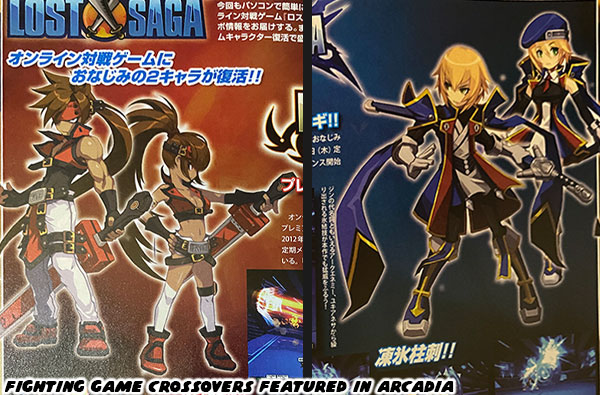
Some of the games featured in Arcadia were unique. Although I was getting the issues mostly for info on fighters, it was nice to see those characters pop up in other games. The Korean title Perfect K.O. for example featured Ken, and Chun-Li from Street Fighter. It was neat seeing how they would fare in 3D combat. It wasn’t the only unique cameo. This was the case for Guilty Gear, when it crossed over with Lost Saga, the free-to-play game developed by I.O. Entertainment in 2009. The game was brawling chaos, like many other games in that vein.

Were there any fighting games you wished you had played, or you wished had been published? I’d like to read about it in the comments section. As always if you would like to sponsor me please visit my Patreon page and consider donating each month, even as little as $1 would help make better blogs and even podcasts!
follow the Street Writer on Patreon!

Thursday, June 30, 2022

Ryu becoming the master in Street Fighter 6, a look at his new path

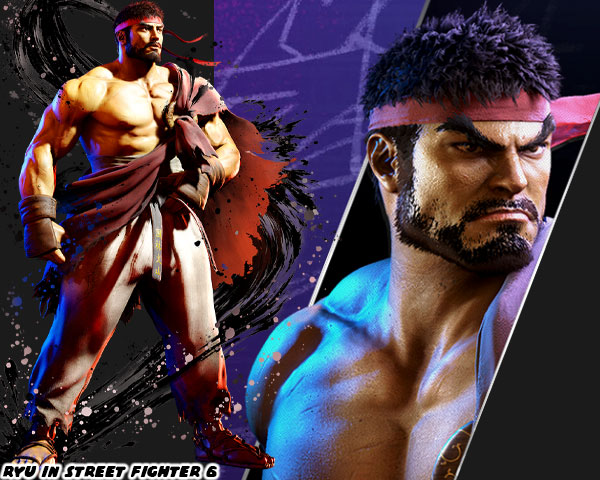
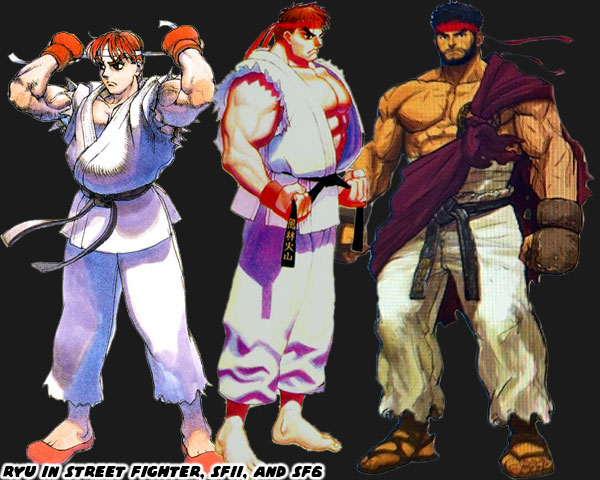
Today we are going to look at the evolution of Ryu in Street Fighter 6. In case you didn’t see him recently, he was presented a little older than any other appearance, plus he had a beard now. The biggest change for the character came with the look of his uniform. For the longest time Ryu wore a traditional, albeit torn, karate gi. Now he was without his top. In SF6 Designer Yusuke Hashimoto now had him wearing a kasaya or Buddhist robe over his shoulder. The design was very interesting. I’m not quite sure it worked in its current form, but let’s take a look at where the tradition came from.
The custom of having marital arts masters wearing classical costumes went back to the birth of the genre. Karate Champ by Data East in 1984 gave us the white, versus red uniform karate guys. A year later Yie Ar Kung Fu by Taito gave audiences multiple opponents, representing different styles. Aside from the way they fought, these characters had costumes that players would have seen in kung-fu cinema. You didn’t have to be an expert on the various styles, and their histories, as long as you had seen at least a few movies. The seeds for Street Fighter were planted then.
The martial arts spread thanks to Buddhist monks. I had documented it previously in the blogs. The monks traveled all throughout Asia, bringing with them the fighting arts. They didn’t learn to fight as a way to seek out opponents, but rather as a way to defend themselves from bandits. The Shaolin developed in China was a form of Buddhism known as Chan, or meditative Buddhism. The school fostered a Northern, and Southern version of their martial arts studies. These various forms would be influential in shaping kung-fu, and karate as well. The interesting thing was while there were many classically styled Chinese fighters throughout game history there were actually few Shaolin characters in the genre. The look was rare, but had been seen in Street Fighter.
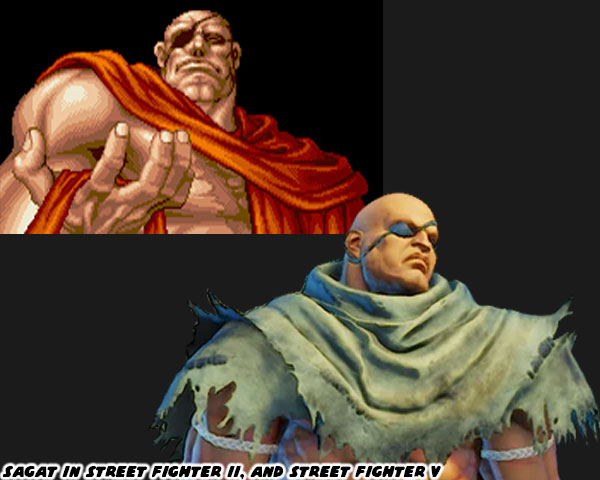
Ryu’s main rival in the original Street Fighter was actually the first in the series to be presented with a kasaya. Sagat was satisfied that he had indeed beaten the best in the world. He had achieved a level of peace with the victory that seemed transformative. He appeared in the ending of Street Fighter II with the robe while meditating on Ryu. That look made sense for Sagat. Years later the alternate costumes of Sagat in Street Fighter IV worked incredibly well. Especially the ones where he wore a tattered wrap. Part of the reason for this was because in pop culture we had seen people from Asia, and South Asia wearing the robes. In my home town of Long Beach we had a large Cambodian, and Vietnamese community, and I had grown up seeing lots of people wearing the robes. Japanese martial artists were rarely, if ever shown in the same way. Instead of the familiar orange robes we would see the elder Japanese master wearing a uniform with one bare arm.
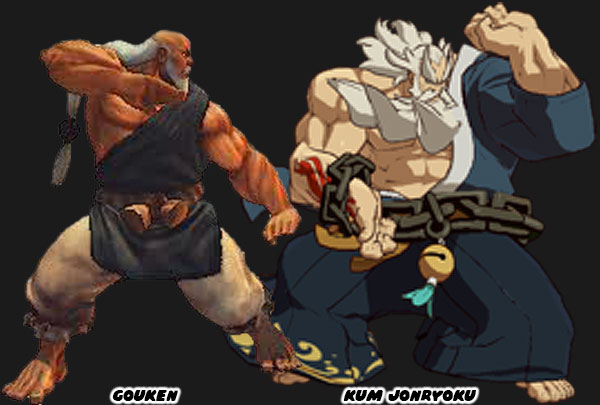
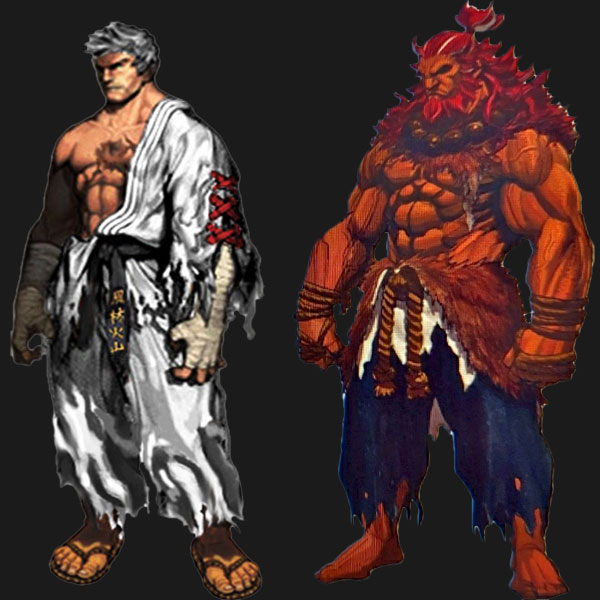
Gouken in the earliest concept art actually wore a gi like Ken, and Ryu. The only difference was that he had a rope belt, instead of a black belt. It was only in later revisions, and his playable debut in Street Fighter IV, when he was given a robe. A similar character appeared in the Guilty Gear series. Kum Jonryoku was a robot made to look like an elder master. He was created, and piloted by Kum Haehyun,a young, and talented scientist. Both fighters represented the peak of the martial arts. They had been studying a specific technique all their lives, if they didn’t invent their own style. These types of people were physically, and mentally stronger than any other person on the planet. Very rarely were they ever seen in mid-life. Gouken was seen in middle-age in Street Fighter manga, and comics books when he took on a young Ken, and Ryu as students. At that time he was not at the peak of his abilities. He was still studying under his master, the elderly Goutetsu. Prior to Ryu’s makeover in Street Fighter 6 there had been at least one young master with a similar look.
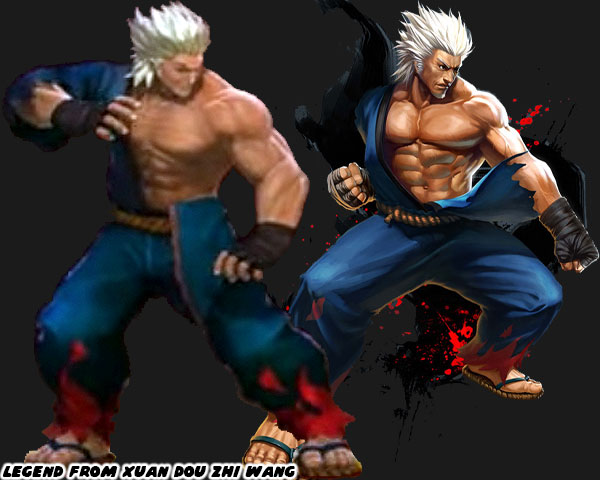
Xuan Dou Zhi Wang aka King of Combat was a Chinese-developed game first published in 2011. It had updates over the following years that patched the control, added levels, and characters. It had characters whose looks, and styles were sampled from various other fighting games. The title already had a Ken / Ryu clone named King. What they lacked was a Gouki / Akuma. That was until they updated the roster, and added a guy called Legend. This person was not much older than King, but more advanced in power, and ability. This person had white hair, no beard, but didn’t look elderly at all. The white hair might have been an aesthetic choice, or to signify that he had some sort of divine revelation. In any case there had been precedent for a young master in fighting games. Not only that, but many artists had been creating their own concept art for Ryu if the series ever did a time jump.
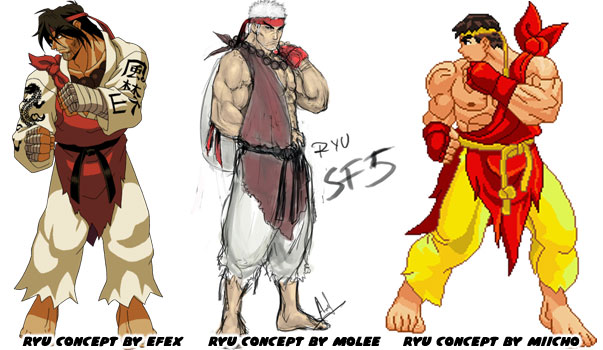
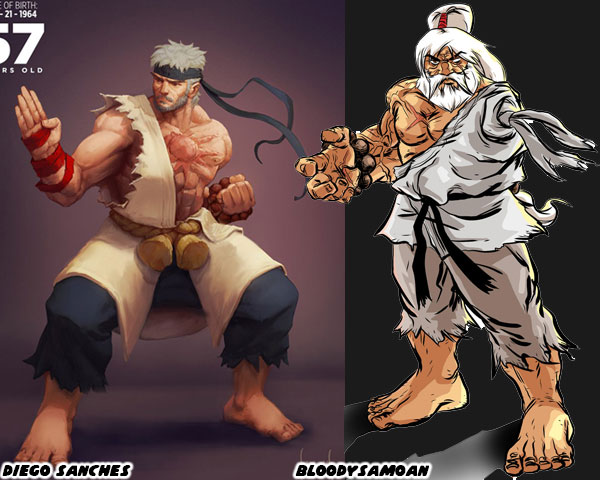
A few designers had a variation of the robe over one shoulder as a nod to Oro becoming his new master. A couple of artists pushed the idea of having the robe be made of Ken’s old gi. This idea had been circulating in the SF community for a long time. One of the older one-armed Ryu illustrations was by the artist BloodySamoan in 2010. In it he also gave Ryu one eye, his red headband now held up a ponytail, and he wore the beads of his master around his wrist. It was a unique take on the fighter for certain. In 2020 the Brazilian illustrator Diego Sanches did a series on older SF characters. He put Ryu in the colors, and costume of Gouken. He also gave him a beard, and gray hair. It also worked well.  
It is highly possible that the creative team working on SF6 was aware of all of the fan art that had come out pre, and post SFIV. They must have been especially aware of the tastes of Western artists as the game had historically sold very will in North, and South America. I’m almost certain that Designer Yusuke Hashimoto, and Director Takayuki Nakayama were aware of these illustrations, and it had a hand in influencing the new look of Ryu. The reason I can say this was because the official concept art for Street Fighter IV, and V coming out of Capcom did not have Ryu wearing a Buddhist robe. Instead they had him with long hair, or with a tattered gi, or in MMA gear. They even had several versions of Evil Ryu, and the stronger Kage variation. But none of Ryu as a Buddhist. Sure it could have been because SF IV, and V were set before he studied under Oro, but even then Oro was added as a DLC character as well.
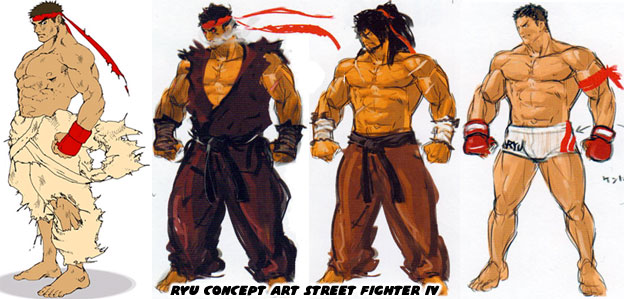
Mr. Nakayama said the new look was to honor his mentor Gouken, but I’m not sold on that idea. From SFII to today it had been established in the game endings that Ryu was not interested in trophies, or accolades. He was the opposite of Ken in this regard. The only thing that pushed Ryu forward was finding the next challenge. To continue developing as fighters both Ken, and Ryu had to prove that their form of Ansatsuken was the best. Why Ryu would suddenly decide to dress up like his mentor didn’t make much sense. He was walking his own path, and not his master’s path. Visually I don’t think the look works. Wearing a brown kasaya across his torso contrasted with the solid white of his original costume. Perhaps if Ryu wore all brown it might work better, but then his colors would be too close to Ken’s.
I’m interested in seeing Ryu continue his path. I want to see what the studio has planned for him. But I’m also interested in seeing a classic uniform DLC because right now I don’t think his new look works. The costume changes for several of the returning characters aren’t as strong as their original look. That’s what I think anyhow. I’m sure Capcom will continue tweaking the look right until the games release date. They did many visual changes to previous games when they were first previewed versus when they were published. Street Fighter 6 should be no different. Maybe Ryu’s outfit would still get updated. I’d like to read your takes in the comments section. Do you like Ryu's updated look? Would you have done anything different? Tell me about it! As always if you would like to sponsor me please visit my Patreon page and consider donating each month, even as little as $1 would help make better blogs and even podcasts!
follow the Street Writer on Patreon!

Monday, May 15, 2017

The aesthetic versus graphics debate, part 3...

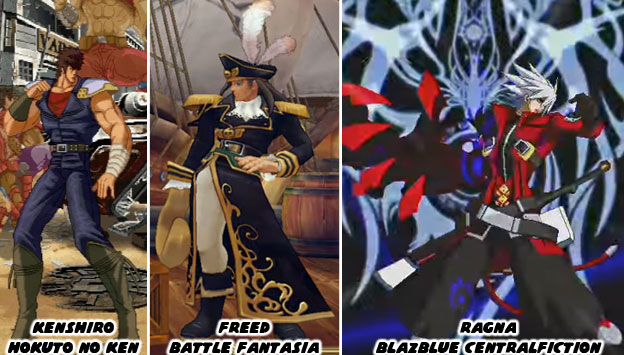
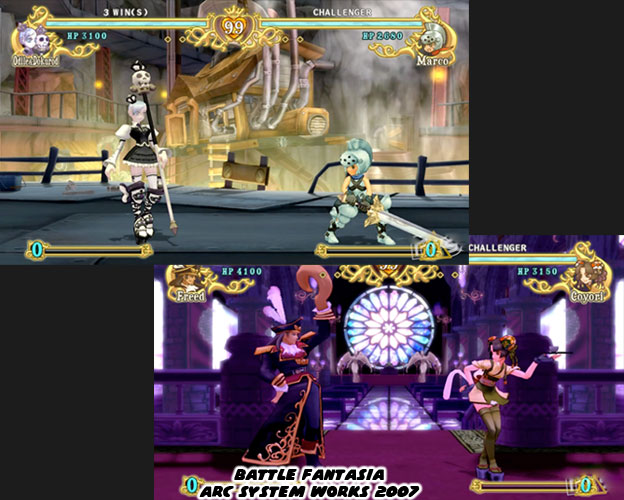
When it came to creating innovative fighting games with a strong aesthetic style you didn’t have to look any further than Arc System Works. Known best for creating Guilty Gear in 1998, the studio had released some very innovative titles over the past three decades. Some of the games were licensed and some were original titles. Each one had its own unique visual style. I had mentioned one of their gems previously, Battle Fantasia, a sleeper from 2007. Some of their other unique releases were Hokuto No Ken (Fist of the North Star) in 2005 and BlazBlue Centralfiction in 2015. Hokuto No Ken recreated the style of the classic 1980’s animé. The manga was drawn by Tetsuo Hara but the anime series was directed by Toyoo Ashida. Mr. Ashida was a character designer and animator that had started working in the ‘60s. By the time he worked on Hokuto No Ken he had studied under multiple different artists. It was this experience that allowed him to capture the essence of the violent comics while retaining the designs that Mr. Hara was known for. The team at Arc System Works did their homework and were able to capture the Hara and Ashida influences in the game.


Battle Fantasia had a much softer feel to it. It was designed to look like a storybook painting come to life. The director Emiko Iwasaki was one of the lead artists on Guilty Gear. When she helmed her own title she wanted to present a visual language that was different than what fighting game fans were used to. She succeeded and showed that 3D games could retain a strong 2D aesthetic. Not only that but female directors were just as innovative as their male peers. The BlazBlue series was a sort of complimentary game to the Guilty Gear franchise. The co-directors Toshimichi Mori and Yūki Katō wanted to create a world that was heavily influenced by bright, colorful anime shows and lay into it heavy doses of the supernatural. Guilty Gear was rooted more in animé-meets-heavy metal. Perhaps it was their work on the Persona 4 fighting game that sparked the interest in humans and demons? 

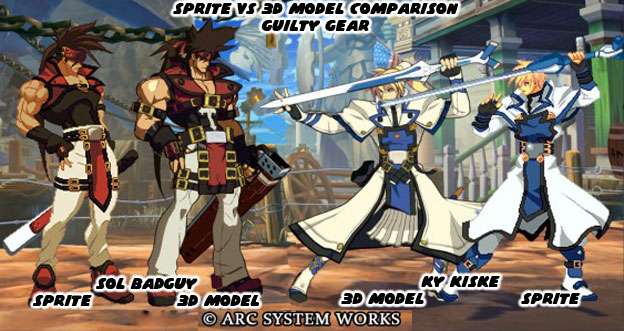
When Arc System Works (ASW) was founded in 1988 they developed their games and adaptations using the same technology and the same techniques as their peers. As the industry changed they also evolved. In the late ‘90s they saw that fighting games were starting to become stagnant. Sprites were being reused in games by Capcom and SNK. This made a lot of the sequels to the Street Fighter Zero, King of Fighters and Vampire games look redundant. They decided to create a whole new game but using high resolution sprites. This way they could create characters with a lot of style and fidelity. It would be as if an animé show had come to life as a fighting game. Guilty Gear was a treat to the eyes. Players hadn’t seen that level of style in a fighting game in a long while. Arc System Works did not stop there. As 3D technology became more powerful, and started appearing in home consoles, the studio knew that they would have to leave sprites behind as well. They didn’t give up on sprites right away but slowly weaned themselves off. Every game, fighter or not, that they developed gave them more experience in 3D. It forced the studio to see how the change in graphics formats would affect their fighting library. Battle Fantasia and Hokuto No Ken were proving grounds. They were showing that they could use 3D graphics to reproduce 2D aesthetics. Their biggest advancement happened when they created an entirely new engine for Guilty Gear Xrd - SIGN (2014) and REVELATOR (2015).


Many games prior to the Xrd title had used a technique called cel-shading to make their graphics appear more hand-drawn. What cel-shading did was filter the colors and shadows into a bold contrast and create an outline on the figures. It was a way to visually flatten out 3D objects and preserve a strong 2D aesthetic. One of the earliest games to popularize the format was the Jet Set Radio series by Sega. What ASW did was study what worked and what didn’t over the past decade and to reconstruct the graphical approach. They weren’t stingy with their findings either but freely gave a presentation at the Game Developer's Conference on the Guilty Gear Xrd graphics format. The studio demonstrated how they bridged the 2D/3D divide and shared those with the industry. They hoped to inspire other developers to create graphics that stood out. The company knew that no matter how well sprites looked in HD, the budgets for most companies would no longer allow them to develop hand-drawn graphics. These companies would have to find ways of preserving the hand-drawn style without betraying the visual style that audiences were used to. This also applied to the way the game moved and played. Everything from frame-skipping to hit box data would now be written using new software.

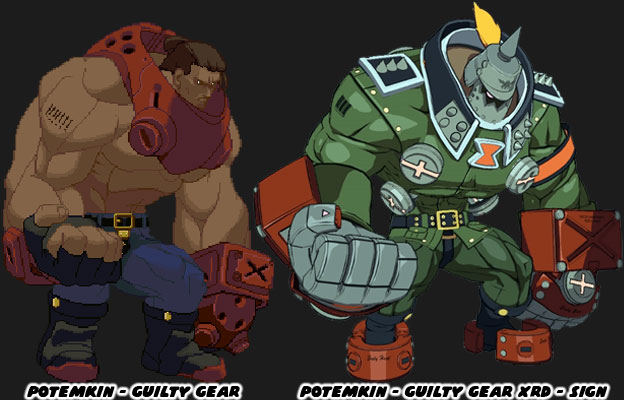
 The studio showed off examples of how character designs evolved for the new technology. Some of the changes were subtle, the length of a coat, the shape of a hairline, other things were more profound, like the redesign of the massive Potemkin. In every example the game managed to retain its unique aesthetic. They could stay on budget, develop innovative titles and appease their fans. The challenge was laid out to other studios. They could keep doing what they were doing. Using the Unreal Engine 3 or 4 their games could all look the same. Or, they could approach graphics from a different angle and give audiences a new experience. It took some effort and fine-tuning in order to achieve the desired results but ASW was not hiding anything from the industry. They learned from their mistakes and wanted to show other companies what they did. The question was whether or not Namco, Microsoft, Capcom, SNK or the other publishers would take these lessons to heart.


Some people might not think there was much of a difference between graphical styles. After all, as long as a fighting game has good balance, control and animation then what do the graphics matter? Well the graphics matter because the industry thinks that the graphics matter. It is often the first thing that audiences and reviewers talk about. It is the thing that draws our eyes to the screen. It is what makes a game visualy appealing. Yet as we know is what they mean to say is that they are attracted to the the aesthetics of the game. The style is more important than the technical numbers powering the graphics engine. The best example of how much of a difference it is to have a 3D game with similar aesthetics could be seen in Guilty Gear Xrd and its contemporaries. Take a close look at the character Kum Haehyun. She was a master of the martial arts and knew how to harness the power of chi / ki. She could use her powers to heal or strengthen not only herself but other people. She could have been introduced into the lineup with an arsenal of moves that fit within the series. In the game she actually pilots a robot body that looks like an elder fighting master called Kum Jonryoku.


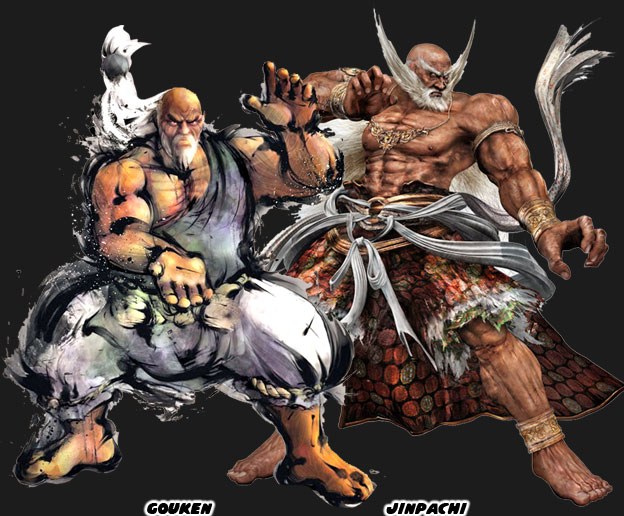
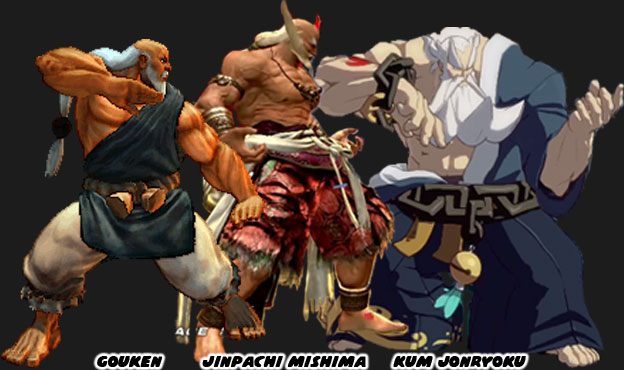
Arc Systems Work introduced Jonryoku as a jab at the recent trend of putting overly-muscular, aged, masters in their games. Specifically the robot was a parody of Gouken, the master of Ken and Ryu, from Street Fighter IV, and Jinpachi Mishima, the father of Heihachi Mishima from Tekken 5. In each of those games a character had literally returned from the dead even stronger and more massive than they ever were in life. They were presented among the biggest and strongest characters in their respective series. They made audiences wonder how people so big and powerful could have ever been killed in the first place. They also made people wonder why it was that they were big and strong while the other elderly martial arts masters looked old and feeble. Jonryoku was the culmination of both Gouken and Jinpachi’s school of design. He sported a long white beard, and ponytail. He had enormous chains instead of a belt and fought against weapons with his bare hands. He was both absurd and awe-inspiring as the previous characters were. The funny thing however that underneath the facade was a girl doing all the actual fighting.


When you looked at the characters side-by-side there wasn’t much of a difference between Gouken and Jinpachi. But when you compared them to Jonryoku the choice of aesthetics was striking. All three games used 3D graphics. All three games kept the majority of the game play on a 2D plane. But only one game managed to recreate the exact aesthetic that the lead designer and director wanted. In a sea of similar-looking fighting games why blend in when you could stand out? These were the things that the best studios did to set themselves apart in the’90s. It was something that the industry forgot how to do following the success of Street Fighter IV. Hopefully other studios would rediscover the importance of aesthetics and try harder in the next round of fighting games. At least I hope that they do. What about you, what were some of your favorite fighting games and why? I’d like to hear about it in the comments section. As always if you enjoyed this blog and would like to sponsor me please visit my Patreon page and consider donating each month, even as little as $1 would help make better blogs and even podcasts!

 follow the Street Writer on Patreon!

Monday, May 1, 2017

Battle Fantasia, the great fantasy fighting games, final part...

The final game in our series of fantasy fighters debuted a decade ago. Battle Fantasia was created by Arc System Works. The studio had been in business since 1988. In the early days they were contract developers for Taito, Sega, Atari, Namco and Capcom. They learned a tremendous amount from the industry by working on many major console adaptations. They had experience in racing games, brawlers, platformers and sports titles. When it came time to create their own games they were always very imaginative. Their biggest hits came from the fighting game arena. It stood to reason to, their very first project was a Sega Master System adaptation of Double Dragon in 1988. Being one of the first studios to see the popularity of brawlers first hand certainly stuck with the company. Battle Fantasia was a tribute to everything they had learned over the generations. Many gamers unfortunately slept on the title when it debuted in 2007. Looking back at it we can’t help but appreciate how innovative it was.


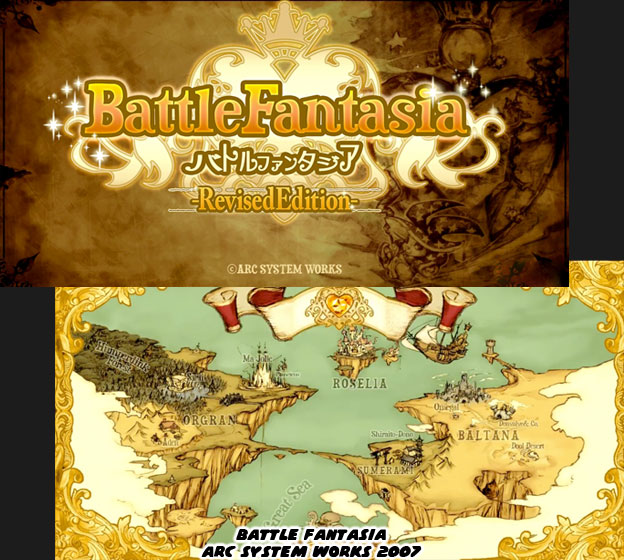
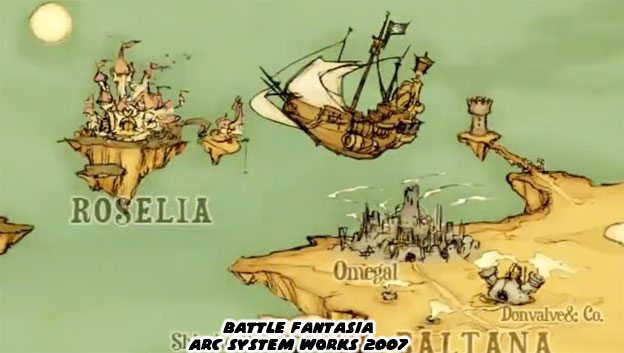
Battle Fantasia had all of the important elements that I had brought up over the course of the series. It was a Japanese take on a traditional western fantasy story. The setting, character classes, and mix of magic and medieval weaponry was something that most audiences would have expected. What no one could expect was how the Japanese were going to reinterpret the western tropes. As with other titles featured on the blog this game took us to a whole new world. This world had an origin, it had alliances, entire kingdoms, remote villages and uncharted territories. We were given a glimpse of the world in the loading screen. Each of the main characters came from a unique place on the map.


The game was meant to evoke images of classic fairy tales, as if you were looking at animated pages in a book. The soft colors, subdued lighting and animation style were very inviting, they were very family friendly. Arc System Works (ASW) tried very hard to make sure that each and every fighting game they created had its own unique style. When they worked on an IP owned by a different company they made sure that it was in the exact style of that publisher. For example the fighting game Persona 4 Arena maintained the look that Atlus director Katsura Hashino and designers Atsushi Watanabe and Azusa Kido had worked to create. When ASW developed Sengouku Basara X for Capcom they made sure that it carried the over-the-top sword-fighting mechanics that Koei had used in the original 3D brawler but with a new “Capcom-style” 2D aesthetic. When ASW developed Dragon Ball Z: Supersonic Warriors for the Game Boy Advance they maintained the look of the classic Akira Toriyama show and the familiar Super Nintendo adaptations. In many ways ASW was like a chameleon, able to adapt to the work of another studio without anyone noticing. However when they created their own IP things really stood out.


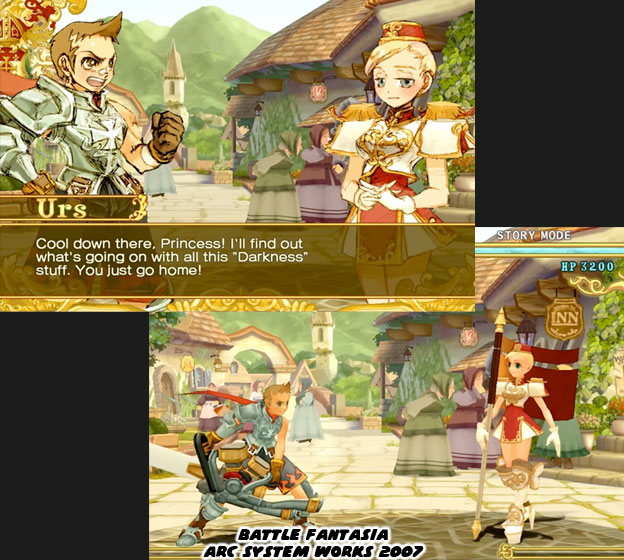
No other fighting game before or since looked like Battle Fantasia. The world created by ASW was perfect to get lost in. The characters were the types of heroes and villains we’d like to see return again and again. It was easy to fall in love with the game because of how unique this fantasy world was. It could never be mistaken for poaching the ideas of Games Workshop or any other western studio. I mean who else could have thought up of a knight carrying around a two-cylinder gas powered light saber? The title was directed by Emiko Iwasaki. She was one of the main artists behind Guilty Gear. If you know your fighting game history then you remember that in 1998 Guilty Gear was a breath of fresh air for the genre. It was completely unlike anything that SNK or Capcom had released, yet at the same time it honored their contributions to the format. Guilty Gear had the bold designs and weapons-based combat from SNK with the fluid animation and exaggerated proportions of a Capcom title. Guilty Gear and it’s spiritual successor BlazBlue were deeply rooted in an anime style but Battle Fantasia really stood apart for its storybook appearance.


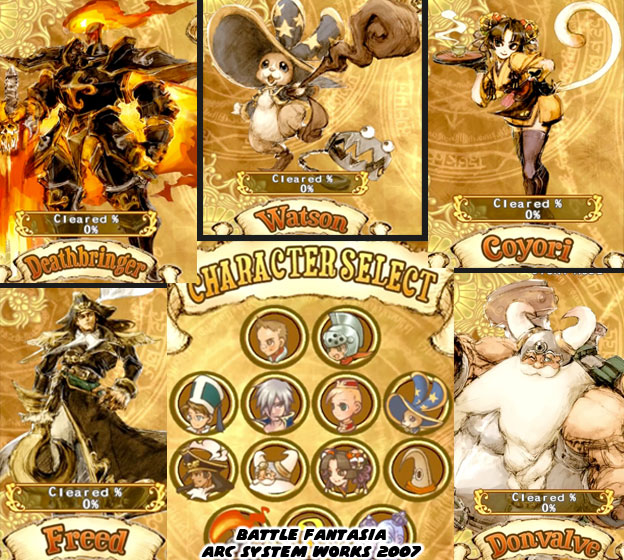
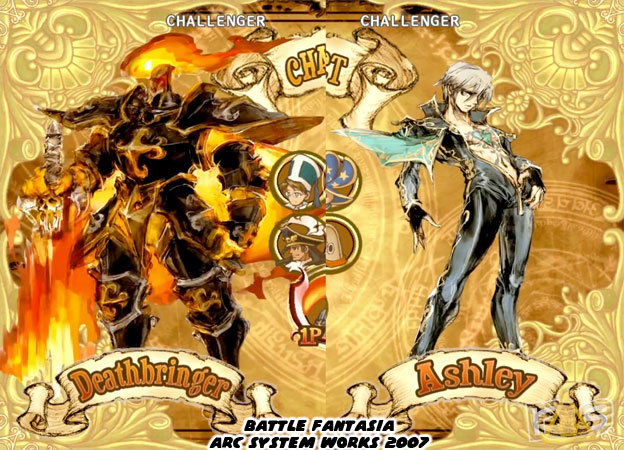
To be fair, the designs in Battle Fantasia did have a hint of the rockstar vibe that Guilty Gear was built on. Some of the men looked like feathery-haired models rather than the swollen barbarians you might expect from a western-produced RPG. Yet at the same time there were fear inducing monsters, covered in black armor occupying the same world. There were variations of the traditional classes of heroes and villains, knights, princesses, etc. Then there were maids, pirates, gunslingers and magical rabbits as well. Battle Fantasia covered a number of different classes and influences with a fresh perspective. The painted portraits on the character select screen captured the spirit that Emiko was going for.


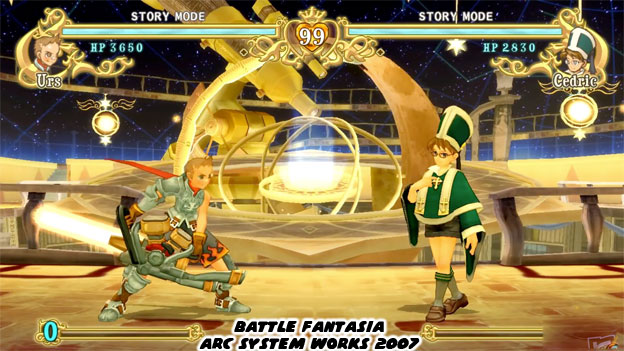
Battle Fantasia had multiple game modes as audiences had come to expect from a fighter. The story mode brought audiences in and allowed them to explore the different relationships in the game. It also allowed them to sink their teeth into a game that had more personality than most other titles. This game like several other ASW titles had a certain level of humor written into it. Characters could be sly or cheeky, their moves meant to reinforce their personality. Their in-game and cut scene animations showed a wide range of expressions. The young knight Urs carried a light sword that was equal parts magic and motor. He was brave but he could be a little bit clueless at times. Princess Olivia had a heart of gold but her daintiness did not stop her from being an exceptional fighter. Marco Van de Land, the younger brother of Urs, was among the smaller characters in the game yet deftly wielded a sword twice his size. There weren't many fighting games that I would ever call whimsical, Battle Fantasia was one of them.


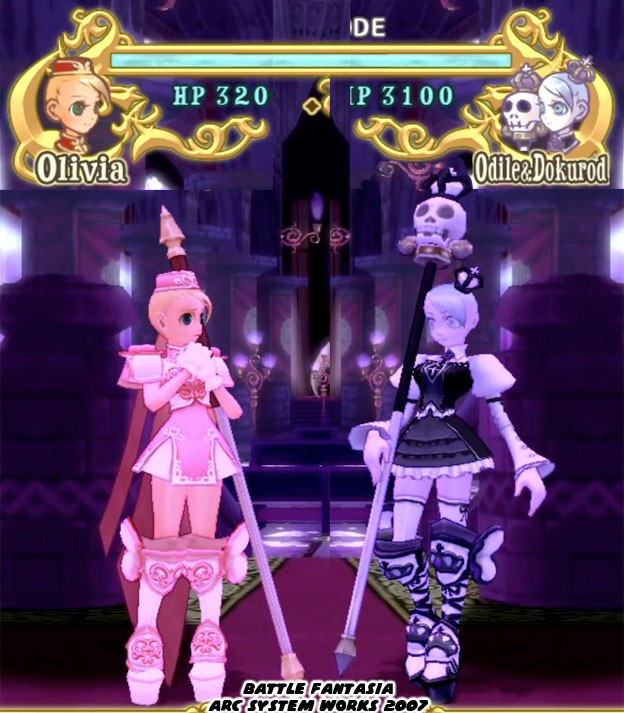
Arc System Works had been in the industry for a long while they knew the subtleties that every great fighting game needed. For example, every great fighting game had a cast of complimentary character designs. That is to say that there was a lot of symmetry when the studio was building a cast. The main characters often had a rival, sometimes a friendly rival like Ken and Ryu in Street Fighter. Sometimes they were bitter enemies, like Sub-Zero and Scorpion in Mortal Kombat. These rivals often had some sort of visual design that was a balance to the main character. Not every major studio knew about this idea or used the concept. Some studios eventually discovered the value of having new characters balance out the established fighters. They would add these characters in a sequel. Such was the case of Iori Yagami introduced as an evil rival for Kyo Kusanagi in the King of Fighters series. For Battle Fantasia it was the delicate Olivia getting balanced out with the chaotic Odile and her animated skeleton staff Dokurod. Olivia's design was rooted in "lolita" fashion rather than the traditional princess gowns in western games. Lolita clothing consisted of ruffled dresses, ornate petticoats and bright stockings worn by trendy Japanese girls. This fashion made its way overseas as did many things that young Japanese trendsetters did. Odile by comparison was clothed in "gothic lolita" fashion, substituting black and white for pastels and looking more grim in appearance.


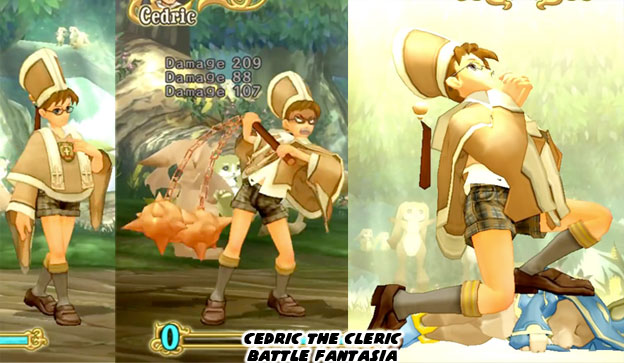
Arc System Works also knew enough about role playing game (RPG) tropes to include them in the game too. This game displayed hit points during attacks as they would have during a turn-based RPG. Each physical and magical attack did x-amount of damage. Characters that used healing spells would even recover x-amount of health. Most studios would simply whittle away at the opponents health or reward players points for long combo strings. The character classes that ASW introduced also revolved around the classic RPG tropes. Cedric for example was a cleric. He appeared bookish, sincere and very devout in his faith. He came across as a little bit snobbish and this rubbed Urs the wrong way. Yet beneath the charm of schoolboy-meets-healer was a vicious persona. When his faith was put to the test he fought with a spiked ball and chain and all manner of brutal techniques. His face twisted into an evil grimace as he flogged his opponents. Then to add insult to injury after each round he would kneel on top of his defeated opponent to offer a prayer. ASW was great at storytelling in every detail they added.


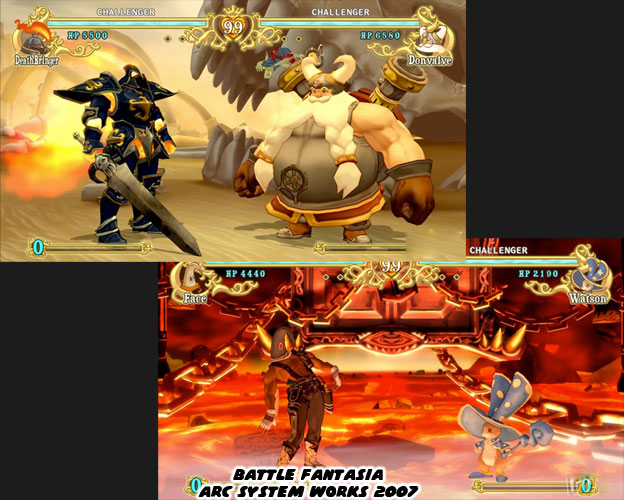
There were so many wonderful characters that I hadn't even mentioned. The cartoonish gun-toting outlaw Face, the massive inventor Donvalve, the magical rabbit Watson. These were the creative types of figures that first caught my eye. Sadly the game did not generate a lot of buzz. A reason for that had a lot to do with the decline of the arcade. There were few places to see, let alone play the game outside of Japan. Even then there were not a lot of new fighting games that would have brought in new crowd to try this out. Thankfully a year after it came out it was brought over to the Playstation 3 and Xbox 360. In 2009 it found its way onto PSN and in 2015 it was brought to Windows PCs with some additional balance. Each iteration helped shed more light onto this gem. While it did not achieve enough success to warrant a sequel it did have an impact on the development of future fighting games.


Arc System Works has always believed in the fighting game market. When many other publishers abandoned the genre they stayed with it. Through the years they demonstrated that a well designed fighting game could always generate a following. They did not always rely on licenses and established IP. They took chances and created new experiences along the way. Guilty Gear was an attempt at a new type of fighter. It was not set in any known time or place, but influenced by equal amounts hard rock and anime. Fans took notice of this game right away. Battle Fantasia was another grand experiment. Instead of using sprites, as they did with the original Guilty Gear, ASW was trying out 3D models on traditional 2D play mechanics. It was not the first but possibly most influential 2.5D fighter. They used textures, modeling and lighting effects to make the graphics appear like the concept paintings. They were able to have a game that played like a classic fighting game but with all new technology. This inspired Yoshinori Ono at Capcom to pursue development on Street Fighter IV. He revealed in a 2009 Gamasutra article that Battle Fantasia demonstrated that the formerly 2D character models wouldn't necessarily look weird in 3D. Battle Fantasia also served as a sort of introductory fighting game. It was not as difficult as some of the biggest titles had become. It was easy to pick up with no previous fighting game experience, yet with enough content to make it rewarding for veteran players.


I think that Battle Fantasia was just the start of something even greater. Arc System Works had big plans for this game just like the other fantasy fighting games I had talked about. Every studio I had mentioned was trying to build a franchise title. Those plans gave way to reality. The market was not ready, or not interested in what they were developing. This did not mean that the games were necessarily bad. Every studio big and small took a chance on a new type of fighter. They transported audiences to a new world. One which was far more interesting than the typical fighter. These worlds had histories, mythologies and heroes. These games put down a template that could be copied even today. The industry learned how magic, armor and leveling could work in a fighter. They saw how different technology would affect their graphics engines. They discovered that great storytelling could be applied even in the most action-oriented of genres. Battle Fantasia, like the games previously mentioned, deserved a second chance. I don't think of it as last great fantasy fighter, just the last one for a while. You never know where the next great fantasy fighter will come from. Soon enough a studio will decide that they are ready to tell a new story, to take another chance. Maybe it will be a free-to-play web game. Maybe it will be for a mobile device. In which ever shape or form it takes I will be eager to explore this new world. I hope that you will be willing to come along for the ride. Thank you for staying with me. Please leave a question or comment if you have enjoyed any entry in this series. As always if you enjoyed this blog and would like to sponsor me please visit my Patreon page and consider donating each month, even as little as $1 would help make better blogs and even podcasts!
 follow the Street Writer on Patreon!