Showing posts with label gouken. Show all posts

Thursday, June 30, 2022

Ryu becoming the master in Street Fighter 6, a look at his new path

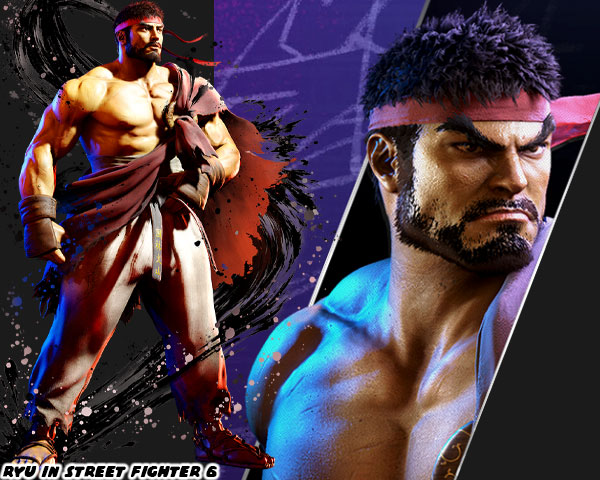
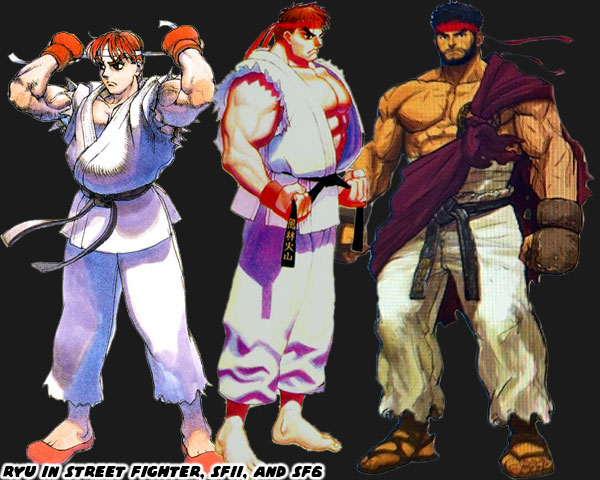
Today we are going to look at the evolution of Ryu in Street Fighter 6. In case you didn’t see him recently, he was presented a little older than any other appearance, plus he had a beard now. The biggest change for the character came with the look of his uniform. For the longest time Ryu wore a traditional, albeit torn, karate gi. Now he was without his top. In SF6 Designer Yusuke Hashimoto now had him wearing a kasaya or Buddhist robe over his shoulder. The design was very interesting. I’m not quite sure it worked in its current form, but let’s take a look at where the tradition came from.
The custom of having marital arts masters wearing classical costumes went back to the birth of the genre. Karate Champ by Data East in 1984 gave us the white, versus red uniform karate guys. A year later Yie Ar Kung Fu by Taito gave audiences multiple opponents, representing different styles. Aside from the way they fought, these characters had costumes that players would have seen in kung-fu cinema. You didn’t have to be an expert on the various styles, and their histories, as long as you had seen at least a few movies. The seeds for Street Fighter were planted then.
The martial arts spread thanks to Buddhist monks. I had documented it previously in the blogs. The monks traveled all throughout Asia, bringing with them the fighting arts. They didn’t learn to fight as a way to seek out opponents, but rather as a way to defend themselves from bandits. The Shaolin developed in China was a form of Buddhism known as Chan, or meditative Buddhism. The school fostered a Northern, and Southern version of their martial arts studies. These various forms would be influential in shaping kung-fu, and karate as well. The interesting thing was while there were many classically styled Chinese fighters throughout game history there were actually few Shaolin characters in the genre. The look was rare, but had been seen in Street Fighter.
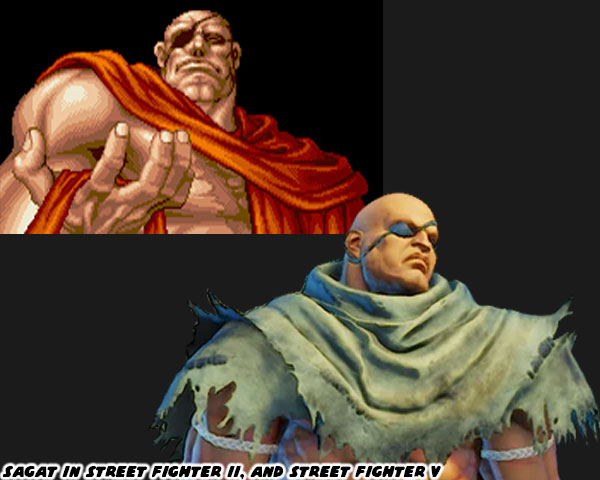
Ryu’s main rival in the original Street Fighter was actually the first in the series to be presented with a kasaya. Sagat was satisfied that he had indeed beaten the best in the world. He had achieved a level of peace with the victory that seemed transformative. He appeared in the ending of Street Fighter II with the robe while meditating on Ryu. That look made sense for Sagat. Years later the alternate costumes of Sagat in Street Fighter IV worked incredibly well. Especially the ones where he wore a tattered wrap. Part of the reason for this was because in pop culture we had seen people from Asia, and South Asia wearing the robes. In my home town of Long Beach we had a large Cambodian, and Vietnamese community, and I had grown up seeing lots of people wearing the robes. Japanese martial artists were rarely, if ever shown in the same way. Instead of the familiar orange robes we would see the elder Japanese master wearing a uniform with one bare arm.
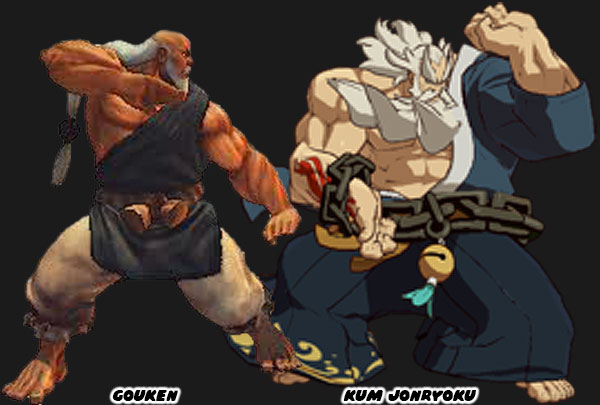
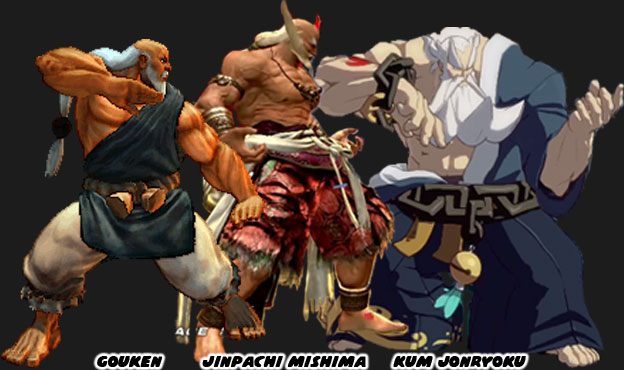
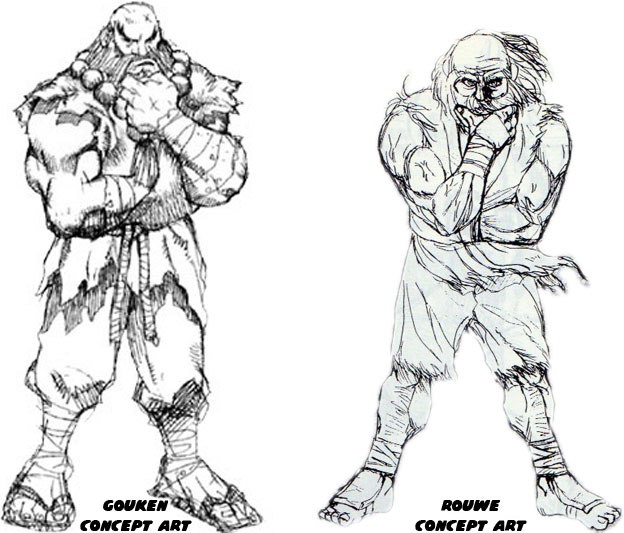
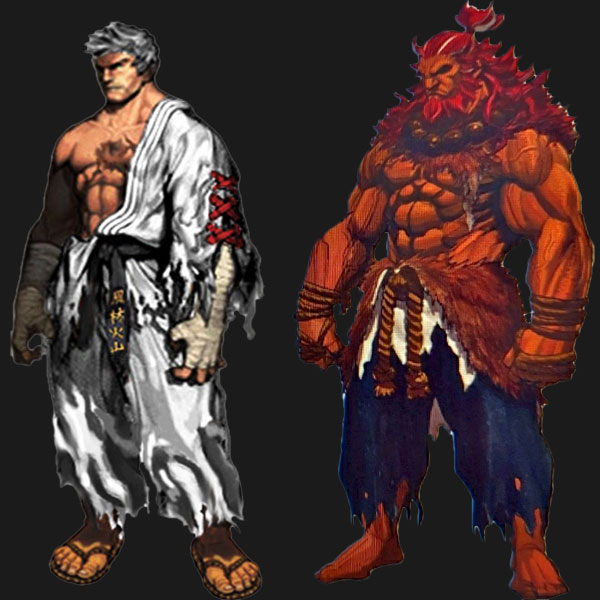
Gouken in the earliest concept art actually wore a gi like Ken, and Ryu. The only difference was that he had a rope belt, instead of a black belt. It was only in later revisions, and his playable debut in Street Fighter IV, when he was given a robe. A similar character appeared in the Guilty Gear series. Kum Jonryoku was a robot made to look like an elder master. He was created, and piloted by Kum Haehyun,a young, and talented scientist. Both fighters represented the peak of the martial arts. They had been studying a specific technique all their lives, if they didn’t invent their own style. These types of people were physically, and mentally stronger than any other person on the planet. Very rarely were they ever seen in mid-life. Gouken was seen in middle-age in Street Fighter manga, and comics books when he took on a young Ken, and Ryu as students. At that time he was not at the peak of his abilities. He was still studying under his master, the elderly Goutetsu. Prior to Ryu’s makeover in Street Fighter 6 there had been at least one young master with a similar look.
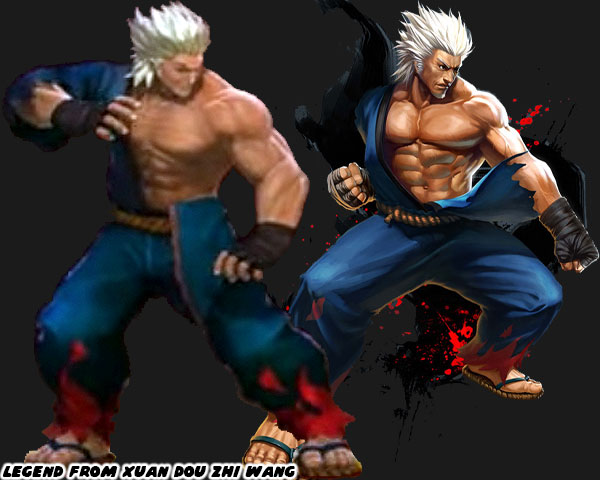
Xuan Dou Zhi Wang aka King of Combat was a Chinese-developed game first published in 2011. It had updates over the following years that patched the control, added levels, and characters. It had characters whose looks, and styles were sampled from various other fighting games. The title already had a Ken / Ryu clone named King. What they lacked was a Gouki / Akuma. That was until they updated the roster, and added a guy called Legend. This person was not much older than King, but more advanced in power, and ability. This person had white hair, no beard, but didn’t look elderly at all. The white hair might have been an aesthetic choice, or to signify that he had some sort of divine revelation. In any case there had been precedent for a young master in fighting games. Not only that, but many artists had been creating their own concept art for Ryu if the series ever did a time jump.
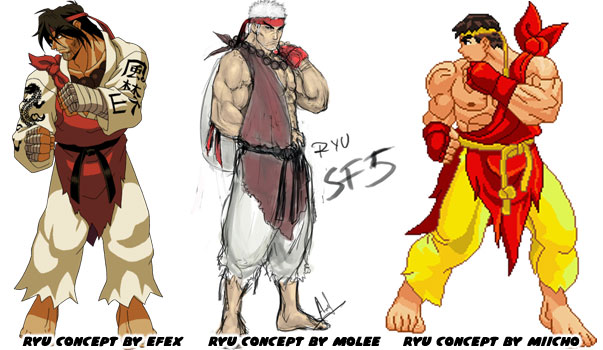
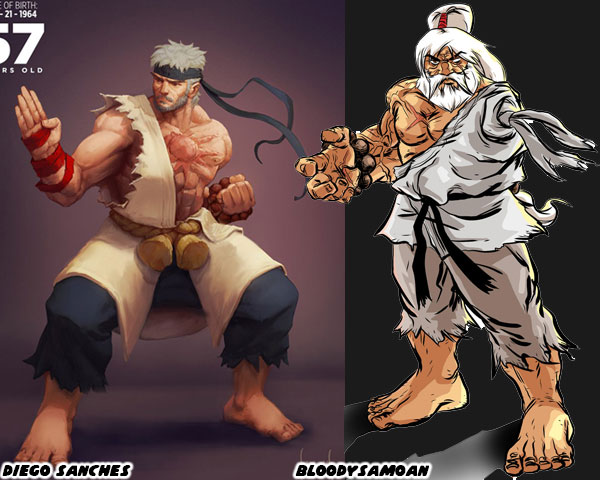
A few designers had a variation of the robe over one shoulder as a nod to Oro becoming his new master. A couple of artists pushed the idea of having the robe be made of Ken’s old gi. This idea had been circulating in the SF community for a long time. One of the older one-armed Ryu illustrations was by the artist BloodySamoan in 2010. In it he also gave Ryu one eye, his red headband now held up a ponytail, and he wore the beads of his master around his wrist. It was a unique take on the fighter for certain. In 2020 the Brazilian illustrator Diego Sanches did a series on older SF characters. He put Ryu in the colors, and costume of Gouken. He also gave him a beard, and gray hair. It also worked well.  
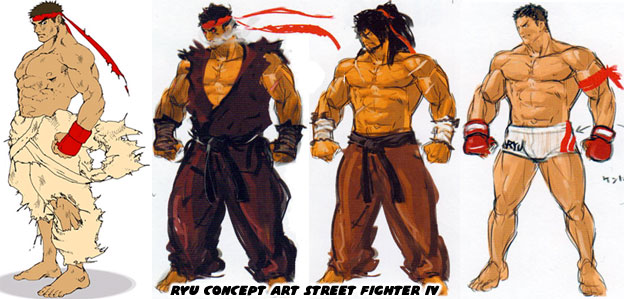
It is highly possible that the creative team working on SF6 was aware of all of the fan art that had come out pre, and post SFIV. They must have been especially aware of the tastes of Western artists as the game had historically sold very will in North, and South America. I’m almost certain that Designer Yusuke Hashimoto, and Director Takayuki Nakayama were aware of these illustrations, and it had a hand in influencing the new look of Ryu. The reason I can say this was because the official concept art for Street Fighter IV, and V coming out of Capcom did not have Ryu wearing a Buddhist robe. Instead they had him with long hair, or with a tattered gi, or in MMA gear. They even had several versions of Evil Ryu, and the stronger Kage variation. But none of Ryu as a Buddhist. Sure it could have been because SF IV, and V were set before he studied under Oro, but even then Oro was added as a DLC character as well.
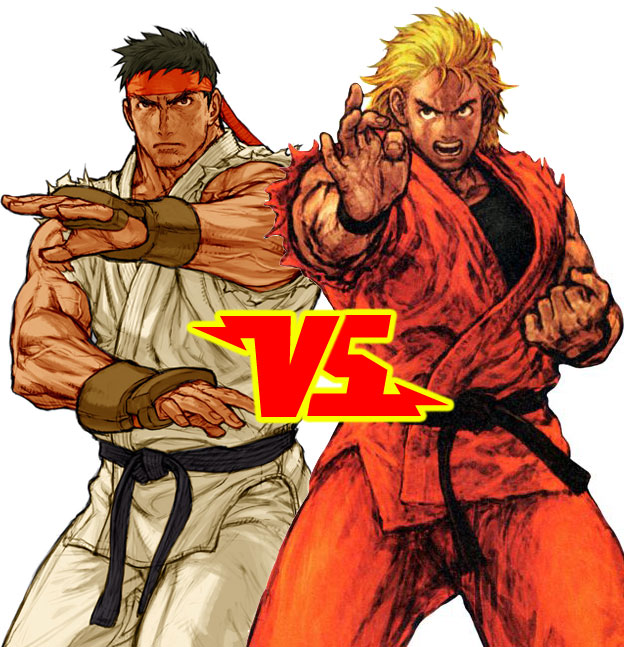
Mr. Nakayama said the new look was to honor his mentor Gouken, but I’m not sold on that idea. From SFII to today it had been established in the game endings that Ryu was not interested in trophies, or accolades. He was the opposite of Ken in this regard. The only thing that pushed Ryu forward was finding the next challenge. To continue developing as fighters both Ken, and Ryu had to prove that their form of Ansatsuken was the best. Why Ryu would suddenly decide to dress up like his mentor didn’t make much sense. He was walking his own path, and not his master’s path. Visually I don’t think the look works. Wearing a brown kasaya across his torso contrasted with the solid white of his original costume. Perhaps if Ryu wore all brown it might work better, but then his colors would be too close to Ken’s.
I’m interested in seeing Ryu continue his path. I want to see what the studio has planned for him. But I’m also interested in seeing a classic uniform DLC because right now I don’t think his new look works. The costume changes for several of the returning characters aren’t as strong as their original look. That’s what I think anyhow. I’m sure Capcom will continue tweaking the look right until the games release date. They did many visual changes to previous games when they were first previewed versus when they were published. Street Fighter 6 should be no different. Maybe Ryu’s outfit would still get updated. I’d like to read your takes in the comments section. Do you like Ryu's updated look? Would you have done anything different? Tell me about it! As always if you would like to sponsor me please visit my Patreon page and consider donating each month, even as little as $1 would help make better blogs and even podcasts!

follow the Street Writer on Patreon!

Thursday, June 28, 2018

30 years of Street Fighter: 30 years of Characters #3

For the 30th Anniversary of Street Fighter we've talked about Ryu, the hero of the series. We've  talked about Sagat, his great rival and the template for a memorable martial arts boss. We've even talked about Vega / The Dictator as a way of redefining what a final boss villain could be. With every fighting game that's ever been and that will ever be, there is one boss that is considered the gold standard. His name is Gouki. You might know him as Akuma. He represents the peak of the mountain, the ultimate fighter if ever one existed. Designed with a frightening appearance he has elements pulled from Asian mythology, including demons, the afterlife, and even lions. His origins are part of a larger narrative. He is the estranged brother of Gouken, the master of Ken and Ryu. He murdered his master and his brother in a fit of rage. He is as complex as he is intimidating. The best renditions of the character coming from the talented hand of Bengus, one of Capcom's best artists.


The origins of Gouki are obscure, owing more to an April Fool's prank rather than clever planning. The long defunct EGM magazine invented a character named Sheng Long who was supposedly the master of Ken and Ryu. He could only be fought under certain conditions. Capcom decided that they should introduce a version of this mythical fighter in one of the final Street Fighter II upgrades for the arcade. His debut in Super Street Fighter II became the stuff of legend. He only showed up at the end of the game if certain conditions were met. He absolutely destroyed Vega before the match started. His moves were far more impressive than Ken or Ryu's. He could throw fireballs while leaping, he could even teleport across the screen. He showed that even the best Street Fighter bosses were far beneath him. His popularity really took off as he was formally added as a playable character in the Street Fighter Zero series. He had his own story and ending to help explain his purpose in the universe. Gouki wasn't the main boss for every character in the Street Fighter universe and that made sense. He wanted to fight the best ever, and in particular see if his brother's students were any good. He was reclusive and you had to work hard to find him and even harder to beat him. He embodied every quality that made for a memorable final boss.


No studio was able to recreate what Capcom had stumbled into. After 30 years we have yet to see a boss character in the series that holds a candle to Gouki. Part of the reason why is because most developers, including the current Capcom stable, have a limited approach to their villain designs. They often create one-dimensional bosses, pure evil with amazing powers and no redeeming factors. Gouki was a murderer, that would never change, but he fought with his own code. He didn't kill everybody he ran into. He was obsessed with a worthy challenge. This was best explained in a drawing by Bengus. Gouki, selling fruit, probably by the side of the road. Earning some money to buy provisions and supplies. He could take whatever he wanted but he was no thief. He only became a monster when a fight was at stake. Gouki looked supernatural, he looked demonic but the thing that made him better than every boss character was his humanity. Gouki could have been a real person with a killer's instinct and that is truly frightening. It may be 30 years before Capcom ever creates a villain as memorable. What do you think about this character? Please let me know in the comments section. If you would like to sponsor me please visit my Patreon page and consider donating each month, even as little as $1 would help make better blogs and even podcasts!
follow the Street Writer on Patreon!

Monday, May 15, 2017

The aesthetic versus graphics debate, part 3...

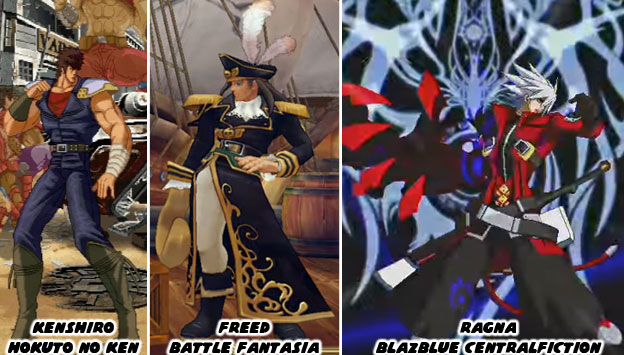
When it came to creating innovative fighting games with a strong aesthetic style you didn’t have to look any further than Arc System Works. Known best for creating Guilty Gear in 1998, the studio had released some very innovative titles over the past three decades. Some of the games were licensed and some were original titles. Each one had its own unique visual style. I had mentioned one of their gems previously, Battle Fantasia, a sleeper from 2007. Some of their other unique releases were Hokuto No Ken (Fist of the North Star) in 2005 and BlazBlue Centralfiction in 2015. Hokuto No Ken recreated the style of the classic 1980’s animé. The manga was drawn by Tetsuo Hara but the anime series was directed by Toyoo Ashida. Mr. Ashida was a character designer and animator that had started working in the ‘60s. By the time he worked on Hokuto No Ken he had studied under multiple different artists. It was this experience that allowed him to capture the essence of the violent comics while retaining the designs that Mr. Hara was known for. The team at Arc System Works did their homework and were able to capture the Hara and Ashida influences in the game.


Battle Fantasia had a much softer feel to it. It was designed to look like a storybook painting come to life. The director Emiko Iwasaki was one of the lead artists on Guilty Gear. When she helmed her own title she wanted to present a visual language that was different than what fighting game fans were used to. She succeeded and showed that 3D games could retain a strong 2D aesthetic. Not only that but female directors were just as innovative as their male peers. The BlazBlue series was a sort of complimentary game to the Guilty Gear franchise. The co-directors Toshimichi Mori and Yūki Katō wanted to create a world that was heavily influenced by bright, colorful anime shows and lay into it heavy doses of the supernatural. Guilty Gear was rooted more in animé-meets-heavy metal. Perhaps it was their work on the Persona 4 fighting game that sparked the interest in humans and demons? 

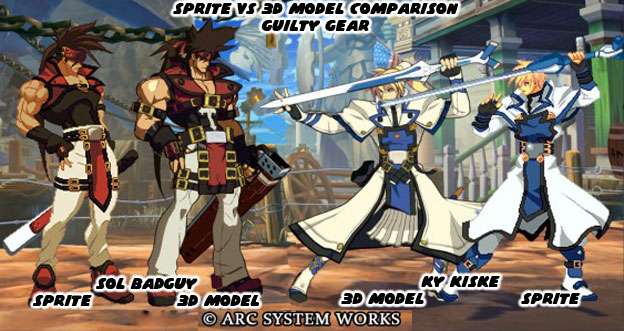
When Arc System Works (ASW) was founded in 1988 they developed their games and adaptations using the same technology and the same techniques as their peers. As the industry changed they also evolved. In the late ‘90s they saw that fighting games were starting to become stagnant. Sprites were being reused in games by Capcom and SNK. This made a lot of the sequels to the Street Fighter Zero, King of Fighters and Vampire games look redundant. They decided to create a whole new game but using high resolution sprites. This way they could create characters with a lot of style and fidelity. It would be as if an animé show had come to life as a fighting game. Guilty Gear was a treat to the eyes. Players hadn’t seen that level of style in a fighting game in a long while. Arc System Works did not stop there. As 3D technology became more powerful, and started appearing in home consoles, the studio knew that they would have to leave sprites behind as well. They didn’t give up on sprites right away but slowly weaned themselves off. Every game, fighter or not, that they developed gave them more experience in 3D. It forced the studio to see how the change in graphics formats would affect their fighting library. Battle Fantasia and Hokuto No Ken were proving grounds. They were showing that they could use 3D graphics to reproduce 2D aesthetics. Their biggest advancement happened when they created an entirely new engine for Guilty Gear Xrd - SIGN (2014) and REVELATOR (2015).


Many games prior to the Xrd title had used a technique called cel-shading to make their graphics appear more hand-drawn. What cel-shading did was filter the colors and shadows into a bold contrast and create an outline on the figures. It was a way to visually flatten out 3D objects and preserve a strong 2D aesthetic. One of the earliest games to popularize the format was the Jet Set Radio series by Sega. What ASW did was study what worked and what didn’t over the past decade and to reconstruct the graphical approach. They weren’t stingy with their findings either but freely gave a presentation at the Game Developer's Conference on the Guilty Gear Xrd graphics format. The studio demonstrated how they bridged the 2D/3D divide and shared those with the industry. They hoped to inspire other developers to create graphics that stood out. The company knew that no matter how well sprites looked in HD, the budgets for most companies would no longer allow them to develop hand-drawn graphics. These companies would have to find ways of preserving the hand-drawn style without betraying the visual style that audiences were used to. This also applied to the way the game moved and played. Everything from frame-skipping to hit box data would now be written using new software.

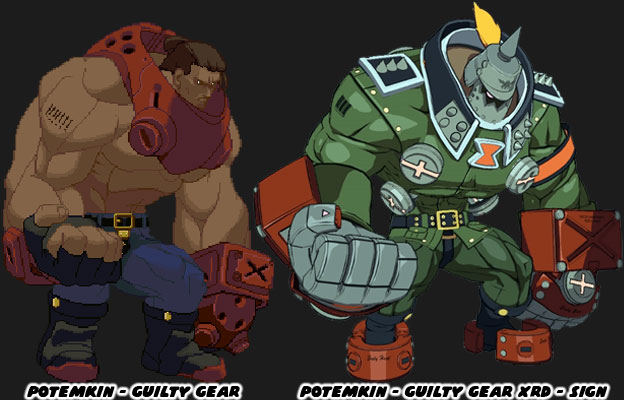
 The studio showed off examples of how character designs evolved for the new technology. Some of the changes were subtle, the length of a coat, the shape of a hairline, other things were more profound, like the redesign of the massive Potemkin. In every example the game managed to retain its unique aesthetic. They could stay on budget, develop innovative titles and appease their fans. The challenge was laid out to other studios. They could keep doing what they were doing. Using the Unreal Engine 3 or 4 their games could all look the same. Or, they could approach graphics from a different angle and give audiences a new experience. It took some effort and fine-tuning in order to achieve the desired results but ASW was not hiding anything from the industry. They learned from their mistakes and wanted to show other companies what they did. The question was whether or not Namco, Microsoft, Capcom, SNK or the other publishers would take these lessons to heart.


Some people might not think there was much of a difference between graphical styles. After all, as long as a fighting game has good balance, control and animation then what do the graphics matter? Well the graphics matter because the industry thinks that the graphics matter. It is often the first thing that audiences and reviewers talk about. It is the thing that draws our eyes to the screen. It is what makes a game visualy appealing. Yet as we know is what they mean to say is that they are attracted to the the aesthetics of the game. The style is more important than the technical numbers powering the graphics engine. The best example of how much of a difference it is to have a 3D game with similar aesthetics could be seen in Guilty Gear Xrd and its contemporaries. Take a close look at the character Kum Haehyun. She was a master of the martial arts and knew how to harness the power of chi / ki. She could use her powers to heal or strengthen not only herself but other people. She could have been introduced into the lineup with an arsenal of moves that fit within the series. In the game she actually pilots a robot body that looks like an elder fighting master called Kum Jonryoku.


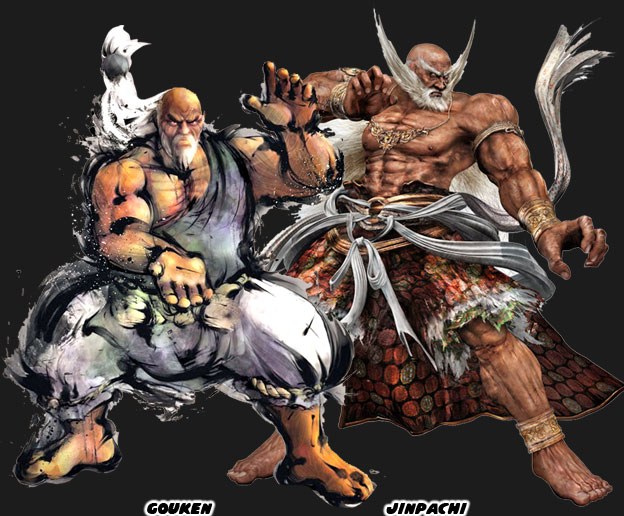
Arc Systems Work introduced Jonryoku as a jab at the recent trend of putting overly-muscular, aged, masters in their games. Specifically the robot was a parody of Gouken, the master of Ken and Ryu, from Street Fighter IV, and Jinpachi Mishima, the father of Heihachi Mishima from Tekken 5. In each of those games a character had literally returned from the dead even stronger and more massive than they ever were in life. They were presented among the biggest and strongest characters in their respective series. They made audiences wonder how people so big and powerful could have ever been killed in the first place. They also made people wonder why it was that they were big and strong while the other elderly martial arts masters looked old and feeble. Jonryoku was the culmination of both Gouken and Jinpachi’s school of design. He sported a long white beard, and ponytail. He had enormous chains instead of a belt and fought against weapons with his bare hands. He was both absurd and awe-inspiring as the previous characters were. The funny thing however that underneath the facade was a girl doing all the actual fighting.


When you looked at the characters side-by-side there wasn’t much of a difference between Gouken and Jinpachi. But when you compared them to Jonryoku the choice of aesthetics was striking. All three games used 3D graphics. All three games kept the majority of the game play on a 2D plane. But only one game managed to recreate the exact aesthetic that the lead designer and director wanted. In a sea of similar-looking fighting games why blend in when you could stand out? These were the things that the best studios did to set themselves apart in the’90s. It was something that the industry forgot how to do following the success of Street Fighter IV. Hopefully other studios would rediscover the importance of aesthetics and try harder in the next round of fighting games. At least I hope that they do. What about you, what were some of your favorite fighting games and why? I’d like to hear about it in the comments section. As always if you enjoyed this blog and would like to sponsor me please visit my Patreon page and consider donating each month, even as little as $1 would help make better blogs and even podcasts!

 follow the Street Writer on Patreon!

Tuesday, March 22, 2016

Who will be the last fighting master left standing?

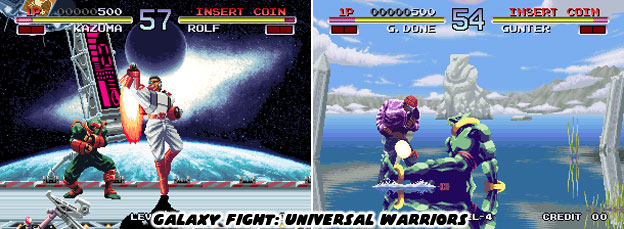
Have you ever wondered who would be the last fighting game character left standing if they all went at it battle royal style? Or maybe it would be better in tournament style because that's what they are used to. I'm talking about just the human characters going at it. Robots, demons, mutants and giant dinosaurs would not be invited to this fight. There have been many heated debates and some great fan match ups online. So far there has not been any consensus. I'd like to think that one fighting game actually answered the question 20 years ago. For once I'm not talking about a title from Capcom, SNK or Namco. A little known developer called Sunsoft came out with a game in 1995 that featured a cameo too great to be ignored. Their game was called Galaxy Fight: Universal warriors. It was set in the far future and featured human and humanoid aliens fighting for good, evil or various other reasons against a powerful alien called Felden.


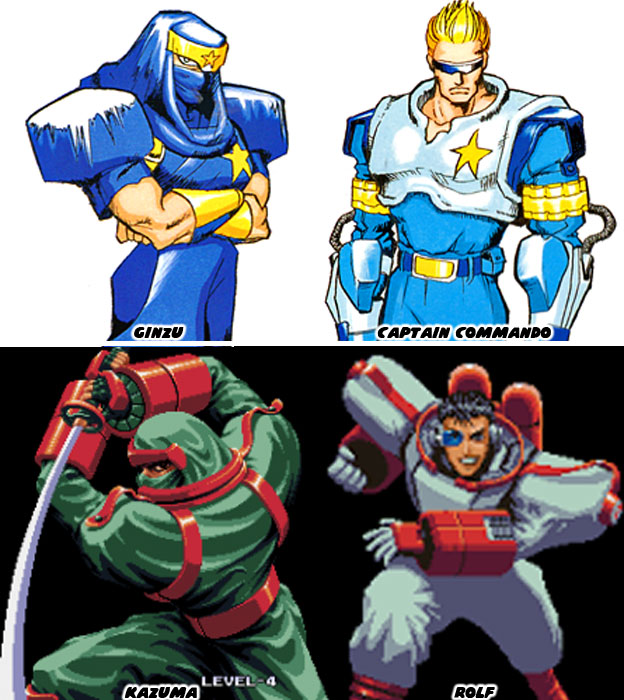
The game had great graphics for the time. The characters were detailed and colorful. The game engine used sprite scaling to zoom in or out of the fighters depending on how close they got to each other. The studio went on to create a few more fighting games that were related to each other. Waku Waku 7 came out in 1996 and the team broke up shortly after and joined up with independent developer SANTACLAUS in 1998 for Astra Super Stars. The fighting games that the team created were very light hearted. They didn't take themselves too seriously and every subsequent fighting game they published was more cartoonish than the last. Galaxy Fight was the one that was the most earnest but even then it was a little bit silly. Sunsoft wasn't afraid at taking a jab at the designs and tropes used by other studios. The two humans in the lineup were a futuristic ninja named Kazuma and fighter named Rolf the "Hero of the Galaxy." Audiences noted that the two leads looked very much like Ginzu the ninja and title character from Captain Commando, a brawling game developed and published by Capcom in 1991.


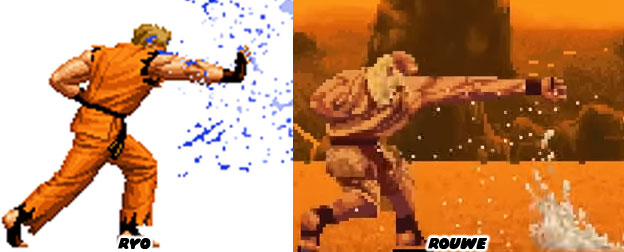
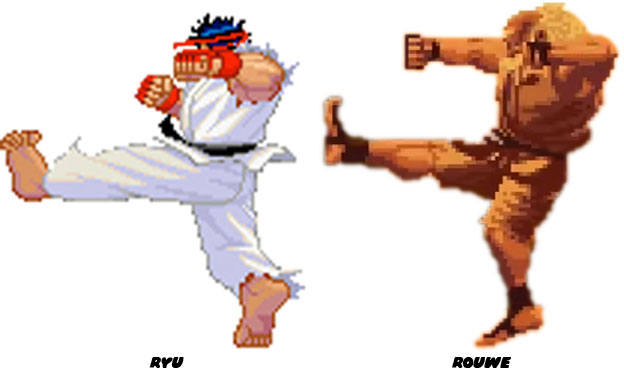
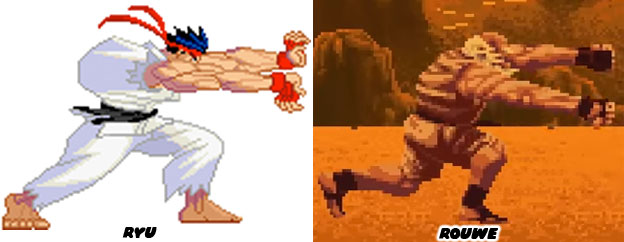
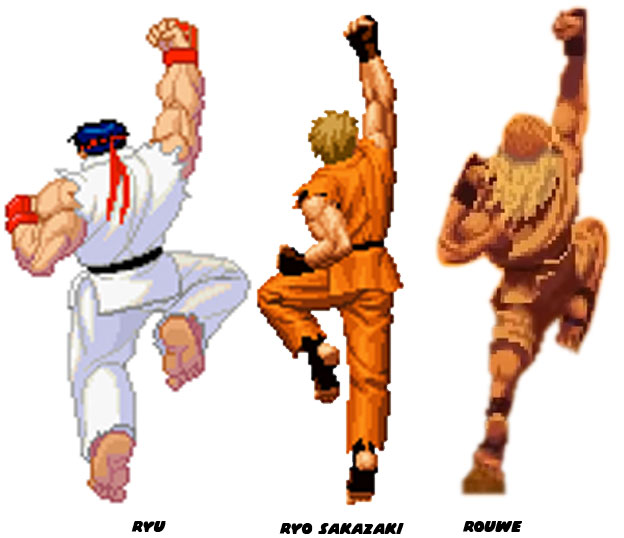
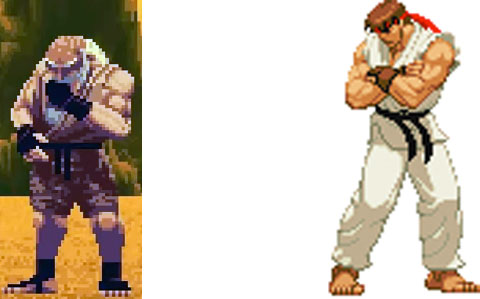
Sure in Japan there were hundreds of shows, cartoons and comics featuring ninjas and characters in power armor but these two looked too much like the Capcom stars to be more than a coincidence. The game revolved around fighters in the future, they had access to modern technology like Rolf's flame thrower, and of course the unexplained powers from various alien species. The real surprise in the game was a hidden character named Rouwe. This character was only accessible after not losing any round and playing a near perfect game. Rouwe represented the "old school" fighting game hero. He was way over 100-years-old and yet there was something eerily familiar about the character. The way he moved, the way he fought and the way he looked that reminded audiences of someone else. Or to be fair this character reminded audiences of the stars of two of the earliest fighting game franchises. He was either Ryu from Street Fighter or Ryo from the Art of Fighting.


The name Rouwe was nebulous on purpose. Perhaps this character was indeed an elderly Ryu or Ryo and the name was a typo. Sunsoft left enough clues in the game so that the character could be interpreted as either star. All of the trademark fighting moves were present from both stars.


There was a variation of Ryo's one-handed fireball, the Ko'ou Ken.


The famous hurricane kick of Ryu also made an appearance, this time however Rouwe also used it to throw a nasty backhand at opponents as well. Who said you couldn't improve on the moves?


Rouwe had a powerful double punch that looked very similar to the pose for the hadoken fireball.


Of course both Ryu and Ryo had a tremendous uppercut. The one that Rouwe used looked closer to Ryu's version. Sunsoft wanted to make it obvious that there was one archetype that would always be the king of the hill. It didn't matter how many fighting games had been developed or would ever be developed. You couldn't really improve upon perfection.


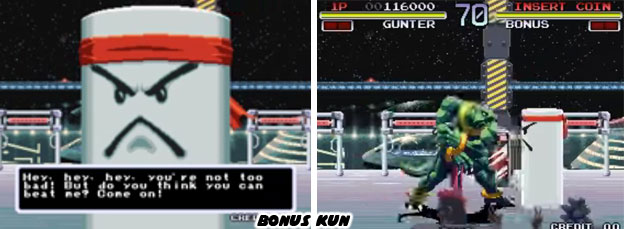
Age may have zapped the size and strength of Rouwe but his technique was flawless. He could hold his own against humans 1/5 his age and of course against various alien champions. It turned out that he was such a powerful master that even his own punching bag had grown sentient.


Rouwe decided to teach this bag how to fight as well. This character was named Bonus-Kun and would turn up in the other Sunsoft fighting games. The designers at Sunsoft were certainly on to something. They knew enough to discolor the gi from years of living in isolation on an alien planet. There was not much left of his uniform in fact, the pants were now shorts from decades of kicking and the vest was threadbare. The look of the character was eerily similar to Gouken, the master of Ken and Ryu. Here's the clincher, the Bengus concept art of Gouken wouldn't be published until after Galaxy Fight had debuted. Was this a case of art imitating game or a coincidence? I'll let you decide.


So do you agree with Sunsoft's prediction? In a hundred years will Ryu or Ryo be the only fighting masters left standing? I'd like to hear your thoughts. As always if you enjoyed this blog and would like to sponsor me please visit my Patreon page and consider donating each month, even as little as $1 would help make better blogs and even podcasts!

 follow the Street Writer on Patreon!

Friday, July 17, 2015

How fight culture became fighting game history, part 8

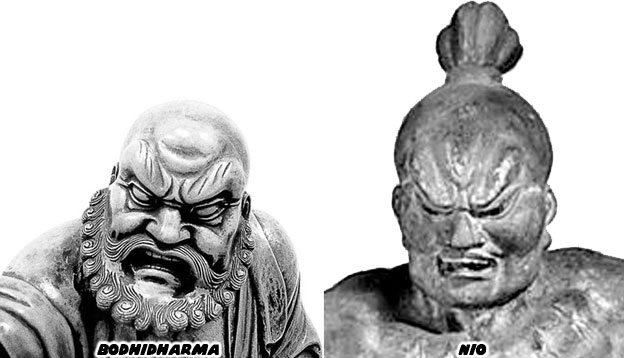
Bodhidharma was a historical figure that helped spread the martial arts and Buddhism throughout Asia. By the time the Chinese fighting arts reached Japan there had been a blend of native Shinto beliefs and mythical stories spreading through the various kingdoms. As Buddhist monks traveled through Japan they spread Buddhism at a slow pace. The Japanese were very insular and wary of any foreign ideas, even more so than the Chinese. The philosophy of the monks became intwined with the Zen teachings in China during the sixth century. By the time Buddhism spread through Korea and reached Japan it was slightly different than what Bodhidharma had started out with. This did not reduce the status however of Bodhidharma. With his dominating presence and hermit-like tendencies the Japanese could see how Bodhidharma predated the wandering swordsmen of the feudal era. It was not hard to understand why he would be revered for his tremendous wisdom and martial prowess.


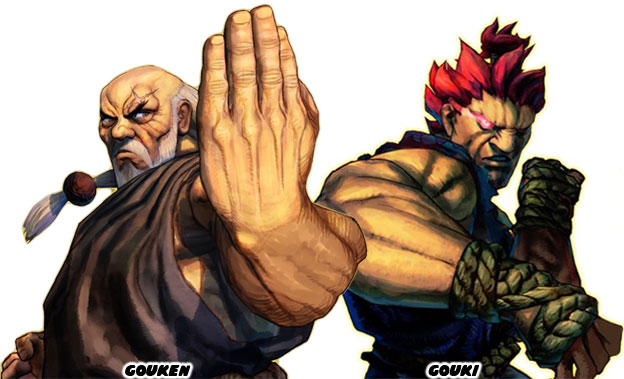
Bodhidharma seemed to be a physical manifestation of the ancient Nio and this appealed to the Japanese. Over the centuries the figure would become more and more recognized until he had also received some level of icon status. Statues and decorations bearing his likeness could be found in temples and also in homes all throughout Asia. Fast forward to the end of the 20th century when the designers at Capcom, and in particular the manga illustrator Masaomi Kanzaki, had to put a face on the master of Ken and Ryu. Up until that point gamers had no idea who their master was. Due to a translation error the west had only known of "Sheng Long." They assumed that it was the name of the master instead of the name of a dragon punch. In Japan the master was known as Gouken but he had only been written about and had never been seen. Kanzaki committed the original design of Gouken to paper in the original Street Fighter manga series. The design had stuck ever since. The master of Ken and Ryu was a bald man, sporting a beard, dressed like a monk with an imposing stature. He had abilities and wisdom that were borderline supernatural. Capcom introduced his evil brother into the Street Fighter series inspired by the myth of Sheng Long. Gouki, Akuma in the USA, had murdered Gouken in a fit of jealousy. The face of Gouki was modeled after that of a lion but his overall impression was that of the Nio. If you were to place Gouken and Gouki side by side it would become apparent that the figures were based in part on Bodhidharma and the Nio.

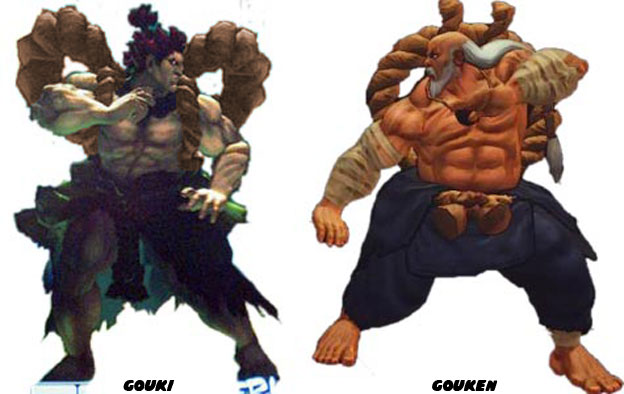
This connection to spiritual figures also explained why the alternate costumes for both fighters featured them wearing enormous Shinto ropes, called Shimenawa. Ropes were used to bind spirits, called Kami, into objects like rocks or trees in Shinto spiritual beliefs. The objects that attracted kami were known as Yorishiro. When the ropes were adorned with paper streamers, called shide, they marked the spiritual sacredness of the location or object. Throughout Japan there were trees and even islands bound by shimenawa and shide. Street Fighter, Samurai Spirits and a few other Japanese-developed games often made use of Shinto iconography. The unique thing for the spiritual belief was that kami could not only possess natural objects but also people as well. A Yorimashi or "Possessed Person" was a person that took the place of a Yoshiro. The rope belt that Gouki wore, instead of the cloth belt worn by traditional karate masters, would be a way for him to symbolically bind the kami to his body. The prayer beads he wore would be a way to keep the spirits under his control and not vice-versa. When Gouki would go crazy in the comic stories his prayer beads would break and scatter. Gouki would not longer be aware of himself as the Dark Hadou (evil spirits) had completely taken over. In the case of Gouken his belt and knot were designed to protect him from the forces of evil and give him the strength to endure.


To make a crude comparison between the types of knots in Shinto beliefs think about the horseshoe mounted over the doorway in many western homes. If the horseshoe is pointing up then it collects fortune for whomever passes through the door. If the horseshoe is pointing down then it symbolically rains down fortune. The horseshoe can not be placed sideways and do a little of both. It is an up or down prospect or nothing at all. For the shimenawa knots it is either the defensive one where the ends point up, known as the Unryu or the offensive version called the Shiranui where the knot points down. Gouki being the more aggressive brother wears the Shiranui knot in his alternate costume. Sumo wrestlers, especially the grand champion (Yokozuna) celebrate the beginning and ending of the tournament season by replacing their synthetic fiber belts with the Shimenawa ropes, shide streamers and ornate knots. A traditional belt can be spotted as the alternate costume for the sumo wrestler E. Honda.


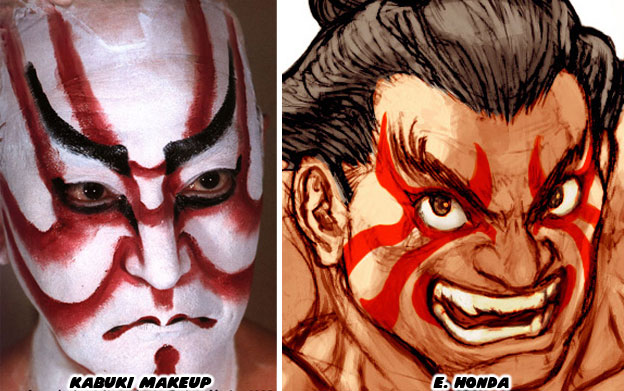
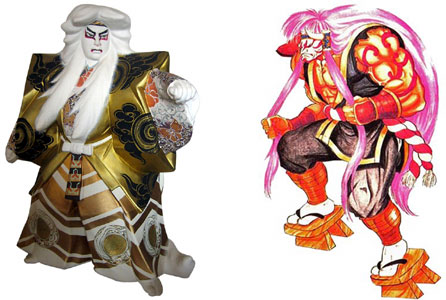
As an aside, the character of E. Honda was one of the first (slightly) controversial figures in the history of Street Fighter. Sumo wrestling was an ancient tradition, going back almost 2000 years. It had a lineage that could be traced back to Central Asia and India, just as karate could be traced back to aikido, kung-fu and older forms of fighting. Sumo above all other fighting forms was also known for having a strong connection to Shinto spirituality and was therefor revered by many nationals. The use of shimenawa belts, the referees that dressed in feudal-era uniforms and even practice of throwing salt in the ring to ward off evil spirits was all based in Shintoism. The decision to use the theatrical face paint of the secular Kabuki theater was seen as a slap in the face to tradition. The designers at Capcom meant no harm with his look, they used the makeup to make the character seem anything but traditional. Honda had to stand out when compared to the colorful cast that would fill out the rest of the World Warriors introduced in Street Fighter II. Characters inspired by kabuki theater would turn up again in other Capcom fighting games, like Final Fight 3, as well as in games by competitors.


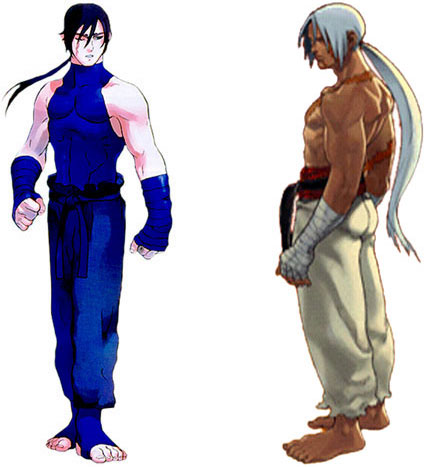
There was an interesting character that Capcom had introduced in Street Fighter EX that was a blend of multiple influences, martial and spiritual as well. Kairi was a melancholy fighter, an amnesiac that was drawn to battle. Kairi's moves took on cultural significance. His fireball was not named the hadoken (punch, wave, fist) but instead the Maryu-Rekko. Maryu meant magical dragon, rekko meant beam / fissure of light. The hurricane kick was named the Mouryo-Kasen. Mouryo were little ghosts, goblins, devils and spirits from Japanese fairy tales. Kasen was a whirlwind / swirling / movement of force. His super fireball was called the Shinki-Hatsudo, which translated to God Ogre - spirit / benevolent energy. His Shungokusatsu-like move was named the Kyoujyarenbu, the "unlucky dance of the cursed tribe." The common translation of "kyo" was unlucky, as this move destroyed him almost as bad as his opponents. The names of his special attacks helped explain his design cues and purpose. They were details that shaped the character and helped explain why he was not only scarred but a loner-type character. We can infer several things from Kairi and his moves. The style of his strikes was based more on spiritual connotations, with a heavy dose of symbolism from Japanese mythology. Imagine that his special kick was possible because he floated on the breeze like little ghosts and goblins. Or that his chi-energy was the result of him tapping into a higher power.


Western gamers wouldn't make sense of these things because most did not have exposure to Japanese mythology, spiritual beliefs or even have translations handy. Most Westerners could tell he was a cool character on the count of his scars and Ryu and Gouki-like moves, the rest of the symbolism was unimportant. While the moves were similar to the fireballs and dragon punches we had been seeing since 1991, their origins were unique. The developers at AKIRA and artists at Capcom were showing players that no one style had exclusive dominion over those special attacks. In a similar fashion Sagat's tiger fireball and uppercut (and knee) were born from Muay Thai rather than karate, Dhalsim's special moves were the result of Yoga and Guile's was a secretive form passed down from Charlie Nash. So what form did Kairi employ? Was it karate or something else?


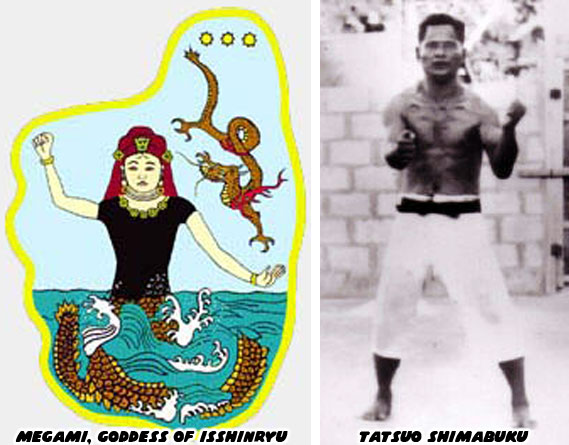
It had been suggested that he was an outcast from the Bushinryuu ninja clan, or a practitioner of the Kyoujarenbu, an "Iron Hand Technique." He was possibly even a practitioner of Mizugami (other times written as Megami or "Goddess") style of Karate. Mizugami style is sometimes dramatized in manga but is rooted in Isshinryu Karate. The form of karate was founded by Tatsuo Shimabuku. Tatsuo was born 1908 and studied in Kyan / Chan village under his uncle Kamusu Chan. The village had a fair share of Chinese immigrants. They were some of the first to introduce an older form of karate to the nation. Tatsuo became well versed in Shorinryu and Gojuryu karate while also studying classic Chinese forms. This diversity made him proficient in both armed and unarmed combat. He was actually one of the legendary fighters that predated Mas Oyama by a generation. Tatsuo avoided being conscripted into World War II by teaching Japanese soldiers how to fight.

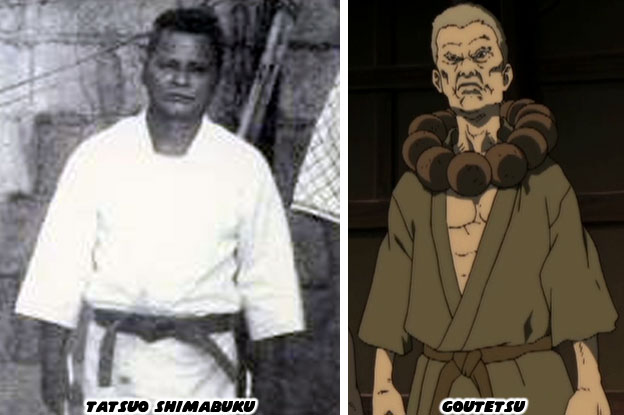
Isshinryu meant "One Heart Method" and actually incorporated Goddess Mizugami on the patch sewn into the gi of practitioners. Ishhinryu had its roots in Okinawa but also in China where other martial arts influenced its development. It's spiritual connection was undeniable. I can draw a spiritual connection between Bodhidharma and Gouken and the Nio and Gouki. I can draw a legacy between Huo Yuanjia and Gen. I can even draw a physical connection between Wing Chun, Bruce Lee and Chun-Li but here is where it gets interesting. There was a master that taught Gouken and Gouki known as Goutetsu. The Chinese immigrant was a master of Ansatsuken, a generic term for the Assassin's Fist. Goutetsu was never written or presented as a particularly large or powerful man. In fact he was a slight figure in most game and comic presentations. Granted, he was elderly by the time he was killed by Gouki but in his younger days he was quite muscular. Tatsuo Shimabuku was to Mas Oyama what Kairi would become for Ryu. He was a martial arts master, a predecessor that was lost to history. He was nonetheless important in its evolution. ARIKA had designed Kairi to ask what would have happened if the two men had faced each other at the peak of their respective abilities. A bit of the ancient world and modern world colliding in video game form. In latter years Capcom would revisit the inspiration for Kairi and instead model Goutetsu after Tatsuo. Gone were the headscarf, long hair and beard, Instead the new Goutetsu, which debuted in the animé film Street Fighter Alpha Generations, looked eerily similar to Mr. Shimabuku.


Isshinryu was a functional form of karate which included vertical strikes (shoryuken?) yet also maintained spiritual beliefs. It bridged the old traditions with the modern concepts of karate. It also predated Oyama's Kyokushin Karate by many years. Tatsuo was a Chinese descendant and the form his uncle introduced to him was rooted in classic Chinese systems. The spirituality behind Isshinryu closely mirrored the philosophy behind many Chinese forms. There was a science behind the fantastic feats of strength and endurance that martial arts practitioners could perform but for most of their history it was assumed to have spiritual importance. The next blog will look at how the myth of the fireball came into being. As always if you enjoyed this blog and would like to sponsor me please visit my Patreon page and consider donating each month, even as little as $1 would help make better blogs and even podcasts!