Showing posts with label e. honda. Show all posts

Monday, September 11, 2023

Street Fighter 6: A master class in game design, part 19

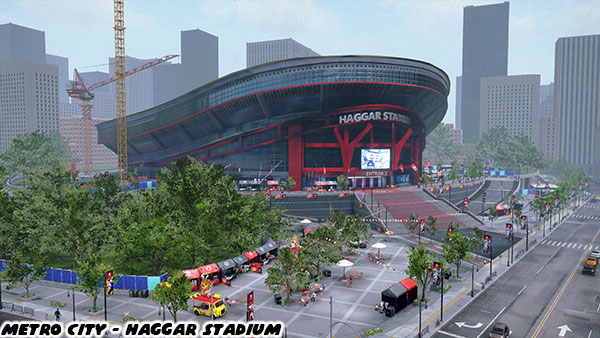
You would complete the side missions of the various masters, build a friendship with them, and challenge them in order learn new techniques. Past a certain point Luke recommended entering the amateur fighting tournament in the Haggar Stadium. It seemed like a logical conclusion to the World Tour. You would be competing against other fighters in this contest. I assumed that the game would end after this point. I mean up until that point I was blown away with how everything had turned out. As a fan since the original title I couldn't ask for anything more. Once you had signed up for the tournament you were allowed to continue exploring, but once the tournament began you wouldn't be allowed to leave the stadium. I had a lot of butterflies about competing so I decided to wander around that side of Metro City, and do more exploration. There was a massive industrial building next to the Chanko House. I decided to check it out.

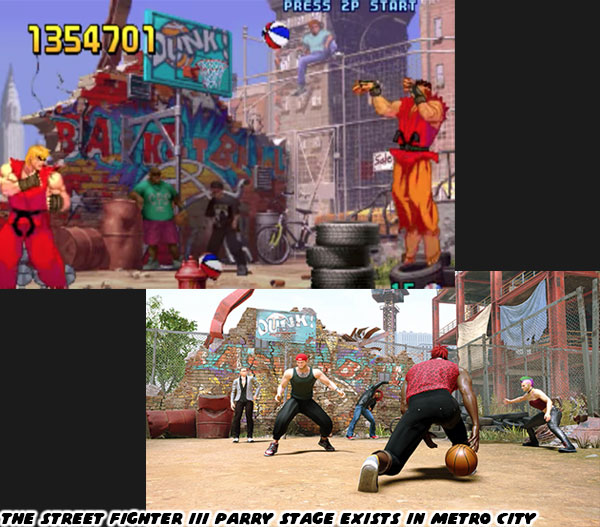
I had the eeriest feeling of deja-vu as I explored the building. I felt that I had been here before, but couldn't quite place the context. As I wandered behind the building I saw some people playing basketball. This was where one of the part time jobs was, the Ball Breaker Blitz, with Baller Mando. People that remember SFIII could recall the bonus stage where Sean was teaching how to parry. He would throw basketballs at you, and had you block them. Capcom had recreated that stage, including the color correct backboard, and graffiti on the wall but in 3D. Again the detail in this game was absolutely insane by any standard.

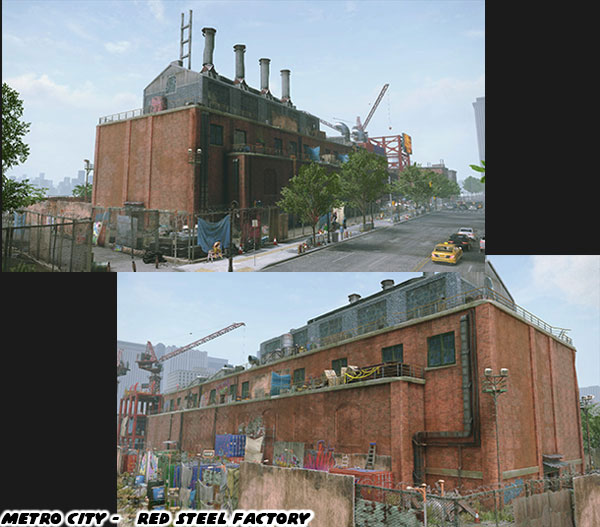
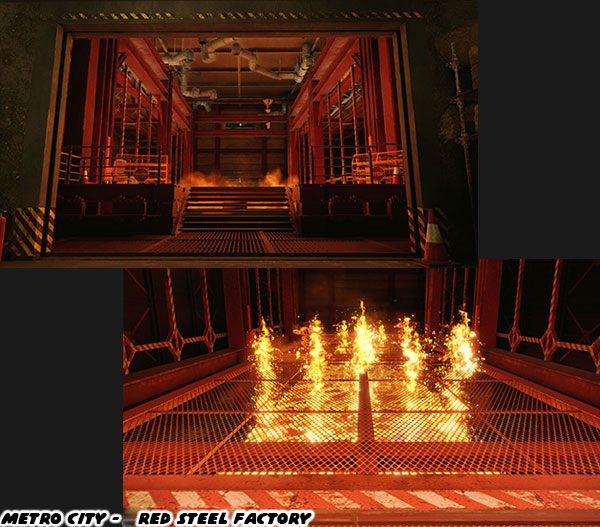
I still couldn't shake the feeling of deja-vu. It wasn't just the basketball court that reminded me of something. As I poked around the factory I kept thinking to myself there was no way a building this massive would just be taking up space in Metro City. That the developers must have placed something inside. Yet all the doors, and gates were closed. I thought that maybe it would open up at night. As I circled the building I found a ladder. As I climbed it I didn't expect to find much. Thankfully a side door was open near the top. That was when the SF6 team again showed why they were the best team for this project.

The factory may have looked abandoned, but it was very much still in use. The furnace was burning away, but the workers were nowhere to be seen. Capcom was letting you figure out what had happened inside. As you explored the massive complex you discovered there were Rampaging Drones, and Rampaging Hyoombas hiding in the corners. The robots that were already causing trouble elsewhere in the city had gone completely haywire inside the building. The rampaging models were overheating, they were sparking, smoking, and much more aggressive than any of the other AI robots in the game. They could be found exclusively inside the factory. I could imagine that the workers were too scared to enter the building once the robots had taken over.

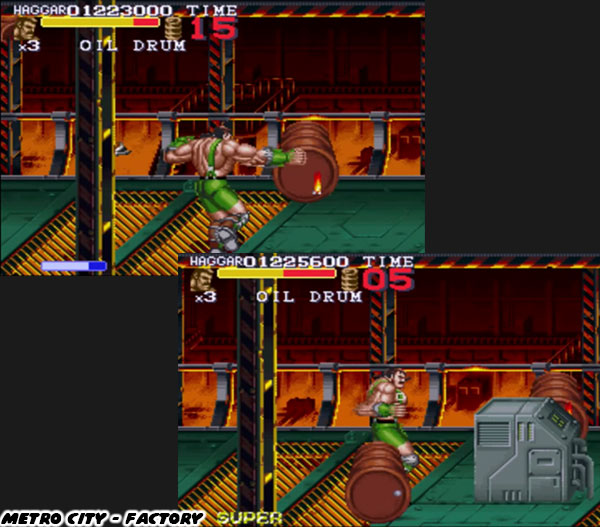
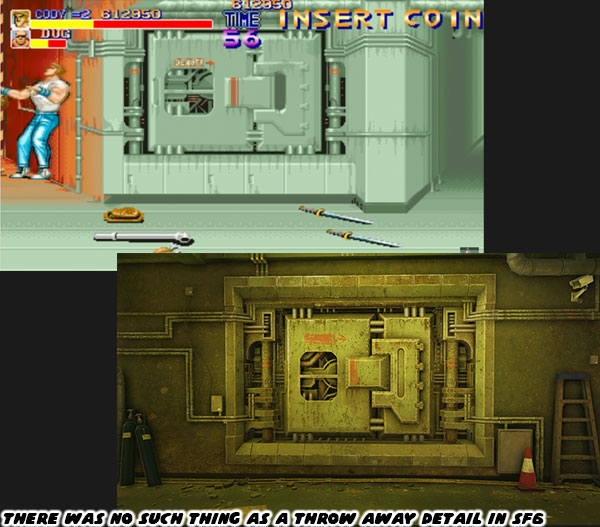
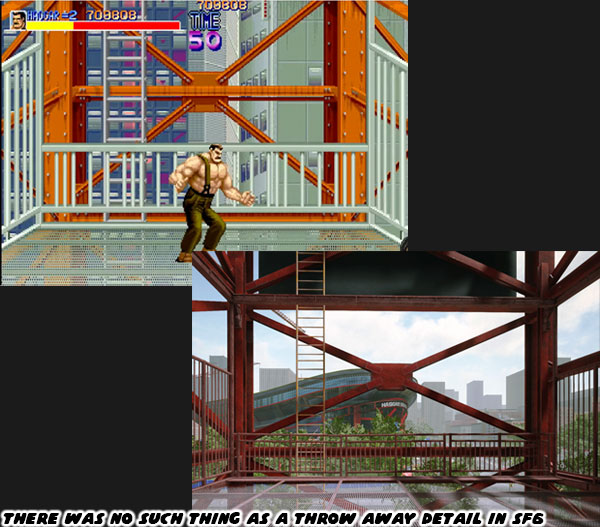
As I made my way through the steel grates, and battled the whirling machines of death I was instantly transported back to 1991. Capcom had recreated the Industrial Area from the original FF as a stand-alone adventure in SF6. This was the exact same Factory that was featured in Final Fight 3 a few years later. As I went floor-by-floor beating up the various robots, and occasional construction gang members waiting outside I was astounded by how much I recalled from the earlier games. Even though I played through the series once or twice I year, many of the details were burned into my memories decades ago.

Seeing the massive machine door at the end of a corridor filled me with delight. I recognized all of the features of the building. I was calling them out to my daughter. She wasn't even born when FF came out, and was barely one-year-old when FF3 debuted. She wouldn't have any context or emotional connection to these things, but was happy that I was happy. I had been explaining to her that the game was very much a love letter to the genre. There was no feature that the studio overlooked. As I climbed up each floor, and fought robots, and workers it captured the spirit of FF just as well as the subway had. When I finally reached the control room for the factory I saw that it was packed with all sorts of robots. They must have easily overrun the workers, and forced them out. Upon defeating them you were able to lower the metal grate over the furnace, and unlock the front doors to the building.

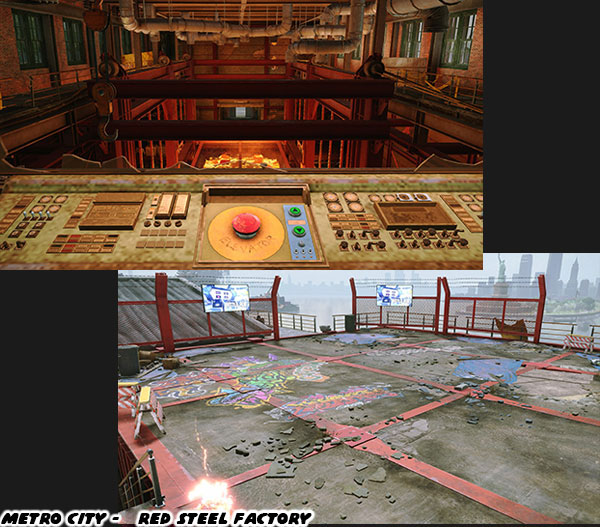
As I walked out of the room, and onto a metal grate industrial elevator I started freaking out. I knew instantly that it was the same elevator that you rode, and fought Rolento on some 35 years prior. There was even a ladder right next to it, the same one that he climbed while throwing grenades at you. As the elevator descended my heart started racing. For just a moment I thought that the Mad Gear general was going to appear. I was disappointed that he didn’t show up given how many cameos the developers were pouring into the game. Instead it was the one place in the city where you were guaranteed to get two android Copy Fighters to appear. After opening up the Red Steel Factory my adrenaline was pumping. The game had me prepped for the tournament now. I reported back to the Mike Haggar stadium, and told the host that I was ready to begin.

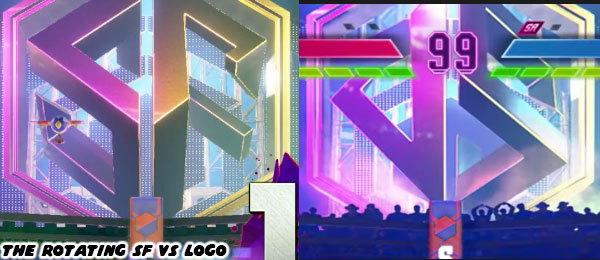
There were a handful of unique characters created for the amateur tournament. Sort of like “light” versions of Street Fighters. They looked like the generic characters that would turn up in an Udon comic book to fill out an encounter with the stars. You were expected to battle a few of them in order to reach the finals. Eternity, the host of the Battle Hub was also on hand to interview the participants before each match. Something that stuck out to me, other than the great arena design, were the floating 3D logos in the background. They rotated to show both the letters SF, and VS, in between matches. Again this was something that could be considered a throw away detail, but was something the team had planned with some forethought.

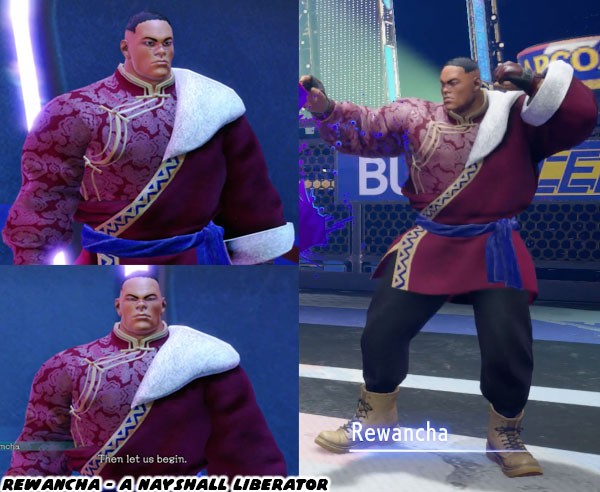
The final match in the tournament featured you versus a large brawler named Rewancha from a country called Nayshall. It was the same place that Bosch was from. This fighter was dressed in traditional clothing, and was determined to win it all. I figured he must be related to Bosch, perhaps a big brother. Maybe he would be able to tell me what happened with my sparring partner. He was as tight lipped, and intimidating as a mob enforcer. You weren’t getting any information out of him, aside from he was planning on destroying you in the fight.

As I said at the start of this blog. I honestly expected the World Tour mode to wrap up after this tournament. After all the SF6 developers had already done a tremendous amount of world building, storytelling, and cameos from the various games. What else could they have hidden up their sleeves? It turned out that I had barely scratched the surface of the game. The next half of the adventure was going to be even deeper. I’ll talk a little bit about the road that brought us here in the next blog. I hope to see you back for that. If you are a long time fan of Final Fight, or Street Fighter then I would like to hear your impressions of SF6. If you have never played any game previously then tell me your experiences in the comments section please. As always if you would like to sponsor me please visit my Patreon page and consider donating each month, even as little as $1 would help make better blogs and even podcasts!
follow the Street Writer on Patreon!

Friday, September 8, 2023

Street Fighter 6: A master class in game design, part 18

The World Tour in Street Fighter 6 was not only designed to ease players into the genre of fighting games, but it also wanted to tell a good story. The challenge, and pace of the game was perfect for new players, and surprisingly fun for seasoned players. Luke from Street Fighter V had returned, a little bit wiser than before as your trainer. He advised you to visit every corner of Metro City, and then travel the globe looking for new masters. The iconic World Warriors would teach you the basics, and help your avatar become a stronger fighter. Chun-Li was the first star that you met along the way, but she was not the only one that was teaching in Metro City. The thing that I could not have predicted was seeing E. Honda appear on the other side of town. The game had already retconned the Masters Building into the Metro City skyline. It was not the only new landmark being added.
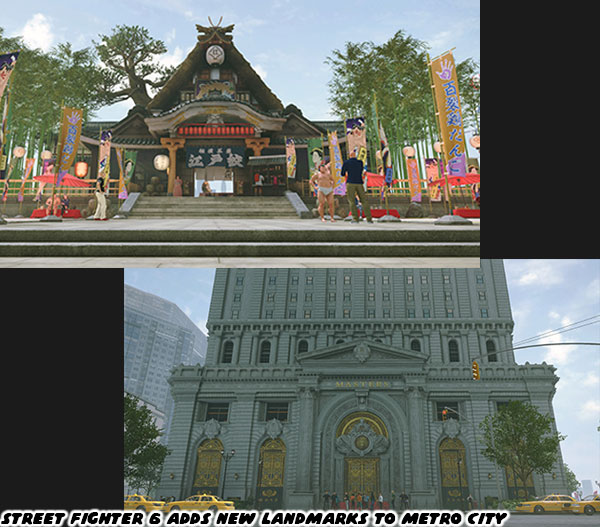
E. Honda had actually been traveling the world looking for the perfect place to set up a restaurant. Well, not just any restaurant, but a chanko house, the food that sumo wrestlers would traditionally eat. He wanted to share the culture of Japan, the tradition of sumo wrestling, and of course the delicious food in an entirely new community. The building he created was similar to a classic Japanese hall. Tiled roof, hardwood floor, and all of the trimmings. The level of detail in the house was absurd. An actual sumo ring was surrounded by booths for guests. They could be seen enjoying bubbling pots of chanko stew, and watching other patrons fight against Honda's stable of wrestlers.
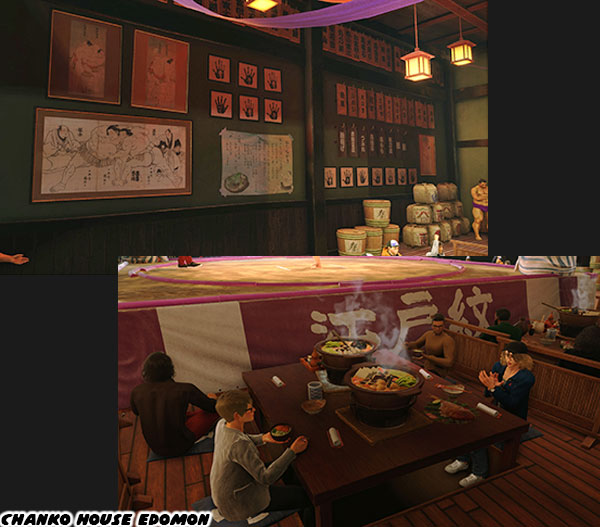
It was easy to get lost in the details placed inside the restaurant. Enormous saké barrels were stacked next to modern refrigerators. There were paintings, and prints of ancient sumo wrestlers adorning the wall. The names of previous yokozuna, ozeki, the ranked sumo wrestlers, and the banzuke or list of current wrestlers were were pinned on the rafters. Sumo autographs were very unique, they would often sign a handprint. Fans could see how massive their palms were compared to regular people. The restaurant had an entire wall dedicated to the other legends in the sport. Honda himself was no different, his hands were as thick as his belly. It was apparent in his dialogue, and the other NPCs that he was beloved in the sport.
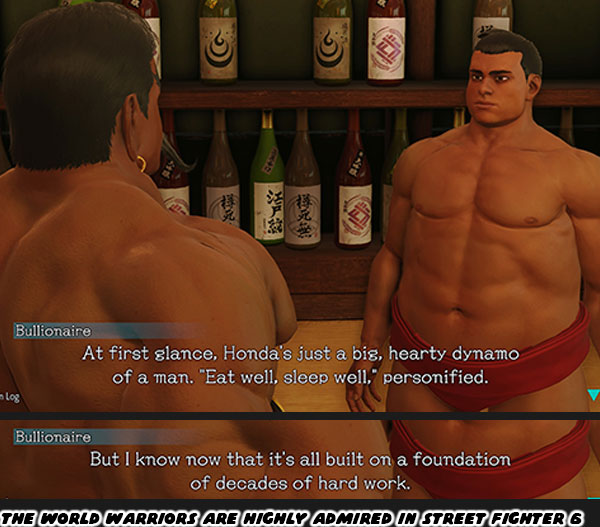
What the game never could have prepared me for was the wholesome writing throughout. You were not only learning how to fight using the styles of the various masters, but you were also building a friendship with them. They were sharing their history, cultures, and traditions with you. Even the more reserved, and introverted characters like Cammy could be won over in time. She would open up a little, and build a bond with you as long as you put in the effort. When it came to Honda he was not doing a surface level overview about sumo culture. He was giving you a deep dive on Japan itself. In fact, Capcom was making sure that he would be bringing a part of Japanese mythology with him. As I was exploring the Chanko House I noticed a young woman named Shoro Nogitsune wearing a fox mask, and standing outside. She had unique yellow eyes. I talked to her to see what she had to say. In one dialogue tree she said that she had no relation with E. Honda. In fact she said “As if I’d give the time of day to young folk like Honda or K-er… did I say young? I meant older than the hills. Why, I’m simply an innocent shrine maiden, lured in by the wafting aroma of fried tofu.” When I returned during the daytime the woman was gone, and instead there was a fox sitting in the rock garden, about the same spot that Shoro was at.
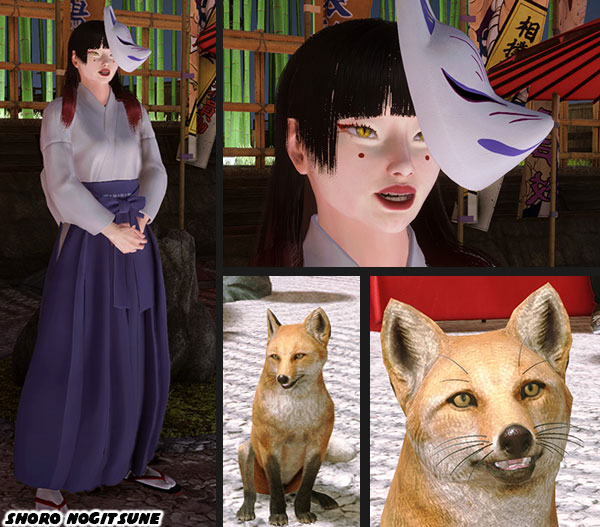
A kitsune was a fox, and had a long history in Japanese mythology, a nogitsune was a fox without a divine spirit this meant they could change shape, and take the appearance of a young woman. Previously we had seen a playable character from the fox myth named Ameth. The 998-year-old fox spirit appeared in the game Xuan Dou Zhi Wang / King of Combat. E. Honda oozed so much Japanese spirit that the spirits followed him to the USA. He explained what the shikona, or ring names meant for the wrestlers themselves. He explained that he never made yokozuna, the top rank in the sport because he was too busy competing outside of the standard tournaments. The sumo schedule was demanding, you had to compete even while injured or else you would lose rankings. He certainly had the skills to be the greatest ever, but his passion extended beyond the ring. In a way it was bittersweet but this self awareness gave the character more dimension than anything else had in the past 30 years.
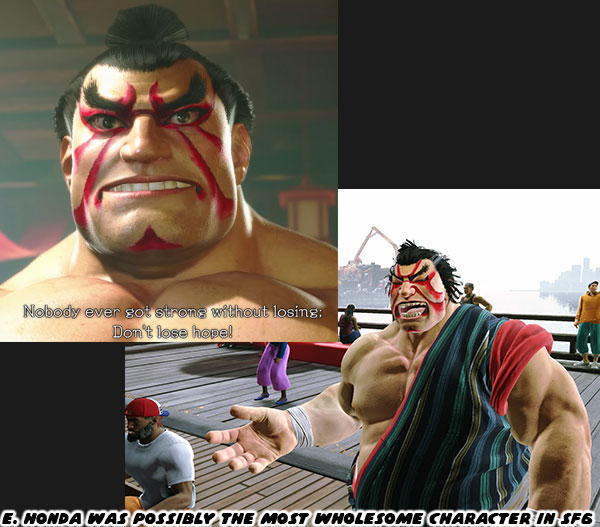
E. Honda was introduced in SFII as the dramatic sumo. His kabuki face-paint flew in the tradition of the sport. Sumo was closely aligned with Shinto spiritual beliefs. Every tournament was layered with religious ceremonies. Then Honda turned up one day and was turning it into theater. That silliness was supposed to appeal to American players more than Japanese audiences. For the majority of his existence he was presented with a comedic tone. This time however he had some actual dimension. The way he acted, the wisdom he spoke, the way he presented himself was deliberate. He was filled with joy, and it was palpable. He would ask you to help find new disciples to work at his restaurant. His passion would rub off on them too. I ended up having much more love, and respect for this character than ever before.
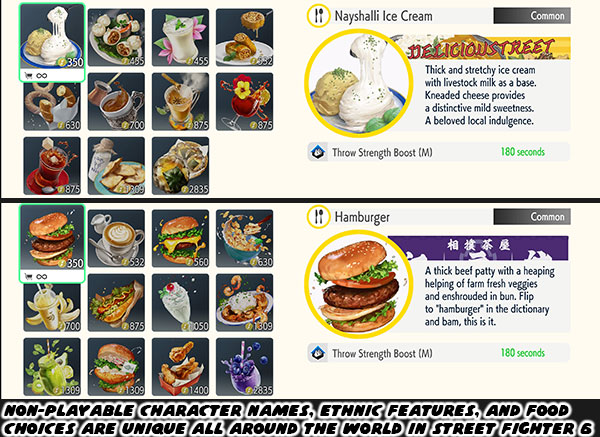
I never expected the SF6 team to go out of their way to give us realistic portraits of the World Warriors. They showed us how they thought, and let us hear in their own words what they were fighting for. The World Tour did much more for all the characters than any arcade story could have ever done. Even the smallest details were explained in the game. For example your avatar would take damage, and lose energy during the fights. You would have to buy something to eat, or drink from the local vendors to recover energy. The food at each business was unique. At the Chanko House you could get udon, tempura, or any other type of traditional meal. Every food item had its own history, and benefit. Some allowed you to earn more experience points, others allowed you to deal more damage for a limited time. There were even unique items that you could order while you were traveling. A drone would deliver your food to you. 
It seemed absurd to me that the SF6 developers would go out of their way to explain every dish in the game, and its benefits, but this was a tiny detail that was important for world building. It would set the standard for the company moving forward. It was an example of the work that Capcom was putting into Street Fighter 6. You weren't expected to just run from fight to fight, but to experience the world that they had created in between all of those battles. We will dig even deeper into this side of Metro City in the next blog. I hope to see you back for that. If you are a long time fan of Final Fight, or Street Fighter then I would like to hear your impressions of SF6. If you have never played any game previously then tell me your experiences in the comments section please. As always if you would like to sponsor me please visit my Patreon page and consider donating each month, even as little as $1 would help make better blogs and even podcasts!
follow the Street Writer on Patreon!

Sunday, June 3, 2018

30 Years of Street Fighter, 30 Days of Characters; #28


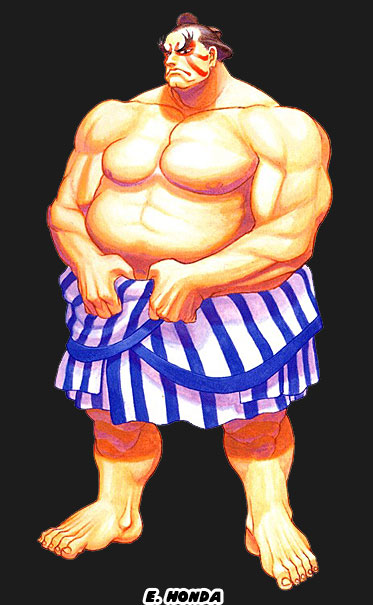
E. Honda has easily earned a spot in my list of 30 memorable characters. His look is so bold and his moves so imaginative that it would be a shame to ignore him this anniversary season. The origins for the character are more cartoon than reality. There was actually a sumo wrestler with a painted face that appeared much earlier in the arcade. The look of E. Honda was meant to grab your attention. He was supposed to be an over-the-top character, borderline parody. He was on the extreme end of designs like the wild man Blanka or the skinny yogi Dhalsim.


E. Honda was unique for a number of reasons. Sumo wrestling had not really been covered in early fighting games. This was a chance for Capcom to write a new page in history. In order to work in Street Fighter it had to be an exaggerated version of the real art, just like the other forms represented. We could tell Honda was strong just by looking at him. His muscles could still be made out under a layer of fat. What audiences never expected was for him to be quick and agile as well. Sumo wrestlers could be surprisingly quick despite their size but E. Honda was on a whole new level. 


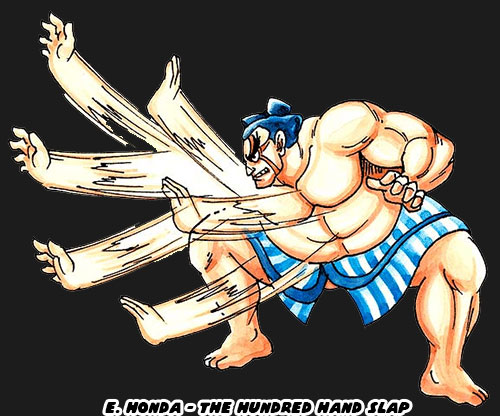
Sumo wrestling was known for being a contest of strength and force. There was a lot of technique involved but moves such as kicks were off limits. Since Honda was competing in an underground tournament his arsenal was expanded. He could jump and kick, trip opponents, sweep the leg and even throw himself head first into a rival. Sumo wrestlers often fought for position by slapping their opponent's head, neck, chest and shoulders. E. Honda was so good at this he could do it with one hand, thus earning the legend of the Hundred Hand Slap. While it wasn't as flashy as a fireball it was still an impressive move. E. Honda's appearance combined with his library of moves made him one of the best heavyweight characters ever created. I'm glad that the character has been a part of the Street Fighter universe for almost three decades. What do you think about him? I'd like your take in the comments section. As always if you enjoyed this blog and would like to sponsor me please visit my Patreon page and consider donating each month, even as little as $1 would help make better blogs and even podcasts!

 follow the Street Writer on Patreon!

Saturday, May 21, 2016

Painted faces, where have I seen that sumo before?

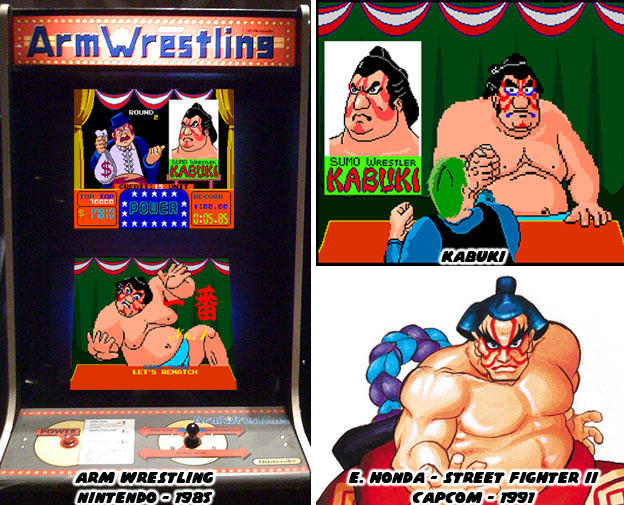
If you are a long-time arcade fan then chances are you are familiar with a rare Nintendo game called Arm Wrestling. It was a sort of spiritual successor to Punch-Out!!. The game came out in 1985 and it featured a cavalcade of silly arm wrestlers, including Frankenstein's monster, a burly Texan and pro boxer Bald Bull in a mask. One of the standout rivals was a sumo wrestler named Kabuki. What made this character unique was his face paint. Apparently this character had a flair for the dramatic. I'm not sure if the idea of mixing kabuki theater face paint with a sumo wrestler was solely Nintendo's idea or if the designers had mixed elements from various pop culture sources. I'm leaning towards the latter. The thing was that the seeds were planted for over-the-top characters to be featured in fighting games.


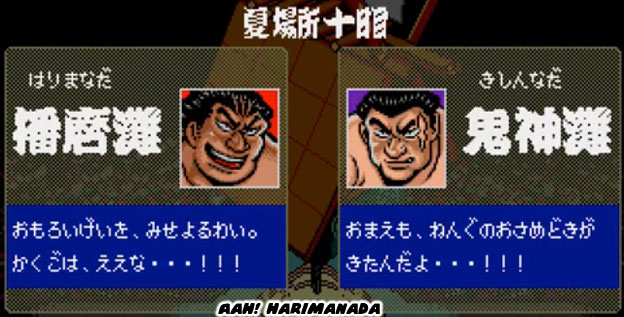
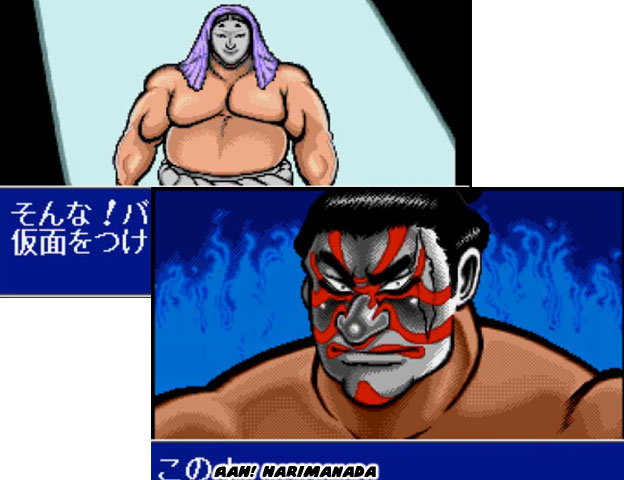
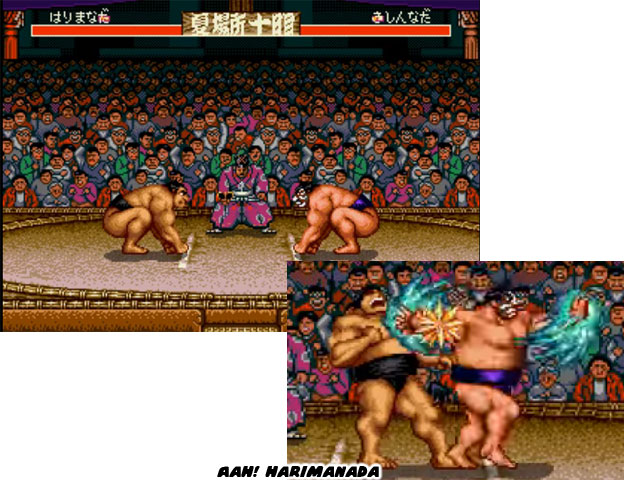
I credit Nintendo with developing a series of international archetypes in the original Punch-Out!! The various boxers from around the world had unique personality traits to go along with their memorable appearances. These caricatures would be emulated by Capcom and various studios when designing the first crop of fighting game all-stars. In 1991 E. Honda would take a page directly from Kabuki. Few remembered the Nintendo character came first and that was okay. Capcom was helping spread fight culture through their characters. The same year that Street Fighter II came out a manga called Aah! Harimanada debuted. The series was by Kei Sadayasu and would eventually be adapted into an anime series and fighting game as well. The series featured the brash Isao Harimanada, a sumo wrestler who was arrogant and insulting to opponents. He was a very dramatic character that would wear masks and headgear to the tournaments, including samurai helmets. The character would boast that that he would beat the 69-consecutive win streak of Sadaji Futabayama or retire trying. The series was kind of boring. It was a definite "Mary Sue" sports hero from Mr. Sadayasu. Isao could be rude and self absorbed and was somehow supposed to be appealing to young readers. As far as fictional sports figures go there was nothing that stood out for the hero. Audiences could guess that he would indeed reach 70 consecutive victories over the series. There was no real chance that he would lose any match. The only thing that changed were which techniques he used in order to beat his opponents. For that matter the rivals were far more interesting than the main character. One of the former champs that gave Isao a run for his money was named Kishin-Nada. The character had a nasty scar on the side of his head.


Kishin lost the match and felt humiliated by Isao, as did many of his opponents. They were all working hard to get a rematch but none took it more personal than Kishin. At the end of Isao's streak a mysterious figure appeared. This sumo was a former champ and he wore a creepy wakaonna, or girl mask from the Noh plays. It was as if Isao would have to wrestle someone with the same flare for the dramatic. When the wrestler removed the mask audiences gasped at his painted face. It was sacrilege that a sumo wrestler would actually wear kabuki face paint into the ring. This figure was trying to create a personae that was every bit as dramatic as Isao. Of course eagle-eyed readers saw that despite the face paint there was a noticeable scar on the side of this new character's face. This fighter called himself Kishin-Ryu, the dragon or ultimate version of Kishin-Nada. I'd like to think that this was Mr. Sadayasu's nod to E. Honda.


There was a Mega Drive (Sega Genesis) version of Aah! Harimanada that came out in 1993. The game by Megasoft was sorely lacking in the control department. Audiences could play through a campaign mode and every battle in the manga was presented in the same order within the game. After a few matches the game felt tedious. It would be a grind to try and beat 70 opponents in a row. What was cool however was how each sumo had their own strength and weaknesses. These things manifested as special attacks and super strikes. Imagine a version of Street Fighter but solely made up of sumo wrestlers. Super thrusts, headbutts, throws and slaps were some of the many techniques players could learn. A dozen characters each had their own super attacks that could be figured out and mastered in a two-player mode. I often wonder how Street Fighter would have been if characters had entirely new move sets applied to them in each sequel. What would have happened to E. Honda if he had new moves added to his library in Turbo, Hyper and Super versions of the game.


I hope you think about this rare series and the flamboyant sumo wrestler that appeared in other games the next time you play Street Fighter. Truth of course was much more interesting than fiction. Isao Harimanada was nowhere near as interesting as the real Futabayama. The record-setting sumo wrestler was blind in one eye but he never revealed this to anyone until after he retired. His opponents could have of course used this information against him. He was certainly much more humble about his abilities than Isao. Maybe a fighting game might base a character after a real legend. Stranger things have happened! As always if you enjoyed this blog and would like to sponsor me please visit my Patreon page and consider donating each month, even as little as $1 would help make better blogs and even podcasts!
 follow the Street Writer on Patreon!