Showing posts with label marco rodriguez. Show all posts

Saturday, April 27, 2024

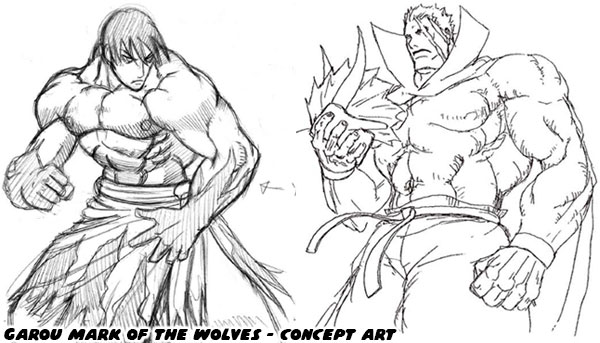
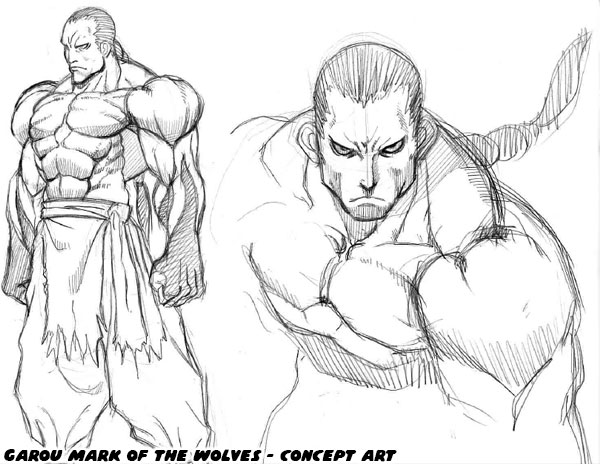
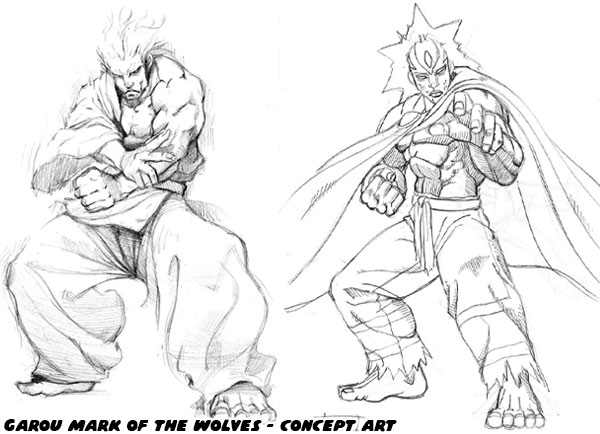
Garou Mark of the Wolves, how some characters evolved from concept art

At the EVO 2024 tournament in Japan SNK showed off a playable build of Fatal Fury City of Wolves, this was the sequel to the 1999 fan favorite Garou Mark of the Wolves. I had written about the original title, and updates on the sequel a few times on the blog. Most recently I talked about Preecha the Muay Thai genius. The entire character lineup hadn’t been revealed yet. There was a lot of speculation as to who was next to be unveiled. I wondered if the concept art of the original game might give us a hint as to how some of the cast evolved. Thanks to Zero an Italian friend of the blog (Grazie!) I was able to put together this quick writeup. 

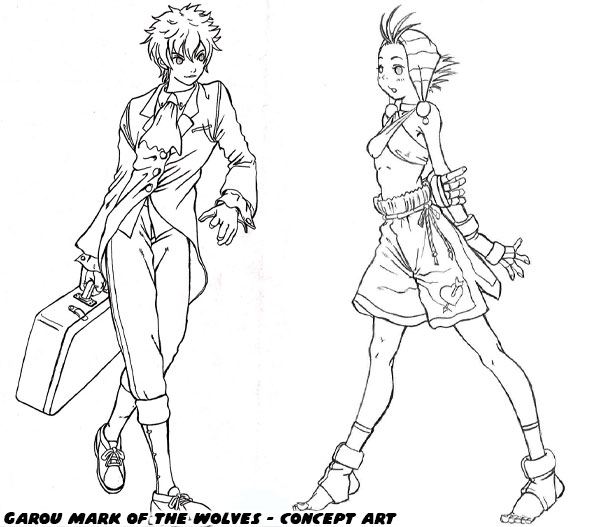
Preecha was not in the original game, however a sprite sheet of the Garou 2 cast had been revealed a few years ago. In the lineup there was a Muay Thai girl that was an understudy of Joe Higashi. If we looked at the original concept art we could see there had been a few girls in the planning stages. One of them had shorts, and padded feet, and hands. She might have been the prototype design for Preecha from 25 years ago. There was also a girl with a briefcase. I think this might have been one of the conceptss for the pirate princess B. Jenet.

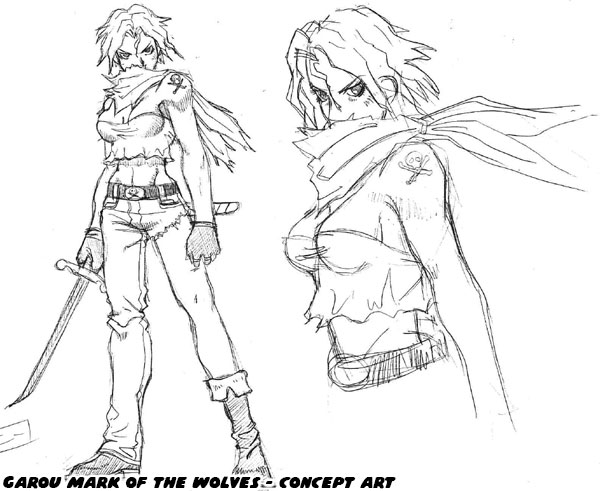
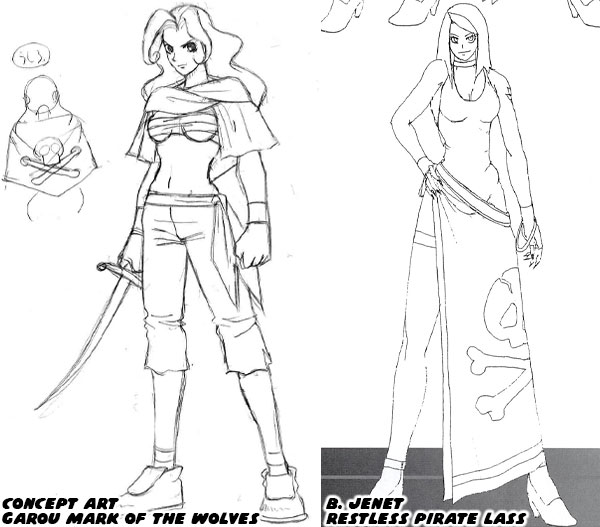
In the official canon B. Jenet came from a rich family, however she was bored with her lifestyle. She rebelled by forming a pirate crew, and going on treasure hunts. I think the girl with the briefcase might have been how Jenet would have looked when she was running away from home. An actual pirate girl would pop up in the concept art as well. The character had a sword, had a classic skull, and crossbones tattoo on her shoulder, and wore tattered clothing. She looked much more aggressive, and mysterious than the final design for Jenet. The character’s hair would get longer, and much softer in revised drawings. Eventually setting the template that would become the sassy blonde pirate queen herself.

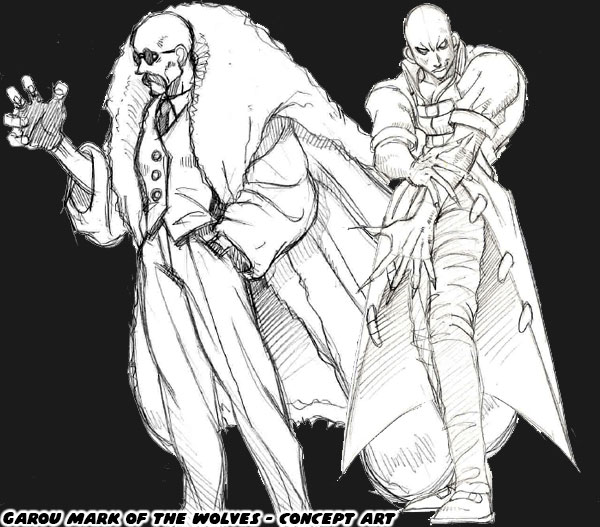
I’m a firm believer that no good idea goes to waste. There were a few character designs that didn’t seem to work for the original Garou, however they would be revisited in other titles by SNK. One of the early concepts was a bald fighter with an oversized coat. He seemed to have sharpened nails. At a quick glance he might have been confused for Mr. Big, one of the South Town bosses that had first appeared in the Art of Fighting. So this character was redesigned a few more times. The coat was made more stylized, not unlike Jedah from the Vampire/Darkstalkers series.

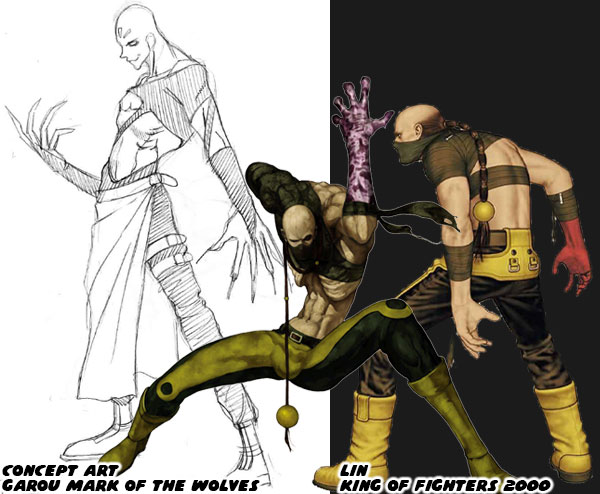
His costume, and overall look would continue to evolve. Eventually he appeared like some sort of martial arts assassin. This character seemed to be one of the poison fist fighters like Duo Lon, A.K.I., Kurow, and Red Snake. Although this character wouldn’t appear in Garou in 1999, the design seemed to be the prototype for Lin. He would debut a year later in the King of Fighters 2000.

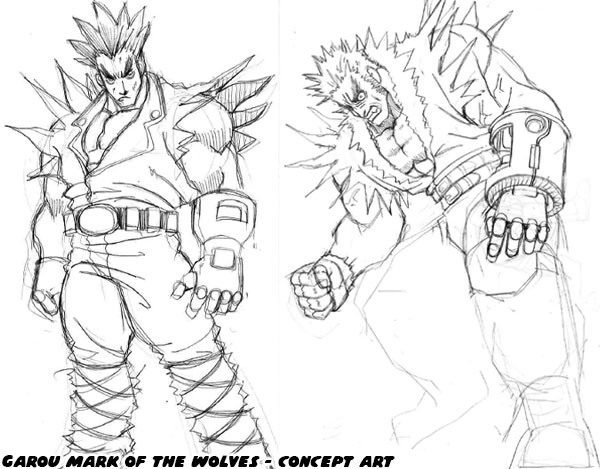
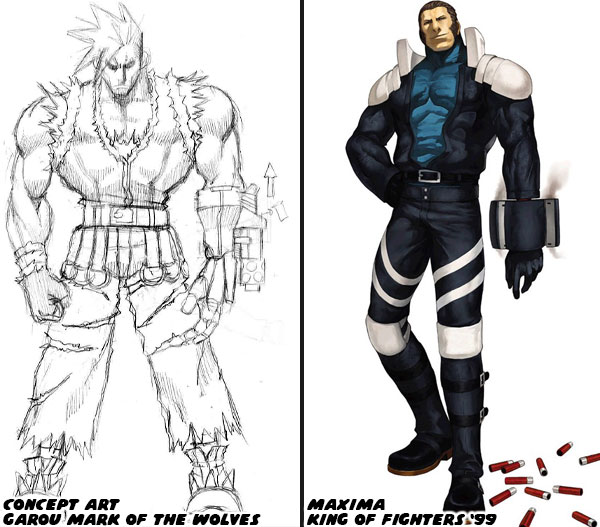
This wasn’t the only character destined to appear in a related game. Another concept character looked like a wild bruiser with a metallic arm, or brace. This arm was a weapon, a sort of cannon that could be used to fire projectiles. Long time fans of the SNK universe could remember that there was another fighter that had a similar mechanic who debuted in 1999. Maxima was a soldier that underwent a cybernetic transformation to make him bigger, stronger, with a false arm that could shoot projectiles. The weird thing was that this character had actually been in the planning stages from the team much earlier than that.

I argued that the designs for K’, Maxima, and Kryzalid from the KOF games were pulled from Daraku Tenshi: the Fallen Angels. The design for a large fighter with an arm cannon was seen in 1998 with the US soldier Harry Ness. The Steel Hearts team that developed the Fallen Angels for Psykio was credited for designing KOF 2001, and 2002, I would argue that their designs were influencing SNK as early as 1999. There was simply too much crossover with what would appear in the SNK games for it to be a coincidence.

There were two concept characters in Garou that only needed a little bit of polish in order to get them ready for the game. There was a classic martial arts villain, and a mysterious warrior in the planning stages. These designs could have been revised again, and again until the best elements of each ended up creating a single character. Instead the team saw that there was enough to make two distinct warriors out of them.

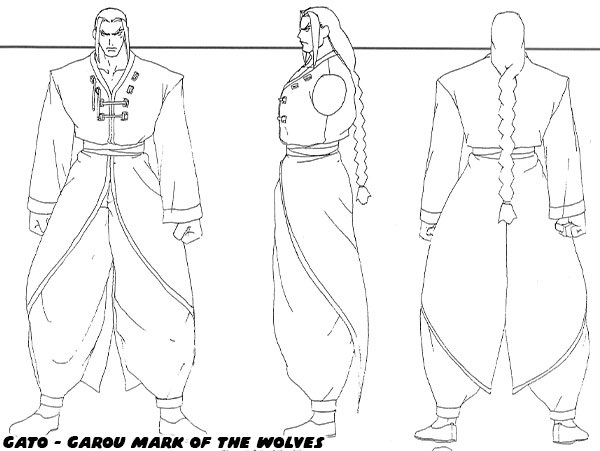
One of the designs was fairly straightforward. What if there were a fighter that was stylized on classic Chinese villains. Someone with a long ponytail, long pants, and wushu sash belt. He would appear similar to Feng Wei who debuted in Tekken 5 in 2004. In the earliest draft this character had massive black tattoos on his hands, and forearms. Perhaps they were tattoos, or they were to signify that he had some sort of poison fist. It was also possible that this marker was transferred to Lin for the King of Fighters game instead.

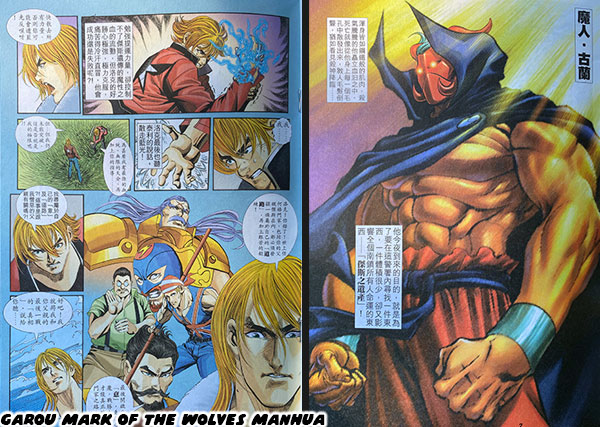
The look of this character was refined so that he looked more classic, and distinct from the other fighters they were working on. Gato ended up being one of the main villains in the Garou manhua (Chinese comics). His look was a little too traditional in my book. There weren’t any elements in his design that could have connected him to the modern era. He could have fit right into the feudal era of Samurai Spirits, or the Last Blade rather than the modern world. It didn’t take a lot to make the difference either. Something subtle like giving him sneakers (as Capcom did with Yan, Yang, and Jamie) could bring him into our time, while still allowing him to represent classic kung-fu forms.

The other villain that SNK was working on was supposed to be more mysterious. One of the ways they did this was by making his costume more stylized. Perhaps he would have only one arm in a sleeve, or even have him wearing a cape, and mask. These things were rarely seen in fighting games, and usually only appeared on bad guys. This rough idea would be the basis for the masked Grant. He would become the enforcer for Kain R. Heinlein, the main villain in Garou Mark of the Wolves.

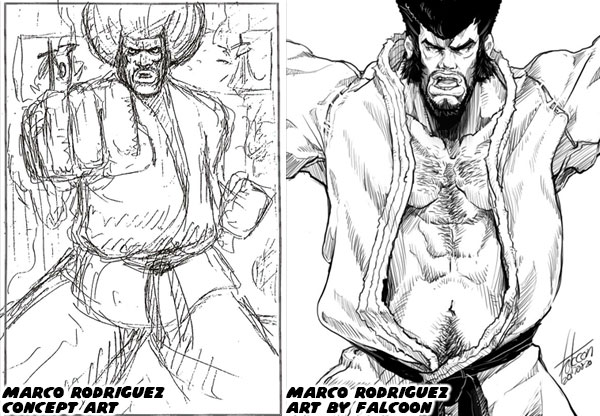
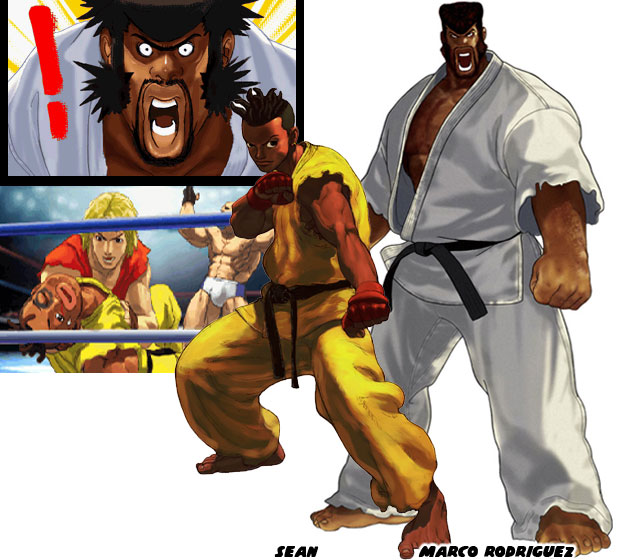
Not every concept piece had potential. Some ideas were scrapped, some ideas would be revisited in sprite form for the proposed Garou sequel. There were some rough ideas that I was glad were changed early on. One of which was for the Black karate master Marco Rodriguez. This was a character that I had celebrated a decade ago in my second blog entry. In his original design he had an afro, rather than a pompadour. The afro was a trope that I had talked about previously as well. It was a bit lazy from Japanese developers to stick Black characters with a basketball, or afro because they simply couldn’t be bothered to have better representation.

There were some other ideas in the drafting process that I’ll talk about more in the future. How other popular characters evolved from concept art to the screen. Until then I’d like to hear your thoughts on the comments section. Were there ever any concept characters that you wish had appeared in your favorite games? Tell me about it. As always if you would like to sponsor me please visit my Patreon page and consider donating each month, even as little as $1 would help make better blogs and even podcasts!
follow the Street Writer on Patreon!

Monday, August 15, 2022

Garou Mark of the Wolves, the manhua part 2

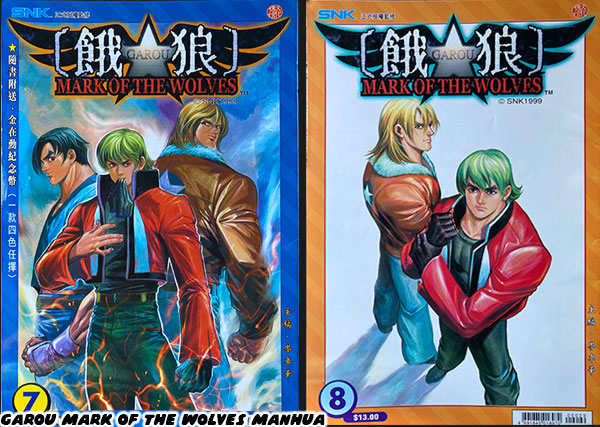
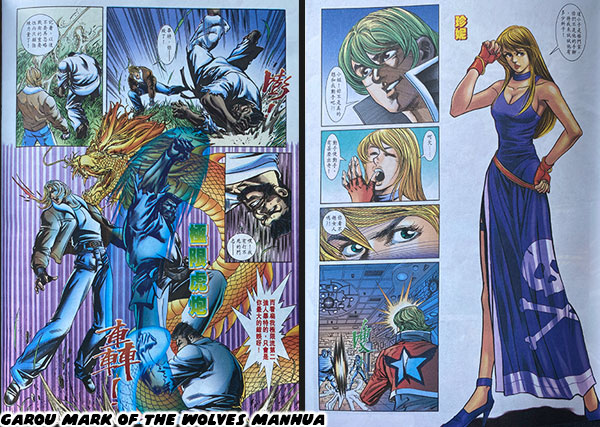
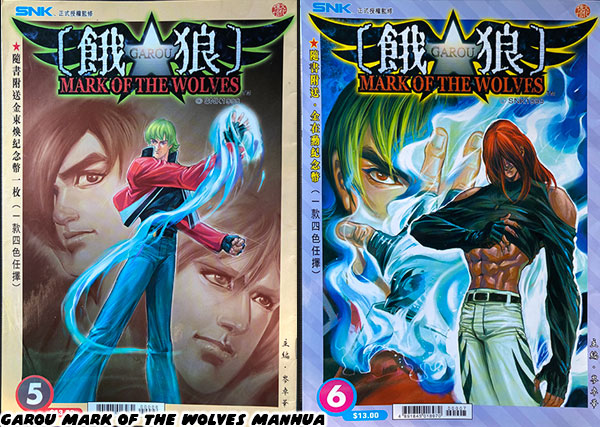
The first half of the Garou Mark of the Wolves manhua from 1999 was a retelling of the events of Fatal Fury. They gave audiences the history of stars Andy, and Terry Bogard. The villain Geese Howard, his relationship with half-brother Wolfgang Krauser, and estranged son Rock Howard. We also get to see several other major players from FF canon including Joe Higashi, Raiden, Mai Shiranui, Tung Fu Rue, Billy Kane, and Yamazaki.

The first few issues had Rock as a kid, and the later issues had him as a young adult. With the rise of new villains like Grant, and his uncle Kain R. Heinlein founding a new KOF tournament Rock is drawn into battle. He has grown as a fighter, and no longer wants to run from his legacy. He feels that he is ready to confront his past, and question his uncle.

Since a decade has passed since we last saw Rock, and Terry it stands to reason that the rest of the cast has also grown, and matured. In the first few issues Ryo Sakazaki was chasing down Geese Howard, and an actively fighting in Southtown. However his father Takuma had retired from teaching his patented Kyokugen “extreme limit style empty hand” form of karate. Ryo was the new master of the dojo, and helping keep the family business alive. He didn’t really venture out of the school.

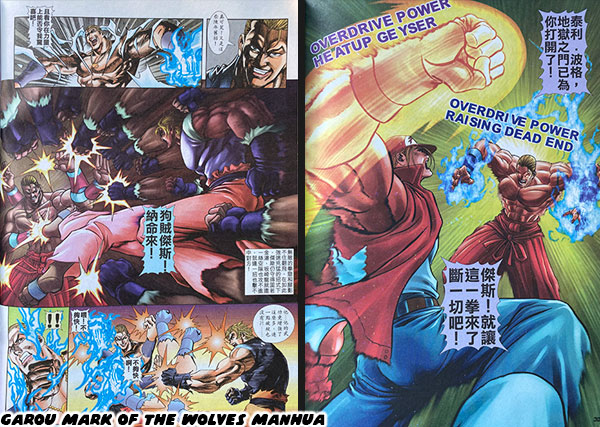
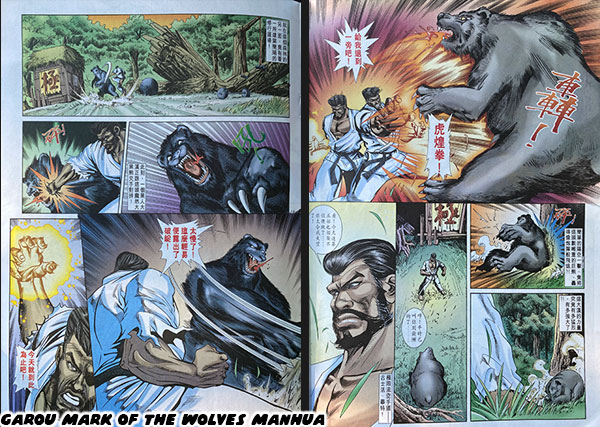
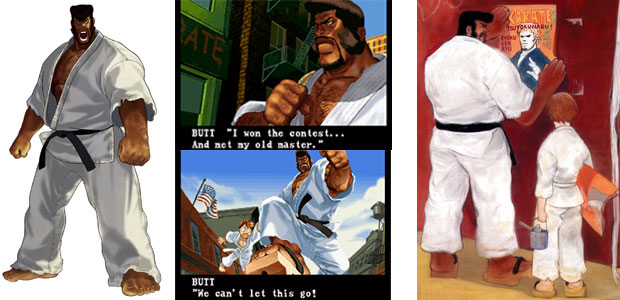
Marco Rodriguez aka Kushnood Butt raids the Sakazaki dojo with some thugs, trying to prove they were the best fighters. Ryo annihilates them, and Marco becomes a convert to the school. He spends the next decade studying under both Takuma, and Ryo. We see him now as a black belt. He’s practicing in the woods, and fighting a bear, a nod to the legendary exploits of Mas Oyama, and Willie Williams.

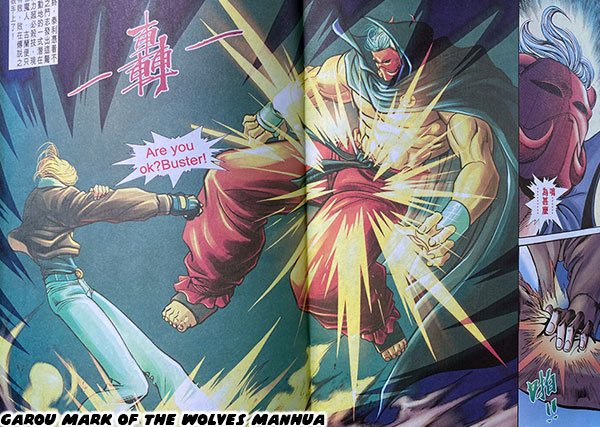
He crosses paths with an older Terry Bogard, and gets into a fight with him. The issues do not spend too much time with the rest of the cast, but at the very least they do get an introduction. This includes Kevin Rian, Hokutomaru, and B. Janet. Their purpose for entering the Maximum Mayhem tournament is explained. Grant is introduced as the big baddie of the tournament, and Terry gets into a fight with him.

The series ends after the introduction of the major players, and how they changed over the years. It doesn’t actually cover the events of the tournament. Which I think is actually the best way to tell the story of a fighting game. When you spell out each, and every battle you end up forcing the canon into a very specific direction, which may, or may not be the intent of the developers. Instead the writers of the manhua let the audience meet the cast. Show some of their backstory. Let a few non-tournament battles take place, and allow the game players to explore all the possibilities, and outcomes in the game.

With the announcement of Garou 2 I can only hope that there is a manga series, and possibly manhua series in the works as well. Either way I am eager to see how the game turns out. It will be about 24 years after the original came out in arcade. The generation that remembers it now has children, and even grandchildren that want to experience the game.

What about you? Are you eager to find out what happened with Terry, and Rock? Do you hope the game is sprite-based, or will you be happy if its 3D? Is there a character you look forward to playing as? Please let me know in the comments section. As always if you would like to sponsor me please visit my Patreon page and consider donating each month, even as little as $1 would help make better blogs and even podcasts!
follow the Street Writer on Patreon!

Monday, October 5, 2015

How fight culture became fighting game history, part 42

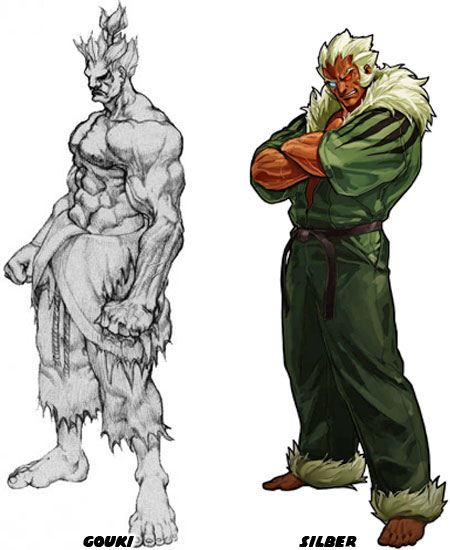
Gouki and Silber demonstrated the price that had to be paid to be two of the best fighting game bosses ever. They were willing to fight to the death at each and every encounter. Very few fighting game characters were ever written with that level of intensity. The pair were willing to kill in order to achieve their goals. The Dictator and the other bosses were willing to do the same but Gouki and Silber did not have a different agenda. They did not want to rule the world or even a small nation. They simply wanted to be the greatest fighters that had ever lived. By their definition the most lethal art proved who had true power. This took them out of the realm of bosses and made them symbols of evil.

The lack of respect that the two villains had for human life extended to themselves. These boss characters were willing to enter a fight even if the numbers were against them. They were willing to punish their own bodies, cripple their own bones and deform themselves for the sake of mastering killing strikes. Gouki and Silber had powerful bodies but gruesome expressions. Their faces were a mockery of the humanity they left behind. In the official character are they almost looked like they were wearing masks. Their features carved by a life of constant battle. The scars that Silber wore were clearly visible but Gouki's were hidden, they were scars on his soul. When Gouki killed his own master and brother he had done damage to himself that he would never be able to undo.
The pair had achieved a level of power that few could ever hope to reach in canon. Their training was so hard that no opponent was strong enough to spar with them and live to talk about it. The two had turned to nature to push themselves further. Instead of breaking rocks and trees they began fighting predators from the animal kingdom. This legend was taken from reality itself. Mas Oyama had travelled the world, defeating masters of just about every fighting style. When he ran out of people to fight he turned to animals. He would put on demonstrations of his Kyokushin karate style by fighting a bull. He would wrestle with the bull, break off its horns with a chop and then kill the bull with a punch to the head. When the bull was examined by a local butcher they would discover that Oyama had broken its ribs in several places and had actually shattered enough bone to make portions of the animal unfit for consumption. This legend evolved to make several Street Fighter characters seem as powerful in comparison and at a younger age at that!
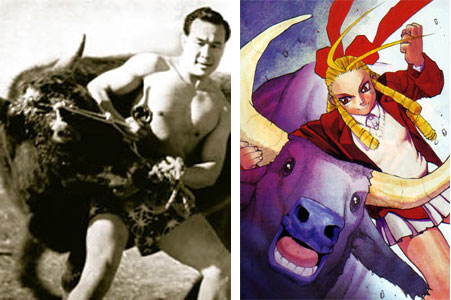
It was such a powerful story that one of Oyama's students played his master in the film Karate Bear Fighter. Sonny Chiba appeared in several other moves based on the life of Oyama. These movies and characterizations helped shape the development of Takuma Sakazaki in the Fatal Fury and King of Fighters series.
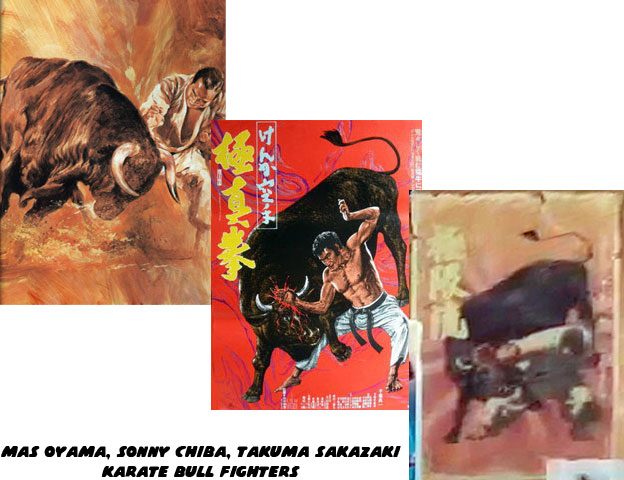
Oyama inspired millions with his exploits and made many people believe that they too could follow in his footsteps. However none have proven to be a Godhand since. This was the cautionary tale of karate, the master that never quite made it. This was the lesson and legend of Willie Williams. Some karate practitioners took Soeno's fight against a bear as a literal challenge. Willie Williams was one of those. At 6" 7" and 230lbs. of lean muscle Williams was an imposing karateka. The African-American moved to Japan to train and follow the path laid out by Oyama. He immersed himself completely in the training regiment and wanted to prove that Kyokushin was indeed the Ultimate Truth.

You can imagine that a tall black man in Japan studying karate, dressing in traditional garb, training in the traditional format was a strange sight for conservatives and traditionalists. Surely no gaijin could grasp the nuances of Kyokushin, the fighting spirit. Williams, and most Americans are want to believe that anything is possible and a form can be learned and understood by the people, not solely the Japanese. To prove the authenticity of the karate format and dispel the legends from the truth Williams and his trainers staged some fights. One pitted the man against a bear. News reporters were invited to capture contest on film.When news of this encounter reached the states a few die-hards like Willie Williams began training in the Kyokushin style to become fighting machines as well. Williams even staged a match against a bear for the documentary "The Strongest Karate."
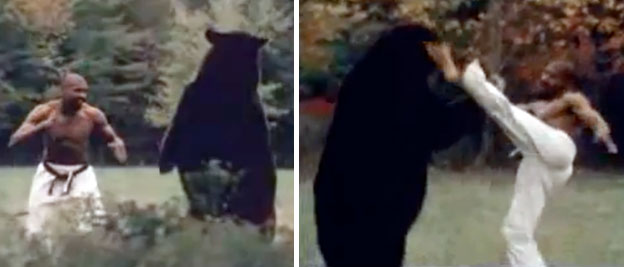
The "fight" was highly debated as the bear seemed disoriented. Critics argued that the bear was clearly drugged and possibly even declawed so that Williams wouldn't have been mauled by the animal. Despite the imposing frame that a young Williams carried his strikes seemed ineffective against the bear. The press that covered the event ended up participating is what was called nothing more than a propaganda film. Williams and his instructor, sensei Shigeru Oyama (no relation to Mas Oyama) spent a lot of time trying to prove the authenticity and effectiveness of the art. In 1980 he and Shigeru were suspended from the International Karate Organization Kyoukushinkaikan because of a fight they had participated in. Williams fought Antoni Inoki to a draw. Williams had suffered a broken arm and Inoki a broken rib. The legend of Inoki grew after the battle while Williams was relegated to the footnotes. It seemed that the best he could do was inspire characters for pop culture.

Marco Rodrguez (translated to Khushnood Butt for the US) for the game Garou, Mark of the Wolves was very closely modeled after Williams. To be fair he was inspired by William Oliver, Willie Williams and Charles Martin, the three black Americans better known as the Fighting Black Kings, from the 1976 documentary on the first world Kyokushin fighting tournament. Marco had immersed himself in the study of the fictional Kyokugen (extreme) form of Karate. This is the form invented by Takuma Sakazaki and passed onto his son Ryo and his friend Robert Garcia. Marco believed in the form as the absolute best and touted its superiority with a fanatical zeal in the game, his eyes welling with pride every time he thought about the art and his master. This level of passion, combined with his moves actually being solid, enamored him to gamers. The character worked abroad despite the double stigma of race and karate fool. Gamers were able to see past those conventions because he was a reliable karate-style fighter who played like the traditional Art of Fighting heroes even within a Fatal Fury title. Marco worked very well within the game as well as canon and wasn't simply a joke character for the sake of being a joke character.
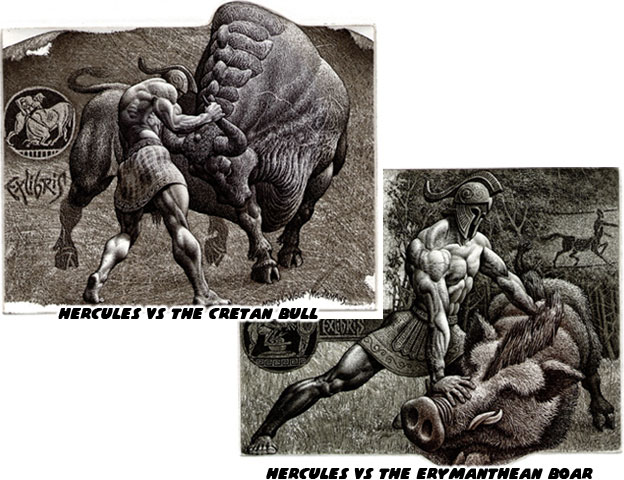
There was a world of difference between a bull and and actual predatory animal however. According to legend Oyama had once staged a battle with a bear. He did not dominate the creature and ended up fighting for his life. A version of that fight was featured in the manga and animé series Karate Baka Ichidai.The idea of a martial artist versus a wild animal had inspired many legends, but the stories themselves were sometimes inspired by actual events. In ancient tradition the heroes of a story were the ones that fought off a colossal beast. Sometimes these animals were real and sometimes they were mythical. In ancient Greece the hero Hercules was said to have wrestler both a lion and boar with his bare hands. The fabled 12 Labors included Hercules against The Erymanthean Boar, The Cretan Bull, The Nemean Lion, The Lemean Hydra and The Cerberus. These were certainly monsters perfect for a video game. Also unlike Mas Oyama the contest was not a fight for survival but a chance for the character to cement his legendary strength.
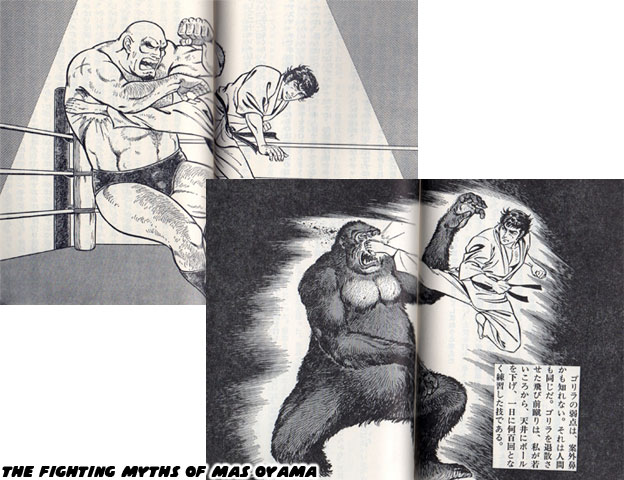
Oyama and his fans would pontificate on his karate and how it was used to defeat other fighters and other forms. Some of his lessons were based on actual encounters. He would describe in detail how his karate form was used to beat boxers and pro wrestlers from the west. These lessons would then be applied in the abstract and authors (including Oyama himself) would come up with scenarios where karate could be used against wild animals. Imagine the situation where a karate expert is ever wandering through a forest and is attacked by a wild ape. The fighter would be no match for the strength of the beast but they would be able to use their long legs to target open spots on the body. Not unlike fighting a musclebound wrestler I'm sure. The story of karate versus an ape would be used by other manga storytellers over the years. The ape would take on demonic features in many retellings and become more of a monster than wild animal when the legends became animated.
Some of the myths that Oyama shared were based on recorded history. Such as a samurai having to defend himself from a pack of wild dogs. The fighter would have to find a way to use the environment to their advantage and not allow themselves to be surrounded by the dogs. Then they would have to focus their attacks so that every strike was lethal. A miss could leave the fighter open to a counter-attack and that could be the difference between life and death. Wandering swordsmen in feudal-era Japan were sometimes targeted by bandits and these same lessons would have been used to ensure their survival. But when it came to bare handed fighting against natural predators there weren't too many success stories to rely on. Oyama had defeated bulls but he often wondered how he, or his karate form would have faired against a more aggressive predator.

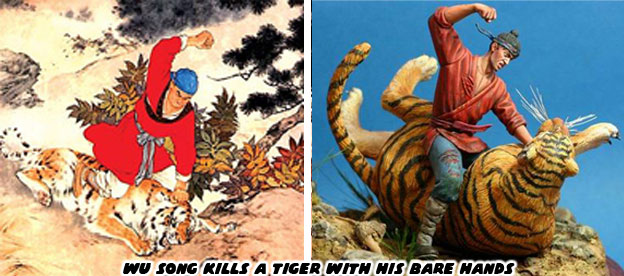
It turned out that a thousand years ago there was an encounter that could go down as something too amazing to be true. The pilgrim Wu Song was traveling through a village in China. He had stopped by an in for some rest. The villagers warned Wu that there was a man-eating tiger nearby and that it was dangerous to take a certain bridge out of town, especially once it started to get dark. After a few drinks Wu thought that it would be a good idea to take the bridge and see what happened. Sure enough the tiger was there and being courageous (or crazed with booze) Song attacked the tiger. He had a stick with him but the tiger broke that quickly. Song in a fit of rage managed to get close to the tiger and kill it with repeated blows to the head. Wu Song was a character in The Water Margin. The character was fictional but many of the men and women in the novel were inspired by actual events. It was possible that a kung-fu practitioner with more ability than sense actually did kill a tiger with his bare hands. When the writer of the Water Margin heard of the legend he figured out a way to incorporate it into the series.
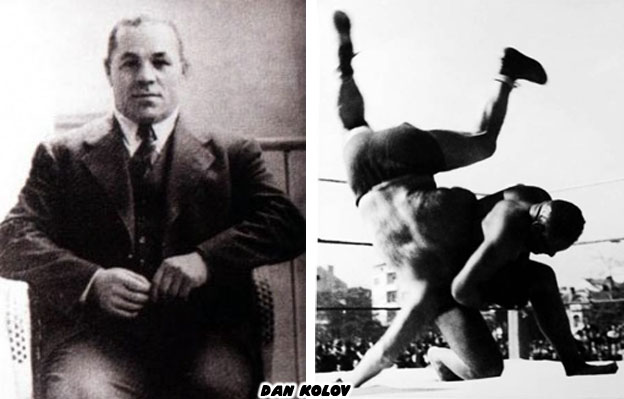
Oyama wasn't the first time that the man versus bear legend had been based on reality. The Bulgarian Dan Kolov was a wrestler and had to fight off a bear attack while he was out hunting. He lost his rifle for a moment when the bear was upon him, he grabbed and pulled at the bear with such ferocity that he pulled chunks of skin and fur off of the creature. Kolov was a self-taught catch wrestler, and circus strongman that was considered by some the greatest wrestler that ever lived. He regained his rifle after a brief struggle and killed the bear with a shot. With such a reputation he became a big draw for wrestling promoters. It was possible that the legend of Kolov had a hand in inspiring the legend of Zangief, who was known to wrestle bears in Street Fighter canon.

Domesticated bears had actually been used in some circus sideshows for over a century. The bears would usually only "wrestle" their trainers, because they were comfortable with them. Bears felt like they were playing and not actually fighting. In some rare cases a circus might let an audience member try to wrestler a muzzled bear. The bear would usually knock the person over and sit on them easily to end the match. But every now and then a story would come out where a person got the upper hand. This was the inspiration behind the Australian folk song about William Sinclair who defeated a bear in a match in Queensland.
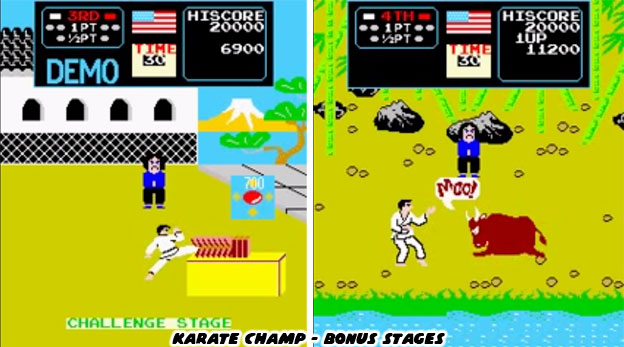
It's easy to imagine that a version of these man-vs-beast myths could end up shaping the development of various fighting games. In the early days of the genre the developers did not have to go very far to bring the legends to the game screen. In Karate Champ the designers at Data East introduced a bonus stage that had fighters kicking stacks of tile. Oyama and his karate predecessors had often given breaking demonstration to audiences wherever they went. Sometimes they broke stones, bricks and blocks of ice. Karate Champ was the first fighting game to feature the bonus level and even had players take out a charging bull with a punch or kick.
As the developers got more comfortable with the genre they began experimenting with enemy types. The early fighting games had masters of various fighting styles competing against each other. After the studios ran out of identifiable forms they started throwing in monsters, animals and even robots and aliens to keep the genre interesting. A tiger, giant falcon, and even shark would be included in Fighting Layer, a game developed by former Street Fighter II designers.

In Battle K-Road the secret boss was named Mr. Bear. It turned out to be an actual grizzly bear and was among one of the most difficult opponents in any game. The game was over-the-top as one could imagine but it retained some charm. These types of encounters would not have been acceptable in the genre if not for people like Oyama and Kolov who actually fought the beasts and lived to tell the story.
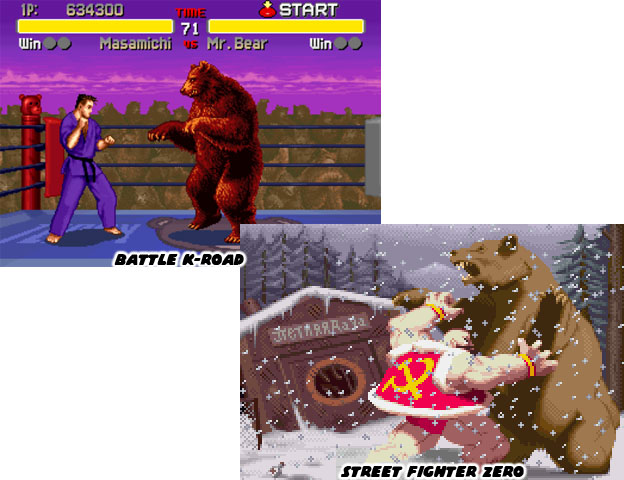
Gouki and Silber should not be confused with the previously aforementioned legends. They did not spar against wild animals with their bare hands, they hunted them down. The two could not only dominate the other fighters that they came across but also the biggest and strongest creatures in nature. In canon Gouki had killed a large bear that was the terror of a nearby forest. A young and inexperienced Ryu went out trying to kill the bear himself but was almost gutted by the creature. Gouki jumped into the fight and punched a hole through the head of the bear. He did not do it as much to save the life of Ryu but to warn him there were things in the world that should be feared and respected more than any animal.

In a similar fashion Silber traveled the globe putting down the animals he tested himself against. He showed little mercy for the other fighters he faced and was willing to put them out of their misery as well. Silber seemed to relish in his power and technique. It had been speculated that the fur on his uniform was taken from a polar bear he had killed and not from a wolf. Few aside from Silber himself knew what points around the world he had visited. Gamers were left to believe that he had wandered into the frozen arctic looking for a new challenge and had returned with the pelt after finding no suitable opponent.
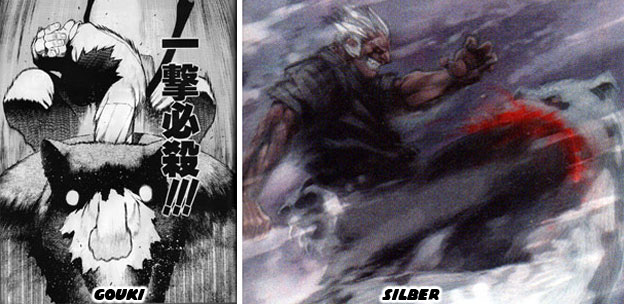
Gouki and Silber were fantastic character designs from Capcom and SNK respectively. They commanded the attention of the audience and held their interest throughout the battle. Each time they appeared in game they were treated with the same sense of awe and respect. Although they were powerful bosses and seemingly superhuman fighters they were not cheap characters from a balance perspective. They did not have attacks that were overpowered or could defeat a player with one or two hits. Even the Shun Goku Satsu at the most took 2/3 of an opponents energy and not the entire health bar. Every character in the game stood a chance against these villains provided that the player were willing to play aggressively and make few mistakes.

The physical appearance and attacks of the two bosses made them stand apart from the cast and even other villains. Yet there was a point where villains were too powerful and too evil for the genre. When pushed to the extreme ends the evil characters could break the suspension of disbelief from the gamer. Gouki had one such makeover in Street Fighter IV. It turned out that Gouki or even Shin Gouki (the white-haired variation) were not the most powerful incarnation of the character. A third form known only as Oni or Demon in Japanese was introduced by the SF IV designers. Oni was the manifestation of the Dark Hadou, or evil power which Gouki possessed, or rather which had possessed Gouki. The character grew long, spiky white hair, and a large underbite like an ogre with small tusks protruding. His skin even went from clay-colored to blue. Gouki no longer had the elements of a humanized lion but instead the wholesale appearance of a Nio, or protector of the underworld.
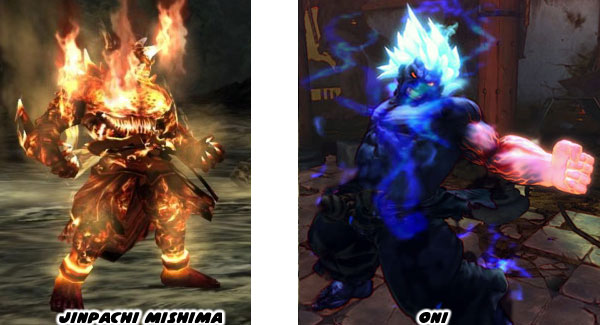
In Tekken a similar character had been unveiled as well. Jinpachi Mishima was a warlord and founder of the Mishima clan. He had spent a few decades locked under the Mishima castle. It was a sentence in Hell but Jinpachi had become so powerful that he broke out and returned to the real world. Oni and Jinpachi were so overpowered that seemingly no other character in the series could have even hurt them. Capcom had ignored all of the elements that made Gouki such an interesting character. They moved right into the realm of the absurd with Oni. The same thing could be said for Namco and the Tekken universe which Jinpachi now occupied. The two studios had been skirting the line between what was good character design, what was bad and what was simply pandering to the masses. Before Oni and Jinpachi the major challenge for the studios was showing gamers the creation of a villain right in the middle of a series. The next blog will look at how Capcom used the template of Gouki to rewrite the Street Fighter mythology. As always if you enjoyed this blog, and would like to sponsor me please visit my Patreon page and consider donating each month, even as little as $1 would help make better blogs and even podcasts!
follow the Street Writer on Patreon!

Tuesday, July 7, 2015

Representation Matters! Or, what happened to Birdie, part 4...


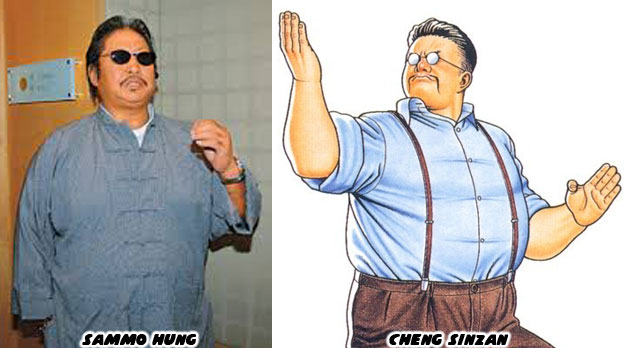
The characters in fighting games are rarely based on mythological figures. Instead they are based on real fighters, comic book characters or actors. Fat martial artists are few and far between. The most popular and longest-lived template for fat fighters is Sammo Hung. The writer, director and actor from Hong Kong broke into cinema at a young age. His talents behind the camera are nothing compared to his knowledge and experience in the martial arts. He was trained as a child in the Chinese Drama Academy, where performers learned what it took to appear in the Chinese Opera. He learned various forms of kung-fu as well as tumbling and working with weapons. The lessons were brutally difficult, children were made to do handstands and splits for hours on end, they would be disciplined with caning for being disobedient. Many would consider the training to be nothing short of child abuse. Sammo made it through and became an exceptional performer and choreographer. He was developed alongside people like Jackie Chan and Yuen Biao, whom also became martial arts superstars. There was a dramatized retelling of what they had gone through in the film Painted Faces. Sammo actually played an instructor in the film and said many things that happened to him growing up were much harsher than what the film depicted.


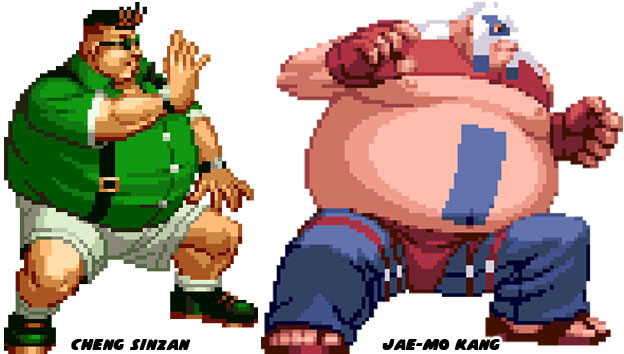
The first fighting game to feature a character modeled after Sammo was Fatal Fury 2 in 1992. Cheng Sinzan was a businessman and expert martial artist. He was fast, as Sammo was, had an assortment of great kung-fu attacks but was always played up to be slightly funny. Sammo was known for his comedic timing. As great as he was in a fighting scene he always found a way to get in a visual gag, usually at the expense of his weight. It was no different for Cheng. He sweated profusely and could be seen wiping his forehead with a handkerchief in between rounds. Cheng got fatter when he turned up again as a non-playable cameo in Fatal Fury 3 and then as a playable character in Real Bout Special. Each time he came back he was fatter than the last time.

The same trend happened to other fat characters in fighting games. They became extraordinarily large, more so than average people. Sammo was always what we would consider "chubby" but he was nowhere near as fat as the in game versions of Cheng were. This was something that character designers and animators learned to do as the genre evolved. It did not matter what form of fighting that a character practiced. They had to have very exaggerated proportions. This was something that worked well in comic books and manga. Gamers would be less likely to watch two average-looking people in a fight, on television or in the comics. If instead the karate guy had torn sleeves to show off bodybuilder-like biceps and the female kung-fu expert had a short dress to show off her long shapely legs then it would be much more appealing.


By the same process the fat characters could not be slightly overweight in games or comics, the had to be morbidly obese. Cheng was only the tip of the iceberg. As other studios got into the genre they began pushing the envelope on what was possible. Those with muscles became extraordinarily swollen, female characters became bustier, and fat characters became almost perfectly round. Such was the case with Jae-Mo Kang, the Korean pro wrestler from the 2002 game Rage of Dragons. The game was set in an anime-like version of the Double Dragon universe. The developers at Evoga avoided the continuity from the previous Double Dragon fighting game. Kang was strong but not meant to be taken as seriously as Burnov.

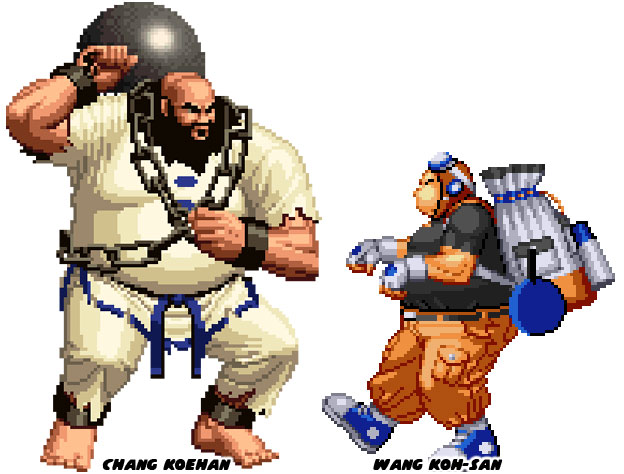
Fat characters were beginning to find their stride through the late '90s and into the '00s and they were supposed to be funny. Any great elements that Sammo had given his roles, anything he meant to the martial arts was completely lost. Heaven help the player if they actually liked or even identified with the fat characters. They were not meant to be seen as stars of the games. In 1994 SNK launched the King of Fighters series. It would become the longest-lived and most popular tag team fighting franchise. The Taekwondo star of the game, Kim Kaphwan needed two partners to round out the Korean team. The designs given to his partners were lackluster. One was a short criminal, Choi Bounge, with claw gloves and a fedora. He looked like a tiny Freddy Krueger from the Nightmare on Elm Street movies. The other was a tall but obese criminal named Chang Koehan. Kim was trying to rehabilitate the pair. Chang was oafish, swinging and enormous ball and chain at his opponents. He lacked appeal and would appear on and off with the team.


Taking a page from the Cheng Sinzan school of funny fatties was Wang Koh-San. The chubby character was introduced in the Art of Fighting 3. The character was a cartoonist that was in the tournament. He seemed outfitted for a long time on the road with all sorts of camping gear attached to his backpack. In the sack there was a pelican that would pop up from time to time. Not only was the character fat and funny but he even had a wacky bird sidekick. If this was a Hanna Barbera cartoon from the '70s then it would have been a hit. In fighting games players were just left scratching their heads.

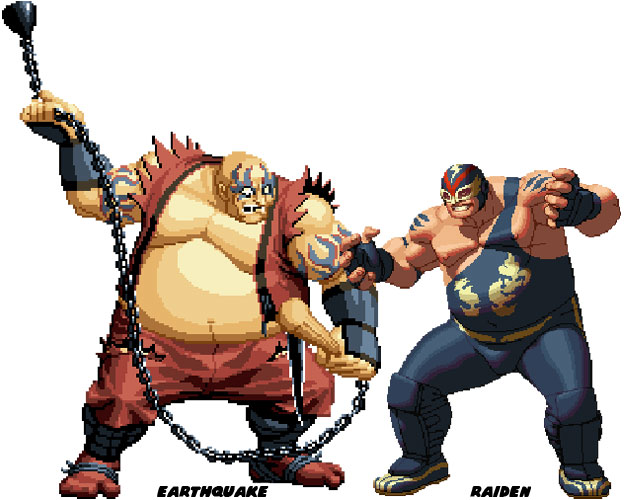
SNK had started a tradition of having morbidly obese people serve as comic relief as far back as 1993. Earthquake in the game Samurai Spirits / Showdown was an American ninja. He was massive, at the time being one of the largest sprites ever created for a fighting game. The character took up almost a third of the screen. He was fat and gross too. Farting on opponents and eating turkey legs that he kept stashed away in his belt. Yet despite these things he was a very fresh design. He had tattoos, and face paint, he was colorful and brought attention to himself. This was the opposite of what most people thought of when they heard that he was a ninja. Despite his size he was able to move quickly, disappear in a puff of smoke and fight with some unique attacks. Earthquake was meant to represent greed, he wanted everything in excess and was looking for the fastest way to get rich, which was why he was so big and fat. He was actually balanced out by another American ninja named Galford. Galford had stayed on the true path set by his masters and was therefor young and handsome. Despite his gross aspects there was not another obese character that was as memorable as Earthquake.


In 1991 Fatal Fury debuted. Created by the planner behind the original Street Fighter it was a new take on the genre. Players could jump between the foreground and background and even team up against opponents. One of the villains (that later became a hero) was a pro wrestler called Raiden. This character was large and heavy-set. But he also had some high flying maneuvers despite his size. He was never as fat as any other character in the SNK universe but always carried around a gut. He was actually modeled after pro wrestler Leon "Big Van Vader" White. Tetsuo Hara used Vader as the basis for Sheep the Royal in Muscle Bomber. Vader came on the heels of Abdullah the Butcher but because he was a bit more athletic he suck around for some more high profile rivalries in promotions. Vader was a huge American wrestler that found a great deal of fame in Japan. He had crazy matches against the biggest bruisers of the era including one against Stan Hansen where he had his eye poked out of its socket. Vader also carried around a belly but was backed up by some big muscles as well. Huge wrestlers like Vader, Abdullah and host of others greatly influenced the development of characters in wrestling games, brawlers and fighting titles. SNK did a good job of experimenting with fat body types in many of their games but tended to side as the fat as funny stereotype. 

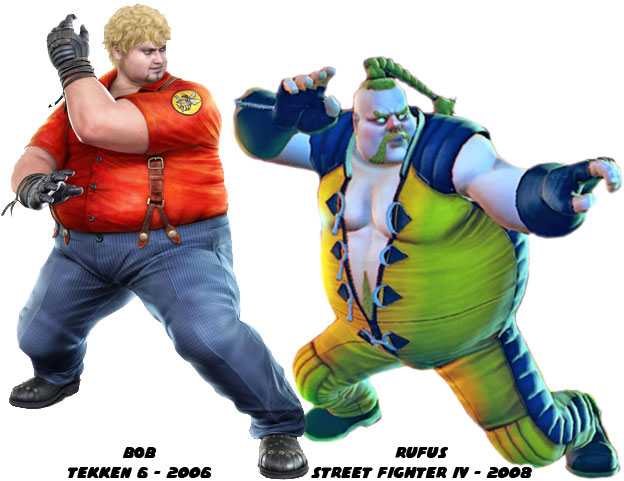
Other studios followed the trend and would only pull out the fat character if they could get a joke out of it. This reality came to a head in 2006 with the release of Tekken 6. The Tekken series was one of the fighting games that actually kept pace with the Street Fighter in terms of sales and popularity. It set itself apart from the other titles because it was one of the first 3D fighting games. The designers of that series and head producer Katsuhiro Harada had introduced dozens of characters into continuity. Many were from around the world and there was even a diverse mix of female characters as well. The game had always combined the fantastic as well as science fiction, cyborgs, mutants angels and demons were all within canon. The reality it was based in was only loosely grounded and this was the understanding that audiences were expected to accept when Bob was put in the game. Bob was a great fighter but he felt that it took too much effort to defeat opponents. He decided that he could do better in tournaments if he had some extra weight behind his punches and kicks. He bulked up and became about three times as heavy as he used to be.


It was strange watching Bob in the game, not because of his size but because how fast he moved. Despite his girth the character was blindingly fast. But that speed also made him look weightless. The graphics engine was very powerful. It was capable of rendering flowing hair, accurate shadows and reflections as well as clothes that bunched and folded realistically. It even put a little bit of jiggle in Bob's belly fat. The illusion of a three-dimensional figure was broken each time he attacked. Bob was so fast that he simply appeared unrealistic.

Yoshinori Ono must have had a strong reaction to Bob because a few years later he announced a new character to debut in Street Fighter IV. Many game players were hoping for something as unique and memorable as the figures in Street Fighter EX, Street Fighter Zero and Street Fighter III. The new character was memorable but for all the wrong reasons. Rufus took a page from Bob and the developers went even faster with his moves and attacks. His gigantic belly would sway underneath his jumpsuit. Both Harada and Ono had put a fat character in the game because it was funny. They did not mean to be more inclusive of different body types. I mean could you imagine how absurd it would be to see a serious fat person in a game? Fat people were not heroes, they were social outcasts. It was obvious in public and reinforced in media.


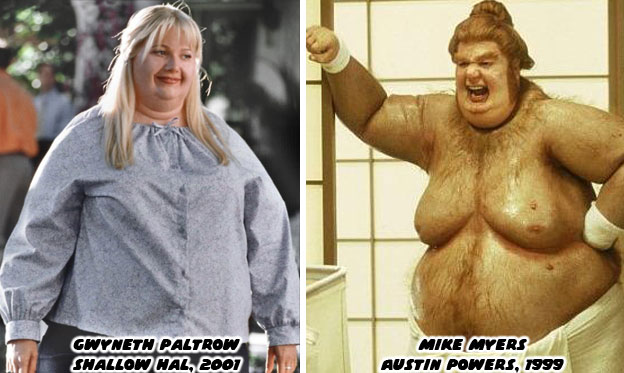
Makeup artists had been making people appear fat since the days of black and white movies. But when newer techniques allowed them to create lightweight "fat suits" then Hollywood began looking for ways to exploit the technology. Comedians Eddie Murphy and Martin Lawrence used fat suits in films to lampoon fat stereotypes respectively in the Nutty Professor and in Big Mama's House. Mike Meyers had a recurring character called Fat Bastard from the 1999 film Austin Powers: the Spy Who Shagged Me. The hit man had an unmistakable presence and was meant to be gross and disgusting. But as audiences discovered there was an underlying sadness to the character this gave him much more dimension than simply writing gag after gag on how fat he was. In his final appearance Fat Bastard had lost his weight and had become much happier with himself.

A similar lesson lesson on sympathy and understanding was learned in the Farrelly Bros. Comedy Shallow Hal from 2001. Gwyneth Paltrow played Rosemary Shanahan and she couldn't find a person to accept her for who she was. Jack Black played Hal Larson, a womanizer who gets hypnotized by life coach Tony Robbins into seeing the inner beauty of people instead of the physical ideals of beauty. Hal realizes that Rosemary is the person he'd been looking for all his life. Both films were comedies and both relied on fat as the punchline to many jokes. Characters like Bob and Rufus appeared later and were simply reinforcing that stereotype.


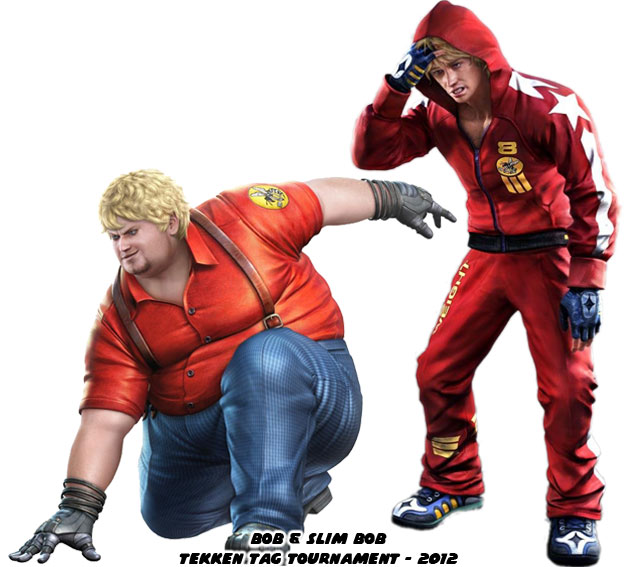
Bob actually had a physical transformation over the years. He lost his weight and by 2012 was back down to his original size. Of course the Tekken team could not allow the character to be quite happy with whatever size he was. Since he had lost the weight it required more effort for him to win battles. He was left tired more often and wondered if his weight loss was worth it. Fat people couldn't catch a break even when they were no longer fat.

What really irks me about the direction of Street Fighter IV and V were how fat was being used as a punchline as well. It was cheap, it was demeaning and it took away from the elements that made all of the other characters great. I've mentioned it before but it bears repeating now more than ever. The designers on Street Fighter IV and V are putting a priority of visual gimmicks and pandering to stereotype rather than great character designs. We could start with Rufus and work backwards. In doing so we could spot a trend. That trend sadly leans towards racial bias and I would even say racial exclusion from Street Fighter.


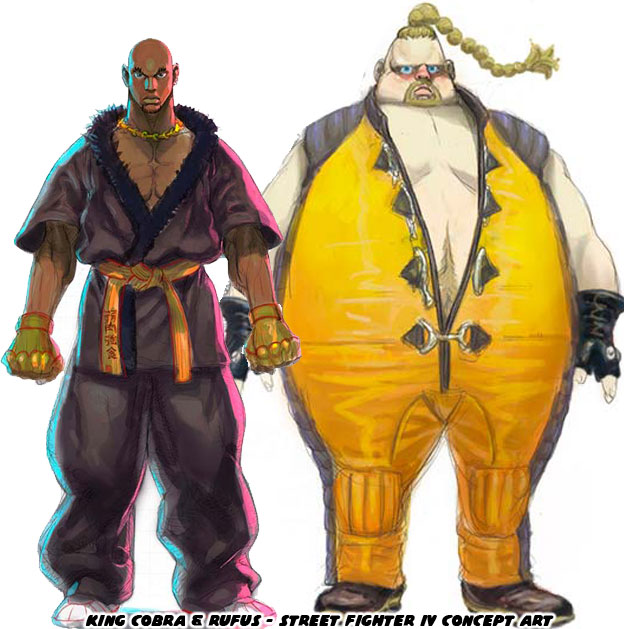
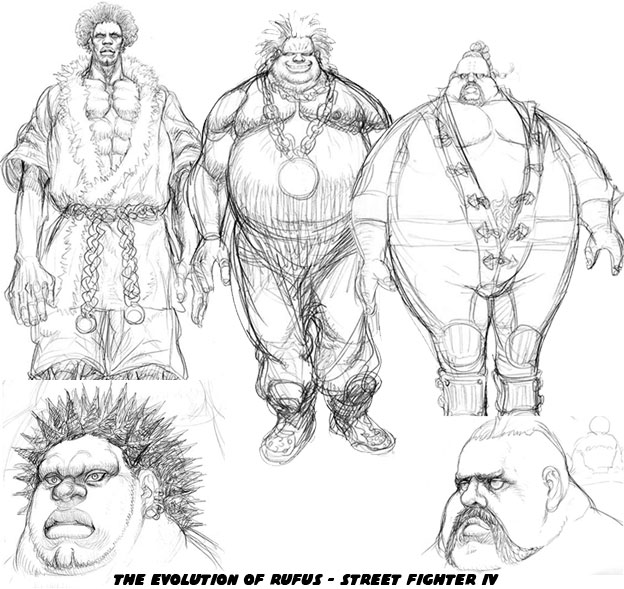
Many people that read my blogs know that the fat white Rufus was not the original choice as a new character in Street Fighter IV. Instead he was going to be a young black man named King Cobra / Black Cobra. The character was in pretty much the final stages when Yoshinori Ono went in a radically different direction and pushed the team to put a "fatty" in the game. All of the great elements of Cobra were gone and in his place there was a tub of jelly that was insanely fast and had moves perfect to counter most every other character in the series. We can actually work backwards and see who Rufus was based on and how radically different he was in the early stages.


Rufus was meant to be the ultimate rival to Ken. The team realized that Ryu had a great rival with Sagat but after 20 years there was not somebody for Ken. The designers wanted players to see a character that was both physically imposing and could be a genuine threat to Ken. They knew this character had to be bigger-than-life, just like Sagat. They also considered making him a minority similar to Sagat. In the planning stages Rufus was a tall, heavy set black man with subtle gangster features. He had high top sneakers, a thick gold chain and pointy dreads. The fat gimmick got more and more pronounced the closer he came to Yoshinori's vision of a fatty. But if you go back far enough you can actually find a character that met the original plan and wasn't fat or silly at all.

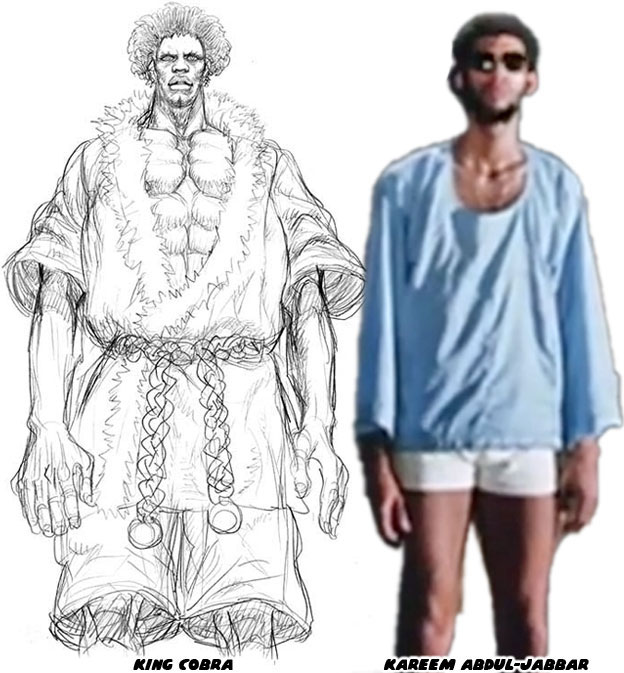
The first thing that made rivalry between Ryu and Sagat important was the size difference between the two characters. Ryu was almost six-feet tall but Sagat was about a foot and a half taller. King Cobra would have been at least as tall if not taller. The earliest version of this figure was tall and lanky. He actually looked like Kareem Abdul Jabbar, the basketball player and friend of Bruce Lee. Kareem played the final opponent in Lee's last film the Game of Death. The second thing that made the classic rivalry important was the techniques that each fighter possessed. Ryu studied karate which was considered a very refined form of self defense and required tremendous self discipline to master. Sagat studied Muay That which was an older system that was designed to hurt, maim and kill opponents. It was an art that required people to be very aggressive and tough. The two styles clashed against each other perfectly. Ken's opponent would have been a tall black man that was a master of a certain form of karate. Perhaps having two forms of karate was a bad choice and the designers began looking elsewhere.


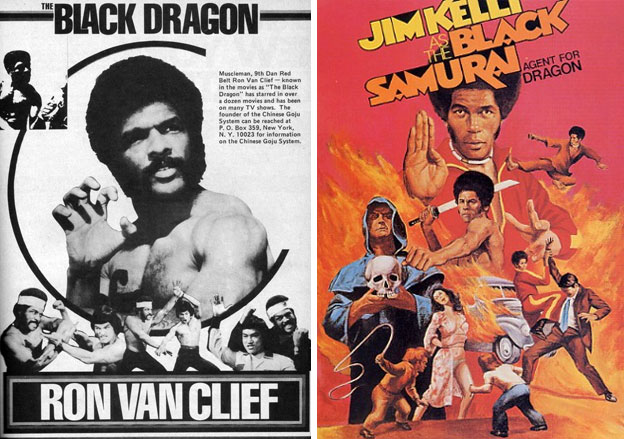
A few of the early US martial arts stars and tournament champions were black. Ron Van Clief, master of karate and several forms of kung-fu was nicknamed "The Black Dragon" and karate champion Jim Kelly starred as the Black Samurai. They were both martial arts pioneers and friends of Bruce Lee. They were well versed in various forms of fighting and this was apparent when they performed on film. What was terrible for the duo was that they could find work in Hong Kong cinema yet be denied many opportunities in the USA. If they performed in a US film they were usually the "Blacksploitation" kind. The two overcame many hardships because of the color of their skin. Things were especially hard for Van Clief. When he joined the Army and was sent to the South to train he was lynched by his fellow enlistees. He barely survived the attack and had to deal with racism both in and out of uniform. Racism was very strong in many parts of the country and that animosity exists to this day.

When I think of a missed opportunity to put in a powerful black karate fighter I think about how blacks had become caricatured in the genre. Just as everything great about Sammo Hung had been stripped away when creating fat characters in the genre. The only thing that Japanese studios seemed to remember from the early black martial arts appearances were the afro and sideburns worn by Clief and Kelly. The developers had reduced black fighters to a trope. It was seen with Tiger Jackson from Tekken, and Mr. Jones from Rage of Dragons. The black fighters in modern games still wore afros, sunglasses and bell bottom pants as if they were perpetually locked in the '70s.


Another questionable approach to the design and purpose of Rufus was how stupid he was. In canon Rufus was incredibly dumb, taking an obvious jab at the Fat Dumb American stereotype. He was so dumb that he could not even identify Ken if they crossed paths, which they did several times. I mean how great it is to have an arch-rival for Ken that is too stupid to spot him in the same room? It's genius planning I tell you! I doubt and sincerely hope that the black rival would not have been presented as stupid.

Imagine what would have happened to Sagat if he couldn't remember what Ryu looked like. His purpose in the series and reputation would have been greatly diminished. Karate could have very well been assigned to Cobra and it could have been a form unique to the Street Fighter universe. But seeing as how the Japanese developers didn't really know much about black fighters then they made things up. In the design notes Cobra actually used "Breakdance Kung-Fu." It seemed as if the Japanese developers could never take blacks seriously as being masters of karate.


Miscasting a minority was nothing new to Japanese developers. Characters like Sean from Street Fighter III and Marco Rodriqguez from Garou: Mark of the Wolves, while popular, were not meant to be taken seriously. They were not supposed to be stars of the games. Instead they were supposed to be overzealous proponents of the fighting art. They were too enthusiastic for their own good and that lesson was seen in their respective endings. Sean would never become as great as Ken. Marco would never become as great as Ryo Sakazaki. Their roles were subservient, it's quite possible that the designers never thought about the statement they were making through these characters.

The thing about history was that blacks were an important part of the evolution of karate. Karate champions Willie Williams, Jamie Oliver and Charles Martin were the subject of the documentary The Fighting Black Kings, set during the 1st Kyokushin (the form founded by Mas Oyama) World Karate Championship. They were the basis for Marco but they were not the only black fighters that influenced the Japanese designers. But I am getting a bit off of the subject. Fat characters were put into fighting games because they were funny to look at. When presented with a choice as to put a strong black character in Street Fighter or put a fatty in Street Fighter the director chose the latter. This is what drives me insane about the people that worked on Street Fighter IV and the people working on Street Fighter V. Each time they make a design choice for a new character it always seems to be the wrong one. It always seems to degrade the character if not devalue the art being depicted. This was a problem that went all the way back to Street Fighter II, however Capcom was able to overcome some potentially disastrous choices. We will look at these things in the next blog. As always if you enjoyed this blog and would like to sponsor me please visit my Patreon page and consider donating each month, even as little as $1 would help make better blogs and even podcasts!