Showing posts with label garou mark of the wolves. Show all posts

Friday, December 13, 2024

Freeze frame, my poster collection, part 20…

It turns out that my fighting game posters are not limited to Capcom. I also want to celebrate their friendly rivals at SNK as well. One of my favorite games is the Samurai Spirits / Showdown series. If you are looking for posters from the SNK franchises then I would suggest tracking down issues of NEO GEO Freak from Japan. They often came with a poster. There are a few issues that I’d like to get still, but if, and when I do I’ll blog about it in the future.

I’ve written about the genius of SNK’s art team on the blog, especially the brush style used by the Samurai Spirits illustrators.

Samurai Showdown II was ranked one of my favorite games of all time. If you’ve never played it then please try to track down a copy in an anthology.

Garou Mark of the Wolves is one of the most underrated fighting games in the history of the genre. Thankfully it is getting a sequel decades later.

I love the SNK posters that I have, and I’d like to add a few more. I’ll never get as many as the Capcom posters I have, but it’s always work trying. Do you have any favorite SNK games or posters? I’d like to read about it in the comments section. As always if you would like to sponsor me please visit my Patreon page and consider donating each month, even as little as $1 would help make better blogs and even podcasts!
follow the Street Writer on Patreon!

Sunday, April 28, 2024

The return of a wrestling icon in Fatal Fury City of Wolves

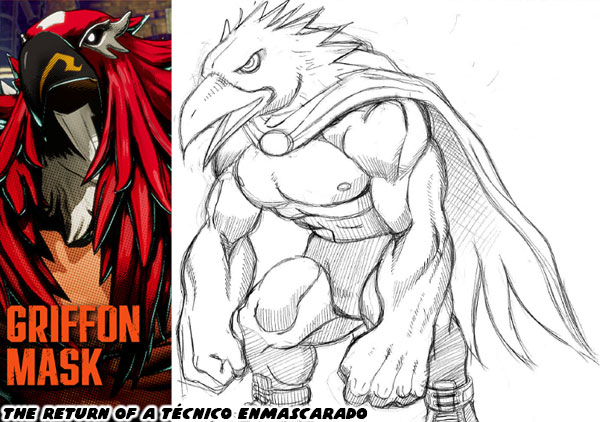
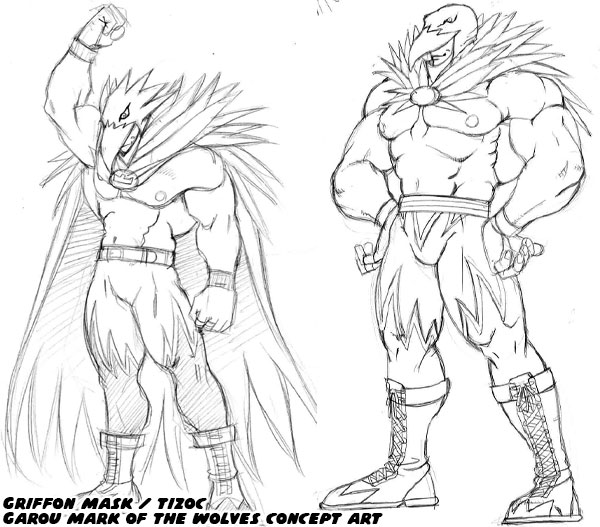
Yesterday the blog looked at some concept art from Garou Mark of the Wolves (1999) thanks to some scans that my friend Zero shared with me. We saw how some character designs evolved. Some characters were dropped, and some ended up being the blueprints for brawlers that would turn up in the King of Fighters series. One of the returning faces in the Garou 2 / Fatal Fury City of Wolves was a masked wrestler that went by the name of Griffon Mask / Tizoc. He was easily one of my favorite pro wrestling characters in a video game. He captured the essence of lucha libre better than 90% of the masked wrestlers in any other title.

There were layers to his design that were important to fans of the sport. Even if you knew nothing about pro wrestling you could tell he was an interesting character, with a unique move set, and his own personal reason for fighting. For die-hard fans of lucha libre his design, and inclusion was profound. There were a lot of differences between the pro wrestling featured in the USA, and in Mexico. I’m going to give you a light overview today, but if you want a deep dive I wrote a comprehensive history of lucha libre on the blog many years ago. Wrestling in Mexico is called lucha libre, literally “free fight” or “freestyle fighting.” Not every luchador or wrestler wore a mask. That was a misnomer. A masked wrestler in Mexico was called an enmascarado.

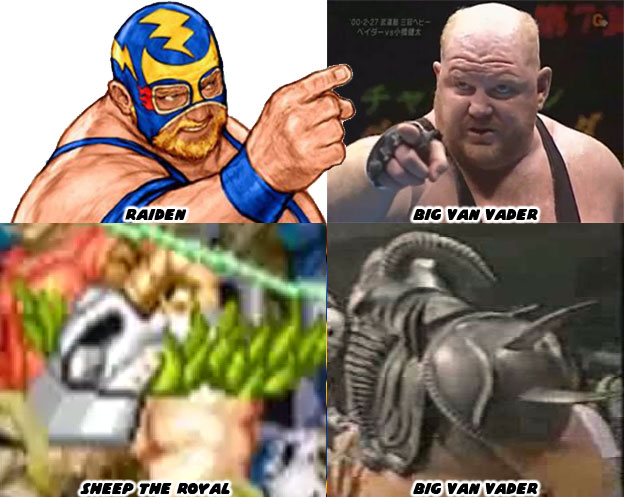
The good guys were referred to as técnicos, literally technical wrestlers. They obeyed the rules of the sport, and practiced good sportsmanship. The villains were called rudos, literally rude, rough, or rugged fighters. They were expected to use dirty tactics, and cheat at every opportunity. It was up to the técnico to beat them fair, and square. It was a challenge never to stoop to their level. There were both good guy, and bad guy enmascarados. They represented a literal battle between good, and evil. In the King of Fighters universe Griffon Mask was among the best of the técnicos. He had no intention of entering the KOF tournament but was recruited by a boxer named Vanessa. Griffon was on the opposite end of the spectrum of Raiden, the heel, or evil masked wrestler that appeared in the original Fatal Fury from 1991. Raiden was based on Leon White aka Big Van Vader. Mr. White (R.I.P) was hugely popular in Japan in the ‘80s, and ‘90s. He influenced the creation of Raiden, as well as Sheep the Royal / Alexander the Grater from the Muscle Bomber / Saturday Night Slam Masters (1993) series by Capcom.

Griffon Mask was the definition of a babyface, or face for short. These were the good guys. He was a noble wrestler, and he fought for all the right reasons. He was actually a mentor to young poor kids, and using his winnings to help orphans. This was a trait shared by King from the Tekken (1994) series. The stories of masked wrestlers fighting for orphans was based on the true story of Fray Tormenta (Friar Storm). He was a monk that would wrestle while masked in order to raise money for the orphanage he ran. His legend changed the perception that Japanese fans had of masked wrestling. He would inspire the creation of some great fighters. The teams at Namco, and SNK seemed to have a profound respect for the sport. By comparison I was not happy with how the developer at Capcom took away the elements of lucha libre, and replaced them with cooking gimmicks for El Fuerte in Street Fighter IV (2008).

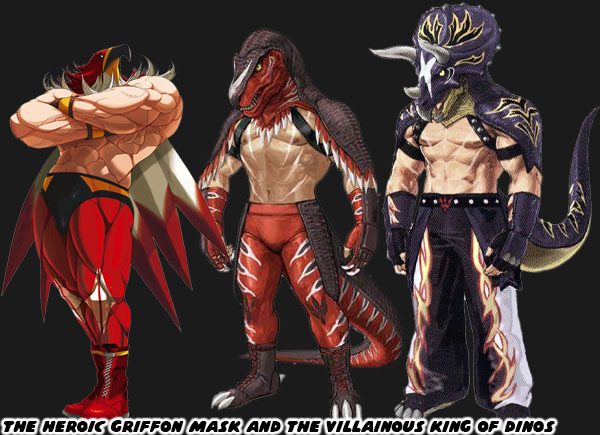
In the King of Fighters XIV (2016) Team Mexico featured a new character. Joining fellow pro wrestler Ramon, and Angel was a new enmascarado named King of Dinosaurs. This guy had a similar build, and move set to Griffon Mask. He was however a rudo. Ramon, Angel, and several other competitors in the tournament knew he was actually Griffon but played along in order to preserve “kayfabe” or keep audiences from discovering the truth. The reason for his change in demeanor was because he had been beaten by a young boxer named Nelson. In order to get even he was willing to fight dirty in the tournament. He didn’t want to let any of his fans down so he created a new persona, and mask by extension. I had written about Nelson, the boxing phenom with vitiligo previously on the blog.

I’m glad that Griffon was back to his good guy identity. I wondered if Vanessa had something to do with this, or if it would be addressed during the story mode. I was eager to see if he was going to have a new rival in Fatal Fury the City of Wolves. It would be great if Raiden, or a new rudo debuted in the sequel. What do you think of this character? Were you ever a fan of pro wrestling, or lucha libre? I’d like to hear about it on the comments section. As always if you would like to sponsor me please visit my Patreon page and consider donating each month, even as little as $1 would help make better blogs and even podcasts!
follow the Street Writer on Patreon!

Monday, August 15, 2022

Garou Mark of the Wolves, the manhua part 2

The first half of the Garou Mark of the Wolves manhua from 1999 was a retelling of the events of Fatal Fury. They gave audiences the history of stars Andy, and Terry Bogard. The villain Geese Howard, his relationship with half-brother Wolfgang Krauser, and estranged son Rock Howard. We also get to see several other major players from FF canon including Joe Higashi, Raiden, Mai Shiranui, Tung Fu Rue, Billy Kane, and Yamazaki.

The first few issues had Rock as a kid, and the later issues had him as a young adult. With the rise of new villains like Grant, and his uncle Kain R. Heinlein founding a new KOF tournament Rock is drawn into battle. He has grown as a fighter, and no longer wants to run from his legacy. He feels that he is ready to confront his past, and question his uncle.

Since a decade has passed since we last saw Rock, and Terry it stands to reason that the rest of the cast has also grown, and matured. In the first few issues Ryo Sakazaki was chasing down Geese Howard, and an actively fighting in Southtown. However his father Takuma had retired from teaching his patented Kyokugen “extreme limit style empty hand” form of karate. Ryo was the new master of the dojo, and helping keep the family business alive. He didn’t really venture out of the school.

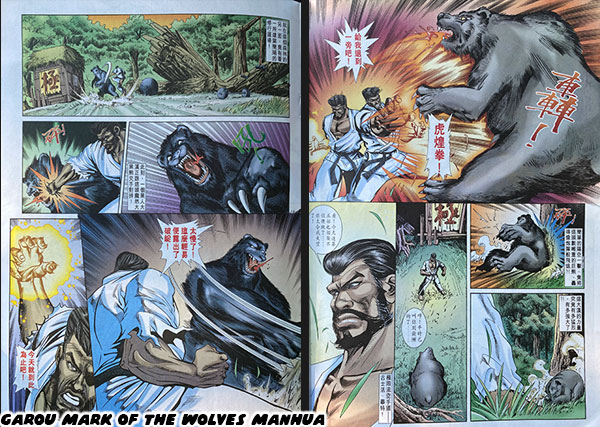
Marco Rodriguez aka Kushnood Butt raids the Sakazaki dojo with some thugs, trying to prove they were the best fighters. Ryo annihilates them, and Marco becomes a convert to the school. He spends the next decade studying under both Takuma, and Ryo. We see him now as a black belt. He’s practicing in the woods, and fighting a bear, a nod to the legendary exploits of Mas Oyama, and Willie Williams.

He crosses paths with an older Terry Bogard, and gets into a fight with him. The issues do not spend too much time with the rest of the cast, but at the very least they do get an introduction. This includes Kevin Rian, Hokutomaru, and B. Janet. Their purpose for entering the Maximum Mayhem tournament is explained. Grant is introduced as the big baddie of the tournament, and Terry gets into a fight with him.

The series ends after the introduction of the major players, and how they changed over the years. It doesn’t actually cover the events of the tournament. Which I think is actually the best way to tell the story of a fighting game. When you spell out each, and every battle you end up forcing the canon into a very specific direction, which may, or may not be the intent of the developers. Instead the writers of the manhua let the audience meet the cast. Show some of their backstory. Let a few non-tournament battles take place, and allow the game players to explore all the possibilities, and outcomes in the game.

With the announcement of Garou 2 I can only hope that there is a manga series, and possibly manhua series in the works as well. Either way I am eager to see how the game turns out. It will be about 24 years after the original came out in arcade. The generation that remembers it now has children, and even grandchildren that want to experience the game.

What about you? Are you eager to find out what happened with Terry, and Rock? Do you hope the game is sprite-based, or will you be happy if its 3D? Is there a character you look forward to playing as? Please let me know in the comments section. As always if you would like to sponsor me please visit my Patreon page and consider donating each month, even as little as $1 would help make better blogs and even podcasts!
follow the Street Writer on Patreon!

Friday, August 12, 2022

Garou Mark of the Wolves, the manhua part 1

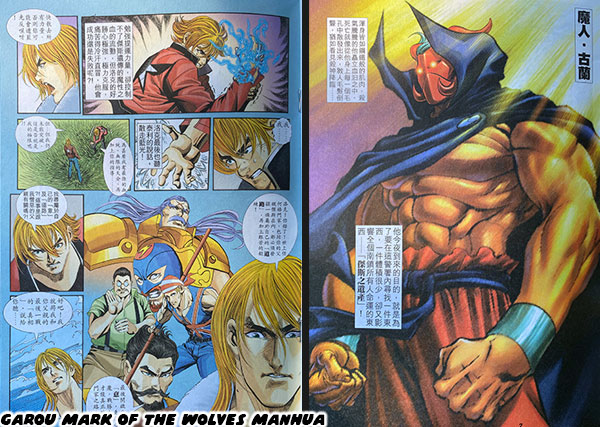
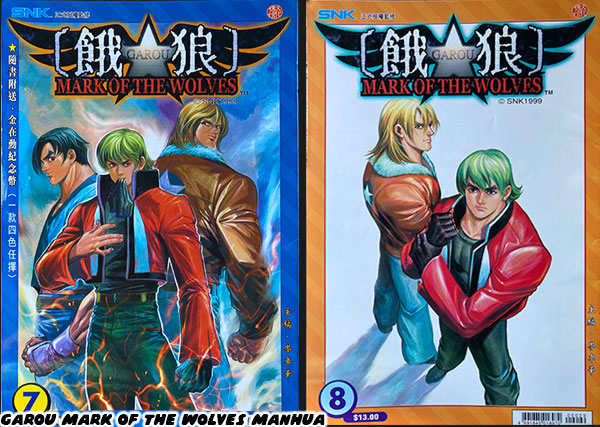
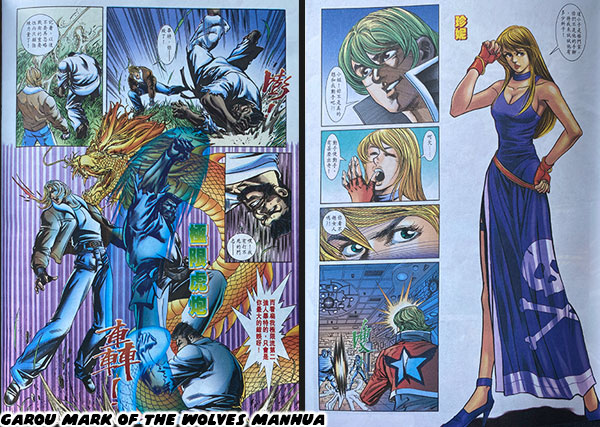
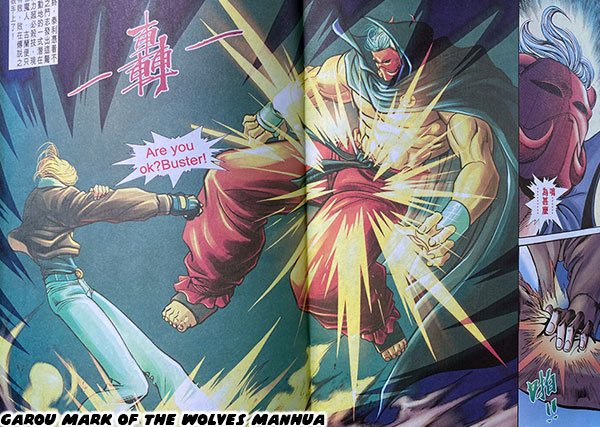
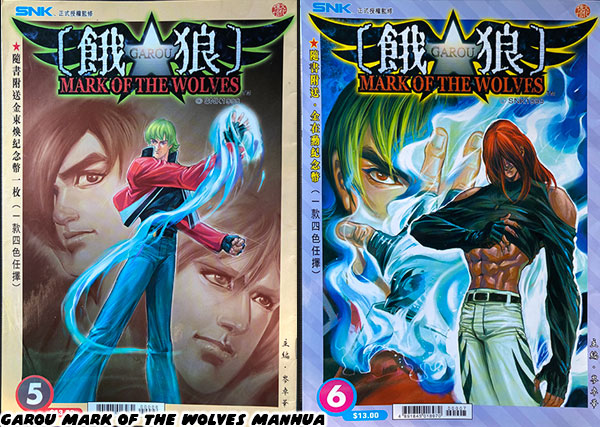
Recently I discovered that there was a manhua, a Chinese comic series based on Garou Mark of the Wolves (MOTW). There were 10 issues in total. The books came out in 1999, the same year that the game debuted. I got them from a collector in California, and thankfully didn’t have to pay a lot. The first thing that I noticed when they arrived were that they were much larger than standard comic books, or manhua. The standard comic book size was 6-5/8 inches wide by 10-1/4” tall, the Garou MOTW books were 7 1/2” wide by 10 1/2”. These issues were almost as big as magazines.
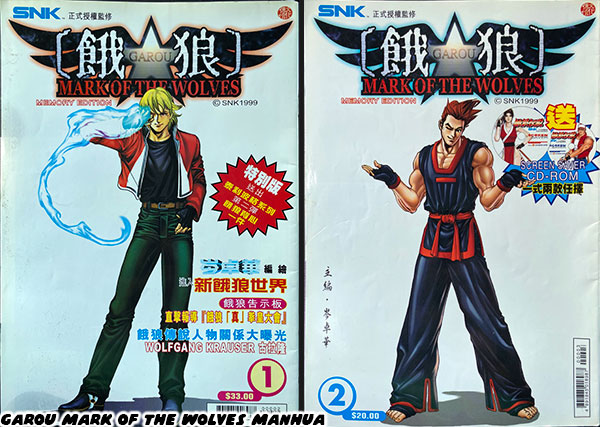
The issues were a great primer on the main players in the Fatal Fury (FF), and Art of Fighting (AoF) series. Specifically focusing on the villains Geese Howard, and the protagonist Terry Bogard. The first several issues actually got us caught up on the events that happened across the first few Fatal Fury games. I’m not certain if there ever were licensed AoF, or FF comics in China in the early ‘90s. There may have been, and like Street Fighter there may have been several unlicensed comics as well. In all my years doing research, surfing bidding sites, I’ve never seen a collection of classic SNK comics from China prior to 1997. I know there were many from the King of Fighters series, and the various games, including KOF 98, 2000, SNK vs Capcom, and KoF Maximum Impact. The fact that the Garou MOTW manhua retold the plot of the first few FF games, including the creation of the KOF tournament helped get audiences up to speed. The events of Garou MOTW are set a decade after what happened in the first FF game.
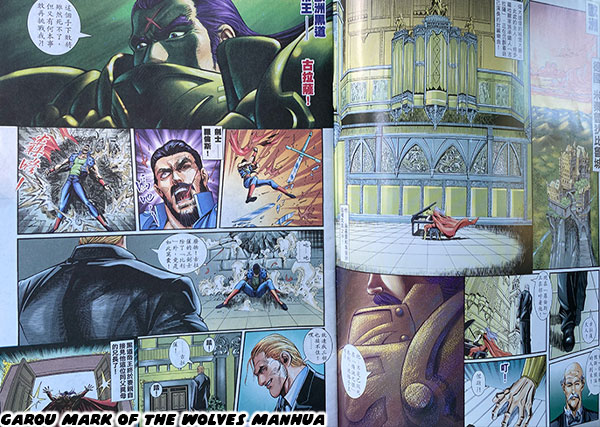
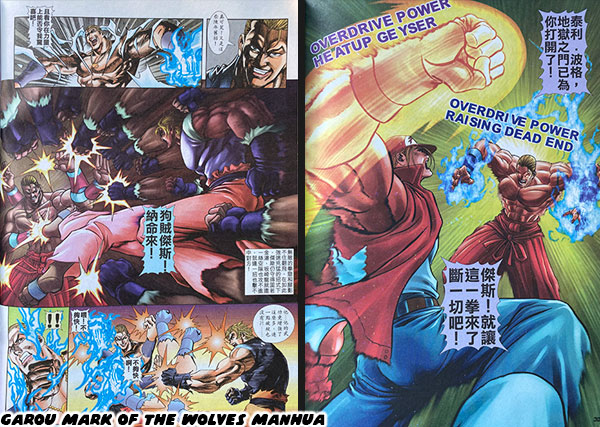
The series actually begins with a look at the battle between Geese, and his half-brother Wolfgang Krauser, head of the Stronheim family. Geese had long sought revenge on Wolfgang, and his father Rudolph, because they abandoned his mother Maria, and left her to die penniless in America. As a long-time fan of fighting games this was the type of action, and storytelling that I looked for. The panels were filled with lots of action, and we got a chance to see each character use their trademark special attacks.
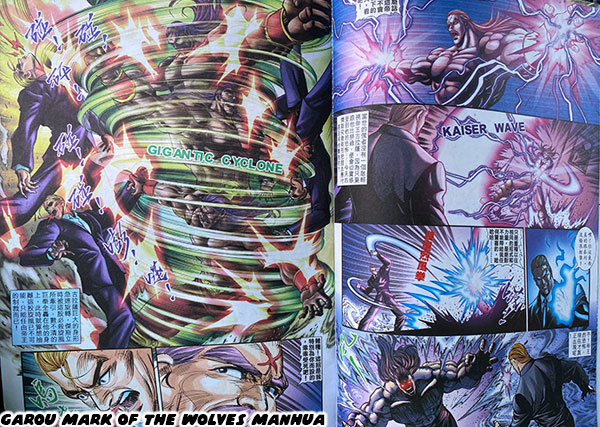
Seeing the fights in print was a way to determine which parts of the game were canon, and which were pure speculation. Not every fighting game gave us concrete answers, or tied up the plot points. More often than not they read as a sort of “what if?” series of events, that were loosely connected. For the longest time I fancied Wolfgang as being the stronger brother. He was older, and much stronger, but Geese had greater fighting experience. After a fierce battle Geese took out Wolfgang to take control of the family assets. With that taken care of he returned to Southtown to run it from the shadows, and sponsor the King of Fighters tournament.
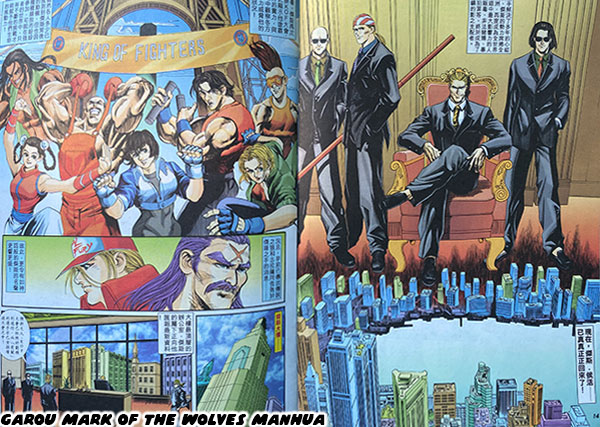
It actually takes a few issues of the Garou MOTW manhua before we even get past the original FF timeline. We actually get a chance to inhabit the complex web of characters, and their relationships. We get to see Toni Sakata from FF Wild Ambition making a cameo when he meets with Geese. We get to see Andy Bogard training with Mai Shiranui, and Jubei Yamada. We also get to see the fallout from the first time an adult Terry Bogard, and Geese Howard do battle. Geese shows him no mercy, and defeats him with relative ease. Terry is bruised, and beaten. Marie, Geese’s estranged wife nurses Terry back to health, and introduces him to a young Rock Howard. The two live in a modest home away from Southtown.
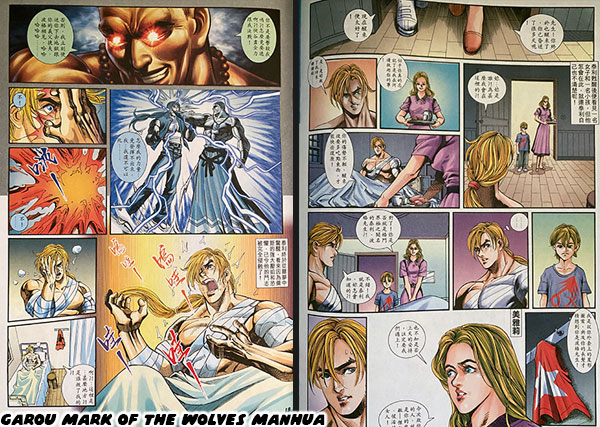
Terry worries about Rock, the legacy he hails from, and what his future might hold. Marie has a rare medical condition that she keeps from Rock. She asks Terry to watch over the young Howard, especially in the event that anything happens to her. Terry promises to take care of him while he continues training, with the hopes of getting a rematch with Geese.
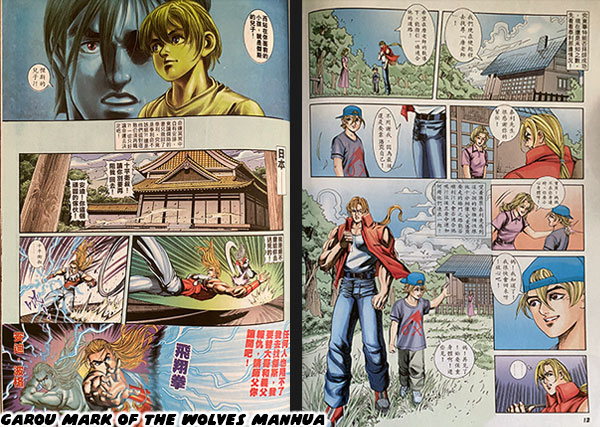
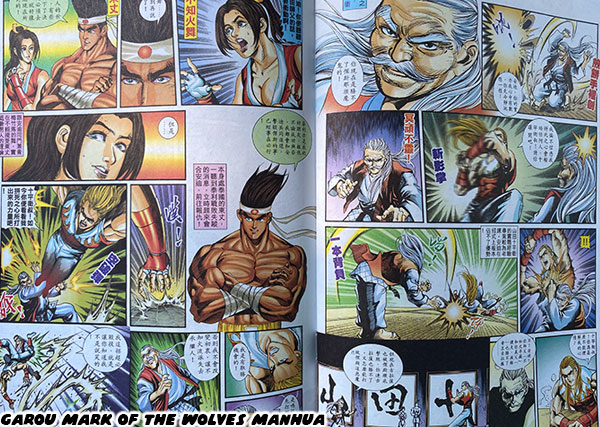
We get to see Terry pick up training with Tung Fu Rue, arguably the most powerful elderly kung-fu master in the entire KOF universe. Tung is attacked by an upstart master named Gato.
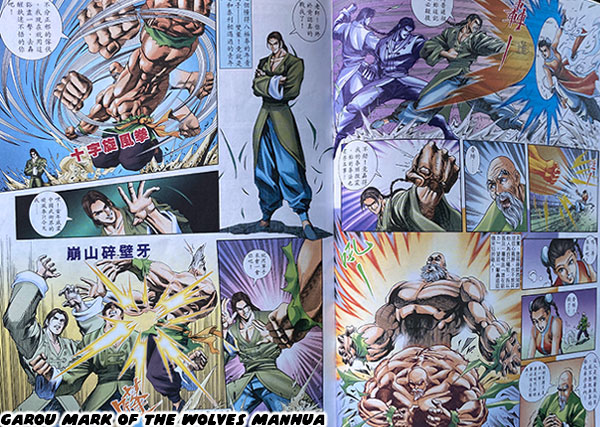
Terry tries to intervene, but he is still not at 100%. Both he, and Rue take some punishment from Gato. Rock steps in, and tries to get Gato to leave them alone. Gato retaliates by strangling the boy.
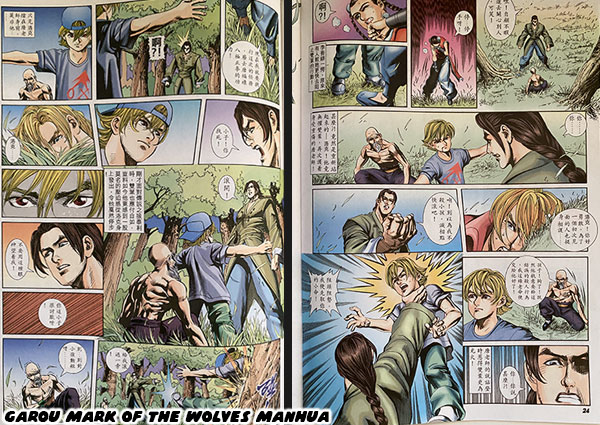
Terry is out of commission for several pages. The story uses that time to look at the history of Terry, and his younger brother Andy. It shows the reader the origins of their vendetta against Geese. We get to see the orphan brothers trying to protect their adopted father Jeff Bogard as he gets pummeled by Geese. We get to see them being trained how to fight in different schools, both before, and after the murder of their father.
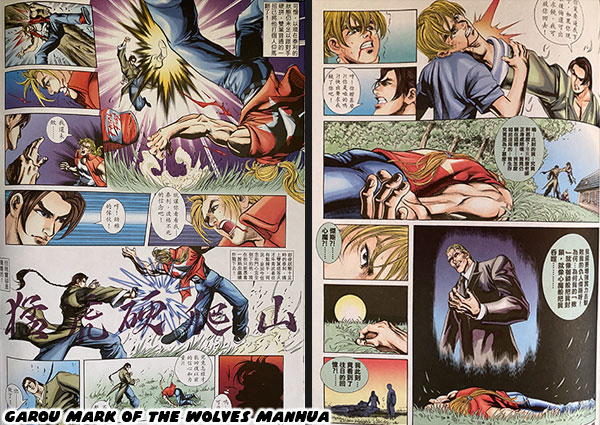
We see that Terry blames himself for not being stronger, for not being able to protect his brother. Eventually the two part ways in search of a master. Their relationship strained. Andy decides to study under the same masters that their father studied with, in the hopes that he could defeat Geese.
Terry on the other hand learns to fight in the street. Living up to his lone wolf reputation.
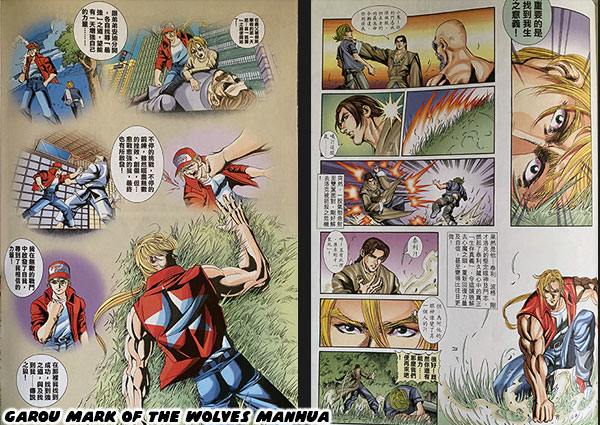
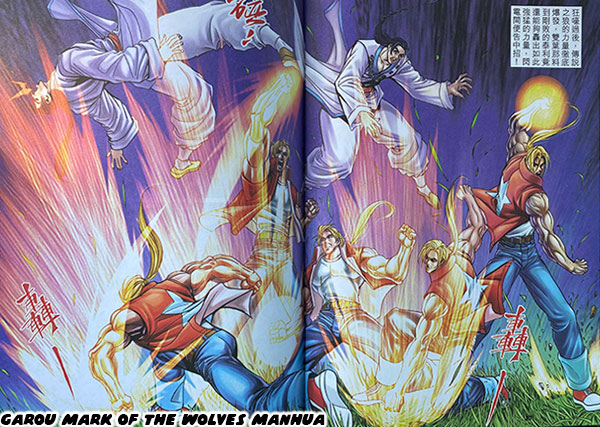
Terry eventually snaps out of it when he realizes that Rock is about to experience the same trauma that he, and his brother endured. He digs in deep, and turns the tables on Gato.
As all this happens Rock discovers that his mother is dying from her condition. He knows that his father is rich, and powerful, and he goes to him to beg for help. Geese wants nothing to do with him or his wife. Rock calls him a cold blooded devil, when he realizes that Geese probably could get Marie the medical attention she needs, but doesn’t care enough to do so. Rock vows never to beg him for anything again.
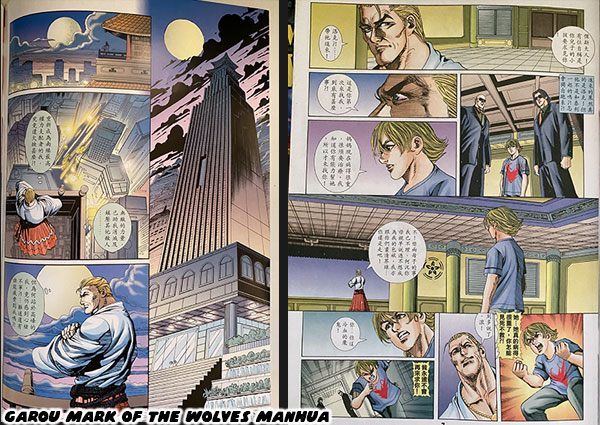
Andy, Terry, and their good friend Joe Higashi are now older, and more experienced. They decide to challenge Geese in the same high rise building that Rock had visited. They are ambushed by Geese’s hired goons, including the wrestler Raiden, yakuza hitman Ryuji Yamasaki, and stick master Billy Kane.
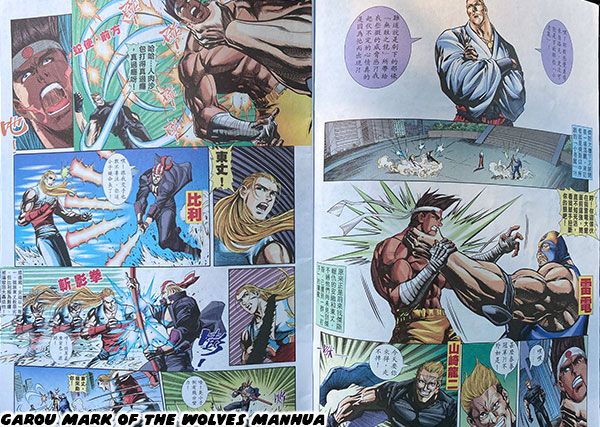
The next part of the story was new to me. The version of the events in the Garou manhua had Ryo Sakazaki as the first to reach, and do battle with Geese. Ryo was from the Art of Fighting game series. In the original game he was hunting down the man that kidnapped his sister Yuri. It turned out that the kidnapper was a masked man known as Mr. Karate. The end of the original AoF reveals that Mr. Karate was actually their father, Takuma Sakazaki. Takuma was forced to work for Geese as an enforcer under the threat that his children would be killed. This leads us to AoF 2, and the chance for Ryo to take out the kingpin.
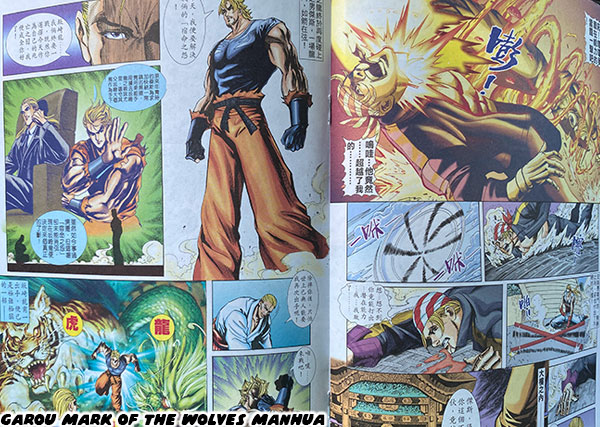
Ryo follows the clues right up to Geese, and gives him a decent fight. Unfortunately it isn’t enough, and the young Sakazaki is defeated. The battle rages on outside with Andy, and Joe barely holding their own against Geese’s best men.
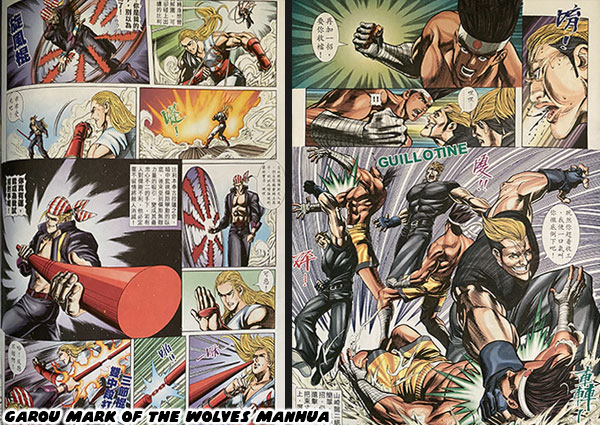
Terry eventually makes it to Geese as well, and they have the battle made famous in the first Fatal Fury. Terry knocks Geese off the roof of his building, seemingly to his death. Of course it turns out that it’s not that easy to kill him.
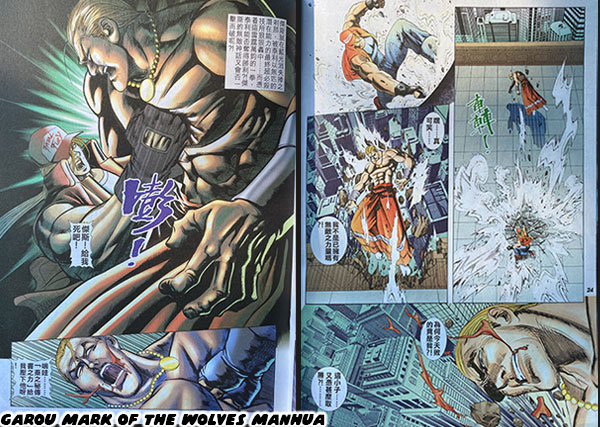
On the other side of town Marie was in the final stages of her disease. We see Rock, and Terry with her when she passes away. Terry promises to take care of Rock. Marie dies peacefully on her bed, and is buried not far from her house. However according to Kain R. Heinlein Rock's mother is still alive. So if the events of the manhua are canon, that means the lady that was buried may not have been Rock's actual biological mother. It would explain why Geese was so indifferent to her, especially since he had also been abandoned as a boy, and knew Rock's pain. At least that's my theory.
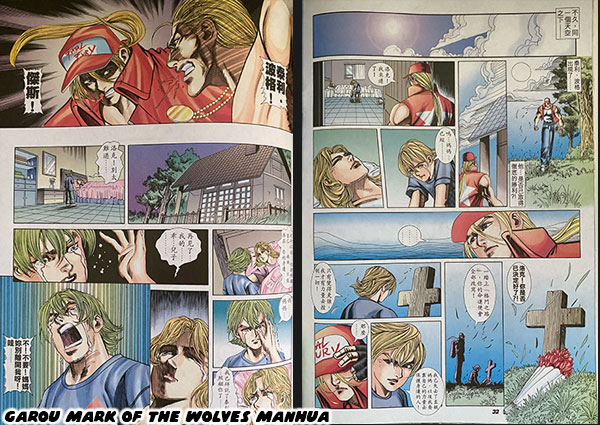
All of this carries us through most of the Garou manhua. However as you may know there are new faces, and changes to existing characters when the King of Fighters Maximum Mayhem tournament is created. The tournament organizer Kain R. Heinlein, the brother of Marie, and uncle of Rock is trying to recruit Terry, and Rock into his organization. He wants to rule Second Southtown following the power vacuum when Geese is defeated.
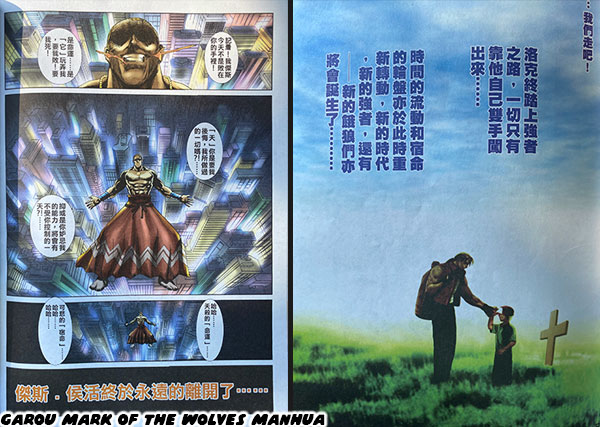
Those that have played Garou know that there were many new characters introduced in the game, and most get at least a panel or two of an introduction. We’ll look at the events in the remaining issues on the next blog. I hope to see you back for that. As always if you would like to sponsor me please visit my Patreon page and consider donating each month, even as little as $1 would help make better blogs and even podcasts!
follow the Street Writer on Patreon!

Monday, July 4, 2016

The legend of Blue Mary, or girls in fighting games, part 3

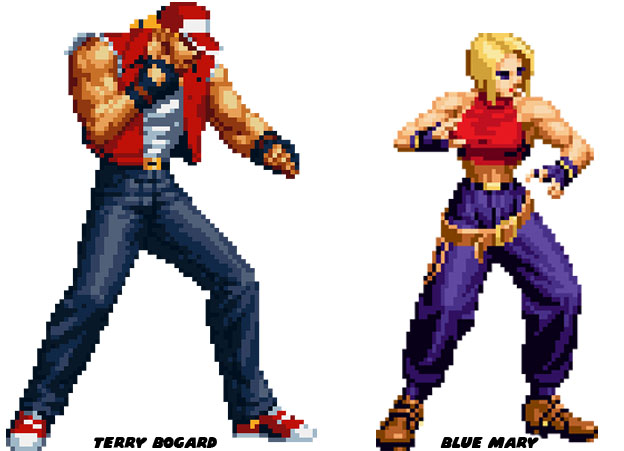
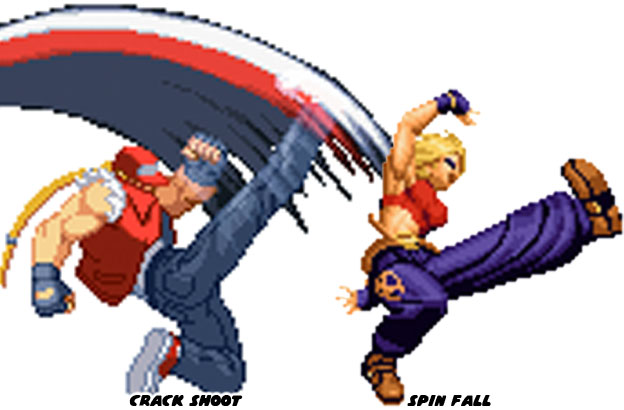
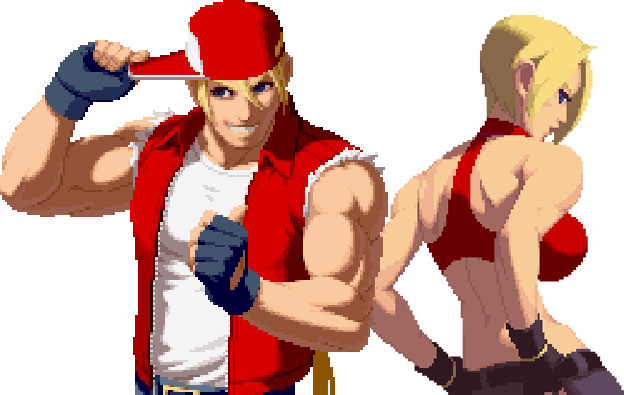
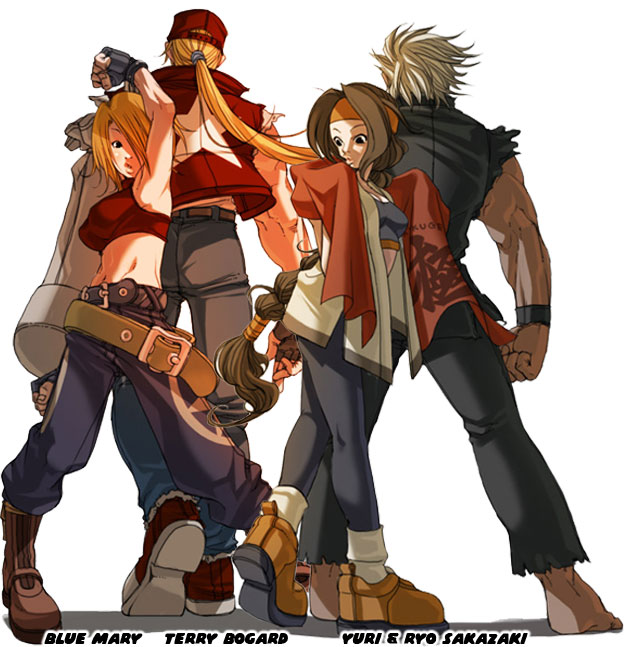
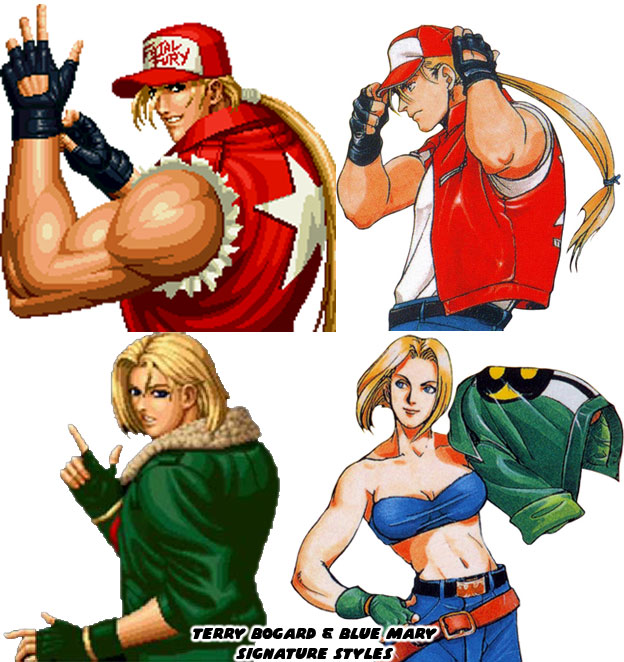
Fatal Fury had built a tremendous fan following in the '90s. The story, characters and fighting styles represented were very unique. SNK had done a great job of introducing characters from around the world and connected many of them to real martial arts. Even the characters that did not represent a particular style, like Terry Bogard, still fit into the universe. SNK was showing audiences that the modern masters of fighting did not have to dress up in robes or gi's in order to be legitimate threats. When the studio wanted to introduce a new female lead in the series they had a perfect template to pull from. Blue Mary had many design cues that were based on Terry. Put the two side-by-side and it's easy to see what I'm referring to. The red top, blue pants and gloves was only the beginning.


Notice how well defined Blue Mary's muscles were. Usually female characters in fighting games were slim. Some were voluptuous but none were presented muscular. Many of the early female characters in fighting games were Asian. Many Asian cultures (and many Western nations) did not consider women with big muscles to be attractive. The male stars in fighting games were always expected to have huge muscles. It made them look more believable as serious brawlers. The same rules applied to comic book heroes of course. Blue Mary changed all of that. As a female balance to Terry she maintained a certain level of athleticism and raw power. Her abs, shoulders and biceps were all well defined and much larger than the muscles on her female co-stars. This seemed acceptable on an "American" character. Her femininity remained, as did her large breasts, and to many players she remained attractive.


On a surface level Blue Mary had the same design cues as Terry. None of her moves, except for Spin Fall even remotely resembled the power moves of Terry. Blue Mary had far many different techniques going for her, not the least of which were having some of the first grapples, submission takedowns and strikes into grapples of any fighting game character. I consider Blair Dame from Street Fighter EX to be the first mixed martial arts character in a fighting game. She debuted in 1996, yet Blue Mary appeared one year earlier and had many similar techniques. So what gives? Blue Mary had moves that were more in line with combat Sambo, a Soviet-era form of fighting that gained exposure in freestyle and vale-tudo tournaments. These were the sorts of no-holds-barred contests that predated modern mixed martial arts tournaments. Sambo would be used by Russian soldiers to help subdue enemies in close quarters combat. There were many lightning quick strikes mixed with takedowns and painful joint lock techniques. The 3D fighting games would features these techniques on characters like Sergei Dragunov and Bayman from the respective Tekken and Dead or Alive series. It made sense that cops and soldiers would be masters of these techniques.


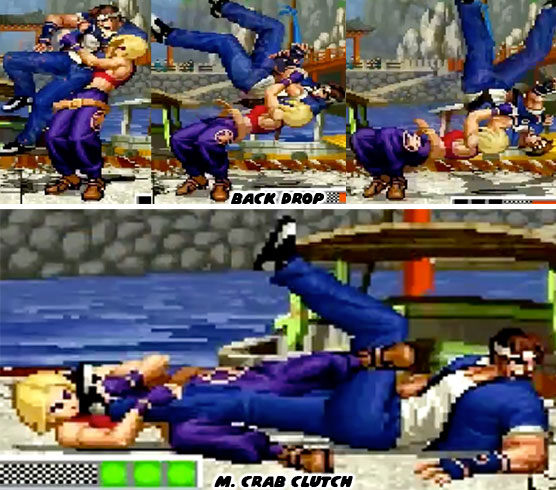
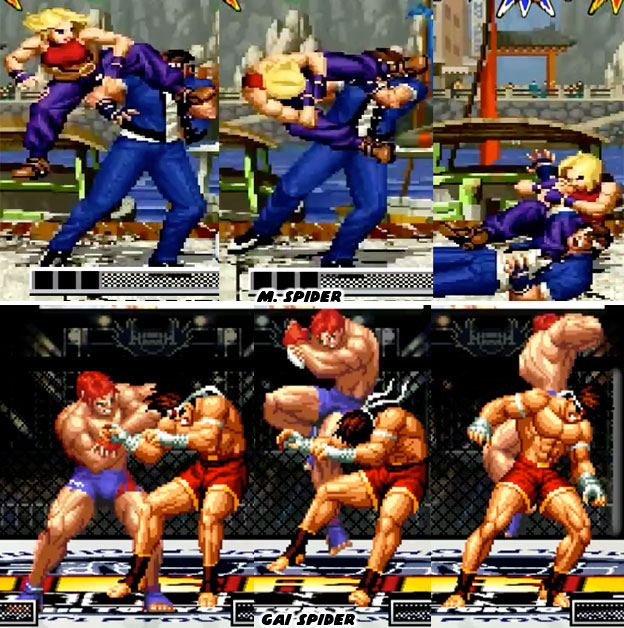
Blue Mary was a vicious grappler with amazing strength. She could hoist her opponents overhead and perform a Back Drop. It was an incredibly dangerous move made popular by the late . The move was banned in the WWE for being too risky. I could easily imagine Mary doing this to unsuspecting criminals. When she didn't go high with her attacks she knew how to shoot low for a takedown. The ankle lock called the M. Crab Clutch could snap a leg as easily as a chicken bone. These were only a few of her awesome moves. It made sense that Butch and her father had shared some of their Secret Service training with her. For opponents that were stand up fighters Mary had a way of breaking them down as well. She was equally fast and strong. She was able to cut into any defense and perform a rolling arm bar. This move would be known as the M. Spider. A variation of the leaping arm bar was given to Gai Tendo, the star of the Buriki One Tournament. His version was known as the Gai Spider. As great a character as Gai was just remember that Mary was doing some MMA moves many years earlier!

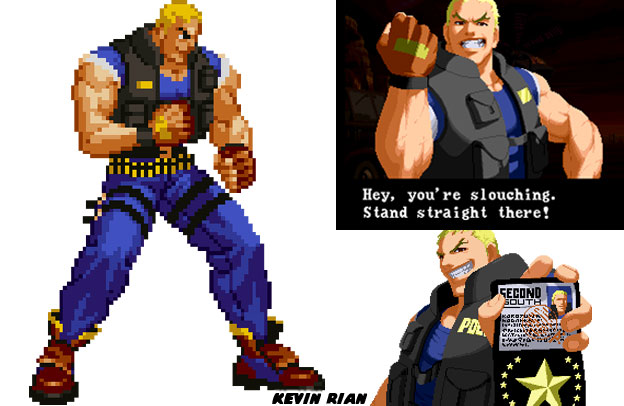
Blue Mary would grow in popularity over the years. Like some of her Fatal Fury co-stars she would eventually turn up in the King of Fighters series as well. Her moves and purpose filled a void that had been missing in the series. To be specific law enforcement officers weren't usually represented in fighting games, especially not in Japanese ones. There were heroes of all sorts but they were usually traditional martial arts masters. There were even military characters from time to time because audiences could accept them as dangerous fighters. Cops on the other hand didn't always have the reputation for being great martial artists. Chun-Li and Blue Mary certainly changed that perception while also serving as powerful female role-models. Blue Mary's distant relative appeared in Garou: Mark of the Wolves, a game from 1999. The game was set about a decade after the events of Fatal Fury 3. The new brawler was known as Kevin Rian, he was a cop, a representative of the Second South Town police force. His last name was mistranslated by the localization team as it was supposed to be Kevin Ryan. He was big with a few grappling moves and heavy hands. His design fit somewhere in between Ralf and Clark, the Ikari Warriors from the King of Fighters tournament crossed with Blue Mary. Kevin, like the other characters in Mark of the Wolves, reflected almost a decade of fantastic character designs. The studio had experimented with graphics, controls and aesthetics and was really hitting its peak by 2000.


From a physical standpoint Blue Mary had all of the same design elements that were originally applied to Terry Bogard. Many of these things were due to the Japanese trying to introduce a "cool" Western fighter into their franchise. It was mostly relying on stereotype, that white Americans had blonde hair, blue eyes, wore jeans and sneakers. The Japanese animé aesthetic paid off when combined with the trope. Mary was young, athletic, and confident. The same characteristics that made Terry appealing to the first generation of fans worked years later and would continue to work in future titles. Mary had staying power as did the better fighters from the Fatal Fury and Art of Fighting franchises. When variations of those characters turned up in Garou: Mark of the Wolves it worked extremely well.

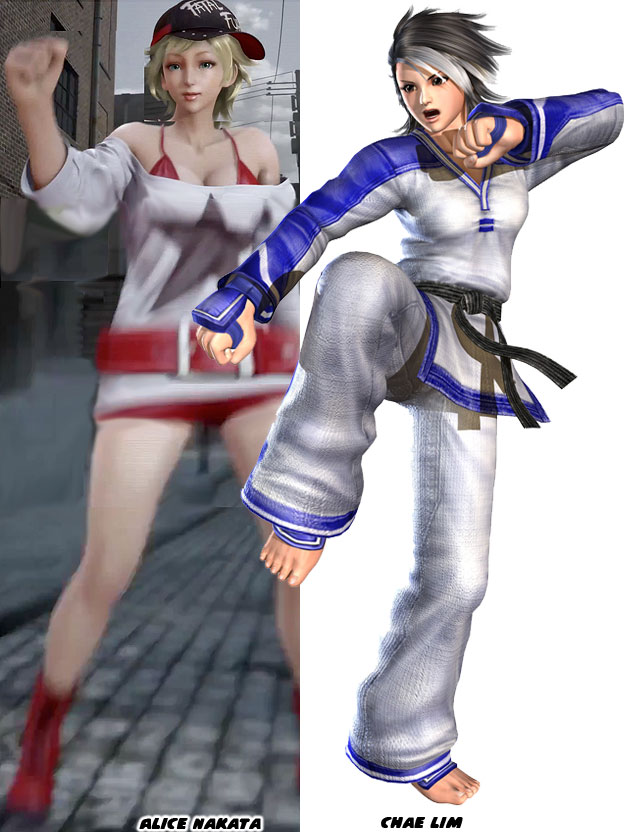
When variations of the look turned up in pachislot machines (a combination pachinko and slot machine popular in Japanese arcades) it still worked. Take a look at Alice Garnet Nakata, the idol character featured in the game. She was a sort of crude talking cheerleader that followed Terry around. Her look was planted in between the style of Terry and Mary. The familiar red, white and blue motif, the cap, the red heels instead of sneakers. Of course you can't miss the extra-wide belt. It's almost as if somebody at SNK had wondered out loud what would have happened if Terry and Mary had a daughter. What would she look like? Well the truth is a little bit backwards. In the planning stages of Fatal Fury 3 there was a new female character in the works called Alice Chrysler (the Japanese aren't the best at making up Western-sounding names). Alice was an understudy of TaeKwon-Do master Kim Kaphwan. She had an affinity for Terry Bogard and was designed to replace Mai Shiranui as the female lead. From a design standpoint she would have beaten Sakura as the younger girl version of the star by one whole year. SNK decided against the original Alice and went back to the drawing board. She got a little older, stronger and was working with different fighting forms and a new name, Mary Ryan. All great ideas however never really die. The studio revisited the understudy of Kim and a new character came out called Chae Lim. The scrappy "secret weapon" with short feathered hair would debut in the KOF Maximum Impact Tournament in 2004. Almost a decade later the studio revisited Alice for the pachislot machine. Her long ponytail gave way to short feathered hair in her makeover. In 2016 SNK would make her a formal character in the King of Fighters XIV.


Competition between SNK and Capcom meant that both studios were taking chances with character designs. In the early days the studios were influenced by action cinema and manga. The heroes of those first games were based on real martial artists and mythical fighters. In time the studios learned that fighting games did not have to be solely about burly men trading punches. They could be about cops, soldiers, gifted orphans, girls and women. If these people had a talent, a solid design and a reason to fight then audiences were willing to come along for the ride. Through the '90s SNK had made some of the biggest advances in diversity for the genre. When the studio decided that the King of Fighters should be about team play then it meant that the roster would have to be filled in with dozens of new faces. There was no way that they could all be men. The women they started with were already well known and all the new ones introduced, both good and evil, found a following. Blue Mary was near the top of the list. She was well regarded and many fans wanted to see if SNK planned any sort of resolution between her and Terry Bogard. It was the unspoken thing that fans had wondered about all fighting games. What sort of relationship did the main characters have and would the male and female stars of the games ever get together. Capcom fans from both sides of the Pacific wondered out loud if Ryu and Chun-Li were a couple. That was the case in the licensed Hong Kong comics and of course many fan pieces.


For SNK fans many wondered if Terry and Mary ever "hooked up." SNK and Capcom avoided the question for most of their characters. This was because when they designed them they didn't have romance in mind. Each and every fighter, male and female, was a stand-alone design. They did not need to have a relationship with any other character in order to be accepted. Kevin Rian and Mary Ryan may have been related but both looked and fought very differently from each other. Even if one character were introduced because of the success of a previous icon it didn't matter. Sakura and Sean for example were not Xerox copies of Ken and Ryu despite being labeled "Shotoclones." Each subsequent fighter from the biggest studios had to hold up to the designs in other titles. When Blue Mary and Sakura debuted they were a sort of balance to the male stars of the games. They had just enough design cues so that audiences knew where they came from, and also enough originality to them as to make them unique fighters. Yet that didn't stop fans from asking the question, especially between Terry and Mary. Terry after all was a lone wolf. His brother Andy had a relationship with the busty ninja Mai Shiranui but poor Terry was all alone. Then there was Mary, she lost her boyfriend and father and was living with a dog. If there was someone in South Town that needed a new relationship it would have been her. Only it didn't come to pass. At least not in the first decade of the Fatal Fury timeline. Terry was busy raising a surrogate son and Mary was busy with her career of keeping South Town from imploding. What SNK did do however was give fans a hint of closure.


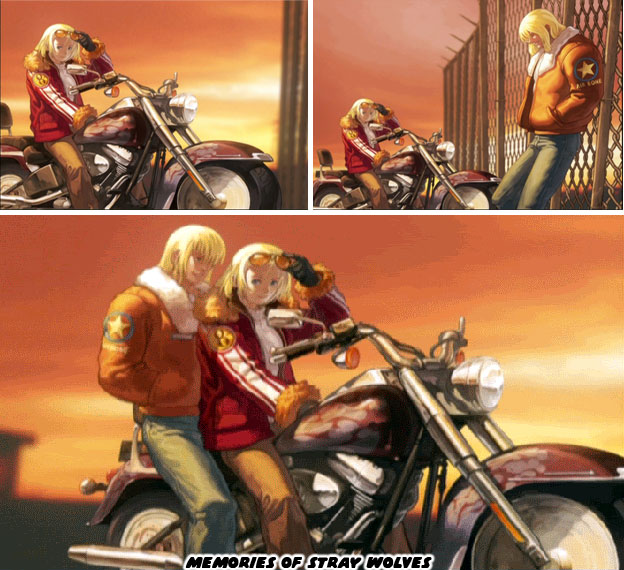
In the drama CD Memories of Stray Wolves Terry and Rock Howard were putting together a narrative. Where did it all begin for the main characters, why were they fighting, where did the time go? Rock was on the eve of his first King of Fighters tournament, he was a little nervous but he also wanted some answers. This story was set during the timeline of Mark of the Wolves, a decade after the demise of Geese Howard. Fatal Fury alumni Duck King, Richard Meyer and Blue Mary all made appearances. Mary was dealing with a few difficult cases and hadn't had a chance to visit with them as often as she'd like. Rock left to find his way and Terry seemed a little blue. Mary showed up on her motorcycle at the end of the story. The years had been kind to both as they still made an attractive couple. While it was never implied in the games there was a relationship between the two. Terry jumped on the back of her motorcycle to look for some fun. It was a creative risk that worked well for the canon and character development at SNK. It was something that was not introduced for the characters until years later and it made sense. It was an evolutionary shift for character designs which gave them more dimension and made the more personable. While I don't think that Ryu or Chun-Li should ever be seen the same way it would be nice to see Capcom age and mature the characters more in the Street Fighter series. There has been too much rehashing of the same characters year after year. We will see how else things have changed post King of Fighters XIV and Street Fighter V. I am looking forward to that. How about you? As always if you enjoyed this blog and would like to sponsor me please visit my Patreon page and consider donating each month, even as little as $1 would help make better blogs and even podcasts!

 follow the Street Writer on Patreon!

Friday, July 1, 2016

The legend of Blue Mary, or girls in fighting games, part 2...

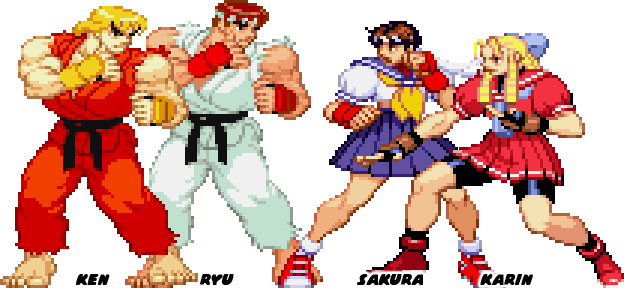
In the previous blog I talked about how Capcom and SNK were trading jabs at each other through the characters they had introduced in their own respective fighting games. The competition was healthy from a business standpoint and also for fans that were lining up to try each and every new game and update from the two publishers. SNK and Capcom both had established strong female characters early on yet SNK also did something more unique. The designers in-house created female characters that could be interpreted as counterparts to the male stars. It was a sort of symmetry that worked for the most memorable fighting games but not many studios recognized that symmetry and balance were things that helped make the cast unique while filling out a roster. When Sakura debuted in Street Fighter Zero it was obvious that she was filling in a role as a female counterpart to Ryu, as well as taking design cues from Yuri Sakazaki. Dan was a sort of balance to the cast, a way of taking two SNK-ish characters and putting them in Street Fighter continuity. Yet there was something missing. Capcom didn't realize it until comic book artist Masahiko Nakahira introduced Karin Kanzuki in his Sakura Ganbare! comics. Suddenly it was too obvious that Sakura needed her own rich, white, counterpart. Karin was officially added by Capcom to the lineup in Street Fighter Zero / Alpha 3. Audiences in the West did not see the comics that introduced her until more than a decade later when Udon translated them. It didn't matter however, the fair skin, red dress and blonde hair pretty much summed up what Karin was supposed to represent. Her unique trapping strikes made her stand out, she was not another "shotoclone." She was certainly more than a girl version of Ken.


SNK had established one of the most important rules in fighting game character designs before Capcom; the symmetry of female counterparts to be specific. It can be fair to say that I did not credit the studio enough for their contributions to the genre in earlier blogs. SNK was critical in the history of the genre and shaped not only their own legacy but influenced the creative decisions in rival studios. SNK developed many strong female character archetypes in every fighting game they produced. The women in these games varied in age, style and ability. Some were very young but capable, and some were closer in age and strength to the male stars of the game. The other studios developing fighting games for the Neo Geo were sometimes on board with the strong female characters but others had more sexual pandering designs in mind. Yuri was a cute character in the Art of Fighting, she was the kid sister of Ryo Sakazaki and not meant to be the main protagonist. It was a fighter in the Fatal Fury series that proved sex and strength could be found in equal measure. While developing this character the team at SNK looked at the elements that made the star of the series work. They then created a female counterpart with a similar look, down to the color schemes and nationality, but with completely different moves. In essence you could say that the studio was working on Karin Kanzuki years before Capcom or Masahiko Nakahira even thought about it. The name of this revolutionary character was Mary Ryan aka Blue Mary. She would become a counterpoint to Terry Bogard. She demonstrated that a fem fighter could be an important addition to the lineup and not just fan service.


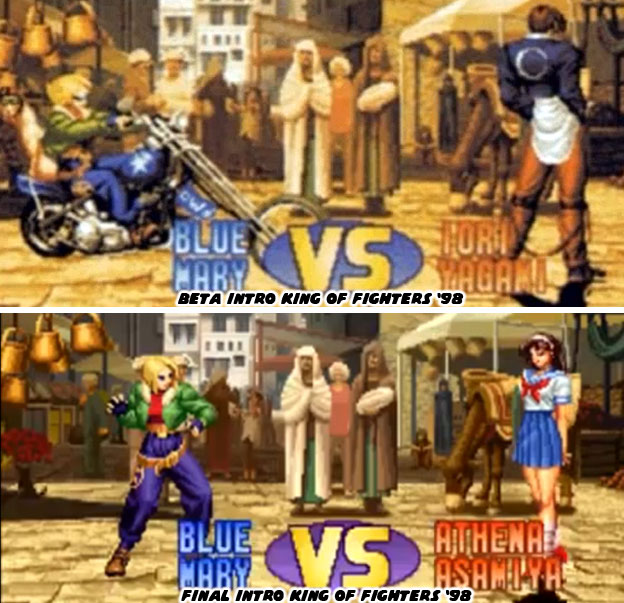
Blue Mary debuted in Fatal Fury 3 - Wild Ambition in 1995. Remember that both she and Yuri were playable characters in a fighting game before years before Sakura or Karin. Mary had a complex back story that would be unveiled over the years. It made her more than just a pretty face. Her origin helped the designers know how to present her in the series, how to include her into the plot and even figure out what techniques she would be using. Mary was always presented as a fearless, completely independent woman. Yet there was a good bit of planning behind this. Her father was a Secret Service Agent as was Butch her boyfriend. Both had taught her some fighting moves as did her own grandfather. Butch and her father were both killed in the line of duty. She believed strongly in justice and became a detective, working on and off for the law. When she debuted in Fatal Fury game there was nothing to lead players into thinking she was in a relationship. The two holdovers from her earlier life were put in plain site and only revealed later on. She was sometimes accompanied by a dog to her matches. This was Antonio or Anton for short, he was a puppy when Mary and Butch adopted him. She also wore a bomber jacket to the the fights, this was a gift from Butch before he passed away. Blue Mary could sometimes be seen riding a motorcycle. It was the obvious choice for a cool American character and a trait that was unique to her. In an early build of the King of Fighters '98 Blue Mary had the trifecta introduction, the motorcycle, her jacket, and Anton riding in the back with goggles on. I'm not sure why the intro was dropped in the final build. Maybe it was too masculine for Japanese tastes?


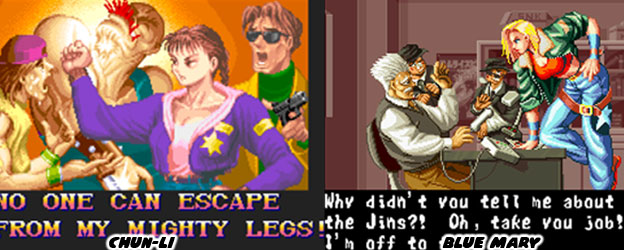
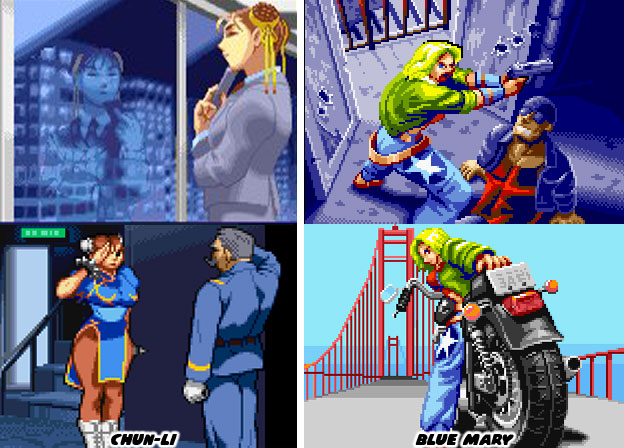
Blue Mary was as far from the dainty-fighter archetype as one could get. She was not the damsel in distress and she was certainly not the prize for any male lead. This character had a lot in common with the first female Street Fighter legend. Chun-Li's father was assassinated by Balrog (Claw), one of the generals of Shadowlaw (Shadaloo). She joined the police academy to obtain justice and eventually worked her way up to ICPO officer. She was a no-nonsense character behind the badge, especially while wearing her plain clothes uniform. What made her unique among the other female icons was that she could then switch her role and appear very feminine in the Street Fighter tournament. She wore nylons and a form-fitting, pseudo traditional dress. Blue Mary did not have this second layer of design. She was more like the female leads in other fighting games. The person that you saw in the pre-round animations and at the end of the game still looked the same.


The design and presentation of Blue Mary was deliberate. She was the cool cop, the rogue that didn't necessarily take orders, a trope created in Western films and shows like Lethal Weapon and Miami Vice. She was a hard drinking, door kicking, motorcycle riding, crime busting bad ass. You could almost imagine the character starring in her own crime action series. Chun-Li was much more reserved. Her time in the academy made her a student of the criminal mind. She began looking at the big picture instead of focusing on stopping individual crimes as she matured through the events of Street Fighter Zero and Street Fighter II. She knew that avenging the death of her father was only one piece of a bigger puzzle. The crimes, drugs, arms flooding the streets in Asia were being controlled by a central kingpin. It was revealed that General Vega had ordered the hit on her father. She would figure out that it was Shadowlaw trying to destabilize several countries in the south. She was instrumental in revealing this conspiracy and helping international forces take down their base of operations. She became a decorated officer in the process. Blue Mary on the other hand wasn't looking for accolades. She wanted to do her job and keep scum off the streets, even if it meant taking down a powerful kingpin in hand-to-hand combat. She was fearless, if slightly foolish, in that regard.


The physical appearance of Blue Mary was molded very closely on Terry Bogard the breakout star of the Fatal Fury series. The Japanese designers didn't really have a point of reference for white American martial arts stars. There were a few notable fighters in the '60s, '70s and '80s that did travel to Japan and abroad. Chuck Norris, Joe Lewis and Bill "Superfoot" Wallace were some of the high-profile white martial artists that made a name for themselves. They appeared on the popular ABC Wide World of Sports broadcasts and on the covers of Black Belt magazine. They were inspiring millions of white Americans to pursue the fighting arts while Bruce Lee and Jim Kelly were opening the eyes of minorities. Yet none of the men were big enough to have their own comic book or cartoon series in Japan, like Mas Oyama and Yoshiji Soeno. To be fair Chuck Norris did have his own cartoon and toy line in the USA in the '80s and Lee had his own comic book series as well. To the mainstream Japanese and many of the artists working at both SNK and Capcom they simply didn't know what made white America unique. They had a few fashion cues from our music videos, television shows and action films. This was what they used when creating Terry Bogard, and for that matter many of the other western characters in Capcom games as well. Stop and think about it for a second, if you were born in the USA and had a reputation for fighting would you wear jeans, a bright red jacket with a star on the back and a trucker cap? Maybe you would wear something more subdued, something that didn't attract too much attention especially from gangs or even the cops. Of course the developers in Japan assumed that their customers needed to see that trope, that stereotype in order to identify the cast. The American needed primary colors that were red, white and blue.


The designers at SNK didn't have to try very hard when creating their new cool female character. They changed some of the colors and dropped the cap but Blue Mary had a signature style that was very much reminiscent of Terry's, The physical similarities didn't end there. Both were blonde, it reinforced the idea that white people were mostly of English descent. Think about how many white characters, especially the early ones in fighting games were blonde. Ken and Joe in the original Street Fighter, Cody in Final Fight, the wrestler in Street Smart, Guile in Street Fighter II, Galford in Samurai Spirits, Ray in Fighter's History, Paul Phoenix in Tekken, Jacky Bryant in Virtua Fighter… the list goes on. It was a bit of racial pandering on the part of the developers. They assumed that most players in the West would want to try a character from their homeland before they tried an Asian character. It was logical thinking. What they often missed were the details that made the characters really "American" or "English" or "French." But I digress. That was only part of the reason why the characters were blonde. The primary colors that were assigned to the costumes needed balance. Most of the Japanese characters practiced karate and their gi was typically white. That costume contrasted well with black hair. They couldn't assign white costumes to the white characters with blonde hair, there wasn't enough contrast. So solid colors like red, green and blue were given to these fighters instead. Blonde hair worked well with those colors and the tradition more or less stuck.


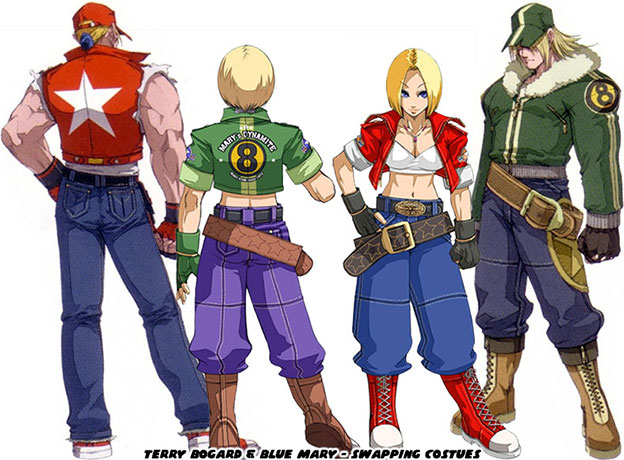
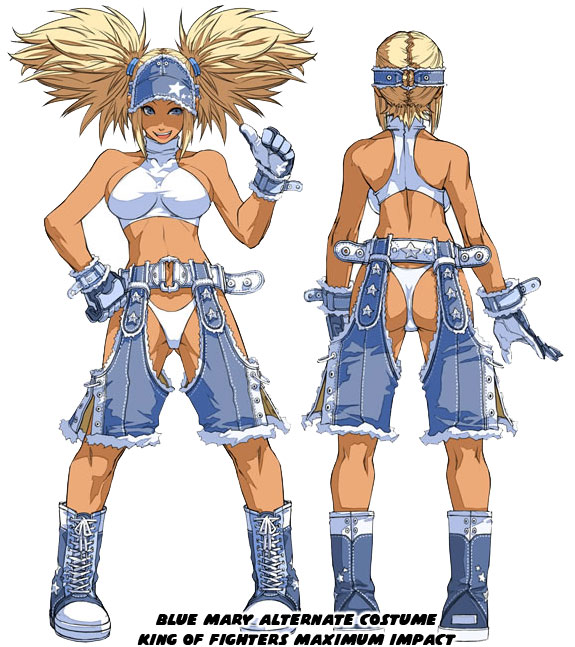
The color choices assigned to Terry and Mary were complimentary. Mary had a few differences in her uniform that made her stand apart. Her pants were not blue jeans but a darker purple with a large sheriff star on the side. She ditched the sneakers for boots and she wore a wide belt on her hips. It was a look that was a little more biker than brawler. It worked so well for her that it was considered as an acceptable alternate costume for Terry in the King of Fighters Maximum Impact game. The opposite was true and Mary could wear Terry's clothing and everything looked great. What was disappointing however was her alternate costume. Terry was given a "B" costume known as the Wild Wolf which was how he appeared in the Garou: Mark of the Wolves game. That version of Fatal Fury was set in the future where Terry was an older and more experienced fighter. He wore a large bomber jacket, boots and let his hair loose. Gone were the sneakers and over-the-top red, white and blue color scheme. Terry was given a look that was more like a biker. Sadly Blue Mary did not get the same Wild Wolf treatment. Instead she was presented in a white bikini with nonsensical jean chaps and a jean visor. Any modicum of respect the original designers meant for her went right out the window. It was unapologetic fan service that didn't fit the character, her origin or any previous appearance.


Blue Mary was a female fighter that defied convention. Her appearance was one thing, the moves she featured in game were something else. In the next blog we will take a closer look at the things that made Blue Mary memorable. As always if you enjoyed this blog and would like to sponsor me please visit my Patreon page and consider donating each month, even as little as $1 would help make better blogs and even podcasts!

 follow the Street Writer on Patreon!