Showing posts with label samurai spirits. Show all posts

Friday, December 13, 2024

Freeze frame, my poster collection, part 20…

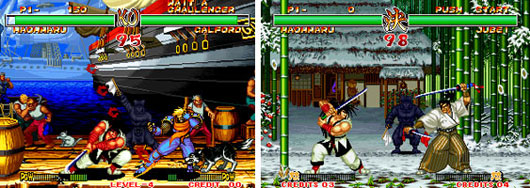
It turns out that my fighting game posters are not limited to Capcom. I also want to celebrate their friendly rivals at SNK as well. One of my favorite games is the Samurai Spirits / Showdown series. If you are looking for posters from the SNK franchises then I would suggest tracking down issues of NEO GEO Freak from Japan. They often came with a poster. There are a few issues that I’d like to get still, but if, and when I do I’ll blog about it in the future.

I’ve written about the genius of SNK’s art team on the blog, especially the brush style used by the Samurai Spirits illustrators.

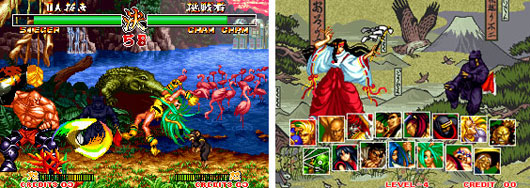
Samurai Showdown II was ranked one of my favorite games of all time. If you’ve never played it then please try to track down a copy in an anthology.

Garou Mark of the Wolves is one of the most underrated fighting games in the history of the genre. Thankfully it is getting a sequel decades later.

I love the SNK posters that I have, and I’d like to add a few more. I’ll never get as many as the Capcom posters I have, but it’s always work trying. Do you have any favorite SNK games or posters? I’d like to read about it in the comments section. As always if you would like to sponsor me please visit my Patreon page and consider donating each month, even as little as $1 would help make better blogs and even podcasts!
follow the Street Writer on Patreon!

Monday, April 3, 2023

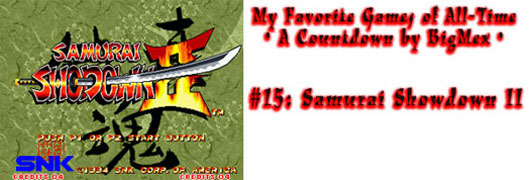
My favorite Games of All-Time #15: Samurai Showdown II - Originally published on 1UP - May 5, 2006

Two arcade games in a row! Can you believe it? People are sadly mistaken if they think Soul Caliber is a great sword fighting game. Samurai Showdown II (Samurai Spirits in Japan) completely destroys the Soul Caliber franchise.

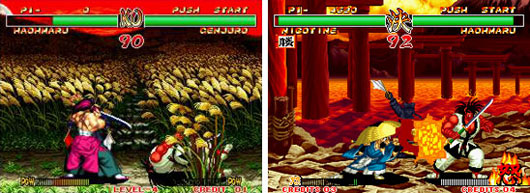
Samurai Showdown II was and still is ahead of the curve. From my criteria in determining which games were great SS II was the total package. It had a great concept, bold, colorful graphics a solid story with a beginning, middle and end. SS II had incredible game mechanics it pushed the genre to new levels and featured the one thing that makes an average to good fighter into a great fighter, it had balance.

Balance is the one thing that has been missing in almost all of the 3D fighters and many of the recent 2D fighters from Capcom. Balance is what makes a player learn strategy, technique and timing in a fighting game. Without balance any person that picks up the game can mash the buttons and win 50% of the matches. Without balance there is a big discrepancy between top tier characters and the rest of the fighters. Balance has been missing for a long time in the fighting genre. This is why even with updated graphics games like Soul Caliber 3, Virtua Fighter 5 and Tekken 5 are only somewhat popular with core gamers and very popular with casual gamers.

For those that do not know the basic premise of the game. SS II is an homage to the legendary swordsmen from Japan and the world. This includes savage warriors from the jungles of Central and South America, Germanic knights, French duelists and secretive ninja clans.

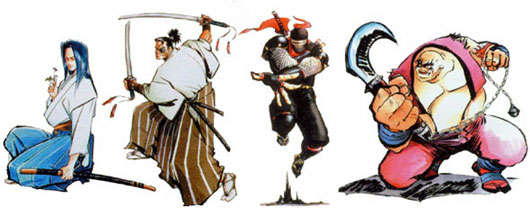
Each of the characters had their own set of special moves, strengths and weaknesses. Large lumbering characters like Wan Fu and Seiger were traditional heavy hitters that could take and deal lots of damage while smaller faster characters like Cham Cham and Nakoruru had to keep opponents at bay. Some of the characters were an odd blend of both. The massive ninja Earthquake had moves that beguiled his size. Players that learned strategy could often catch opponents off guard with Earthquake or the freakish Genan.

Samurai Showdown II introduced the concept of swordplay to modern arcade players. It was not solely a sword fighting engine as players could lose their weapon and still be able to fight. Players quickly learned that they could survive longer with a weapon than without one.

The characters in the game did not rely solely on swords. Some like (my favorite) Wan Fu used a broken column, Cham Cham used a boomerang, the demonic Mizuki used a magic wand and even the ref Kuroko used flags as weapons. Each of these characters was well designed and utilized within the game.

Samurai Showdown II was a step ahead previous fighters because it incorporated many new elements. For a while there was no rival in terms of design, graphics, scope and balance. It was not a coincidence that SS became more popular what the aging Street Fighter II upgrades. Many of the people that worked on the first few SS games were ex-employees of Capcom. They were the people directly responsible for the success of the original Street Fighter II. After being told to release upgrade after upgrade for SF II many employees simply walked away from Capcom to rival SNK... the rest as they say is history.

Samurai Showdown II came hot on the heels of the original release, rather than just adding some polish to the previous engine, they added a new layer of complexity to the control, sprites, moves and animation but to the art, story and design of the series as well. Characters could dodge attacks and taunt opponents, the first time these two components worked successfully in any rapid pace fighting game. Players had to employ different strategies when facing different computer AI opponents and not solely human opponents.

One of the unheralded genius in the art department was Eiji Shiroi (one of my Top-5 artists). Her paintbrush designs helped set the mood for the game. Leave the character designs aside for a moment and just appreciate the levels that the art team at SNK designed. Wheat and tall grass blew in the wind, a single path disappeared in the distance. A solitary temple perched on a hill. Each level was less a stage in a videogame than it was a living-breathing painting. I dare say a visual haiku. The levels had as much personality as any of the main characters or was it vice versa?

There is still much that needs to be said for the 2D fighter but it can summed it up in a few words.

A better sword fighting game has yet to be created.

I hope you have a good weekend. I'll see you at the E3.

I’d like to hear your personal top-10, top-20, top fighting games, top sports games, or top games in any genre. Let me know in the comments section please. As always if you would like to sponsor me please visit my Patreon page and consider donating each month, even as little as $1 would help make better blogs and even podcasts!
follow the Street Writer on Patreon!

Monday, October 2, 2017

Hiding the master in plain sight, the genius of SNK's character design... part 3

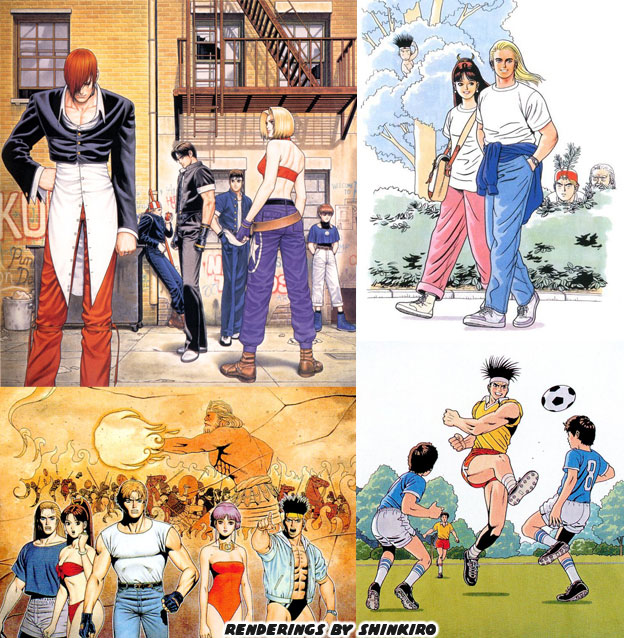
In previous blogs I established that Shinkiro had become one of the most influential fighting game artists of all time. The reason for this was obvious when comparing his work to other artists in the studio and abroad. He would render many of his subjects in realistic settings, with realistic clothing choices. They were often presented in casual settings, perhaps enjoying a cocktail, playing in the park or hanging out at the pool. Prior to that most character illustrations had the figures in fighting scenes and only in fighting scenes. Audiences were used to characters looking highly stylized, with exaggerated physiques. Guys were overly muscular and females were slim with large bouncy breasts. After all these were the types of physiques that manga and comic books expected the archetypes to have. Shinkiro changed all of that. You could look at his art and see people that very well could have existed. By looking at these figures you would necessarily be able to tell what martial arts form they represented. Again, he his that martial arts master in plain site.


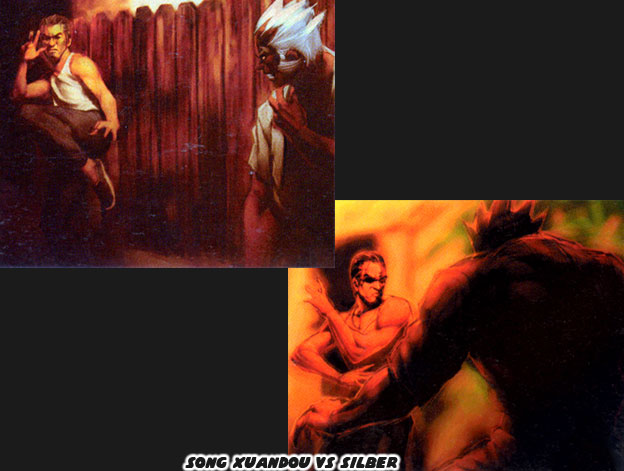
Eventually all of the artists at SNK started to become attuned to what Shinkiro had brought to the genre. They understood that if they wanted to put a character into the Fatal Fury, Art of Fighting or King of Fighters, they they had to meet the elements that Shinkiro had established for the series. There would be no green-skinned Brazilian wild man or stretchy-limbed Indian for example. Those figures were not necessarily grounded in any sort of realism. The fighters did not have to be realistic, but they did have to have a sense of realism. The artist Hiroaki Hashimoto aka Hiroaki was an exceptional painter and considered an understudy of Shinkiro. He worked on a number of excellent pieces for the KOF series. In 1999 he was a lead on a new title called Buriki One. This game was set in the KOF universe but a bit in the future. There was a new tournament in town, inspired by the real world K-1 and Pride fighting championships in Japan. There was a call for representatives of the various martial arts. It was the closest that the team at SNK came to creating martial arts archetypes in the vein of the Street Fighter series. The final opponent was a new villain. Silber was very much an SNK answer to Gouki, he had traveled the globe defeating the masters of various arts and even a few wild animals.


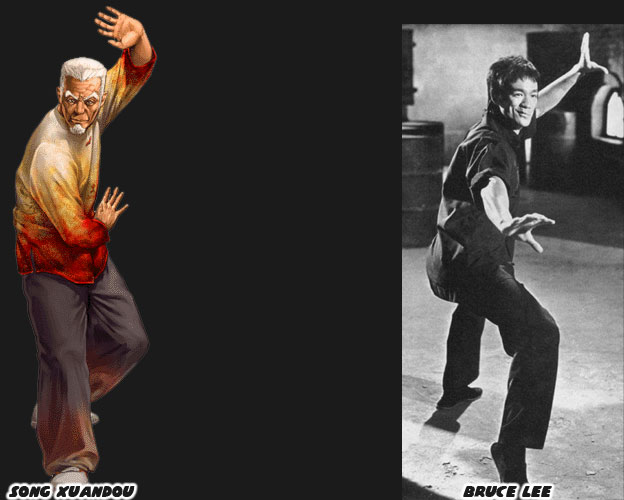
One of the competitors in the Buriki One tournament was an elderly Tai Chi master named Song Xuandou. It turned out that this was the only character that had a previous run in with Silber. Decades earlier, before MMA tournaments were being televised the only way for these fighters to find out who was the best was by actually visiting various dojos and exotic locations. There were no newspapers, no radio or film crews following these people. The fights that went down were the stuff of legend and only a handful of people actually saw them. This was how people like Mas Oyama earned a reputation. When Song was a young man he was lightning quick and very confident in his abilities. He took on Silber and lost. Although he was defeated it was a close battle. It could have been likened to the fight between Bruce Lee and Wong Jack Man. Song was one of the few people that could have claimed to have survived a fight with the powerful German. Silber was and remained a secretive figure in the world of SNK. It was entirely possible that he killed some of the people that he battled. Official character art for example featured him smashing in the face of a polar bear. When the designers of Buriki One called for a Chinese fighter to be put into the game Hiroaki gave audiences an elderly archetype. Nothing about the character seemed to stand out. But again, he was hiding the master in plain sight.


While Song no longer held the speed or flashy kicks of his youth, he retained most of his power. Song was modeled partly on Bruce Lee. This was a version from another timeline, say if he had remained in China and had stayed closer to the kung-fu traditions. This was why he didn’t move or fight like Marshall Law from the Tekken games. He was not just a carbon copy of the actor. Song had the vigor and even look of a youthful Lee in the ’60s. This was back when both he and Silber were getting started in their careers. Song had now distilled his techniques to a few deceptive moves. He could strike, trip and kick his opponents with ease. It was graceful watching him work in the tournament. You could have mistaken him for the old guy practicing Tai Chi in the park rather than a former martial arts superstar. Again this was the SNK school of design at their best, they hid the master in plain sight. It should be noted that not every SNK fighting game required this type of design. For example Shinkiro did a tremendous amount of promotional art for the Samurai Spirits / Shodown series. But he was not the only artist that influenced the fighters.


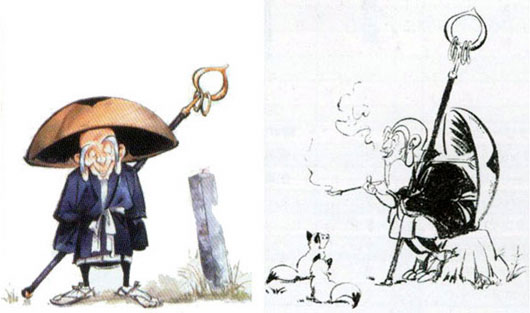
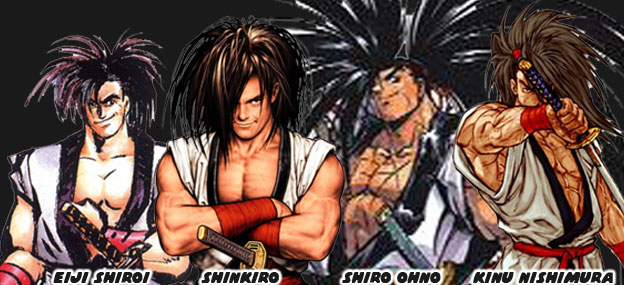
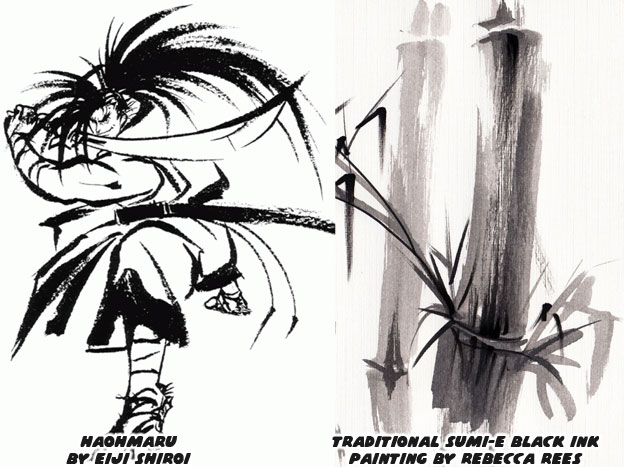
The game was set centuries ago, in feudal Japan. Gunpowder and steam were barely shaping the world, changing the course of the industrialized nations. Japan was insular during this period and held onto tradition longer than most other countries. SNK wanted to capture that era but not romanticize it. They wanted it to pop, to be vibrant, like an animé show. In order to do that the game had to be highly stylized. One of the artists that got picked up for the sequels was manga artist Shiro Ono. He had a very sharp style, with hard lines and exaggerated poses. At the same time the studio did not want the designs to be too outlandish. Shinkiro’s realistic style would have been in contrast with their goal. The artist that the company settled with was Jin Mera aka Eiji Shiroi. Her style was deceptively clean. No extra brush strokes in his renderings. The character designs were easy to read, her choice of color and style really stood out from her peers. In fact the thing that helped cement the look of the series were some paintings that she created using charcoal ink. The sumi-e style was traditional and went back centuries, if not thousands of years. Calligraphers and portrait artists used minimalism to create forms and figures.


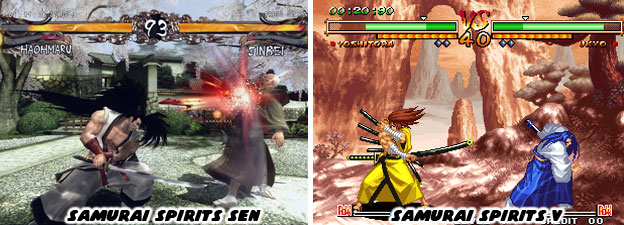
The solid black and white paintings that Ms. Shiroi created perfectly reflected the era that SNK was trying to capture. Eiji was a drawing teacher, her training and insight were perfect for this project. In the case of Samurai Spirits the masters of the various sword arts did not have to be hiding. They wore classic-looking costumes, some wore armor, and they all fought with traditional melee weapons. There were swords, daggers, cleavers, hammers and axes used by the various fighters. As the series grew these things began to include the occasional explosive and even a rifle. For the most part however combat was based on bladed weapons. The designs had to be clear and easy to read. A Chinese warlord for example had a different costume than a Japanese ronin. Even among the various Japanese sword masters there was a lot of diversity. Ms. Shiroi helped plan their look and assigned each person bright primary colors so that they all stood out. As the series aged SNK experimented with 3D and they discovered that the muted colors that were en vogue didn’t really work for Samurai Spirits. This was most apparent in Samurai Spirits Sen. Realism didn’t work very well for the fantastic swordsmen and women. So they returned to 2D shortly after with Samurai Spirits V.


Not every design that SNK created went over well. The studio had a lot of growing pains and made a lot of mistakes when they were trying to capture the fighting game crown. We’ll explore one of the most diverse lineups the company ever gave us in the next blog. As always if you enjoyed this blog and would like to sponsor me please visit my Patreon page and consider donating each month, even as little as $1 would help make better blogs and even podcasts!

 follow the Street Writer on Patreon!

Monday, August 15, 2016

Fighting with a disability, part 1...

Fighting games make the fantastic possible, but sometimes they make the real-world fantastic as well. It's one of the reasons we love the genre so much. They can turn a boxer into an unstoppable force of nature, they can turn a wrestler into a cast-iron robot. There is a part of us that believes in these characters because we know there have been men and women throughout history that have done legendary things. One of the things I enjoy most are seeing the unorthodox, whether it's a technique or personality. This time I want to feature fighters that were unique because of their disability. There have been athletes and fighters born with all manner of physical and mental conditions. This did not stop them from achieving personal success and I find their stories inspirational. But what about the fighting game characters with disabilities, what do we know about them? What can they tell us about the developers or nations they came from? I want you to think for a moment about characters in fighting games that were presented with a disability. How many could you name?


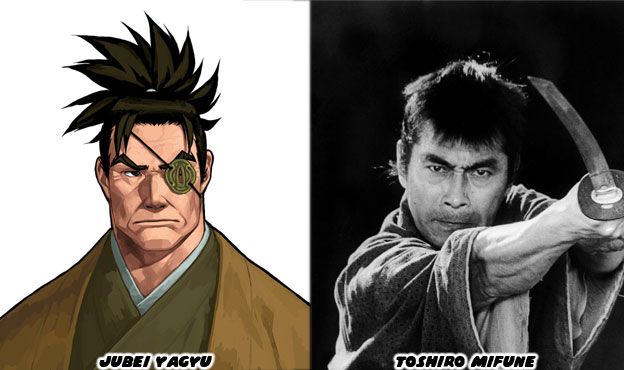
One of the longest-lived character designs, really a trope at this point, is the eyepatch-wearing fighter. Many games have featured a character with this disability. Usually in the form of a villain. But there were a few heroic characters that wore the patch as well. Many of these characters, including men and women, were based on the true story of Jubei Mitsuyoshi. While the actual Jubei had use of both eyes the authors that turned his story into legend often embellished his look and said he wore an eyepatch on the count that he lost it while sparring with his father. It made for an interesting character. One of the first fighting game characters to poach the look was Jubei Yagyu, who appeared in the original Samurai Shodown / Spirits in 1993. What made the series great was that several of the sword masters were inspired by fighters from different feudal eras. The scruffy hair, square chin and rugged looks of the SNK character were no doubt inspired by the actor Toshiro Mifune who played a swordsman in several films, including the phenomenal Seven Samurai.


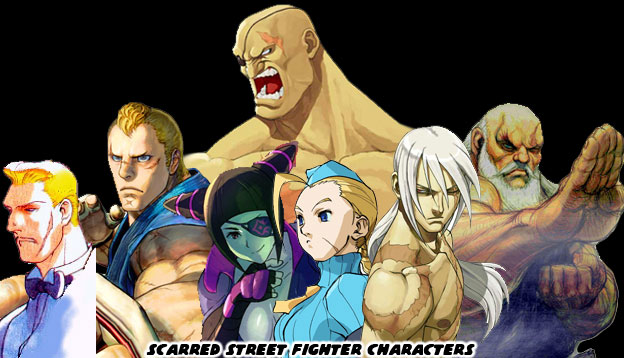
Characters with eye patches were nothing new in the Street Fighter series. The original world champion, Sagat, had a patch. More recently Juri was also presented with an eyepatch as well. When it came to other memorable traits there were several characters covered in massive scars. Eagle, Cammy and Abel were three blondes that each had facial scarring. Abel and Cammy of course also suffered from amnesia and brain washing. These designs and themes would turn up in the Rival School series as well. Some of the characters were covered in many grotesque scars, even over their eyes, like Kairi and Gouken. The bare-handed one-eyed fighter was quickly becoming a trope for the genre.

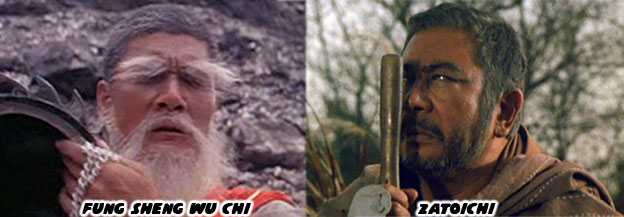
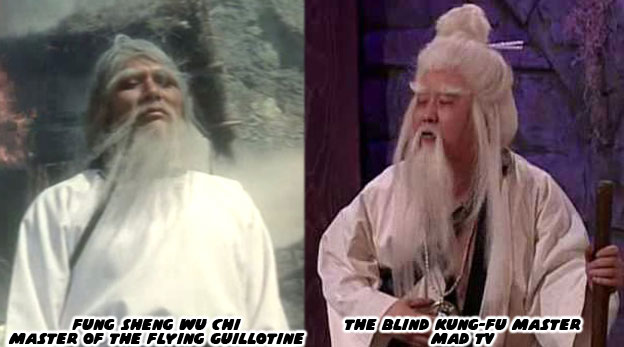
A character blind in one eye was interesting enough but films and comics had turned completely blind characters into stars as well. Hong Kong and Japanese cinema both featured fictional heroes and villains that were both blind but lethal as well. None was more popular than Zatoichi. Created by Kan Shimozawa in the early '60s, the character of Zatoichi engrossed movie audiences for several decades. There was even a television series featuring the character that went on for 100 episodes. Zatoishi was a travelling masseuse and hired sword. His fighting ability seemed superhuman as he would often take on dozens of men at once. He often dealt with and for unsavory characters, including yakuza bosses. There was something sympathetic about the character and the actor. Shintaro Katsu poured himself into the role. Shintaro played the character in almost 30 films. You may have seen a more recent remake of the character featuring cult film star Beat Takeshi. In China there was a villain that was as awe-inspiring as Zatoishi. Unfortunately this character would appear in only one film; the Master of the Flying Guillotine, aka the One Armed Boxer part 2.


Whether the character was a good guy or a bad guy did not matter as much as their martial arts prowess. Zatoishi set an incredible standard. Fung Sheng Wu Chi was just as lethal, taking out masters of various fighting arts with his throwing weapon. The creators of both blind characters demonstrated that their other senses were heightened so that they could anticipate the moves of their opponents. They could hear and even smell opponents, which came in handy while fighting in the pitch black of night. Hong Kong cinema made sure that the myth of the blind master would spread around the world. When the west saw these figures they were engrossed by them. Some of the blind master retellings worked well. Such as the USA take on Zatoishi called Blind Fury. Other retellings were a little more humorous such as the Blind Kung-Fu Master from Mad TV.


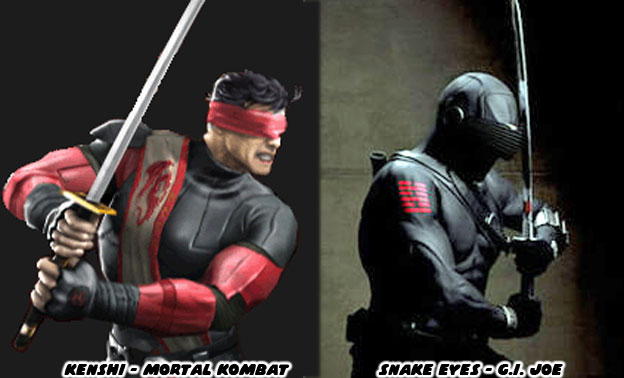
In some instances the blind warrior would become the mentor for the star of the series. Think of the blind Shaolin priest from the classic television series Kung-Fu. Or Jedi Kanan Jarrus from Star Wars Rebels and even Chirrut Imwe from Rogue One. They were great warriors filled with wisdom despite their physical disability. Everything they knew could be passed on to a star pupil that would change the world. The west found these archetypes appealing and began creating new heroes from their legends. In the Mortal Kombat series there was Kenshi Takahashi. He had moves based on Tai Chi and Judo while wielding an ancient sword. Audiences could tell from the red bandage covering his eyes that Kenshi was a blind master. He had telekinetic powers that allowed him to throw opponents around and retrieve his sword without having to move. His initial costume and design was rooted slightly in the comic book and cartoon icon Snake Eyes. While Snake Eyes is not blind, he was disfigured and is mute and wears a mask. He was trained in the secretive arts of ninjitsu and became an elite member of G.I. Joe. He was the deadliest hand-to-hand fighter in the group comprised of the best soldiers of every branch of the armed forces. Mysterious characters like Snake Eyes and Kenshi always go over big in the west.


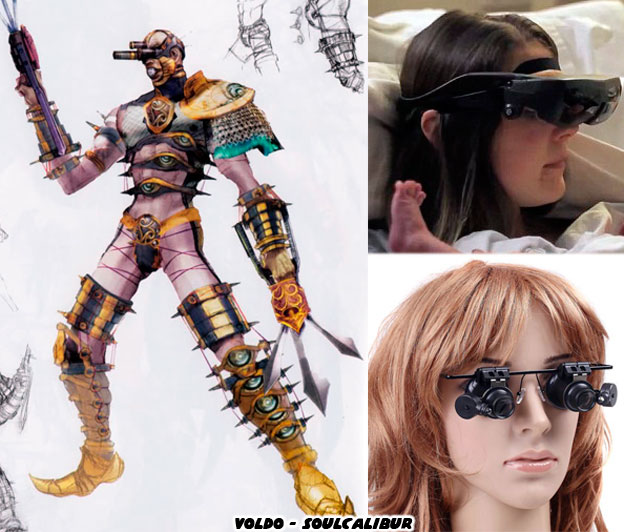
Kenshi was far from being the first blind fighting game character. That honor would go to Voldo. He appeared in Soul Blade / Edge, the first successful 3D sword fighting game from Namco. Voldo was an assassin from Palermo in the Kingdom of Naples from ancient Italy. He fought in an unorthodox style, twisting and flipping at opponents. He fought in an odd costume, wrapped in leather and other bondage elements. He even fought with an unconventional weapon, the three-bladed Jamadhar Katars. Voldo wore a strap across his eyes but he was not completely blind. He suffered from an eye condition that severely limited his vision. Whether it was due to an accident or birth defect he was presented using a telescopic device which allowed him limited visibility. The version he wore predated modern medical devices by more than 400 years. I think this would qualify Voldo as the first and as far as I can remember only character to wear a low vision optical device. Score one for the visually impaired community!


Characters come in a variety of sizes and abilities. We have just talked a little bit about those with disabilities. Differences in physical to mental conditions make certain characters more interesting. They add dimension to the figures and can turn an ordinary fighter into a memorable one. In the next entry we will look at those that had slightly more physical challenges. I hope to see you back for that! As always if you would like to sponsor me please visit my Patreon page and consider donating each month, even as little as $1 would help make better blogs and even podcasts!

follow the Street Writer on Patreon!

Monday, July 25, 2016

The Street Writer Podcast, Episode 7

On the previous blog I had talked about the Bancho, Japanese school delinquents that knew how to fight. They were made popular in the '80s thanks to manga and anime. In the '90s they would be incorporated into fighting game design. We begin today in the early '90s. The stand alone King of Fighters franchise hadn't been born yet and SNK was a crossroads. Should they keep taking chances in the fighting game genre or branch out with other formats? The studio had found moderate success with their fighting games but they wanted to create a breakout hit, like Street Fighter II or Mortal Kombat. In order to do this they had to take some chances with the genre and introduce some new blood to the lineup. They had done some experimentation previously, the ability to jump between the foreground and background in Fatal Fury was revolutionary. The large scaling sprites in the Art of Fighting gave it a cinematic feel. Budgets were tight during the development of the King of Fighters '94 (KoF) and risking it all on a completely new cast was out of the question. It made sense to bring together the Art of Fighting (AoF) and Fatal Fury (FF) groups. Those titles had both evil and heroic fighters that audiences were already familiar with. Reaching out and including the Ikari Warriors and Psycho Soldiers would ensure some non-fighting game players would check out the title too. As the teams were being finalized the studio decided that they had to take a chance on some new faces. They did not want to place either the AoF or FF teams as the stars of the game but rather a new group which the plot would focus on. The designers bet that the new teams would become as iconic as the previous franchise characters. Well the studio was half right. Team Japan would grow a tremendous following. These fighters would become pivotal in the canon of the series while the members of Team USA would fade into obscurity.


As the first generation of fighting games tapered off the developers began looking for new influences. Team Japan and Team USA were pulled mainly from pop culture rather than fight culture. The references worked in favor of Team Japan. The team captain was Kyo Kusanagi was a young and handsome high school student. His design was was very clean cut but deceptive. His uniform looked like a traditional gakuran, yet there was something unique about his design. Think about a character like Ryu, he certainly looked like a traditional karate fighter, yet most traditional fighters did not wear a gi with torn sleeves and frayed pant cuffs. Nor did they let their hair grow too long and unruly. At first glance you were supposed to know that Ryu was a karate fighter, but the details of his costume told a story. Similar details applied to Kyo's design. His hair was long and held up with a headband rather than a cap, his jacket was open allowing him a wide range of movement. His sleeves were rolled up and he wore fingerless black gloves. He was certainly a fighter more than a scholar. His teammates represented other aspects of Japanese culture. The flamboyant Benimaru Nikaido, whose crop-top, earrings and tall blonde hair were very counter-culture. The character had a unique fighting style and the ability to generate electricity and shock his opponents. Benimaru was modeled closely on Jean Pierre Polnareff from JoJo's Bizarre Adventure. The third member, Goro Diamon, was the bruiser of the team and the one with the closest traditional fighting style. He was a Judo gold-medalist yet also had the ability to perform some superhuman feats of strength. When deciding who would represent Japan in the KOF global tournament there was an MMA tournament. Kyo defeated his two partners and became team captain.
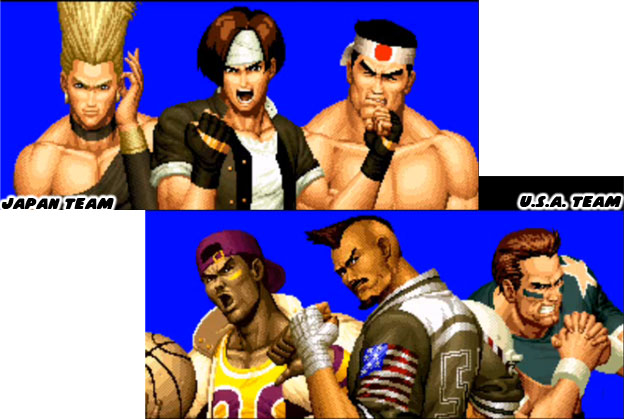

The team that represented the USA was based on basic knowledge of the US. If anything they were stereotypes of Western culture. The team captain was a street boxer named Heavy D. possibly after the rapper with the same name. His partners were a basketball player named Lucky Glauber who was not unlike Kobe Bryant, even wearing the Los Angeles Lakers gold and royal colors. He even had a distinct "swoosh" logo on his cheek, certainly without Nike's knowledge or consent. He could summon basketballs to throw at his opponents instead of fireballs. The third, Brian Battler, had a football shoulder pad and a few tackling moves. In the KoF manga by Gamest the character was introduced as a stock car driver that was seemingly indestructible. Having walked away from a burning car crash just a few moments after being introduced in the series. It was obvious that the US team didn't have the same level of forethought that SNK had used when creating Team Japan. There was no doubt that international audiences would understand that they were typical "American" characters with their focus on sports. Past that there was little that made the US figures interesting. Each character had a few neat moves but none really looked like a fighter except for Heavy D. One character couldn't really carry the team and that was part of the reason why they faded into obscurity. The members were seen after KOF '94 but weren't the stars that SNK had hoped for. That gamble had only partially paid-off.
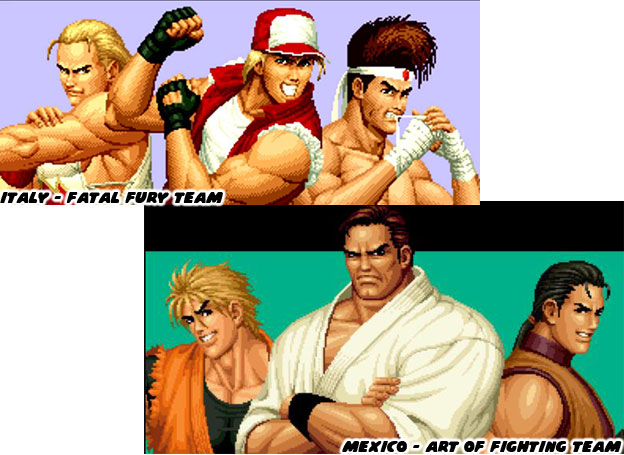
 

Team Japan and Team USA were planned as being the counter points to the Fatal Fury and Art of Fighting teams, so that no one country (or series) could claim to having the best fighters in the SNK universe. In canon Team Japan was written as the winners of the first three KOF titles. It was obvious from the onset that the team had some staying power. None of the new characters introduced had a bigger following than Kyo. The bancho had finally found a mainstream fighting game. Like Ryo Sakazaki and Terry Bogard before him there was a star that would help keep SNK on the map and give audiences somebody to root for, somebody to follow and most important somebody to play as. With the introduction of Kyo something was missing. He lacked a rival. In promotional material Team Japan was featured sided against Team Italy, the Fatal Fury group. Yet many players didn't see that as a balanced lineup. Terry was an older and more experienced brawler, his brother Andy had mastered the Shiranui ninjitsu art and Joe Higashi was also a muay thai striker and not a grappler. None of the men were as outlandish as Benimaru or as large as Goro. Also, despite being teams of three the team captain was usually recognized as the most interesting or most popular character. Whomever was going to rival team Japan needed to have someone as interesting as Kyo. This was going to be a problem.
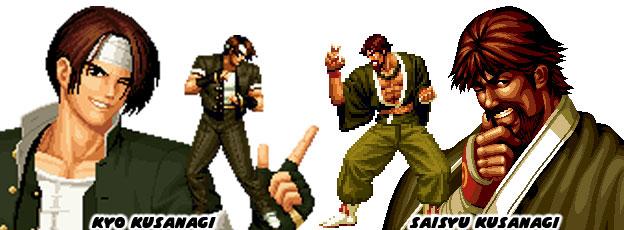

Kyo wasn't just a really good fighter, he had the ability to project fire from his hands. It was the special attack that allowed him to hold his own against Ryo or Terry plus it was a very well animated effect. As the series grew it was revealed that Kyo had mastered the art of fire at the age of 15. It was a secret technique known only to the members of the Kusanagi clan. At a young age he had passed all of the trials of his family and had even surpassed his father Saisyu in fighting ability. Yet in typical fatherly (stubborn) fashion Saisyu would never admit that he was no longer the greatest warrior in his clan. Just as Takuma Sakazaki would never admit that he was ready to defer the throne to Ryo. Both men felt that they still had something they could teach the next generation. Saisyu would turn up in King of Fighters '95 as a sub-boss. He had an interesting design, his costume was closer to a fighting monk with the family crest, an eclipsed sun on the back of his robe. Kyo had the same logo on the back of his jacket. Yet Saisyu was not a great rival for Kyo. The animosity was not there. The two would never be rivals like Heihachi and Kazuya Mishima from Tekken. The studio had to dig a little deeper in order to create just the right rival. It turned out that the SNK had made a similar design error previously.
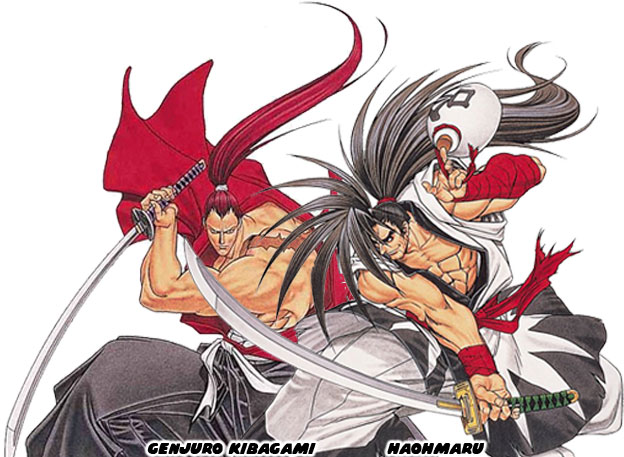
 

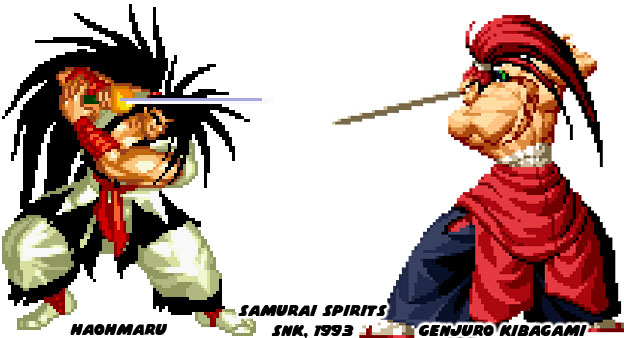
In 1993 the studio had released a smash hit called Samurai Shodown / Samurai Spirits in Japan. It was one of the first and best weaponized fighting games ever developed. It had very bold character designs, inspired by fictional and real sword fighters from the feudal era. The star of the game was the hard-drinking, wild-haired Haohmaru. A wandering swordsman very loosely based on the actual Miyamoto Musashi. While the first game had many other sword fighters none really matched the design of Haohmaru or could be considered his main rival. A year later the studio finally crafted a rival that was beat-for-beat every bit as interesting as the main character, if not more so. Genjuro Kibagami was the red-haired rival with a nasty scar running the length of his back. It was given to him by his mother after Genjuro killed her lover. In return he killed his own mother. There was a whole lot of drama in the series and I might talk about it some day, but the main beef among the cast was between Genjuro and Haohmaru. They used to be friends but that friendship turning into a rivalry. It made things difficult for the star of the game, knowing that not only did he have to deal with the main villain, usually a demon of some sort, but that there was another sword master out there looking to take his head. SNK looked at this rivalry and found the missing ingredient for the King of Fighters. It didn't really matter if Team Japan had a person to balance out Benimaru or Goro as long as there was somebody for Kyo to deal with.
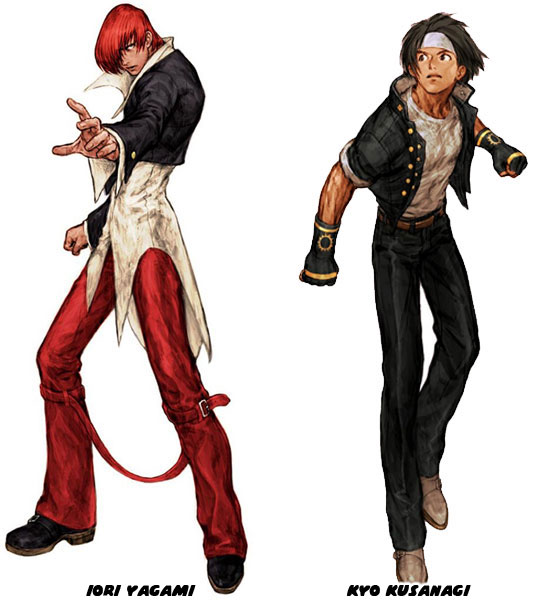
   

Heavy D from the USA did not seem interesting enough to merit a rivalry with Kyo. Team captains Terry and Ryo had their own rivalries and their own villains to contend with, not to mention that they were older and more seasoned fighters than Kyo. SNK decided to create an age-appropriate and culturally similar rival. This young fighter was Iori Yagami, like Kyo he was a high school student, a bancho without a gang to lead. He had his own unique spin on the school uniform, with an un-tucked long shirt, bright red pants and suspenders tying his knees together. His look was so bold that audiences instantly knew that he was the perfect rival for Kyo. Nothing had to be stated in canon in order for audiences to see that this character was going places. As the series went on it was revealed that the fire powers of Kyo, and odd blue fire of Iori were from their respective clans. The two were part of a lineage that was destined to battle the Orochi, historically this was an eight-headed, eight-tailed serpent from Shinto mythology. In KOF canon it could instead be represented as a human. The original creature was an Earth god and required a sacrifice every year. The sun goddess Amaterasu (the star of the Capcom game Okami) cast her brother Susanoo down from Heaven for tricking her. While on Earth Susanoo found out about the sacrifices and fought the Orochi. First by getting each head drunk and then cutting the monster into pieces. There was a fantastic science fiction retelling of the legend in the manga titled Orion by Masamune Shirow. But I digress...

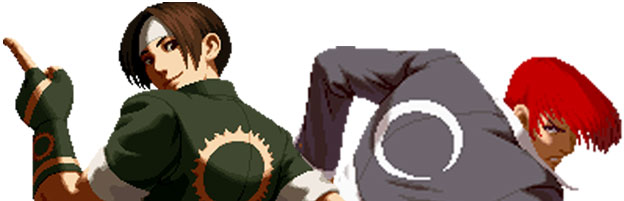
There was tremendous symbolism involved with the design of both Kyo and Iori. The fire techniques that each held were not scientific but spiritual in nature. The Kusanagi house symbol was a sun in eclipse. This unbroken ring represented both Amaterasu as the sun, but also symbolized the return of the Orochi. The eclipse was the moment that her light was no longer touching / protecting or enlightening the Earth. It was fire that would subdue the Orochi again. This layer of design was a bit more heavy-handed with Kyo's father. Saisyu had prayer beads, tabi socks and a robe that looked closer to that of a Shinto priest. The sun on the back of his costume was much more pronounced. Iori was a representative of the Yagami clan, they had built a blood feud with the Kusanagi clan going back untold generations. The Yagami had also been put in charge of keeping the Orochi at bay, and were also masters of the sacred fire techniques. At some point in the past they were seduced with promises of power. So they released the Orochi and in doing so they did gain more power than the Kusanagi. The family symbol on the back of Iori's gakuran was a crescent moon. The moon was a celestial counter to the sun, it was also mysterious to the ancient tribes on Earth. The silver globe in the sky seemed to have magical properties of its own. It illuminated the night and could even be seen during the day. The logo was more than the balance to Kyo's family crest. The sun was in heaven and the Orochi was bound to Earth. The Orochi could only break out with the help of the moon, the gateway between the Earth and the Heavens. It did this by blocking the sun during an eclipse or by following an opening at night. The crescent moon of the Yagami clan was specifically a waning moon. This was a moon that was on its way to becoming completely dark. The circle was broken, letting the darkness out, or perhaps in the case of the Yagami letting the darkness in.
 

The power that the Orochi promised was delivered but it came at a price. The sacred flame the Yagami created now turned blue. This supernatural power drove the Yagami members into a frenzy and shortened their lives in the process. Iori came from the same cursed blood and was a ticking time bomb. It wasn't high school pressure, nor was it runaway hormones driving him mad. The only thing that could satiate his bloodlust was the destruction of the Kusanagi lineage, at least that was what the Orochi promised. Kyo may not have believed in the myth or he may have been so confident in his powers that he actually seemed bored with his role. Kyo was young, the era he was living much different from ancient Japan. Bullet trains now criss-crossed the countryside, every phone had internet access and cars practically drove themselves. The superstition of the Orochi didn't quite fit in with his world view. It made sense that the high school student was being a little immature at the start of the KoF series. He was looking for a purpose and he found it in a girl, a classmate named Yuki. The sudden love interest was something that happened to bancho manga heroes Takagi Yoshiyuki and Taison Maeda in Osu Karate bu and Rokudenashi Blues. As Kyo grew up he also learned that his gift could be shared rather than coveted. Again, like Takagi and Taison there was a lot of growing and teaching happening in the series. Kyo and later-on his father, began teaching his classmate Shingo Yabuki their secret fighting techniques. Kyo would have an apprentice whereas his rival would have none. It seemed that the wisdom of Amaterasu did manage to get through to him.

Kyo matured into his role. He discovered other beings with inexpiable powers in the King of Fighters tournament. He discovered that cults and demons were real. The tournament was a front to bring together the greatest fighters and recruit them or kill them once learning their secrets. Kyo became central to the plot of NESTS; militant extremists bent on controlling the world with their super-powered clones. They were able to extract Kyo's blood and give other fighters some new powers. Iori was in the tournament not to represent his country but to finish the Kusanagi lineage. He didn't care for his teammates, opponents or anyone else in his path. If he could destroy the previous champion. If he could do it on the international stage with the world watching then it would be his perfect outcome. Kyo had an unnamed style of fighting but it was very direct and smooth. By comparison Iori fought like a wild man. Slashing at his opponent with his long fingers, stomping on them and just shy of biting their faces off. He would even slash at his own throat and draw out his blood for the temporary power boost it provided. The raw energy coursing through his veins made him one of the most dangerous fighters in SNK canon. Some villains tried to offer Iori a "cure" by allowing him to transfer his energy to them but that would leave him powerless to stop their agenda. At least one character, Ash Crimson, was able to steal part of his abilities and use it for his own devices. Ash would become a fighter that both Kyo and Iori would unite against.
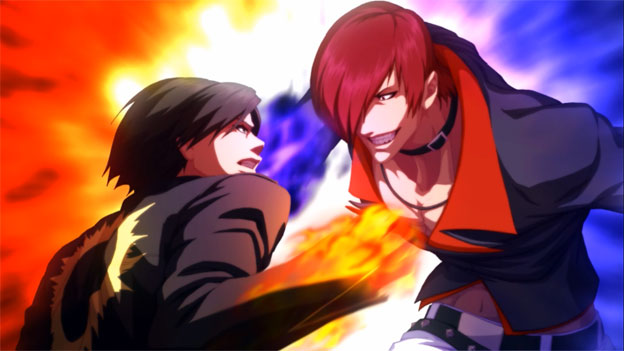
   

SNK wanted to create a fighting game that would become a phenomenon. One that would steal the thunder away from Capcom, Sega, Namco and Midway. They took many chances, team battles, mixing old characters and new faces, and expanding the plot to make it more cinematic. Many of the risks they took paid off. The new stars of the series would hold up to the first generation of fighting game all-stars. The bancho hero and villain were definite Japanese character tropes. It turned out that fans around the world and not just the Japanese loved the duo. Kyo and Iori ended up eclipsing the popularity of the entire USA Team. Their inclusion worked out better than another pairing of martial arts masters. It was one of the first titles that brought the concept of the fighting master into the 21st century. SNK taught the industry that a great rivalry could make or break a series. For more than 20 years the most heated rivalry in the SNK universe wasn't between an orphan and a businessman, nor was it between two sword masters that used to be friends. The greatest rivalry was between two kids right out of school. No one could have predicted it. Especially not the Generation-X players that grew up living that rivalry.

Kyo and Iori had most of the elements that I had talked about throughout this series. They were well balanced, they represented unique styles, were visually interesting and had contrasting purposes. Both were headstrong, talented and dangerous fighters. They were assembled from various pop culture cues. They celebrated a cultural archetype, the roguish delinquent that just so happened to work perfectly for the genre. SNK also knew that they should plan a unique back story so they could keep bringing these fighters back. Best of all Kyo and Iori divided the community. The best rivalries always began with fans choosing a side. Some rooted for the hero and some for the anti-hero. Most rivalries I had talked about had fans siding with the hero. Great gameplay, great animation and great control were the things that kept fans coming back. After 25 years the King of Fighters tournament was still alive. Proof that a great fighting game could withstand the test of time. The feud between Kyo and Iori could now be enjoyed by a new generation. SNK would have it no other way. I would like to thank you for following me on this journey and I have some final questions for you. Through this series which rivalry was your favorite? Do you think that Kyo and Iori were the most memorable rivals in the SNK universe? Which series handled the rivalry best of all? Which rivalry do you want me to talk about? Please let me know and take care. As always if you would like to sponsor me please visit my Patreon page and consider donating each month, even as little as $1 would help make bigger and better recordings and videos.

 follow the Street Writer on Patreon!

Saturday, July 11, 2015

The Ken reaction, part 1...

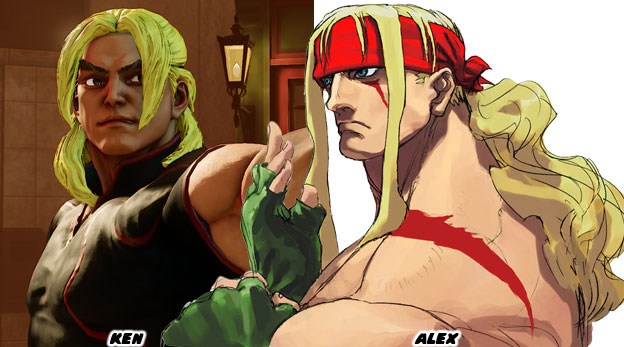
Let's talk a moment about the reaction to Ken returning in Street Fighter V. There are people that love the news, the new look and new moves and people that are offended by all the changes. It's understandable from either perspective. Those that have been with the series for a long time might not welcome the changes made to the character. Those that are relatively new don't mind the makeover as long as he still plays well. One of the biggest knee-jerk reactions has actually been about his hair. It is much longer now than in the previous game. So much so that it is falling over his eyes. There hasn't been a male character with this much hair since Alex in Street Fighter III.
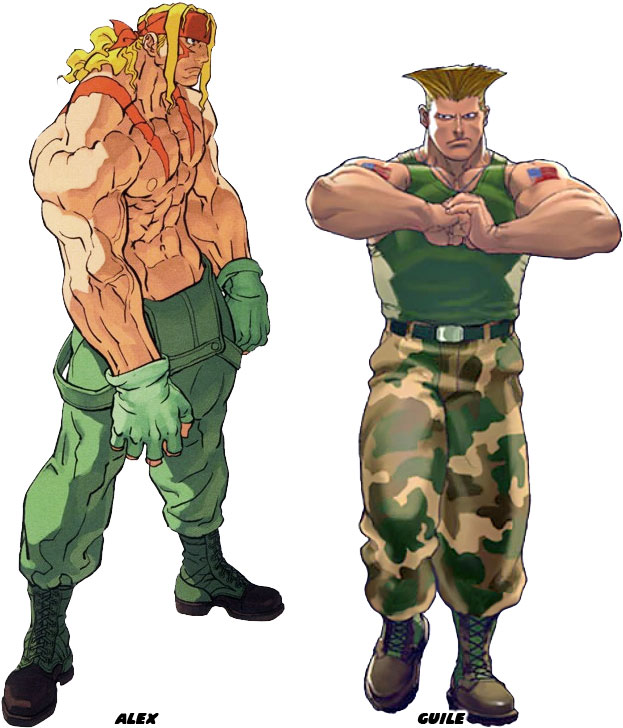

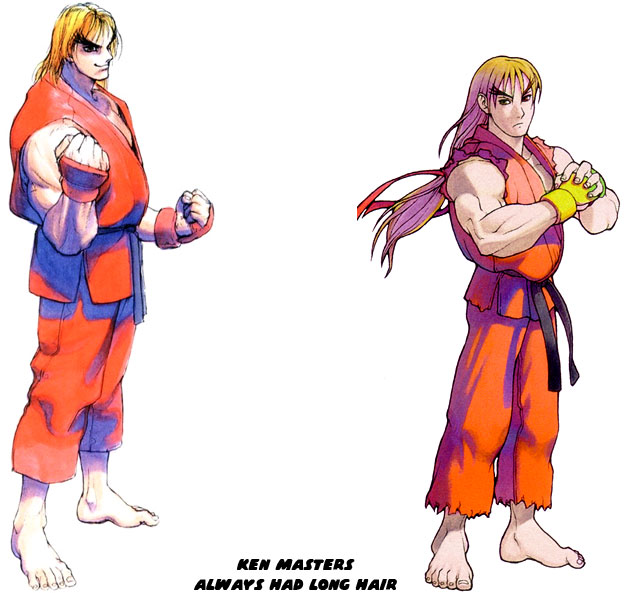
Of course the people that are complaining about his long hair may fail to address that this character has always had long blonde hair. In fact this is the second major makeover for the character. In Street Fighter Alpha / Zero, he had much longer hair and in a ponytail. The decision to present a young Ken and Ryu in the series was based in part on the designs used for the Street Fighter II anime movie. Most fans enjoyed the look so long as Ken was still a fun character to play as.


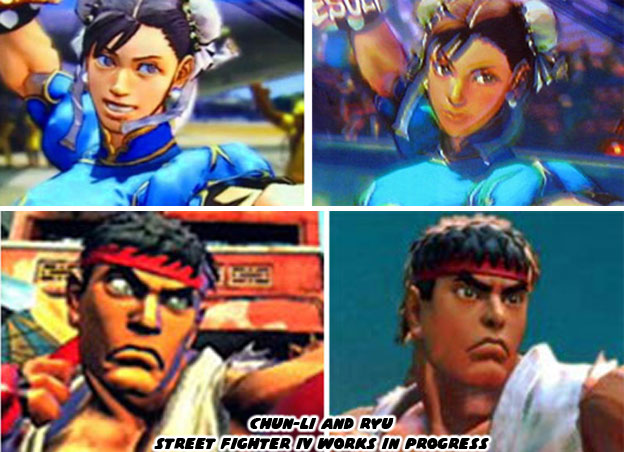
The other major complaint is that the model in the trailer is ugly. The hair itself looks like it was sculpted out of Play-doh. I'd actually like to remind critics that these are Beta and possibly even Pre-Alpha models going into the teaser trailers. The character is still months and months away from being finalized. In case these people forgot the early footage of Street Fighter IV caused the same reaction from many gamers. Ryu was ugly, as was Chun-Li. Their heads were odd, their proportions were funny. Their hair looked like blobs of colored clay. On and on people complained while the game was still being developed. Many wrote off the series then and there. They should have stuck around a bit longer because from month to month the models changed greatly. I can only assume that the same thing is going to happen with Ken and the rest of the cast. Also for the people that dropped the series while it was still in beta were not really missed. The over 8 million copies of the Street Fighter IV series sold helped single-handedly revive and entire genre with the masses.


I'll hold my judgement on Ken until he is finalized. I'm already not happy with what the studio did with Birdie but that's an entire series in and of itself. Right now I am sitting on the fence regarding the redesign for Ken. Like many long-time fans of the genre I can point out what the issues are. First and foremost the character is part of a legacy design going back to the start of the genre. And I'm not talking about the first Street Fighter either. I mean a game even older than that!


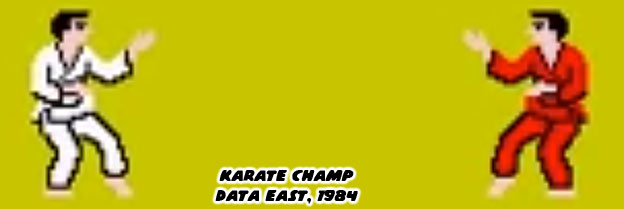
The karate guy in the white uniform versus the karate guy in the red uniform was a tradition started by Data East over 30 years ago! There were a couple of reasons why the characters were presented this way. First off the uniforms could have actually been worn in competition. Secondly the red uniform was a good contrast because two characters wearing white would be difficult to track as they jumped toward each other. It made a lot of sense for programmers that had to use two main karate fighters in a game. It would become a tradition that other studios would follow.


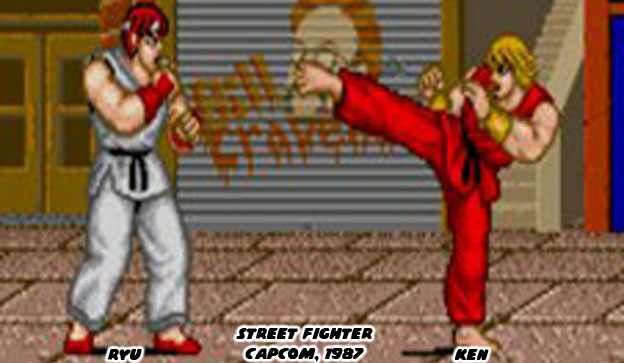
Capcom pretty much set the standard a few years later with the original Street Fighter. Since the game engine was running on the CPS-1 board the sprites were larger and supported more colors than what was possible earlier. They used these extra colors to add some details to the characters. Ryu had reddish hair, red punching gloves and red slippers. Ken had blonde hair and gold punching gloves. These details would become standardized for both characters over the next 25+ years.


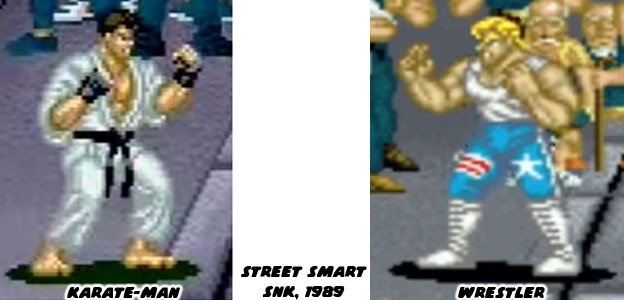
As more developers began creating fighting games of their own they started out with two main characters. They were almost always a Japanese and an American because that was the two biggest markets the industry was focused on. The Japanese was usually a karate fighter and the American was also a karate fighter or some sort of wrestler. SNK had experimented with the formula since early on. Such was the cast with Street Smart. A game that was a hybrid brawler and fighting game.


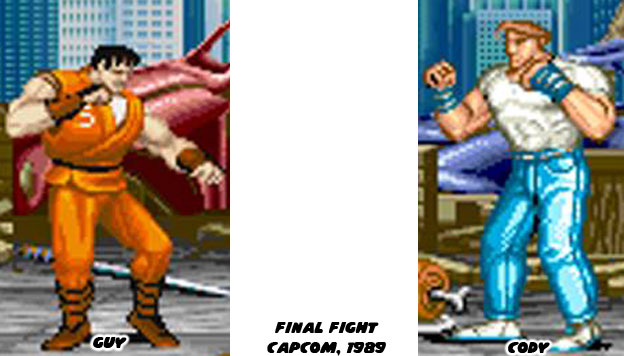
That same year Capcom also released a title that was a hybrid fighting game and brawler. Final Fight was designed as the sequel to Street Fighter. What was interesting was that the uniforms for the main characters were reversed. The American wore white and the Japanese wore red, well actually a burnt orange color.


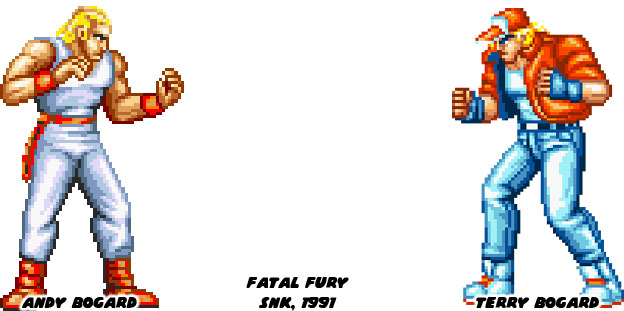
And so the trend continued through the years. In 1991 Capcom released Street Figher II and updated the look of Ryu mostly. Ryu had dark hair and lost the slippers. Ken more or less stayed the same. The other developers were keenly aware of the trends and had also released their own fighters. The closest one on the calendars was Fatal Fury, which was produced by the planner on the original Street Fighter. The main colors remained on the characters, red and white yet this time they were brothers. Also SNK began inserting more contrasting colors and even secondary colors to all of the uniforms. This would be a trend that made the SNK library appear much different.


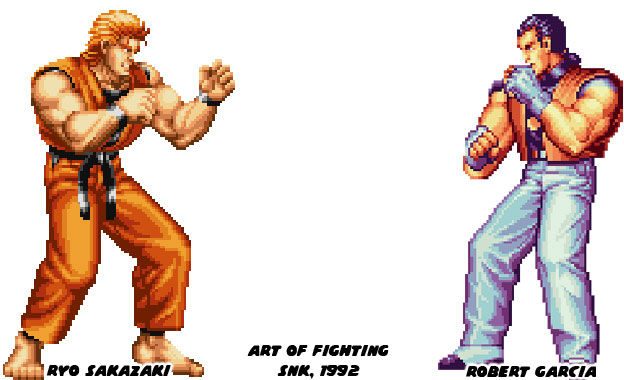
A year later SNK released the Art of Fighting. Again the colors were reversed on the main characters, except this time there was more diversity. Instead of a blonde American, the second player was a black haired Italian. I'm sure many audiences noticed that while Ryo was very much an amalgamation of Ken and Ryu, his uniform had a distinct black vest under his gi. This was something that would return for Ken in Street Fighter V.


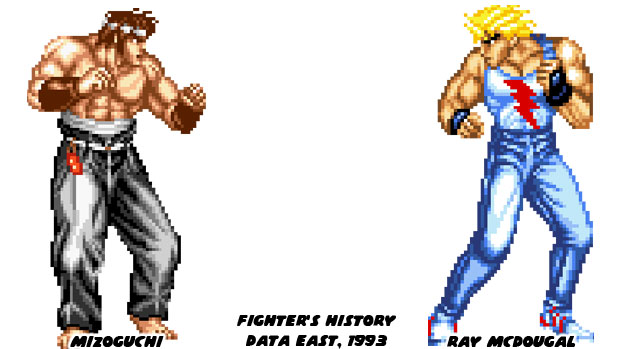
The following year was a major period for the evolution of fighting games. Three titles were released that each shaped the course of history. Data East finally returned to the genre they created with Fighters History. From the neck up the two main characters were very much identical to Ken and Ryu. The rest of the cast was even similar to the World Warriors in Street Fighter II. So much so that Capcom sued Data East for copyright infringement. Capcom would lose the case which allowed other studios to release games and characters very similar to Street Fighter.


SNK would return with one of the most popular weapon-based fighting games of all-time. Samurai Spirits came out in 1993 and introduced Haohmaru. However he was without his balance until the sequel came out. Genjuro was very much the Ken to Haohmaru's Ryu, although technically both were Japanese.


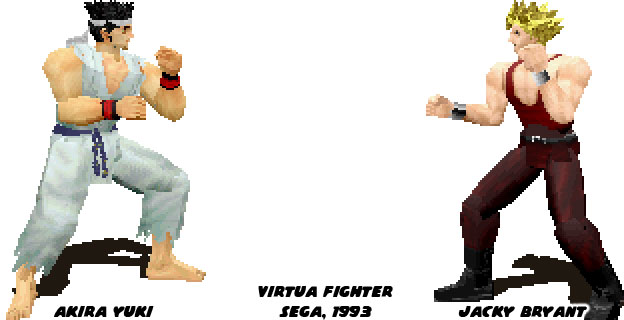
The most revolutionary title of '93 was Virtua Fighter by Sega. It was the first 3D fighting game. Yet despite all of the advances with graphics technology the main characters were still a Japanese and blonde American wearing white and red respectively.


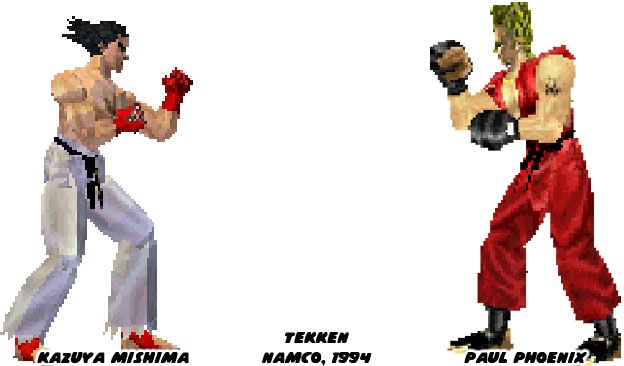
A year later Namco released their first entry in the 3D arena and surprise-surprise there was a Japanese protagonist wearing white and a blonde American in red. Of course any similarity between Ken and Ryu to Paul and Kazuya was superficial. The Street Fighters and the Tekken games had different control schemes, different combo setups and altogether different gameplay elements. The biggest franchises, at least those that came from Japan kept the tradition alive for a generation. Red and white costumers were done because of technical limitations originally. The early arcade engines only had enough memory and processing power to display a few colors at a time. Characters had to be painted in broad single colors. As technology improved so did the ability to display dozens and then hundreds of colors on screen. Even then developers learned that the most memorable characters preserved a single main color. This was most obvious in Street Fighter.


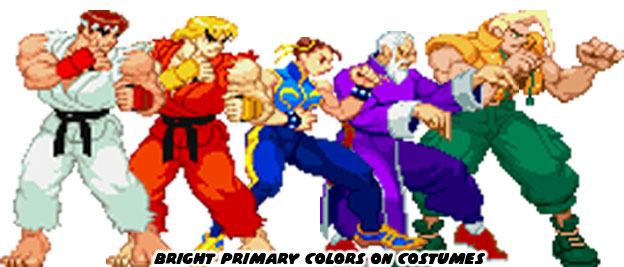
Let's play some word association. What is the first color that comes to mind when you think about these characters: Ryu, Ken, Chun-Li, Gen and Charlie Nash? Chances are you would think white, red, blue, purple and green. Think about every Street Fighter character and how you could pin a color to them, Sean was synonymous with yellow, Blanka was green and Makoto was white. Costumes or uniforms with a solid color were easier to track on the screen than a character with busy patterns on them. This worked in traditional animation, in comic books and just about everywhere else where you wanted to grab the attention of the audience. If there was one thing that Capcom had relied too much on over the past 30 years was that certain nationalities were stuck with the same colors.


It was not a hard and fast rule but audiences around the world were expected to identify the American character because they were white with blue eyes, blonde hair and military themes. Costumes started to become a little heavy handed with social bias. Japanese characters that were not wearing a gi were sumo wrestlers. Black fighters were mainly boxers and on an on. This started to wear a little thin with audiences. They wanted to see some more original ideas. If not more diversity then perhaps costumes that would make the characters look a little more contemporary. The only down side was that Street Fighter had gone unchanged for such a long time that giving a main character with a completely new look was going to make a lot of players mad. Capcom found a nice middle ground by offering DLC costume packs which offered everything from actual street clothing to animal costumes. However Street Fighter V was a completely different approach to the genre and because of that some of the returning characters would not be the same. In the next blog we will take a closer look at the new Ken. As always if you enjoyed this blog and would like to sponsor me please visit my Patreon page and consider donating each month, even as little as $1 would help make better blogs and even podcasts!