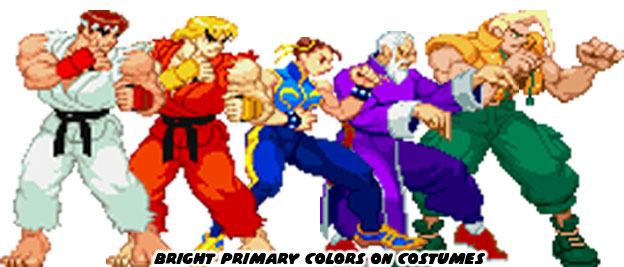
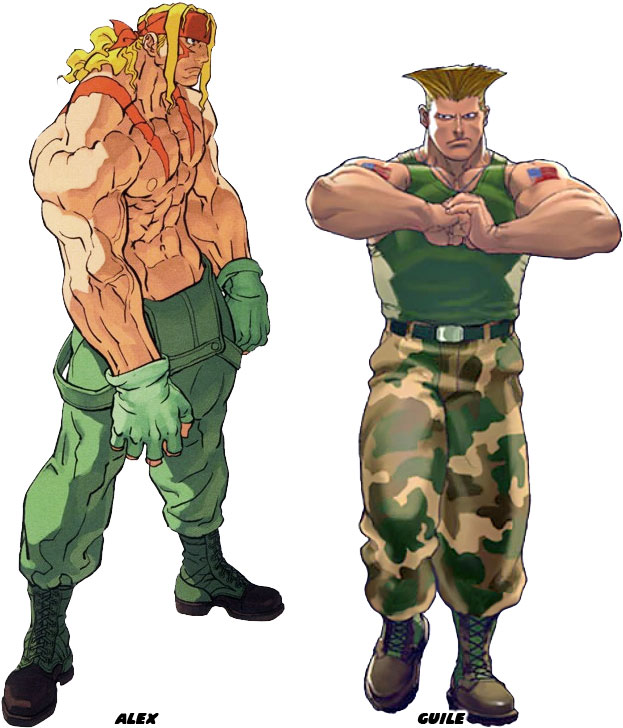
When we look at fighting game characters, both the good or bad designs, we have to take them in context. Most fighting game characters represent more than a fighting art. They often represent a region of the world, and in some cases an entire culture. The majority of fighting game characters are East versus West, but more specifically Japanese versus USA designs. Some of these men and women were inspired by actual people but the majority were created from a number of sources. Films, comics, cartoons and television had done a lot to influence the creation of the biggest names. One region that was rarely discussed, even by me, was the Middle East. It had colored a few of the characters that appeared throughout gaming history. In order to understand the design, influence and even impact of the newer characters added to both Street Fighter and Tekken we have to look at them in context. We will start by going back in time, back to the Golden Age of Islam. Now I do not mean to offend my audience by discussing Islam during this era of heightened security and suspicion. I have talked about Buddhism, Shinto and other spiritual beliefs on my earlier posts regarding fighting game characters and their origins. I hope my readers can extend the same courtesy to the culture I am going to present.
The Arabian Peninsula, Saudi Arabia for the most part, is a bridge of cultures and customs. It was a hub of commerce from North Africa to South Asia, there was tremendous influence in the region to the people, tribes, and traditions of the surrounding areas. From Russia, China and India to Egypt, Sudan and Ethiopia, there were some connective tissues that united this region of the world thanks to the Middle East. When it came to pop culture there were a few things that people knew of the area. It was rich in oil, had survived countless conflicts from internal and external forces and had remained culturally isolated for a good portion of its history. When it came time to present characters from this part of the world the writer, artists or producer often relied on trope. The majority looked at one specific point of reference The folk tales or ancient Arabia could be found in the book One Thousand and One Nights, sometimes printed as 1001 Arabian Nights.
It was a collection of myths from South Asia and the Middle East. There were stories of magicians, monsters, exotic locations, epic battles, great heroes and treacherous villains. Little by little the stories of various cultures, some which were riddles or short poems, would be added to the anthology. The character of Scheherazade would become the storyteller in the series. Just about every myth that people associated with the Middle East, including the tales of Sinbad and Aladdin had come from this book. The stories from 1001 Arabian Nights had the same romantic elements found in many western literature pieces. There were princes and princesses, dragons, magic and all sorts of fantastic elements. Some stories even were precursors to science fiction as they mentioned being able to travel to distant planets and having machines that appeared like robots and androids. It could actually be argued that some western myths were stolen from the Arabic tradition.
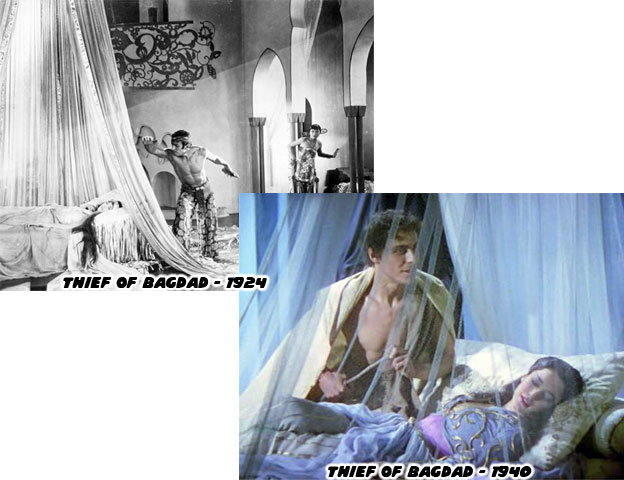
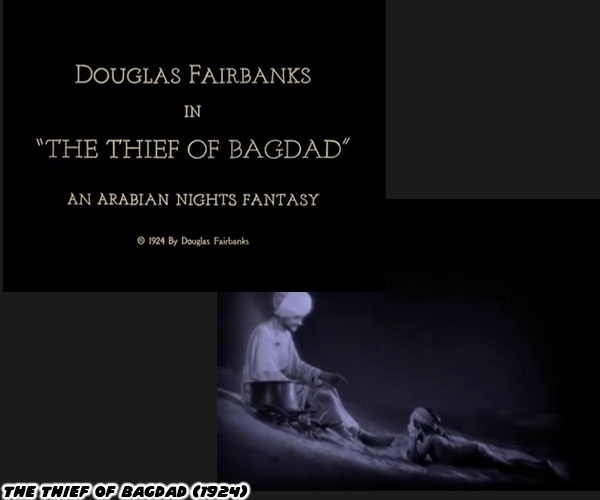
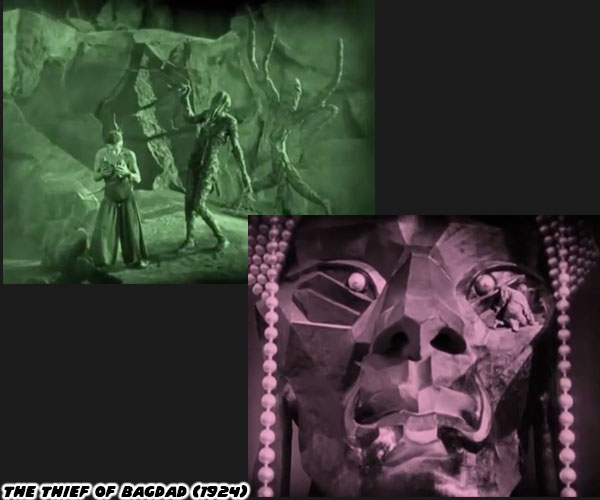
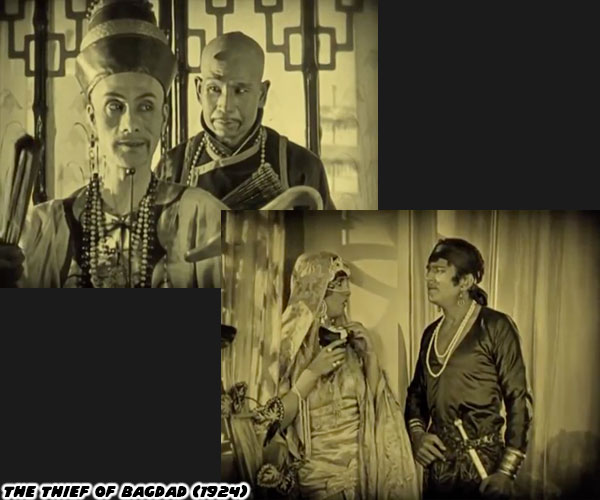
One of the earliest pieces of pop culture was an adaptation of Middle East story called the Thief of Bagdad. I have talked about Hollywood white washing characters before and having minorities cast as villains. When I was talking about F.A.N.G. I mentioned that the West created characters far more offensive than anything Capcom could do. When it came to the Middle East you could expect white actors to play the lead roles. It wasn't the white-washing that stuck with audiences as much as it was the stories. The fantasy created in this part of the world was amazing. Flying carpets, shape-changers and winged horses were visualized in film. They were early attempts at special effects and some of the illusions the pioneers created were well done. The hero of the films, Ahmed, would travel to some exotic locations, including active volcanoes and the bottom of the sea. The early effects artists had to figure out how to create the illusion of weightlessness and the early makeup artists had to create passable monsters for film. These characters and settings would be revisited again and again by Hollywood. Even great animated features like Disney's Aladdin and The Thief and the Cobbler had borrowed liberally from the Thief of Bagdad.
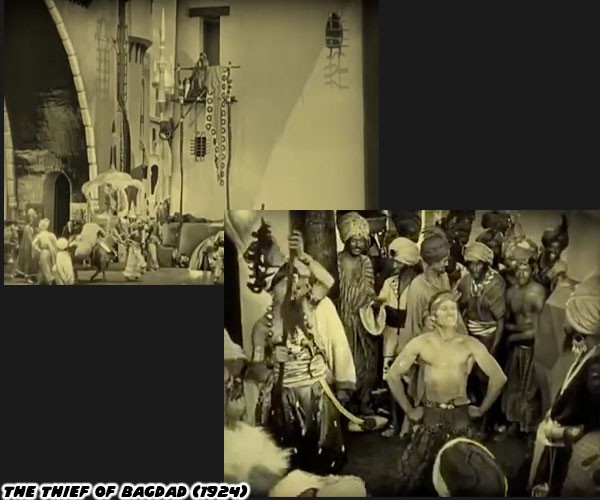
In doing so the studios were exposing countless generations in the USA as well as around the world to the Arabian myths. What was interesting was how benevolent Islam had been presented in these early pop culture pieces. If you ever get a chance please watch
the 1924 version of the Thief of Bagdad. It is a silent film but the mythology is not changed to fit western tastes. Imam, the Holy Man that narrates the story and is seen at the beginning and end of the film quotes the Quran and gives praise to Allah. He appears several more times in the film guiding the hero Ahmed, as played by Douglas Fairbanks (who had attained a level of fame in his era that could be considered the equivalent of George Clooney+Brad Pitt+Johnny Depp). It would be almost impossible to film a movie like this today, especially with a big name white actor playing a Muslim. But that era was far different, and surprisingly very accepting of the tenants the film described. Imam was very warm and humble, almost Christ-like with his generosity and wisdom. He helped set Ahmed on the right path after being tortured and whipped by his royal captors. A warm religious figure, even from a different faith, would have gone over very well in turn of the century America. Sadly those days are gone and may never come again. Needless to say the early movies, whether in color or black and white created a world that fans wanted to dig into.
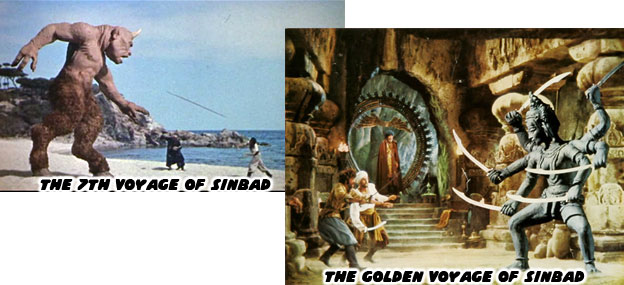
Other stories from the Arabian Nights would be adapted to the big screen. None were more popular or successful than the Sinbad films. Of course the characters were white washed as well but the settings and situations remained based strictly in Arabian fantasy. An effects artist named Ray Harryhausen helped create monsters that the heroes would do battle with. Whether it was a cyclops, medusa, skeleton warrior or kraken the films made the impossible look real. Haryrhausen would painstakingly hand animate tiny models and match them to the actors performances. There was no CGI in the early days of cinema so Harryhausen had to combine props, models and stop-motion animation in order to achieve a desired effect. Many of the sequences he animated withstood the test of time and set the bar for future visual effects artists to meet. Hollywood was doing a fantastic job of bringing the audience into the world of Arabian myth. Many young artists and designers around the world were growing up on these films. As entertainment formats changed some studios looked for ways of incorporating these myths into their own titles.
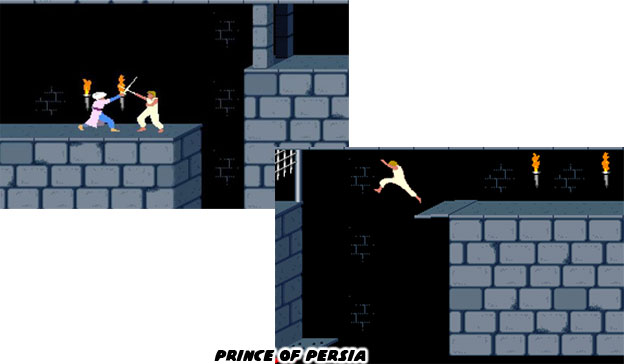
One of the great all-time video games was set in the ancient world . Prince of Persia debuted in 1989 and did a great job of capturing the spirit of mythical Arabia. There was a bad guy, a princess, a hero, some magic, exotic locations and sword fights. The PC game by Broderbund was a hit and eventually found its way on multiple systems, consoles and handhelds. It would receive sequels and reboots but thankfully always retained its location and theme. It was not the first game set in the ancient world and certainly not the last. The Arabian Nights mythology was the basis for several arcade games. The first major title was published by Atari. Arabian was released in 1983, it was actually developed by Sun Electronics. The game featured a digitized score made up of many classical music pieces. Each stage was introduced in the pages of a book, as if you were entering the actual Arabian Nights series. The hero in the game was a tiny figure that wore a turban and fought mythical monsters with his hands and sword. The mechanics of the game were ahead of their time. The prince could jump, crawl and climb throughout the maze-like stages. Most games were having problems figuring out how to do the most basic of controls. The original Mario Bros. was released the same year as Arabian and featured a character that could "only" jump. Granted Mario became a superstar and the prince disappeared into the footnotes of history. To be fair Arabian predicted the gameplay that would become a staple in every adventure title, and especially in the Prince of Persia.
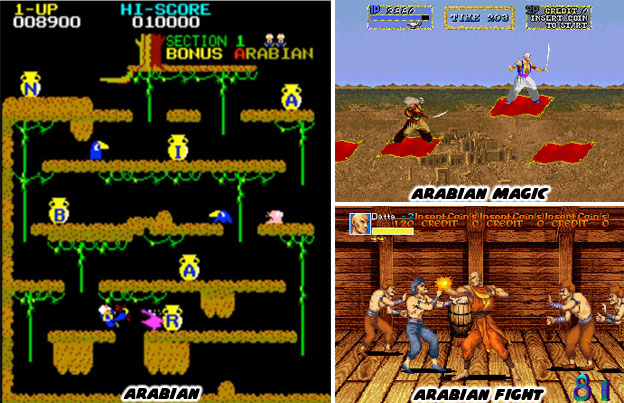
The backdrop of ancient Arabia would be used in two rarely seen arcade titles. Taito unveiled Arabian Magic and Sega unveiled Arabian Fight both in the same year, 1992 to be precise. Both games were brawlers, the same format used in classic games like Double Dragon and Final Fight. Players could control one of multiple characters, each with their own strengths and weaknesses and have a go at the title alone or with a bunch of friends. Both games featured exotic locations, from sailing ships, to temples and even battles while riding atop flying carpets. Both games also featured multiple types of opponents, including assassins, soldiers and the undead. Both games even featured a magic system that allowed them to create more damage to their opponents than fists or weapons ever could. The magic system in Arabian Magic was much harder to use. Players could unlock a new "spell" only if they defeated the djinn or genie that acted as a boss character. Even if the player had a magic in their inventory they could only use it once. There was none of this three wishes stuff so players had to save their magic for when they truly needed it.
In Arabian Fight the characters could perform the magic attacks multiple times and recharge the system as well. Both games were rare in the arcade. Sega was showing off its new System 32 hardware, capable of presenting sprites that were much larger than the competition. Plus these sprites featured more colors and more frames of animation than the game engines used by other studios. The System 32 hardware was also capable of scaling sprites on the fly, displaying transparencies and other graphical effects that were put to use in creating visuals that hadn't been seen in any other arcade title. The Taito game was visually impressive as well. The amount of detail that was crammed into each level was amazing. Unfortunately the game seemed to lack polish. The animation was spotty in places and the control was not as tight as it could have been. Of all the Arabian themed games that had ever come out I think Arabian Magic was aesthetically once of the best. The character designs were superb, the costumes, stages, djinn and opponents were all well done and correct for the history they were representing. Arabian Fight was simply too animé in design and presentation. The characters looked like typical Japanese cartoon characters but dressed in costumes, rather than actual Arab, Indian, African or Asian figures.
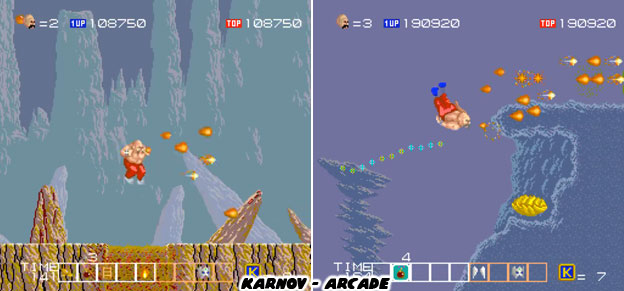
One of the most interesting video game characters was based on Arabian storytelling traditions. Karnov appeared in his own arcade game in 1987. The title by Data East featured the fire-breathing strongman on an adventure in the ancient world. He fought dozens of mythical creatures, including griffons, gorgons (Medusa), mermaids and other fantastic beasts from Arab, Indian, Assyrian, Greek and Egyptian mythology. In the game players could unlock bombs, ladders, wings and other bonuses that would help Karnov complete his journey. Karnov was physically gifted, in addition to his strength and fire-breathing ability he could also swim like a fish and when equipped with a golden wing backpack he could fly. The developers created many wonderful stages highlighting the diverse gameplay features. The title was difficult in that it did not give you hints as to what type of item had to be used in order to reach the end of the stages. Many items were hidden throughout the levels and players were rewarded by exploring their surroundings. When I think of the design of classic adventure games and even some modern adventure games like God of War I see some traditions that were started in Karnov. Through his adventure the character would end up symbolizing the myth of the Arabian hero. He would be blessed with magical abilities that would be applied to other game characters across multiple genres.
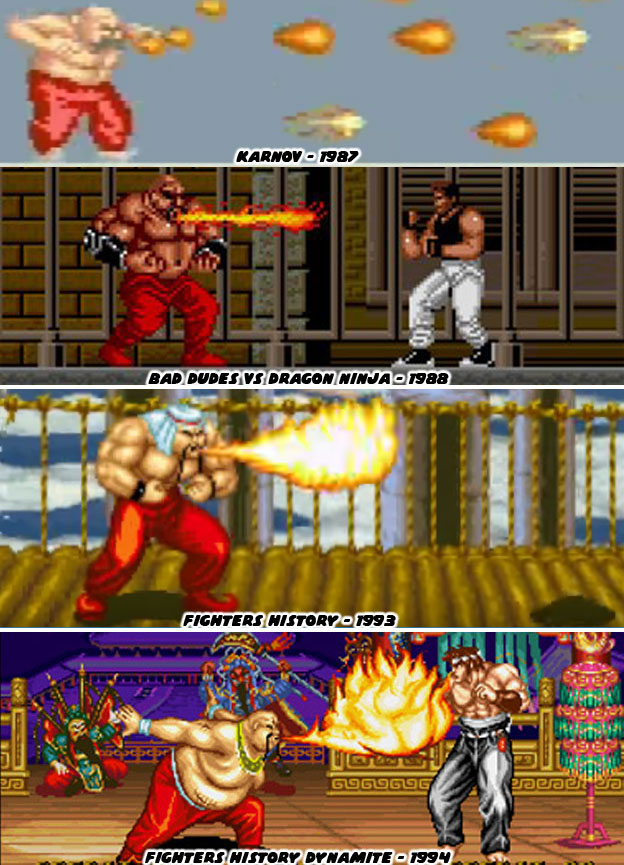
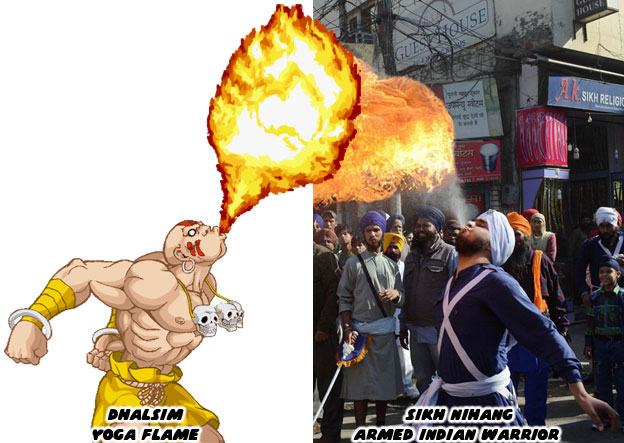
The trademark of the character was his fire-breathing attack. He could spit fireballs or breath large clouds of flame. Each time he returned, whether it was a cameo character in Bad Dudes, or as a boss in the Fighter's History fighting series, he retained the ability to breathe fire. These things, these techniques were pulled partially from myth and partially from fact. In classical literature it was Indian and sometimes Arab characters that could breathe fire. These characters would come in handy when having to do battle with supernatural monsters. Yet there were people in the real world that were considered true "fire eaters." Street and circus performers were known for their ability to spit fire, juggle flaming chains, walk on fire and even eat hot coals without injuring themselves. Some of these performances were done by religious and military officials. What game designers did in Japan and the USA was sprinkle some basic understanding of a region and mix it with a liberal dose of fiction. I had
talked about Indian characters and yoga as the inspiration for magical fighters on an earlier blog. Karnov may have been the first fire-breathing mystic in a game but it was Dhalsim from Street Fighter that became the most popular.
Game developers took the elements that made the Arabian characters memorable in the fantasy stories and began including them in various games. In many instances they were not far removed from the classic hero. Whether they worked in the game or not was subject to debate. In the next blog we will look at how Karnov began a questionable legacy. As always if you enjoyed this blog and would like to sponsor me
please visit my Patreon page and consider donating each month, even as little as $1 would help make better blogs and even podcasts!