Showing posts with label sinbad. Show all posts

Friday, December 25, 2015

The Middle Eastern Fighter, building a legacy, part 3...

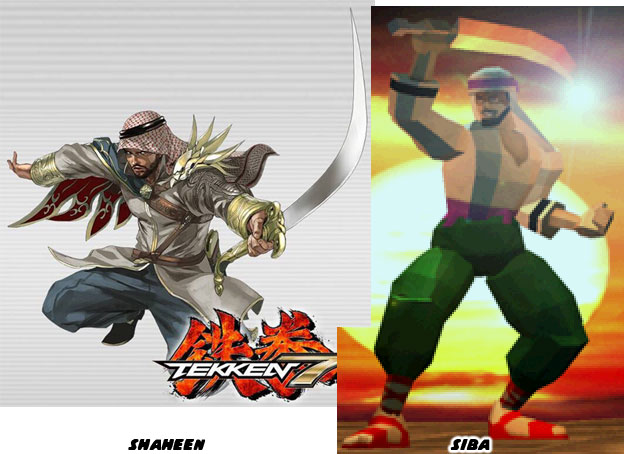
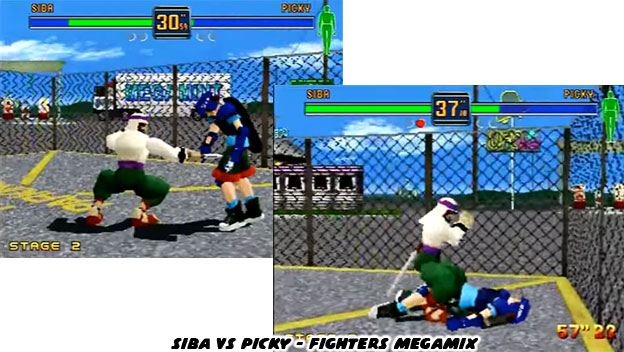
The Middle Eastern fighter had never found his or her groove in the most popular titles. When I heard that there would be one in Street Fighter V I was a bit skeptical. How would this person be presented. Would they also be a fat fire breather with curly-toed shoes? Or would they be something else entirely? I wasn't sure then but I did know that the Arab hadn't really been a major player in the genre. The first 3D fighter from the Middle East that could have been a major star was Siba. The reason I say could-have-been was because he was cut at the last moment from the game Virtua Fighter before it was released in arcades. The character actually appeared in previews for the games circa late 1992 and early 1993, in some test locations and even in early advertising. He was very much a traditional character in that he wore what someone would expect an Arabian fighter to wear from perhaps a century ago. He sported a beard, wore a keffiyeh and brandished a scimitar. The character did not officially debut until Fighter's Megamix in 1996. The Sega Saturn title crossed over characters from Virtua Fighter, Fighting Vipers and even Daytona USA!


It seemed difficult to get accurate Arabian representation in an arcade fighter. At the same time home consoles did not fare any better. Aside from Siba in Fighter’s Megamix there was the character Abdul in Fighter’s Destiny. This was a title exclusive to the Nintendo 64. The console was not really known for their deep 2D or 3D fighting game library. The title from 1998 was developed by Genki, and Opus Corp. In Japan it was known as Fighting Cup. Abdul was a mix of multiple “exotic” elements. Physically he was the chubby, yet muscular character that we had come to expect from Arabian mythology. Turban, vest, genie pants, and curly-toed boots. It was another caricature of Middle Eastern wear. The developers even leaned into his ethnic origins as his full name was Abdul Jabbar. This was a traditional Muslim name which translated to “Servant of the giver / compeller / god.”

The game was not well known outside of the most die-hard console gamers, or fighting game aficionados. It was an average experience at best, with some extremely challenging features. This included a 100 man kumite tournament, and some overpowered hidden bosses. The game did well enough to warrant a sequel in 1999, also for the N64. The game had improved visuals, controls, and animation. Abdul got some adjustments to his outfit. Specifically his feathered turban was replaced with a naqshbandi taj, this was a pointy shaped kufi, or hat worn in many Arab countries. The hats were not only stylish, they were also functional. They could be folded for easy travel. The hats were seen outside of Arab nations, and were often found in Muslim countries such as Turkey. This was where the lack of cultural insight from the developers at Genki, as well as other Japanese studios really stood out. Not all Arabs were Muslim, and vice-versa. Abdul was a Muslim name, however in official canon he was from Mongolia. Around half of the Mongolians identified as Buddhist, while nearly the other half did not consider themselves as religious at all. A very small minority, about 3-4% were Muslim, and those were often people that had Kazakh or Turkish roots.

I was surprised that Abdul did not represent Mongolian Wrestling. The first time that form of fighting appeared in a game was in Fighting Layer. The ARIKA title from 1998 featured a grappler named Jigjid Bartol. He dressed much more like a Mongolian athlete compared to Abdul. His strikes, and grabs were also closer to the actual form of wrestling. Although it could be argued that the developers were trying to give Abdul a stylized version of the wrestling. It was nice to see Genki make the effort to try and connect the Mongolian culture through his stage design. Across the grassy planes we could see many large yurts set up. These tents could be transported for the nomadic people, and were resistant to the elements, and even extreme cold found in the steppes. The little bit of cultural insight to the Mongolians was undone by the official story. Abdul’s occupation was “Mysterious Phantom” which was a fancy way to say street performer. His entire purpose in the Fighting Cup was to buy back a cow which he had sold off for money a long time ago. His attacks were odd, and his victory animation had him gyrating in a sort of dance. It seemed that Japanese developers lacked any sort of cultural awareness. It was as if every attempt to diversify the nationalities of the fighting games always ended up taking shots at some ethnic group.

Sega had created the world's first 3D arcade fighter in 1993 and had beaten Namco to the punch by a year. Both studios learned from Capcom and tried to have a diverse lineup in their games. Virtua Fighter featured characters from around the world, although most systems and characters were Asian. Producer Yu Suzuki was trying to make a game that was more accurate to real fighting than what Street Fighter portrayed. Thus the characters were more or less the same size and build with strikes were based on actual systems. Namco's Tekken on the other hand had a mix of characters and abilities that was a mix of realism and fantasy. As if the studio was looking for a balance between Street Fighter and Virtua Fighter's mechanics. Yet Namco did not feature a Middle Eastern character when Tekken came out in 1994. A fighter from that region would not appear until Tekken 7, in 2015. This figure had very similar design to Siba. Although the characters were separated by 20 years the Japanese designers did not put too much effort into Shaheen.


Although to be more accurate, the look of Shaheen was based on a real person. It wasn't a martial arts expert though, not someone like Palestinian Nizar Taleb or Lebanese Walid Kassas. Nor was it a modern MMA fighter like Jordanian Hashem Arkhagha. The person that inspired Shaheen was a model named Omar Borkan Al Gala. This was a man whose good looks were cause for concern. The rumors were that religious clerics in Saudi Arabia were concerned that he was giving women impure thoughts and he had to be deported to Canada. He was a big draw wherever he went and was even a celebrated model in Japan. There was no doubt that some of the team members at Namco remembered this figure.
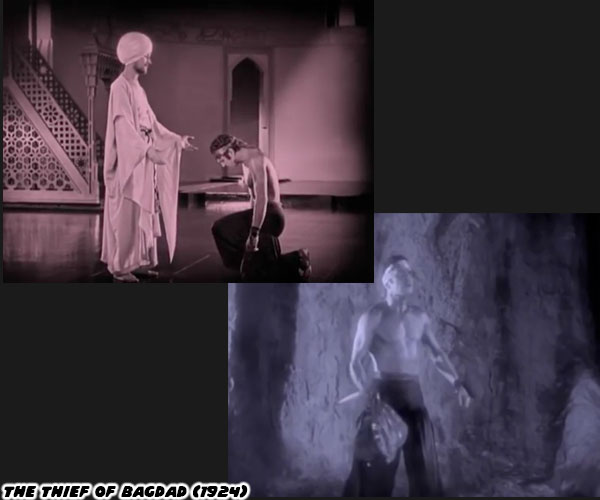

When it came time to introduce a Middle Eastern fighter into Tekken then they decided he should be based on the popular model. I didn't really have a problem with Shaheen except that he lacked an actual Arab striking art. I was more concerned that in the modern crop of fighting games looks greatly determined how a character would be perceived. If you wanted to state an opinion about a minority you could make them fat and ugly. If you wanted to show favoritism you could make them handsome, or in the case of female character you could sex them up. The concept of beauty was something defined by society. What the west and east saw as attractive differed greatly. I was Mexican and not Middle eastern, not that it mattered because I was brown-skinned and brown-skinned people were always being told what beautiful looked like on TV. Dark skinned people wre rarely seen on TV or in games.
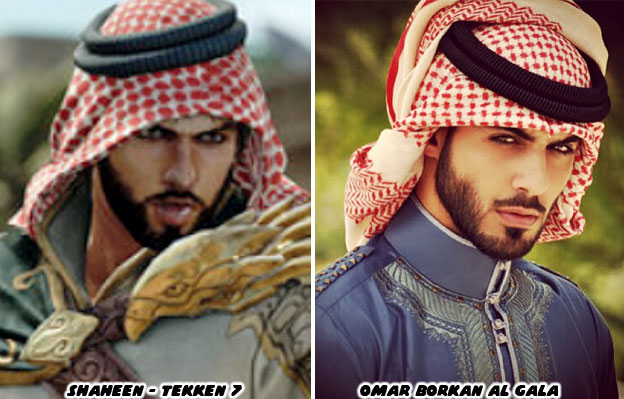

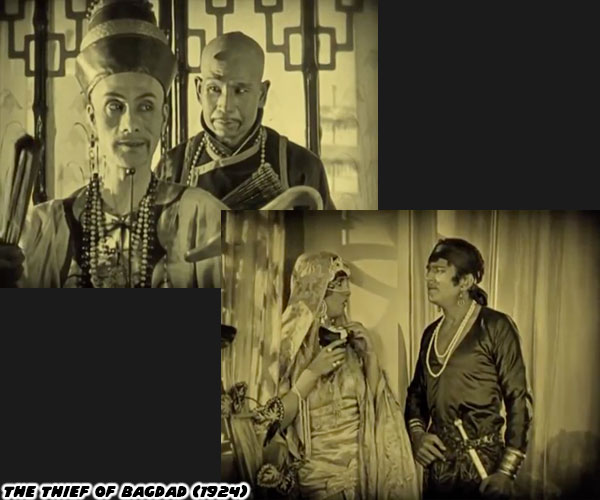
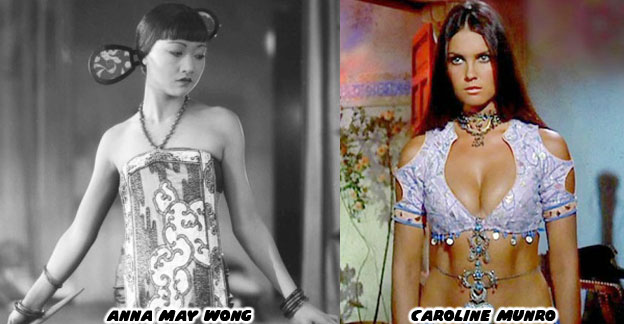
While growing up I was aware how minorities and other cultures were being represented in pop culture. I grew up reading the myths from different nations, watching the films on TV. The Arabian heroes had been presented many times by many different studios. I did pay attention whenever the heroes of a movie had dark skin and dark hair. They were the opposite of the blonde haired, blue-eyed heroes I was told to idolize in comics and cartoons. Mind you I'm a huge fan of Captain America but just a hint of representation went a long way as a kid. The stories from Arabia always seemed to have the largest cast of dark-skinned people. They were always going on the most wonderful adventures. I was always saddened when the minority actors played villains in the films. As I grew older I learned to appreciate their contribution. Anna May Wong was the servant and a spy in the Thief of Bagdad.
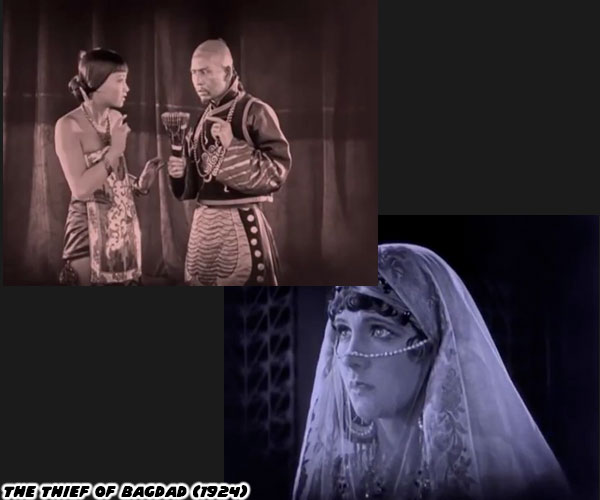
 

I was a kid when I saw the silent film on a TV marathon, and couldn't help but notice how beautiful she was. Audiences were supposed to be awe-struck with the Princess that Julanne Johnson played but she had nothing on Anna May. It turned out that Ms. Wong was one of the first major Asian actors in Hollywood. She was someone that never settled for a stereotypical role, never spoke in broken English and instead let Hollywood hang itself with their appropriation films. I was even younger when I saw Caroline Munro in the Golden Voyage of Sinbad. She had the most beautiful bronze skin and dark hair. I'm pretty sure that was the moment when I became a life-long fan of the Sinbad films. I would hear things like blondes Marilyn Monroe, Jennifer Anniston and Calista Flockhart were the most beautiful actresses of their era, yet in my mind they couldn't compare to Caroline or Anna May. Could a non-Western ideal of beauty ever be seen in a game? Could there be a dark-skinned character in a fighting game that transcended sexiness?

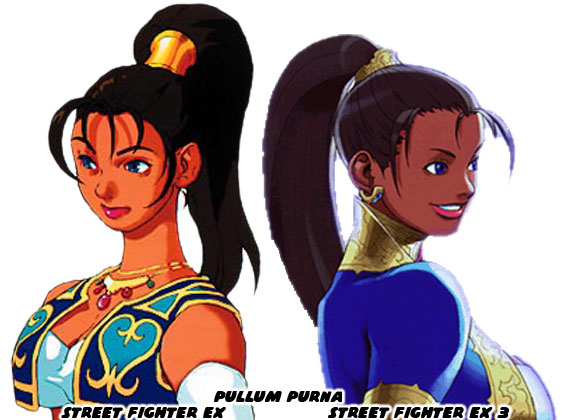
Almost 20 years before Shaheen there was another fighter from the Middle East. The pioneering 3D character was actually a female. It turned out that Street Fighter had the first Arab fighter to be featured in an arcade 3D release. To be specific the game was Street Fighter EX, a title from 1996 that was developed by ARIKA and published by Capcom. This game would be the last title created by the majority of the people that worked on the Street Fighter II. The studio wanted to create a cast of new international stars to compliment the original "World Warriors." Pullum Purna (sometimes written as Puruna) was introduced as a contemporary to Chun-Li. The fighter was actually one half of a compliment to Chun-Li, the other was Pullum's friend and the first MMA fighter in the Street Fighter universe, Blair Dame. I had talked about these designs on an earlier blog. Pullum was a strong character that had many things going for her. Representation was as important to audiences then as it was now. Introducing a character from a different nationality always brought risks with it. What fighting style would they represent? How would they look, how would they move, what was their story? Would audiences accept them? Making a new character female was doubly challenging. We would like to think that gaming was diverse but we know there were far more male leads than females, especially in fighting games. When it came to females they were almost all hyper-sexualized figures.
 

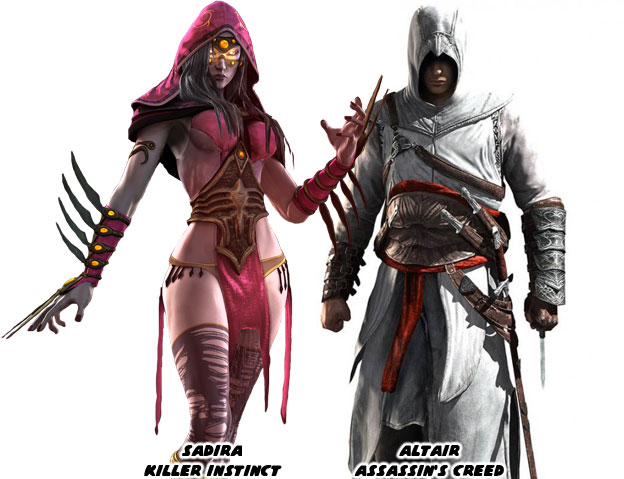
Pullum was absolutely modest when compared to Sadira, the Persian fighter introduced in Killer Instinct. The 2013 game by Microsoft Studios was a remake of an arcade fighting classic by Rare. The original title featured a large number of black, Native American and mixed-ethnicity characters. Sadira was a sexy character and an assassin to boot. Her inclusion in this new game was in part to help diversify the cast but also to perpetuate the types of sexy fighters that the west seemed to favor. Her costume and appearance may have been inspired in part by the uniform worn by Altair in Assassin's Creed. She may also have been a counterpoint to the sexy female ninjas in the Mortal Kombat series as well. Women in the Killer Instinct had always been very curvy, fan-service-type characters. Sadira was no different, except for her country of origin made her a standout for this blog.
 

Pullum was a different type of character though. While her costume showed off some skin it was not far removed from the costumes worn by the heroes in legend. It certainly was not more revealing than the costumes of the female leads in Arabian Fight or Arabian Magic. Pullum had a series of unique tumbling kicks and sweeps that hadn't really been used by many characters. She also had a few special takedowns that were a unique mixture of wrestling and MMA. I think the most striking thing of Pullum and her bodyguard Darun Mister was their skin color. They were both presented as dark and proud. In fact the design of Pullum changed slightly as the series progressed. She matured a little and her skin color actually got darker. This was the opposite of what happened to Vanessa Lewis, a black female Vale Tudo striker introduced in Virtua Fighter 4. The 2001 game was met with a lukewarm response from audiences. The graphics got better but the gameplay mechanics lacked the spark of a title like Street Fighter or Tekken, but that's an aside. The next time players saw Vanessa in Virtua Fighter 5 they could see something had definitely changed about her. Many assumed that she was lightened considerably because Japanese audiences did not find dark skin attractive.
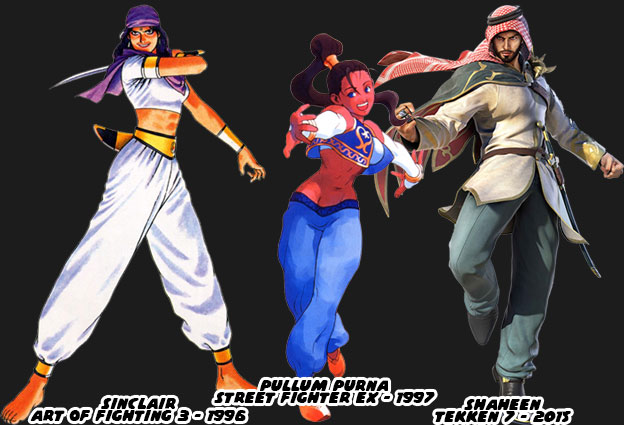

The Middle Eastern fighter had become a part of the genre in the '90s but they were relegated to a classic costume. Characters from other nations, Japanese, American and British for example were allowed to wear more contemporary clothing. A good portion of the King of Fighters cast for example wore street clothing. It was as if designers lacked the confidence to say a character was from Egypt, Iran or Persia, unless they also put them in a storybook costume. Japanese developers were not the only ones that were guilty of this. Despite what could be construed as misrepresentation, it was nice to see dark skinned characters in fighting games.
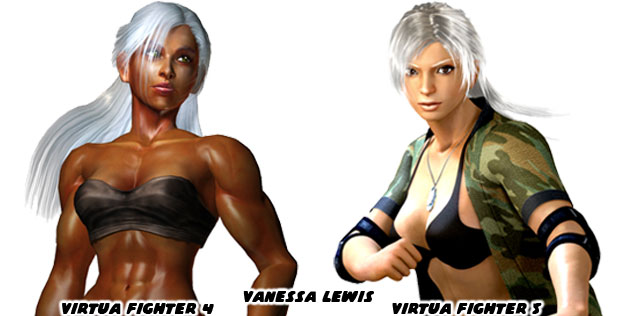

Here is where I have to stop momentarily and talk about the game players that were offended by Capcom removing the shot of R. Mika's butt slap in Street Fighter V. As of this writing there are almost 8,000 signatures on Change.org claiming that Capcom is performing self censorship and that gamers will not buy a game that is censored in any way. Not too far removed is a petition with almost 7,000 signatures as of this writing, saying that Western gamers are in support of Japanese developers and they shouldn't alter their content for Westerners with delicate tastes. The goal in part is to get Dead or Alive Xtreme 3 (a bikini-centric game featuring the DOA girls) released in the USA and to get Capcom to put the butt slap back into Street Fighter V. Where all that outrage was when minority characters were whitewashed by Sega? I mean if game players do not want the producers to alter their vision because of some delicate tastes then why not make it an international rule? Why not tell the Japanese that dark skin is beautiful and belongs in Virtua Fighter? Do these people realize that the Japanese change course on a game, feature or character without ever taking western opinions into consideration?
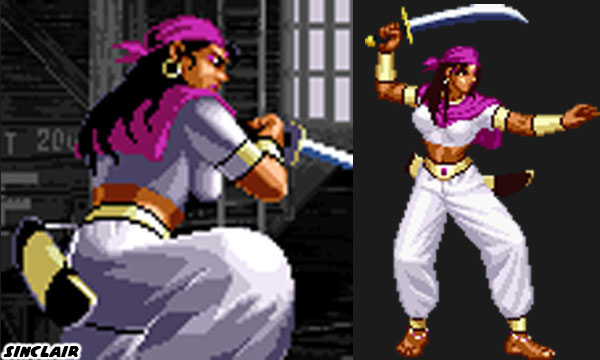
 

I mean if the Japanese were concerned about what the USA thought do you really think Rufus would have made it into Street Fighter IV? Do you think they ran Hakan past a group of Turkish kids before he was added to the series as well? If the people in favor of the petitions would stop for a moment and just think about how women are depicted in games they might think twice about signing. These things have less to do with censorship as much as they have to do with control. How women are represented in gaming and to a larger context how minorities are represented is a real problem. This has nothing to do with censorship or altering a creative vision. You have to be included in the discussion before you can be silenced. Right now women and minorities do not have a seat at the table.
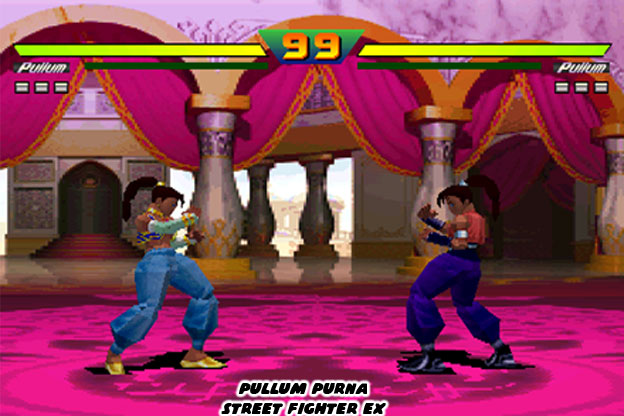
 

But I digress, Pullum Purna and Darun Mister were a refreshing change of pace for the genre. The fact that ARIKA had chosen two dark skinned characters, from South Asia and the Arabian Peninsula to balance out the cast was very progressive. These characters were never whitewashed. These were not fat and ugly caricatures like Karnov, they were not even stretchy-limbed cartoons like Dhalsim. There was a sense of realism to their designs, no fire breathing special attacks here! Sincerity was something that made the Street Fighter EX cast unique. The designers at Capcom and ARIKA were not making fun of a culture as much as they were celebrating it. The Middle East could produce interesting characters that did not necessarily rely on trope to sell. The question was whether the new Middle Eastern character added to Street Fighter V would be based on stereotypes or not. The next blog will look at this figure. As always if you enjoyed this blog and would like to sponsor me please visit my Patreon page and consider donating each month, even as little as $1 would help make better blogs and even podcasts!
Monday, December 21, 2015

The Middle Eastern fighter, building a legacy, part 1...

When we look at fighting game characters, both the good or bad designs, we have to take them in context. Most fighting game characters represent more than a fighting art. They often represent a region of the world, and in some cases an entire culture. The majority of fighting game characters are East versus West, but more specifically Japanese versus USA designs. Some of these men and women were inspired by actual people but the majority were created from a number of sources. Films, comics, cartoons and television had done a lot to influence the creation of the biggest names. One region that was rarely discussed, even by me, was the Middle East. It had colored a few of the characters that appeared throughout gaming history. In order to understand the design, influence and even impact of the newer characters added to both Street Fighter and Tekken we have to look at them in context. We will start by going back in time, back to the Golden Age of Islam. Now I do not mean to offend my audience by discussing Islam during this era of heightened security and suspicion. I have talked about Buddhism, Shinto and other spiritual beliefs on my earlier posts regarding fighting game characters and their origins. I hope my readers can extend the same courtesy to the culture I am going to present.


The Arabian Peninsula, Saudi Arabia for the most part, is a bridge of cultures and customs. It was a hub of commerce from North Africa to South Asia, there was tremendous influence in the region to the people, tribes, and traditions of the surrounding areas. From Russia, China and India to Egypt, Sudan and Ethiopia, there were some connective tissues that united this region of the world thanks to the Middle East. When it came to pop culture there were a few things that people knew of the area. It was rich in oil, had survived countless conflicts from internal and external forces and had remained culturally isolated for a good portion of its history. When it came time to present characters from this part of the world the writer, artists or producer often relied on trope. The majority looked at one specific point of reference The folk tales or ancient Arabia could be found in the book One Thousand and One Nights, sometimes printed as 1001 Arabian Nights.


It was a collection of myths from South Asia and the Middle East. There were stories of magicians, monsters, exotic locations, epic battles, great heroes and treacherous villains. Little by little the stories of various cultures, some which were riddles or short poems, would be added to the anthology. The character of Scheherazade would become the storyteller in the series. Just about every myth that people associated with the Middle East, including the tales of Sinbad and Aladdin had come from this book. The stories from 1001 Arabian Nights had the same romantic elements found in many western literature pieces. There were princes and princesses, dragons, magic and all sorts of fantastic elements. Some stories even were precursors to science fiction as they mentioned being able to travel to distant planets and having machines that appeared like robots and androids. It could actually be argued that some western myths were stolen from the Arabic tradition.


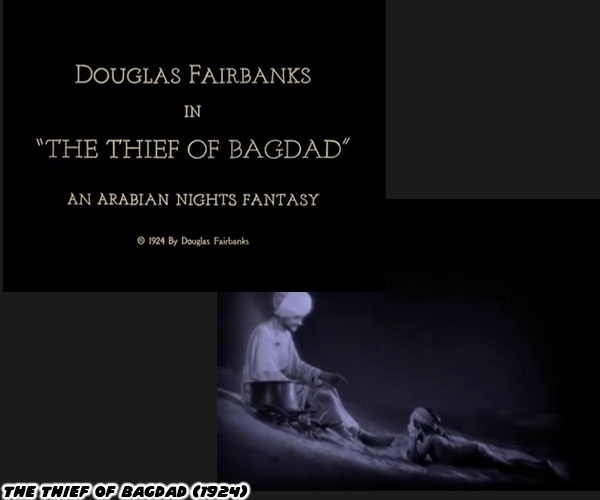
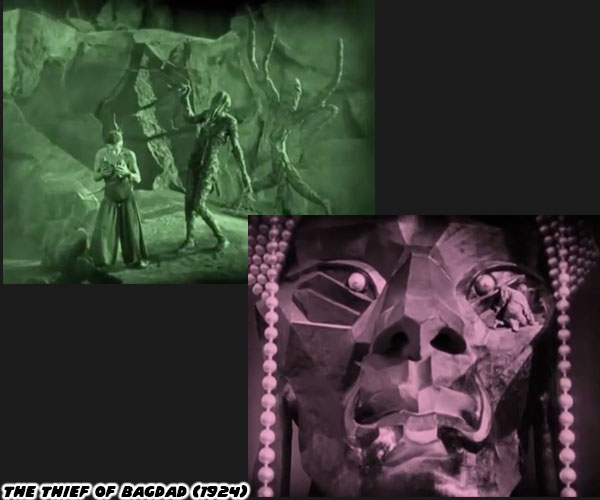
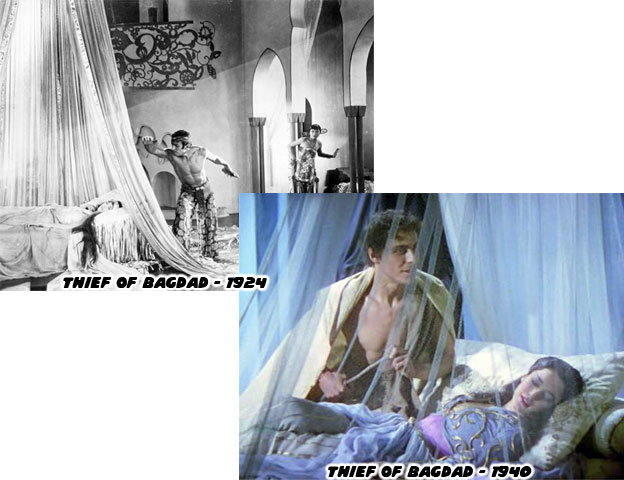
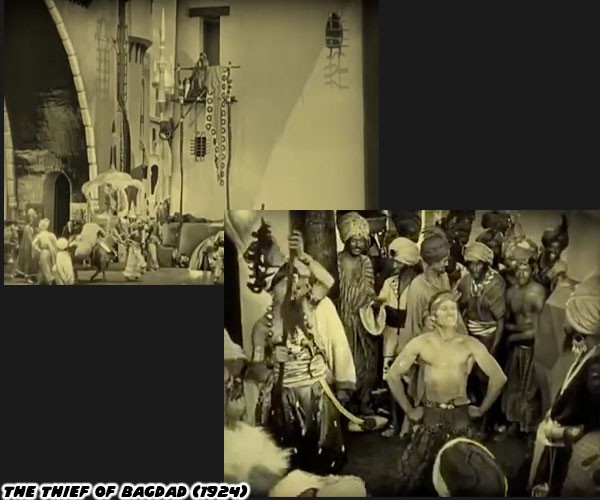
One of the earliest pieces of pop culture was an adaptation of Middle East story called the Thief of Bagdad. I have talked about Hollywood white washing characters before and having minorities cast as villains. When I was talking about F.A.N.G. I mentioned that the West created characters far more offensive than anything Capcom could do. When it came to the Middle East you could expect white actors to play the lead roles. It wasn't the white-washing that stuck with audiences as much as it was the stories. The fantasy created in this part of the world was amazing. Flying carpets, shape-changers and winged horses were visualized in film. They were early attempts at special effects and some of the illusions the pioneers created were well done. The hero of the films, Ahmed, would travel to some exotic locations, including active volcanoes and the bottom of the sea. The early effects artists had to figure out how to create the illusion of weightlessness and the early makeup artists had to create passable monsters for film. These characters and settings would be revisited again and again by Hollywood. Even great animated features like Disney's Aladdin and The Thief and the Cobbler had borrowed liberally from the Thief of Bagdad.


In doing so the studios were exposing countless generations in the USA as well as around the world to the Arabian myths. What was interesting was how benevolent Islam had been presented in these early pop culture pieces. If you ever get a chance please watch the 1924 version of the Thief of Bagdad. It is a silent film but the mythology is not changed to fit western tastes. Imam, the Holy Man that narrates the story and is seen at the beginning and end of the film quotes the Quran and gives praise to Allah. He appears several more times in the film guiding the hero Ahmed, as played by Douglas Fairbanks (who had attained a level of fame in his era that could be considered the equivalent of George Clooney+Brad Pitt+Johnny Depp). It would be almost impossible to film a movie like this today, especially with a big name white actor playing a Muslim. But that era was far different, and surprisingly very accepting of the tenants the film described. Imam was very warm and humble, almost Christ-like with his generosity and wisdom. He helped set Ahmed on the right path after being tortured and whipped by his royal captors. A warm religious figure, even from a different faith, would have gone over very well in turn of the century America. Sadly those days are gone and may never come again. Needless to say the early movies, whether in color or black and white created a world that fans wanted to dig into.


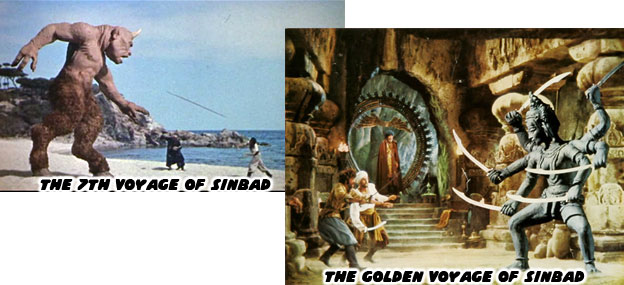
Other stories from the Arabian Nights would be adapted to the big screen. None were more popular or successful than the Sinbad films. Of course the characters were white washed as well but the settings and situations remained based strictly in Arabian fantasy. An effects artist named Ray Harryhausen helped create monsters that the heroes would do battle with. Whether it was a cyclops, medusa, skeleton warrior or kraken the films made the impossible look real. Haryrhausen would painstakingly hand animate tiny models and match them to the actors performances. There was no CGI in the early days of cinema so Harryhausen had to combine props, models and stop-motion animation in order to achieve a desired effect. Many of the sequences he animated withstood the test of time and set the bar for future visual effects artists to meet. Hollywood was doing a fantastic job of bringing the audience into the world of Arabian myth. Many young artists and designers around the world were growing up on these films. As entertainment formats changed some studios looked for ways of incorporating these myths into their own titles.


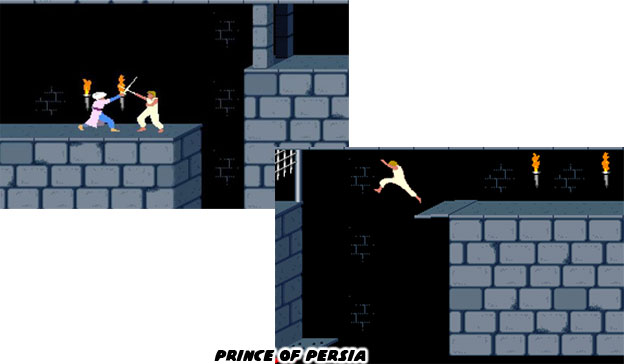
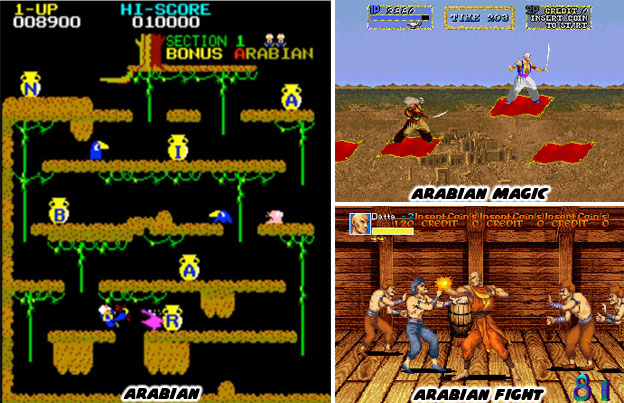
One of the great all-time video games was set in the ancient world . Prince of Persia debuted in 1989 and did a great job of capturing the spirit of mythical Arabia. There was a bad guy, a princess, a hero, some magic, exotic locations and sword fights. The PC game by Broderbund was a hit and eventually found its way on multiple systems, consoles and handhelds. It would receive sequels and reboots but thankfully always retained its location and theme. It was not the first game set in the ancient world and certainly not the last. The Arabian Nights mythology was the basis for several arcade games. The first major title was published by Atari. Arabian was released in 1983, it was actually developed by Sun Electronics. The game featured a digitized score made up of many classical music pieces. Each stage was introduced in the pages of a book, as if you were entering the actual Arabian Nights series. The hero in the game was a tiny figure that wore a turban and fought mythical monsters with his hands and sword. The mechanics of the game were ahead of their time. The prince could jump, crawl and climb throughout the maze-like stages. Most games were having problems figuring out how to do the most basic of controls. The original Mario Bros. was released the same year as Arabian and featured a character that could "only" jump. Granted Mario became a superstar and the prince disappeared into the footnotes of history. To be fair Arabian predicted the gameplay that would become a staple in every adventure title, and especially in the Prince of Persia.


The backdrop of ancient Arabia would be used in two rarely seen arcade titles. Taito unveiled Arabian Magic and Sega unveiled Arabian Fight both in the same year, 1992 to be precise. Both games were brawlers, the same format used in classic games like Double Dragon and Final Fight. Players could control one of multiple characters, each with their own strengths and weaknesses and have a go at the title alone or with a bunch of friends. Both games featured exotic locations, from sailing ships, to temples and even battles while riding atop flying carpets. Both games also featured multiple types of opponents, including assassins, soldiers and the undead. Both games even featured a magic system that allowed them to create more damage to their opponents than fists or weapons ever could. The magic system in Arabian Magic was much harder to use. Players could unlock a new "spell" only if they defeated the djinn or genie that acted as a boss character. Even if the player had a magic in their inventory they could only use it once. There was none of this three wishes stuff so players had to save their magic for when they truly needed it.


In Arabian Fight the characters could perform the magic attacks multiple times and recharge the system as well. Both games were rare in the arcade. Sega was showing off its new System 32 hardware, capable of presenting sprites that were much larger than the competition. Plus these sprites featured more colors and more frames of animation than the game engines used by other studios. The System 32 hardware was also capable of scaling sprites on the fly, displaying transparencies and other graphical effects that were put to use in creating visuals that hadn't been seen in any other arcade title. The Taito game was visually impressive as well. The amount of detail that was crammed into each level was amazing. Unfortunately the game seemed to lack polish. The animation was spotty in places and the control was not as tight as it could have been. Of all the Arabian themed games that had ever come out I think Arabian Magic was aesthetically once of the best. The character designs were superb, the costumes, stages, djinn and opponents were all well done and correct for the history they were representing. Arabian Fight was simply too animé in design and presentation. The characters looked like typical Japanese cartoon characters but dressed in costumes, rather than actual Arab, Indian, African or Asian figures.
 

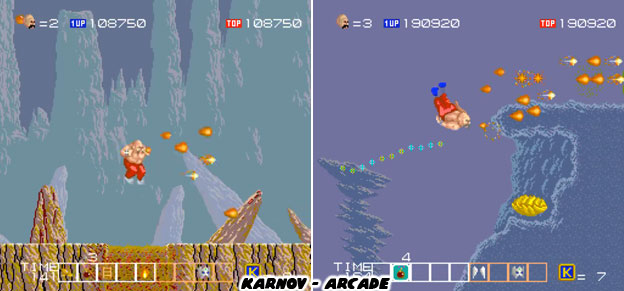
One of the most interesting video game characters was based on Arabian storytelling traditions. Karnov appeared in his own arcade game in 1987. The title by Data East featured the fire-breathing strongman on an adventure in the ancient world. He fought dozens of mythical creatures, including griffons, gorgons (Medusa), mermaids and other fantastic beasts from Arab, Indian, Assyrian, Greek and Egyptian mythology. In the game players could unlock bombs, ladders, wings and other bonuses that would help Karnov complete his journey. Karnov was physically gifted, in addition to his strength and fire-breathing ability he could also swim like a fish and when equipped with a golden wing backpack he could fly. The developers created many wonderful stages highlighting the diverse gameplay features. The title was difficult in that it did not give you hints as to what type of item had to be used in order to reach the end of the stages. Many items were hidden throughout the levels and players were rewarded by exploring their surroundings. When I think of the design of classic adventure games and even some modern adventure games like God of War I see some traditions that were started in Karnov. Through his adventure the character would end up symbolizing the myth of the Arabian hero. He would be blessed with magical abilities that would be applied to other game characters across multiple genres.


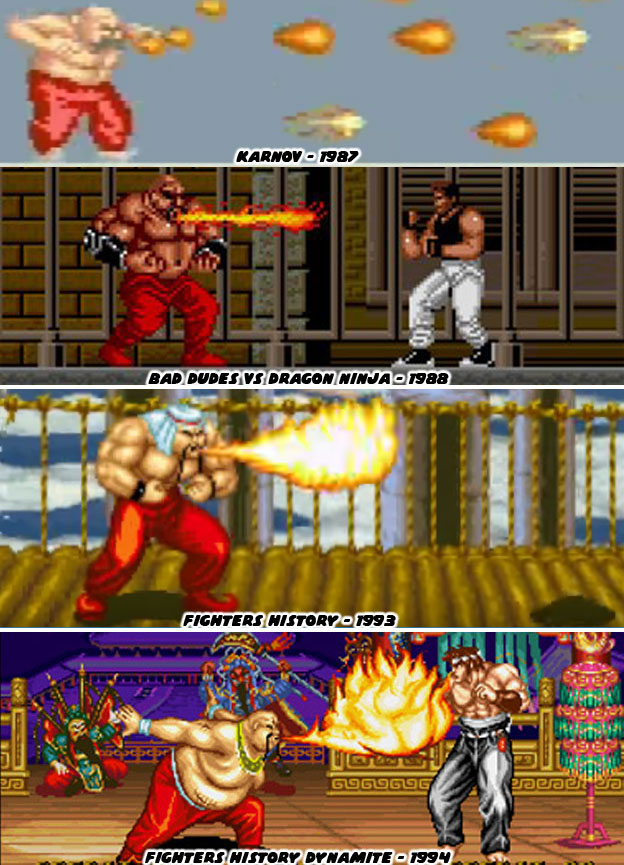
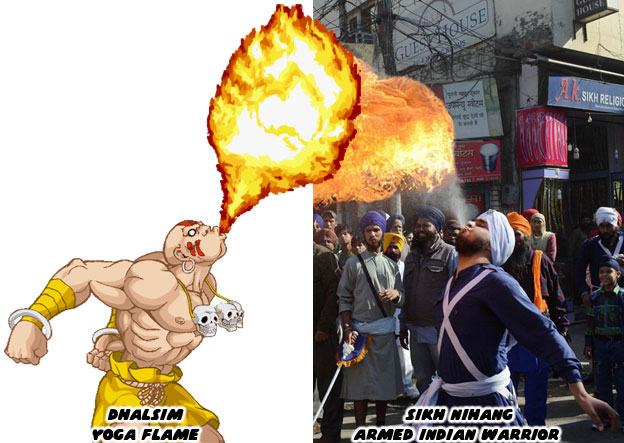
The trademark of the character was his fire-breathing attack. He could spit fireballs or breath large clouds of flame. Each time he returned, whether it was a cameo character in Bad Dudes, or as a boss in the Fighter's History fighting series, he retained the ability to breathe fire. These things, these techniques were pulled partially from myth and partially from fact. In classical literature it was Indian and sometimes Arab characters that could breathe fire. These characters would come in handy when having to do battle with supernatural monsters. Yet there were people in the real world that were considered true "fire eaters." Street and circus performers were known for their ability to spit fire, juggle flaming chains, walk on fire and even eat hot coals without injuring themselves. Some of these performances were done by religious and military officials. What game designers did in Japan and the USA was sprinkle some basic understanding of a region and mix it with a liberal dose of fiction. I had talked about Indian characters and yoga as the inspiration for magical fighters on an earlier blog. Karnov may have been the first fire-breathing mystic in a game but it was Dhalsim from Street Fighter that became the most popular.


Game developers took the elements that made the Arabian characters memorable in the fantasy stories and began including them in various games. In many instances they were not far removed from the classic hero. Whether they worked in the game or not was subject to debate. In the next blog we will look at how Karnov began a questionable legacy. As always if you enjoyed this blog and would like to sponsor me please visit my Patreon page and consider donating each month, even as little as $1 would help make better blogs and even podcasts!