Showing posts with label tizoc. Show all posts

Sunday, April 28, 2024

The return of a wrestling icon in Fatal Fury City of Wolves

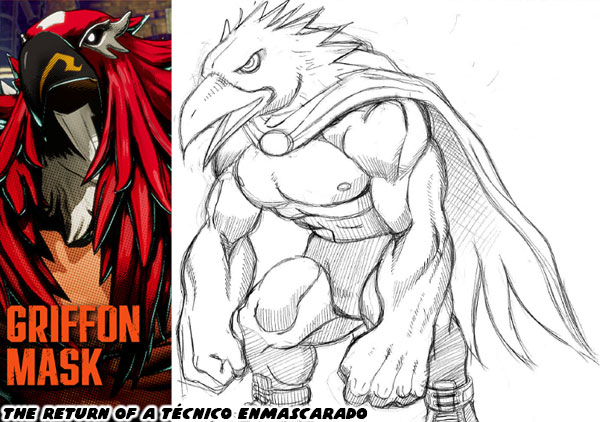
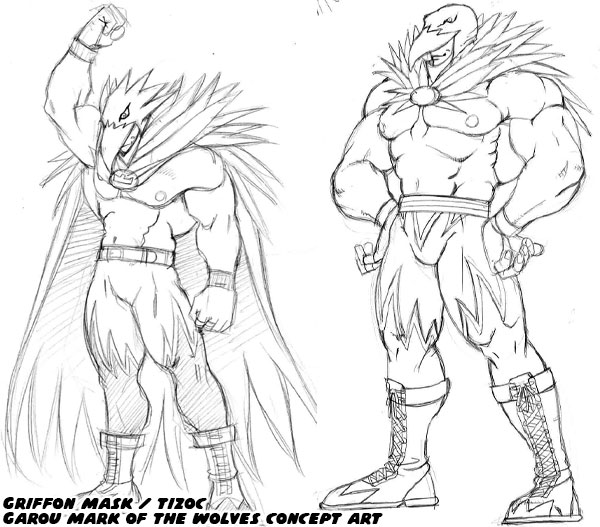
Yesterday the blog looked at some concept art from Garou Mark of the Wolves (1999) thanks to some scans that my friend Zero shared with me. We saw how some character designs evolved. Some characters were dropped, and some ended up being the blueprints for brawlers that would turn up in the King of Fighters series. One of the returning faces in the Garou 2 / Fatal Fury City of Wolves was a masked wrestler that went by the name of Griffon Mask / Tizoc. He was easily one of my favorite pro wrestling characters in a video game. He captured the essence of lucha libre better than 90% of the masked wrestlers in any other title.

There were layers to his design that were important to fans of the sport. Even if you knew nothing about pro wrestling you could tell he was an interesting character, with a unique move set, and his own personal reason for fighting. For die-hard fans of lucha libre his design, and inclusion was profound. There were a lot of differences between the pro wrestling featured in the USA, and in Mexico. I’m going to give you a light overview today, but if you want a deep dive I wrote a comprehensive history of lucha libre on the blog many years ago. Wrestling in Mexico is called lucha libre, literally “free fight” or “freestyle fighting.” Not every luchador or wrestler wore a mask. That was a misnomer. A masked wrestler in Mexico was called an enmascarado.

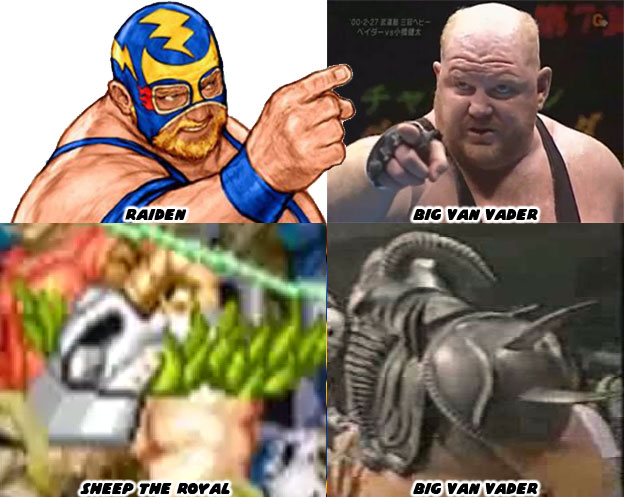
The good guys were referred to as técnicos, literally technical wrestlers. They obeyed the rules of the sport, and practiced good sportsmanship. The villains were called rudos, literally rude, rough, or rugged fighters. They were expected to use dirty tactics, and cheat at every opportunity. It was up to the técnico to beat them fair, and square. It was a challenge never to stoop to their level. There were both good guy, and bad guy enmascarados. They represented a literal battle between good, and evil. In the King of Fighters universe Griffon Mask was among the best of the técnicos. He had no intention of entering the KOF tournament but was recruited by a boxer named Vanessa. Griffon was on the opposite end of the spectrum of Raiden, the heel, or evil masked wrestler that appeared in the original Fatal Fury from 1991. Raiden was based on Leon White aka Big Van Vader. Mr. White (R.I.P) was hugely popular in Japan in the ‘80s, and ‘90s. He influenced the creation of Raiden, as well as Sheep the Royal / Alexander the Grater from the Muscle Bomber / Saturday Night Slam Masters (1993) series by Capcom.

Griffon Mask was the definition of a babyface, or face for short. These were the good guys. He was a noble wrestler, and he fought for all the right reasons. He was actually a mentor to young poor kids, and using his winnings to help orphans. This was a trait shared by King from the Tekken (1994) series. The stories of masked wrestlers fighting for orphans was based on the true story of Fray Tormenta (Friar Storm). He was a monk that would wrestle while masked in order to raise money for the orphanage he ran. His legend changed the perception that Japanese fans had of masked wrestling. He would inspire the creation of some great fighters. The teams at Namco, and SNK seemed to have a profound respect for the sport. By comparison I was not happy with how the developer at Capcom took away the elements of lucha libre, and replaced them with cooking gimmicks for El Fuerte in Street Fighter IV (2008).

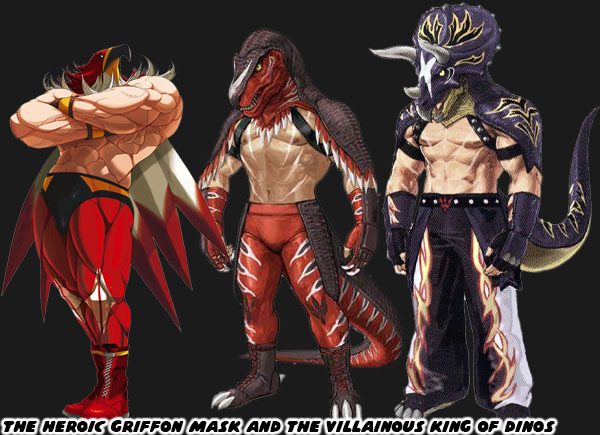
In the King of Fighters XIV (2016) Team Mexico featured a new character. Joining fellow pro wrestler Ramon, and Angel was a new enmascarado named King of Dinosaurs. This guy had a similar build, and move set to Griffon Mask. He was however a rudo. Ramon, Angel, and several other competitors in the tournament knew he was actually Griffon but played along in order to preserve “kayfabe” or keep audiences from discovering the truth. The reason for his change in demeanor was because he had been beaten by a young boxer named Nelson. In order to get even he was willing to fight dirty in the tournament. He didn’t want to let any of his fans down so he created a new persona, and mask by extension. I had written about Nelson, the boxing phenom with vitiligo previously on the blog.

I’m glad that Griffon was back to his good guy identity. I wondered if Vanessa had something to do with this, or if it would be addressed during the story mode. I was eager to see if he was going to have a new rival in Fatal Fury the City of Wolves. It would be great if Raiden, or a new rudo debuted in the sequel. What do you think of this character? Were you ever a fan of pro wrestling, or lucha libre? I’d like to hear about it on the comments section. As always if you would like to sponsor me please visit my Patreon page and consider donating each month, even as little as $1 would help make better blogs and even podcasts!
follow the Street Writer on Patreon!

Friday, March 18, 2016

Trading masks, the Griffon versus the Dinosaur...

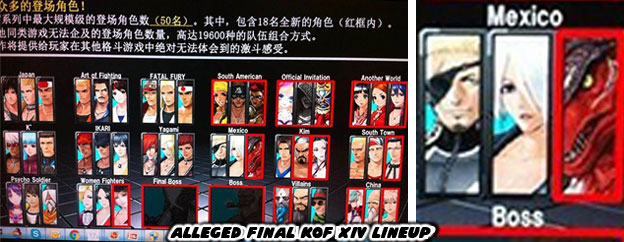
If you are following this blog then you are a fan of fighting games and hopefully a fan of lucha libre. Well Street Fighter V did get a couple of wrestlers to return which was good. The Mexico representatives were missing, so far, but there are more characters to be added in the next few months and years.Word is that SNK has a few wrestlers returning as well. A few weeks back there was a leaked image that shows allegedly the final roster of King of Fighter XIV. Which is supposed to be 50 characters in total. People are skeptical because the screenshot seems to be from a Windows laptop. So it just might be a doctored photo with fan-favorite characters. It the screenshot holds up however there may be a dedicated Mexico team. So what does that mean to fans of lucha libre in fighting games? Well it's a mixed bag. The three characters announced are all Mexico natives. Angel, Ramon and a new character called the King of Dinosaurs.


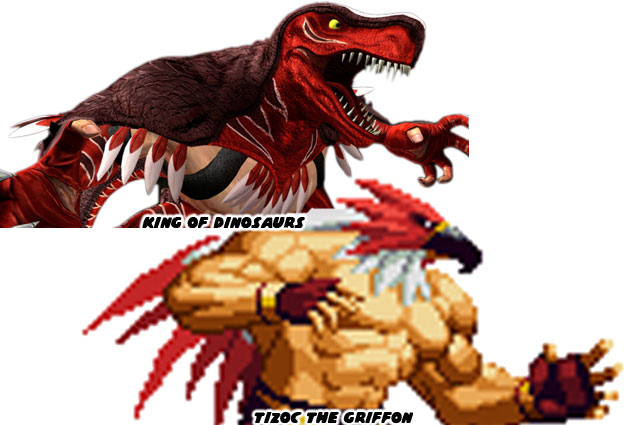
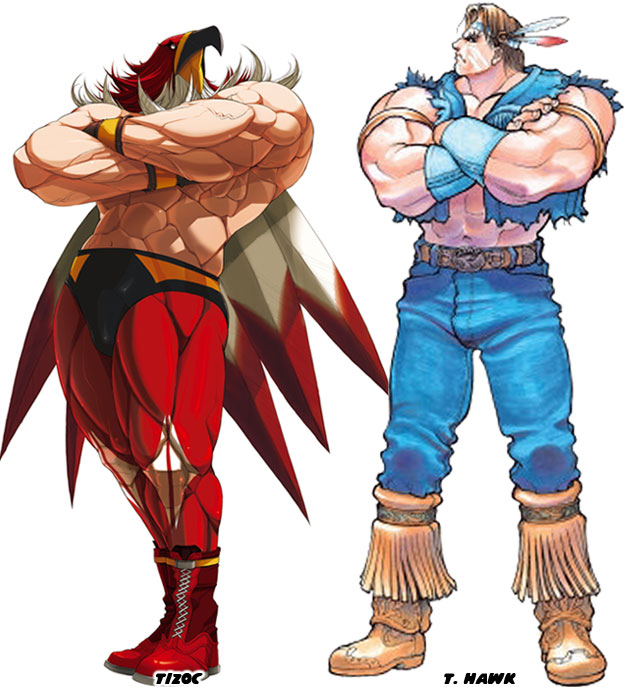
Angel was a genetically modified fighter that did have some pro wrestling moves as well as some muay thai strikes.She was insanely strong and was one of the fan favorite characters from previous games. Ramon had some high flying wrestling moves as well. His design, featuring blonde hair and an eyepatch, was actually inspired by real Mexican wrestlers such as Shocker and Pirata Morgan. The third member of the Mexico team was somebody new. He wore a mask, but not a traditional lucha libre mask. Instead it was a full-on t-rex mask and tail that covered his shoulders and waist. When he was revealed a lot of people noted that he looked eerily familiar. There was a character named Tizoc aka Griffon Mask in Garou Mark of the Wolves, another game from SNK that takes place in the King of Fighters continuity. This character was a huge wrestler that wore an oversized mask as well.


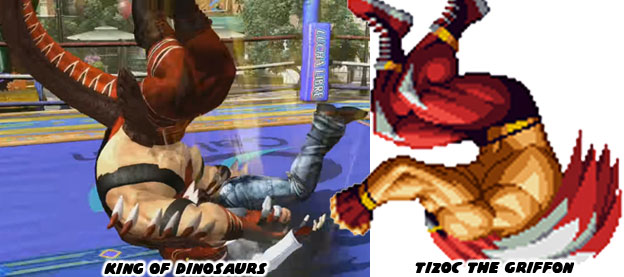
Many assumed that the King of Dinosaurs was the return of Tizoc. They could be right. In Mexico it is not uncommon to have a masked wrestler lose his mask in a match, disappear for a while and turn up in a new promotion with a new mask and a new gimmick. This new guy with the reptile head has the same build and size of Tizoc. He also has familiar grapples and special moves. His trademark "Big Fall Griffon," a spinning suplex drop, is actually seen in the reveal video for the King of Dinosaurs. I want to find out if he abandoned the original character, or if he lost the mask in a match or if this is some sort of twin brother.


Do you think the design for Tizoc or King of Dinosaurs was better? Is this a character you'd think about playing as? What do you think of the KOF XIV reveal so far? Are there and characters you look forward to playing as or against? Are there any characters you wish were in the series? What about the direction of the franchise, do you think SNK is playing it safe by not evolving the characters much? I'd like to hear your thoughts on the game. As always if you enjoyed this blog and would like to sponsor me please visit my Patreon page and consider donating each month, even as little as $1 would help make better blogs and even podcasts!


Monday, September 7, 2015

How fight culture became fighting game history, part 30

There were many manga writers and artists that had published comics on real and fictional wrestlers. These comics had a hand in inspiring many game characters also. One of the more famous artists, Tetsuo Hara, who was co-creator on  Hokuto No Ken / Fist of the North Star was a huge fan of wrestling. He had used wrestlers like Abdullah the Butcher and Big Van Vader as the basis for some of his characters. His work had heavily influenced the development of Street Fighter II. In some early designs Ryu looked very much like Kenshiro from Hokuto No Ken before his design was taken to a more karate form.

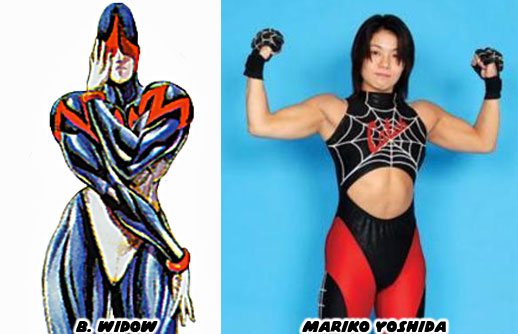
Hara stayed in contact with the developers at Capcom and when they asked the artist if he could help design the wrestlers for the Muscle Bomber / Saturday Night Slam Masters series he was happy to oblige. His intimate knowledge with wrestlers from the world over allowed him to put a unique spin on many figures. For example, the only female playable female character in the Muscle Bomber series was Black Widow. Her look and gimmick was modeled after Mariko Yoshida.


Hara was also the designer for adapting Big Van Vader into the Muscle Bomber series as Sheep the Royal aka Alexander the Grater. There were many masked wrestlers featured in his title, many from around the world. Hara helped demonstrate that great characters in fighting games came in all shapes and sizes. They did not all have to look like karate or kung-fu masters in order to be memorable. Best of all by extension the characters he created became part of the Street Fighter universe.

Game designers had an incredible diversity of designs for over 25 years. In early arcade and console games there could always be a masked wrestler to help break up the traditional karate and kung-fu characters that were all the rage. Many times the designers would push the idea of what a luchador could be and what fantastic moves they could contribute to the fighting game genre. Like the other characters in the title the moves that the wrestlers were given were great exaggerations of the actual fighting arts. A suplex was a dangerous throw but imagine how much greater it would look if the performer would leap and spin in the air with their opponent as they performed it. The same thought process was applied to pile drivers, power bombs and all sorts of real wrestling moves. They were made fantastic for the sake of the game. The luchadors and enmascarados that appeared in fighting games were sometimes mild adaptations, as with El Blaze or they were completely over-the-top as with King in Tekken or Tizoc in Garou Mark of the Wolves. 


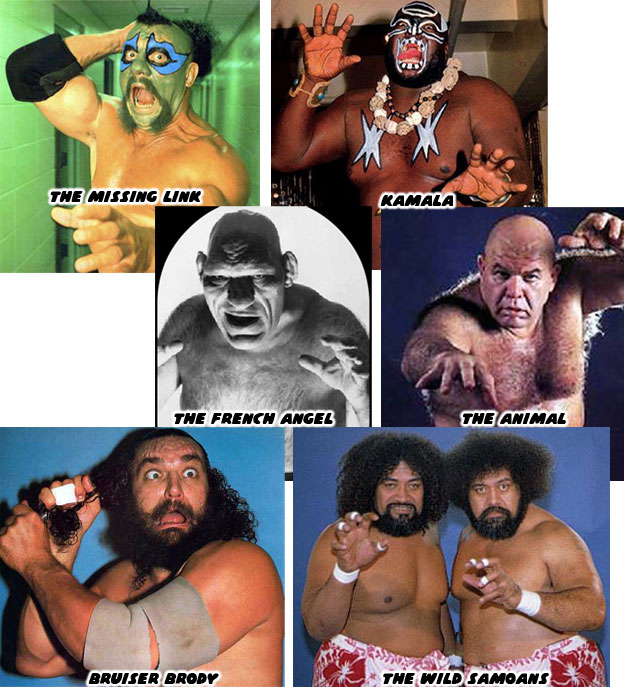
Pro Wrestling did not need masked wrestlers in order to create mysterious personas. Some of the most most popular characters often came "From Parts Unknown." It could be seen as lazy writing from bookers or inspired creativity by the performers themselves. By leaving the country of origin unknown the audience was allowed to imagine what far off island, or lost civilization these fighters came from. In many instances having a strange physical appearance was enough to keep the illusion alive. Some wrestlers were tall, gangly, obese, muscular or outright grotesque. George "The Animal" Steele was a heavy set and hairy man that would paint his tongue green. This plus his erratic mannerisms was enough to scare audiences into thinking that he was some sort of Neanderthal in wrestling trunks. Maurice Tillet aka the French Angel was an even earlier version of the monster man. Maurice suffered from Acromegaly which caused his hands and head to expand through most of his life. His features were proportioned for somebody much larger, making him look gruesome even against other less-than-handsome wrestlers. Some wrestlers used a little face paint or body paint in order to enhance their appearance. Dewey Roberts was a mid-card wrestler until he discovered his gimmick, a crazy haircut and some face paint, then he was elevated to stardom. He was known as the Missing Link and would brutalize his opponents by using headbutts over and over. The large Southerner James Harris was nicknamed the Ugandan Headhunter Kamala. Sometimes teamed with the Missing Link and formed Devistation Inc.


The origins of these gimmicks went back to the earliest days of wrestling in North America. Back when many performers worked the Sideshow in the circus. Sometimes the wrestlers were legitimate fighters and sometimes these fighters needed a gimmick to get them over with audiences. Sadly some of these gimmicks could actually be linked to racial biases and ignorance on foreign cultures. Previously on the blog I had mentioned how ignorance about the Indian fighting forms led to Chinese filmmakers exploiting Yoga as a fighting art. This in turn influenced the creation of characters like Dhalsim and the Great Tiger. Through the history of wrestling the islanders from the South Pacific were often presented as savages and wild men. In the early days of televised wrestling audiences in smaller markets genuinely believed that these men, and sometimes women, with large heads of hair were indeed Headhunters.

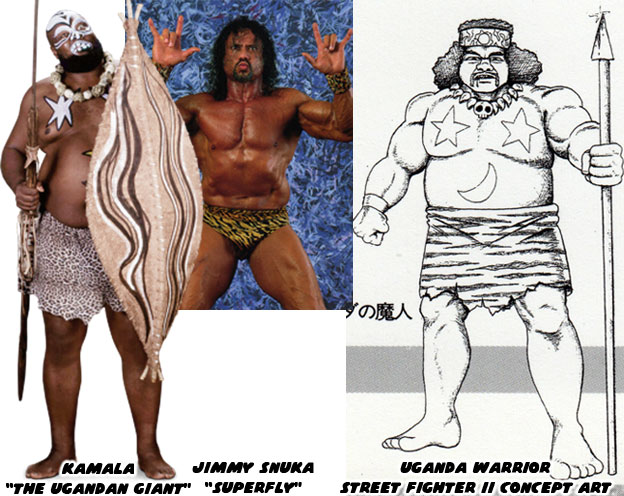
A savvy promoter might help develop a gimmick and convince audiences that their new talent was indeed from some sort of far off land. The wrestlers sometimes did not have to speak to the camera, and the gimmick worked better when they didn't, so that they could be presented as uncultured savages. The designers working on Street Fighter II had used wrestlers as a point of reference for several characters. One of those that ended up on the cutting room floor was an amalgamation of several "wild" wrestlers. The Uganda Warrior had a physical build similar to Afa and Sika, the Wild Samoans, as well as Jimmy "Superfly" Snooka but with the body paint of Kamala.


The savage wrestlers had a big presence in the ring. When promotions went from local television to the mainstream bookers knew to hire wrestlers that looked great on television. Those that had bodybuilder physiques and handsome faces were easier to book than the chubby ones that had actual fighting ability. Masked wrestlers were always great mystery opponents that would boost the ratings. Something that also worked great on television were the gimmick wrestlers that worked the wild man angle. These characterizations translated very well to fighting games. These savage figures were less like traditional wrestlers and more like animals when they fought. They sometimes scratched and bit opponents when the ref wasn't watching, they often celebrated when they were able to draw blood. The line between man and monster would be blurred depending on the performer, or in the case of gaming, depending on the designer.


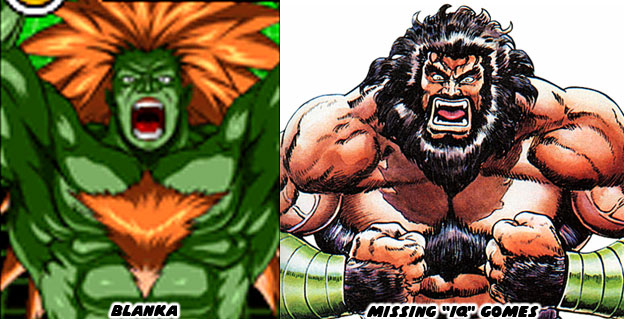
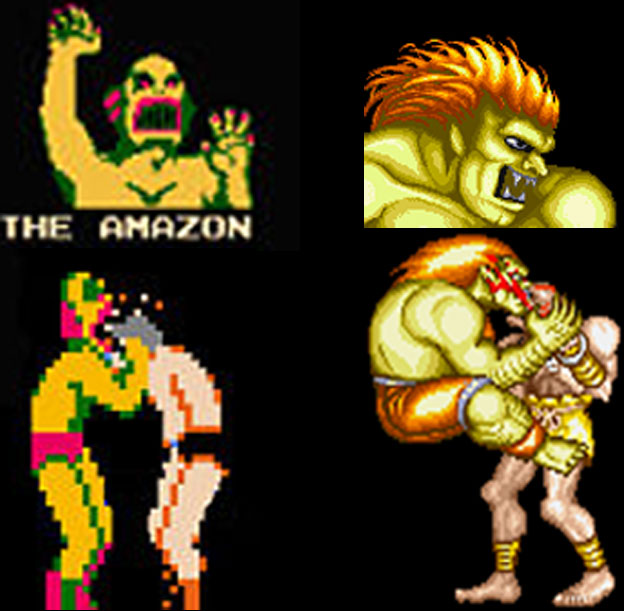
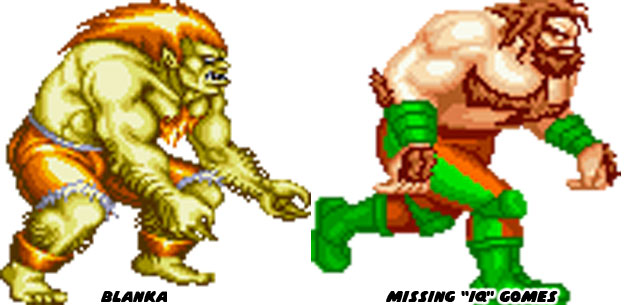
Take the character Blanka from the Street Fighter series and Missing IQ Gomes from the Muscle Bomber series. Both were featured in a Capcom title and both fell within the canon of Street Fighter. The figures were both extremely muscular, very hairy and had features that were almost ape-like.The major difference between the two was skin deep. Blanka was colored green with bright orange hair whereas Gomes had a more natural skin color. The senior designers working on Street Fighter II wanted to see how far they could push the wild man concept and still keep the attention of gamers. Blanka was rooted mainly on an earlier character called The Amazon that was featured in Nintendo's Pro Wrestling game.  Artist Akira "Akiman" Yasuda wanted to make players feel powerless as Blanka would bite the face of his opponents as the Amazon did to him on the old Nintendo console.

Capcom could go way out with the look and Blanka would still work within the context of the series. Blanka had long extended ears, sharp teeth, claws (which were simply long nails) and shackles as if he were an escaped animal. He was a good counter-point to the character Dhalsim. Both featured very odd fighting styles and represented mysterious origins. They added a sense of wonder and fantasy to an otherwise traditional cast of boxers, kung-fu and karate experts.


By comparison Gomes had many of the same features yet could have existed in an actual promotion. Like George Steele he was a very strong hairy man that acted irrationally in the ring. The wild outbursts performed by Gomes was something that a wrestler like Frank "Bruiser Brody" Goodish excelled at in real life. Tetsuo Hara tried to keep the majority grounded in reality. He had such tremendous respect for the art of pro wrestling that he didn't want to push the envelope as far as the Street Fighter II team had done. The gimmicks Hara exploited were strong for most of the wrestlers and even the more "exotic" characters could have existed in some promotion. The roots of Blanka's design were not as harmless as those used by Hara.


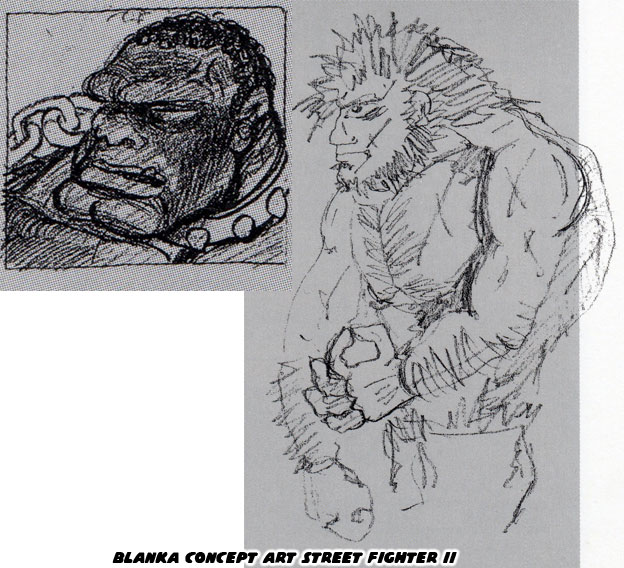
In the earliest concept art Blanka was a savage black man that was in chains. Tight curly hair, big lips and distorted proportions made him appear more ape than man. Somebody at Capcom had enough sense to change the design. The character known as Anabebe could have been a potential disaster, especially in the black community. Arcade games depend on making their audiences happy and keeping them happy. Street Fighter II would have offended many players overseas if figures like "Great Tiger" and Anabebe had not been rethought.


There was still an unmistakable draw to the wild man as a fighter. Many great characters in literary and movie history were based on the idea of a man becoming more like a monster. Think about the classic characters Dr. Jeckyl and Mr. Hyde, Frankenstein's monster, the Mummy, Dracula, and the Wolf Man. They were the inspirations for some of the longest-running movie characters. Universal Studios would revisit those characters time and time again. Modern retellings of these characters could be seen through comic book icons like The Incredible Hulk, Bane and Gorilla Grodd. The influence of these monsters with human traits was universally appealing. A version of the monster-as-a-man was in every culture and storytelling tradition. Capcom had even experimented with the genre by putting the iconic movie monsters in a fighting game known as Vampire / Darkstalkers. Yet for the Street Fighter franchise they wondered how far they could push the wild man, or savage man concept without losing the audience. Blanka had done very well for the series but the developers were looking to recast the game in Street Fighter III. The stretchy-limbed lab experiment named Necro was a variation of Dhalsim. The Chinese twins Yun and Yang were younger takes on Ken and Ryu.

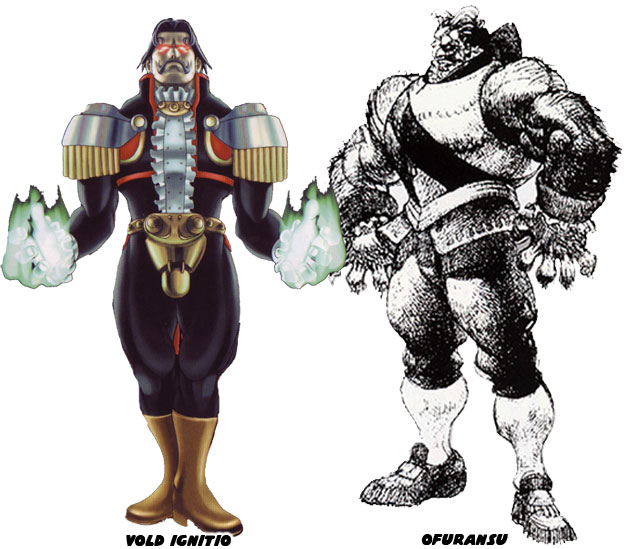
The Blanka-type character for the game never made it past the planning stages. Ofuransu was described as being "a noble field beast." He was an aristocrat that had the features of a wolf man. This combination of royalty and hulking brute was very unique. It was not the only time that Street Fighter designers had kicked around the idea. Half of the team that worked on Street Fighter II left Capcom to form ARIKA. They created a game called Fighting Layer. It incorporated many ideas from Street Fighter II, including ideas left on the cutting room floor. The main villain of the game was an aristocrat named Vold Ignitio. He was more vampire than werewolf in the game, his regal costume beguiled his savage attacks. He would slash at opponents with his long fingernails and even pounce on opponents and bite at their necks.


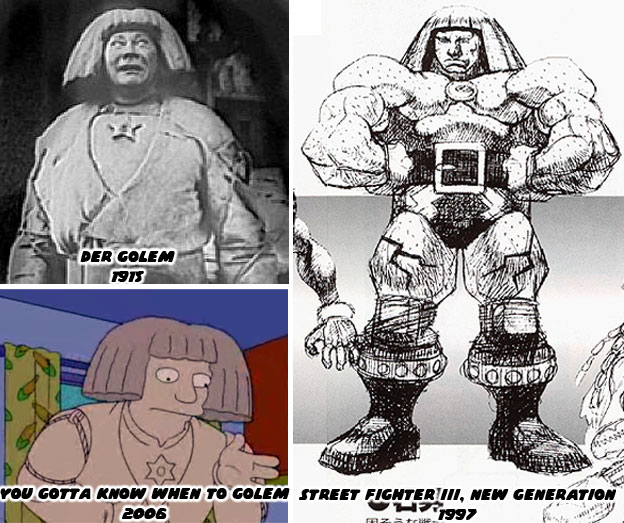
Wild men, monsters, savages and demons were on the extreme edge of designs that worked for the fighting game genre. The team working on Street Fighter III had even kicked around the idea of having a man made of stone, instead of the MMA fighter Alex, or the giant Hugo be the "strong" character in the title. The Golem was actually based on a character featured in what was considered the earliest horror film ever made, an experimental German film from 1915 titled Der Golem. The Golem was a man made of clay from Jewish myth. A person seeking revenge against a great adversary could bring the monster to life by using magic. He would write the name of the person he wanted to kill on a piece of paper and feed it to the Golem. The Golem would then go out and hunt his victim, never tiring, impervious to harm and never stopping until his mission was accomplished. This character was considered the basis for Frankenstein's monster. The character was obscure compared to the more famous movie monsters. That didn't stop the designers at Capcom from putting him on the table or even from the writers on the Simpsons from using him in a Halloween special.


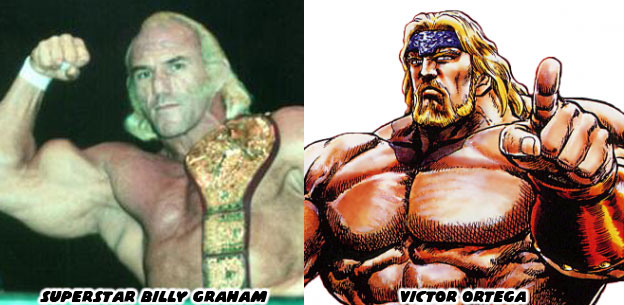
The designers at Capcom came to their senses and scaled back their character choices. They found a good balance between new fighting forms and returning characters as the Street Fighter III series took off. Wrestlers would remain popular choices while casting other fighting games. Artists like Tetsuo Hara would find success in adapting real wrestlers into the Muscle Bomber games. The champion of the universe was a semi-retired fighter by the name of Victor Ortega. The character was modeled after "Superstar" Billy Graham, one of the most colorful wrestlers from the '70s and '80s. Graham was a great in-ring worker and had an amazing bodybuilder physique. His look and gimmick would be copied for generations by Jessie "the Body" Ventura, Hulk Hogan and Scott Steiner. Ortega was one of the most muscular characters ever featured in a Capcom fighting game, easily beating the massive frames of Zangief and Darun Mister.


Despite its long and colorful history pro wrestlers, masked or not, were thought of as the bottom tier of the fight circuit. Television and motion pictures had convinced audiences that the best fighters stood on their feet and traded punches and kicks with each other until one person fell. Wrestlers did not really throw punches and kicks therefor they were not "real" fighters. The reality of combat was completely different. Most street fights and even professional fights ended up on the ground. It would be anticlimactic in most fighting games to have the final boss simply tackle the player and break their arm, even if that was what would work best in the real world. It was rare when a fight stayed upright but allegedly not for the best fighters. People like Bruce Lee and Mas Oyama were said to have ended fights quickly, before they could be taken down. When Oyama would have an open challenge sparring match he would often dispatch opponents with a single punch, usually to the torso instead of the head. Even with that said both men knew the importance of being well rounded fighters. They studied the grappling arts and knew how to stay on their feet even when people were desperate to take them down. Judo, jujitsu and wrestling were forms that they had learned a tremendous amount from. This made them much more formidable than any one style could have ever taught them. Achieving that level of expertise was not easy for the fighters.


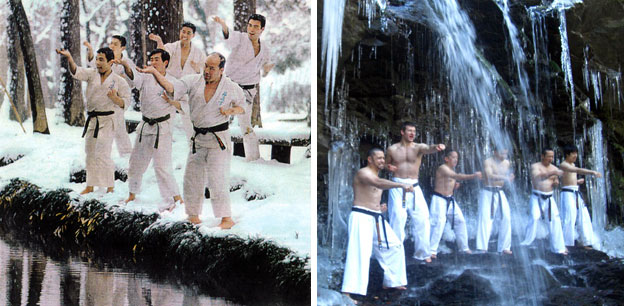
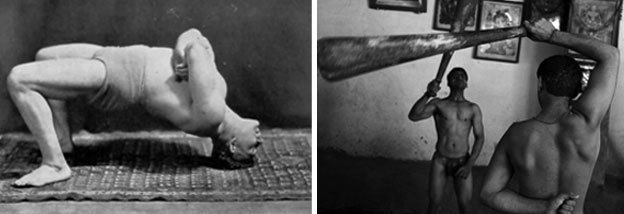
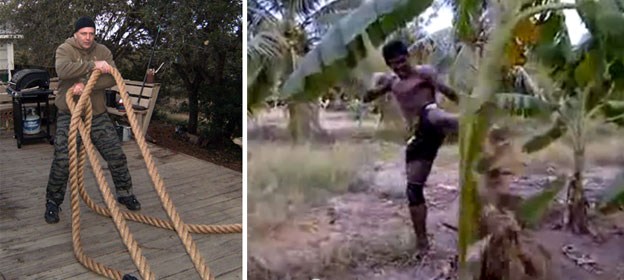
In his pursuit of perfection Oyama lived like a hermit in the mountains for years. He lived in relative isolation, free from distractions and tried to unite the body and mind through his rigorous training. His physical conditioning was brutal. Running, punching, kicking were the only things on his mind, that was when he was not trying to clear his mind through meditation. It wasn't as if he were punching a bag filled with sand either. He would punch and kick hard wood, or trees wrapped in rope and canvas. His skin became rough, his hands and feet calloused. The micro-fractures his limbs suffered by hitting hard surfaces had calcified, making his bones thicker and stronger. He could actually break rocks, stones and bottle necks with the edge of his hands. He trained day and night, in good weather as well as miserable weather. He worked out barefoot, even during the winter. He would run and train under icy waterfalls to harden his mind as well as his test his willpower. When he returned to challenge the community of martial artists he was able to drop most opponents with a single punch. The training regiment would be repeated by other karate practitioners. Many of his Kyokushin students joined Oyama on his journey as his legacy grew. Even after his death his die-hard students kept up with the practice. People would fly in from around the world with the hopes of becoming hardened like steel under the harsh conditions.

Older martial arts systems had their own training techniques which could be considered as brutal as anything that Oyama had suffered through. The Shaolin school, the ancestor of the kung-fu schools, had very strict guidelines. Practitioners ate a diet of vegetables and trained and mediated from morning until night. They too would harden their bones by punching hard wooden dummies, running up and down hills and even focus on strengthening tendons. The feats of superhuman strength and endurance shown by the masters of the fighting arts grew into legend. They truly seemed superhuman, even when compared to other fighters. Those that were strikers had gotten all of the glory. However there were men that had fought just as many opponents if not more than the fabled masters. There were men that had compiled 100, 200 or more undefeated battles in their lifetime. Because they settled the contests through the grappling arts rather than the striking arts they weren't as well remembered. It did not make them any less formidable though.

Wrestlers of the various forms applied themselves just as hard at their craft as the Japanese or Chinese fighters did. The conditioned themselves by running, sometimes with a teammate over their shoulder. They developed exercises to help them build strength in their joints, neck, back, shoulders and core. By swinging heavy weights and clubs they developed insane grip strength. They would perform rigorous calisthenics, sometimes thousands of repetitions per day to build stamina. Some of the grappling legends did not have the punches or kicks that made other fighters immortal there were still extremely dangerous. The best wrestlers could dislocate and break bones with ease. They knew how to cut, gouge, stretch and maim opponents without a weapon. Yet they also learned to temper their ability so as not to permanently disable an opponent. The same code of conduct almost chivalrous observed by other martial artists was also practiced by most world class grapplers.


Players realized that the grapplers featured in fighting games were pulled from real world and pop culture influences. Some characters wore masks, others bizarre costumes, most wore traditional uniforms and let their abilities speak for themselves. The grappler was an appealing character because they were grounded in realism. They demonstrated that even mere mortals stood a chance against the martial arts heroes. In fighting games the grapplers did not have projectile moves. The lack of a "fireball" attack did not necessarily hold them back. The most extreme caricatures of a grappler made them iconic to gamers. Zangief, Darun Mister, Alex, Abel and Tendo Gai were just some of the wrestlers featured over the years in some fighting games.

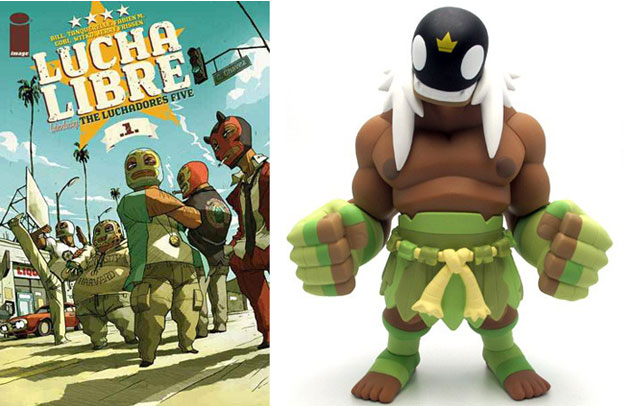
Fans of wrestling history never forgot the influence of Catch on modern wrestlers and MMA fighters. Even comic book artists had been eager to put their spin on the wrestling legacy. The French writers and artists that worked on a series called Lucha Libre highlighted the various genres featured in wrestling matches and even movies. Masked wrestlers, monsters, mad scientists, damsels in distress, cool cars and even tikis had all been featured in one way of another. The most powerful fighter in the series was called King Catch. The masked warrior lived on a tropical island and would be a run in character featured with the Tikitis. The character was designed by Fabien M. Although he never crossed over into the Luchadores Five comics the people at Muttpop hired Monster5 to create a vinyl figure that would fit with the other heroes.


The Catch icons in MMA had shown the limitations of relying on one school of grappling for all the answers. They demonstrated that for every attack there was a defense, and for every hold there was a counter-hold. Fights were fluid and had to be approached as a series constantly changing situations. The people that froze up or relied too heavily on what they had been taught without adapting found themselves on the losing end of a battle. Lee, Oyama and the other fighting masters had come to this realization early on in their careers. The best fighters of the modern era learned that no one school held all the secrets to being a great fighter. The lessons in conditioning and strength training from various disciplines could help make a person physically capable of competing but the mental toughness required was something entirely different. The reason that Oyama and his students studied under harsh conditions was to help train their minds to deal with pain, fatigue or other forces that were beyond their control. The various schools of Karate, Kung-Fu, Judo, Wrestling and Ju-jitsu had taught the world that the striking arts were to be tempered with self-discipline. Knowing how to fight was never an excuse to fight.

Modern gladiators began to pick and choose the best elements from the traditional arts and began re-writing the book on training. They took the hard training from the Asian fighting arts. Building strong bones through repeated striking. Then the new generation of fighters then began developing core and grip strength workouts using classic tools like ropes and kettlebells but with cross training applications as well. The most important thing was the sharing of knowledge between martial arts schools. Students no longer had to limit their training to one system or another. If a fighter learned muay thai strikes from one teacher they were free to go to a different teacher and learn the nuances of boxing as well. Previously there was a stigma associated to "betraying" one school to learn from another. Now many instructors encourage diversity and experimentation. No one school was perfect for every build, body type, expertise or age. Exploration into the various systems meant that competing schools had to become more diversified. This would allow a person to cater to their strengths and build on their weaknesses. The end result were fighters that were well-rounded and would have made the early MMA pioneers proud.


Despite the difficult cross training that the best fighters endured there always seemed to be the one fighter that was better than them. Maybe it was a classmate, a former friend or a bitter rival but there always seemed to be a superior fighter waiting in the wings. Perhaps the opponent got lucky or maybe they had indeed developed a better fighting system. Whatever the case was the loss often changed the path for a legend in the making. The next blog will look at the evolution of MMA in Eurasia as well as the myth of the elderly masters. As always if you enjoyed this blog and would like to sponsor me please visit my Patreon page and consider donating each month, even as little as $1 would help make better blogs and even podcasts!

Friday, September 4, 2015

How fight culture became fighting game history, part 29

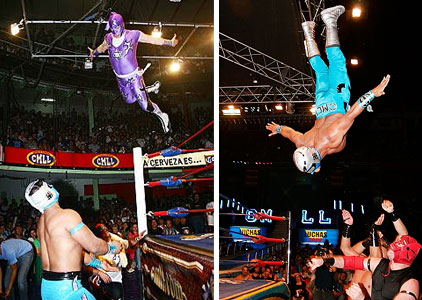
Many people do not realize that there are many different types of pro wrestling. They usually understand that the matches are pre-determined, which leads many to call the sport "fake" but the athleticism of the performers and the origins of their moves are anything but fake. The pro wrestling seen in the US has many variations, from traditional to bloody and violent "hardcore." Those are slightly different than the high-flying lucha libre matches seen in Mexico. In Japan the style of wrestling they perform is a little stiffer, as in the hits they perform are a little harder and they go through more "finishing moves" than either the US or Mexico. They even have a unique name for their format of pro wrestling called puroresu or puro for short. Japanese puro has been heavily influenced by both the USA and Mexico formats. Japan's love of lucha libre even resulted in the creation of lucharesu, a combination of lucha libre and puroresu. What makes the sport unique is how different cultures interpret it and make it their own. For the past century the Americas, North, Central and South have been the catalyst for a unique variation of grappling and fighting. One with more theatrics, more pageantry and more high-risk maneuvers than any other form of ritualized combat in the world.


The most obvious distinction of lucha libre to every other form of "pro wrestling" in the Americas are the masked characters and high-flying acrobatics. To many in the US they view these "gymnastics" with disdain, saying that pro wrestling has a history connected to trapping and grappling of catch wrestling, freestyle wrestling and of course classic Greco-Roman wrestling. The National Wrestling Alliance (NWA) from North America could claim to trace its championship back to the first Heavyweight World Championship of Catch-as-catch-can from 1905 won by George Hackenschmidt. Of course the actual NWA organization was founded in 1948 to give the North American territories a "World Champion." The type of wrestling performed in Mexico is seen as too acrobatic or choreographed to be taken seriously. Lucha libre as we know it is actually the oldest form of pro wrestling in the Americas. The original promotion that started it all, the Consejo Mundial de Lucha Libre (CMLL, which was actually the EMLL previously) was established in Mexico in 1933 and survives to this day. It is the longest running promotion in world history. By comparison the WWE could trace its history back to 1952. Also, just so you know not every luchador wears a mask. A masked wrestler is called an enmascarado, these are the creme of the crop when compared to regular luchadores.

Salvador Lutteroth is the man credited to bringing wrestling to Mexico. He saw some matches in El Paso and noticed how a masked performer worked well with the crowd. He thought this secret identity would be very important to fans. They could imagine themselves as the person behind the mask and get lost in the show. They would also believe all sorts of origin stories, such as a wrestler covered his face to keep women from fainting at the sight of his grotesquely disfigured face. Or perhaps this character was a hero, like the Lone Ranger, or Bass Reeves, and hid his identity to protect his family and friends from evil doers. Salvador knew that masked characters would go over well in Mexico and needless to say he was right! I would suggest you watch a short but very well put-together lucha libre podcast from the George Eastman (as in Eastman Kodak) house explaining some of the history and charm of these masked characters. Lucha libre certainly has a long and established tradition that has been highlighted for several generations in gaming.
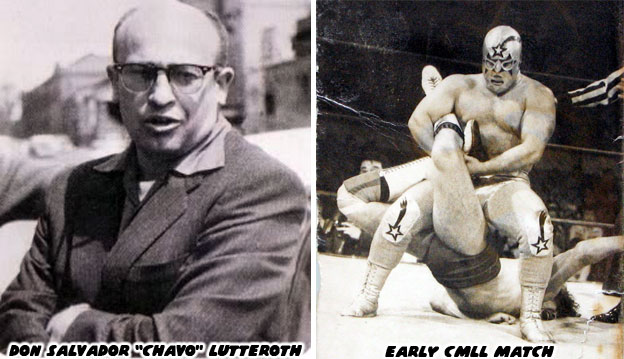


The closest thing that I could compare the enmascarados in the USA to would be superheroes. The elaborate masks, tights (and sometimes capes), are all part of their costume. Their secret identity is as important to them and their fans as it is to the fictional characters in comic books. A true enmascarado never, ever goes out in public without his mask and protects his identity to the best of his ability. He never does anything to bring shame to his name or his mask. An enmascarado does not go into the lifestyle casually but with all his heart and conviction. If the wrestler is lucky enough to have kids then his son or daughter might take up the family business and even carry the mask through the next generation. Believe it or not the true enmascarados in Mexico never leave the house without their masks, even when they are out with their friends and family. To the public it's all part of tradition and they do not think twice about seeing a masked man.

The reason for what we would consider "odd social behavior" is actually seeped in tradition. These men are seen as daring fighters, mythical warriors. The physical ability to perform all sorts of crazy moves is part of the spectacle but the bond between the audience and the luchador goes deeper than performance fighting. The good guys are called "Technicos" they fight by particular guidelines and always have to uphold the rules of clean combat. The bad guys are called "Rudos" and are free to use every dirty trick in the book. The matches they engage in are very much a live battle between good and evil.

Audiences are drawn to these morality plays like moths to a flame. With the good guys and bad guys so clearly defined it becomes hard not to choose a side. Kids will their heroes to overcome the obstacles and win the fight even when faced against insurmountable odds. Remember the appeal of the wrestler Rikidozan had in Japan? He knew that by wrestling against the foreign invaders, aka the USA, he would win over fans. Each match of Rikidozan's was a chance to prove to the fans that the Japanese were the best. Now imagine that Mexico was the home of a dozen characters as important to history as Rikidozan. Many of these men were fighting for the very souls of the audience.

El Santo "the Saint" was the biggest wrestling superstar of all-time. He was one of the few enmascarados to be buried with his mask on, never losing it in a match. He created an iconic character that still resonates with many Mexicans and Mexican-Americans today. His nickname was el enmascarado de plata (the silver masked man), his mask and silver outfit became a trademark and currently his son keeps the tradition alive.

A huge reason why enmascarados go over so well in Mexico, as opposed to in the USA or Japan, is because of cultural relevance. Mexico is predominantly Catholic but with lingering traditions, folklore and myth from the natives. The battles between good an evil are an every day occurrence for those with strong superstitions. These people pray each and every day to do the right things and not go astray. They pray that they have the courage to fight against evil and even if they lack courage to make sure that God sends a holy warrior to guide them. The warriors that perform in these battles have a second layer of context that is unique to Mexico. 

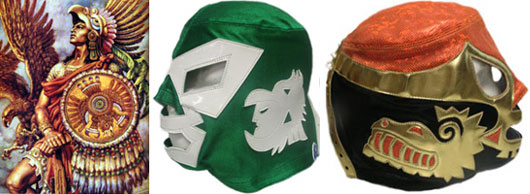
Enmascarados harken back to the pre-columbian world. The masks themselves are inspired by actual warriors. The Aztec warriors went into battle with brightly colored uniforms and headdresses so that generals could watch their exploits in battle. These were known as Caballeros Aguilas (eagle riders) and are symbolic of the fiercest warriors of ancient society. The design of the caballero aguila can be seen on the mask of the villainous Dr. Wagner Jr and Canek "El Princepe Maya" (the Mayan Prince).
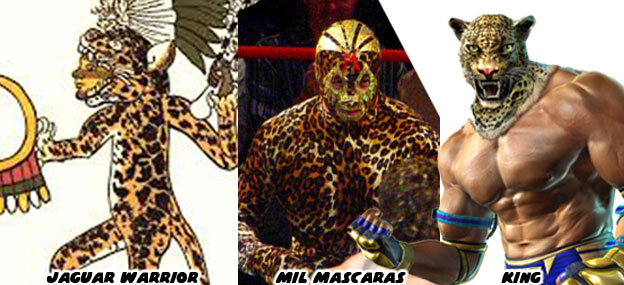


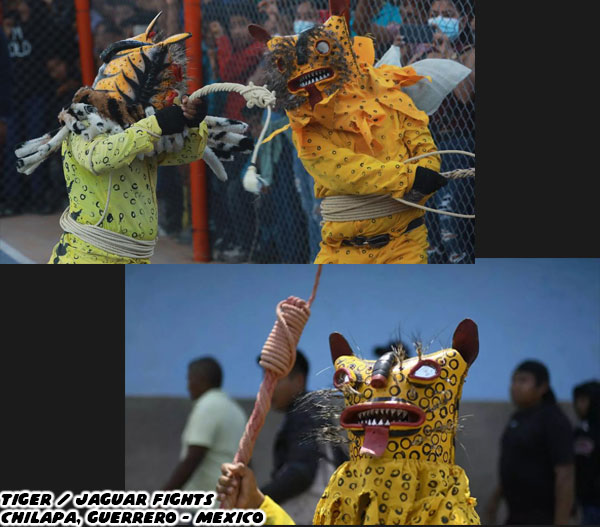
One of the most famous and successful of all the Mexican wrestlers is Mil Mascaras (a thousand masks). He has a mask and costume in the jaguar pattern, similar to what the ancient warriors would wear in battle. His animal print designs helped inspire the character of King in the Tekken series. The tradition of masked fighters outside of the wrestling ring is still seen to this day. One of the longest running traditions happens every year in the city of Chilapa, in the state of Guerrero Mexico. The state is south of Mexico City, and known for the beach city Acapulco. The town of Chilapa is a farming community, and in order to ensure a good harvest they hold a festival in honor of Tlaloc, the ancient Aztec rain god. 


Villagers from Chilapa wear costumes that mimick the jaguars, and tigers of Caballero Aguila fame. They have a parade, and dance in costume. Men, and women then square off in fights where they beat each other with clubs made of rope. Their tiger masks act more like helmets, absorbing terrible blows from the fights. The better the fight, the more rain they can expect to ensure a good harvest. Many people have been severely injured, and a few have died from the battles. When it came to masked combat there was no country on Earth that took it more seriously than Mexico. Here is an excerpt from the Sun interview with enmascarado El Hijo Del Santo explaining the origin and importance of the mask.

"The Sun: Can you describe the importance and history of the mask to Mexican wrestlers?

El Hijo Del Santo: I believe that when lucha libre started, it all began with a wrestler that came from the American circuit. He [the masked wrestler] got a lot of attention from the Mexican crowds and as Mexican wrestling is a war of good v evil, the masks have an importance with the roots of our culture, like the Aztecs, Olmecs and Teotihuacans. They always wore masks of animals when at war, the most significant were the jaguar, wolf, the eagle, snake, as they believed they would get the animal’s powers in combat. I think lucha libre adopted this belief and the luchador looks for a name that suits his personality from say nature, animals, the heaven like El Santo or hell like Demon. Many years ago, my father Santo took the mask off Black Shadow in a match with wagers, that day the importance of the mask took a new dimension, to lose a mask became very important and an opportunity for promoters in Mexico to present something new that doesn’t happen in the USA."
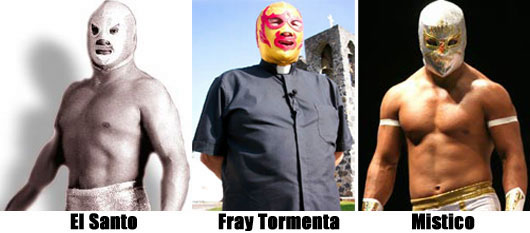


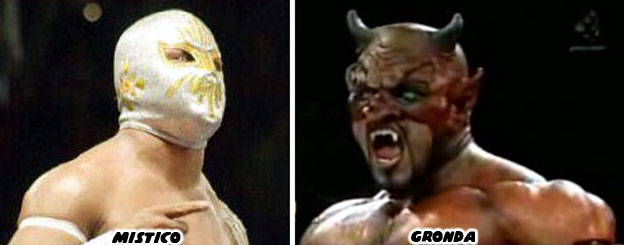
While Fray Tormenta (Father storm) is not the true heir to the Santo legacy, he is a bit of a literal "spiritual" successor. Fray as you might know was the basis of the movie Nacho Libre. He was an actual priest that wrestled to raise money for his parish and the local orphans. The movie isn't nearly as interesting as the true story, and if you ask me quite an insult to the legacy. Fray wore a mask of gold with red lightning trim. Something of a balance to El Santo's silver. A couple of generations later a new high-flying enmascarado showed up on the scene, the new chosen one was not Rey Mysterio Jr. as many believed, he was Mistico and he was "ordained" by Fray Tormenta. His mask was an equal mix of gold and silver, his title "the Prince of the Silver and Gold mask" was a way bringing the iconography of both legends together. He took on all challengers including the men who wore masks of skulls and demons, people like Averno, Ephesto, Mephisto, but not the Devil-masked Gronda because he was in a different federation.
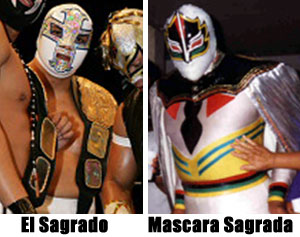

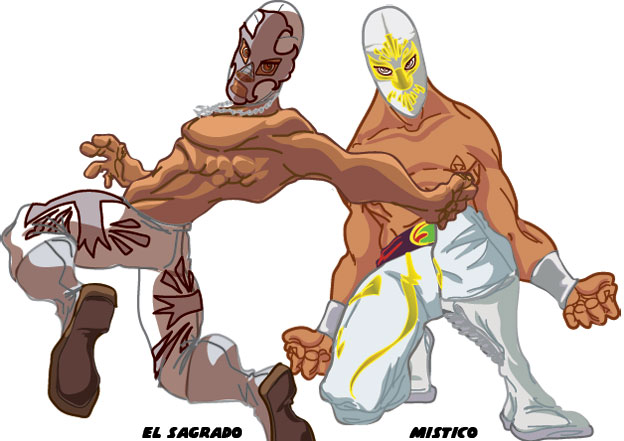
If lucha libre represents the eternal fight between good and evil then fans would want to see the absolute best representing the path of righteousness. Wrestlers like El Santo, Mistico and El Sagrado were famous because of their ties with the Catholic faith. They were very popular in the highly religious small towns of Mexico and even more so in the secular big cities. I cannot overemphasize the importance of the faith that these masked men stood for. They weren't simply "technicos" but absolutely represented the best qualities in humanity. Some, like El Santo, Fray Tormenta and Mistico had a lot of spirituality behind their look and name. The use of halos, crosses and even the Eucharist were not considered gimmicks but symbols of their practicing faith. They represented the ideal qualities of man and acted as living symbols of faith. El Sagrado (the sacred one) and Mascara Sagrada (the sacred mask) were other wrestlers that purported a spiritual path. Their roles were to be great performers and never succumb to the dirty tactics of the rudos. El Sagrado was supposed to be the modern "chosen one" but he did not seem ready for the limelight so he was held back until fans warmed up to him. Mistico was an instant hit with audiences so the torch was passed to him instead.

If you know your Street Fighter history then you remember that a masked wrestler was on the drawing board while SF II was in development. They had at least two separate looks for this "Maskuman" (Mask Man) early on. One that looked very much like the legendary Tiger Mask. There was no doubt that Tiger Mask was a character that many of the developers had grown up with. He was unique among his wrestling peers because started off as a bad guy and became a good guy. Tiger Mask proved a popular character in manga and even had his own anime series.

Japanese culture provided a lot of the SF II character influences, Ryu looked more like Kenshiro from Hokuto No Ken than Mas Oyama in the early Street Fighter II concept art as well. It was easy to imagine that the designers wanted an over-the-top masked wrester in the game that had as much personality as any of the characters or bosses in the SF II. Read the InsertCredit.com Making of Street Fighter II feature to see some more concept art.
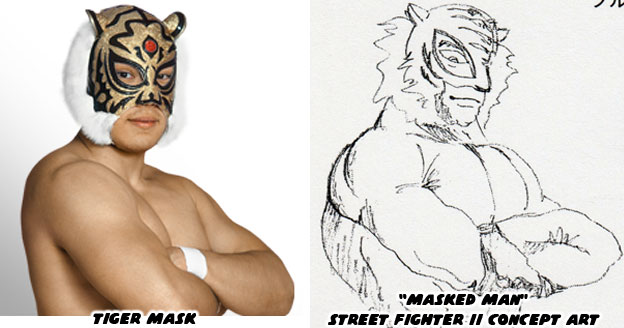

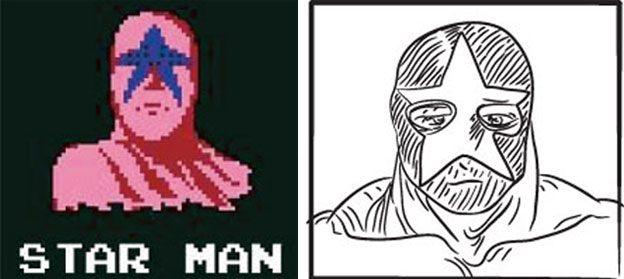
Here is where Japan's wrestling influence, and especially the masked wrestler variety differ from the enmascarado; Japan does not have the cultural relevance of masked characters. Certainly the do respect the legends, especially people like the Destroyer who was the great Western heel a generation before Big Van Vader. At the same time it would be very odd to see a masked person walking around the streets in Japan, unless it was a surgical mask to prevent the spread of colds. They do not have the same cultural significance as the luchadores have in Mexico. They do not have the same religion, myths and folklore that support the symbolism and tradition of elaborate masks. To them a mask is just a mask and it is the wrestler that defines the character. During the development of Street Fighter II Capcom was just drawing masked characters from pop culture without really understanding their origins.In another take on the character he had an enormous star placed over his face, it was not unlike the same mask worn by Star Mask in Tecmo Pro Wrestling for the NES. Because Capcom could not come to a consensus as to what type of masked wrestler they wanted in the game Maskuman never made it past the planning stages.

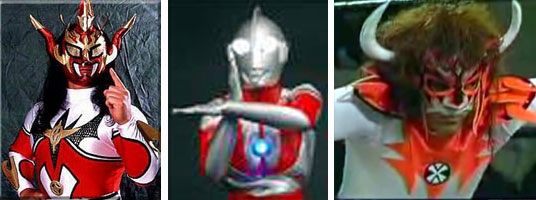
As the lucha style began gaining popularity in Japan in the late 1970's-early-80's so too did the masked wrestler. Part of this reason was because the Japanese promotions began partnering with Luttheroth's CMLL. The Japanese would send talent to Mexico to learn all about high flying moves and on occasion the Mexicans would organize a tour of Japan. This cross cultural exposure made is to that the Japanese and Mexican's began influencing the development of each form of wrestling. The martial arts characters from Japan, like the Great Sasuke planted the seeds for martial arts enmascarados like Octagon. Sasuke returned to Japan and honored the traditions of Mexico. He did not take off his mask in public and even ran for local government office and won, where he attended cabinet meetings in mask. He was not the only masked wrestler to create waves in Japan either. More famous than the Great Sasuke and possibly just as famous as Tiger Mask was Jushin "Thunder" Liger. The look of the masked wrestler in Japan began to evolve to fit their culture. Since they could not draw cultural significance from the masks or costumes of Aztec warriors they instead began taking cues from henshin and sentai, the popular superhero and science fiction characters from television. The look of Thunder Liger is somewhere in between Ultraman and a Power Ranger. Interestingly enough in Mexico the enmascarados like Psicosis also began experimenting with this new look.

However not all of the masked wrestler in Japan went out of their way to preserve their identity or maintain kayfabe (the illusion of their character). They did not go to extreme lengths to preserve the sacred title of an enmascarado because the cultural significance had no precedence. Even one of my favorite masked Japanese wrestlers of all-time, the Great Hayabusa, would remove his mask after matches so photographers could take pictures of his face. The ego had superseded the symbol in Japanese wrestling.

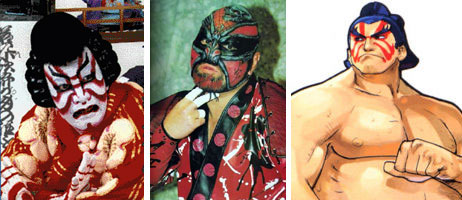
The wrestlers that wore face paint in Japan were closer to capturing the spirit of an enmascarado. They were a little closer in recreating the ideal following in Japan. Some of the most famous Japanese wrestlers, like the Great Muta, wore face paint and sometimes masks during their matches. Many wrestling fans believe that this was because Japan had a well established tradition in theater. Kabuki in particular with the dramatically painted faces of characters was an easy comparison. This translated well to Street Fighter II.

Look at how the kabuki paint was used on E. Honda. From my understanding this was to make Japanese characters more appealing to US audiences. Many sumo purists saw this as a slap in the face, as wearing makeup in the sumo ring is almost sacrilegious. However E. Honda managed to win over enough fans to become the iconic sumo in the universe. As Maskuman ended up on the cutting room floor, he was compensated in some way by a kabuki-painted sumo wrestler, a more "theatrical" traditional athlete.

To this day masked wrestlers continue to shape the evolution of fight culture and game design. Rey Mysterio Jr., another famous second-generation wrestler, is undoubtedly the template for popular enmascarado designs in most new fighting games. He does have classic lucha libre training and is considered one of the best high flyers of all-time. His look is very contemporary, as he wears pants instead of tights, sports an open mouth mask and is covered in tattoos. Traditional enmascarados would never dress or present themselves in this way but at the same time the tradition had to evolve in order to stay relevant with audiences. El Blaze from Sega's Virtua Fighter series steals many cues from Rey Mysterio Jr. but even female wrestlers in Japanese games are getting into the enmascarado tradition. Jaycee from Tekken was an attempt at changing the identity of the character previously known as Julia Chang (JC, get it?). Her makeover was a nod to the lucharesu and puro stars in the female wrestling circuit. For decades female wrestlers in Japan had been into the masked traditions as well. Just like their male counterparts many did tours in Mexico where they learned how to work at a quick pace and how to perform the aerial moves.
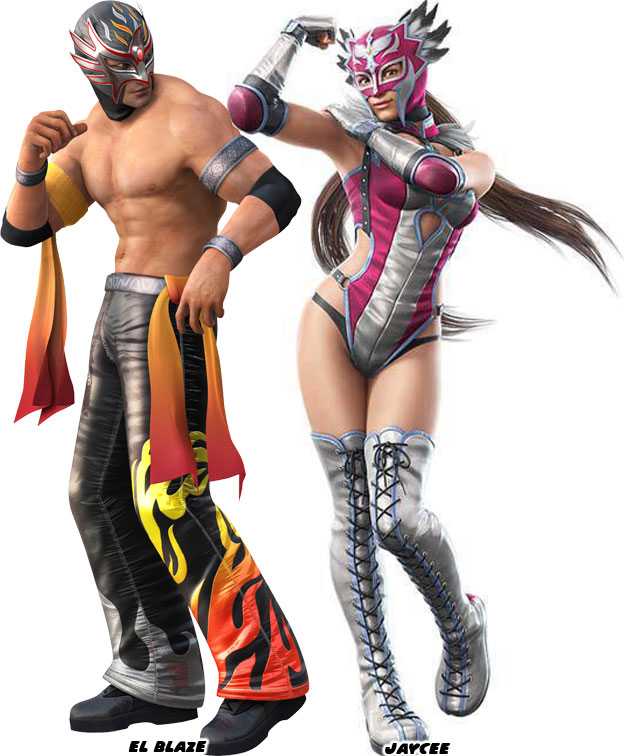


The longer the Japanese were exposed to the culture and tradition of masked wrestling the more they adapted it into their culture. Game developers were not the only ones that showed their love of masked wrestlers or pro wrestlers in general. In the next blog we will take a closer look at the man men of wrestling and how Japanese artists turned them into game characters. As always if you enjoyed this blog and would like to sponsor me please visit my Patreon page and consider donating each month, even as little as $1 would help make better blogs and even podcasts!