If you would like to sponsor me please visit my Patreon page and consider donating each month, even as little as $1 would help make better blogs and even podcasts!
Showing posts with label bruiser brody. Show all posts
Showing posts with label bruiser brody. Show all posts
Monday, August 3, 2020
The Street Writer Podcast, Episode 13
1991 was an amazing year for brawlers. SNK released some of the most unique games in the genre, and was poised to take on both Capcom and Konami thanks to their development teams.
If you would like to sponsor me please visit my Patreon page and consider donating each month, even as little as $1 would help make better blogs and even podcasts!
If you would like to sponsor me please visit my Patreon page and consider donating each month, even as little as $1 would help make better blogs and even podcasts!


Friday, April 15, 2016
The Abridged History of the Brawler, part 7
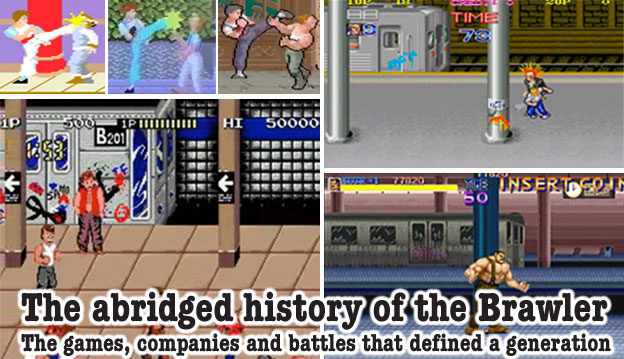
Konami came out swinging in 1991. Their first licensed title of that year was considered by many long-time Simpsons fans as the best videogame based on the animated series. I would be inclined to agree with them. Konami approached the series in the completely opposite direction than Data East did with Captain America and the Avengers. The show was just beginning to gain momentum, it was not the pop juggernaut that it became a few years later. Konami did not have to go out of their way to ensure it received any special treatment. Instead of simply licensing the series and throwing some random game together, or worse yet, ignoring the important Simpsons canon, Konami did a great deal of research and stayed completely true to the source material. They went so far as to capture the early artistic style of creator Matt Groening, whose fingerprints were all over the earliest seasons. Konami had applied a greater level of detail even than when they released the TMNT game which was impressive because at that point there was still not a tremendous amount of Simpsons animated material to draw from.
The game revolved around the kidnapping of Maggie Simpson by Mr. Burns. The Simpsons clan traversed the known Springfield universe to get her back, including a stop off at Moe's Tavern, the Springfield Discount Cemetery, Channel 6 and the Nuclear Power Plant. The game was filled with details pulled right from the show and plenty of hidden gags. Players were tempted to go near doors only to have them swing open and flatten the heroes. The same gag had been featured in Crime Fighters, also by Konami, a year before. Other gags involved not moving the joystick and watching the hidden animations and word balloons appear over the characters. To break up the monotony mini games were placed between the levels.
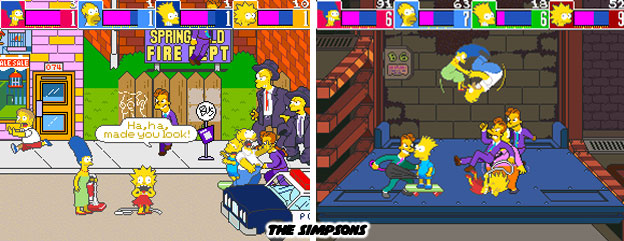
As far as brawling titles went the game had it all. Wave after wave of unique rivals, mostly goons hired by Mr. Burns, but also the rabbit characters from Groening's Bongo comics, wrestlers, robots and ninjas as well. There were also secret double-team attacks as well. If two characters stood side by side and the players did not move the controls then they would team up to do damage to opponents without getting hurt themselves. Homer could throw Bart at opponents, Marge and Homer could roll over opponents and Bart and Lisa would hold hands and run down opponents while yelling their lungs out (my personal favorite). The animation was great with plenty of nuances that followed the style of the show and didn't appear to have been designed or programmed by the Japanese.
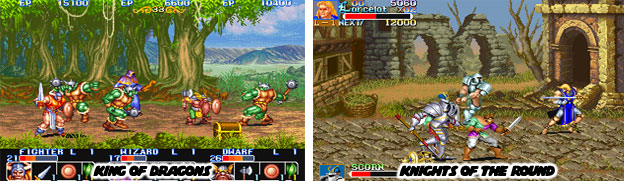
Capcom was trying a multi-tiered approach to the brawler that year. They tried out different genres and artistic styles for the brawler. Two of which were medieval titles that came out the same year. King of Dragons was a brawler with RPG elements. Players could choose from one of several classes including the traditional Elf, Wizard and Dwarf. Characters fought off waves of orc's, goblins, dragons and other fantasy monsters.
The characters had weapons that could be "upgraded" by collecting treasures and defeating opponents. This meant for stronger attacks and vitality through the course of the game. These same elements were explored in the sister title Knights of the Round. Knights of the Round was a fantasy brawler as well. Instead of five character classes there were three main characters to choose from; King Arthur, Lancelot and Percival. They, and their opponents, were based on the legendary figures. The sprites were slightly larger than those from King of Dragons and more detailed. As the characters progressed and gained levels and experience their weapons and armor reflected the changes. If a player went from beginning to the end then they would have earned the best possible version of the weapons or armor. If a player decided to join a game in progress then they would begin at level 1 weapons and armor. The game offered no shortcuts to eager cheaters.
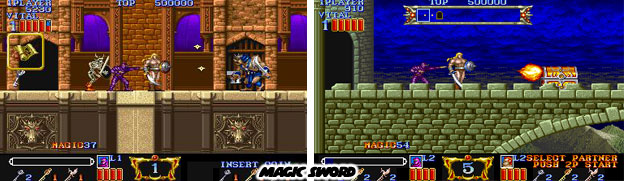
Knights of the Round and the King of Dragons were not Capcom's first attempt at sword and sorcery action games. A year prior they had released Magic Sword. It was a 2-D adventure game that had many of the same elements featured in both brawlers. Characters could earn weapon, armor and magic upgrades. They could even earn sidekicks to help with battles and those sidekicks could be upgraded as well. The three games were very fun to play and offered a unique take on the fantasy brawler. They were all far enough removed from Golden Axe as not to draw immediate comparisons yet were still as accessible. The games worked in the arcade and were able to be ported to the Super Nintendo home console quickly because they lacked the complexity or large sprites featured in the Simpsons arcade game. Capcom would see a tremendous potential in keeping their arcade efforts and home versions almost identical. In many cases they could charge people twice for playing the same game.
Both Konami and Capcom were experimenting with animation techniques and visual stylization in 1991. Both put forward games that featured original characters with cartoon elements.
Captain Commando, the game featuring the company mascot (CAPtain COMmando). The good Captain was joined by a trio of odd archetypes. The alien mummy Mack the Knife, the futuristic ninja Ginzu and the robot-piloting Baby Head.
The characters were silly and their opponents were over-the-top. The game was like a send up of the old superhero shows where a handful of heroes fought against impossible odds to save the planet. The game was fun but featured elements that were reminiscent of things explored by Konami the previous year. In one part of the game the main characters could jump into robot suits and set opponents on fire. This was similar to the robot suit that players could use against the alien queen at the end of Konami's Aliens game. Also a portion of the Captain Commando game featured the characters flying over the ocean on rocket powered hoverboards. This was not unlike the skateboard mechanic used in Konami's TMNT game.
Konami did not just meet the challenge laid out by Capcom, they exceeded it in many regards. The Simpsons was a runaway hit in the arcade, their other brawler was not as popular but it was equally fun. Sunset Riders was a brawling interpretation of the wild west. It featured four generic heroes, two of which fought with pistols and two of which fought with rifles. The four were on the search for outlaws and their bounties. The characters could walk along frontier towns, forests and trails, in some parts of the game they could even climb hand over hand on suspended rope bridges. Some of the levels featured the cast on horseback chasing down opponents. The game was filled with as many hidden animations if not more than the Simpsons. Players that happened to pass an open door could run into the room and get kissed by a girl for extra health. The characters could also interact with the environment. They could shoot ropes holding barrels down onto opponents, take hold of gatling guns and shoot up to fortifications and swing on chandeliers while shooting at bosses inside a saloon.
Sunset Riders was not the first attempt for Konami to get into the western. In 1986 they released a game called Ironhorse which played somewhere in between a brawler and Castlevania, which they also created. Ironhorse was set entirely within a stolen train and the main character had defeat wave after wave of opponents as he ran towards the engine. Ironhorse was nothing special, especially when compared to Sunset Riders. The game was a caricature of the wild west, further distilled by Japanese animé aesthetics. Despite being entirely based on gunplay the title was cartoony and lighthearted. The title was definitely not politically correct. Good guy and bad guy archetypes were brightly painted interpretations of history. The Mexican character for example, Cormano, wore a pink sombrero and poncho. Saloon girls entertained our heroes with a flirty can-can, in the opening credits the hero Billy could clearly be smoking a cigarette and the Native American boss character "Chief Scalpem" and his tribe were as stereotypical as the studio could get. Needless to say a game like this would have never been released by a US developer. Yet remember that the Japanese and most other Asian countries do not share the same cultural perceptions. Many countries on the other side of the Pacific did not have a Civil Rights Movement, they did not change policy or social customs because of the minority. What some people in the USA would consider stereotype they might consider entertainment. If anything Sunset Riders was pandering to the same crowd that grew up on westerns in the USA.
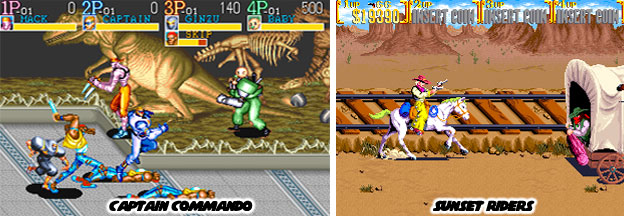
Despite its skewed take on the west the game was still highly memorable and playable. The levels were familiar versions of western locations. Characters battled scores of bandits not only on horseback but also while riding atop a train, while raiding a fort and even running on top of bulls during a stampede. The levels were an amalgamation of cool movie moments that never were just as the cast was made up of familiar faces that were brand new. The boss fights were intense but not outright cheap and the music kept a familiar guitar twang throughout. In fact there were several digitized audio files that worked well in the game, none more than the dialogue between the characters and bosses. After the very first boss, Simon Greedwell was defeated he took a tumble from the balcony of his business and said with a Southern drawl "bury me with my money." That overly dramatic line would stick with my brothers. 20 years later whenever one of us said that line we would laugh and wonder why there was never a sequel.
Most brawling games rarely saw a sequel, the few ones that came out were mostly released on consoles. Double Dragon had a couple of arcade sequels which, depending on whom you asked, were of diminishing quality. Konami did develop a sequel that was hands down better than the original title. Vendetta was a sequel to Crime Fighters, the 4-player brawler from 1989. The original game had the bad luck of being released the same year as Final Fight. Konami got buried by Capcom's urban brawler. A few years later they came back with an updated game which met, and in some ways, topped Final Fight. Now I don't want to say anything too outlandish because it appears that 99% of the arcade vets remember Final Fight but only 1% remember Vendetta. If it were great then surely it would have been enshrined in the arcade hall of fame. I certainly would not want to offend the 99% but the game definitely deserves a spot in the top 10 list of all-time brawlers.
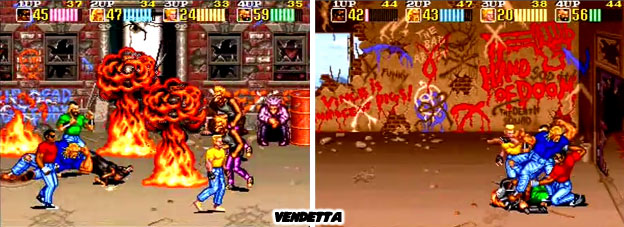
Vendetta was a trip back to the elements that made the brawler so appealing, especially to young men. To audiences it was a better version of Double Dragon with support for 4-players. Then they could dig deeper and find all sorts of advances to the genre. Players could punch, kick and combo attack opponents just as they could in other urban based brawlers. They could also grab and strike as well as throw opponents, that was nothing new. However the moves that characters had in this game were unique and greatly rewarding especially for those that played in a group. Players could sneak up behind opponents, grab them in a full nelson and let teammates punch them. Players could also strike opponents on the ground. Best of all none of the four playable characters shared the exact same move set; one kicked, one punched, one dropped a knee and one dropped elbows on the prone opponents. Up until that point most brawling games had characters that played fair and let gang members get up before they could be hit again. The bad guys fought dirty and heroes never could in other games. Vendetta was a counter to that logic. If a bad guy could pull a knife or gun on the heroes then why should they hold back? Players could smack into opponents with a running clothesline, throw molotov cocktails, pick up dropped shotguns and swing nail bats with reckless abandon.
There was nothing more satisfying than playing in a group and experiencing the mayhem that was Vendetta. Throwing opponents off of elevated platforms, hitting them with a sack of cement and watching them go blind for a moment before following up with a sucker punch. It satiated the bloodlust of the teenage mind by allowing it to fulfill the violent fantasies that were denied in other brawlers. It predated the design and chaotic atmosphere that made State of Emergency one of my favorite games of all-time. However it was a game that wast best enjoyed with a group of players, the best mechanics in the game were dependent on having other players team up on the rival gang. Arcade players rarely ran in packs, let alone played the same game at the same time. Final Fight could be enjoyed as a solo experience or with a team, that was the balance that Konami lacked here and why Vendetta was not as well remembered. The other reason why it might have been overlooked was because it was a retelling of the original Crime Fighters plot. Except instead of kidnapping several women this time it was one girl that was kidnapped. The damsel in distress was starting to become a stale plot.
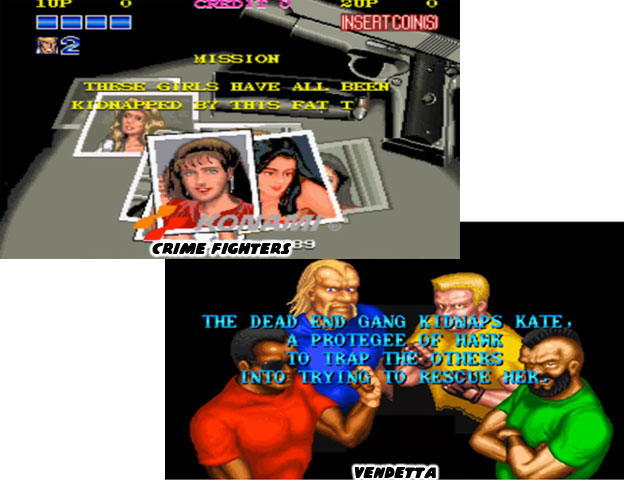
Vendetta was a spectacle, every level tried to outdo the last and even the final level consisted of taking on all of the bosses in a battle royal (just as in the original Crime Fighters). The gang characters were not quite typical with the occasional masked, chubby voodoo brawler or whip-cracking dominatrix chasing down the heroes. The game even allowed players to fight off rabid doberman pinschers (much to the chagrin of animal lovers). The bosses were typical exaggerated gang archetypes. Leather-clad tough guys and suit wearing kooks that could have fallen out of a comic book. Those bosses and even the heroes themselves were actually a Japanese interpretation of US pop culture. In the original Crime Fighters the four main characters looked identical with only the color of their pants separating the brawlers. In the sequel there were four distinct characters, members of the Cobras gang. The black ex-boxer Blood (wearing red mind you), the former pro wrestler Hawk (which looked just like Hulk Hogan), Boomer the blonde karate fighter and Sledge the ex-military convict (who looked like a white version of Mr. T.) made up the playable characters. The crew was fighting off the menace of the Dead End gang, which did sound very intimidating, and featured characters like Buzzsaw Bravado, the Rude Bros. and the leader Faust.
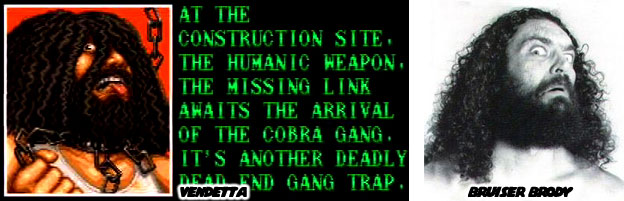
It was always interesting to see how Western pop culture or even sub-culture was assimilated into gaming design. Hard rock and heavy metal had always maintained a certain level of popularity in Japan. The characters Poison, Roxy, Axel and Sodom from Final Fight were inspired by the metal scene from the late 80's and early 90's. In Vendetta it was a bit of US wrestling culture that took the lead. Mr T and Hulk Hogan were old favorites from TV that had appeared in Japan following their pop explosion in the 80's. A lesser-known wrestler by the name of Bruiser Brody had made quite an impression on the Japanese during his various tours. A version of the character was featured in Vendetta, dubbed the Missing Link (not to be confused with another wrestler actually called the Missing Link). The videogame version was a crazed fighter not far removed from the actual wrestler and his gimmicks.
It could be argued that the brawler evolved from Japan pandering to Western markets. Kung-Fu Master and Karate Champ were groundbreaking games but in order to appeal to the US arcade market the publishers had to reflect the culture. Double Dragon succeeded because it was set in a pseudo New York. Almost every successive brawler from that point on was steeped in western culture. The Simpsons, Aliens and TMNT were popular licenses. Sunset Riders was a take off on the TV western. Even fantasy brawlers, Knights of the Round and King of Dragons were based on western rather than eastern mythology. Final Fight and Vendetta were superior versions of Double Dragon with hopefully enough western cultural references to keep gamers putting in their quarters. Both Konami and Capcom made sure that 1991 was a very good year for players. The rest of the industry would continue pushing the genre forward, releasing wave after wave of new takes on the genre. We shall explore these in the next blog. As always if you enjoyed this blog and would like to sponsor me please visit my Patreon page and consider donating each month, even as little as $1 would help make better blogs and even podcasts!
Monday, September 7, 2015
How fight culture became fighting game history, part 30
There were many manga writers and artists that had published comics on real and fictional wrestlers. These comics had a hand in inspiring many game characters also. One of the more famous artists, Tetsuo Hara, who was co-creator on Hokuto No Ken / Fist of the North Star was a huge fan of wrestling. He had used wrestlers like Abdullah the Butcher and Big Van Vader as the basis for some of his characters. His work had heavily influenced the development of Street Fighter II. In some early designs Ryu looked very much like Kenshiro from Hokuto No Ken before his design was taken to a more karate form.
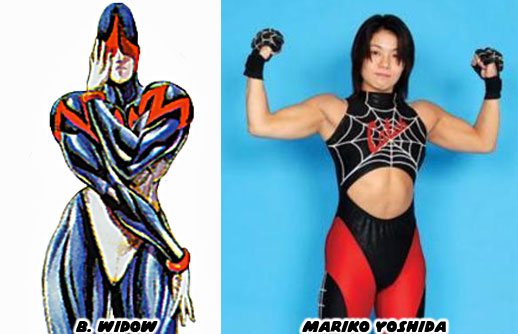
Hara stayed in contact with the developers at Capcom and when they asked the artist if he could help design the wrestlers for the Muscle Bomber / Saturday Night Slam Masters series he was happy to oblige. His intimate knowledge with wrestlers from the world over allowed him to put a unique spin on many figures. For example, the only female playable female character in the Muscle Bomber series was Black Widow. Her look and gimmick was modeled after Mariko Yoshida.
Hara was also the designer for adapting Big Van Vader into the Muscle Bomber series as Sheep the Royal aka Alexander the Grater. There were many masked wrestlers featured in his title, many from around the world. Hara helped demonstrate that great characters in fighting games came in all shapes and sizes. They did not all have to look like karate or kung-fu masters in order to be memorable. Best of all by extension the characters he created became part of the Street Fighter universe.
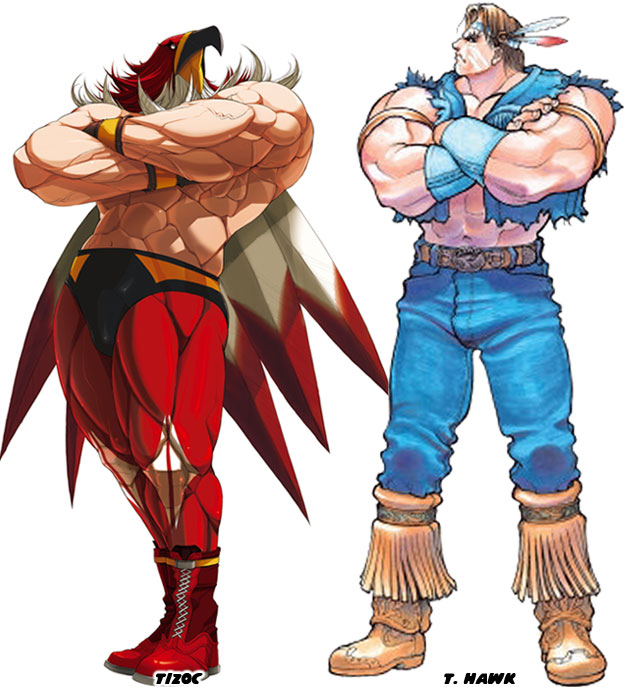
Game designers had an incredible diversity of designs for over 25 years. In early arcade and console games there could always be a masked wrestler to help break up the traditional karate and kung-fu characters that were all the rage. Many times the designers would push the idea of what a luchador could be and what fantastic moves they could contribute to the fighting game genre. Like the other characters in the title the moves that the wrestlers were given were great exaggerations of the actual fighting arts. A suplex was a dangerous throw but imagine how much greater it would look if the performer would leap and spin in the air with their opponent as they performed it. The same thought process was applied to pile drivers, power bombs and all sorts of real wrestling moves. They were made fantastic for the sake of the game. The luchadors and enmascarados that appeared in fighting games were sometimes mild adaptations, as with El Blaze or they were completely over-the-top as with King in Tekken or Tizoc in Garou Mark of the Wolves.
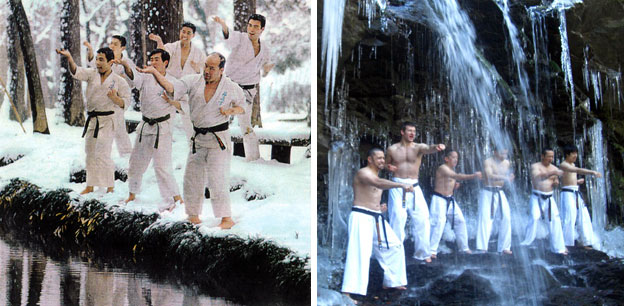
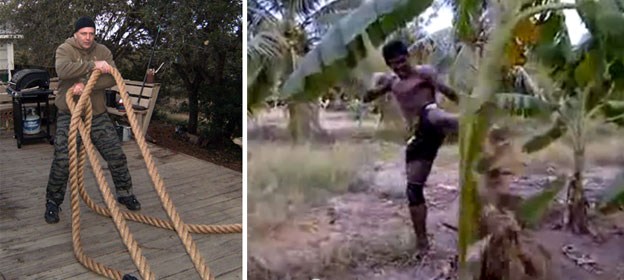
In his pursuit of perfection Oyama lived like a hermit in the mountains for years. He lived in relative isolation, free from distractions and tried to unite the body and mind through his rigorous training. His physical conditioning was brutal. Running, punching, kicking were the only things on his mind, that was when he was not trying to clear his mind through meditation. It wasn't as if he were punching a bag filled with sand either. He would punch and kick hard wood, or trees wrapped in rope and canvas. His skin became rough, his hands and feet calloused. The micro-fractures his limbs suffered by hitting hard surfaces had calcified, making his bones thicker and stronger. He could actually break rocks, stones and bottle necks with the edge of his hands. He trained day and night, in good weather as well as miserable weather. He worked out barefoot, even during the winter. He would run and train under icy waterfalls to harden his mind as well as his test his willpower. When he returned to challenge the community of martial artists he was able to drop most opponents with a single punch. The training regiment would be repeated by other karate practitioners. Many of his Kyokushin students joined Oyama on his journey as his legacy grew. Even after his death his die-hard students kept up with the practice. People would fly in from around the world with the hopes of becoming hardened like steel under the harsh conditions.
Older martial arts systems had their own training techniques which could be considered as brutal as anything that Oyama had suffered through. The Shaolin school, the ancestor of the kung-fu schools, had very strict guidelines. Practitioners ate a diet of vegetables and trained and mediated from morning until night. They too would harden their bones by punching hard wooden dummies, running up and down hills and even focus on strengthening tendons. The feats of superhuman strength and endurance shown by the masters of the fighting arts grew into legend. They truly seemed superhuman, even when compared to other fighters. Those that were strikers had gotten all of the glory. However there were men that had fought just as many opponents if not more than the fabled masters. There were men that had compiled 100, 200 or more undefeated battles in their lifetime. Because they settled the contests through the grappling arts rather than the striking arts they weren't as well remembered. It did not make them any less formidable though.
Wrestlers of the various forms applied themselves just as hard at their craft as the Japanese or Chinese fighters did. The conditioned themselves by running, sometimes with a teammate over their shoulder. They developed exercises to help them build strength in their joints, neck, back, shoulders and core. By swinging heavy weights and clubs they developed insane grip strength. They would perform rigorous calisthenics, sometimes thousands of repetitions per day to build stamina. Some of the grappling legends did not have the punches or kicks that made other fighters immortal there were still extremely dangerous. The best wrestlers could dislocate and break bones with ease. They knew how to cut, gouge, stretch and maim opponents without a weapon. Yet they also learned to temper their ability so as not to permanently disable an opponent. The same code of conduct almost chivalrous observed by other martial artists was also practiced by most world class grapplers.
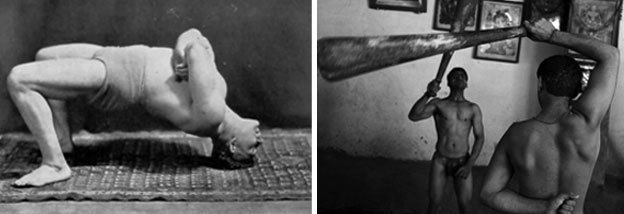
Players realized that the grapplers featured in fighting games were pulled from real world and pop culture influences. Some characters wore masks, others bizarre costumes, most wore traditional uniforms and let their abilities speak for themselves. The grappler was an appealing character because they were grounded in realism. They demonstrated that even mere mortals stood a chance against the martial arts heroes. In fighting games the grapplers did not have projectile moves. The lack of a "fireball" attack did not necessarily hold them back. The most extreme caricatures of a grappler made them iconic to gamers. Zangief, Darun Mister, Alex, Abel and Tendo Gai were just some of the wrestlers featured over the years in some fighting games.
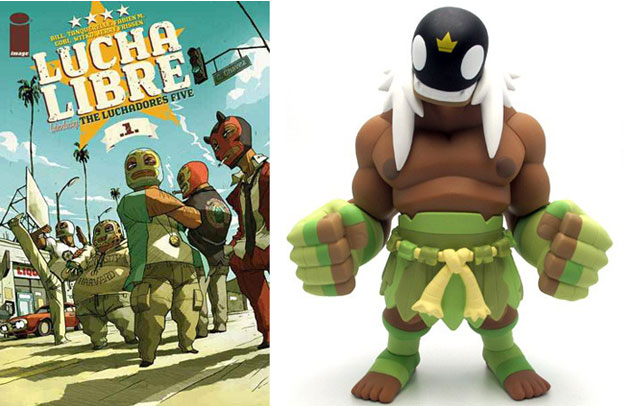
Fans of wrestling history never forgot the influence of Catch on modern wrestlers and MMA fighters. Even comic book artists had been eager to put their spin on the wrestling legacy. The French writers and artists that worked on a series called Lucha Libre highlighted the various genres featured in wrestling matches and even movies. Masked wrestlers, monsters, mad scientists, damsels in distress, cool cars and even tikis had all been featured in one way of another. The most powerful fighter in the series was called King Catch. The masked warrior lived on a tropical island and would be a run in character featured with the Tikitis. The character was designed by Fabien M. Although he never crossed over into the Luchadores Five comics the people at Muttpop hired Monster5 to create a vinyl figure that would fit with the other heroes.
The Catch icons in MMA had shown the limitations of relying on one school of grappling for all the answers. They demonstrated that for every attack there was a defense, and for every hold there was a counter-hold. Fights were fluid and had to be approached as a series constantly changing situations. The people that froze up or relied too heavily on what they had been taught without adapting found themselves on the losing end of a battle. Lee, Oyama and the other fighting masters had come to this realization early on in their careers. The best fighters of the modern era learned that no one school held all the secrets to being a great fighter. The lessons in conditioning and strength training from various disciplines could help make a person physically capable of competing but the mental toughness required was something entirely different. The reason that Oyama and his students studied under harsh conditions was to help train their minds to deal with pain, fatigue or other forces that were beyond their control. The various schools of Karate, Kung-Fu, Judo, Wrestling and Ju-jitsu had taught the world that the striking arts were to be tempered with self-discipline. Knowing how to fight was never an excuse to fight.
Modern gladiators began to pick and choose the best elements from the traditional arts and began re-writing the book on training. They took the hard training from the Asian fighting arts. Building strong bones through repeated striking. Then the new generation of fighters then began developing core and grip strength workouts using classic tools like ropes and kettlebells but with cross training applications as well. The most important thing was the sharing of knowledge between martial arts schools. Students no longer had to limit their training to one system or another. If a fighter learned muay thai strikes from one teacher they were free to go to a different teacher and learn the nuances of boxing as well. Previously there was a stigma associated to "betraying" one school to learn from another. Now many instructors encourage diversity and experimentation. No one school was perfect for every build, body type, expertise or age. Exploration into the various systems meant that competing schools had to become more diversified. This would allow a person to cater to their strengths and build on their weaknesses. The end result were fighters that were well-rounded and would have made the early MMA pioneers proud.
Despite the difficult cross training that the best fighters endured there always seemed to be the one fighter that was better than them. Maybe it was a classmate, a former friend or a bitter rival but there always seemed to be a superior fighter waiting in the wings. Perhaps the opponent got lucky or maybe they had indeed developed a better fighting system. Whatever the case was the loss often changed the path for a legend in the making. The next blog will look at the evolution of MMA in Eurasia as well as the myth of the elderly masters. As always if you enjoyed this blog and would like to sponsor me please visit my Patreon page and consider donating each month, even as little as $1 would help make better blogs and even podcasts!
Hara stayed in contact with the developers at Capcom and when they asked the artist if he could help design the wrestlers for the Muscle Bomber / Saturday Night Slam Masters series he was happy to oblige. His intimate knowledge with wrestlers from the world over allowed him to put a unique spin on many figures. For example, the only female playable female character in the Muscle Bomber series was Black Widow. Her look and gimmick was modeled after Mariko Yoshida.
Hara was also the designer for adapting Big Van Vader into the Muscle Bomber series as Sheep the Royal aka Alexander the Grater. There were many masked wrestlers featured in his title, many from around the world. Hara helped demonstrate that great characters in fighting games came in all shapes and sizes. They did not all have to look like karate or kung-fu masters in order to be memorable. Best of all by extension the characters he created became part of the Street Fighter universe.
Game designers had an incredible diversity of designs for over 25 years. In early arcade and console games there could always be a masked wrestler to help break up the traditional karate and kung-fu characters that were all the rage. Many times the designers would push the idea of what a luchador could be and what fantastic moves they could contribute to the fighting game genre. Like the other characters in the title the moves that the wrestlers were given were great exaggerations of the actual fighting arts. A suplex was a dangerous throw but imagine how much greater it would look if the performer would leap and spin in the air with their opponent as they performed it. The same thought process was applied to pile drivers, power bombs and all sorts of real wrestling moves. They were made fantastic for the sake of the game. The luchadors and enmascarados that appeared in fighting games were sometimes mild adaptations, as with El Blaze or they were completely over-the-top as with King in Tekken or Tizoc in Garou Mark of the Wolves.
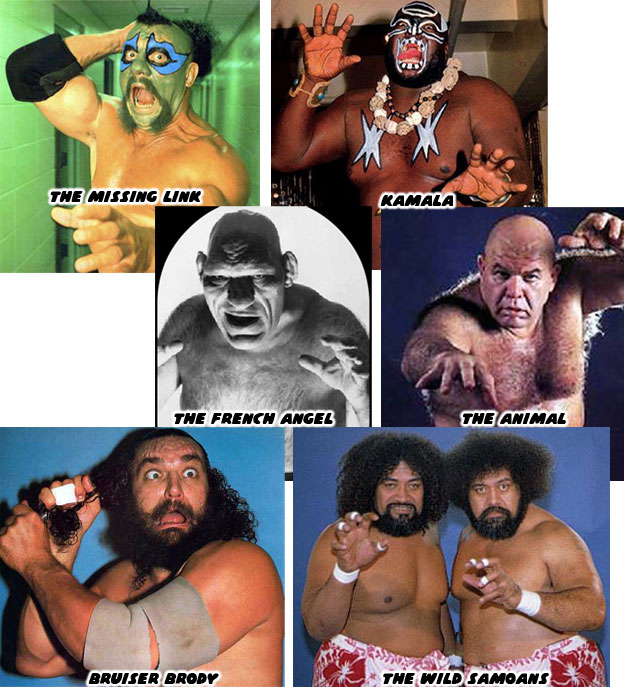
Pro Wrestling did not need masked wrestlers in order to create mysterious personas. Some of the most most popular characters often came "From Parts Unknown." It could be seen as lazy writing from bookers or inspired creativity by the performers themselves. By leaving the country of origin unknown the audience was allowed to imagine what far off island, or lost civilization these fighters came from. In many instances having a strange physical appearance was enough to keep the illusion alive. Some wrestlers were tall, gangly, obese, muscular or outright grotesque. George "The Animal" Steele was a heavy set and hairy man that would paint his tongue green. This plus his erratic mannerisms was enough to scare audiences into thinking that he was some sort of Neanderthal in wrestling trunks. Maurice Tillet aka the French Angel was an even earlier version of the monster man. Maurice suffered from Acromegaly which caused his hands and head to expand through most of his life. His features were proportioned for somebody much larger, making him look gruesome even against other less-than-handsome wrestlers. Some wrestlers used a little face paint or body paint in order to enhance their appearance. Dewey Roberts was a mid-card wrestler until he discovered his gimmick, a crazy haircut and some face paint, then he was elevated to stardom. He was known as the Missing Link and would brutalize his opponents by using headbutts over and over. The large Southerner James Harris was nicknamed the Ugandan Headhunter Kamala. Sometimes teamed with the Missing Link and formed Devistation Inc.
The origins of these gimmicks went back to the earliest days of wrestling in North America. Back when many performers worked the Sideshow in the circus. Sometimes the wrestlers were legitimate fighters and sometimes these fighters needed a gimmick to get them over with audiences. Sadly some of these gimmicks could actually be linked to racial biases and ignorance on foreign cultures. Previously on the blog I had mentioned how ignorance about the Indian fighting forms led to Chinese filmmakers exploiting Yoga as a fighting art. This in turn influenced the creation of characters like Dhalsim and the Great Tiger. Through the history of wrestling the islanders from the South Pacific were often presented as savages and wild men. In the early days of televised wrestling audiences in smaller markets genuinely believed that these men, and sometimes women, with large heads of hair were indeed Headhunters.
A savvy promoter might help develop a gimmick and convince audiences that their new talent was indeed from some sort of far off land. The wrestlers sometimes did not have to speak to the camera, and the gimmick worked better when they didn't, so that they could be presented as uncultured savages. The designers working on Street Fighter II had used wrestlers as a point of reference for several characters. One of those that ended up on the cutting room floor was an amalgamation of several "wild" wrestlers. The Uganda Warrior had a physical build similar to Afa and Sika, the Wild Samoans, as well as Jimmy "Superfly" Snooka but with the body paint of Kamala.
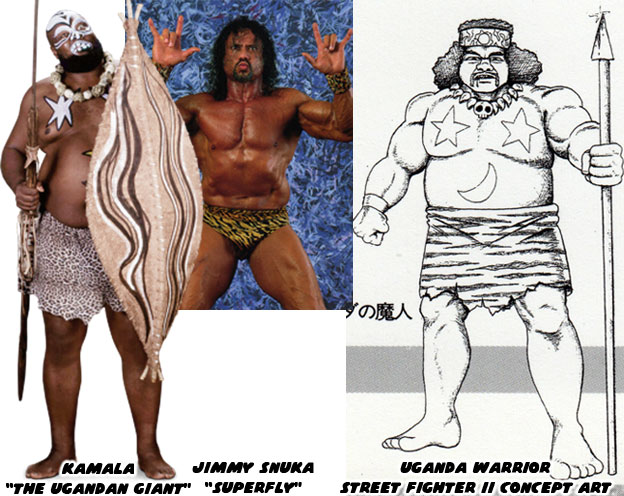
The savage wrestlers had a big presence in the ring. When promotions went from local television to the mainstream bookers knew to hire wrestlers that looked great on television. Those that had bodybuilder physiques and handsome faces were easier to book than the chubby ones that had actual fighting ability. Masked wrestlers were always great mystery opponents that would boost the ratings. Something that also worked great on television were the gimmick wrestlers that worked the wild man angle. These characterizations translated very well to fighting games. These savage figures were less like traditional wrestlers and more like animals when they fought. They sometimes scratched and bit opponents when the ref wasn't watching, they often celebrated when they were able to draw blood. The line between man and monster would be blurred depending on the performer, or in the case of gaming, depending on the designer.
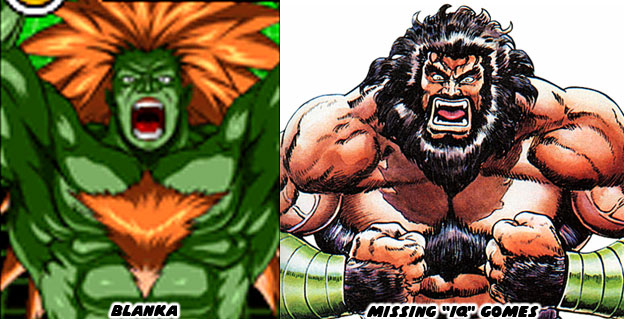
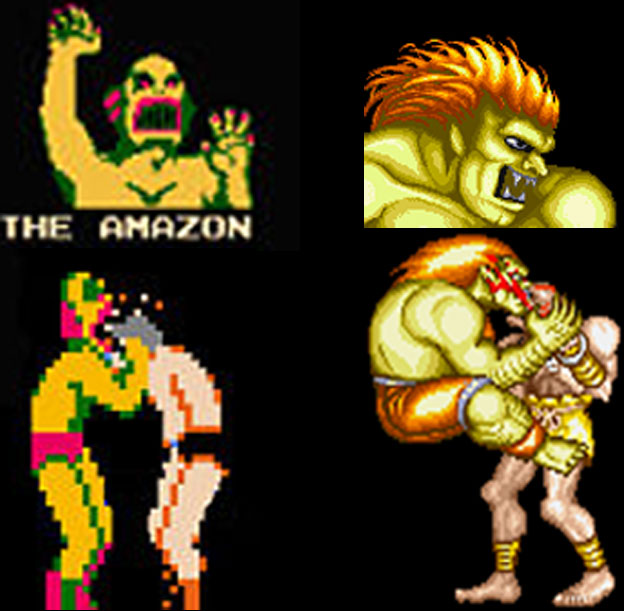
Take the character Blanka from the Street Fighter series and Missing IQ Gomes from the Muscle Bomber series. Both were featured in a Capcom title and both fell within the canon of Street Fighter. The figures were both extremely muscular, very hairy and had features that were almost ape-like.The major difference between the two was skin deep. Blanka was colored green with bright orange hair whereas Gomes had a more natural skin color. The senior designers working on Street Fighter II wanted to see how far they could push the wild man concept and still keep the attention of gamers. Blanka was rooted mainly on an earlier character called The Amazon that was featured in Nintendo's Pro Wrestling game. Artist Akira "Akiman" Yasuda wanted to make players feel powerless as Blanka would bite the face of his opponents as the Amazon did to him on the old Nintendo console.
Capcom could go way out with the look and Blanka would still work within the context of the series. Blanka had long extended ears, sharp teeth, claws (which were simply long nails) and shackles as if he were an escaped animal. He was a good counter-point to the character Dhalsim. Both featured very odd fighting styles and represented mysterious origins. They added a sense of wonder and fantasy to an otherwise traditional cast of boxers, kung-fu and karate experts.
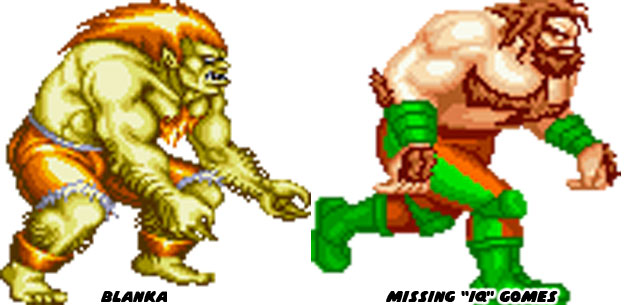
By comparison Gomes had many of the same features yet could have existed in an actual promotion. Like George Steele he was a very strong hairy man that acted irrationally in the ring. The wild outbursts performed by Gomes was something that a wrestler like Frank "Bruiser Brody" Goodish excelled at in real life. Tetsuo Hara tried to keep the majority grounded in reality. He had such tremendous respect for the art of pro wrestling that he didn't want to push the envelope as far as the Street Fighter II team had done. The gimmicks Hara exploited were strong for most of the wrestlers and even the more "exotic" characters could have existed in some promotion. The roots of Blanka's design were not as harmless as those used by Hara.
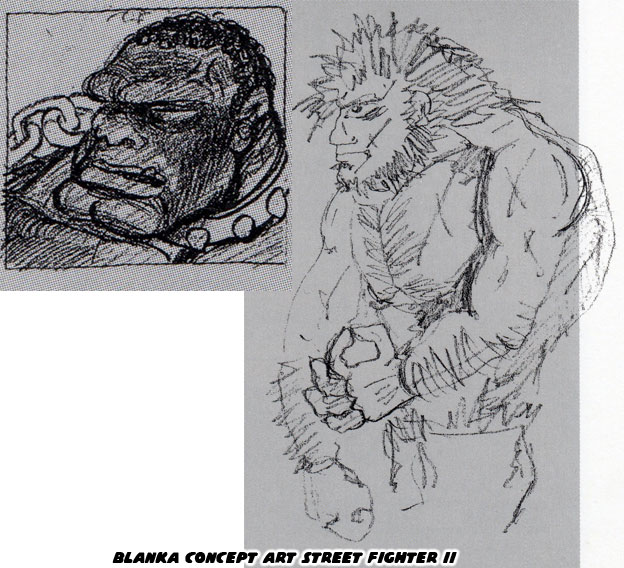
In the earliest concept art Blanka was a savage black man that was in chains. Tight curly hair, big lips and distorted proportions made him appear more ape than man. Somebody at Capcom had enough sense to change the design. The character known as Anabebe could have been a potential disaster, especially in the black community. Arcade games depend on making their audiences happy and keeping them happy. Street Fighter II would have offended many players overseas if figures like "Great Tiger" and Anabebe had not been rethought.
There was still an unmistakable draw to the wild man as a fighter. Many great characters in literary and movie history were based on the idea of a man becoming more like a monster. Think about the classic characters Dr. Jeckyl and Mr. Hyde, Frankenstein's monster, the Mummy, Dracula, and the Wolf Man. They were the inspirations for some of the longest-running movie characters. Universal Studios would revisit those characters time and time again. Modern retellings of these characters could be seen through comic book icons like The Incredible Hulk, Bane and Gorilla Grodd. The influence of these monsters with human traits was universally appealing. A version of the monster-as-a-man was in every culture and storytelling tradition. Capcom had even experimented with the genre by putting the iconic movie monsters in a fighting game known as Vampire / Darkstalkers. Yet for the Street Fighter franchise they wondered how far they could push the wild man, or savage man concept without losing the audience. Blanka had done very well for the series but the developers were looking to recast the game in Street Fighter III. The stretchy-limbed lab experiment named Necro was a variation of Dhalsim. The Chinese twins Yun and Yang were younger takes on Ken and Ryu.
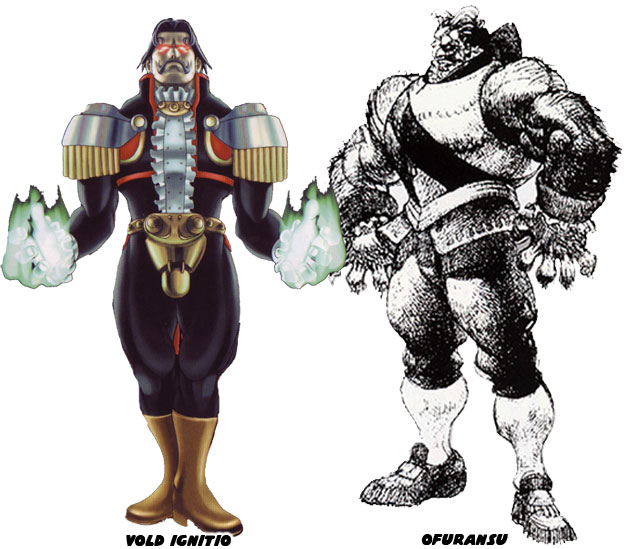
The Blanka-type character for the game never made it past the planning stages. Ofuransu was described as being "a noble field beast." He was an aristocrat that had the features of a wolf man. This combination of royalty and hulking brute was very unique. It was not the only time that Street Fighter designers had kicked around the idea. Half of the team that worked on Street Fighter II left Capcom to form ARIKA. They created a game called Fighting Layer. It incorporated many ideas from Street Fighter II, including ideas left on the cutting room floor. The main villain of the game was an aristocrat named Vold Ignitio. He was more vampire than werewolf in the game, his regal costume beguiled his savage attacks. He would slash at opponents with his long fingernails and even pounce on opponents and bite at their necks.
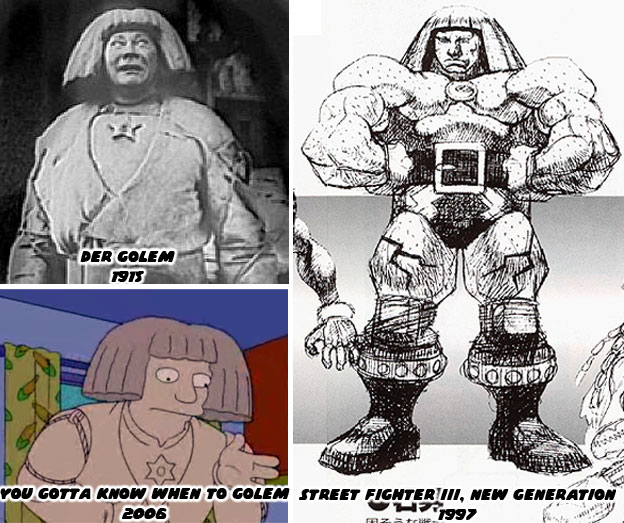
Wild men, monsters, savages and demons were on the extreme edge of designs that worked for the fighting game genre. The team working on Street Fighter III had even kicked around the idea of having a man made of stone, instead of the MMA fighter Alex, or the giant Hugo be the "strong" character in the title. The Golem was actually based on a character featured in what was considered the earliest horror film ever made, an experimental German film from 1915 titled Der Golem. The Golem was a man made of clay from Jewish myth. A person seeking revenge against a great adversary could bring the monster to life by using magic. He would write the name of the person he wanted to kill on a piece of paper and feed it to the Golem. The Golem would then go out and hunt his victim, never tiring, impervious to harm and never stopping until his mission was accomplished. This character was considered the basis for Frankenstein's monster. The character was obscure compared to the more famous movie monsters. That didn't stop the designers at Capcom from putting him on the table or even from the writers on the Simpsons from using him in a Halloween special.
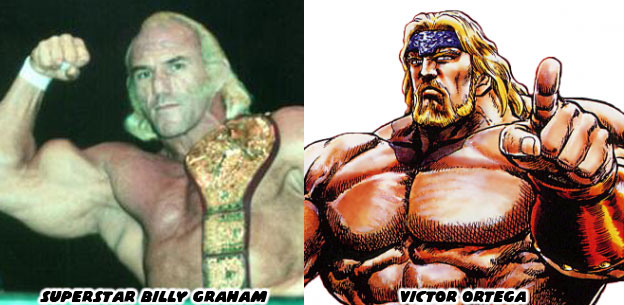
The designers at Capcom came to their senses and scaled back their character choices. They found a good balance between new fighting forms and returning characters as the Street Fighter III series took off. Wrestlers would remain popular choices while casting other fighting games. Artists like Tetsuo Hara would find success in adapting real wrestlers into the Muscle Bomber games. The champion of the universe was a semi-retired fighter by the name of Victor Ortega. The character was modeled after "Superstar" Billy Graham, one of the most colorful wrestlers from the '70s and '80s. Graham was a great in-ring worker and had an amazing bodybuilder physique. His look and gimmick would be copied for generations by Jessie "the Body" Ventura, Hulk Hogan and Scott Steiner. Ortega was one of the most muscular characters ever featured in a Capcom fighting game, easily beating the massive frames of Zangief and Darun Mister.
Despite its long and colorful history pro wrestlers, masked or not, were thought of as the bottom tier of the fight circuit. Television and motion pictures had convinced audiences that the best fighters stood on their feet and traded punches and kicks with each other until one person fell. Wrestlers did not really throw punches and kicks therefor they were not "real" fighters. The reality of combat was completely different. Most street fights and even professional fights ended up on the ground. It would be anticlimactic in most fighting games to have the final boss simply tackle the player and break their arm, even if that was what would work best in the real world. It was rare when a fight stayed upright but allegedly not for the best fighters. People like Bruce Lee and Mas Oyama were said to have ended fights quickly, before they could be taken down. When Oyama would have an open challenge sparring match he would often dispatch opponents with a single punch, usually to the torso instead of the head. Even with that said both men knew the importance of being well rounded fighters. They studied the grappling arts and knew how to stay on their feet even when people were desperate to take them down. Judo, jujitsu and wrestling were forms that they had learned a tremendous amount from. This made them much more formidable than any one style could have ever taught them. Achieving that level of expertise was not easy for the fighters.
The origins of these gimmicks went back to the earliest days of wrestling in North America. Back when many performers worked the Sideshow in the circus. Sometimes the wrestlers were legitimate fighters and sometimes these fighters needed a gimmick to get them over with audiences. Sadly some of these gimmicks could actually be linked to racial biases and ignorance on foreign cultures. Previously on the blog I had mentioned how ignorance about the Indian fighting forms led to Chinese filmmakers exploiting Yoga as a fighting art. This in turn influenced the creation of characters like Dhalsim and the Great Tiger. Through the history of wrestling the islanders from the South Pacific were often presented as savages and wild men. In the early days of televised wrestling audiences in smaller markets genuinely believed that these men, and sometimes women, with large heads of hair were indeed Headhunters.
A savvy promoter might help develop a gimmick and convince audiences that their new talent was indeed from some sort of far off land. The wrestlers sometimes did not have to speak to the camera, and the gimmick worked better when they didn't, so that they could be presented as uncultured savages. The designers working on Street Fighter II had used wrestlers as a point of reference for several characters. One of those that ended up on the cutting room floor was an amalgamation of several "wild" wrestlers. The Uganda Warrior had a physical build similar to Afa and Sika, the Wild Samoans, as well as Jimmy "Superfly" Snooka but with the body paint of Kamala.
The savage wrestlers had a big presence in the ring. When promotions went from local television to the mainstream bookers knew to hire wrestlers that looked great on television. Those that had bodybuilder physiques and handsome faces were easier to book than the chubby ones that had actual fighting ability. Masked wrestlers were always great mystery opponents that would boost the ratings. Something that also worked great on television were the gimmick wrestlers that worked the wild man angle. These characterizations translated very well to fighting games. These savage figures were less like traditional wrestlers and more like animals when they fought. They sometimes scratched and bit opponents when the ref wasn't watching, they often celebrated when they were able to draw blood. The line between man and monster would be blurred depending on the performer, or in the case of gaming, depending on the designer.
Take the character Blanka from the Street Fighter series and Missing IQ Gomes from the Muscle Bomber series. Both were featured in a Capcom title and both fell within the canon of Street Fighter. The figures were both extremely muscular, very hairy and had features that were almost ape-like.The major difference between the two was skin deep. Blanka was colored green with bright orange hair whereas Gomes had a more natural skin color. The senior designers working on Street Fighter II wanted to see how far they could push the wild man concept and still keep the attention of gamers. Blanka was rooted mainly on an earlier character called The Amazon that was featured in Nintendo's Pro Wrestling game. Artist Akira "Akiman" Yasuda wanted to make players feel powerless as Blanka would bite the face of his opponents as the Amazon did to him on the old Nintendo console.
Capcom could go way out with the look and Blanka would still work within the context of the series. Blanka had long extended ears, sharp teeth, claws (which were simply long nails) and shackles as if he were an escaped animal. He was a good counter-point to the character Dhalsim. Both featured very odd fighting styles and represented mysterious origins. They added a sense of wonder and fantasy to an otherwise traditional cast of boxers, kung-fu and karate experts.
By comparison Gomes had many of the same features yet could have existed in an actual promotion. Like George Steele he was a very strong hairy man that acted irrationally in the ring. The wild outbursts performed by Gomes was something that a wrestler like Frank "Bruiser Brody" Goodish excelled at in real life. Tetsuo Hara tried to keep the majority grounded in reality. He had such tremendous respect for the art of pro wrestling that he didn't want to push the envelope as far as the Street Fighter II team had done. The gimmicks Hara exploited were strong for most of the wrestlers and even the more "exotic" characters could have existed in some promotion. The roots of Blanka's design were not as harmless as those used by Hara.
In the earliest concept art Blanka was a savage black man that was in chains. Tight curly hair, big lips and distorted proportions made him appear more ape than man. Somebody at Capcom had enough sense to change the design. The character known as Anabebe could have been a potential disaster, especially in the black community. Arcade games depend on making their audiences happy and keeping them happy. Street Fighter II would have offended many players overseas if figures like "Great Tiger" and Anabebe had not been rethought.
There was still an unmistakable draw to the wild man as a fighter. Many great characters in literary and movie history were based on the idea of a man becoming more like a monster. Think about the classic characters Dr. Jeckyl and Mr. Hyde, Frankenstein's monster, the Mummy, Dracula, and the Wolf Man. They were the inspirations for some of the longest-running movie characters. Universal Studios would revisit those characters time and time again. Modern retellings of these characters could be seen through comic book icons like The Incredible Hulk, Bane and Gorilla Grodd. The influence of these monsters with human traits was universally appealing. A version of the monster-as-a-man was in every culture and storytelling tradition. Capcom had even experimented with the genre by putting the iconic movie monsters in a fighting game known as Vampire / Darkstalkers. Yet for the Street Fighter franchise they wondered how far they could push the wild man, or savage man concept without losing the audience. Blanka had done very well for the series but the developers were looking to recast the game in Street Fighter III. The stretchy-limbed lab experiment named Necro was a variation of Dhalsim. The Chinese twins Yun and Yang were younger takes on Ken and Ryu.
The Blanka-type character for the game never made it past the planning stages. Ofuransu was described as being "a noble field beast." He was an aristocrat that had the features of a wolf man. This combination of royalty and hulking brute was very unique. It was not the only time that Street Fighter designers had kicked around the idea. Half of the team that worked on Street Fighter II left Capcom to form ARIKA. They created a game called Fighting Layer. It incorporated many ideas from Street Fighter II, including ideas left on the cutting room floor. The main villain of the game was an aristocrat named Vold Ignitio. He was more vampire than werewolf in the game, his regal costume beguiled his savage attacks. He would slash at opponents with his long fingernails and even pounce on opponents and bite at their necks.
Wild men, monsters, savages and demons were on the extreme edge of designs that worked for the fighting game genre. The team working on Street Fighter III had even kicked around the idea of having a man made of stone, instead of the MMA fighter Alex, or the giant Hugo be the "strong" character in the title. The Golem was actually based on a character featured in what was considered the earliest horror film ever made, an experimental German film from 1915 titled Der Golem. The Golem was a man made of clay from Jewish myth. A person seeking revenge against a great adversary could bring the monster to life by using magic. He would write the name of the person he wanted to kill on a piece of paper and feed it to the Golem. The Golem would then go out and hunt his victim, never tiring, impervious to harm and never stopping until his mission was accomplished. This character was considered the basis for Frankenstein's monster. The character was obscure compared to the more famous movie monsters. That didn't stop the designers at Capcom from putting him on the table or even from the writers on the Simpsons from using him in a Halloween special.
The designers at Capcom came to their senses and scaled back their character choices. They found a good balance between new fighting forms and returning characters as the Street Fighter III series took off. Wrestlers would remain popular choices while casting other fighting games. Artists like Tetsuo Hara would find success in adapting real wrestlers into the Muscle Bomber games. The champion of the universe was a semi-retired fighter by the name of Victor Ortega. The character was modeled after "Superstar" Billy Graham, one of the most colorful wrestlers from the '70s and '80s. Graham was a great in-ring worker and had an amazing bodybuilder physique. His look and gimmick would be copied for generations by Jessie "the Body" Ventura, Hulk Hogan and Scott Steiner. Ortega was one of the most muscular characters ever featured in a Capcom fighting game, easily beating the massive frames of Zangief and Darun Mister.
Despite its long and colorful history pro wrestlers, masked or not, were thought of as the bottom tier of the fight circuit. Television and motion pictures had convinced audiences that the best fighters stood on their feet and traded punches and kicks with each other until one person fell. Wrestlers did not really throw punches and kicks therefor they were not "real" fighters. The reality of combat was completely different. Most street fights and even professional fights ended up on the ground. It would be anticlimactic in most fighting games to have the final boss simply tackle the player and break their arm, even if that was what would work best in the real world. It was rare when a fight stayed upright but allegedly not for the best fighters. People like Bruce Lee and Mas Oyama were said to have ended fights quickly, before they could be taken down. When Oyama would have an open challenge sparring match he would often dispatch opponents with a single punch, usually to the torso instead of the head. Even with that said both men knew the importance of being well rounded fighters. They studied the grappling arts and knew how to stay on their feet even when people were desperate to take them down. Judo, jujitsu and wrestling were forms that they had learned a tremendous amount from. This made them much more formidable than any one style could have ever taught them. Achieving that level of expertise was not easy for the fighters.
In his pursuit of perfection Oyama lived like a hermit in the mountains for years. He lived in relative isolation, free from distractions and tried to unite the body and mind through his rigorous training. His physical conditioning was brutal. Running, punching, kicking were the only things on his mind, that was when he was not trying to clear his mind through meditation. It wasn't as if he were punching a bag filled with sand either. He would punch and kick hard wood, or trees wrapped in rope and canvas. His skin became rough, his hands and feet calloused. The micro-fractures his limbs suffered by hitting hard surfaces had calcified, making his bones thicker and stronger. He could actually break rocks, stones and bottle necks with the edge of his hands. He trained day and night, in good weather as well as miserable weather. He worked out barefoot, even during the winter. He would run and train under icy waterfalls to harden his mind as well as his test his willpower. When he returned to challenge the community of martial artists he was able to drop most opponents with a single punch. The training regiment would be repeated by other karate practitioners. Many of his Kyokushin students joined Oyama on his journey as his legacy grew. Even after his death his die-hard students kept up with the practice. People would fly in from around the world with the hopes of becoming hardened like steel under the harsh conditions.
Older martial arts systems had their own training techniques which could be considered as brutal as anything that Oyama had suffered through. The Shaolin school, the ancestor of the kung-fu schools, had very strict guidelines. Practitioners ate a diet of vegetables and trained and mediated from morning until night. They too would harden their bones by punching hard wooden dummies, running up and down hills and even focus on strengthening tendons. The feats of superhuman strength and endurance shown by the masters of the fighting arts grew into legend. They truly seemed superhuman, even when compared to other fighters. Those that were strikers had gotten all of the glory. However there were men that had fought just as many opponents if not more than the fabled masters. There were men that had compiled 100, 200 or more undefeated battles in their lifetime. Because they settled the contests through the grappling arts rather than the striking arts they weren't as well remembered. It did not make them any less formidable though.
Wrestlers of the various forms applied themselves just as hard at their craft as the Japanese or Chinese fighters did. The conditioned themselves by running, sometimes with a teammate over their shoulder. They developed exercises to help them build strength in their joints, neck, back, shoulders and core. By swinging heavy weights and clubs they developed insane grip strength. They would perform rigorous calisthenics, sometimes thousands of repetitions per day to build stamina. Some of the grappling legends did not have the punches or kicks that made other fighters immortal there were still extremely dangerous. The best wrestlers could dislocate and break bones with ease. They knew how to cut, gouge, stretch and maim opponents without a weapon. Yet they also learned to temper their ability so as not to permanently disable an opponent. The same code of conduct almost chivalrous observed by other martial artists was also practiced by most world class grapplers.
Players realized that the grapplers featured in fighting games were pulled from real world and pop culture influences. Some characters wore masks, others bizarre costumes, most wore traditional uniforms and let their abilities speak for themselves. The grappler was an appealing character because they were grounded in realism. They demonstrated that even mere mortals stood a chance against the martial arts heroes. In fighting games the grapplers did not have projectile moves. The lack of a "fireball" attack did not necessarily hold them back. The most extreme caricatures of a grappler made them iconic to gamers. Zangief, Darun Mister, Alex, Abel and Tendo Gai were just some of the wrestlers featured over the years in some fighting games.
Fans of wrestling history never forgot the influence of Catch on modern wrestlers and MMA fighters. Even comic book artists had been eager to put their spin on the wrestling legacy. The French writers and artists that worked on a series called Lucha Libre highlighted the various genres featured in wrestling matches and even movies. Masked wrestlers, monsters, mad scientists, damsels in distress, cool cars and even tikis had all been featured in one way of another. The most powerful fighter in the series was called King Catch. The masked warrior lived on a tropical island and would be a run in character featured with the Tikitis. The character was designed by Fabien M. Although he never crossed over into the Luchadores Five comics the people at Muttpop hired Monster5 to create a vinyl figure that would fit with the other heroes.
The Catch icons in MMA had shown the limitations of relying on one school of grappling for all the answers. They demonstrated that for every attack there was a defense, and for every hold there was a counter-hold. Fights were fluid and had to be approached as a series constantly changing situations. The people that froze up or relied too heavily on what they had been taught without adapting found themselves on the losing end of a battle. Lee, Oyama and the other fighting masters had come to this realization early on in their careers. The best fighters of the modern era learned that no one school held all the secrets to being a great fighter. The lessons in conditioning and strength training from various disciplines could help make a person physically capable of competing but the mental toughness required was something entirely different. The reason that Oyama and his students studied under harsh conditions was to help train their minds to deal with pain, fatigue or other forces that were beyond their control. The various schools of Karate, Kung-Fu, Judo, Wrestling and Ju-jitsu had taught the world that the striking arts were to be tempered with self-discipline. Knowing how to fight was never an excuse to fight.
Modern gladiators began to pick and choose the best elements from the traditional arts and began re-writing the book on training. They took the hard training from the Asian fighting arts. Building strong bones through repeated striking. Then the new generation of fighters then began developing core and grip strength workouts using classic tools like ropes and kettlebells but with cross training applications as well. The most important thing was the sharing of knowledge between martial arts schools. Students no longer had to limit their training to one system or another. If a fighter learned muay thai strikes from one teacher they were free to go to a different teacher and learn the nuances of boxing as well. Previously there was a stigma associated to "betraying" one school to learn from another. Now many instructors encourage diversity and experimentation. No one school was perfect for every build, body type, expertise or age. Exploration into the various systems meant that competing schools had to become more diversified. This would allow a person to cater to their strengths and build on their weaknesses. The end result were fighters that were well-rounded and would have made the early MMA pioneers proud.
Despite the difficult cross training that the best fighters endured there always seemed to be the one fighter that was better than them. Maybe it was a classmate, a former friend or a bitter rival but there always seemed to be a superior fighter waiting in the wings. Perhaps the opponent got lucky or maybe they had indeed developed a better fighting system. Whatever the case was the loss often changed the path for a legend in the making. The next blog will look at the evolution of MMA in Eurasia as well as the myth of the elderly masters. As always if you enjoyed this blog and would like to sponsor me please visit my Patreon page and consider donating each month, even as little as $1 would help make better blogs and even podcasts!
Subscribe to:
Posts (Atom)