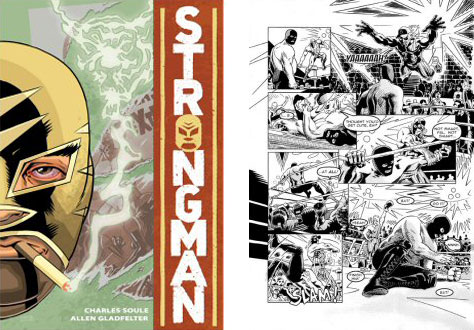
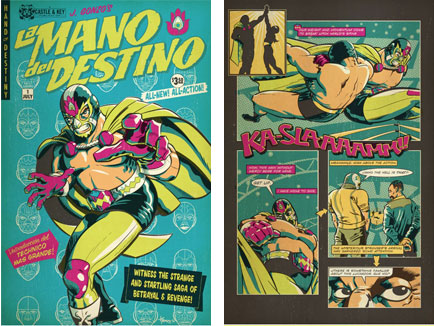
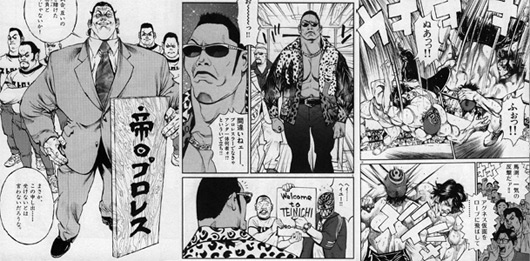
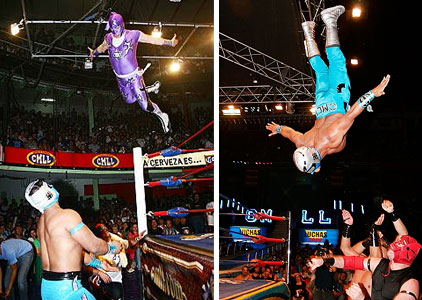
Many people do not realize that there are many different types of pro wrestling. They usually understand that the matches are pre-determined, which leads many to call the sport "fake" but the athleticism of the performers and the origins of their moves are anything but fake. The pro wrestling seen in the US has many variations, from traditional to bloody and violent "hardcore." Those are slightly different than the high-flying lucha libre matches seen in Mexico. In Japan the style of wrestling they perform is a little stiffer, as in the hits they perform are a little harder and they go through more "finishing moves" than either the US or Mexico. They even have a unique name for their format of pro wrestling called
puroresu or puro for short. Japanese puro has been heavily influenced by both the USA and Mexico formats. Japan's love of lucha libre even resulted in the creation of
lucharesu, a combination of lucha libre and puroresu. What makes the sport unique is how different cultures interpret it and make it their own. For the past century the Americas, North, Central and South have been the catalyst for a unique variation of grappling and fighting. One with more theatrics, more pageantry and more high-risk maneuvers than any other form of ritualized combat in the world.
The most obvious distinction of lucha libre to every other form of "pro wrestling" in the Americas are the masked characters and high-flying acrobatics. To many in the US they view these "gymnastics" with disdain, saying that pro wrestling has a history connected to trapping and grappling of
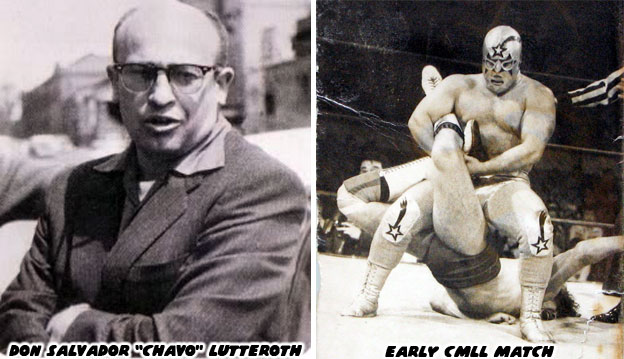
catch wrestling, freestyle wrestling and of course classic Greco-Roman wrestling. The National Wrestling Alliance (NWA) from North America could claim to trace its championship back to the first Heavyweight World Championship of Catch-as-catch-can from 1905 won by George Hackenschmidt. Of course the actual NWA organization was founded in 1948 to give the North American territories a "World Champion." The type of wrestling performed in Mexico is seen as too acrobatic or choreographed to be taken seriously. Lucha libre as we know it is actually the oldest form of pro wrestling in the Americas. The original promotion that started it all, the Consejo Mundial de Lucha Libre (CMLL, which was actually the EMLL previously) was established in Mexico in 1933 and survives to this day. It is the longest running promotion in world history. By comparison the WWE could trace its history back to 1952. Also, just so you know not every luchador wears a mask. A masked wrestler is called an enmascarado, these are the creme of the crop when compared to regular luchadores.
Salvador Lutteroth is the man credited to bringing wrestling to Mexico. He saw some matches in El Paso and noticed how a masked performer worked well with the crowd. He thought this secret identity would be very important to fans. They could imagine themselves as the person behind the mask and get lost in the show. They would also believe all sorts of origin stories, such as a wrestler covered his face to keep women from fainting at the sight of his grotesquely disfigured face. Or perhaps this character was a hero, like the Lone Ranger, or Bass Reeves, and hid his identity to protect his family and friends from evil doers. Salvador knew that masked characters would go over well in Mexico and needless to say he was right! I would suggest you watch a short but very well put-together
lucha libre podcast from the George Eastman (as in Eastman Kodak) house explaining some of the history and charm of these masked characters. Lucha libre certainly has a long and established tradition that has been highlighted for several generations in gaming.
The closest thing that I could compare the enmascarados in the USA to would be superheroes. The elaborate masks, tights (and sometimes capes), are all part of their costume. Their secret identity is as important to them and their fans as it is to the fictional characters in comic books. A true enmascarado never, ever goes out in public without his mask and protects his identity to the best of his ability. He never does anything to bring shame to his name or his mask. An enmascarado does not go into the lifestyle casually but with all his heart and conviction. If the wrestler is lucky enough to have kids then his son or daughter might take up the family business and even carry the mask through the next generation. Believe it or not the true enmascarados in Mexico never leave the house without their masks,
even when they are out with their friends and family. To the public it's all part of tradition and they do not think twice about seeing a masked man.
The reason for what we would consider "odd social behavior" is actually seeped in tradition. These men are seen as daring fighters, mythical warriors. The physical
ability to perform all sorts of crazy moves is part of the spectacle but the bond between the audience and the luchador goes deeper than performance fighting. The good guys are called "Technicos" they fight by particular guidelines and always have to uphold the rules of clean combat. The bad guys are called "Rudos" and are free to use every dirty trick in the book. The matches they engage in are very much a live battle between good and evil.
Audiences are drawn to these morality plays like moths to a flame. With the good guys and bad guys so clearly defined it becomes hard not to choose a side. Kids
will their heroes to overcome the obstacles and win the fight even when faced against insurmountable odds. Remember the appeal of the wrestler Rikidozan had in Japan? He knew that by wrestling against the foreign invaders, aka the USA, he would win over fans. Each match of Rikidozan's was a chance to prove to the fans that the Japanese were the best. Now imagine that Mexico was the home of a dozen characters as important to history as Rikidozan. Many of these men were fighting for the very souls of the audience.
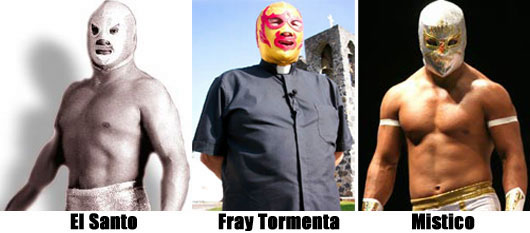
El Santo "the Saint" was the biggest wrestling superstar of all-time. He was one of the few enmascarados to be buried with his mask on, never losing it in a match. He created an iconic character that still resonates with many Mexicans and Mexican-Americans today. His nickname was el enmascarado de plata (the silver masked man), his mask and silver outfit became a trademark and currently his son keeps the tradition alive.
A huge reason why enmascarados go over so well in Mexico, as opposed to in the USA or Japan, is because of cultural relevance. Mexico is predominantly Catholic but with lingering traditions, folklore and myth from the natives. The battles between good an evil are an every day occurrence for those with strong superstitions. These people pray each and every day to do the right things and not go astray. They pray that they have the courage to fight against evil and even if they lack courage to make sure that God sends a holy warrior to guide them. The warriors that perform in these battles have a second layer of context that is unique to Mexico.
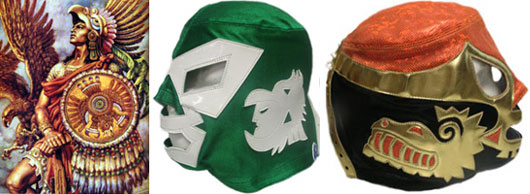
Enmascarados harken back to the pre-columbian world. The masks themselves are inspired by actual warriors. The
Aztec warriors went into battle with brightly colored uniforms and headdresses so that generals could watch their exploits in battle. These were known as Caballeros Aguilas (eagle riders) and are symbolic of the fiercest warriors of ancient society. The design of the caballero aguila can be seen on the mask of the villainous Dr. Wagner Jr and Canek "El Princepe Maya" (the Mayan Prince).
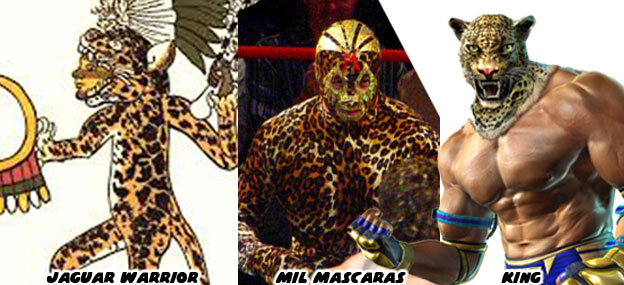
One of the most famous and successful of all the Mexican wrestlers is Mil Mascaras (a thousand masks). He has a mask and costume in the jaguar pattern, similar to what the ancient warriors would wear in battle. His animal print designs helped inspire the character of King in the Tekken series. The tradition of masked fighters outside of the wrestling ring is still seen to this day.
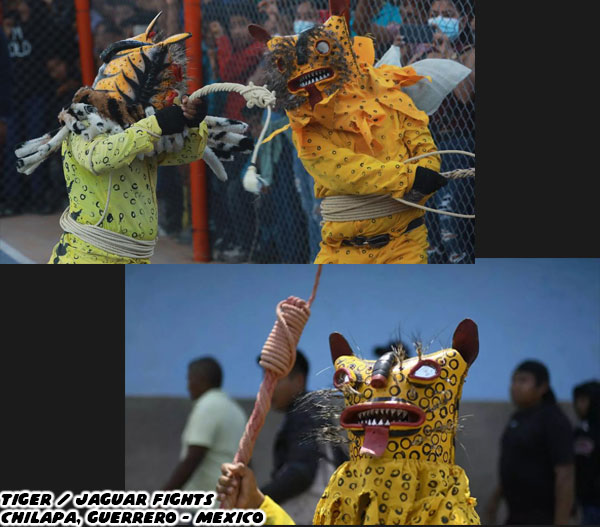
One of the longest running traditions happens every year in the city of Chilapa, in the state of Guerrero Mexico. The state is south of Mexico City, and known for the beach city Acapulco. The town of Chilapa is a farming community, and in order to ensure a good harvest they hold a festival in honor of Tlaloc, the ancient Aztec rain god.
Villagers from Chilapa wear costumes that mimick the jaguars, and tigers of Caballero Aguila fame. They have a parade, and dance in costume. Men, and women then square off in fights where they beat each other with clubs made of rope. Their tiger masks act more like helmets, absorbing terrible blows from the fights. The better the fight, the more rain they can expect to ensure a good harvest. Many people have been severely injured, and a few have died from the battles. When it came to masked combat there was no country on Earth that took it more seriously than Mexico. Here is an
excerpt from the Sun interview with enmascarado El Hijo Del Santo explaining the origin and importance of the mask.
"The Sun: Can you describe the importance and history of the mask to Mexican wrestlers?
El Hijo Del Santo: I believe that when lucha libre started, it all began with a wrestler that came from the American circuit. He [the masked wrestler] got a lot of attention from the Mexican crowds and as Mexican wrestling is a war of good v evil, the masks have an importance with the roots of our culture, like the Aztecs, Olmecs and Teotihuacans. They always wore masks of animals when at war, the most significant were the jaguar, wolf, the eagle, snake, as they believed they would get the animal’s powers in combat. I think lucha libre adopted this belief and the luchador looks for a name that suits his personality from say nature, animals, the heaven like El Santo or hell like Demon. Many years ago, my father Santo took the mask off Black Shadow in a match with wagers, that day the importance of the mask took a new dimension, to lose a mask became very important and an opportunity for promoters in Mexico to present something new that doesn’t happen in the USA."
While
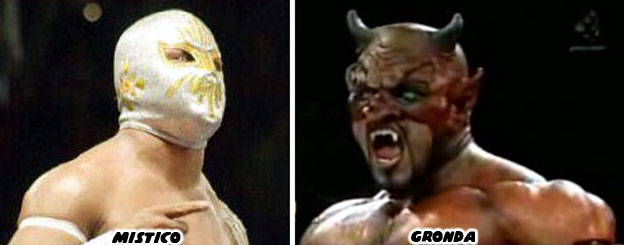
Fray Tormenta (Father storm) is not the true heir to the Santo legacy, he is a bit of a literal "spiritual" successor. Fray as you might know was the basis of the movie Nacho Libre. He was an actual priest that wrestled to raise money for his parish and the local orphans. The movie isn't nearly as interesting as the true story, and if you ask me quite an insult to the legacy. Fray wore a mask of gold with red lightning trim. Something of a balance to El Santo's silver. A couple of generations later a new high-flying enmascarado showed up on the scene, the new chosen one was not Rey Mysterio Jr. as many believed, he was
Mistico and he was "ordained" by Fray Tormenta. His mask was an equal mix of gold and silver, his title "the Prince of the Silver and Gold mask" was a way bringing the iconography of both legends together. He took on all challengers including the men who wore masks of skulls and demons, people like Averno, Ephesto, Mephisto, but not the Devil-masked Gronda because he was in a different federation.
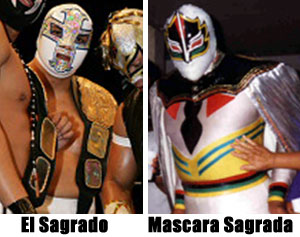
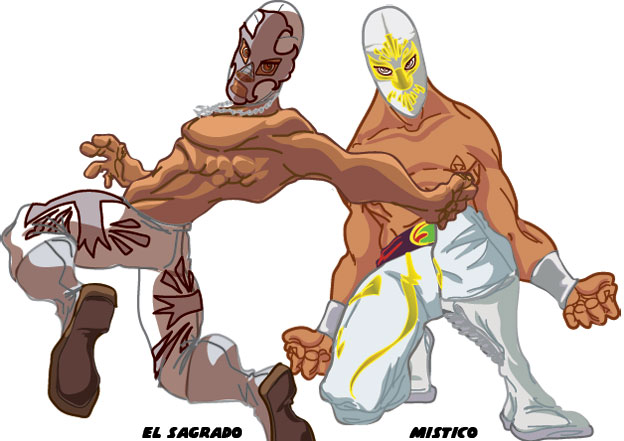
If lucha libre represents the eternal fight between good and evil then fans would want to see the absolute best representing the path of righteousness. Wrestlers like El Santo, Mistico and El Sagrado were famous because of their ties with the Catholic faith. They were very popular in the highly religious small towns of Mexico and even more so in the secular big cities. I cannot overemphasize the importance of the faith that these masked men stood for. They weren't simply "technicos" but absolutely represented the best qualities in humanity. Some, like El Santo, Fray Tormenta and
Mistico had a lot of spirituality behind their look and name. The use of halos, crosses and even the Eucharist were not considered gimmicks but symbols of their practicing faith. They represented the ideal qualities of man and acted as living symbols of faith. El Sagrado (the sacred one) and Mascara Sagrada (the sacred mask) were other wrestlers that purported a spiritual path. Their roles were to be great performers and never succumb to the dirty tactics of the rudos. El Sagrado was supposed to be the modern "chosen one" but he did not seem ready for the limelight so he was held back until fans warmed up to him. Mistico was an instant hit with audiences so the torch was passed to him instead.
If you know your Street Fighter history then you remember that a masked wrestler was on the drawing board while SF II was in development. They had at least two separate looks for this "Maskuman" (Mask Man) early on. One that looked very much like the legendary
Tiger Mask. There was no doubt that Tiger Mask was a character that many of the developers had grown up with. He was unique among his wrestling peers because
started off as a bad guy and became a good guy. Tiger Mask proved a popular character in manga and even had
his own anime series.
Japanese culture provided a lot of the SF II character influences, Ryu looked more like Kenshiro from
Hokuto No Ken than
Mas Oyama in the early Street Fighter II concept art as well. It was easy to imagine that the designers wanted an over-the-top masked wrester in the game that had as much personality as any of the characters or bosses in the SF II. Read the
InsertCredit.com Making of Street Fighter II feature to see some more concept art.
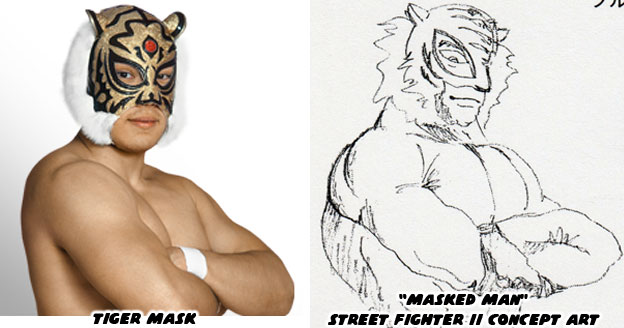
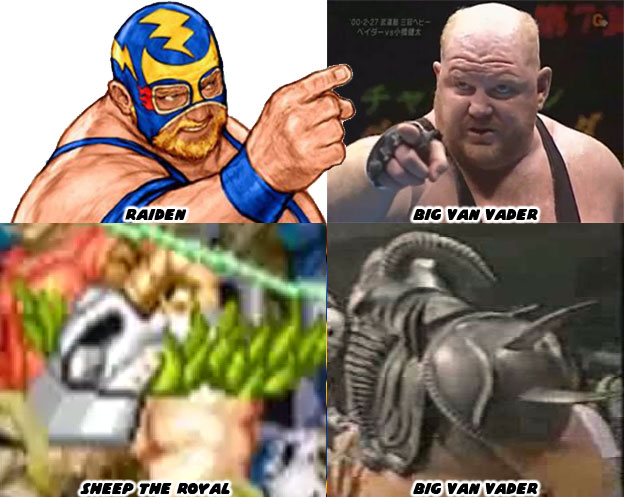
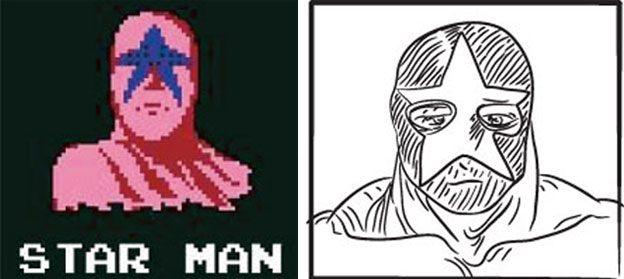
Here is where Japan's wrestling influence, and especially the masked wrestler variety differ from the enmascarado; Japan does not have the cultural relevance of masked characters. Certainly the do respect the legends, especially people like the Destroyer who was the great Western heel a generation before Big Van Vader. At the same time it would be very odd to see a masked person walking around the streets in Japan, unless it was a surgical mask to prevent the spread of colds. They do not have the same cultural significance as the luchadores have in Mexico. They do not have the same religion, myths and folklore that support the symbolism and tradition of elaborate masks. To them a mask is just a mask and it is the wrestler that defines the character. During the development of Street Fighter II Capcom was just drawing masked characters from pop culture without really understanding their origins.In another take on the character he had an enormous star placed over his face, it was not unlike the same mask worn by Star Mask in Tecmo Pro Wrestling for the NES. Because Capcom could not come to a consensus as to what type of masked wrestler they wanted in the game Maskuman never made it past the planning stages.
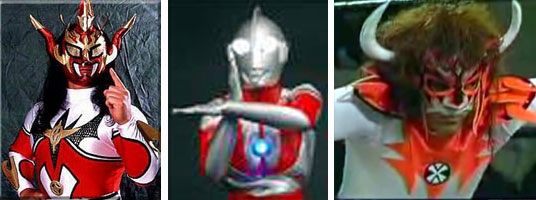
As the lucha style began gaining popularity in Japan in the late 1970's-early-80's so too did the masked wrestler. Part of this reason was because the Japanese promotions began partnering with Luttheroth's CMLL. The Japanese would send talent to Mexico to learn all about high flying moves and on occasion the Mexicans would organize a tour of Japan. This cross cultural exposure made is to that the Japanese and Mexican's began influencing the development of each form of wrestling. The martial arts characters from Japan, like the Great Sasuke planted the seeds for martial arts enmascarados like Octagon. Sasuke returned to Japan and honored the traditions of Mexico. He did not take off his mask in public and even ran for local government office and won, where he attended cabinet meetings in mask. He was not the only masked wrestler to create waves in Japan either. More famous than the Great Sasuke and possibly just as famous as Tiger Mask was
Jushin "Thunder" Liger. The look of the masked wrestler in Japan began to evolve to fit their culture. Since they could not draw cultural significance from the masks or costumes of Aztec warriors they instead began taking cues from
henshin and
sentai, the popular superhero and science fiction characters from television. The look of Thunder Liger is somewhere in between Ultraman and a Power Ranger. Interestingly enough in Mexico the enmascarados like Psicosis also began experimenting with this new look.
However not all of the masked wrestler in Japan went out of their way to preserve their identity or maintain
kayfabe (the illusion of their character). They did not go to extreme lengths to preserve the sacred title of an enmascarado because the cultural significance had no precedence. Even one of my favorite masked Japanese wrestlers of all-time, the Great Hayabusa, would remove his mask after matches so photographers could take pictures of his face. The ego had superseded the symbol in Japanese wrestling.
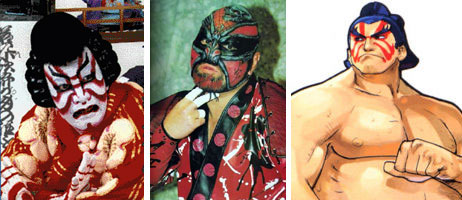
The wrestlers that wore face paint in Japan were closer to capturing the spirit of an enmascarado. They were a little closer in recreating the ideal following in Japan. Some of the most famous Japanese wrestlers, like the
Great Muta, wore face paint and sometimes masks during their matches. Many wrestling fans believe that this was because Japan had a well established tradition in theater.
Kabuki in particular with the dramatically painted faces of characters was an easy comparison. This translated well to Street Fighter II.
Look at how the kabuki paint was used on E. Honda. From my understanding this was to make Japanese characters more appealing to US audiences. Many sumo purists saw this as a slap in the face, as wearing makeup in the sumo ring is almost sacrilegious. However E. Honda managed to win over enough fans to become the iconic sumo in the universe. As Maskuman ended up on the cutting room floor, he was compensated in some way by a kabuki-painted sumo wrestler, a more "theatrical" traditional athlete.
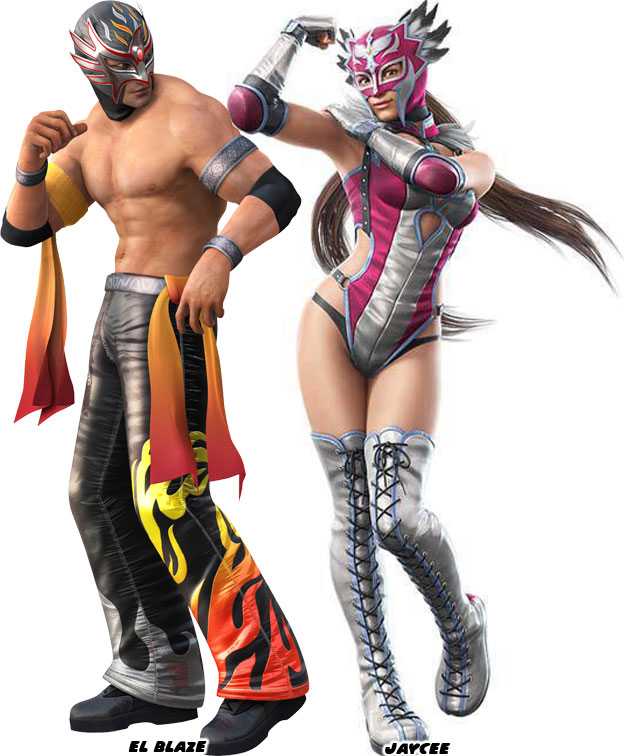
To this day masked wrestlers continue to shape the evolution of fight culture and game design. Rey Mysterio Jr., another famous second-generation wrestler, is undoubtedly the template for popular enmascarado designs in most new fighting games. He does have classic lucha libre training and is considered one of the best high flyers of all-time. His look is very contemporary, as he wears pants instead of tights, sports an open mouth mask and is covered in tattoos. Traditional enmascarados would never dress or present themselves in this way but at the same time the tradition had to evolve in order to stay relevant with audiences. El Blaze from Sega's Virtua Fighter series steals many cues from Rey Mysterio Jr. but even female wrestlers in Japanese games are getting into the enmascarado tradition. Jaycee from Tekken was an attempt at changing the identity of the character previously known as Julia Chang (JC, get it?). Her makeover was a nod to the lucharesu and puro stars in the female wrestling circuit. For decades female wrestlers in Japan had been into the masked traditions as well. Just like their male counterparts many did tours in Mexico where they learned how to work at a quick pace and how to perform the aerial moves.
The longer the Japanese were exposed to the culture and tradition of masked wrestling the more they adapted it into their culture. Game developers were not the only ones that showed their love of masked wrestlers or pro wrestlers in general. In the next blog we will take a closer look at the man men of wrestling and how Japanese artists turned them into game characters. As always if you enjoyed this blog and would like to sponsor me
please visit my Patreon page and consider donating each month, even as little as $1 would help make better blogs and even podcasts!