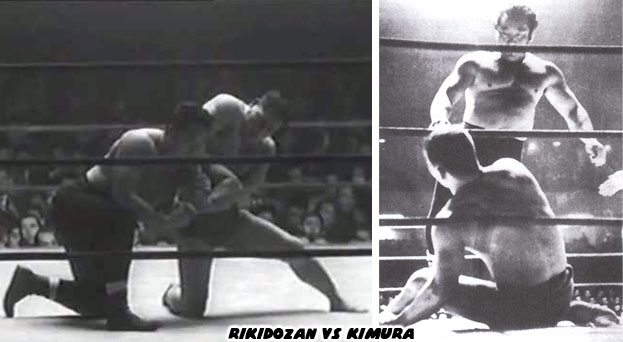
After Helio Gracie lost to Masahiko Kimura the Brazilian Ju-Jitsu scene exploded in popularity. The Gracie family would open schools and spread their technique all over South, Central and North America. Tragedy seemed to follow Kimura by comparison. Kimura had done some pro wrestling to help make ends meet as judo instructor did not pay as well. It was said that the only reason he became a pro wrestler was to make enough money to help pay for his wife's tuberculosis medication. He had partnered with another pro wrestler named Rikidozan before and after the fight with Helio. The two decided to start a feud to raise their profile and generate ticket sales. In case you don't know much about "pro" wrestling, many of the big names often start a feud and go town to town generating buzz through highly publicized matches. These matches are often pre-determined and no wrestler ever seems to get the upper hand. Many times the matches end at a draw or disqualification. When the audiences can take no more, usually after a few months, a world champion match is set where both of the performers get a big payout. Unfortunately in the first match Rikidozan decided to fight Kimura for real and put himself "over" as the better athlete. He delivered a neck chop with full force to
knock Kimura out in December 1954.
The loss was a few months after Kimura had defeated Helio. This win made Rikidozan an even larger-than-life figure than he already was. The Yakuza was incensed at the betrayal, chances were they were taking part of the gate and expected a big return on an ongoing feud. They called Kimura to let him know they would kill his opponent. Years later they made good on their promise by stabbing Rikidozan in a club. He died a few weeks later from an infection.
The life of Rikidozan was actually a unique case of martial arts storytelling. The man was born Mitsuhiro Momota, a Korean-Japanese that tried to hide his heritage. Koreans were and continue to be looked down upon socially by the Japanese. It was interesting that Mas Oyama and Rikidozan were seen like fighting gods to many of the same people that considered Koreans inferior people. But I digress! Mitsuhiro wanted to be a sumo wrestler and faired decently in many matches. But the social stigma was getting to him and he needed to find another source of income. Mitsuhiro had an impressive physique and was destined to find greatness in pro wrestling. He was a bit of a "stiff" worker, that was he was green and didn't always pull his punches. What he lacked in in-ring ability he made up for with a strong gimmick. During the '50s pro wrestling was as hot in Japan as it had ever been in the USA. Rikidozan would often partner up with another Japanese wrestler to fight against the US talent. Back in the wrestling heyday the matches would have several rounds, like a boxing match. For two rounds the US performers would "work" over the Japanese wrestlers. They would sometimes use illegal moves and cheat and somehow never get caught by the referee. This made the audiences have a great sense of despair during the matches. The US were occupiers after all and following the events of World War II nobody wanted to see the Westerners beat up any more Japanese.
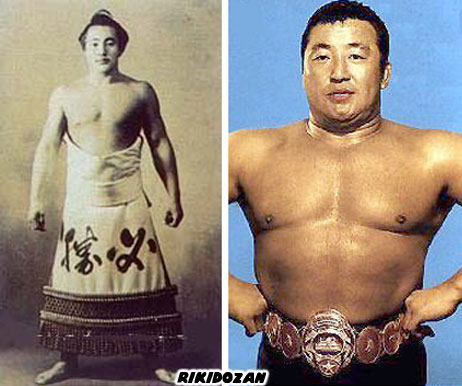
Just as everything seemed at a loss Rikidozan would turn up in the third round and absolutely crush the Americans with broad "Mongolian" chops and big kicks. The audiences exploded as they watched Rikidozan seemingly rise from the ashes like the fabled Phoenix and destroy his opponents. It was very cathartic for the fans, no matter how far down the Japanese had been beaten they would find a way back. A similar experience could be said to have happened to the audiences that watched the first Godzilla movie. The monster of atomic warfare had a name and a face and the Japanese would withstand his worse time and time again. But again I digress. When Rikidozan traveled to the US the gimmick was reversed and he was the heel or bad guy. He would dominate and cheat when he could but always lose in the end. Rikidozan was as big a star as any wrestler could be in Japan. He was like Hulk Hogan, Steve Austin and Ric Flair all rolled into one. He was also a very hard living man. He drank and partied like there was no tomorrow and became very full of himself. Through the '50s his battles and style became the template for Japanese pro wrestling or "puroresu," sometimes written as "puro" for short. By the end of the decade he assumed that he could begin calling the shots. His streak ended in the early '60s when the Yakuza had tired of his antics. Japanese game developers grew up with the legend of Rikidozan and all of the wrestlers that followed in his footsteps. Many of the big stars in the US worked in Japan where they developed very strong gimmicks. Those with the biggest personalities often found themselves being repurposed as fighting game characters.
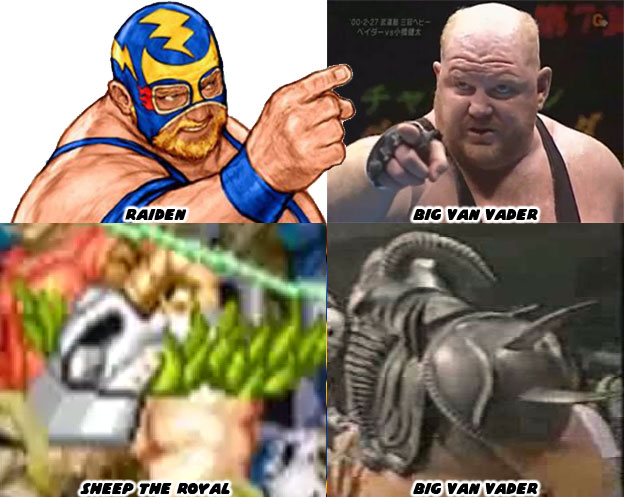
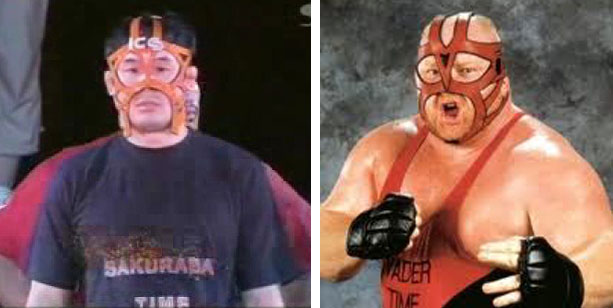
One such personality was Leon "Big Van Vader" White. His large frame, extreme physicality and in-ring presence gave kids nightmares and delighted adults. He had a mask and shoulder pads fashioned that made him look like a live action "henshin" villain. It would even blow smoke as he made his entrance. He was such an inspiring figure that several characters were molded after him in the early days of fighting games. SNK created Raiden and Big Bear (Raiden without the mask) for the Fatal Fury and King of Fighters series. Capcom developed Sheep the Royal aka Alexander the Grater after Vader in the Muscle Bomber / Saturday Night Slam Masters series.
I will spend much more time talking about the influence of pro wrestlers in fighting games a little later on. Right now lets gets back to seeing how mixed martial arts developed in the new world.
The next few decades would see a lot of interesting, controversial and lethal consequences for being in the fight game, this was not limited in Japan either! The Gracie family pretty much had a target painted on their back after the Kimura battle. The sons and grandchildren of Helio and his brothers were pretty much guaranteed to be enrolled in the school of hard knocks from the get go. They would have to defend the family name and school wherever they went. When doing clinics they would get called out to prove the superiority of their style. On the street, in the gym, on the beach and in any other public venue the family would get called out. Such was the case for
Rickson Gracie, the son of Helio, when he had to deal with Hugo Duarte for slandering the family name. Even in the professional ring it was a tough going. Fighters from every background would test their mettle against the Gracie clan again and again.
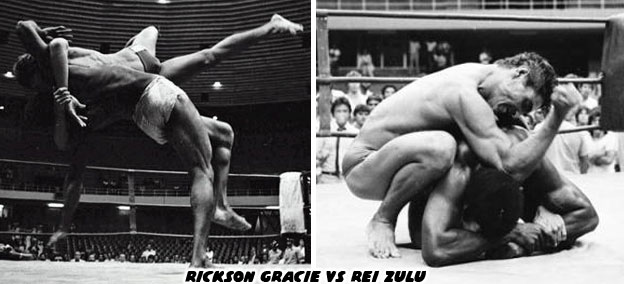
One such character was an underground legend that went by Rei Zulu. Literally the "Zulu King." The big man, about 6' 4" and had earned a reputation on the street for being a natural born fighter. He was tough, wily and adapted well to his opponents. He had compiled an undefeated streak in some of the toughest parts of Brazil. He had a record of allegedly of 150-0 when he challenged Rickson Gracie to prove who was the best "Vale Tudo" fighter. In Brazil the fighters were called luttadores, or wrestlers. Luta Livre was their version of pro wrestling and a pretty rough version at that. They had a more violent form of fighting as well called Vale Tudo or anything goes. Knees, elbows, just about anything was allowed short of eye gouges. Instead of closed fists most of the fighters had to use open hand slaps or palm strikes to subdue opponents. That rule was not always observed however.
Anyhow in 1980 Rei Zulu was served with his first ever defeat. It seemed that everyone in Brazil witnessed the fight or knew someone that was there in person. Rickson and the name of Gracie had become even bigger. For some Zulu was a hero from the streets that could never be defeated in a fair fight. For others he was like the neighborhood bully and used his strength and natural ability to push people around. Unfortunately for him natural ability did not prepare him for the techniques that the Gracie family had been refining for over two generations. Zulu called out Rickson a few years later.
The rematch in 1984 drew an even bigger crowd. Zulu lost again. Unlike the manga comics that were made on the life of Oyama there would be no caricatures made of Rickson or Zulu. It would be a shame too. Both men had such different upbringings that they had deserved the same treatment of the Japanese superstars.
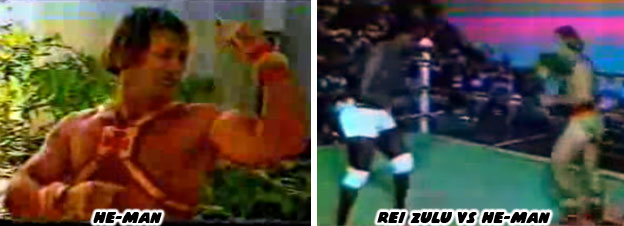
Not everyone would or could become a hero like Helio Gracie even in defeat. It was the sad reality of fighters that lost and Rei Zulu was no exception. The man was born, raised and lived in poverty for most of his life. The Gracie family cleverly marketed their name, built their schools, legacies and successes. The family would end up very well off while Zulu would be relegated to the outskirts. The people Rei faced seemed to be as big characters and underground legends. This included the blonde
wrestler from Paraguay named He-Man. Lenine "He-Man" Alves Batista pulled his look and gimmick from the Mattel toy and cartoon character. He was beloved by all audiences because he extolled the virtues of clean living, represented wrestlers from America and could prove they were the best fighters. The fight between Zulu and He-Man was a high point in many young South American kids eyes. It was like Hulk Hogan fighting and beating Andre the Giant at Wrestlemania.
Sadly He-Man would hold onto the gimmick well past his prime. The long haired barbarian with a bit more paunch still plied his craft in Brazil until 2010. He worked for a circus and would take on all challengers, in a way it was a nod to the wrestlers of old. For the right money capoiera fighters, karate fighters, vale tudo fighters and even random people could step into the ring to challenge him. He
fought 30 men at once in one encounter, in another
he fought a group of women. The ring was makeshift and falling apart but fans still packed the stands. They had grown up watching the man wrestle in the late '80s and early '90s. They gave him all the awe and respect that people in the US would have reserved for Hulk Hogan or Roddy Piper. He was shot by his father-in-law for unexplained reasons when he returned to Paraguay. The martial arts community didn't seem to notice. Had the wrestler been doing the same gimmick a century earlier, without cameras to capture the battles and only eyewitness testimony to go on then he would probably be written about as a fighting god.
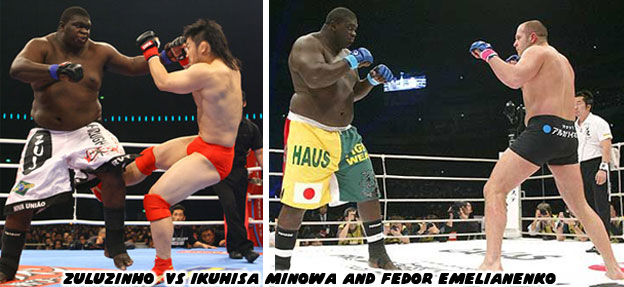
It was tragic when the heroes fell, got old or never grew out of their character. He-man and Zulu suffered much in the same way. Never quite becoming superstars in their own right, never being recognized out of their own neighborhood. Zulu, alive today, still lived in relative poverty and despite being over 60 was still looking for a fight if the money was right. His legacy would also continue through his bruiser-of-a-son named Zuluzinho. The "kid" was 6' 7" and neared 400 lbs. The son of Zulu did not gain his reputation by going building to building and beating up the local tough guys. Instead he tried making his money in legal cage fighting tournaments. His record was not as impressive as his father's, in fact more people seemed to be interested in the spectacle that his fight provided more than the idea that he could win. Thankfully he had the support of sponsors and media coverage to ensure that his moment in the spotlight would generate more money for him than his father had earned in a lifetime. People like Zulu and his son were spectacles that would find a modicum of success in professional fighting.
It is true that larger and heavier fighters hit harder than small fighters. It is also generally accepted that they tend to be able to absorb more damage than smaller opponents. But it comes to a point where the fighters are so massive that they end up being too slow to achieve a world championship. Well, this is not necessarily true in the Sumo arena, but in the mixed martial arts arena the most massive fighters rarely fare that well. They do attract audiences because of the spectacle they provide like Zuluzinho. It becomes apparent however that no amount of size or strength can compensate for a lack of technique or speed, especially against slightly smaller opponents.
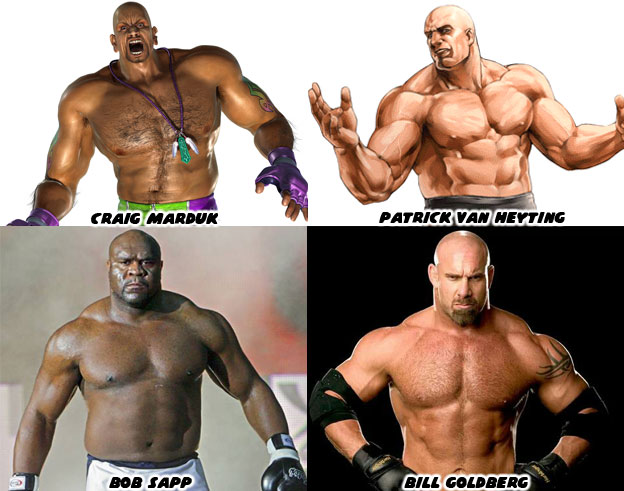
The massive fighter is still a fan favorite around the world, and doubly so in the pro wrestling community. These fighters become recreated in various fighting games, including those from Capcom as well as SNK, Namco and Tecmo. Certainly they change some of the details, alter the color of the skin or nation of origin but the inspiration is unmistakable. People like Zuluzhino, or the more muscular Bob Sapp (6'7") or Bill Goldberg (6'4") look very much like the templates used for the massive fighters in 3D titles. Okay, to be fair the Australian wrestler and actor Nathan Jones (7') was also an inspiration for Marduk from Tekken and US wrestler and actor Stone Cold Steve Austin (6'2") was also influential with the design of Von Heyting from Buriki One. In gaming form the massive characters tend to stick around a little longer than they do in real life. That's a good thing for fans.
It turned out that Brazil had only just begun influencing the fight community. The next blog will explore how the younger brother of Rickson Gracie would change the way the world thought about Ju-jitsu as a fighting art. As always if you enjoyed this blog and would like to sponsor me
please visit my Patreon page and consider donating each month, even as little as $1 would help make better blogs and even podcasts!