A blog about my interests, mainly the history of fighting games. I also talk about animation, comic books, car culture, and art. Co-host of the Pink Monorail Podcast. Contributor to MiceChat, and Jim Hill Media. Former blogger on the old 1UP community site, and Capcom-Unity as well.
Showing posts with label mr. karate. Show all posts
Monday, May 18, 2026
Bookmark This Page; Discovering SNK character design
I may be known for my Street Fighter deep dives, but did you know that some of my first blogs were about Fatal Fury, and the Art of Fighting? If you want to learn the differences between Capcom and SNK's approach to design then Bookmark This Page.
Tuesday, May 24, 2016
The Street Writer Blogcast, Episode 3
Every time I release a new Podcast I will release the text version for my hearing-impaired friends. I don't want them to miss anything that I cover. Also you are welcome to leave comments and questions for this podcast as well as future podcasts on this blog.
We are still looking at the great rivalries in fighting games. Up until now most of the rivals were strangers. Terry Bogard knew that Geese Howard had killed his father but that was about all he knew about the man. Ryu knew even less about Sagat before the two fought. Was it possible to create a rivalry out of two people that knew each other, or more important, two people that were related? How would that be presented and would it make a fighting game series interesting? Many games featured "friendly" rivalries. Ken and Ryu were best friends and fought from time to time in canon. Ryu did not always come out on top which lent credibility to Ken being the greatest fighter in the Street Fighter universe. Other games also featured friendly rivals and some even had siblings that fought with and against each other. The most dramatic of all rivalries however was between father and son. This was the basis for the Tekken series by Namco. There was actually an inter-generational rivalry happening in the franchise. The founder of the Mishima Zaibatsu, a powerful multinational private army and weapons supplier, was Jinpachi Mishima. He had a son named Heihachi whom he despised almost immediately. The feeling was mutual and when Heihachi came of age he took over the family company and had his father imprisoned. Well imprisoned is a kind way of saying he chained Jinpachi to a rock and buried him alive. Heihachi had a son named Kazuya. When Kazuya became powerful enough he dethroned his father. Well dethroned is a kind way of saying he threw his old man off of a cliff. Kazuya had a son named Jin, care to guess what happened when Jin came of age? The heart of the rivalries really began with Heihachi and Kazuya. The two debuted in Tekken, released by Namco in 1994, and had appeared in every sequel.
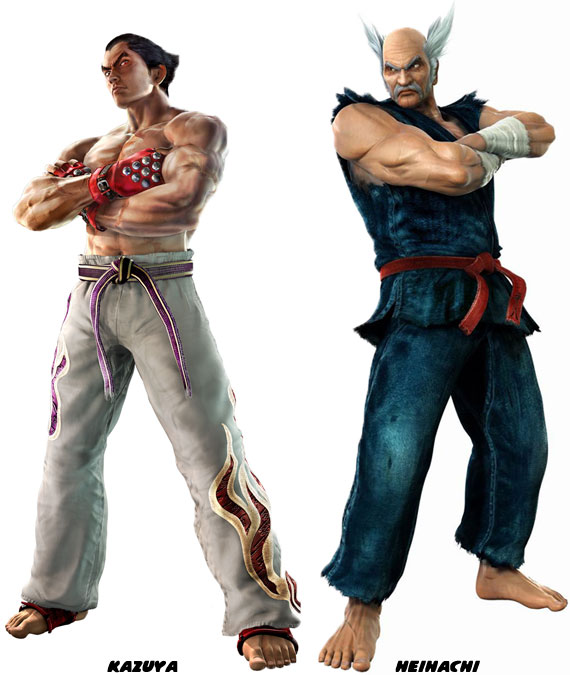
Kazuya was the star of the original game and Heihachi was the original boss. As was tradition the boss had started a tournament to find the greatest fighters. This tournament was called Tekken: the King of the Iron Fist. At first audiences did not know that Kazuya and Heihachi were related. They also did not know that Kazuya was just as bad as the boss. Up until that point every fighting game had been about good versus evil. This was the first series that broke from tradition. The main character and boss were both evil. I'm not talking about anti-heroes versus villains either, I mean both of these men were really the bad guys. Series producer Katsuhiro Harada had a very different approach to his fighting game. Tekken was one of the early titles to be completely in 3D. The graphics immediately grabbed the attention of players. Once hooked Mr. Harada wanted to hold their attention. He challenged convention at every turn. He placed robots, cyborgs, assassins and monsters in the lineup against the human characters. The plot involving a father and son rivalry was icing on the cake. Mr. Harada showed audiences how extremely dysfunctional one family was. This game was as far from Street Fighter and Fatal Fury as could be.
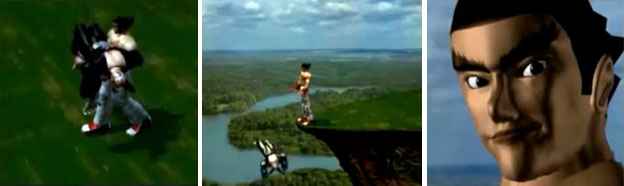
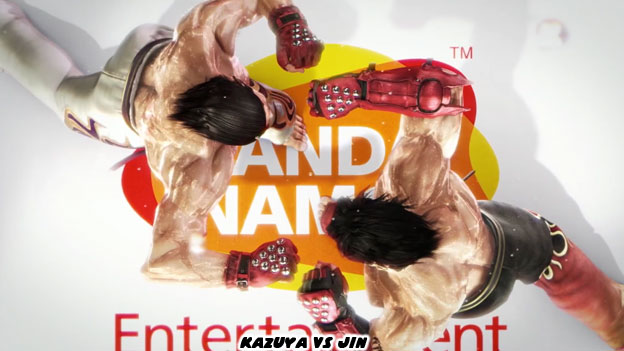
The rivalry between Kazuya and Heihachi started at a young age. Jinpachi warned Heihachi that having a son would make him weak. Heihachi wanted to prove his father wrong. When Kazuya was five years old he threw him off of a cliff. He said if he was the true heir to the Mishima Zaibatsu then he would climb out and return a powerful man. Kazuya survived the fall and did return many years later during the events of the first Tekken tournament. Kazuya was covered in scars, built from a lifetime of fighting man and beast. At the end of the tournament he returned the favor and took his father to the edge of the same cliff and threw him over. Audiences were not prepared for this. They thought that he was going to take his father to get help, or at the very least give him a proper burial. Instead he dropped him and turned to the camera and smiled. It was one of the more shocking moments in game history. Proving ever resourceful, and taking a page from the Fatal Fury playbook, Heihachi survived the fall.
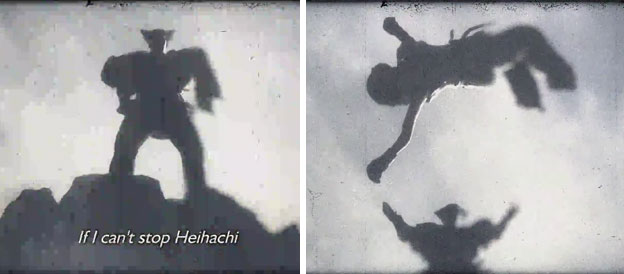
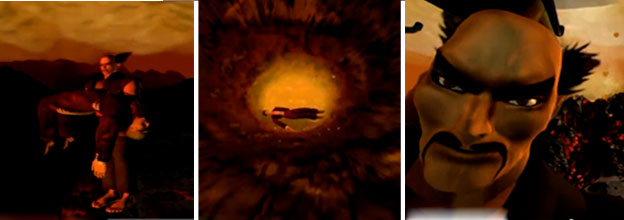
By the time of Tekken 2 Kazuya had taken over the family business and Heihachi had to enter the tournament to try an extract his revenge. As with all great rivalries the two were evenly matched. Unlike Sagat and Ryu where they had two different martial arts forms, or with Geese Howard and Terry Bogard where they had clashing styles, the techniques used by Heihachi and Kazuya were almost mirror images. Each fighter focused on different strikes in order to gain an advantage in battle. What it all boiled down to was technique and experience. Heihachi was able to gain the upper hand and went back to where it all started in his ending scene. This time he dropped Kazuya in the heart of an active volcano and flew away on a helicopter. The ending movie was beat-for-beat the same as Kazuya's original ending. Mr. Harada knew that a little dark comedy went a long way in the series. Audiences were eating up this bitter rivalry.
What many failed to realize was that the rivalry was an homage to a classic manga. Osamu Tezuka was considered the godfather of manga and anime. He was a pioneering artist from Japan that created hundreds of original characters and some of the most beloved stories of all time. One of his heroes was a doctor named Kuro Hazama aka Black Jack. The comic debuted in 1973 and the original run went on for a decade. During this time Mr. Harada and the Tekken team were growing up and were more than likely influenced by many of Tezuka's stories. Kuro was caught in a land mine explosion as a kid, it killed his mother and left him barely alive. He had required reconstructive surgery and skin grafts. When the doctor working on him asked the parents of his classmates if their children would be willing to donate skin they all turned him down, all except his friend Takashi, who was half-black half-Japanese. The skin was applied to Kuro's arms, shoulders and face. This left Kuro with contrasting patches that gave him a unique look. People were often put off by his appearance because he looked monstrous to them. This discoloration was actually featured on the fighting game characters Preston Ajax and Charlie Nash. Kuro dedicated his life to becoming a doctor and honoring the memory of his friend. He practiced outside of the system because he saw there was terrible corruption in the medical field, where only the richest could afford treatment. He had a private practice far away from any town. He would treat mobsters and regular people alike for the right price. He didn't have many friends but made contacts along the way of people that he trusted. One of these contacts had reached out to him because he was afraid of his father. This was where the seeds of Tekken were planted.
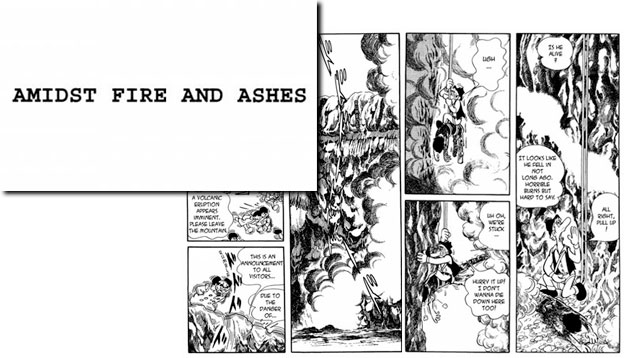
In an issue of Black Jack titled "Amidst Fire and Ashes" the doctor was introduced to a cruel tycoon. The issue opened with a volcano, Mt. Roar, that was erupting near a research center. There was a man in a suit looking down into the volcano but quickly walked away as people got closer. A park ranger spotted a charred body in the crater and lowered himself down to rescue the man. The body was badly burned but the person was still alive. The body was taken to a visitor's center. The man in the suit sprung forward and announced himself as the father of Ryohei, the burn victim. He seemed distressed that his son was dying. Black Jack offered his services but for some ungodly high rates. He knew full well that the man was the CEO of Nippachi Trading and could easily afford the ¥20 million bill to save his son. The man reluctantly agreed but only after Black Jack produced a note from the son, saying that he was going to have a meeting with his father and something may happen to him. He wanted the brilliant surgeon there just in case. Ryohei had a suspicion that his father may do something drastic and his hunch was right. Despite the lack of witnesses placing the father and son together at the time of the accident the CEO felt the pressure to save Ryohei. He agreed to Black Jack's demands and let him operate.
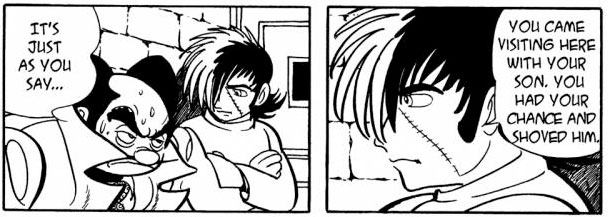
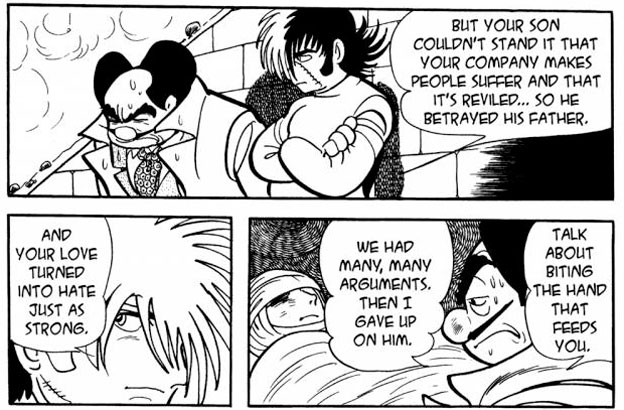
Mt. Roar continued erupting and the visitors were evacuated. Unfortunately Ryohei was in no condition to travel and only Black Jack and the CEO were left behind. The CEO actually tried to leave with the crowd until he was called out by the doctor. After operating on Ryohei the father was still eager to kill his son. He tried wheeling out the body on a stretcher towards the volcano. The doctor punched him out and said he would never allow any harm to the man he had just saved. It didn't take too much prodding from Black Jack to get a confession. It turned out that Ryohei did not want to inherit the company. It had dealings that he found unsavory. His first action would have been to dissolve the corporation. His father would not let that happen to the company that he had built himself. He wanted his son to be strong, in the business world people had to be as cutthroat as he was. His son didn't have a mean bone in his body. The name Ryohei could be translated to "good boy," despite his father's actions he still loved and forgave him. This made the betrayal sting harder for readers. Eventually the CEO came to terms with this and was willing to stay with his son and make sure that he recovered.
The volcano had become too dangerous and Black Jack was ordered to evacuate. The CEO swore that he would stay with his son. The two died on the mountain when it exploded. When rescuers found the bodies they said their hands were clasped tightly together. It was a heartbreaking ending. Then again most of the Black Jack stories were melancholy. The seeds for the evil corporate archetype had been planted in that adventure. The CEO was without a doubt the basis for Heihachi Mishima. In addition to being extremely wealthy and enjoying throwing his kid into a volcano the physical traits were more obvious. Nobody else had the same haircut and mustache. The template would return in manga form years later. Daikenjuro Kanzuki, the father of Karin Kanzuki from the Street Fighter Zero / Alpha series, was another dead-ringer for the CEO. He was not in the game series but instead the manga based on the game. He shared the same physical appearance of the Nippachi Trading CEO. Daikenjuro was similar to Heihachi in that the two had amassed a fortune that could only exist in a fictional world. I'm talking about Scrooge McDuck levels of wealth. They both had private armies at their command, corporate offices in every corner of the globe, residences that stretched over several hundred acres of prime real estate and politicians in their back pocket. They both seemed untouchable. Of course both also had family members who were eager to dethrone them. This made for an interesting dynamic in the game and manga titles.
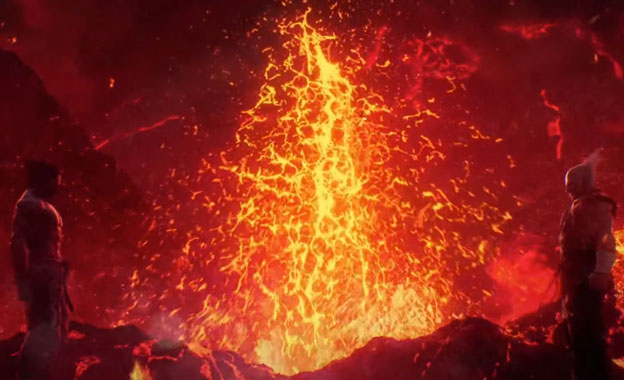
A volcano would appear in the backdrop of other fighting games but few stages were actually set inside of a volcano. This location certainly meant something in the Tekken series. Mr. Harada had meant for it to be the final resting place for both Heihachi and Kazuya. He had talked about finishing the Mishima Saga in Tekken 7. This was why he framed key scenes in the story mode and actual stages inside the cauldron. Unlike the reconciliation in Black Jack this father and son duo were willing to drag each other into hell. It was a bitter rivalry to say the least. You would be hard pressed to find two characters in any series that hated each other more. Yet even with their extreme distrust of each other they had been known to team up, especially during the Tekken Tag Tournaments. Of course each person had their own reason for entering and would betray their partner as soon as they reached the end. Not every legacy character was filled with as much hate even when there was just cause to hold a grudge. Some of the rivals could not bring themselves to hate. This was the case between Takuma Sakazaki and his son Ryo. Ryo did not know that Mr. Karate was his father until the end of the original Art of Fighting. Yuri Sakazaki had been kidnapped and once she was rescued she begged her brother to stop fighting. She revealed that Takuma was behind the mask. It was one of the best twist endings in a fighting game.
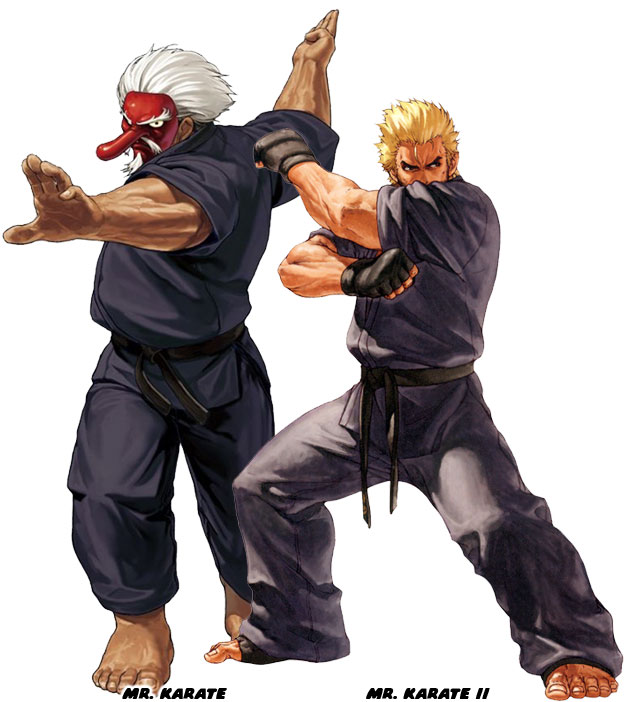
Takuma would keep the mask around for when other fighters needed to be taught a lesson. He eventually retired the name and his son took over. At the peak of his abilities Ryo entered tournaments under the name Mr. Karate II. This version of the character ditched the bright orange gi that he wore in the Art of Fighting and King of Fighters series. He went with a solid black one in honor of his father. This version of the character debuted in the Buriki-One tournament. But I digress... Tekken was a series filled with many memorable rivalries. None were as intense as the ones between the Mishima family members. Writers and artists putting together their own stories would do well to remember that family could create the most passionate feuds.
One of the greatest rivalries in fighting game history was also one of the shortest-lived ones. The next part in this series will travel across time and space to resurrect an often overlooked title. Until then please leave a comment or tell me what one of your most favorite rivalries was. As always if you would like to sponsor me please visit my Patreon page and consider donating each month, even as little as $1 would help...
We are still looking at the great rivalries in fighting games. Up until now most of the rivals were strangers. Terry Bogard knew that Geese Howard had killed his father but that was about all he knew about the man. Ryu knew even less about Sagat before the two fought. Was it possible to create a rivalry out of two people that knew each other, or more important, two people that were related? How would that be presented and would it make a fighting game series interesting? Many games featured "friendly" rivalries. Ken and Ryu were best friends and fought from time to time in canon. Ryu did not always come out on top which lent credibility to Ken being the greatest fighter in the Street Fighter universe. Other games also featured friendly rivals and some even had siblings that fought with and against each other. The most dramatic of all rivalries however was between father and son. This was the basis for the Tekken series by Namco. There was actually an inter-generational rivalry happening in the franchise. The founder of the Mishima Zaibatsu, a powerful multinational private army and weapons supplier, was Jinpachi Mishima. He had a son named Heihachi whom he despised almost immediately. The feeling was mutual and when Heihachi came of age he took over the family company and had his father imprisoned. Well imprisoned is a kind way of saying he chained Jinpachi to a rock and buried him alive. Heihachi had a son named Kazuya. When Kazuya became powerful enough he dethroned his father. Well dethroned is a kind way of saying he threw his old man off of a cliff. Kazuya had a son named Jin, care to guess what happened when Jin came of age? The heart of the rivalries really began with Heihachi and Kazuya. The two debuted in Tekken, released by Namco in 1994, and had appeared in every sequel.

Kazuya was the star of the original game and Heihachi was the original boss. As was tradition the boss had started a tournament to find the greatest fighters. This tournament was called Tekken: the King of the Iron Fist. At first audiences did not know that Kazuya and Heihachi were related. They also did not know that Kazuya was just as bad as the boss. Up until that point every fighting game had been about good versus evil. This was the first series that broke from tradition. The main character and boss were both evil. I'm not talking about anti-heroes versus villains either, I mean both of these men were really the bad guys. Series producer Katsuhiro Harada had a very different approach to his fighting game. Tekken was one of the early titles to be completely in 3D. The graphics immediately grabbed the attention of players. Once hooked Mr. Harada wanted to hold their attention. He challenged convention at every turn. He placed robots, cyborgs, assassins and monsters in the lineup against the human characters. The plot involving a father and son rivalry was icing on the cake. Mr. Harada showed audiences how extremely dysfunctional one family was. This game was as far from Street Fighter and Fatal Fury as could be.

The rivalry between Kazuya and Heihachi started at a young age. Jinpachi warned Heihachi that having a son would make him weak. Heihachi wanted to prove his father wrong. When Kazuya was five years old he threw him off of a cliff. He said if he was the true heir to the Mishima Zaibatsu then he would climb out and return a powerful man. Kazuya survived the fall and did return many years later during the events of the first Tekken tournament. Kazuya was covered in scars, built from a lifetime of fighting man and beast. At the end of the tournament he returned the favor and took his father to the edge of the same cliff and threw him over. Audiences were not prepared for this. They thought that he was going to take his father to get help, or at the very least give him a proper burial. Instead he dropped him and turned to the camera and smiled. It was one of the more shocking moments in game history. Proving ever resourceful, and taking a page from the Fatal Fury playbook, Heihachi survived the fall.

By the time of Tekken 2 Kazuya had taken over the family business and Heihachi had to enter the tournament to try an extract his revenge. As with all great rivalries the two were evenly matched. Unlike Sagat and Ryu where they had two different martial arts forms, or with Geese Howard and Terry Bogard where they had clashing styles, the techniques used by Heihachi and Kazuya were almost mirror images. Each fighter focused on different strikes in order to gain an advantage in battle. What it all boiled down to was technique and experience. Heihachi was able to gain the upper hand and went back to where it all started in his ending scene. This time he dropped Kazuya in the heart of an active volcano and flew away on a helicopter. The ending movie was beat-for-beat the same as Kazuya's original ending. Mr. Harada knew that a little dark comedy went a long way in the series. Audiences were eating up this bitter rivalry.

What many failed to realize was that the rivalry was an homage to a classic manga. Osamu Tezuka was considered the godfather of manga and anime. He was a pioneering artist from Japan that created hundreds of original characters and some of the most beloved stories of all time. One of his heroes was a doctor named Kuro Hazama aka Black Jack. The comic debuted in 1973 and the original run went on for a decade. During this time Mr. Harada and the Tekken team were growing up and were more than likely influenced by many of Tezuka's stories. Kuro was caught in a land mine explosion as a kid, it killed his mother and left him barely alive. He had required reconstructive surgery and skin grafts. When the doctor working on him asked the parents of his classmates if their children would be willing to donate skin they all turned him down, all except his friend Takashi, who was half-black half-Japanese. The skin was applied to Kuro's arms, shoulders and face. This left Kuro with contrasting patches that gave him a unique look. People were often put off by his appearance because he looked monstrous to them. This discoloration was actually featured on the fighting game characters Preston Ajax and Charlie Nash. Kuro dedicated his life to becoming a doctor and honoring the memory of his friend. He practiced outside of the system because he saw there was terrible corruption in the medical field, where only the richest could afford treatment. He had a private practice far away from any town. He would treat mobsters and regular people alike for the right price. He didn't have many friends but made contacts along the way of people that he trusted. One of these contacts had reached out to him because he was afraid of his father. This was where the seeds of Tekken were planted.

In an issue of Black Jack titled "Amidst Fire and Ashes" the doctor was introduced to a cruel tycoon. The issue opened with a volcano, Mt. Roar, that was erupting near a research center. There was a man in a suit looking down into the volcano but quickly walked away as people got closer. A park ranger spotted a charred body in the crater and lowered himself down to rescue the man. The body was badly burned but the person was still alive. The body was taken to a visitor's center. The man in the suit sprung forward and announced himself as the father of Ryohei, the burn victim. He seemed distressed that his son was dying. Black Jack offered his services but for some ungodly high rates. He knew full well that the man was the CEO of Nippachi Trading and could easily afford the ¥20 million bill to save his son. The man reluctantly agreed but only after Black Jack produced a note from the son, saying that he was going to have a meeting with his father and something may happen to him. He wanted the brilliant surgeon there just in case. Ryohei had a suspicion that his father may do something drastic and his hunch was right. Despite the lack of witnesses placing the father and son together at the time of the accident the CEO felt the pressure to save Ryohei. He agreed to Black Jack's demands and let him operate.

Mt. Roar continued erupting and the visitors were evacuated. Unfortunately Ryohei was in no condition to travel and only Black Jack and the CEO were left behind. The CEO actually tried to leave with the crowd until he was called out by the doctor. After operating on Ryohei the father was still eager to kill his son. He tried wheeling out the body on a stretcher towards the volcano. The doctor punched him out and said he would never allow any harm to the man he had just saved. It didn't take too much prodding from Black Jack to get a confession. It turned out that Ryohei did not want to inherit the company. It had dealings that he found unsavory. His first action would have been to dissolve the corporation. His father would not let that happen to the company that he had built himself. He wanted his son to be strong, in the business world people had to be as cutthroat as he was. His son didn't have a mean bone in his body. The name Ryohei could be translated to "good boy," despite his father's actions he still loved and forgave him. This made the betrayal sting harder for readers. Eventually the CEO came to terms with this and was willing to stay with his son and make sure that he recovered.

The volcano had become too dangerous and Black Jack was ordered to evacuate. The CEO swore that he would stay with his son. The two died on the mountain when it exploded. When rescuers found the bodies they said their hands were clasped tightly together. It was a heartbreaking ending. Then again most of the Black Jack stories were melancholy. The seeds for the evil corporate archetype had been planted in that adventure. The CEO was without a doubt the basis for Heihachi Mishima. In addition to being extremely wealthy and enjoying throwing his kid into a volcano the physical traits were more obvious. Nobody else had the same haircut and mustache. The template would return in manga form years later. Daikenjuro Kanzuki, the father of Karin Kanzuki from the Street Fighter Zero / Alpha series, was another dead-ringer for the CEO. He was not in the game series but instead the manga based on the game. He shared the same physical appearance of the Nippachi Trading CEO. Daikenjuro was similar to Heihachi in that the two had amassed a fortune that could only exist in a fictional world. I'm talking about Scrooge McDuck levels of wealth. They both had private armies at their command, corporate offices in every corner of the globe, residences that stretched over several hundred acres of prime real estate and politicians in their back pocket. They both seemed untouchable. Of course both also had family members who were eager to dethrone them. This made for an interesting dynamic in the game and manga titles.

A volcano would appear in the backdrop of other fighting games but few stages were actually set inside of a volcano. This location certainly meant something in the Tekken series. Mr. Harada had meant for it to be the final resting place for both Heihachi and Kazuya. He had talked about finishing the Mishima Saga in Tekken 7. This was why he framed key scenes in the story mode and actual stages inside the cauldron. Unlike the reconciliation in Black Jack this father and son duo were willing to drag each other into hell. It was a bitter rivalry to say the least. You would be hard pressed to find two characters in any series that hated each other more. Yet even with their extreme distrust of each other they had been known to team up, especially during the Tekken Tag Tournaments. Of course each person had their own reason for entering and would betray their partner as soon as they reached the end. Not every legacy character was filled with as much hate even when there was just cause to hold a grudge. Some of the rivals could not bring themselves to hate. This was the case between Takuma Sakazaki and his son Ryo. Ryo did not know that Mr. Karate was his father until the end of the original Art of Fighting. Yuri Sakazaki had been kidnapped and once she was rescued she begged her brother to stop fighting. She revealed that Takuma was behind the mask. It was one of the best twist endings in a fighting game.

Takuma would keep the mask around for when other fighters needed to be taught a lesson. He eventually retired the name and his son took over. At the peak of his abilities Ryo entered tournaments under the name Mr. Karate II. This version of the character ditched the bright orange gi that he wore in the Art of Fighting and King of Fighters series. He went with a solid black one in honor of his father. This version of the character debuted in the Buriki-One tournament. But I digress... Tekken was a series filled with many memorable rivalries. None were as intense as the ones between the Mishima family members. Writers and artists putting together their own stories would do well to remember that family could create the most passionate feuds.

One of the greatest rivalries in fighting game history was also one of the shortest-lived ones. The next part in this series will travel across time and space to resurrect an often overlooked title. Until then please leave a comment or tell me what one of your most favorite rivalries was. As always if you would like to sponsor me please visit my Patreon page and consider donating each month, even as little as $1 would help...
Labels:
bigmex,
black jack,
blogcast,
heihachi,
jinpachi,
kazuya,
mishima,
mr. karate,
mr. karate II,
namco,
podcast,
rivals,
street writer,
tekken,
tekken 7,
volcano
Friday, October 2, 2015
How fight culture became fighting game history, part 41
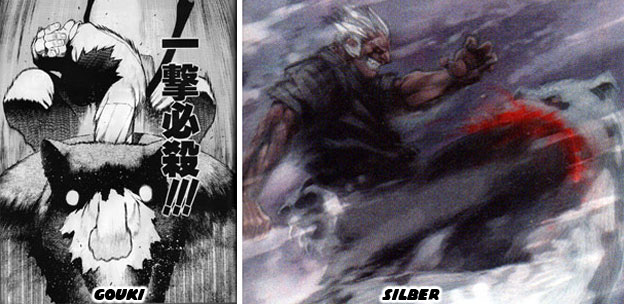
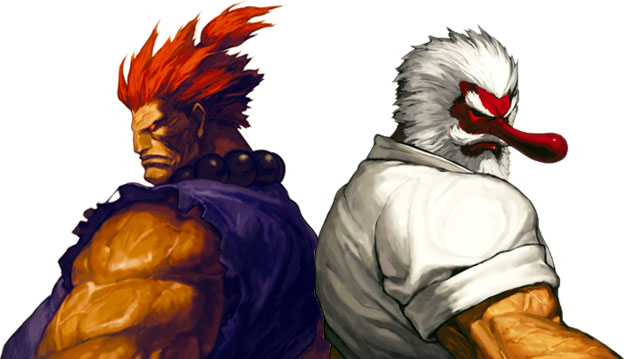
When Gouki debuted in 1994's Super Street Fighter II Turbo he set the standard for boss characters and villains in fighting games. The other studios took notice and tried to create legends of their own. SNK was a long time rival to Capcom. They had a masked fighter named "Mr. Karate" that predated Gouki by a few years. Takuma Sakazaki was the masked villain and final boss in the Art of Fighting. He was also the father of the heroes of the game Ryo and Yuri Sakazaki. The 1992 title did not originally feature the character as a pseudo demon but instead had him wearing a Tengu or devil mask. As the series went on the character of Mr. Karate grew more and more powerful until he took on a number of the same traits that Gouki had. His attacks became more powerful and he seemed to be a completely different person behind the mask. Most fans would consider the characters to be evenly-matched villains.
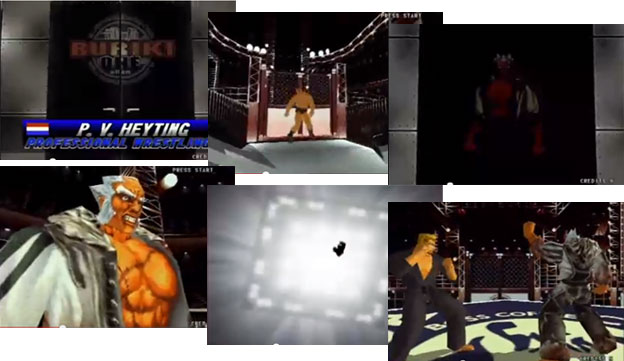
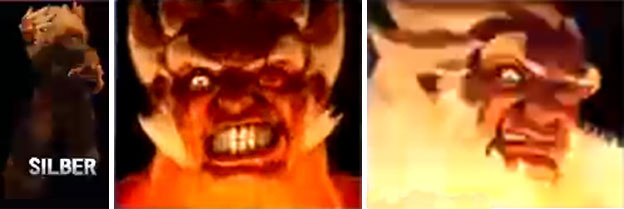
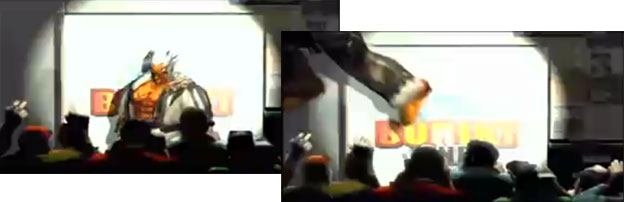
Not many fighting game aficionados however would remember that SNK had introduced a character that was eerily closer to Gouki in form and presentation than Mr. Karate. The 1999 arcade release Buriki One was one of SNK's first attempts at moving their IP into three-dimensions. The game had a cast of mostly new faces with the exception of Ryo Sakazaki, who had entered the tournament under the name of Mr. Karate II. Players fought masters of various styles and could beat the game by winning the tournament. The secret character in the game had an entrance that was reminiscent of the first appearance of Gouki. Players would go through their usual opening animation; where the selected character walked from backstage to the tournament platform. When the rival was announced the screen switched to the locker room. The opponent would be thrown through the double doors and crash into the caged-off platform. The true boss character would then appear. He was a muscular German named Silber. The character had a terrible gash over one eye and was covered in grizzly scars. The white-haired fighter looked nightmarish. He would rush the stage and take a superhuman leap over the barrier.
Silber had a very unorthodox stance and fighting style. The story behind the character was very interesting. The German had spend the last 30 years traveling the globe, fighting the best masters of other fighting arts and leaving few witnesses in his wake. He had developed his own form of karate which was unlike the traditional Japanese schools but just as lethal if not more so. When he learned there was a tournament to find out which was the best fighting style he decided to enter without an invitation. Silber was the first non-Japanese karate villain in a fighting game. The fact that SNK made him the boss character was even more impressive. It was as if the Japanese developers had suddenly come to realize that people from other nations could not only master foreign fighting arts, but they could also create their own contributions to the form. To help Silber stand out from Mr. Karate or the other bosses from SNK history the studio took a page from Capcom's school of design. They made the German look like a supernatural character. The patchwork of scars that covered his body made him appear like Frankenstein's monster. It was more than coincidence that his look was pulled from classic literary traditions.
Gouki had elements from Eastern mythology and Silber's design observed many Western ones. Centuries ago the Black Forest in Germany had been romanticized in fairy tales. The Brothers Grimm brought imps, dwarfs, witches and shapeshifters from classic folklore into popular culture. Snow White, Little Red Riding Hood and Sleeping Beauty were just some of the old stories that the brothers had adapted not only to entertain but to also put the fear of the unknown into children. In fact, some of the stories were not called fairy tales but instead "warning tales." The Black Forest, like many other forests in Germany, was once very dangerous. It hosted wild boars, bears and wolves that killed many a settler. Many of those creatures were hunted to extinction but the legends of dangerous predators remained in the stories. The designers at SNK thought to develop a new fable out of a creature that came out of the woods to hunt down man as well. Silber would take on the appearance of the animal-turned-human in the Buriki One tournament. The artists did not look at a lion for inspiration this time. The bright white hair and sideburns stuck out like the mane of a timber wolf. The look was enhanced by the fur-lined gi that he wore in competition. The character was certainly an alpha-predator. It was assumed that he had killed an animal and skinned it to line his uniform. The cold German winters would have made outdoor training unbearable without some protection. His clothing had dark black stripes that looked like claw marks to perpetuate the myth of the animal-like survivalist. The character art and profile featured in the game was unmistakable. This was a major villain, a nightmare from classic storytelling traditions.
SNK wanted to make the character very mysterious. They gave him no dialogue or lines in the game. If a player managed to defeat Silber an ending animation would play before the credits. He survived the fight, stood up and took another superhuman leap to escape from the ring. If gamers managed to beat Silber with all of the regular characters then he too would become a playable character. This meant that Silber had his own stats, alternate costume and even ending cinema. Each character held a press conference at the end of the game where they talked about the fighting style that took them to the top. The credits would roll during the press conference and players could get filled into the plot.
Players that wanted to learn a bit more about Silber were disappointed with his ending. Nothing was revealed during his interview. He looked at the room full of reporters with disdain in his eyes. Instead of answering their questions he simply jumped off the screen. This bit of mystery would follow the character in all his future appearances. He was the boss character that would never stay down for long no matter how badly the player had beaten him. He would leap out of each game just as quickly as he arrived. It helped add an air of mystery to him and kept fans of the SNK universe guessing when he would turn up again. For older fans of animé the spectacular leaps that Silber made were a nod to the classic series Karate Baka Ichidai. The show was a serialized retelling of the life of Mas Oyama featuring his encounters against various fighting styles. This hinted that Silber was like a modern Oyama, only without scruples or compassion for other fighters.
There was something outside of the gruesome appearances that made Gouki and Silber similar. The two were not solely boss characters but also villains. They were not villains in the traditional sense of the word. They did not kidnap princesses or take Gotham City hostage. They were villains in the sense that they were both very evil men. They were both obsessed with power and were willing to achieve that power at any price. For professional and underground fighters this meant that they had to be the best that ever lived. In order to achieve that the duo had focused on nothing else except for training and fighting. They had no friends, no family and no sense of loyalty. Silber was rumored to have mentored the pro boxer and criminal Rob Python, also from the Buriki One universe. Gouki had a run in with his brother Gouken at several points during the training of Ken and Ryu. The wisdom and warnings from Gouki did not fall on deaf ears then. Despite these limited interactions with younger fighters the two had almost no contact with anyone else in canon or the games. There was something that made the characters truly evil though. The next blog will talk about the elements of evil design and how it inspired minority villains. As always if you enjoyed this blog and would like to sponsor me please visit my Patreon page and consider donating each month, even as little as $1 would help make better blogs and even podcasts!

Not many fighting game aficionados however would remember that SNK had introduced a character that was eerily closer to Gouki in form and presentation than Mr. Karate. The 1999 arcade release Buriki One was one of SNK's first attempts at moving their IP into three-dimensions. The game had a cast of mostly new faces with the exception of Ryo Sakazaki, who had entered the tournament under the name of Mr. Karate II. Players fought masters of various styles and could beat the game by winning the tournament. The secret character in the game had an entrance that was reminiscent of the first appearance of Gouki. Players would go through their usual opening animation; where the selected character walked from backstage to the tournament platform. When the rival was announced the screen switched to the locker room. The opponent would be thrown through the double doors and crash into the caged-off platform. The true boss character would then appear. He was a muscular German named Silber. The character had a terrible gash over one eye and was covered in grizzly scars. The white-haired fighter looked nightmarish. He would rush the stage and take a superhuman leap over the barrier.

Silber had a very unorthodox stance and fighting style. The story behind the character was very interesting. The German had spend the last 30 years traveling the globe, fighting the best masters of other fighting arts and leaving few witnesses in his wake. He had developed his own form of karate which was unlike the traditional Japanese schools but just as lethal if not more so. When he learned there was a tournament to find out which was the best fighting style he decided to enter without an invitation. Silber was the first non-Japanese karate villain in a fighting game. The fact that SNK made him the boss character was even more impressive. It was as if the Japanese developers had suddenly come to realize that people from other nations could not only master foreign fighting arts, but they could also create their own contributions to the form. To help Silber stand out from Mr. Karate or the other bosses from SNK history the studio took a page from Capcom's school of design. They made the German look like a supernatural character. The patchwork of scars that covered his body made him appear like Frankenstein's monster. It was more than coincidence that his look was pulled from classic literary traditions.

Gouki had elements from Eastern mythology and Silber's design observed many Western ones. Centuries ago the Black Forest in Germany had been romanticized in fairy tales. The Brothers Grimm brought imps, dwarfs, witches and shapeshifters from classic folklore into popular culture. Snow White, Little Red Riding Hood and Sleeping Beauty were just some of the old stories that the brothers had adapted not only to entertain but to also put the fear of the unknown into children. In fact, some of the stories were not called fairy tales but instead "warning tales." The Black Forest, like many other forests in Germany, was once very dangerous. It hosted wild boars, bears and wolves that killed many a settler. Many of those creatures were hunted to extinction but the legends of dangerous predators remained in the stories. The designers at SNK thought to develop a new fable out of a creature that came out of the woods to hunt down man as well. Silber would take on the appearance of the animal-turned-human in the Buriki One tournament. The artists did not look at a lion for inspiration this time. The bright white hair and sideburns stuck out like the mane of a timber wolf. The look was enhanced by the fur-lined gi that he wore in competition. The character was certainly an alpha-predator. It was assumed that he had killed an animal and skinned it to line his uniform. The cold German winters would have made outdoor training unbearable without some protection. His clothing had dark black stripes that looked like claw marks to perpetuate the myth of the animal-like survivalist. The character art and profile featured in the game was unmistakable. This was a major villain, a nightmare from classic storytelling traditions.

SNK wanted to make the character very mysterious. They gave him no dialogue or lines in the game. If a player managed to defeat Silber an ending animation would play before the credits. He survived the fight, stood up and took another superhuman leap to escape from the ring. If gamers managed to beat Silber with all of the regular characters then he too would become a playable character. This meant that Silber had his own stats, alternate costume and even ending cinema. Each character held a press conference at the end of the game where they talked about the fighting style that took them to the top. The credits would roll during the press conference and players could get filled into the plot.
Players that wanted to learn a bit more about Silber were disappointed with his ending. Nothing was revealed during his interview. He looked at the room full of reporters with disdain in his eyes. Instead of answering their questions he simply jumped off the screen. This bit of mystery would follow the character in all his future appearances. He was the boss character that would never stay down for long no matter how badly the player had beaten him. He would leap out of each game just as quickly as he arrived. It helped add an air of mystery to him and kept fans of the SNK universe guessing when he would turn up again. For older fans of animé the spectacular leaps that Silber made were a nod to the classic series Karate Baka Ichidai. The show was a serialized retelling of the life of Mas Oyama featuring his encounters against various fighting styles. This hinted that Silber was like a modern Oyama, only without scruples or compassion for other fighters.

There was something outside of the gruesome appearances that made Gouki and Silber similar. The two were not solely boss characters but also villains. They were not villains in the traditional sense of the word. They did not kidnap princesses or take Gotham City hostage. They were villains in the sense that they were both very evil men. They were both obsessed with power and were willing to achieve that power at any price. For professional and underground fighters this meant that they had to be the best that ever lived. In order to achieve that the duo had focused on nothing else except for training and fighting. They had no friends, no family and no sense of loyalty. Silber was rumored to have mentored the pro boxer and criminal Rob Python, also from the Buriki One universe. Gouki had a run in with his brother Gouken at several points during the training of Ken and Ryu. The wisdom and warnings from Gouki did not fall on deaf ears then. Despite these limited interactions with younger fighters the two had almost no contact with anyone else in canon or the games. There was something that made the characters truly evil though. The next blog will talk about the elements of evil design and how it inspired minority villains. As always if you enjoyed this blog and would like to sponsor me please visit my Patreon page and consider donating each month, even as little as $1 would help make better blogs and even podcasts!
Labels:
akuma,
buriki one,
capcom,
gouki,
mr. karate,
nio,
silber,
snk,
takuma sakazaki
Wednesday, April 30, 2014
The Legend of Kyokugen Karate, Marco Rodriguez
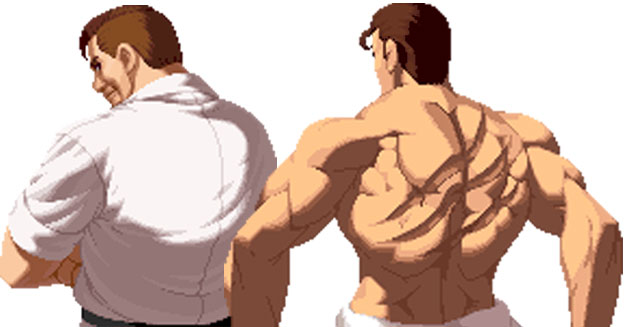
Mr. Karate represented the unbreakable will of Takuma Sakazaki. The man himself was flawed, aging and losing presence within the SNK universe. It was his alter ego that was the true boss that all of the other fighters feared. Mr. Karate never seemed to age, never seemed to get hurt and was an all powerful martial artist without equal. Takuma by comparison had lost his friends and wife in the rough city of Southtown. His children and students helped keep him together but there was always something bubbling under the surface. Many gamers could tell that even without the mask on there was a good portion of Mr. Karate living inside of Takuma. It was obvious by looking at the massive scar over his chest but not that many had seen the marks on his back. This was a person that had survived knife fights, sword fights and gun battles using his bare hands. This was also a person, like Mas Oyama, that had tested himself against wild animals.
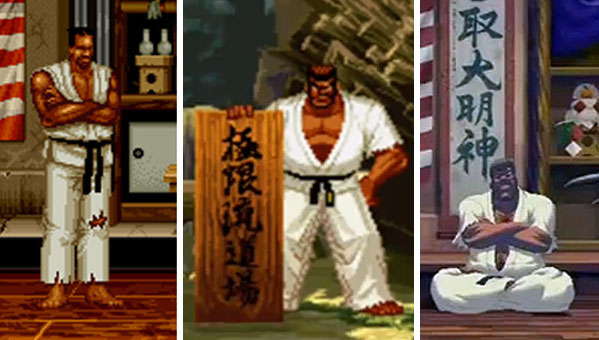
The legend of Mr. Karate was what drew practitioners into Southtown, none of them was more important as a student and a character than Marco Rodriguez. This character was absent from my Coloring Perception series. I could not find a proper place to mention him with regards to black character designs in fighting games. Marco had one foot in the absurd design typical of many fighting game developers, yet he was not a clown. He had as many abilities and attacks as Takuma, Ryo, Robert or Yuri. It was his zest for the Kyokugen style that made him a standout. Rodriguez was not only the star pupil but also its biggest supporter. While the Sakazaki's were competing in the KOF tournaments, Buriki One tournament or chasing bad guys around in the Art of Fighting titles it had been Marco that kept the school alive, paid the bills, promoted the system. His eyes would well up with pride whenever he thought about Ryo and how much the school meant to him.
Marco had first appeared as a background character in Takuma's Art of Fighting (AoF) 2 stage. The designers never forgot him so when they redrew the stage for the King of Fighters XII they made sure to include his updated look with a pompadour and sideburns instead of braids. He was also sitting in the dojo laughing at the fighters, it said about the personality and the abilities of Rodriguez. Marco had first appeared as a playable character in Garou: Mark of the Wolves. It was notable because Marco was trained by Ryo and was the first Kyokugen fighter to appear in the Fatal Fury (FF) series. Released in 1999 Mark of the Wolves was the final game in the Fatal Fury series. Most fans of the SNK titles had wondered which star was the best fighter in the universe. Was it Ryo from the Art of Fighting or Terry Bogard from Fatal Fury? SNK would only tease gamers by saying that both universes were connected and even set within the same city and timeline. The boss character from Fatal Fury appeared as a boss in the Art of Fighting 2 yet none of the heroes ever crossed over until the original King of Fighters was released in 1994. However to fans it was a bit of a cop-out. The KOF series had mixed in a lot of other characters and changed the gameplay so that it was neither Fatal Fury nor the Art of Fighting. Both of the earlier games had a unique design aesthetic and control scheme. The sprites featured in the FF series were smaller with the gameplay being focused on allowed characters to jump between to or three different planes so that they could go around opponents. It was a precursor to the first 3D games. By comparison the AoF featured very large, highly detailed sprites and tried to capture a more realistic feel for the fighters. The characters could bruise and their clothes could even tear depending on how much damage the players sustained. Yet neither development team would allow for the stars from one title to appear on the other game.
Garou: Mark of the Wolves was the closest that the two universes would come together outside of the KOF. An older, stronger Terry Bogard was the star of the game yet there was one Kyokugen master in the game as well only it wasn't Ryo Sakazaki or Robert Garcia. Marco Rodriguez was a student of Ryo's and had committed himself completely to the art form. He was so dedicated in fact that he was living like a hermit in the nearby Sarah Forest, training in complete isolation in the same ways of the founder of Kyokugen. Marco had the same moves of the main AoF stars but the control and presentation was decidedly FF. It was a way to finally get both universes in one title without upsetting the rival fans.
Marco was an absolute zealot of the Kyokugen way. He even carried around a large wooden sign of the dojo whenever he fought. He was inspired by Willie Williams, a black US fighter that dedicated himself to the Kyokushin style back in '70s. He believed in the system with tremendous fervor and even moved to Japan to follow in the footsteps of Mas Oyama and train in many of the same places. In 1979 during second ever Kyokushin World Tournament, held in Tokyo Japan, Williams representing the USA competed and came in third. At the time it was the highest ranking for a non-Japanese and the record remained until 1987 when the Swiss-born Andy Hug came in second. In 1980 Williams fought Japanese wrestling icon Antonio Inoki in a highly publicized bout. Inoki had fought Muhammad Ali a few years prior to a draw in the pro wrestling vs boxing contest. This time he wanted to take on the massive American and see if karate was stronger than pro wrestling. The two battled for just over 5 minutes, the first half of which was mostly both men posturing and putting on a show but the last few were rough. This match also ended in a draw but Inoki would suffer from a broken rib and Williams from a broken arm. Williams would be kicked out of the organizing body of Kyokushin for participation in the fight.
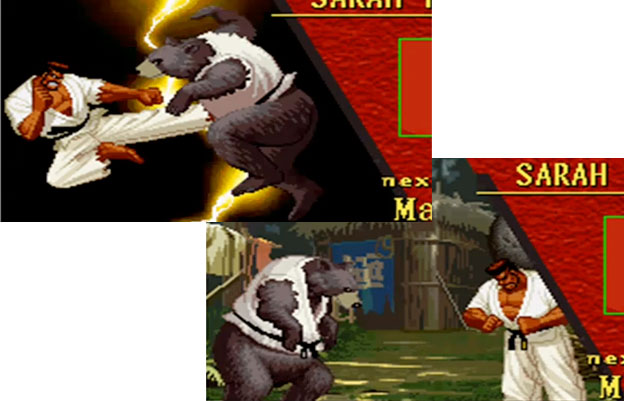
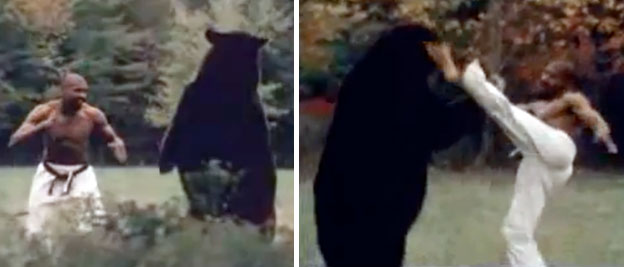
Williams, like many people in the '60s and '70s, had become obsessed with Oyama's total karate system. The martial arts had exploded in popularity thanks to the kung-fu films of the Shaw Bros. and Bruce Lee. Westerners were eager to master these exotic arts and signed up for kung-fu, karate, judo and jujitsu classes. Those that stuck with the arts became some of the early masters outside of Japan. Marco was a caricature of Williams. The character not only trained like Takuma but he even lived like a hermit out in the woods in order to focus on just his training. At the start of his stage players actually got to see Rodriguez sparring with a bear dressed in a karate gi. It was a funny visual however players that were familiar with the legend of Mas Oyama remember that he had fought a bear during his many adventures. This encounter was retold in the Karate Baka Ichidai manga and animé series. The fight made the man a legend, yet to Willie Williams he saw it as a testament to Kyokushin. Williams was actually filmed sparring with a bear for the documentary "The Strongest Karate" which was a thinly veiled Kyokushin propaganda piece. Williams was tall and strong but even the 6' 7" man seemed hopelessly ill prepared to fight the bear. Most witnesses said that the bear seemed drugged and confused. Even in such a state the bear managed to throw aside Williams with ease and handily absorbed the punches and kicks from the karateka.
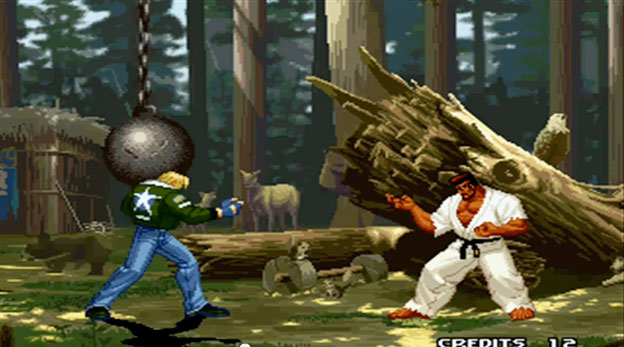
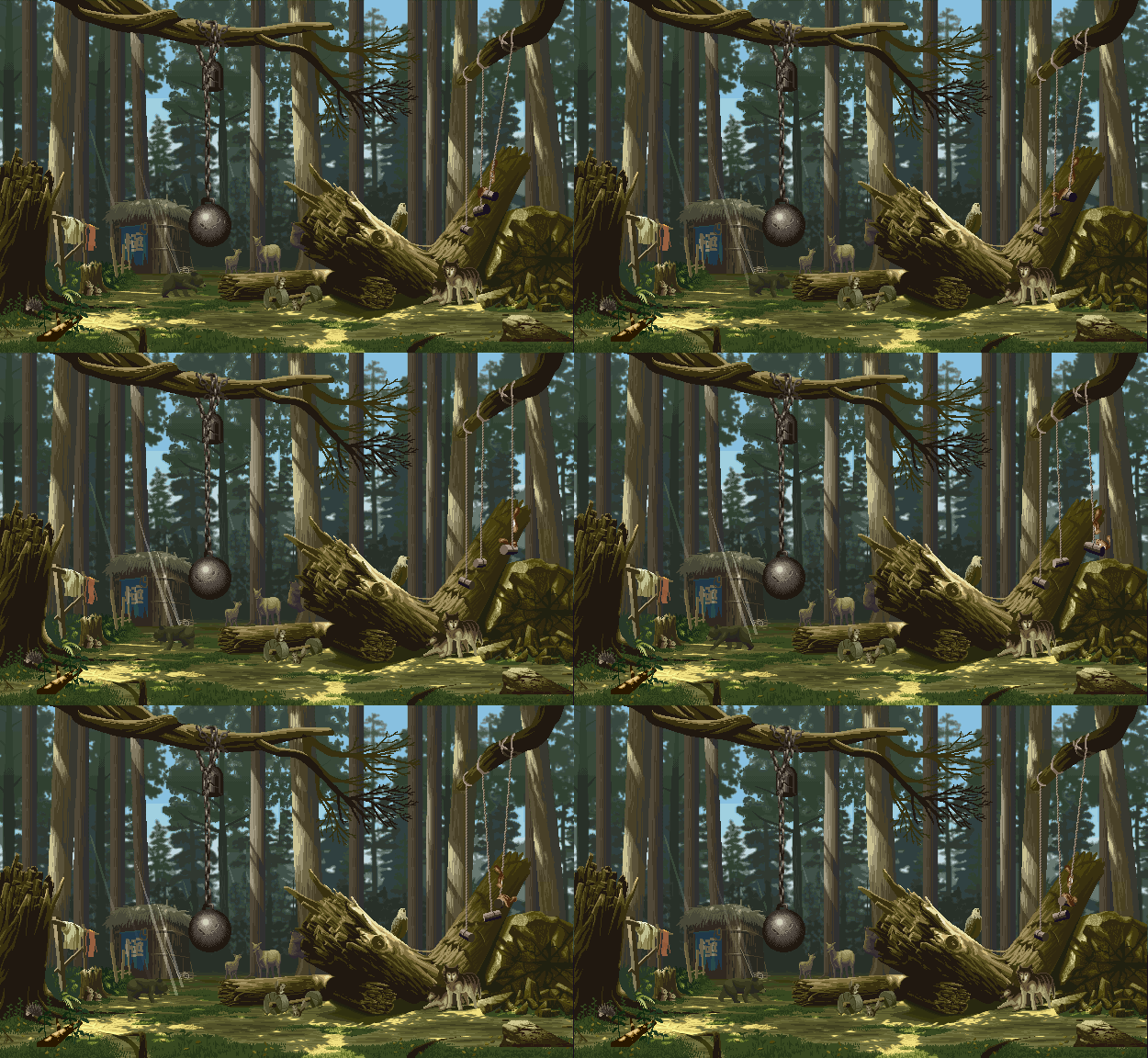
In the videogame however Marco was something else entirely. Just as Takuma Sakazaki was a super powerful version of Mas Oyama so too was Rodriguez when compared to Williams. There was a reason that Rodriguez was smirking and laughing at the characters in the KOF stage. He felt superior to them thanks to his hard training in Kyokugen. After all real men sparred with bears and lived off the land. His stage painted a clear picture as to his level of power. The man made a dumbbell out of boulders and used a wrecking ball as a punching bag. He even chopped down trees with his bare hands and feet. These weren't little trees either but giant hardwood trees that were wider than most cars. It was assumed that he had developed the level of power of Takuma, Ryo and Robert. This made him a perfect ambassador for Kyokugen in the Fatal Fury game and a fitting rival to Terry Bogard.
Marco was extremely passionate about the fighting art and vehemently defended it in the game. He was the ad campaign that the Sakazaki's needed to keep their gym alive. As much as he idolized Ryo he was probably not aware of the dark secret that Takuma was hiding. This complexity made Takuma and his fighting system very unique. His alter ego would be elevated to the status of major villain. With the mask on the character was ruthless in battle. He did not tire, did not suffer injuries and never seemed to age. Mr. Karate was the superior character in every regard. It was as if the mask had relieved Takuma of his responsibilities. He could put everything on the line because his children were safe. The person he fought knew nothing of the man behind the mask or his legacy. It was the same reason why superheroes wore a mask in Western comics, except instead of protecting innocent lives Mr. Karate was seeking out worthy opponents to destroy. While Takuma had an interesting life story he was the reason why I could not rank him higher in my list of greatest fighting game bosses. The character kept Mr. Karate grounded. Truly great villains had no family and held no allegiance. In fighting games this meant that the last man standing was the greatest fighter.
I would always consider Gouki to be the perfect fighting game boss because nothing held him back. Gouki had even made sure of that by killing his master and his brother. Zumbi had ditched Cobra and sold his soul to Macumba in order to become Zumbi Azul. Silber actively pursued the masters of fighting styles like a predator in nature stalking its prey. None of my top three had any regard for their opponents on themselves. Mr. Karate might be considered the greatest boss that ever appeared in an SNK game but he also had a weakness. Mr. Karate had an unbreakable will but Takuma Sakazaki's could still be bent by threatening the lives of his children. Silber did not have that going against him and that was why I ranked him higher.
What do you guys and girls think? Who would you consider the greatest fighting game bosses ever designed? I'd like to hear about it in the comments section. If you would like to sponsor me please visit my Patreon page and consider donating each month, even as little as $1 would help make better blogs and even podcasts!

The legend of Mr. Karate was what drew practitioners into Southtown, none of them was more important as a student and a character than Marco Rodriguez. This character was absent from my Coloring Perception series. I could not find a proper place to mention him with regards to black character designs in fighting games. Marco had one foot in the absurd design typical of many fighting game developers, yet he was not a clown. He had as many abilities and attacks as Takuma, Ryo, Robert or Yuri. It was his zest for the Kyokugen style that made him a standout. Rodriguez was not only the star pupil but also its biggest supporter. While the Sakazaki's were competing in the KOF tournaments, Buriki One tournament or chasing bad guys around in the Art of Fighting titles it had been Marco that kept the school alive, paid the bills, promoted the system. His eyes would well up with pride whenever he thought about Ryo and how much the school meant to him.

Marco had first appeared as a background character in Takuma's Art of Fighting (AoF) 2 stage. The designers never forgot him so when they redrew the stage for the King of Fighters XII they made sure to include his updated look with a pompadour and sideburns instead of braids. He was also sitting in the dojo laughing at the fighters, it said about the personality and the abilities of Rodriguez. Marco had first appeared as a playable character in Garou: Mark of the Wolves. It was notable because Marco was trained by Ryo and was the first Kyokugen fighter to appear in the Fatal Fury (FF) series. Released in 1999 Mark of the Wolves was the final game in the Fatal Fury series. Most fans of the SNK titles had wondered which star was the best fighter in the universe. Was it Ryo from the Art of Fighting or Terry Bogard from Fatal Fury? SNK would only tease gamers by saying that both universes were connected and even set within the same city and timeline. The boss character from Fatal Fury appeared as a boss in the Art of Fighting 2 yet none of the heroes ever crossed over until the original King of Fighters was released in 1994. However to fans it was a bit of a cop-out. The KOF series had mixed in a lot of other characters and changed the gameplay so that it was neither Fatal Fury nor the Art of Fighting. Both of the earlier games had a unique design aesthetic and control scheme. The sprites featured in the FF series were smaller with the gameplay being focused on allowed characters to jump between to or three different planes so that they could go around opponents. It was a precursor to the first 3D games. By comparison the AoF featured very large, highly detailed sprites and tried to capture a more realistic feel for the fighters. The characters could bruise and their clothes could even tear depending on how much damage the players sustained. Yet neither development team would allow for the stars from one title to appear on the other game.

Garou: Mark of the Wolves was the closest that the two universes would come together outside of the KOF. An older, stronger Terry Bogard was the star of the game yet there was one Kyokugen master in the game as well only it wasn't Ryo Sakazaki or Robert Garcia. Marco Rodriguez was a student of Ryo's and had committed himself completely to the art form. He was so dedicated in fact that he was living like a hermit in the nearby Sarah Forest, training in complete isolation in the same ways of the founder of Kyokugen. Marco had the same moves of the main AoF stars but the control and presentation was decidedly FF. It was a way to finally get both universes in one title without upsetting the rival fans.

Marco was an absolute zealot of the Kyokugen way. He even carried around a large wooden sign of the dojo whenever he fought. He was inspired by Willie Williams, a black US fighter that dedicated himself to the Kyokushin style back in '70s. He believed in the system with tremendous fervor and even moved to Japan to follow in the footsteps of Mas Oyama and train in many of the same places. In 1979 during second ever Kyokushin World Tournament, held in Tokyo Japan, Williams representing the USA competed and came in third. At the time it was the highest ranking for a non-Japanese and the record remained until 1987 when the Swiss-born Andy Hug came in second. In 1980 Williams fought Japanese wrestling icon Antonio Inoki in a highly publicized bout. Inoki had fought Muhammad Ali a few years prior to a draw in the pro wrestling vs boxing contest. This time he wanted to take on the massive American and see if karate was stronger than pro wrestling. The two battled for just over 5 minutes, the first half of which was mostly both men posturing and putting on a show but the last few were rough. This match also ended in a draw but Inoki would suffer from a broken rib and Williams from a broken arm. Williams would be kicked out of the organizing body of Kyokushin for participation in the fight.

Williams, like many people in the '60s and '70s, had become obsessed with Oyama's total karate system. The martial arts had exploded in popularity thanks to the kung-fu films of the Shaw Bros. and Bruce Lee. Westerners were eager to master these exotic arts and signed up for kung-fu, karate, judo and jujitsu classes. Those that stuck with the arts became some of the early masters outside of Japan. Marco was a caricature of Williams. The character not only trained like Takuma but he even lived like a hermit out in the woods in order to focus on just his training. At the start of his stage players actually got to see Rodriguez sparring with a bear dressed in a karate gi. It was a funny visual however players that were familiar with the legend of Mas Oyama remember that he had fought a bear during his many adventures. This encounter was retold in the Karate Baka Ichidai manga and animé series. The fight made the man a legend, yet to Willie Williams he saw it as a testament to Kyokushin. Williams was actually filmed sparring with a bear for the documentary "The Strongest Karate" which was a thinly veiled Kyokushin propaganda piece. Williams was tall and strong but even the 6' 7" man seemed hopelessly ill prepared to fight the bear. Most witnesses said that the bear seemed drugged and confused. Even in such a state the bear managed to throw aside Williams with ease and handily absorbed the punches and kicks from the karateka.

In the videogame however Marco was something else entirely. Just as Takuma Sakazaki was a super powerful version of Mas Oyama so too was Rodriguez when compared to Williams. There was a reason that Rodriguez was smirking and laughing at the characters in the KOF stage. He felt superior to them thanks to his hard training in Kyokugen. After all real men sparred with bears and lived off the land. His stage painted a clear picture as to his level of power. The man made a dumbbell out of boulders and used a wrecking ball as a punching bag. He even chopped down trees with his bare hands and feet. These weren't little trees either but giant hardwood trees that were wider than most cars. It was assumed that he had developed the level of power of Takuma, Ryo and Robert. This made him a perfect ambassador for Kyokugen in the Fatal Fury game and a fitting rival to Terry Bogard.

Marco was extremely passionate about the fighting art and vehemently defended it in the game. He was the ad campaign that the Sakazaki's needed to keep their gym alive. As much as he idolized Ryo he was probably not aware of the dark secret that Takuma was hiding. This complexity made Takuma and his fighting system very unique. His alter ego would be elevated to the status of major villain. With the mask on the character was ruthless in battle. He did not tire, did not suffer injuries and never seemed to age. Mr. Karate was the superior character in every regard. It was as if the mask had relieved Takuma of his responsibilities. He could put everything on the line because his children were safe. The person he fought knew nothing of the man behind the mask or his legacy. It was the same reason why superheroes wore a mask in Western comics, except instead of protecting innocent lives Mr. Karate was seeking out worthy opponents to destroy. While Takuma had an interesting life story he was the reason why I could not rank him higher in my list of greatest fighting game bosses. The character kept Mr. Karate grounded. Truly great villains had no family and held no allegiance. In fighting games this meant that the last man standing was the greatest fighter.
I would always consider Gouki to be the perfect fighting game boss because nothing held him back. Gouki had even made sure of that by killing his master and his brother. Zumbi had ditched Cobra and sold his soul to Macumba in order to become Zumbi Azul. Silber actively pursued the masters of fighting styles like a predator in nature stalking its prey. None of my top three had any regard for their opponents on themselves. Mr. Karate might be considered the greatest boss that ever appeared in an SNK game but he also had a weakness. Mr. Karate had an unbreakable will but Takuma Sakazaki's could still be bent by threatening the lives of his children. Silber did not have that going against him and that was why I ranked him higher.

What do you guys and girls think? Who would you consider the greatest fighting game bosses ever designed? I'd like to hear about it in the comments section. If you would like to sponsor me please visit my Patreon page and consider donating each month, even as little as $1 would help make better blogs and even podcasts!
Subscribe to:
Posts (Atom)