The character was actually teaser earlier, appearing in the visions of Ed. In her earlier debut she was listed only as a Fortune Teller. The connection between her and Ed was instant. I had mentioned previously that Ed was a return to Psycho Power. This was the mysterious psychic energy that powered Vega / the Dictator and allowed him to do things like fly, teleport and glowing orbs of psychic energy. The origins of this power were connected by a mystical person named Rose. She debuted in Street Fighter Zero / Alpha, which tied together the events that happened between Street Fighter, Final Fight and Street Fighter II. It looks like Menat is filling in that same role. Harrison said that Menat was the understudy of Rose. It made sense that Menat and Ed were connected. Rose and Vega also shared a psychic bond. This was explored in the various endings.

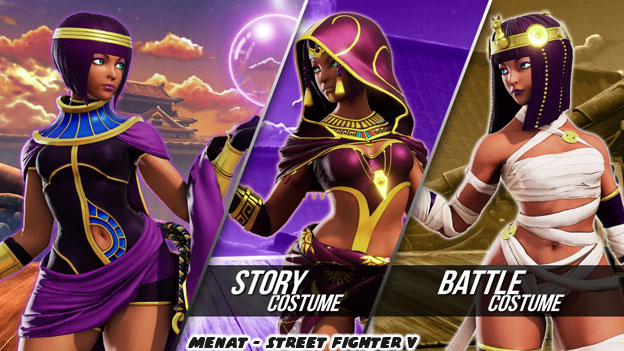
The moves and special abilities of Menat had a few things in common with Rose. She could reflect fireball attacks and even add energy to them to make them more powerful. Yet like Ed, she was her own unique character. Menat fought with a crystal ball, which she named Ankh. The Capcom designers called it a soul sphere, the name was based on the ancient Egyptian symbol which symbolized life. I didn't know if the crystal ball actually contained her soul, or was a conduit for her psychic powers. I suppose we'll find out shortly. There had been a few characters from the Middle East in the history of fighting games. Egyptian characters were not unique but they sometimes wore costumes that were more classical than contemporary.

I wouldn't say that Menat's default costume was daily wear for an Egyptian but her alternate costumes did seem eerily familiar. At worst the costumes could be considered culturally insensitive. I mean did Egyptians in the 21st century really wear mummy wraps? But more important than that, a lot of people have noticed that the alternate costumes looked like costumes worn by characters in other fighting games. Sadira for example was an assassin introduced in Killer Instinct. The fighting game from 2013 was a relaunch of a cult-classic Rare franchise. Sadira was inferred to be from the Middle East. The colors of her hood and patterns on her costume looked like traditional dress. Something inspired loosely by the bedleh, the light clothing worn by dancers. Sadira's uniform looked very much like the basis for Menat's costume. Then there was Eliza. This Pharaoh-themed character was introduced in Skullgirls Encore. The indy fighting game from 2014 pulled inspiration from dozens of different sources, including classic American cartoons and Japanese anime. Eliza was actually a design that was voted on by fans. The studio used Kickstarter to raise funds for new characters and Eliza was extremely popular in the voting. She really stood out when she was finally added. It was as if Cleopatra had become a fighter, her dress, Ankh symbol and crown were pulled from ancient history. And then apparently it looked like these things were poached by Capcom to be used for Menat as well. The similarities I think were too close for this to be more than coincidence.
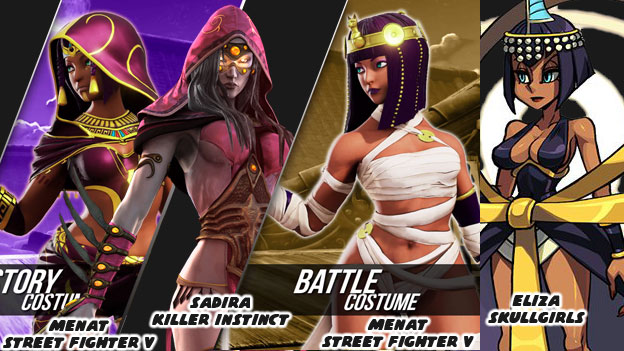
Poaching costumes from a rival studio was pretty low in my book. But then it might all be coincidence. The first time I saw the Fortune Teller / Menat the very first thing that stood out to me was the cut of her hair. Her look, her costume didn't immediately strike me as something that was featured in any contemporary game. Instead the hair, the colors and overall look actually reminded me of a few characters that Capcom had designed previously. The hair specifically reminded me of Claire, an officer in the Fourth Empire. She had a look that was inspired by medieval Spanish knights. She even fought with a plasma rapier. Plasma Sword: Nightmare of Bilstein came out in 1998. It was the sequel to Star Gladiator, a 1996 3D game, that was essentially Capcom's version of Star Wars as a fighting game. The sequel also introduced us to Luca, an alien fighter that was the fiance' of the alien Gore.
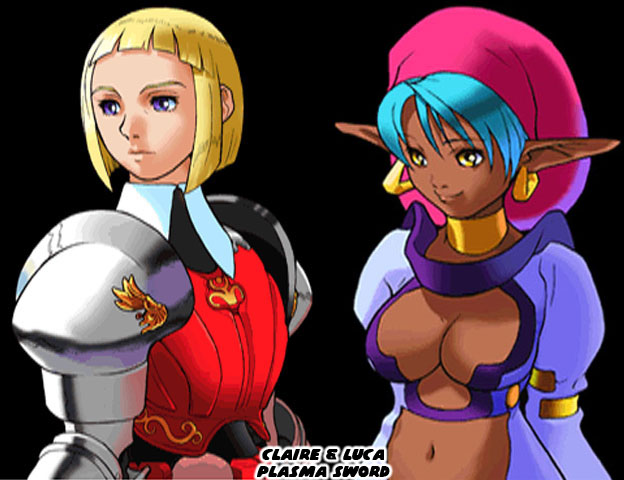
When I first saw Menat I thought that she was a sort of combination design of Claire and Luca. As if the designers revisited the notes on other fighters and tried to create something new. Also, seeing her bubbly personality reminded me of ARIKA's Pullum Purna. The youthful and energetic girl from the Arabian peninsula predated Menat by 20 years. It was hard to deny that Sadira and and Eliza also predated if not outright influenced Menat's design. What Capcom did right was in approaching her move set, her special abilities and connection to the past. Menat worked in part because she was reminiscent of Rose. Just as Ed reminded us of M. Bison and Vega, the Boxer and Dictator. But Menat was her own character, with her own special attacks, strategies and techniques. She would bridge the legacy designs and make a unique spot in the lineup.
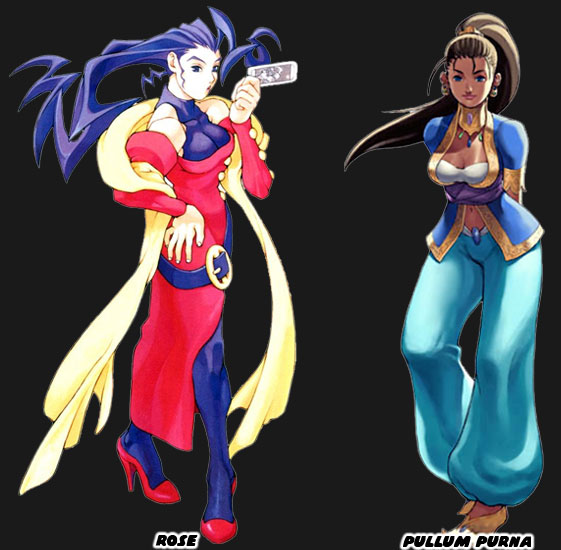
If you are an artist trying to crack the code of the Street Fighter designs just look at three of the newer characters introduced into the series. Juri, Ed and Menat were all inspired by previous characters, they were in essence mirroring legacy designs. Juri was like an evil version of Chun-Li. Ed was a hybrid of Vega and Bison. Menat was the fresh face. She was to Rose as Cammy was to Chun-Li. It was not a coincidence that audiences gravitated towards these characters. Whether they realized it or not Capcom was using the same design elements that brought people into the fold 30 years ago. You can't really say the same about Rufus, Hakan, F.A.N.G. or Necali could you? I'd like to hear your take on Menat. Do you like the character? Why do you think she does or doesn't work in the series. As always if you enjoyed this blog and would like to sponsor me please visit my Patreon page and consider donating each month, even as little as $1 would help make better blogs and even podcasts!