Showing posts with label zangief. Show all posts

Wednesday, May 20, 2026

Bookmark This Page; 30 years of Street Fighter, 30 Days of Characters

Street Fighter is my favorite fighting game series by a mile. If you want to learn about my favorite characters from the SF universe over the past 30+ years then Bookmark This Page.

30 Years of Street Fighter, 30 Days of Characters; #30

30 Years of Street Fighter, 30 Days of Characters; #29

30 Years of Street Fighter, 30 Days of Characters; #28

30 Years of Street Fighter, 30 Days of Characters; #27

30 Years of Street Fighter, 30 Days of Characters; #26

30 Years of Street Fighter, 30 Days of Characters; #25

30 Years of Street Fighter, 30 Days of Characters; #24

30 Years of Street Fighter, 30 Days of Characters; #23

30 Years of Street Fighter, 30 Days of Characters; #22

30 Years of Street Fighter, 30 Days of Characters; #21

30 Years of Street Fighter, 30 Days of Characters; #20

30 Years of Street Fighter, 30 Days of Characters; #19

30 Years of Street Fighter, 30 Days of Characters; #18

30 Years of Street Fighter, 30 Days of Characters; #17

30 Years of Street Fighter, 30 Days of Characters; #16

30 Years of Street Fighter, 30 Days of Characters; #15

30 Years of Street Fighter, 30 Days of Characters; #14

30 Years of Street Fighter, 30 Days of Characters; #13

30 Years of Street Fighter, 30 Days of Characters; #12

30 Years of Street Fighter, 30 Days of Characters; #11

30 Years of Street Fighter, 30 Days of Characters; #10

30 Years of Street Fighter, 30 Days of Characters; #9

30 Years of Street Fighter, 30 Days of Characters; #8

30 Years of Street Fighter, 30 Days of Characters; #7

30 Years of Street Fighter, 30 Days of Characters; #6

30 Years of Street Fighter, 30 Days of Characters; #5

30 Years of Street Fighter, 30 Days of Characters; #4

30 Years of Street Fighter, 30 Days of Characters; #3

30 Years of Street Fighter, 30 Days of Characters; #2

30 Years of Street Fighter, 30 Days of Characters; #1

Who is your favorite Street Fighter universe character? Tell me about it in the comments section. As always if you enjoyed this blog, and would like to sponsor me please visit my Patreon page and consider donating each month, even as little as $1 would help make better blogs and even podcasts!

follow the Street Writer on Patreon!

Wednesday, May 29, 2024

Clash Road and Ring King, early sport games to check out - A 1UP classic from July 31, 2012

Hello friends, hope you are having a good week so far. My back is killing me. I might have pulled something moving furniture this past weekend. Hopefully it will be better by next weekend as the missus and I will be painting a room. What have you been up to? Right now we're in the early days of the Olympics. What do you think so far? Did you like the opening ceremonies? Are there any sports you are following? For some reason I was thinking about cycle racing and one of my favorite cycle racing games.

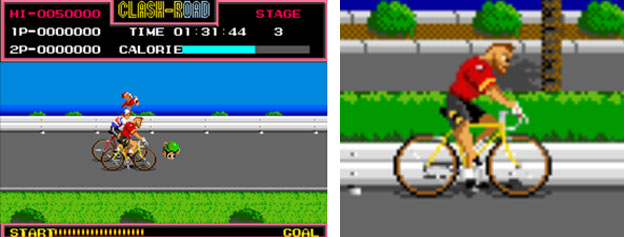
Chances are you've never heard of Clash Road, in all my years I've only seen the cabinet in the wild three times. Two in an arcade and one in a liquor store. The game was never ported over to the consoles as far as I can remember. It's a shame too, it's like the version of pro cycling that should be real and everyone should play! Players are riding in a no-holds-barred bike race. Despite the sponsor logos and authentic looking gear the bikers actually are allowed to punch each other and run opponents off the road. If I could describe the gameplay mechanics think of a mash up between the skateboarding section of T&C Surf Designs and Road Rash. Players have to worry about keeping pace and trying not to lose too much energy before the end of a race. The calorie count that each character has is like the fuel gage in most classic racing games. Players can get more energy by running down joggers, whom I guess give up their water bottles? The majority of the game is avoiding obstacles by jumping over them with a well timed bunny hop while backhanding rivals. Players can collect turtles with letters on their backs. If players spell out "Clash Road" they become temporarily invincible and can plow down opponents. I loved the nuance and control of the game. I would line up my bike with my rivals and then bunny hop right onto their back tire, sending them flying. Often times I didn't need to throw a punch as a simple jump could topple the toughest racer.

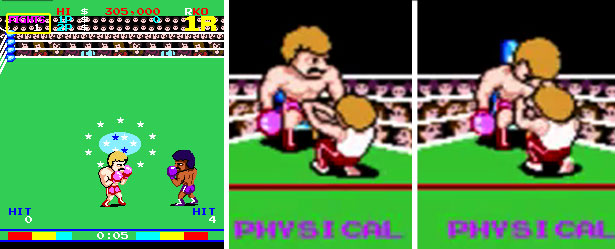
Clash Road was also the first game where I saw a burly fighter with a mohawk and beard. If I didn't know better this game was the first appearance of Zangief almost 8 years before Street Fighter II. However the title was not from Capcom but instead by a company known as Woodplace. That studio was perhaps better known for creating Ring King. It was a semi-popular arcade boxing game that was ported over to the NES by Data East. As far as fighting games went Ring King was a pretty good arcade title. There were some questionable elements in the game but these didn't become apparent until 1UP pointed them out in one of the funniest videos ever.

Woodplace managed to make bicycle road racing more masculine and violent than the actual sport yet they sort of did the opposite to boxing...

So those are the two sports type games that I wanted to mention during this Olympics period. I do think that isometric boxing was done better than Ring King however. Taito's Kageki came out in 1988 and was a more well-rounded fighting game with less questionable elements. Are there any sports games that you are playing during these few weeks? Tell me about them in the comments section.

As always if you would like to sponsor me please visit my Patreon page and consider donating each month, even as little as $1 would help make better blogs and even podcasts!
follow the Street Writer on Patreon!

Wednesday, October 11, 2023

Street Fighter 6: A master class in game design, final part

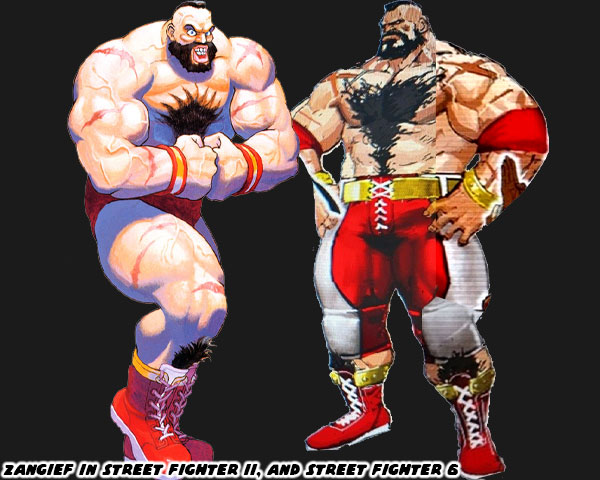
Street Fighter 6 Designer Yusuke Hashimoto had an impossible task. Update the look of the classic SF characters without causing an all-out riot with the fans. I did a quick take on all the leaked designs last year, like Zangief for example. Mr. Hashimoto had impeccable fashion sense, knew how to work with color, and use fabric, and layers to tell a story with costuming. He worked on Bayonetta, and Bayonetta 2 previously. Those games had some amazing designs, turning witches, demons, angels, and other religious figures into a dazzling runway fashion show but with guns, and cheeky humor. I would argue that he approached each SF character with a certain level of respect. He wouldn't be turning them into Bayonetta characters, but preserve their roots as best as he could while trying to update them a little. He might have asked himself what did they wear in a formal setting? What did they wear when they weren’t fighting? I believe that half the SF6 lineup were wearing casual outfits on purpose.

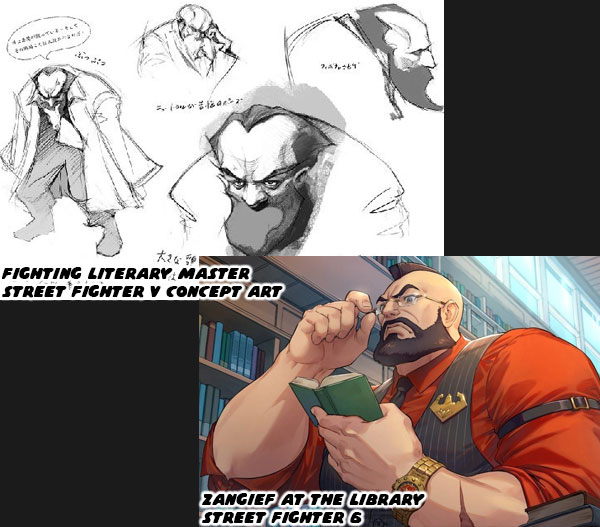
We wouldn’t expect Chun-Li to walk around the city wearing 30 lbs. spiked bracelets on each wrist, and wrestling boots. So she was given a very casual makeover that still looked like classic Chinese costuming. The same applied to Luke, Jamie, Kimberly, and the other new faces. They each had fight wear, and street wear as alternate costumes or vice-versa. Mr. Hashimoto had probably gone through the Capcom archives to see what some of the concept art was for each character, and even abandoned characters like the Fighting Literary Master that was in the planning stages of SFV. The bearded professor archetype would be easy to apply to the Red Cyclone. Presenting Zangief an intellectual when he wasn’t wrestling perfectly captured his personality. Zangief was absolutely dedicated to his craft. When he wasn’t training we could expect to find him learning new subjects with the same level of intensity. In the game he finished books faster than he finished reps in the weight room.

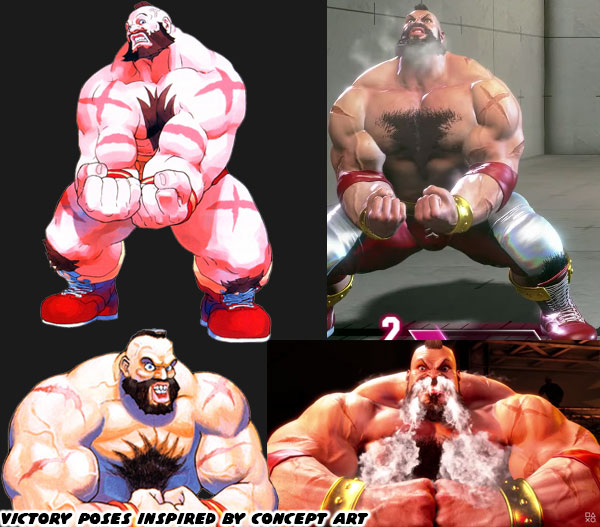
The animation team was as insightful as Mr. Hashimoto. They dug into the archives when modeling the cast. The studio used concept art to create taunts, and victory poses from. They captured an absurd amount tiny details for each character that either was missed, or never created in the first place. For example Zangief was known for being covered in scars. This was because he wrestled bears in the Siberian tundra. However all of his scars were only on his front. As a trained wrestler he never gave his back up to an opponent, and never ran from a conflict. In canon he actually had one scar on his back, but this was from taking an assassin’s bullet for the former president of the Soviet Union. I think it was only mentioned in a novel, and never illustrated in any manga. This tiny, insignificant detail was modeled, and skinned onto the character. As I said previously, the amount of work that went into SF6 was absurd.

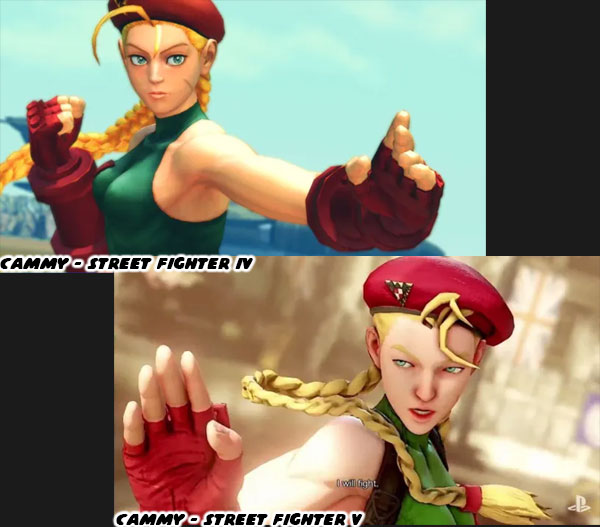
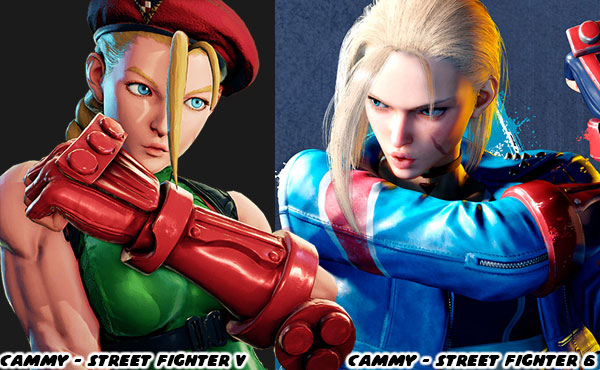
The SF6 art team also had to figure out what style, aesthetic, and proportions they were going to go with for the cast. One of the things that really made Japanese audiences upset was when the studio changed the look of Cammy between SFIV, and SFV. many Japanese gamers said Cammy looked ugly in Street Fighter V. They said the studio was trying to appeal more to European tastes, rather than keep her looking more like an anime character. I had covered the aesthetic debate previously on this blog. It was hard to make the visuals of a franchise stand out from the competition. Every now and then we would get a genius like BENGUS to create new looks for the character that were recreated in sprite form. The SFIV models were based on Daigo Iken's work, and SFV models were trying to use the BENGUS style. Unfortunately proportions that worked in 2D did not always work in 3D.

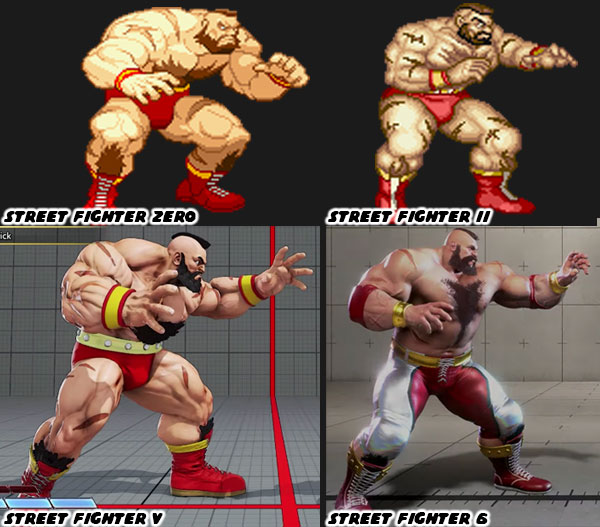
The models in SFIV, and SFV were getting bulkier, and bulkier, and it was hard to see relative heights between the fighters because they were so thick. Not to mention that the character models looked like they were made out of lumpy clay. The exaggerated BENGUS proportions that looked brilliant as sprites in Street Fighter Zero / Alpha were hard to recreate in 3D without making the characters look grotesque. The SF6 team went back to the more realistic proportions that AKIMAN, and Shoei used when designing the SFII lineup. These more lifelike designs were easier to read on screen, their moves, and animations flowed better, and the differences between fat, skinny, tall, and short body types really stood out.

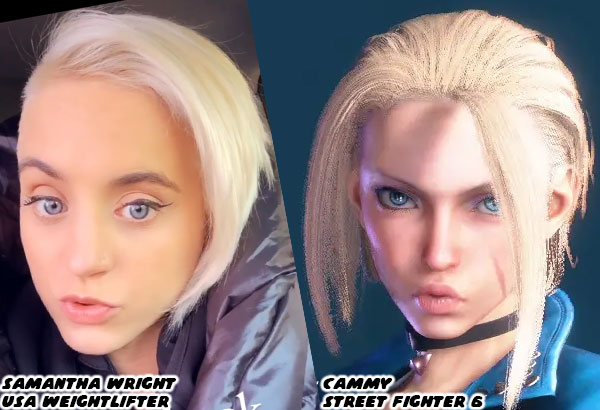
Cammy got a similar type of ground-up makeover. I don’t know what the average Japanese or global reaction was for the cast. Based on the fan art I’ve seen online it looked like people on both sides of the Pacific were really digging her new look. She still had a youthful appearance, but her eyes weren’t too big, or cartoonish like with Lily. Her muscular frame was still there, as was her love of cats. For anybody that believed athletic women couldn’t have her model looks I would argue that she might have been based on Team USA weightlifter Samantha Wright. Her bright eyes, soft features, and naturally pursed lips beguiled that she could easily out lift many men in the gym. It turned out that it was possible to find a balance between realistic, and stylized aesthetics for the cast. In this way it could be argued that the developers were able to strike a look that could appeal to international audiences.

In my book Capcom had knocked Street Fighter 6 out of the park. Every element that went into the game was influenced by 35 years of the Capcom legacy. We're not only talking about the Street Fighter franchise but also Final Fight, Rival Schools, Tech Romancer, Vampire / Darkstalkers, Star Gladiator, Muscle Bomber / Saturday Night Slam Masters, and Warzard / Red Earth. It also allowed players to enjoy more than a dozen classic arcade games in a virtual arcade open 24/7. The studio was making nods to anime, manga, wrestling, and pop culture all throughout the adventure. Capcom was doing all of this while pushing the franchise into the future. Character design, plot, music, sound, animation, modeling, balance, level design, stage layout, world building, control, and balance were executed to perfection. Capcom did the impossible. They elevated the fighting genre, and put it on par with the best AAA adventure titles. The games that took 30 or 40 hours to complete now had competition from a completely different format. We did not have to play as Link, Mario, Spider-Man, the One-Armed Wolf, Kratos, or any other named character. Instead we could make up our own avatar and become the hero of the Street Fighter universe. I do not think that any other studio could have pulled it off. At least not nearly as well. In fact I do not think that any other studio did anything more revolutionary for gaming in 2023. Street Fighter 6 was an absolute master class in game design.

I’ve spent the past three months on this blog showing the individual elements that when combined made for what I consider to be the game of the year. What more could I say to convince you? When voting opens up on the various forums, and websites later this year I sincerely hope that you consider Street Fighter 6 as the best of the lineup. Thank you for joining me on this series. I appreciate every view, share, and comment. I put a lot time, energy, and myself into this series. I'm exhausted, and will probably rest for a few months before writing something new. Thanks for watching me massacre the English sentence structure. I wouldn't have done it without you. If you are a long time fan of Final Fight, or Street Fighter then I would like to hear your impressions of SF6. If you have never played any game previously then tell me your experiences in the comments section please. As always if you would like to sponsor me please visit my Patreon page and consider donating each month, even as little as $1 would help make better blogs and even podcasts!
follow the Street Writer on Patreon!

Friday, June 24, 2022

The Red Tornado returns in Street Fighter 6, a look at Zangief.

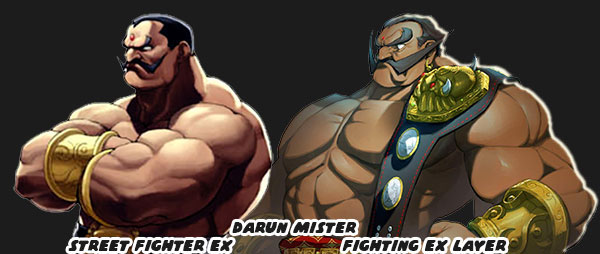
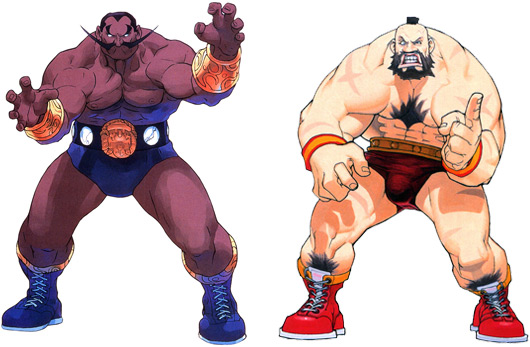
Today we’re going to look at Zangief, and his updated look in Street Fighter 6. For the most part very little was done with the character. He doesn’t seem to have aged much, if at all. There is no gray in his hair, or beard. Also he remains as massive as ever. The primary color associated with him remains red. In Street Fighter II he wore red trunks, and boots with gold trim. This time he is wearing red pants with white, and gold accents. Given his size these aren’t normal pro wrestler pants, but instead the kind worn by USA football players. They do incorporate kneepads as well. The only other changes made to him are the addition of red elbow pads, and the tape on his wrists have been replaced with gold bracelets. I’m kind of surprised at this stage in his career he isn’t presented with the Capcom Wrestling Association championship belt. Similar to the way Darun Mister wore his belts in Street Fighter EX, and Fighting EX Layer. All in all I think this redesign maintains the classic look that we’ve come to expect from the Red Tornado.

By now you should have noticed that not one returning character in the series is wearing their same costume. They may have similar color choices, like Zangief, or go with a different color scheme like Ken, but in either case nothing is exactly the same in this sequel. These are bold directions from Street Fighter 6 Director Takayuki Nakayama, Producer Kazuhiro Tsuchiya, and Designer Yusuke Hashimoto. Previously the studio did their best to incorporate as many details from the sprite-based versions featured in SFII when being adapted for 3D. Even “minor” details like Ryu having ragged edges on his gi, while Ken had hemmed edges were not overlooked by Yoshinori Ono, and the team working on Street Fighter IV. I am not on board with all of the changes that they have made, but I do appreciate the tweaks that they made to designs to make them stronger. Changing the cut of Rashid’s uniform, as well as the cut, and color choices for Juri were well done. Completely revising Luke helped make him look less like a nationalist.

What do you think of the decision to completely redo the costumes for everyone revealed so far? Was this a good idea? Are you eager to get DLC of the classic costumes if Capcom offers them? My friends, and family know that I love playing as Zangief in the game. I can't wait to see how the studio has updated his move set, and special attacks. Did you ever play any of the wrestling characters in the franchise? I’d like to read your thoughts in the comments section. If you would like to sponsor me please visit my Patreon page and consider donating each month, even as little as $1 would help make better blogs and even podcasts!
follow the Street Writer on Patreon!

Sunday, June 24, 2018

30 years of Street Fighter: 30 years of Characters #7


Darun Mister is one of the great all-time grapplers in the Street Fighter universe. He debuted more than 20 years ago in Street Fighter EX. I've already talked about Victor Ortega, the pro wrestling heavyweight champion in the Street Fighter universe. Victor dominated the competition and retired undefeated. He resurfaced years later to test out the next generation of pro wrestlers. I've also talked about the Wraith, one of the more obscure, and macabre pro wrestlers in the Street Fighter universe. Both Ortega and the Wraith were gigantic and fearsome grapplers. But neither, at least not to the best of my knowledge, have ever faced Darun Mister in or out of the ring. Darun is the Indra (Indian) wrestling champion. His championship belt is among the greatest ever designed for a game. I mean just look at the gold, silver and ruby-encrusted elephant on the belt! He dominated the competition in South Asia as much as Ortega had around the world. He also served as the personal bodyguard for Pullum Purna. The duo traveled the globe fighting other champions during the EX tournament. 


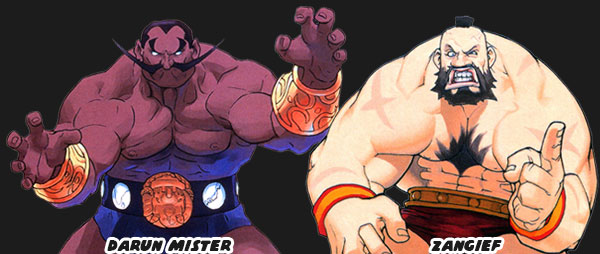
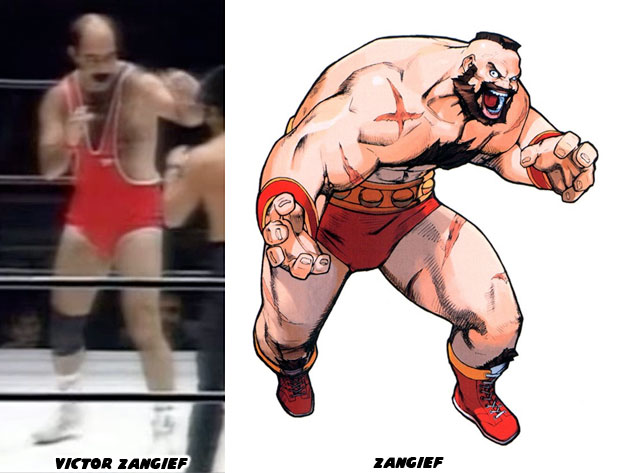
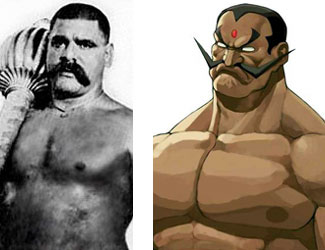
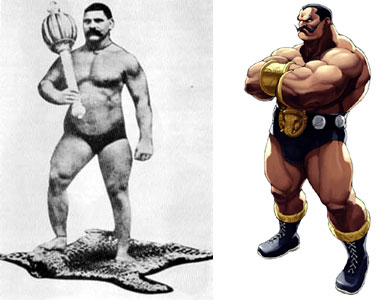
Darun was such an exceptional grappler that he actively sought out masters of other disciplines. When he was defeated by the demon Garuda he swore to return stronger for a rematch. Just a reminder that Garuda killed his opponents but Darun was simply too tough to die. If the story of Darun rings a bell it's because he is a second-take on the character Zangief. The Red Cyclone set a standard that was pretty tough to beat in the Street Fighter series. The team at ARIKA had a hand in developing the original Street Fighter II cast, so when they created the EX series they made parallels in their fighting lineup. Darun was beat-for-beat a counter to Zangief and was destined to be his rival in canon. Believe it or don't Zangief was inspired in part by an actual wrestler named Victor Zangief that the Capcom crew saw on TV. I mentioned previously that Victor Ortega was inspired by wrestlers like Superstar Billy Graham and Hulk Hogan. The Wraith was inspired by The Undertaker and even Darun was based in reality. The Great Gama was a turn-of-the-century wrestling legend from India that sought out and beat the European champions. He was celebrated as a hero in his home country and was a perfect template to rival the burly Russian.  


More than a hundred years has passed since the Great Gama was in his prime. The good news is that Darun Mister will always be in peak physical condition and looking for opponents to mangle. I enjoyed playing as the character in Street Fighter EX and look forward to his return in Fighting EX Layer. Today we celebrate this legend. Do you have a favorite Street Fighter wrestler? If so tell me in the comments section. As always if you enjoyed this blog and would like to sponsor me please visit my Patreon page and consider donating each month, even as little as $1 would help make better blogs and even podcasts!
 follow the Street Writer on Patreon!

Tuesday, August 1, 2017

A look at the big man, where did the Capcom giants come from? Part 2...

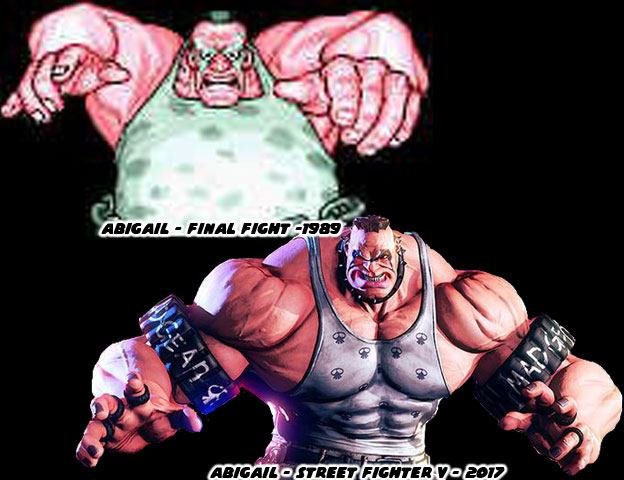
Abigail, a character introduced in Season 2 of Street Fighter V had originally appeared in Final Fight, an arcade hit from 1989. The character was a boss in Mad Gear gang, a group made up of the biggest, meanest criminals from Metro City. Abigail was gigantic, even by Final Fight standards which had many characters above 6 and 7-feet in height. In the Street Fighter universe, where the Final Fight story took place in, he was listed at 8' tall and 584 lbs. He was the largest figure in the series and among the largest human character in any fighting game. The tradition of over-sized, muscular characters in fighting games went back to the start of the genre. The third boss in the 1984 Irem classic Kung Fu Master was a dark skinned character named Giant, he was a full head and shoulders taller than Thomas the hero. The trope of gigantic villains in a fighting game really took off however with the cast featured in the Technos series Double Dragon. There were massive villains in the original and sequel; named Burnov, Bolo, Oharra and Abore. They were capable of lifting players up with one hand and even punching down walls with their bare fists. The bad guy that audiences remember most was a bodybuilder-type character called Abobo.


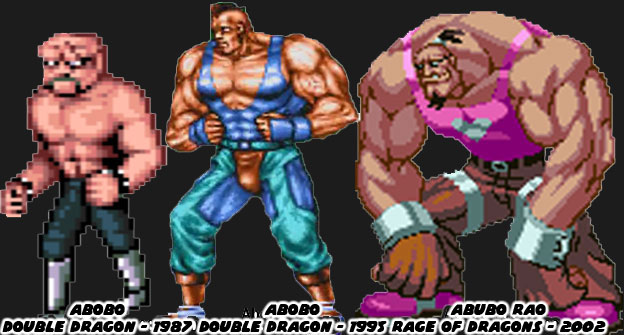
Abobo actually changed during the various sequels and remakes of the series. He was a generic bruiser in the original 1987 game. His face paint and spiked wrist guards made him appear like a heel or bad guy wrestler. Abobo was far more fleshed out when the studio created a 2D fighting game in 1995. This newer version of Abobo was more proportional to the rest of the cast and was officially listed at 7' 2" and 336 lbs. He was still huge but nowhere near as big as the character's final appearance. In 2002 the Mexican developer EVOGA created an unlicensed Double Dragon game, which they called Rage of the Dragons, an homage to the series. They avoided legal issues by slightly changing the names of the main characters. The bruiser in this game was called Abubo instead of Abobo. This character was on the absolute extreme end of character designs. He was now 8-feet tall, actually 8.03, and 640 lbs. making him a fraction bigger than Abigail. His arms were so huge that they hung to the ground. This type of large upper half / small lower half character designs had actually evolved through the '90s and were almost commonplace post 2000. I had written a history of these "top heavy" designs when Gigas was introduced in Tekken 7. Abubo and Abobo had set a standard, or rather limit, on what worked when it came to fighting character designs. Believe it or not in the '95 version of Double Dragon the character could grow even larger and more muscular.


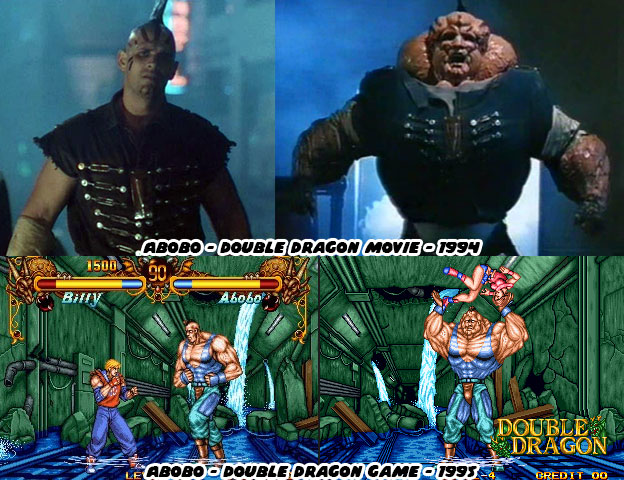
The "transforming" version of Abobo and the updated cast were based on the 1994 Double Dragon film. In the movie Abobo was a typical punk bad guy. He was already big and dumb but Koga Shuko, the main villain in the film, turned him into a mutated freak for failing to recover an artifact. This weirdly swollen character had muscles where muscles didn't exist. He was literally swollen where his glands, bones, cartridge and neck should have been. The absurdity of his updated look was incorporated into the game where he could temporarily "buff up" while performing certain moves. The movie was absolutely horrid and had nothing in common with the game, except for the names of the characters. It was the first and hopefully last film directed by James Yukich, whom had probably never even played the title. Interestingly enough the story was co-written by Paul Dini (The Batman Animated Series and co-creator of Harley Quinn) who has been one of the greatest comic and cartoon writers of a generation. I guess something was lost in translation when the screenwriters adapted his story. But I digress, character transformations were not a new idea in games, cartoons or comics. The Incredible Hulk for example turned from a small scientist into a thousand-pound green skinned monster. A more contemporary version of the transforming villain was seen with the character Bane.


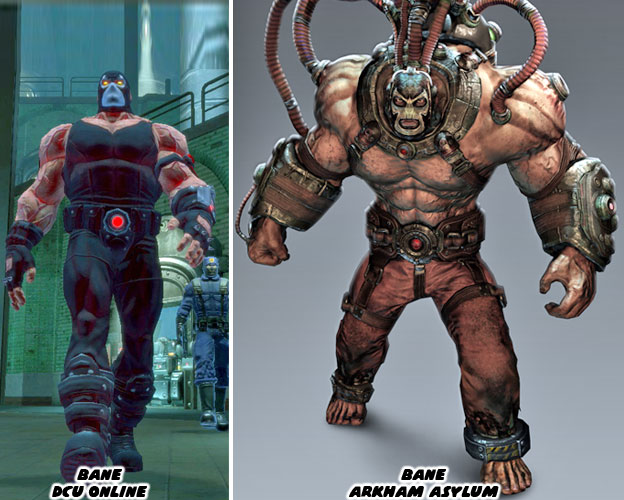
Bane debuted as a Batman villain in 1993. He was an assassin that was trained in the fighting arts and was a perfect rival to Batman. The thing that made him a superior opponent was a synthetic drug, similar to adrenaline, called Venom. It increased his speed, reflexes, strength and durability. He could turn on a pump filled with Venom whenever he wanted to boost his fighting prowess. When the character originally appeared he was muscular but realistic. He had a bodybuilder physique and was not as deformed as Abobo. A really good 3D representation of his original design appeared in DCU Online, the DC Comics online multiplayer game (MMO). However as comic book aesthetics changed, and as different writers and artists took over, the look and purpose of Bane changed as well. In less than 20 years he went from a realistic physique to a grossly disproportionate one. To see how far the character had changed look at the version that was featured in the Batman Arkham games. This new Bane had a gross physique. Not only that but every iteration of Bane seemed to become dumber and dumber. It wasn't long until he was nothing more than a typical brute that used his muscles rather than technique to beat people. Abigail was sliding into modern Bane territory but for over 30 years the designers at Capcom managed to avoid this trope. How did they do it?


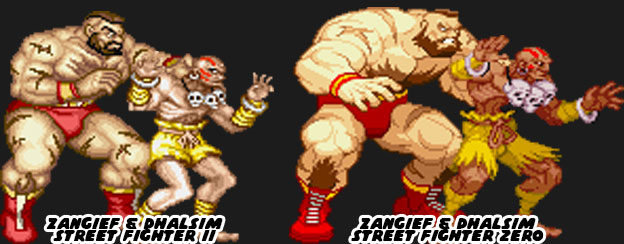
Capcom developed a template copied hundreds of times over. The idea for Street Fighter was simple, different martial arts masters fighting against each other to prove who was the best. The designers created a library of characters that reflected different nationalities and by default the different fighting arts. One of the reasons the series stood out was because of how unique the character designs looked compared to other games. The artists at Capcom, people like AKIMAN, Shoei and SENSEI created figures that were not quite manga, not quite anime, and not even comic book in appearance. They were instead something in between the Japanese and USA aesthetics. These archetypes worked incredibly well and they helped launch a franchise. The characters were diverse in size, color and body type. Their appearance helped reinforce a particular fighting style. These basic concepts were used and expanded upon by other studios as well. Look at a character like Dhalsim, a slender Yoga practitioner that stood 5' 9" and weighed about 100 lbs. Compare him to the burly Zangief, a 7-foot 400 lbs wrestler. In Street Fighter II the characters had good contrast. When the studio created a new sequel they went with a different designer. Bengus wanted to keep the scale of the characters similar but he used artistic license to exaggerate their proportions. Zangief and Dhalsim had the same height difference in Street Fighter Zero, but Bengus made Zangief much wider, especially on his shoulders, arms and back. He also cut Dhalsim's waist in half, making him even more gaunt. This contrast was more profound. It looked fantastic on screen but did not break the scale of the franchise. The exaggerated proportions ended up influencing a generation of game designers in Japan and even comic book artists in the USA.


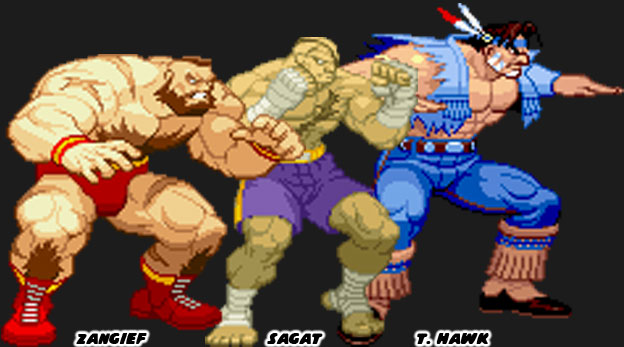
The proportions developed by Bengus were used by Edayan, Kinu and Ikeno in the other Capcom games from that era. In doing so the giant characters appeared far more menacing when compared to the rest of the lineup. The Street Fighter library had always worked within a certain range of body types. Every character had to be muscular, the sumo wrestler E. Honda had an enormous belly but his arms and chest were well defined. Dhalsim was thin but his muscles had definition as well. As the characters got taller they preserved those same basic rules. Zangief was considered a standard for giant characters in the series but that concept was flexible. Sagat was 7' 4", a few inches taller and slightly leaner than Zangief. Sagat was the original boss in Street Fighter and was a character of distinction in both Street Fighter II and Street Fighter Zero. He stood a head above every other character and did a great job of capturing the boss feel. Yet even Sagat would be replaced as the biggest fighter. T. Hawk was a native character, at 7' 7" he was on the edge of the character sizes that worked within the continuity of the series. Moreover his height was about the limit for any giant character in a fighter. There was actually some real world precedence for this.


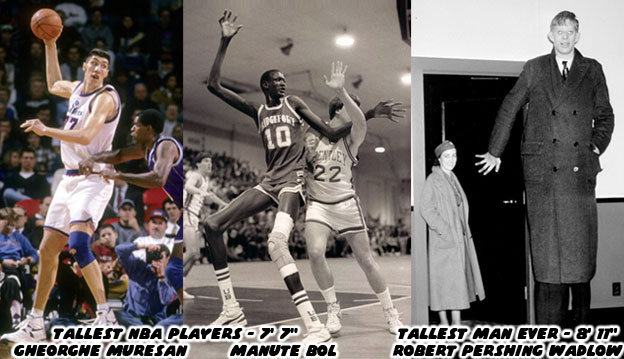
Professional NBA basketball players were 6' 7" on average with centers being around 6' 10" to 6' 11". Teams were constantly on the hunt for athletic 7-footers. These people represented less than .00004% of the population, and an even smaller fraction of those were healthy and coordinated enough to play at a professional level. The tallest of these men were Shawn Bradley standing 7' 6", Manute Bol at 7' 7" and Gheorghe Muresan also at 7' 7". Think about how imposing it was for T. Hawk to be created at the same height as the biggest NBA players. When you saw these players on TV the height differences between someone 6' 6" and 6' 10" looked much greater. Keep height to weight ratio in mind. A bulky tall person did not appear as tall as a lean person at the same height. Most basketball players were lean because it allowed them greater flexibility and speed. On television thinner people looked much taller than their opponents even though the actual height difference was only an inch or two. In a sport like American football tall players were very muscular. Because of this it was harder to spot the height differences on television.

Most fighting games have characters with a similar height to weight ratio. When you look at the height differences between Zangief, Sagat and T. Hawk it doesn't seem like much. Now think about Abigail. At 8 feet his height was very rare but not impossible. There had been taller people in history. The tallest that ever lived, Robert Pershing Wadlow was 8' 11". He would have broken the 9-foot barrier if an infection and compromised immune system didn't end his life at the age of 22. What made Abigail so awkward in appearance was his weight. The character was extremely muscular, almost to the inflated Bane or Abobo proportions. In the original Final Fight Abigail was shaped more like a professional strongman, with a wide gut, rather than a trim bodybuilder physique. This was actually very believable as there were many strongmen and wrestlers throughout history that were tall with that same body type.


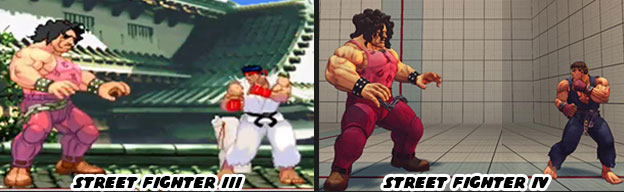
The designers at Capcom went overboard with the muscular physiques in Street Fighter IV. I believe it was because the artists were reacting to the trends in Western character designs which favored overly-muscular characters. Look at how big comic book characters were today. When presented as 3D models rather than 2D sprites the extra bulk made the height seem less dramatic. In order to make the differences more noticeable the model heights were exaggerated ever so slightly. Many players did not pick up on the new sizes. When the characters were far apart on the screen most people couldn't tell that the scale was different. But as they got closer it became obvious. Take the character Hugo for example. The original version featured in Street Fighter III Giant Attack was an updated version of the classic Final Fight character. His height was astounding but proportional to the rest of the cast. Fans of the Final Fight series, and those that remember his cameos in the Street Fighter Zero / Alpha series remember how massive he was and therefor his sprite worked. When the character was created in 3D for Street Fighter IV and also for Street Fighter X Tekken he became bulkier and taller. Players really noticed this change when the character model was close to an opponent.


Abigail was absurdly huge. He looked as wide as he was tall, dwarfing Zangief and the other large characters in the process. He didn't seem to have the same proportions as Hugo or the other giants. That is to say he was missing his neck and shoulders. This made him look cartoonish in appearance. None of the other characters had the same type of physiology. The addition of car tires around his biceps and belt made little to no sense. I understand they were part of his new personae as a scrap yard owner but they were not part of his original costume. The most jarring thing about Abigail's appearance in Street Fighter V was his personality. Abigail went from high-ranking Mad Gear boss, with a genuine fighting ability to an idiot. He retained his temper from Final Fight but everything else was made up. It was embarrassing watching him putting around and making car noises in his introduction and story mode. Both Street Fighter IV and V had played up the silliness of certain characters while making others seem terrifying. Rufus, Hakan, Birdie and F.A.N.G were some of the other goofy / awkward characters added to the series. The director and producer of the series were certainly playing favorites with the cast. I wondered if the studio created a moronic Abigail to make fun of USA fighting game designs. They had given us a mindless Bane because apparently that's what we thought all strong characters should be like. The studio hadn't always treated their giant characters so poorly. In fact they used to treat their legacy characters with a lot more consideration. We'll look at the ways they used to present giants in the next blog. As always if you enjoyed this blog and would like to sponsor me please visit my Patreon page and consider donating each month, even as little as $1 would help make better blogs and even podcasts!

 follow the Street Writer on Patreon!

Wednesday, September 2, 2015

How fight culture became fighting game history, part 28

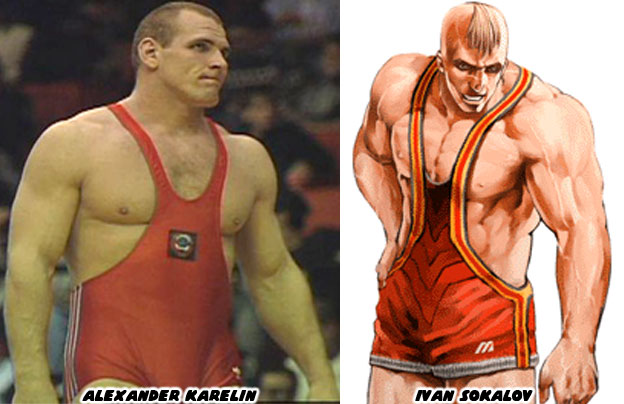
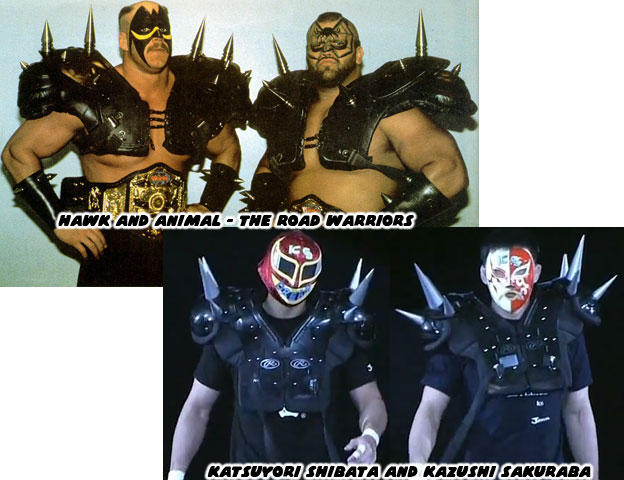
Buriki One was released by SNK in 1999. The game tried to capture the spirit of the early MMA competitions. To help ground the game in reality none of the characters could throw fireball-like projectiles. It also featured character designs that were inspired by actual fighters. Royce Gracie had influenced the development of Jacques Ducalis and Kazushi Sakuraba had influenced Tendo Gai. Those weren't the only high-profile athletes whose fingerprints were in the game. Multi Olympic and World Gold Medalist Alexander Karelin influenced the inclusion of Ivan Sokalov. At his peak Alexander was considered the most dangerous man on the planet. More than a decade had gone without a defeat in international competition, and not only that but during that time an opponent could not manage to score a point off of him. He had a list of incredible statistics that would make him a shoe-in for the pantheon of wrestling Gods. Possibly his most outstanding accomplishment was that he would routinely pick opponents off of the mat and flip them upside down in the air. These were men weighing almost 300 lbs and most of that solid muscle, they would kick, squirm and flail and still they would be tossed like rag dolls. it was something not seen before or since Karelin. Yet since he was not a striker then most people did not know about his legacy or his contribution to the fighting arts.


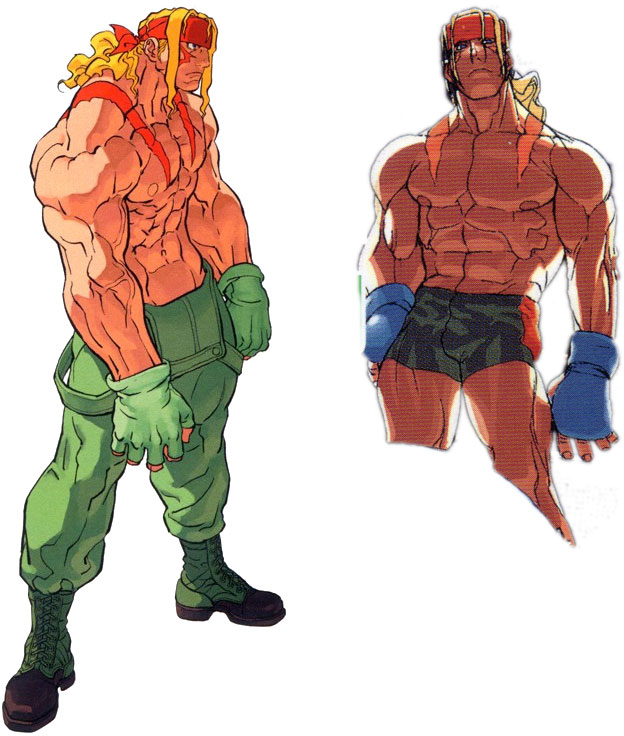
Rival studio Capcom had actually incorporated an MMA fighter years before Gai. Instead of basing a character on real world fighters Capcom invented their own legend. This was one thing that Capcom did better than any other studio. They took cues from various fighting arts and real legends and adapted them into new and refreshing designs. In 1997 they introduced the world to the star of Street Fighter III. The first of the "New Generation" fighters was named Alex.

In keeping with tradition the studio had to tell a story through the design of the character. They made Alex tall and incredibly muscular. His costume had to show off enough skin to highlight his massive frame, as well as two massive scars that ran under his eyes and down his shoulders. His clothing consisted of fingerless gloves, a pair of green overalls and green combat boots. Street Fighter characters had typically been assigned a primary color to help them stand out in a lineup. Chun-Li wore blue, Ken wore red and Ryu wore white for example. A large red bandanna kept Alex's long hair out of his face. Designer Kinu Nishimura had considered placing him in the more traditional MMA uniform. However it was not believable that a half naked person wearing only shorts and sparring gloves would have been able to wander from town to town without drawing the attention of local authorities.


Alex was in essence a new fighter that was following in the traditions of Ryu. The red bandana was partially an homage to Ryu as well as his mentor Tom. Instead of traveling from place to place fighting the masters of the martial arts he was learning from them. Alex wanted to be the best fighter the world had ever known so that he could get revenge on a powerful Illuminati leader named Gill.
The fighting style given to Alex was unique for SF characters yet also eerily familiar. Capcom wanted to make it very obvious who his fighting influences had been. Unlike Ken and Ryu who shared a similar form of karate or any of the Kung-Fu fighters, Alex had strikes and special attacks that crossed the spectrum of schools. The attacks were meant to remind players of older characters.


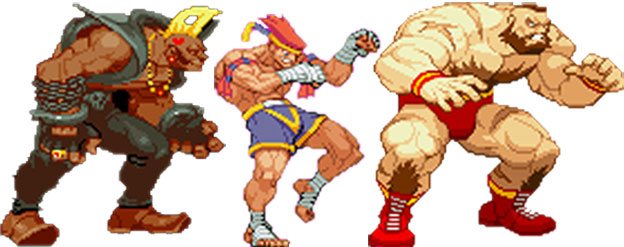
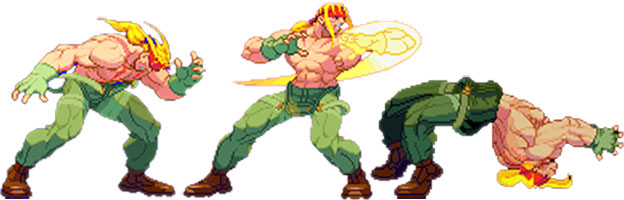
Long time fans of the series could pick out the moves that Alex had learned and who he had learned them from. He had the scrappy street brawling style of Birdie from the original Street Fighter and Street Fighter Alpha. From Birdie he also picked up a dangerous headbutt strike. Alex had a flurry of vicious elbow strikes that could only come from a master of muay thai. However he did not have the knees or kicks of Sagat so the flashy elbows were undoubtedly from Adon, the understudy. Adon was also from the original Street Fighter and Street Fighter Alpha. The grappling moves, throws and rolling German suplex attacks could have only come from the Russian Zangief.

Capcom managed to create a character that was textbook MMA, as in he had bits and pieces of very effective systems, and combined them into his own form. By not making him look like any fighter living or dead they would not date themselves to a particular era. Overalls and combat boots could be found in any time of the modern world yet could have also worked a century ago. Some of the fighters featured in Buriki One were based on real people and thus marked a particular era. By 2013 most of the original fighters from Pride and K1 had retired from competition and some of the promotions that hosted early MMA tournaments had closed as well.


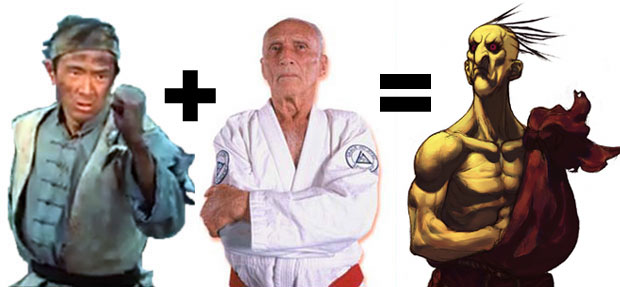
To be fair Capcom had also inserted a character that looked eerily similar to a certain BJJ master. The character of Oro was an ancient fighter that was looking for a worthy understudy. He was so powerful that he would only use one arm in combat. That was all he needed too! He could choke out opponents and even throw them effortlessly with his single arm. Oro had been influenced in part by the One Armed Boxer, a character created by Jimmy Wang Yu, but his physical appearance was very much based on Helio Gracie. That was if Helio were 140-years-old and had lived in a cave for the past half century. The arm tucked into his gi was also a nod to the toughness of Helio and his refusal to ever tap out.


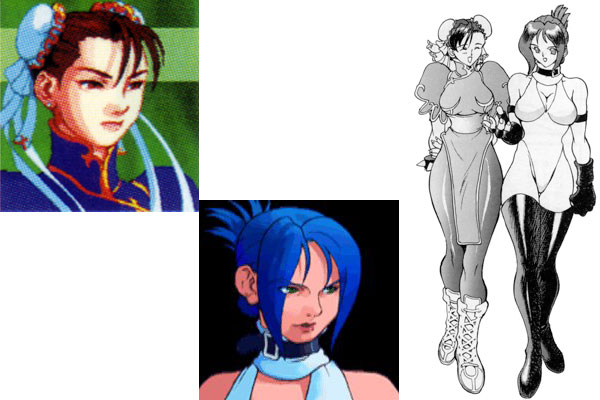
Capcom had actually featured a different MMA fighter earlier. A year before Street Fighter III was released the character Blair Dame appeared in Street Fighter EX. The game was rendered in 3D rather than 2D as Street Fighter had traditionally been done. Blair had a number of strikes, takedowns and bone-breaking locks that she could use in rapid succession. Yet despite this few people acknowledged the contribution of the EX designs even though they were done by current and former Capcom employees.


Additionally ARIKA held the rights to the EX characters so most did not recognize the first lady of MMA in a Street Fighter game. A decade after Street Fighter III was released Capcom returned for a sequel. One of the bruisers they introduced in Street Fighter IV was modeled after the God of heavyweight MMA fighters.

Unfortunately audiences in the west had made up their minds as to the authenticity of wrestling and wrestlers. To them only boxing or karate were real fighting arts and any wrestler trying to convince the public otherwise was looking for a big payday. This perception only grew through the 80's and 90's as gimmick gave way to attitude and wrestling shows began to be scripted by Hollywood writers. This shift began to polarize the audience and those that grew up on a steady diet of wrestling were looking for something more genuine. By this time Japan was going through a mixed martial arts renaissance.


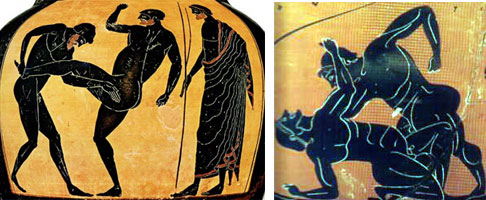
The MMA concept has actually been around for thousands of years in one format or another. Not content with being one of the first cultures to establish both wrestling and boxing the Greeks also developed pankration which was a hybrid of the two. It was the closest thing to no-holds-barred fighting. The modern world would rediscover this type of combat and package it with all the spectacle of pro wrestling, with pyrotechnics, ring girls and hyped match-ups. The K-1 Grand Prix and Pride Tournaments were becoming very popular.

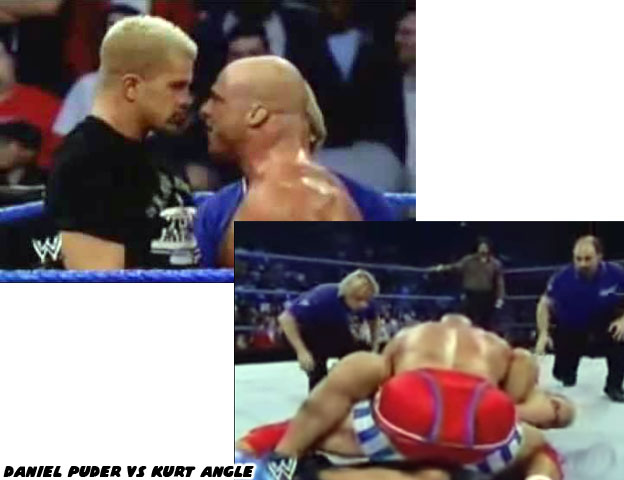
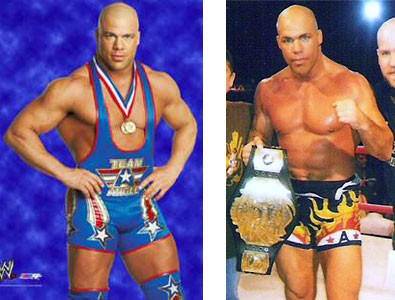
The US was slow on adopting the format as the UFC and King of the Cage tournaments followed at a slower pace. Young grapplers, eager to show their skills and become television superstars were more than willing to try out for reality shows like WWE's "Tough Enough." One of the challenges had hopefuls taking on Olympic gold medalist and WWE superstar Kurt Angle in a wrestling match. To ensure that Angle looked unbeatable the challengers were forced to do wind sprints and other exercises for an hour before accepting Angle's test. The organizers assumed that the activity would tire them out and they wouldn't be able to put up a decent fight. The opposite turned out to be true.


Daniel Puder was trained in various martial arts and had already competed in UFC matches before auditioning for Tough Enough. He was eager to fight Angle and give the audience a taste of some real fighting. In the video you can clearly hear the fans cheering on Puder with chants of "UFC." Angle did not dominate the match as management had hoped and was angered at being shown-up on national television. A rift between the entertainment product, the audience and the wrestlers had grown tremendously on that night. Rather than embrace the MMA community and audience WWE instead went out of their way to downplay and humiliate Puder for his efforts. Fans of the sport argued that WWE management had no idea what the audience was looking for and should have capitalized on the rivalry between Angle and Puder, between wrestling and MMA.

Angle was furious for several reasons. Had the hold Puder put on Angle lasted a few more seconds he would have separated Angle's arm from his shoulder. Severely injuring the star wrestler of a company you are trying to get a contract with is not only bad for business but it also made Puder look selfish and reckless with his skills. This was also a severe blow to Angle's ego. Angle had won a gold medal competing in the 1996 Olympics in Atlanta, as he likes to remind people, "with a broken frickin' neck." So Angle had genuine wrestling skills and in a competition under greco-roman wrestling or freestyle wrestling he would have outclassed Puder. Unfortunately he was not well versed in the trappings of jujitsu and could not have foreseen that Puder would try to get him in a submission move. It was probably Angle's pride that took the biggest hit.


Over the next few years many pro wrestlers would begin adopting submission moves into their repertoire. The "Dead Man" character the Undertaker even adopted the gogoplata jujitsu submission move to make him more fearful. Even without formally saying anything about the contribution of mixed martial arts, the wrestlers were slowly taking on more of their cues in an attempt to broaden their appeal. None more so than Angle. After leaving the WWE Angle maintained his wrestler gimmick a while longer before slowly changing his look to more of a MMA fighter. He ditched the stars and stripes wrestling suit and boots in favor of shorts and taped up hands and feet. Without saying he had renounced wrestling it was easy to see that Angle had taken on the guise of MMA fighter to appeal more to the fans.


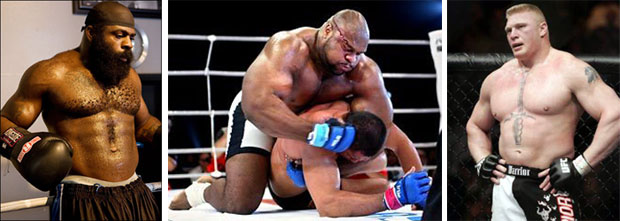
This part of the draw of modern mixed martial arts. The reason why it, above all of the combat sports, has been growing in popularity around the world. Many fighters hungry for fame and fortune began seeing the sport as a way to reach the top. To achieve what we call the "American Dream." Beating the snot out of people is appealing in and of itself for the majority of the fighters. However the challenge is more than being able to dish out the hits but to be able to take them as well. You would think that burly guys would reign supreme in the culture. Several strongmen have tried their hand at the sport. Bouncers, professional football players and yes indeed, champion wrestlers like Brock Lesnar have all stepped into the cage. The results have been varied. It seems that it takes more than brute force to be a successful MMA fighter.


The best, or at least longest-lived MMA fighters were more than gifted athletes or strongmen. They proved their dominance by learning to adapt and build on the legacy of several martial arts. The angles exploited by boxers, the punishing strikes of karate, the close work of muay thai, the grappling of judo and jujitsu and even the mat skills of wrestling. As the name implies, these fighters practice under a mixed bag of martial arts. Some of them were better on the mat and some were better strikers on their feet, very rarely would we find fighters that could do both well. It would make sense that the brutal art would find favor in the most recent fighting game sequels.

Even with the rise in popularity of MMA tournaments Pro wrestling would remain as popular as ever. The pioneers of the sport were some of the most colorful performers ever to step into the ring. In North America they reflected a culture steeped in centuries of tradition. The next blog will highlight these people. As always if you enjoyed this blog and would like to sponsor me please visit my Patreon page and consider donating each month, even as little as $1 would help make better blogs and even podcasts!

Friday, August 28, 2015

How fight culture became fighting game history, part 26

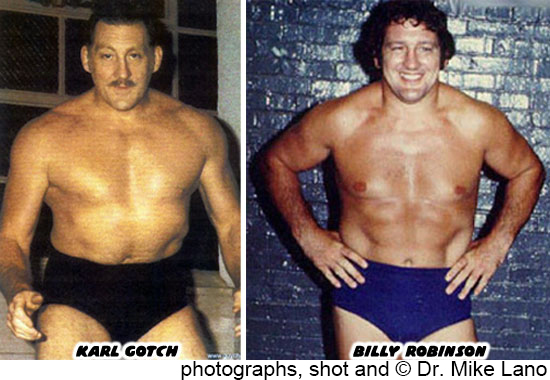
In the previous blog I had mentioned that pro wrestler Karl Gotch had influenced the development of the hard, shoot style of wrestling that the Japanese enjoyed. He would share his training, conditioning and grappling techniques with his fellow professionals. Helping them become better athletes and appreciate the roots of wrestling in the process. Karl was still alive when Sakuraba started his career. He would have offered insight on the advantages catch-as-catch-can or "Catch" school of wrestling to other martial arts. Moreover one of Karl's contemporaries Billy Robinson was also available to help shape the young wrestler as well. Both Karl and Billy had earned reputations as hard workers but also genuine shooters. They knew the business of wrestling but also knew how to seriously hurt someone or "stretch" them if they wanted. They had to carefully walk the line between entertainment and genuine combat for most of the 20th century. If they had been born a century earlier they would have been much better regarded as legitimate fighters.


Through the lessons of Billy and Karl the deficiencies of the BJJ system was exposed. In fact a major deficiency had been exposed in the early UFC battles featuring Royce Gracie. He seemed to have a weakness against people that were not dressed in traditional jujitsu uniforms, it was apparent when he fought Ken Shamrock and Kimo Leopoldo who only wore shorts. Helio had taught his sons to work while using a gi. The judo uniforms were what had helped Helio in his famous battles. The clothing could be grabbed to help generate leverage even for people that weren't as strong as their opponents. The clothing could be used to move opponents, get them off balance and even trap and choke people out. When Royce did not have something to hold onto it was more difficult to control his opponents and work a submission move. What Sakuraba needed was a system that could control his opponents arms and legs while standing or even from the ground but that did not rely on clothing to grab onto. He began studying Catch in early on in his wrestling career. By the time he had exploited it against the BJJ students and Gracie family he was well versed at what was capable using only traditional holds. In fact the uniform that had served Royce so well in his early competitions worked against him the first time he fought Sakuraba. The Japanese fighter would pull Royce upside down by his belt so that he couldn't escape from the floor. Then Sakuraba would throw a punch whenever he saw an opening on the upturned Gracie.


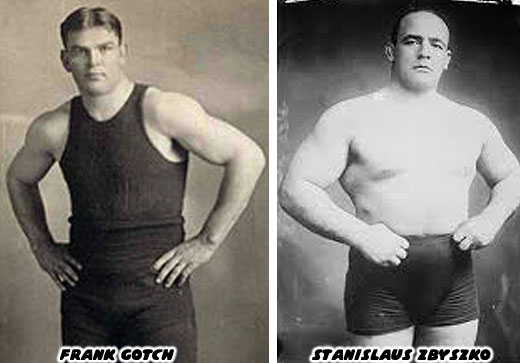
The more Sakuraba learned about the system the better he became at the grappling game. As a huge fan of pro wrestling he went out of his way to pay an homage to his idols each time he stepped into the ring. These outlandish displays hid the very dangerous techniques he was picking up. He studied the lessons of Billy Riley and Billy Robinson that had brought the fighting art over from England decades earlier. Riley's training ground was dubbed the Snake Pit, it had generated some tremendous talent. It would be knocked down and rebuilt over the century but never lost its allure. The current caretaker and trainer Roy Wood was the subject of a short documentary on catch-as-catch-can. It turned out that Catch had actually been a long time gaining a reputation in the West. Before the pro wrestling business became "sports entertainment" the best wrestlers were as well regarded as professional boxers. In fact to help himself get over in the business Karl Charles Istaz had taken the surname of the early US Catch hero Frank Gotch. Greco Roman wrestling was still practiced in gyms but a variation that had modern roots, an understanding of joint locks and submission holds was taking shape. This was in the 18th and 19th century well before the first "new" Olympic Games in 1896. In fact some of the modern wrestling forms predated the Kung-Fu taught by Ng Mui to Wing Chun, and heroes Huo Yuanjia and Wong Fei Hung. Frank Gotch, just so you know, was the first US wrestler to gain merit against the European champions.


Frank was one of the luminaries of the sport. Others included the Great Gama from India and Stanislaus Zbyszko from Poland. Those men were legitimate champions of the sport and proponents of the Catch school. In England the working class enjoyed the wrestling arts for both the calisthenic properties as well as the gambling reasons. The best were masters of the Catch school, then called the Scientific Method of wrestling, to differentiate itself from the Greco-Roman school. In the US the working class and farmers also enjoyed wrestling. Young Abraham Lincoln was said to have been a good wrestler but he was not the only US President with wrestling roots. George Washington, Andrew Jackson, Ulysses S. Grant and Theodore Roosevelt were also wrestlers in their youth.

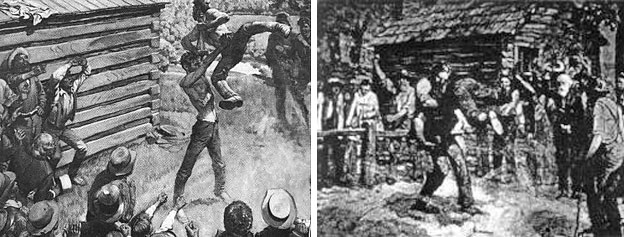
In the late 1800s traveling carnivals would put out open challenges to try and defeat their wrestler, usually also the circus strongman. The tradition had survived in remote parts of the world up until the modern times. In a previous blog I had mentioned the wrestler named He-Man was a circus wrestler up until his murder in 2010. Those foolish enough to try would and take He-Man and his kind would get bent over backwards. The reputation of the traveling performers often preceded them. The promoters learned the importance of creating a character and building a legacy. Legends would surface of men that had fought bears, alligators and mountain lions with their bare hands. Anyone foolish enough to grapple with them would surely be skinned alive. That cycle of hype and show would go on to shape the legends that founded the early US territories. It planted the seeds of pro wrestling as more of a staged battle than an actual fighting art. The Bleacher Reoprt had a great slideshow on the evolution of pro wrestling for those interested in seeing some archival footage.


Some wrestlers still held onto the old traditions though. When they could they would participate in genuine shoots, sometimes for the money but sometimes to build a name. These fighters had earned a reputation as being hookers, legitimate wrestlers that could easily break bones. Unfortunately the times were catching up with the sport. Media was changing the face of sports and entertainment. A long career was not guaranteed for those that pursued submission wrestling. The money and longevity was in entertainment. Wrestlers were expected to develop a character, a personality and "sell" moves and holds to the audience without actually hurting their opponents. Film had changed the landscape of the early sports reporting but not nearly as much as television. Some of the early stars did have high school and college wrestling backgrounds. Others were from track and field or football programs. They were filled in by other pro and catch wrestlers as they developed a gimmick. The biggest names would turn out to be the ones with the best mic skills and not necessarily the best wrestling abilities. This rubbed many veterans the wrong way.


This trend was not exclusive to the US alone. In Japan, in the UK and around the world where matches were being televised the genuine shooters were slowly being replaced by handsome men and women that looked great on TV. Skills could always be taught to the talent and to be fair some of the people that picked up wrestling became very good workers. The influence of every type of wrestler could be seen in the first few generations of fighting game character. Street Fighter did not only look to Muay Thai for real legends, it also looked to boxing and wrestling as well. It did not matter if the game were a 2D or 3D title because the designers gravitated towards what worked best and what was easily identifiable to audiences. I mean a person in a gi with a black belt was obviously a karate master and a person in wrestling trunks was obviously a grappler. It was relatively easy for the developers to put in a fighter that reminded people of Bruce Lee or a wrestler like Hulk Hogan because they had international exposure.

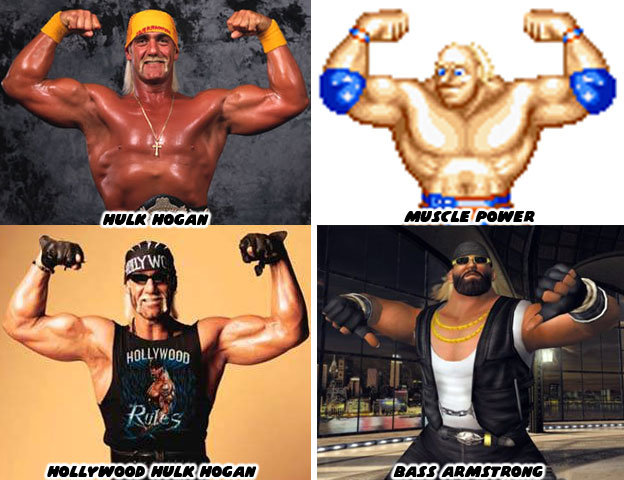
As technology evolved so too did the ability to present characters that kept pace with their real-life counterparts. For example, in the '80s Hulk Hogan was as American pride as a character could get but in the '90s the anti-hero was en vogue. Hogan ditched his clean-cut image and became a "bad guy" called Hollywood Hulk Hogan. There was a notable difference between Muscle Power and Bass Armstrong from the respective World Heroes and Dead or Alive series. It was uncanny how similar game characters would appear like their real world counterparts. Of course the developers at ADK and Tecmo knew to change just enough details so that they wouldn't get sued for trademark infringement.


Developers would even create alternate costumes to place on 3D models that made them look more like their inspiration. I mean Fei Long was very much a Bruce Lee clone but Capcom found that they could create costumes that mirrored those worn in several Lee films and sell them to audiences. Now if only the developers could create download packs to make the character fight differently, then you would have my attention. But I digress! I was talking about wrestling before I got sidetracked. Catch wrestling went underground but never disappeared. The narrative that kept the sport alive was similar to a popular book and groundbreaking film. The next blog will look at the seedy world that kept Catch alive. As always if you enjoyed this blog and would like to sponsor me please visit my Patreon page and consider donating each month, even as little as $1 would help make better blogs and even podcasts!

Wednesday, August 26, 2015

How fight culture became fighting game history, part 25

Kasushi Sakuraba had done some time in pro wrestling circles before his stint with the Pride and other MMA tournaments. Most professional wrestlers made poor MMA fighters and vice versa. Sakuraba seemed to be able to transition between the two worlds seamlessly. In fact he would return to pro wrestling and help give some credibility to his opponents by adapting some of his famous moves into his arsenal. The cartwheel and the foot stomp returned except this time his opponents knew that he would be pulling the majority of his strikes.
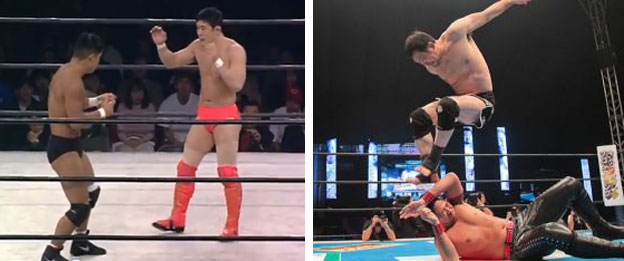


What many people did not realize was the pedigree that Sakuraba had inherited. Sakuraba was not simply a fighter with a personality. He was a rare athlete that understood the proper application and uses of the moves he had picked up in the ring. In pro wrestling circles the Japanese style was known to be very stiff or hard-hitting. The strikes were pulled to a lesser degree than those performed in the US which gave the fighting art some credibility to audiences. In fact some promotions prided themselves on highlighting realistic combat. The UWF promotion that Sakuraba worked with had rules that were closer to vale tudo than the pro wrestling that Westerners were used to. Fighters performed locks, holds and hard-hitting strikes that were designed to convince audiences that each fight was a "shoot" or a real battle.

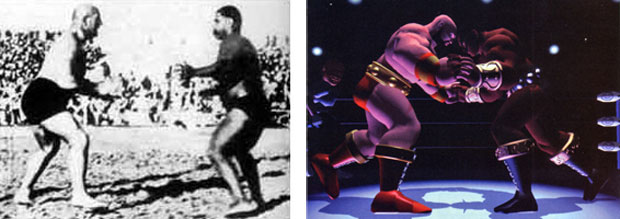
There was a reason that the Japanese style of wrestling was hard-hitting. The man that helped shape the wrestling game in Japan was Karl Gotch. He trained many of the best fighters in the game, including Antonio Inoki. Remember he was the guy that fought Ali? Karl was considered the God of Wrestling to the Japanese, holding a place of prestige that may be even greater than Rikidozan. Gotch himself had been trained in a legacy that dated back to the birth of scientific or "catch-as-catch-can" wrestling from the late 19th century. Sakuraba embraced the roots of Japanese wrestling and began learning the moves from the other masters of the game. It would turn out to be the secret weapon that he used in getting past the BJJ system.
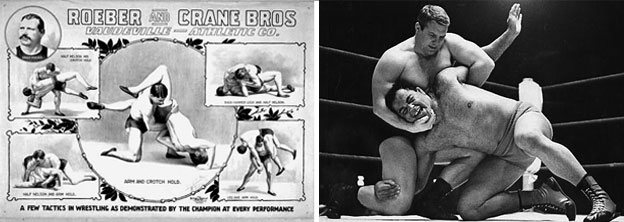


Grappling was the oldest known fighting art. It went well back in time when the earliest civilizations were getting established. Warriors and soldiers needed to learn how to fight unarmed in service of their emperors. Systems had to be established that relied on painful joint locks to subdue attackers and disarm opponents. Even laymen had to learn how to defend themselves in the event of a robbery attempt. The best fighters competed in early tournaments. In the Mediterranean the local nations would compete in regional wrestling tournaments before the rise of the modern Olympics. The ancestor to Roman-Greco wrestling had a second fighting art that developed alongside it. The pankration was a mix of wrestling and boxing, for all intents and purposes it was the first mixed martial art style or tournament. Fighters were allowed more leeway with their strikes but eye gouging and biting was still not permitted. Pankration, wrestling and boxing paintings adorned pottery, jewelry, statues and carved reliefs several thousand years old. Pankration was big in ancient times and the mythical heroes Hercules and Theseus were said to be masters of the art.
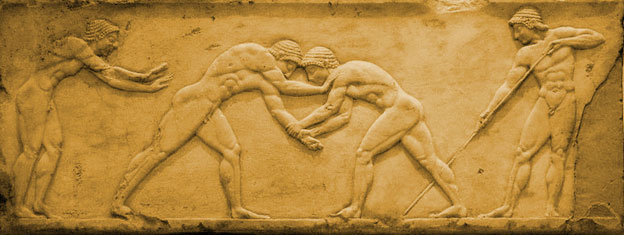


The names of the early champions were recorded by ancient historians. The legacy of those fighters survived more than 2,000 years. It showed that truly great fighters would indeed achieve immortality. A post apocalyptic animated comic named Pancratia by Ryan Benjamin was inspired by those heroes and their everything goes fighting style.

History books, as well as the graphic novel and movie series "300" reminded people that the Spartans were exceptionally dangerous because they trained in every form of combat from a young age. It was said that Alexander the Great surrounded himself with the best pankratia fighters from his army. According to historians other cultures were exposed to the fighting art during his campaigns and incorporated it into their own wrestling traditions.
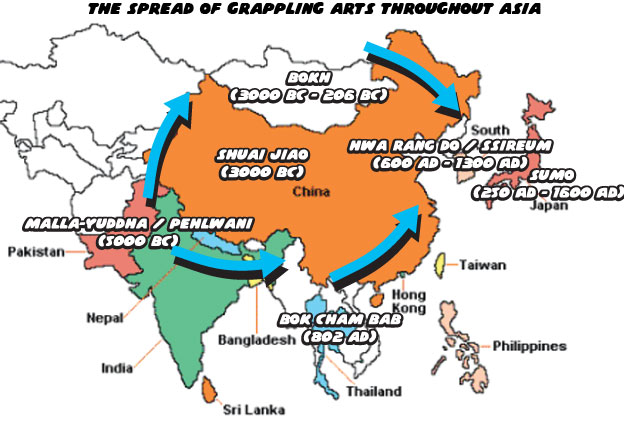
 

In 326 B.C. Alexander's campaign had taken his army through India where the western arts cross pollinated with another equally ancient form of wrestling. The early Buddhists took elements of the grappling arts north with them into China. It turns out that the striking arts were not the only things that migrated East. As many martial arts fans know the kung-fu forms influenced the development of the fighting arts in the southern part of the continent, Thailand and Cambodia as well as in the north like Mongolia. By the time traders settled in the islands to the far east they had taken their cross pollination of forms and planted the seeds for karate, judo and jujitsu.
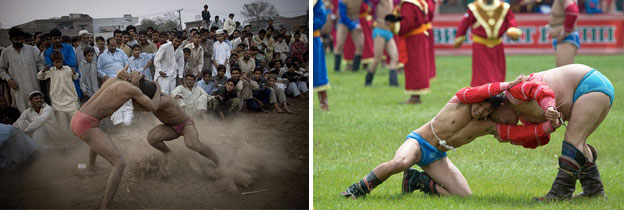


Japan developed Sumo wrestling. Sumo wrestling has a rich history, a detailed tapestry of ethnic identity. Religious, mythological and royal characters have all been associated with the sport. Sumo has been called the most physically demanding of all the martial arts. The best wrestlers or yokozunas are the stuff of legend, massive men whose speed and ability beguile their size. Why wouldn't E. Honda have worked in the Street Fighter series? His strikes and kicks were simply caricatured versions of actual sumo slaps and thrusts. This is something that you should remember of all the classic SF characters. At some point in their design we can trace back an actual art or purpose for their moves and looks. It was only in recent generations of the game that it became disconnected from the martial arts.


The further East we travel the more interesting the sport becomes. In Mongolia the form of wrestling Mongol Buh seems to have a little commonality with the techniques and strategies of stand-up, sumo style wrestling. Travel south a little and we discover that China has several variations of wrestling or Shuai Jiao. It is in the Chinese versions that we see a strong connection between wrestling and kung-fu.


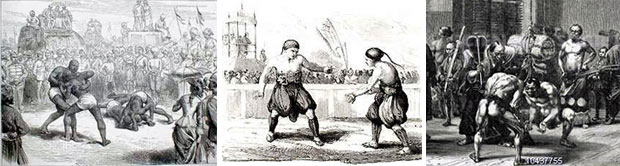
Indian wrestling or "Pehelwani" gave rise to, what I believe to be, the greatest grappler in the Street Fighter universe. Darun Mister from the Street Fighter EX series was inspired by the actual undefeated pehelwani champion Ghulam Muhammad aka the Great Gama. My brothers and I like this character more than the Red Cyclone himself. That is not to say that Zangief was a poorly designed character but his concept version was lacking. A tattooed sailor originally named "Vodka Gobalsky?" With designs like that you'd think that Capcom of Japan wouldn't be surprised by how the west reacted to new characters in SF IV.


After a lot of fine tuning Zangief made his proud debut in SF II. Darun would not have worked as well without Zangief having established the fantastic qualities that wrestlers in the SF universe had. Darun had a Brahma Bomb or front-flip powerbomb to counter the Spinning Piledriver. The Banishing Flat and Spinning Lariat were combined through Darun's Lariat. But what was it about Darun that made him so special, so interesting outside of doppleganger moves? It could have been the cues that ARIKA used when creating the character.

The entire cast of SF EX was created to balance out the original world warriors. Ken and Ryu were balanced by Allen Snider and Kairi respectively. The strong females were balanced out, Chun Li had Blair Dame or Pullum Puruna. The oddballs were balanced out through Dhalsim had Skullomania. Military strongman Guile had Doctrine Dark and of course Zangief had Darun. Darun had to be as exaggerated in proportions as the burly Russian, and have equally fantastic wrestling moves. His dark skin color and trunks even balanced out the fair skin and bright shorts of 'geif. But there was a certain je nai se quoi that made Darun special. It was more than the upturned mustache or elephant champion belt, although those were cool touches as well.


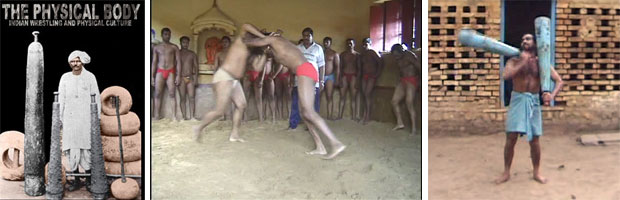
The appeal of Darun came from an understanding and appreciation of Gama and the Indian Wrestling culture. This is a topic that my friend AerialGroove from FightingStreet.com and I have been going over. AerialGroove clued me in to a documentary titled The Physical Body: Indian Wrestling and Physical Culture. I picked up the DVD and was fascinated with the unique regiments, weight lifting and strength training exercises that traditional Pehelwani demanded. This was a form of wrestling and physical culture invented centuries, if not millennia, before the modern strength training became understood in the western world. Pehelwani students would dig pits, lift stones, swing the gada and do calisthenics to develop muscles, flexibility and endurance. Some of these exercises were simple and functional, climbing ropes to strengthen grip and upper body for example, other exercises were more unique like reverse bridges to flips in order to strengthen back and neck muscles, some Yoga moves were even used during conditioning. Pehelwani students not only practiced wrestling moves but spent some of their time in prayer, observing the religious ties to the sport. Darun takes some artistic liberties with the culture, in the game he is represented as a Hindu when the actual Gama was Muslim.

The Pehelwani techniques must have worked because Gama was a physical specimen as much as he was a wrestling spectacle. When you think back to the early 1900's there weren't many physiques that could have compared with modern bodybuilders, Gama was one of the few exceptions. Some of his strength training formats are still practiced by people around the world. Unfortunately for every up there was a down. He would find criticism for his reliance on standing wrestling skills without developing proper mat skills. This and the diet he was on helped increase his bulk but eventually lead to his heart condition. Early physical culture understood the importance of eating large amounts of protein to build mass but unfortunately did not realize that his diet also contributed to his heart disease. You could learn a lot reading about the life and death of the Great Gama. His final days were actually kind of sad as the man who inspired a nation seemed to be forgotten by his fellow Indians.


Gama went on to great success in his wrestling exploits in the early 1900's. In the thousands of matches he had reportedly been in he had never been defeated. He had drawn a few of his matches but none could have ever claimed a pin against him. His legend seemed to grow with every passing year. Even if some of his matches were met with controversy and less than flattering reviews none could argue that he was a fake. He travelled to England issuing challenges when he wasn't allowed to formally compete. Minorities were very strongly discriminated against for many sports. While there he defeated the Polish Stanislaus Zbyszko and eventually claimed the world heavyweight title.

Mr. Zbyszko was another titan of wrestling. He traveled the globe challenging the best in North America and Europe and winning more often than not. Only Frank Gotch had amassed a more impressive record in a tragically shorter time. Stanislaus' defeat at the hands of Gama took on some significance. Mr. Zbyszko probably had nothing to do with the creation of Zangief but Russians like Ivan Poddubny were very much feared at the time. Zbyszko was one of the few to defeat Poddubny.


When development of a 3D Street Fighter game came up ARIKA needed somebody that could not only be a worthy rival to Zangief but had genuine chance of beating him. They went back through the annals of wrestling lore and returned with the legend of the Great Gama. A man of exotic origin, dark of skin and well regarded for his unbreakable determination and undefeated legacy. ARIKA and Capcom then stylized his look turned him into a character whose scale and moves fit perfectly into canon.

This was when Capcom was going the extra mile in character design. No character could simply be added into the series just for visual appeal, they had to take on an additional context in order to both grab the audiences and compete against the returning legacy characters. Darun was just one of the characters featured in SF EX that was based on a legend. Darun and Zangief were presented as the genuine article. They were not gimmick wrestlers from modern times, or even showmen from the era of Gene Lebell. They were inspired by an earlier time, an era of authenticity. While modern gamers might not know exactly who or when they came from all can agree that they were exceptional designs, straightforward and to the point.
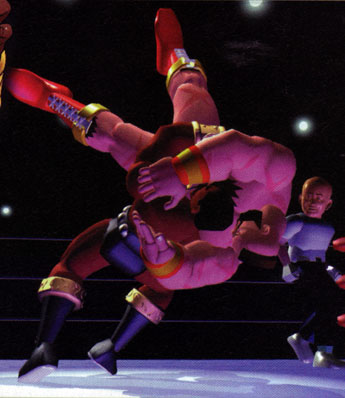

The Great Gama was the template for Darun. He was a wrestling God. He had the same mythical status that Oyama or Lee would enjoy in the modern era. Of course most of the people in the West had never heard of him. It was his contemporaries that helped popularize the evolution of wrestling from its ancient Greek tradition into something more scientific by the 19th century. These people were directly connected to the development of a system that Sakuraba and other practitioners of the modern fighting arts would exploit to great success. The next blog will look at these icons. As always if you enjoyed this blog and would like to sponsor me please visit my Patreon page and consider donating each month, even as little as $1 would help make better blogs and even podcasts!