Showing posts with label dc comics. Show all posts

Friday, July 19, 2024

Remix Culture, how Asian designers changed the game, part 13

Earlier in this series I talked about changing the conversation. Most of us in the west would always associate China with counterfeit products, even though they also produced most of the authentic goods the world consumed. It was a heck of a thing to have praise for the product, but disdain for the country producing it. Michael Lau was raised in Hong Kong, a nation with one foot in the East, and West. Because of this distinction he absorbed, and remixed western culture in a new, and exciting format; the vinyl figure. When his contemporaries followed suit I didn’t have much respect for what they were doing because they were retreading the same idea. But I took a step back, and acknowledged that they were not all cash grabs, many of these creators were also celebrating the new art form.
In the early days artists followed along with what Lau was doing, essentially making street fashion character toys, whether they were stylized 12-inch figures or squat 6-inch collectables. They were almost all universally variations on a skater kid, or a Hip Hop kid. Then other studios like Brothersfree demonstrated that figures could be made out of industrial workers, robbers, or even clowns. The doors had been blown open. The best designers like Jei Tseng Studio were able to remix cartoon stars, video game characters, mythological heroes, basketball players, and even superheroes into something new, and unique. Comic book fans would be able to identify right away who some of the Street Mask series figures were just by looking at them. The four characters Ken, Ray, Derek, and Gino were inspired by the DC Justice League characters Superman, Flash, Batman, and the Green Lantern respectively. 
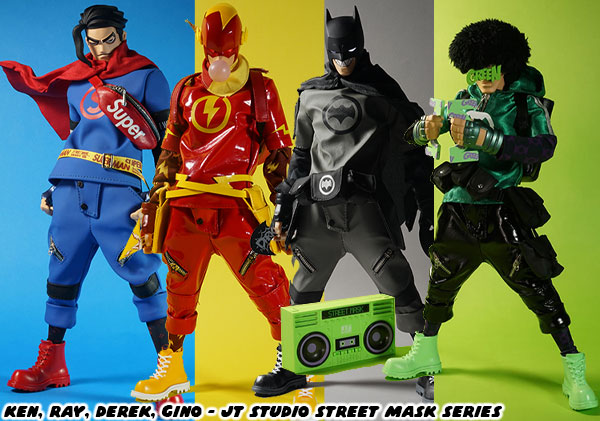
Yet these figures weren’t licensed from DC, nor were any of their fashion accessories licensed from similar manufacturers. The red crossbody bag on Ken was based on the SUPREME bag, but the matching font said SUPER instead. The studio was able to create something unique by layering multiple levels of detail, and meaning on their figures. This was whether they were using genuine branding, or a remixed logo. JT Studio understood the assignment. This trend had been happening for generations, not just in figure art, but all of the creative arts. In the 20th century millions of musicians jumped on the rock, punk, new wave, and Hip Hop sound after they first heard the music. We wouldn’t have had the Bauhaus, Modern Classical, Art Nouveau, or Art Deco movements unless it the form had also been embraced by millions of creators. Yes there were some derivative artists, but there were many fresh voices that helped propel the various formats forward.
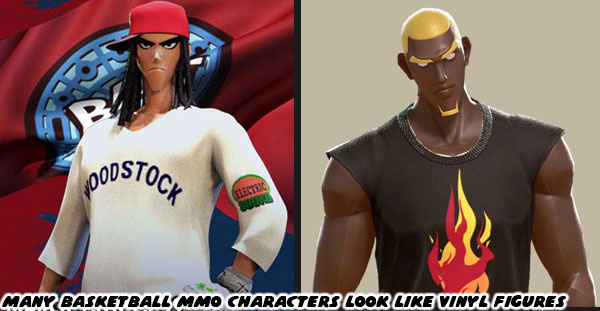
The creators from Hong Kong, and China were remixing culture in real time. They were mashing together fashion, movies, music, cartoons, comics, and toys. Taking the elements that worked from different formats, and seeing how it would look in a figure, or game, or model. It was something that they had been accelerating at all through the ‘90s. In fact they were remixing, a remix before it even got a chance to catch on. This allowed the designs of urban vinyl figures to influence game character designs, and vice versa. I had talked about many of the biggest streetball MMO’s in previous entries of the series. JC Entertainment released FreeStyle Street Basketball, Freestyle2 Street Basketball, and 3on3 Freestyle Basketball. Beijing Halcyon Network Technology Co., LDT released Dunk Nation 3x3. All9Fun released Basketrio: Allstar Streetball. 
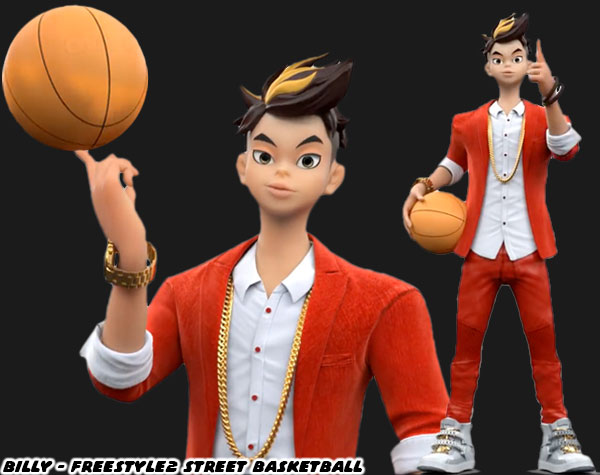
The designs in each basketball MMO were fairly well done. They pulled heavily from the stylized proportions of urban vinyl figures. Billy for example, the character pictured above looked like a vinyl figure I would have collected. The proportions of the 3D model, the style of his hair, gold jewelry, and designer sneakers certainly told a story. Streetball players in the real world all had their own distinct personalities. Some were flashy, some were powerful, some were tricksters. Their look, and their style of play reflected those personalities. The games from JC Ent. made sure that the library of characters they created represented a broad cross section of society. It was something that JC did better than a lot of other studios.
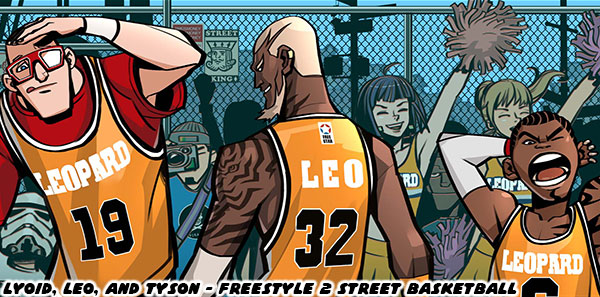
The games they had been developing since 2004 did feature a number of traditional looking male, and female basketball players. We’re talking about matching jerseys, knee gaskets, sneakers, etc. However they also had characters wearing regular street clothes, and people from all walks of life. Working professionals, inventors, mechanics, gang members, robots, and the wealthy elite. This with the case of Billy, and his rich mentors Robert, and Grace. Just because they came from wealth didn’t mean they knew nothing about the game of basketball. They were every bit as dangerous on the court as they were on the boardroom.
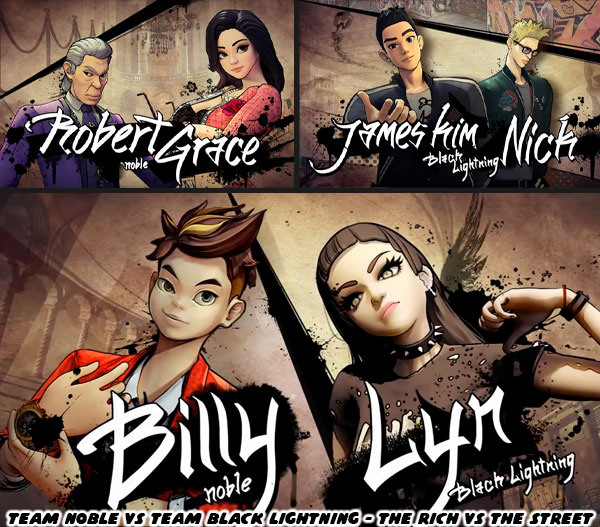
There was a tremendous amount of storytelling in Freestyle2, 3on3 Freestyle Basketball, and the other games. This came through in seasonal events, and even through the designs of the characters. When Billy made his debut so too did Team Black Lightning. The street kids were ready to take the game right to the one-percenters, and you were free to choose a side. While audiences became familiar with Saru, Jack, and Joey over the years there were technically no heroes, or villains in the universe, just different clashing personalities. The majority of the cast represented a particular subculture. Over time new teams would pop out of the woodwork. If there was something cool out there in the universe it would eventually end up in the game. For example people on both sides of the Pacific thought wuxia heroes were cool. What if there was a modern team that pulled elements from the ancient kung-fu masters? That was essentially the inspiration behind the Ace of Wulin team. 
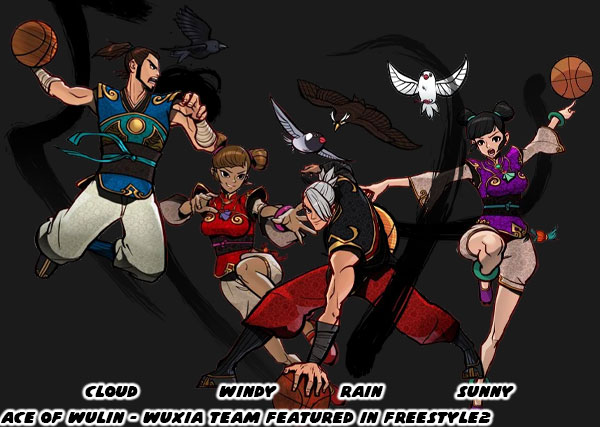
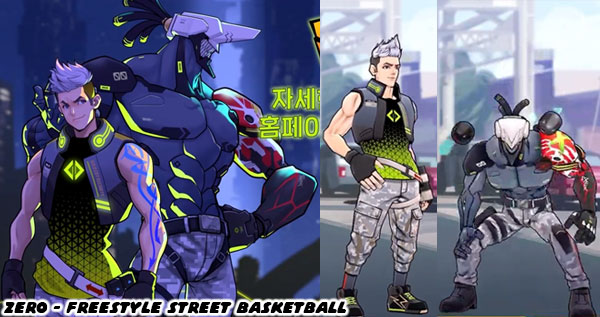
The Wulin team's special moves on offense, and defense were inspired by their martial training. The name wulin was derived from “martial forest;” the secret society of wuxia heroes from fiction. Rich people, goths, and kung-fu masters, were just some of the teams that broke up the classic pro, or even Hip Hop designs going back to NBA Street from 2001. The studios weren’t afraid of coming up with designs that might work in a stand-alone science fiction adventure. Some characters like the cyberpunk mascot named Zero could transform into his armored alter ego with boosted stats. This sci-fi monster had no connection to basketball. I’d be lying if I said that the design didn’t go hard, and wasn’t someone that fans were eager to try.
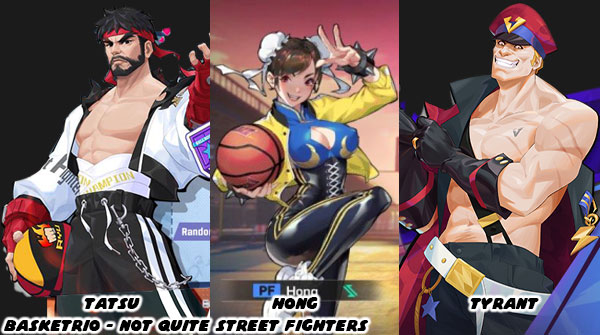
Not every entry had some level of forethought. Sometimes the studios would just fit pop culture characters, or celeb look-alikes into the game. Not that it made sense to just give the Jared Leto version of the Joker from the Zack Snyder DC universe movies a basketball. Or say give the enigmatic guitarist Buckethead a basketball. Yet those characters, or rather ballers inspired by those characters ended up in Dunk Nation 3x3. Fans of pop culture that understood the reference appreciated these weird designs getting inserted into their favorite game. It was certainly an easy way to fill out a roster of recognizable faces without paying for a license. Speaking of putting in non-traditional, high-profile characters in a streetball game… what if the developers put fighting game icons into their titles? The designers at All9Fun placed several characters that were heavily inspired by Capcom, and SNK’s biggest stars in Basketrio. Of course they got away with it by changing the names, and details just enough so they wouldn’t get a cease and desist letter.
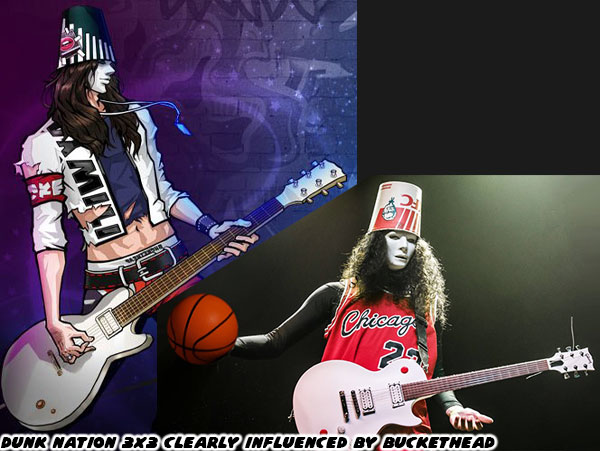
These were examples of the remix culture that I was talking about. After adding all sorts of traditional basketball, and streetball archetypes, the studios then started populating their worlds with unique figures. When they couldn’t think up new designs they instead starting asking “what if?” and found ways to incorporate musicians, actors, comic book characters, sci-fi, or fantasy heroes. The designers at all of the studios didn’t bother to ask for permission to use a character, or likeness in their game. They just went ahead and did it. Like the old saying goes “It’s easier to ask for forgiveness, than to ask for permission.” I didn’t think it was a good look to poach the designs of Street Fighter, or King of Fighters characters. I appreciated the hustle, but at least JC Entertainment bothered to create an original wuxia team without just copying from a Japanese developer.
Of all the remix figures that I enjoyed, at least for this genre, were the ones based on actual basketball players. After all they made more sense than comic book superheroes in a streetball game. The way these icons were remixed was what amazed me as an artist. I’d like to explore it a little bit more in the next blog. Until then I’d like to know if there was a character in an MMO that you thought looked cool enough to be featured in a stand alone game. Or if you knew of a character that was such a blatant rip off that you couldn’t believe the publisher wasn’t sued. As always if you would like to sponsor me please visit my Patreon page and consider donating each month, even as little as $1 would help make better blogs and even podcasts!
follow the Street Writer on Patreon!

Monday, May 20, 2024

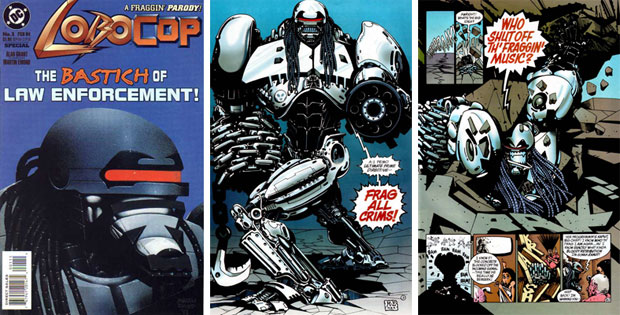
Dance 'till you drop, do the LoboCop - A 1UP classic from December 15, 2010

As I'm going through the old comics to share with the little gal I can't help but wonder where the fun went in comic books. Sometimes the storylines and characters take themselves too seriously.

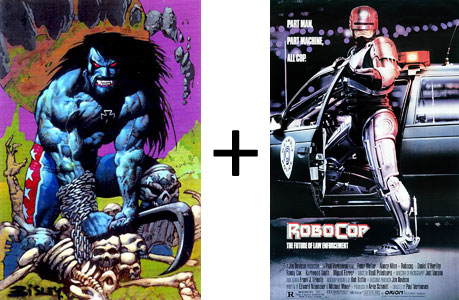
I stumbled across one of the best parodies of film-meets-comic book characters ever. Featuring two unlikely but very complimentary sources. The "Main Man" Lobo getting put into the titanium body of a Robocop. The result of which was a crazy send up of law enforcement gone too far.

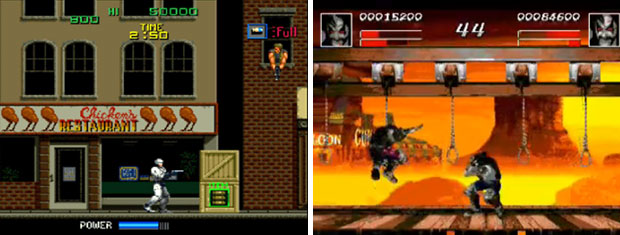
With fun designs and lots of violence I'm wondering why DC didn't bother revisiting the character. LoboCop would make for a fun videogame. Perhaps the arcade mechanics of Robocop, plus the comedic timing of Sunset Riders. It would certainly much better than the Lobo videogame that never came out.

I guess there was the good and bad in the 90's now that I think about it. Comics were fun but every quick-buck videogame was a fighter. It's a darn shame too.

As always if you would like to sponsor me please visit my Patreon page and consider donating each month, even as little as $1 would help make better blogs and even podcasts!
follow the Street Writer on Patreon!

Tuesday, August 1, 2017

A look at the big man, where did the Capcom giants come from? Part 2...

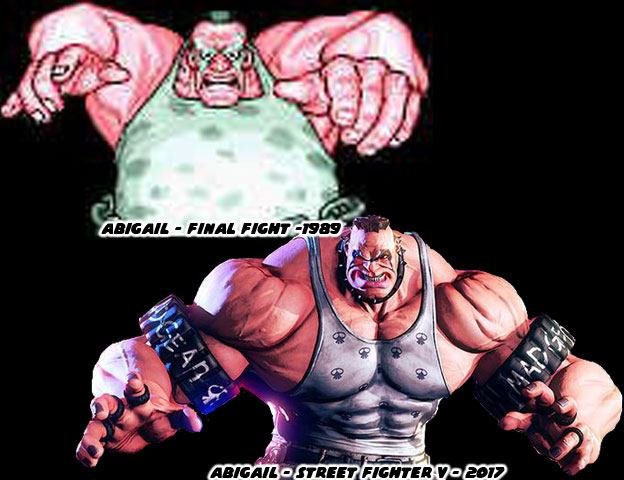
Abigail, a character introduced in Season 2 of Street Fighter V had originally appeared in Final Fight, an arcade hit from 1989. The character was a boss in Mad Gear gang, a group made up of the biggest, meanest criminals from Metro City. Abigail was gigantic, even by Final Fight standards which had many characters above 6 and 7-feet in height. In the Street Fighter universe, where the Final Fight story took place in, he was listed at 8' tall and 584 lbs. He was the largest figure in the series and among the largest human character in any fighting game. The tradition of over-sized, muscular characters in fighting games went back to the start of the genre. The third boss in the 1984 Irem classic Kung Fu Master was a dark skinned character named Giant, he was a full head and shoulders taller than Thomas the hero. The trope of gigantic villains in a fighting game really took off however with the cast featured in the Technos series Double Dragon. There were massive villains in the original and sequel; named Burnov, Bolo, Oharra and Abore. They were capable of lifting players up with one hand and even punching down walls with their bare fists. The bad guy that audiences remember most was a bodybuilder-type character called Abobo.


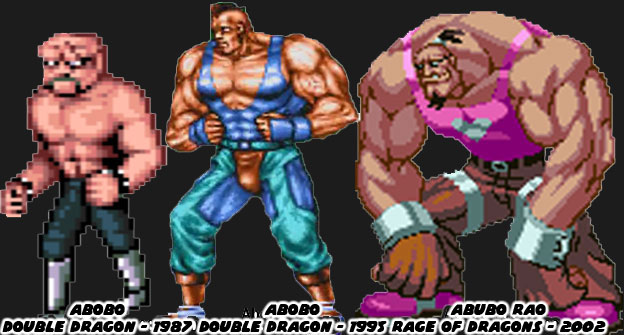
Abobo actually changed during the various sequels and remakes of the series. He was a generic bruiser in the original 1987 game. His face paint and spiked wrist guards made him appear like a heel or bad guy wrestler. Abobo was far more fleshed out when the studio created a 2D fighting game in 1995. This newer version of Abobo was more proportional to the rest of the cast and was officially listed at 7' 2" and 336 lbs. He was still huge but nowhere near as big as the character's final appearance. In 2002 the Mexican developer EVOGA created an unlicensed Double Dragon game, which they called Rage of the Dragons, an homage to the series. They avoided legal issues by slightly changing the names of the main characters. The bruiser in this game was called Abubo instead of Abobo. This character was on the absolute extreme end of character designs. He was now 8-feet tall, actually 8.03, and 640 lbs. making him a fraction bigger than Abigail. His arms were so huge that they hung to the ground. This type of large upper half / small lower half character designs had actually evolved through the '90s and were almost commonplace post 2000. I had written a history of these "top heavy" designs when Gigas was introduced in Tekken 7. Abubo and Abobo had set a standard, or rather limit, on what worked when it came to fighting character designs. Believe it or not in the '95 version of Double Dragon the character could grow even larger and more muscular.


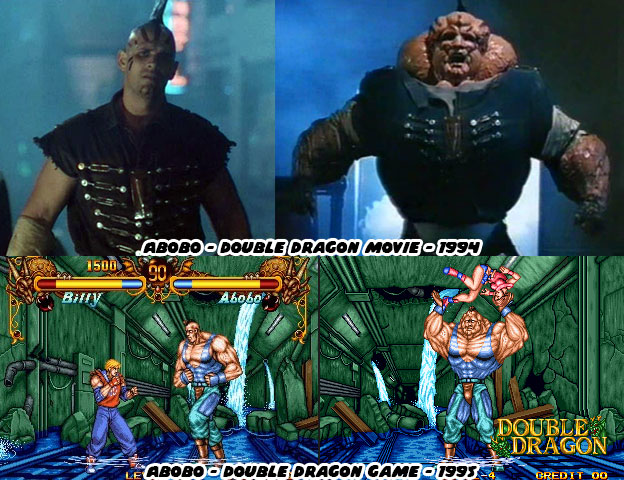
The "transforming" version of Abobo and the updated cast were based on the 1994 Double Dragon film. In the movie Abobo was a typical punk bad guy. He was already big and dumb but Koga Shuko, the main villain in the film, turned him into a mutated freak for failing to recover an artifact. This weirdly swollen character had muscles where muscles didn't exist. He was literally swollen where his glands, bones, cartridge and neck should have been. The absurdity of his updated look was incorporated into the game where he could temporarily "buff up" while performing certain moves. The movie was absolutely horrid and had nothing in common with the game, except for the names of the characters. It was the first and hopefully last film directed by James Yukich, whom had probably never even played the title. Interestingly enough the story was co-written by Paul Dini (The Batman Animated Series and co-creator of Harley Quinn) who has been one of the greatest comic and cartoon writers of a generation. I guess something was lost in translation when the screenwriters adapted his story. But I digress, character transformations were not a new idea in games, cartoons or comics. The Incredible Hulk for example turned from a small scientist into a thousand-pound green skinned monster. A more contemporary version of the transforming villain was seen with the character Bane.


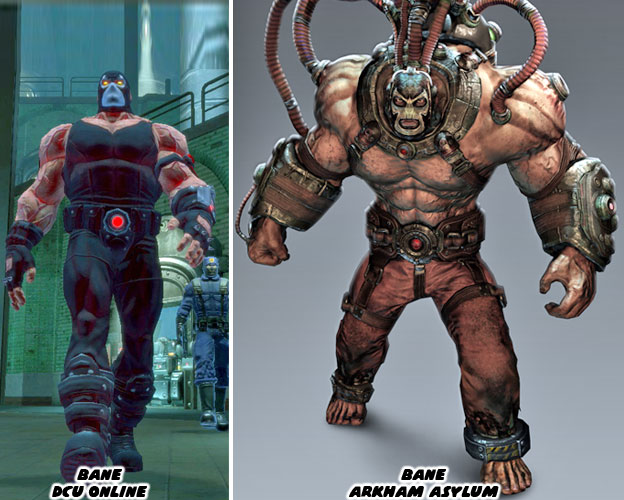
Bane debuted as a Batman villain in 1993. He was an assassin that was trained in the fighting arts and was a perfect rival to Batman. The thing that made him a superior opponent was a synthetic drug, similar to adrenaline, called Venom. It increased his speed, reflexes, strength and durability. He could turn on a pump filled with Venom whenever he wanted to boost his fighting prowess. When the character originally appeared he was muscular but realistic. He had a bodybuilder physique and was not as deformed as Abobo. A really good 3D representation of his original design appeared in DCU Online, the DC Comics online multiplayer game (MMO). However as comic book aesthetics changed, and as different writers and artists took over, the look and purpose of Bane changed as well. In less than 20 years he went from a realistic physique to a grossly disproportionate one. To see how far the character had changed look at the version that was featured in the Batman Arkham games. This new Bane had a gross physique. Not only that but every iteration of Bane seemed to become dumber and dumber. It wasn't long until he was nothing more than a typical brute that used his muscles rather than technique to beat people. Abigail was sliding into modern Bane territory but for over 30 years the designers at Capcom managed to avoid this trope. How did they do it?


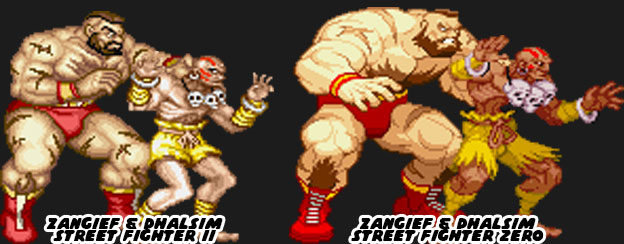
Capcom developed a template copied hundreds of times over. The idea for Street Fighter was simple, different martial arts masters fighting against each other to prove who was the best. The designers created a library of characters that reflected different nationalities and by default the different fighting arts. One of the reasons the series stood out was because of how unique the character designs looked compared to other games. The artists at Capcom, people like AKIMAN, Shoei and SENSEI created figures that were not quite manga, not quite anime, and not even comic book in appearance. They were instead something in between the Japanese and USA aesthetics. These archetypes worked incredibly well and they helped launch a franchise. The characters were diverse in size, color and body type. Their appearance helped reinforce a particular fighting style. These basic concepts were used and expanded upon by other studios as well. Look at a character like Dhalsim, a slender Yoga practitioner that stood 5' 9" and weighed about 100 lbs. Compare him to the burly Zangief, a 7-foot 400 lbs wrestler. In Street Fighter II the characters had good contrast. When the studio created a new sequel they went with a different designer. Bengus wanted to keep the scale of the characters similar but he used artistic license to exaggerate their proportions. Zangief and Dhalsim had the same height difference in Street Fighter Zero, but Bengus made Zangief much wider, especially on his shoulders, arms and back. He also cut Dhalsim's waist in half, making him even more gaunt. This contrast was more profound. It looked fantastic on screen but did not break the scale of the franchise. The exaggerated proportions ended up influencing a generation of game designers in Japan and even comic book artists in the USA.


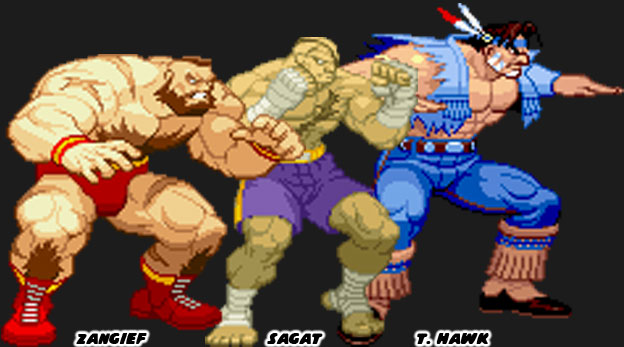
The proportions developed by Bengus were used by Edayan, Kinu and Ikeno in the other Capcom games from that era. In doing so the giant characters appeared far more menacing when compared to the rest of the lineup. The Street Fighter library had always worked within a certain range of body types. Every character had to be muscular, the sumo wrestler E. Honda had an enormous belly but his arms and chest were well defined. Dhalsim was thin but his muscles had definition as well. As the characters got taller they preserved those same basic rules. Zangief was considered a standard for giant characters in the series but that concept was flexible. Sagat was 7' 4", a few inches taller and slightly leaner than Zangief. Sagat was the original boss in Street Fighter and was a character of distinction in both Street Fighter II and Street Fighter Zero. He stood a head above every other character and did a great job of capturing the boss feel. Yet even Sagat would be replaced as the biggest fighter. T. Hawk was a native character, at 7' 7" he was on the edge of the character sizes that worked within the continuity of the series. Moreover his height was about the limit for any giant character in a fighter. There was actually some real world precedence for this.


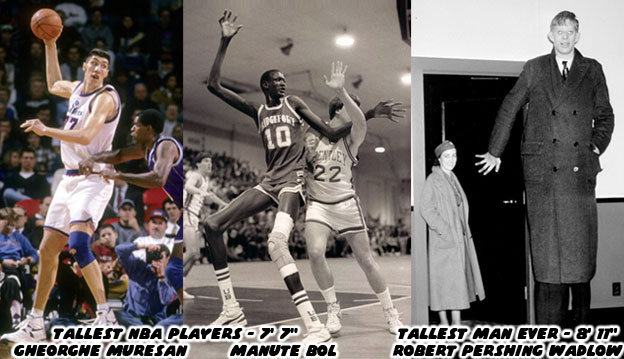
Professional NBA basketball players were 6' 7" on average with centers being around 6' 10" to 6' 11". Teams were constantly on the hunt for athletic 7-footers. These people represented less than .00004% of the population, and an even smaller fraction of those were healthy and coordinated enough to play at a professional level. The tallest of these men were Shawn Bradley standing 7' 6", Manute Bol at 7' 7" and Gheorghe Muresan also at 7' 7". Think about how imposing it was for T. Hawk to be created at the same height as the biggest NBA players. When you saw these players on TV the height differences between someone 6' 6" and 6' 10" looked much greater. Keep height to weight ratio in mind. A bulky tall person did not appear as tall as a lean person at the same height. Most basketball players were lean because it allowed them greater flexibility and speed. On television thinner people looked much taller than their opponents even though the actual height difference was only an inch or two. In a sport like American football tall players were very muscular. Because of this it was harder to spot the height differences on television.

Most fighting games have characters with a similar height to weight ratio. When you look at the height differences between Zangief, Sagat and T. Hawk it doesn't seem like much. Now think about Abigail. At 8 feet his height was very rare but not impossible. There had been taller people in history. The tallest that ever lived, Robert Pershing Wadlow was 8' 11". He would have broken the 9-foot barrier if an infection and compromised immune system didn't end his life at the age of 22. What made Abigail so awkward in appearance was his weight. The character was extremely muscular, almost to the inflated Bane or Abobo proportions. In the original Final Fight Abigail was shaped more like a professional strongman, with a wide gut, rather than a trim bodybuilder physique. This was actually very believable as there were many strongmen and wrestlers throughout history that were tall with that same body type.


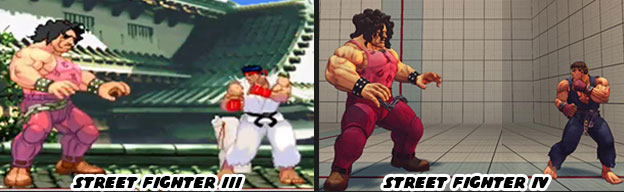
The designers at Capcom went overboard with the muscular physiques in Street Fighter IV. I believe it was because the artists were reacting to the trends in Western character designs which favored overly-muscular characters. Look at how big comic book characters were today. When presented as 3D models rather than 2D sprites the extra bulk made the height seem less dramatic. In order to make the differences more noticeable the model heights were exaggerated ever so slightly. Many players did not pick up on the new sizes. When the characters were far apart on the screen most people couldn't tell that the scale was different. But as they got closer it became obvious. Take the character Hugo for example. The original version featured in Street Fighter III Giant Attack was an updated version of the classic Final Fight character. His height was astounding but proportional to the rest of the cast. Fans of the Final Fight series, and those that remember his cameos in the Street Fighter Zero / Alpha series remember how massive he was and therefor his sprite worked. When the character was created in 3D for Street Fighter IV and also for Street Fighter X Tekken he became bulkier and taller. Players really noticed this change when the character model was close to an opponent.


Abigail was absurdly huge. He looked as wide as he was tall, dwarfing Zangief and the other large characters in the process. He didn't seem to have the same proportions as Hugo or the other giants. That is to say he was missing his neck and shoulders. This made him look cartoonish in appearance. None of the other characters had the same type of physiology. The addition of car tires around his biceps and belt made little to no sense. I understand they were part of his new personae as a scrap yard owner but they were not part of his original costume. The most jarring thing about Abigail's appearance in Street Fighter V was his personality. Abigail went from high-ranking Mad Gear boss, with a genuine fighting ability to an idiot. He retained his temper from Final Fight but everything else was made up. It was embarrassing watching him putting around and making car noises in his introduction and story mode. Both Street Fighter IV and V had played up the silliness of certain characters while making others seem terrifying. Rufus, Hakan, Birdie and F.A.N.G were some of the other goofy / awkward characters added to the series. The director and producer of the series were certainly playing favorites with the cast. I wondered if the studio created a moronic Abigail to make fun of USA fighting game designs. They had given us a mindless Bane because apparently that's what we thought all strong characters should be like. The studio hadn't always treated their giant characters so poorly. In fact they used to treat their legacy characters with a lot more consideration. We'll look at the ways they used to present giants in the next blog. As always if you enjoyed this blog and would like to sponsor me please visit my Patreon page and consider donating each month, even as little as $1 would help make better blogs and even podcasts!

 follow the Street Writer on Patreon!