Showing posts with label technos. Show all posts

Saturday, May 18, 2024

The story of Burnov. Or how to make a fat character work in a fighting game.

Last week I talked about Rage of the Dragons by Evoga, Steel Hearts, and BreezaSoft from 2002 as a sequel to the Double Dragon fighting game by Technōs from 1995. Technōs had created the original Double Dragon as a brawler way back in 1987. It put the genre on the map, and had every major studio making their own clone. Each Double Dragon sequel in the arcade lacked the innovative game play that appeared in rival titles. It seemed that when it came to development they were playing it safe, cheap, and simply going through the motions. A few years later when fighting games were more popular they released their own fighter as well. The game suffered when they tied their SNK fighter to the horrid live action movie. The company did not seem to know how to evolve their own franchise regardless of what format they used. Despite the failings of their fighting game I would argue that one of the best character designs, and certainly one of my favorite redesigns came out of it.
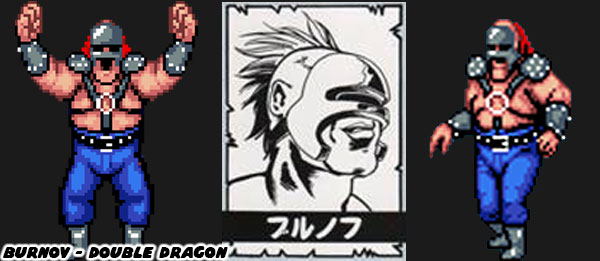
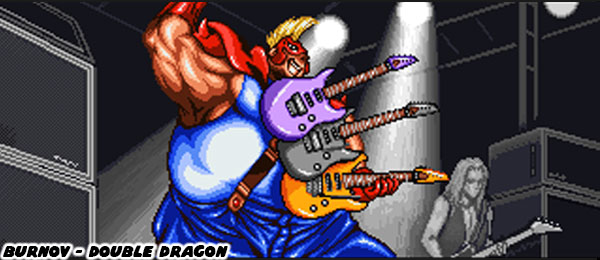
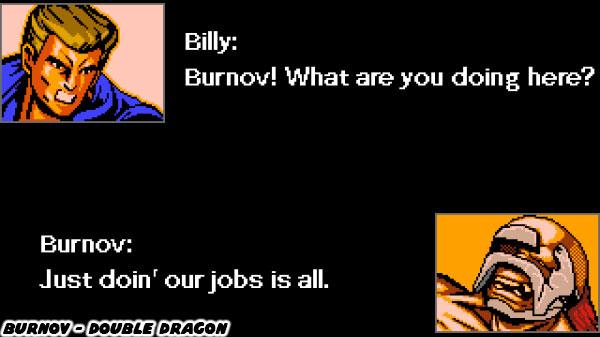
The original Double Dragon brawling game was set in a post apocalyptic future. Although there were still big cities, cars, and modern amenities there were also roving gangs, mutants, and bad guys that terrorized even the police. It was up to people to take the law into their own hands. This was the context that stars of the game Billy, and Jimmy Lee fought in. Abobo was one of the giant characters in the first game. Those massive bruisers changed a little in the sequel. One of the larger bad guys was a masked former wrestler-turned-villain. Burnov made his debut in Double Dragon II: The Revenge. His look in the game pulled elements from pro wrestlers, but more specific the gangs featured in the Mad Max movie series. The films by director George Miller started in 1979. The wild characters, armor, and vehicle designs by Miller influenced the mangas Hokuto No Ken / Fist of the North Star, Trigun, Battle Angel Alita, and the game franchises Twisted Metal, Carmageddon, and even Street Fighter II.
Burnov had a metal mask in his original form, and long stringy hair. He was most likely inspired by the Lord Humungus from the Road Warrior sequel to Mad Max. He appeared as a level 1 boss in Double Dragon II. He was much taller than the Lee brothers, and even came with his own stage music. If you got too close to this boss, or tried to grapple with him then he would pick you up by the head, and punch you in the face. It was a brutal but equally cool attack. This character would turn up again in the various sequels, and reboots to the franchise. Shortly after his debut the character was made a considerably fatter. Contrary to popular belief I didn’t have a problem with fat fighting game characters. I had an issue with fat being used as a punchline. Bob in Tekken, and Rufus in Street Fighter being introduced as joke characters. They diluted otherwise great ensembles.
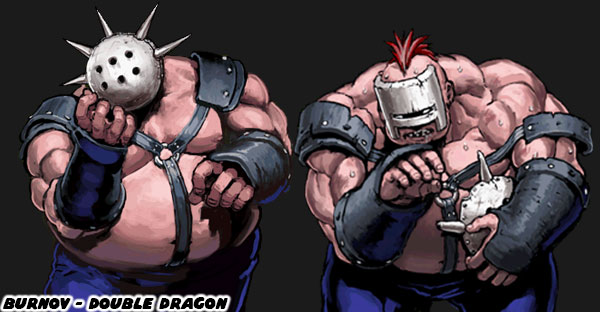
Some of the best designs for brawlers, and fighters were obese wrestlers. Almost a decade ago I talked about how Burnov, and Kimala the Bouncer were two of the best characters ever featured in a game. They happened to be massively fat, but underneath that fat was a large amount of muscle as well. They had power in spades, as some famous fat strongmen had all throughout history. I had a low opinion of the Double Dragon fighting game, and especially the movie, but thought that Burnov’s new look was brilliant.
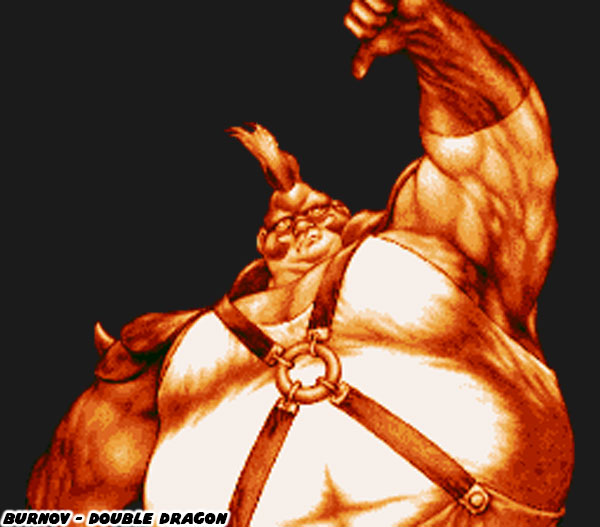
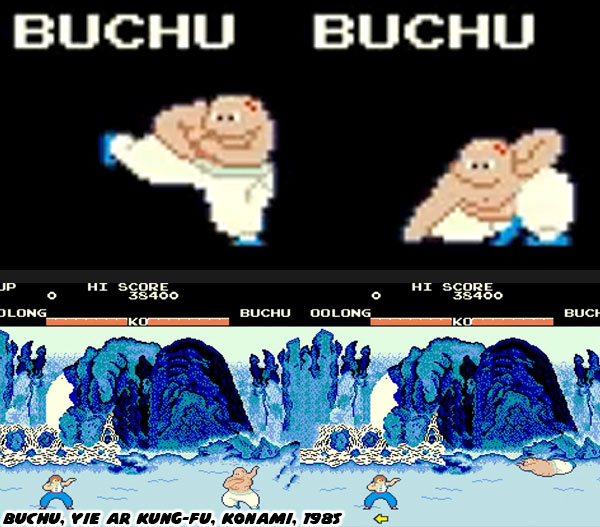
I was surprised at how fat he had become, especially when compared to his original look. He was proportionally much fatter than any other character used in a fighting game. This list would go beyond sumo wrestlers, and into the realm of fantasy characters like Avu, Sheik Maherl, and Karnov. With the exception of Buchu from Konami's Yie Ar Kung-Fu (1984) it was Karnov (1987) that became first breakout game star that was also fat. I had mentioned his status in the blog about representation a decade ago

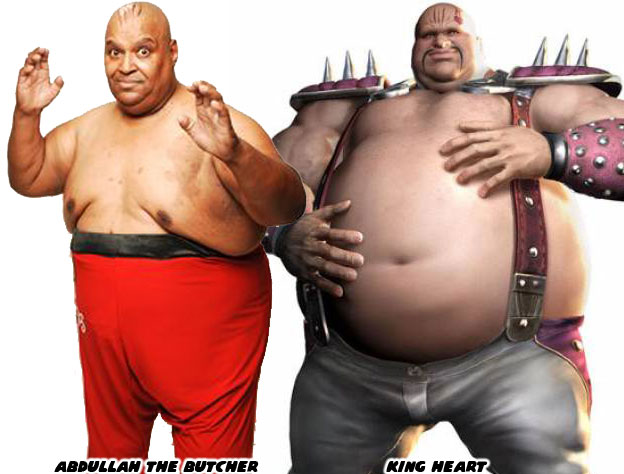
Aside from Kimala the Bouncer, the closest design that you compare him to would be King Heart from Hokuto No Ken. Both were obese boss characters from a post apocalyptic world. Yet like Heart this character was also absurdly muscular as well. It turned out that it was more than coincidence that their designs were so similar. Kimala, Burnov, and Heart (and especially Karnov) were all inspired by the pro wrestler Abdullah the Butcher. The “Madman from Sudan” traveled the globe brutalizing his opponents. He wore a keffiyeh, curled toe boots, and Arabian pants as part of his outfit.
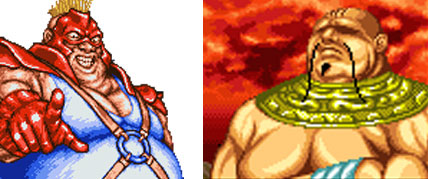
Technōs had the WWF (WWE) license for arcade games in the late '80s, and had created the wrestling games WWF Superstars in 1989, and WWF Wrestlefest in 1991. Abdullah was supposed to be in the game. He was in the design stages, but his sprite, and animations were never finished. So the developers instead changed his skin color, added some armor, and a mohawk. Thus the sprite that would become  Burnov was born. His strikes were still based on wrestling moves, chops, tackles, and leg drops. His special attacks were fire-based, like the Arabian characters mentioned above. Everything about this character worked surprisingly well, especially in the context of the Double Dragon universe.
Burnov was created as the second bruiser in the game, a sort of rival to Abobo. His girth, strikes, and special attacks were a perfect counter to Abobo’s height, and power moves. Remember that Abobo was a literal giant. He was over seven feet tall, and 336 lbs. In order to hold his own the shorter Burnov had to be massive, weighing in at 495 lbs. The game referred to him as the Muscle Bomber Man. I'm not sure if they were calling out the Capcom wrestling series Muscle Bomber intentionally. In any instance it was completely believable that he could bulldoze through all of his opponents. In fact I thought his Dynamite Tackle was one of the most awesome moves in all of fighting game history. 
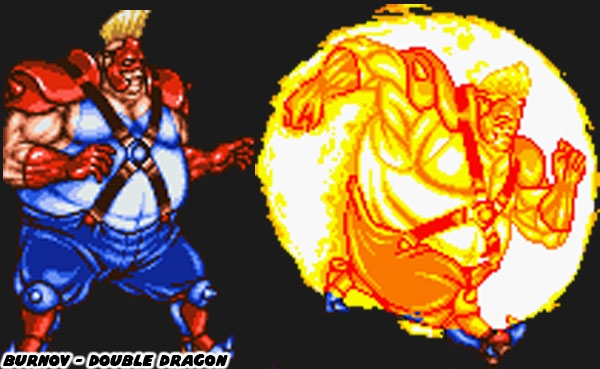
His super attack saw the man nicknamed “The Human Bomb” become engulfed in flame, and just plow through his enemies. It wasn't a fireball, sonic boom, knife, or other kind of projectile attack. Instead it was a man that weighed a quarter-ton simply running full speed at his opponent. I ranked this attack above Vega’s Psycho Crusher from Street Fighter II, especially when it came to believability. Why would I think so? When I was younger I studied karate with my big brother, and our friends. It was hard for me to find an equal sparring partner given my height, and weight. I was 6’ 7”, and around 330 lbs. at the time. Our sensei appreciated how hard I was working to learn the proper forms, and strikes. He revealed that in an actual fight these moves were impractical for me.
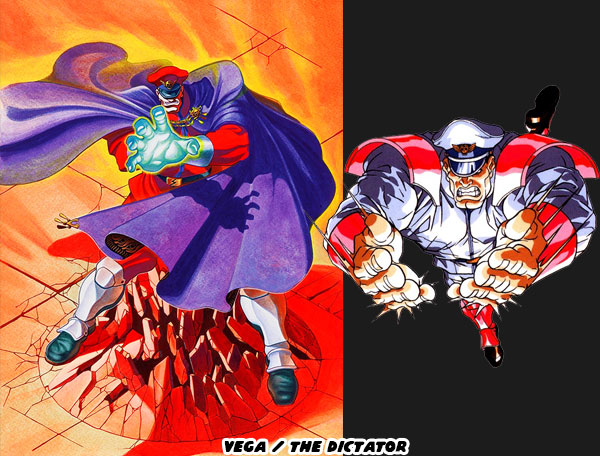
My teacher knew that I was a passive person, and not the type to look for trouble. Anyone foolish enough to pick a fight with me was probably carrying a weapon. They were looking for a reason to shoot, or stab somebody. This was especially true if they could claim self defense, or hide behind stand-your-ground laws. He advised that if I could not avoid a fight then I should literally run through that person. "In a life or death situation don’t try to punch, kick, or grapple." He said "just bowl them over, and get out of there." They wouldn't be able to stop me from doing so. Even the best martial arts practitioners could get trampled. Burnov was really good at doing exactly what I was taught. The fact that he could run down the Double Dragon sub-boss Duke, and boss Shuko was proof of this.
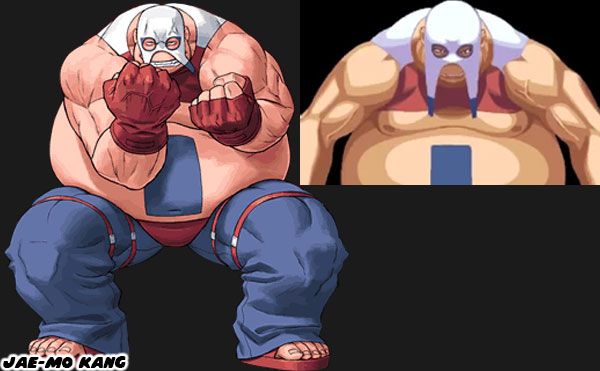
The next version of this character in a Double Dragon title wouldn't have the same impact. Jae-Mo Kang was a fat South Korean wrestler that appeared in the Rage of Dragons. He was a silly homage to Burnov. According to the designers at Evoga "Kang was one of the last characters to join, since we decided to include Mr. Jones I thought on a "Laurel & Hardy" team, so at first his name was McGuire, a Pro Wrestler and Businessman, later on during development we were told that we needed to change his nationality ot Korean for marketing reasons, so I asked for advice about a good Korean name..." Sadly Evoga missed the point of Burnov's redesign. This was evident when they insisted on making Kang, and his partner Mr. Jones into stereotypical caricatures

Burnov was the type of over-the-top character that added color, and personality to fighting games. He had a shocking appearance in the vein of Blanka, and Dhalsim, mixed with the entertainment factor of Skullomania. Like those characters he was also effective against the various martial arts styles. He was fun, and energetic, but not a joke. He was the fat fighter done right. He was a template that should be learned from for all the budding game designers out there. Were there any fighting game characters that you thought were well done in otherwise forgettable games? I’d like to read about them in the comments section. As always if you would like to sponsor me please visit my Patreon page and consider donating each month, even as little as $1 would help make better blogs and even podcasts!
follow the Street Writer on Patreon!

Monday, July 27, 2020

The Street Writer Podcast, Episode 11

We end the '80s on a high note. Konami lays down the law and creates some of the best licensed brawling games of all time. Sega starts off slow but then shines when they enter the console arena. Find out more on this episode.


If you would like to sponsor me please visit my Patreon page and consider donating each month, even as little as $1 would help make better blogs and even podcasts!
follow the Street Writer on Patreon!

Monday, February 17, 2020

Wednesday, February 5, 2020

The Street Writer Podcast, Episode 9

As always if you enjoyed this podcast and would like to sponsor me please visit my Patreon page and consider donating each month, even as little as $1 would help make better entries!

 follow the Street Writer on Patreon!

Tuesday, August 1, 2017

A look at the big man, where did the Capcom giants come from? Part 2...

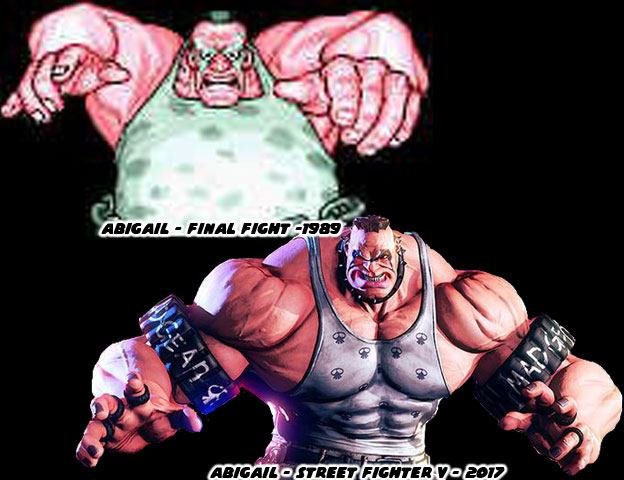
Abigail, a character introduced in Season 2 of Street Fighter V had originally appeared in Final Fight, an arcade hit from 1989. The character was a boss in Mad Gear gang, a group made up of the biggest, meanest criminals from Metro City. Abigail was gigantic, even by Final Fight standards which had many characters above 6 and 7-feet in height. In the Street Fighter universe, where the Final Fight story took place in, he was listed at 8' tall and 584 lbs. He was the largest figure in the series and among the largest human character in any fighting game. The tradition of over-sized, muscular characters in fighting games went back to the start of the genre. The third boss in the 1984 Irem classic Kung Fu Master was a dark skinned character named Giant, he was a full head and shoulders taller than Thomas the hero. The trope of gigantic villains in a fighting game really took off however with the cast featured in the Technos series Double Dragon. There were massive villains in the original and sequel; named Burnov, Bolo, Oharra and Abore. They were capable of lifting players up with one hand and even punching down walls with their bare fists. The bad guy that audiences remember most was a bodybuilder-type character called Abobo.


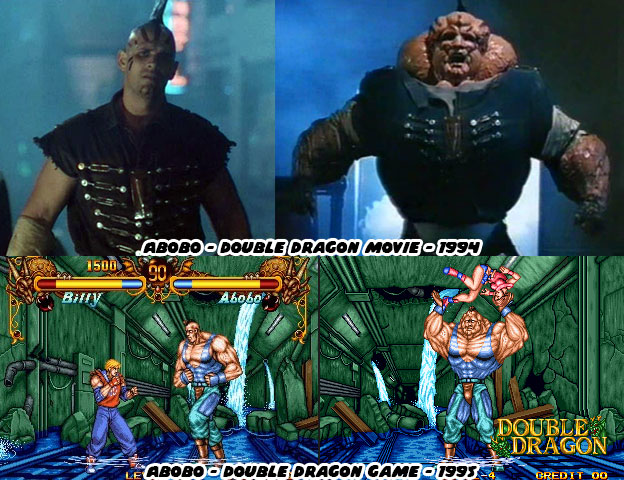
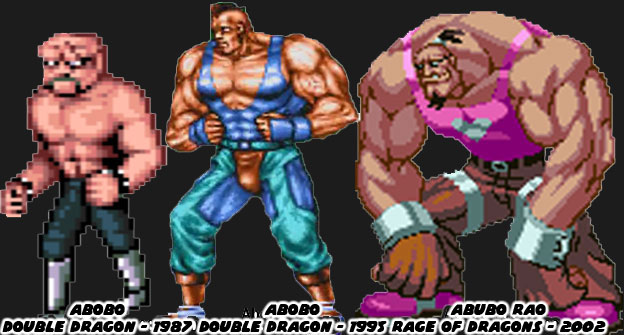
Abobo actually changed during the various sequels and remakes of the series. He was a generic bruiser in the original 1987 game. His face paint and spiked wrist guards made him appear like a heel or bad guy wrestler. Abobo was far more fleshed out when the studio created a 2D fighting game in 1995. This newer version of Abobo was more proportional to the rest of the cast and was officially listed at 7' 2" and 336 lbs. He was still huge but nowhere near as big as the character's final appearance. In 2002 the Mexican developer EVOGA created an unlicensed Double Dragon game, which they called Rage of the Dragons, an homage to the series. They avoided legal issues by slightly changing the names of the main characters. The bruiser in this game was called Abubo instead of Abobo. This character was on the absolute extreme end of character designs. He was now 8-feet tall, actually 8.03, and 640 lbs. making him a fraction bigger than Abigail. His arms were so huge that they hung to the ground. This type of large upper half / small lower half character designs had actually evolved through the '90s and were almost commonplace post 2000. I had written a history of these "top heavy" designs when Gigas was introduced in Tekken 7. Abubo and Abobo had set a standard, or rather limit, on what worked when it came to fighting character designs. Believe it or not in the '95 version of Double Dragon the character could grow even larger and more muscular.


The "transforming" version of Abobo and the updated cast were based on the 1994 Double Dragon film. In the movie Abobo was a typical punk bad guy. He was already big and dumb but Koga Shuko, the main villain in the film, turned him into a mutated freak for failing to recover an artifact. This weirdly swollen character had muscles where muscles didn't exist. He was literally swollen where his glands, bones, cartridge and neck should have been. The absurdity of his updated look was incorporated into the game where he could temporarily "buff up" while performing certain moves. The movie was absolutely horrid and had nothing in common with the game, except for the names of the characters. It was the first and hopefully last film directed by James Yukich, whom had probably never even played the title. Interestingly enough the story was co-written by Paul Dini (The Batman Animated Series and co-creator of Harley Quinn) who has been one of the greatest comic and cartoon writers of a generation. I guess something was lost in translation when the screenwriters adapted his story. But I digress, character transformations were not a new idea in games, cartoons or comics. The Incredible Hulk for example turned from a small scientist into a thousand-pound green skinned monster. A more contemporary version of the transforming villain was seen with the character Bane.


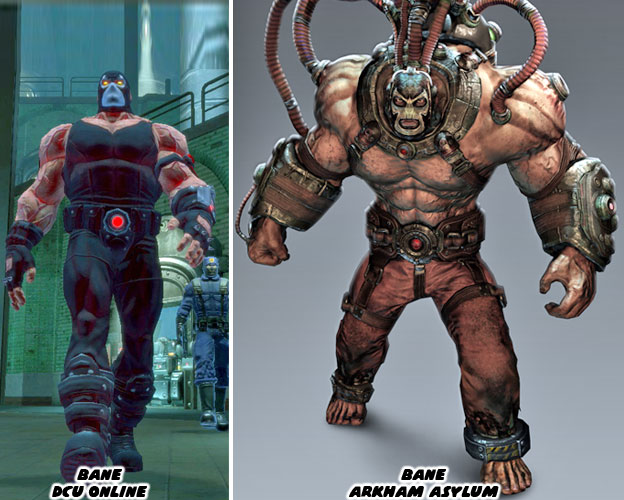
Bane debuted as a Batman villain in 1993. He was an assassin that was trained in the fighting arts and was a perfect rival to Batman. The thing that made him a superior opponent was a synthetic drug, similar to adrenaline, called Venom. It increased his speed, reflexes, strength and durability. He could turn on a pump filled with Venom whenever he wanted to boost his fighting prowess. When the character originally appeared he was muscular but realistic. He had a bodybuilder physique and was not as deformed as Abobo. A really good 3D representation of his original design appeared in DCU Online, the DC Comics online multiplayer game (MMO). However as comic book aesthetics changed, and as different writers and artists took over, the look and purpose of Bane changed as well. In less than 20 years he went from a realistic physique to a grossly disproportionate one. To see how far the character had changed look at the version that was featured in the Batman Arkham games. This new Bane had a gross physique. Not only that but every iteration of Bane seemed to become dumber and dumber. It wasn't long until he was nothing more than a typical brute that used his muscles rather than technique to beat people. Abigail was sliding into modern Bane territory but for over 30 years the designers at Capcom managed to avoid this trope. How did they do it?


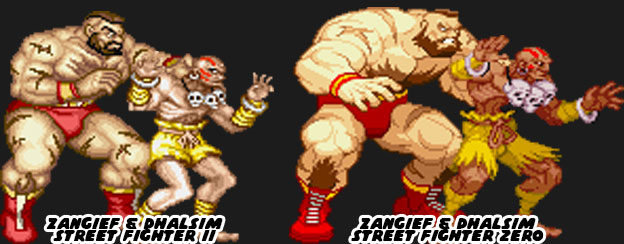
Capcom developed a template copied hundreds of times over. The idea for Street Fighter was simple, different martial arts masters fighting against each other to prove who was the best. The designers created a library of characters that reflected different nationalities and by default the different fighting arts. One of the reasons the series stood out was because of how unique the character designs looked compared to other games. The artists at Capcom, people like AKIMAN, Shoei and SENSEI created figures that were not quite manga, not quite anime, and not even comic book in appearance. They were instead something in between the Japanese and USA aesthetics. These archetypes worked incredibly well and they helped launch a franchise. The characters were diverse in size, color and body type. Their appearance helped reinforce a particular fighting style. These basic concepts were used and expanded upon by other studios as well. Look at a character like Dhalsim, a slender Yoga practitioner that stood 5' 9" and weighed about 100 lbs. Compare him to the burly Zangief, a 7-foot 400 lbs wrestler. In Street Fighter II the characters had good contrast. When the studio created a new sequel they went with a different designer. Bengus wanted to keep the scale of the characters similar but he used artistic license to exaggerate their proportions. Zangief and Dhalsim had the same height difference in Street Fighter Zero, but Bengus made Zangief much wider, especially on his shoulders, arms and back. He also cut Dhalsim's waist in half, making him even more gaunt. This contrast was more profound. It looked fantastic on screen but did not break the scale of the franchise. The exaggerated proportions ended up influencing a generation of game designers in Japan and even comic book artists in the USA.


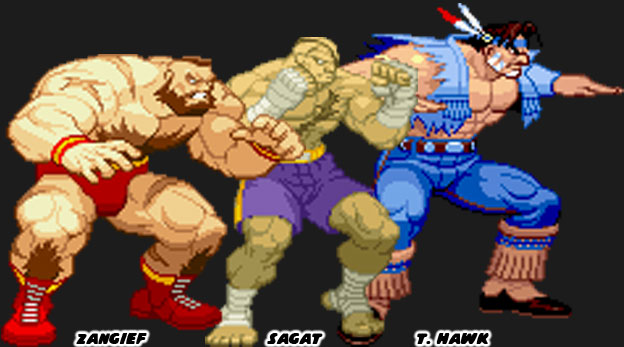
The proportions developed by Bengus were used by Edayan, Kinu and Ikeno in the other Capcom games from that era. In doing so the giant characters appeared far more menacing when compared to the rest of the lineup. The Street Fighter library had always worked within a certain range of body types. Every character had to be muscular, the sumo wrestler E. Honda had an enormous belly but his arms and chest were well defined. Dhalsim was thin but his muscles had definition as well. As the characters got taller they preserved those same basic rules. Zangief was considered a standard for giant characters in the series but that concept was flexible. Sagat was 7' 4", a few inches taller and slightly leaner than Zangief. Sagat was the original boss in Street Fighter and was a character of distinction in both Street Fighter II and Street Fighter Zero. He stood a head above every other character and did a great job of capturing the boss feel. Yet even Sagat would be replaced as the biggest fighter. T. Hawk was a native character, at 7' 7" he was on the edge of the character sizes that worked within the continuity of the series. Moreover his height was about the limit for any giant character in a fighter. There was actually some real world precedence for this.


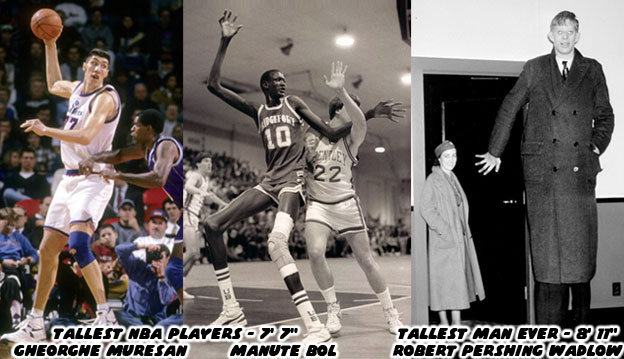
Professional NBA basketball players were 6' 7" on average with centers being around 6' 10" to 6' 11". Teams were constantly on the hunt for athletic 7-footers. These people represented less than .00004% of the population, and an even smaller fraction of those were healthy and coordinated enough to play at a professional level. The tallest of these men were Shawn Bradley standing 7' 6", Manute Bol at 7' 7" and Gheorghe Muresan also at 7' 7". Think about how imposing it was for T. Hawk to be created at the same height as the biggest NBA players. When you saw these players on TV the height differences between someone 6' 6" and 6' 10" looked much greater. Keep height to weight ratio in mind. A bulky tall person did not appear as tall as a lean person at the same height. Most basketball players were lean because it allowed them greater flexibility and speed. On television thinner people looked much taller than their opponents even though the actual height difference was only an inch or two. In a sport like American football tall players were very muscular. Because of this it was harder to spot the height differences on television.

Most fighting games have characters with a similar height to weight ratio. When you look at the height differences between Zangief, Sagat and T. Hawk it doesn't seem like much. Now think about Abigail. At 8 feet his height was very rare but not impossible. There had been taller people in history. The tallest that ever lived, Robert Pershing Wadlow was 8' 11". He would have broken the 9-foot barrier if an infection and compromised immune system didn't end his life at the age of 22. What made Abigail so awkward in appearance was his weight. The character was extremely muscular, almost to the inflated Bane or Abobo proportions. In the original Final Fight Abigail was shaped more like a professional strongman, with a wide gut, rather than a trim bodybuilder physique. This was actually very believable as there were many strongmen and wrestlers throughout history that were tall with that same body type.


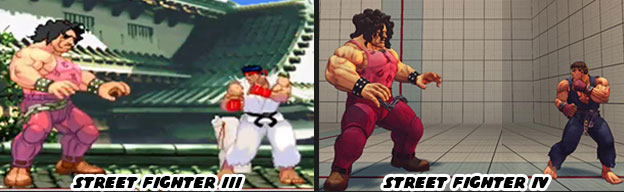
The designers at Capcom went overboard with the muscular physiques in Street Fighter IV. I believe it was because the artists were reacting to the trends in Western character designs which favored overly-muscular characters. Look at how big comic book characters were today. When presented as 3D models rather than 2D sprites the extra bulk made the height seem less dramatic. In order to make the differences more noticeable the model heights were exaggerated ever so slightly. Many players did not pick up on the new sizes. When the characters were far apart on the screen most people couldn't tell that the scale was different. But as they got closer it became obvious. Take the character Hugo for example. The original version featured in Street Fighter III Giant Attack was an updated version of the classic Final Fight character. His height was astounding but proportional to the rest of the cast. Fans of the Final Fight series, and those that remember his cameos in the Street Fighter Zero / Alpha series remember how massive he was and therefor his sprite worked. When the character was created in 3D for Street Fighter IV and also for Street Fighter X Tekken he became bulkier and taller. Players really noticed this change when the character model was close to an opponent.


Abigail was absurdly huge. He looked as wide as he was tall, dwarfing Zangief and the other large characters in the process. He didn't seem to have the same proportions as Hugo or the other giants. That is to say he was missing his neck and shoulders. This made him look cartoonish in appearance. None of the other characters had the same type of physiology. The addition of car tires around his biceps and belt made little to no sense. I understand they were part of his new personae as a scrap yard owner but they were not part of his original costume. The most jarring thing about Abigail's appearance in Street Fighter V was his personality. Abigail went from high-ranking Mad Gear boss, with a genuine fighting ability to an idiot. He retained his temper from Final Fight but everything else was made up. It was embarrassing watching him putting around and making car noises in his introduction and story mode. Both Street Fighter IV and V had played up the silliness of certain characters while making others seem terrifying. Rufus, Hakan, Birdie and F.A.N.G were some of the other goofy / awkward characters added to the series. The director and producer of the series were certainly playing favorites with the cast. I wondered if the studio created a moronic Abigail to make fun of USA fighting game designs. They had given us a mindless Bane because apparently that's what we thought all strong characters should be like. The studio hadn't always treated their giant characters so poorly. In fact they used to treat their legacy characters with a lot more consideration. We'll look at the ways they used to present giants in the next blog. As always if you enjoyed this blog and would like to sponsor me please visit my Patreon page and consider donating each month, even as little as $1 would help make better blogs and even podcasts!

 follow the Street Writer on Patreon!

Monday, April 11, 2016

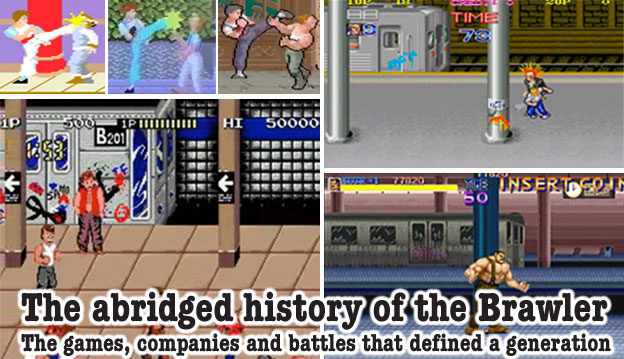
The Abridged History of the Brawler, part 5


By the end of 1989 and the start of 1990 several studios began experimenting with the direction of the brawler. In addition to Capcom the major innovator of the decade would be Konami. At that point the best most studios were doing was copying the Double Dragon formula. As exceptional as Final Fight was it still borrowed heavily from the Double Dragon elements. What was needed was something different. Konami became very successful at applying the brawling elements to licensed games.

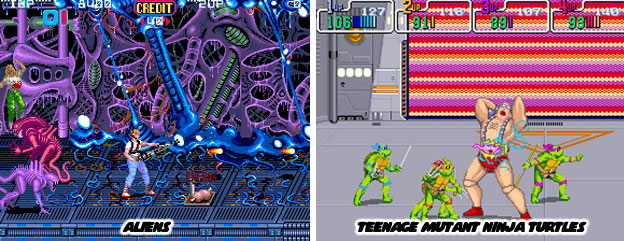
Good arcade games based on movies or TV shows were very sparse. Great licensed brawlers were even rarer. Konami changed all of that in the end of 1989 by releasing an arcade version of the wildly popular Teenage Mutant Ninja Turtles cartoon. This game was far more memorable than Crime Fighters, their previous brawling effort.


The game was layered with amazing details pulled right from the cartoon series. Plenty of gags, inside jokes, sound bites and hidden animations were crammed into the game. It was fanservice of the highest caliber, but it was quality fanservice that tried out new directions for the genre. The majority of the game was the traditional brawling experience. However that branched out when players were zipping down the streets fighting the evil Foot Clan on rocket powered skateboards. The illusion of moving quickly through a location while still being able to fight opponents with the existing play mechanics had not been done better than that previously. Konami was definitely onto something with this game.


In 1990 Konami turned Aliens, a groundbreaking science fiction movie, into a different type of brawler. Despite being two completely different types of subject matter, the lessons they learned from TMNT were carried over into Aliens. They preserved the attention to detail from canon and shaped that as a game narrative.


Where Aliens differed from the other brawlers was that the players did not use their hands or feet. Instead programmers put different types of high powered machine guns in the hands of players. Several of these weapons were pulled right from the movie. Each gun, rather than each player, had its own effective range, strength and weakness. This distinction made for a unique gameplay element. In the traditional brawler each player was free to explore the screen and take on any rival they could. It was very much every man for himself in those games. In Aliens some of the species took several shots to put down and by that time there would be another following it or sneaking up on the player from the opposite direction. Gamers that worked closely together, perhaps one with a short range flamethrower and one with a long range assault cannon could get further into the game than players that went on their own.

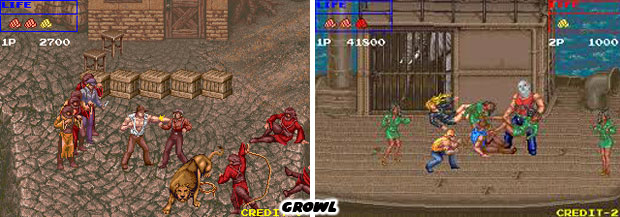
That year was not filled entirely with great advances in the genre. Studios were quickly developing their own take on the brawler and they weren’t all great or memorable. Several were applying the formula as fast as they could and pushing a title right to market. That was the sense I got from Taito when they released GROWL. A brawler set in the '30s-'40s about a group of adventurers tackling poachers in the jungle. The game was a thinly-veiled Indiana Jones rip off as scores of thugs went after fedora wearing heroes.


The handful of rival designs had nothing more than color palette swaps. Random men and women wearing the same costumes in different colors would simply show up to fight players over and over. The only interesting elements going for the brawler were some of the stage designs. Fighting aboard a steam ship as it sailed down a river, or atop a train as it sped through the jungle made for memorable levels. Everything aside from that was truly forgettable.

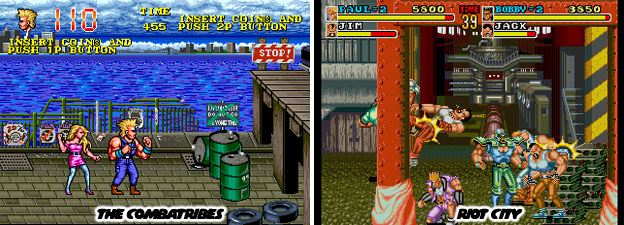
Technos was guilty of exploiting their own Double Dragon formula when it released the Combatribes. They added a third, black character, to the lineup of Billy and Jimmy Lee clones just to keep things fresh. I will go on record to say that the first time I saw the famous Guile haircut from Street Fighter II. It  was with the blonde character in the game a full year before Capcom revolutionized the fighting genre. Granted the graphics and animation were improved over Double Dragon, but the case was true for every other game released three years after Double Dragon.


The things that made this game unique had to do with the combat system. Downed opponents could be kicked, picked up or swung around by the ankle. Swinging opponents around and throwing them into each other was truly my favorite part. Rarely did brawling games allow for rivals to be struck while they were down. If they were allowed to fight dirty why couldn’t the players be allowed the same luxury? The game also exploited the health allowance that Konami charged in Crime Fighters. Quarters granted players a set amount of health. Thankfully unlike Konami that health did not go down by the second.

After Konami had pushed the genre forward with TMNT and Aliens players had an elevated expectation for brawlers. Taito and Technos seemed to have missed that expectation and as such GROWL and Combatribes saw a limited following. The next year would be the defining moment for the brawler. Unfortunately it got off to a rough start.


Westone (a publisher I never heard from again) developed a game for Sega. Riot City would be one of the companies first forays into the genre. The game was a pretty forgettable brawler, with a questionable design team and lackluster graphics.


About the only thing I remember from the game was the funny strut that the black character had. I guess he had to be even cooler than the white guy in the game so he walked like a rooster. Seriously Sega, what was that all about? Thankfully the rest of 1991 would give Sega another chance to get things right. In fact every major developer and publisher seemingly released at least one brawling game that year. Some were fantastic, some were okay and a few ones were real stinkers. We shall explore these over the next few blogs.

As always if you enjoyed this podcast and would like to sponsor me please visit my Patreon page and consider donating each month, even as little as $1 would help make better entries!

follow the Street Writer on Patreon!

Friday, April 8, 2016

The Abridged History of the Brawler, part 4


The games featured today were the best examples of how the brawler was shaping the game industry and creating sub-genres in its wake. 1989 was the year that showed it was not simply enough to follow the trend, studios had to innovate and change the genre in order to keep the momentum going. The first title was a sort of high water mark for the brawling sub-genre better known as the hack-and-slash.

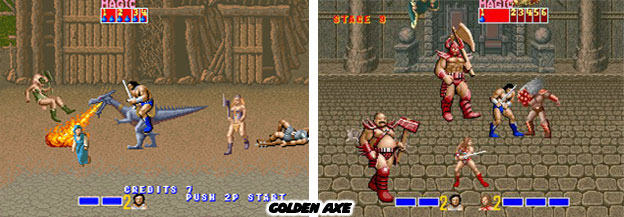
Golden Axe developed by Sega was a sword and sorcery take on the brawler. It featured three characters, a barbarian like warrior known as Axe Battler, a dwarf named Gilius Thunderhead and a female warrior named Tyris Flare. All three fought with weapons instead of their bare hands across a medieval fantasy setting. They could take down rogues, bandits and monsters. In several portions the characters could even mount dragon-like creatures and burn down opponents. The trio of fighters were set to defeat a barbarian lord named Death Adder (which always was a cool name) before he could claim the Golden Axe and the kingdom that followed it.


The game was important to the history of the brawler for the design and magic system that went along with it. Although it was infamous for a sound bite or two they ripped off of the movie Conan the Barbarian. The characters were fun but for the adolescent boys playing, the warrior Tyris was the memorable one. A perfect tan, a toned figure and a tiny white bikini weren’t quite the things people thought of as suitable for a warrior until Tyris came along. Tyris also sported the most powerful magic attacks in the game making her a practical choice and not just a sex object.

The fantasy themes worked well for the genre but were cemented by the exotic locations featured on the travels to find Death Adder. One level, which appeared like an island actually took place atop a giant sea turtle as it moved from port to port. Another branching path was set on the back of a giant eagle. Branching paths was a new feature in video games and Golden Axe was among the first, if not the first arcade title to use them. Incorporating a tremendous sense of scale had not been done in any previous brawler. The magic system itself was completely unique among brawlers. Players collected magic vials by hitting tiny thieves. Each level of magic required a set amount of vials. Once the player had collected them they could activate the magic at any time. The more vials required to activate a spell then the more damage it did to opponents. Players learned to save a magic attack for when they were surrounded by opponents or the final boss himself.


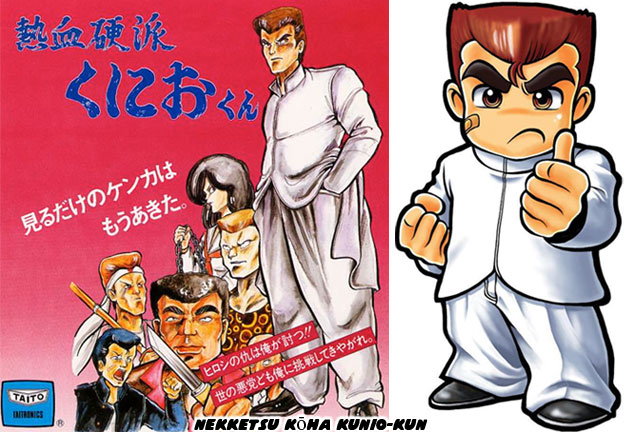
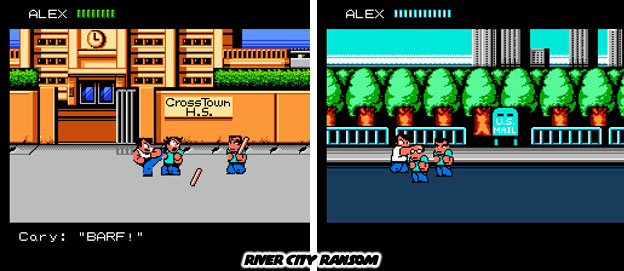
By this point the industry was clearly interested in the brawler and they were trying to bring the experience to home systems. Technos released a variation of the brawler with a Japanese High School theme titled Downtown Nekketsu Monogata. It was set in the same continuity as the arcade title Nekketsu Kōha Kunio-kun. For a while Technos actually had Kunio-kun act as a mascot. When that game came out for the Nintendo Entertainment System in North America we knew it better as River City Ransom. The limited processing power, color palette and memory of the NES meant that there was no way that the 8-bit console would be able to match anything the arcade had.


Technos succeeded in creating a memorable brawling experience by creating small stylized figures out of the Japanese high school characters. The smaller figures required less details and animations and the memory saved on limiting the detail on each character meant that more rivals could be drawn on screen by the processor. To keep the NES from being overworked the environment was limited to a strict, flat battleground while still allowing for backgrounds to change and show that characters were advancing through the city. In the end it was a pocket version of the brawler and proof that consoles were capable of carving their own niche with the genre.

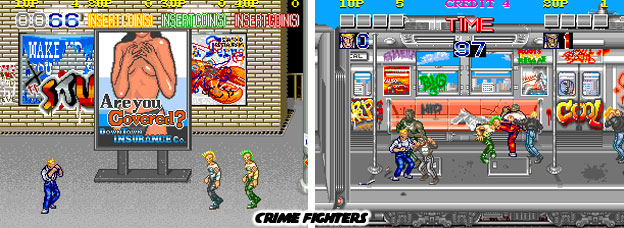
With that said Konami was going to point out how the arcade brawler could get away with things not allowed by Nintendo’s policies which were a form of game censorship. In the arcade they released Crime Fighters. It was a large 4-player cabinet featuring generic characters wearing white shirts and four different colored pants. Talk about taking the quick road to character design! The game was notable for a few reasons. The designers created large, detailed environments for the four players to fight in an around. The characters were smaller than those featured in other brawlers but proportional unlike the River City Ransom figures.


The game pandered to just about every adolescent boy’s fantasy. It was a cool version of New York with plenty of brightly colored graffiti covering the walls and lots of fighting. It was extremely violent as well, more so than even Double Dragon. Rivals could knee the player in the groin players could hit opponents with lead pipes and even use a handgun, which was against the code of fair fighting for most brawlers. There was also a bit of sex appeal with a lot of cleavage shown in a billboard early on in the game, not to mention that rival female gang members were dressed like dominatrix’s and used whips on the players. Crime Fighters would never have been released on a Nintendo console without some serious retooling.

The game itself was fun but very difficult. Every credit gave players a set amount of health and that health counted down slowly. Taking damage from opponents caused the energy to drain faster. Thankfully some of the damage could be recovered at the end of the level based on how many opponents were defeated. That was of course if the player managed to beat the boss characters. The bosses were larger variations on the gang members, each boss having a gimmick like wielding a chainsaw or fighting with wrestling moves.


The hardest part of the game was the end in which all of the bosses had to be defeated in a battle royal. Konami wasn’t mincing things, they wanted one of the most difficult and quarter-hungry games of all-time. It did fairly well in arcades, however there was another brawler released that same year which took the lion’s share of profits.

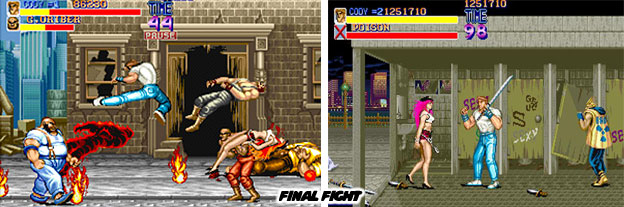
Final Fight by Capcom was the heir apparent to Double Dragon. In fact the producers went into the project trying to dethrone the game. For the most part it was mission accomplished. Visually the game was a great leap ahead of the Taito brawler. The sprites were larger, more detailed and better animated. The designs of the heroes and rival Mad Gear gang members would become brawling archetypes. For players there was a large and powerful character that moved slowly but could deal great damage with his wrestling moves. There was also a smaller martial artist that struck very quickly and whose quick punches and kicks could stun opponents approaching from any direction. Then there was a character in the middle that had strength and speed at his disposal. For the gang members there were character types that mirrored the heroes. The world that they inhabited, a certain Metro City, would become part of Street Fighter canon.


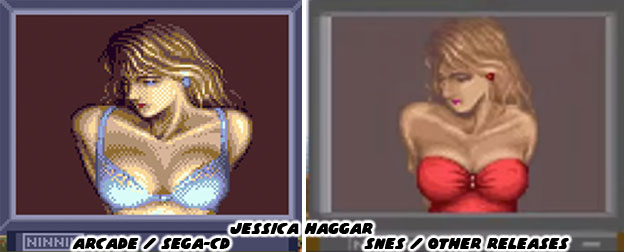
The plot was familiar, a girl was kidnapped and a team had to come to her rescue. Arcade players were treated to a shot of Jessica Haggar in her bra tied to a chair. This bit of skin already made the game more mature than other brawlers. This show would be toned down and even removed in future revisions and home versions. It turned out that she was the daughter of Mike Haggar the mayor of Metro City. The former champion pro wrestler recruits Jessica’s fiancé Cody and his martial arts trainer Guy to go into battle. The rest of the game was a lesson in flawless design and execution.

Players were taken through the boroughs of Metro City on the way to rescue Jessica from the crime lord Belger. The Mad Gear gang members hanging out, seemingly every few feet, waiting for their chance to take on the advancing heroes. Along the way new boss characters were introduced. Sodom, Rolento and Andore, that would become legendary in future Capcom fighting games. The game had the right amount of difficulty and challenge. Patient players could pick off most opponents and use all the time available to them to clear each stage with a minimal amount of health lost. Those that wanted to go all out and have all three players on screen at once for some mayhem could do the same at the risk of wasting plenty of quarters. Those that went full tilt into the game experienced the best that the brawler had to offer.


The arcade was the original social gaming experience. Players did not have the luxury of being connected to a network and having players across the country or around the world be able to drop into the action. If a player needed help clearing a stage then a friend or family member would have to be standing with them, fighting the good fight. Ask any player that remembers clearing a fighting game how much fun was had when the battle was a shared experience. Memories were made and bonds grew stronger when players could say that they fought from beginning to end with a good friend. It was that way for my brother and our friends when we visited the Cal State Long Beach campus while still in high school.

We were on a school field trip and Final Fight had been released earlier. A brand new cabinet was waiting in the campus arcade. Instead of enjoying our lunch my brother and friends decided we were going to beat the game and earn the bragging rights among the other gamers at school. The risk of not eating was not as big as missing the bus back to school. We were determined that nothing was going to stop us and played through level after level. Frantically running back and forth between the change machine and the cabinet to keep us engaged when the lives started running out. Defeating wave after wave of the relentless Mad Gear gang members with a combination of shoulder throws, jumping piledrivers and spinning back kicks. Surviving the cheap shots by bosses and their countless minions. Getting a small group of classmates gathered around the machine rooting us on and at long last kicking Belger out of a window and reuniting Cody with Jessica. Those memories would never be replaced in our collective consciousness. It was more than 20 years ago today yet the memories remain vivid as ever. Proof that gaming could have a profound impact on our lives. Yet the brawler would not be done shaping our gaming tastes The new decade would see the genres pulled in many different directions all at once. I hope to see you back for the next blog which will look at how the 1990s saw some of the defining moments in all of gaming. As always if you enjoyed this blog and would like to sponsor me please visit my Patreon page and consider donating each month, even as little as $1 would help make better blogs and even podcasts!
Monday, April 4, 2016

The Abridged History of the Brawler, part 2


Today we'll look at the godfather of the brawling game. As fellow 1UP member Jgusw pointed out it might have been Renegade. It was a game released by Taito in 1986, exactly one year before the same studio released Double Dragon. This was actually the western version of the game called Nekketsu Kouha Kuniou-Kun which translated to "Hot Blood Tough Guy Kunio." It was developed by Technos and the main character was named after Technos president Kunio Taki. The game about high school tough guys and gang members doing battle.


The game looked and played a little "looser" than Double Dragon but all of the familiar elements were there. Players were constantly hounded by gang members and could use anything available to defend themselves. As with Double Dragon players could use weapons and even the environment to their advantage. The animation, and visual style of the game was the template that Double Dragon followed and refined. If Renegade had one failing it was the brevity of the game. The three levels and bosses can be defeated in under six minutes. Double Dragon provided a more robust experience and lasted about five time longer. That was probably why more gamers remembered this title.


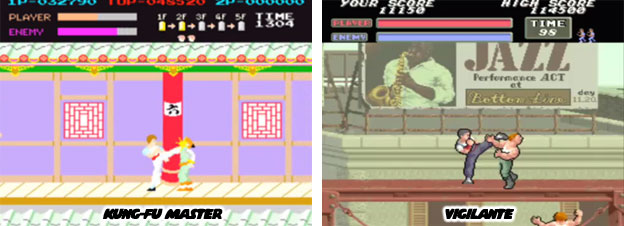
As fun as Renegade was, it too was not the founder of the brawling experience. In 1984, the same year that Karate Champ debuted, Irem had released Kung-Fu Master. The brawling game and fighting game were canonized at the same time. Kung-Fu Master featured a familiar story, a gang kidnapped Silvia, the love interest of Thomas the kung-fu master. I found it odd that neither of them had traditional Chinese names… Thomas had to fight wave after wave of opponents to reach his beloved. The character used nothing more than his quick hands and feet to defeat different character types including knife throwers, burly guards, dragons and even little people.


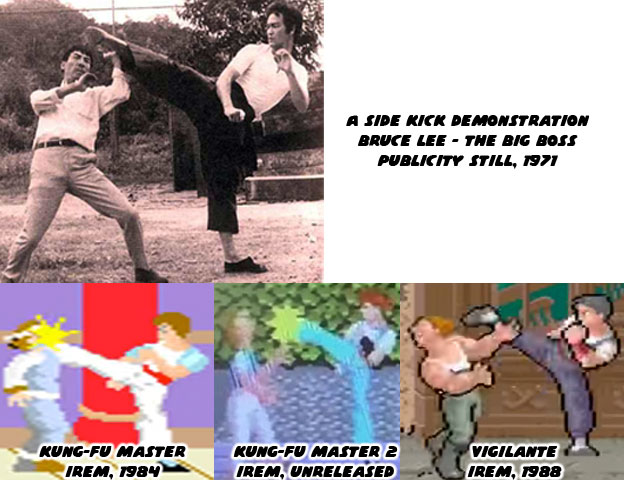
Thomas was the first character that was closely modeled after Bruce Lee. While his costume might not bring up memories of the actor, his moves and trademark yell certainly should. Lee was a perfect template to build martial artists from. His punches and kicks worked well when illustrated. He had a dynamic range, his moves were easy to read when created frame by frame. Best of all he was recognized the world over as a martial artist that really moved as fast as any game character could.


This game established the formula of waves of opponents approaching from the left and right, different strengths and weaknesses for those opponents and also boss fights. The idea of fighting combinations exploited in Renegade and Double Dragon was not quite the same. Players could switch between punches and kicks but the game system did not include knees, elbows or headbutt attacks at different ranges. The speed and damage that diverse strikes provided made the latter games more efficient when dealing with scores of rivals. By comparison Kung-Fu Master was more about finding the right timing against the advancing hordes and pressing the attack buttons quickly.


The seeds for the brawler were germinating and bearing fruit. Irem had actually planned a sequel to Kung-Fu Master. They had created a prototype board featuring new sprites, animations and villains but with the same familiar Chinese location. The publisher was afraid that this game wouldn't be interesting to Western audiences because it was more of the same. So they cancelled production on the game and went back to the drawing board. A year after Double Dragon was released Irem returned with what many consider to be the spiritual successor to Kung-Fu Master. Vigilante, published by Data East in 1988, improved on the mechanics in every way and brought the martial arts legend to the modern world. Ancient China was traded out for the urban jungle which looked an awful lot like New York City. The girlfriend was named Madonna and the unnamed hero, possibly the reincarnation of Thomas could get access to a weapon, a nunchaku to help out against the Skinheads terrorizing the city. A great deal of the mechanics from Kung-Fu Hero were preserved with different-sized opponents sneaking up on the hero from both sides. The visuals and animations were updated thanks to the newer hardware and software.


The format of keeping all of the action to a 2D plane seemed limiting to gamers. That mechanic went over well with the original arcade brawler but seemed dated now that engines could have characters move all over the screen in a pseudo-3D environment. A few other great games would preserve the 2D legacy and they will be mentioned in due time but for the majority of gamers the brawler held more potential when the world opened up and the brawling required more strategy. 1988 saw several other games looking to give Double Dragon a run for the title. We shall look at these in the next blog. As always if you enjoyed this blog and would like to sponsor me please visit my Patreon page and consider donating each month, even as little as $1 would help make better blogs and even podcasts!