Showing posts with label irem. Show all posts

Monday, May 4, 2026

Bookmark This Page; Art, graphics, and aesthetics in fighting games

Video game players sometimes use the word graphics, when instead they mean the aesthetics, or art style of the game. If you want to learn about some of the most unique looking fighters then Bookmark This Page.

The aesthetic versus graphics debate, part 1…

The aesthetic versus graphics debate, part 2…

The aesthetic versus graphics debate, part 3…

The Style Files, Voltage Fighter Gowcaizer & Goketsuji Ichizoku aka Power Instinct

The Style Files, Psikyo and the aesthetic copies

The Style Files, Daraku Tenshi: The Fallen Angels, part 1

The Style Files: Daraku Tenshi The Fallen Angels, part 2...

Did you get a chance to play any of these fighting games? Let me know about it in the comments section. As always if you enjoyed this blog, and would like to sponsor me please visit my Patreon page and consider donating each month, even as little as $1 would help make better blogs and even podcasts!

follow the Street Writer on Patreon!

Friday, August 16, 2024

D.A.S. the biggest video game bad guys you've probably never heard of

Hello friends, and visitors to the blog. The other day a random question popped into my head. What was my favorite evil organization in gaming history? Did I even have a favorite? Have you ever thought about the bad guys in your favorite video games? I didn’t mean the villains in game, but the evil organizations. The ones that returned more than once in a series? Evil groups had always appeared in the comics books, and cartoons. When I was a kid G.I. Joe fought against Cobra. The Autobots fought against the Decepticons. The Ninja Turtles fought against the Foot Clan. But could you think of a game series that had a recurring evil organization?
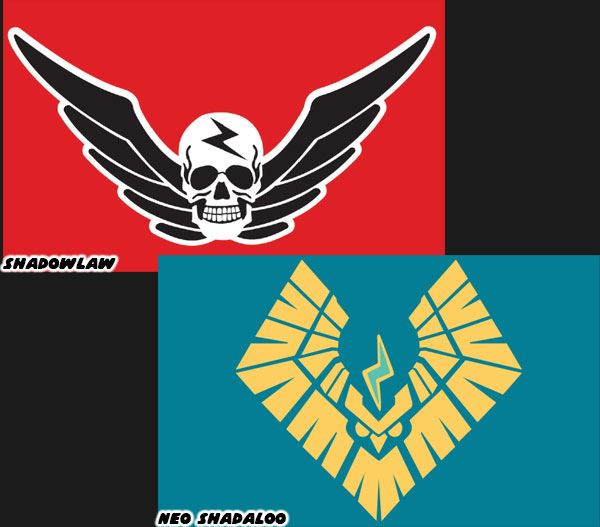
Since I wrote mostly on fighting games it might be Shadowlaw / Shadaloo. That organization got its start in 1991 with Street Fighter II. A dictator named Vega / M. Bison ran his own small nation near Thailand. This group, its soldiers, spies, and generals would pop up again, and again all throughout the series, and even some crossover games. Currently a rival group was introduced by the team at Capcom called Neo Shadaloo. Would they become major players in the franchise, or were they only going to be a part of Ed’s back story in Street Fighter V, and 6?
Shadowlaw had a great name, but I didn’t care to see them keep popping up in the SF franchise. Nor did I care about NESTS showing up in the King of Fighters franchise. I believed that fighting games were more unique when they focused on the fighters, their forms, and the challenge of facing the best. It was more interesting to me to see who could be the next great challenge rather than figure out a way to connect them all to a cartoonish villain again, and again.

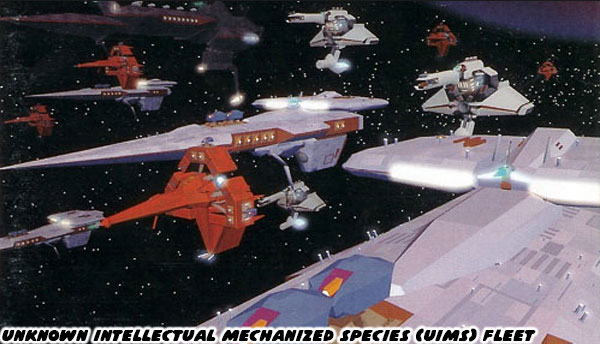
One of my favorite enemy groups might be the Unknown Intellectual Mechanized Species (UIMS). They were just one of the many alien species challenging humanity, and the United Galaxy Space Force (UGSF). The Bosconians, and Galagans were also memorable enemies across the various Namco franchises. As cool as those bad guys were I thought that one of the rarest groups ever featured in any game series deserved more love. The D.A.S. (Dark Anarchy Society) in the international releases, Destroy And Satsujin (Satsujin means murder in Japanese) was a recurring villainous force from Irem's Arcade games.
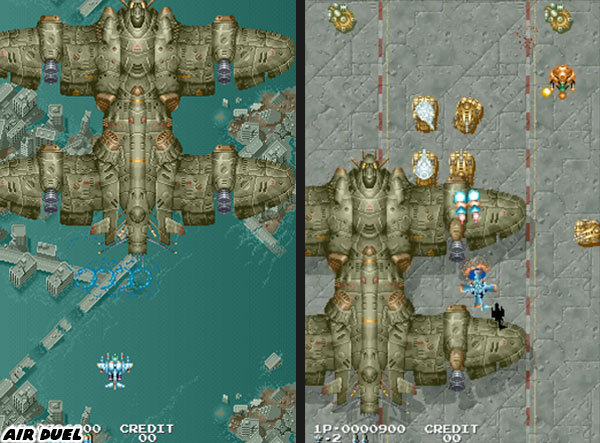
The group appeared as the main antagonists in several titles by Irem, they include In The Hunt, Gun Force II/Geo Storm and Undercover Cops. There were a few things that made the groups, and games they appeared in unique. Primarily that none of the games were in the same genre. Air Duel was a SHMUP, a shoot ‘em up or shooter featuring a jet, and attack helicopter. The game was set in a near post apocalyptic future. D.A.S. would try to take over the world, and it was up to the arcade players to see them destroyed. They would lay low for a few years, and then try to set up their totalitarian regime through violence. Each game mentioned above would be connected by the same group. Probably the closest that D.A.S. came to world domination was with In the Hunt aka Kaitei Daisensou (Great Undersea War) in Japan. The submarine shooter was set in a version of the Earth where the bad guys had just about conquered every nation. With the melting of the polar caps, and the major cities underwater it was easy for them to clear out opposition using their superior naval forces. The last ditch effort to destroy their ocean-based super weapon came with the creation of a super attack submarine called the Granvia. 
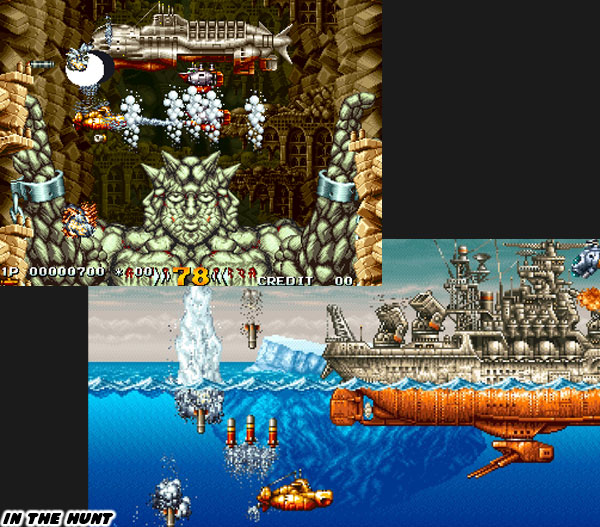
The submarine that players controlled could dance circles around its opposition. I had talked about In the Hunt, and Air Duel on the blog previously. This conflict was serialized in a Gamest Manga by Masato Natsumoto. His vehicle design, and presentation were influenced by Masamune Shirow. He was a perfect fit for the world created by Irem. The series explained that the reason the sub was such an amazing weapon because its design was based on stolen plans for a D.A.S. sub-orbital attack ship. The weapons, and unique magnetic propulsion system was repurposed technology that would liberate the worlds from the oppressive regime.
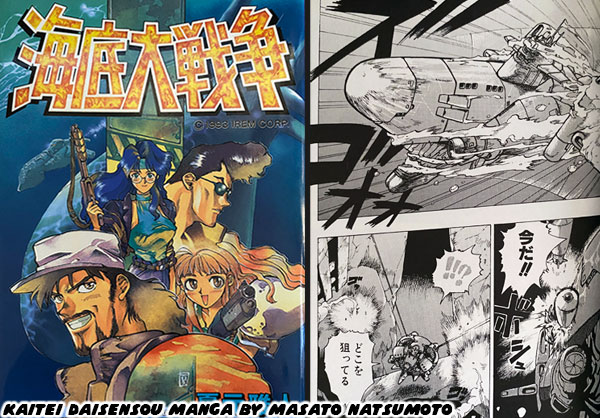
The manga featured the brave pilots Jin, and Rei against the D.A.S. captain Sharking. Every encounter in the game was recreated, and the adventure was greatly fleshed-out. It was a shame the series didn't get a follow-up. These games were important in the history of arcade gaming not only for their content, but for their style of presentation. Visually there were no other studios that crammed as many details on their sprites as this team did. To this day no other studio could claim to have created sprite-based titles with as high a level of detail, and animation. The studios that came close like IGS, and their game Demon Front still fell short of that high mark. The members of that team applied the same amount of detail to everything they worked on. The D.A.S. gunships, tanks, copters, drones, and bases oozed with style. Now that they had covered the air, and sea shooters, they decided to make things interesting with a side-scrolling shooter.
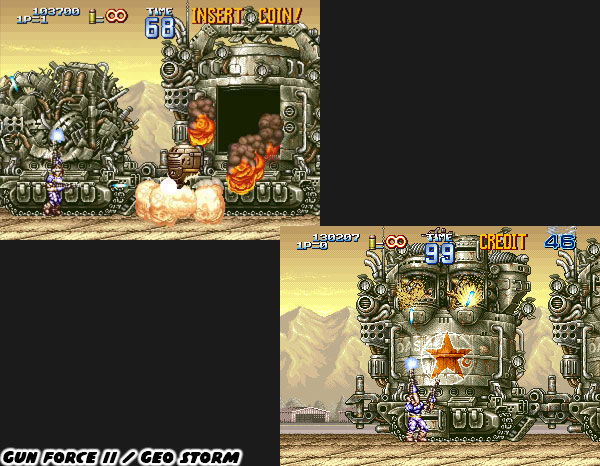
Geo Storm was their response to popular franchises like Konami’s Contra, and Data East’s Midnight Resistance. The challenge was getting even closer to D.A.S. vehicles, upping the amount of detail, and letting us see the individual soldiers. They hit it out of the park, and no other studio could even compare to the work that went into Geo Storm. This group would get tired of waiting for Irem to start new projects, so they left and formed a new company called Nazca. The next gem for the Neo Geo was called Metal Slug. They were the only company capable of topping themselves. Metal Slug, and the team at Nazca were part of a massive legacy in gaming. Before they left Irem the Nazca team flexed their muscle in yet another genre. I talked about Undercover Cops during my history of the brawler series, it was one of the more unique titles of 1992. The fact that they were able to apply the same amount of detail in a brawler, and add new features to the genre meant that this team were made up of critically underrated game designers. Other studios that bounced around different genres were rarely good at multiple ones. They instead specialized in one type of game. The Nazca staff could seemingly do it all.
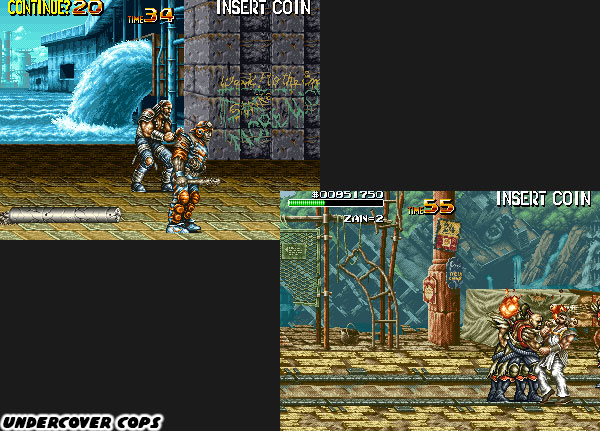
I would like to think that they started with D.A.S., and then worked backwards to figure out who were the heroes that could stand up to this unstoppable evil force. In the oldest games we were looking at massive D.A.S. ships, planes, and tanks. As Nazca learned to make games we started getting closer to the bad guys. By the time they released Undercover Cops we were able to see the monsters, mutants, and villains in a one-on-one setting. No other company had given us the big picture, all the way down to the individual foot soldiers for the evil organization. The nearest thing to that type of world building could be seen with the Rebel Army in the Metal Slug series. It made me appreciate the bad guys that went into the creation of a great series. I’d like to know if there was ever any evil group that you admired in your favorite games. Were they from a well established universe like Star Wars? Or from a horror series like Resident Evil? I’d like to read about them in the comments section. As always if you would like to sponsor me please visit my Patreon page and consider donating each month, even as little as $1 would help make better blogs and even podcasts!
follow the Street Writer on Patreon!

Monday, August 10, 2020

The Street Writer Podcast, Episode 15

The start of the '90s changed quickly for the brawlers. Fighting games had exploded on the scene. Brawlers took a back seat, but innovated despite the market. Some studios went with more kid friendly options, and a few explored cultures other than the USA or Japan for their content.

If you would like to sponsor me please visit my Patreon page and consider donating each month, even as little as $1 would help make better blogs and even podcasts!
follow the Street Writer on Patreon!

Wednesday, February 5, 2020

The Street Writer Podcast, Episode 9

As always if you enjoyed this podcast and would like to sponsor me please visit my Patreon page and consider donating each month, even as little as $1 would help make better entries!

 follow the Street Writer on Patreon!

Monday, May 23, 2016

The Abridged History of the Brawler, part 23


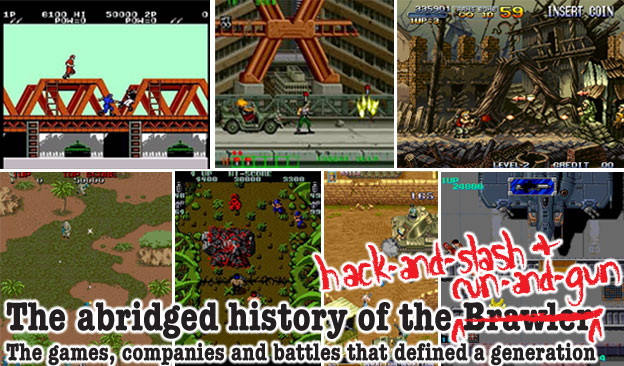
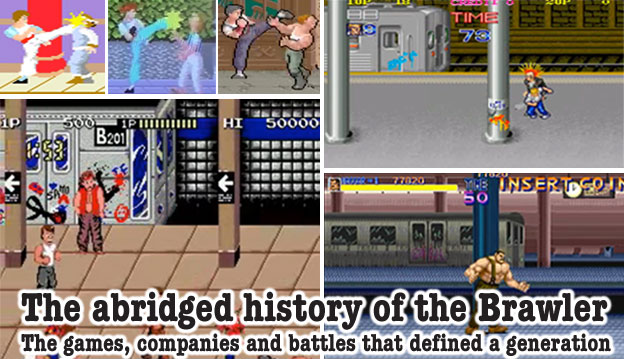
The mechanics of the brawler had been a part of the gaming history at least a decade before Double Dragon. Before arcade players could fight wave after wave of opponents with their bare hands they had to defeat wave after wave of aliens in a spaceships in titles like Space Invaders (Taito, 1978) and Galaxian (Namco, 1979). When those ships were replaced with humans, usually made up of a few pixels, the genre began to evolve. Starting with Kung-Fu master the "Beat-em-Up" was the earliest of the Brawler formats. A year later the "Run-and-Gun" and "Hack-and-Slash" formats were born. Really the only difference between the gameplay was that fists were usually replaced with either guns or swords. In some games players could use fists, guns and swords to combat opponents. What I would like to do in this series is highlight how the graphics, gameplay and genres were constantly evolving. How these titles borrowed elements from each other, explored different formats, visual styles and mechanics The first titles I would like to mention were among Konami's earliest arcade hits.


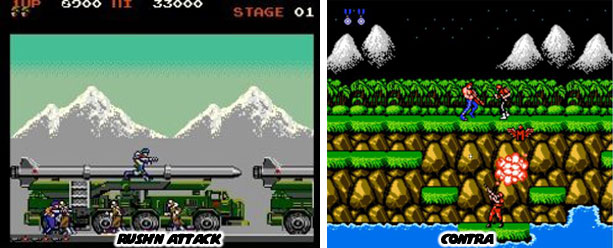
Largely forgotten by most arcade gamers, Rush'n Attack was the 1985 title that really established the side-scrolling run-and-gun action for Konami. In the game a special-forces agent could fight with his bare hands and take weapons from defeated opponents. From flame throwers to laser rifles, each weapon had its own advantage and ammo supply. This game laid the foundation for a more popular title and one which has received countless makeovers since its debut.


Contra became famous for the Konami code (up, up, down, down, left, right, left right, B, A) which allowed gamers to have scores of lives on the home console version of the game. The 1987 arcade gem featured two-player action which had improved on the Rush 'n Attack formula. Players could jump up or down on platforms and shoot in 8 directions now. In portions of the game players could even advance in a behind-the-back POV. The diversity of weapons and nonstop action made the title very popular in the arcades and at home.


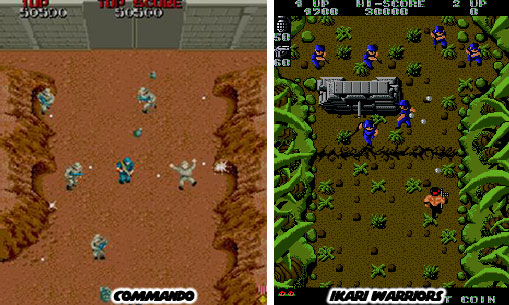
Before Contra had taken off in popularity the run-and-gun had been experimenting with different camera points of view. One of the earliest titles was Commando by Capcom. This 1985 title was set in an overhead perspective. For many developers this approach made sense. The formula had been used with great success previously. The only thing developers had to do was replace the spaceship with a soldier and space with a battlefield for them to advance on. Players could move around the screen in several directions and shoot at opponents but the screen mostly advanced up.


In 1986, before they developed their own arcade platform, or became heavily invested in fighting games, SNK had released the Ikari Warriors. The game allowed two players to control the mercenaries Ralf and Clark as they made their way through some unknown jungle. The game introduced a joystick with an octagonal handle that could be rotated to shoot in 8 different directions. With commando players could shoot forward and to the sides but not behind them. Ikari Warriors proved popular and like Contra several sequels were made. Today most players are familiar with the Ikari Warriors thanks to the King of Fighters series.


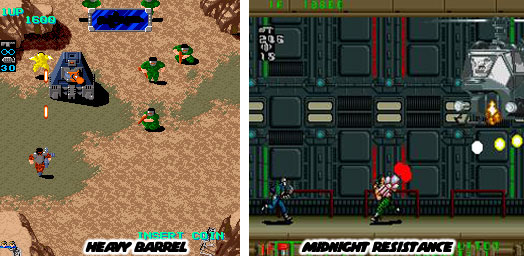
Through the 80’s most of the studios would try to see which format worked best for the run-n-gun shooter. Data East tried a variation of the overhead shooter first with Heavy Barrel in 1987. The game also made use of the octagonal handled joystick. The “Heavy Barrel” itself was a super rifle capable of mowing down the strongest opponents. It was a precursor to the BFG 9000 featured in Doom. Players had to piece it together by locating keys from fallen soldiers and corresponding chests scattered throughout the levels. My older brother had played the game so many times he had the locations of all the keys known by heart. He could speed run through the game before that concept was even invented.


A couple of years later Data East released a sequel. The 1989 game Midnight Resistance was presented in a side-scrolling format, similar to Contra. It kept the octagonal handle on the joystick and allowed players to assemble the mega-weapon from the original game as well. Little by little the side-scrolling format began to shift away from the overhead view. The genre seemed to work better for run-and-gun as well as beat-em-up brawling.


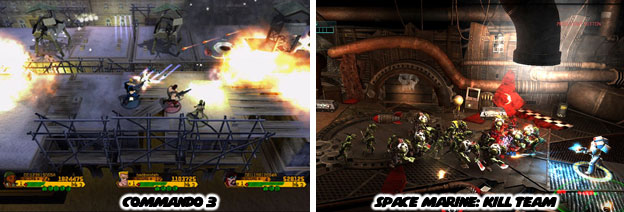
In recent years several major and independent studios had been using the overhead camera to create remake or classic-inspired run-and-gun games. Capcom found great success updating the graphics by preserving the classic gameplay in Bionic Commando for Xbox Live and they Playstation Network. They also released Commando 3: Wolf of the Battlefield for the downloadable services. Developed by Backbone Entertainment in 2008 the game actually borrowed the full name from the original 1985 arcade hit. The game preserved many of the classic run-and-gun mechanics over improved 3D visuals. Unlike the beat-em-up brawler which mostly suffered the migration to 3D the overhead shooting titles worked well with newer technologies.


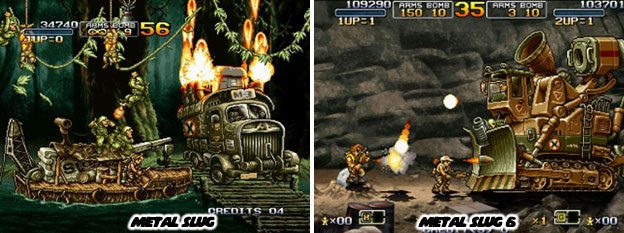
By using a fixed camera perspective several developers were able to create new gaming experiences with a moderate budget and release them across several platforms. Space Marine: Kill Team, released by THQ in 2011 showed that the gameplay could still be as entertaining as it was 26 years ago while the dedicated Space Marine console game used a third-person perspective and was designed for a more modern experience. The side scrolling format would still remain popular for many run-and-gun titles and the best of these would be the Metal Slug series, developed by Nazca and released on the SNK Neo Geo systems through the mid to late 1990's.


The Metal Slug games were a work of art, as difficult as the best side scrolling run-and-gun titles and more beloved than Contra, Ikari Warriors or any other long running title. The contributions of the game and team at Nazca to the run-and-gun genre were so profound that they deserved (and would get) a blog of their own someday… It turned out that side scrolling camera worked well for beat-em-up, run-and-gun and even hack-and-slash titles. We shall explore these transitional titles in the next blog. As always if you enjoyed this blog and would like to sponsor me please visit my Patreon page and consider donating each month, even as little as $1 would help make better blogs and even podcasts!

 follow the Street Writer on Patreon!

Friday, April 22, 2016

The Abridged History of the Brawler, part 10


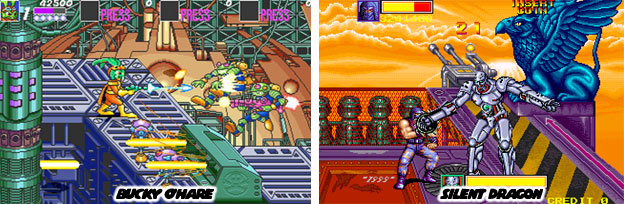
Konami made sure that 1992 got off to a good start with the X-Men game, their next title was also a licensed brawler. Bucky O'Hare was a popular animated series based on an independent comic. It featuring a crew of anthropomorphic alien / animals that were fighting for freedom out in the cosmos.


The game was lighthearted and followed the visual style of the cartoon, going so far as to include sound bytes from the voice actors from the TV series. The game was not very difficult for seasoned players, it was not meant to introduce new gameplay elements. The game was important however because it was designed for a new generation of gamer. The bright colors, smooth animation and clean level design could be seen as an attempt to make a kid-friendly brawler. Those players would be interested in trying out the other titles from Konami and help keep the industry going.


One of the other titles that could be described as player-friendly was Silent Dragon by Taito. It was a very formulaic 4-player brawler, capitalizing on the western fascination with ninjas, fights and random monsters. The large colorful sprites were very animated and the game never felt heavy-handed.


The game was about as simple and straightforward as a brawler could get. Taito did not develop a game as much as they picked characters, designs and themes from other studios and put them in a game. Taito had not done players any favors but was helping move the industry forward with a cross pollination of elements.

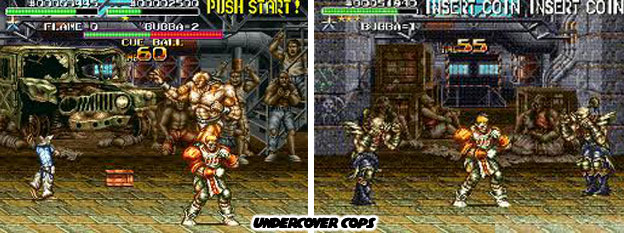
Irem did a better job with the brawler they introduced that year. Undercover Cops returned to the Japanese roots of pandering to the west while making some interesting design choices. In the far future (2015) crime had run amok. Different gangs, some bordering on cults, ruled the streets. Officials formed a team of "City Sweepers" to clear out the thugs, mutants and creeps. I think there was something lost in translation when the characters were created. The three playable characters were Claude the ex-karate master, Bubba the ex-pro football player and Flame ex-female vigilante. I always laughed wondering how somebody could be an ex-karate master, as if they got hit too many times in the head and forgot how to perform karate. Or Flame, who was a rip-off of Blaze from Streets of Rage. Flame was an ex-female vigilante... I thought Poison and Roxy from Final Fight were the only transgender brawlers… but I digress.


The game was unique in that it allowed all three players to choose the same character rather than being forced to use their partners. Characters also had special attacks and techniques that allowed them to knock leaping opponents out of the sky or strike opponents on the other side of the screen. The best brawling experiences were built around characters that weren't slightly better than opponents but had access to techniques and abilities that made fighting fun rather than redundant. The hard hitting heroes that young boys idolized were and should always be head and shoulders above the lowest goon and almost on par with boss characters.


This game was notable also in that the visuals were dark and detailed. Those were the trademarks of other Irem titles. Some of the artists that worked on Undercover Cops would be the same people drawing the insanely detailed pieces for GunForce II, In the Hunt and the iconic Metal Slug series.

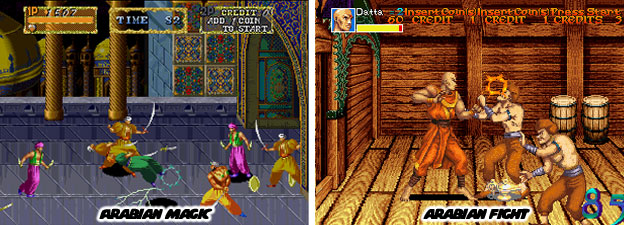
The last two great titles worth mentioning were both set in the Middle East. Sega returned with their System 32 engine and scalable sprites with Arabian Fight. The game featured some of the largest sprites ever in any brawling game. The engine would pan out to show more of the stage as players moved further and further away from each other. It was not until this game was released that the limitations of sprite-based combat in pseudo 3D environments became visible.


A sprite is an animated 2D image, it can be presented to gamers with a sense of weight and depth if artists and programmers remember to draw in shadows and highlights as well. The other visual elements in the game like the perspective and angles used to draw levels could help players visualize the sprite as moving in three-dimensions. Arabian Fight constantly scaled in and out, far more often than in the Spider-Man game. As the camera kept changing distance it became obvious to players that they were looking at 2D objects. The sprites appeared like animated hieroglyphs, flat characters from the walls of some ancient Egyptian tomb. Now if Sega had meant for the entire story to play out on the walls of a temple, or on the pages of a book, then the effect would have been revolutionary. Unfortunately the game was supposed to take place in 3D space and as often as the sprites scaled the game suffered. Players were not fans of the paper-thin sprites. They seemed to ignore the magic system from the game and even the exotic locations featured within as well. The game was Sega's second sleeper in a row. They would shy away from further arcade brawlers and concentrate instead on the home series with Streets of Rage sequels.

Despite the lackluster showing from Arabian Fight the genre was still in need new places to visit and explore. The use of exotic places and legendary characters to play as would help expand the universe. Taito answered the call through Arabian Magic. Like Arabian Fight it too featured multiple characters to play as and a magic system. The locations were even similar, including elaborate palaces, mysterious dungeons, flying carpets and pirate ships. The similarities ended there. Taito used a fixed camera that highlighted the small but detailed figures on elaborate backgrounds.


The game worked because it pandered to the fantastic legends that most gamers in the west had grown up with. Not necessarily from reading the adventures of Sinbad or the 1001 Arabian Nights of Scheherazade but instead from consuming those legends in moves. That was certainly the case for my brothers and I as we were raised on classics like the Thief of Bagdad and The Golden Voyage of Sinbad.

Many a Sunday afternoon was spent watching those movies on TV. Wondering how the Kali statue was brought to life or how the other special effects were accomplished before the aid of computers. The legends of Sinbad were always more appealing to me as a youngster. It was always easier to identify with a dark-skinned hero (even if it was only a tan) than the pasty white guys playing King Arthur and Robin Hood. Not to mention the love interest, a chesty Caroline Monro that sent my adolescent head spinning. Guinevere and Maid Marian could stay locked up in a tower for all I cared! Anyhow, my brothers and I loved the magic, fantasy and worlds that those movies exposed us to and we were eager to see how they would be adapted in a game. Prince of Persia, released by Broderbund gave us taste of that world in 1989. Still we longed for something a bit more epic.


Arabian Magic was the title we were hoping to see in arcades much earlier The sprites and opponents were a fraction of the size of those in Arabian Fight but the game was exponentially greater. The archetypes fought in exotic palaces, decorated in elaborate tiles and ornate rugs, many of them set with traps and pitfalls. Towering minarets of gold dotted the background. Players battled guards, assassins, skeleton warriors, sorcerers and magical creatures. The boss characters could be captured and placed in lamps if they were defeated. The magic system in the game was unlike those from other titles. Players had a finite number of djinn (genies) that they could capture and use. Each spell had its own effect and range. Once used the spirit was gone forever. This management of items was unique among all the brawlers. The locations and heroes from myth, including Sinbad, were icing on the cake. The game was imperfect for its minimal animations. Had a studio like Capcom developed this game then it would have easily made the list of the top 10 greatest brawlers of all-time. 1992 was a very quiet year for brawlers compared to the previous year. The handful of games released did have their own charm but would be forgotten as the industry pushed forward. As always if you enjoyed this blog and would like to sponsor me please visit my Patreon page and consider donating each month, even as little as $1 would help make better blogs and even podcasts!

 follow the Street Writer on Patreon!

Monday, April 4, 2016

The Abridged History of the Brawler, part 2


Today we'll look at the godfather of the brawling game. As fellow 1UP member Jgusw pointed out it might have been Renegade. It was a game released by Taito in 1986, exactly one year before the same studio released Double Dragon. This was actually the western version of the game called Nekketsu Kouha Kuniou-Kun which translated to "Hot Blood Tough Guy Kunio." It was developed by Technos and the main character was named after Technos president Kunio Taki. The game about high school tough guys and gang members doing battle.


The game looked and played a little "looser" than Double Dragon but all of the familiar elements were there. Players were constantly hounded by gang members and could use anything available to defend themselves. As with Double Dragon players could use weapons and even the environment to their advantage. The animation, and visual style of the game was the template that Double Dragon followed and refined. If Renegade had one failing it was the brevity of the game. The three levels and bosses can be defeated in under six minutes. Double Dragon provided a more robust experience and lasted about five time longer. That was probably why more gamers remembered this title.


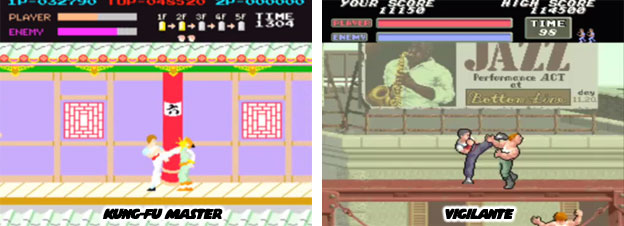
As fun as Renegade was, it too was not the founder of the brawling experience. In 1984, the same year that Karate Champ debuted, Irem had released Kung-Fu Master. The brawling game and fighting game were canonized at the same time. Kung-Fu Master featured a familiar story, a gang kidnapped Silvia, the love interest of Thomas the kung-fu master. I found it odd that neither of them had traditional Chinese names… Thomas had to fight wave after wave of opponents to reach his beloved. The character used nothing more than his quick hands and feet to defeat different character types including knife throwers, burly guards, dragons and even little people.


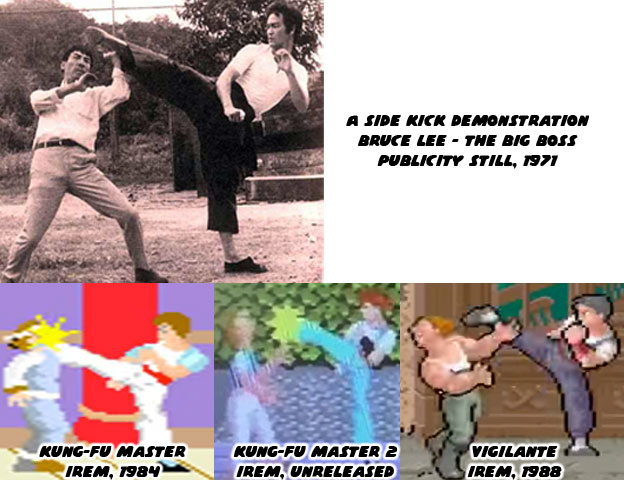
Thomas was the first character that was closely modeled after Bruce Lee. While his costume might not bring up memories of the actor, his moves and trademark yell certainly should. Lee was a perfect template to build martial artists from. His punches and kicks worked well when illustrated. He had a dynamic range, his moves were easy to read when created frame by frame. Best of all he was recognized the world over as a martial artist that really moved as fast as any game character could.


This game established the formula of waves of opponents approaching from the left and right, different strengths and weaknesses for those opponents and also boss fights. The idea of fighting combinations exploited in Renegade and Double Dragon was not quite the same. Players could switch between punches and kicks but the game system did not include knees, elbows or headbutt attacks at different ranges. The speed and damage that diverse strikes provided made the latter games more efficient when dealing with scores of rivals. By comparison Kung-Fu Master was more about finding the right timing against the advancing hordes and pressing the attack buttons quickly.


The seeds for the brawler were germinating and bearing fruit. Irem had actually planned a sequel to Kung-Fu Master. They had created a prototype board featuring new sprites, animations and villains but with the same familiar Chinese location. The publisher was afraid that this game wouldn't be interesting to Western audiences because it was more of the same. So they cancelled production on the game and went back to the drawing board. A year after Double Dragon was released Irem returned with what many consider to be the spiritual successor to Kung-Fu Master. Vigilante, published by Data East in 1988, improved on the mechanics in every way and brought the martial arts legend to the modern world. Ancient China was traded out for the urban jungle which looked an awful lot like New York City. The girlfriend was named Madonna and the unnamed hero, possibly the reincarnation of Thomas could get access to a weapon, a nunchaku to help out against the Skinheads terrorizing the city. A great deal of the mechanics from Kung-Fu Hero were preserved with different-sized opponents sneaking up on the hero from both sides. The visuals and animations were updated thanks to the newer hardware and software.


The format of keeping all of the action to a 2D plane seemed limiting to gamers. That mechanic went over well with the original arcade brawler but seemed dated now that engines could have characters move all over the screen in a pseudo-3D environment. A few other great games would preserve the 2D legacy and they will be mentioned in due time but for the majority of gamers the brawler held more potential when the world opened up and the brawling required more strategy. 1988 saw several other games looking to give Double Dragon a run for the title. We shall look at these in the next blog. As always if you enjoyed this blog and would like to sponsor me please visit my Patreon page and consider donating each month, even as little as $1 would help make better blogs and even podcasts!