
Showing posts with label vigilante. Show all posts
Showing posts with label vigilante. Show all posts
Wednesday, February 5, 2020
The Street Writer Podcast, Episode 9
As always if you enjoyed this podcast and would like to sponsor me please visit my Patreon page and consider donating each month, even as little as $1 would help make better entries!

Monday, April 4, 2016
The Abridged History of the Brawler, part 2
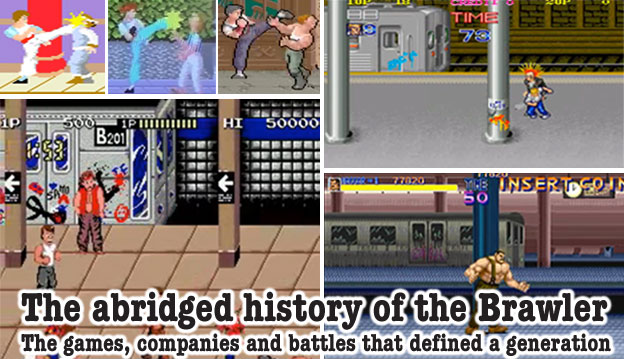
Today we'll look at the godfather of the brawling game. As fellow 1UP member Jgusw pointed out it might have been Renegade. It was a game released by Taito in 1986, exactly one year before the same studio released Double Dragon. This was actually the western version of the game called Nekketsu Kouha Kuniou-Kun which translated to "Hot Blood Tough Guy Kunio." It was developed by Technos and the main character was named after Technos president Kunio Taki. The game about high school tough guys and gang members doing battle.
The game looked and played a little "looser" than Double Dragon but all of the familiar elements were there. Players were constantly hounded by gang members and could use anything available to defend themselves. As with Double Dragon players could use weapons and even the environment to their advantage. The animation, and visual style of the game was the template that Double Dragon followed and refined. If Renegade had one failing it was the brevity of the game. The three levels and bosses can be defeated in under six minutes. Double Dragon provided a more robust experience and lasted about five time longer. That was probably why more gamers remembered this title.
As fun as Renegade was, it too was not the founder of the brawling experience. In 1984, the same year that Karate Champ debuted, Irem had released Kung-Fu Master. The brawling game and fighting game were canonized at the same time. Kung-Fu Master featured a familiar story, a gang kidnapped Silvia, the love interest of Thomas the kung-fu master. I found it odd that neither of them had traditional Chinese names… Thomas had to fight wave after wave of opponents to reach his beloved. The character used nothing more than his quick hands and feet to defeat different character types including knife throwers, burly guards, dragons and even little people.
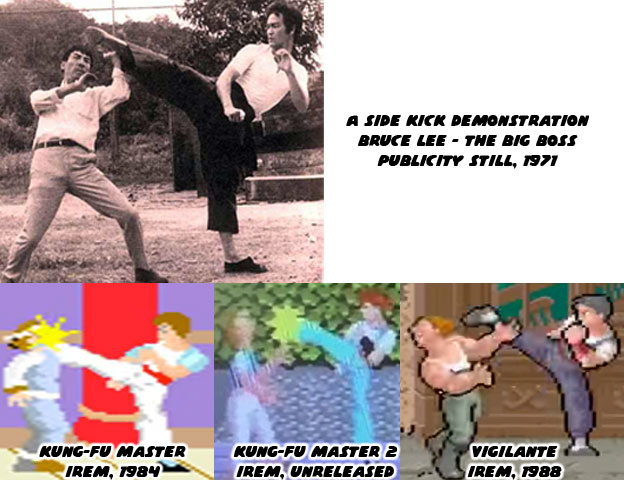
Thomas was the first character that was closely modeled after Bruce Lee. While his costume might not bring up memories of the actor, his moves and trademark yell certainly should. Lee was a perfect template to build martial artists from. His punches and kicks worked well when illustrated. He had a dynamic range, his moves were easy to read when created frame by frame. Best of all he was recognized the world over as a martial artist that really moved as fast as any game character could.
This game established the formula of waves of opponents approaching from the left and right, different strengths and weaknesses for those opponents and also boss fights. The idea of fighting combinations exploited in Renegade and Double Dragon was not quite the same. Players could switch between punches and kicks but the game system did not include knees, elbows or headbutt attacks at different ranges. The speed and damage that diverse strikes provided made the latter games more efficient when dealing with scores of rivals. By comparison Kung-Fu Master was more about finding the right timing against the advancing hordes and pressing the attack buttons quickly.
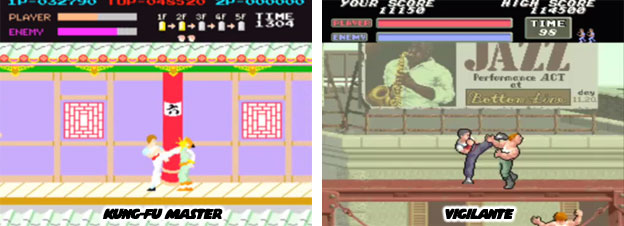
The seeds for the brawler were germinating and bearing fruit. Irem had actually planned a sequel to Kung-Fu Master. They had created a prototype board featuring new sprites, animations and villains but with the same familiar Chinese location. The publisher was afraid that this game wouldn't be interesting to Western audiences because it was more of the same. So they cancelled production on the game and went back to the drawing board. A year after Double Dragon was released Irem returned with what many consider to be the spiritual successor to Kung-Fu Master. Vigilante, published by Data East in 1988, improved on the mechanics in every way and brought the martial arts legend to the modern world. Ancient China was traded out for the urban jungle which looked an awful lot like New York City. The girlfriend was named Madonna and the unnamed hero, possibly the reincarnation of Thomas could get access to a weapon, a nunchaku to help out against the Skinheads terrorizing the city. A great deal of the mechanics from Kung-Fu Hero were preserved with different-sized opponents sneaking up on the hero from both sides. The visuals and animations were updated thanks to the newer hardware and software.
The format of keeping all of the action to a 2D plane seemed limiting to gamers. That mechanic went over well with the original arcade brawler but seemed dated now that engines could have characters move all over the screen in a pseudo-3D environment. A few other great games would preserve the 2D legacy and they will be mentioned in due time but for the majority of gamers the brawler held more potential when the world opened up and the brawling required more strategy. 1988 saw several other games looking to give Double Dragon a run for the title. We shall look at these in the next blog. As always if you enjoyed this blog and would like to sponsor me please visit my Patreon page and consider donating each month, even as little as $1 would help make better blogs and even podcasts!
Wednesday, March 30, 2016
The Abridged History of the Brawler, a pre-rumble...
Over the next few weeks I'm going to be looking at one of my favorite all-time genres, the Brawler. This was originally a series that I ran on 1UP but I decided to revisit it and update a few entries. Now note that I call the genre the "Brawler." Other people and game sites call the genre "Beat-em Ups." But those people often call fighting games beat-em ups as well. I would contend that the fighting game and the brawler are actually two completely different genres. A fighting game is traditionally a one-vs-one game. Whether it's two martial arts masters, or a robot versus a demon or two dinosaurs going head-to-head, there is always one player versus another (sometimes a PC opponent instead). That is by my definition a fighting game. There are usually a few things that most fighting games have in common. There is a scoring system, a way to track health and often a time clock or ring out rule as well. Again the fight is usually one on one. There is the rare exception where the original Fatal Fury actually allowed two versus one battles and it would still be considered a fighting game. For the most part however a fighting game is one vs one.
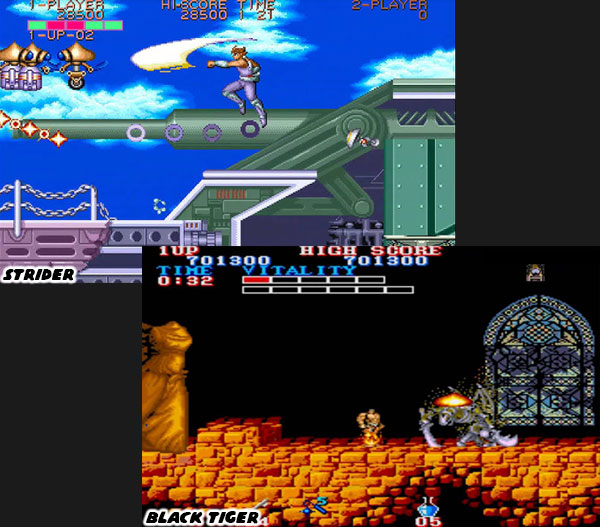
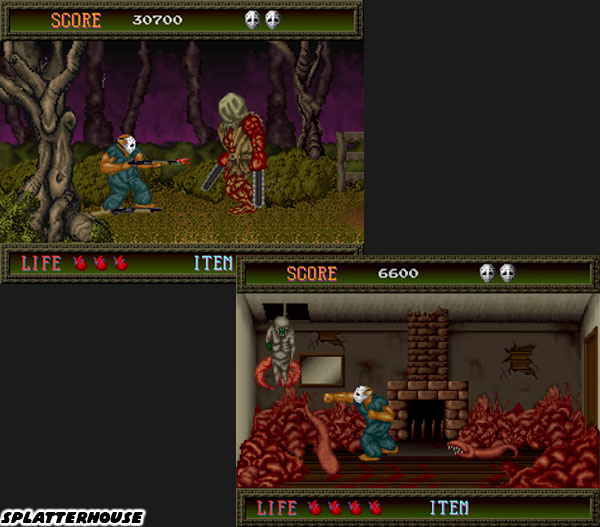
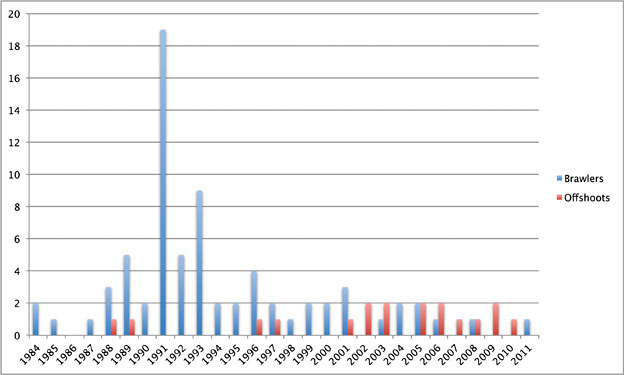
The Brawler, just like every other genre, came from somewhere. The early generation of arcade hits were inspired, if not outright stolen, from comics and movies. These games would then become adapted to the home consoles as a sort of faded copy of a familiar idea. Star Wars, Star Trek, various anime shows, manga and comic books all had a hand in shaping the history of game designs. The developers on the first batch of action titles often looked at action movies for inspiration. There was a lot of crossover to influences for the early action games, fighting games and brawlers. The action movie star was often a kung-fu expert. After all if you are going to have a story where one person can take out an army of opponents then they better know how to fight. There was no bigger star on the planet than Bruce Lee, at least this was the case back in the '70s. The young developers in Japan and the United States would have been greatly influenced by the man and his movies while growing up. When they started working on the first wave of action arcade games, almost a decade later, then there was usually one person they all looked to. It didn't matter how the artists colored or animated the early sprite heroes, there was something very familiar about the way they appeared...
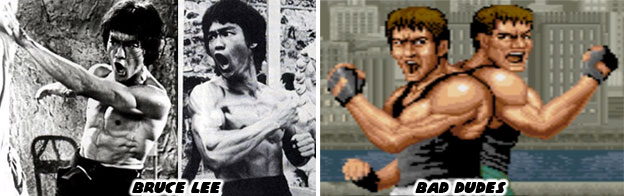
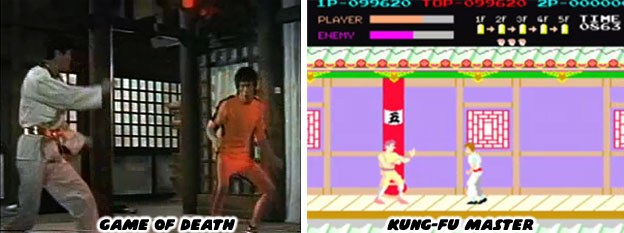
The presence of Lee actually worked in favor of these early games. We had an actor and martial artist that dressed in very clean and easy to read costumes in his films. The shirtless hero with dark pants would pop up on various character designs. When the early arcade and console systems had limited memory to work with then simple two-color costumes were perfect designs. Of course Lee's signature yellow jumpsuit with black stripe from the film the Game of Death would become iconic as well. The costumes that Lee wore, his haircut, stance and moves would influence character designs for the next few generations. From some of the earliest 2D fighting game characters to some of the first 3D fighting game characters, even the Flash-based fighting games and hybrid 2.5D fighters all had a Bruce Lee clone. Some of these were subtle nods to the actor but the majority stole his likeness.
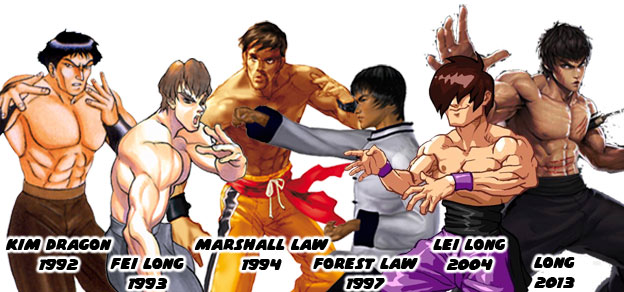
Lee moved with a quickness that had never been seen before. He punched and kicked so fast that it was a blur on screen. These would be elements that would become adapted in the early brawlers. Resources were very limited on the arcade machines at the time, especially memory. Perhaps a character had two frames of animation between a punch and kick. This would have seemed impossible on a bulky character but a skinny fighter like Lee actually did strike that fast. Even the trademark yell of Lee, his facial quirks and mannerisms would be reproduced on many characters in fighting games and brawlers. The godfather of the brawler, the one that I believe started it all was Kung-Fu Master by Irem. It was released in 1984, a pivotal year for arcade games. The title was a subtle nod to Lee's final film, the Game of Death. Players had to climb a tower filled with various fighters, and it got progressively more difficult the higher you went. The main character "Thomas" was searching for his girlfriend "Sylvia." Of course the names were changed from the original title, Spartan X. What didn't need translating was the lighting-quick strikes and familiar yell of the hero.
The US didn't really have a connection to martial arts cinema in the '60s or '70s. The action movies that the USA enjoyed right through the '80s had a different type of violence, one which was rooted on guns and revenge. The anti-hero was a popular subject in many of the movies. As it turned out the settings were a character all to themselves. The fictional version of New York in the John Carpenter film Escape from New York lit the imagination of the Japanese studios. Cities in western-themed games had to be big, dirty and overcrowded. The walls had to be covered in graffiti and colorful gangs patrolled every corner. Japanese studios began creating impressions of these cities, based on cult films like Death Wish and Streets of Fire for the earliest and often most successful brawling franchises. Double Dragon and Final Fight were two of the biggest sellers and they introduced audiences to a modern "western" metropolis overrun with gangs.
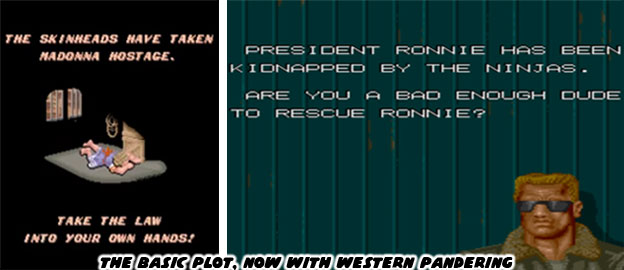
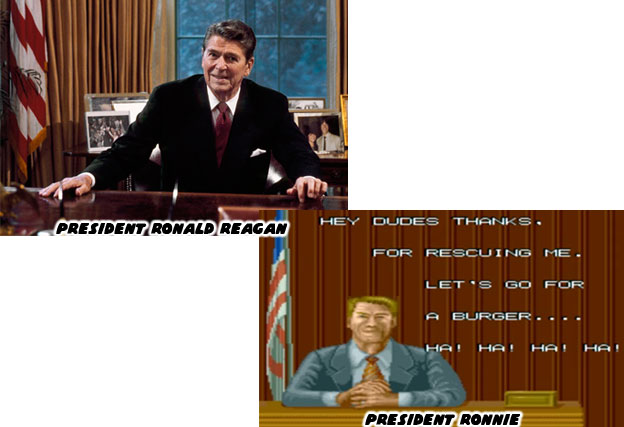
The setup for most of the games was simple. A person of interest was usually kidnapped, often a girlfriend, a finacee and at least in one case it was the President of the United States. Seeing as how the Japanese were shamelessly pandering to Western audiences they would drop names like pop singer Madonna and Ronnie, the nickname of President Ronald Reagan, into their games. If the brawler could be compared to a film genre then it would be the cult action film. Not quite a summer blockbuster yet not lowbrow enough to be a "grindhouse" picture (with the exception of Splatterhouse that is). The Brawler was nothing short of mindless action, it was like the perfect summer movie for eating popcorn, drinking soda and turning off your brain for an hour. After all, the payoff after saving President Ronnie was getting hamburgers. It was hardly Oscar-caliber material the Japanese were interpreting.
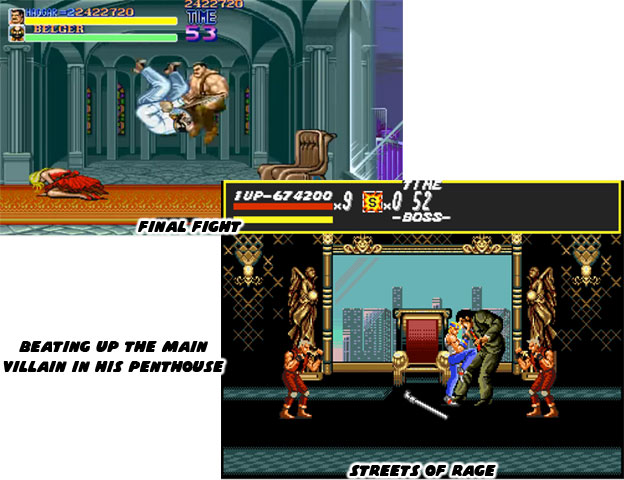
Of course for most of these movies audiences would wonder why the cops didn't stop the bad guys. There was usually two reasons for this. The cops were either too afraid of the gangs or they were being paid off not to do their job. The gangs often had leaders and these were not the typical thug. They were instead rich crime bosses living in the lap of luxury. Sometimes they were politicians or even heads of corporations. Players figuratively and literally fought their way to the top in many of the games. As dirty subways gave way to abandoned amusement parks and crowded alleyways the player would find themselves fighting in nicer and nicer neighborhoods. Eventually they would end up in the suite or penthouse of a millionaire. It turned out that the person that was pulling the strings was often the richest person in the city. They could have had it all but instead messed with the wrong people. The punishment for kidnapping or putting a city at war was often a long drop for the bad guy.
There were many other plots to explore, many more heroes to become and many more villains to throw through windows. The brawler was and continues to be a fun genre. I hope there are a few games mentioned in this series that rekindles some memories. Perhaps I'll highlight a few that you may not have played and give you a reason to track them down. Whatever the case I hope you stick around and as always share a comment. As always if you enjoyed this blog and would like to sponsor me please visit my Patreon page and consider donating each month, even as little as $1 would help make better blogs and even podcasts!
Subscribe to:
Posts (Atom)