Showing posts with label aliens. Show all posts

Friday, January 27, 2023

Learning how to tell a story from movies, and the studio that sold the Playstation to me

We’ve been going through a bit of personal history in the past couple of blogs. I’m going to keep digging in because these things definitely helped shape what I enjoy in my favorite forms of entertainment, and will tie back into my love of the God of War series. Bear with me please. All through my childhood repeatedly consuming games, comics, and movies made me aware of the types of stories I enjoyed. I learned the techniques that writers used to help shape a story thanks to my English teachers. I copied my favorite artists work hoping that I would pick up how they see the world. I’d rewatch movies on VHS, and later DVD to pick up how sometimes movie studios got things right, and sometimes they missed the point. It was easier to figure out what worked best when creating big budget projects. When movies were at their best it seemed almost easy to make a sequel. There were a lot of amazing sequels that my brothers, and I grew up with. I didn’t always believe in trilogies, and often wished that some stories ended sooner.
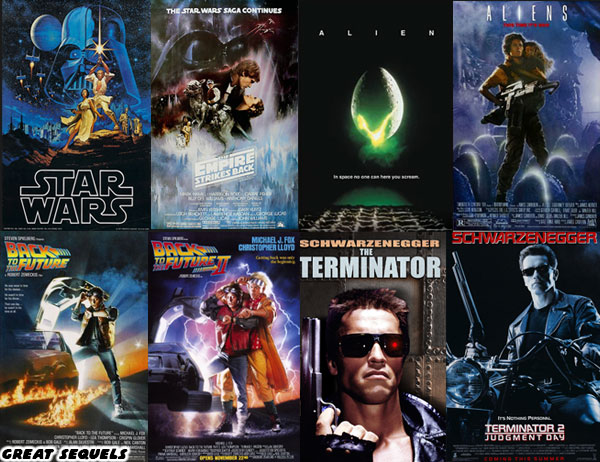
There were a few things that I thought made up great sequels. First is that the stakes had to be much higher in the next movie. It couldn’t simply be more of the same thing. Yes there had to be familiar elements, but the challenge had to be cranked up tremendously. From Alien to Aliens for example, Ripley went from surviving a single xenomorph in a horror film type setting to being an action hero against an army of xenomorphs. In Back to the Future II the original villain Biff completely changed history. It was up to Doc, and Marty to restore the timeline. In Terminator 2 the killer T-800 cyborg was sent back in time to protect Sarah Connor from an even more dangerous robot. Terminator 2, Aliens, and Back to the Future II were almost a complete reversals of the original movies. Audiences loved it, and to me the film series could have wrapped up then. My favorite blockbusters created heroes, and villains that I wouldn’t mind seeing for a movie, or two. Ripley, Sarah, or Marty would be fun to follow for a few adventures. However at some point I thought their story should wrap up. There were a few characters that seemed better suited for a series of adventures. People like Indiana Jones, or Rick O’Connell (the Mummy 1999) were the types of heroes that I thought could easily carry a series of films. The sequels could raise the stakes in unique ways, such as Indy being a father figure in the Temple of Doom, or helping his own father recover the literal Holy Grail in The Last Crusade. The video game equivalents of Laura Croft, and Nathan Drake were adventurers that we’d be happy to follow along with as well.
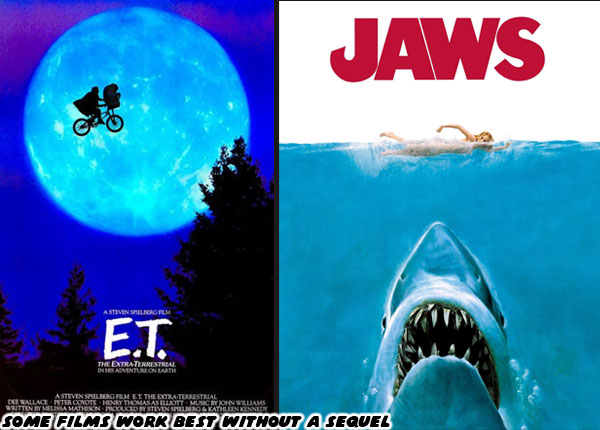
Then there were some films that I thought worked so well that they didn’t need a sequel. I’m forever grateful that E.T. never got a sequel despite calls to do this from the studio. That film wrapped up so well that there was nothing else that needed to be said. The pressure to revisit the property was tremendous, but thankfully Steven Spielberg stuck to his guns. He wanted to focus on original stories. Then there were films that didn’t really need a sequel. The Jaws films for example were nothing more than cash grabs from the studio. The most interesting characters in the original film died after all, those being the shark, and the shark hunter Quint. Even if Police Chief Brody, or ichthyologist Hooper turned up in other movies the plot, and chemistry couldn’t repeat the magic of the original. I applied what movies had taught me to the games I played. Did some games deserve a sequel? Or were they better as one-off experiences? If they did get a sequel then how did they raise the stakes, or completely rewrite the direction of the franchise? The leap from 16-bit pixel games, to the early stage of 32, and 64-bit polygons helped make sequels much stronger. Developers had a chance to expand on the worlds they wanted to create thanks to a bump in storage capacity, audio, and graphic technology.
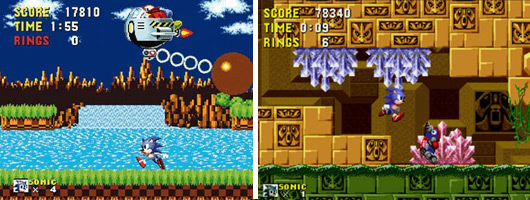
We were blessed to have the several consoles while growing up. Our parents sacrificed a lot of time, money, and sanity making sure that they could keep their three boys happy. Starting with the Atari 2600, then every few years another console. The NES, Super Nintendo, Genesis, Saturn, GameCube, and Dreamcast to name a few. After the Genesis our parents made sure that my older brother, and I worked (part-time) to pay for our own games, and consoles. My younger brother was able to get out of that rule for a few more releases. None of us ever believed in console bandwagons. We knew that great games were on every platform. Nobody could claim to be the absolute best. We also knew that the best developers made the best games, regardless of hardware. Sony was the newest entry in the console wars, by having Namco bring arcade hits Tekken, and Ridge Racer to the Playstation helped us decide if we’d be spending money on it. Remember that 3D games were still relatively new for home consoles. Seeing polygons with textures, and higher frame rates than we had seen in the past was revolutionary. Although near arcade perfect adaptations helped sell the PS, it was actually original hits by independent studios that made the console matter to us. We started to notice that some studios really spoke to us. As if everything they did was gold. One of those was SingleTrac.
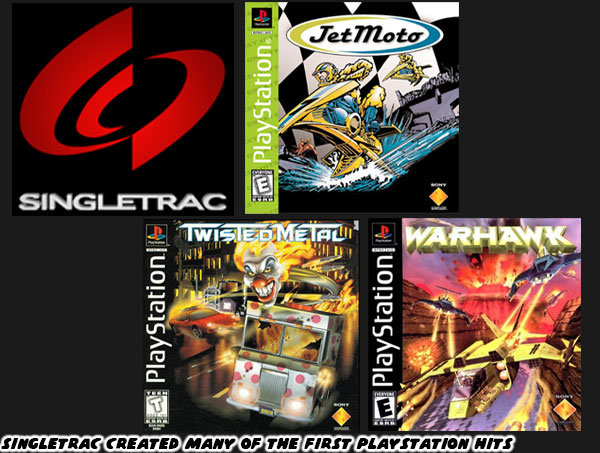
Three of the first games they released for the PS were amazing. Jet Moto, Twisted Metal, and Warhawk. Each of these games was an original idea, something new to the genre, if not carving out a new niche altogether. Jet Moto was a sci-fi racing game, Twisted Metal a vehicle combat game, and Warhawk an air combat game. Many early PS fans would remember WipeOut as Sony’s response to Nintendo’s F-Zero, but that wasn’t the only futuristic racer on the console. Jet Moto was as good, but at the same time a different kind of beast. The flying jet bikes went over land, and sea, allowing it to play like the best parts of Namco’s Ridge Racer, with Nintendo’s WaveRace 64. Warhawk was a futuristic air combat game, with a plane that could both fly, and hover. It found the balance between fighter jet, helicopter combat, and third-person shooter. Twisted Metal was a post-apocalyptic vehicle combat shooter. Of the three it was a breakout hit for the console. The graphics, control, sound, characters, levels, game play, and storyline were brilliant. They were a far departure from the mascot-driven games of the late ‘80s, and early ‘90s. The crazed contestants of the Twisted Metal tournament could never be mistaken for the friendly faces of Mario, Pac-Man, or Sonic. If there was something that SingleTrac understood better than their contemporaries was that audiences was getting older, and looking for more mature themes in their gaming.
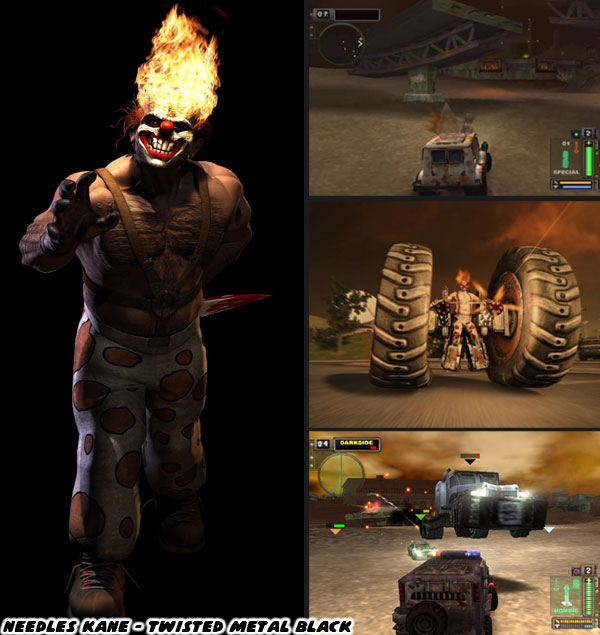
Twisted Metal, the most recognizable character Needles Kane, and his Sweet Tooth ice cream truck became synonymous with the console. For a while many fans, including Sony, considered him a mascot for their platform. The studio had a hit, and the sequel was even more amazing. New characters were introduced, the story was fleshed out, and every element of the game became better, and more polished. What happened next was Sony shooting themselves in the foot. Imagine how important it was to have a studio capable of cranking out so many memorable first generation titles, and all original so that Sony didn’t have to pay for an IP? You would think that Sony gave SingleTrac a massive budget to continue building hits. What actually happened was the publisher turned around, and gave the property to 989 Studios. 989 released the dismal Twisted Metal 3, and 4. The backlash against the game was almost instant from critics, and gamers. My brothers, and I could tell that the new studio was not at the same caliber of SingleTrac. We were sorely disappointed in what happened. Their version of the franchise was a sluggish, and ultimately forgettable mess. I talked about it extensively on an earlier blog when I compared what Sony did to Twisted Metal, to what SCI did with the Carmageddon game. In the end SingleTrac broke up, but from the ashes an even more amazing studio named Icognito Entertainment was born. Sony went back to the game creator, a guy named David Jaffe, and asked if they could develop a new Twisted Metal for their follow-up console the Playstation 2. David said yes, as long as they would get more creative freedom. Sony agreed, and the rest was history.
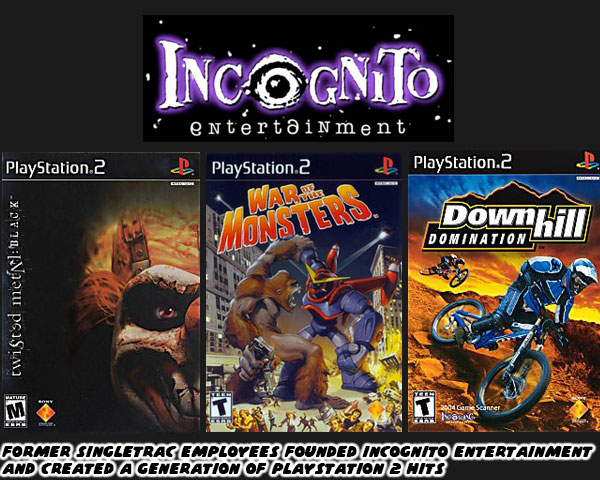
Twisted Metal Black was one of the darkest games seen in any generation. At the same time it was also one of the best PS2 games ever released. Jaffe, and the team knew better than most Hollywood studios on how to craft a sequel. They kept their content fresh, even when revisiting familiar themes. They added new faces to the lineup, upped the challenge, but made sure the game was still easy to pick up, and play. You didn’t necessarily have to have played the previous versions to get the most out of it. The studio once again demonstrated that they had the pulse of the audience. More so than just about any other studio in the industry. The Gen-X community that made up a huge portion of the video game market was entering adulthood, and they wanted their games to mature as well. Yes they still wanted a challenge, and they still wanted a diversity of traditional gaming experiences. But they also wanted the serious games to become more serious, or in the case of Twisted Metal, to become more over-the-top with the violence, and carnage. Incognito Entertainment was the second coming of SingleTrac. Every title they developed was completely new, and unique. They didn’t bother with nailing down an IP from any movie, or comic book. They didn’t copy what other studios were doing. The proof of was in their other PS2 games.
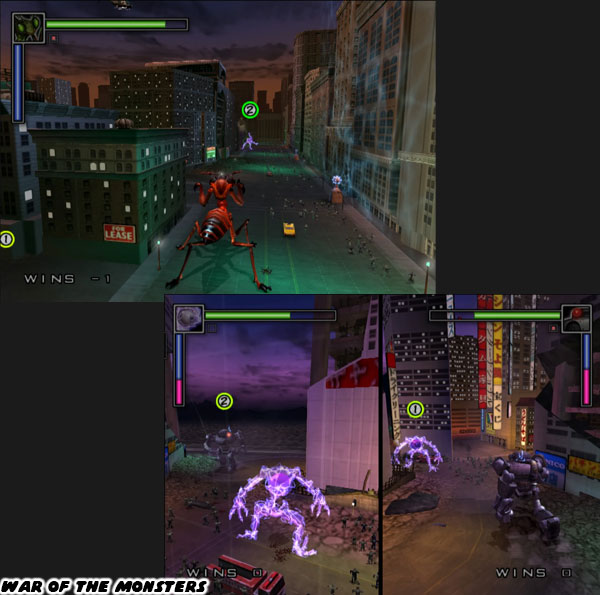
War of the Monsters was one of the greatest games for the Playstation 2. It showed off what the hardware was capable of from an animation, graphics, sound, music, and control aspect. It was easily one of my favorite games of all time. It was almost criminal how little buzz it generated from audiences, and critics. Jaffe, and the studio created a giant monster fighting game that played better than most 3D brawlers, and believe me when I say I’ve played almost every brawler that’s ever been released. None were as smooth, as memorable, or as addictive as what Incog Ent. had delivered. You might think a game without licensed giant monsters wouldn’t be any good, but by the lineup was inspired by a mixed theme of creatures from the golden age of monster films. We’re talking gigantic baddies from the ’50s, through the ‘70s. The studio was able to deliver archetypes from the US, the UK, and Japan. Yet somehow they all managed to work well together. It’s one of the few games that I sorely wish had gotten a sequel. It wasn’t the only critically underrated game that Incog developed.
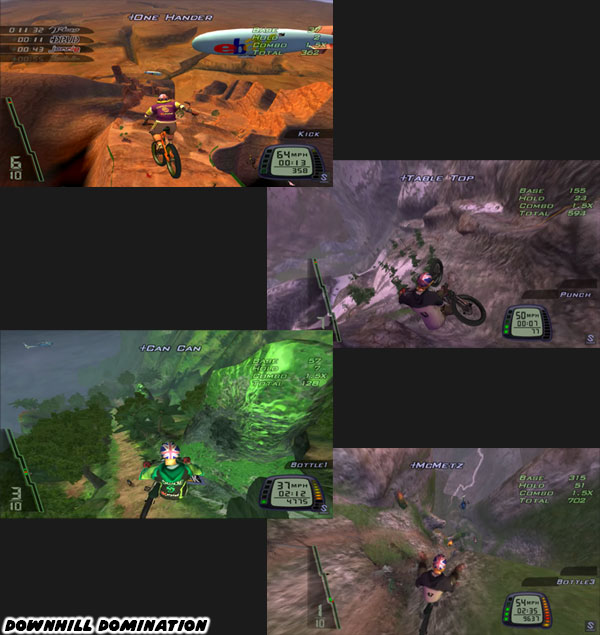
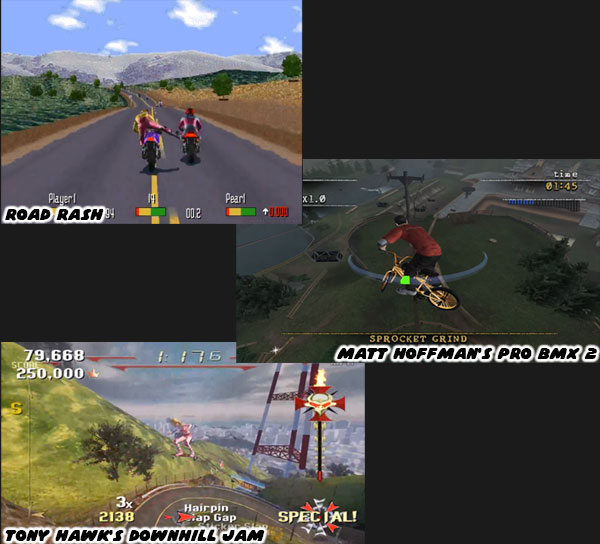
Downhill Domination was an arcade style mountain bike racing game. From a visual standpoint it was one of the best-looking PS2 games ever released. Players took riders down several mountain stages scattered all around the world. Incog got a chance to show off all the tricks they had been learning with the hardware. Every stage had a mix of different elements, terrain, and even weather. This included snow, gravel, dirt, grass, rocks, and even lava. Tracks were set along ski courses, they had waterfalls, and rivers running through them. You'd have to watch out for hikers, and wildlife scaling the mountain. There were tons of lines to find, and hidden paths down the courses. There was nothing as amazing as racing side-by-side with another maniac while trying to survive a lightning storm sparking a forest fire in your path. As if racing down a mountain wasn't challenging enough the computer opponents could kick, and punch you. You could return the favor, and earn upgrades like sticks, and bottles of water to throw at them. In order to earn better weapons, and sponsorship money you could perform freestyle tricks while racing. The enormous leaps you had down precarious cliffs gave you several seconds to perform all sorts of freestlye moves. Incognito had approached the racing genre with the same sort of creative freedom that went into JetMoto. The best way I could explain the brilliance of Downhill Domination would be to say it took the racing combat of Road Rash, the BMX freestlye tricks of Matt Hoffman Pro BMX, and the fun characters, and massive stages of Tony Hawk's Downhill Jam. It didn't do these things okay, in many ways it did these things better than the aformentioned games.
I was in awe of how wonderful each game the company developed turned out. The diversity, and game play they created over the years should never be understated. When I heard the studio was absorbed by Sony I was heartbroken. That meant I'd more than likely never see another War of the Monsters, Dowhnill Jam, or any other original idea. It would probably all be licensed IP, or sequels to other hits. I wouldn't mind the team creating another Twisted Metal, but that was up to the publisher now. I had little faith in Sony. Thankfully they proved me wrong with what they were working on. David Jaffe, and many of the team members he had worked with in the past were cooking up something new. It would be an action fantasy game the likes of which had never been seen before. The game was called God of War. I was not ready for it. We'll talk more about it in the next blog. Did you ever play any of the SingleTrac, or Ingonito Entertainment games? Did you have a favorite? Let me know in the comments section please. As always if you would like to sponsor me please visit my Patreon page and consider donating each month, even as little as $1 would help make better blogs and even podcasts!
follow the Street Writer on Patreon!

Monday, July 27, 2020

The Street Writer Podcast, Episode 11

We end the '80s on a high note. Konami lays down the law and creates some of the best licensed brawling games of all time. Sega starts off slow but then shines when they enter the console arena. Find out more on this episode.


If you would like to sponsor me please visit my Patreon page and consider donating each month, even as little as $1 would help make better blogs and even podcasts!
follow the Street Writer on Patreon!

Thursday, February 27, 2020

The Aliens, Predator, Terminator, and Capcom connection...

In the previous blog I talked a little bit about the inspiration behind some of the Mad Gear bosses. It got me thinking about the roots of other designs in the series. It made me realize that Metro City may have been a nexus for some science fiction franchises. Before we do a deep dive we should acknowledge the state of Capcom during this period. What games were they working on, what games that they published in the arcade, and home consoles? The early '90s was unique for the industry because the brawling game was declining in popularity at the same time that the fighting game was exploding. While the two genres were similar, they each had their own audience. In any case Capcom was knee-deep in keeping both formats alive. The teams working on arcade and home brawlers had some crossover. In 1993 the studio published Final Fight 2 for the Super Nintendo, and released The Punisher, and Cadillacs and Dinosaurs in the arcade.


In 1995 when the studio published the last entry in the Final Fight series, they were also releasing a new version of Street Fighter. They used this time to tie together the events of several games. For the Street Fighter Alpha / Zero series it was connecting Street Fighter, Street Fighter II, and Final Fight into one narrative. For Final Fight 3, on the SNES, it was calling out the various brawlers that the studio had worked on. There was dealership selling the very distinctive Cadillac cars. There was also a stage set aboard a moving bus. There were even details pulled from the Alien vs Predator arcade game from 1994. Capcom had every right to be proud of the legacy that they had created. Final Fight 3 was overlooked for how it tied together various properties.


Before I get ahead of myself let's talk about one of the bosses, and his design inspiration. So we've established that films like Escape from New York, Streets of Fire, and the Wanderers inspired the creation of the Final Fight series. Those films from the early '80s had a unique take on science fiction, and gang culture. They framed the characters, and story of the original Final Fight. The sequels therefor pulled influences from later films. The villain Stray from Final Fight 3 was a boss in the Skull Cross organization. He was nowhere near as memorable as the bosses from previous FF games. His look however had some familiar elements.


The appearance of the armored warrior was more than likely inspired by the bad guys in Cyborg. The film from 1989 featured Jean-Claude van Damme. The post-apocalyptic science fiction movie had gangs patrolling the wastelands of the southern US. Actor Vincent Klyn played Fender Tremolo, leader of the pirates. Ralf Möller was the second in command, named Brick Bardo. Both were cruel, and very strong. Their group murdered countless families in the movie. In the canon of Final Fight 3 Stray had murdered the family of Dean, one of the heroes. I would argue that the look, and costume of Stray was an amalgamation of the two villains. But the inspiration from science fiction cinema ran so much deeper than that. The stage where players fought Stray was set inside of a giant factory. The heroes fought on top of metal grates, suspended over boiling metal. It looked very much like the steel mill at the end of the 1991 James Cameron film Terminator 2: Judgement Day.


Final Fight 3 was peppered with nods to science fiction cinema. These Easter Eggs were more than an homage to the great films from the '80s and early '90s. Capcom was trying to connect the movie and game continuities together. During the development of the arcade and home brawlers the studio had become well versed in the canon of the popular science fiction films. They did a deep dive into those worlds because they were working on high profile licenses. They went over production notes, design books, comic books, and various cuts of the film to try and squeeze out anything that could be used in a game. Capcom did not get a license to create a Terminator game, however during their research they made an important connection. As a wink to sharp-eyed audiences they put in a number of these cameos, and let players figure things out.


Final Fight 3 was not about breaking up the Mad Gear gang. Nor was it about defeating the crime lord Belger. A new gang called Skull Cross had taken over Metro City. They were headed up by a rogue military leader named Black. The arms merchant was trafficking illegal firearms through the city. They ran operations out of a company called SIM Inc. Veteran fighters Mike Haggar, and Guy reunited to save the city. They were joined by Detective Lucia Morgan, and the mysterious Dean. Their hunt for Black lead them all throughout the city. As they put the pieces together they found where the weapons were being manufactured. It turned out that SIM Inc. was working on more than just guns. In a side room of one of their factories there was a cybernetic arm in a glass case. This was a nod to the same arm featured in the Terminator 2 film. This technology from Cyberdyne Systems, would lead to the creation of the Terminator cyborgs and Skynet.


As the heroes of Metro City fought their way to the top they raided the headquarters of SIM Inc. Inside there were even more nods to science fiction canon. In a glass case there was a Work Loader. It looked identical to the ones featured in the 1986 movie Aliens. In film canon Weyland Corp built and patented the P-5000 Powered Work Loader in 2025. Caterpillar Inc. would make commercial versions later on. Was SIM Inc. the actual manufacturer of these machines? Did they secure government contracts to help develop this technology for Cyberdyne? To further connect Final Fight continuity to those of other Capcom brawlers there were also display cases filled with the latest weapons developed by SIM Inc. In the Aliens film it was never stated who had created the weapons used by the Marines in the far future.


So why are all of these Terminator / Aliens connections so important? Why would they be featured in a Capcom fighting game set in an urban city? Aside from the easy answer; that the developers were just calling out all of the other games the studio published. The truth was that Capcom had very subtly managed to link three of the biggest science fiction franchises together in a licensed game. The timelines from Terminator, Predator, and Aliens were all interconnected thanks to the Alien vs Predator arcade game that the studio released in 1994. Cracked put the pieces together several years ago. If you haven't heard here is how everything fits; so you may know that Arnold Schwarzenegger played the Terminator in the 1984 film by the same name, and he also played Dutch Schaefer in the 1987 film Predator. What if I were to tell you that the reason the characters looked similar was not because they were played by the same actor, but because in canon they shared the same DNA?


In his story Dutch was already a well regarded mercenary, but he became legend as the first human to kill a Yautja, or Predator in a one-on-one fight. Years after the initial encounter he lost an arm during what was called the 2nd Alien War. Cyberdyne Systems retrofitted him with a cybernetic arm, which doubled as a gun. With his newly enhanced strength he could now go toe-to-toe with both Alien and Predator lifeforms. This enhanced version of Dutch was recorded as CDS-170A3. This numbering was important. In the Terminator 2 film it was explained that Dr. Miles Dyson, director of Special Projects was working on the next generation of cybernetics. He helped develop the CDS T-800 Endoskeleton. More commonly known as the Terminator. Cyberdyne undoubtedly used Dutch's martial training, military tactics, and weapons proficiency to program the perfect killing machine. It only made sense that they also used Dutch's DNA to clone human flesh and muscle to go over the robotic frame.


Lt. Linn Kurosawa, a cyborg from the 13th Colonial Marine Corps, was also featured in Alien VS Predator. Linn was younger, and featured newer technology than Dutch. Her skeleton and frame were enhanced with synthetics. She was essentially the next generation of human. Cyberdyne Systems would eventually evolve into Hyperdyne Systems. The company would create Synthetics, human-passing androids designed by Michael Weyland. Eventually his company would merge with another and create Weyland Yutani Corporation. The synthetic named Ash (Hyperdyne Systems 120-A/2) was featured in the original 1979 film Alien, and another named Bishop appeared in the James Cameron-directed sequel. Being partly synthetic would explain why Kurasawa was able to keep pace with the larger Dutch, and their Predator teammates.


I believe that the reason that Capcom went with a new villain named Black, and an organization called SIM Inc. was so that they could expand on the brawling worlds they had built. Metro City, and Final Fight by extension allowed the studio new paths for their cast to explore. It allowed crossovers from Street Fighter, or another franchise I way to fit into continuity. I'm holding out hope that we might get a new Final Fight, or at least another new brawler from Capcom in the near future. Which were your favorite Capcom brawlers? Were there any hidden details that you enjoyed in any of the games? I'd like to hear about it! If you would like to sponsor me please visit my Patreon page and consider donating each month, even as little as $1 would help make better blogs and even podcasts!
follow the Street Writer on Patreon!

Monday, April 11, 2016

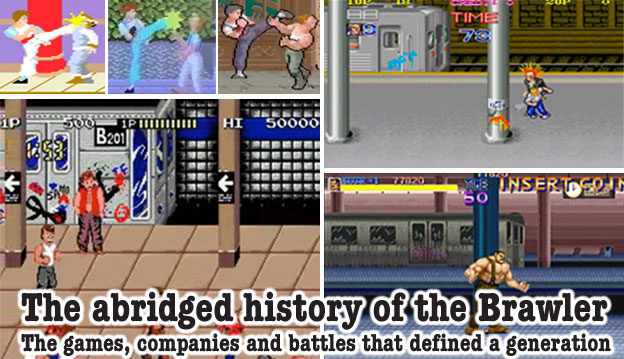
The Abridged History of the Brawler, part 5


By the end of 1989 and the start of 1990 several studios began experimenting with the direction of the brawler. In addition to Capcom the major innovator of the decade would be Konami. At that point the best most studios were doing was copying the Double Dragon formula. As exceptional as Final Fight was it still borrowed heavily from the Double Dragon elements. What was needed was something different. Konami became very successful at applying the brawling elements to licensed games.

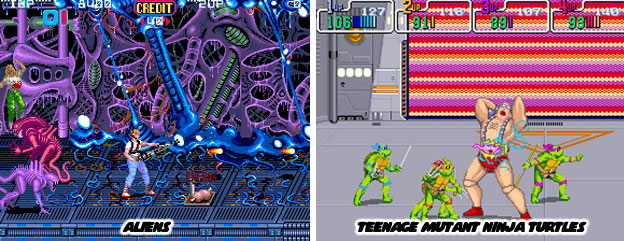
Good arcade games based on movies or TV shows were very sparse. Great licensed brawlers were even rarer. Konami changed all of that in the end of 1989 by releasing an arcade version of the wildly popular Teenage Mutant Ninja Turtles cartoon. This game was far more memorable than Crime Fighters, their previous brawling effort.


The game was layered with amazing details pulled right from the cartoon series. Plenty of gags, inside jokes, sound bites and hidden animations were crammed into the game. It was fanservice of the highest caliber, but it was quality fanservice that tried out new directions for the genre. The majority of the game was the traditional brawling experience. However that branched out when players were zipping down the streets fighting the evil Foot Clan on rocket powered skateboards. The illusion of moving quickly through a location while still being able to fight opponents with the existing play mechanics had not been done better than that previously. Konami was definitely onto something with this game.


In 1990 Konami turned Aliens, a groundbreaking science fiction movie, into a different type of brawler. Despite being two completely different types of subject matter, the lessons they learned from TMNT were carried over into Aliens. They preserved the attention to detail from canon and shaped that as a game narrative.


Where Aliens differed from the other brawlers was that the players did not use their hands or feet. Instead programmers put different types of high powered machine guns in the hands of players. Several of these weapons were pulled right from the movie. Each gun, rather than each player, had its own effective range, strength and weakness. This distinction made for a unique gameplay element. In the traditional brawler each player was free to explore the screen and take on any rival they could. It was very much every man for himself in those games. In Aliens some of the species took several shots to put down and by that time there would be another following it or sneaking up on the player from the opposite direction. Gamers that worked closely together, perhaps one with a short range flamethrower and one with a long range assault cannon could get further into the game than players that went on their own.

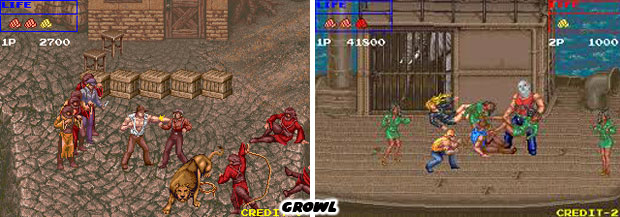
That year was not filled entirely with great advances in the genre. Studios were quickly developing their own take on the brawler and they weren’t all great or memorable. Several were applying the formula as fast as they could and pushing a title right to market. That was the sense I got from Taito when they released GROWL. A brawler set in the '30s-'40s about a group of adventurers tackling poachers in the jungle. The game was a thinly-veiled Indiana Jones rip off as scores of thugs went after fedora wearing heroes.


The handful of rival designs had nothing more than color palette swaps. Random men and women wearing the same costumes in different colors would simply show up to fight players over and over. The only interesting elements going for the brawler were some of the stage designs. Fighting aboard a steam ship as it sailed down a river, or atop a train as it sped through the jungle made for memorable levels. Everything aside from that was truly forgettable.

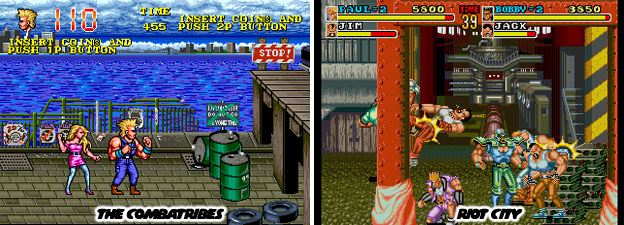
Technos was guilty of exploiting their own Double Dragon formula when it released the Combatribes. They added a third, black character, to the lineup of Billy and Jimmy Lee clones just to keep things fresh. I will go on record to say that the first time I saw the famous Guile haircut from Street Fighter II. It  was with the blonde character in the game a full year before Capcom revolutionized the fighting genre. Granted the graphics and animation were improved over Double Dragon, but the case was true for every other game released three years after Double Dragon.


The things that made this game unique had to do with the combat system. Downed opponents could be kicked, picked up or swung around by the ankle. Swinging opponents around and throwing them into each other was truly my favorite part. Rarely did brawling games allow for rivals to be struck while they were down. If they were allowed to fight dirty why couldn’t the players be allowed the same luxury? The game also exploited the health allowance that Konami charged in Crime Fighters. Quarters granted players a set amount of health. Thankfully unlike Konami that health did not go down by the second.

After Konami had pushed the genre forward with TMNT and Aliens players had an elevated expectation for brawlers. Taito and Technos seemed to have missed that expectation and as such GROWL and Combatribes saw a limited following. The next year would be the defining moment for the brawler. Unfortunately it got off to a rough start.


Westone (a publisher I never heard from again) developed a game for Sega. Riot City would be one of the companies first forays into the genre. The game was a pretty forgettable brawler, with a questionable design team and lackluster graphics.


About the only thing I remember from the game was the funny strut that the black character had. I guess he had to be even cooler than the white guy in the game so he walked like a rooster. Seriously Sega, what was that all about? Thankfully the rest of 1991 would give Sega another chance to get things right. In fact every major developer and publisher seemingly released at least one brawling game that year. Some were fantastic, some were okay and a few ones were real stinkers. We shall explore these over the next few blogs.

As always if you enjoyed this podcast and would like to sponsor me please visit my Patreon page and consider donating each month, even as little as $1 would help make better entries!

follow the Street Writer on Patreon!