Showing posts with label final fight 3. Show all posts

Thursday, February 27, 2020

The Aliens, Predator, Terminator, and Capcom connection...

In the previous blog I talked a little bit about the inspiration behind some of the Mad Gear bosses. It got me thinking about the roots of other designs in the series. It made me realize that Metro City may have been a nexus for some science fiction franchises. Before we do a deep dive we should acknowledge the state of Capcom during this period. What games were they working on, what games that they published in the arcade, and home consoles? The early '90s was unique for the industry because the brawling game was declining in popularity at the same time that the fighting game was exploding. While the two genres were similar, they each had their own audience. In any case Capcom was knee-deep in keeping both formats alive. The teams working on arcade and home brawlers had some crossover. In 1993 the studio published Final Fight 2 for the Super Nintendo, and released The Punisher, and Cadillacs and Dinosaurs in the arcade.


In 1995 when the studio published the last entry in the Final Fight series, they were also releasing a new version of Street Fighter. They used this time to tie together the events of several games. For the Street Fighter Alpha / Zero series it was connecting Street Fighter, Street Fighter II, and Final Fight into one narrative. For Final Fight 3, on the SNES, it was calling out the various brawlers that the studio had worked on. There was dealership selling the very distinctive Cadillac cars. There was also a stage set aboard a moving bus. There were even details pulled from the Alien vs Predator arcade game from 1994. Capcom had every right to be proud of the legacy that they had created. Final Fight 3 was overlooked for how it tied together various properties.


Before I get ahead of myself let's talk about one of the bosses, and his design inspiration. So we've established that films like Escape from New York, Streets of Fire, and the Wanderers inspired the creation of the Final Fight series. Those films from the early '80s had a unique take on science fiction, and gang culture. They framed the characters, and story of the original Final Fight. The sequels therefor pulled influences from later films. The villain Stray from Final Fight 3 was a boss in the Skull Cross organization. He was nowhere near as memorable as the bosses from previous FF games. His look however had some familiar elements.


The appearance of the armored warrior was more than likely inspired by the bad guys in Cyborg. The film from 1989 featured Jean-Claude van Damme. The post-apocalyptic science fiction movie had gangs patrolling the wastelands of the southern US. Actor Vincent Klyn played Fender Tremolo, leader of the pirates. Ralf Möller was the second in command, named Brick Bardo. Both were cruel, and very strong. Their group murdered countless families in the movie. In the canon of Final Fight 3 Stray had murdered the family of Dean, one of the heroes. I would argue that the look, and costume of Stray was an amalgamation of the two villains. But the inspiration from science fiction cinema ran so much deeper than that. The stage where players fought Stray was set inside of a giant factory. The heroes fought on top of metal grates, suspended over boiling metal. It looked very much like the steel mill at the end of the 1991 James Cameron film Terminator 2: Judgement Day.


Final Fight 3 was peppered with nods to science fiction cinema. These Easter Eggs were more than an homage to the great films from the '80s and early '90s. Capcom was trying to connect the movie and game continuities together. During the development of the arcade and home brawlers the studio had become well versed in the canon of the popular science fiction films. They did a deep dive into those worlds because they were working on high profile licenses. They went over production notes, design books, comic books, and various cuts of the film to try and squeeze out anything that could be used in a game. Capcom did not get a license to create a Terminator game, however during their research they made an important connection. As a wink to sharp-eyed audiences they put in a number of these cameos, and let players figure things out.


Final Fight 3 was not about breaking up the Mad Gear gang. Nor was it about defeating the crime lord Belger. A new gang called Skull Cross had taken over Metro City. They were headed up by a rogue military leader named Black. The arms merchant was trafficking illegal firearms through the city. They ran operations out of a company called SIM Inc. Veteran fighters Mike Haggar, and Guy reunited to save the city. They were joined by Detective Lucia Morgan, and the mysterious Dean. Their hunt for Black lead them all throughout the city. As they put the pieces together they found where the weapons were being manufactured. It turned out that SIM Inc. was working on more than just guns. In a side room of one of their factories there was a cybernetic arm in a glass case. This was a nod to the same arm featured in the Terminator 2 film. This technology from Cyberdyne Systems, would lead to the creation of the Terminator cyborgs and Skynet.


As the heroes of Metro City fought their way to the top they raided the headquarters of SIM Inc. Inside there were even more nods to science fiction canon. In a glass case there was a Work Loader. It looked identical to the ones featured in the 1986 movie Aliens. In film canon Weyland Corp built and patented the P-5000 Powered Work Loader in 2025. Caterpillar Inc. would make commercial versions later on. Was SIM Inc. the actual manufacturer of these machines? Did they secure government contracts to help develop this technology for Cyberdyne? To further connect Final Fight continuity to those of other Capcom brawlers there were also display cases filled with the latest weapons developed by SIM Inc. In the Aliens film it was never stated who had created the weapons used by the Marines in the far future.


So why are all of these Terminator / Aliens connections so important? Why would they be featured in a Capcom fighting game set in an urban city? Aside from the easy answer; that the developers were just calling out all of the other games the studio published. The truth was that Capcom had very subtly managed to link three of the biggest science fiction franchises together in a licensed game. The timelines from Terminator, Predator, and Aliens were all interconnected thanks to the Alien vs Predator arcade game that the studio released in 1994. Cracked put the pieces together several years ago. If you haven't heard here is how everything fits; so you may know that Arnold Schwarzenegger played the Terminator in the 1984 film by the same name, and he also played Dutch Schaefer in the 1987 film Predator. What if I were to tell you that the reason the characters looked similar was not because they were played by the same actor, but because in canon they shared the same DNA?


In his story Dutch was already a well regarded mercenary, but he became legend as the first human to kill a Yautja, or Predator in a one-on-one fight. Years after the initial encounter he lost an arm during what was called the 2nd Alien War. Cyberdyne Systems retrofitted him with a cybernetic arm, which doubled as a gun. With his newly enhanced strength he could now go toe-to-toe with both Alien and Predator lifeforms. This enhanced version of Dutch was recorded as CDS-170A3. This numbering was important. In the Terminator 2 film it was explained that Dr. Miles Dyson, director of Special Projects was working on the next generation of cybernetics. He helped develop the CDS T-800 Endoskeleton. More commonly known as the Terminator. Cyberdyne undoubtedly used Dutch's martial training, military tactics, and weapons proficiency to program the perfect killing machine. It only made sense that they also used Dutch's DNA to clone human flesh and muscle to go over the robotic frame.


Lt. Linn Kurosawa, a cyborg from the 13th Colonial Marine Corps, was also featured in Alien VS Predator. Linn was younger, and featured newer technology than Dutch. Her skeleton and frame were enhanced with synthetics. She was essentially the next generation of human. Cyberdyne Systems would eventually evolve into Hyperdyne Systems. The company would create Synthetics, human-passing androids designed by Michael Weyland. Eventually his company would merge with another and create Weyland Yutani Corporation. The synthetic named Ash (Hyperdyne Systems 120-A/2) was featured in the original 1979 film Alien, and another named Bishop appeared in the James Cameron-directed sequel. Being partly synthetic would explain why Kurasawa was able to keep pace with the larger Dutch, and their Predator teammates.


I believe that the reason that Capcom went with a new villain named Black, and an organization called SIM Inc. was so that they could expand on the brawling worlds they had built. Metro City, and Final Fight by extension allowed the studio new paths for their cast to explore. It allowed crossovers from Street Fighter, or another franchise I way to fit into continuity. I'm holding out hope that we might get a new Final Fight, or at least another new brawler from Capcom in the near future. Which were your favorite Capcom brawlers? Were there any hidden details that you enjoyed in any of the games? I'd like to hear about it! If you would like to sponsor me please visit my Patreon page and consider donating each month, even as little as $1 would help make better blogs and even podcasts!
follow the Street Writer on Patreon!

Tuesday, February 25, 2020

The unlikely origins of some Mad Gear bosses...

I've been playing through a number of classic games recently, and have been focusing on the Final Fight trilogy. It got me thinking about the details that Capcom put into the title. It also made me wonder where some of the characters came from. I'm particularly fond of the villains in the series, and I want to share what I think were the inspiration behind some of the most unique. For example, did you ever notice that there was an evil technician that was a boss character in the series? If you are a designer then how do you get across that a character is an inventor of sorts? Is it because of wild facial hair? A lab coat? Maybe goggles, or perhaps a bald head? How do audiences know what a crazy scientist looks like? When you think of evil geniuses in video games who usually comes to mind? I usually think of Dr. Eggman from Sonic the Hedgehog, but even he had to come from somewhere. Eggman did come from somewhere. Brian Ashcraft noticed how some of the early Studio Ghibli characters looked like Eggman. Of course this was a topic of a Reddit thread, and VGDensetsu tweeted the observation as well.


The roots behind the evil scientist go back even further. Possibly to the story of Frankenstein almost 200 years ago. In pop culture however the template for the evil scientist probably came from the Mad Doctor. The villain appeared in a Mickey Mouse cartoon in 1933. He was sporting a bald head, and wild facial hair long before Studio Ghibli or Sonic Team were created. He came back in game form for Epic Mickey 2 in 2012. Have you ever wondered if there could be a good mad inventor archetype? Again taking influences from Japan there was such a character. Cid Pollendina, my favorite of all the Cid characters, debuted in Final Fantasy IV way back in 1991. The airship engineer was the former Captain of the Red Wings in the game. He was burly, with a wild beard, physically strong, and a genius with mechanics. I believe he was the inspiration for the Skull Cross boss mechanic Caine.


Caine was located in a junkyard. He could only be reached if players were careful not to break a bus stop sign in Round 3. The top-heavy boss was cut from the same cloth as Cid. Overly muscular with goggles, and wild mane of hair instead of a beard. He would pin players with his thick welding gloves and smash them over the head with an enormous wrench. Talk about a cheap shot! Thankfully like most Final Fight bosses he was more brute than brains. He lacked the fighting techniques of the heroes. As neat a design as Caine was he wasn't even remotely the oddest of the bosses. In previous blogs I talked about the heavy metal stars, and films that inspired the creation of Final Fight. Sodom was a German metal band that formed in the early '80s. Their name and use of a masked military character on the album covers inspired the creation of the Mad Gear boss.


Depending on your point of view Sodom was either a harcore Japanophile or a certifiable kook. Either way he took his obsession with Japanese culture to extreme lengths. This came through in his game appearances, cut scenes, and official art from Capcom. Sodom fashioned a helmet and samurai "armor" out of football pads, jeans and a jersey. In the original Final Fight he would fight opponents inside of a wrestling ring. He used two katana swords and called them Masamune and Muramasa, named after the legendary Japanese swordsmiths. In The Street Fighter Zero / Alpha series he switched to jitte, the steel batons that Edo-period Japanese officers used. What if I were to tell you that aside from the metal band there was possibly a real-world inspiration for this character? Peter Thornley aka Kendo Nagasaki was a British wrestler that was obsessed with Japanese culture, and tradition. He was one of the biggest wrestling draws in Britain in the late '60s and early '70s. He even wrestled through the '80s, around the formative years of the Capcom staff.


The Kendo "gimmick" was very earnest. Thornley did everything he could to keep his identity a secret. He wore a mask in ring, and didn't lose it in any matches. He never gave interviews, and his manager did all the talking for him. When a plumber found out his identity Thornley was forced to come forward, but on his own terms. He unmasked himself in the late '70s during an elaborate, pseudo-Japanese ceremony. To this day Thornley claims that he is a spiritual vessel, and the host of a 300-year-old Japanese spirit. I have no doubt that Thornley believes in his claims. Sodom is drawn from the same level of obsession as Kendo. Both sometimes miss the details of the culture they are emulating. In canon Sodom speaks with very rough Japanese pronunciation. To emulate Japanese he will sound words out phonetically, like "It's Toe Show! Show Sea Send Bang! and Die Job Death Car!" The last phrase is pronounced "daijōbu desu ka?" and means "Are you alright?" When he wins a match he will sometimes say "Yo Parry," which is supposed to be "yappari" or "I thought so!"


The kanji on his jersey is supposed to read "Shi" or death in Japanese, but he missed a brush stroke so the character doesn't mean anything. When Sodom tried reuniting his gang during the events of Street Fighter Zero he painted kanji on the sign that was phonetically MA-DU-GI-A aka Madgear, but the combination of letters doesn't actually mean anything in Japanese. Sodom, like Thornley, was obsessed with keeping his identity a secret. Possibly because he was ashamed that he was not actually Japanese. In the Street Fighter Zero manga his mask was broken, and he covered his face out of fear of being found out. He claimed that he could not fight without it. The scene explained a lot about the character without having to go into further detail. He was probably the best example of the creative process behind the Mad Gear bosses. The villains often had layers of detail that went into their development. These most memorable were revisted by the studio. Which were some of your favorites? If you would like to sponsor me please visit my Patreon page and consider donating each month, even as little as $1 would help make better blogs and even podcasts!
follow the Street Writer on Patreon!

Wednesday, May 11, 2016

The Abridged History of the Brawler, part 18


Home consoles had been trying to get in on the brawling action through most of the 90's by the turn of the millennia they had found their rhythm. Unfortunately at that point the brawler had lost popularity. This blog will highlight the arcade influence on console versions of the brawler as well as independent brawlers inspired by arcade hits.


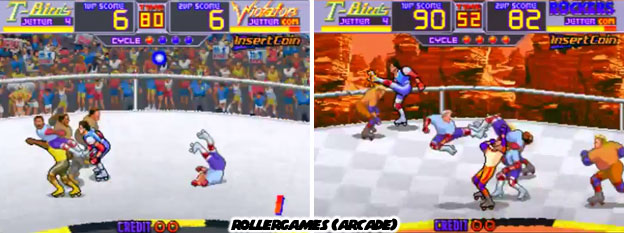
In 1990 Konami released RollerGames in the arcade as well as on the Nintendo Entertainment System. The game was licensed from the television show about an updated version of roller derby. The teams and players in the league were very over-the-top, not unlike pro wrestlers. It was great fun on TV and part of that spirit made it into the arcade. The game took place on one of several roller rinks located throughout the USA. Players actually could move all over the screen as they could in other brawling games while their characters automatically skated on the rink. The effect could be dizzying if players focused on the changing track instead of the approaching opponents. While fun the arcade version was a shameless quarter waster.


The player had to win a set amount of matches between the male and female teams. All the while the opponents were relentlessly dropping teammates and earning points. The battles were nonstop as teams seemed to have an unlimited supply of opponents right up until the clock ran out. Players that did not manage to throw, dropkick or punch out enough opponents could kiss their quarters goodbye.

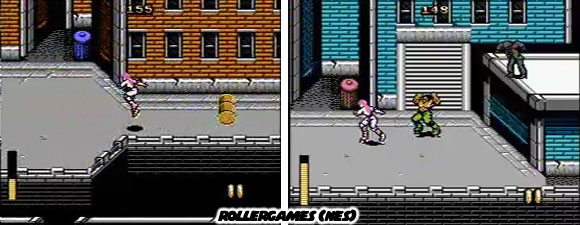
The experience changed completely when RollerGames was brought to the NES. The game became an adventure platformer featuring one playable character from each team. The character traveled from city to city, avoiding obstacles and pitfalls en route to defeating a boss, or manager from each team. At the end they fought through a corporate tower and defeated the big boss. It was nonsensical, just like many things that were popular in the 80's!


Very few brawling titles worked well on the 8-bit systems. The limit on sprite sizes, animations and colors made the brawler look like a minimalist genre. The next generation of hardware would be able to create experiences much closer to the arcade.

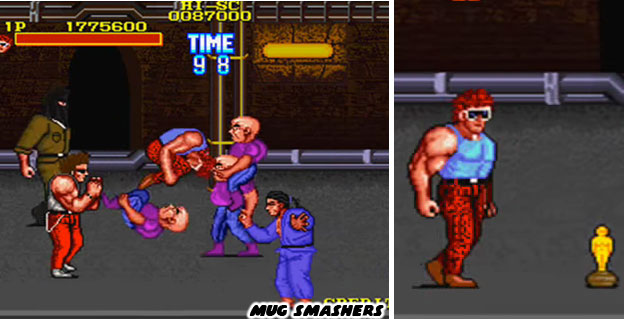
Of course there was always the PC, which promised to bring arcade-quality graphics home. For the most part they did. The gameplay, design and animation however were sorely lacking in many of the independently produced PC brawlers. One of the worst of the lot was by a British company called Electronic Devices. In 1990 they created a brawler set in San Francisco that was simply horrendous.


There were generic heroes and villains. Audiences could tell that they had poached various titles in order to recreate the genre. The control was bad, the villains were silly, there was one bad guy made up of three little people riding on each other's shoulders! The power ups made no sense, one even looked like an Academy Award! The prize for worst PC brawler was clearly won here.

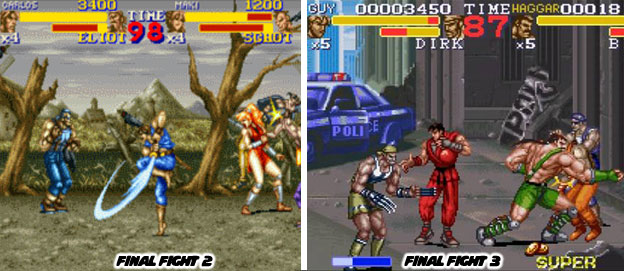
The consoles on the other hand had a lot of promise, especially once they transitioned to 16-bit systems. Capcom, as always, was one of the first to develop console titles based on their popular arcade games. Final Fight 2, released in 1993, was a Super Nintendo exclusive. The sequel to the arcade gem came out years after the original and featured new characters, locations and gameplay elements. It expanded the universe of Final Fight by taking Mike Haggar and his associates Maki and Carlos out of Metro City on a trip around the world.


Players learned that Mad Gear was a global crime syndicate that touched just about every continent. The bosses in this game were as memorable and diverse as they were in the original. The control was solid and Capcom had finally learned how to make a brawler that featured three characters. In the original Final Fight release for the SNES only Cody or Haggar were playable characters. A special edition featured Guy and cost more because of the memory costs associated with storing the information for one more sprite-based character.


In 1996 Final Fight 3 had returned to the streets of Metro City. Haggar returned to clean out the scourge of a new gang that had moved into town. The game introduced super attacks for the main characters. Dean and Lucia had replaced the other supporting characters in this story. A separate energy bar could be filled up and a screen-clearing super attack could be unleashed on bosses or groups of Skull Cross gang members alike.


It was a fun play mechanic that helped keep things fresh. The details in the sprites, animations and character designs did well to mirror the original title, however the sprite-based engine was beginning to show its age. Consoles were quickly moving to 3D experiences and players expected the genre to follow suit.


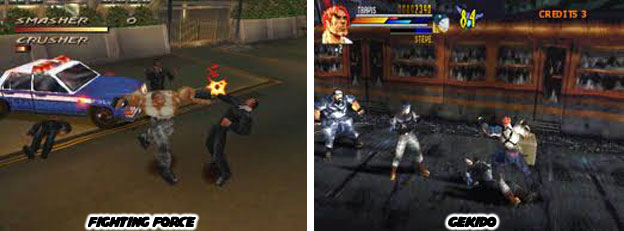
Fighting Force, released by Core Design in 1997, was originally pitched to Sega as Streets of Rage 4. Sega passed on the title so the title name was changed. The game was an early attempt at moving the brawling franchises to 3D. The polygon characters were large and animated slowly. The fighting mechanics lacked the speed or accuracy of 2D titles. The camera focused the attention of the player towards a particular direction and could not be changed. Core Design gave a clear example of how difficult it was to create the brawler in 3D using console hardware.


A few year later, in 2000, Naps Team tried to improve o the 3D brawler formula with Gekido. The animation was faster, camera improved, levels slightly more interactive and designs a bit more polished than Fighting Force. The console still lacked the raw 3D rendering power of most arcade cabinets but they were quickly catching up.


Very shortly the Playstation 2, Dreamcast and original Xbox would debut 3D brawling titles that were visually as impressive as anything released in arcades. Gekido could have been considered a forerunner to the Bouncer, which had been looked at in the previous blog.


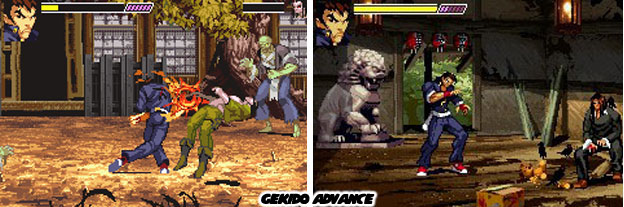
Naps Team had released a sequel on the GameBoy Advance in 2002. Gekido Advance; Kintaro's Revenge was a step back to traditional 2D, sprite-based gameplay. Which at this point was very unique. Most studios were struggling to bring 2D franchises into 3D. Naps Team made a sequel that convinced most gamers that the series was originally rooted in 2D. It was well done, well animated with solid character designs.


The game was decidedly Japanese animé influenced. The villains ranged from typical goons to monsters and mutants, a sort of Night Slashers meets the King of Fighters. The main character, Tetsuo, looked and moved similarly to Kyo from the KOF series. The game did well at recreating the classic feel of a brawler but kept things fresh by incorporating some fighting game mechanics and visuals.

The PC market in the west had a lackluster history with original brawlers however in the east things were different. In parts of Asia the PC market was often more popular than the console. The PC allowed DVD playback of course but also homebrew apps and small publishers could flourish. The PC's were of course online well before the consoles. Places like China and South Korea had a rapidly growing PC market. The studios in both countries were catching up with the trends in gaming. They were creating their own brawlers and fighting games less than a decade after they hit it big in the USA and Japan. That window of following the trends had grown shorter and shorter every year after 2000. The countries were able to develop and release their own mobile and MMO games a year or less after a popular title in the west had debuted. In other cases they were experimenting with the genres at a rapid pace.


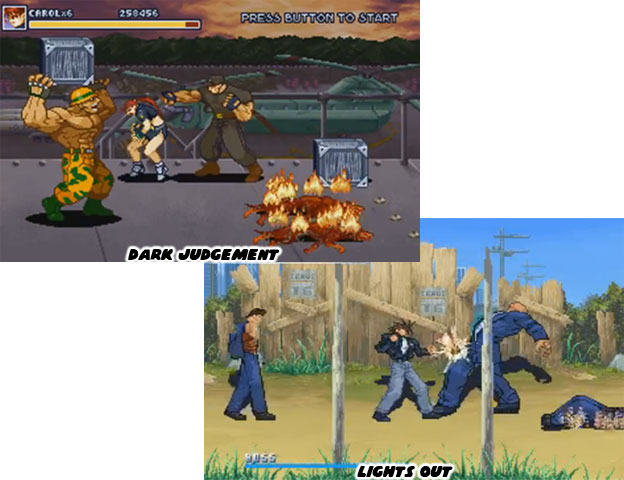
Two of the better brawlers released in South Korea were Dark Judgement: by SOHO Studio of Hong Kong and localized in Korean by Frankenstein Studio, the other was Eojjeonji Joheun Il-i Saenggil Geot Gateun Jeonyeok by TG Entertainment. The second game had a long title but it was based on the manhwa "Lights Out."  Comics in Korea were known as manhwa, comics in China were called manhua and you probably know that comics in Japan were manga. The two games came out in 1997 for Windows. Dark Judgement borrowed the aesthetic from the Capcom brawlers and mixed in some of the action of the Konami ones as well. It was created by a small team from Hong Kong and distributed by a Taiwanese Publisher. The SOHO Studio name was removed when it was released in South Korea. Thanks to the graphic artist, Lambonbon, who worked on the game for the bit of insight. Lights Out had a more distinct Korean style of animation and character design that was based on a bunch of high school tough guys fighting. Both of the games were well done and helped bring back a sense of the classic era of the brawler. There was something to be said about 2D graphics. They seemed to work better for the genre. In the arcade an indy developer would do similar things and release fantastic sprite-based titles within a sea of 3D releases. This game and more will be featured in the next blog. As always if you enjoyed this blog and would like to sponsor me please visit my Patreon page and consider donating each month, even as little as $1 would help make better blogs and even podcasts!

 follow the Street Writer on Patreon!