Showing posts with label inspiration. Show all posts

Saturday, July 20, 2024

A Street Fighter 6 detail that was bugging me until now...

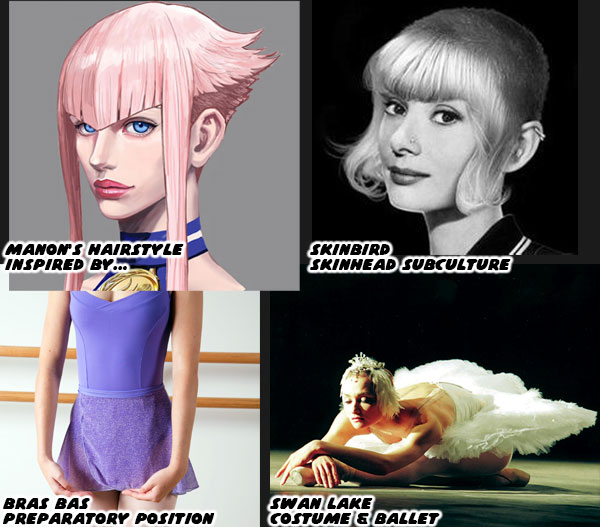
Believe it or not I finally have closure on a Street Fighter 6 detail that's been bugging me for years. It goes back to 2022 when I did a writeup on Manon (then called Mimi). Her design had been leaked for the Street Fighter 6 roster, and I talked about it as a chance to redo the character of Abel. I mentioned that her hair was very stylish, as she was presented as a fashion model, and fighter. One of my blog visitors named sparrowhawk made a comment about her hair being based on a Skinbird. The type of hair that girl skinheads sometimes wear. They shave all of their hair except for their bangs.  

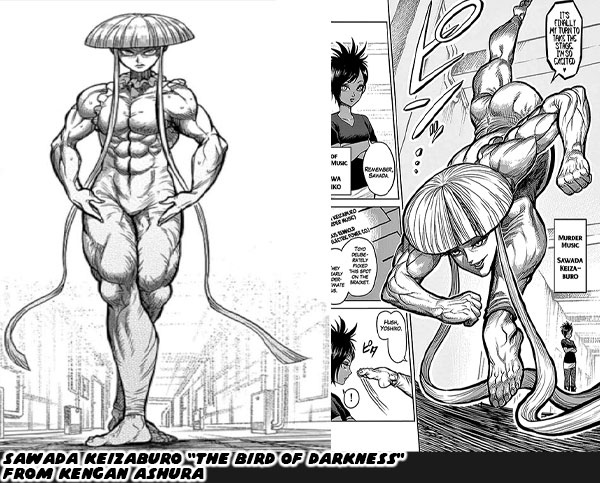
Sparrowhawk also made another great observation. He said that Manon was similar to the character Sawada Keizaburo from the manga, and anime series Kengan Ashura. The series written by Yabako Sandrovich, and illustrated by Daromeon was published from 2012-2018. The story was in the vein of Baki the Grappler in that the characters represented the pinnacle of their particular fighting styles. Also that they were hyper muscular, and violent combatants. Aside from the muscular frame, and long bangs there was little that I could see of Manon in the look of Sawada. 


That did not mean that the design didn't rub off on Yusuke Hashimoto the designer for Street Fighter 6. The hair alone would be ported over to A.K.I.  Mr. Hashimoto was known for his fashion-forward designs. He produced Bayonetta, and directed Bayonetta 2. As I stated previously; his sense of color, and costuming worked well for the SF cast, and could appeal to international audiences. There was one thing that I simply could not figure out with the design of Manon. That would be her bangs. When I looked at Marisa it was obvious that her haircut was designed to look like a Roman helmet. I could tell that the cropped hair of Manon was feathered to look like a bird. But the bangs were too thin, and too long to be wings.

If Manon were a principal artist then she would always be ready to perform. I would argue that she carried the character of Odette, the Swan Princess off of the stage, and into the arena. The part that bugged me was why would her bangs would be like this, then I realized that they weren't bird wings, but styled after her arms. The length, and cut of her bangs represented the bras bas in ballet, this was how the dancers held their arms before the first position. I think this was the best reason why Mr. Hashimoto went with that haircut. I know it was a dumb theory but it made sense to me. I wish I could ask him if I guessed correctly. Were there any details in Street Fighter or any fighting game that bugged you, but you couldn't guess why? I'd like to read about it in the comments section. As always if you would like to sponsor me please visit my Patreon page and consider donating each month, even as little as $1 would help make better blogs and even podcasts!
follow the Street Writer on Patreon!

Monday, March 22, 2021

Take a bike ride on the road to mental wellness...

Apologies for not updating my blog as frequently as I used to. The COVID-19 pandemic took its toll on my mental, and physical health. Only now am I starting to turn things around. A lot of that has to do with getting back into art. The previous post in October 2020 was a starting off point. Doing style studies of Steve Nazar's art for T&C Surf Designs made me feel better. So through November I looked up other things that inspired me as a kid. Around Thanksgiving I caught a BMX race on YouTube. That's when I remembered I loved all things BMX while growing up. It was like waking up a part of my brain that had amnesia. 

Diamondback F1 bike

Of all the bike types the ones I really loved were called Formula-1 bikes. It was a short-lived trend, circa 1987-1989. They were road racing versions of BMX bikes. The massive Japanese company Shimano tried to get a new street racing league started, and had convinced a dozen manufacturers to make the bikes as well.  US companies like DiamondBack, and Haro jumped on board. 

Haro Pursuit F1 bike


The thing was that even though Shimano was pushing a standard for racing bikes, the company Hutch was already working on fast street bikes. The Ferrari of which was one that I idolized was called the HPV, or Human Powered Vehicle. It hit over 40 miles per hour and got the world record for fastest 20-inch bike. 

hutch hpv bicycle with fairing

I started drawing all of my favorite bikes, and then went further. Using the BMX Museum website as a reference I started drawing every known Formula 1 bike that existed. While doing research I ended up adding a dozen that the site had never heard of.

BH Bikes Fast Formula

Doing research gave my mind focus. Creating renderings of these bikes gave me purpose. It was as if I was wrestling my life, my focus, back from the pandemic. The more I researched and drew, the more I felt like I was getting back into my old self. I felt like I was reconnecting with a part of me that had died.

MBK Formula-1 bike


When I wasn't doing my normal job (which I also did from home thanks to the pandemic) I spent every waking hour working on bikes. Days turned into weeks. Before I knew it I had drawn over 50 F1 bikes. I uploaded all of my drawings to the BMX Museum. I had finished my passion project at the end of 2020. I wasn't out of the woods yet. 

collection of formula 1 bike illustrations

The politics, work, home, family, and stress of 2020 could not be undone in a couple of months. As drawing bikes gave me back control, I started working on other types. Formula 1 bikes would always be my most favorite. They were not however the only favorite style of bikes that I enjoyed.

bmx bike illustrations

I began drawing freestyle, and traditional racing bikes in even greater detail than before. I even gave these new drawings themed backgrounds. It was a creative challenge that gave me a new sense of purpose. So I kept on drawing. 

bmx bike illustrations

I drew old school ('80s), mid school ('90s), and modern bikes. I researched my favorite bikes growing up, and essentially drew all of the bikes I wish I had as a kid. It gave me a sense of accomplishment as they started to come together.

Haro Team Master freestyle bike illustration

As I shared my illustrations on the BMX Museum fellow members started reaching out to me, several to commission me to create drawings for them as well. It was humbling that long-time collectors enjoyed my art, and were willing to commission me for an original drawing. Some of the best art I had ever produced came out thanks to the pandemic. It gave me a sense of control that had been lacking. It gave me back my focus, my drive, and desire. This leads me all the way back to this blog.

Ghost Rider bmx illustration

I've started getting back into podcasting. Which means I will get back to recording content for this blog. I will also get back to doing some fighting game research, and reviews. I want to thank all of the visitors that have been checking in on the site. Whether you left a comment on an old post. Or checked for new content, I appreciate it. I really do. I'm never going to abandon this blog. I may be getting slower with the updates, but I'm never going to stop posting. If there's anything you'd like me to look at, or write about, please let me know. If you would like to sponsor me please visit my Patreon page and consider donating each month, even as little as $1 would help make better blogs and even podcasts!
follow the Street Writer on Patreon!

Tuesday, February 25, 2020

The unlikely origins of some Mad Gear bosses...

I've been playing through a number of classic games recently, and have been focusing on the Final Fight trilogy. It got me thinking about the details that Capcom put into the title. It also made me wonder where some of the characters came from. I'm particularly fond of the villains in the series, and I want to share what I think were the inspiration behind some of the most unique. For example, did you ever notice that there was an evil technician that was a boss character in the series? If you are a designer then how do you get across that a character is an inventor of sorts? Is it because of wild facial hair? A lab coat? Maybe goggles, or perhaps a bald head? How do audiences know what a crazy scientist looks like? When you think of evil geniuses in video games who usually comes to mind? I usually think of Dr. Eggman from Sonic the Hedgehog, but even he had to come from somewhere. Eggman did come from somewhere. Brian Ashcraft noticed how some of the early Studio Ghibli characters looked like Eggman. Of course this was a topic of a Reddit thread, and VGDensetsu tweeted the observation as well.


The roots behind the evil scientist go back even further. Possibly to the story of Frankenstein almost 200 years ago. In pop culture however the template for the evil scientist probably came from the Mad Doctor. The villain appeared in a Mickey Mouse cartoon in 1933. He was sporting a bald head, and wild facial hair long before Studio Ghibli or Sonic Team were created. He came back in game form for Epic Mickey 2 in 2012. Have you ever wondered if there could be a good mad inventor archetype? Again taking influences from Japan there was such a character. Cid Pollendina, my favorite of all the Cid characters, debuted in Final Fantasy IV way back in 1991. The airship engineer was the former Captain of the Red Wings in the game. He was burly, with a wild beard, physically strong, and a genius with mechanics. I believe he was the inspiration for the Skull Cross boss mechanic Caine.


Caine was located in a junkyard. He could only be reached if players were careful not to break a bus stop sign in Round 3. The top-heavy boss was cut from the same cloth as Cid. Overly muscular with goggles, and wild mane of hair instead of a beard. He would pin players with his thick welding gloves and smash them over the head with an enormous wrench. Talk about a cheap shot! Thankfully like most Final Fight bosses he was more brute than brains. He lacked the fighting techniques of the heroes. As neat a design as Caine was he wasn't even remotely the oddest of the bosses. In previous blogs I talked about the heavy metal stars, and films that inspired the creation of Final Fight. Sodom was a German metal band that formed in the early '80s. Their name and use of a masked military character on the album covers inspired the creation of the Mad Gear boss.


Depending on your point of view Sodom was either a harcore Japanophile or a certifiable kook. Either way he took his obsession with Japanese culture to extreme lengths. This came through in his game appearances, cut scenes, and official art from Capcom. Sodom fashioned a helmet and samurai "armor" out of football pads, jeans and a jersey. In the original Final Fight he would fight opponents inside of a wrestling ring. He used two katana swords and called them Masamune and Muramasa, named after the legendary Japanese swordsmiths. In The Street Fighter Zero / Alpha series he switched to jitte, the steel batons that Edo-period Japanese officers used. What if I were to tell you that aside from the metal band there was possibly a real-world inspiration for this character? Peter Thornley aka Kendo Nagasaki was a British wrestler that was obsessed with Japanese culture, and tradition. He was one of the biggest wrestling draws in Britain in the late '60s and early '70s. He even wrestled through the '80s, around the formative years of the Capcom staff.


The Kendo "gimmick" was very earnest. Thornley did everything he could to keep his identity a secret. He wore a mask in ring, and didn't lose it in any matches. He never gave interviews, and his manager did all the talking for him. When a plumber found out his identity Thornley was forced to come forward, but on his own terms. He unmasked himself in the late '70s during an elaborate, pseudo-Japanese ceremony. To this day Thornley claims that he is a spiritual vessel, and the host of a 300-year-old Japanese spirit. I have no doubt that Thornley believes in his claims. Sodom is drawn from the same level of obsession as Kendo. Both sometimes miss the details of the culture they are emulating. In canon Sodom speaks with very rough Japanese pronunciation. To emulate Japanese he will sound words out phonetically, like "It's Toe Show! Show Sea Send Bang! and Die Job Death Car!" The last phrase is pronounced "daijōbu desu ka?" and means "Are you alright?" When he wins a match he will sometimes say "Yo Parry," which is supposed to be "yappari" or "I thought so!"


The kanji on his jersey is supposed to read "Shi" or death in Japanese, but he missed a brush stroke so the character doesn't mean anything. When Sodom tried reuniting his gang during the events of Street Fighter Zero he painted kanji on the sign that was phonetically MA-DU-GI-A aka Madgear, but the combination of letters doesn't actually mean anything in Japanese. Sodom, like Thornley, was obsessed with keeping his identity a secret. Possibly because he was ashamed that he was not actually Japanese. In the Street Fighter Zero manga his mask was broken, and he covered his face out of fear of being found out. He claimed that he could not fight without it. The scene explained a lot about the character without having to go into further detail. He was probably the best example of the creative process behind the Mad Gear bosses. The villains often had layers of detail that went into their development. These most memorable were revisted by the studio. Which were some of your favorites? If you would like to sponsor me please visit my Patreon page and consider donating each month, even as little as $1 would help make better blogs and even podcasts!
follow the Street Writer on Patreon!

Wednesday, July 15, 2015

How fight culture became fighting game history, part 7

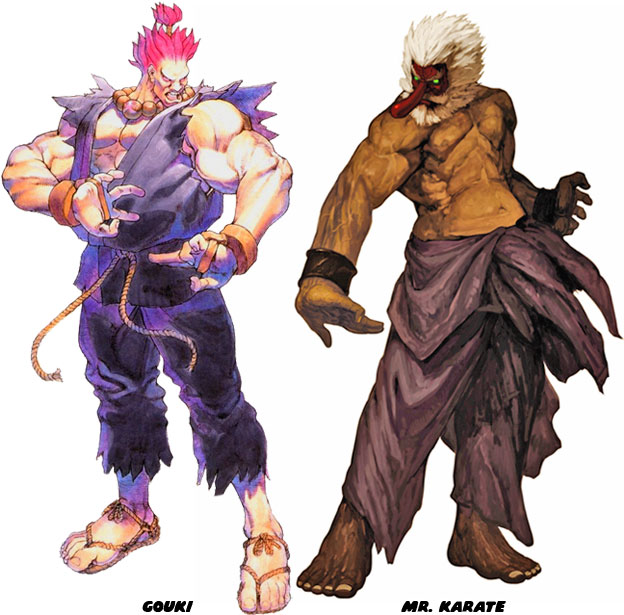
No character is truly original, none are pulled out from thin air, at least not the memorable ones. Gouki and Mr. Karate, the greatest "boss" characters from Capcom and SNK respectively, were inspired by mystical icons. To be specific the spiritual influences of Asian religions. These fighting game characters, their appearance, colors and even poses were based on the Nio. The Nio were the guardians of Buddha. They deterred evil man and demon from the gates of the afterlife and met the honorable ones as a friend when their spirit was ready to transcend this dimension. These figures could be found in temples as intricately detailed wooden carvings, some were life-sized and some were gigantic. They were also referred to as the the Benevolent Kings in other writings. The two most recognizable, the ones highlighted in manga and anime, being Agyo and Ungyo; the beginning and end, or "alpha" and "omega." The guardians were physically imposing figures, whose exaggerated muscles and proportions were meant to instill fear into those that would desecrate a temple. Although empty-handed in most representations they were nonetheless meant to be seen as fearsome warriors and masters of the martial arts.
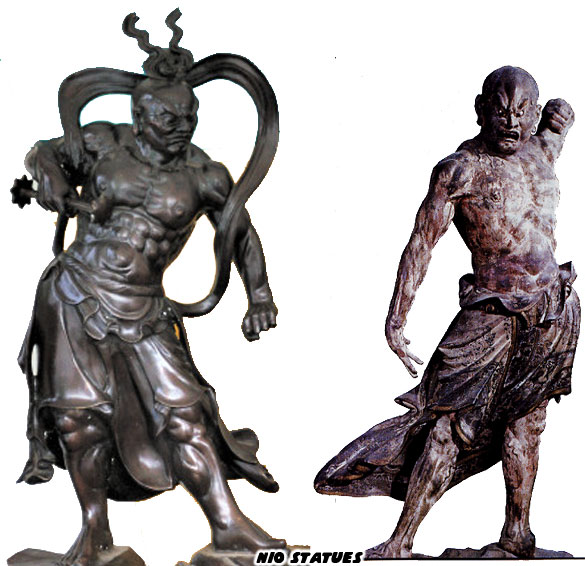

Upon studying the statues, their origins and aesthetics we can see how the Nio could be incorporated into a fighting game. One of the most popular incarnations being Gouki / Akuma from Capcom's revolutionary Street Fighter series. Years later many of the fearsome elements from the Nio and earlier Vedic Traditions were pulled by Capcom once more to create the heroes and villains featured in Asura's Wrath. Given their importance in Buddhism and symbolically strong gestures they could not have been meant for anything less than "boss" status in their respective titles. The scowls, wide-eyes, raw power and menacing poses were universally understood even if their divine origin was not. All it took was for some artists to come along and update their designs, bring them into a contemporary setting.

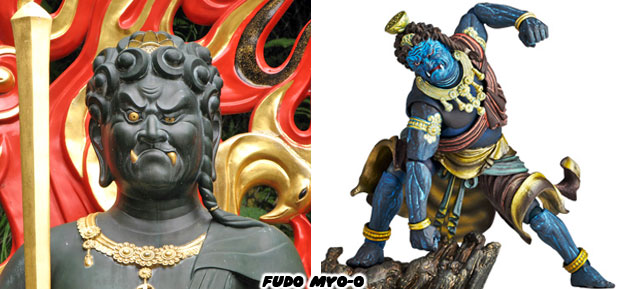
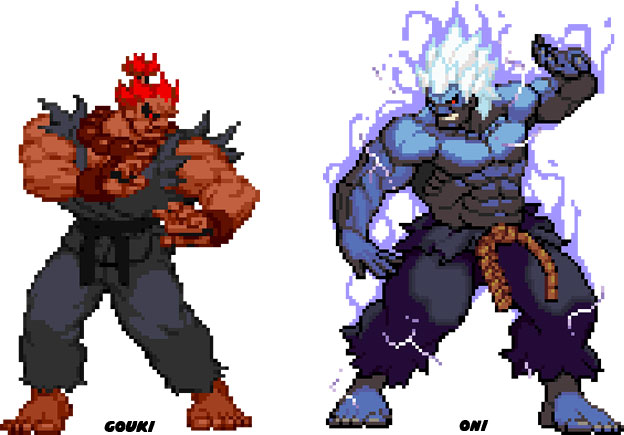
The Nio are sometimes mistaken for another figure from Buddhism. Fudo Myo-o AKA Acala is known as the "Immovable One." The fearsome-looking demon is actually a protector as well. He burns away all impediments and defilement so that living beings can reach enlightenment. The blue skin is supposed to recall elements of the supernatural. Gods and demons are often presented with blue or red skin. Many Hindu deities were presented with blue skin as well and possibly influenced the creation of the Chinese and Japanese spirits.


While Gouki was based on the Nio, a latter version of the character introduced in Super Street Fighter IV was known as Oni (the Japanese word for demon). The supercharged, blue-skinned version of Gouki was undoubtedly rooted in the design of Fudo Myo-o.


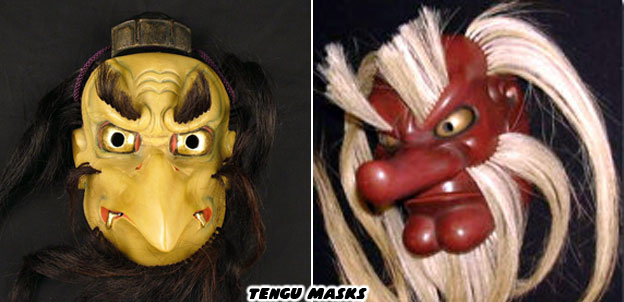
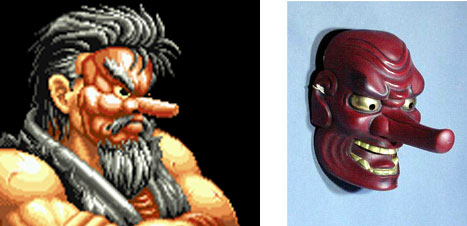
Mr. Karate from the SNK King of Fighters universe combined the Nio influence with a Tengu mask. Masks were very powerful symbols of culture, every culture had a mask tradition and were recognized for their symbolic properties. When used carefully by a game designer they could make an ordinary character extraordinary. In Japan, and in some regions, masks had an important ceremonial position. Originally carved from wood and later turned into a paper-maché craft, Iwami Kagura masks, which were similar to the Tengu masks were used in a historical and folk context. They were most commonly used for Noh plays as great storytelling devices. Even those without an understanding of Japanese culture could still find time to appreciate the colors, design and craftsmanship that goes into these amazing masks.


The use of masks as a storytelling device is also something featured in theSichuan Chinese opera. Stories based on the Romance of the Three Kingdoms and Journey to the West often feature performers in full face paint, if not ornately designed silk masks. Some performers were able to switch masks in a fraction of a second as a magic trick. This centuries-old practice was fiercely guarded by the Chinese and the techniques of the masked performers were often handed down to members of the immediate family only through a rigorous apprenticeship. In similar ways certain forms of kung-fu were also only trusted to immediate family members. While the Shaolin were willing to train other monks in the art of self defense many kung-fu practitioners were much more secretive. Many forms died out and it took a long time for certain lineages to be taught to foreigners, if at all. The fighting game character Lee Pai Long was a masked performer and master martial artist. His father was a legend and trusted his only son with his arcane knowledge of medicine as well as the martial arts. In SNK canon Lee Pai Long was a minor character but his design influences were notable. His mask had the pattern of the Monkey King on it. He came from a tradition that predated the Tengu mask.
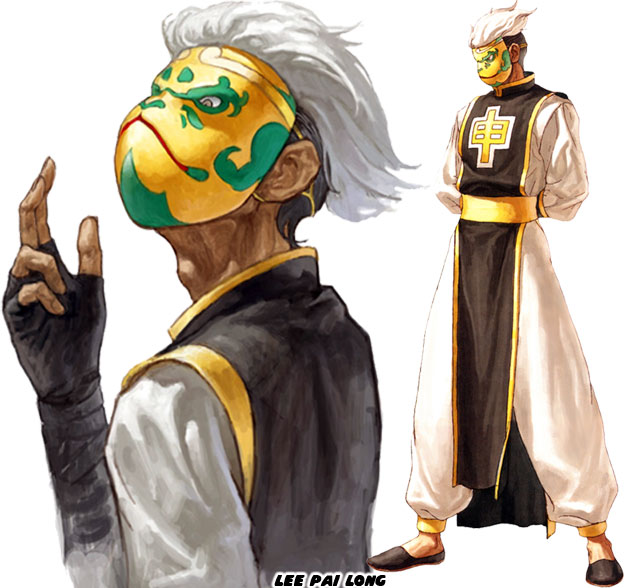
 

The word Tengu translated to Heavenly Dog, a Shinto god. Sometimes the tengu mask had a beak and made the wearer appear like a bird. The more common version has red skin and a long nose with certain phallic qualities. Yes, there were some tengu masks with long flaccid noses as well! The term tengu and the characters used to write it in Japanese were borrowed from the name of a fierce demon from Chinese folklore called tiāngoǔ. The tengu were mythical characters, spirits, animals, goblins and such that existed before Buddhism reached Japan. As was the case in other locations the Buddhists pulled mythology of the region and incorporated it into their stories. The tengu stopped being representatives of ancient animistic Shinto figures and were written as opponents of Buddhism but also sometimes protectors of it. This dual nature worked in the favor of the characters designed for fighting games. The character of Mr. Karate was the alias for Takuma Sakazaki. As Takuma the character was heroic, noble and very honorable. Mr. Karate by comparison was a brutal fighter that held nothing back and showed no mercy to his opponents. Takuma was based greatly on the Japanese karate master Mas Oyama. However as soon as he put on the mask he developed a completely new personality. The father of Lee Pai Long was Lee Gakusuo, he was the martial artist that left an enormous scar across the chest of a young and arrogant Takuma. Gakusuo was what Mr. Chen was to the legend of Mas Oyama.
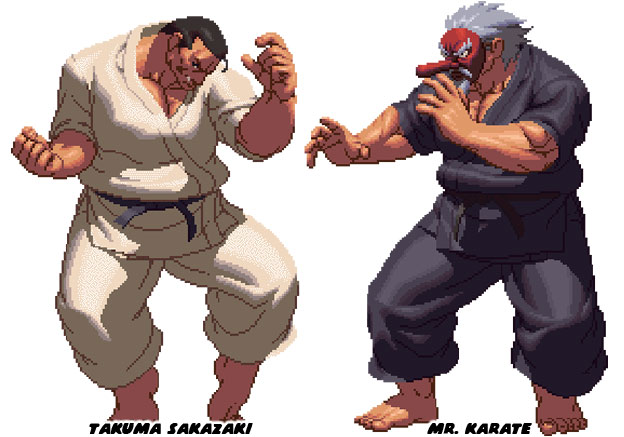
 

As a design choice it was a bold move from the people working at Capcom and SNK to feature martial artists disguised as divine beings. Imagine what a spectacle a real fighter would have created if they chose to protect their identity, or create a new personae with a mask? What would have happened if Mas Oyama or Huo Yuanjia had returned from their self-imposed exile to fight foreign champions while wearing a mask? What if they shunned the fame and had shown up at fighting tournaments unannounced and disappeared as soon as they beat their opponent? Imagine what the reaction would have been if Bruce Lee had lived and caught anonymously instead of promoted himself and his philosophies on movie screens. The stories and conspiracy theories surrounding their lives would be even stronger today.

The most unique designs in the King of Fighters and Street Fighter revolved around a distinct Japanese aesthetic. The Nio figures, the tengu masks and classic theater all had a part in shaping the legacy of fighting games. To ignore the origins of these characters was to deny the reason why audiences were so attracted to them. Western fans of the titles that lacked an understanding behind the Eastern religions, customs and traditions still appreciated these unique characters. I would argue that Gouki, Mr. Karate and other characters like them inspired Westerners to study more about Asian cultures and religions. There was no doubt that they found some influences with their favorite characters as they progressed deeper into history. The foundation for the King of Fighters and Street Fighter series was planted at the start of the 20th century not in the middle of the century. Mas Oyama was a central influence to both games but there were Japanese legends that existed before he did. When the designers at Capcom and SNK studied these men they were able to work them into the canon of each series. The next blog will get to the roots of the Japanese masters. As always if you enjoyed this blog and would like to sponsor me please visit my Patreon page and consider donating each month, even as little as $1 would help make better blogs and even podcasts!