Showing posts with label origins. Show all posts

Wednesday, April 1, 2026

Bookmark This Page; How fight culture became fighting game history

One of the first series I created for this blog was a look at the martial arts legends that inspired many of our favorite characters, and games. If you want to learn the ancient history of modern games then Bookmark This Page.

How fight culture became fighting game history, part 1…

How fight culture became fighting game history, part 2…

How fight culture became fighting game history, part 3…

How fight culture became fighting game history, part 4…

How fight culture became fighting game history, part 5…

How fight culture became fighting game history, part 6…

How fight culture became fighting game history, part 7…

How fight culture became fighting game history, part 8…

How fight culture became fighting game history, part 9…

How fight culture became fighting game history, part 10…

How fight culture became fighting game history, part 11…

How fight culture became fighting game history, part 12…

How fight culture became fighting game history, part 13…

How fight culture became fighting game history, part 14…

How fight culture became fighting game history, part 15…

How fight culture became fighting game history, part 16…

How fight culture became fighting game history, part 17…

How fight culture became fighting game history, part 18…

How fight culture became fighting game history, part 19…

How fight culture became fighting game history, part 20…

How fight culture became fighting game history, part 21…

How fight culture became fighting game history, part 22…

How fight culture became fighting game history, part 23…

How fight culture became fighting game history, part 24…

How fight culture became fighting game history, part 25…

How fight culture became fighting game history, part 26…

How fight culture became fighting game history, part 27…

How fight culture became fighting game history, part 28…

How fight culture became fighting game history, part 29…

How fight culture became fighting game history, part 30…

How fight culture became fighting game history, part 31…

How fight culture became fighting game history, part 32…

How fight culture became fighting game history, part 33…

How fight culture became fighting game history, part 34…

How fight culture became fighting game history, part 35…

How fight culture became fighting game history, part 36…

How fight culture became fighting game history, part 37…

How fight culture became fighting game history, part 38…

How fight culture became fighting game history, part 39…

How fight culture became fighting game history, part 40…

How fight culture became fighting game history, part 41…

How fight culture became fighting game history, part 42…

How fight culture became fighting game history, part 43…

How fight culture became fighting game history, part 44…

How fight culture became fighting game history, part 45…

How fight culture became fighting game history, part 46…

How fight culture became fighting game history, part 47…

How fight culture became fighting game history, final part…

Did you have a favorite legend, or real world fighter that you were inspired by? Let me know about it in the comments section. As always if you enjoyed this blog, and would like to sponsor me please visit my Patreon page and consider donating each month, even as little as $1 would help make better blogs and even podcasts!

follow the Street Writer on Patreon!

Monday, October 23, 2023

Martial Myths; the dangers of the dark path and the dim mak. A 1UP classic from April 5, 2012

In adventure stories there was usually a great warrior or even king that had exceptional martial prowess. What made them important were the qualities that they demonstrated to audiences. These heroes were brave, kind, clever and acted as a moral compass for a society that had lost its way. In the adventure traditions there were usually villains that were morally opposite of everything the hero stood for. What made these villains scary was that they usually had far more martial prowess than the heroes and were willing to kill. In wuxia legends the heroes and villains mainly fought with their hands and occasionally a weapon. These archetypes followed the classic traditions, powers and origin stories.
What made Street Fighter special was that it brought the wuxia tradition to game players. It gave a generation that may not have been exposed to the same comics or films as the SF developers a way to experience the heroic traditions. It was more important to the traditions because it gave audiences a chance to play as the archetypes. By tapping into fighting mythology the developers at Capcom were able to create heroes and villains that could withstand the test of time. The heroic tradition has many parallels in Eastern and Western storytelling. What makes it unique in wuxia was in how circular the stories were. The basic plot goes as follows: tragedy begets a quest for revenge, the heroes are hopelessly overwhelmed by the villain and driven out of society, along the way the heroes train brutally and learn the techniques required to defeat their nemesis. The hero grows into a powerful martial artist and returns to redeem their name and fulfill the vow of revenge. This template was taken almost verbatim in martial arts cinema, manhua stories as well as in the origin story of Street Fighter.

As the Street Fighter universe was fleshed out through the 1990's the traditions of wuxia were used to make the characters more interesting and plot more dramatic. Ken and Ryu were the introduction to the universe. At first gamers did not know much about the characters, how they got such awesome powers or what they were fighting for. The designers at Capcom had actually been fleshing out the characters well before the first manga was ever published. 

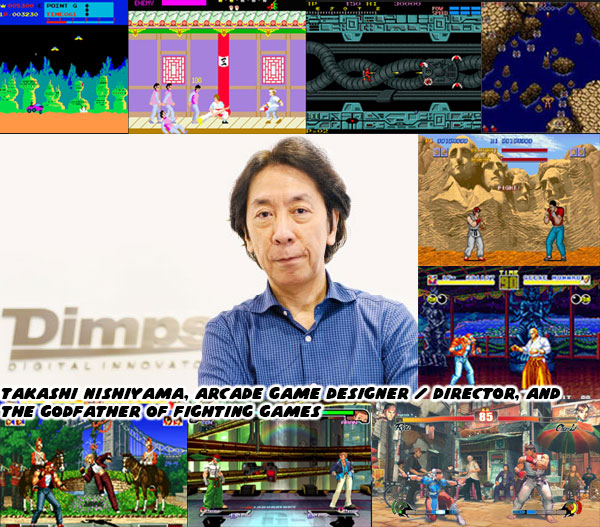
"I wanted to add depth with a story. It just happened to be a fighting game, but I wanted there to be a story so it would feel like a movie. We even conceptualized details for the characters that we didn't put in the game itself -- what the characters might like to eat, do they have sisters, other family members, etc. Street Fighter was different from prior games in the amount of depth we gave the characters." - Takashi Nishiyama, the designer of the original Street Fighter.
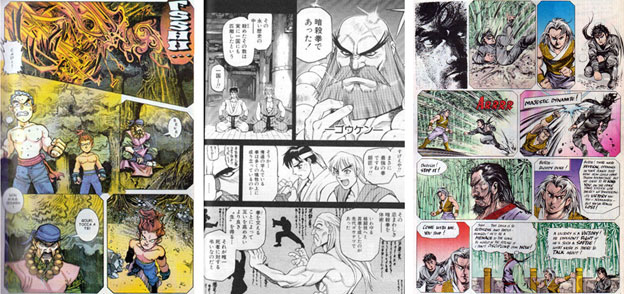
As the universe was explored in manga and animé the classic themes began coming up. Ken and Ryu were part of a martial arts tradition. Their master was named Gouken, he along with his brother Gouki were taught by a kung-fu master named Goutetsu. It was not karate as many fans of the series had assumed. The main characters were learning but a form of Antsasuken, or an "assassins fist." Goutetsu brought this over from China and had distilled the most lethal techniques into an unstoppable fighting art. In manhua the setup was very familiar. Two gifted youngsters, raised as brothers would be trained, one with a level head and another more impulsive. The more impulsive one would tend to get himself in trouble with the master and disobey orders. In the Iron Marshall the master was Tienway Champ, the level-headed youngster was Iron and the impulsive one was his adopted brother Duke.

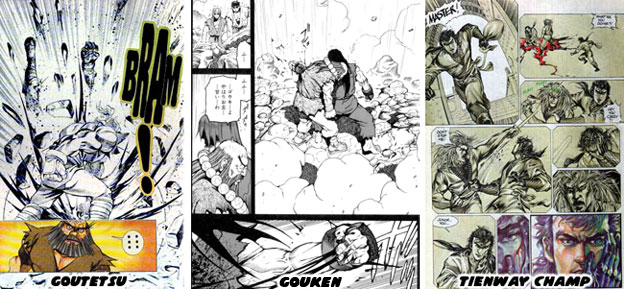
In order to create dramatic tension there had to be a terrible accident or a murder witnessed by the young students. In the Street Fighter mythos it was Gouki that assassinated his master. His brother was a witness to this terrible crime. Years later Gouki assassinated Gouken while Ken and Ryu were witnesses. Iron ran in on the assassination of Tienway by Duke. These things left the characters with emotional and in the case of Iron, physical scars. The tragic events galvanized the heroes' resolve and put them on a path toward revenge. This was difficult for the young martial artists to accomplish now that they were masterless. In order to become better fighters they must seek out new challenges and learn the difficult lessons without the aid of a mentor.
Similar tragedies were the origin stories for Western heroes like Batman, Spider-Man and Superman. It was a great plot device which helped hook the reader and made the hero sympathetic.

In the wuxia tradition, if a fighter was lucky they came across another master who was willing to teach them new techniques. More often than not however the fighter had to learn by teaching themselves. They had to fight masters of every style and learn how to defeat that style along the way. This made for great adventure writing, and a chance to explore the various martial arts schools. However for the sake of a self-contained story rather than adventure serial the fighter had to come across a new master.
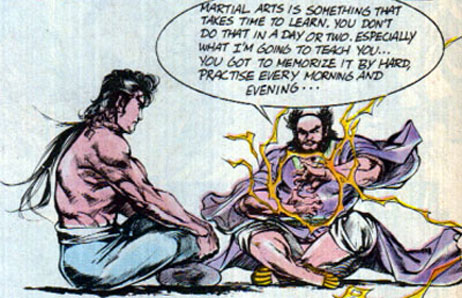
The heroes of the stories were usually gifted fighters to begin with. They knew all the techniques and secrets of their original master and could quickly build onto these things in a relatively short amount of time. This helped speed up the plot and allowed audiences not to have to sit through months of training and humbling lessons.
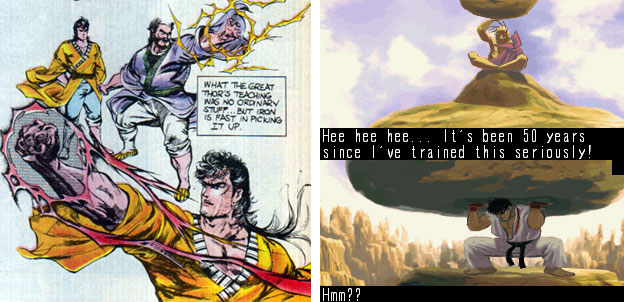
Years after the death of Tienway Champ, and hot on the pursuit of the Bloody Duke, the Iron Marshal was aided by a hermit named the Great Thor. He promised to teach Iron his trademark Thunder techniques. These techniques could take a great fighter decades to master but Iron picked them up at a rapid pace. Similarly the SF games allowed for both classic wuxia traditions to be explored over the course of multiple games. Characters had new or more powerful moves and those techniques did not have to be explained, players assumed that they were becoming better fighters as the years went by. Story-wise Ken and Ryu travelled the world looking for challenges and becoming stronger fighters in the first two SF games. By SF III it seemed that the characters had reached their potential and could fight Gouki. At this point in the story the elderly fighter Oro decided to take Ryu under his tutelage. It seemed that the young master still could become more powerful and thus fill an even greater presence in the universe.
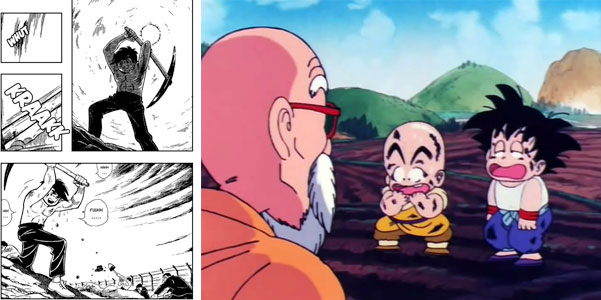
The manga and manhua stories would often take an aside to show the characters becoming stronger by highlighting the training regiments they endured. It was supposed to be inspiring but almost sad to see how characters had to suffer during these periods. Characters could sometimes be degraded and tortured just to become marginally better. Perhaps the writer and artists of the stories were a bit sadistic but in actuality were reinforcing the understanding that mastery of the martial arts required constant hard work. The end result would be worth all the struggles especially when revenge was involved (think of how Beatrix suffered under the cruel tutelage of Pai Mei in the Kill Bill movies).
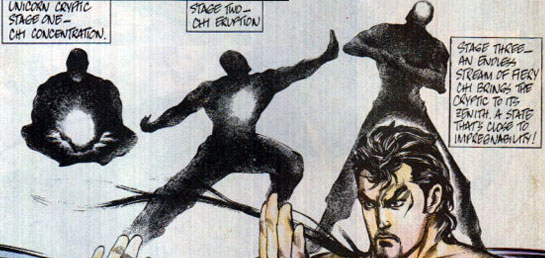
These characters often learned secretive techniques known only to a handful of people. In many cases it was only the master and the one or two disciples that were privy to the ancient techniques. This exclusivity made the heroes and villains unique. They could do things that regular people, or masters of the traditional fighting arts could not do. The trust that the masters had in their pupils had to be absolute. There was often a danger associated with teaching these techniques to inexperienced or corruptible students. In the SF canon Gouken was once infuriated with Ryu with the nonchalance that he put behind the techniques. In one story Ryu recalled the first time he performed a variation of the Shoryuken, or rising dragon fist. Ryu had split a boulder with the punch to which Ken was bragging about what a powerful fighter Ryu was becoming. Instead of being pleased with his disciples Gouken was infuriated, he struck down Ryu. The two were being shown extremely dangerous moves, some were techniques that were not used for fighting but instead for killing, the fact that they did not treat the moves with more reverence had caused Gouken to react the way he did. Ryu recalled this lesson as he was on the verge of defeat at the hands of Sagat following their first encounter.
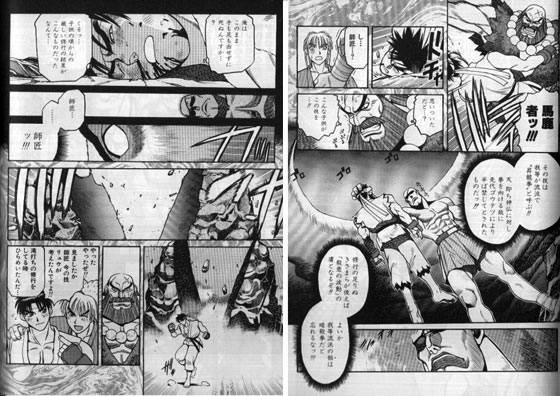
Ryu staged a miraculous comeback against Sagat thus becoming the greatest fighter in the world. This story became the stuff of legend in SF canon. It highlighted how a perfect technique could topple even the most powerful fighter in the world. When Masahiko Nakahira revisited the fight in the Street Fighter Zero manga he took a closer look at what was driving Ryu and it was neither brave nor honorable.

Ryu exploited that same killing technique he used to split the boulder on Sagat. The Metsu Shoryuken or "Destroying Rising Dragon Fist" was supposed to be a killing blow. If Sagat were not equally powerful then he surely would have been killed by the punch. The encounter had repercussions in the continuity of the universe. Gouken was trying to convey the gravity of the moves his pupils were learning. They should be taken in all earnestness and never used casually in a fight. Ryu could have accepted defeat and acknowledged that Sagat was a better fighter when they first met. It would have been his pride that would have suffered the most. He could have returned to fight Sagat in the future, older wiser and stronger. Instead Ryu gave into the temptation of exploiting the most powerful strike even if it would have turned him into a murderer. This made for a much more interesting story, especially for a jumping off point as the sequel had developed. Sagat returned as a boss character but had a grisly scar across his chest.
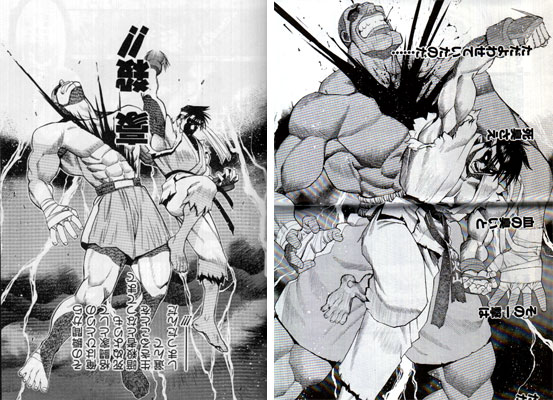
A shortcut to winning battles was not what Gouken was protecting his students from. By going for the lethal arts Ryu had exposed himself to the corrupting influences of techniques based in dark hadou, or evil chi. The philosophy is similar to the "dark force" from Star Wars mythology.

Again, to use an example of turning to darkness here was another quote from the Star Wars series.
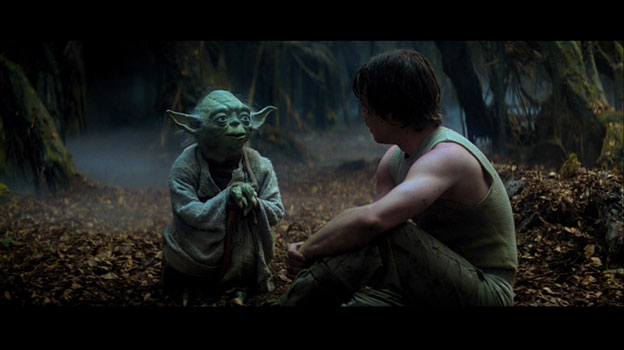
Yoda: Yes, run! Yes, a Jedi's strength flows from the Force. But beware of the dark side. Anger, fear, aggression; the dark side of the Force are they. Easily they flow, quick to join you in a fight. If once you start down the dark path, forever will it dominate your destiny, consume you it will, as it did Obi-Wan's apprentice.
Luke: Vader… Is the dark side stronger?
Yoda: No, no, no. Quicker, easier, more seductive.
Luke: But how am I to know the good side from the bad?
Yoda: You will know... when you are calm, at peace, passive. A Jedi uses the Force for knowledge and defense, NEVER for attack.
Luke: But tell my why I can't...
Yoda: No, no! There is no "why".
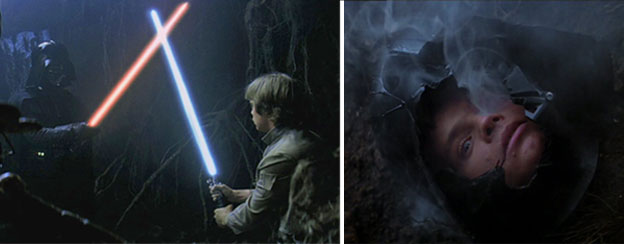
Once a person set toward the path to the dark side it was all but impossible to find the path back. In doing so the hero would become exactly like the villain. For Star Wars Luke would symbolically become Vader. In Street Fighter Ryu would become Gouki. In wuxia traditions there was good and evil chi as well. The meridians in the body cycled through energy that could grant strength or heal. If a person succumbed to evil then they generated dark chi. This energy was poisonous and could grant practitioners tremendous strength but could also turn them into monsters. Tapping into this power could make a hero as powerful in a villain, but by doing so the hero could become just as reviled as the villain.
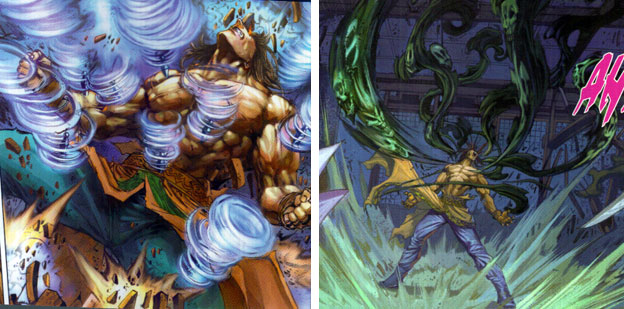
The martial arts myth did a good job at exploring the variables in the revenge plot. If a main character succumbed to darkness then they could become very powerful, but the cost of that is the humanity of the fighter. Getting revenge on an assassin by becoming a murder undid the purpose of the hero. It was the classic "two wrongs do not make a right" or "an eye for an eye" parable that was being explored in wuxia. The temptation to steer away from the honorable and righteous path was a constant in literary form. The hero was defined by being able to overcome strife and adversity without succumbing to temptation. In the SF mythos Ryu had to face the challenges of his own dark side. This storyline was explored in the SF Zero / Alpha series.
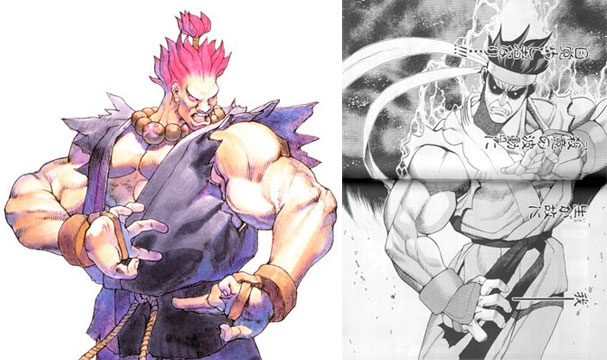
When a fighter became evil they traded in their humanity and compassion. The core of the martial arts was not learning how to fight, per-say, but how to defend from attacks. Even Shaolin Quan was created as a form of exercise to combat the fatigue of sitting for extended periods of time in meditation. It was also designed as a means for monks to fight off wild animals. The techniques and philosophies were designed to make a practitioner mentally stronger as well and make their spiritual cores healthier. In qigong this meant keeping the meridians clear and connected to the elements. By focusing on developing a higher consciousness the practitioners could see the importance of the fight, not to win or lose but to become examples of righteous living. By showing mercy to an opponent, even those who sought to fight for the wrong reasons, could often turn them into allies. This plot was explored in many wuxia legends and even contemporary Hong Kong films.
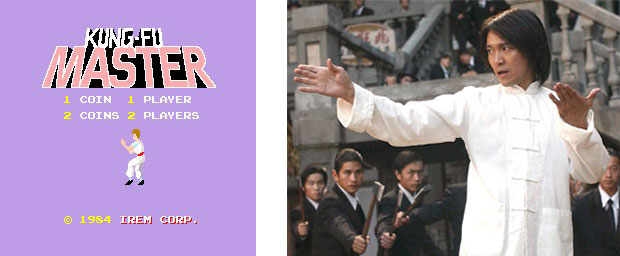
A hero defending his life from an assassin would not always seek to kill his opponent but to grant him mercy instead. The assassin, if he or she did not poison themselves, would give up crucial information to the hero. For the villains however this was the complete opposite. They were often cruel to opponents and demonstrated a lack of compassion. Mercy was for the weak and there was a great temptation to keep exploiting the most dangerous techniques that they knew. The most powerful of the evil techniques could often kill with a single strike. This legend was based on martial arts fact.

In the classic martial arts the lethal strikes were called the dim mak. These were death touches or death punches delivered to vital organs, or major meridians. The five point palm exploding heart technique from Kill Bill was an example of a dim mak, the metsu shoryuken was another. In manhua and manga the dim mak was often delivered in a spectacular fashion. Kenshiro from Hokuto no Ken for example punched villains in their pressure points and then walked away exclaiming that they were already dead. When a villain did this it had to be delivered more brutally. They wanted their opponent not only to die, but to suffer in death as well. In the Iron Marshal, the Bloody Duke performed a dim mak to the chest of a fighter named Elephant. This punch crushed Elephant's heart and went clean through his torso.
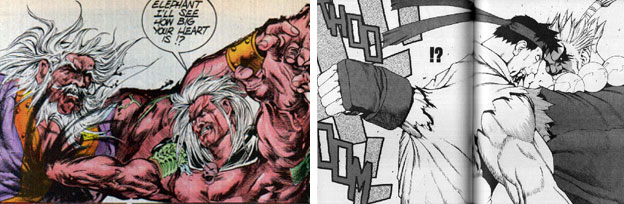
In the SF series the final punch of Gouki's Shun Goku Satsu aka "Instant Hell Murder" traveled through the opponent. He was not the only character to possess this technique in canon. Those that could perform moves like that were evil characters, such as Evil Ryu, Dark Hokuto and her brother Kairi from Street Fighter EX. What made the move awe-inspiring in the comic format was that the technique exploded in the shape of kanji, or traditional calligraphic characters. Street Fighter fanatics might be surprised to learn that this had been done years before SF in manhua tales like the Iron Marshal. The Bloody Duke did not only cause a heart to explode into a single character, he actually wrote out a challenge to the Emperor in blood, using punches and sword strikes on his opponents.
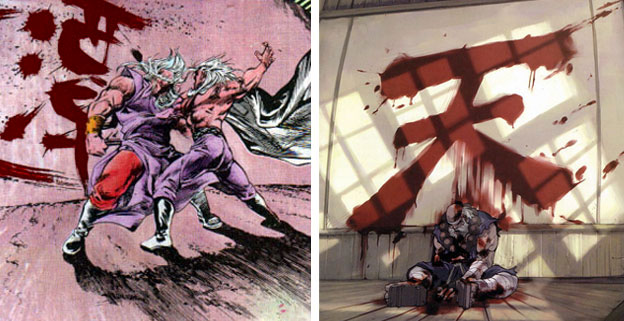
These techniques were exploited by the villains in wuxia epics to strike fear into the hearts of opponents. However what it did to the practitioner of the dark arts was even worse. This was the cautionary tale that went back thousands of years. It was shared by every culture around the world in poetry, spoken word, comic book, and film. As summed up by the character Harvey Dent aka Two Face in the 2008 film The Dark Knight; “You Either Die A Hero, Or You Live Long Enough To See Yourself Become The Villain.”  Were there any hero origins, major villains, or cautionary tales that you grew up with? I'd like to hear about it in the comments section please. As always if you would like to sponsor me please visit my Patreon page and consider donating each month, even as little as $1 would help make better blogs and even podcasts!

follow the Street Writer on Patreon!

Tuesday, February 25, 2020

The unlikely origins of some Mad Gear bosses...

I've been playing through a number of classic games recently, and have been focusing on the Final Fight trilogy. It got me thinking about the details that Capcom put into the title. It also made me wonder where some of the characters came from. I'm particularly fond of the villains in the series, and I want to share what I think were the inspiration behind some of the most unique. For example, did you ever notice that there was an evil technician that was a boss character in the series? If you are a designer then how do you get across that a character is an inventor of sorts? Is it because of wild facial hair? A lab coat? Maybe goggles, or perhaps a bald head? How do audiences know what a crazy scientist looks like? When you think of evil geniuses in video games who usually comes to mind? I usually think of Dr. Eggman from Sonic the Hedgehog, but even he had to come from somewhere. Eggman did come from somewhere. Brian Ashcraft noticed how some of the early Studio Ghibli characters looked like Eggman. Of course this was a topic of a Reddit thread, and VGDensetsu tweeted the observation as well.


The roots behind the evil scientist go back even further. Possibly to the story of Frankenstein almost 200 years ago. In pop culture however the template for the evil scientist probably came from the Mad Doctor. The villain appeared in a Mickey Mouse cartoon in 1933. He was sporting a bald head, and wild facial hair long before Studio Ghibli or Sonic Team were created. He came back in game form for Epic Mickey 2 in 2012. Have you ever wondered if there could be a good mad inventor archetype? Again taking influences from Japan there was such a character. Cid Pollendina, my favorite of all the Cid characters, debuted in Final Fantasy IV way back in 1991. The airship engineer was the former Captain of the Red Wings in the game. He was burly, with a wild beard, physically strong, and a genius with mechanics. I believe he was the inspiration for the Skull Cross boss mechanic Caine.


Caine was located in a junkyard. He could only be reached if players were careful not to break a bus stop sign in Round 3. The top-heavy boss was cut from the same cloth as Cid. Overly muscular with goggles, and wild mane of hair instead of a beard. He would pin players with his thick welding gloves and smash them over the head with an enormous wrench. Talk about a cheap shot! Thankfully like most Final Fight bosses he was more brute than brains. He lacked the fighting techniques of the heroes. As neat a design as Caine was he wasn't even remotely the oddest of the bosses. In previous blogs I talked about the heavy metal stars, and films that inspired the creation of Final Fight. Sodom was a German metal band that formed in the early '80s. Their name and use of a masked military character on the album covers inspired the creation of the Mad Gear boss.


Depending on your point of view Sodom was either a harcore Japanophile or a certifiable kook. Either way he took his obsession with Japanese culture to extreme lengths. This came through in his game appearances, cut scenes, and official art from Capcom. Sodom fashioned a helmet and samurai "armor" out of football pads, jeans and a jersey. In the original Final Fight he would fight opponents inside of a wrestling ring. He used two katana swords and called them Masamune and Muramasa, named after the legendary Japanese swordsmiths. In The Street Fighter Zero / Alpha series he switched to jitte, the steel batons that Edo-period Japanese officers used. What if I were to tell you that aside from the metal band there was possibly a real-world inspiration for this character? Peter Thornley aka Kendo Nagasaki was a British wrestler that was obsessed with Japanese culture, and tradition. He was one of the biggest wrestling draws in Britain in the late '60s and early '70s. He even wrestled through the '80s, around the formative years of the Capcom staff.


The Kendo "gimmick" was very earnest. Thornley did everything he could to keep his identity a secret. He wore a mask in ring, and didn't lose it in any matches. He never gave interviews, and his manager did all the talking for him. When a plumber found out his identity Thornley was forced to come forward, but on his own terms. He unmasked himself in the late '70s during an elaborate, pseudo-Japanese ceremony. To this day Thornley claims that he is a spiritual vessel, and the host of a 300-year-old Japanese spirit. I have no doubt that Thornley believes in his claims. Sodom is drawn from the same level of obsession as Kendo. Both sometimes miss the details of the culture they are emulating. In canon Sodom speaks with very rough Japanese pronunciation. To emulate Japanese he will sound words out phonetically, like "It's Toe Show! Show Sea Send Bang! and Die Job Death Car!" The last phrase is pronounced "daijōbu desu ka?" and means "Are you alright?" When he wins a match he will sometimes say "Yo Parry," which is supposed to be "yappari" or "I thought so!"


The kanji on his jersey is supposed to read "Shi" or death in Japanese, but he missed a brush stroke so the character doesn't mean anything. When Sodom tried reuniting his gang during the events of Street Fighter Zero he painted kanji on the sign that was phonetically MA-DU-GI-A aka Madgear, but the combination of letters doesn't actually mean anything in Japanese. Sodom, like Thornley, was obsessed with keeping his identity a secret. Possibly because he was ashamed that he was not actually Japanese. In the Street Fighter Zero manga his mask was broken, and he covered his face out of fear of being found out. He claimed that he could not fight without it. The scene explained a lot about the character without having to go into further detail. He was probably the best example of the creative process behind the Mad Gear bosses. The villains often had layers of detail that went into their development. These most memorable were revisted by the studio. Which were some of your favorites? If you would like to sponsor me please visit my Patreon page and consider donating each month, even as little as $1 would help make better blogs and even podcasts!
follow the Street Writer on Patreon!

Monday, February 3, 2020

The Street Writer Podcast, Episode 8

So I'm finally recording some of my older posts and turning them into podcasts. Here's the start of a new run where I talk about Brawling games, going back to the roots and how they evolved from year to year. I hope you enjoy!

As always if you enjoyed this podcast and would like to sponsor me please visit my Patreon page and consider donating each month, even as little as $1 would help make better entries!

 follow the Street Writer on Patreon!

Friday, July 12, 2019

The monster files, when giants roamed the Earth.

So I had some extra details that I had gathered on monster trucks that didn't quite fit in with my diesel series. Rather than let them go to waste here's one extra post on my favorite automotive freak show. Most of you may know that the tires are really what make the monster trucks unique. In the four wheel drive community bigger is better. At the start of the monster truck movement it got to the point where traditional truck tires were not enough. So the pioneers in the late '70s and early '80s looked elsewhere for resources. Farm, construction, forestry and even mining vehicles were scoured for their unique, and massive tires. The early builds used military wheels and axles to support the weight of these new tires. With the exception of the motor, the biggest cost of each monster truck are the tires. On average the "terra" tires are 66 inches tall, 43 inches wide, and cost $5000 or more each. This price does not include the rims. The tires weigh over 800 lbs. each. On average monster trucks are 10,000 pounds, so a good chunk of that comes just from the wheels and tires.


In normal farm applications these oversize tires are not modified. Their wide stance and deep treads are meant to help pull heavy equipment across soft terrain. They provide enough buoyancy to help move a vehicle over swamps, marshes and even rivers. More important, they can do all of this without damaging crops. The extra weight of a stock tire however affects the performance (and safety) of monster trucks. So the tires are shaved using a hot tool. Hundreds of pounds of rubber are cut from each tread. The process of shaping each tire can take over two days. Teams sometimes have different treads or patterns that they cut depending on the types of shows they perform in. If a truck performs on mainly concrete courses they would have almost no tread. If they performed on mixed courses with dirt, and asphalt then a light tread would suffice. They would cut very little off if they performed on sand.


There were no templates to work from in the early days of monster truck construction. Each vehicle was completely unique. Builders were figuring out how to create suspensions, what types of motors and transmissions to use, and even the different sizes of terra tires to go with. The profile, or stance of each truck was different. This was something that I absolutely loved about the early days of monster trucks. Each truck had its own personality. Today the sizes and frames are almost all uniform with just a different fiberglass body on top. Back in the '80s a long-bed or short-bed truck determined the wheelbase, or distance between the wheels. Longer trucks tended to race better and turn quickly. Shorter wheelbase trucks tended to bounce, and lose control quickly because their center of gravity was very high. Yet for many of these builders the look of the truck was more important than how it performed.


Everyone knew that the big trucks could crush cars, but how many could look good while doing it? Some trucks were considered more for show rather than for sport. One of these was Showtime. It had a bright yellow paint job and a lot of chrome detailing. It did compete in many events but it also looked amazing. It boasted a powerful sound system, and it showed up perfectly polished in many car shows. The 1978 Ford Bronco had a shorter wheelbase than others, and when it that was combined with 73 inch tires, then it really stood out. There were a fewer number of trucks that used 73 inch Firestone Flotation 23's rather than the 66 inch Goodyear Terra's that most ran with. These trucks included Casper by Dale Harris, High X-pectations by Scott Palmer, Lon-Ranger by Gary Bauer, and the Giant by Kirk Dabney. When those trucks lined up against others the difference was noticeable. The extra size of tires also meant they raced slower and broke parts with more frequency. It was a small price to pay to stand out from the crowd. But like I said, in the early days bigger was better, and some builders started going to extremes.


The Dabney brothers, Kirk and Kevin, experimented with different monster building techniques. Instead of a truck for example Blue Thunder was a 1968 Camaro SS. It was piloted with a joystick from a Huey helicopter. That bar not only controlled the front wheel steering, but also the lights, nitrous, hydraulics, and rear wheel steering. Then they built two Nissan King Cab trucks. Mega Force and Alien. They started with 66 inch Goodyear Terras as well, but then made the switch to 80 inch Heavy Duty Deep Tread Firestones. When paired against other monsters these compact trucks looked gigantic. In fact the Nissan's were advertised as the "world's largest mini trucks." The only other import trucks that compared were The Toy. A 1985 Toyota Hilux compact by Joe Rinke that also sported the 80 inch Firestone's. It actually had a giant metal wind up key in the truck bed that rotated, making it look like an enormous toy. I have very vivid memories of seeing this truck as a child. Then there was So High Too by Dave Bell. The 1985 Toyota Hilux long bed had 73 inch Firestones, however the body rested on an elevated frame that made it stand over 13 feet in height.


Shots kept getting fired at Bob Chandler and his Bigfoot team as monster trucks got bolder. Every new build was a chance to do something original, and try to dethrone the king of the monster trucks. I had mentioned in the previous series that Jeff Dane's Awesome Kong II had a 3000 hp V-12 Allison aircraft engine. It was sourced from a helicopter. In the golden age of monster creators Scott Stephens built the Coors Brewser, and Coors Silver Bullet with jet turbine engines. They were capable of shooting flames almost 20 feet in the air. These jet monsters were capable of generating over 1,800 hp.

Then there was the diesel powered beast Godzilla. It took years to build, and when it was unveiled the monster truck community took notice. With its "standard" 73 inch tires, and custom features, it was much bigger and heavier than Bigfoot. The builders Al Thurber Jr., and Al Thurber III wanted to make their beast incomparable so they got even bigger tires. With 96 inch Firestones (and gold plated rims) Godzilla stood 16 feet in height, taller than So High Too. It weighed 28,000 lbs. Many thought that Bigfoot couldn't compare. History would prove them wrong.


Bob Chandler got tired of comparisons and wanted to settle the issue once and for all. Bigfoot was the King of the Monster Trucks. To prove it he built different versions of Bigfoot that could support 10 foot tires. That's not a typo. He has several sets of 120 inch Firestone tires. Their origins of those tires are fantastic. The LeTourneau Land Train started off as a military project in the 1950's. The company wanted to create an off road vehicle that could cross any terrain, especially extreme locations like the arctic or desert environments. This was to support research stations that could not be accessed by helicopter or ship. Roads were not readily available where this beast was headed. The company created hybrid diesel, electric motors that went into each wheel and helped pull the train over everything. Several versions of the land train were built, each better than the last. Each of those sported the enormous 10 foot tires. Sadly the military stopped testing the train, and parts of it ended up scattered all over the Pacific Northwest and Canada.


In the mid '80s Bob Chandler was on tour with Bigfoot when he saw some of the enormous tires at a salvage yard in Seattle. The owner was asking tens of thousands for them, so Chandler let it go. He returned later and offered to buy multiple sets at a lower price. After lots of back and forth they finally agreed on a price. Chandler then started work on Bigfoot V. Not satisfied with being able to run with a single set of 10 foot tires he created rims that could connect two sets, or "duallys." Its total weight jumped from 28,800 lbs to over 38,000 lbs. Each tire weighs a ton, with the aluminum wheel they jump to 2,400 lbs. In dually configuration that is over 19,000 lbs. In the end Bigfoot V stood 15' 6" tall, 13' 1" wide, 20' 5" wide with duals. In 1986 Chandler set the Guinness Book of World Records for the biggest, tallest and heaviest pickup truck. By this point Chandler was on top of the world. It was apparent that Godzilla and the rest could try to take the title, but his best could never be beaten. With the Bigfoot name out there it was only a matter of time before Hollywood came calling again. Silver Pictures needed an expert to build a monster truck for a very expensive stunt. Chandler's shop rose to the occasion and they created Bigfoot VII so it could be used in the 1989 movie Roadhouse.


Bigfoot VII originally had the traditional 66 inch tires. In the movie they used the truck to drive through an auto dealership, crushing every car inside. Estimates say the shot cost about a half million dollars to put together. I'm sure most of that went into building Bigfoot VII. After the movie Chandler returned it to his shop configured the truck so that it could also use the 10 foot tires. Chandler was approached by the Race Rock Cafe, to sell them Bigfoot VII for their collection. The cafe was a themed restaurant in Orlando Florida that had racing memorabilia from all over the world. The engine and transmission were removed and the truck sat outside as a show piece. The restaurant closed down in 2007 and all the memorabilia was sold off. Bigfoot VII ended up at Fun Spot USA in Kissimmee. The amusement park painted the truck slightly different and changed the name to BigFun. This version of Bigfoot was so iconic that an homage to it appeared in the Splat Pack, a video game expansion to Carmageddon. The Mac and PC title from 1997 had a cult-like following (I was a huge fan). The truck went by the name of the Monster Masher. It sported "Firestarter" tires and was driven by Herman Monster.


With the Bigfoot legacy secure this piece of history could be laid to rest. But if you know me then you know that I like to dig a little deeper. What if I were to tell you that there was a monster truck even bigger than Bigfoot VII? It turns out that in the super heavyweight category Godzilla had the third biggest tires, and Bigfoot VII was the runner up. There was a colossal monster truck from Canada that owned the title. This enormous beast went by the name of Superfoot. It was the undisputed champ of gigantic monster trucks. It used 150 inch tires, that's 12 feet, 6 inches of rock hard rubber. The tires came from an earth mover, one of those enormous yellow dump trucks that Tonka modeled their toys on. The tires were designed for enormous mining equipment and definitely not for regular trucks. It didn't stop the madman Richard Arel from trying the impossible. Richard was known for tinkering with engines, transmissions, and making his own vehicles for use on his pig farm.


The original name of the 1978 GMC 3500 truck was Suberfoot, because it was part Suburban. Arel had actually put two GMC trucks together to make his ultimate farm truck. This was way back in 1982, making him a pioneer of the culture. He put his (then) black and red truck on 66 inch terra tires, and it became the first Canadian monster truck. He did stadium shows all over the country. He was joined by the Super Toy, a Ford monster truck and fellow early Canadian monster. Suberfoot was eventually painted hot pink with bright blue lettering on the side. The name was then changed to Superfoot. When the monster truck shows slowed down Arel decided to use his truck as a centerpiece at Le Madrid, a hotel-restaurant that he owned. The restaurant was a popular rest stop, it was situated on the long road between Montreal and Quebec City. It featured a number of roadside attractions, including a collection of giant cement and fiberglass dinosaurs. Superfoot would fit right in with them.


To make it really stand out however Arel built an extended frame and mounted the 12+ foot tires on the truck. The engine and transmission were removed and it remained outdoors for years, just like Bigfoot VII. The downside was that he let the truck fall into disrepair. He would tell patrons that he was going to restore it someday but that day never came to pass. The truck ended up rusted and covered in graffiti near the end of its life. Arel sold off the property in 2011 and the truck vanished. Many assumed to the scrap yard, but I like to imagine that it got bored and instead ran away. It now roams the countryside looking for abandoned cars to flatten. Like a cryptid it pops up every now and then to startle young motorists. So if you're ever driving alone in the middle of nowhere and see a bright pink giant off in the distance, just keep moving, or you might become the next victim of the mysterious Superfoot. I hope you enjoyed this look at monster truck history. Did you have a favorite monster truck while you were growing up? I'd like to hear about it. If you would like to sponsor me please visit my Patreon page and consider donating each month, even as little as $1 would help make better blogs and even podcasts!
follow the Street Writer on Patreon!

Sunday, June 12, 2016

Revenge of the wooden men! (Originally posted on my Capcom-Unity blog)

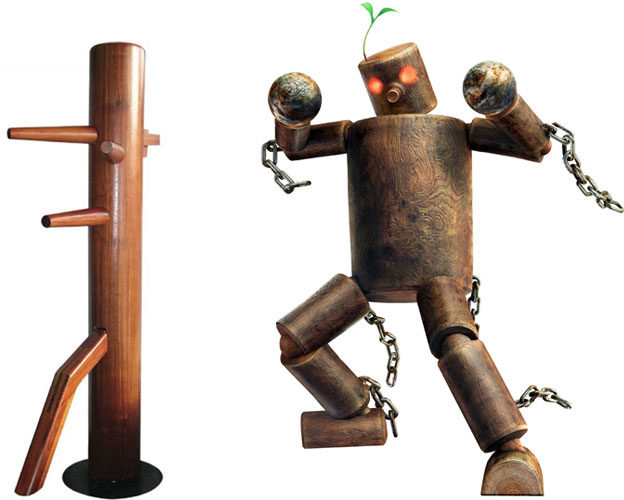
You ever wonder where there weird fighting game characters come from? I don't mean the occasional pro wrestler or pop idol either, I mean the really weird, way out of left-field characters. Somebody like Mokujin from the Tekken series for example. The character first appeared in Tekken 3 back in 1997. Many thought that it was a wooden man post, a training tool used by kung-fu practitioners, that had sprung to life. It couldn't really talk and seemed to be a sort of comedic character that mimicked the moves of the entire Tekken cast.
 

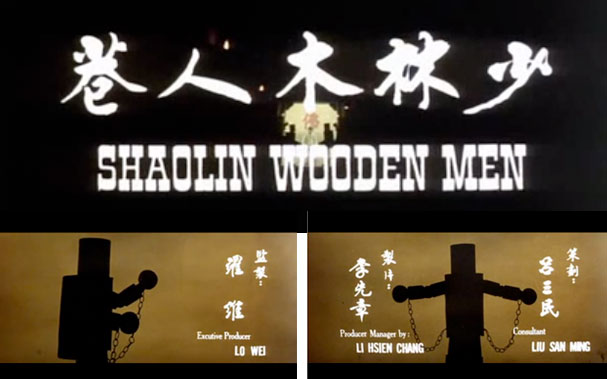
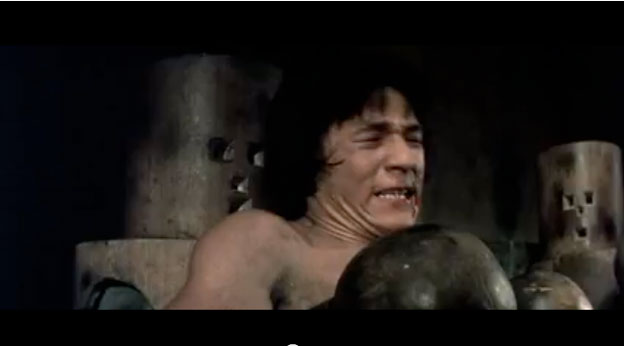
The figure was actually based on the training dummies from the Shaolin Wooden Men. A movie from 1976 starring Jackie Chan. The wooden men were fictional sparring partners controlled by a series levers and pulleys in the Shaolin temple. In order for a person to be deemed a master they had to survive a gauntlet made up of these wooden men. When I was a little kid my brothers and I saw the film on kung-fu theater. It was a local show that would marathon different kung-fu movies. There was no doubt that my exposure to those movies was part of why I became attracted to fighting games in the first place. Anyhow I remembered that film for the special effects and rows of various wooden men.
 

Something that I always appreciated about the films was that no matter how cheesy they were it was easy to get carried away by the story. The special effects were all practical. They built sets for the films, used costumes and props to make things seem period-correct. When you're a kid you just accept the fact that somewhere in China there's a temple with wooden men like Mokujin training the kung-fu masters. You also accept that the best fighters could do all the impossible things you would see on tv.
 

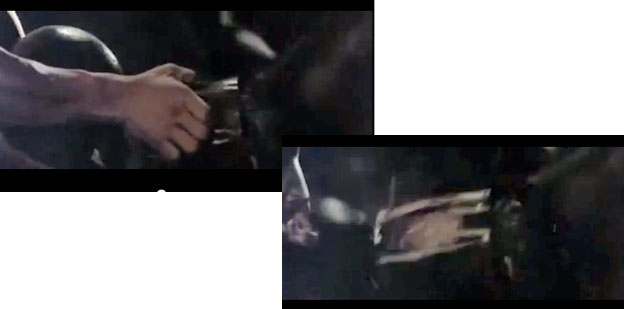
There was something about the film that freaked me out though. In one scene Jackie grabbed the forearm of a wooden man and broke it open. There was nothing inside. I was sure that there would have been a Shaolin master in each costume doing the fighting. As I little kid I actually believed that the movie producers had actually rigged a few wooden men and were controlling them with chains and levers. Even better I believed that this technology was something that the Chinese had been sitting on for centuries. Sure it's an absurd thought but anything is possible if you are a kid. When I saw Mokujin many years later I wondered how many of the same films the Tekken developers had grown up with.
 

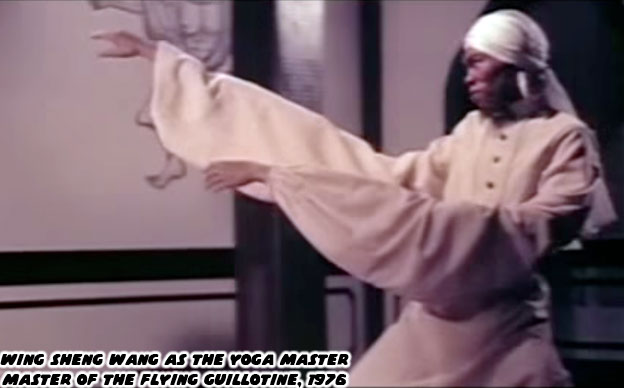
Of every martial arts fable I believed in growing up the only thing that was scarier than a wooden man run amok was a blind master of the Flying Guillotine. Again, that movie was probably the reason why I ended up loving Street Fighter and Mortal Kombat. It was what prepared me for the ultimate battle between the various fighting arts. Anyhow in that movie a blind assassin was pretending to be a Shaolin monk while he was tracking down the one-armed boxer. He had amazing hearing for a blind man and could throw his flying guillotine with pinpoint accuracy. Near the end of the film he is trapped in a coffin shop. The hero throws rocks at the walls to confuse the assassin. The blind monk stands perfectly still and rotates his head 360 degrees while trying to figure out where his opponent is. Of every kung-fu film I had ever seen that was the scene that freaked me out the most. Producer / director / star Jimmy Wang Yu used the effect sparingly and right at the end of the movie for the biggest shock value. Even today I get creeped out by the thought of a free spinning head.
 

Were there any fantastic characters or impossible fighting techniques that you had seen as a kid that you genuinely thought were true? I'd like to hear about it. As always if you enjoyed this blog and would like to sponsor me please visit my Patreon page and consider donating each month, even as little as $1 would help make better blogs and even podcasts!

follow the Street Writer on Patreon!

Monday, July 6, 2015

How fight culture became fighting game history, part 3

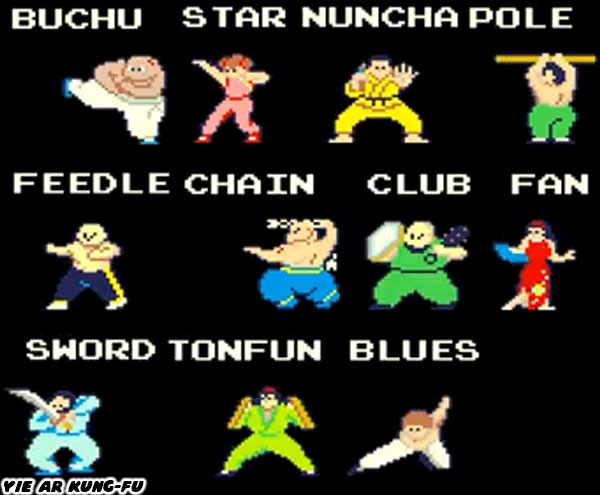
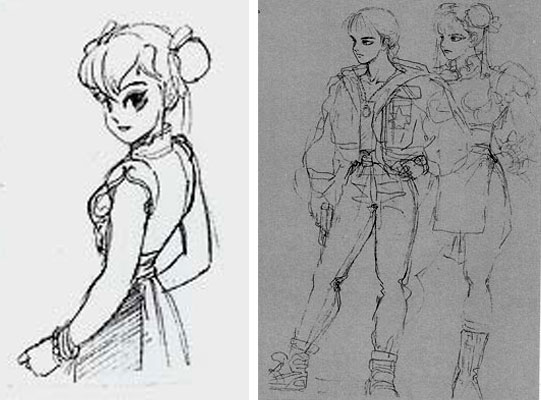
Chun-Li started out like most Street Fighter characters as a basic concept. The game already had karate archetypes through Ken and Ryu. The developers at Capcom wanted to spread out the styles including pro wrestling, boxing and sumo wrestling through different characters and nationalities. It was a given that the Chinese character would represent kung-fu, especially since it was the cradle of the Asian martial arts. In order to make the character stand out it was decided that she would be a woman. There were no female characters in the 1987 release of the original Street Fighter. To be fair Konami had featured two Chinese female martial artists named Star and Fan in their 1985 arcade game Yie Ar Kung-Fu. Chun-Li differed in that she was the first playable female fighting game character and the only female in the lineup for the 1991 release of Street Fighter II. At first the design for the "China Daughter" was very simplistic. She was a young girl dressed in a traditional uniform.

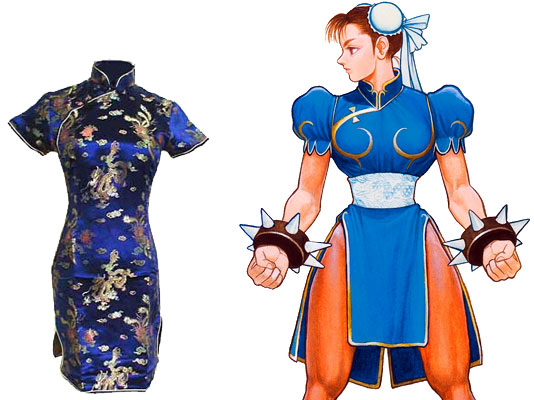
The designers wanted to make her more interesting not to mention strong enough to be believable against a cast of seasoned brawlers. They decided to make her an adult police officer. The older Chun-Li and urban uniform were better but the artists wanted to make sure that her appearance worked when placed against fighters wearing more traditional clothing. She was revised yet again and placed in an outfit that reflected her heritage. As such her costume took a lot of liberties with cuts from traditional Chinese clothing. This costume was designed not to inhibit her during a fight, yet also not to be too revealing. The costume tricked gamers into thinking that it was somewhat authentic. A closer look at the uniform would reveal how these things worked together to help build a memorable design.

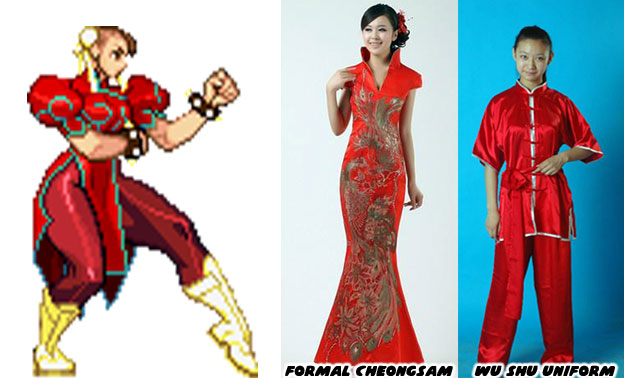
A kepi or cheongsam was a traditional tailored Chinese dress. Depending on the length, material and embroidery featured on the cheongsam it could be used as work wear, casual wear or even formal wear. It was never designed for fighting. A traditional Chinese martial arts uniform was far more loose-fitting, allowing for flexibility and freedom of movement in the arms and legs. Unfortunately the female figure would be difficult to make out in a videogame if she wore loose clothing. The designers struck a balance between the modern and the classic for the cut of Chun-Li's dress. It was so subtle that not many noticed that the individual elements were completely made up.

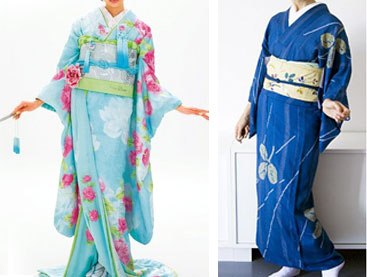
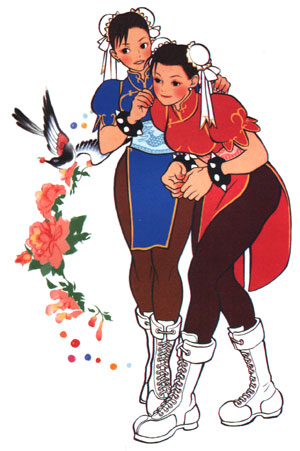
The hair buns and gold filigree on the costume were non-traditional but there to make her appear more feminine. The oversized spiked weights and wrestling boots signaled that she was a fighter. Chun-Li's costume appeared tailored to flatter her figure, like a traditional cheongsam it followed the curves of her body. However it also featured puffy sleeves which allowed her shoulders to have a wide range of movement. To give her legs the freedom to kick there were slits on the front sides of the dress that rested on top of her hips. To help make the leg show more modest the character was given dark tights. Her slender waist was framed with a decorated belt. The cheongsam was rarely if ever worn with a belt and wu shu uniforms used a bright sash in the place of a belt but never anything fancy. The ultra-wide belt was possibly inspired by the decorative belts worn with Japanese kimonos.

The character was given moves that were every bit as impressive as the fireball or dragon punch. Her "Spinning Bird Kick" and "Lightning Kick" became trademark attacks. Arcade visitors quickly learned that she was a top-tier fighter and not some sort of token female character. The look of the fighter was set but she needed to be infused with personality. Chun-Li could have been a dainty, "girly" fighter but instead she was presented powerful and confident, only occasionally letting a giggle slip out when she was proud of herself. She would remind players that "I am the strongest woman in the world" in between rounds. Previously in fighting games the female was the prize that the hero had to rescue. Such was the case for Sylvia in the 1984 hit Kung-Fu Master and Marian in the 1987 hit Double Dragon. Chun-Li was the polar opposite of those women. In fact she could have easily replaced the heroes in those games. Her strong personality and proud heritage were undoubtedly inspired by the actresses in Hong Kong cinema.

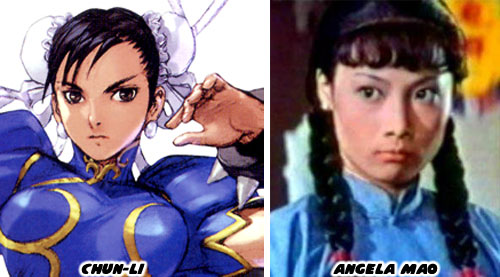
Females had always been an important part in the martial arts movies from China. Many women that appeared in the films took an active role in the stories. There had been female martial artists in Chinese cinema since the early part of the 20th century however the one that got the ball rolling for leading ladies was Angela Mao in the 1972 film "Lady Whirlwind." The actor was a dynamo that studied traditional Chinese wushu as well as the Korean art of Hapkido. In the film Angela's character, Miss Tien, was a fiercely independent woman looking to seek revenge on the death of her sister. She fought practitioners of different styles including Japanese karate and judo masters. It was possibly the first action film featuring a female lead against non-Chinese styles. People in the US would see Angela for a brief moment in the Bruce Lee film Enter the Dragon, she played the part of Lee's sister. Characters like Miss Tien undoubtedly influenced the development and presentation of Chun-Li.

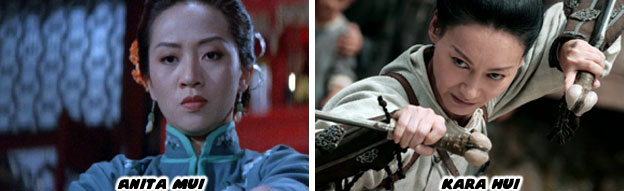
Fiercely determined, capable and independent women were a rarity in gaming but never in martial arts cinema. Many actresses had become icons in the movies, appearing in as many films as most of the biggest male stars. These stars appeared a decade or two before the original Street Fighter was released and helped influence the world of the young developers at Capcom. Some actresses played villains as well as they did heroes, like Kara Hui, the 13th Madam in the film Wu Xia. She was a ruthless killer that gave Tang Lung, as played by veteran actor Donnie Yen, a run for his money. Others were not only capable fighters but also had tremendous comedic timing. Anita Mui (RIP) was a great fighter but also was experienced at physical comedy and actually upstaged Jackie Chan in the film Drunken Master 2.

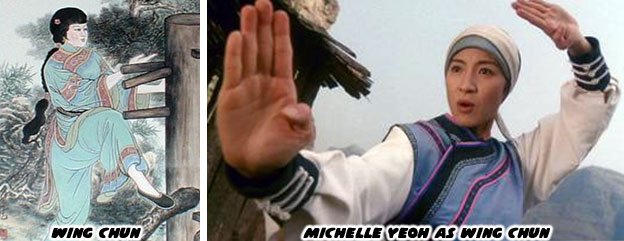
The myth of the female martial arts master were inspired by an actual historical fighter. In the mid 18th century Yim Wing-Chun had to master various fighting styles to protect herself from the unwanted advances of suitors. Her biggest influence was Ng Mui. Ms. Mui was a Buddhist nun that lived in secrecy. She survived the Qing government burning of the Southern Shaolin temples and lived life on the run. She befriended Yim and trusted her with a new technique. Ng Mui was inspired to create a fighting style after watching a snake and crane battle. She saw ways of striking, trapping and intercepting attacks from a close range. If it worked in nature then it should help in practical fights as well. This boxing style was dubbed Wing Chun after her best student. It was perfectly suited for self defense, not only for women but for people of any age or athletic ability. The legend of Wing Chun was well underway by the time Huo YuanJia was born. The template of Chun-Li predated that of Gen.

Eventually the Wing Chun style found its way to Ip Man, sometimes spelled Yip Man. Yip was born at the end of the 19th century and fought against the Japanese occupiers during World War II, albeit only to keep his family and friends alive. He was a figure whose martial exploits inspired the Chinese nationals similarly to how Huo had done previously. Yip Man became a Chinese folk hero and survived an assassination attempt by the Japanese. He continued teaching Wing Chun and passed down many lessons to a young fighter named Bruce Lee. Bruce of course became more famous for his kicks than punches, but he was considered equally dangerous at any range. As for the origin of the name Chun-Li, let's just say that that the fighting spirit of Yim Wing Chun and the kicking speed of Bruce Lee had something to do with it.

Yet Chun-Li was a classic character cast in the modern world. Her costume was only disguise for her police background. The spiked weights and wrestling boots grounded her in the present. What was interesting was how Hong Kong cinema had developed similar characters. The Jackie Chan film Supercop began filming at about the same time as SF II was released. It also featured a strong female protagonist that was an undercover Chinese police officer. Actress Michelle Yeoh played inspector Jessica Yang, in the film she was trying to help Jackie infiltrate a drug ring. She dressed in simple country clothing and sported pigtails. Like a modern Angela Mao her disguise beguiled her training. Michelle took part in some amazing fighting and stunt sequences to rival Jackie's. She even appeared as Wing Chun in a film a few years later. When Chun-Li first appeared she was an instant sensation. She was feminine but powerful. She might have been conceived originally to fill in a slot on the roster however there was nothing token about her inclusion in SF II. She appealed to players of all types. Part of the reason she worked with audiences was because she reminded them of the heroines from kung-fu cinema.

The name Wing Chun could be translated as "Forever Spring" and she would always be remembered as a spirited young fighter by her fans. Similarly Chun-Li was presented as a vibrant young lady in all of her official art. By comparison all of her male counterparts were older and looked more rugged. Chun-Li represented power and beauty, her moves and athleticism redefined femininity in videogaming. Just about every piece of art based on the character made sure to get the cut of her costume and the shape of her muscular legs right. Female players could finally fight for themselves and no longer wait to be rescued in a game. In her game endings she achieved justice for her murdered father while remaining independent. Despite fan fiction and some questionable licensed comic books she was never presented in game as falling hopelessly in love with her co-stars, especially not Ryu. She was the definition of what was admirable for fighting protagonists in gaming. Her costume was cute but modest, her personality was strong but friendly. Capcom demonstrated that a fighting female could be powerful and beautiful, as well as sexy without being slutty.


The martial artists spread by Bodhidharma had survived persecution and strife for well over a thousand years within China. The arts continued on with the help of brave Buddhist monks and nuns. The mysterious fighting arts continued to shape the world even past the industrial revolution and well into the atomic age. In pop culture the Shaolin monks became legend. Some of the oldest schools of fighting were still around and continued to crank out disciples that could perform impossible feats of strength and endurance. In the next blog we will go further back in time and see how ancient Chinese spiritual beliefs intermingled with the martial arts traditions of Bodhidharma. As always if you enjoyed this blog and would like to sponsor me please visit my Patreon page and consider donating each month, even as little as $1 would help make better blogs and even podcasts!