


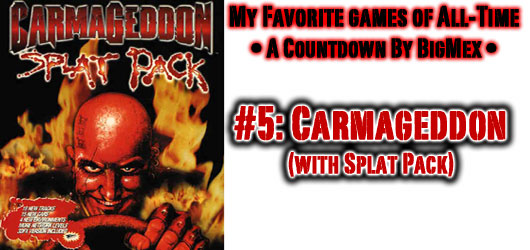
Carmageddon is the most vile and repulsive game on my list. It makes State of Emergency look like a walk in the park. My brothers were shocked to see how high it ranked on my list, more so when they found out that I ranked it above Burning Rangers. Carmageddon fills my criteria of a great game so perfectly that it is amazing I didn't rank it higher. If I were ranking games based on total time spent playing then Carmageddon is a top-three game.
I had to rank the games based on their importance to me. If I could only play one game for the rest of my days which one meant the most to me? Which game is my absolute favorite and which ones come close? Carmageddon is the closest game that any non-Japanese designers have ever designed. It is in the top-5, it is in a place of great distinction.
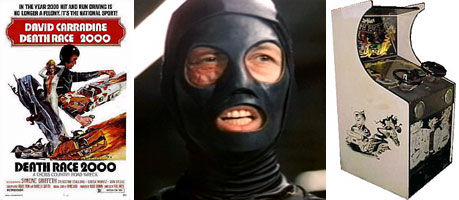
Carmageddon was inspired by the classic cult movie Death Race 2000, featuring David Carradine and Sylvester Stallone. If you can get the game to crash the error screen says "Terminate Death Race." There was also an arcade game called Death Race way back in the late 70's. The arcade game had nothing to do with the movie, it was a hot rod race around a cemetery where you ran over pedestrians and tombstones popped up. These peds were also called "gremlins" in some literature. The original arcade game was so repulsive that it was banned from most establishments. About 30 years later the legacy continued when Carmageddon was released and Australia banned the import and sale of the game.
Carmageddon (Carma for short) is repulsive and vile. It came out at the height of a congressional inquiry into violent videogames. Grand Theft Auto and Mortal Kombat were the other big games being dissected at this point. Carmageddon showed up and the debate exploded. The content and purpose of the game could not be argued. You were the participant in a death race, you acquired time and points by running over pedestrians.
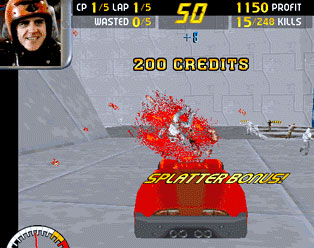
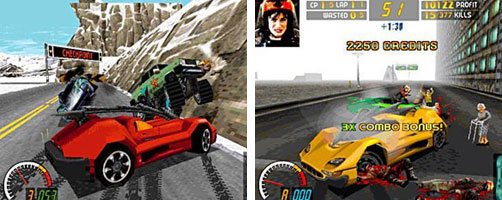
After all, look at the play screen. All of the important information appears on screen. There is car position and lap position, in case you really were paying attention to the race. Number of opponents wasted, time, profits and pedestrian kills. You could finish the stage by either winning the race, destroying all of your opponents or killing all of the pedestrians.
The gore was through the roof in this game. Points were rewarded for how many people you could take out in a combo. If you clipped a ped and sent them spinning you might have gotten an artistic bonus, if you plowed through them you might have gotten a splatter bonus. Blood was everywhere and the image of the driver (Max Damage) in the upper left corner sums it up. He seems to derive pleasure from the violence. Congress was in a fit, they had all the evidence they needed to condemn videogames. Only real sickos could find any pleasure in this game.
Seeing as how 1UP is filled with murderous sickos then I feel right at home. After all, those that have been playing videogames for any amount of time are surely riding an immoral path. If you've played Silent Hill and are longing for a giant butcher knife with which to skin people alive then please raise your hand. If you've ever played Mario Bros and have taken magic mushrooms that allow you to throw fireballs then please... raise your hand.
Congress, and many people that "don't get it" see only the surface level of a videogame. They don't understand that the good majority of gamers know the difference between right and wrong. We know the difference between what we see on the screen and our actions in real life. This isn't a case of monkey see, monkey do. This isn't a case of de-sensitation to violence. Violence has been around for as long as human kind has, we don't have the luxury of blaming videogames for the wars we have engaged in. Some of us choose peace, and would rather play games with action or violence than engage in the real deal.
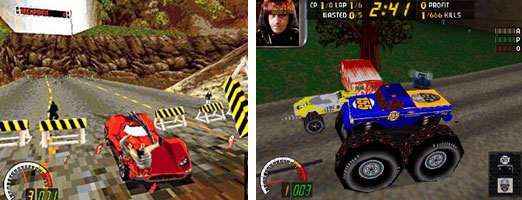
The first two Carma games were made by the people at Stainless Games over in England. SCi published the titles. The people that worked on this game seemed to be out of their mind while they were developing the title. With the debate raging in congress they had the audacity to not only create but market this game as the goriest title ever
While in development Stainless went to extremes to capture the sights and sounds for the game. Polyphony is famous for recording the engine sounds of more than 400 cars for Gran Turismo. On the other side of the planet Stainless participated in demolition derbies to get the authentic sounds of cars crashing. Then they recorded the cars getting hit by bats, bricks and cinder blocks. In order to get an authentic sound of hitting pedestrians they got a good friend, Tony Taylor, the actor that plays Max Damage, to put on a helmet and let himself get hit a couple of times by a slow moving car. Then they took a bat to his helmet and recorded those sounds as well. Some people suffer for their art, none more than those at Stainless.
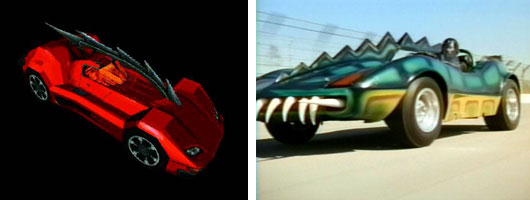
The plot of the game was set, you started off as either Max in his Eagle, which was a take on a car in the Death Race. Or as the female counterpart, Die Anna, in her faster car, the Hawk. Carmageddon was a sanctioned race taking place all over the world. Anything was legal in this race, including taking shortcuts, running over opponents and pedestrians. There were temporary power-ups scattered over the map and many secrets to discover on the massive maps.
The opponents and cars in the game were all unique. Depending on your rank you could sometimes win their car if you destroyed it in the middle of a race. Each car had different strengths and weaknesses. Some were dainty and some were unstoppable. These cars were designed for the various styles of drivers. All of the cars could be upgraded, money won from the races could be used to purchase extra armor or horsepower.
Carmageddon was the definition of the impossible racer. The physics were good. The cars all handled realistically, more or less. It was what the cars that were capable of that made the game so much fun. The cars were almost indestructible. In any other game a car that hits a wall at 300 mph would explode. In this game it would just wreck the body a little. The cars behaved like Hot Wheel toys on some of the most fantastic tracks ever designed. These tracks had tunnels, massive jumps and drop offs. The cars could even operate under water, in acid, toxic goo, snow and lava. Some tracks were on raceways and others were on rooftops of massive skyscrapers.
Blind intersections where two cars could collide at high speed and send one of them flying a few hundred feet straight up were the rule, not the exception. This helped create a breakneck (no pun intended) pace for gameplay. Drivers and opponents were always willing to go full-tilt at each other or even at the police that patrolled the race because the cars would mostly survive the wreck.
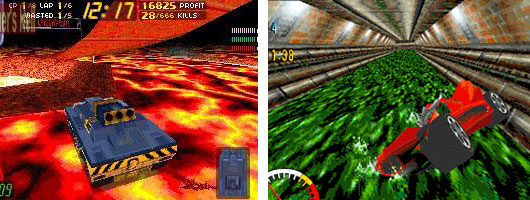
Carmageddon is a great stress reliever. The more people you can get to join in a lan game the better it is. Within a few minutes any person that I've introduced the game to had the car up and running and was shouting "holy shit" at every crazed jump and high speed wipeout.
People often say that Carmageddon would be perfect if only it had weapons like Twisted Metal. I say that they are missing the point. The cars are the weapons. In Twisted Metal the cars don't behave like cars at all, they behave like FPS characters. The mass and momentum of real cars is lost in that game because the designers don't want it to weigh down the gameplay. Carmageddon is a pure game, the car is everything and it is the only thing. There is no more rewarding experience than catching up to a race in progress and wiping out the lineup with a runaway plow. Or dropping down on an unsuspecting opponent that is hobbling on his last three wheels.
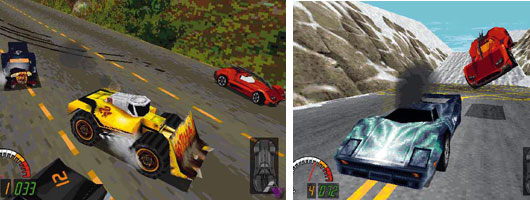
Here's the part where you ask "well if this game is so great how come I've never heard of it?" Hell if I know. Stainless made this game back in the day when you could fit a Windows and Mac version of the title on one CD. Most reviewers that played the first fell in love with it. The game was mad hijinks and word of mouth helped it spread quickly.
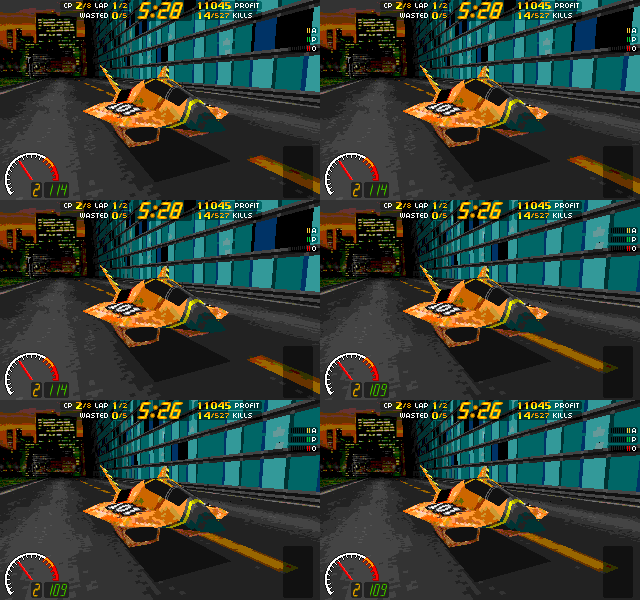
A large community of gamers became dedicated to the game. Stainless released tool kits to let gamers make their own skins for the cars. The code for some cars that weren't finished with the release of the game were left on the CD. Budding programmers and modelers were allowed to finish the work of Stainless and were fully supported for example with patches that allowed gamers to play in ED-101's flying concept car.
The congressional hearings only helped make Carmageddon a more desirable game by all audiences. As the saying goes "even bad publicity is better than no publicity at all." Despite the negative attacks, magazine editors and gamers both agreed that this game was pretty damn good.
Stainless helped keep the momentum of the game going by releasing the "Splat Pack" shortly after the original was released. The new tracks and cars helped round out the overall experience. The Splat Patch helps cement this game in the top-5.
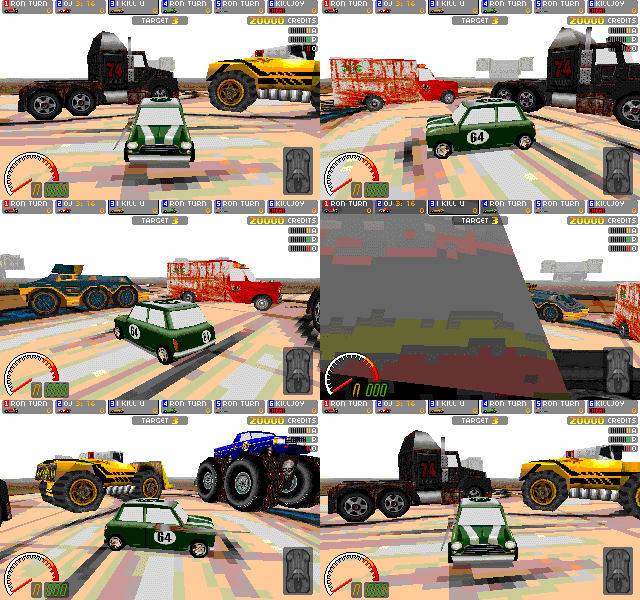
If this game was so great what happened? The sequel "Carpocalypse Now" was a fun game. The cars were far more detailed and could be pulled apart, pedestrians were no longer sprites but three dimensional models with their own weight and mass. Power ups were more weapon like now. The levels were just as massive and as interactive as they've ever been.
However the experience was less enjoyable the more realistic the game became. Cars could be destroyed far more easily. Some blind hits or explosive barrels could take you apart quickly. This turned a former full out crash and smash title into a delicate shadow of its former self. Realism is not meant for every game and definitely not this one.
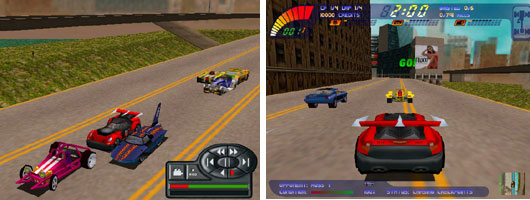
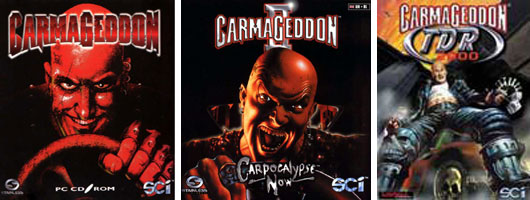
Carmageddon 2 was good but not great. The third in the series was absolutely horrid. SCi had just acquired the rights to the Death Race 2000. The official name for the next title would be Carmageddon 3 TDR 2000, SCi figured that they could save some money by giving the game to a new developer and took Stainless off of the job. The game that came out was absolutely horrid.
Everything that was good in Carma 2 was gone. Any remnants from the original game were in name alone. TDR 2000 was panned by gamers and critics and a legacy that could have been was buried some years ago.
I still find the time to play the original game, although OSX on the Mac is making it harder to launch these days. The game holds up very well, even more against a human opponent. My brother was always a fan of Grand Theft Auto and Twisted Metal. There was one game that was more pure and enjoyable than either of these. I hope you get a chance to play it before your computer can no longer run it.
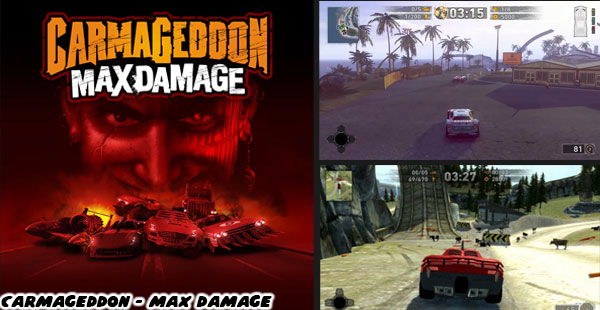
When I got Carmageddon Max Damage my expectations were kind of low. They were pretty much nonexistent. I was thinking that it was going to look, and play as poorly as the reviewers had said. I thought to try it for a little bit, and if it was truly bad then I’d let the franchise go. I played through the PS4 version first, for about two months, then I got the Xbox One version. Of those two the Xbox One was superior, it ran at a faster frame rate, and it had better graphics all around. Of course I understand that the PC version runs much faster, and has the best graphics. But I took it for what it was; this was an attempt for Stainless Games to release a more complete Carmageddon Reincarnation for the home market. In case you enjoyed the original PC games, and have been thinking about picking it up let’s get you caught up. Most of the drivers, and their cars from the original game have returned. Absent are Burly Shirley, Agent Orange, Wanda Lust, OK Stimpson, and the Mech Maniac. Nora Virus represents the Auto Scum gang, she is driving the Razorbill.
From the Splat Pack we had Rusk in the Degoryun, Mother Trucker and her Rig O’Mortis. Sadly none of the vehicles from Carmageddon II returned. Then there are the new faces; Roman and the futuristic Crazor truck, Twig N. Berries driving the Trope-Kill minivan, Nutkenz and the exotic Snaky Bastard, Ed Lesgar with the sporty KVN Toucan, and the Terrible Twins driving the jet-engine Siamese Dream. Of course you start the game with either Max Damage, or Die Anna in the Eagle, or Hawk. This time around you can freely switch between drivers. Destroying opponents still allows you to unlock their cars. Except for the police APC, which has to be earned by completing all the objectives for each main race. The PS4 version does not feature the angular Tez Eagle (much to my disappointment), or the Iron Hawk, which is sort of the Tez version for Die Anna. Both are in the Xbox One version. Besides that you can see that the latest versions of the main cars have a familiar look to them. They’re not numbered but instead have the “R” badge, I guess it stands for Racing edition, or is it Reincarnated?
You can also tell that the studio continues the tradition to make each car look distinct. The Eagle being a heavier fighter, with the engine upfront, and the Hawk being more of a mid-engine speed machine. All of the cars were completely redone, but have the familiar paint job, look, and feel of the classics. The details on each ride is obscene. I’ve mentioned the working transmission, and suspension in the previous blogs. But the engines, and interiors are also just as detailed. I'm talking about spinning belts, and spark plug cables! Every car can be pulled apart completely, and of course restored on the fly. The little things really stand out from a physics perspective. At speed both the Eagle, and Hawk (plus a few other cars) have active aerodynamics. That is their tail fins rise up to give them more traction when they’re going fast, and can even act as air brakes to help them slow down. You would think this doesn’t actually cause drag, or affect aerodynamics in the game until you are in the middle of a jump. I discovered that popping open the doors, or activating the plow on Don Dumpsters ride, actually causes the vehicles to slow down, or change direction mid air. That is some fancy programming for sure!
Great physics aside. What actually surprised me at first was listening to the game. As soon as I started playing I had the eeriest sense of deja vu. In fact several stages in the game gave me the feeling that I had travelled back in time. The sounds of the menu, the announcer doing the countdown, saying “checkpoint,” the sounds of the car recovering were all pulled from the very first game. They instantly set the tone for the experience. I think the sound design really works best if you wear good headphones while playing. You can hear the ambient sounds of the stages. The different engine sounds, especially when they hit higher RPM's while using the Turbo, or Hot Rod power up. Even the sounds of tires deflating, the clank of metal treads, versus hard rubber for different rides. The people at Stainless Games made sure that every audible sound told the story alongside the visuals. This was going to be a classic game made brand new. It was not going to be an HD remake of the original. That was more or less what the iOS version was from a few years back. Everything in Max Damage was something different, yet familiar. Anything that was missing from the eyes of die-hard fans would be addressed by the modding community, such as the return of some classic big rigs.
Speaking of sounds, the music for the game was pretty on brand. I actually didn’t pay attention to it for the first month that I played the game. For whatever reason the mixing on the PS4 was terrible. Even when I went into the settings and turned down all the other sounds, and set the music to 100% I couldn’t really get the details of the soundtrack to come through. Eventually I went to YouTube to listen to it. I was blown away by what I heard. I certainly would have enjoyed the game much more if I could have heard it cranking on my speakers. Like the original Carmageddon the songs were mostly metal, and industrial tracks done by two groups; Morgue from Finland, and Maximum Sexy Pigeon from Australia. Big and Clever, Halls of Morgue, Revenge of the Titanic, and the Pig Welder are standout tracks. I enjoyed the music so much I jumped on BandCamp and bought their albums. I paid much more than the dollar or two they were asking for. The musicians certainly deserved some love seeing as how Sony didn’t bother to get them mixed right in the game. Everything sounded much better on the Xbox One, again especially with good headphones.
I found myself driving the first course through Bleak City almost by memory. The layout, buildings, locations, and distinct neighborhoods had all returned. Everything looked a thousand times better than before. Granted the placement of certain buildings was a bit different, but the studio had essentially remastered the stage. They added multiple side streets, and alleys which would be critical in escaping opponents, but certain power up barrels were in the exact same spot in the new game, as they were in the original. Long-time fans should remember which corner the pedestrian zapper power up was in the Bleak City Stadium. It made me appreciate all the details that Stainless was putting into the experience. Having an immersive world was one of the four elements that I consider makes a great game. The sheer variety of architecture really brought Bleak City to life. Pizza shops, restaurants, gas stations, factories, and even adult clubs were all represented. Understandably the limitations for PCs 20+ years ago made it so that cities lacked depth. They were mostly different polygon shapes, with a handful of textures applied to them. It could be easy to get lost looking at the same buildings over, and over. A good developer like Stainless could figure out how to make basic blocks appear like skyscrapers, and entire neighborhoods to race in.
The new Bleak City had a layer of wear that underscored the realism Stainless was shooting for. This was important to help pull audiences into the world of Carmageddon. In other sandbox environments the players could get out of the cars, and interact with the world. We don’t have that luxury in the tournament, but we can still explore. Not that it would make sense to get out of your car in the first place. Stainless was said to have contemplated that at some point during development. That’s great for GTA, but that’s not what this game is about. In order to put drivers in the moment Stainless had to convince them that these worlds were living. The devil was definitely in the details. There were weeds, and crab grass in the parks, which got churned up by tires as you drove over them. There were bags of trash, newspapers, cardboard boxes, plastic bottles, sofas, and appliances dumped in alley ways. Everything seemed destructible, even the cardboard boxes tore down, and folded flat under the cars as they plowed through. Water shot up if you sheared off a fire hydrant, traffic lights, and crossing signs lit up. Cans of soda fell off the hot dog carts when you bumped them. Street signs had unique names. In fact the street lights were different in different neighborhoods. They were Art Deco in the ritzy part of town, and rusty old poles in the industrial part of town. They shorted out if you ran over them, could be broken off, and the bulbs would even shatter when they hit the ground.
Bleak City had a completely different mood depending on what part of the map you were going through. The atmosphere, and visual effects were much better on the Xbox, and PC. With that said I was still happy with the graphics on the PS4. Again, remember that I said that frame rate, and graphics to me were not as important as the control, and game play. Familiar paths, and outlets returned for each stage, but with a ton of new ideas. Working bridges, shipping cranes, and elevators were added to the MagNuChem (sometimes written as Magnachem) Acid Ocean Reprocessing plant. New tunnels, secret paths, and ramps opened up the possibilities for combat, especially with multiplayer matches. Each of the returning locations filled me with a sense of nostalgia, but also with a sense of awe at all of the new material that Stainless had crammed into the world. The studio was very self-aware. They wanted audiences to recognize the callbacks they were doing to the first game. Little details like the name of the gas station (Gasso), the sponsors of the tournament CLANG, MAIM, and VLAD’s speed shop made me appreciate what Stainless had done. In a couple of stages you could actually find the original polygon models for several of the cars. Whether they were frozen in ice, or being window dressing in the 4x4 shop, Stainless never forgot where they came from.
There were many different levels returning for the game, including the arctic, and desert environments. Each filled with tons of new content, and details. The world building was tremendous in the game, as was the stage storytelling. Look for the "At the Mountains of Madness" inspiration in the arctic stage for proof. As for the game play itself. It still felt like Carmageddon. It took me only a moment to get used to the game pad instead of the keyboard. I learned how to fitness the triggers for the gas pedal, and the analog steering was on point. I was able to juggle between different power ups, and activate them on the fly using the shoulder buttons. The cars handled somewhere in between the Splat Pack, and Carmageddon II versions. The physics were improved, and the damage, and collision details were through the roof. If you want to get a sense to how violent the collisions were in this version try playing the game from the driver’s POV. To help get players to explore the maps Stainless put upgrade tokens throughout the stages. It was reminiscent of the hidden upgrades in Carma II. The difference was that you got to choose what you wanted to upgrade with your virtual tokens. Also there were “Smelly Bushes” hidden on the stages as well. These were supposed to be like the pine tree shaped air fresheners you might hang in your car, but of course they took on a sexual overtone in this game. Collecting these helped unlock the different skins for the vehicles. The one thing I didn’t appreciate was that some of the skins, and different wheels, could only be unlocked if you played online multiplayer. I never went online, and could imagine how frustrating it was for players that didn’t even have a decent internet connection.
Carmageddon Max Damage had already checked off the four criteria I had for a favorite game. It gave me an immersive world. The control was easy to use. The gameplay was original, and the music was icing on the cake. I hadn’t even mentioned the obscene amount of damage you could do to the pedestrians in the game. Stainless was in rare form as they set out to offend everyone equally. There were fat people, elderly people, athletic, skinny, homeless, and regular citizens of every shade. There were people riding bikes, or putting around on personal mobility scooters. There were even people using wheelchairs. Before you ask, yes, you could knock a person out of their wheelchair, and they would crawl on their arms trying to get away from you. You could also blow off their limbs, and watch them wriggle on the ground before bleeding to death. If the thought of that offends you then I shouldn’t bring up the penguins, coyotes, bears, sheep, and other animals that you could also do this too. The only thing off limits were kids. If there’s one thing that GTA, and Carmageddon had in common it was the lack of kids. I’m paraphrasing the President of Rockstar games when he said “kids should be in school during the daytime, and at home during the night. They should never be found wandering the streets.”
Pedestrians ran for their lives. Those that avoided getting hit were often soaked in the blood of those not as lucky. Carma now allowed you to commit war crimes as you could use poison gas against pedestrians. If you ran over ones having a breakdown, or were injured, you'd get a Mercy Killing bonus. It was truly compassionate for Stainless to do so. There was no kink shaming in the game either, as some people walked around in their lingerie, or danced with cows at the the strip club “Saggy Maggies.” Everybody had finally become an equal target in the universe. Although I don't remember seeing any nuns in the PS4 version. I did see them in the Xbox One. If this game had two steadfast rules those were; it was made in poor taste, and it was never meant for kids. To stick to its controversial reputation in 2016 the studio released the US Election Nightmare Special Edition. Which turned the pedestrians into Donald Trump, or Hilary Clinton. Each exploded in pools of either red blood, or blue blood depending on party affiliation. Even the Brits knew that the US was dealing with the least popular candidates in our history. Many of us would rather run them both over than let them run the country.
The lessons learned from the first three games were visible in Max Damage. Capturing the look, and feel of the original Carmageddon was of course the goal. It was dark, futuristic, funny, naughty, and filled with mayhem. The studio just had to update the look, features, and control to match modern games. I believe that was accomplished for the most part in Reincarnation. From the Splat Pack they learned that multiplayer stages should be compact, have multiple escape routes, and be filled with lots of random power ups, those were in Max Damage. Also from the Splat Pack we saw that exotic, or even occult details on the stages, helped bring an element of the supernatural into this science fiction world. From Carmageddon II Stainless learned that cars could actually be too big. The rides had to be able to explore just about every inch of the stages. The Big Dump, and the Loggerhead from Carma II (as awesome as they were) would have had problems accessing many areas in Max Damage. There were still callouts to those massive rides in a couple of stages. The Rig O’Mortis diesel truck, towing a trailer was the measuring stick for every tight corner, and blind alley. Anything bigger than that would have broken the experience.
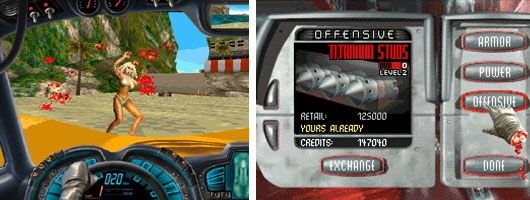
The studio also learned from Carma II that you could overpower your car, and kill the challenge. So they scaled back the upgrade purchases from 90 total slots to 15. It was much more like the original. To keep cars from being OP the studio put a cap in the Armor, Power, and Offense categories. They allowed for a maximum of 12 points to be spent on the cars, even though there were 5 slots available in each category. If you wanted the best engine, or armor, or offense, then you had to sacrifice points in a different slot. Not only that but each car required you to spend upgrade tokens on it. The upgrades didn’t transfer just because you stole a new car. Your prize money also didn’t count towards upgrades. It could however be used to purchase an in-game power up, and assign one of four d-pad buttons for easy access. There was a lot of replaying the stages, and seeking out hidden items to help earn the best parts for each ride. All of these things helped increase the replay value.
Stainless eliminated the mission objectives from Carma II as well. Instead each level was the host to a different type of game. Some had you chasing down certain pedestrians. Some had you going after checkpoints, destroying opponents, or completing laps first. The difficulty could be challenging at times, with opponents, and cops smashing you from all directions. It could be hard to get away, but that was also the reality of many fights in the original. I didn’t find any of the stages too difficult to complete on the normal setting. It had just the right challenge for long-time fans. I had previously mentioned the APC, and Subpressor were in the game. I’m not sure how the Subpressor control got past QA testing. or whether it was made intentionally hard to stop. The car skids like it’s on ice. It is impossible to stop on a dime, or do handbrake turns with. Even then it’s still fun to drive. The best surprise I had was learning that there were more than two types of police cars to unlock. A tiny little car known as the CU:NT (Compact Unit: Nil Threat) was added to the police arsenal. The car was about the size of a personal mobility scooter, and designed for community liaisons. It was included because Nobby was loaned a Smart car while his actual car was in the shop. He hated it so much that he insisted something as useless be added so that every player could have fun kicking it around. Using the car in the game was extremely difficult, and yet also fun. It was the equivalent of trying to beat a first person shooting game while using only a knife.
The other vehicle was the BFG of the series. The Super Suppressor was absolutely massive. Imagine a rolling roadblock, towing a tank trailer! It added another strong female to the lineup, Agent Debbie O’Nuts. The first time I ran across it I had the same reaction to it as I did the Suppressor some 20+ years ago. I thought “what the hell is that?” before getting flattened by it. As with the original game, you couldn’t access the heaviest hitters until the final stages of the game. Even then beating them was a challenge all to itself. Carmageddon Max Damage was a fantastic game, but it was not without its perceived flaws. We will talk about those in the next, and final entry in this series. I hope to see you back for that. If you would like to sponsor me please visit my Patreon page and consider donating each month, even as little as $1 would help make better blogs and even podcasts!


