Showing posts with label sci. Show all posts

Wednesday, April 26, 2023

My favorite Games of All-Time #5: Carmageddon - Originally published on 1UP - July 21, 2006

Carmageddon is the most vile and repulsive game on my list. It makes State of Emergency look like a walk in the park. My brothers were shocked to see how high it ranked on my list, more so when they found out that I ranked it above Burning Rangers. Carmageddon fills my criteria of a great game so perfectly that it is amazing I didn't rank it higher. If I were ranking games based on total time spent playing then Carmageddon is a top-three game.

I had to rank the games based on their importance to me. If I could only play one game for the rest of my days which one meant the most to me? Which game is my absolute favorite and which ones come close? Carmageddon is the closest game that any non-Japanese designers have ever designed. It is in the top-5, it is in a place of great distinction.
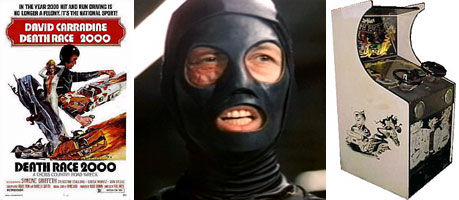
Carmageddon was inspired by the classic cult movie Death Race 2000, featuring David Carradine and Sylvester Stallone. If you can get the game to crash the error screen says "Terminate Death Race." There was also an arcade game called Death Race way back in the late 70's. The arcade game had nothing to do with the movie, it was a hot rod race around a cemetery where you ran over pedestrians and tombstones popped up. These peds were also called "gremlins" in some literature. The original arcade game was so repulsive that it was banned from most establishments. About 30 years later the legacy continued when Carmageddon was released and Australia banned the import and sale of the game.

Carmageddon (Carma for short) is repulsive and vile. It came out at the height of a congressional inquiry into violent videogames. Grand Theft Auto and Mortal Kombat were the other big games being dissected at this point. Carmageddon showed up and the debate exploded. The content and purpose of the game could not be argued. You were the participant in a death race, you acquired time and points by running over pedestrians.
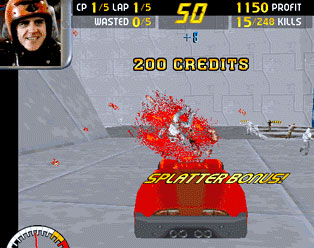
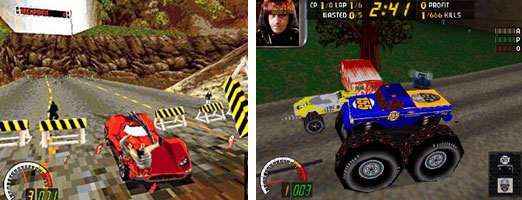
After all, look at the play screen. All of the important information appears on screen. There is car position and lap position, in case you really were paying attention to the race. Number of opponents wasted, time, profits and pedestrian kills. You could finish the stage by either winning the race, destroying all of your opponents or killing all of the pedestrians.

The gore was through the roof in this game. Points were rewarded for how many people you could take out in a combo. If you clipped a ped and sent them spinning you might have gotten an artistic bonus, if you plowed through them you might have gotten a splatter bonus. Blood was everywhere and the image of the driver (Max Damage) in the upper left corner sums it up. He seems to derive pleasure from the violence. Congress was in a fit, they had all the evidence they needed to condemn videogames. Only real sickos could find any pleasure in this game.
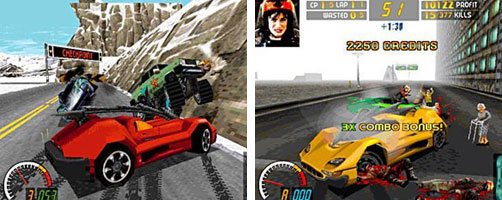
Seeing as how 1UP is filled with murderous sickos then I feel right at home. After all, those that have been playing videogames for any amount of time are surely riding an immoral path. If you've played Silent Hill and are longing for a giant butcher knife with which to skin people alive then please raise your hand. If you've ever played Mario Bros and have taken magic mushrooms that allow you to throw fireballs then please... raise your hand.

Congress, and many people that "don't get it" see only the surface level of a videogame. They don't understand that the good majority of gamers know the difference between right and wrong. We know the difference between what we see on the screen and our actions in real life. This isn't a case of monkey see, monkey do. This isn't a case of de-sensitation to violence. Violence has been around for as long as human kind has, we don't have the luxury of blaming videogames for the wars we have engaged in. Some of us choose peace, and would rather play games with action or violence than engage in the real deal.
The first two Carma games were made by the people at Stainless Games over in England. SCi published the titles. The people that worked on this game seemed to be out of their mind while they were developing the title. With the debate raging in congress they had the audacity to not only create but market this game as the goriest title ever

While in development Stainless went to extremes to capture the sights and sounds for the game. Polyphony is famous for recording the engine sounds of more than 400 cars for Gran Turismo. On the other side of the planet Stainless participated in demolition derbies to get the authentic sounds of cars crashing. Then they recorded the cars getting hit by bats, bricks and cinder blocks. In order to get an authentic sound of hitting pedestrians they got a good friend, Tony Taylor, the actor that plays Max Damage, to put on a helmet and let himself get hit a couple of times by a slow moving car. Then they took a bat to his helmet and recorded those sounds as well. Some people suffer for their art, none more than those at Stainless.
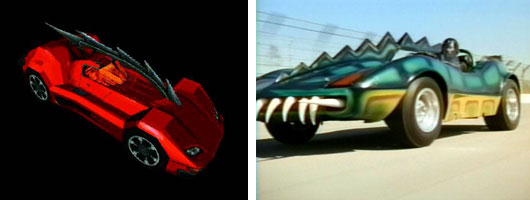
The plot of the game was set, you started off as either Max in his Eagle, which was a take on a car in the Death Race. Or as the female counterpart, Die Anna, in her faster car, the Hawk. Carmageddon was a sanctioned race taking place all over the world. Anything was legal in this race, including taking shortcuts, running over opponents and pedestrians. There were temporary power-ups scattered over the map and many secrets to discover on the massive maps.

The opponents and cars in the game were all unique. Depending on your rank you could sometimes win their car if you destroyed it in the middle of a race. Each car had different strengths and weaknesses. Some were dainty and some were unstoppable. These cars were designed for the various styles of drivers. All of the cars could be upgraded, money won from the races could be used to purchase extra armor or horsepower.
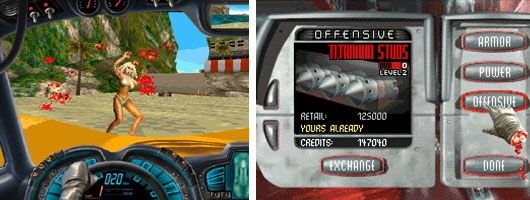
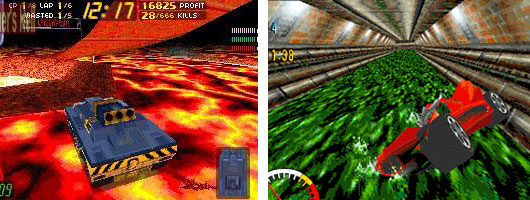
Carmageddon was the definition of the impossible racer. The physics were good. The cars all handled realistically, more or less. It was what the cars that were capable of that made the game so much fun. The cars were almost indestructible. In any other game a car that hits a wall at 300 mph would explode. In this game it would just wreck the body a little. The cars behaved like Hot Wheel toys on some of the most fantastic tracks ever designed. These tracks had tunnels, massive jumps and drop offs. The cars could even operate under water, in acid, toxic goo, snow and lava. Some tracks were on raceways and others were on rooftops of massive skyscrapers.

Blind intersections where two cars could collide at high speed and send one of them flying a few hundred feet straight up were the rule, not the exception. This helped create a breakneck (no pun intended) pace for gameplay. Drivers and opponents were always willing to go full-tilt at each other or even at the police that patrolled the race because the cars would mostly survive the wreck.
Carmageddon is a great stress reliever. The more people you can get to join in a lan game the better it is. Within a few minutes any person that I've introduced the game to had the car up and running and was shouting "holy shit" at every crazed jump and high speed wipeout.

People often say that Carmageddon would be perfect if only it had weapons like Twisted Metal. I say that they are missing the point. The cars are the weapons. In Twisted Metal the cars don't behave like cars at all, they behave like FPS characters. The mass and momentum of real cars is lost in that game because the designers don't want it to weigh down the gameplay. Carmageddon is a pure game, the car is everything and it is the only thing. There is no more rewarding experience than catching up to a race in progress and wiping out the lineup with a runaway plow. Or dropping down on an unsuspecting opponent that is hobbling on his last three wheels.
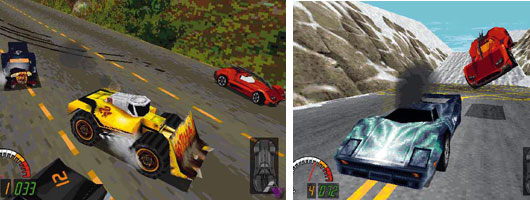
Here's the part where you ask "well if this game is so great how come I've never heard of it?" Hell if I know. Stainless made this game back in the day when you could fit a Windows and Mac version of the title on one CD. Most reviewers that played the first fell in love with it. The game was mad hijinks and word of mouth helped it spread quickly.

A large community of gamers became dedicated to the game. Stainless released tool kits to let gamers make their own skins for the cars. The code for some cars that weren't finished with the release of the game were left on the CD. Budding programmers and modelers were allowed to finish the work of Stainless and were fully supported for example with patches that allowed gamers to play in ED-101's flying concept car.
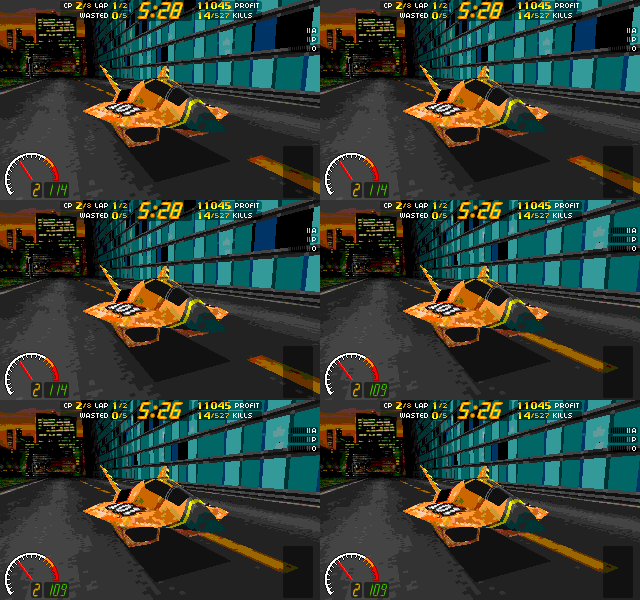
The congressional hearings only helped make Carmageddon a more desirable game by all audiences. As the saying goes "even bad publicity is better than no publicity at all." Despite the negative attacks, magazine editors and gamers both agreed that this game was pretty damn good.

Stainless helped keep the momentum of the game going by releasing the "Splat Pack" shortly after the original was released. The new tracks and cars helped round out the overall experience. The Splat Patch helps cement this game in the top-5.
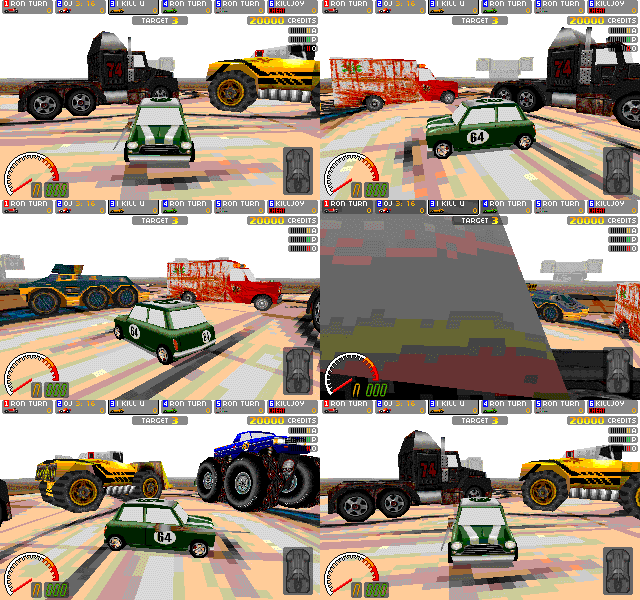
If this game was so great what happened? The sequel "Carpocalypse Now" was a fun game. The cars were far more detailed and could be pulled apart, pedestrians were no longer sprites but three dimensional models with their own weight and mass. Power ups were more weapon like now. The levels were just as massive and as interactive as they've ever been.

However the experience was less enjoyable the more realistic the game became. Cars could be destroyed far more easily. Some blind hits or explosive barrels could take you apart quickly. This turned a former full out crash and smash title into a delicate shadow of its former self. Realism is not meant for every game and definitely not this one.
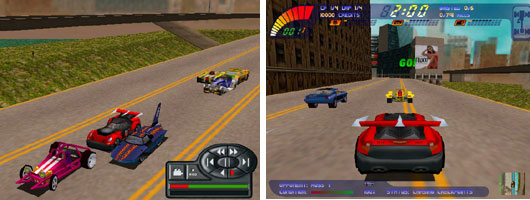
Carmageddon 2 was good but not great. The third in the series was absolutely horrid. SCi had just acquired the rights to the Death Race 2000. The official name for the next title would be Carmageddon 3 TDR 2000, SCi figured that they could save some money by giving the game to a new developer and took Stainless off of the job. The game that came out was absolutely horrid.

Everything that was good in Carma 2 was gone. Any remnants from the original game were in name alone. TDR 2000 was panned by gamers and critics and a legacy that could have been was buried some years ago.
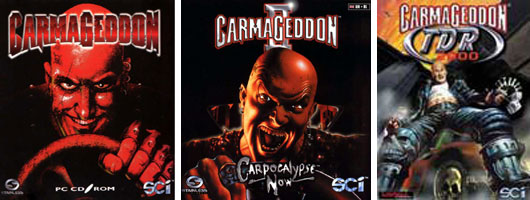
I still find the time to play the original game, although OSX on the Mac is making it harder to launch these days. The game holds up very well, even more against a human opponent. My brother was always a fan of Grand Theft Auto and Twisted Metal. There was one game that was more pure and enjoyable than either of these. I hope you get a chance to play it before your computer can no longer run it.
I’d like to hear your personal top-10, top-20, top fighting games, top sports games, or top games in any genre. Let me know in the comments section please. As always if you would like to sponsor me please visit my Patreon page and consider donating each month, even as little as $1 would help make better blogs and even podcasts!
follow the Street Writer on Patreon!

Wednesday, June 16, 2021

My favorite games of all time, the story of Carmageddon part 7...

Publisher SCi would like you to believe that there were three main Carmageddon games. I count three all right, Carmageddon, the Splat Pack, and Carmageddon II Carpocalypse Now. The one known as Carmageddon TDR 2000 was released in 2000, and has only the name in common. Many were hopeful that the TDR stood for "The Death Race," but again SCi failed in acquiring the license, so it actually stood for "Total Destruction Racing." It slightly resembles a Carmageddon game, but it certainly doesn’t play like one. Something happened with the franchise that came as a shock to fans. SCi had a contract dispute with Stainless Games. This was nothing new in the industry. Developers have been hired, and fired since the industry was founded. What was uncommon was for a developer with a proven track record to create a hit, be let go, and replaced with a relative unknown.

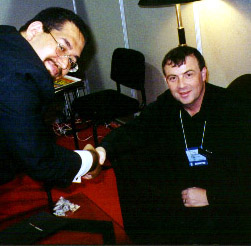
Torus Games out of Australia took over the IP. I hold no ill will to Torus for what went down. In my photograph archives I actually have a picture of myself shaking hands with the President of Torus.We met at the E3 in Los Angeles back in 1999. We talked about what they had planned for Carmageddon 3. The Australian company was trying to make a name for themselves in PC development, and in this case they bit off more than they could chew. It was apparent from the get-go. 

What happened between Stainless Games, and SCi, mirrors what happened between SingleTrac, and Sony. The Twisted Metal series was pretty much the brainchild of David Jaffe, and his team at SingleTrac. They had cut their teeth developing many of the first generation hits for the Playstation, and Playstation 2. The first wave included Warhawk, Jet Moto, and Critical Depth, in addition to the first two Twisted Metal games. They showed that they were capable of innovating in the combat department. It didn't matter if the fights were in the air, on the ground, or underwater. It was a niche they had carved out for themselves. This track record gave them the creative flexibility to begin developing another string of original games for the Playstation 2, including War of the Monsters (another of my absolute favorite games), and Downhill Domination. These titles were all good, but it was Twisted Metal that really took off for them. Then Twisted Metal 2 completely rewrote the book on vehicle combat. Everything that made the first game good was expanded upon. This included the library of characters, cars, physics, animation, combat design, levels, storytelling, music, and especially control. The things that were lacking were polished, and made better. A studio may get lucky out of the gate, but it takes real talent to build a greater sequel. This leap from game to game was not unlike the work that went into Carmageddon, and Carmageddon II by Stainless.

Fans were excited about a third game was in the works from Sony. It would debut two years later, but this time by a new developer. That was roughly the same window of time that Torus had to create an all-new game. 989 Studios took over for Sony, and although they had helped a little with the previous games, they had never been directly in charge of the franchise until Twisted Metal III. Audiences, and reviewers could tell that the game had taken a considerable dip. The control was unpolished, the vehicles lacked the creative spark or the prior games, the combat felt sluggish, and the story didn’t seem to fit the mold. When SingleTrac was dropped the team turned around, and released Rouge Trip which audiences could tell was the spiritual successor to Twisted Metal 2. Even with Sony’s powerful marketing arm, and great soundtrack (although Rob Zombie’s “Dragula” seemed to be featured in every other game), it was not enough to convince audiences that Twisted Metal 3 was  good. Things improved in Twisted Metal 4, which came out in 1999. Most sites commented that the things that were lacking had been fixed, and 989 had finally made a good sequel. By then the damage to the franchise had been done. Word of mouth killed the momentum, as did the bad reviews.

The best thing Sony could do was save face, and ask Jaffe and his team to return. They were given lots of creative freedom to reboot the franchise. The much darker Twisted Metal Black debuted in 2001. It was possibly the highest rated entry in the series. Shortly after Jaffe moved to Sony Santa Monica to begin development on another new idea, a game called God of War. Carmageddon TDR 2000 had dismal reviews, only SCi wouldn’t be able to save face by going back to Stainless. The franchise seemed dead, and buried. Fans got word of mouth that the new game was bad. Really, really bad. Those living in denial waited for a review from a trusted site, or magazine before deciding to pass on it. Their fears were only confirmed. GameSpot gave it a 5.7 out of 10, IGN gave it a 5.8 out of 10, PC Gamer gave it a 59%, and PC Zone gave it a 6.9 out of 10. 

The fallout from critics, and audiences was almost immediate. For starters the game was ugly. Yes it was in 3D, and yes the models, pedestrians, and environments had nice, high resolution textures, and improved lighting effects. But all of this was on a clunky engine. It wasn’t just rough around the edges, it felt like a tech demo for things their company could do. Had this game been on the demo disk I tried out in 1996 I would have passed on the series. The story became a convoluted mess about the apocalypse, a zombie outbreak, and the Carmageddon tournament being a chance for Max Damage to be let into a gated paradise. None of it felt thematically like anything that Stainless had even set up prior. Stages were dressed more like levels in a console game. The whole racing in a dystopian future seemed to take a back seat to mission objectives, and elaborate set pieces. Exploration didn't seem to be as much of a priority as the game seemed to hold your hand from start to finish. Not to mention there was a time traveling element to the levels. Where did that come from? To be fair however, the studio did a few things right. They returned the Suppressor, and squad cars of the first game. Also the studio added pedestrians that fought back against the cars, some even threw molotov cocktails!

You could almost sum up what was wrong with the game by looking at the rides. The Eagle was a shadow of its former self. It was fatter, rustier, and sported a jet exhaust, barely resembling what audiences remembered. Not only that, but the co-stars of the game, Die Anna, and her Hawk were nowhere to be found. Torus was keenly aware of the reputation of the series, their home government  had been very vocal about banning the game. They knew that violence was a strong selling point, and the cars had to go above, and beyond in their design. Several of the cars were very odd, whether they were three-wheeled, shaped like a brick, a hamster cage, or were made of translucent material with a naked driver. Torus was trying to be creative. Yet they would then turn around and put a garbage truck in the lineup. It was a literal work truck that didn’t have any extra flair added to it. To be fair Stainless put a combine in Carmageddon II, but at least it was designed for mowing down wide swaths of pedestrians. Torus also knew how influential the Mad Max movies were to the creation of the franchise. A car styled on Max’s Interceptor from the first film, both the black, and yellow versions, was featured in the game. Other cars like KITT from the TV show Knight Rider was introduced as KNAVE. It was an odd mix of street cars, hot rods, movie cars, and science fiction vehicles that didn’t mesh well together. Torus was trying their best to keep the series going, but they were just the wrong team for this project.

Part of the greatness of the original series were the vehicle designs. I hold the library with the same reverence I have for the Street Fighter cast. Every ride seemed to have a following. It wasn’t enough to just copy a design from a movie. Stainless put a lot of forethought into the look, and handling of each car. It is true that many were inspired by real world rides, but they were made to fit thematically as modified killing machines. The use of colors, spikes, blades, drills, and scythes gave each vehicle personality. No two looked alike. They could easily be made out even in the most heated multiplayer game. More important, each ride had a different effect on the game play experience. Stainless made sure to give the vehicles appropriate handling. It wasn’t meant to be a perfect simulation of driving, or even racing. A real big rig could have up to 18 gears. It would lose half a lap to a sports car just getting out of the first three gears. All you had to do in Carmageddon was point the Rig O’Mortis in the right direction, and mash the gas pedal. No shifting required, and in about four seconds you could be breathing down the neck of almost any opponent. This was arcade control, this was arcade handling. No driving experience needed, not even a steering wheel. A keyboard would do the job. From the biggest truck, to the smallest buggy, Stainless had built a simple-to-use universal set of controls. The cars from Carmageddon, the Splat Pack, and Carmageddon II were all easy to pick up, and play. 

These vehicles not only accelerated faster than their real world counterparts, they often handled better too. Plus they were much stronger than any real car. Audiences could randomly choose any ride, and enjoy the experience. Granted, some cars were more difficult to control, and this was a design choice from the team. It created a challenge for those looking to see the benefits of each ride. There was often an upside to a car that went too fast, or one whose suspension seemed to have more travel than the others. When it was on the right level, perhaps the street vs off-road, it was the car that could dominate the opponents. Then there were the cars that simply existed because they were over-the-top. Maybe they were too slow, rolled, or spun out easily. They’d be extremely difficult to win a race with, but the challenge was worth it for many players. Don’t believe me? There are people that try to beat first person shooter games using only a knife, instead of the biggest guns. To them a greater challenge is the experience they want. I find myself doing the same thing by choosing cars much smaller, or difficult to control, than my opponents. These subtle but important game play elements were lacking in TDR 2000. The majority of the cars were evenly matched, any real strengths or weaknesses were negligible. Torus tried to fix their shortcomings by releasing an expansion pack. The Nosebleed Pack could not hold a candle to the Splat Pack.

SCi had painted themselves into a corner. The franchise had sold millions of copies earlier, and was a game of the year at one point. Now it couldn’t find an audience. No studio would touch Carmageddon because of the controversial reputation. Now they wouldn’t touch it because it was a bad game. The publisher merged with Eidos in 2005. They were eventually taken over by Square Enix in 2009. Square Enix did not want to tarnish their reputation by bringing back the franchise. To audiences it was dead, and buried. That made me sad, but it wasn’t the first game that would never get a worthy revival. Work seemed less interesting after Carmageddon II. Most of my coworkers graduated, or transferred. I left college too, and started working at JPL. It was there that I got news that changed everything. Find out about the Reincarnation in the next blog. If you would like to sponsor me please visit my Patreon page and consider donating each month, even as little as $1 would help make better blogs and even podcasts!
follow the Street Writer on Patreon!

Monday, June 7, 2021

My favorite games of all time, the story of Carmageddon part 3...

Carmageddon would never have been developed by any major studio in the ‘90s. No AAA team would  approach the idea. Management would fire anybody that had pitched something similar. Decades later some of the biggest games revolve around sex, guns, violence, and fast cars. Studios are falling over themselves to corner the mature market. The biggest of the mature titles is the Grand Theft Auto (GTA) series. GTA V has made Rockstar Games an unbelievable amount of money. Disney, and 20th Century Fox tout the billions made by Avatar, and the Avengers. When it comes to a return on an investment nothing comes close to GTA. Avatar for example made $2.8 billion, on a budget of $237 million. That’s impressive but GTA V made $6 billion on a budget of $265 million. Even if you factor in marketing costs the numbers are simply unbelievable. When GTA was first released in 1997 it was nowhere near as notorious as Carmageddon. I would often have a laugh when people would ask “if you love Carmageddon, why don’t you like GTA?” Back then the camera was top-down, and the game play didn't compare. I would sometimes move the camera to top down in Carma, and say, “there, now it’s GTA.” To be fair there was one other major studio that beat both Stainless Games, and Rockstar to the punch. That was SingleTrac, and their breakout hit Twisted Metal, which was published by Sony.

It was not surprising that Sony published Twisted Metal. They understood that the audiences growing up on consoles were getting older. They were targeting the families that already had a Sega, or Nintendo system. Most of those kids had outgrown Sonic, and Mario. They wanted a game with more blood, and action.  If it wasn't on the Sega, or Nintendo machines, they were willing to switch. The wave of violent fighting games, and 3D shooters in the early ‘90s, such as Atari’s Primal Rage, Rage’s Killer Instinct, Midway’s Mortal Kombat, and id's Doom were proof that mature titles were selling. Aside from fighting games where else could the genre incorporate violence? David Jaffe and his team at SingleTrac melded vehicle combat, with a first person shooter. Throw in an over-the-top story involving a tournament, and you’d think that Stainless Software was poaching the concept. The ideas featured in Twisted Metal, and Carmageddon actually came from many different places. Vehicle combat was nothing new, and had roots in traditional tabletop gaming.

Steve Jackson Games was responsible for publishing dozens of original tabletop gaming systems. Those are the ones that require dice, some miniatures, and a score sheet. One of the more popular titles was Autoduel. This role playing system from 1985, received a PC game by Origin Systems in 1987. The rules of Autoduel would eventually become standardized in GURPS, the Generic Universal Role Playing System, which was first published in 1986. These systems, and games were based on an even older Steve Jackson game. Car Wars the tabletop game series first published in 1980. It has always remained popular in the tabletop gaming community. The sixth edition was published in 2019. The newest tabletop game to join the genre was called Gaslands. It was released by Osprey in 2017. Games Workshop released Dark Future in 1988. It faded in popularity over the years but was brought back as a PC game with Dark Future: Blood Red States in 2019, by developer Auroch Digital. All of these titles had a hand in influencing the creation of the vehicle combat genre. 

Video games would bring the tabletop experience to life. I already mentioned Twisted Metal, however the ‘90s, and ‘00s saw the genre grow. Twisted Metal received a number of sequels. I will talk about the varying quality of those later. Other publishers knew the trend was coming, and had their own games lined up. One of the more stylish entries was Interstate ’76 by Activision. The game came out in 1997 same as GTA, and Carmageddon. Its physics engine was amazing, and stylish polygons gave it a retro feel. The combat mechanics found the line between Twisted Metal, and Carmageddon. The sequel was Interstate ’82, which came out in 1999. The series also inspired the Vigilante 8 games, which were designed with consoles in mind rather than the PC. Rogue Trip Vacation 2012 was a spiritual successor to Twisted Metal by SingleTrac. It came out in 1998. David Jaffe wouldn’t touch another vehicle combat game until 2007, when Incognito Entertainment released Calling All Cars! Not to be outdone Slick Entertainment released Scrap Metal for Xbox Live in 2010. All of those aforementioned games had tremendous planning, and lots of market research. This ensured the publisher could have a game delivered on time, and on budget. Carmagedon wasn't the result of spreadsheets, and data analysis. It came about more by accident.

When the developers at Stainless would get bored with racing games, they would turn around, and see what chaos they could create by driving head first into traffic. They saw that most games handled collisions poorly, if at all. Some didn’t even allow you to turn around completely. They were fans of Banger Racing. It was a sort of demolition derby-style race that had a following in Britain. They knew that there was a market for a game like that, and started putting together a prototype. The work they were doing would influence a generation of game developers. These included Criterion, famous for the Burnout series, Evolution Studios which created MotorStorm, Black Rock Studio which developed Split/Second, and Rockstar which created GTA. Fellow UK developer Reflections Interactive actually beat them all to the market. They released Destruction Derby for the Playstation in 1995. For a console game the physics engine was amazing. It gave a real sense of weight, and speed to the cars. Vehicles were deformed in pileups, this was the opposite of Gran Turismo, where Sony promised the manufacturers that their cars would never so much as be dented in the game. This focus on realism was also very noticeable when compared to Twisted Metal. The engine Reflections built got better in the Driver series, and Stuntman for the Playstation 2, both of which added different types of vehicles.

Destruction Derby, and Twisted Metal helped put the Playstation on the map in 1995. Stainless had started working on their own vehicle combat system in 1994. One of the things they were trying to figure out was how to avoid pedestrians in their open-world game. They decided they should make running them over a part of the game play. There weren’t any publishers willing to take the call to talk about their idea. Fellow Brits at Sales Curve Interactive (SCi) had worked with Stainless in the past. Having the studio adapt PC games for the Mac. They decided to take a chance on the game. To increase the odds of getting published they were looking for a license to attach the game to. One of the front runners was the Mad Max series. The trilogy by George Miller started in 1979, and had sequels in 1981, and 1985. The films had a cult following the world over. The title character fought roving gangs in a post-apocalyptic wasteland. It is entirely possible that Max Damage was named after Mad Max. At the very least some of the “Auto Scum” gang members in Carmageddon could be traced to designs featured in the Miller films. The series was big enough to be recognized, but not so big as acquiring the license would be wildly expensive. SCi had difficulty finding out who owned the rights to the property. Since Miller had made the films in Australia, different studios in the US, and the UK were responsible for rights, and distribution.

SCi hit a literal dead end trying to get the rights for Mad Max. They didn’t pull the plug on Stainless. They kept them in business by assigning them other projects in the interim. While doing research SCi discovered an even older cult film revolving around cars, and violence. This film had even more in common with what Stainless was going after, including awarding points for killing pedestrians. Death Race 2000 had been released in 1975. Featuring David Carradine, an actor that became famous from the TV show Kung Fu. As well as a young Sylvester Stallone before he created the first Rocky movie. The characters were very crass, and over-the-top. Carradine played two-time winner Frankenstein, “who lost a leg in ’98, an arm in ’99, with half a face, and half a chest, and all the guts in the world.” His face was covered by a rubber mask, and he sported a helmet similar to Darth Vader’s two years before Star Wars premiered. Many people noticed that Kutter from Carmageddon looked very similar to Frankenstein. Stallone played mob enforcer Machine Gun Joe Viterbo, his moll Myra was played by Louisa Moritz. These were not unlike Alfonzo Spaghetti, and Madam Scarlett respectively. There were many more such characters in the film, such as Nero, Calamity Jane, and a Nazi named Matilda the Hun. Each character  had an outlandish supercharged race car, covered in spikes, horns, and even teeth. The Hawk, and Eagle from Carmageddon were undoubtedly based on The Monster.

In the film the high-speed cars run a transcontinental rally, rather than just around a city. The rule changes for the year 2000 were explained in the film; women are worth 10 points more than men in all age brackets. Teenagers are worth 40 points. Toddlers under 12 are worth 70 points. Anyone over 75-years-old was worth 100 points. The movie featured nudity, sex, drug use, vulgar language, and misogyny, on top of all that violence. Of course audiences accepted that this was a dark comedy set in a dystopia. Many films from the ‘70s were about exploitation. Death Race 2000 had shlock value like other titles from that era. With the fancy sets, actual race car props, and various locations used, it was essentially a polished “grindhouse” movie. A full year later the video game industry had its first controversial game. The title was called Death Race, it had nothing to do with the movie, you could imagine that many people assumed it did. Exidy had released its first title Destruction Derby (no kidding!) in 1975. Their follow up was Death Race, in which the Grim Reaper in a hot rod drove over “gremlins,” and not people. Each time players ran over a character there would be a scream, followed by a tombstone left on the screen. The game made headlines as parents were upset with the content, trying to get arcade operators to pull the cabinet. Reporters were shocked as well, and published brutal reviews. This negative publicity of course increased orders through 1977.

SCi had no luck with the owners of Death Race 2000 either. They were afraid that a video game allowing you to run over pedestrians was too controversial. It would bring down the value of their film. Yes, the same producers that had no problem with Sylvester Stallone punching his girlfriend in the face, a man getting stabbed in the crotch by a bumper-mounted knife, a Nazi expounding the values of the master race, and Frankenstein assassinating the President of the USA was okay. A video game with only a fraction of that content was simply too much! The talks seemed to be going well for Stainless, or so they thought. The studio didn’t even get a chance to change the program name before the it was published. If the title managed to suddenly quit on the Mac, or PC it would say that “Deathrace” has crashed. This did not deter the team from putting their efforts into making the best game that they could. That was easier said than done. No other studio had attempted what they were going for. Stainless didn’t really work from a template, they literally made things up as they went along. Part of this meant doing research on actual car crashes, as well as running over pedestrians. No, really!

On an earlier blog I mentioned that Tony Taylor played Max Damage in the “Prat Cam.” He was a general handyman, and a friend of the team. He was also a sort of amateur stuntman. When the studio was recording footage for the Prat Cam he yelled, and jerked himself around as if he was in the Eagle. In order to get the shot of him getting crashed into from behind he had the team hit him as hard as they could in the back of his head with a pool cue. Thankfully he was wearing his helmet at the time. It was only the beginning of his exploits. I think the statute of limitations has expired on the things that Stainless Games had gotten away with during the development of Carma. Frankly it’s a miracle that nobody was killed! We will look at what the creative, and physical risks the studio took in the next blog. If you would like to sponsor me please visit my Patreon page and consider donating each month, even as little as $1 would help make better blogs and even podcasts!

follow the Street Writer on Patreon!

Friday, June 4, 2021

My favorite games of all time, the story of Carmageddon part 2...

When the final version of Carmageddon was released in February 1997 it was so much greater than I could have anticipated. I brought the box purchased from CompUSA (ask your parents) into the computer lab early on a Saturday. I didn’t normally work weekends, thankfully we were only open for a half day. After we rushed the last student out we locked the lab doors, and fired it up, sitting through the opening cinema and getting hyped. The intro animation was burned into the memories of a generation. So much so that a fan recreated the opening using the in game camera of the latest version of the game. You can watch the original intro below, be forewarned, it mirrors the dark violence of the series.  


It turned out that not all of the cars, and features were available from the start. Which bummed us out, we were ready for multiplayer madness out of the box. It made sense from a game play standpoint. What was the point of playing if you had access to every level, and every car right away? You had to earn everything, as it was with all great games. It made me appreciate having to grind through the experience, and sharing everything I earned with the staff. I would gladly go through the game on breaks, and after work. Mastering every stage, and vehicle along the way. I even wrote up a 70-page strategy guide for my coworkers by taking screenshots, and writing tips for each level. I even included bios, and maps. I’m sure it’s saved on some Zip drives in my garage (again, ask you parents). If you’ve never played we should begin with the stars of the game. The biggest titles always had some sort of main character, or mascot that they could build a franchise around. Carmageddon was no different. Even though it was about vehicle combat the game had two stars; Max Damage, and Die Anna. Each with own signature car, the Hawk, and Eagle respectively. Think of the relationship between the characters, and their cars just like the stars in the Twisted Metal series. They were interconnected.

Max, and Die Anna were seen on the “Prat Cam” it was supposed to be the drivers in the cockpit reacting to the race. The two would laugh like maniacs as they ran over people, whip their head around after getting in a wreck, scream as they fell off of a building, and even swear under their breath. It gave a lot of personality to the characters, and added another layer of dark humor to an already absurd premise. At the start of the game the cars were nowhere near as fast, or as powerful as they were in the demo. They were easy to wreck, and could be pushed around by opponents, and police cars alike. Earning enough credits to power up the vehicles, and unlock opponents would test my patience. It turned out that the demo stage, and cars were approximately where the cars would have been at about 90% through the game. Their armor, their offense, and their engines had been heavily upgraded by that point. There were many miles of virtual racing to actually get to this point in the full release.

The game began with you ranked 99th in a tournament. Your goal was to finish every race in the series, and become #1. There were almost 40 levels in the game in which to accomplish your goal. Players could skip ranks depending on how many points were earned during each level. It was not uncommon to jump 7 ranks or more for a particularly violent contest. The specific how, and why the Carmageddon tournament was created was never fully explained. This was perfectly fine, as audiences were left to fill in the blanks. Between the opening cinema, and clues picked up from the races we could gather all the information we needed. The tournament was held all around the world, and only the most dangerous racers were invited. These included murderers, celebrities, gang members, cops, and even robots. When races took place in a city, the outskirts, and main roads were walled off. Anyone that remained inside was left to fend for themselves. Other stages were set on an island, or enclosed circuit. This was also not a post-apocalyptic race for survival. You could never mistake the locations for the wastelands of the Mad Max universe. The Carma world was set in living, breathing factories, towns, and vacation resorts. The tournament was a violent satire of the real world. Take it as a futuristic gladiator battle, broadcast to the masses to appease their blood lust.

The rules for the tournament were simple. Each race could be won in three ways, you could complete the required laps, destroy all of the opponents, or kill every pedestrian on the map. The third was the most difficult, but also potentially worth the most points, and prestige. The opponents themselves were a cross section of archetypes, and stereotypes from pop culture. You can imagine that the Black community did not like the representation in the game. There was the pimp-coded Otis P. Jivefunk, and his leopard print top “Caddy Fat Cat.” To be fair the Caddy Fat Cat was the car I used most often in the game. It was fast, heavy, and could take a lot of damage. Then there was the former football star-turned-murderer OK Stimpson, driving a “Fraud Broko.” For those that don’t know the story he was based on; former pro football star O.J. Simpson killed his ex-wife, and her boyfriend in 1994. He was caught in a Ford Bronco during a slow speed pursuit as he tried to flee the country. I would argue that Stainless Games wasn’t making fun of one ethnic group as much as every person in the game was an ugly parody. Also Stainless admits that they pre-censored themselves. They had men, women, cops, and elderly people that you could run over in the game. Artist Terry Lane put his foot down when they said pregnant women should be pedestrians too. They were also mindful that if they had Black pedestrians the racists would go out of their way to only run them over. So they made all the pedestrians white in the first game. They wanted audiences to know that all pedestrians were equal targets in their world. Black, and brown pedestrians, as well as better Black driver archetypes would appear in the sequel.

These drivers, as offensive as they were, and their respective vehicles did not all show up right away. As with all great game design, the opponent rides were equal to, or slightly better than the Hawk, and Eagle at the start of the game. Early races were long, drawn out battles. Opponents smothered players at every turn. Throw in the police which were randomly dispersed through each stage, and the car battles became harder. Only by winning races and increasing your stats could you hope to make the later stages any easier. To balance out the game more difficult opponents would join the tournament as players increased in rank, and as their car became faster, and stronger. Every opponent vehicle had its own strengths and weaknesses. Some were blindingly fast, some were heavily armored, but all could potentially be unlocked. In order to do so you had to outrank your opponents, and destroy them in the level. Once acquired you could drive that specific car, and also increase its armor, offense, and engine. Every vehicle in the game was unique with the exception of Halfwit Harry, and his sister Burly Shirley. Harry, and Shirley had a respective green, or pink Hummer-type off roader. In any instance the diversity of vehicle types, the way they controlled, and benefits really gave Carmageddon a lot of replay value. Some of the cars were labeled Cheat, not necessarily because they had an outright advantage, but because unlocking them seemed to be more random than other cars.

The full version of the game also meant that we had a soundtrack to play along with. Original music was one one of my elements of great game design. Carma did not disappoint. So what kind of music went well with all of that mayhem? We needed something that could get the adrenaline pumping right away. So it was heavy metal of course! Not just any type of metal, but industrial, and electronic. The tempo, and riffs hit like a punch to the chest. They seemed to go very well to create an aggressive, yet also futuristic atmosphere. The biggest name on the soundtrack was Fear Factory. Three of their songs appeared in the game, including Zero Signal, which was also on the Mortal Kombat movie soundtrack. Composer Lee Groves had several tracks as well, which complimented the themes of the major areas of the games. These included “industrial, coastal, desert, and winter wonderland.” Stainless sound designer, and composer Chris Melchior had a few tracks, including music on the expansion as well. The music, screaming peds, explosions, and collisions all blended perfectly. They audibly brought audiences much deeper into this world.

The sudden increase in car types, and multiplayer game modes went over great at work. The other lab techs also began using their break time to get better at Carma, and learn which cars were most advantageous. We began setting parameters on which vehicles were allowed in certain game modes. Some cars were banned outright because they were simply too powerful, or because they had some other unfair property. Stella Stunna for example, a rubber-clad sadist, drove “Electric Blue.” Her car had a built in Electro-Bastard Ray. This was normally a power up that only lasted for a few seconds in other cars. For Stella it was permanently enabled, and could zap pedestrians with a bolt of lighting from up to 10 meters away. This meant that she could easily rack up points in multiplayer games, and power up her vehicle on the fly. This left no pedestrians for the rest of the players.

The other car that was banned from competition was The Suppressor. In the game, as in real life, the cops had access to the biggest and baddest vehicles. The squad car in Carmageddon weighed almost 3 tons, and could go 150mph. It much closer to a supercharged armored personnel carrier rather than the traditional cop car. A group of them could turn any stage into a nightmare, With about 90% of the game complete players would have earned heavy-hitters that could eventually take out a squad car. However the supreme heavy hitter in the game was called The Suppressor, piloted by Police Chief Biggun. It weighed 5 tons, and could reach 250mph. The first time I saw it was actually on the stage featured in the demo. You can imagine my surprise. I was going through the route that I had raced hundreds of times before. I reached the top of a skyscraper, and it was waiting where no cops were previously. I had a fraction of a second to ask myself “what the hell is that?” Before it ran me off the roof and destroyed me with a couple of hits.

I fought tooth and nail against the Suppressor again, and again with different rides until I was able to unlock it. My favorite heavy-hitter was the Plow, a four wheel drive bulldozer formally piloted by Don Dumpster. I used that to great effect against the cops in the game. In LAN matches when using the Plow I would sign in as El Don. Once the Suppressor was in the garage the rest of the game played relatively easily. Again traditional game design dictated that the best weapons were only accessible near the end of the title, otherwise the experience would have felt cheap. The team at Stainless Games knew what they were doing. They even went so far as to highlight it as the vehicle you were rewarded with in the final game cinema. During the awards ceremony the organizers of the tournament are presenting a trophy to an unknown driver. Then in the dark a six-wheeled beast rides up the podium, and flattens everyone, including the cup. I suppose the lesson for Carma was never was about becoming the best, it was about the enemies killed along the way... We were having an absolute blast at work. With the exception of Stella, and Chief Biggun, all of the cars were fair game in multiplayer modes. Depending on my competition I would choose the car that would be the biggest nightmare for them. This frustrated my coworkers to no end. For every one game they won I would often win the next eight. 


The end of the semester tournaments were even more exciting now. Not only that, but as our computer lab expanded, we had more hires that were becoming solid players. The bigger labs also meant that we were getting more attention from other departments looking to create their own computer labs. Carol was our Dean, and would show our labs off to other college admins. This included the VP, and President Carol stopped by for the end of the semester party one year. She was always a bubbly presence, and welcome whenever she visited. She wanted to sit in on our tournament, and see what the fuss was about. The boss lady Alison wasn’t too sure about it, but I insisted. Carol gasped when she found out the game was about racing, and running over pedestrians. After the initial shock wore off she asked, “is it okay if I try it?” We had her sit down, and watched as she drove around the virtual block a few times. She screamed when she began running over pedestrians, “oh no, oh no!” Then she began giggling as she started running into other drivers. After a few minutes she was red in the face from laughing at the mayhem she had participated in. She assured Alison, and even Phyllis our department head, that the game was as much fun as advertised. From that moment on we would be sure to invite her to the tournament each semester. She would decline, but asked that we enjoy ourselves. I can’t imagine that any other college had an administrator that was half as cool. Carol eventually became a Dean at an even bigger college. She retired years ago, but we stay in touch on Facebook.

It turned out that as other departments opened up their own computer labs they were eager to hire our staff. In a few instances they had poached talent from our labs. Carol, Phyllis, and Alison met with the other departments. They said they did not mind sharing talent, or having lab techs train alongside us for a few weeks so they could get up to speed. Poaching our team was not a good look. I remained with our department because as I discovered from my friends in IT that the other labs had far more restrictions than we had. They had their computers on lock down. No games, no demos, no fun. The IT department mostly left us to our own devices because we were good at maintaining our own systems, updates, and security. When I wasn’t playing the game I was researching it. I learned lots about Carma from the game forums, including how it was made. It turned out that there was a huge challenge in trying to get it published. It made me appreciate it that much more. We’re going to look at why nobody was willing to sell Stainless a license in the next entry. If you would like to sponsor me please visit my Patreon page and consider donating each month, even as little as $1 would help make better blogs and even podcasts!

follow the Street Writer on Patreon!