Showing posts with label racing game. Show all posts

Wednesday, August 7, 2024

NiGHTS, Power Truck, and Gyrozetter - A 1UP classic from January 02, 2012

Hello friends, Happy New Year to you and yours! Did you get everything that you asked Santa for? I hope so, I’ll be mentioning the presents got and given to the family in another blog. Right now I’d like to talk about the presents being given to console and arcade players. The biggest of all news comes courtesy of the NiGHTS into dreams… fan webpage. To mark the 15th Anniversary of the game the webmasters and a contributor got together to release a very special recording of “Sweet Snow” the slower version of the title track “Dreams Dreams.” What makes this release special was that it reunited the vocals of the original singers, Jasmine Ann Allen who voiced Claris Sinclair and Cameron Strother who voiced Elliot Edwards. The kids are all grown up now, their voices have certainly matured.

They manage to hit all the right notes like true professionals. This was not a knock at the original Dreams Dreams, the young and inexperienced voices made the song sound absolutely sincere. It was and always be one of the best game songs ever recorded. Fans of the original game owe it to themselves to visit the NiD fanpage and download the free MP3. It certainly shows once again how Sega fans manage to do more to keep the community going than the parent company does, especially on anniversary years!

The other goodies to announce are games for the arcade. One is out now and one will be out soon. Both of these titles involve two of my favorite things, cars and robots. First up is Power Truck by IGS. Remember the studio that I mentioned a number of times during the brawler series? Anyhow, their arcade title is less like Sega’s classic 18 Wheeler and more like Burnout.

As with other arcade racing games this title allows players to save data on a card and keep track of their progress. Aside from tracking races and points the card-based system allows players to store any customizations and upgrades they can earn for their trucks.

Power Truck has several truck types and different game modes, what I find interesting is that there is a Story Mode. It’s not enough to have trucks racing and crashing, there has to be a narrative as well?

What type of story can be made out of the stereotypical USA characters like Milky and Hunter? Or the school kids / witches Wolf and Mystery?

What really brings my attention to this game are that the trucks can transform mid race to take down other racers. On of the upgrades is a giant rocket booster that not only speeds up the truck but also seems to allow players to plow through traffic. It's sort of like Hydro Thunder's patented Mighty Hull attack but for cars instead of boats.

There is also a second attack that knocks opponents away with a sonic blast. For those interested in random arcade trivia, the last arcade racer that had a sonic-based attack was the super taxi cab in Spanish developer Gaelco's Smashing Drive. The title from 2000 allowed players to get a temporary upgrade of a massive horn that could cause cars ahead of the player to explode and get cleared out of the way.

I'm not sure if the rocket boost and sonic blast attacks can be combined, it would be interesting to see if they could. The cabinet itself it a sit-down model with a long gear shifter similar to an actual big-rig. By comparison the Sega arcade game had a simpler reverse, low and high gear. I hope to see one of these in a local arcade soon.

The second arcade game being developed is actually by SquareEnix and it is highly doubtful that anyone in the US will see the title. The developer may not be known for their arcade efforts in the west however in Japan they've released a few arcade experiences, none more popular than Lord of Vermillion. I've mentioned the card-based title a few times on this blog, including the announcement that there would be a crossover between LoV II and Final Fantasy IV. SquareEnix actually has a wide range of arcade holdings, including a strong investment in Taito arcades and titles like Darius Burst. But I digress…

Gyrozetter is a multi-player arcade title that has characters driving licensed and fictional vehicles that can transform into robots. What makes the game more than an arcade version of the popular Transformers console games, aside than it is not based on the characters, is that the arcade cabinet actually transforms! The steering wheel flips up and as do the speedometer and RPM dials on the dashboard to reveal a second set of controllers. The dual joystick setup is reported to be comparable to Sega's Virtua On.

The game doesn't have a trailer yet and SquareEnix has not released any animations or full details even on the game website. Hopefully Arcadia magazine will get to preview the game before the other outlets and I'll get a chance to let the visitors here in on the news.

What do you guys and gals think about either game? Would you be willing to try them out in the arcade or at home even? Also, how was your Christmas and New Years, did you go anywhere or do anything? What goodies did you get?

As always if you would like to sponsor me please visit my Patreon page and consider donating each month, even as little as $1 would help make better blogs and even podcasts!
follow the Street Writer on Patreon!

Friday, November 10, 2023

The Hot Rod Game, part 1 - A 1UP classic from May 7, 2009

I couldn't end the car series without making a wish list of sorts. After decades of playing driving games I asked myself what type of racing game would I come up with. Something that everybody could enjoy and not solely for car fans. A racer that brings in new ideas and doesn't feel like another cookie-cutter experience.

Now is the time to bring up my idea, not as the capper for the car series but because I feel that the game industry is stuck in a rut. They seem to be out of driving ideas and are now grasping for straws. Very few of the driving IP coming out today seems to be coming from car fans. One new titles that embodies the spirit of the hot rod isn't even about hot rodding. The heavy metal homage Brütal Legend features a hot rod coupe battling hordes of demons.
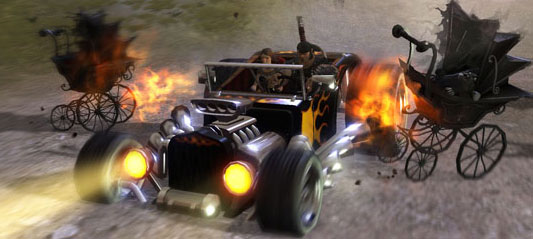
I want you to commit the artistic direction of Brütal Legend to memory. If I were to design a racing game then it would probably be set with a similar look and feel. The presentation of this game is based on many cultures. Brütal Legend is set to explore and in ways parody the whole rock and roll scene while at the same time celebrating the movement. Having a hot rod as a major weapon in the game is a nod to the contribution of car culture. It is an earnest statement from director Tim Schafer.

Other studios aren't approaching the car with a similar appreciation. Those at Disney Interactive have recently announced a new racer. Titled Split/Second and developed by Black Rock Studios, makers of racing game PURE, this new game sounds like an outlandish Hollywood blockbuster rather than a memorable racer. Disney saw the success of titles like Burnout and MotorStorm and figured they could capitalize on the formula by introducing more chaos and destruction to the tracks than either game. Of course when racing takes a back seat to special effects then you can't really expect much more than a bunch of eye candy.
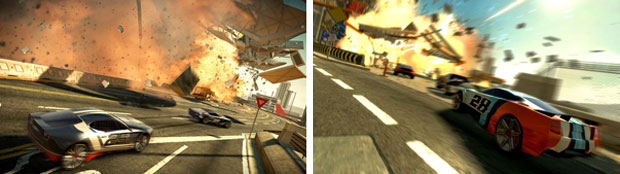
The approach to this title has been described as a Michael Bay-meets-reality TV racer. The emphasis seems to be more on the events the drivers can trigger rather than the act of racing itself. There are many ways to make racing more visceral than simply causing sh*t to blow up in the foreground. But I suppose we are going to the lowest common denominator here.
Does anybody remember the lukewarm reception to the Stuntman series? The linear nature of the levels, reliance on timed sequences and pretty pyrotechnics did little to make this a memorable series. It seems that Disney would rather make a spectacle than a racing game. That is a shame too because Black Rock Studios is capable of much more. Perhaps the Fast and the Furious is also to blame for this debacle?

But I digress...

Burnout is a fine template on which to build a new racing game around. It has a basic premise, is easy to get into and play. Burnout chooses a few things in the racing genre and does them well, like an arcade experience brought to the consoles. If I were creating a racer I would want to begin with the familiar Burnout experience. That would mean solid control, lots of motion blur and the ability to smash opponents into oncoming traffic. Except instead of doing laps around a city I would create a coast-to-coast, multiple branching racer with the engine. In essence becoming Burnout-meets-Out Run. Already sounds better than what Disney was working on, right?
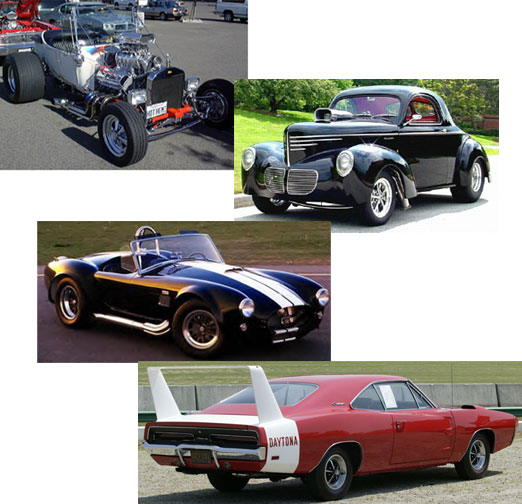
Initially the player would only be able to choose from four cars. These four represent the evolution of the hot rod and are distinct for their contributions. The cars for the game should look like dead-ringers for them but not actually be branded as such just to avoid licensing issues. Yup, I'm cheap like that. If I were naming the four machines they would be the '23 Ford T-bucket because it is the father of the hot rod, a DIY machine with a giant motor and light frame built for speed. The 1940's Willys coupe represents the car turned dragster, it was also the forefather to the lead sled movement. The 1962 Shelby Cobra shoehorned American muscle into a small British frame and dominated the racing circuit. The last was the 200 MPH cruise missile known better as the 1969 Dodge Daytona. For all intents and purposes this 20-foot-long monster was a marvel of modern engineering and represented the peak of the muscle car movement. Each of these cars was an amazing machine, they all deserve to have some shine in a racing game. To the car community each car is also very symbolic of the times. I'm beginning with these machines as a way to get non-car fans a little more interested in the culture.

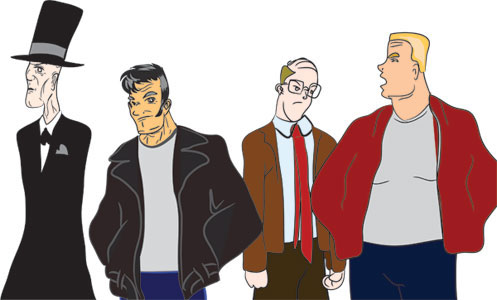
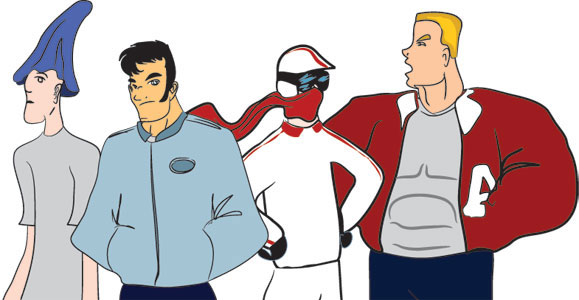
Even the drivers of the cars are all archetypes. Each driver looks like they belong in the game. The driver of the T-bucket is the oldest and dresses classy, his name is the Eddie the "Tin Man," rail thin and quite sickly yet holding onto his dignity. The driver of the Willys looks like an old motorcycle greaser, his name is Gus and he's been sporting the same boots and jeans for decades. The driver of the Cobra, Brian, is a successful businessman that rarely finds the time to do what he really loves. Sometimes you can even catch him in his suit and tie tearing up the streets. The driver of the Daytona is a heavy-set guy with a crew-cut and racing jacket. Dave was the big man on campus back in the day but now settles for racing against anybody and everybody that crosses the path of his muscle car. These are minor details that help frame the universe this race takes place in.
The premise of the game is simple. The four friends decide to settle a bet. Which car would have won a transcontinental race. They agree to go all-out the next day during a grand prix. When the player chooses a character then a small cinema plays out. The night before the race a mysterious benefactor approaches the driver and offers a bottle of special boost. Saying that the mixture is guaranteed to turn their car into an unstoppable monster. The only thing he asks in return for the boost is a race against the winner, never quite saying what happens to the loser. The driver agrees and installs the boost to the engine. We see the stranger make the same offer to each of the other drivers, making them all think that they have the advantage.
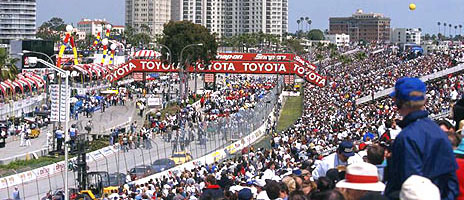
The race begins in Long Beach. A grand prix is running near the coast. The four drivers crash the gates and run side-by side with the Indy cars, police cars follow closely behind. Players learn how to shift, drift and knock opponents out of the race while beating up on Indy cars. The cars continue to do laps until the player has managed to pass all of the control lessons, then the next portion of the level begins. The four cars break through a barrier and get on the freeway, the police still chasing them.
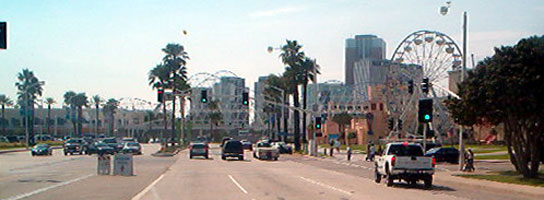
The freeway is wide open for a few miles. Allowing players a chance to get used to their controls and take-down commuters to block the path of their rivals. Doing so damages the player's car, damage is displayed on a meter, crash into too many cars and your car will blow up. The player can take out traffic by using the police "pit manuever" and not damage their own car too much. This strategy is much better than ramming cars at full force. Knocking out opponents or traffic also recharges the boost meter. The boost meter is earned while on the freeway speeding towards Downtown Los Angeles.

The boost is the most important part of the race. Boosting allows players to go much faster than normal, complete with awesome blur effects and a rumbling controller. Boosting also allows the player to smash through traffics and obstacles without damaging the car. Successive take downs recharges the boost quickly, like a combo modifier. A player that lines up enough traffic and finds the right lines can boost almost from the beginning of a stage until the end. While boosting the car, driver and level also begins transforming. This is the real meat of the game, the motif that transforms the racing game.
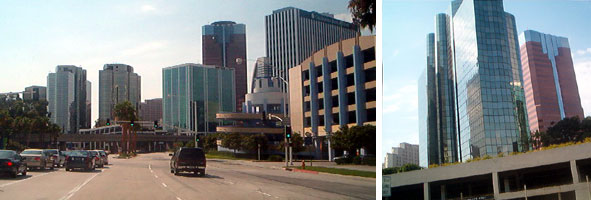
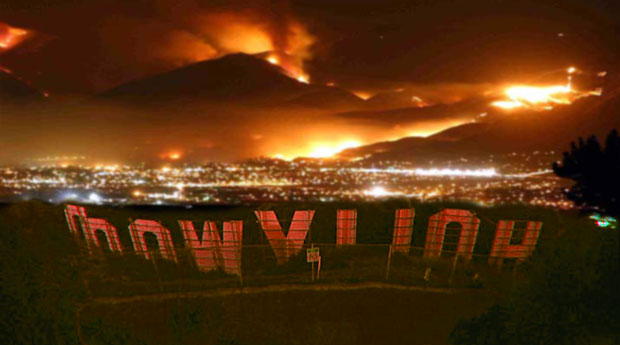
The longer a player boosts the more ominous the level becomes. The edges of the screen glow red, as if the world is catching fire. Prolonging the boost makes the edges creep in towards the center of the screen. Until the level becomes a nightmarish version of Los Angeles. Players can make out demons or giant bats flying on the horizon. Fire has engulfed the hills and city. If you have ever seen the film Constantine then you would know what I'm talking about.
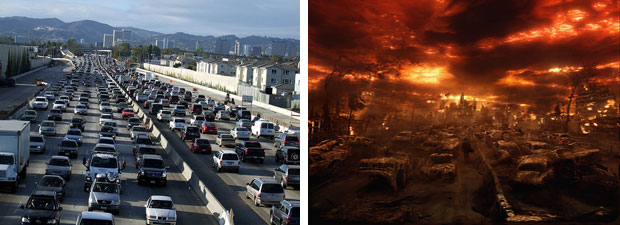
In the film Constantine visits a Hell version of Los Angeles. Everything from the real world is there, the buildings, landmarks and even freeways, only burned and twisted as if hit by the fires of the apocalypse. Long boost chains in my game would render a similar version of LA. Letting off the boost would slowly return the level to normal.
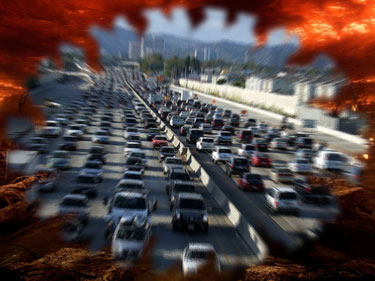
However it is not enough to turn levels upside down, the cars themselves also must undergo a transformation. Even though I said the cars were all legendary, featuring them in a stock condition isn't enough to create an arcade experience. Everything in the game has to take on the speed demon look, especially these rides.
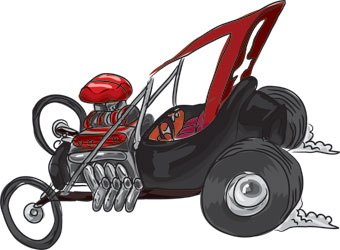
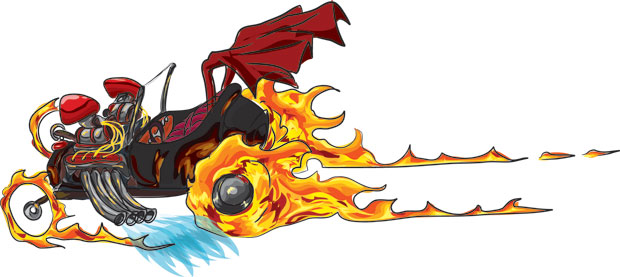
The title car, the T-bucket, is symbolic of how extreme the transformation has to be while boosting. The T-bucket is an great looking ride, with an exposed engine and a canvas canopy over the driver. This 1400-pound car is obscenely fast as is. However while boosting something awesome happens to the ride. The red-painted blower over the engine splits in half and creates two superchargers for the engine. The massive addition of horsepower unfurls the exhaust pipes like a party whistle. The canvas top rips back and almost off the frame, if not for the two metal braces holding them to the windshield. The end result makes the canvas look like a cloth spoiler or gigantic bat wings providing gothic down force to the ride.
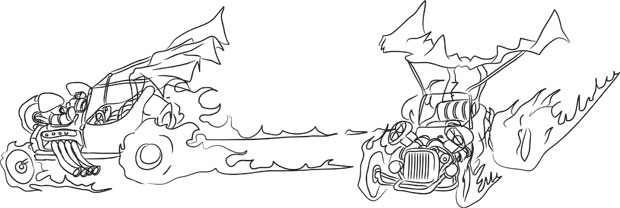
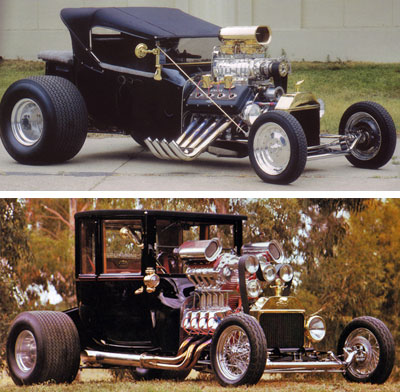
The transformation of this car, like all the rest is inspired by real life. Rod Hadfield's twin-superchaged t-bucket was one of those legendary builds that defines the spirit of hot rodding. Hailing from Australia Mr. Hadfield has a reputation that precedes him. His imagination comes through in the cars he builds, their exaggerated but real proportions make for the embodiment of the style that I'm trying to capture in the game. Just compare what an "average" t-bucket looks like when compared to Mr. Hadfield's beast.
For the game the best part of the transformation happens with the tires. While boosting the tires catch fire and leave long trails of flame in their wake. The longer the boost remains the brighter and hotter the tires burn until they are completely engulfed in flames. The fire creates a vapor Tell me you wouldn't want to play a game where this happens to one of the cars when it reaches top speed?
However the same burning tires thing doesn't happen to each of the other cars. They all transform but in different ways. Each of these ways complimenting the strengths of the car and making the iconic rides turn into grotesque but equally impressive machines. Despite the approach of transforming cars with exaggerated features I don't want you to think that this is some sort of Wacky Races redux. The tone of the game should be a fantastic realism rather than a stylized cartoon. Even if a great animation director can re-imagine the Penelope Pitstop adventures this is nothing to do with the Hanna Barbera type of racing.

For example the T-bucket is the fastest accelerating car in the game. However it is also the lightest and has problems knocking traffic and opponents out of the way. Even while boosting the car suffers from a lack of mass. The saving grace is it's manic accelerating ability. Aggressive drivers might want to try a different car if the T-bucket is too "squirrely" for them.
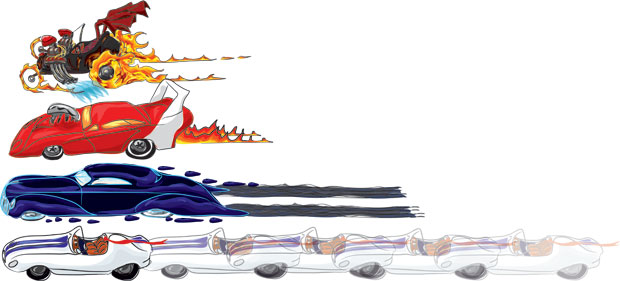
 

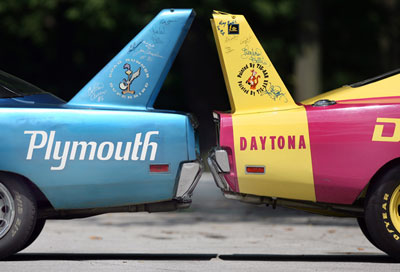
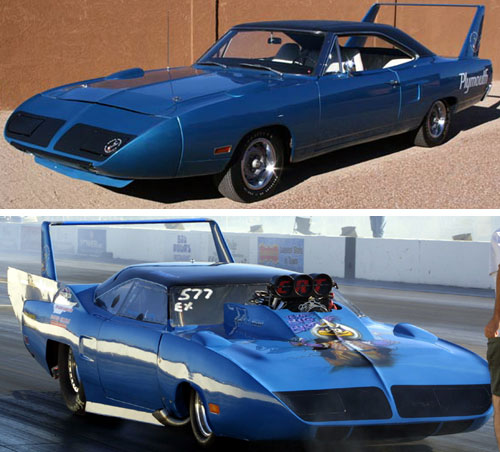
The Daytona clone changes into a funny car while boosting. The tires in the rear balloon up and the angle of attack becomes more aggressive. A gigantic blower melts out from the hood, exposing the monstrous burning hemi engine. The Daytona is the slowest accelerating ride but has the highest top speed. It is also a heavy car so it can plow through opponents and traffic. The real world inspiration was based on a funny car version of the Daytona's sister car, known to car buffs as the Plymouth Superbird.
Matt Tolbin, from Texas, took the already fast and definitive muscle car and turned it into a funny car. It was too large and heavy to compete in class. That didn't stop the car from being a real crowd pleaser. But since I'm saying the cars in the game would be inspired-by rather than licensed from we'll go with a red and white scheme rather than the more familiar blue.
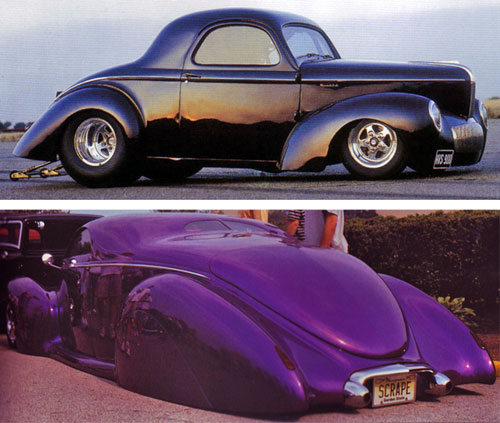
The Willy's has a very dramatic transformation. Rather than becoming a funny car or demon bucket, it begins melting. The body becomes short and squat, melting over the tires like a liquid lead sled and leaving an oil slick in its wake. It has the second fastest top speed while boosting and is the toughest ride of the four. Easily plowing through traffic and opponents. Players trying to hide behind this car as it clears a path for them would spin out from the melting frame. Unfortunately this car, like the Daytona doesn't do as well on turns. Most Willys get the funny car treatment, very few become lead sleds. The majority of lead sleads would be based more on cars like the Mercury Cougar. But hey, it's my game so allow me to make one type of car melt into another shape.
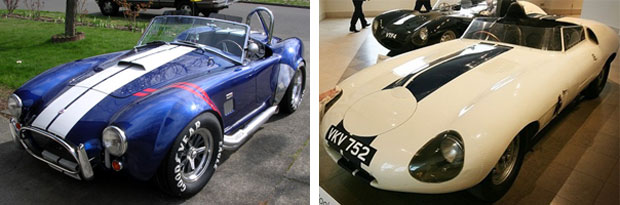
Speaking of changing shape completely; the Cobra has a unique transformation. The colors reverse on the car, from blue with white stripes to white with blue stripes. It becomes a little lower and longer. While boosting it behaves like a ghost. Opponents are unable to run into it while it is boosting although it can still smash into opponents and traffic. This car has decent acceleration and a good top speed. It weighs a bit more than the t-bucket so it can plow through traffic better. The transformation makes the Cobra look more like a Jaguar racing coupe, a bitter European rival to the Cobra.
While boosting something also happens to the drivers. It isn't obvious in the Daytona and Willys but for the t-bucket and Cobra it is. All of the drivers become younger versions of themselves. The beergut on Dave goes away and he is once again built like a high school linebacker, his racing jacket even becomes a letterman jacket. The Tin Man is no longer a wrinkled old man but a spry teenager. His nice tuxedo becomes a dirty tee shirt and his top hat becomes a hillybilly hat, made famous by Ed Roth. Brian is no longer a high strung day businessman but instead a phantom racer of old, with only his red scarf flowing behind him rather than his necktie. Gus seems the least changed of all, with only the gray in his hair turning black and his jacket becoming a mechanic's.
The game continues well past the Hollywood hills, where we can see that Los Angeles is sure enough becoming like hell. Of course there are roads and freeways in the game that don't exist in real life. We get to catch a glimpse of the USA while traveling at over 200 MPH through the desert and rockies.
Save points pop up every so often and players can pause and save in between stages or practice stages once completing the game, searching for additional shortcuts and secrets.

Traffic isn't everywhere so players will learn to conserve what they have during these stages. Without boost then being a good driver really comes in handy during these parts. The courses won't all take place on the roads, rockslides and other natural disasters will force players to cut across the wilderness, and in some stages to ride over bumpy railroad tracks. During one particular detour players will be racing at the bottom of a dry riverbed. Suddenly a huge thunderstorm appears. A torrent of rain creates a massive wall of water that chases the players along the winding canyon.
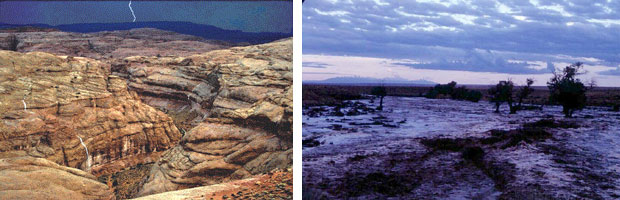
The canyon eventually opens up to a shallow lake. The cars skittle over the surface of the water like 2-ton skipping stones. Unfortunately the lake turns out to be the edge of a dam, with a monstrous drain hole taking the excess water and dumping it at the base of a dam. The cars have no choice but to go down the hole and go shooting out at the base.
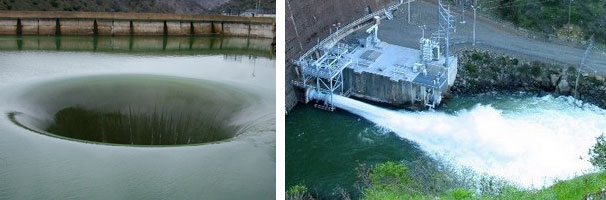
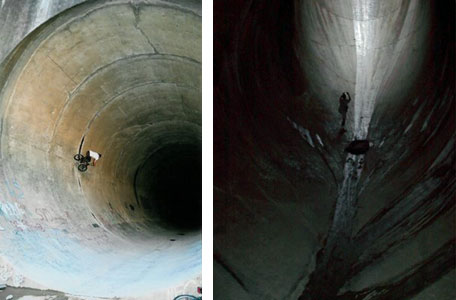
This portion was based on the real-world drain holes made famous by skateboarders. When the weather is dry and the dam is far from capacity plenty of skateboarders and BMX guys make a pilgrimage, and trespass on Federal land, to skate these monsters. I've always wanted to see a car shoot down and through the pipes in a videogame.
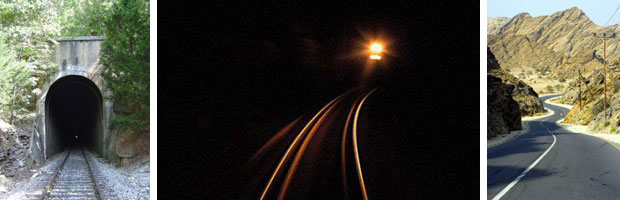
Once the cars rejoin the road they make their way through the Rocky Mountains. The scenery is awe-inspiring. The bridges plentiful and chance to take shortcuts through train tunnels numerous. Of course on some of the longer tunnels players will come face to face with a massive train bearing down on them. Then only a last chance exit through a side tunnel will lead back to the highway.
These changing levels and dramatic situations were mashed together from memories of Rad Mobile. The whole coast-to-coast theme and running against the sun so that day and night would happen faster were also pulled from Rad Mobile. But where did the rest of this game come from, the transforming racers and the hell motif? And what happens once the racers reach the east coast? Come back next week to find out!
Is this a racing game you would like to play? Let me know in the comments section please. As always if you would like to sponsor me please visit my Patreon page and consider donating each month, even as little as $1 would help make better blogs and even podcasts!

follow the Street Writer on Patreon!

Friday, June 4, 2021

My favorite games of all time, the story of Carmageddon part 2...

When the final version of Carmageddon was released in February 1997 it was so much greater than I could have anticipated. I brought the box purchased from CompUSA (ask your parents) into the computer lab early on a Saturday. I didn’t normally work weekends, thankfully we were only open for a half day. After we rushed the last student out we locked the lab doors, and fired it up, sitting through the opening cinema and getting hyped. The intro animation was burned into the memories of a generation. So much so that a fan recreated the opening using the in game camera of the latest version of the game. You can watch the original intro below, be forewarned, it mirrors the dark violence of the series.  


It turned out that not all of the cars, and features were available from the start. Which bummed us out, we were ready for multiplayer madness out of the box. It made sense from a game play standpoint. What was the point of playing if you had access to every level, and every car right away? You had to earn everything, as it was with all great games. It made me appreciate having to grind through the experience, and sharing everything I earned with the staff. I would gladly go through the game on breaks, and after work. Mastering every stage, and vehicle along the way. I even wrote up a 70-page strategy guide for my coworkers by taking screenshots, and writing tips for each level. I even included bios, and maps. I’m sure it’s saved on some Zip drives in my garage (again, ask you parents). If you’ve never played we should begin with the stars of the game. The biggest titles always had some sort of main character, or mascot that they could build a franchise around. Carmageddon was no different. Even though it was about vehicle combat the game had two stars; Max Damage, and Die Anna. Each with own signature car, the Hawk, and Eagle respectively. Think of the relationship between the characters, and their cars just like the stars in the Twisted Metal series. They were interconnected.

Max, and Die Anna were seen on the “Prat Cam” it was supposed to be the drivers in the cockpit reacting to the race. The two would laugh like maniacs as they ran over people, whip their head around after getting in a wreck, scream as they fell off of a building, and even swear under their breath. It gave a lot of personality to the characters, and added another layer of dark humor to an already absurd premise. At the start of the game the cars were nowhere near as fast, or as powerful as they were in the demo. They were easy to wreck, and could be pushed around by opponents, and police cars alike. Earning enough credits to power up the vehicles, and unlock opponents would test my patience. It turned out that the demo stage, and cars were approximately where the cars would have been at about 90% through the game. Their armor, their offense, and their engines had been heavily upgraded by that point. There were many miles of virtual racing to actually get to this point in the full release.

The game began with you ranked 99th in a tournament. Your goal was to finish every race in the series, and become #1. There were almost 40 levels in the game in which to accomplish your goal. Players could skip ranks depending on how many points were earned during each level. It was not uncommon to jump 7 ranks or more for a particularly violent contest. The specific how, and why the Carmageddon tournament was created was never fully explained. This was perfectly fine, as audiences were left to fill in the blanks. Between the opening cinema, and clues picked up from the races we could gather all the information we needed. The tournament was held all around the world, and only the most dangerous racers were invited. These included murderers, celebrities, gang members, cops, and even robots. When races took place in a city, the outskirts, and main roads were walled off. Anyone that remained inside was left to fend for themselves. Other stages were set on an island, or enclosed circuit. This was also not a post-apocalyptic race for survival. You could never mistake the locations for the wastelands of the Mad Max universe. The Carma world was set in living, breathing factories, towns, and vacation resorts. The tournament was a violent satire of the real world. Take it as a futuristic gladiator battle, broadcast to the masses to appease their blood lust.

The rules for the tournament were simple. Each race could be won in three ways, you could complete the required laps, destroy all of the opponents, or kill every pedestrian on the map. The third was the most difficult, but also potentially worth the most points, and prestige. The opponents themselves were a cross section of archetypes, and stereotypes from pop culture. You can imagine that the Black community did not like the representation in the game. There was the pimp-coded Otis P. Jivefunk, and his leopard print top “Caddy Fat Cat.” To be fair the Caddy Fat Cat was the car I used most often in the game. It was fast, heavy, and could take a lot of damage. Then there was the former football star-turned-murderer OK Stimpson, driving a “Fraud Broko.” For those that don’t know the story he was based on; former pro football star O.J. Simpson killed his ex-wife, and her boyfriend in 1994. He was caught in a Ford Bronco during a slow speed pursuit as he tried to flee the country. I would argue that Stainless Games wasn’t making fun of one ethnic group as much as every person in the game was an ugly parody. Also Stainless admits that they pre-censored themselves. They had men, women, cops, and elderly people that you could run over in the game. Artist Terry Lane put his foot down when they said pregnant women should be pedestrians too. They were also mindful that if they had Black pedestrians the racists would go out of their way to only run them over. So they made all the pedestrians white in the first game. They wanted audiences to know that all pedestrians were equal targets in their world. Black, and brown pedestrians, as well as better Black driver archetypes would appear in the sequel.

These drivers, as offensive as they were, and their respective vehicles did not all show up right away. As with all great game design, the opponent rides were equal to, or slightly better than the Hawk, and Eagle at the start of the game. Early races were long, drawn out battles. Opponents smothered players at every turn. Throw in the police which were randomly dispersed through each stage, and the car battles became harder. Only by winning races and increasing your stats could you hope to make the later stages any easier. To balance out the game more difficult opponents would join the tournament as players increased in rank, and as their car became faster, and stronger. Every opponent vehicle had its own strengths and weaknesses. Some were blindingly fast, some were heavily armored, but all could potentially be unlocked. In order to do so you had to outrank your opponents, and destroy them in the level. Once acquired you could drive that specific car, and also increase its armor, offense, and engine. Every vehicle in the game was unique with the exception of Halfwit Harry, and his sister Burly Shirley. Harry, and Shirley had a respective green, or pink Hummer-type off roader. In any instance the diversity of vehicle types, the way they controlled, and benefits really gave Carmageddon a lot of replay value. Some of the cars were labeled Cheat, not necessarily because they had an outright advantage, but because unlocking them seemed to be more random than other cars.

The full version of the game also meant that we had a soundtrack to play along with. Original music was one one of my elements of great game design. Carma did not disappoint. So what kind of music went well with all of that mayhem? We needed something that could get the adrenaline pumping right away. So it was heavy metal of course! Not just any type of metal, but industrial, and electronic. The tempo, and riffs hit like a punch to the chest. They seemed to go very well to create an aggressive, yet also futuristic atmosphere. The biggest name on the soundtrack was Fear Factory. Three of their songs appeared in the game, including Zero Signal, which was also on the Mortal Kombat movie soundtrack. Composer Lee Groves had several tracks as well, which complimented the themes of the major areas of the games. These included “industrial, coastal, desert, and winter wonderland.” Stainless sound designer, and composer Chris Melchior had a few tracks, including music on the expansion as well. The music, screaming peds, explosions, and collisions all blended perfectly. They audibly brought audiences much deeper into this world.

The sudden increase in car types, and multiplayer game modes went over great at work. The other lab techs also began using their break time to get better at Carma, and learn which cars were most advantageous. We began setting parameters on which vehicles were allowed in certain game modes. Some cars were banned outright because they were simply too powerful, or because they had some other unfair property. Stella Stunna for example, a rubber-clad sadist, drove “Electric Blue.” Her car had a built in Electro-Bastard Ray. This was normally a power up that only lasted for a few seconds in other cars. For Stella it was permanently enabled, and could zap pedestrians with a bolt of lighting from up to 10 meters away. This meant that she could easily rack up points in multiplayer games, and power up her vehicle on the fly. This left no pedestrians for the rest of the players.

The other car that was banned from competition was The Suppressor. In the game, as in real life, the cops had access to the biggest and baddest vehicles. The squad car in Carmageddon weighed almost 3 tons, and could go 150mph. It much closer to a supercharged armored personnel carrier rather than the traditional cop car. A group of them could turn any stage into a nightmare, With about 90% of the game complete players would have earned heavy-hitters that could eventually take out a squad car. However the supreme heavy hitter in the game was called The Suppressor, piloted by Police Chief Biggun. It weighed 5 tons, and could reach 250mph. The first time I saw it was actually on the stage featured in the demo. You can imagine my surprise. I was going through the route that I had raced hundreds of times before. I reached the top of a skyscraper, and it was waiting where no cops were previously. I had a fraction of a second to ask myself “what the hell is that?” Before it ran me off the roof and destroyed me with a couple of hits.

I fought tooth and nail against the Suppressor again, and again with different rides until I was able to unlock it. My favorite heavy-hitter was the Plow, a four wheel drive bulldozer formally piloted by Don Dumpster. I used that to great effect against the cops in the game. In LAN matches when using the Plow I would sign in as El Don. Once the Suppressor was in the garage the rest of the game played relatively easily. Again traditional game design dictated that the best weapons were only accessible near the end of the title, otherwise the experience would have felt cheap. The team at Stainless Games knew what they were doing. They even went so far as to highlight it as the vehicle you were rewarded with in the final game cinema. During the awards ceremony the organizers of the tournament are presenting a trophy to an unknown driver. Then in the dark a six-wheeled beast rides up the podium, and flattens everyone, including the cup. I suppose the lesson for Carma was never was about becoming the best, it was about the enemies killed along the way... We were having an absolute blast at work. With the exception of Stella, and Chief Biggun, all of the cars were fair game in multiplayer modes. Depending on my competition I would choose the car that would be the biggest nightmare for them. This frustrated my coworkers to no end. For every one game they won I would often win the next eight. 


The end of the semester tournaments were even more exciting now. Not only that, but as our computer lab expanded, we had more hires that were becoming solid players. The bigger labs also meant that we were getting more attention from other departments looking to create their own computer labs. Carol was our Dean, and would show our labs off to other college admins. This included the VP, and President Carol stopped by for the end of the semester party one year. She was always a bubbly presence, and welcome whenever she visited. She wanted to sit in on our tournament, and see what the fuss was about. The boss lady Alison wasn’t too sure about it, but I insisted. Carol gasped when she found out the game was about racing, and running over pedestrians. After the initial shock wore off she asked, “is it okay if I try it?” We had her sit down, and watched as she drove around the virtual block a few times. She screamed when she began running over pedestrians, “oh no, oh no!” Then she began giggling as she started running into other drivers. After a few minutes she was red in the face from laughing at the mayhem she had participated in. She assured Alison, and even Phyllis our department head, that the game was as much fun as advertised. From that moment on we would be sure to invite her to the tournament each semester. She would decline, but asked that we enjoy ourselves. I can’t imagine that any other college had an administrator that was half as cool. Carol eventually became a Dean at an even bigger college. She retired years ago, but we stay in touch on Facebook.

It turned out that as other departments opened up their own computer labs they were eager to hire our staff. In a few instances they had poached talent from our labs. Carol, Phyllis, and Alison met with the other departments. They said they did not mind sharing talent, or having lab techs train alongside us for a few weeks so they could get up to speed. Poaching our team was not a good look. I remained with our department because as I discovered from my friends in IT that the other labs had far more restrictions than we had. They had their computers on lock down. No games, no demos, no fun. The IT department mostly left us to our own devices because we were good at maintaining our own systems, updates, and security. When I wasn’t playing the game I was researching it. I learned lots about Carma from the game forums, including how it was made. It turned out that there was a huge challenge in trying to get it published. It made me appreciate it that much more. We’re going to look at why nobody was willing to sell Stainless a license in the next entry. If you would like to sponsor me please visit my Patreon page and consider donating each month, even as little as $1 would help make better blogs and even podcasts!

follow the Street Writer on Patreon!