Showing posts with label monster trucks. Show all posts

Friday, May 15, 2026

Taking a shark bite out of my monster collection

Previously on the blog I mentioned how I had started collecting some monster truck toys decades after I stopped. I discovered that not only did they look good sitting on my desk, but they actually photographed fairly well. My pride and joy were the Bigfoot trucks that I had. The oldest was the one from the Matchbox Super Charger series from 1986. This was the one that I could never find on the store shelves. Thankfully an inexpensive one popped up on eBay so I had to pick it up. The newer one from the Hot Wheels Monster Truck line circa 2025 looked great as well. The one with the 10-foot tires from Greenlight models was stunning. It had a highly detailed interior where you could make out the console, glove compartment, and even cup holders! These three were the clearest example of how far toys had evolved in 40 years. I could look at them every day, and never get tired of how cool they were.

I made a conscious decision to clear more room on my desk for more toys, specifically my trucks. I then got the idea of photographing them for the blog. Many 1/64 scale model car collectors had scale garages, parking lots, and even light up gas stations that they displayed their favorite cars on. I didn’t have that much space, or money. Also if I wanted to display monster trucks they might seem out of place next to a scale building. I then got an idea based on the color of my desk. The hardwood was very light in tone, almost like dirt, or sand. So I wondered if I could find a desk mat that looked like a beach, complete with crashing waves. There were a few options, but found one that I think worked best. As soon as I laid down the mat I knew that I was going to have fun with it. I stated previously that I was a fan of storytelling with monster truck designs. I specifically mentioned that the Wreckreation monster camping truck was probably my favorite of the past decade. However that truck wouldn’t make much sense in the middle of the surf. I needed to find other trucks that worked better for the pics.

I found three that were absolutely perfect. Hot Wheels made two of them, the Surf Bus, and the Great Bite shark-bodied truck. Spinmaster / Monster Jam had created the Big Kahuna. Despite my distaste for Feld Motorsports I wasn’t going to lie about how great the design behind the Big Kahuna truck was. The rusty square-body truck with surfboards in the bed definitely told a story. In fact I think it worked better than the more traditional Woodie body that the latter Big Kahuna used. It had a good color scheme, a classic monster truck shape. There wasn’t much they could have added or taken away from its look. The surf bus was self-explanatory. It was the type of bus that would have been used by surfers to visit destinations up and down the coast. The Great Bite however was definitely something else entirely.

I mentioned previously how I didn’t care for monster trucks with silly 3D bodies. This was something that the Monster Jam tour pushed in the late ‘90s when they were booming in popularity. The trucks shaped like dogs, ponies, skulls, and sharks I thought were doing a disservice to the sport. Granted there were a few 3D body trucks in the early ‘90s including Snake Bite which was designed by the Bigfoot Team. To put it in perspective maybe three out of the dozens of trucks competing professionally had non-traditional bodies. The majority of the ones with animal-type bodies appeared almost 20 years after the birth of the culture, so I felt that they weren’t carrying on the tradition. I had no idea who thought this was a great idea, but I was sure that they hadn’t followed the history of the sport. I could just imagine that a corporate boardroom put together truck bodies based on a marketing survey. They asked kids what they liked. The responses were things like ponies, dinosaurs, and monsters. So the people at Feld ran with it. It would be easy for them to market these trucks, make tee shirts, and toys out of them with little regard for the sport itself.

Of the animal bodies the shark was one of the most popular ones in the past decade. This was overlooking Monster Mutt (2003), and El Toro Loco (2001) of course. The Megalodon truck was announced in 2016, and debuted in 2017. It became a hit with audiences, and opened the floodgates for more outlandish animal bodies. The thing was that Hot Wheels had actually created the body style much earlier. Great Bite appeared as a toy way back in 2003, and its sister Shark Wreak in 2010. So once again Monster Jam was cashing in on ideas that they didn’t even come up with. With that said I didn’t care much for the body shape. It wasn’t really telling a story as much as it was just a gimmick. The designers at Hot Wheels went back to the drawing board and came up with something infinitely better.

The new Great Bite body released in 2025. It was another master class in storytelling from the people at Mattel. Instead of creating a generic shark-shaped body the designers Kevin Cao, and Kurina Alim went full Hot Wheels mode into it. For almost 60 years the toy series was known for coming up with all sorts of fun, and wild cars. In this case Alim, and Cao asked themselves what would it look like if a great white shark mutated into a monster truck? They incorporated elements of a shark, but also a shark cage, manta ray, and enormous V8 motor into the body itself. Every angle was dynamic, all of the body lines flowed into each other organically. It was flesh, and machine made into one. It was a radical look that could never be confused with the older shark bodies. It spoke to me when it came out, and I certainly knew why. When I was a kid Hot Wheels launched a line of cars shaped after animals, bugs, monsters, and robots. They called them the Speed Demons.

The Speed Demons were bolder than anything I had seen in the late ‘70s when I got my first toy cars. The line included such memorable names as Vampyra, Cargoyle, Turboa, Ratmobile, and Rodzilla. I’m sure you could imagine what inspired them. Of all the cars released there was one that I thought was the best of all. The Sharkruiser was an absolute beast in both look, and performance. It didn’t have any flashy graphics, or bright stickers to dress it up. Instead it was a flat gray body with chrome teeth, and an enormous engine. It was an apex predator hunting for other fast cars on the road. I took it to school, and my friends agreed that it was the coolest Hot Wheel they had ever seen. I kept that car in my pocket wherever I went. I always had something to play with when my family was traveling. It was one of the few cars that I didn’t give to my cousins when I got older.

The Sharkruiser certainly looked great on my desk. It made me think about getting a small playset to put on the desk as well. I remembered that Mattel released a few shark-themed tracks. For some reason sharks and cars just seemed to go together. I had no idea how many had come out until I started searching for them. There must have been nine or ten released in the past 30 years. Then there were tracks themed around snakes, spiders, dinosaurs, volcanoes, slime pits, and more. The majority of the playsets were too big to display, but there might be one that could fit onto my beach mat. If, and when I decided to get one then it would be a topic for another blog.

I’d like to know your thoughts. Did you have any classic toys that you held onto? Did you get any re-releases of a favorite figure, or car? Tell me about it in the comments section. As always if you enjoyed this blog, and would like to sponsor me please visit my Patreon page and consider donating each month, even as little as $1 would help make better blogs and even podcasts!
follow the Street Writer on Patreon!

Friday, May 8, 2026

Undead hot rod culture, a match made in hell

I spent the last few weeks doing a deep dive on my obsession with monster trucks. How I became a fan, what toys I collected, a history of the organizers, and more. I had something left to say about the design behind the Bone Shaker. I said that it was essentially Mattel’s counter to the Grave Digger. I argued that the reason why the Bone Shaker was an instant hit with the community was because it called back to the roots of hot rod culture. It had a body similar to the classic Ford Model T, A-Frame, and B-Frame cars with the styling of modern rat rods, and the fantastic elements of a chrome skull, and skeleton hand headlights at the front.

Americans had been car crazy ever since the introduction of the automobile. In the early 1900’s cars were utilitarian. They were a replacement for horses, and buggies. Some of the first car builders were former carriage makers. As technology improved they made cars with better handling, better visibility for drivers, and better comfort for passengers. By the 1930’s cars started having more unique body shapes that were less carriage like. Automobile manufacturers also started offering different colors, and options. Some cars were now becoming luxury items. Roads began being paved, and expanded beyond the city. In the late 1940’s Americans were returning from a war economy to a peace economy. Factory jobs were changing. Women, and minorities were not willing to give up the advances that they had gained, and suburbs were expanding. There was some civil turmoil boiling under the surface, and it would only get stronger through the 1950’s, and especially the 1960’s.

As far as car culture went it was in the late 40’s, and ‘50s that a perfect storm was brewing. That original generation of cars were now filling up junkyards, and collecting dust in garages. There was a surplus of bodies, and a youth culture that was eager to get away from the war mentality that they had grown up with. They put that energy into rock and roll music. They put that energy into rebellion. They put that energy into remaking old cars because they couldn’t buy new ones. More than simply trying to go faster, and faster this was the foundation of hot rod culture. Hot rods were considered too fast, and too dangerous for the masses. Hot rods were counter culture. They were punk. They were rebellious. They were visual statements against the establishment. After all what could be more punk that ripping the hood, and fenders off of grandpa’s old car, chopping off the top, and exposing the motor?

Teens were constantly embracing anything that shocked adults. The fashion, the music, the language, anything that challenged the status quo was appealing to them. The bigger the shock value the more the youth were drawn to it. Years ago I talked about “Big Daddy” Ed Roth. He created the most mind-bending custom cars, trucks, and motorcycles. More important he created Rat Fink. He would become the mascot of hot rod culture. Aside from Rat Fink things like ghouls, ghosts, skeletons, monsters, and the macabre actually mixed into hot rod culture very well. This wild mashup of elements couldn’t be ignored any longer. It was becoming a part of pop culture. It could be seen in Ghost of Dragstrip Hollow, a movie from 1959.

Hot rod culture was constantly evolving, and creating different branches. Entering the 1960’s there was another movement happening within the culture. Builders were creating what would later be known as “show rods”. These were hot rods seemingly built out of anything, including a barbershop chair, telephone booth, bathtub, bed frame, and popcorn cart. The Boothill Express by Ray Fahrner was arguably the coldest example of the movement. He turned a late 1800’s funeral coach, the kind that carried the outlaw Jessie James into a hot rod. Show rods could be a little campy, but the builders that understood the culture could really make a statement. Such was the case for the “King of Kustomizers” George Barris.

Mr. Barris was known for building all sorts of outlandish hot rods, show rods, and especially cars for television. He built the Black Beauty for the Black Hornet television show. He built the Batmobile for the Adam West TV series. He built K.I.T.T. for the show Knight Rider. He built the Beverly Hillbillies truck. He built the Monkeemobile (designed by Dean Jeffries) for the Monkee’s television show. All of these cars were brilliant, but I would argue that his best work went into the Munsters show. The family car was a stretched t-bucket-meets-hearse called the Munster Koach. Not long after he gave Grandpa Munster a car by turning a coffin into the wickedly cool Drag-u-la. To be fair these last two were designed by Tom Daniel. Tom had created a number of best selling hot rod model kits, some of which were so popular that they were turned into actual show rod builds.

There was definitely an appeal to the ghoulish hot rods. By the late 1960’s hot rod culture was becoming mainstream culture. It was subtle in movies like The Great Race. The 1965 Warner Bros. classic featured several fictional rides, but none were as scene stealing as Professor Fate's Hannibal 8. I would call that ride the original Sinister Six. You could also see the hot rod appeal in the cartoons from the era. Shows like Tom Slick captured the spirit in 1967. A more popular cartoon was called Wacky Races, which was influenced by The Great Race. Animation studio Hanna-Barbara was always quick to turn a pop trend into a cartoon. They were the animation studio that turned the live action shows Happy Days, Star Trek, and Gilligan’s Island into cartoons after all. The studio saw how quickly car culture had grown in the past decade. They made a cartoon that was essentially a mash up of show rods, hot rods, and the model kits from Roth, Daniel, and Barris.

The Wacky Races featured a car made of stone driven by cavemen, a ‘30s sedan driven by mobsters, an airplane-turned-car driven by a pilot, a military tank driven by a general, and even a distillery on wheels driven by a moonshiner. Some of contestants were Big Gruesome, and Li’l Gruesome know as the Gruesome Twosome. They piloted the Creepy Coupe which was a rolling haunted house. It hosted all manner of monsters that they could call upon for help. The kinds of fantastic cars featured in Wacky Races wouldn’t necessarily have made sense in any other time, but they perfectly captured the anything goes spirit of the ‘60s.

There was a certain appeal to what I called the goth hot rod aesthetic. It was as intimidating as a custom car build could get. The hot rod had long been a canvas for artists of every kind. Some would paint pinstripes, or airbrush flames all over their rides. Some would make cartoons of monsters driving hot rods, or build models of skeletons racing dragsters. Some would hand build fiberglass bodies over a rolling chassis. Ed Roth managed to do all of the above. He was the leader of a movement that had no parallel. Certain paint schemes, or body mods told a story. They reflected the personality of the builder. These things let other people on the road know how badass their ride was. There was the extreme end of kustom kulture. One that went well beyond a massive engine or paint scheme. The most heavy metal thing a person could do was turn a hearse into a hot rod. Changing a car that was previously used to carry dead people into a street racing machine was beyond macabre. It was apparent in the Boothill Express, and every modern hearse-turned-rod ever made. This connection between hot rods, and the undead had been coloring the mainstream for generations. It would eventually influence car designs in video games.

Carmageddon was one of my favorite games of all time. It was a vehicle combat game from the mid-‘90s that didn’t use guns. Instead the cars destroyed each other in collisions. That was when they weren’t running over pedestrians. There was a number of memorable cars, trucks, tanks, and monsters that had been featured in the series. One that was highlighted in the original title, and early ads was a fan favorite called the Stiff Shifter. It was a hot rod hearse driven by the Brother’s Grimm. It had coffin in the trunk, and the owners were rumored to have a connection to the underworld. The full story of the Brother’s Grimm hunting for souls, and summoning demons was explained in the official comic which was available to people that contributed to the Kickstarter campaign. It was my little brother’s favorite ride in the game, and one that I certainly enjoyed racing with as well. It wouldn’t be the only game influenced by the wicked designs of hot rods, and show rods.

The 2009 game Brütal Legend by Double Fine was a love letter to everything rock & roll, specifically heavy metal music. It called out 50+ years of history, and culture. It presented the type of world that Ed Roth would have dreamed up; filled with avatars of metal icons like Rob Halford (Judas Priest), Ozzy Osbourne, Lemmy Kilmister (Motörhead), Glenn Danzig, Lita Ford, Metallica, KISS, and more. Director Tim Schafer was known for his sharp writing, engaging stories, and funny games. These included Maniac Mansion 2: Day of the Tentacle, Psychonauts, Grim Fandango, and Full Throttle. Each one was a refreshing change of pace from the standard genres. Brütal Legend had one of the greatest aesthetics, and world building of any action-meets-RTS game. There was nothing like it before, or after. The good guys, bad guys, magics, vehicles, and character designs pulled together several generations of heavy metal influences. The team at Double Fine somehow made it all work together, and put it in a package that was severely underrated. The iconic rides reminded me of the darkest monster trucks I had ever seen.

There had been a few hearse-bodied monster trucks in the community. Some going back almost to the birth of the sport. The oldest I think was called the Undertaker. It had a 1955 Cadillac Hearse body that was built by Tom Zachery and Robert Moore. I first saw it in an old monster truck poster magazine. Based on its construction it looked like a first generation monster truck. This meant that it was on a stiff frame with traditional shock absorbers. These were prone to breaking if pushed too hard in competition. Then there was Cardiac Arrest, which was built by Rick Rabb from a 1961 Cadillac Hearse. The construction of this one was closer to a second generation truck, which meant it had a greater range of travel on its suspension. This made it less likely to break in racing. This truck was sold to a Canadian. It was fixed up as the Soul Collector, and turned into a ride truck from the last news I was able to find on it. They all demonstrated that the goth hot rod worked whether they were slammed to the ground, or riding on monster truck tires. That was one of the reasons why the Bone Shaker looked so good as a monster truck. This dark aesthetic also reminded me of the early version of the Grave Digger.

Dennis Anderson like many of the early monster builders started with a work truck. He strengthened the chassis, built a new motor, added a better suspension, and more over the years. Replacing mechanical parts like transmissions, and axles with military equipment so they could take severe abuse. The tires got taller, but still narrow so that he could conquer the mud. Then one day his truck got big enough to run in monster truck competition. The 1950 Chevrolet Panel Van that it was built from was both beautiful, and brutal. No other driver had anything that looked remotely as tough. A lot if it had to do with its paint scheme. The van was all black with green flames on the front, and an airbrushed ghostly skull cloud hovering over a cemetery. A haunted house was shrouded in the mist. The chrome grille with some patina, red headlights, and gold rims gave the truck contrasting colors. It helped frame its tough appearance. Everything about the early Grave Digger embraced the spirit of do-it-yourself. That was the backbone of hot rodding. Monster trucks were essentially hot rods for off road enthusiasts. The baddest monster trucks embraced their brutal side. They didn’t aways have to look bright, and polished like a show truck. They were allowed to be rough around the edges. To show their working man roots. The important thing was that they got the job done.

By comparison the recent builds by Feld Entertainment were more uniform, almost cookie-cutter. The trucks featured in the Monster Jam shows had steel tube chassis made by one of a handful of fabricators, often painted with a bright complimentary color. The interchangeable fiberglass bodies had colorful graphics. Not the toned down, hand painted metal bodies of the old school trucks. The new frames were covered with sponsor stickers similar to NASCAR. The Feld monsters looked like they were searching for corporate branding opportunities rather than cars to flatten. Feld made sure that their trucks offered a family-friendly look, whereas the original Grave Digger looked like it was about to beat you up, and take your lunch money. This was what I felt was missing in the modern format, and most new builds. It wouldn’t hurt to see them return to their roots, and maybe put a coffin in the bed. That’s what I think anyhow. Do you think the macabre and motorsports work together? I mean would a goth NASCAR design work? Tell me in the comments section. As always if you enjoyed this blog, and would like to sponsor me please visit my Patreon page and consider donating each month, even as little as $1 would help make better blogs and even podcasts!
follow the Street Writer on Patreon!

Friday, April 3, 2026

Losing a monster collection, and getting it back

If you were a regular visitor to this blog then you probably knew that I collected various things. These included foreign, and domestic comic books, comic book toys (especially Hulk figures), Japanese video game magazines, sneaker books, vinyl basketball figures, Wonder Eggs ephemera, and of course Oswald the Lucky Rabbit merchandise. One of the things that I used to collect were monster truck magazines. In fact I used to have a massive library of 4x4 magazines, skateboard magazines, and US video game magazines.

Unfortunately almost 20 years ago Southern California experienced a series of freak rainstorms that lasted for weeks on end. Some of my collection was in my bedroom, but a good portion was also stored in my parent’s garage. I didn’t realize at the time that there was a leak in the garage roof, directly over where I kept most of my magazines. It not only dripped directly onto my magazines, but it also pooled on the garage floor, where most of my books were sorted in cardboard boxes. By the time I learned what had happened I had lost decades of issues, including the first hundred or so copies of Electronic Gaming Monthly, Game Pro, and Gamefan.
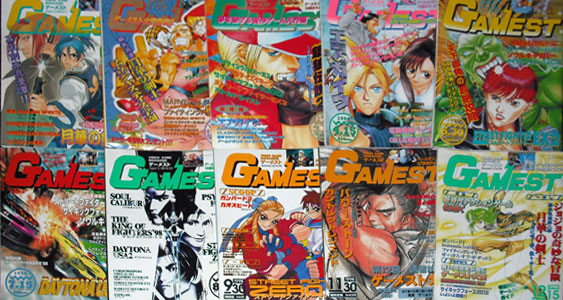
By a miracle the rarer Japanese issues that I owned managed to stay dry. After the storms passed my family rented a dumpster. My brothers, and I helped empty out the garage, throwing away piles of disintegrating paper. My mom would have the garage torn down, and rebuilt. I began sorting, and organizing the things that survived. I put them in a storage unit where they remained for years and years. I was genuinely heartbroken over what I had lost. I didn’t bother trying to build the monster magazine collection again. In fact I didn’t want to look or think about anything monster truck related for years after. I mentioned how I broke out of that cycle in 2019 when a monster truck jumped over a flying plane. Some people outgrew the things they loved as kids. Not me, from the moment I saw my first monster truck I was hooked. My friends, and family learned to live with my obsession. Remember the story about how I was more excited to play a monster truck arcade game than go on any rides at a local theme park? When I say I was a fan I meant it.

My parents always supported our interests. While they bought my brothers toys, I begged them for a subscription to Four Wheeler Magazine. They were happy that I was a voracious reader, more important they appreciated how well we took care of the things they bought. My brothers, and I were aware how hard they both worked. They gave us the advantages they didn’t have growing up. We saw them go without just to make ends meet. So we took good care of every present we got. In fact we still had some of the toys, and comics we grew up with. At the end of the year we would give some of the toys we had outgrown to cousins, nieces, and nephews in the US, and Mexico. In my case I gave up entire Hot Wheel track sets, and dozens of cars that I had held onto for years. For my little brother he gave up folders of Pokemon cards, which in hindsight could have been a downpayment to a house. The gifts also included our BMX bikes as we entered our teen years. We knew that things were sometimes tough for our extended family. We were fortunate enough to help.

Quality monster truck toys were hard to come by when I was growing up. For the longest time all we had were Hot Wheel trucks, which were good, but not real monsters. Then one day the gods smiled on us. The Super Chargers by Matchbox set the bar that wouldn’t be topped for years. They were roughly the same scale as Hot Wheels, about 1:64. They had the trademark oversized Goodyear tires, and axels with a little give so you could roll over your toy cars. They debuted in 1985-1986 and featured a who’s-who of the monster pioneers. These included Bigfoot, USA-1, Awesome Kong II, Fly-N-Hi, Mad Dog II, Rollin’ Thunder, and Taurus. Over the following years Matchbox would add more trucks, and even pulling sleds to the lineup. These other monsters were completely made up. I’m sure an accountant at Matchbox said they could save money on licensing costs by creating their own lineup. These included cars, trucks, and jeeps with names like Bog Buster, Hawk, Toad, Doc, and So High. My parents were willing to get me one of these cars each time we visited Toys R Us. Again, I was grateful for their generosity. I’m sure they were happy that we were content with Hot Wheels, and never asked about the U.S.S. Flagg for our G.I. Joes.

As the ‘80s went on more, and more monster truck toys started popping up, and even monster-adjacent trucks started appearing. For example my older brother was an avid collector of Legos. He’d been a fan since the late 1970’s. In my lifetime I only collected a few sets. Some of which were the first lifted trucks produced by the company. I remember my brother’s excitement when he found them. He pulled me to the toy aisle to show me. A little red, white, and blue truck called the 4-Wheelin’ Truck from 1987. Then in 1988 he found the black Road and Trail 4x4 which was even larger, and clearly the first monster produced by the company. Just out of curiosity I jumped on eBay to see what the trucks were going for today. The white one was around $20 including the box. I was shocked to see that the Road and Trail boxed set ran for around $260. This made me more grateful that I took good care of my toys, even if most of them were still in the garage. Looking back on the ones I collected it frustrated me was that the Bigfoot Matchbox toy was never on the shelves. I searched at every toy store for years, but I could never find the iconic blue Ford. That was the one that I always wanted. I had to settle for some of the generic monsters, and a couple of the named ones. I still respected the vehicles in my collection because they were groundbreakers.

Taurus was a popular truck. It became a legend for crushing busses. By the mid ‘80s people knew that monster trucks could easily crush cars. In order to stand out the drivers had to get more creative. Jack Wilman the builder / driver of Taurus decided to run his crimson painted monster over two school busses tucked side-by-side. It was super dangerous considering that in order to reach that height the truck first had to roll over some cars, and then crawl up to the roofs of the busses. You might know that bus roofs were not reinforced. So the almost six-ton monster truck would flatten the roofs, and create a shaky platform. Mr. Wilman would then have to get off the other end without falling off sideways. He could have easily injured himself, and wrecked his truck in the process. It was a spectacular stunt that was rarely performed by any other monster. Then there was the first monster van Rollin’ Thunder. This bright orange van was actually a local legend. The owner / builder / driver was Jim Oldaker. He was out of Redondo Beach. I would often see the van parked at a shop in Wilmington California. I never got a picture with the van because I assumed it would always be there. These two Matchbox monsters went everywhere with me. They were especially fun to play with in the playground, and beach. The big wheels rolled right over the sand whereas all my Hot Wheels would sink right in. I was super-happy with the Matchbox toys, then one Christmas I got the greatest present a kid could ask for. My very own Bigfoot from Playskool toys.

The rest of the toy industry was learning that monster trucks were not a fad. They had captured the imagination of the entire nation. They appeared in movies, and on television. There were news reports, and magazine articles on the movement. Kids were especially drawn to them. We couldn’t get enough of the awesome machines. Toy companies were scrambling to create new 4x4 products. Then they had to figure out how to market these trucks to the masses. It was an easy sell to me, however some people needed to understand what these giant trucks were all about. Playskool, or rather their parent company Hasbro learned that they could feature Bigfoot in a cartoon show. These shows were wildly successful ads for their other toy lines including Jem and the Holograms, Inhumanoids, Transformers, and G.I. Joe. In the cartoon series the fictional Yank Justice was the driver of Bigfoot. He was the star of a traveling crew called the Muscle Machines. This team had sled pulling cars, and trucks like the Orange Blossom Special, War Lord, and Black Gold. They were putting on shows all over the country when they got involved in a mystery adventure.

The series was animated by the same studios that worked on G.I. Joe, and voiced by the same cast. It was a cheesy series that managed to make sure that each character got a chance to shine. I think this was the part that studios didn’t really understand about the culture. The trucks were the draw at the sled pulling events, mud bog, and hill climbs at stadium shows, and county fairs. Each vehicle had its own personality. They all had unique bodies, suspensions, tires, and power plants. No two performed the same. More important each truck built their own fan base. It was apparent in the Knight Rider TV series that the robot car K.I.T.T. was more than the co-star of the show. The episodes that revolved around vehicle opponents like K.A.R.R., the Juggernaut, and Goliath were the most memorable ones. In a similar fashion the best parts of the Bigfoot cartoon was watching the truck go up against combine harvesters, steam rollers, and the fictional monster trucks Grave Roller, and Barbarian. I had a feeling that if the series had been more encounters like that, and less mystery adventure like a G.I. Joe then it would have been picked up for another season.

When our parents moved us out of our tiny apartment in Downtown Long Beach into a house in North Long Beach our toys, comics, and magazines came along. When I didn’t have anything to read I would walk to the local 7-11 to buy issues of Off-Road, and also 4Wheel & Off-Road magazine. This was through the mid ‘80s, and early ‘90s. You could now imagine how many issues of that era were lost. Monster trucks meant a lot to me all through my childhood, through my formative years, and into adulthood. While I gave up a lot of toys to my nieces, and nephews, I never stopped loving monster trucks That was why I was devastated when my collection was wiped out. I learned to accept the loss, and be grateful with what was preserved. Years later I got married, went through various moves. Including a period where we didn’t have a permanent residence. Eventually we were able to get some stable housing. By the grace of God I was able to bring the collection out of storage, and move it into a new garage (with a better roof). My family noticed that my mental health improved when I brought my Japanese game magazines into the house. My wife, and kid encouraged me to start collecting again. The library felt incomplete because it lacked the extensive 4x4 library that I once owned. So I decided that would become my focus.

I started rebuilding the library in earnest. It took almost 15 years by the time I wrote this blog to talk about it. I would pick up back issues on eBay. Sometimes I would get an entire lot of 10 or 20 off road issues at a time for very little. I’d toss the ones that didn’t have monster features in the recycle bin, or pull out single pages for my scrapbook wherever there was a short article. Sometimes I would go months without seeing anything worth collecting. Then there were greedy sellers asking too much for single issues. I kept to my budget, and waited them out. Every now, and then someone would sell the same rare issues for a few bucks, and that’s when I would move. By my estimation I managed to get back about 95% of the titles that I originally owned. I was missing scores of posters. Again greedy sellers were gutting poster books, and trying to sell individual posters for absurd prices. So I passed on all of those. The biggest surprise was that I managed to land books, and magazines that I never owned as a kid. I had an entire chronology of the birth of the monster truck movement in the early ‘80s, all the way to the creation of the Monster Jam tour in the ‘90s, and even the rise of the mega truck generation in the 2000’s. As an illustrator I had a resource library that I could go to for every era, and type of truck, engine, suspension, and angle that you could imagine. I was very proud of what my family helped me rebuild. As with everything I owned it was a slow, and steady process.

Speaking of rebuilding. When I couldn’t find any back issues then I would hunt for physical toys. Since our apartment was tiny I wanted something small that wouldn’t take up much space. Preferably something that would fit on my desk. It would be nice to have something that I could look at every day while I was working from home. I already had a number of items on my desk to remind me of my passions. Things like skate tools, fantasy coins, a Big the Cat figurine, a Laboon gashapon, a Neo Geo Pocket Color, and a Michael Lau figure. These were things that I could pick up, study, and play with while I was on break. The only thing missing were some vehicles. At first I thought about picking up some of the recent model quality trucks. GreenLight Collectibles launched the Kings of Crunch series in April 2020. These were first generation, and some second generation monsters in the traditional 1:64 scale. They were absurdly detailed, with realistic interiors (including cupholders!), and undercarriages. The quality of each build was well above the standard Hot Wheels toy. No disrespect to Mattel, but these were gorgeous models that you could proudly display. Although I was tempted to invest heavily in the line I decided to only get a couple of trucks. Those being Bigfoot V, and Bigfoot VII, the ones that had the 10-foot tires.

In addition to the Greenlight models there were tons of monsters in the toy aisles, however there was only one line that I really wanted to return to. I jumped on eBay, and searched for the original Super Chargers. You could already guess which was the first one that I picked up. After 40 years I finally had my own Matchbox Bigfoot! Then I worked backwards to pick up the other real world trucks. USA-1, Awesome Kong II, Fly-N-Hi, Mad Dog II, and Rollin’ Thunder. My original Taurus truck was somewhere in the garage, so I would eventually add it to the desk as well. It turned out that a lot of monster truck toys came, and went after I lost my original magazine collection. I’ll talk about picking those up in a future blog. Did you have something you loved, and lost? Were you able to get it back? Tell me in the comments section. As always if you enjoyed this blog, and would like to sponsor me please visit my Patreon page and consider donating each month, even as little as $1 would help make better blogs and even podcasts!
follow the Street Writer on Patreon!

Monday, December 18, 2023

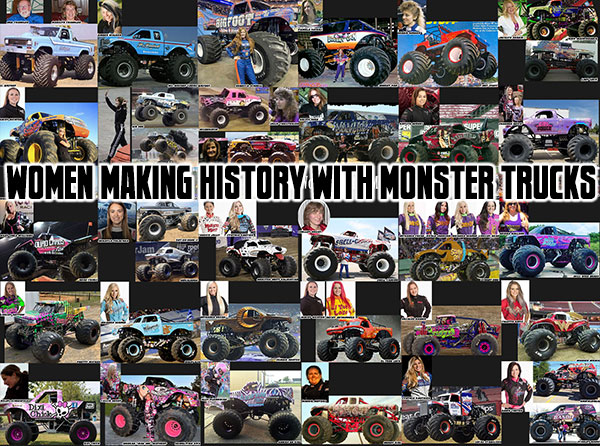
Women Making History with Monster Trucks...

In March 2023 I did a month long series on my Twitter, and Instagram celebrating the contribution of women in the history of monster trucks. As a huge monster truck fan I wanted to share the posts here on my blog as well. I hope you enjoy, and I hope that you are having a wonderful holiday season!

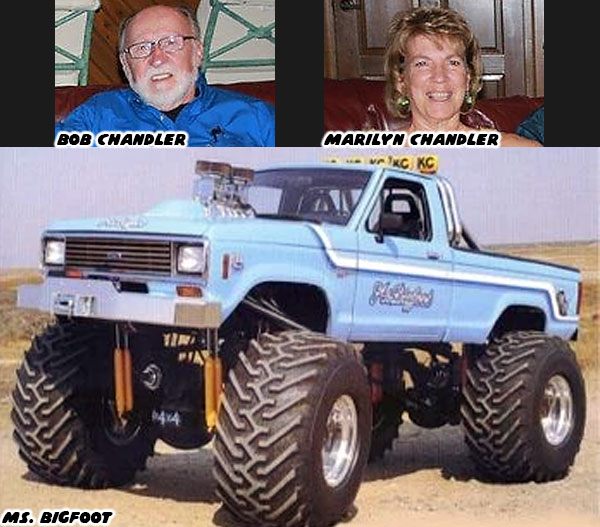
I’ve been keeping this in my back pocket for a while. For women’s history month I’ve always wanted to celebrate the women that helped shape monster truck history. Starting with Ms. Bigfoot, Marilyn Chandler. The wife of the of monster truck innovator Bob “Bigfoot” Chandler. She got tired of him having all the fun, and asked for a truck of her own in 1985. The rest as they say is history.

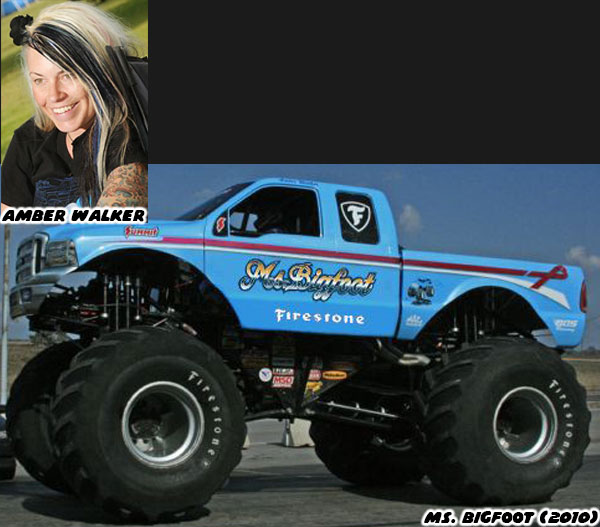
To be fair Bob used to call the trucks "silly" but his wife said they looked more like monsters. She along with Pontiac Silverdome announcer Bob George helped coin the term monster trucks. Amber Walker drove the updated Ms. Bigfoot (2010). I still think this was one of the best bodies ever used on the truck.

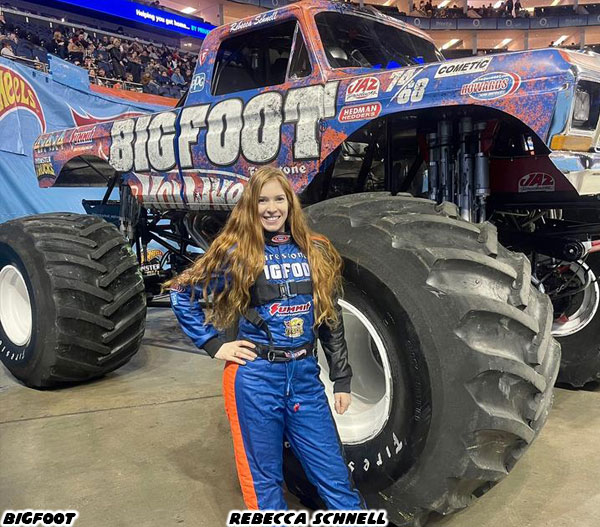
And these days Bigfoot is sometimes driven by Rebecca Schnell. She even lets her husband Darron Schnell drive it from time to time.

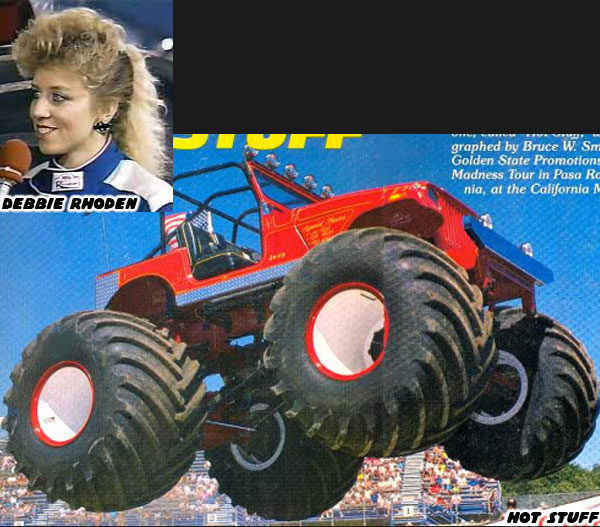
There weren't many monster trucks built out of Jeeps. For the obvious safety issues in the event of a rollover. One of the first brave enough to race with one was Debbie Rhoden in the bright red Hot Stuff.

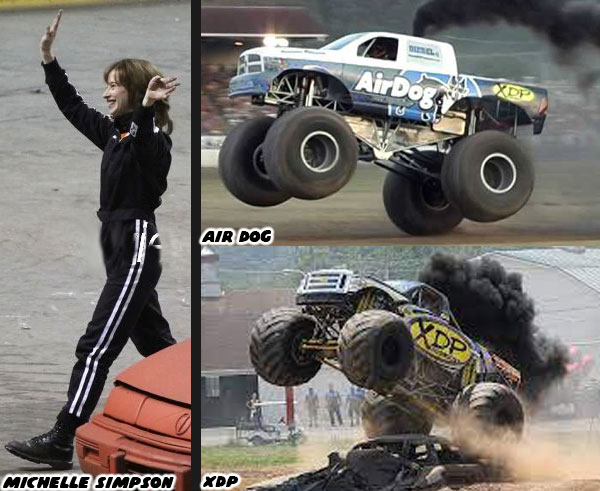
Contrary to popular belief Brodozer was not the first diesel monster truck. Those were in competition for decades. One of the pioneer drivers was Michelle Simpson who piloted the Air Dog, and XDP trucks.

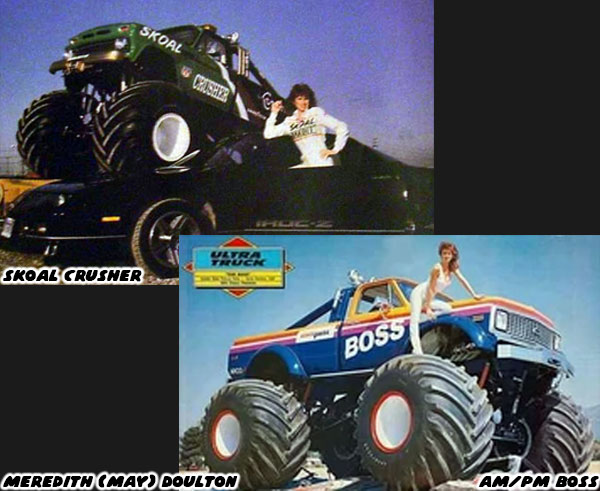
Meredith (May) Doulton, and husband Seth formed Golden State Promotions in the early '80s. They were among the first to get big name sponsors for trucks like the Skoal Crusher, and AM/PM Boss. She competed, and advertised at the same time. It was genius, and she is overdue for the monster truck hall of fame!

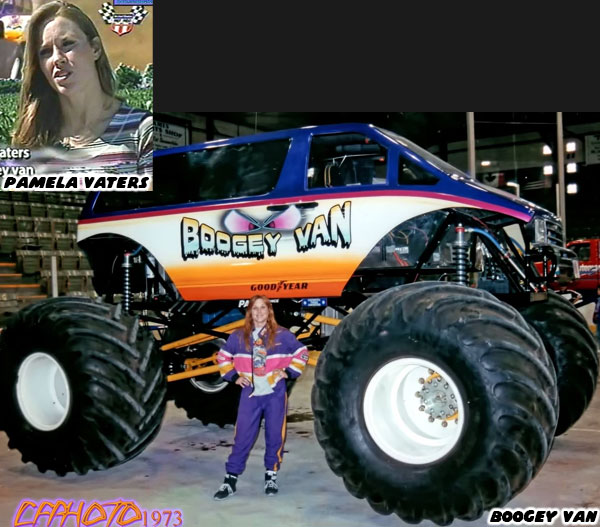
Beware the Boogey Man? NOPE! Beware the Boogey Van! Vans were rarely seen in monster truck competition. I can't think of any as quick as the Boogey Van. Pamela Vaters was one of the drivers competing regularly in the USHRA Monster Truck races.

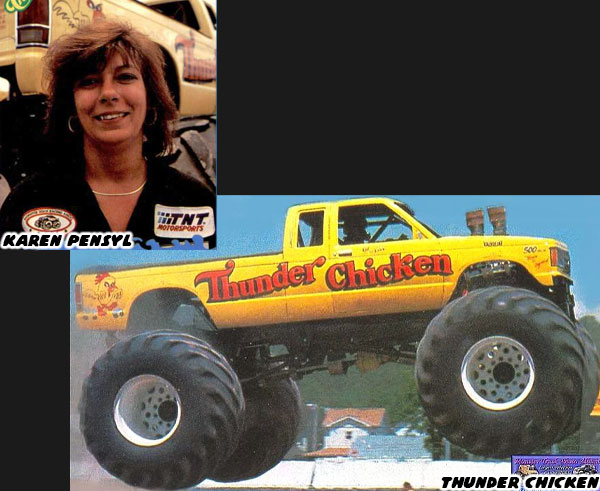
Thunder Chicken was a bright yellow racing truck driven by Karen Pensyl in early televised races. She took on classics like Mad Dog, Wild Hair, and the Carolina Crusher on TNT Motorsports.

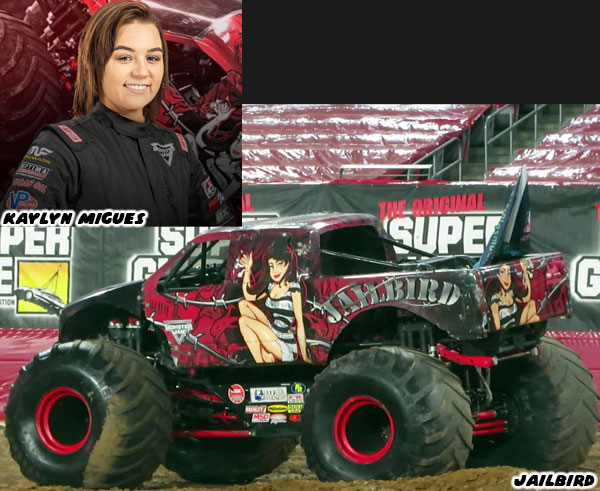
Monster trucks run in the family. Kaylyn Migues drives Jailbird. She's the daughter of monster truck owner / driver Darren Migues, and the sister of driver Tyler Migues.

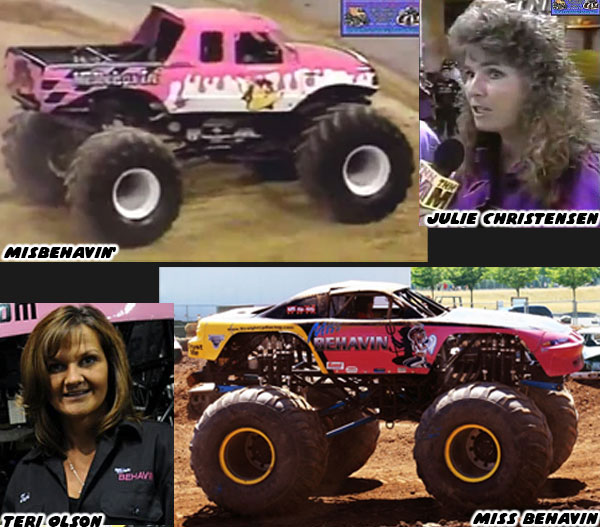
Two awesome women drove two awesome monsters. Miss Behavin, a stock car type monster was driven by Teri Olson, Julie Christensen drove a more traditional truck known as Misbehavin'.

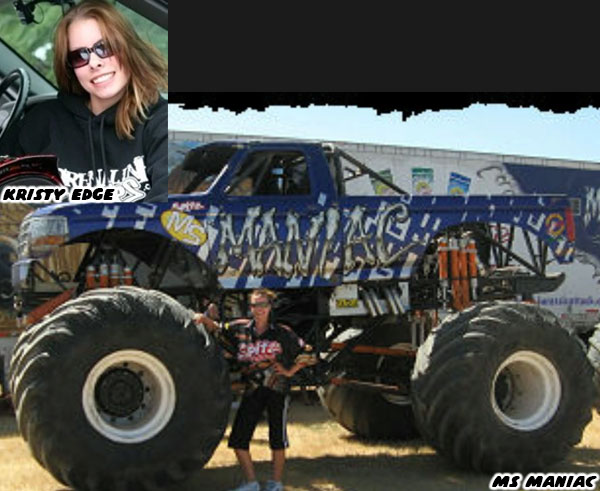
The wild looking Ms. Maniac monster truck was driven by Kristy Edge. She would sometimes compete against the Maniac truck driven by Don Frankish.

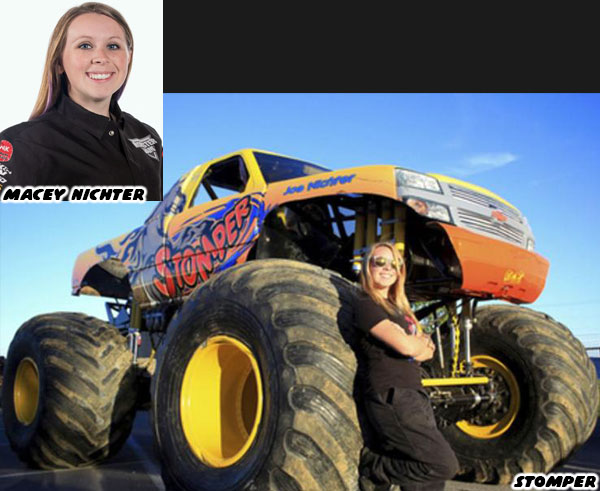
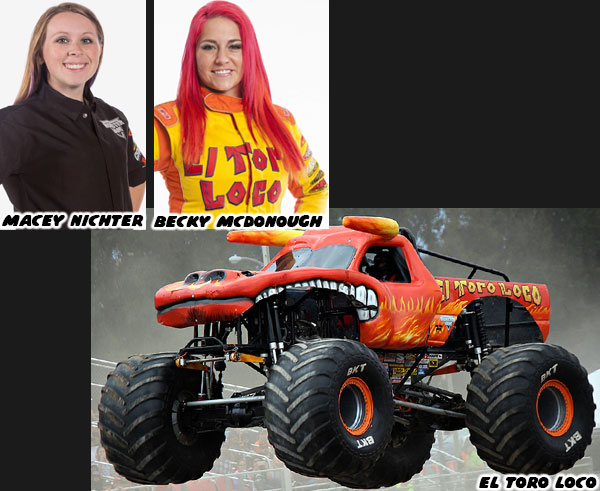
Stomper the monster truck, also known as Lethal Threat Stomper goes back to the early '90s. Different owners, different drivers then. Today it is driven by Macey Nichter, sometimes she lets her dad Joe drive it as well.

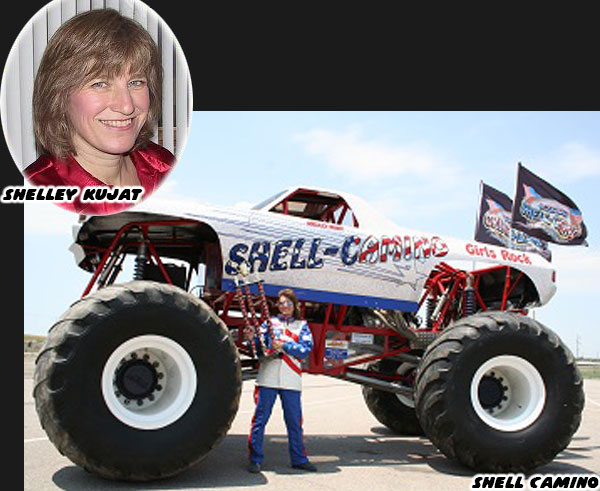
Not every great monster truck is in big stadium shows. Some are putting in their time in fairs, and local events. They are as important to the history of the sport. A salute to Shelley Kujat, and her gorgeous Shell-Camino monster for putting in the work.

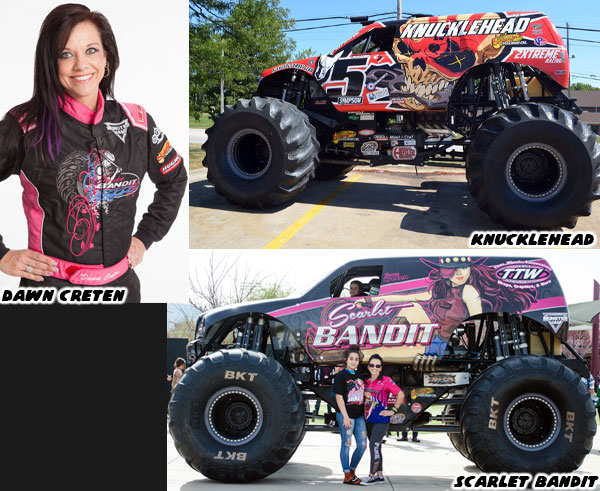
Dawn Creten is a titan of monster truck drivers. Whether a small local show, or a massive stadium tour, she always brings her best. She's known for driving the Scarlet Bandit, but has also driven Knucklehead from time to time as well.

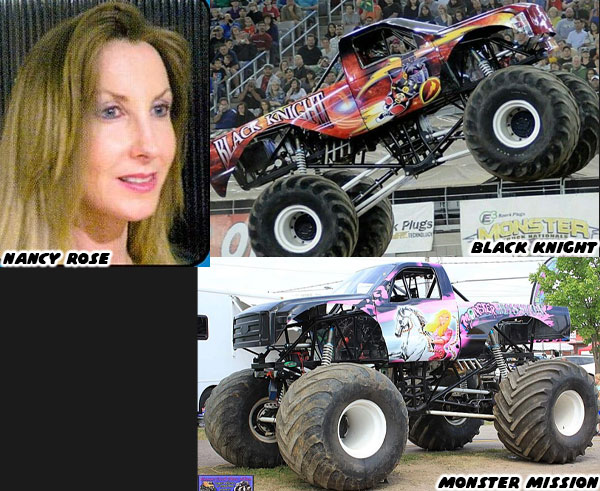
Who says monster trucks can't be inspired by fantasy? Nancy Rose has driven the brilliantly painted Black Knight, and Monster Mission.

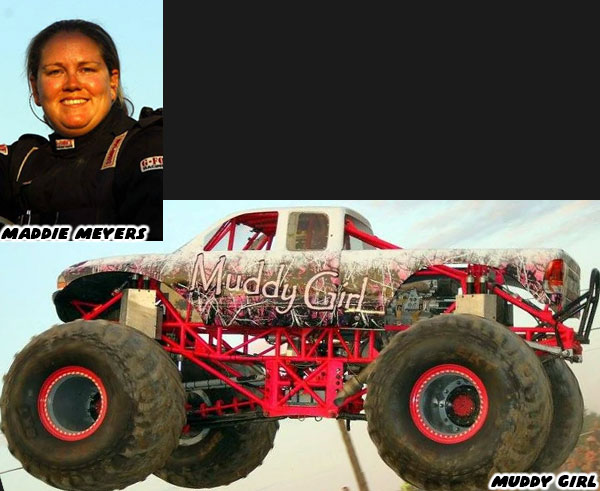
Maddie Meyers / Maddie Breaud was the driver of the Muddy Girl. This pink framed monster was the successor to the Eradicator. Maddie stepped down, and the truck was now driven by Anne Streach.

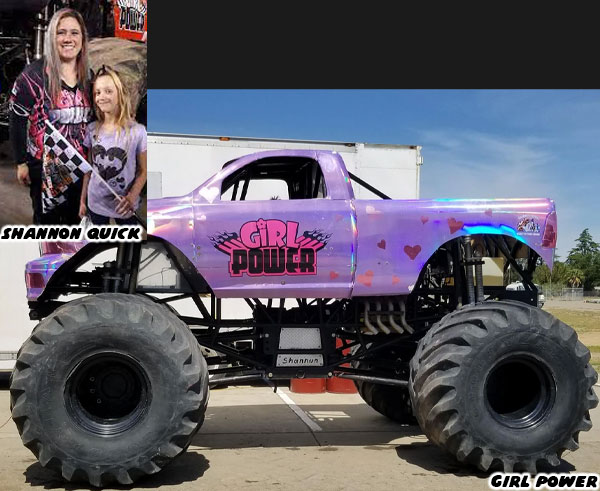
Shannon Quick drives the Girl Power monster truck, sometimes appearing on the No Limits Monster Truck tour. Its reflective foil, and hearts lavender body might be the brightest in the business.

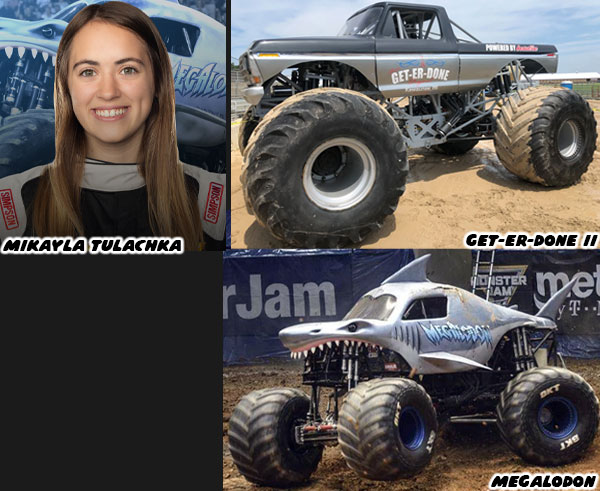
Whether competing in a smaller venue, or a stadium tour the modern crop of drivers knows how to handle any truck. Mikayla Tulachka for example has driven Get Er Done II, and Megalodon.

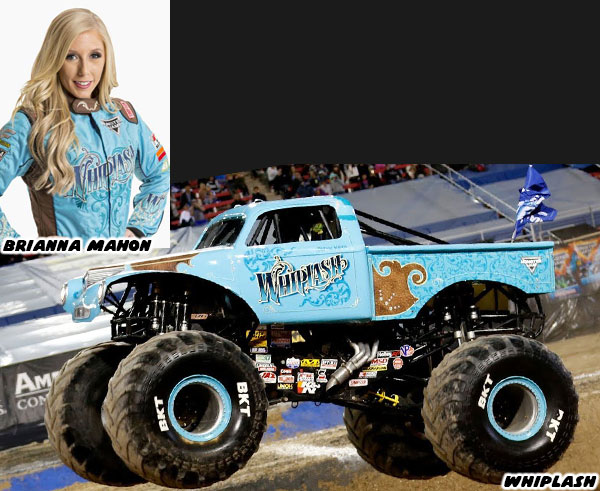
Once a racer, always a racer. Brianna Mahon cut her teeth racing micro sprint, and motocross before becoming the primary driver for Whiplash. The baby blue, classic body monster truck.

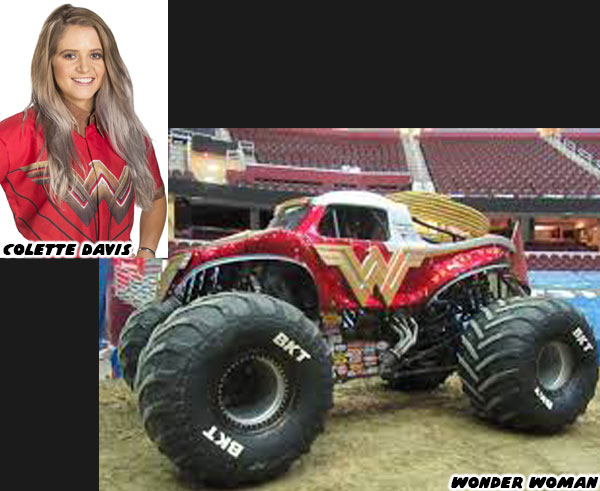
What girl doesn't look up to Wonder Woman? Well if you're Colette Davis then you are her. Well, at the very least she's the driver of the Wonder Woman monster truck.

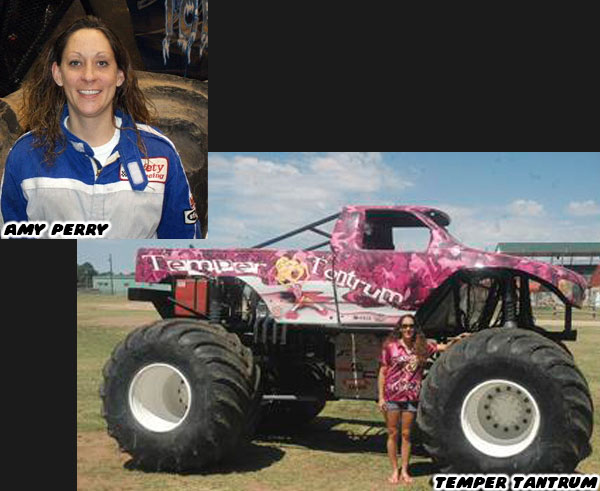
Amy Perry races out of Texas, and gets what she wants. Otherwise she'll throw a six ton Temper Tantrum in your general direction.

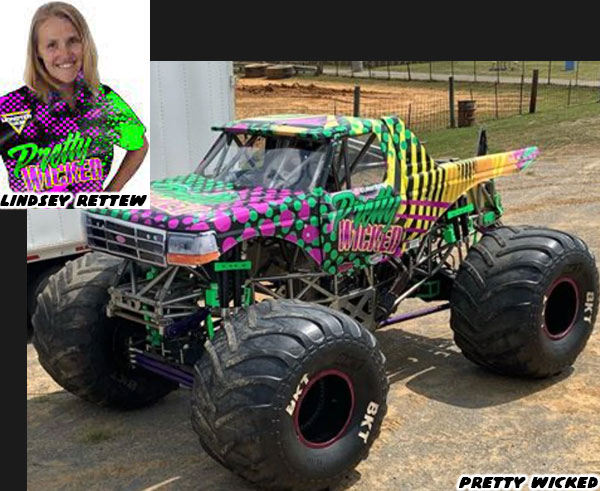
Pretty Wicked might have the most psychedelic paint scheme in monster truck history. Lindsey Rettew drives this technicolor beast.

El Toro Loco has a few different drivers, two that share the distinction are Becky McDonough (she ties a pink bandana over one of the horns when she is driving), and Macey Nichter. Who wouldn't want this wild ride?

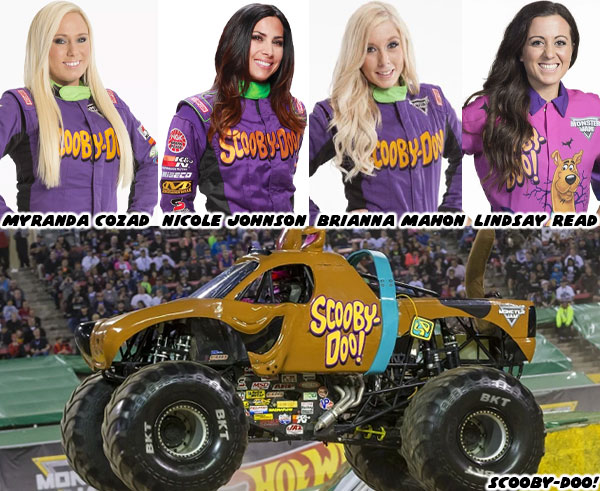
Women have made up a huge core of the Monster Jam tour. When teams are racing all around the country you might see different drivers at different stadiums. Here are just a handful of drivers for Scooby-Doo! Nicole Johnson, Bailey Shea Williams, Brianna Mahon, Dawn Creten, Lindsay Read, and Myranda Cozad.

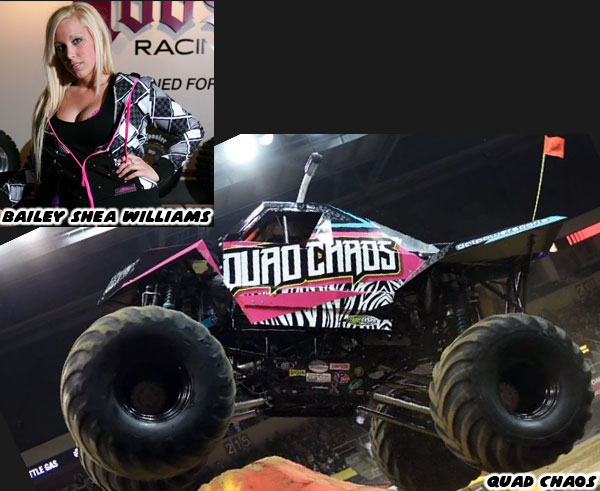
Quad Chaos is a fun monster truck, it's shaped like a gigantic quadracer. One of the drivers is Bailey Shea Williams. She usually sports a pink body whereas a green body is seen when Aaron Cain drives it.

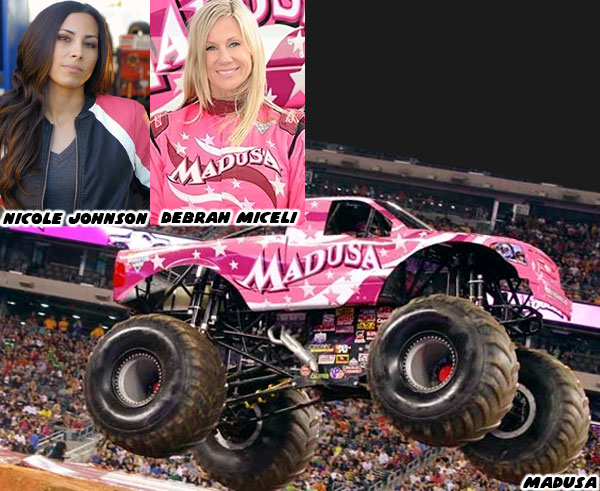
The pink stars and stripes of Madusa is well known on the Monster Jam circuit. There have actually been many drivers to the awesome truck, including Nicole Johnson, Debrah Miceli, Candice Jolly, and Bailey Shea.

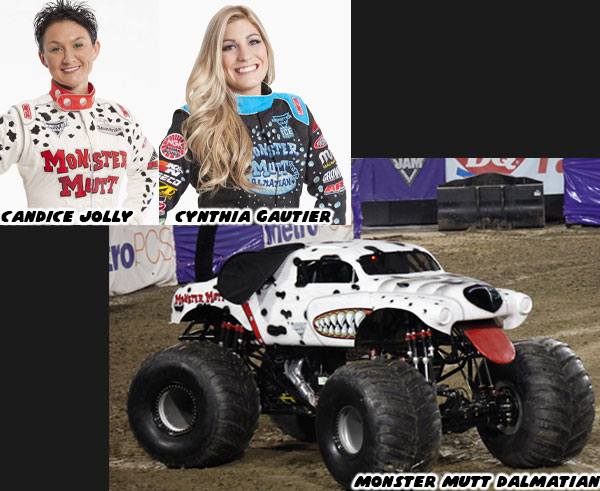
Who says monsters can't be playful too? Monster Mutt - Dalmatian has a few different drivers including Candice Jolly, and Cynthia Gautier.

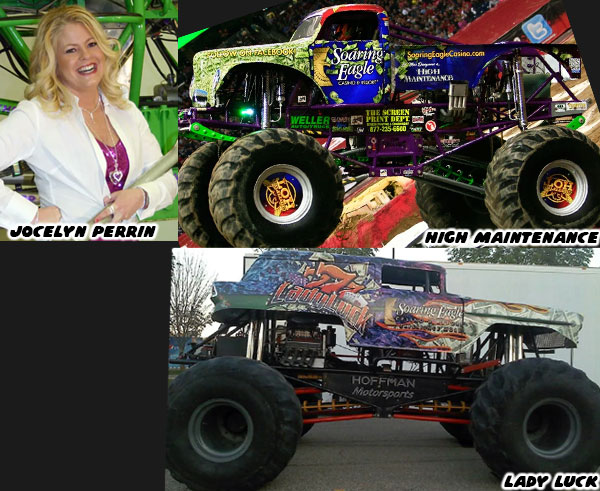
Meet Jocelyn Perrin the driver of Lady Luck, and High Maintenance (Soaring Eagle Casino). She's the monster truck mom with the radical rides.

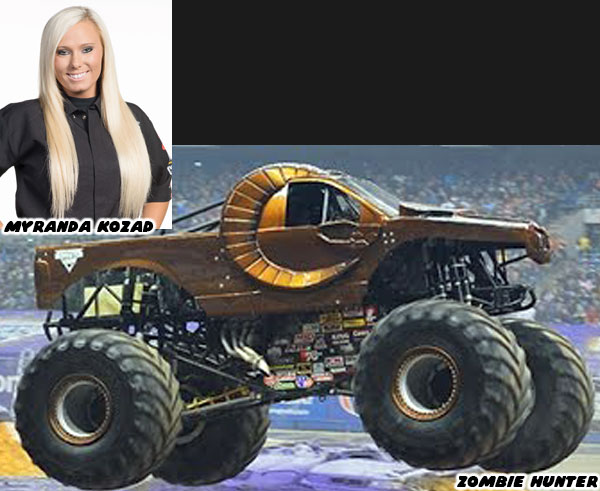
Myranda Kozad has raced a few different monster trucks, one of most unique is the Zombie Hunter. I'm sure she would come in handy if there was a zombie breakout.

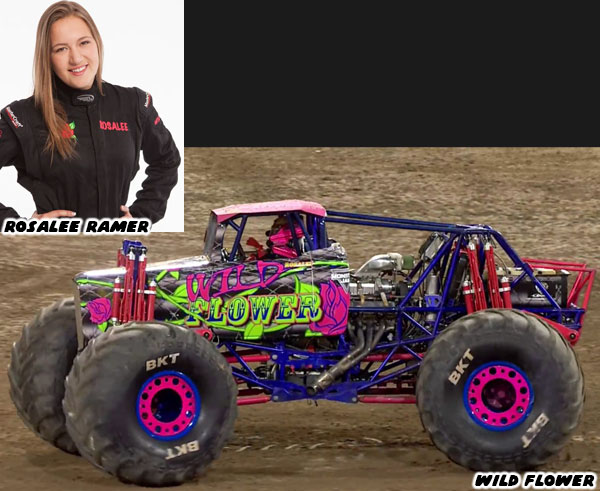
Rosalee Ramer, daughter of Kelvin Ramer was the youngest monster truck driver in the world. There are pictures of her as a little kid helping her father work on his own monster truck Time Flys. Her ride Wild Flower is a work of art.

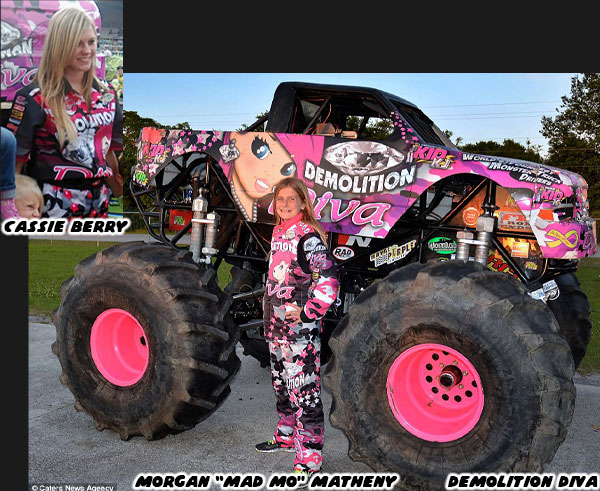
The next generation of monster truck drivers are already putting on shows in their scaled-down rides. Demolition Diva is driven by Mad Mo Morgan Matheny (Team Kid KJ) or Cassie Berry (Uncle Tod Motorsports).

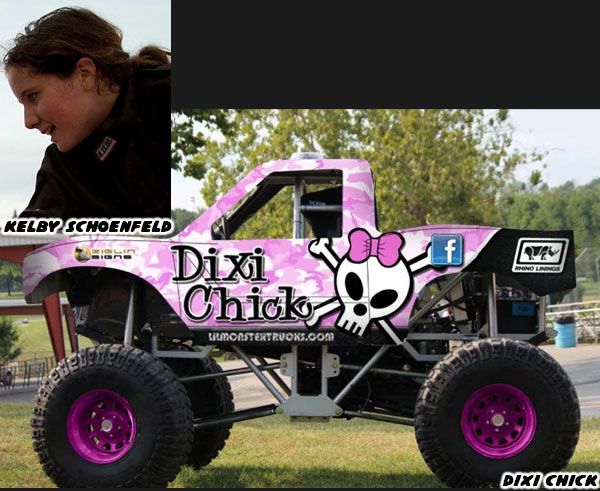
Dixie Chic is piloted by Kelby Schoenfeld (Lil’ Monster Trucks).

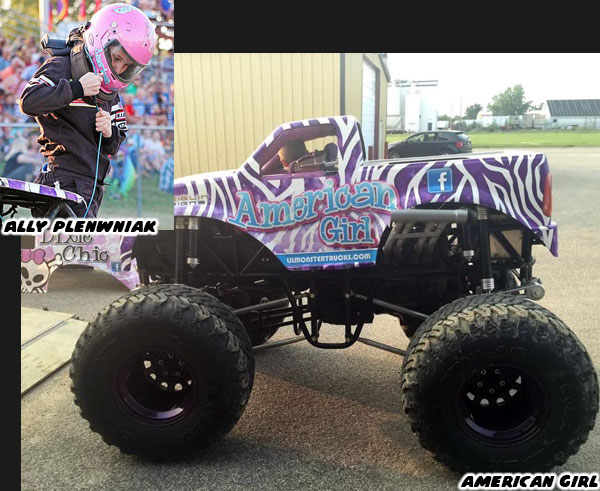
With American Girl by Ally Plenwniak, and Kelby (Lil’ Monster Trucks). The future is in very good hands.

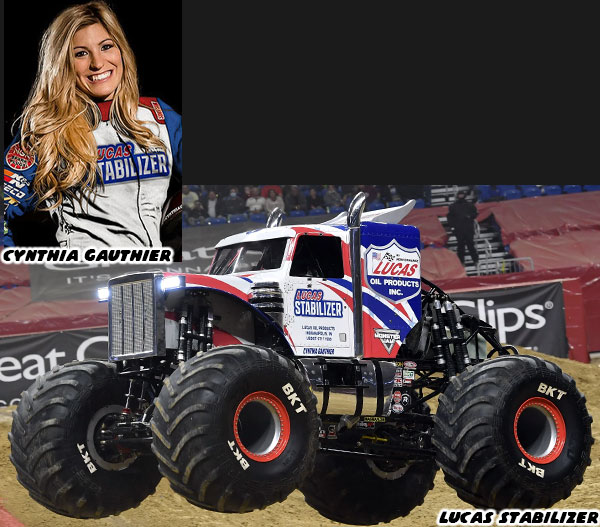
Cynthia Gauthier drives the Lucas Stabilizer. It's one of the newest, and possibly coolest truck on the list. Women have always been a part of this awesome motorsport. Remind your daughters that they can do anything, as long as they work hard for it nothing is impossible.

As I said in the start of this entry that I have always been a fan of monster trucks. If you want to find out about the history of the culture, and how it has appeared in gaming then be sure to check out my previous entries. 


Are there any motorsports, or car cultures that you are into? Like hot rods, lowriders, import tuners, drifting, NASCAR, Formula-1, or associated video games? If so I'd like to hear about it. As always if you would like to sponsor me please visit my Patreon page and consider donating each month, even as little as $1 would help make better blogs and even podcasts!
follow the Street Writer on Patreon!