Showing posts with label cyborg. Show all posts

Monday, July 6, 2020

Creating a fighting game Frankenstein's monster...

When I talk about fighting game character designs I usually start with martial artists, and particular styles. Sometimes we look at the pop culture influences behind these designs. Today we’re going to look at the horror, and science fiction roots of a certain character type. The artificial human, the man created by science. We’re familiar with the story, which is as old as Mary Shelley’s original work Frankenstein; or, The Modern Prometheus. The book from 1818 has been adapted thousands of times, from stage plays, to cartoons, and live action movies. In the story Dr. Victor Frankenstein pieces together a man made from different cadavers, and then brings it to life. He abandons his creation, and the monster is shunned by society because of his grotesqueness. The monster makes it his mission to track down his creator and destroy him. It’s a cautionary tale with many different lessons, one of the most important is what happens to science without ethics.


The creature turning against the creator is the backbone of science fiction. The Terminator movie series is not far removed from the story of Frankenstein. In the movies Cyberdyne Systems loses control of its artificial intelligence SKYNET network. Without the military issuing commands the T-800 robots almost wipe out humanity. The robots covered in organic flesh are very lifelike, and each revision becomes harder and harder for humans to detect. Now the question is whether or not the fighting game genre has ever given audiences a Frankenstein's monster. The short answer is yes, of course it has. Many times in fact. The Terminator appeared in Mortal Kombat 11, the NetherRealm title from 2019. A more literal Frankenstein's monster appeared with Victor Von Gerdenheim in 1994's Vampire / Darkstalkers by Capcom. Yet there were more examples of the humanoid mechanical fighter that were poached by studios.


In the film Terminator 2: Judgement Day (1991) the next variation of the cyborg, the T-1000 is made of a liquid metal that allows it to mimic any person, or object. The special effects by Industrial Light and Magic were revolutionary. It was the first time that life-like CGI and practical effects blended seamlessly in a big budget Hollywood movie. The visuals of the T-1000 inspired a generation of artists, animators, and producers. The idea of putting a Terminator-like character in a fighting game were not far behind.


Battle K-Road by Psikyo was a 1994 fighting game that poached heavily from actual fighters, and pop culture. It was notable for using a cyborg that was a dead ringer for Arnold Schwarzenegger from the original 1984 Terminator film. Aside from that, the T-1000 was far more interesting to fighting game developers. The idea that one character could mimic the moves of every fighter was an interesting premise. Of course a fighter that could do this would be overpowered, and not someone that studios would want to make playable. That is possibly why the first character that was poured from the T-1000 mold was Geegus. The silver-skinned boss character from the game World Heroes debuted in 1992. The developers at ADK were coming out with a number of the early brawling, and fighting game hits for the Neo Geo platform.


World Heroes was one of the first, if not the first, time-traveling fighting games. It took a number of characters from history, not all necessarily fighters, and put them in a tournament to determine who was the greatest hero. Geegus was an alien using the tournament as a front to observe, and absorb the moves of every participant. This became a popular trend as other boss characters appeared that were more of less the same. Dural from Virtua Fighter (1993) by SEGA, was the next similar boss design. She had the moves of every fighter in the tournament. This cyborg was based on a human kunoichi, or female ninja fighter. She was the first 3D female boss in a game. The first female boss that predated her (that I know of) was Mizuki Rashojin, who appeared in Samurai Showdown II just a month earlier. Dural could not melt and change shape like Geegus, but the silver skin was nonetheless an impressive technological feat for the time.


The fighting game genre was exploding in the early ’90s. The technology used in arcades was transitioning from sprite to polygon. Rare was on the cutting edge of graphics at the time. They released Killer Instinct in 1994. The game used Silicon Graphics workstations (then the most powerful engines for 3D effects) to create their models, and stages. The game featured a number of fighting archetypes, but one of the most memorable was the alien Glacius. This character did not have the ability to mimic the moves of his opponents, but he was like the T-1000 in that he could change shape. In the Terminator film the T-1000 could turn his appendages into spikes, go completely flat, and slide past opponents. Rare demonstrated that the shape-shifting moves from the film could work in a fighting game.


The challenge was on for the developers. Could they create a playable character that could mimic his opponents without being overpowered? Capcom was up to the task, but their first attempt at creating a move-stealing fighter wasn’t seen by the majority of their fans. The Cyborg appeared in the 1995 game, Street Fighter II: The Interactive Movie. The evil Shadowlaw cyborgs were featured in the SF II animated movie, as they observed, and reported back to Vega (Dictator). In the game the character would learn the special attacks of the fighters at various points in the movie. The robot potentially had the ability to use the super fireball of Ryu, the super dragon punch of Ken, and even the sweeping kicks of Chun-Li. The seven-foot cyborg was essentially the first original Frankenstein's monster in the genre. Although it was a villain, an alternate ending in the game saw the Cyborg turn against Shadowlaw and destroy Vega. Sadly the character wouldn’t appear in another Street Fighter game, but its DNA would be revisited.


A good number of the team members responsible for Street Fighter II wanted to take a crack at the cybernetic mimic. They formed a new studio called ARIKA. They came up with two new characters; Cycloid β (Beta), and Cycloid γ (Gamma). The robots appeared in Street Fighter EX, the original 3D SF game at the end of 1996. What ARIKA did to keep their Cycloids from being overpowered was to give each of them moves from half the cast. In this way they had an even mix of close, mid range, and distance attacks. They also had unique combos that no other character could perform. Their move selection was very much pieced together like Frankenstein. Although they could not shape shift, they were still memorable attempts at making synthetic fighters.


Not to be outdone Capcom wanted to take another crack at the shape shifting, and move stealing monster. Their next attempt would be the last time they developed a sprite-based character. Twelve debuted in Street Fighter III: 3rd Strike. The game from 1999 was the last numbered Street Fighter to use traditional hand-drawn sprites. This character was very flexible, and rubbery, even when compared to Necro from the same game.  Twelve was not completely fluid, like Geegus or Glacius, he couldn’t exactly flow like water. The animators at Capcom gave him the illusion of weight, and mass, like a rubber tire, rather than a ball of mercury. It could still change shape. The synthetic life form could turns its appendages into blades, or whips. It could glide, and even spring around the stage. In order to prevent Twelve from being overpowered it could only mimic the moves of the character it was currently fighting. It was easily one of the best animated characters from any fighting game, and possibly the closest thing to being a playable T-1000. As far as Frankenstein creatures went, it was a trained weapon, not exactly going against its creators.


Namco had been focused on their own characters, and designs with the Tekken series. They weren’t interested in silver-skinned, bald men as bosses. They already had cyborgs like Jack and P-Jack that were above and beyond the T-800. Their magically animated wooden fighter Mokujin could also emulate its opponent. In 2001 the studio finally decided to create a dedicated robot capable of stealing the moves of its opponent. Combot appeared first in Tekken 4. It was not covered in liquid metal like the T-1000. It looked more like a traditional robot than any other fighter listed thus far. The studio had been paying attention to what Capcom, and ARIKA had done. The character could only mimic the moves of its current opponent. It was a great choice if you wanted to learn the nuances of each character in arcade mode.


The start of the new millennium was pretty quiet for the fighting game community. All of that changed in 2008 with the release of Street Fighter IV. Capcom was eager to get audiences back into the genre and they did so by reintroducing the original World Warriors. The studio also created a new boss that was a call back to Geegus. Seth was the silver-skinned humanoid perfected. The character was the President of S.I.N. the weapons development unit of Shadowlaw. His team used his body to build the perfect weapon. He could emulate, and reflect both special, and super attacks from the fighters he crossed. The character was visually unique, with a rotating power source where his abdomen should be. In the game story it was explained that the Shadowlaw scientists had been able to recreate the moves of the masters using the Tanden Engine. Daigo Ikeno, lead designer on Street Fighter IV pulled a lot of visual elements from Shinto, and Tao spiritual beliefs, and turned them into pseudo-scientific technology.


Capcom didn’t do much in the way of changing the Seth or developing a new boss character over the next decade. The standard had been set early on. Seth was arguably the best original Frankenstein's monster in the genre. Even better because this was as if Victor Frankenstein had built the monsterous body to drop his brain into. In 2019 Capcom decided to revisit Seth for Season Four of Street Fighter V: Champion Edition. This time the re-skinned Seth was also assigned a new gender. I’m not sure how much forethought was given to this idea, but I’d like to think it was a progressive statement from Capcom. The change of Seth from a male to female body was written into the story, as the cyborg had its consciousness transferred to a new body. This new form rounded out the abilities of the character, and if anything, made it even more interesting.


The Tanden Engine, was powered by Yin and Yang energy. The opposing forces were required to achieve balance. Being gender-neutral made Seth able to explore both sides of this power source. The duality could be seen in the concept art, as well as in the final design of both versions of Seth. Her standing lotus pose was a call back to the original seated position of the character. But the details in the updated Seth went much deeper than that. Seth’s new haircut covered half her face, literally making it half light, and half dark. A mirrored yin and yang symbol from her stomach. The circular hair bun completed the look.


The use of knots, braids, and ropes for the various character costumes were pulled right from Shinto beliefs. These details were covered previously on the blog. I mentioned how the knots worn on the belts of Gouken, and Gouki had symbolic meanings. The same could be attributed to the hair of Seth. Capcom had created both the genre's original Frankenstein's Monster, and the Bride of Frankenstein with this fighter. Seth in either male or female form was far more powerful, and dangerous than any human. Its creators at S.I.N. had propelled science beyond human understanding. By doing so they created a villain that was immortal, essentially god-like.


The connections to Seth and godhood were not a coincidence. In earlier concept art the designers at Capcom were considering adding a flowing scarf, and top knot. This look was a direct call out to Raijin, the Shinto god of thunder. Audiences were supposed to tell instantly that this was a powerful villain. In many classical paintings, and even statues, Raijin was presented with a flowing scarf. Sometimes holding a vajra, a type of dagger used for striking down evil. The poses, and figures from Buddhism, complimented the Shinto beliefs in Japan. The poses and iconography are sometimes blended together, and easily recognized in Asian countries. While fans in the West may not get all of the mythology behind Seth’s details, they are nonetheless interesting to study and learn from.


We have the technology to create an actual T-1000 character in a fighting game, one that could change shape, and use all of the special attacks of the cast. Time has shown us that such a character would be far too powerful to be anything but a boss design. So for the help of balancing the roster the studios have learned to tone down their moves and abilities. At least Capcom, Namco, ARIKA, and DIMPS learned what Dr. Frankenstein never could. Don't build a monster that you cannot control! What do you think of move-stealing cyborgs in fighting games? Are you for them? Against them? Let me know in the comments section. If you would like to sponsor me please visit my Patreon page and consider donating each month, even as little as $1 would help make better blogs and even podcasts!
follow the Street Writer on Patreon!

Thursday, February 27, 2020

The Aliens, Predator, Terminator, and Capcom connection...

In the previous blog I talked a little bit about the inspiration behind some of the Mad Gear bosses. It got me thinking about the roots of other designs in the series. It made me realize that Metro City may have been a nexus for some science fiction franchises. Before we do a deep dive we should acknowledge the state of Capcom during this period. What games were they working on, what games that they published in the arcade, and home consoles? The early '90s was unique for the industry because the brawling game was declining in popularity at the same time that the fighting game was exploding. While the two genres were similar, they each had their own audience. In any case Capcom was knee-deep in keeping both formats alive. The teams working on arcade and home brawlers had some crossover. In 1993 the studio published Final Fight 2 for the Super Nintendo, and released The Punisher, and Cadillacs and Dinosaurs in the arcade.


In 1995 when the studio published the last entry in the Final Fight series, they were also releasing a new version of Street Fighter. They used this time to tie together the events of several games. For the Street Fighter Alpha / Zero series it was connecting Street Fighter, Street Fighter II, and Final Fight into one narrative. For Final Fight 3, on the SNES, it was calling out the various brawlers that the studio had worked on. There was dealership selling the very distinctive Cadillac cars. There was also a stage set aboard a moving bus. There were even details pulled from the Alien vs Predator arcade game from 1994. Capcom had every right to be proud of the legacy that they had created. Final Fight 3 was overlooked for how it tied together various properties.


Before I get ahead of myself let's talk about one of the bosses, and his design inspiration. So we've established that films like Escape from New York, Streets of Fire, and the Wanderers inspired the creation of the Final Fight series. Those films from the early '80s had a unique take on science fiction, and gang culture. They framed the characters, and story of the original Final Fight. The sequels therefor pulled influences from later films. The villain Stray from Final Fight 3 was a boss in the Skull Cross organization. He was nowhere near as memorable as the bosses from previous FF games. His look however had some familiar elements.


The appearance of the armored warrior was more than likely inspired by the bad guys in Cyborg. The film from 1989 featured Jean-Claude van Damme. The post-apocalyptic science fiction movie had gangs patrolling the wastelands of the southern US. Actor Vincent Klyn played Fender Tremolo, leader of the pirates. Ralf Möller was the second in command, named Brick Bardo. Both were cruel, and very strong. Their group murdered countless families in the movie. In the canon of Final Fight 3 Stray had murdered the family of Dean, one of the heroes. I would argue that the look, and costume of Stray was an amalgamation of the two villains. But the inspiration from science fiction cinema ran so much deeper than that. The stage where players fought Stray was set inside of a giant factory. The heroes fought on top of metal grates, suspended over boiling metal. It looked very much like the steel mill at the end of the 1991 James Cameron film Terminator 2: Judgement Day.


Final Fight 3 was peppered with nods to science fiction cinema. These Easter Eggs were more than an homage to the great films from the '80s and early '90s. Capcom was trying to connect the movie and game continuities together. During the development of the arcade and home brawlers the studio had become well versed in the canon of the popular science fiction films. They did a deep dive into those worlds because they were working on high profile licenses. They went over production notes, design books, comic books, and various cuts of the film to try and squeeze out anything that could be used in a game. Capcom did not get a license to create a Terminator game, however during their research they made an important connection. As a wink to sharp-eyed audiences they put in a number of these cameos, and let players figure things out.


Final Fight 3 was not about breaking up the Mad Gear gang. Nor was it about defeating the crime lord Belger. A new gang called Skull Cross had taken over Metro City. They were headed up by a rogue military leader named Black. The arms merchant was trafficking illegal firearms through the city. They ran operations out of a company called SIM Inc. Veteran fighters Mike Haggar, and Guy reunited to save the city. They were joined by Detective Lucia Morgan, and the mysterious Dean. Their hunt for Black lead them all throughout the city. As they put the pieces together they found where the weapons were being manufactured. It turned out that SIM Inc. was working on more than just guns. In a side room of one of their factories there was a cybernetic arm in a glass case. This was a nod to the same arm featured in the Terminator 2 film. This technology from Cyberdyne Systems, would lead to the creation of the Terminator cyborgs and Skynet.


As the heroes of Metro City fought their way to the top they raided the headquarters of SIM Inc. Inside there were even more nods to science fiction canon. In a glass case there was a Work Loader. It looked identical to the ones featured in the 1986 movie Aliens. In film canon Weyland Corp built and patented the P-5000 Powered Work Loader in 2025. Caterpillar Inc. would make commercial versions later on. Was SIM Inc. the actual manufacturer of these machines? Did they secure government contracts to help develop this technology for Cyberdyne? To further connect Final Fight continuity to those of other Capcom brawlers there were also display cases filled with the latest weapons developed by SIM Inc. In the Aliens film it was never stated who had created the weapons used by the Marines in the far future.


So why are all of these Terminator / Aliens connections so important? Why would they be featured in a Capcom fighting game set in an urban city? Aside from the easy answer; that the developers were just calling out all of the other games the studio published. The truth was that Capcom had very subtly managed to link three of the biggest science fiction franchises together in a licensed game. The timelines from Terminator, Predator, and Aliens were all interconnected thanks to the Alien vs Predator arcade game that the studio released in 1994. Cracked put the pieces together several years ago. If you haven't heard here is how everything fits; so you may know that Arnold Schwarzenegger played the Terminator in the 1984 film by the same name, and he also played Dutch Schaefer in the 1987 film Predator. What if I were to tell you that the reason the characters looked similar was not because they were played by the same actor, but because in canon they shared the same DNA?


In his story Dutch was already a well regarded mercenary, but he became legend as the first human to kill a Yautja, or Predator in a one-on-one fight. Years after the initial encounter he lost an arm during what was called the 2nd Alien War. Cyberdyne Systems retrofitted him with a cybernetic arm, which doubled as a gun. With his newly enhanced strength he could now go toe-to-toe with both Alien and Predator lifeforms. This enhanced version of Dutch was recorded as CDS-170A3. This numbering was important. In the Terminator 2 film it was explained that Dr. Miles Dyson, director of Special Projects was working on the next generation of cybernetics. He helped develop the CDS T-800 Endoskeleton. More commonly known as the Terminator. Cyberdyne undoubtedly used Dutch's martial training, military tactics, and weapons proficiency to program the perfect killing machine. It only made sense that they also used Dutch's DNA to clone human flesh and muscle to go over the robotic frame.


Lt. Linn Kurosawa, a cyborg from the 13th Colonial Marine Corps, was also featured in Alien VS Predator. Linn was younger, and featured newer technology than Dutch. Her skeleton and frame were enhanced with synthetics. She was essentially the next generation of human. Cyberdyne Systems would eventually evolve into Hyperdyne Systems. The company would create Synthetics, human-passing androids designed by Michael Weyland. Eventually his company would merge with another and create Weyland Yutani Corporation. The synthetic named Ash (Hyperdyne Systems 120-A/2) was featured in the original 1979 film Alien, and another named Bishop appeared in the James Cameron-directed sequel. Being partly synthetic would explain why Kurasawa was able to keep pace with the larger Dutch, and their Predator teammates.


I believe that the reason that Capcom went with a new villain named Black, and an organization called SIM Inc. was so that they could expand on the brawling worlds they had built. Metro City, and Final Fight by extension allowed the studio new paths for their cast to explore. It allowed crossovers from Street Fighter, or another franchise I way to fit into continuity. I'm holding out hope that we might get a new Final Fight, or at least another new brawler from Capcom in the near future. Which were your favorite Capcom brawlers? Were there any hidden details that you enjoyed in any of the games? I'd like to hear about it! If you would like to sponsor me please visit my Patreon page and consider donating each month, even as little as $1 would help make better blogs and even podcasts!
follow the Street Writer on Patreon!

Sunday, November 13, 2016

Did Warner Bros Animation just give a nod to Street Fighter?

The good thing about being raised on a steady diet of comic books and cartoons is that you learn appreciate the best things in life. Those of us who remember the late '80s and '90s experienced the fighting game revolution as well. Kids that got a chance to live through that era were influenced by a lot of different things. Those kids eventually grew up to become artists, animators and producers in their own right. It looks like they did not forget the things that meant the most to them.


Warner Bros Animation has come up with a spiritual successor to The Justice League and Justice League Unlimited series. The new series is called Justice League Action and has a style that falls somewhere in between the original Teen Titans and JLU shows. A lot of classic voice actors have returned as well as rare DC heroes and villains. I'm glad that Plastic Man finally has a chance to shine but even more happy that they are keeping things light with the pop culture references.


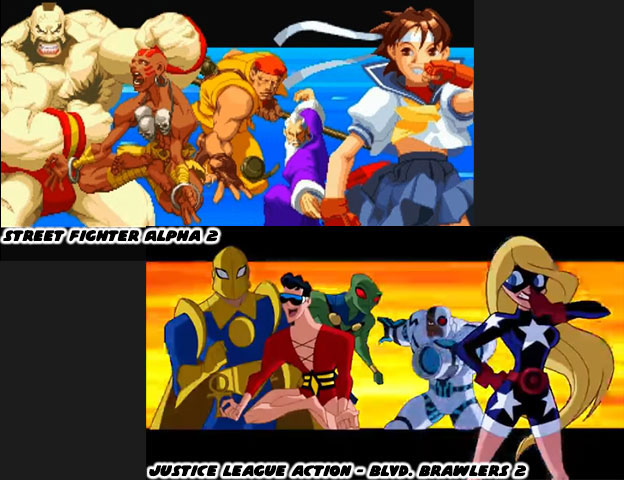
In one of the new episodes the Toy Man makes the Justice League fight against each other in a game called Blvd. Brawlers 2. It is beat-for-beat identical to the introduction of my personal favorite Street Fighter Alpha 2.


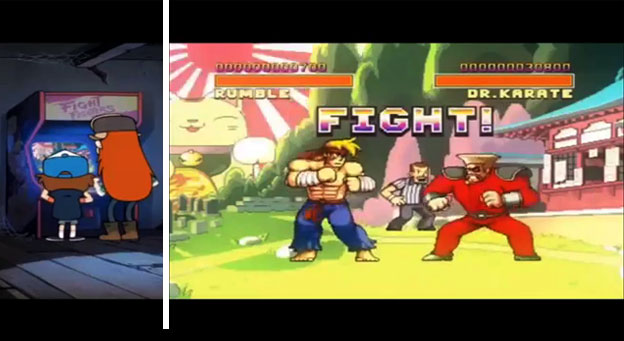
Warner Bros isn't the only studio that gets a shout out for the Street Fighter love. Remember that Disney's Gravity Falls had an episode that centered around "Fight Fighters" a Street Fighter II knock-off?


Are you happy that the JL series is giving the nod to Street Fighter instead of the Injustice games? What are your favorite pop culture Street Fighter nods? I'd like to read about them in the comments section. As always if you enjoyed this blog and would like to sponsor me please visit my Patreon page and consider donating each month, even as little as $1 would help make better blogs and even podcasts!

 follow the Street Writer on Patreon!