Showing posts with label terminator. Show all posts

Friday, May 29, 2026

Warhammer drawings from my sketchbook

Hello friends, I hope that you are doing well. Today I’m posting again to help snap me out of my art block. I am sharing some art from the past. Like last time I would be looking at some fantasy, and sci-fi art. You could find all of these and more on my Warhammer & Warhammer 40,000 Gallery.

These were done when I was on an ink series while on my lunch break at work. There was something that I missed about working in an office, and that was having a break room with a drawing table. It allowed me the space to really explore my creativity. Here’s a dwarf and war pony. Also a Female Dwarf Warrior - I think there aren’t more female dwarf miniatures because the sculptors don’t want to create some glorious hair. This piece was dedicated to all the shorties fighting their fights.

I had an idea for a video game featuring this Skaven Warrior. I wanted to see Cyanide Studios, the creators of Styx: Master of Shadows to create a new stealth combat game featuring a Skaven hunting down vampires in the Warhammer Fantasy universe. I would replace one of his eyes (under the patch) with a warp stone shrapnel so that he could see in the dark, and detect magic. Would you play a game like that?

Nurgle had some of the best art, and miniatures in the Warhammer universe. I had to come up with my idea of a Nurgle Champion. This was part of my ink sketch series, starting in October (Inktober) 2016 and going on almost every weekday until March 2017. This was a very creative period where I drew mostly things that interested me. Lots of skateboarding, cars, games and people.

Noise Marine Terminator - I've got lots of ideas for Noise Marines. In the perfect world where time, and money were no object I would have an entire until made of of Noise Marines that I converted to have fantastic weapons, and armor. For example I want to see an organ-playing Noise Marine that wears the pipes on the back of his Terminator armor. I'm sure somebody could convert the organ on the Sister's of Battle Exorcist tank to get the needed parts.

Here was another example of a custom Noise Marine that I would love to do. The Noise Marine Dreadnought - How about a Dreadnought that looks like a walking mausoleum-meets-boom box? Complete with iron fencing.

The Titan Sketch was the largest Warhammer 40K illustration I ever made. I would sometimes write massive letters on 18x24-inch sketch paper. On one side I would write a letter to a friend, or family member, then on the back I would do a drawing. I wrote to Games Workshop one day, and did of the Imperator along with the internal workings. The letter went to game creator, and editor at White Dwarf Magazine Jervis Johnson. He replied to me, and said he appreciated the letter. He also added that creative director, and legendary artist John Blanche enjoyed the titan sketch. John Blanche was like if Alan Moore was a painter rather than a writer. As far as compliments went I couldn't ask for a greater endorsement. Did you have a favorite drawing, or idea that should be turned into a model? Tell me about it in the comments section. As always if you enjoyed this blog, and would like to sponsor me please visit my Patreon page and consider donating each month, even as little as $1 would help make better blogs and even podcasts!
follow the Street Writer on Patreon!

Monday, July 6, 2020

Creating a fighting game Frankenstein's monster...

When I talk about fighting game character designs I usually start with martial artists, and particular styles. Sometimes we look at the pop culture influences behind these designs. Today we’re going to look at the horror, and science fiction roots of a certain character type. The artificial human, the man created by science. We’re familiar with the story, which is as old as Mary Shelley’s original work Frankenstein; or, The Modern Prometheus. The book from 1818 has been adapted thousands of times, from stage plays, to cartoons, and live action movies. In the story Dr. Victor Frankenstein pieces together a man made from different cadavers, and then brings it to life. He abandons his creation, and the monster is shunned by society because of his grotesqueness. The monster makes it his mission to track down his creator and destroy him. It’s a cautionary tale with many different lessons, one of the most important is what happens to science without ethics.


The creature turning against the creator is the backbone of science fiction. The Terminator movie series is not far removed from the story of Frankenstein. In the movies Cyberdyne Systems loses control of its artificial intelligence SKYNET network. Without the military issuing commands the T-800 robots almost wipe out humanity. The robots covered in organic flesh are very lifelike, and each revision becomes harder and harder for humans to detect. Now the question is whether or not the fighting game genre has ever given audiences a Frankenstein's monster. The short answer is yes, of course it has. Many times in fact. The Terminator appeared in Mortal Kombat 11, the NetherRealm title from 2019. A more literal Frankenstein's monster appeared with Victor Von Gerdenheim in 1994's Vampire / Darkstalkers by Capcom. Yet there were more examples of the humanoid mechanical fighter that were poached by studios.


In the film Terminator 2: Judgement Day (1991) the next variation of the cyborg, the T-1000 is made of a liquid metal that allows it to mimic any person, or object. The special effects by Industrial Light and Magic were revolutionary. It was the first time that life-like CGI and practical effects blended seamlessly in a big budget Hollywood movie. The visuals of the T-1000 inspired a generation of artists, animators, and producers. The idea of putting a Terminator-like character in a fighting game were not far behind.


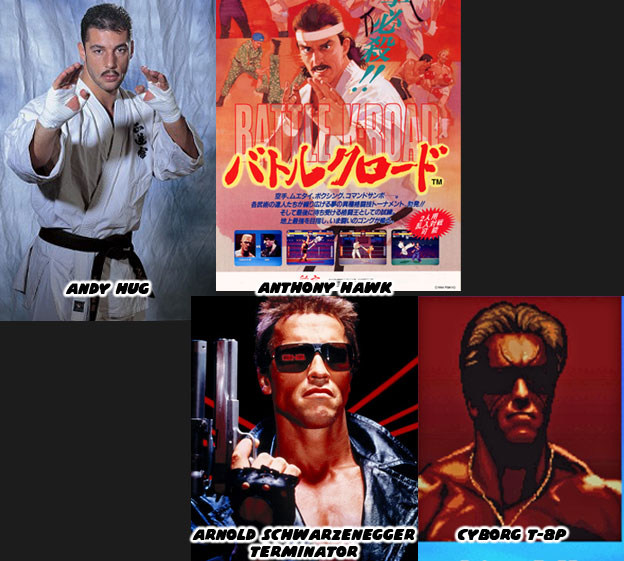
Battle K-Road by Psikyo was a 1994 fighting game that poached heavily from actual fighters, and pop culture. It was notable for using a cyborg that was a dead ringer for Arnold Schwarzenegger from the original 1984 Terminator film. Aside from that, the T-1000 was far more interesting to fighting game developers. The idea that one character could mimic the moves of every fighter was an interesting premise. Of course a fighter that could do this would be overpowered, and not someone that studios would want to make playable. That is possibly why the first character that was poured from the T-1000 mold was Geegus. The silver-skinned boss character from the game World Heroes debuted in 1992. The developers at ADK were coming out with a number of the early brawling, and fighting game hits for the Neo Geo platform.


World Heroes was one of the first, if not the first, time-traveling fighting games. It took a number of characters from history, not all necessarily fighters, and put them in a tournament to determine who was the greatest hero. Geegus was an alien using the tournament as a front to observe, and absorb the moves of every participant. This became a popular trend as other boss characters appeared that were more of less the same. Dural from Virtua Fighter (1993) by SEGA, was the next similar boss design. She had the moves of every fighter in the tournament. This cyborg was based on a human kunoichi, or female ninja fighter. She was the first 3D female boss in a game. The first female boss that predated her (that I know of) was Mizuki Rashojin, who appeared in Samurai Showdown II just a month earlier. Dural could not melt and change shape like Geegus, but the silver skin was nonetheless an impressive technological feat for the time.


The fighting game genre was exploding in the early ’90s. The technology used in arcades was transitioning from sprite to polygon. Rare was on the cutting edge of graphics at the time. They released Killer Instinct in 1994. The game used Silicon Graphics workstations (then the most powerful engines for 3D effects) to create their models, and stages. The game featured a number of fighting archetypes, but one of the most memorable was the alien Glacius. This character did not have the ability to mimic the moves of his opponents, but he was like the T-1000 in that he could change shape. In the Terminator film the T-1000 could turn his appendages into spikes, go completely flat, and slide past opponents. Rare demonstrated that the shape-shifting moves from the film could work in a fighting game.


The challenge was on for the developers. Could they create a playable character that could mimic his opponents without being overpowered? Capcom was up to the task, but their first attempt at creating a move-stealing fighter wasn’t seen by the majority of their fans. The Cyborg appeared in the 1995 game, Street Fighter II: The Interactive Movie. The evil Shadowlaw cyborgs were featured in the SF II animated movie, as they observed, and reported back to Vega (Dictator). In the game the character would learn the special attacks of the fighters at various points in the movie. The robot potentially had the ability to use the super fireball of Ryu, the super dragon punch of Ken, and even the sweeping kicks of Chun-Li. The seven-foot cyborg was essentially the first original Frankenstein's monster in the genre. Although it was a villain, an alternate ending in the game saw the Cyborg turn against Shadowlaw and destroy Vega. Sadly the character wouldn’t appear in another Street Fighter game, but its DNA would be revisited.


A good number of the team members responsible for Street Fighter II wanted to take a crack at the cybernetic mimic. They formed a new studio called ARIKA. They came up with two new characters; Cycloid β (Beta), and Cycloid γ (Gamma). The robots appeared in Street Fighter EX, the original 3D SF game at the end of 1996. What ARIKA did to keep their Cycloids from being overpowered was to give each of them moves from half the cast. In this way they had an even mix of close, mid range, and distance attacks. They also had unique combos that no other character could perform. Their move selection was very much pieced together like Frankenstein. Although they could not shape shift, they were still memorable attempts at making synthetic fighters.


Not to be outdone Capcom wanted to take another crack at the shape shifting, and move stealing monster. Their next attempt would be the last time they developed a sprite-based character. Twelve debuted in Street Fighter III: 3rd Strike. The game from 1999 was the last numbered Street Fighter to use traditional hand-drawn sprites. This character was very flexible, and rubbery, even when compared to Necro from the same game.  Twelve was not completely fluid, like Geegus or Glacius, he couldn’t exactly flow like water. The animators at Capcom gave him the illusion of weight, and mass, like a rubber tire, rather than a ball of mercury. It could still change shape. The synthetic life form could turns its appendages into blades, or whips. It could glide, and even spring around the stage. In order to prevent Twelve from being overpowered it could only mimic the moves of the character it was currently fighting. It was easily one of the best animated characters from any fighting game, and possibly the closest thing to being a playable T-1000. As far as Frankenstein creatures went, it was a trained weapon, not exactly going against its creators.


Namco had been focused on their own characters, and designs with the Tekken series. They weren’t interested in silver-skinned, bald men as bosses. They already had cyborgs like Jack and P-Jack that were above and beyond the T-800. Their magically animated wooden fighter Mokujin could also emulate its opponent. In 2001 the studio finally decided to create a dedicated robot capable of stealing the moves of its opponent. Combot appeared first in Tekken 4. It was not covered in liquid metal like the T-1000. It looked more like a traditional robot than any other fighter listed thus far. The studio had been paying attention to what Capcom, and ARIKA had done. The character could only mimic the moves of its current opponent. It was a great choice if you wanted to learn the nuances of each character in arcade mode.


The start of the new millennium was pretty quiet for the fighting game community. All of that changed in 2008 with the release of Street Fighter IV. Capcom was eager to get audiences back into the genre and they did so by reintroducing the original World Warriors. The studio also created a new boss that was a call back to Geegus. Seth was the silver-skinned humanoid perfected. The character was the President of S.I.N. the weapons development unit of Shadowlaw. His team used his body to build the perfect weapon. He could emulate, and reflect both special, and super attacks from the fighters he crossed. The character was visually unique, with a rotating power source where his abdomen should be. In the game story it was explained that the Shadowlaw scientists had been able to recreate the moves of the masters using the Tanden Engine. Daigo Ikeno, lead designer on Street Fighter IV pulled a lot of visual elements from Shinto, and Tao spiritual beliefs, and turned them into pseudo-scientific technology.


Capcom didn’t do much in the way of changing the Seth or developing a new boss character over the next decade. The standard had been set early on. Seth was arguably the best original Frankenstein's monster in the genre. Even better because this was as if Victor Frankenstein had built the monsterous body to drop his brain into. In 2019 Capcom decided to revisit Seth for Season Four of Street Fighter V: Champion Edition. This time the re-skinned Seth was also assigned a new gender. I’m not sure how much forethought was given to this idea, but I’d like to think it was a progressive statement from Capcom. The change of Seth from a male to female body was written into the story, as the cyborg had its consciousness transferred to a new body. This new form rounded out the abilities of the character, and if anything, made it even more interesting.


The Tanden Engine, was powered by Yin and Yang energy. The opposing forces were required to achieve balance. Being gender-neutral made Seth able to explore both sides of this power source. The duality could be seen in the concept art, as well as in the final design of both versions of Seth. Her standing lotus pose was a call back to the original seated position of the character. But the details in the updated Seth went much deeper than that. Seth’s new haircut covered half her face, literally making it half light, and half dark. A mirrored yin and yang symbol from her stomach. The circular hair bun completed the look.


The use of knots, braids, and ropes for the various character costumes were pulled right from Shinto beliefs. These details were covered previously on the blog. I mentioned how the knots worn on the belts of Gouken, and Gouki had symbolic meanings. The same could be attributed to the hair of Seth. Capcom had created both the genre's original Frankenstein's Monster, and the Bride of Frankenstein with this fighter. Seth in either male or female form was far more powerful, and dangerous than any human. Its creators at S.I.N. had propelled science beyond human understanding. By doing so they created a villain that was immortal, essentially god-like.


The connections to Seth and godhood were not a coincidence. In earlier concept art the designers at Capcom were considering adding a flowing scarf, and top knot. This look was a direct call out to Raijin, the Shinto god of thunder. Audiences were supposed to tell instantly that this was a powerful villain. In many classical paintings, and even statues, Raijin was presented with a flowing scarf. Sometimes holding a vajra, a type of dagger used for striking down evil. The poses, and figures from Buddhism, complimented the Shinto beliefs in Japan. The poses and iconography are sometimes blended together, and easily recognized in Asian countries. While fans in the West may not get all of the mythology behind Seth’s details, they are nonetheless interesting to study and learn from.


We have the technology to create an actual T-1000 character in a fighting game, one that could change shape, and use all of the special attacks of the cast. Time has shown us that such a character would be far too powerful to be anything but a boss design. So for the help of balancing the roster the studios have learned to tone down their moves and abilities. At least Capcom, Namco, ARIKA, and DIMPS learned what Dr. Frankenstein never could. Don't build a monster that you cannot control! What do you think of move-stealing cyborgs in fighting games? Are you for them? Against them? Let me know in the comments section. If you would like to sponsor me please visit my Patreon page and consider donating each month, even as little as $1 would help make better blogs and even podcasts!
follow the Street Writer on Patreon!

Thursday, February 27, 2020

The Aliens, Predator, Terminator, and Capcom connection...

In the previous blog I talked a little bit about the inspiration behind some of the Mad Gear bosses. It got me thinking about the roots of other designs in the series. It made me realize that Metro City may have been a nexus for some science fiction franchises. Before we do a deep dive we should acknowledge the state of Capcom during this period. What games were they working on, what games that they published in the arcade, and home consoles? The early '90s was unique for the industry because the brawling game was declining in popularity at the same time that the fighting game was exploding. While the two genres were similar, they each had their own audience. In any case Capcom was knee-deep in keeping both formats alive. The teams working on arcade and home brawlers had some crossover. In 1993 the studio published Final Fight 2 for the Super Nintendo, and released The Punisher, and Cadillacs and Dinosaurs in the arcade.


In 1995 when the studio published the last entry in the Final Fight series, they were also releasing a new version of Street Fighter. They used this time to tie together the events of several games. For the Street Fighter Alpha / Zero series it was connecting Street Fighter, Street Fighter II, and Final Fight into one narrative. For Final Fight 3, on the SNES, it was calling out the various brawlers that the studio had worked on. There was dealership selling the very distinctive Cadillac cars. There was also a stage set aboard a moving bus. There were even details pulled from the Alien vs Predator arcade game from 1994. Capcom had every right to be proud of the legacy that they had created. Final Fight 3 was overlooked for how it tied together various properties.


Before I get ahead of myself let's talk about one of the bosses, and his design inspiration. So we've established that films like Escape from New York, Streets of Fire, and the Wanderers inspired the creation of the Final Fight series. Those films from the early '80s had a unique take on science fiction, and gang culture. They framed the characters, and story of the original Final Fight. The sequels therefor pulled influences from later films. The villain Stray from Final Fight 3 was a boss in the Skull Cross organization. He was nowhere near as memorable as the bosses from previous FF games. His look however had some familiar elements.


The appearance of the armored warrior was more than likely inspired by the bad guys in Cyborg. The film from 1989 featured Jean-Claude van Damme. The post-apocalyptic science fiction movie had gangs patrolling the wastelands of the southern US. Actor Vincent Klyn played Fender Tremolo, leader of the pirates. Ralf Möller was the second in command, named Brick Bardo. Both were cruel, and very strong. Their group murdered countless families in the movie. In the canon of Final Fight 3 Stray had murdered the family of Dean, one of the heroes. I would argue that the look, and costume of Stray was an amalgamation of the two villains. But the inspiration from science fiction cinema ran so much deeper than that. The stage where players fought Stray was set inside of a giant factory. The heroes fought on top of metal grates, suspended over boiling metal. It looked very much like the steel mill at the end of the 1991 James Cameron film Terminator 2: Judgement Day.


Final Fight 3 was peppered with nods to science fiction cinema. These Easter Eggs were more than an homage to the great films from the '80s and early '90s. Capcom was trying to connect the movie and game continuities together. During the development of the arcade and home brawlers the studio had become well versed in the canon of the popular science fiction films. They did a deep dive into those worlds because they were working on high profile licenses. They went over production notes, design books, comic books, and various cuts of the film to try and squeeze out anything that could be used in a game. Capcom did not get a license to create a Terminator game, however during their research they made an important connection. As a wink to sharp-eyed audiences they put in a number of these cameos, and let players figure things out.


Final Fight 3 was not about breaking up the Mad Gear gang. Nor was it about defeating the crime lord Belger. A new gang called Skull Cross had taken over Metro City. They were headed up by a rogue military leader named Black. The arms merchant was trafficking illegal firearms through the city. They ran operations out of a company called SIM Inc. Veteran fighters Mike Haggar, and Guy reunited to save the city. They were joined by Detective Lucia Morgan, and the mysterious Dean. Their hunt for Black lead them all throughout the city. As they put the pieces together they found where the weapons were being manufactured. It turned out that SIM Inc. was working on more than just guns. In a side room of one of their factories there was a cybernetic arm in a glass case. This was a nod to the same arm featured in the Terminator 2 film. This technology from Cyberdyne Systems, would lead to the creation of the Terminator cyborgs and Skynet.


As the heroes of Metro City fought their way to the top they raided the headquarters of SIM Inc. Inside there were even more nods to science fiction canon. In a glass case there was a Work Loader. It looked identical to the ones featured in the 1986 movie Aliens. In film canon Weyland Corp built and patented the P-5000 Powered Work Loader in 2025. Caterpillar Inc. would make commercial versions later on. Was SIM Inc. the actual manufacturer of these machines? Did they secure government contracts to help develop this technology for Cyberdyne? To further connect Final Fight continuity to those of other Capcom brawlers there were also display cases filled with the latest weapons developed by SIM Inc. In the Aliens film it was never stated who had created the weapons used by the Marines in the far future.


So why are all of these Terminator / Aliens connections so important? Why would they be featured in a Capcom fighting game set in an urban city? Aside from the easy answer; that the developers were just calling out all of the other games the studio published. The truth was that Capcom had very subtly managed to link three of the biggest science fiction franchises together in a licensed game. The timelines from Terminator, Predator, and Aliens were all interconnected thanks to the Alien vs Predator arcade game that the studio released in 1994. Cracked put the pieces together several years ago. If you haven't heard here is how everything fits; so you may know that Arnold Schwarzenegger played the Terminator in the 1984 film by the same name, and he also played Dutch Schaefer in the 1987 film Predator. What if I were to tell you that the reason the characters looked similar was not because they were played by the same actor, but because in canon they shared the same DNA?


In his story Dutch was already a well regarded mercenary, but he became legend as the first human to kill a Yautja, or Predator in a one-on-one fight. Years after the initial encounter he lost an arm during what was called the 2nd Alien War. Cyberdyne Systems retrofitted him with a cybernetic arm, which doubled as a gun. With his newly enhanced strength he could now go toe-to-toe with both Alien and Predator lifeforms. This enhanced version of Dutch was recorded as CDS-170A3. This numbering was important. In the Terminator 2 film it was explained that Dr. Miles Dyson, director of Special Projects was working on the next generation of cybernetics. He helped develop the CDS T-800 Endoskeleton. More commonly known as the Terminator. Cyberdyne undoubtedly used Dutch's martial training, military tactics, and weapons proficiency to program the perfect killing machine. It only made sense that they also used Dutch's DNA to clone human flesh and muscle to go over the robotic frame.


Lt. Linn Kurosawa, a cyborg from the 13th Colonial Marine Corps, was also featured in Alien VS Predator. Linn was younger, and featured newer technology than Dutch. Her skeleton and frame were enhanced with synthetics. She was essentially the next generation of human. Cyberdyne Systems would eventually evolve into Hyperdyne Systems. The company would create Synthetics, human-passing androids designed by Michael Weyland. Eventually his company would merge with another and create Weyland Yutani Corporation. The synthetic named Ash (Hyperdyne Systems 120-A/2) was featured in the original 1979 film Alien, and another named Bishop appeared in the James Cameron-directed sequel. Being partly synthetic would explain why Kurasawa was able to keep pace with the larger Dutch, and their Predator teammates.


I believe that the reason that Capcom went with a new villain named Black, and an organization called SIM Inc. was so that they could expand on the brawling worlds they had built. Metro City, and Final Fight by extension allowed the studio new paths for their cast to explore. It allowed crossovers from Street Fighter, or another franchise I way to fit into continuity. I'm holding out hope that we might get a new Final Fight, or at least another new brawler from Capcom in the near future. Which were your favorite Capcom brawlers? Were there any hidden details that you enjoyed in any of the games? I'd like to hear about it! If you would like to sponsor me please visit my Patreon page and consider donating each month, even as little as $1 would help make better blogs and even podcasts!
follow the Street Writer on Patreon!

Friday, May 19, 2017

The Style Files, Psikyo and the aesthetic copies

Many game fans wish their favorite developers had an unlimited budget and an unlimited development cycle to create “perfect” titles. This would make for better movies, cartoons and comic books as well. But we live in a practical world. A world that doesn't have unlimited time or money. We live in a world where the decision makers are not always the creative types. Stockholders demand a return on investment and they have little patience for a director's flights of fancy. No studio could survive for long if they wrote their team a blank check. Do you wonder what would happen if a studio gambled really big and put all their chips on one game? What would happen if they spent years in development and were still not finished when the game was published? How good could a rushed game really be? How much better could it have been? This happened with a lot of games, including many of the biggest franchises. The best managed to cut the right parts without sacrificing the overall experience. One game in particular became a sort of urban legend in the fighting game community. It was released before it was ready, didn’t see too many arcades and then vanished. It retained enough elements to let audiences know where the developer was headed with it. The people that worked on the game ended up coloring the biggest franchises, including Street Fighter and the King of Fighters. In order to tell the story properly we need to look at the agenda of the publishers and developers separately.


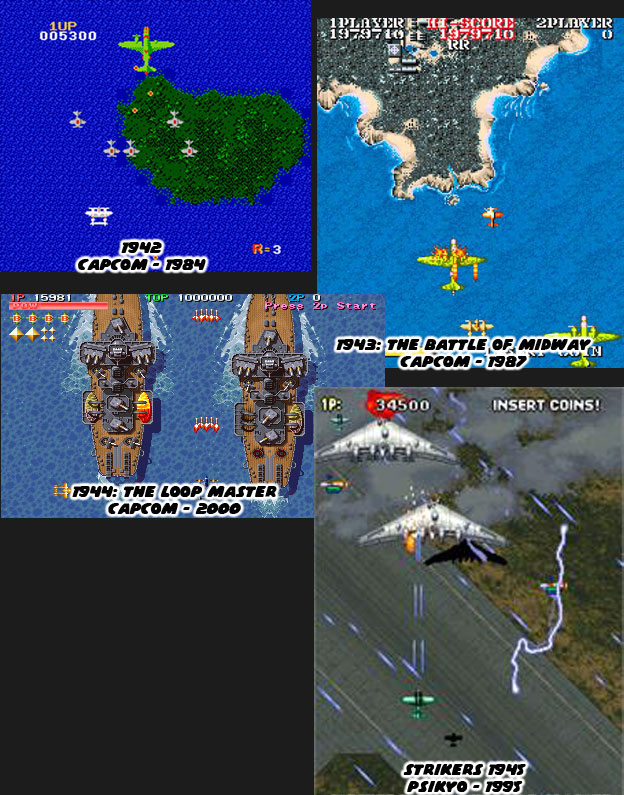
Studios copied game designs from each other. That was a tradition that went back to the earliest days of the arcade. If one company created a racing game then another studio created a racing game. If one studio created a space shooter then the other studio followed suit. The more popular the game was the more likely it was to be copied. The runaway success of Pac Man in the '80s meant that every developer would create their own maze game. Psikyo was no different when it came to copying ideas. What they did was unique. They waited a few years, sometimes a decade, and released a game that had many of the elements of a classic arcade title. The shoot 'em up (SHMUP) was an arcade standard. Every designer tried to improve on the classic Space Invaders formula. Studios experimented with graphics, controls and game play. Capcom took the SHMUP out of space and used the mechanics to tell a story set in WWII featuring planes and ships from that era. The game 1942 was a phenomenal success. They created a sequel called 1943 and many years later, riding a wave of arcade nostalgia, released 1944. Psikyo had developed their own take on the title, Strikers 1945, released almost a decade after Capcom's original game.


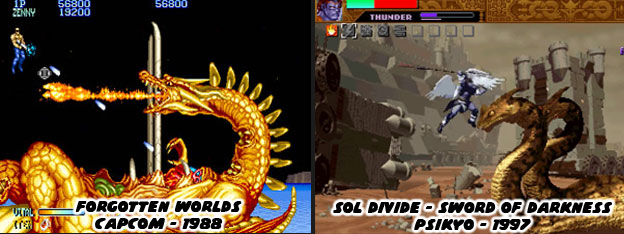
Psikyo had become very good at filling in a certain niche. It was as if they knew that arcade audiences occasionally longed for classic experiences. Even with the leaps and bounds in graphics and genres there was still a certain charm to the feel of a traditional game. So they used newer technology and better graphics to enhance the classic-inspired titles. Strikers 1945 was probably one of the better known releases but one of their games with a very strong aesthetic was called Sol Divide - Sword of Darkness. It was a side-scrolling SHMUP that featured flying characters in a fantasy universe. If I were to compare it to another classic it would undoubtedly be Capcom's Forgotten Worlds and sure enough it came out almost 10 years later. To be fair the Capcom game was set in a post-apocalyptic wasteland where monsters and angels were fighting alongside jet-pack wearing mercenaries. Sol Divide had similar mechanics but a strict fantasy environment. It was a fun game and an under appreciated Playstation title. When fighting games were red-hot at the start of the ‘90s Psikyo couldn’t afford to stay quiet for another decade. They jumped into the genre with a game called Battle K-Road.


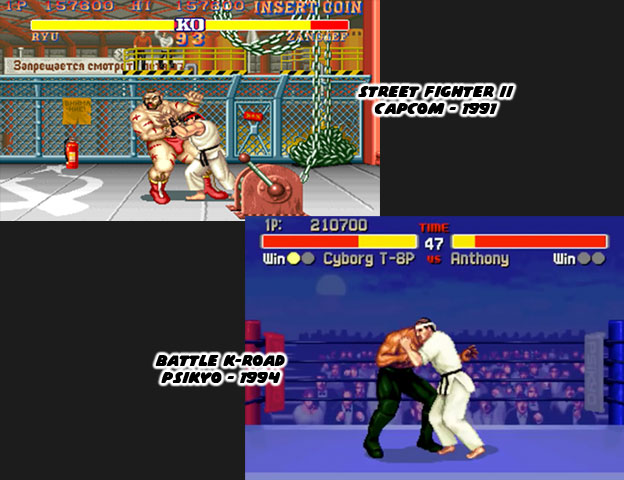
The game was inspired by the hugely popular K-1 fighting tournament. It was one of the influencers of modern MMA tournaments. It focused more on strikes than grapples. The name of the tournament actually got its name by taking the first letter of Karate, Kickboxing and Kung Fu. One of the most popular fighters was a Swiss Kyokushin practitioner named Andy Hug. He was an exceptional fighter and helped build a bridge between western and eastern practitioners. His look was the basis for one of the lead characters in Battle K-Road, Anthony Hawk, yes as in “Tony” Hawk. The game was notoriously bad. The control, balance, animation and character design were forgettable. Even the boss character Mr. Bear was overpowered. It poached a number of elements from other fighting games but especially the likenesses of real people. Andy looked similar to Anthony but there was even a cyborg in the game that was a dead ringer for a certain bodybuilder-turned-actor-turned-politician. Psikyo’s flop was released in 1994 for the arcade and never saw a console or PC release, which was rare for most fighting games of the era.


Psikyo had struck out when they really needed a hit. They asked their development team Steel Hearts to work on a new fighting game. If Psykio’s first attempt failed because it lacked originality then this new one would pull out all the stops. Steel Hearts looked at their art team and pushed for a very strong aesthetic. This new game could not look remotely like any other fighting game that had ever come out. In order to set themselves apart they had to have a distinct visual style that carried through every part of the game, not just the character designs, but every stage, every intro screen and ending as well. Capcom, SNK, Sega, Namco and the other big companies knew that there was a steep price to developing fighting games. Perhaps Psikyo was underestimating the task. There were many variables that went into the budget; programmers, animators, sound and music all factored in. Sprite creation accounted for a good chunk of the money. The size of the sprite, number of colors, number of animation frames all effected the price. Of course the team also had to settle on the lineup. Not enough unique characters and audiences would skip the title, too many and the game would never be completed in a reasonable time frame. Steel Hearts wanted to create larger-than-average sprites that looked as if they were hand-painted by the lead artist on top of highly-detailed stages. Except they didn’t have a lead artist right away or theme they wanted to pursue.


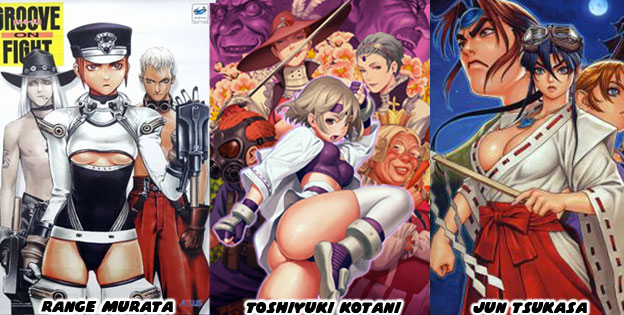
What the studio did know was that the game industry focused on cartoonish or animé-style aesthetics. They didn’t pursue anything with softer, more realistic tones. A designer like Range Murata really stood out in the crowd. It would be wonderful if they could get his style, down to the color palette that he used in a fighting game. Yet Range was contracted by Atlus not to mention that he was already doing the designs for the Goketsuji Ichizoku / Power Instinct Series. The team at Atlus had other tremendous artists that filled in the stage art, menu art and other details. Range didn’t do everything himself and that’s why there were some slight differences in the stage art and background characters between games. They didn’t all capture his unique perspective. One of the secret weapons that Atlus had was an artist named Toshiyuki Kotani aka Styleos. He could mimic the Range Murata style very well especially in the final games of the series. Later on he began to show off his own style, which had soft, blended colors on top of lean athletic figures. His style of art really stood out when he worked on the indy fighter Yatagarasu: Attack on Cataclysm along with former KOF developers. Atlus had a packed art team working on their fighting game series; Haya, Kobayashi Takashi, Masafumi Fujii, Shioi Tomohide (KOF Maximum Impact), Nishikawa Yoshikazu and dadamusi. They had no lack of talent coming up with all the wild characters and stages in their games.


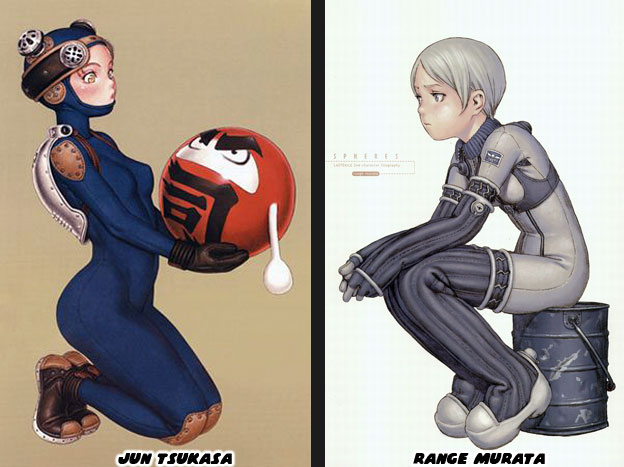
Psikyo had their own art team as well and a special designer whose illustrations were very much on par with those of Murata. Jun Tsukasa was the character designer and illustrator on Psikyo’s Sengoku Blade series and mahjong games. He often created cheesecake paintings of very busty women in revealing costumes if not semi-nude for the in-game graphics as well as arcade posters. I cannot recall a time a time that Range Murata painted voluptuous women. When Tsukasa drew young men and women they often had the same proportions and stylings of Murata. When put side-by-side it was almost eerie how similar their work was. If you have difficulty telling the artists apart then just compare their main body of work. Tsukasa tended to focus on paintings of busty women whereas Range’s subjects were often thin girls. Unfortunately Mr Tsukasa was not able to help Steel Hearts develop the characters, I’m not sure what he was working on in that time. So Steel Hearts turned to the talented Morioka Shinichi to come up with the art direction of their next game; Daraku Tenshi - The Fallen Angels. His own style of illustrating was similar to those of Murata and Tsukasa. Toshiyuki Kotani also ended up working on the project, helping keep the Murata / Tsukasa aesthetic very close. In Gamest Mook Vol. 113: Psikyo Illustrations Mr. Shinichi said that he worked on the project for three years and wishes to revisit it so he could complete what the studio set out to do. Imagine working every day for three years and having the game published but considering it unfinished. Did Steel Hearts not hire enough talent to properly complete the title? Did Psikyo again underestimate what it took to create a AAA fighting game? Or were both studios to blame? We’ll look at this title in the next blog and see what made it one of the most anticipated fighting games of the ‘90s. As always if you enjoyed this blog and would like to sponsor me please visit my Patreon page and consider donating each month, even as little as $1 would help make better blogs and even podcasts!

 follow the Street Writer on Patreon!

Tuesday, January 19, 2016

Building a gaming legacy, the Games Workshop series, part 2...

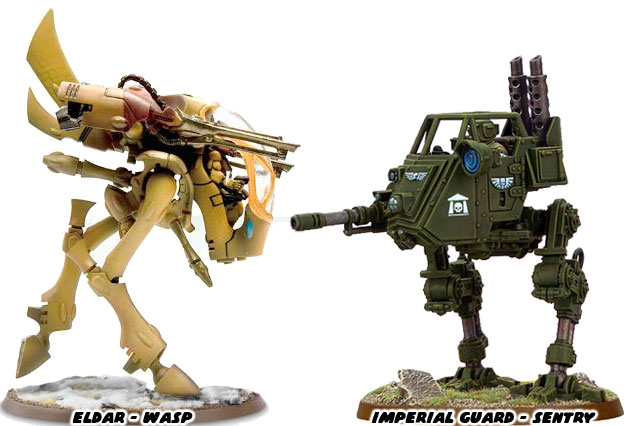
In the previous blog I mentioned that the sculptors working at Games Workshop create some fantastic miniatures for the Warhammer 40,000 system. Specifically these sculptors, sometimes freelancers, work for Citadel, the studio responsible for making the paints, models and tool kits for Games Workshop. Citadel is owned and operated by GW but have the responsibility of all the hobby elements that go into the system. In 40K the sculptors have to create vehicles and machines that reflect the aesthetics of each race. From human to alien, each species has a certain look, a certain style. The designers at GW help put together the back story and origin of each species. The sculptors at Citadel help translate the paintings and illustrations of the artists into three dimensional figures. The work that they do is beyond exceptional, they are awe-inspiring. For example in 40K there are aliens called the Eldar. Think of them like space elves. They are tall, slender and have weapons, armor and vehicles that are sleek. The lines on their war gear are smooth and flowing, inspired in many regards by the beauty of nature. Their weaponry is run on an exotic crystal fusion. By comparison the humans have weapons that we could imagine are forged from iron and steel and are run on diesel fuel. Take a look at the single-pilot walkers that the Eldar and Imperial Guard use in combat. Both machines are prime examples of science fiction storytelling. They have mounted weapons on a robotic frame with two legs but one seems to be half the weight and able to glide across the battlefield while the other stomps around like a clumsy wind-up toy.


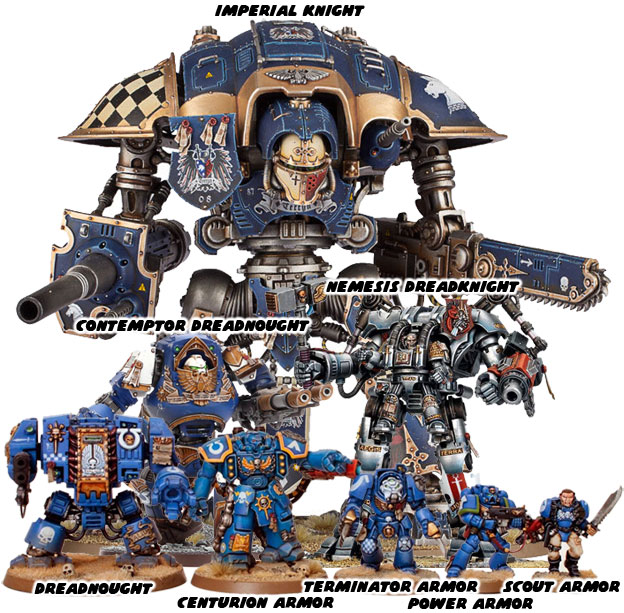
These aesthetic choices are by design and help reinforce the species that make up 40K. The Eldar are very proud of themselves and think that all of the other aliens are primitive and crude. The word that they have for humans is Mon-kei. Some of the aliens that they speak of certainly fit the bill. The Orks for example have heavy, cumbersome weapons that double as clubs for the savage greenskins. They manage to cobble together weapons, artillery and spacecraft using whatever crude material they have on hand. In a way they are engineering savants. Their work is not pretty but it gets the job done. On the other side of the cosmos are the Tau. The gray-skinned aliens are very advanced and are trying to bring peace throughout the cosmos, by conquest of course! The technology they exploit is neither fluid like the Eldar or gothic like the humans but instead something completely different. I would compare the design aesthetic applied to the Tau like mecha designs featured in Japanese anime. Not surprising is how well it balances out the technology exploited by the other aliens. These things are especially obvious when you look at the robotic armor that the races can field. Space Marines have Power Armor, Terminator Armor and other forms of armor and battle suits that they can wear. They are not the only ones that benefit from this type of armor.


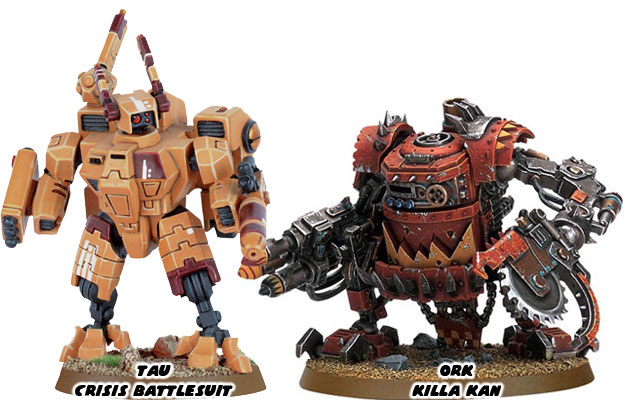
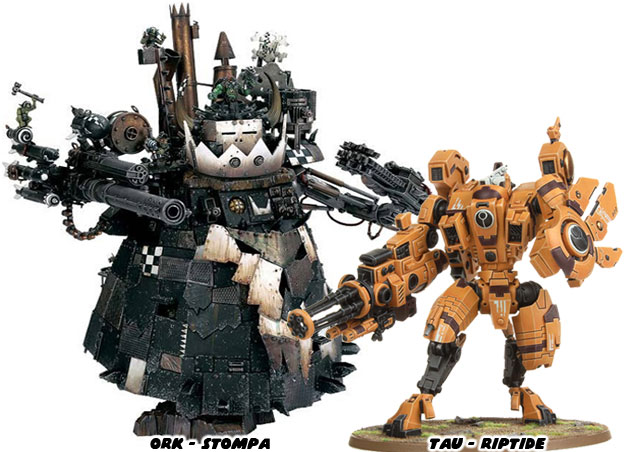
The Tau have a fast and powerful suit called the Crisis Battlesuit. By comparison the Orks have a crude, but equally lethal, robot they can pilot called the Killa Kan. Even though the subject matter of a future that was eternally at war was quite grim the game designers always found a way to put some humor in the system. It's easy to see the differences in alien technology when you compare the weapons side-by-side. When GW was designing the 40K system they learned early on that every alien race needed some sort of counterpart to a particular troop type or weapon. If an alien had a single-person speeder then humans and other species ended up with their own variation on that speeder. If an alien had a tank or transport then humans and other creatures had their own version as well. This sense of balance went from small handheld weapons and armor all the way up to gunships and space craft. The 40K universe always had a great sense of scale. The volumes written and drawn about the universe gave audiences an idea that there were countless other planets and stories waiting to be discovered. When it came to war there were giant robots that made human soldiers seem inconsequential. The artists and sculptors working on the gigantic models never forgot to reflect the technology behind each species. Take a look at the enormous Ork Stompa and Tau Riptide. They were not far removed from their smaller robotic suit counterparts.


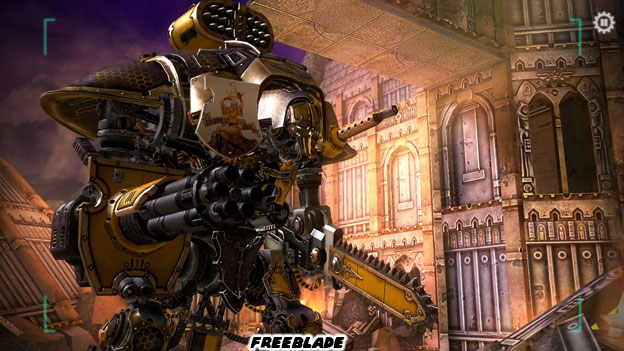
Robotic suits of armor were the backbone of the Space Marine armies. I mentioned that there were more than one set of power armor that a unit could wear. There was a reason for these different types of armors and as you can imagine the bigger ones were designed for more dangerous encounters. The sculptors at Citadel had been refining the armor designs for almost three decades. These are easily some of the best miniature figures you will ever see. The detail applied to each piece is amazing. When you see them side-by-side you can only imagine that the team spent countless hours not only creating these models, but they had to turn around and create a balance for each of the alien races as well. Of the single-pilot suits of armor the largest is the Imperial Knight. This was the armor featured in the game Freeblade. This suit of armor was at a scale to combat the enormous robots like the Riptide and Stompa.


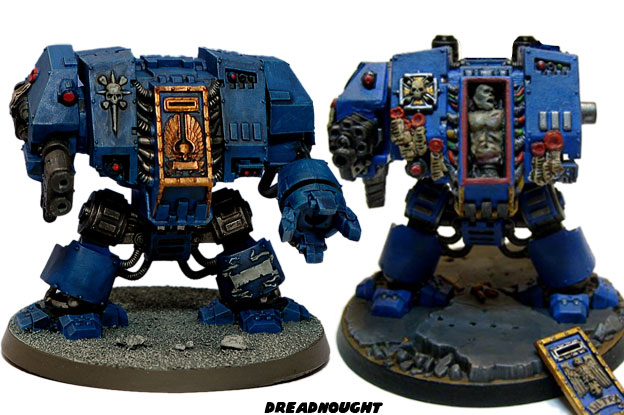
What made the robots used by humanity, and specifically by the Space Marines, different than those piloted by the aliens was the neural interface. Pilots of the Imperial Knight actually became a part of the machine. Their brains and life support systems were tied into the robot during a process called the "Becoming." The consciousness remained with the robot for centuries if not for thousands of years. Only in death would the service to the Imperium end. At which point the robot would be taken apart, reassembled and a new pilot be selected. The robotic host was a tradition that went back to the early days of 40K. The Space Marines were long-lived and super resilient yet even the greatest Space Marine eventually succumbed to injury. Rather than "retire" those warriors and lose much valued military knowledge and experience the best underwent something similar to the Becoming. Those marines were interred in Dreadnought Armor. Their life support systems were connected to the machine and they would be able to fight on for centuries more.


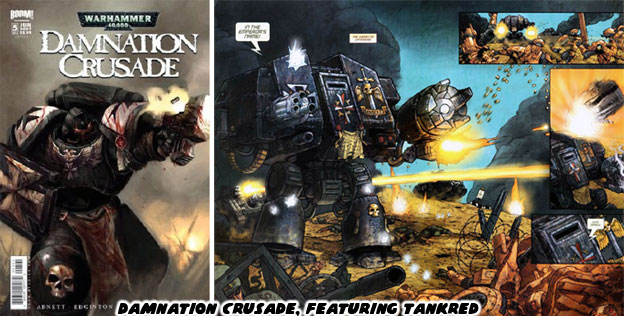
A collection of servitors, or robotic servants would attend to the Dreadnought when not in battle. A Dreadnought was treated like a holy relic. The servitors cared for the mechanical and organic parts with incantations, litanies and sacred oils. The robots received the same care that a nun would give a leper in the slums of poor countries. In many instances the warrior within would sleep for decades at a time until his services were needed once more. One of the great examples of the importance of a Dreadnought in the universe was explored in the comic book Damnation Crusade. A portion of the story is told from the point of view of Tankred, a member of the Black Templars. It's one of the best examples of the sacrifice that the Space Marines make in order to keep humanity alive against the cruel aliens and twisted demons of Chaos. It was great science fiction storytelling and went over amazingly well in the game system.


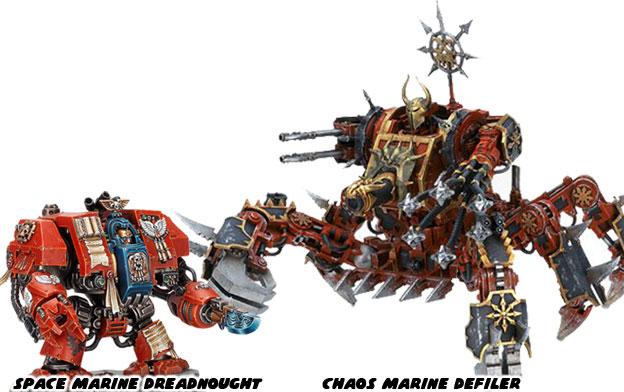
Each legion had its own unique Dreadnoughts, they were honored members and brought into battle an assortment of heavy weapons. The weapons they used, the literal arms on each robot, could be replaced depending on the battle. They had robotic hands that could tear open tank armor, flame throwers that could burn down buildings and plasma cannons that could blow holes through the biggest opponent. The idea of man and machine unified was something that made the science fiction in the world dark and foreboding. This technology was not exclusive to the Space Marines but had a variation in the alien races as well. The most interesting combinations of living tissue and robot came in the forms of the Chaos engines of destruction. The forces of chaos could turn man into beast and heroes into demons. Those that were previously pilots and crews on tanks and artillery became fused with the machines. Not thanks to technology but the magic of the warp, that part of the galaxy that exists beyond our concepts of time and space. Bones became forged into the structure of the machines and blood replaced oil in the infernal contraptions. Skin was stretched across the joins like some macabre hide. Just look at how more intense the Chaos Defiler looks when compared to the already enormous Dreadnought.


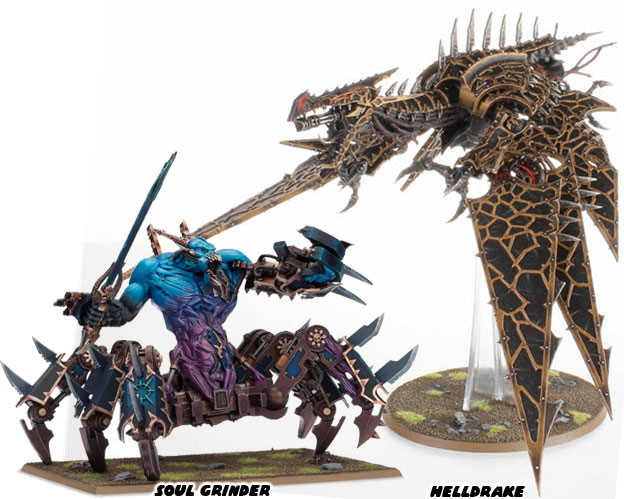
The more powerful the demon the more powerful the living weapon they would become. Some of the larger machine and creature hybrids dwarfed the mighty Dreadnought. Just take a look at the Soul Grinder. The multi-legged robot was far more than a Defiler and yet not quite a demon prince but instead something in between. The forces of Chaos rewarded their champions with awesome powers. Some became larger and more grotesque monsters, some were given weapons with magical properties. Other machinations of chaos were metal birds that could take on any assault jet. The larger weapons of chaos had a purpose, they were a counterpart for the most powerful artillery in an army. Citadel did a fantastic job bringing these creations to life. The designs created by the studio went on to influence other miniature gaming systems and even video game development as well. Several of these monsters-turned-vehicles began popping up in Games Workshop video games.


For years the Dreadnought was considered the most valuable single-pilot robot in canon. The Space Marines and Chaos Space Marines made great use of these machines. Just a handful of the robots could change the course of a battle. Yet as the system grew over the past 30 years the threats became bigger and stronger. Thanks to aliens that became more aggressive and dangerous it was not enough for a Dreadnought to take on the most powerful opponents. Games Workshop began creating more powerful armor for the Space Marines. The Terminator Armor was the best for a long time, then the studio introduced Centurion Armor as well. Gray Knights even had access to a gigantic walking frame so that they could face demon princes in hand-to-hand combat. Yet these bigger and better armor choices were not always enough for the biggest enemies in the 40K universe. This would become the task of an even larger robot. The Imperial Knight, the star of the mobile game Freeblade, would become the most powerful single-pilot robot in the ranks of the Imperial Army. The best part of this robot, aside from its awe-inspiring design, was that it was created so that it could freely move between armies. It did not have to adopt the livery of any particular army. Instead it was a freelance robot that had its own legacy recorded on its own armor. It could have its own insignia and even custom weapon choices to wear in battle. Then it was free to move to another sector of space where it was needed by a different legion.


The Imperial Knight was a force to be reckoned with. The forces of Chaos and the different races learned to feel the mechanical giant in battle. Yet when it came to the history of Warhammer 40,000 it turned out that the Imperial Knight was not at the top of the robotic food chain. If you can believe it there were robots even bigger helping keep the torch burning bright for humanity. The next blog will feature these colossal machines. As always if you enjoyed this blog and would like to sponsor me please visit my Patreon page and consider donating each month, even as little as $1 would help make better blogs and even podcasts!

 follow the Street Writer on Patreon!