Showing posts with label citadel. Show all posts

Monday, March 29, 2021

Why limited-edition tabletop game items are so cool. A 1UP classic...

Tabletop gamers are a unique lot. They enjoy the gaming experience for many of the same reasons that the video game crowd does. There are games that can take players back in time, to fantastic worlds or even to far off planets. There are games that allow players to take on the role of a pro athlete, dictator, robot, cartoon character, police officer or even monster. The best titles are the immersive experiences, the ones that allow players to lose themselves even if just for a moment. Exceptional games can keep a player hooked for hours on end. Many gamers can attest to losing track of time during a session. The most die-hard gamer can attest to losing track of decades. This is because very often a great game has a backstory to hook the player, whether stated or not. The player is often dropped in the middle of a crisis that only they can solve. As the game progresses the elements of the story and the world are revealed to them. The more players become engaged with the experience the more they play and the more that they learn about the game and the game world. The cycle of gaming and discovering continues with every successive play through. Above everything else however there is the camaraderie, the community and the mutual appreciation of the games that players enjoy.

Both the tabletop and video game players can also enjoy the collecting aspect but one goes to the extreme end to support the community. Tabletop gamers enjoy the tangible aspect of the hobby. Each game and each system is supported by books, dice, miniatures and templates. To be fair some video games do have merchandise and collectables as well. Toys, clothing, books and yes, even miniatures and tabletop systems as well. The ones who do it best and who will always do it best are the tabletop gaming manufacturers. The physical objects they produce have a special connection with collectors. Yes an MMO player can spend just as much time as a tabletop gamer leveling, customizing and even painting a character. Once the power goes out however only one type of player has a physical reminder of their game. Those that have been playing miniature based games for 10, 15 or even 20 years have enough physical reminders to fill a garage or two. These players have to collect, assemble and paint their armies one soldier at a time. Video game players get to command a single person or entire unit, some armed with amazing weapons, at their disposal. Dozens if not hundreds of people created those game characters for their entertainment. Tabletop game players have to collect, assemble and paint their own terrain as well. Video game players get to explore vivid worlds created by teams of developers. All of the hours spent playing are not meaningless for tabletop gamers, especially once the power goes out. As gamers on both sides get older their tastes change as well. They tend to demand some more sophistication in the games they play and more immersion. As gamers get older they become working professionals and have more disposable income. This means that they demand a more diverse selection of models and higher quality and hereby higher priced collectables.

Last summer I had talked about the limited edition items from Games Workshop. The creator of the popular Warhammer Fantasy Battle system had released some special markers, rulers and templates for players to collect. Since the world of Warhammer was set in a fantasy world, complete with dragons, ogres and magic, the accessories had to reflect the same spirit. Dice had ancient symbols and skulls carved into them. The rulers and compasses were shaped with macabre icons as well and gilded with the details of medieval artists. These new markers would help distinguish the "hardcore" players from the crowd that used traditional rulers and dice. Collectors knew it would only be a matter of time before the science fiction game Warhammer 40,000 would also get the same treatment.

The company tended to focus the support on each system for full year intervals. Even years were often reserved for new fantasy releases and odd years usually went to 40K campaigns. The end of 2012 and start of 2013 saw several new items added for collectors. The templates for Warhammer 40K had every bit the attention to detail that the fantasy ones had. The markers were silver with gothic iconography made popular in the grim futuristic universe. They were made to look as if they had cool blue electrical sparks flowing between them. This was a good contrast to the gold reserved for the fantasy system.

Citadel, the hobby manufacturer for Games Workshop, also released new dice and objective markers, the Munitorum templates that were consistent with the universe as well. The dice had intricate, circuit-board-like lines carved into them. These new items were placed inside of a metal tin stamped and colored to look like a laser gun power pack. It's a perfect collectable for fans of the Imperial Guard and Space Marines. The objective markers were floating servo-skulls. The skulls were prevalent in the 40K universe, specifically for the human colonies. The servo skulls were made from the heads of devout followers of the Empire and fitted with robotic attachments and anti-gravity disks. They provided all sorts of uses for the empire, from recording audio and video to surveying sites too dangerous for living creatures. Some servo skulls had medical equipment and even weapons attached to them. They often accompanied Space Marines into battle and were most often found with Tech Priests (engineers) and officers. They were as ubiquitous and indispensable as the Droids in Star Wars mythos. It made great sense to turn them into objective markers for a game. Citadel saw an additional use for them though.

A second Servo Skull was released with a built in measuring tape. The front teeth of the skull could be pulled out to show off the bright red laser-like tape. Most tabletop gamers keep a folding ruler or tape measure handy but none have ever looked so cool! It is a good contrast to the traditional ruler created for the fantasy gamers.

There was actually something that Games Workshop had created a few years ago that was among the best accessories for tabletop gaming yet invented. In tabletop games there is a long standing rule called Line of Sight (LOS). When players have a firearm with a specific range then they check to see if all or only part of an opponent's character is exposed. Even partially covered characters can be shot at, however the person attacking suffers a penalty when rolling the dice. Sometimes a player on defense hides a character behind a sandbag or wall and assumes they have enough cover to be completely out of the LOS. Many a game has become heated, even between two good friends, because one player claims that they have a shot and the other does not concur. This ends up bringing a game to a grinding halt and often ends up with one party feeling like they are being cheated. What Games Workshop did was create an LOS laser. It had a curved tail that could be placed over a miniature and show exactly where the character could realistically fire. The laser would actually mark a crosshair on the target and not simply a red dot. It was one of the greatest tools a player could take with them especially to a tournament.

I wonder if any bad sport ever shot an opponent in the eye with the laser. As with all of the new accessories released, the laser LOS was a limited-edition item. Once GW and Citadel had sold out of the item that was it. More unique collectables would be released over the years to keep fans buying. If you would like to sponsor me please visit my Patreon page and consider donating each month, even as little as $1 would help make better blogs and even podcasts!

follow the Street Writer on Patreon!

Saturday, February 13, 2016

Building a gaming legacy, the Games Workshop series, part 6...

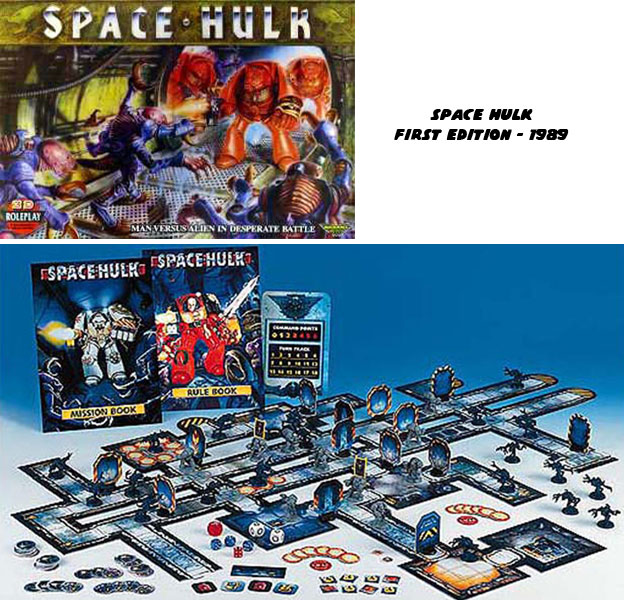
Once upon a time Games Workshop used to support original, stand-alone games. These titles often expanded the canon of the established Warhammer Fantasy and Warhammer 40,000 systems. In the previous blog I mentioned that the company created Adeptus Titanicus out of necessity when Battletech had become all the rage in the tabletop gaming community. In doing so they made the 40K universe much more interesting with the use of robotic Titans and allowed gamers to experience the awesome power of walking battleships. This system ended up being expanded and created the 6mm scale and Epic Space Marine rules which allowed players to deploy entire legions in battle. One of the more popular and even longer-lived systems actually debuted just a year after Adeptus Tianicus. In 1989 GW released Space Hulk. A boxed game set aboard an abandoned space ship in the 40K universe.


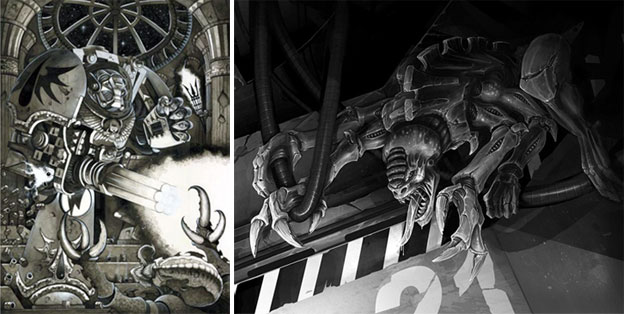
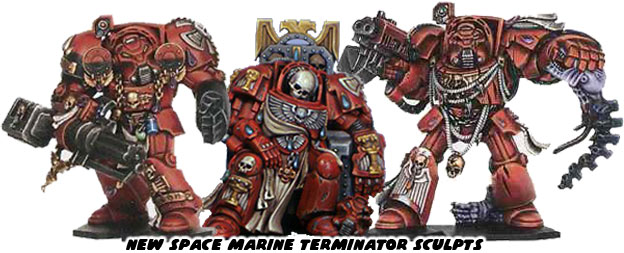
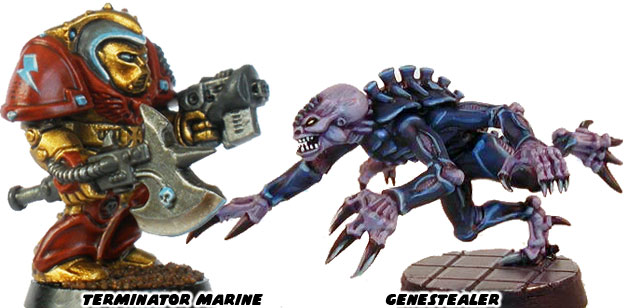
The game was unique for several reasons, but the most important were the introductions of the Terminator Armor Space Marines and the alien enemies known as Genestealers. An entirely new chapter of 40K lore was written in Space Hulk. It was explained that the First Company of each Space Marine chapter consisted of the most experienced and capable warriors from each unit. They were the ones tasked with the most dangerous missions and as such had access to the most powerful weapons and armor. The Terminator Armor was created for the most inhospitable environments. It was bigger and stronger than the standard Power Armor and treated with the reverence of a holy relic. These suits of armor were worn in battle but had gained a reputation for being used while being deployed in a Space Hulk. So what is a Space Hulk? In the 40K universe spaceships are able to cross the galaxy by using the Warp. It is like crossing through a wormhole or tear in space that unites systems that are countless light years apart. The ships have to have powerful reactors in order to escape the gravity well created by the Warp, as well as not to be torn apart by the forces within the Warp which bend time and space as well.


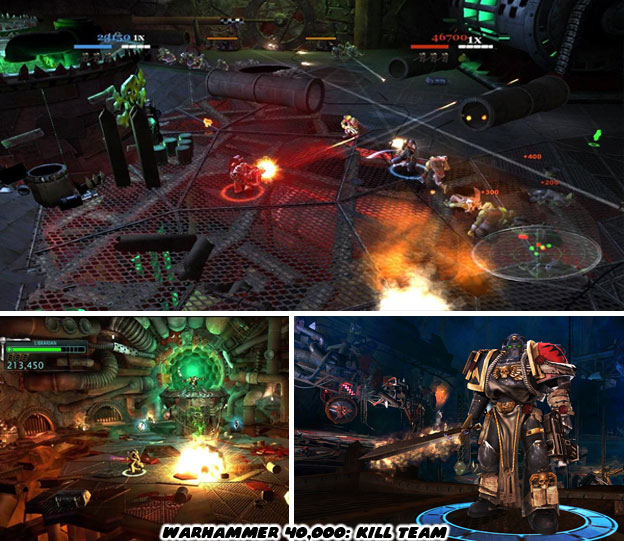
Anyhow, some ships are damaged in the process or have engines that break down and cause the ships to be stuck in the Warp. They will pop in and out of the universe from time to time before being pulled back into the Warp. Some of these ships have weapons and resources that are attractive to scavengers. Aliens and humans alike will risk everything to board one of these vessels. After thousands of years of being adrift in the Warp some of the ships are fused together and get stuck in asteroids and other debris that makes its way into the Warp. These enormous floating piles of debris are often bigger than cities and may even reach the size of a state or nation. They are dubbed Space Hulks and are an ominous sign when they appear near inhabited planets. The reason they are bad news is because within the Space Hulk there are often diseases or even alien species that may easily wipe out an inhabited planet. Those foolish enough to try to salvage the Space Hulks, explore the wreckage of the ships or asteroids they are tied to don't always make it back to port with their bounty. Orks sometimes take over a Space Hulk, put engines on it and raid outposts. This was the plot of the THQ multi-player video game Warhammer 40,000 Kill Team.


Just like the video game there is something far more sinister than Orks lying in the bowels of the oldest and most traveled Space Hulks. The Space Hulks can be lost for countless generations in the Warp. They may turn up in yet uncharted parts of the galaxy and when that happens an alien race may board them and then hibernate, waiting for a foolish explorer to wake them from their slumber. This is the case with the Genestealers. They are an alien shock troop that is the first wave of a species that would later be known as the Tyranid. The Genestealer was modeled after the H.R. Geiger Alien. They are huge, covered in a carapace stronger than steel, quite strong and can even survive in the vacuum of space. Traditional Space Marine armor and weapons are not powerful enough to handle wave after wave of the Genestealers. This is why the Terminators are called in whenever a Space Hulk appears near an Empire-controlled portion of the cosmos.


The Terminators have a set of missions that they can complete in the original boxed game. Sometimes they have to recover a relic from a Space Marine chapter, sometimes they have to find a piece of crucial data from a system computer. Often they have to ensure that there are no Genestealers on board and try to poison the life support systems if they are still functioning so that they can eradicate the threat before the ship slips back into the Warp. The game allows players to explore tight corridors and engage in firefights with scores of Genestealers. Anyone that has seen the film Aliens can remember how intense it is to fight wave after wave of alien with limited resources and in tight quarters. Space Hulk ramps up this concept tenfold and makes surviving each map all the more intense. Speaking of the maps, the original game also came with printed cardboard tiles and doors that could be assembled in any number of layouts. This ensured that the game would constantly keep evolving and offer a different experience each time a player started a campaign. The other thing these printed pieces did was help immerse the player into the game. Those with limited hobby experience didn't have to build or paint any terrain. Each piece was highly detailed, the tiles were painted by Games Workshop artists after all. The boards made it easy to imagine that the Terminators were battling for survival in the maze-like Space Hulk.


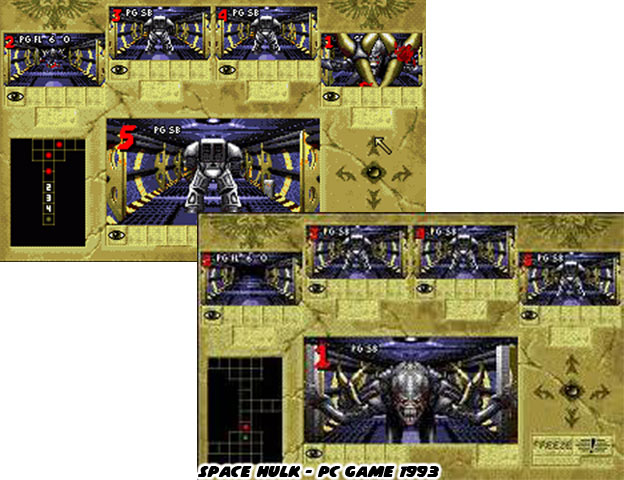
Space Hulk did such a great job at capturing even non traditional tabletop audiences that it was turned into a PC game by Electronic Arts in 1993. The PC game did a fantastic job of recreating the isolation and horror of each mission. Genestealers would lurk at every turn and you would find yourself saying a prayer to the machine spirit that your heavy bolter wouldn't jam during an intense firefight. In the science fiction genre it was a refreshing change of pace, it worked because of the liberally sprinkled horror elements as well. It was unlike anything the US and Japanese studios were producing. Best of all the PC game was getting people interested in the universe of 40K. Space Hulk, the tabletop and PC versions would receive expansions.


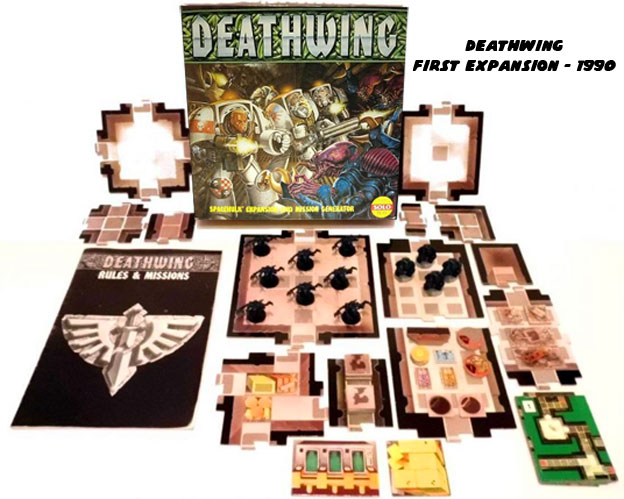
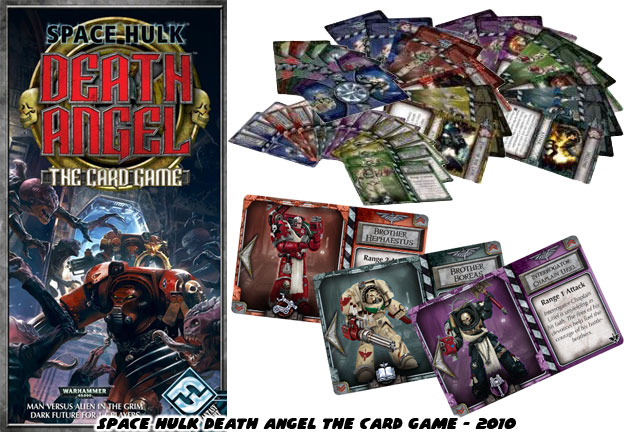
The Deathwing expansion came out in 1990. It would begin to flesh out the Tyranids as well as the other alien species that called the Space Hulk home. The games also helped shed some light on the Dark Angels and Blood Angel Space Marine Chapters. Two of the oldest and most tragic chapters from the earliest days of the Empire. The popularity and longevity of the game was apparent when Fantasy Flight Games released a CCG (collectible card game) based on Space Hulk. The new game called Death Angel came out almost 20 years after the original tabletop game. It instantly brought audiences up to speed on the elements that made the original game so memorable. Players had missions, could arm themselves with rare items or even hunt down opponents as Genestealers. The card game and the expansions that followed could be found in most book stores and even toy stores. This was one of the few Games Workshop systems that found a bit of mainstream success. The popularity of which would bring a few generations into the larger system of Warhammer 40,000.


Because of Space Hulk all new models and rules would be created for the Tyranids. Not only that the entire alien race would be fleshed out. Genestealers would only be one type of troop. There were small, spore-like Tyranids that acted like land mines, releasing toxins and poison quills to those that approached them. There were larger Tyranids, like the Carnifex that were the size of tanks and could peel them apart like a tin can with their massive claws. There were even Tyrnaid large enough to fight against Titans! Tyranids were becoming the alpha-predator in the 40K universe. They would eat and harvest the DNA of every species they came across. This caused the troop types to mutate and gain the best traits of a particular species. Some became bulky and strong thanks to Ork DNA. Some became powerful psychics because they had absorbed Eldar DNA. Because of this new threat the Space Marines would get a boost in new weapons and armor as well.


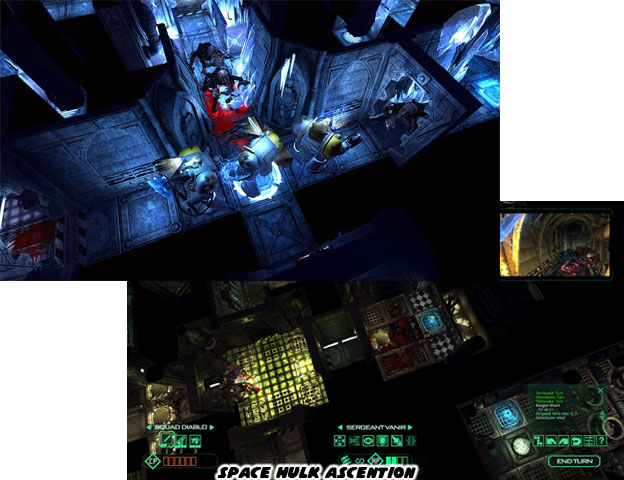
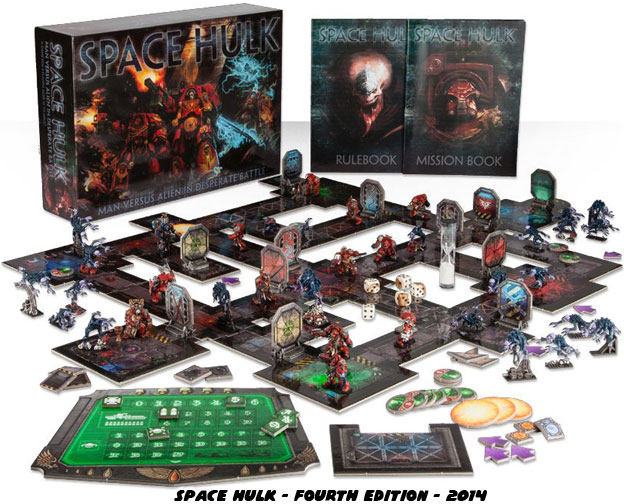
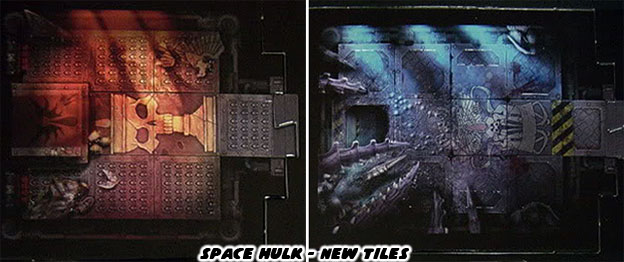
The love of the Space Hulk never died off. In 2013 the PC game was remade, called Space Hulk Ascension. It helped spark renewed interest in the universe. That same year Games Workshop would publish a third-generation of the game with all new rules, models and tiles. Games Workshop made sure to use the latest advances in publishing and released a superior product. The old illustrated cardstock tiles were replaced with thicker, higher quality embossed tiles that featured digital renderings. The printing on the tiles gave them the illusion of depth, light and even texture. One of the problems with the old cardstock tiles was that they were flat-edged, this did allow each tile to perfect align to the next but they often slid around on a table. The new tiles had jigsaw edges so that they could all interlock. The majority of the miniatures that Citadel created for the Games Workshop systems were metal, originally lead but then later on they went to pewter. The plastic miniatures that Citadel developed in the late '80s and early '90s were well done but lacked the same level of detail of metal miniatures. Citadel went with plastics for the self-contained systems, they were cheaper to produce and less prone to bending as a metal figure. The plastic models were used in boxed sets like Blood Bowl, Heroquest and Space Hulk.


The original Space Hulk featured printed cardstock tiles that allowed gamers to create their own mazes, scatter objectives and never have the same experience twice. The combination of plastic miniatures and printed cardstock tiles worked very well for the genre. Audiences didn't have to invest time or money in building elaborate sets to play in, although some of the more hardcore gamers did just that. In fact a few companies popped up featuring easy-to-assemble terrain, much of which was pre-painted or pre-printed so it complimented the Space Hulk rules. What Games Workshop did was create a bridge between the tabletop roleplay system of Warhammer 40K with more traditional board games. By limiting the movement to corridors and small open rooms the studio streamlined the rules on movement, ranged and melee attacks and line of site so that audiences could pick up the gameplay much faster than 40K. In the fantasy world GW did the same thing with Warhammer Quest, which took the characters and rules of Warhammer Fantasy Battle and made it an easy to pick up system with mazes that audiences could randomly build.


Space Hulk and the other boxed games from the studio, which I will highlight on future blogs, were gateway systems for the hobby and in some cases could even be found in large-scale toy stores. The plastics manufacturing process had improved greatly over the decades. When Space Hulk was relaunched the miniatures created for the game were amazing. The characters had individual dynamic poses, both the Terminators and Genestealers and an unparalleled level of detail. Even the relics being searched for got a makeover thanks to the Citadel modeling department.


The third and fourth editions of Space Hulk won several awards and the accolades of gamers and editors the world over. It gave Games Workshop the confidence to pursue other self-contained boxed sets, which was something they hadn't done in years. Before I go too far into the science fiction worlds that Games Workshop created I want to go back and explore the fantasy systems that helped put them on the map. You see if Space Hulk was a great introduction to tabletop role playing systems for sci-fi there was something even more successful for fantasy. The next blog will look at this system. As always if you enjoyed this blog and would like to sponsor me please visit my Patreon page and consider donating each month, even as little as $1 would help make better blogs and even podcasts!
 follow the Street Writer on Patreon!

Tuesday, January 19, 2016

Building a gaming legacy, the Games Workshop series, part 2...

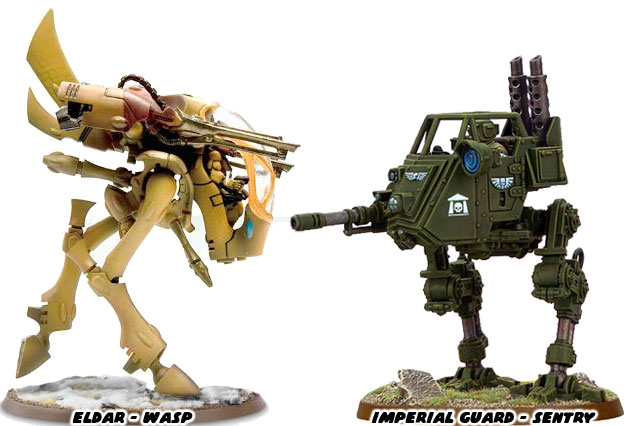
In the previous blog I mentioned that the sculptors working at Games Workshop create some fantastic miniatures for the Warhammer 40,000 system. Specifically these sculptors, sometimes freelancers, work for Citadel, the studio responsible for making the paints, models and tool kits for Games Workshop. Citadel is owned and operated by GW but have the responsibility of all the hobby elements that go into the system. In 40K the sculptors have to create vehicles and machines that reflect the aesthetics of each race. From human to alien, each species has a certain look, a certain style. The designers at GW help put together the back story and origin of each species. The sculptors at Citadel help translate the paintings and illustrations of the artists into three dimensional figures. The work that they do is beyond exceptional, they are awe-inspiring. For example in 40K there are aliens called the Eldar. Think of them like space elves. They are tall, slender and have weapons, armor and vehicles that are sleek. The lines on their war gear are smooth and flowing, inspired in many regards by the beauty of nature. Their weaponry is run on an exotic crystal fusion. By comparison the humans have weapons that we could imagine are forged from iron and steel and are run on diesel fuel. Take a look at the single-pilot walkers that the Eldar and Imperial Guard use in combat. Both machines are prime examples of science fiction storytelling. They have mounted weapons on a robotic frame with two legs but one seems to be half the weight and able to glide across the battlefield while the other stomps around like a clumsy wind-up toy.


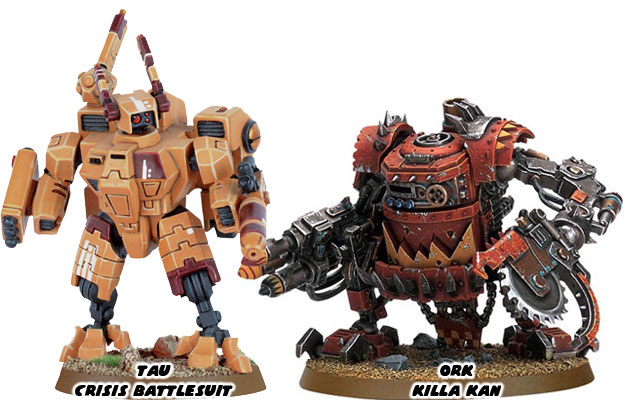
These aesthetic choices are by design and help reinforce the species that make up 40K. The Eldar are very proud of themselves and think that all of the other aliens are primitive and crude. The word that they have for humans is Mon-kei. Some of the aliens that they speak of certainly fit the bill. The Orks for example have heavy, cumbersome weapons that double as clubs for the savage greenskins. They manage to cobble together weapons, artillery and spacecraft using whatever crude material they have on hand. In a way they are engineering savants. Their work is not pretty but it gets the job done. On the other side of the cosmos are the Tau. The gray-skinned aliens are very advanced and are trying to bring peace throughout the cosmos, by conquest of course! The technology they exploit is neither fluid like the Eldar or gothic like the humans but instead something completely different. I would compare the design aesthetic applied to the Tau like mecha designs featured in Japanese anime. Not surprising is how well it balances out the technology exploited by the other aliens. These things are especially obvious when you look at the robotic armor that the races can field. Space Marines have Power Armor, Terminator Armor and other forms of armor and battle suits that they can wear. They are not the only ones that benefit from this type of armor.


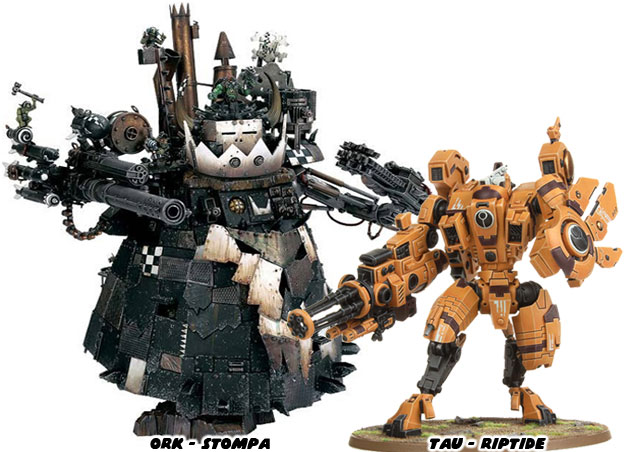
The Tau have a fast and powerful suit called the Crisis Battlesuit. By comparison the Orks have a crude, but equally lethal, robot they can pilot called the Killa Kan. Even though the subject matter of a future that was eternally at war was quite grim the game designers always found a way to put some humor in the system. It's easy to see the differences in alien technology when you compare the weapons side-by-side. When GW was designing the 40K system they learned early on that every alien race needed some sort of counterpart to a particular troop type or weapon. If an alien had a single-person speeder then humans and other species ended up with their own variation on that speeder. If an alien had a tank or transport then humans and other creatures had their own version as well. This sense of balance went from small handheld weapons and armor all the way up to gunships and space craft. The 40K universe always had a great sense of scale. The volumes written and drawn about the universe gave audiences an idea that there were countless other planets and stories waiting to be discovered. When it came to war there were giant robots that made human soldiers seem inconsequential. The artists and sculptors working on the gigantic models never forgot to reflect the technology behind each species. Take a look at the enormous Ork Stompa and Tau Riptide. They were not far removed from their smaller robotic suit counterparts.


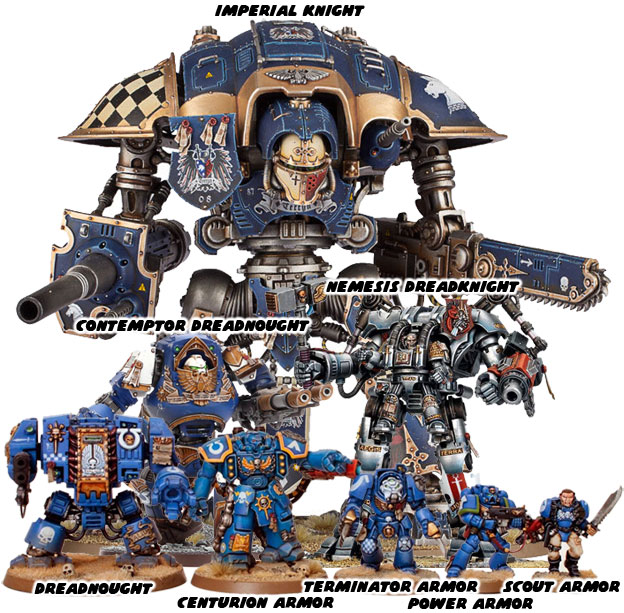
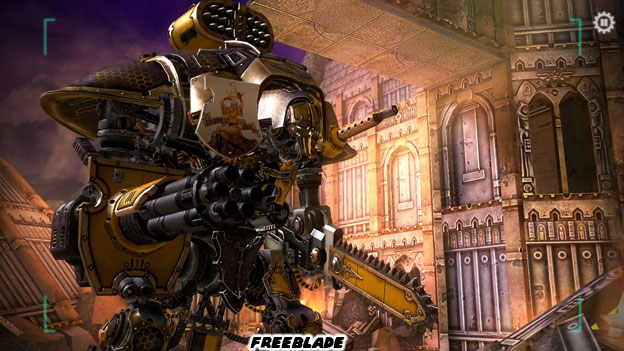
Robotic suits of armor were the backbone of the Space Marine armies. I mentioned that there were more than one set of power armor that a unit could wear. There was a reason for these different types of armors and as you can imagine the bigger ones were designed for more dangerous encounters. The sculptors at Citadel had been refining the armor designs for almost three decades. These are easily some of the best miniature figures you will ever see. The detail applied to each piece is amazing. When you see them side-by-side you can only imagine that the team spent countless hours not only creating these models, but they had to turn around and create a balance for each of the alien races as well. Of the single-pilot suits of armor the largest is the Imperial Knight. This was the armor featured in the game Freeblade. This suit of armor was at a scale to combat the enormous robots like the Riptide and Stompa.


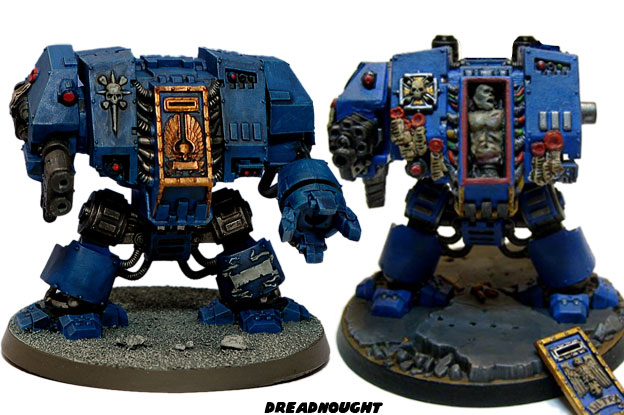
What made the robots used by humanity, and specifically by the Space Marines, different than those piloted by the aliens was the neural interface. Pilots of the Imperial Knight actually became a part of the machine. Their brains and life support systems were tied into the robot during a process called the "Becoming." The consciousness remained with the robot for centuries if not for thousands of years. Only in death would the service to the Imperium end. At which point the robot would be taken apart, reassembled and a new pilot be selected. The robotic host was a tradition that went back to the early days of 40K. The Space Marines were long-lived and super resilient yet even the greatest Space Marine eventually succumbed to injury. Rather than "retire" those warriors and lose much valued military knowledge and experience the best underwent something similar to the Becoming. Those marines were interred in Dreadnought Armor. Their life support systems were connected to the machine and they would be able to fight on for centuries more.


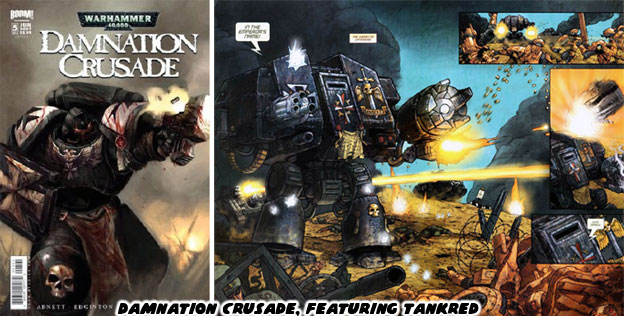
A collection of servitors, or robotic servants would attend to the Dreadnought when not in battle. A Dreadnought was treated like a holy relic. The servitors cared for the mechanical and organic parts with incantations, litanies and sacred oils. The robots received the same care that a nun would give a leper in the slums of poor countries. In many instances the warrior within would sleep for decades at a time until his services were needed once more. One of the great examples of the importance of a Dreadnought in the universe was explored in the comic book Damnation Crusade. A portion of the story is told from the point of view of Tankred, a member of the Black Templars. It's one of the best examples of the sacrifice that the Space Marines make in order to keep humanity alive against the cruel aliens and twisted demons of Chaos. It was great science fiction storytelling and went over amazingly well in the game system.


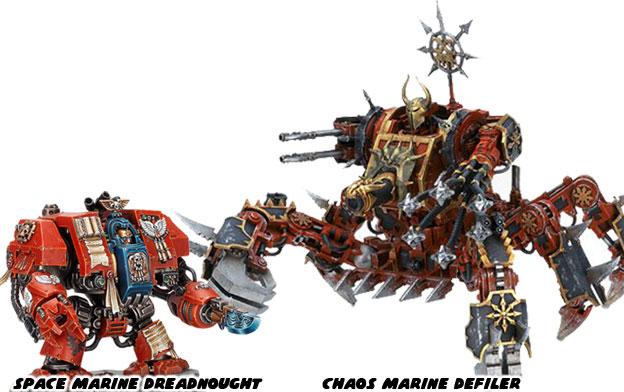
Each legion had its own unique Dreadnoughts, they were honored members and brought into battle an assortment of heavy weapons. The weapons they used, the literal arms on each robot, could be replaced depending on the battle. They had robotic hands that could tear open tank armor, flame throwers that could burn down buildings and plasma cannons that could blow holes through the biggest opponent. The idea of man and machine unified was something that made the science fiction in the world dark and foreboding. This technology was not exclusive to the Space Marines but had a variation in the alien races as well. The most interesting combinations of living tissue and robot came in the forms of the Chaos engines of destruction. The forces of chaos could turn man into beast and heroes into demons. Those that were previously pilots and crews on tanks and artillery became fused with the machines. Not thanks to technology but the magic of the warp, that part of the galaxy that exists beyond our concepts of time and space. Bones became forged into the structure of the machines and blood replaced oil in the infernal contraptions. Skin was stretched across the joins like some macabre hide. Just look at how more intense the Chaos Defiler looks when compared to the already enormous Dreadnought.


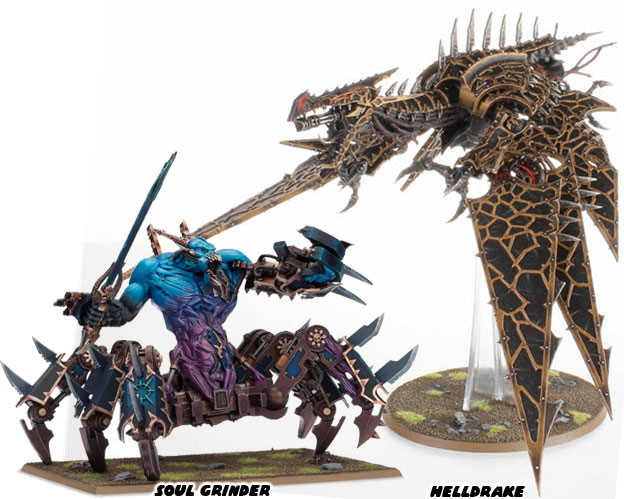
The more powerful the demon the more powerful the living weapon they would become. Some of the larger machine and creature hybrids dwarfed the mighty Dreadnought. Just take a look at the Soul Grinder. The multi-legged robot was far more than a Defiler and yet not quite a demon prince but instead something in between. The forces of Chaos rewarded their champions with awesome powers. Some became larger and more grotesque monsters, some were given weapons with magical properties. Other machinations of chaos were metal birds that could take on any assault jet. The larger weapons of chaos had a purpose, they were a counterpart for the most powerful artillery in an army. Citadel did a fantastic job bringing these creations to life. The designs created by the studio went on to influence other miniature gaming systems and even video game development as well. Several of these monsters-turned-vehicles began popping up in Games Workshop video games.


For years the Dreadnought was considered the most valuable single-pilot robot in canon. The Space Marines and Chaos Space Marines made great use of these machines. Just a handful of the robots could change the course of a battle. Yet as the system grew over the past 30 years the threats became bigger and stronger. Thanks to aliens that became more aggressive and dangerous it was not enough for a Dreadnought to take on the most powerful opponents. Games Workshop began creating more powerful armor for the Space Marines. The Terminator Armor was the best for a long time, then the studio introduced Centurion Armor as well. Gray Knights even had access to a gigantic walking frame so that they could face demon princes in hand-to-hand combat. Yet these bigger and better armor choices were not always enough for the biggest enemies in the 40K universe. This would become the task of an even larger robot. The Imperial Knight, the star of the mobile game Freeblade, would become the most powerful single-pilot robot in the ranks of the Imperial Army. The best part of this robot, aside from its awe-inspiring design, was that it was created so that it could freely move between armies. It did not have to adopt the livery of any particular army. Instead it was a freelance robot that had its own legacy recorded on its own armor. It could have its own insignia and even custom weapon choices to wear in battle. Then it was free to move to another sector of space where it was needed by a different legion.


The Imperial Knight was a force to be reckoned with. The forces of Chaos and the different races learned to feel the mechanical giant in battle. Yet when it came to the history of Warhammer 40,000 it turned out that the Imperial Knight was not at the top of the robotic food chain. If you can believe it there were robots even bigger helping keep the torch burning bright for humanity. The next blog will feature these colossal machines. As always if you enjoyed this blog and would like to sponsor me please visit my Patreon page and consider donating each month, even as little as $1 would help make better blogs and even podcasts!
 follow the Street Writer on Patreon!