Showing posts with label dreadnought. Show all posts

Sunday, January 24, 2016

Building a gaming legacy, the Games Workshop series, part 3...

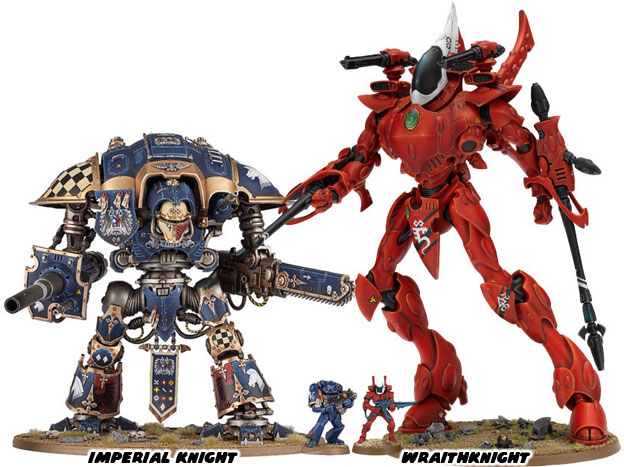
In the previous blog I mentioned that the Imperial Knight was the largest single-pilot robot in the Warhammer 40,000 universe. Well, this was true for the human armies but what about the aliens? The Tau had some large robots (the ones that looked like Japanese mecha) but so too did the Eldar (remember the space elves?). One of their larger robots was called the Wraith Knight. It also had a single pilot that was connected neurologically to the robot and was much taller and more powerful than the Imperial Knight. Because of its size this robot was a different class from the Imperial Knight. It was considered a Titan.


In the 40K universe the titans were the largest robots used in battle. Believe it or not the Imperial Knight was not as big as the smallest Titan. The Imperial Knight was much larger than a Space Marine or a Dreadnought. It was bigger than even the super-heavy tanks used by the Imperial Army. Seeing one walking towards the front line was enough to cause fear of most enemies on the battlefield. Even large Chaos engines of destruction and Ork Squiggoths would find the Imperial Knight formidable. Yet some of the small and mid-size Titans made the Imperial Knight less imposing and even the Space Marines armies seem insignificant. Just look at how massive the foot was for a Reaver Titan compared to a Space Marine. The marine was well over seven-feet tall yet was no taller than a "toe" on the Reaver.
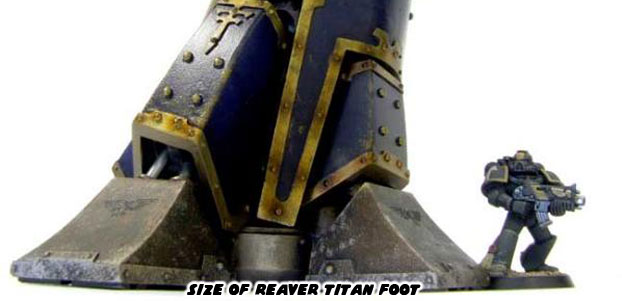
 

In canon the smallest two Titans employed by the Imperium were the Warhound and the Reaver. Like the Imperial Knight they were used where firepower was necessary and where flexibility was crucial. They had to be able to perform functions that no tank unit could in an area that was too tight for aircraft as well. The Titans were not necessarily as slow and cumbersome as people assumed. With the right crew they could navigate narrow streets, target and strafe opponents without stopping and even bring down buildings around them if they could not hold a position. Depending on the situation they could be equipped with an assortment of weapons, from long range artillery and anti-aircraft missiles, to closer range force claws and plasma cannons . A giant robot may seem like an easy target on the battlefield but they were often protected by invisible force fields. A smaller variation of this shield could be generated by the Imperial Knight. The shield would absorb the energy from explosives, lasers and plasma blasts and deflect it around the frame.
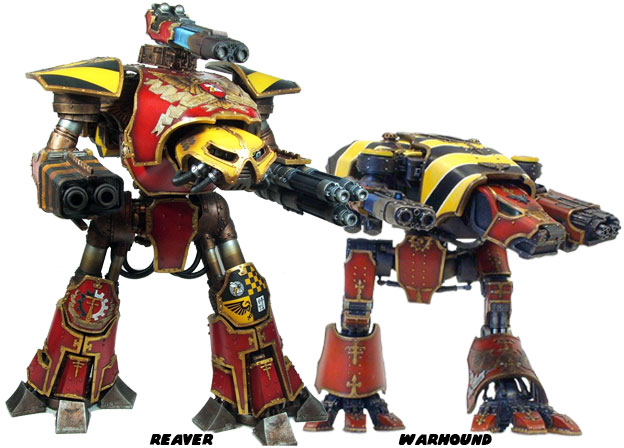
 

While they were considered "small" they still required a crew to move, function and remain operational. This was where the differences between the Imperial Knight and the Titans really came into play. An Imperial Knight had a crew waiting for it to return from battle in order to perform the necessary repairs and weapon replacements. The pilot was pretty much on his own in the battlefield. A Titan required a crew to operate both on and off the battlefield. Perhaps there was a pilot or two manning the movement and weaponry, but there were countless other servitors taking care of the mechanics in real time. Think of a servitor as a sort of zombie mechanic. They were servants retrofitted with tools, welding torches and wrenches instead of arms and hands. They were strong, loyal and programmed only to perform their duties. In this case a servitor would keep the Titan running on the battlefield while performing all of the maintenance on the fly. A servitor did the things that the R-type Droids did in the Star Wars universe.
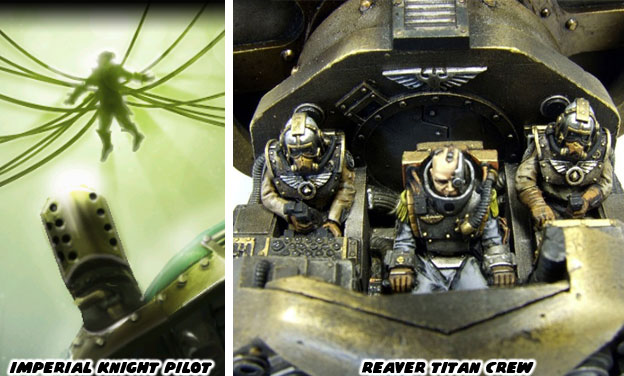
 

An Imperial Knight was instead piloted by a single individual, he was reliant on his crew only after the battle. The Imperial Knight pilot faced the same challenges that a Dreadnought pilot had. Both types of robotic armor depended on outside crews to aide them, repair them and deploy them because they were not physically capable of doing anything themselves. It was a sad existence when you think about it. To the pilots however it was their duty to the Empire. It was an honor to serve as a mechanized warrior, fighting alongside or as a member of the brave Space Marines. There was a precedent for this, for placing yourself in the heart of a machine. It was a tradition that went back to the year 30,000. The Emperor of Terra had a Golden Throne created by the greatest adepts and scientists from Earth and Mars. The Golden Throne was able to harness his psychic energy and create portals to other planets. He could send his Space Marines almost anywhere in space with this fantastic invention.
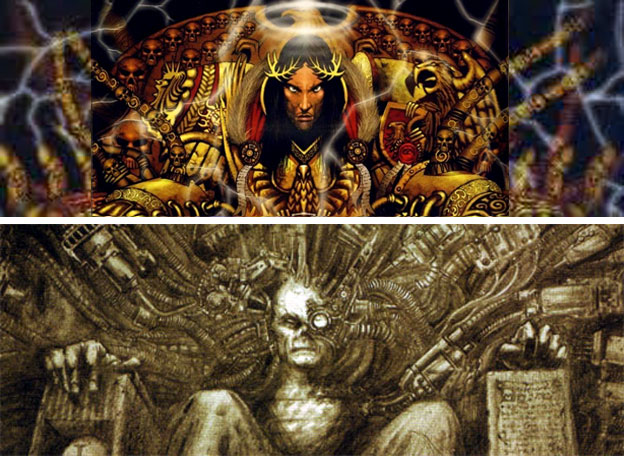

The Emperor was betrayed by his Warmaster Horus and had to fight against him. The Chaos Gods had granted Horus amazing powers which made him a perfect rival to the Emperor. The Emperor killed Horus but was left near death in the fight. He was placed on the Golden Throne and it was turned into a life support system. Instead of tapping into his psychic power it was tapping into the living energy of thousands of powerful psykers, flown in every day from all over the galaxy. Their life force would be depleted in a few hours but combined they would keep the Emperor in a state of suspended animation, or rather slow decay. The Emperor would become fused with the machine for the next 10,000 years. At least one of the Dreadnoughts in 40K canon, Bjorn the Fell-Handed, was a member of the Space Wolves and was alive during the Great Crusade and the Horus Heresy. Imagine the type of mental fortitude that it takes to become attached to a machine for most of your existence. There is a special model and rules created for Bjorn in case the players of the tabletop system want to use the Dreadnought in a campaign.
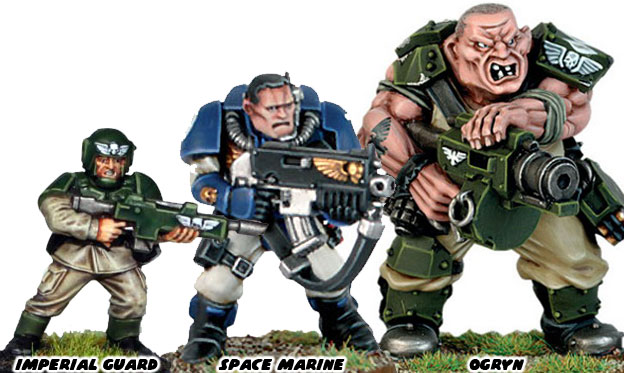
 

But I digress... I can talk about how awesome the giant robots were in 40K but you do not really appreciate the scale of the Titans until you see them compared to the single-unit types. A Space Marine is much larger than an Imperial Guard soldier, yet they are not as large as an Ogryn. An Ogryn is not as large as a Space Marine in Centurion Armor, nor are they as large as a Dreadnought. The Dreadnought is huge and powerful but is only a fraction as big as an Imperial Knight. This is where things start to fall into perspective.
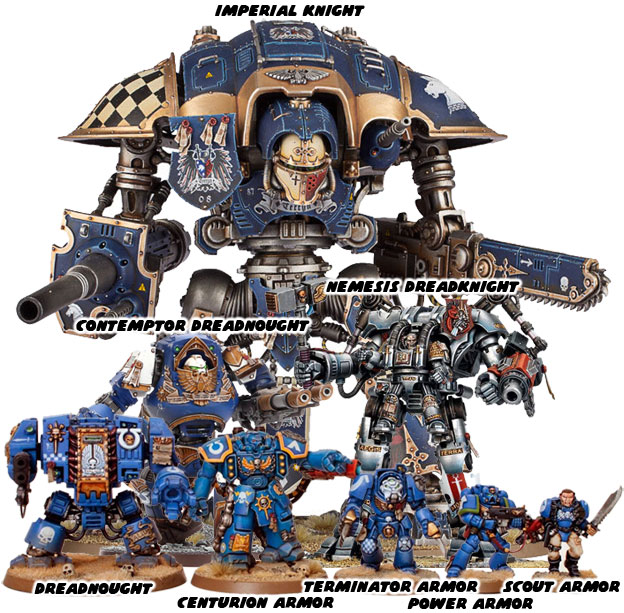

At 50-feet-tall the Imperial Knight is dwarfed by the Titans. Remember that the Warhound and Reaver were small and mid-size Titans. The largest Titans, like the Warlord MKIII for example, were very similar to walking battleships. They had a command, carried a crew, support, radar and artillery. With the cases of the biggest, they could even carry and entire regiment of Space Marines into battle.
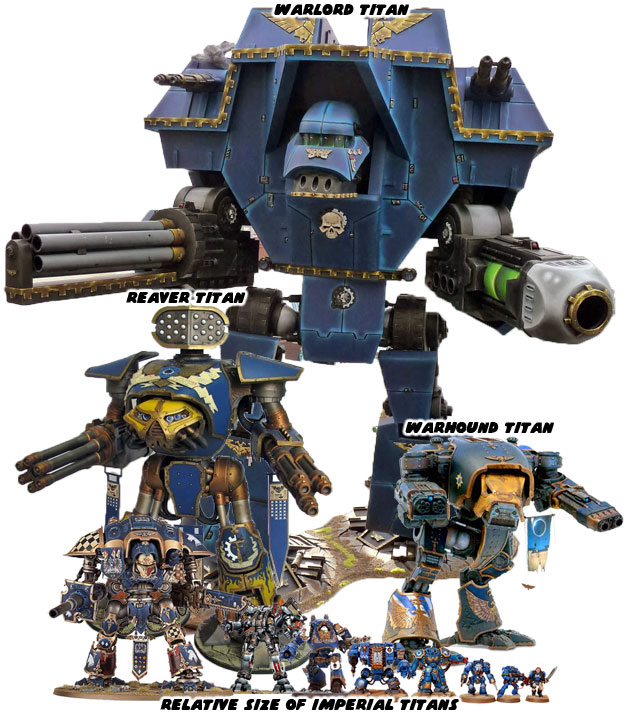
 

When a Titan goes to war it literally changes the shape of the battlefield. A Titan is a force of nature, like a tornado or hurricane, it is absolutely unstoppable. Entire cities are turned to rubble, forests are burned to the ground and hills are flattened in their wake. Only another Titan or squadron of Titans can offer a suitable challenge. They are absolute symbols of power and can inspire an army to victory and cause the enemy to shrivel in fear.
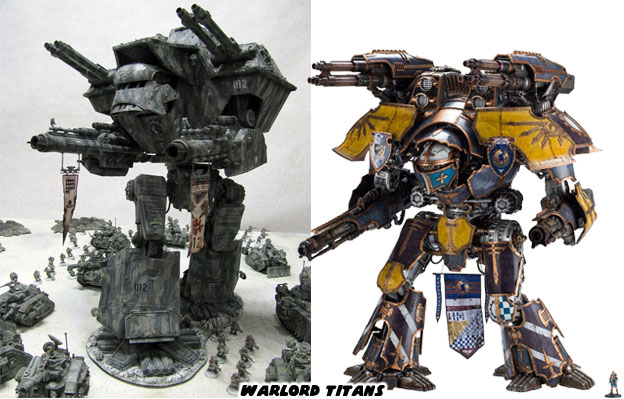

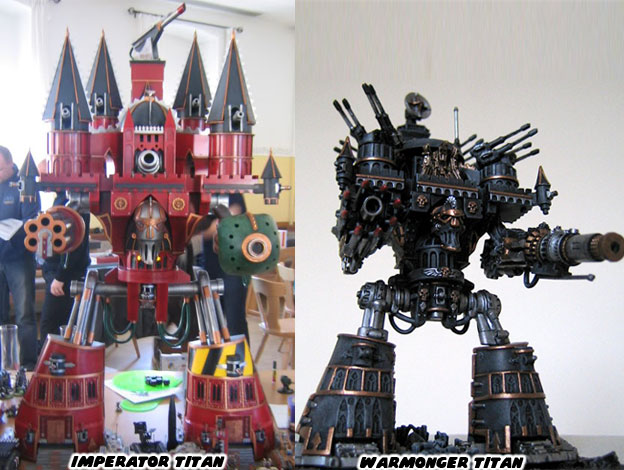
There are Titans in 40K canon that are so obscenely huge that they are almost impossible to imagine. The Warlord Titans are awe-inspiring but they are not the largest class of Titans. At the far end of the spectrum there is a class known as the Warmonger and Imperator. These Titans are walking skyscrapers. In each leg they carry a unit of Space Marines and on their back is a full headquarters contained within a fortress. They were critical during the Great Crusades, lead by the Emperor of Terra himself. Titans helped establish the dominion of the Emperor, and took entire sectors of the galaxy back from alien invaders. They faded in number but their stories grew into legend. A few die-hard tabletop gaming fans around the world have scratch-built their own titans to the exacting specifications set up by the 40K canon.

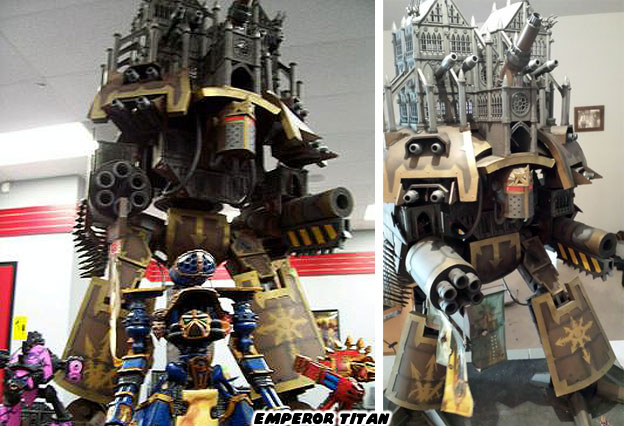
Remember that in 40K the forces of Chaos can corrupt and turn machines into hybrids of demon and robots. The same applies to the Titans. There have been legends of chaotic titans which sprout horns, spit blood instead of plasma and have mechanical tails that slash of their own free will. The crews and pilots on the chaos titans are usually "digested " by the Titan if they do not become fused and part of the nervous and sensory systems. Fans have also scratch-built their own Chaos "Emperor" Titans that are every bit as impressive as the Imperator.

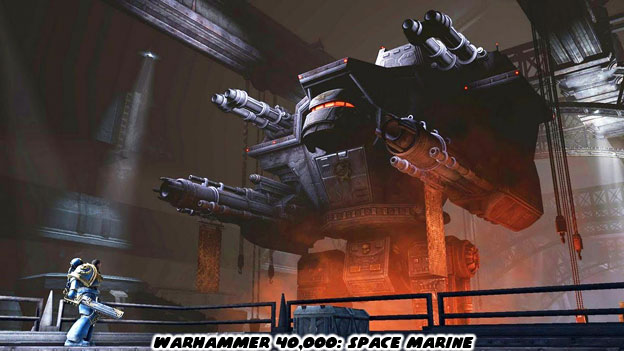
The Titan is the ultimate set piece. Whether we are talking about a tabletop game or a video game. It is very hard to ignore the giant robot, the literal elephant in the room. The Titan has been central to a few PC and console games based on Warhammer 40K. One of the best uses of the robot was in the title Warhammer 40,000 Space Marine. The game by Relic Entertainment features a Warlord class Titan known as the Invictus. In the game players got to run in around the Titan as it rested in an Imperial Hangar. Its weapons were needed to destroy a dimensional bridge being used by Chaos. The player actually got to run on its shoulders, shooting down opponents while it moved into firing position. It was one of the great moments in the history of video games. It was something that a tabletop fan like myself never thought that they would see in any video game.

What was fantastic about the 40K universe was how the scale would continue to grow and grow. The most massive of Titans was never big enough, there was always a threat more imposing, more dangerous. War was everywhere and even with these colossal robots the survival of humanity was never guaranteed. In many ways the soul of humanity had already been transferred to the machines. It was done before the first Dreadnought was built, it was even done before the Golden Throne was created. In the next blog we will look at those former humans that are guided by the Machine God. As always if you enjoyed this blog and would like to sponsor me please visit my Patreon page and consider donating each month, even as little as $1 would help make better blogs and even podcasts!
 follow the Street Writer on Patreon!

Tuesday, January 19, 2016

Building a gaming legacy, the Games Workshop series, part 2...

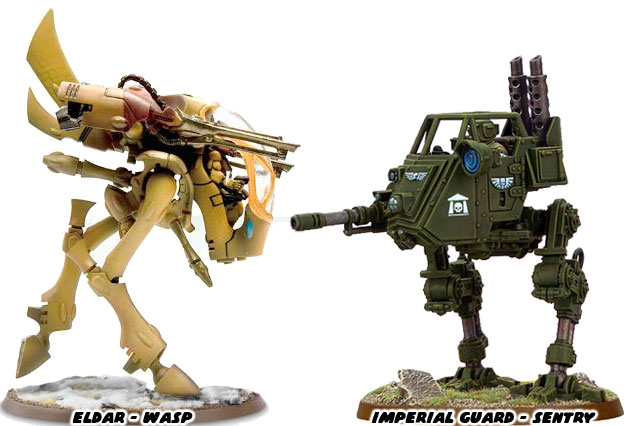
In the previous blog I mentioned that the sculptors working at Games Workshop create some fantastic miniatures for the Warhammer 40,000 system. Specifically these sculptors, sometimes freelancers, work for Citadel, the studio responsible for making the paints, models and tool kits for Games Workshop. Citadel is owned and operated by GW but have the responsibility of all the hobby elements that go into the system. In 40K the sculptors have to create vehicles and machines that reflect the aesthetics of each race. From human to alien, each species has a certain look, a certain style. The designers at GW help put together the back story and origin of each species. The sculptors at Citadel help translate the paintings and illustrations of the artists into three dimensional figures. The work that they do is beyond exceptional, they are awe-inspiring. For example in 40K there are aliens called the Eldar. Think of them like space elves. They are tall, slender and have weapons, armor and vehicles that are sleek. The lines on their war gear are smooth and flowing, inspired in many regards by the beauty of nature. Their weaponry is run on an exotic crystal fusion. By comparison the humans have weapons that we could imagine are forged from iron and steel and are run on diesel fuel. Take a look at the single-pilot walkers that the Eldar and Imperial Guard use in combat. Both machines are prime examples of science fiction storytelling. They have mounted weapons on a robotic frame with two legs but one seems to be half the weight and able to glide across the battlefield while the other stomps around like a clumsy wind-up toy.


These aesthetic choices are by design and help reinforce the species that make up 40K. The Eldar are very proud of themselves and think that all of the other aliens are primitive and crude. The word that they have for humans is Mon-kei. Some of the aliens that they speak of certainly fit the bill. The Orks for example have heavy, cumbersome weapons that double as clubs for the savage greenskins. They manage to cobble together weapons, artillery and spacecraft using whatever crude material they have on hand. In a way they are engineering savants. Their work is not pretty but it gets the job done. On the other side of the cosmos are the Tau. The gray-skinned aliens are very advanced and are trying to bring peace throughout the cosmos, by conquest of course! The technology they exploit is neither fluid like the Eldar or gothic like the humans but instead something completely different. I would compare the design aesthetic applied to the Tau like mecha designs featured in Japanese anime. Not surprising is how well it balances out the technology exploited by the other aliens. These things are especially obvious when you look at the robotic armor that the races can field. Space Marines have Power Armor, Terminator Armor and other forms of armor and battle suits that they can wear. They are not the only ones that benefit from this type of armor.


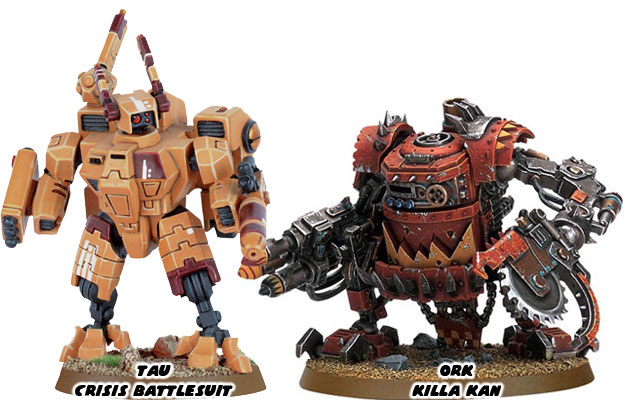
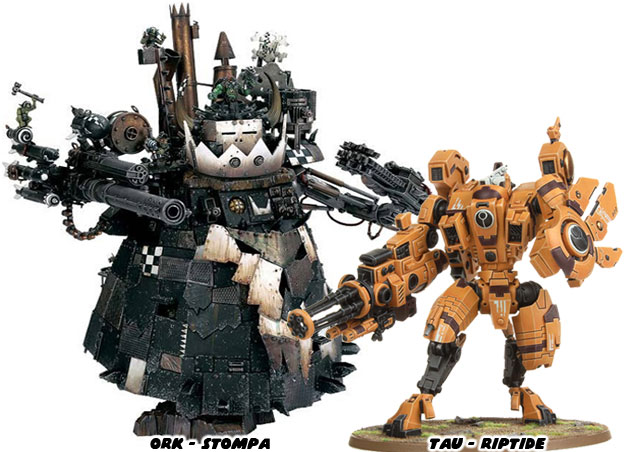
The Tau have a fast and powerful suit called the Crisis Battlesuit. By comparison the Orks have a crude, but equally lethal, robot they can pilot called the Killa Kan. Even though the subject matter of a future that was eternally at war was quite grim the game designers always found a way to put some humor in the system. It's easy to see the differences in alien technology when you compare the weapons side-by-side. When GW was designing the 40K system they learned early on that every alien race needed some sort of counterpart to a particular troop type or weapon. If an alien had a single-person speeder then humans and other species ended up with their own variation on that speeder. If an alien had a tank or transport then humans and other creatures had their own version as well. This sense of balance went from small handheld weapons and armor all the way up to gunships and space craft. The 40K universe always had a great sense of scale. The volumes written and drawn about the universe gave audiences an idea that there were countless other planets and stories waiting to be discovered. When it came to war there were giant robots that made human soldiers seem inconsequential. The artists and sculptors working on the gigantic models never forgot to reflect the technology behind each species. Take a look at the enormous Ork Stompa and Tau Riptide. They were not far removed from their smaller robotic suit counterparts.


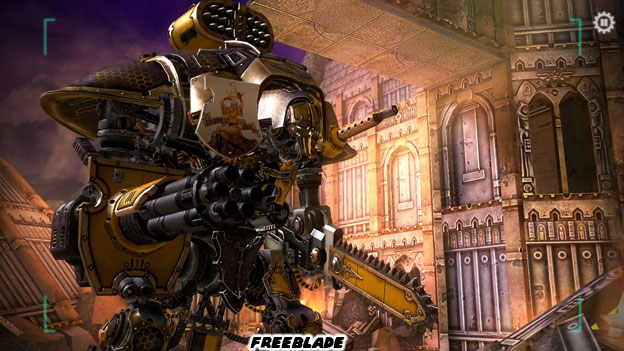
Robotic suits of armor were the backbone of the Space Marine armies. I mentioned that there were more than one set of power armor that a unit could wear. There was a reason for these different types of armors and as you can imagine the bigger ones were designed for more dangerous encounters. The sculptors at Citadel had been refining the armor designs for almost three decades. These are easily some of the best miniature figures you will ever see. The detail applied to each piece is amazing. When you see them side-by-side you can only imagine that the team spent countless hours not only creating these models, but they had to turn around and create a balance for each of the alien races as well. Of the single-pilot suits of armor the largest is the Imperial Knight. This was the armor featured in the game Freeblade. This suit of armor was at a scale to combat the enormous robots like the Riptide and Stompa.


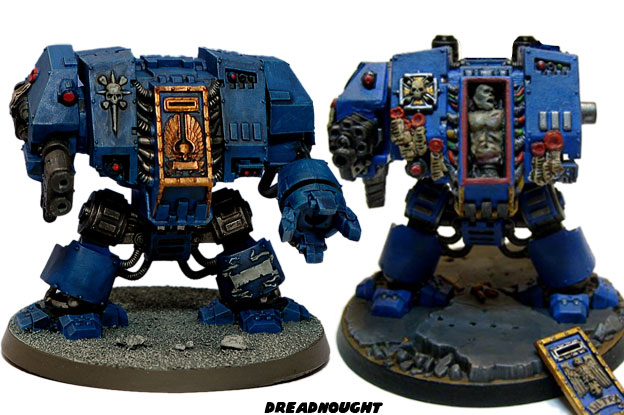
What made the robots used by humanity, and specifically by the Space Marines, different than those piloted by the aliens was the neural interface. Pilots of the Imperial Knight actually became a part of the machine. Their brains and life support systems were tied into the robot during a process called the "Becoming." The consciousness remained with the robot for centuries if not for thousands of years. Only in death would the service to the Imperium end. At which point the robot would be taken apart, reassembled and a new pilot be selected. The robotic host was a tradition that went back to the early days of 40K. The Space Marines were long-lived and super resilient yet even the greatest Space Marine eventually succumbed to injury. Rather than "retire" those warriors and lose much valued military knowledge and experience the best underwent something similar to the Becoming. Those marines were interred in Dreadnought Armor. Their life support systems were connected to the machine and they would be able to fight on for centuries more.


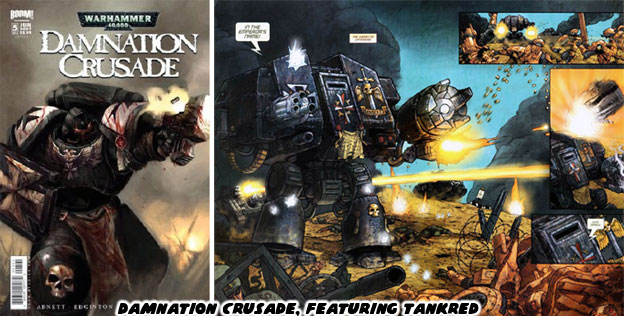
A collection of servitors, or robotic servants would attend to the Dreadnought when not in battle. A Dreadnought was treated like a holy relic. The servitors cared for the mechanical and organic parts with incantations, litanies and sacred oils. The robots received the same care that a nun would give a leper in the slums of poor countries. In many instances the warrior within would sleep for decades at a time until his services were needed once more. One of the great examples of the importance of a Dreadnought in the universe was explored in the comic book Damnation Crusade. A portion of the story is told from the point of view of Tankred, a member of the Black Templars. It's one of the best examples of the sacrifice that the Space Marines make in order to keep humanity alive against the cruel aliens and twisted demons of Chaos. It was great science fiction storytelling and went over amazingly well in the game system.


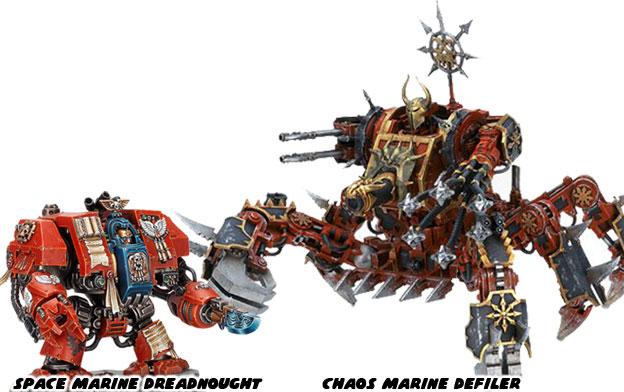
Each legion had its own unique Dreadnoughts, they were honored members and brought into battle an assortment of heavy weapons. The weapons they used, the literal arms on each robot, could be replaced depending on the battle. They had robotic hands that could tear open tank armor, flame throwers that could burn down buildings and plasma cannons that could blow holes through the biggest opponent. The idea of man and machine unified was something that made the science fiction in the world dark and foreboding. This technology was not exclusive to the Space Marines but had a variation in the alien races as well. The most interesting combinations of living tissue and robot came in the forms of the Chaos engines of destruction. The forces of chaos could turn man into beast and heroes into demons. Those that were previously pilots and crews on tanks and artillery became fused with the machines. Not thanks to technology but the magic of the warp, that part of the galaxy that exists beyond our concepts of time and space. Bones became forged into the structure of the machines and blood replaced oil in the infernal contraptions. Skin was stretched across the joins like some macabre hide. Just look at how more intense the Chaos Defiler looks when compared to the already enormous Dreadnought.


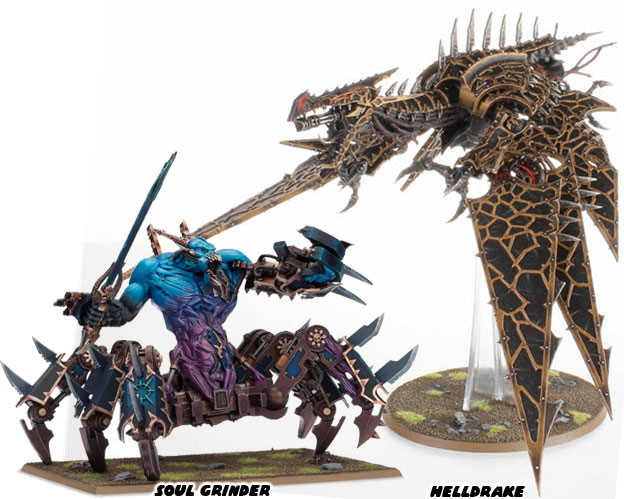
The more powerful the demon the more powerful the living weapon they would become. Some of the larger machine and creature hybrids dwarfed the mighty Dreadnought. Just take a look at the Soul Grinder. The multi-legged robot was far more than a Defiler and yet not quite a demon prince but instead something in between. The forces of Chaos rewarded their champions with awesome powers. Some became larger and more grotesque monsters, some were given weapons with magical properties. Other machinations of chaos were metal birds that could take on any assault jet. The larger weapons of chaos had a purpose, they were a counterpart for the most powerful artillery in an army. Citadel did a fantastic job bringing these creations to life. The designs created by the studio went on to influence other miniature gaming systems and even video game development as well. Several of these monsters-turned-vehicles began popping up in Games Workshop video games.


For years the Dreadnought was considered the most valuable single-pilot robot in canon. The Space Marines and Chaos Space Marines made great use of these machines. Just a handful of the robots could change the course of a battle. Yet as the system grew over the past 30 years the threats became bigger and stronger. Thanks to aliens that became more aggressive and dangerous it was not enough for a Dreadnought to take on the most powerful opponents. Games Workshop began creating more powerful armor for the Space Marines. The Terminator Armor was the best for a long time, then the studio introduced Centurion Armor as well. Gray Knights even had access to a gigantic walking frame so that they could face demon princes in hand-to-hand combat. Yet these bigger and better armor choices were not always enough for the biggest enemies in the 40K universe. This would become the task of an even larger robot. The Imperial Knight, the star of the mobile game Freeblade, would become the most powerful single-pilot robot in the ranks of the Imperial Army. The best part of this robot, aside from its awe-inspiring design, was that it was created so that it could freely move between armies. It did not have to adopt the livery of any particular army. Instead it was a freelance robot that had its own legacy recorded on its own armor. It could have its own insignia and even custom weapon choices to wear in battle. Then it was free to move to another sector of space where it was needed by a different legion.


The Imperial Knight was a force to be reckoned with. The forces of Chaos and the different races learned to feel the mechanical giant in battle. Yet when it came to the history of Warhammer 40,000 it turned out that the Imperial Knight was not at the top of the robotic food chain. If you can believe it there were robots even bigger helping keep the torch burning bright for humanity. The next blog will feature these colossal machines. As always if you enjoyed this blog and would like to sponsor me please visit my Patreon page and consider donating each month, even as little as $1 would help make better blogs and even podcasts!
 follow the Street Writer on Patreon!