Showing posts with label titan. Show all posts

Friday, May 29, 2026

Warhammer drawings from my sketchbook

Hello friends, I hope that you are doing well. Today I’m posting again to help snap me out of my art block. I am sharing some art from the past. Like last time I would be looking at some fantasy, and sci-fi art. You could find all of these and more on my Warhammer & Warhammer 40,000 Gallery.

These were done when I was on an ink series while on my lunch break at work. There was something that I missed about working in an office, and that was having a break room with a drawing table. It allowed me the space to really explore my creativity. Here’s a dwarf and war pony. Also a Female Dwarf Warrior - I think there aren’t more female dwarf miniatures because the sculptors don’t want to create some glorious hair. This piece was dedicated to all the shorties fighting their fights.

I had an idea for a video game featuring this Skaven Warrior. I wanted to see Cyanide Studios, the creators of Styx: Master of Shadows to create a new stealth combat game featuring a Skaven hunting down vampires in the Warhammer Fantasy universe. I would replace one of his eyes (under the patch) with a warp stone shrapnel so that he could see in the dark, and detect magic. Would you play a game like that?

Nurgle had some of the best art, and miniatures in the Warhammer universe. I had to come up with my idea of a Nurgle Champion. This was part of my ink sketch series, starting in October (Inktober) 2016 and going on almost every weekday until March 2017. This was a very creative period where I drew mostly things that interested me. Lots of skateboarding, cars, games and people.

Noise Marine Terminator - I've got lots of ideas for Noise Marines. In the perfect world where time, and money were no object I would have an entire until made of of Noise Marines that I converted to have fantastic weapons, and armor. For example I want to see an organ-playing Noise Marine that wears the pipes on the back of his Terminator armor. I'm sure somebody could convert the organ on the Sister's of Battle Exorcist tank to get the needed parts.

Here was another example of a custom Noise Marine that I would love to do. The Noise Marine Dreadnought - How about a Dreadnought that looks like a walking mausoleum-meets-boom box? Complete with iron fencing.

The Titan Sketch was the largest Warhammer 40K illustration I ever made. I would sometimes write massive letters on 18x24-inch sketch paper. On one side I would write a letter to a friend, or family member, then on the back I would do a drawing. I wrote to Games Workshop one day, and did of the Imperator along with the internal workings. The letter went to game creator, and editor at White Dwarf Magazine Jervis Johnson. He replied to me, and said he appreciated the letter. He also added that creative director, and legendary artist John Blanche enjoyed the titan sketch. John Blanche was like if Alan Moore was a painter rather than a writer. As far as compliments went I couldn't ask for a greater endorsement. Did you have a favorite drawing, or idea that should be turned into a model? Tell me about it in the comments section. As always if you enjoyed this blog, and would like to sponsor me please visit my Patreon page and consider donating each month, even as little as $1 would help make better blogs and even podcasts!
follow the Street Writer on Patreon!

Friday, April 24, 2026

Collecting modern monsters

In a previous blog I talked about how Hot Wheels stopped producing Monster Jam toys in 2018 to create their own line. Mattel also partnered up with the Bigfoot Team, and a few independent monster truck owner / drivers to bring an arena show to fans. Hot Wheels Monster Trucks Live was now in its eight year with no sign of slowing down. This change of toy companies allowed me to focus back on something that I had been a fan of all my life. As long as Feld Entertainment controlled Monster Jam, and the majority of monster toys then I couldn’t bring myself to collect anything. Once I had an alternative it would be easy to start again. As with everything in my collection I had to be very selective. I had a budget I couldn’t go over, and very little space in my home to display anything. This meant that I could only collect a handful of trucks that really meant something to me. I’m going to feature them today.

I’m going to start with the most obvious toy. Bigfoot was the original monster truck, and the one that I grew up with. I was a fan from day one. I was also a fan of the owner Bob Chandler, and various Bigfoot drivers for decades. The next one I added to my collection was for the missus. When Bigfoot started gaining popularity in movies, and TV Bob’s wife Marilyn asked why he should be having all the fun. So he built her a baby blue Ms. Bigfoot. It was almost identical to the original Ford F-250 that he used for Bigfoot. He even kept it on 48-inch tires which was what the original Bigfoot drove around in before Bob put it on 66-inch tires. I covered Marilyn as the first female monster truck driver, and the truck on a previous blog. It was important for me to have the Chandlers at the start of my new collection.

The next two trucks were also complimentary for a different reason. The Grave Digger was always a tough competitor. Despite the feelings I had for the Feld company, I had nothing but respect for Dennis Anderson, and his family. He built his own truck, and legacy in many early competitions. Plus the Grave Digger had a fantastic look often imitated, but never duplicated. It earned its spot at the top of the collection. Note that the version I got was a classic design. The skull, cemetery, and haunted house were similar to the "Grandma" version with the words Grave and Digger on top of each other, as opposed to side-by-side. Right next to it was the Bone Shaker. Larry Wood’s iconic Hot Wheels design was every bit as brutal as the Grave Digger. There was a reason why it was the star of Hot Wheels Monster Trucks Live. The old school hot rod-turned-monster truck was just too cool for words.

The next truck was actually a fictional rival to Bigfoot. Snake Bite debuted in 1991, it was the first monster truck to have a custom 3D character body. Underneath the snake-shaped shell was actually a rebuilt Bigfoot IV. This allowed Chandler to run two trucks in shows, and competitions. The team really committed to the rivalry. They said the truck came from Cobra Creek, Colorado (which didn’t actually exist). They also had the drivers wear snake-patterned airbrushed masks. Veteran Bigfoot drivers like Andy Brass, Dan Runte, Larry Swim, Chris Norman, and a few others played the characters Colt Cobra, Ricky Rattler, Vic Venom, Kris Kopperhead, Andy Anaconda, or Sid Sidewinder. Hot Wheels was on board the rivalry, and made some popular toys featuring both trucks. The Carolina Crusher was another formidable competition monster truck. It was built, and driven by Gary Porter for years, and years. He stepped away from racing for a while. He returned in 2014 to drive once more for the 30th anniversary of his truck. He eventually sold the rights to Paul Shafer, who later sold those rights to Pace Motorsports which became Feld Motorsports. Despite all this I still held Mr. Porter, and his truck in high regards.

The next truck in my series was created by Rosalee Ramer, and her father Kelvin Ramer. Kelvin built, and drove the Time Flys truck. Rosalee grew up learning how to fix trucks alongside her dad. There were pics of her as a little kid doing repairs. By 14 she was driving competitively. Making her the youngest professional monster truck driver ever. Her truck was called Wild Flower, and was easily one of the most unique trucks ever built. Next to it was King Krunch. It was an old-school truck that also represented generations of competitors. It was originally built by Scott Stephens from Texas way back in 1982. He toured the country for years, and his son Colt Stephens became a driver as well. Scott also built two of my favorite trucks, the jet-powered Coors Brewser, and the Coors Light Silver Bullet. Those trucks would never be made into toys, so having a King Krunch was as close as I could get.

The next two trucks embodied the spirit of the early monsters. Those trucks were literally inspired by ancient monsters, and cryptids. The first was the Cyclops. It was a 1969 Chevrolet C-10 built by brothers Fred and Gary Dykman out of Arizona. It was similar to the Grave Digger in that it was a famous mud truck that got coverage in the 4x4 magazines, and later become a monster truck. The Dykman brothers were very committed to the Cyclops gimmick. They had a giant animated eye hidden under the hood. It would pop out, and look around before starting a run. I remember seeing this live as a kid, and the audience went crazy when it happened. The Michigan Ice Monster was a 1983 Chevrolet C-10 by Brett Engleman. It was only in competition for a few years before Mr. Engleman stepped away from the sport. This was also one of the old school trucks that I saw live for the small window it toured originally. There was a smaller version of the truck called the Michigan Ice Monster Jr. It was built from a 1975 Chevrolet Blazer, and owned by Jesse Birgy.

The next two trucks represented the smaller owner / drivers that carved out their own path, and became successful. Titan was an awesome 1972 Chevy C-10 truck owned, and driven by Donald Epidendio from Lower Lake California. He drove as a member of the Straight up Racing team, and took part in the Monster X Tour. He also competed in several Monster Jam World Finals as well. There was something about the old school square body trucks that I thought could never be topped. Bigfoot, Cyclops, King Krunch, Titan, Giant, and a few more were all square bodied classics. The next monster in my collection was easily the most successful to feature a car body. The Avenger had a 1957 Chevy Bel Air body. It was owned, and driven by Jim Koehler from Columbus Michigan. He owned, and operated Team Scream Racing, and ran in the Monster Truck Throwdown Tour. He had an outspoken personality, and knew how to fire up the crowd whenever he got on the mic. He was possibly the greatest ambassador the sport had ever seen.

The next truck owner / driver Dave “Heavy D” Sparks was half of the Diesel Brothers alongside “Diesel Dave” Kiley. Sparks fell out of favor in my eyes for a number of reasons which had nothing to do with his arrest, and release either. It was more about his outspoken defense of immigrant Mexican laborers while also revealing he was a MAGA Trump supporter. Rather than waste my time on this glaring contradiction I would rather talk about the Brodozer. The Ford Super Duty truck was one of the first modern diesel trucks to compete in Monster Jam. I wrote about it years ago. The next truck belonged to an owner / driver that was a tough competitor. Joe Sylvester out of Canton Ohio played by his own rules, and had a truck that reflected that. My favorite version of Bad Habit featured a Jeep Gladiator body. There was a build with an Escalade body but I thought it was too bland. Mr. Sylvester held the records for both the fastest truck in the quarter mile, and furthest jump. 

The next truck in my collection was the Lucas Stabilizer, which was driven by Cynthia Gauthier. It was the only truck owned, and operated by Feld that I collected on purpose. I did so for two reasons; because Ms. Gauthier was an exceptional driver who had been competing for years with different trucks, and different teams. She had long since earned a truck of her own. The other reason why it was in my collection was because it was a callback to the classic Peterbilt monster trucks like Big Pete, and Super Pete. I also had a truck that was featured in the first few years of the Hot Wheels Monster Truck Tour. There was a WWII airplane-themed square body truck called the V8 Bomber. It looked hyper-American. On tour it was driven by Stevie Snellen, and built on a version of Basher with a vinyl wrap. Mattel realized in hindsight that maybe it wasn’t a good look to have a truck like this on tour that glorified war machines. This was especially true as they took the tour international. So they came up with a different theme.

I did collect one vehicle that wasn’t based on a specific truck. That was the Cremator, a hearse-bodied monster. There were other hearse monsters in the past, and I would like to talk about them one day, but this was a Hot Wheels original. The last monster truck in my collection was Wreckreation. It was an RV monster truck which was run by Tomfoolery Motorsports. The Pagliarulo family out of Florida owned and operated many trucks including the classic Michigan Ice Monster, and Excalibur, as well as the newer Jester, Kraken, and Missfire. Matt Pagliarulo was a veteran driver, and his children Michael, Nick, and Brooke were competing alongside him. The trucks they owned were cool, however they didn't appeal to me as much as this RV. Wreckreation captured the essence of everything I loved about monster trucks. It had a classic square body, a solid color, and a very strong visual theme.

The trucks that told a story were always the ones that I gravitated toward. Wreckreation could have come from the actual first generation of monsters. There were pics of early trucks such as Bigfoot, and King Kong with camper shells on the bed. Remember that Bob Chandler, and Jeff Dane would take camping trips using their actual daily driver trucks? They would hit the trails, and mud bogs as weekend warriors. Wreckreation was carrying on that tradition. It was possibly the last of the working man's monster campers. By contrast I never cared for the trucks with animal, zombie, or robot bodies. Those weren't cohesive themes. They didn't tell a story, they were just gimmicks.

Of course I needed a place to store my trucks when I wasn’t playing, I mean, when I wasn’t studying them for reference. Hot Wheels released a Bone Shaker Monster Mover in 2018, the same year that they released the Bone Shaker monster truck. It could store a dozen models. How amazing was this?! I put the most important trucks to me in the carrier, in case I ever cleared enough space in the home to display them. You’ll have to guess which ones those were.

So this wrapped up my look at the monster truck toys I currently had. Were there any toys that you collected because they meant something to you? Tell me about them in the comments section. As always if you enjoyed this blog, and would like to sponsor me please visit my Patreon page and consider donating each month, even as little as $1 would help make better blogs and even podcasts!
follow the Street Writer on Patreon!

Wednesday, October 23, 2024

Generations of Hulk creators, part 5...

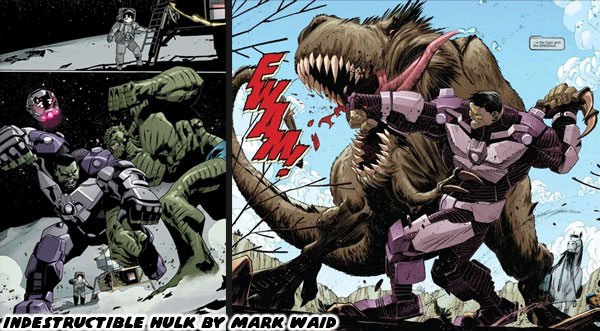
In the previous blog I talked about how Ed McGuinness was an artist born to draw the Hulk comics. Unfortunately for him the writer that he was paired with was sort of the opposite. When the Incredible Hulk was rebooted Jeph Loeb decided to change the focus of the series. He created a murder mystery for an OP villain called the Red Hulk. Mr. Loeb deviated from the stories that worked best for the title character. McGuinness ended up drawing issue after issue featuring the “Rulk” rather than the Banner version we were familiar with. I felt like his talents were being wasted. Because of this I stopped collecting the series in 2009, and walked away from comics entirely. Only recently had I started getting back into the series. In that time I learned that there were other writers, and other artists that were more familiar with the Jade Giant, and knew exactly the types of stories that fit the character. For example there was a 20-issue run titled the Indestructible Hulk, written by Jeff Parker, and Mark Waid. It featured art from Kim Jacinto, Matteo Scalera, Walt Simonson, and Leinil Francis Yu.

The Indestructible Hulk was notable because it highlighted the intelligence of Banner, and the power of the Hulk in equal amounts. In the series Banner was still a fugitive. He surrendered himself to S.H.I.E.L.D., and in return he would start inventing technology for them that could revolutionize the world. In exchange for a lab, and assistants Banner offered the Hulk to be used as the ultimate shock trooper for the organization. The Hulk would be able to take missions head-on, and prevent S.H.I.E.L.D. agents from being put in harms way. The series reestablished Banner as one of the big brains, if not the biggest brain on Earth. It also reminded audiences that the Hulk was capable of surviving conflicts, and extreme conditions that would have killed all but a handful of Marvel characters. The series was reminiscent of the adventures of the Professor Hulk written by Peter David, and illustrated by Dale Keown. That series was a high point for the characters in the early ’90s.

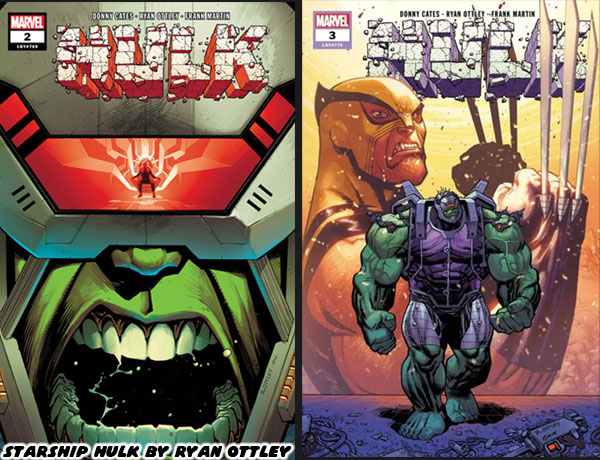
It turned out that while I was avoiding the books there was another story arc for the Hulk that was even shorter than the Indestructible Hulk. It featured a version of the Green Goliath called the Starship Hulk. I scoffed when I read the premise. Banner had taken over the mind, and body of the Hulk. He imprisoned the green personality in his own subconscious, and was going to “pilot” the Hulk. Banner implanted stolen A.I.M. technology into the Hulk, and planned to use his gamma radiation as a form of propulsion. His goal was to leave the Earth as a literal “Smashstronaut” and never threaten humanity again. All of this sounded absolutely bonkers. I assumed that there was no way that the story by Donny Cates would make any sense, or even fit in the context of the universe. I picked up the trade paperbacks that made up the 14-issue run, as well as the tie-in TPB that made the Banner of War arc. I quickly realized that the story not only worked for all of the characters involved, but the partnering of Cates, and artist Ryan Ottley was absolute genius. I’m sure it was considered madness as well depending on who you asked. I read, and reread the series several times over the past few weeks. The story was my favorite Hulk arc in the past 15+ years.

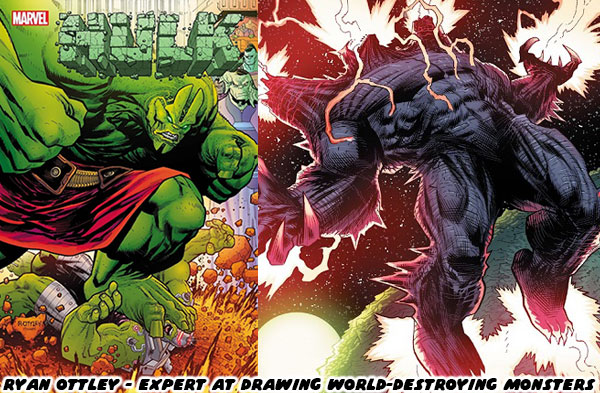
I was not familiar with Ottley’s art because he hadn’t done too many Marvel titles. He was best known as the main artist on a series called Invincible, which was published by Image. You might have seen the animated show based on the ultra-violent comic. It explained the occasional gore, and dismemberment that would appear with this new story. Mr. Ottley’s art really grew on me. Similar to Ed McGuinness I could tell that he was born to draw the Hulk, but had spent years working for other companies, biding his time. Also like McGuinness his monster design style was very reminiscent of Arthur Adams. Ryan went all out creating dozens, upon dozens of various gamma-powered monsters for the book. Culminating in a 60-foot-tall mutated Spider-Man. That alternate universe version of Peter Parker turned out to be far from the biggest threat for the Starship Hulk. There was a far more dangerous villain named Titan lurking in the recesses of the Hulk’s psyche. Each creature from Ottley was as fantastic as anything that could have been dreamt up by Adams.

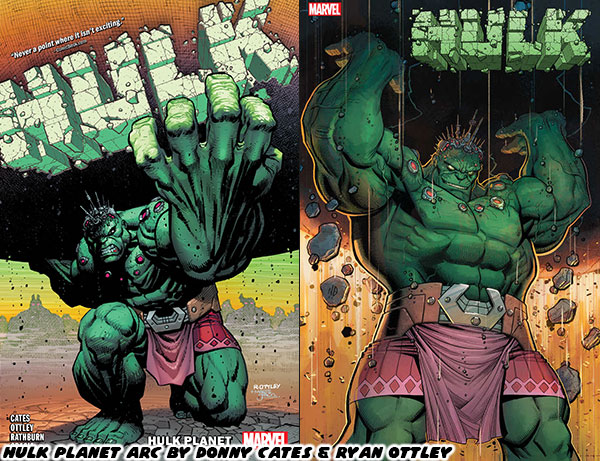
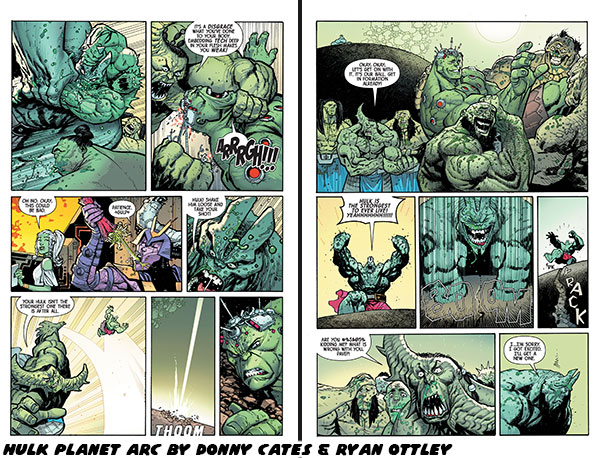
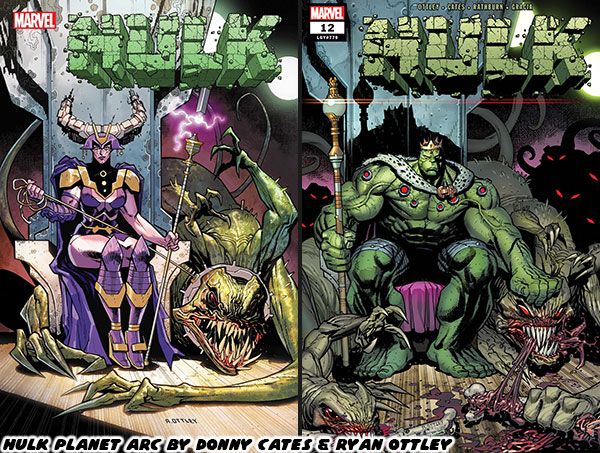
The proportions that Ottley used with the Hulk were familiar, but he maintained his own distinct style. The thick, and stocky body, the square, but animated face. His version of the bruiser had a lot of personality, but was absolutely made for destruction. Ottley’s patented violence, gore, and horror from the Invincible books managed to sneak into a few panels. This was especially true in the second half of the story known as Hulk Planet. It was a sort of send up of the Planet Hulk arc. If you weren’t familiar with the story this was where the Hulk had been exiled to an alien planet called Sakaar. The Hulk took on the role of Spartacus and lead a group of alien gladiators in a rebellion. This would conclude when the Hulk returned to Earth during the events of World War Hulk. By comparison in Hulk Planet the Hulk landed on a world of fellow gamma-irradiated monsters. He was not only welcomed as a visitor, but hailed as a king. Donny Cates could raise the stakes now that he was on a planet of super-powerful aliens that were strong, and had similar healing abilities. To show off how absurdly powerful they were their national sport was called Godball. It was a version of handball-meets-dodgeball using the solid cores of planets that they had destroyed. The Hulk was assured that he couldn't hurt anyone, and no one could hurt him there.

Ottley was the perfect choice to illustrate the adventure that took our hero around the world, through different dimensions, and into deep space. We got a chance to see the Hulk cut loose in ways that Jeph Loeb could have never imagined. In the span of just over a dozen issues Mr. Cates developed a story impossible for any other hero in the Marvel U to survive. Donny reminded audiences how the power scale worked, and the Hulk was at the top of the mountain. It was much more than strength that made the Hulk incredible. Characters like the Captain Marvel, the Sentry, Thor, and the Silver Surfer were powerful, and might be triumphant in some of the battles. However the Hulk survived all the fights back-to-back, while being shredded by countless gamma-monsters, losing a limb to Iron Man’s Hulkbuster armor, and having Mjolnir tear a hole through his chest. Those would have been mortal injuries for the aforementioned powerhouses. Not to mention that all of this happened before the Titan even showed up. It goes without saying that none of the members of the Avengers, the Fantastic Four, or the X-Men could have lived through the same encounters.

Sadly Ottley wouldn’t draw any more Hulk arcs after the Hulk Planet story wrapped. He did get to do an occasional variant cover, but speaking as a fan I think that Ottley, and Cates should absolutely get a chance to work on another story, or perhaps limited run like the Rampaging Hulk, or Savage Hulk series from the ‘80s, and ‘90s. They understood the character better than most teams, and set a standard that few creators could match. It turned out they weren’t the only writer, and art duos that worked wonders for the series. In the next, and final entry of this series I am going to talk about the return of the monster. Were there any artists that you think would be a good fit for the Hulk? Or were there any comics you wish were drawn by a specific artist? I’d like to read about it in the comments section. As always if you would like to sponsor me please visit my Patreon page and consider donating each month, even as little as $1 would help make better blogs and even podcasts!
follow the Street Writer on Patreon!

Wednesday, January 27, 2016

Building a gaming legacy, the Games Workshop series, part 4...

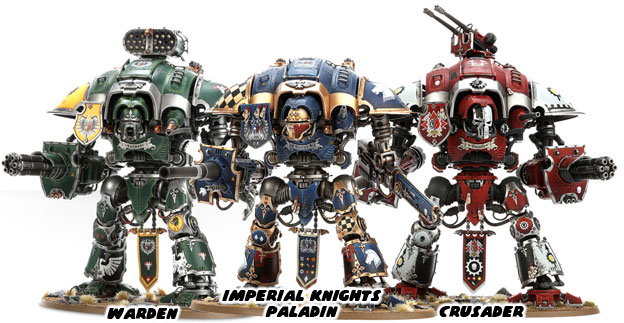
The game Freeblade started off this recent series. The gigantic Imperial Knight robot was the heart of the game. The Knight was a part of the Warhammer 40,000 legacy. It was a unique mix of science fiction storytelling and feudal lineage that created these robots. Before the Emperor of Terra there were nobles that defended humanity from alien threats. They had an army of giant robots that were the equivalent of knights from the legends of King Arthur. They went from battle to battle seeking glory and honor for their kingdom. Just like the knights of old the new giant robots were covered in their particular house colors and were designed to stand out on the battlefield. There were different types of Imperial Knights too, there were Crusaders, Wardens, Paladins and Errants. These all helped distinguish a particular house and gain a reputation throughout the galaxy. When the Emperor of Terra began reuniting all of the human planets in the year 30,000 the Barons and Kings of these various houses joined in the quest and helped the Space Marines conquer and recapture various outposts. The pilots of these machines were nobles, even the one featured in the game Freeblade was royalty and had been raised with the purpose of cementing his family lineage in combat. The Space Marines had their own variation of the single-pilot robot known as the Dreadnought. While it lacked the size and firepower of an Imperial Knight it was still revered by its fellow warriors.


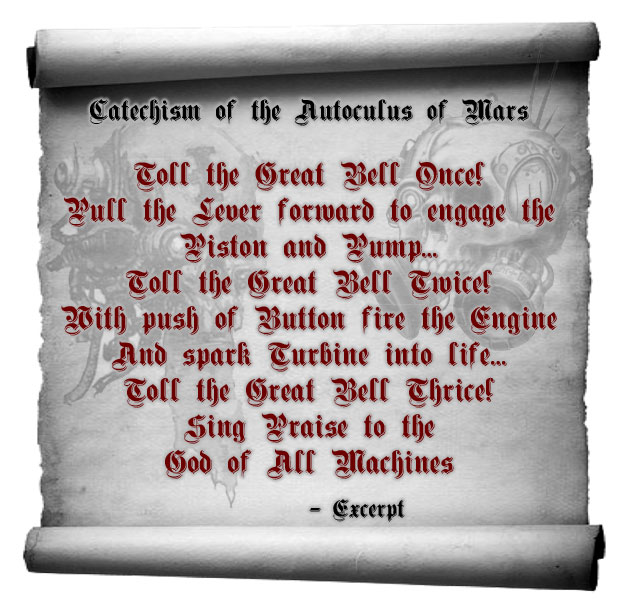
People that don't follow the 40K universe may not be aware that man and machine had been fused together before the Empire and before the Imperial Knights. The engineers and builders of all the great war machines used to conquer space had a base of operations on Mars. This was the home world for the machine cult, the Adeptus Mechanicus. Throughout space there are entire planets dedicated to creating the tanks, robots and space ships used by the Imperium, these are called Forge Worlds. They are highly valued resources in the war against Xenos (aliens) and Chaos. Games Workshop, or rather Citadel has a sister company that builds high-end models for use in Warhammer and Warhammer 40,000. This company is called Forge World. But I digress. The Adeptus Mechanicus believe in the Machine God. All machines have a spirit and the greatest machines, the battleships, star ship and enormous Titans have very temperamental spirits. The Adeptus Mechanicus have litanies, incantations and prayers dedicated to the God of the Machines. When they power up something as massive as a Titan they have a ritual that they go through. The belief in the Machine God has become part of Imperial life, even Space Marines are known to say a prayer to the machine god so that their weapons do not jam in combat.


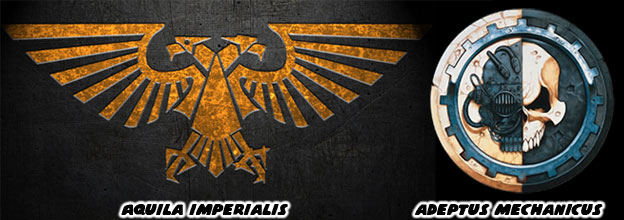
The Emperor of Terra is a very Christ-like figure. He sits upon the Golden Throne and led his Primarchs, which were like his Apostles, thousands of years ago. In canon this relationship can be likened to Catholicism. The hierarchy, organization, symbolism and belief in an omnipotent divine being was done on purpose. Space Marines are very much like friars or war priests, while the female warriors, the Adeptus Sororitas, are like nuns. The champions are canonized in death, even regular people can become martyrs for the Empire if they die valiantly and defy the forces of Chaos and the alien. The Empire is symbolized by a two headed eagle, it looks to both the past and future. This symbol appears on the armor, heraldry and vehicles of the Empire. It even appears on the bullets, or rather explosive bolts in the Space Marine bolt gun. As you can imagine with the rise of the Emperor in the year 30,000 there was a sort of chasm that widened between those that followed rule Terra and those that followed rule from Mars. If the Empire were Catholics then the Adeptus Mechanicus were Freemasons, there was nothing that said they were not allowed to practice the beliefs that they wanted. Both groups needed the other in order to help reunite mankind. The Emperor and his organizers knew that they depended on Mars and the various forge worlds that were needed to build the armor and weapons that would be used in the crusades. They came to an agreement and the rulers on Mars were allowed a high level of anonymity in return for their engineers and technology.


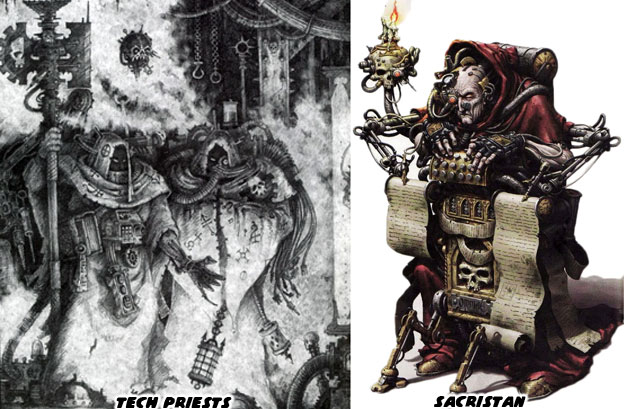
The Cult Mechanicus dated its lineage back, before the Emperor, before the Royal Houses, back before Mars was colonized and back to the great engineers of Terra (Earth). Its rituals were closely guarded as were its organizations. It was not unlike the Freemasons claiming their heritage went back to the architects that built ancient Egypt. Their symbols and traditions followed a Great Architect, perhaps it was the ones the Christians called God. The Catholic Church were by extension a slightly newer religion but one that had close ties to the same foundations of Freemasonry. This was paralleled in 40K. The Cult Mechanicus kept the gears turning for the Empire just as the Masons claim that they built all the great temples of the ancient world and secretly kept the Pharaohs in power. The neat thing about the Mechanicus and Empire was how they were presented in the art of 40K. The servants carried enormous tomes, like bibles with them, some of the text was written by hand, some by machine, in several cases the scriptures were written in digital code. They also carried torches and thuribles, incense burners at the end of long chains used in Catholic ceremonies to bless altars and holy relics. It was great science fiction imagery based on gothic ceremony, that wasn't seen anywhere else in books, movies or television.


The symbol of the Adeptus Mechanicus was a servo skull, half human and half robotic surrounded by a gear. On the larger war machines you may find more heraldry for the Adeptus Mechanicus than the Empire. The practitioners of the Cult Mechanicus, the ones charged with the most important ceremonies of repair and restoration were known as Tech Priests. These characters were mostly machine and carried with them a symbol of the machine god. Instead of carrying a staff with a cross they instead carried a staff with a gear, or wrench and blade. It was both a symbol of the machine god as well as an actual functional tool. The Adeptus Mechanicus have a strong belief that flesh is corruptible and will eventually fail with age, thus as they get older more and more of their human organs are replaced with mechanical parts. Eventually the senior and most experienced engineers are mostly all machine with a number of technical enhancements to their brains and nervous systems. With all of these cybernetic enhancements the Adeptus Mechanicus can actually communicate directly with the machine. They can change code as easily as speaking a native language directly to a machine. They can even send encrypted wireless messages to each other using their mind, which would seem like some sort of telepathy to novices.


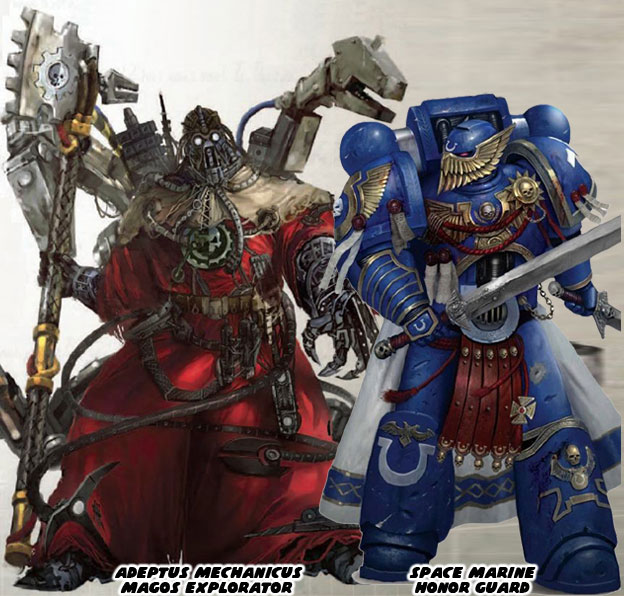
The Mechanicus have gone to war in defense of Terra, Mars and the Forge World for thousands of years. Often times they do so alongside of a Space Marine or Imperial Army. The weapons they use are more esoteric and experimental than those wielded by the human armies. The Mechanicus are not worried about trying untested weaponry in a firefight. Since they are more machine than man the worries of radiation and malfunctions that would kill a normal person are considered acceptable variables. You can easily spot the differences between the followers of the Emperor and those of the Machine God. Space Marines wear power armor in battle whereas the Mechanicus usually wear robes, even in combat. The Space Marine is given biological enhancements with drugs, implants and gene therapy. The Mechanicus is enhanced with machine parts. Both are extremely strong and capable fighters. While the Space Marines are fighting to keep humanity safe, they sometimes do so to honor their own chapter as well. The Empire has zero tolerance for alien and demon alike. The Mechanicus are more concerned with finding and recovering unknown technology. Whether it is demon or alien in origin the Mechanicus have a lot that they can learn from everything. Each new thing brings them one step closer to knowing the Machine God. The Empire would normally destroy or lock away anything recovered from a battle. They would definitely keep these things hidden from the Mechanicus.


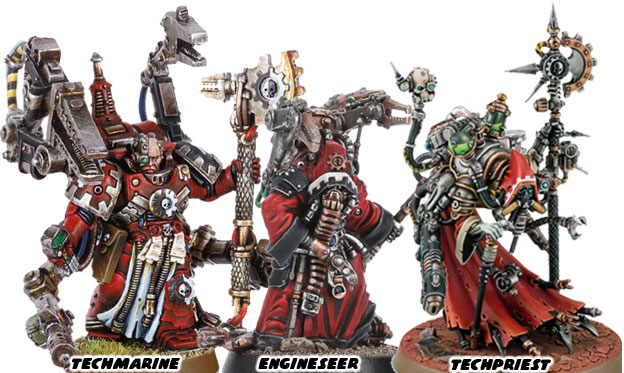
Thanks to their arrangement however it is difficult to keep the Empire and Mechanicus apart when alien technology is found. The Mechanicus are on the front lines, they have trained battle-hardened Space Marines into becoming engineers. These Space Marines are able to perform complex repairs on the front line, their power armor enhanced with extra servitor arms and tools. The more complex equipment is usually attended to by Engineseers. The sculptors at Citadel were able to capture the intricate details of the Mechanicus from the art of the game. The senior Techpriests no longer looked human when compared to the other models used by the Empire. It was great visual storytelling and again, an aesthetic that was not really used in any other science fiction world. The Adeptus Mechanicus really came to the forefront of Warhammer 40K in the late '80s thanks to the introduction of the Titans. Their story and influence in 40K canon would grow over the next 30 years. They had a few models released here and there through the '90s and early '00s and never fell out of favor with hobbyists. They were finally granted their own official units, rules and organizational guide for use in 40K these past two years. Yet this chapter in the history of Games Workshop would never have been written had it not been for a rival game studio. We'll look at this on the next blog. As always if you enjoyed this blog and would like to sponsor me please visit my Patreon page and consider donating each month, even as little as $1 would help make better blogs and even podcasts!

 follow the Street Writer on Patreon!

Sunday, January 24, 2016

Building a gaming legacy, the Games Workshop series, part 3...

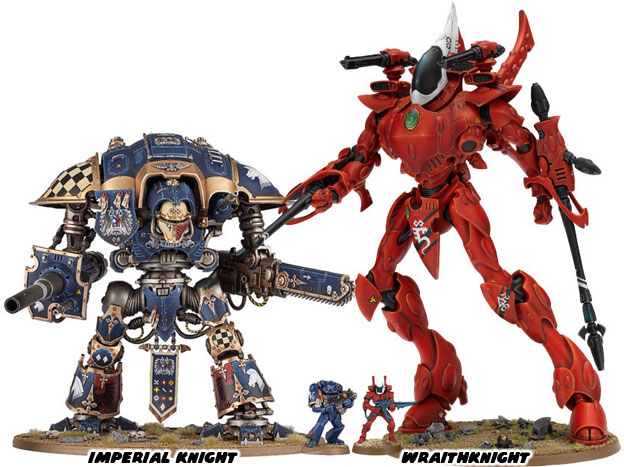
In the previous blog I mentioned that the Imperial Knight was the largest single-pilot robot in the Warhammer 40,000 universe. Well, this was true for the human armies but what about the aliens? The Tau had some large robots (the ones that looked like Japanese mecha) but so too did the Eldar (remember the space elves?). One of their larger robots was called the Wraith Knight. It also had a single pilot that was connected neurologically to the robot and was much taller and more powerful than the Imperial Knight. Because of its size this robot was a different class from the Imperial Knight. It was considered a Titan.


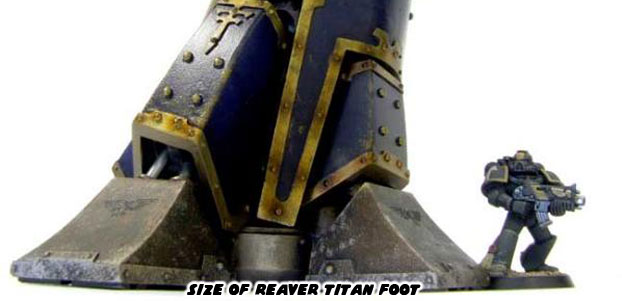
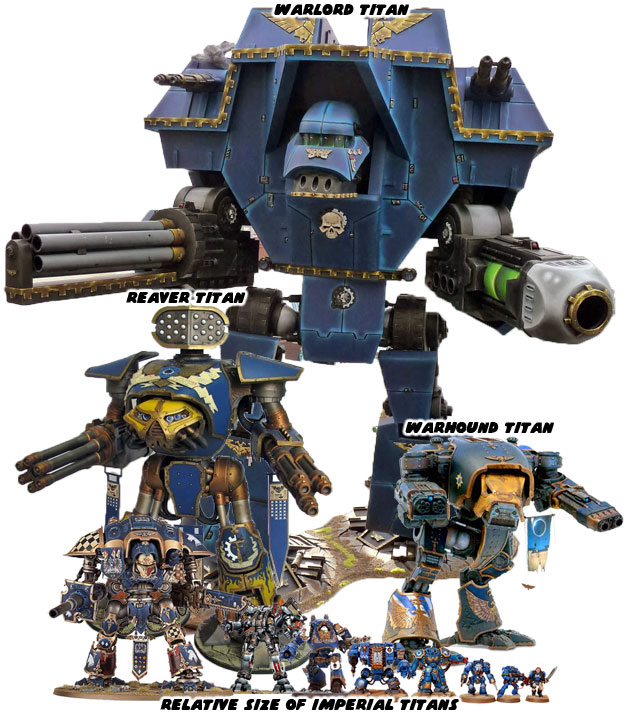
In the 40K universe the titans were the largest robots used in battle. Believe it or not the Imperial Knight was not as big as the smallest Titan. The Imperial Knight was much larger than a Space Marine or a Dreadnought. It was bigger than even the super-heavy tanks used by the Imperial Army. Seeing one walking towards the front line was enough to cause fear of most enemies on the battlefield. Even large Chaos engines of destruction and Ork Squiggoths would find the Imperial Knight formidable. Yet some of the small and mid-size Titans made the Imperial Knight less imposing and even the Space Marines armies seem insignificant. Just look at how massive the foot was for a Reaver Titan compared to a Space Marine. The marine was well over seven-feet tall yet was no taller than a "toe" on the Reaver.


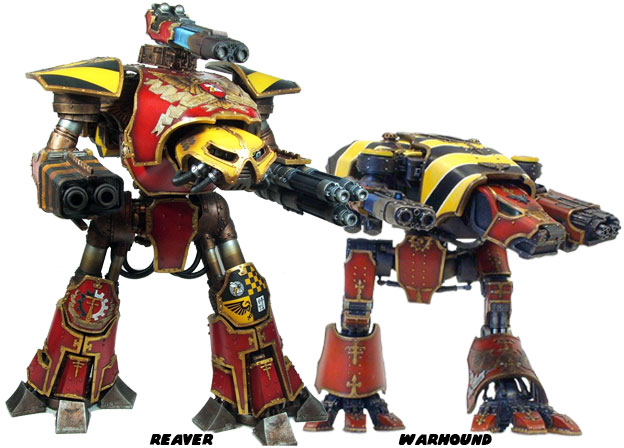
In canon the smallest two Titans employed by the Imperium were the Warhound and the Reaver. Like the Imperial Knight they were used where firepower was necessary and where flexibility was crucial. They had to be able to perform functions that no tank unit could in an area that was too tight for aircraft as well. The Titans were not necessarily as slow and cumbersome as people assumed. With the right crew they could navigate narrow streets, target and strafe opponents without stopping and even bring down buildings around them if they could not hold a position. Depending on the situation they could be equipped with an assortment of weapons, from long range artillery and anti-aircraft missiles, to closer range force claws and plasma cannons . A giant robot may seem like an easy target on the battlefield but they were often protected by invisible force fields. A smaller variation of this shield could be generated by the Imperial Knight. The shield would absorb the energy from explosives, lasers and plasma blasts and deflect it around the frame.


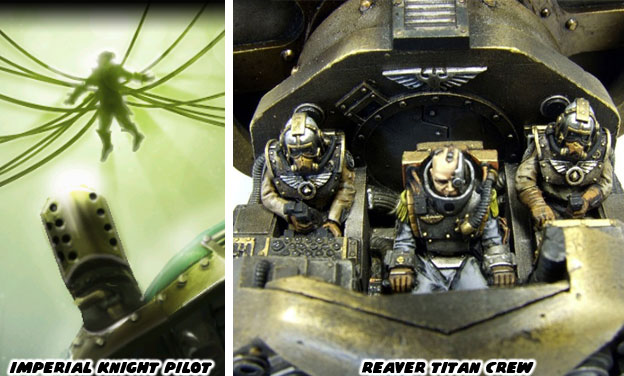
While they were considered "small" they still required a crew to move, function and remain operational. This was where the differences between the Imperial Knight and the Titans really came into play. An Imperial Knight had a crew waiting for it to return from battle in order to perform the necessary repairs and weapon replacements. The pilot was pretty much on his own in the battlefield. A Titan required a crew to operate both on and off the battlefield. Perhaps there was a pilot or two manning the movement and weaponry, but there were countless other servitors taking care of the mechanics in real time. Think of a servitor as a sort of zombie mechanic. They were servants retrofitted with tools, welding torches and wrenches instead of arms and hands. They were strong, loyal and programmed only to perform their duties. In this case a servitor would keep the Titan running on the battlefield while performing all of the maintenance on the fly. A servitor did the things that the R-type Droids did in the Star Wars universe.


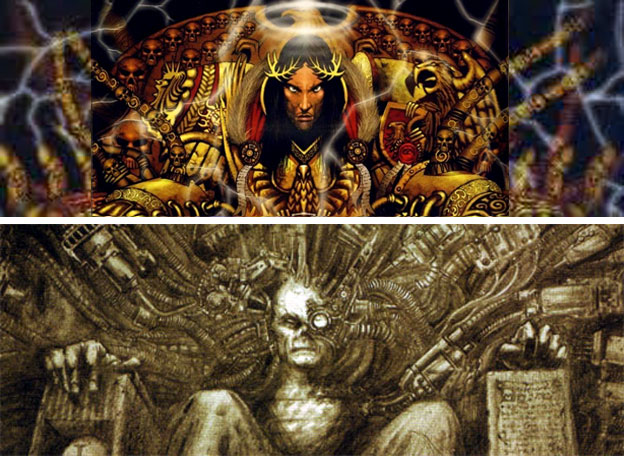
An Imperial Knight was instead piloted by a single individual, he was reliant on his crew only after the battle. The Imperial Knight pilot faced the same challenges that a Dreadnought pilot had. Both types of robotic armor depended on outside crews to aide them, repair them and deploy them because they were not physically capable of doing anything themselves. It was a sad existence when you think about it. To the pilots however it was their duty to the Empire. It was an honor to serve as a mechanized warrior, fighting alongside or as a member of the brave Space Marines. There was a precedent for this, for placing yourself in the heart of a machine. It was a tradition that went back to the year 30,000. The Emperor of Terra had a Golden Throne created by the greatest adepts and scientists from Earth and Mars. The Golden Throne was able to harness his psychic energy and create portals to other planets. He could send his Space Marines almost anywhere in space with this fantastic invention.


The Emperor was betrayed by his Warmaster Horus and had to fight against him. The Chaos Gods had granted Horus amazing powers which made him a perfect rival to the Emperor. The Emperor killed Horus but was left near death in the fight. He was placed on the Golden Throne and it was turned into a life support system. Instead of tapping into his psychic power it was tapping into the living energy of thousands of powerful psykers, flown in every day from all over the galaxy. Their life force would be depleted in a few hours but combined they would keep the Emperor in a state of suspended animation, or rather slow decay. The Emperor would become fused with the machine for the next 10,000 years. At least one of the Dreadnoughts in 40K canon, Bjorn the Fell-Handed, was a member of the Space Wolves and was alive during the Great Crusade and the Horus Heresy. Imagine the type of mental fortitude that it takes to become attached to a machine for most of your existence. There is a special model and rules created for Bjorn in case the players of the tabletop system want to use the Dreadnought in a campaign.


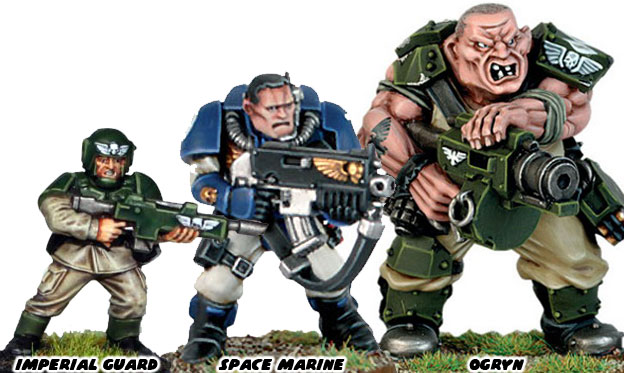
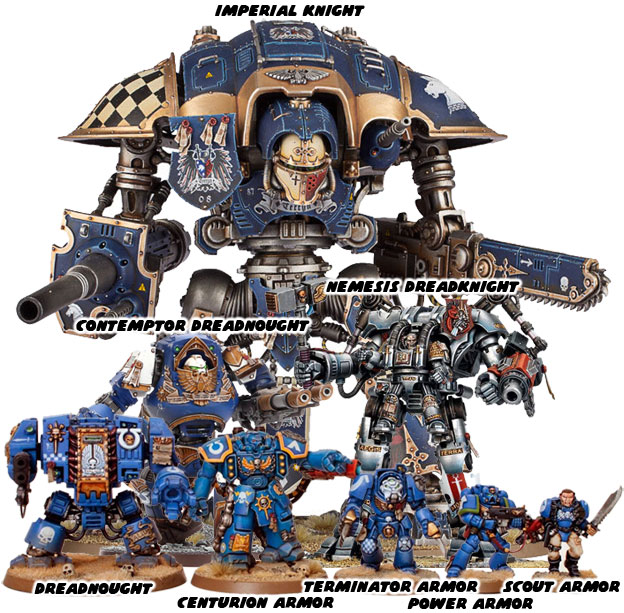
But I digress... I can talk about how awesome the giant robots were in 40K but you do not really appreciate the scale of the Titans until you see them compared to the single-unit types. A Space Marine is much larger than an Imperial Guard soldier, yet they are not as large as an Ogryn. An Ogryn is not as large as a Space Marine in Centurion Armor, nor are they as large as a Dreadnought. The Dreadnought is huge and powerful but is only a fraction as big as an Imperial Knight. This is where things start to fall into perspective.


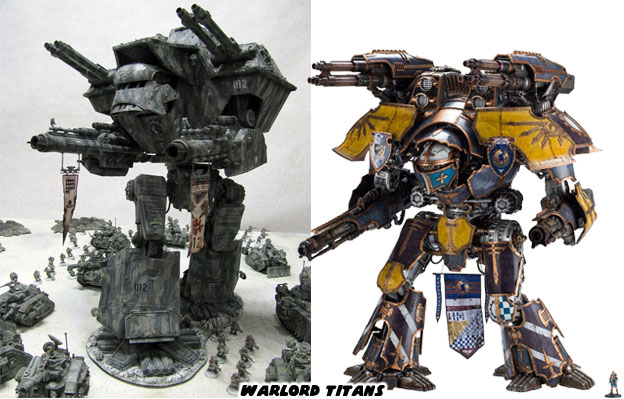
At 50-feet-tall the Imperial Knight is dwarfed by the Titans. Remember that the Warhound and Reaver were small and mid-size Titans. The largest Titans, like the Warlord MKIII for example, were very similar to walking battleships. They had a command, carried a crew, support, radar and artillery. With the cases of the biggest, they could even carry and entire regiment of Space Marines into battle.


When a Titan goes to war it literally changes the shape of the battlefield. A Titan is a force of nature, like a tornado or hurricane, it is absolutely unstoppable. Entire cities are turned to rubble, forests are burned to the ground and hills are flattened in their wake. Only another Titan or squadron of Titans can offer a suitable challenge. They are absolute symbols of power and can inspire an army to victory and cause the enemy to shrivel in fear.


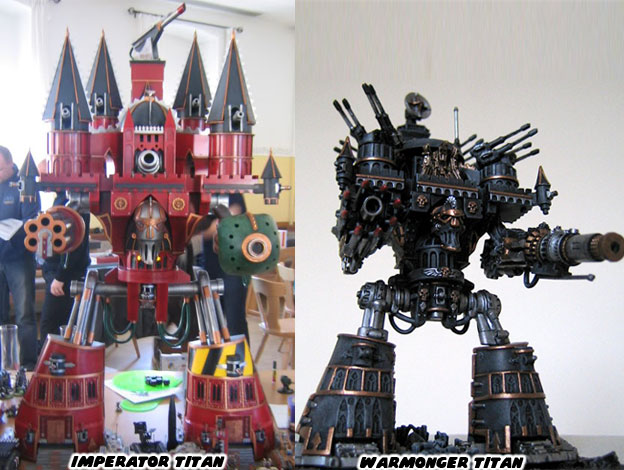
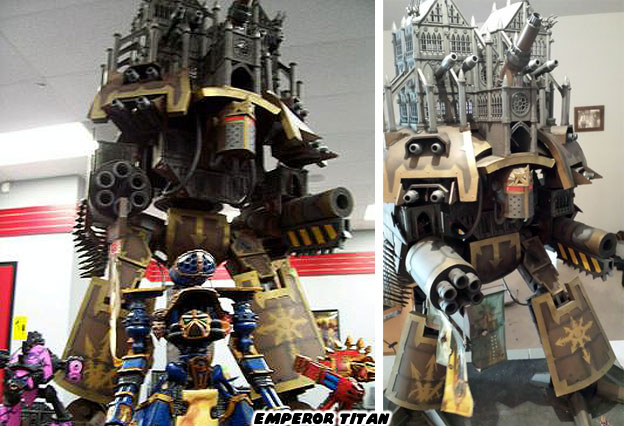
There are Titans in 40K canon that are so obscenely huge that they are almost impossible to imagine. The Warlord Titans are awe-inspiring but they are not the largest class of Titans. At the far end of the spectrum there is a class known as the Warmonger and Imperator. These Titans are walking skyscrapers. In each leg they carry a unit of Space Marines and on their back is a full headquarters contained within a fortress. They were critical during the Great Crusades, lead by the Emperor of Terra himself. Titans helped establish the dominion of the Emperor, and took entire sectors of the galaxy back from alien invaders. They faded in number but their stories grew into legend. A few die-hard tabletop gaming fans around the world have scratch-built their own titans to the exacting specifications set up by the 40K canon.


Remember that in 40K the forces of Chaos can corrupt and turn machines into hybrids of demon and robots. The same applies to the Titans. There have been legends of chaotic titans which sprout horns, spit blood instead of plasma and have mechanical tails that slash of their own free will. The crews and pilots on the chaos titans are usually "digested " by the Titan if they do not become fused and part of the nervous and sensory systems. Fans have also scratch-built their own Chaos "Emperor" Titans that are every bit as impressive as the Imperator.


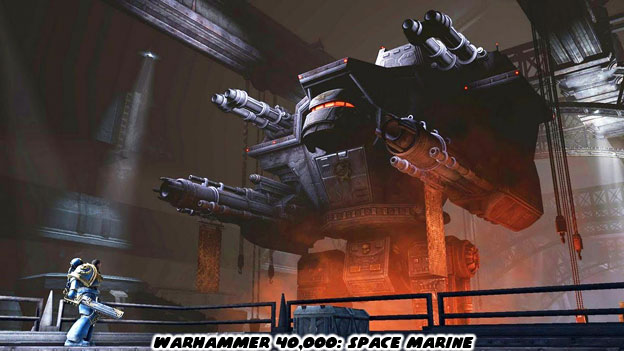
The Titan is the ultimate set piece. Whether we are talking about a tabletop game or a video game. It is very hard to ignore the giant robot, the literal elephant in the room. The Titan has been central to a few PC and console games based on Warhammer 40K. One of the best uses of the robot was in the title Warhammer 40,000 Space Marine. The game by Relic Entertainment features a Warlord class Titan known as the Invictus. In the game players got to run in around the Titan as it rested in an Imperial Hangar. Its weapons were needed to destroy a dimensional bridge being used by Chaos. The player actually got to run on its shoulders, shooting down opponents while it moved into firing position. It was one of the great moments in the history of video games. It was something that a tabletop fan like myself never thought that they would see in any video game.


What was fantastic about the 40K universe was how the scale would continue to grow and grow. The most massive of Titans was never big enough, there was always a threat more imposing, more dangerous. War was everywhere and even with these colossal robots the survival of humanity was never guaranteed. In many ways the soul of humanity had already been transferred to the machines. It was done before the first Dreadnought was built, it was even done before the Golden Throne was created. In the next blog we will look at those former humans that are guided by the Machine God. As always if you enjoyed this blog and would like to sponsor me please visit my Patreon page and consider donating each month, even as little as $1 would help make better blogs and even podcasts!

 follow the Street Writer on Patreon!